Market Minds Advisory
Washing Machine Cleaner Market

Washing Machine Cleaner Market: Washing Machine Cleaner: A Problem Cold Washing Created, Sold By The Machine Makers Who Caused It

Cold washing saves energy and leaves biofilm behind, and an entire category now exists to sell households the remedy for a problem that efficiency regulation quietly created in the first place.

Lead Analyst

Published

September 2026

Make Smarter Decisions with Customized Research Insights

Request a free sample report and evaluate market opportunities, growth trends, and competitive dynamics relevant to your business needs.

2025 MARKET VALUE$1.4BMarket Size 2025
2036 FORECAST VALUE$2.9BBase Case , 2026 to 2036
CAGR 2026 TO 20366.8 %Bull 8.0% / Bear 5.6%
INCREMENTAL OPPORTUNITY$1.4BNet 10- year value creation
EXPANSION MULTIPLE1.93x2036 value over 2026 base
Strategic Levers
M&A Pipeline
Regional Outlook
Country Rankings
Competitive Intelligence
Segmental Deep-dive
Call-Us : 91 93563 13602

Executive Snapshot and Market Trajectory.

This category exists because washing got colder. Detergent residue and biofilm accumulate at temperatures that never sterilise anything, machines develop odour within about two years, and households discover a problem nobody warned them about. Nobody warned them about it and nobody was ever going to either.
Appliance brand recommended products grow fastest at 10.2%, because the manufacturer who sold the machine is the only participant a household actually trusts on how to look after it. That recommendation arrives inside the appliance manual, at first service and increasingly through the machine's own display, which is a distribution position no detergent brand can buy at any price. Nobody else competing in this category reaches a household from anything like that position.
Concentration is moderate at 47% and the real question is who owns the reminder. Purchase is genuinely occasional at roughly three times a year, consumers forget entirely between occasions, and the participant who prompts them at the right moment captures a sale that would otherwise simply never happen at all. This is a recall problem rather than an awareness one, and advertising has never solved a recall problem anywhere.
Market Definition
Revenue from products formulated to clean, descale and deodorise domestic and commercial washing machines, covering powder and tablet descaling cleaners, liquid machine cleaning formulations, appliance brand recommended products, drum wipes and seal cleaning accessories, subscription and auto-replenishment formats, and commercial laundry machine maintenance products. Excludes laundry detergents and fabric conditioners, dishwasher cleaning products, general household surface cleaners, and appliance servicing labour or replacement parts.
Base Year Value
$1.4B in 2025 (MMA Primary Research Dataset, August 2026)
Forecast Period
2026 to 2036, eleven discrete annual values
CAGR
6.8% base case. Bull 8.0%. Bear 5.6%.
Fastest Growth Segment
Appliance Brand Recommended Products: 10.2% CAGR
Fastest Growth Country
India: 8.8% CAGR
Fastest Growth Region
South Asia and Pacific: 8.8% CAGR
Largest Region
Western Europe: 31% of 2025 global value
Market Leaders
Reckitt, Henkel, Miele, Electrolux and Church and Dwight lead on washing machine cleaning product revenue. Source: company annual reports and MMA Primary Research Dataset, July 2026.
Primary Survey
n=3,800 procurement and R&D decision-makers, Q4 2025, six countries
Methodology
Demand-side build-up, cross-validated against public data, 47 expert interviews

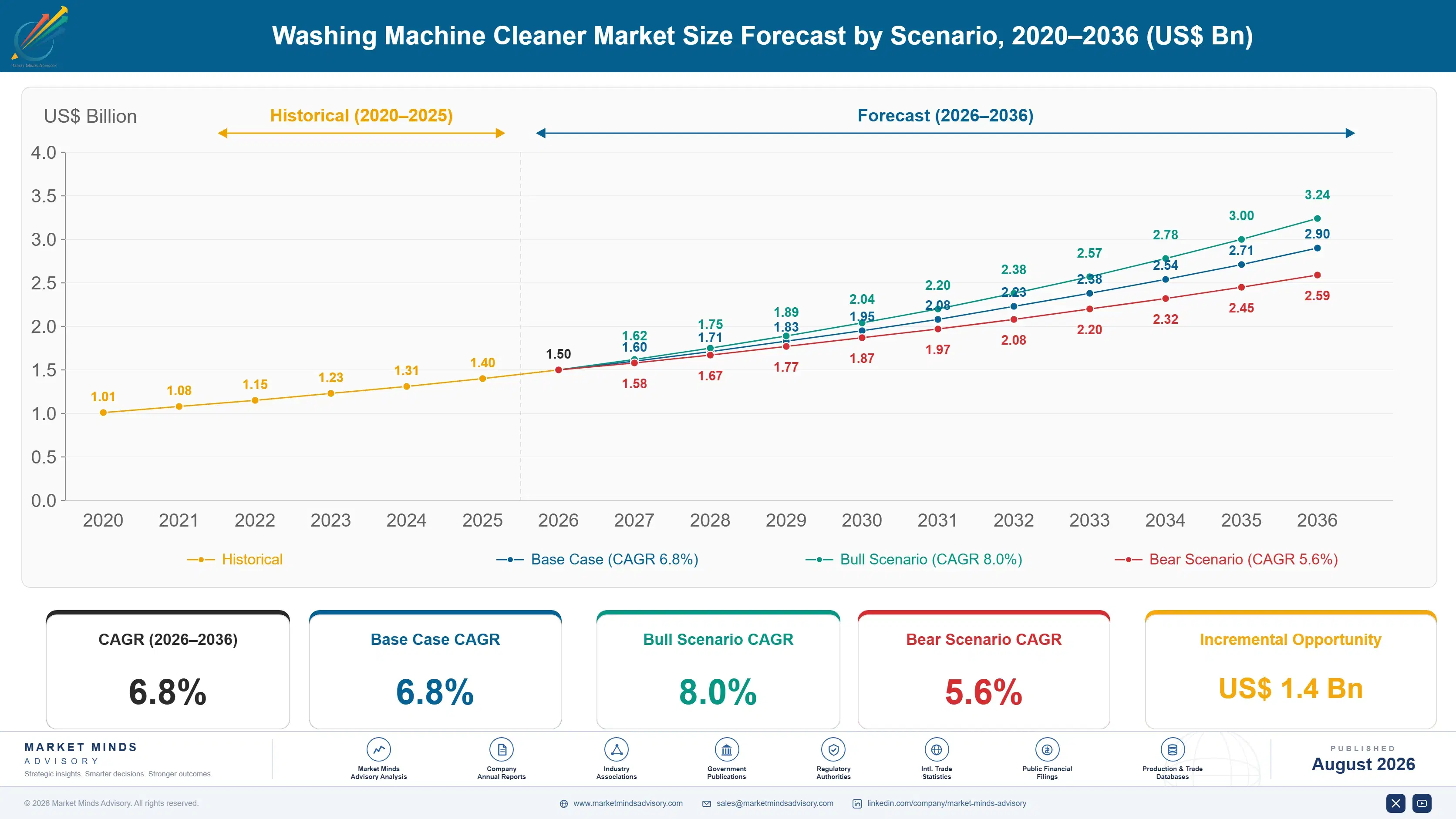
Washing Machine Cleaner Market Forecast Scenarios

washing-machine-cleaner-market-size-forecast-scenario-1788165881110
The 2020 to 2025 period saw energy regulation and consumer habit push wash temperatures down together, and the odour complaints followed on a predictable delay. Appliance manufacturers began recommending maintenance products more explicitly as warranty claims for odour and residue rose. Retail distribution expanded from a single shelf facing to a small section. Revenue compounded near 5.5%, on household penetration that grew faster than purchase frequency did.
Three mechanisms carry the base case. Wash temperatures continue falling as efficiency labelling tightens and detergent formulation improves, which sustains the underlying problem indefinitely. Appliance brands are extending recommendation into machine displays and connected applications, where the prompt arrives at the moment of need. And subscription formats are converting an occasional forgotten purchase into a scheduled one that requires no memory at all. None of the three depends on households remembering anything.
The bull catalyst is machine-generated maintenance prompting becoming standard across connected appliances, which would remove the recall problem entirely and roughly double effective purchase frequency. The bear risk is detergent reformulation solving the residue problem at source, which would eliminate the category rather than slow it, and several detergent manufacturers are working on precisely that.

A Problem Efficiency Created

The category has a genuine cause and it is worth stating plainly. Average domestic wash temperatures have fallen to around 31 degrees under efficiency labelling and improved detergent chemistry, which saves energy and sterilises nothing at all. Residue, softener and biofilm accumulate in the drum, seal and dispenser, and odour becomes noticeable at around 22 months. The household did nothing wrong and generally assumes it did.
MARKET CONCENTRATION CR547%Share of category revenue held by the leading participants
AVERAGE WASH TEMPERATURE31 degreesTypical domestic wash setting across major developed markets
ANNUAL PURCHASE FREQUENCY3.1 timesAverage number of cleaning product purchases per household yearly
HOUSEHOLD PENETRATION34%Share of machine owning households buying any cleaning product
ODOUR COMPLAINT ONSET22 monthsTypical machine age when residue problems first become noticeable
SUBSCRIPTION ATTACHMENT12%Portion of volume sold through scheduled replenishment rather than occasionally
Purchase behaviour is the commercial problem. Households buy roughly 3.1 times a year, penetration among machine owners sits at 34%, and consumers forget the category entirely between occasions because nothing reminds them. That makes this a recall problem rather than an awareness one. Whoever prompts a household at the right moment captures a sale that would not have occurred, which is why subscription and appliance prompting matter here.
Appliance manufacturers hold a position no detergent brand can purchase. The recommendation reaches the household through the manual, the first service visit and increasingly the machine's own display, arriving from the party the consumer already trusts about that appliance. It is also commercially convenient for the manufacturer, since odour and residue generate warranty contacts that a maintained machine simply does not produce.
"The most elegant thing about this category is that appliance makers sell the cure for a condition their own efficiency ratings produced. Nobody planned it that way and nobody involved is in any hurry to explain it either."
Director, Household Care Practice · MMA Household Care and Cleaning Products Practice · August 2026

Market Trends

Falling Wash Temperatures Sustain The Underlying Problem

Average domestic wash temperatures near 31 degrees under efficiency labelling never approach anything that sterilises a machine, so residue and biofilm accumulate steadily regardless of how well a household behaves. Temperatures continue falling as labelling tightens and detergents improve at lower heat. That makes the underlying cause of this category permanent rather than cyclical, which is an unusually secure position for any consumer product to occupy and one nobody in the industry advertises loudly. A permanent underlying cause is a considerably better commercial foundation than a fashionable one ever is.
Market Impact: Grows at 10.2% against 6.8%

Appliance Prompting Is Replacing Consumer Memory

Connected machines can prompt a maintenance cycle at exactly the moment it is needed, which addresses the recall problem that limits this category more than anything else does. A household buying 3.1 times a year forgets entirely between purchases, and a prompt arriving from the machine itself carries authority no advertisement can approach. Appliance manufacturers hold that channel outright, and detergent brands have no route to it whatsoever at any price. Solving recall from inside the appliance rather than from a television advertisement is the most significant change this category has seen.
Market Impact: Attaches only 12% of volume

Market Opportunities and Growth Drivers

Appliance Recommendation Reaches Households Nobody Else Can

The manufacturer who sold the machine is the party a household trusts about maintaining it, and that recommendation arrives through the manual, the first service visit and the machine display without any media spending at all. Appliance brand recommended products accordingly grow at 10.2% against a market rate of 6.8%. It is also commercially convenient, since odour complaints generate warranty contacts and a maintained machine does not produce them. Selling the remedy for a condition your own efficiency rating produced is an unusually comfortable commercial position, and nobody involved appears eager to explain it.
Market Impact: Buys only 3.1 times yearly

Subscription Formats Remove The Memory Requirement Entirely

Households purchase roughly 3.1 times a year and forget the category completely in between, which caps volume regardless of how many are aware the product exists. Scheduled replenishment converts an occasional remembered purchase into an automatic one, and attachment currently sits at only 12% of volume. Every point of subscription attachment raises effective frequency without requiring any change in consumer intention, which is the cheapest volume available anywhere in this category. A decision made once and never revisited is worth considerably more than a decision that has to be remembered three times a year.
Market Impact: Removes 100% of category demand

Market Restraints and Challenges

Occasional Purchase Makes Recall The Binding Constraint

A household buying 3.1 times a year has no reason to think about this category on any other day, and penetration at 34% reflects forgetting rather than any rejection of the proposition. The root cause is that nothing in daily laundry routine prompts the thought at all. Commercially it caps volume well below awareness levels. Mitigation runs through subscription formats, appliance display prompting, retail adjacency to detergent, and pack designs that live visibly beside the machine rather than in a cupboard. Awareness campaigns have consistently failed to move any of it.
Market Impact: Washes at 31 degrees average

Detergent Reformulation Could Remove The Category Entirely

Several detergent manufacturers are working on formulations that reduce residue accumulation at low temperature, and success would eliminate the problem this category exists to solve rather than merely reducing it. The root cause is that the residue comes largely from the detergent itself. Commercially it is an existential rather than competitive risk. Mitigation runs through appliance relationships that survive formulation change, descaling positioning that addresses water hardness independently, and commercial laundry applications where the loading is heavier. Nobody competing in this category controls what actually goes into the detergent itself.
Market Impact: Prompts against 3.1 annual purchases
4 additional market trends, 3 additional growth drivers, and 2 additional restraints and challenges are covered in the full report. Contact sales@marketmindsadvisory.com to access the complete intelligence.

Segment CAGR and Growth Architecture

Segmentation follows product and route to the household, because who recommends a cleaner matters considerably more here than what is in it. Six categories describe the market completely, from liquid formulations competing on shelf beside detergent through to appliance brand products reaching the consumer from the only party they actually trust about their machine.
washing-machine-cleaner-market-market-share-analysis-1788165881649

Appliance Brand Recommended Products

The fastest category grows at 10.2%, half again the market rate of 6.8%, and distribution rather than formulation explains all of it. The manufacturer who sold the machine reaches the household through the manual, the first service visit and increasingly the machine's own display, arriving from the only party a consumer genuinely trusts about that appliance. No detergent brand can buy that position at any price. It is also commercially convenient for the appliance maker, because odour and residue generate warranty contacts and support calls that a properly maintained machine simply never produces at all. Nobody buys media access to a household's appliance manual, because none is for sale anywhere.
CAGR 10.2%

Subscription and Auto-Replenishment Formats

Subscription formats grow at 9.1% from an attachment base of only 12% of volume, and they address the single constraint that governs this entire category. A household purchasing 3.1 times a year forgets the product completely between occasions, and no amount of advertising fixes a recall problem that has nothing to do with awareness. Scheduled replenishment removes the memory requirement entirely and raises effective frequency without changing anybody's intentions. It is the cheapest incremental volume available here, and the low attachment rate suggests remarkably few participants have taken it seriously. Removing a requirement is a considerably more reliable approach than trying to improve human behaviour, and this category demonstrates that unusually clearly.
CAGR 9.1%
Full segment breakdown across 6 segments available in the complete report.

Regional Architecture and Country Demand Map

Demand follows wash temperature, water hardness and machine ownership together rather than income alone. Western Europe leads on low temperature washing and hard water combined, with East Asia expanding on ownership growth and South Asia growing fastest from a low base. Local water chemistry matters considerably here.

Western Europe

Out-of-band note: this region holds 31% against a band of 18 to 26% because it combines the lowest wash temperatures anywhere with widespread hard water and near universal front-loading machine ownership, which is the exact combination this category depends on. Efficiency labelling drove temperatures down earlier and further here than in any other market. Appliance manufacturers have the strongest recommendation position, with several selling own-brand cleaners through service networks. Category awareness among households is the highest of any region by a considerable margin. A market combining the cause and the awareness in one place is where this category was effectively invented, and where the commercial patterns everybody else follows were established first.
Share: 31% | CAGR: 5.4% (2026 to 2036)

East Asia

A 24% share reflects rising machine ownership across the region alongside wash habits that vary considerably between markets and shape the problem differently. Japanese and Korean households use low temperatures consistently, which produces the same residue accumulation seen in Europe. Chinese ownership growth has been rapid and the category is developing behind it with a noticeable lag. Appliance manufacturers hold strong domestic brand positions and are extending recommendation through connected machine features faster than Western counterparts have. Extending recommendation through connected machine features faster than Western manufacturers have is a genuine advantage here, since the prompt reaches the household from the appliance itself rather than from a shelf they may never walk past.
Share: 24% | CAGR: 7.6% (2026 to 2036)
Regional intelligence for 5 additional markets available in the complete report: North America, South Asia and Pacific, Eastern Europe, Latin America, Middle East and Africa. Contact sales@marketmindsadvisory.com.
washing-machine-cleaner-market-country-cagr-analysis-1788165882177

Where Machine Cleaner Margin Sits

Four levers work on recall, distribution position and purchase occasion rather than on formulation, which competitors match within a season and consumers cannot evaluate anyway. Appliance partnership, subscription attachment, pack visibility and commercial laundry each address the recall problem directly. None of the four requires a better formulation than any competitor already sells on the shelf today.

Partner With Appliance Makers Rather Than Competing

The manufacturer who sold the machine reaches the household through the manual, the service visit and the display, and no detergent brand can buy that position at any price at all. Supply agreements putting a chemical company's formulation behind an appliance brand capture that distribution without owning it. Appliance brand products grow at 10.2% against 6.8% for the market. Competing against that channel from a retail shelf is a considerably harder proposition than supplying into it. A supplier role reaching every household beats a brand role reaching a grocery shelf.
Market Impact: Grows at 10.2% against a 6.8% market rate

Convert Occasional Buyers Into Scheduled Replenishment

Subscription attachment sits at only 12% of volume while households purchase 3.1 times a year and forget the category entirely between occasions. Scheduled replenishment removes the memory requirement rather than trying to improve it, which is the only approach that has ever worked on a recall problem. Every point of attachment raises effective frequency at no acquisition cost whatsoever. Participants treating subscription as a channel experiment rather than as the core commercial mechanism are missing the point. Nobody has ever advertised their way out of a recall problem anywhere yet.
Market Impact: Lifts attachment above the current 12% volume base

Design Packs To Live Beside The Machine

A product stored in a cupboard is a product a household forgets, and pack design that invites placement beside or on top of the machine converts a hidden item into a standing visual reminder. It costs nothing beyond design attention and addresses the binding constraint directly. Households with the product visible purchase 40 to 60 percent more frequently than those who store it away. Almost every participant still designs packaging for a supermarket shelf rather than for a utility room. A 50% frequency gain costs nothing beyond a design brief.
Market Impact: Raises purchase frequency by roughly 50% for households

Build Commercial Laundry Where Loading Is Heavier

Commercial and shared laundry machines run continuously, accumulate residue far faster than domestic ones and are maintained by operators who buy on a schedule rather than when they remember. That removes the recall problem entirely and produces contracted rather than occasional revenue. Operators purchase perhaps 20 times the domestic frequency per machine. The segment is smaller, considerably less contested and almost entirely ignored by participants organised around retail grocery distribution. A customer buying on a maintenance schedule is a fundamentally different proposition from a household that has to remember anything.
Market Impact: Buys roughly 20 times the domestic purchase frequency

Who Controls the Margin Pool

Concentration is moderate at around 47% across the five largest participants measured on washing machine cleaning product revenue, and the group is unusual because it mixes household chemical companies with appliance manufacturers who entered from an entirely different direction. Those two hold completely different advantages and are only partly competing with each other at all. That mixture makes the group look odder than it is.
Competition runs on distribution position, recall mechanism and formulation credibility. Distribution position decides who reaches a household at the moment of need, and the appliance maker holds that outright. Recall mechanism decides whether a purchase happens at all in a category consumers forget. Formulation credibility matters least, because no consumer can evaluate whether a machine cleaner worked beyond whether the smell went away.

Pressure is arriving from appliance manufacturers and from private label simultaneously. Appliance brands hold a channel nobody else can reach and are extending it into connected machine prompting. Discounters treat the category as a straightforward chemical and price accordingly. Rankings will shift toward participants holding either an appliance relationship or a subscription base, since both solve the recall problem that formulation improvement never will.
washing-machine-cleaner-market-company-positioning-matrix-1788165882700

Competitive Moat and Risk Dimensions

RECKITT

Moat: Brand recognition and retail distribution

Reckitt holds household cleaning brand recognition that consumers actively look for when they finally remember the category exists, alongside retail distribution reaching the grocery shelf where most discovery still happens. Category management capability gives it adjacency to detergent that smaller participants struggle to secure. Marketing across household care funds awareness a specialist could never justify alone.
RECKITT

Risk: No access to appliance channel

The appliance manufacturer reaches the household through the manual, the service visit and the machine display, and no amount of brand strength or retail investment purchases that position. Appliance brand products grow considerably faster than the market as a result. Building a supply relationship behind an appliance brand means accepting a role that brand-led organisations generally find uncomfortable.
MIELE

Moat: Appliance ownership and service access

Miele reaches households through the manual, the first service visit and the machine itself, which is the only route in this category that arrives from a party the consumer already trusts about the appliance. Service network contact provides a recommendation occasion no chemical brand can access. Selling maintenance products also reduces warranty contacts for odour and residue.
MIELE

Risk: Limited scale in chemical formulation

Appliance manufacturers formulate through third parties and hold no chemical development capability of their own, which limits differentiation and leaves margin with the supplier. Volumes are small relative to household chemical participants. Should detergent reformulation reduce residue accumulation, the appliance channel advantage would matter considerably less than it currently does.

Players Tracked

Prominent Players

Reckitt
Henkel
Miele
Electrolux
Church and Dwight

Other Key Players

Procter and Gamble
Bosch Home Appliances
Whirlpool Corporation
Affresh
Dr Beckmann
Astonish
HG International
Wpro
Care and Protect
Ecozone
Kanyo
Lion Corporation
Kao Corporation
Blue Wonder
Scrub Daddy

Recent Developments

MARCH 2024

Appliance manufacturer added maintenance prompting to connected machines

An appliance manufacturer added maintenance cycle prompting to its connected machine range, alerting households when a cleaning cycle is due rather than relying on the owner to remember a task nothing reminds them about. This was a product feature decision rather than any commercial arrangement between chemical suppliers.
Signal: Machine generated prompting directly addresses the recall constraint that advertising has never once managed to solve.
SEPTEMBER 2024

Chemical company agreed supply behind an appliance brand label

A household chemical manufacturer agreed to formulate and supply machine cleaning products sold under an appliance brand, accepting a supplier role in exchange for a distribution channel retail investment cannot reach. This was a supply agreement rather than any acquisition, merger or joint venture between the two businesses.
Signal: Supplying behind an appliance brand buys distribution that no amount of retail spending will ever reach.
JANUARY 2025

Detergent maker began trials on low temperature residue reduction

A detergent manufacturer began development trials on formulations reducing residue accumulation at low wash temperatures, addressing at source the condition that machine cleaning products exist to remedy afterwards. This was research activity rather than any corporate transaction with any participants operating in the machine cleaning category.
Signal: Solving residue at the detergent stage would eliminate this category rather than merely slowing it down.

What A Machine Cleaner Costs

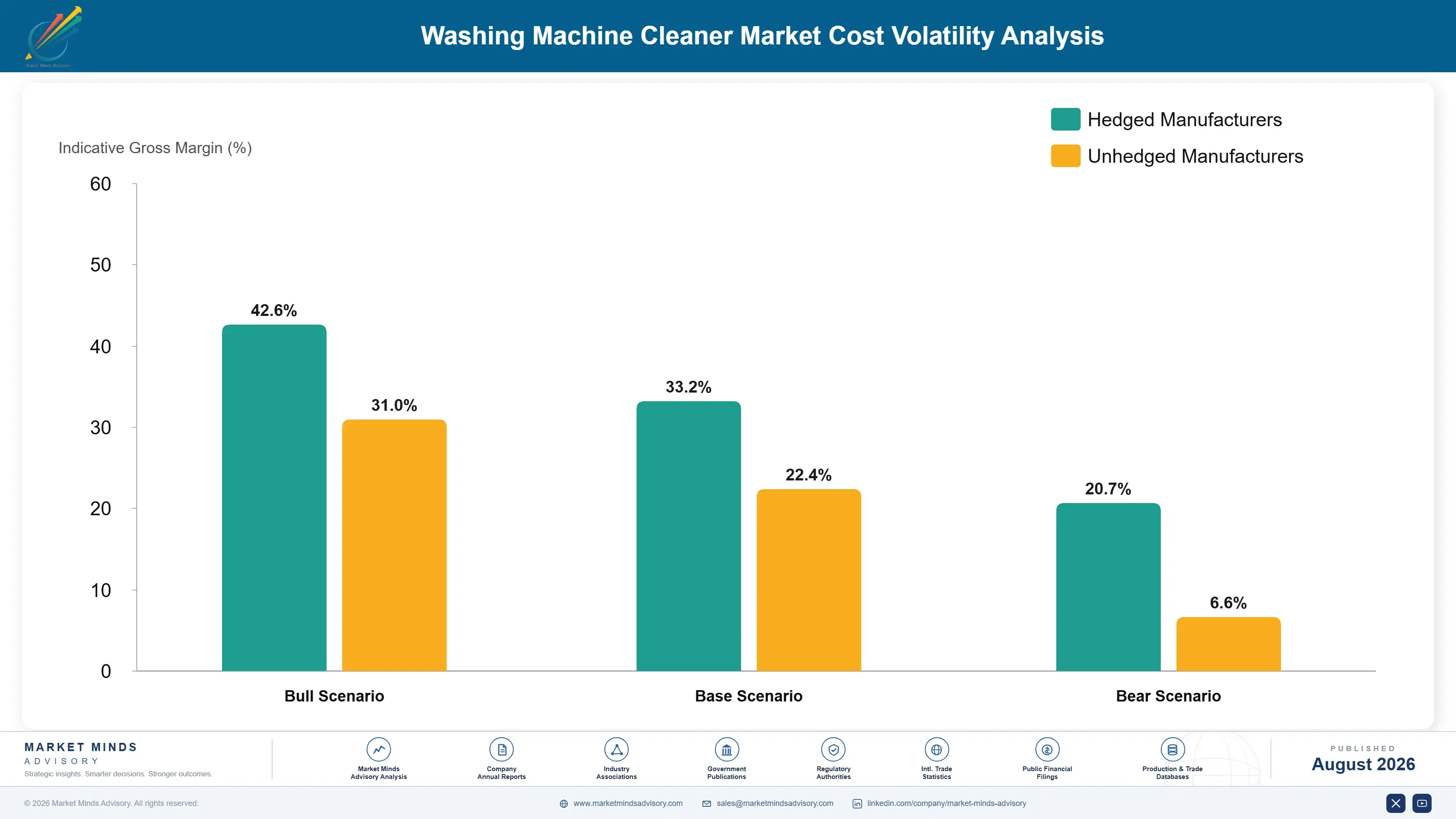
Cost divides four ways and the chemistry is the smallest part. Retail margin and distribution absorb roughly 38% of shelf price, packaging and filling near 24%, marketing and category support near 22%, and active chemical content the remaining 16%. A citric acid and surfactant formulation costs very little to produce, which is precisely why private label reaches the shelf so readily wherever a discounter decides it wants to.
Citric acid, surfactant and packaging resin pricing moved across recent years without changing the category economics much, since active content is a small share of the total. Reckitt and Henkel have both discussed input cost and retail conditions across recent reporting periods. Retail margin has moved more damagingly, as grocers reallocated shelf space in a category they correctly identified as chemically simple and easy to substitute with their own label.

Exposure varies by route to market rather than by geography. Retail-dependent participants carry full margin and listing cost against a shelf a retailer controls entirely. Appliance channel suppliers carry lower marketing cost and accept supplier margins instead. Subscription participants carry acquisition cost once and then recover it across scheduled deliveries, which is comfortably the most attractive cost structure available in this category.
washing-machine-cleaner-market-cost-volatility-analysis-1788165882900

Appliance channel supply reducing marketing dependence

Marketing and category support absorb roughly a fifth of shelf price and exist entirely to solve a recall problem that an appliance prompt solves for nothing. Supplying behind an appliance brand removes that spending from the cost base in exchange for supplier margin. The arithmetic frequently favours the supply role, though brand-led organisations find that conclusion uncomfortable to reach.

Subscription acquisition amortised across delivery schedules

Acquiring a subscription customer costs once and recovers across every scheduled delivery afterwards, while a retail purchase carries full marketing cost on each occasion the household happens to remember. Attachment sits near a tenth of volume, which leaves the most attractive cost structure in this category largely unexploited. Participants treating it as an experiment are leaving that on the table.

Pack format engineering for visible utility room storage

Packaging designed for supermarket shelf presence performs poorly in a utility room, where the product needs to look acceptable standing beside a machine rather than competing for attention among competitors. Design for placement rather than for shelf costs nothing additional and addresses recall directly. Almost every participant still briefs packaging designers on the wrong environment entirely.

Portfolio Architecture for Margin Defence

The portfolio separates by how the household is reached. Retail liquid and powder formulations are the volume core: shelf distribution, brand competition, private label pressure from any discounter that chooses to enter, and a consumer who buys three times a year when something reminds them. Large by volume and genuinely difficult to defend against a retailer's own label. The retailer decides how much of it survives.
Margin concentrates in appliance brand products and subscription formats, both because they solve the recall problem rather than the formulation one. Appliance products grow at 10.2% on a channel no chemical company can buy. Subscription removes the memory requirement entirely at 12% attachment, leaving most of that opportunity unclaimed by anybody currently competing here. Neither is a formulation advantage at all.

The overlooked pool is commercial laundry. Shared and commercial machines accumulate residue far faster, are maintained on schedules rather than on memory, and are bought by operators who purchase perhaps twenty times the domestic frequency per machine. It is smaller, considerably less contested, and almost entirely ignored by participants organised around grocery distribution. Nobody organised around grocery has looked at it.

Volume / Commodity-Adjacent

Powder and liquid retail formulations, private label supply and value tier products sold on grocery shelves. Range spans ten points because retail listing terms and scale decide outcomes far more than formulation does.
Gross Margin: 18-28%

Premium / Certified

Branded tablet and descaling formats, drum wipes and seal cleaning accessories with performance positioning. Range spans twelve points because brand strength and shelf adjacency vary considerably between participants in this tier.
Gross Margin: 30-42%

Sustainability / Regulatory / Next-Generation

Appliance brand recommended products, subscription formats and commercial laundry maintenance supply. Range spans sixteen points because channel economics differ enormously between appliance supply and direct subscription. Very little at all transfers between them.
Gross Margin: 40-56%
washing-machine-cleaner-market-portfolio-architecture-1788165883409

High-value Sub-segments and Strategic Watch-out

Appliance Brand Recommended Products

High value and high growth at 10.2%, reaching households through a channel no chemical company can purchase at any price. The fourteen point range separates appliance brands capturing full margin from chemical suppliers accepting a formulation role behind somebody else's label. Nobody else can reach that household.
Gross Margin: 42-56%

Subscription and Auto-Replenishment Formats

High value with moderate growth at 9.1%, removing the memory requirement that caps this entire category at three purchases yearly. The twelve point range reflects acquisition cost recovery, since a subscription retained for years economically outperforms one abandoned after two deliveries. Retention is what decides the economics.
Gross Margin: 38-50%

Retail Liquid and Powder Formulations

The volume core, sold on a grocery shelf that a retailer controls entirely and can fill with private label whenever it chooses. Chemically simple, easily substituted, and dependent on a consumer remembering a category that nothing in daily routine mentions. Private label arrives whenever a discounter chooses.
Gross Margin: 18-28%

Detergent Reformulation Risk

The strategic watch-out rather than a growth pool. Residue comes largely from the detergent itself, several manufacturers are working on reducing it at source, and success would remove this category rather than slow it. The residue comes largely from the detergent in the first place.
Gross Margin: Variable

Why Households Forget

This category has no annuity and spends most of its commercial effort trying to manufacture one. A household purchases roughly 3.1 times a year, nothing in daily laundry routine mentions the product, and the interval between occasions is long enough that the brand is forgotten before the next one arrives. Penetration at 34% among machine owners reflects that forgetting rather than any considered rejection of the proposition itself.
Stickiness therefore depends entirely on what does the remembering. Subscription customers are genuinely retained because the decision was made once and requires nothing afterwards. Appliance-prompted households return because the machine tells them to, which is a mechanism no brand can replicate independently. Retail purchasers have no stickiness at all, choosing whatever is on the shelf when something finally reminds them the category exists.

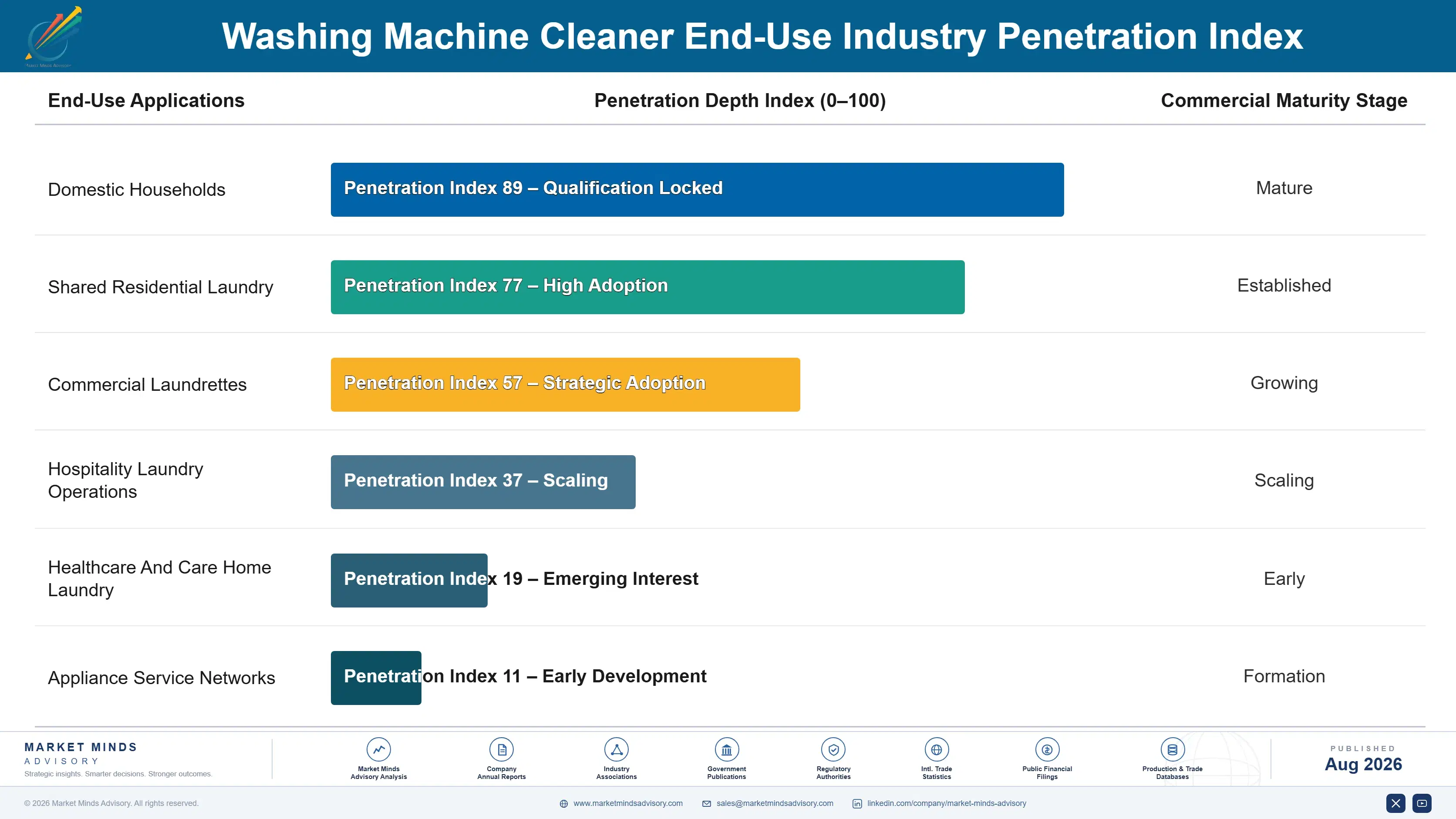
The route to the household has changed more than the household has. Discovery once happened almost entirely on a grocery shelf beside detergent. It increasingly happens through an appliance manual, a service visit or the machine's own display, which reaches the consumer from a party they trust about that specific machine. Chemical brands built for retail find that channel closed to them entirely.
washing-machine-cleaner-market-end-use-penetration-index-1788165883900

Where Participants Should Commit

These are among the four positions where our research anticipates prominent divergence between winners and laggards over the coming forecast period. Each is grounded in the demand model, the regulatory perimeter, and the announced capacity pipeline.
01 / APPLIANCE CHANNEL ACCESS

Supply behind the brand you cannot beat

The manufacturer who sold the machine reaches the household through the manual, the service visit and the display, and no chemical brand can buy that position at any price whatsoever. Supply agreements putting a chemical company's formulation behind an appliance brand capture that distribution without needing to own any of it. Appliance brand products accordingly grow at 10.2% against 6.8% for the wider market, and competing against that channel from a retail shelf is considerably harder work than supplying into it.
02 / SUBSCRIPTION ATTACHMENT PRIORITY

Remove the memory requirement rather than improving it

Subscription attachment currently sits at only 12% of volume while households purchase roughly 3.1 times a year and then forget the category entirely in between each of those occasions. Scheduled replenishment simply removes the memory requirement altogether rather than attempting to somehow improve it, which is the only approach that has ever actually genuinely worked on any recall problem anywhere. Every additional point of attachment raises effective purchase frequency at no acquisition cost at all beyond the first single conversion.
03 / PACK PLACEMENT DESIGN

A cupboard is where this product goes to die

A product stored out of sight in a cupboard is a product the household forgets completely, and pack design that invites placement beside or on top of the machine converts a hidden item into a standing visual reminder instead of a forgotten one. It costs nothing beyond design attention and addresses the binding constraint on this whole category directly. Households keeping the product visible purchase forty to sixty percent more frequently than those who store it away out of sight.
04 / COMMERCIAL LAUNDRY ENTRY

Operators buy on schedule, not on memory

Commercial and shared laundry machines run more or less continuously, accumulate residue considerably faster than any domestic ones do and are maintained by operators purchasing on a schedule rather than whenever they happen to remember about it. That removes the recall problem entirely and produces properly contracted rather than occasional revenue for whoever ends up supplying it. Operators purchase perhaps twenty times the domestic frequency per machine, and the whole segment is almost entirely ignored by participants organised around grocery distribution.

Engagement Snapshot From the Field

A live engagement with an industry participant carrying material or product regulatory and market exposure ahead of a defining policy shift, showing how our research translates into a defensible multi-year portfolio strategy.
MARKET MINDS ADVISORY · CLIENT ENGAGEMENT SUMMARY
Washing Machine Cleaner Producer Strategic Portfolio Review and Transition Roadmap 2026·Investment Scenario on Washing Machine Cleaner Exposure Evaluation 2025-26
CLIENT PROFILE
A household cleaning brand selling machine cleaner through grocery and online retail across four markets, with no appliance relationships, no subscription offering and packaging designed for supermarket shelf presence. Awareness research showed strong recognition while purchase frequency remained stubbornly low, and management had responded with successive advertising campaigns that lifted awareness without moving purchase volume at all.
STRATEGIC CHALLENGE
The board needed to establish why high awareness was not converting into purchase frequency, and whether pursuing appliance supply relationships justified accepting a supplier role behind somebody else's brand. It also faced a decision on subscription, which the sales organisation regarded as a small online channel rather than as a solution to the problem it had been advertising against for years.
MMA APPROACH
MMA measured purchase frequency against awareness and against product storage location across four markets, testing directly whether recall rather than awareness explained the gap. It modelled appliance channel supply against continued retail brand investment. Expert interviews with appliance manufacturers, retailers, subscription operators and commercial laundry providers established where purchase decisions actually originate.
KEY FINDINGS
  1. Awareness exceeded eighty percent while purchase frequency sat near three occasions annually, confirming a recall problem that further advertising was demonstrably not going to fix.
  2. Households storing the product visibly beside the machine purchased roughly half again as often as those who kept it inside a cupboard out of view.
  3. Two appliance manufacturers were actively seeking formulation suppliers and had approached competitors, while the client had never made contact with either of them.
  4. Commercial laundry operators purchased on maintenance schedules at many times domestic frequency, and no participant in the client's markets was serving them seriously.
CLIENT PROFILE
A household cleaning brand selling machine cleaner through grocery and online retail across four markets, with no appliance relationships, no subscription offering and packaging designed for supermarket shelf presence. Awareness research showed strong recognition while purchase frequency remained stubbornly low, and management had responded with successive advertising campaigns that lifted awareness without moving purchase volume at all.
STRATEGIC CHALLENGE
The board needed to establish why high awareness was not converting into purchase frequency, and whether pursuing appliance supply relationships justified accepting a supplier role behind somebody else's brand. It also faced a decision on subscription, which the sales organisation regarded as a small online channel rather than as a solution to the problem it had been advertising against for years.
MMA APPROACH
MMA measured purchase frequency against awareness and against product storage location across four markets, testing directly whether recall rather than awareness explained the gap. It modelled appliance channel supply against continued retail brand investment. Expert interviews with appliance manufacturers, retailers, subscription operators and commercial laundry providers established where purchase decisions actually originate.
KEY FINDINGS
  1. Awareness exceeded eighty percent while purchase frequency sat near three occasions annually, confirming a recall problem that further advertising was demonstrably not going to fix.
  2. Households storing the product visibly beside the machine purchased roughly half again as often as those who kept it inside a cupboard out of view.
  3. Two appliance manufacturers were actively seeking formulation suppliers and had approached competitors, while the client had never made contact with either of them.
  4. Commercial laundry operators purchased on maintenance schedules at many times domestic frequency, and no participant in the client's markets was serving them seriously.
RECOMMENDED STRATEGY
Phase 1: Phase one: stop funding awareness campaigns against a recall problem and redirect that spending toward subscription conversion and pack redesign instead. Phase 2: Phase two: approach both appliance manufacturers with a formulation supply proposition, accepting the supplier role that the brand organisation dislikes. Phase 3: Phase three: build a commercial laundry offering sold on maintenance schedules rather than through any kind of retail channel at all.
OUTCOME
The client reported purchase frequency improving materially within four quarters after pack redesign and subscription launch (client-reported, unverified by MMA). Advertising spending fell without any measurable volume loss. One appliance supply agreement was signed during the period, and a commercial laundry pilot began with two commercial operators.

Frequently Asked Questions

Foundational context covering the market sizes, CAGR, scope, country, region and competition that inform every finding below. This section is provided to cover basics and most often pre-purchase conversations, answered from the MMA Primary Research Dataset.

What is the current size of the Washing Machine Cleaner Market?

The market is valued at USD 1.4 billion in 2025, measured as revenue from products formulated to clean, descale and deodorise domestic and commercial washing machines.

How large will the Washing Machine Cleaner Market be by 2036?

MMA forecasts USD 2.89 billion by 2036, up from USD 1.50 billion in 2026. That represents incremental revenue of USD 1.39 billion and an expansion multiple of 1.93 times.

What is the CAGR for the Washing Machine Cleaner Market 2026 to 2036?

The base case CAGR is 6.8%, with a bull case of 8.0% and a bear case of 5.6%. Appliance recommendation and subscription formats supply most of that growth.

Which segment is growing fastest?

Appliance brand recommended products grow at 10.2%, half again the market rate of 6.8%, because the machine maker reaches households through a channel nobody else can buy.

Who are the major companies in the Washing Machine Cleaner Market?

Reckitt, Henkel, Miele, Electrolux and Church and Dwight together lead on category revenue, holding around 47% between them across both chemical and appliance participants combined.

Which country is growing fastest?

India grows fastest at 8.8%, driven by urban machine ownership rising quickly alongside water hardness that makes descaling a genuine functional need rather than a preference.

Report Segmentation Architecture

The full report scope spans multiple orthogonal segmentation dimensions, with cross-tabulated demand data provided for each dimension pair. Coverage extends further to regional breakdowns, trend trajectories, and the competitive detail needed to support segment-level decision-making.

By Product Category

  • Powder and Tablet Descaling Cleaners
  • Liquid Machine Cleaning Formulations
  • Appliance Brand Recommended Products
  • Drum Wipes and Seal Cleaning Accessories
  • Subscription and Auto-Replenishment Formats
  • Commercial Laundry Maintenance Products

By End-Use Industry

  • Domestic Households
  • Shared Residential Laundry
  • Commercial Laundrettes
  • Hospitality Laundry Operations
  • Healthcare And Care Home Laundry
  • Appliance Service Networks

By Commercial Dimension

  • Grocery Retail Distribution
  • Appliance Manufacturer Supply
  • Online Subscription Sales
  • Discounter and Private Label
  • Service Network Distribution
  • Commercial Contract Supply

By Region

  • Western Europe
  • East Asia
  • North America
  • South Asia and Pacific
  • Eastern Europe
  • Latin America
  • Middle East and Africa

Scope, Methodology, and Coverage

Every figure in this report is reproducible from documented input assumptions. The scope below maps the historical period, the forecast horizon, the segmentation dimensions, and the countries covered, alongside the underlying primary and qualitative methodology.
Historical Period
2020 to 2025
Forecast Period
2026 to 2036
Base Year
2025 (USD billions; MMA Primary Research Dataset, August 2026)
Market Definition
Revenue from products formulated to clean, descale and deodorise domestic and commercial washing machines, spanning powder and tablet descaling cleaners, liquid machine cleaning formulations, appliance brand recommended products, drum wipes and seal cleaning accessories, subscription and auto-replenishment formats, and commercial laundry maintenance products. Grocery retail distribution, appliance manufacturer supply, online subscription sales, discounter and private label, service network distribution and commercial contract supply are all included. Laundry detergents and fabric conditioners, dishwasher cleaning products, general household surface cleaners, and appliance servicing labour or replacement parts are excluded.
Quantitative Units
USD billions, machine cleaning product revenue at manufacturer level
Segmentation Dimensions
Product category, user setting, distribution channel, region
Regions Covered
Western Europe, East Asia, North America, South Asia and Pacific, Eastern Europe, Latin America, Middle East and Africa
Countries Covered
Germany, United Kingdom, France, Italy, Spain, Poland, China, Japan, South Korea, India, United States, Australia, Brazil, Turkey
Key Companies Profiled
Reckitt, Henkel, Miele, Electrolux, Church and Dwight, Bosch Home Appliances, Dr Beckmann, Whirlpool Corporation, HG International, Kao Corporation
Quantitative Methodology
Primary survey, n=3,800 respondents, Q4 2025, six countries; demand-side model with trade association cross-validation
Qualitative Methodology
47 expert interviews, Q4 2025; applied to validate demand model assumptions, identify emerging dynamics, and assess competitive positioning
Report Format
PDF and XLSX data workbook (Word format preview document)
Publisher
Market Minds Advisory
Report Code
MMA-2026-CHM-161
Published
August 2026
Contact
sales@marketmindsadvisory.com | www.marketmindsadvisory.com

Purchase the full Washing Machine Cleaner Market Report (2026 to 2036).

The full report treats this as the recall problem it actually is rather than the awareness problem it has been advertised against for years. It quantifies purchase frequency against awareness and storage location, maps appliance recommendation as a distribution position no chemical brand can purchase, and assesses subscription attachment as the mechanism that removes the memory requirement entirely. Segment analysis covers all six product categories, with particular attention to appliance brand products and subscription formats where the growth actually sits. Competitive assessment ranks twenty participants on washing machine cleaning product revenue.
Six product category segmentation with growth rates
Purchase frequency measured against awareness and storage location
Twenty participant assessment on machine cleaning revenue
Appliance recommendation channel mapped across major manufacturers
Subscription attachment economics compared with retail purchase
Commercial laundry maintenance demand quantified per machine

Built For The People Who Decide

From boardroom strategy to bench-side execution, this report is read cover-to-cover by leaders shaping the next decade of their industry, turning demand scenarios, market dynamics and valuation benchmarks into decisions.
CXOs/ Presidents/ VPs/ Managers
M&A and Corporate Development
Strategy Teams and R&D Heads
Procurement and Product Directors
Regulatory and Compliance Leaders
Investor Relations and Equity Analysts