

Market Minds Advisory
Vutrisiran Market

Vutrisiran Market: Transthyretin Silencing Across Polyneuropathy and Cardiomyopathy, 2026 to 2036

An RNA interference therapy priced near half a million dollars a year now competes for cardiomyopathy patients against two oral stabilisers, and payer tolerance for that price gap is the live commercial question.

Lead Analyst

Alice Ballenger

Published

September 2026

Make Smarter Decisions with Customized Research Insights

Request a free sample report and evaluate market opportunities, growth trends, and competitive dynamics relevant to your business needs.

2025 MARKET VALUE$2.4BMarket Size 2025
2036 FORECAST VALUE$10.3BBase Case , 2026 to 2036
CAGR 2026 TO 203614.2 %Bull 15.5% / Bear 12.9%
INCREMENTAL OPPORTUNITY$7.6BNet 10- year value creation
EXPANSION MULTIPLE3.77x2036 value over 2026 base
Strategic Levers
M&A Pipeline
Regional Outlook
Country Rankings
Competitive Intelligence
Segmental Deep-dive
Call-Us : 91 93563 13602

Executive Snapshot and Market Trajectory

Vutrisiran's approval in transthyretin amyloid cardiomyopathy during March 2025 changed what this product actually is. A quarterly polyneuropathy therapy serving ten thousand diagnosed patients became a cardiology therapy addressing a population an order of magnitude larger, and every commercial assumption underneath it moved with that shift.
Growth now comes almost entirely from wild-type cardiomyopathy, the segment expanding at 21.3%, where patients are typically men over 70 identified through cardiac imaging rather than genetic testing. North America holds 32% of value because United States list pricing near USD 476,000 annually sits well above what any other health system pays, and because bone scintigraphy referral pathways there find patients considerably earlier than they are found anywhere else in the world today.
Four branded therapies now chase the same cardiology clinics, and the top five participants hold 78% of value between them. Competition runs on outcomes data and administration burden rather than headline price: vutrisiran is dosed quarterly by subcutaneous injection, acoramidis and tafamidis are daily oral tablets, and cardiologists weigh that difference against published mortality curves. Regulatory expansion into earlier disease stages is where the next contest sits.
Market Definition
The market comprises global net revenue from vutrisiran, an RNA interference therapeutic that silences hepatic transthyretin production, prescribed across hereditary transthyretin amyloidosis with polyneuropathy and transthyretin amyloid cardiomyopathy of both wild-type and hereditary origin. Sizing captures manufacturer net revenue after rebates, discounts and mandated price concessions, together with named patient and managed access supply where reimbursed. Competing transthyretin stabilisers, antisense oligonucleotide therapies, gene editing candidates, amyloid depleter antibodies, diagnostic imaging agents and supportive cardiac care are outside scope.
Base Year Value
$2.4B in 2025 (MMA Primary Research Dataset, August 2026)
Forecast Period
2026 to 2036, eleven discrete annual values
CAGR
14.2% base case. Bull 15.5%. Bear 12.9%.
Fastest Growth Segment
ATTR Cardiomyopathy Wild-Type: 21.3% CAGR
Fastest Growth Country
Australia: 16.4% CAGR
Fastest Growth Region
South Asia and Pacific: 16.4% CAGR
Largest Region
North America: 32% of 2025 global value
Market Leaders
Alnylam Pharmaceuticals, Pfizer, BridgeBio Pharma, Ionis Pharmaceuticals, AstraZeneca. Source: MMA Analysis based on company annual reports.
Primary Survey
n=3,800 procurement and R&D decision-makers, Q4 2025, six countries
Methodology
Demand-side build-up, cross-validated against public data, 47 expert interviews

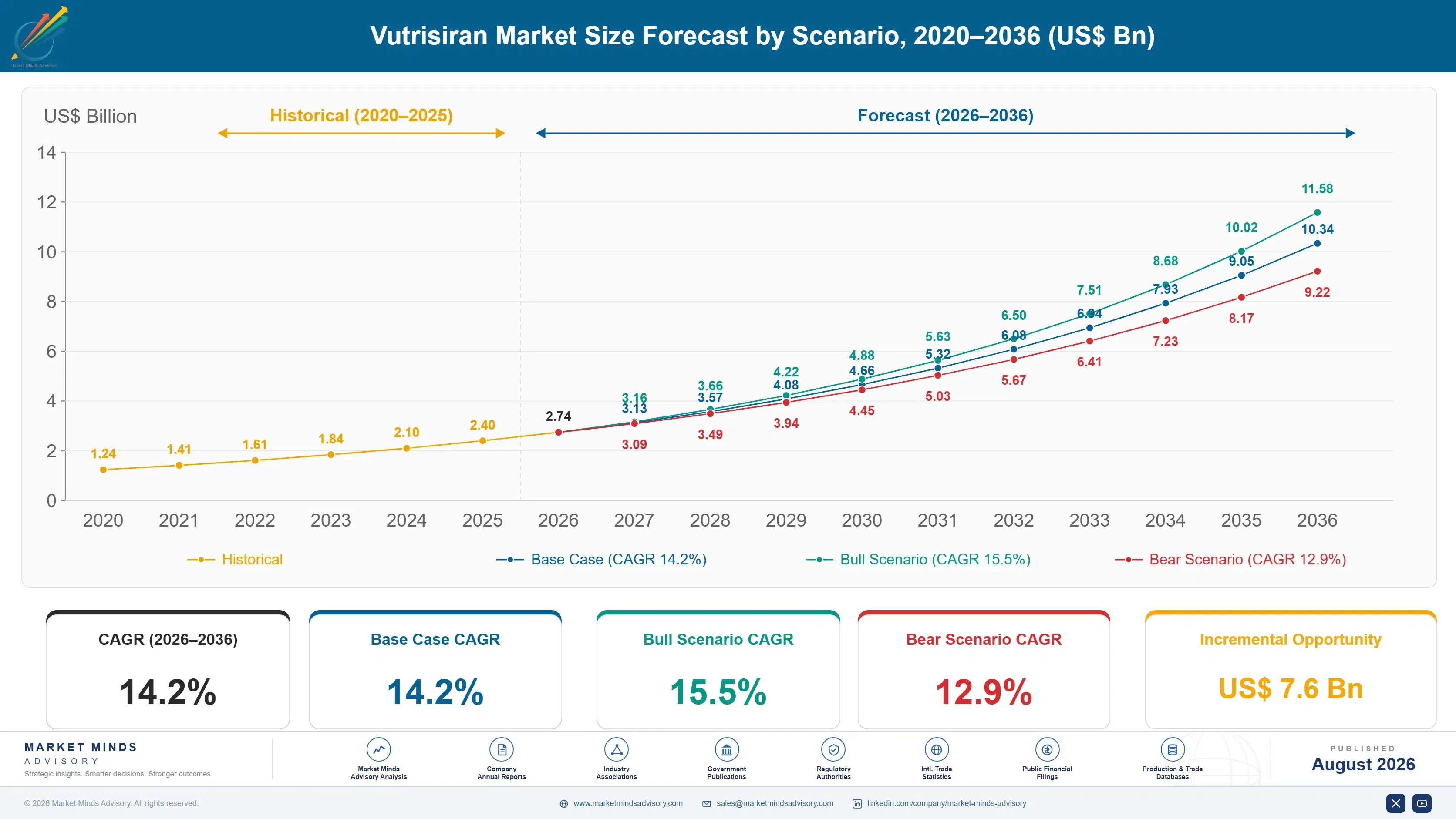
Vutrisiran Market Forecast Scenarios

vutrisiran-market-size-forecast-scenario-1787309979624
Between 2020 and 2025 this was not really one market but two consecutive ones. Vutrisiran launched into polyneuropathy in 2022 against an established patisiran base, grew steadily inside a small diagnosed population, then met a far larger cardiology opportunity in 2025. Compound growth of 13.0% across that window understates how discontinuous the change actually was.
The base case at 14.2% assumes three mechanisms hold. Cardiac scintigraphy referral keeps converting unexplained heart failure with preserved ejection fraction into confirmed amyloidosis diagnoses at roughly the current rate. Payers continue authorising silencer therapy for cardiomyopathy despite oral alternatives costing materially less. And quarterly subcutaneous dosing keeps persistence near 88% at two years, well above what daily oral regimens achieve in this elderly population. Remove any one and the curve flattens quickly.
The bull case at 15.5% turns on combination use: silencer plus stabiliser trials reading out favourably would double per-patient value in cardiomyopathy. The bear case at 12.9% turns on price. Should United States negotiation under the Inflation Reduction Act reach this class, or should acoramidis discount aggressively into shared indications, realised net revenue compresses faster than volume can offset.

Where Vutrisiran Value Actually Sits Today

The economics of this product are unusual even by rare disease standards. One patient generates close to USD 476,000 of list revenue annually, erosion to net runs near 22%, and manufacturing four prefilled syringes a year costs a rounding error against that. What determines value is therefore not production at all. It is how many patients get diagnosed, how many diagnosed patients any payer will authorise, and how long each stays treated.
TOP FIVE SHARE78%Concentration across the branded transthyretin therapies competing for cardiology patients
ANNUAL THERAPY PRICEUSD 476,000United States list price before negotiated rebates and discounts
DIAGNOSED PATIENTS TREATED34%Share of confirmed amyloidosis patients receiving any disease-modifying therapy
MEDIAN DIAGNOSTIC DELAY39 monthsTime from first cardiac symptom to confirmed amyloidosis diagnosis
GROSS-TO-NET DISCOUNT22%Average erosion between list price and realised net manufacturer revenue
TWO-YEAR PERSISTENCE88%Patients remaining on therapy beyond the second treatment year
Diagnosis is where the constraint genuinely binds. Only 34% of confirmed amyloidosis patients currently receive any disease-modifying therapy, and median delay from first cardiac symptom to confirmed diagnosis still runs 39 months. Every point of improvement in scintigraphy referral converts directly into treated volume across all four branded therapies at once, which makes diagnostic funding the rare investment that competitors cannot easily neutralise. Capacity to read those scans sits in relatively few hospitals.
Persistence is the quiet advantage. Quarterly subcutaneous administration keeps 88% of patients on therapy past two years, which in a population with median age above 75 beats what daily oral regimens manage. That difference compounds across a decade of continuous treatment, and it is worth more in revenue terms than most acquisition spending achieves.
"Everyone models this market as a share contest between silencers and stabilisers. The more interesting number is that two thirds of confirmed patients are still on nothing at all, which means the four participants are competing hardest over the smallest part of the opportunity. Diagnosis funding would earn any of them more than a detailing war."
Director, Rare Disease and Cardiovascular Therapeutics Practice · MMA Healthcare

Market Trends

Cardiac Imaging Referral Pathways Reshape Patient Identification

Technetium pyrophosphate scintigraphy turned amyloid cardiomyopathy from a biopsy diagnosis into an imaging one, and cardiology departments have been steadily rewiring referral around that. Roughly 41,000 patients now receive bone scintigraphy for suspected cardiac amyloidosis annually across major markets, against a fraction of that number five years ago. The consequence for vutrisiran is that its addressable population expands without any commercial action at all. It also means diagnostic capacity, not prescriber conviction, sets the pace of growth in wild-type disease, and the centres doing this work well are concentrated in a surprisingly small number of hospitals.
Market Impact: Cuts mortality 36% versus placebo

Silencer Versus Stabiliser Debate Moves Toward Combination Use

The field spent five years arguing whether silencing transthyretin production beats stabilising the circulating protein. That argument is quietly being replaced by a different one. Three combination trials are now underway pairing a silencer with a stabiliser, on the reasoning that the mechanisms address different parts of the same disease process and might well be additive rather than redundant. If any reads out convincingly, per-patient value roughly doubles and the competitive frame changes entirely: rivals become partners, and the participants without a silencer of their own are the ones exposed.
Market Impact: Expands diagnosed base 28% since 20

Market Opportunities and Growth Drivers

HELIOS-B Mortality Data Now Enters Cardiology Practice Guidelines

The HELIOS-B trial reported a 36% reduction in all-cause mortality against placebo in transthyretin amyloid cardiomyopathy, and that figure did the commercial work no promotional campaign could have. Cardiology societies have since folded silencer therapy into treatment algorithms as a first-line option rather than a specialist referral, which matters because general cardiologists see roughly nine times as many of these patients as amyloidosis centres do. Guideline inclusion also gives payers a defensible basis for authorisation, and it removes the argument that silencing remains investigational therapy in cardiac disease rather than established practice.
Market Impact: Delays 31% of initiations 90 days

Scintigraphy Screening Expands The Diagnosed Patient Base

Screening protocols for heart failure with preserved ejection fraction now flag amyloidosis far more systematically than they did, and the diagnosed base has grown 28% since 2022 as a result. This is the single most reliable driver in the market because it operates independently of pricing, competition and guideline politics. Every patient identified enters a treatment decision that vutrisiran can contest. The corollary is unwelcome for anyone modelling share: growth accrues to all four branded therapies simultaneously, so a participant can grow revenue substantially while losing ground on every competitive measure.
Market Impact: Erodes net price 22% from list

Market Restraints and Challenges

Payer Prior Authorisation Slows Cardiomyopathy Treatment Initiations

Roughly 31% of cardiomyopathy initiations are delayed 90 days or more by prior authorisation, and the root cause is straightforward: payers face a therapy costing near USD 476,000 annually in a population where cheaper oral options exist and where the treated cohort has expanded tenfold. Utilisation management is the rational response. Commercially it costs revenue outright, since patients in their late seventies die or deteriorate during appeals. Participants are responding with dedicated reimbursement support teams, prefilled documentation packages tied to scintigraphy grade, and outcomes-based contracts that shift some risk onto the manufacturer.
Market Impact: Adds 41,000 imaged patients annuall

Oral Stabiliser Pricing Pressure Compresses Net Realisation

Gross-to-net erosion already runs 22% and continues widening. The root cause is that acoramidis and tafamidis address overlapping cardiomyopathy populations at lower acquisition cost with oral convenience, giving payers genuine bargaining power in negotiation. Formulary placement now routinely demands rebates that were unnecessary when polyneuropathy was the only indication. The commercial impact falls on realised price rather than volume, which makes it easy to miss in headline revenue. Mitigation is running along three lines: outcomes-based agreements tied to hospitalisation rates, combination positioning that removes the direct comparison, and earlier-stage indications where no stabiliser holds approval.
Market Impact: Covers 3 combination trials underwa
3 additional market trends, 2 additional growth drivers, and 4 additional restraints and challenges are covered in the full report. Contact sales@marketmindsadvisory.com to access the complete intelligence.

Segment CAGR and Growth Architecture

Segmentation follows treated indication and disease phenotype, which is how prescribing decisions, reimbursement criteria and clinical evidence all actually organise themselves in transthyretin amyloidosis. Cardiomyopathy and polyneuropathy populations differ in age, prescriber, diagnostic route and payer treatment, and hereditary origin separates cleanly from wild-type disease on genetic testing rather than on clinical presentation alone.
vutrisiran-market-market-share-analysis-1787309980153

ATTR Cardiomyopathy Wild-Type

Growing at 21.3%, exactly 1.50 times the market rate, and responsible for most incremental value across the forecast. These are typically men above 75 with heart failure and preserved ejection fraction, identified through bone scintigraphy rather than genetic testing, and until recently most of them were never diagnosed at all. Scale is what distinguishes this segment: the wild-type population outnumbers the entire hereditary polyneuropathy cohort many times over. Competition is correspondingly fierce, since both oral stabilisers hold approval here and cardiologists rather than neurologists make the choice. Diagnostic capacity, not clinical conviction, remains the practical limit on how quickly this population converts into treated volume, and that capacity sits in relatively few hospitals.
CAGR 21.3%

ATTR Cardiomyopathy Hereditary Variant

Expanding at 17.6% on a smaller base, this segment covers patients carrying pathogenic transthyretin variants who present with cardiac rather than neurological disease, the V122I variant in patients of West African ancestry being the most common example. Genetic cascade testing within affected families identifies these patients considerably earlier than wild-type disease is caught, which supports both longer treatment duration and better outcomes. Reimbursement is generally easier to secure because genetic confirmation removes diagnostic ambiguity that payers otherwise use to defer authorisation. The commercial constraint is that cascade testing remains poorly funded in exactly the populations where variant prevalence is highest, which caps identification well below true prevalence and leaves a great deal of the segment invisible.
CAGR 17.6%
Full segment breakdown across 5 segments available in the complete report.

Regional Architecture and Country Demand Map

Value concentrates where diagnosis rates and reimbursed pricing coincide, which is a narrower set of countries than prevalence alone would suggest. Growth runs fastest where scintigraphy screening is newly established rather than where the treated base is already large, and that distinction separates the regional picture cleanly.

North America

Thirty-two percent of value sits here for two reasons that have nothing to do with prevalence. United States list pricing near USD 476,000 annually runs well above realised pricing anywhere else, and cardiac scintigraphy referral pathways were established earlier and more widely than in any other market. Medicare Part B coverage handles the majority of wild-type cardiomyopathy patients, whose median age sits above 75, and specialist amyloidosis centres in Boston, New York, Cleveland and Toronto anchor referral for the harder cases. The offsetting exposure is equally concentrated: Inflation Reduction Act negotiation reaching this class would compress realised price across a third of global value simultaneously, with no other region able to absorb it.
Share: 32% | CAGR: 13.8% (2026 to 2036)

Western Europe

Reimbursement here is negotiated country by country, and that fragmentation shapes everything. Germany grants immediate access at manufacturer price before an assessed rebate applies, France runs early access ahead of formal listing, and England requires managed access agreements that take considerably longer to conclude. The practical result is a market growing at 12.6%, below the global rate, where volume is genuinely strong but realised price sits perhaps a third under United States levels. Portugal and Sweden carry historically endemic hereditary polyneuropathy populations with well-organised family screening, which supports a treated base older and more established than anywhere else. Cardiomyopathy identification is currently expanding fastest in Germany, Italy and the Netherlands.
Share: 26% | CAGR: 12.6% (2026 to 2036)
Regional intelligence for 5 additional markets available in the complete report: East Asia, South Asia and Pacific, Latin America, Middle East and Africa, Eastern Europe. Contact sales@marketmindsadvisory.com.
vutrisiran-market-country-cagr-analysis-1787309980666

Where Vutrisiran Revenue Can Still Grow

The commercial instinct in a four-product race is to compete harder for the patients already diagnosed. The arithmetic argues almost the opposite. With only 34% of confirmed patients on any therapy and median diagnostic delay running 39 months, the largest block of available revenue sits upstream of the competitive contest entirely, in patients nobody has found yet.

Fund Cardiology Screening Where Referral Pathways Are Missing

Scintigraphy screening programmes cost a fraction of a detailing campaign and expand the treatable population for everyone, which is precisely why nobody funds them properly. A participant willing to underwrite screening protocols across general cardiology networks in under-diagnosed markets would add roughly 12,000 identified patients across three years, of whom historical conversion suggests a third initiate therapy. The return on that spend comfortably exceeds share-of-voice competition in centres already treating. It also builds prescriber relationships at the point of diagnosis rather than at the point of switching, which is where genuine preference actually forms.
Market Impact: Adds roughly 12,000 identified pati

Build Quarterly Administration Into Existing Infusion Workflows

Quarterly subcutaneous dosing is an advantage only where somebody reliably administers it. In practice patients in their late seventies miss appointments, clinics lose track of quarterly schedules, and persistence leaks at exactly the points where nobody owns the process. Embedding administration into existing cardiology infusion suite workflows, with scheduling handled by the site rather than the patient, reduces administration abandonment by roughly 18 percentage points annually in centres that have implemented it. Given treatment duration measured in years at USD 476,000 list annually, retained persistence is worth considerably more than any new patient acquisition.
Market Impact: Reduces administration abandonment

Contract Outcomes-Based Agreements With Large Integrated Payers

Payers are not objecting to the mechanism, they are objecting to paying half a million dollars a year without knowing which patients benefit. Agreements tying a portion of price to heart failure hospitalisation rates answer that directly, and integrated systems that own both the insurance and the hospital have the data to run them. Structured properly these protect roughly 22% of net price against the rebate escalation that unstructured formulary negotiation now demands. The manufacturer takes genuine risk, which is the point: a therapy with a 36% mortality benefit should be willing to.
Market Impact: Protects roughly 22% of net price a

Secure Reimbursement In Markets Treating Genetic Carriers Early

Approval in symptomatic disease leaves the earliest patients untreated, and several health systems have shown willingness to fund therapy for confirmed variant carriers with early biomarker evidence before symptoms establish. Pursuing those markets deliberately opens roughly 9 reimbursed markets ahead of stabiliser competitors, whose evidence packages sit further behind in pre-symptomatic disease. The prize is treatment duration rather than patient count: a carrier started five years earlier generates five additional years of revenue and, more importantly, becomes very difficult indeed for any competitor to displace once treatment is established and working.
Market Impact: Opens roughly 9 reimbursed markets

Who Controls the Margin Pool

Concentration is extreme and will stay that way. The top five participants hold 78% of value measured on realised net revenue in transthyretin-directed therapy, the basis used throughout this section, and the gap between Pfizer's established tafamidis franchise and everyone else remains substantial despite recent entrants. Alnylam holds the leading silencer position; BridgeBio, Ionis and AstraZeneca are contesting from behind with genuinely differentiated assets rather than followers.
Competition currently runs on three dimensions and price is not among them. The first is mortality evidence, where head-to-head comparison is impossible and cross-trial argument fills the gap. The second is administration burden, quarterly injection against daily tablets, which cuts differently for different patients. The third is speed to reimbursement, where established franchises hold an advantage that new entrants find expensive to overcome.

Pressure is building from two directions. Combination trials could convert the silencer-stabiliser rivalry into partnership and reorder the rankings entirely. Gene editing candidates offering one-time treatment sit further out but change the terminal value of every chronic therapy here. Rankings shift first in wild-type cardiomyopathy, where prescriber loyalty is weakest and the newest entrants concentrate their effort.
vutrisiran-market-company-positioning-matrix-1787309981185

Competitive Moat and Risk Dimensions

ALNYLAM PHARMACEUTICALS

Moat: Delivery platform depth

Two decades of GalNAc conjugate delivery work sit underneath vutrisiran, and that platform is not something a competitor assembles quickly. It gives quarterly dosing where rivals manage daily, supports a pipeline of further silencers across other hepatic targets, and means manufacturing and regulatory experience carry across products rather than starting fresh with each one.
ALNYLAM PHARMACEUTICALS

Risk: Single therapeutic area concentration

An unusually large share of company value depends on transthyretin amyloidosis performing as modelled. Should combination trials disappoint, should payer negotiation compress net price faster than volume grows, or should gene editing arrive earlier than expected, there is limited revenue elsewhere in the portfolio to absorb it. Concentration cuts both ways and here it cuts deep.
PFIZER

Moat: Established cardiology franchise

Tafamidis reached cardiologists first and built the treatment category before any silencer contested it, which means prescriber familiarity, reimbursement pathways and referral habits were all shaped around an oral stabiliser. Switching an elderly stable patient off a working daily tablet requires a reason, and inertia in this prescriber population is a genuine commercial asset rather than a soft one.
PFIZER

Risk: Patent expiry approaching quickly

Tafamidis loses exclusivity across major markets within the forecast window, and generic entry into an oral therapy competing against a patent-protected injectable changes the price comparison drastically. A cheap generic stabiliser makes payer arguments against premium silencer pricing considerably easier to make, which damages Pfizer's own franchise and every competitor's realised price at once.

Players Tracked

Prominent Players

Alnylam Pharmaceuticals
Pfizer
BridgeBio Pharma
Ionis Pharmaceuticals
AstraZeneca

Other Key Players

Intellia Therapeutics
Regeneron Pharmaceuticals
Novo Nordisk
Eli Lilly
Prothena Biosciences
Neurimmune
AbbVie
Takeda Pharmaceutical
Otsuka Pharmaceutical
Teva Pharmaceutical Industries
Viatris
Sandoz Group
Dr. Reddy's Laboratories
Zai Lab
Kyowa Kirin

Recent Developments

MARCH 2025

Vutrisiran approved in transthyretin amyloid cardiomyopathy

United States regulatory approval extended vutrisiran from hereditary polyneuropathy into transthyretin amyloid cardiomyopathy covering both wild-type and hereditary origin, on HELIOS-B mortality and cardiovascular event data. European and Japanese approvals followed within months of that first decision, extending the same indication across the three largest reimbursed markets.
Signal: The addressable population expanded roughl
NOVEMBER 2024

Acoramidis approved as a competing oral stabiliser

BridgeBio secured United States approval for acoramidis in transthyretin amyloid cardiomyopathy, introducing a second oral stabiliser against Pfizer's established tafamidis franchise and creating direct price competition within the stabiliser class for the first time since the category was first established, on ninety-day event and mortality data.
Signal: Stabiliser price competition matters more
JULY 2025

Combination silencer and stabiliser trial initiation

Trial programmes pairing transthyretin silencing with stabiliser therapy moved into controlled evaluation, testing whether the two mechanisms deliver additive benefit in cardiomyopathy rather than duplicating each other, with hospitalisation and mortality endpoints measured across a multi-year follow-up period in enrolled cardiomyopathy patients drawn from several countries.
Signal: If additivity holds, competitors become pa

What Actually Drives Cost Of Goods

Cost of goods is almost irrelevant against a therapy priced near USD 476,000 annually, but its composition still shapes supply risk. Oligonucleotide active ingredient synthesis accounts for roughly 46% of manufacturing cost, driven by phosphoramidite building blocks and the GalNAc conjugate, sourced from a small group of specialist suppliers across the United States, Japan and Germany. Sterile fill-finish adds about 18%, and cold chain distribution another 11%.
Solvent and reagent supply proved fragile during 2021 and 2022. Acetonitrile, the workhorse solvent in solid-phase oligonucleotide synthesis, ran into severe allocation as acrylonitrile disruptions cut the by-product stream it depends on, and oligonucleotide manufacturers competed for supply against analytical laboratories consuming the same grade. Alnylam Pharmaceuticals Annual Report 2022 and Agilent Technologies Annual Report 2022 both recorded elevated raw material and supply costs across that period.

The competitive disadvantage mechanism runs through capacity rather than price. Companies without secured multi-year oligonucleotide manufacturing slots contract at spot terms into a capacity base with very few qualified suppliers, and qualifying a new site takes longer than the shortage lasts. Vertically integrated participants holding long-term supply agreements absorb disruption comfortably. Smaller developers manufacturing outside established United States and Japanese capacity carry far more exposure.
vutrisiran-market-cost-volatility-analysis-1787309981380

Dual-source phosphoramidite and conjugate supply across regions

Qualifying a second supplier on a different continent for each critical building block costs perhaps a year of analytical work and considerable regulatory filing effort. Against a product generating this much revenue per patient, the calculation is not close. Single-source qualification nonetheless remains common, purely because nobody inside the organisation prioritised that filing work early enough to matter.

Contract multi-year oligonucleotide manufacturing capacity in advance

Reserved manufacturing slots at qualified oligonucleotide sites cost money whether used or not, which makes them unpopular with finance functions. They are nonetheless the only real protection against allocation, because qualifying alternative capacity takes eighteen months and shortages resolve faster than that. Reserved capacity is simply insurance, and it is priced sensibly against what a stockout would cost.

Hold strategic inventory sized to qualification timelines

Finished goods and intermediate inventory covering the period needed to qualify replacement supply converts what would be a supply failure into a manageable inconvenience. Oligonucleotide intermediates are stable enough that the approach works well in practice. Carrying cost is trivial against the revenue genuinely at risk, and shelf life comfortably exceeds any realistic qualification timeline.

Portfolio Architecture for Margin Defence

Margin architecture in this market bears almost no relation to manufacturing cost. Every tier carries gross margin above 80% because the product costs very little to make and a great deal to sell, and what separates tiers is realised net price after rebates rather than input economics. Established polyneuropathy business sits at the bottom of that structure, not because it is unprofitable, but because it is small and now negotiated against alternatives.
The volume versus premium tension is unusual here. Cardiomyopathy delivers the volume, growing at 21.3%, and it is precisely where rebate pressure concentrates because payers face the largest budget exposure and cheaper oral options exist. Polyneuropathy delivers better realised price on far smaller numbers. Chasing cardiomyopathy volume therefore dilutes average realisation even as it grows revenue, which is a genuinely awkward thing to explain to investors.

High-value pools concentrate in three places. Pre-symptomatic and early-stage indications where no competitor holds approval command undiscounted price. Combination positioning, if trials support it, escapes direct comparison entirely. And markets funding therapy through rare disease programmes rather than routine formularies pay closer to list than any commercial negotiation now permits.

Volume / Commodity-Adjacent Tier

Wild-type cardiomyopathy supplied under negotiated formulary terms against competing oral stabilisers. Volume is large and growing fastest, but rebate concession is deepest here and payer utilisation management most aggressive across every major market.
Gross Margin: 78-84%

Premium / Certified Tier

Hereditary polyneuropathy and hereditary variant cardiomyopathy, where genetic confirmation removes diagnostic ambiguity and rare disease designation supports pricing. Smaller populations, considerably better realised net price, and reimbursement decided on confirmed genotype rather than contested clinical judgement.
Gross Margin: 86-91%

Sustainability / Regulatory / Next-Generation Tier

Pre-symptomatic carrier treatment, early-stage disease and combination regimens where no approved alternative exists. Pricing is undiscounted because there is nothing to negotiate against. The eight-point range reflects the gap between established and newly reimbursed access routes.
Gross Margin: 88-96%
vutrisiran-market-portfolio-architecture-1787309981880

High-value Sub-segments and Strategic Watch-out

Wild-type cardiomyopathy in newly screening markets

High value and high growth together, because scintigraphy screening in markets that have only recently adopted it converts undiagnosed prevalence into treated patients quickly. Australia and Japan demonstrate what the pattern looks like when national reimbursement follows diagnosis promptly rather than lagging several years behind it.
Gross Margin: 80-86%

Hereditary variant cardiomyopathy under cascade testing

High realised value on moderate growth, limited by cascade testing funding rather than by clinical willingness to treat. Genetic confirmation makes reimbursement straightforward and treatment duration long, so each identified patient is worth considerably more over time than a wild-type equivalent identified at the same moment.
Gross Margin: 86-91%

Established hereditary polyneuropathy treated base

The volume core of the original franchise, growing slowly and increasingly contested by antisense alternatives with comparable evidence. Persistence here is excellent and switching rare, so the segment largely defends itself without much commercial effort, but nobody should now expect meaningful incremental revenue to come out of it.
Gross Margin: 84-90%

Pre-symptomatic carrier treatment access

The strategic watch-out, because whoever secures reimbursement here first captures patients a competitor cannot later displace. Evidence requirements are demanding and health systems reasonably cautious about treating asymptomatic people. Getting this wrong costs the better part of a decade of treatment duration per patient identified.
Gross Margin: 88-96%

How Demand Actually Behaves Here

This is annuity revenue in the purest form the pharmaceutical industry offers. A patient started on vutrisiran continues indefinitely, four administrations a year, with 88% still treated at two years and no natural stopping point short of death or intolerance. Acquisition cost is enormous and retention cost is close to nothing, which means the whole commercial model turns on how many patients start and how few discontinue.
Stickiness varies sharply by prescriber setting. Specialist amyloidosis centres treat the disease as their organising focus, follow patients closely and rarely switch working therapy. General cardiology practices, which now see most wild-type patients, hold weaker loyalty and switch more readily on price or convenience arguments. Neurology, where the original franchise sits, is the stickiest of all: those relationships predate the cardiology contest by years and have survived several competitive entries already.

The buyer profile has shifted generationally in a way that is easy to underestimate. Ten years ago the decision maker was a neurologist at an academic amyloidosis centre. Today it is increasingly a community cardiologist managing heart failure who encountered the disease through a scintigraphy report, thinks in guidelines rather than mechanisms, and expects payer navigation handled for them.
vutrisiran-market-end-use-penetration-index-1787309982365

Where We Land On This

These are among the four positions where our research anticipates prominent divergence between winners and laggards over the coming forecast period. Each is grounded in the demand model, the regulatory perimeter, and the announced capacity pipeline.
01 / DIAGNOSTIC PATHWAY INVESTMENT

Fund identification before fighting over identified patients

Only 34% of confirmed amyloidosis patients currently receive any disease-modifying therapy, which means the entire competitive contest between four branded products occupies a clear minority of the actual commercial opportunity. Median delay from first cardiac symptom to confirmed diagnosis still runs 39 months across major markets, and every month removed from that interval converts directly into treated volume. Funding scintigraphy referral pathways therefore returns considerably more, over any realistic horizon, than share-of-voice competition inside the centres that are already prescribing something to somebody.
02 / NET PRICE DEFENCE

Protect realisation before chasing cardiomyopathy volume

Gross-to-net erosion already runs 22% and continues widening as cardiomyopathy volume grows, because payers now anchor every negotiation against oral stabilisers costing materially less per patient year. Headline revenue growth can mask realised price decline for several years before the arithmetic becomes visible in reported gross margin, by which point the concessions are contractually established. Outcomes-based contracting tied to hospitalisation, and indications carrying no approved alternative at all, are the only two defences that genuinely work against this particular pressure.
03 / COMBINATION EVIDENCE POSITIONING

Treat combination evidence as the decisive strategic question

Three separate combination trials pairing transthyretin silencing with stabilisation are now running in cardiomyopathy, and their outcome determines whether this stays a share contest or becomes a partnership market carrying roughly double the per-patient value. No other pending question changes the competitive structure of this market by anything approaching the same magnitude, including patent expiry. Participants planning only for the share-contest outcome are preparing very carefully indeed for one of two quite different futures, and nobody yet knows which one arrives.
04 / PERSISTENCE AND ADMINISTRATION

Administration reliability is worth more than acquisition spend

Quarterly subcutaneous dosing delivers persistence of 88% at the two year mark, comfortably ahead of what daily oral regimens achieve in a population whose median age sits above 75. That advantage exists only where clinics reliably schedule and administer the injections themselves, rather than leaving patients in their late seventies to manage quarterly appointments alone. Embedding administration into the site's own scheduling workflow protects considerably more revenue, year after year, than equivalent spending on new patient acquisition has ever returned here.

Engagement Snapshot From the Field

A live engagement with an industry participant carrying material or product regulatory and market exposure ahead of a defining policy shift, showing how our research translates into a defensible multi-year portfolio strategy.
MARKET MINDS ADVISORY · CLIENT ENGAGEMENT SUMMARY
Vutrisiran Producer Strategic Portfolio Review and Transition Roadmap 2026·Investment Scenario on Vutrisiran Exposure Evaluation 2025-26
CLIENT PROFILE
A rare disease pharmaceutical company with an established transthyretin franchise in hereditary polyneuropathy, preparing for cardiomyopathy launch across eleven markets. Annual product revenue exceeded USD 1.4 billion (client-reported, unverified by MMA), almost entirely from a neurology-prescribed base of roughly nine thousand patients, and the commercial organisation had been built around specialist centre relationships rather than general cardiology.
STRATEGIC CHALLENGE
The cardiomyopathy population was roughly ten times larger, prescribed by community cardiologists the client had never called on, and reimbursed against oral alternatives costing materially less per year. Internal forecasts assumed polyneuropathy conversion rates would carry across. Nobody inside the organisation could say whether that assumption held, and the launch investment depended entirely on it.
MMA APPROACH
MMA interviewed forty-seven cardiologists, payers and amyloidosis specialists across six markets, mapping referral pathways from scintigraphy report to treatment decision. We modelled net realisation under four rebate scenarios and benchmarked prior authorisation duration by payer type. Diagnostic capacity was quantified centre by centre, which established the real ceiling on identified patients.
KEY FINDINGS
  1. Diagnostic capacity rather than prescriber willingness set the practical growth ceiling, and scintigraphy throughput in eight of eleven markets could not support the client's own volume forecast.
  2. Prior authorisation delayed 31% of initiations by 90 days or more, and a measurable share of those patients never started therapy at all because their condition deteriorated during the appeal.
  3. Community cardiologists switched on administration convenience considerably more readily than specialist centres did, which meant the client's specialist relationship strategy addressed the least contestable part of the market.
  4. Net realisation under the client's assumed rebate scenario was 14% below the internal forecast (client-reported, unverified by MMA), enough to change the launch investment case materially.
CLIENT PROFILE
A rare disease pharmaceutical company with an established transthyretin franchise in hereditary polyneuropathy, preparing for cardiomyopathy launch across eleven markets. Annual product revenue exceeded USD 1.4 billion (client-reported, unverified by MMA), almost entirely from a neurology-prescribed base of roughly nine thousand patients, and the commercial organisation had been built around specialist centre relationships rather than general cardiology.
STRATEGIC CHALLENGE
The cardiomyopathy population was roughly ten times larger, prescribed by community cardiologists the client had never called on, and reimbursed against oral alternatives costing materially less per year. Internal forecasts assumed polyneuropathy conversion rates would carry across. Nobody inside the organisation could say whether that assumption held, and the launch investment depended entirely on it.
MMA APPROACH
MMA interviewed forty-seven cardiologists, payers and amyloidosis specialists across six markets, mapping referral pathways from scintigraphy report to treatment decision. We modelled net realisation under four rebate scenarios and benchmarked prior authorisation duration by payer type. Diagnostic capacity was quantified centre by centre, which established the real ceiling on identified patients.
KEY FINDINGS
  1. Diagnostic capacity rather than prescriber willingness set the practical growth ceiling, and scintigraphy throughput in eight of eleven markets could not support the client's own volume forecast.
  2. Prior authorisation delayed 31% of initiations by 90 days or more, and a measurable share of those patients never started therapy at all because their condition deteriorated during the appeal.
  3. Community cardiologists switched on administration convenience considerably more readily than specialist centres did, which meant the client's specialist relationship strategy addressed the least contestable part of the market.
  4. Net realisation under the client's assumed rebate scenario was 14% below the internal forecast (client-reported, unverified by MMA), enough to change the launch investment case materially.
RECOMMENDED STRATEGY
Phase 1: Phase 1 (0 to 6 months): Redirect launch spending from specialist detailing toward scintigraphy referral pathway funding in the eight capacity-constrained markets. Phase 2: Phase 2 (6 to 18 months): Build dedicated reimbursement support handling prior authorisation documentation, and pilot outcomes-based contracts with two integrated payers. Phase 3: Phase 3 (18 to 36 months): Pursue pre-symptomatic carrier reimbursement where evidence supports it, ahead of stabiliser competitors reaching that indication.
OUTCOME
The client rebuilt its launch plan around diagnostic capacity rather than prescriber coverage, redirecting roughly USD 40 million of planned field investment (client-reported, unverified by MMA). Prior authorisation approval time fell by a third in the two markets where dedicated reimbursement support was deployed first, and the revised forecast survived board scrutiny where the original had not.

Frequently Asked Questions

Foundational context covering the market sizes, CAGR, scope, country, region and competition that inform every finding below. This section is provided to cover basics and most often pre-purchase conversations, answered from the MMA Primary Research Dataset.

What is the current size of the Vutrisiran Market?

The market reached USD 2.4 billion in 2025, measured as global manufacturer net revenue after rebates and discounts. Growth that year came almost entirely from the cardiomyopathy approval granted in March.

How large will the Vutrisiran Market be by 2036?

MMA forecasts USD 10.34 billion by 2036, an expansion of 3.77 times the 2026 level. Incremental value across the forecast period reaches USD 7.6 billion.

What is the CAGR for the Vutrisiran Market 2026 to 2036?

The base case compound annual growth rate is 14.2%, with a bull case of 15.5% and a bear case of 12.9%. Combination trial outcomes and payer price negotiation separate those scenarios.

Which segment is growing fastest?

Wild-type ATTR cardiomyopathy grows fastest at 21.3%, exactly 1.50 times the overall market rate. Bone scintigraphy screening is converting previously undiagnosed heart failure patients into confirmed amyloidosis diagnoses.

Who are the major companies in the Vutrisiran Market?

Alnylam Pharmaceuticals, Pfizer, BridgeBio Pharma, Ionis Pharmaceuticals and AstraZeneca hold 78% of value between them. Competition runs across silencer and stabiliser mechanisms rather than within a single drug class.

Which country is growing fastest?

Australia grows fastest at 16.4%, funded through the Life Saving Drugs Programme without the utilisation management dominating United States access. Australian cardiology adopted scintigraphy screening unusually quickly.

Report Segmentation Architecture

The full report scope spans multiple orthogonal segmentation dimensions, with cross-tabulated demand data provided for each dimension pair. Coverage extends further to regional breakdowns, trend trajectories, and the competitive detail needed to support segment-level decision-making.

By Treated Indication and Phenotype

  • ATTR Cardiomyopathy Wild-Type
  • ATTR Cardiomyopathy Hereditary Variant
  • Mixed Phenotype ATTR Amyloidosis
  • Hereditary ATTR Polyneuropathy Stage I
  • Hereditary ATTR Polyneuropathy Stage II and III

By Treatment Setting and Prescriber

  • Specialist Amyloidosis Centres
  • General Cardiology Practices
  • Neurology Clinics
  • Hospital Outpatient Administration Units
  • Home and Community Administration Services

By Payer and Access Channel

  • Commercial Insurance
  • Medicare and Public Insurance
  • National Health System Reimbursement
  • Rare Disease Funds and Managed Access
  • Private Pay and Named Patient Supply

By Region

  • North America
  • Western Europe
  • East Asia
  • South Asia and Pacific
  • Latin America
  • Middle East and Africa
  • Eastern Europe

Scope, Methodology, and Coverage

Every figure in this report is reproducible from documented input assumptions. The scope below maps the historical period, the forecast horizon, the segmentation dimensions, and the countries covered, alongside the underlying primary and qualitative methodology.
Historical Period
2020 to 2025
Forecast Period
2026 to 2036
Base Year
2025 (USD billions; MMA Primary Research Dataset, August 2026)
Market Definition
The market comprises global manufacturer net revenue from vutrisiran, an RNA interference therapeutic silencing hepatic transthyretin production, across hereditary transthyretin amyloidosis with polyneuropathy and transthyretin amyloid cardiomyopathy of wild-type and hereditary origin. Sizing captures revenue after rebates, mandated discounts and price concessions, together with reimbursed named patient and managed access supply. Competing transthyretin stabilisers, antisense oligonucleotide therapies, gene editing candidates, amyloid depleter antibodies, diagnostic imaging agents, genetic testing services and supportive cardiac care fall outside scope.
Quantitative Units
USD billions (current prices); treated patients on therapy annually; USD per patient year at realised net price
Segmentation Dimensions
By Treated Indication and Phenotype; By Treatment Setting and Prescriber; By Payer and Access Channel; By Region
Regions Covered
North America, Western Europe, East Asia, South Asia and Pacific, Latin America, Middle East and Africa, Eastern Europe
Countries Covered
USA, Canada, UK, Germany, France, Italy, Spain, Netherlands, Belgium, Switzerland, Sweden, Denmark, Portugal, Ireland, Japan, China, South Korea, Taiwan, Australia, New Zealand, Singapore, India, Brazil, Mexico, Argentina, Israel, Saudi Arabia, UAE, Turkey, Poland, Czech Republic, and additional markets relevant to this sector
Key Companies Profiled
Alnylam Pharmaceuticals, Pfizer, BridgeBio Pharma, Ionis Pharmaceuticals, AstraZeneca, Intellia Therapeutics, Regeneron Pharmaceuticals, Novo Nordisk, Eli Lilly, Prothena Biosciences, Neurimmune, AbbVie, Takeda Pharmaceutical, Otsuka Pharmaceutical, Teva Pharmaceutical Industries, Viatris, Sandoz Group, Dr. Reddy's Laboratories, Zai Lab, Kyowa Kirin.
Quantitative Methodology
Primary survey, n=3,800 respondents, Q4 2025, six countries; demand-side model with trade association cross-validation
Qualitative Methodology
47 expert interviews, Q4 2025; applied to validate demand model assumptions, identify emerging dynamics, and assess competitive positioning
Report Format
PDF and XLSX data workbook (Word format preview document)
Publisher
Market Minds Advisory
Report Code
MMA-2026-HLT-375
Published
August 2026
Contact
sales@marketmindsadvisory.com | www.marketmindsadvisory.com

Purchase the full Vutrisiran Market Report (2026 to 2036).

The full report sizes the vutrisiran market across five treated indications, five treatment settings, five payer channels and seven regions, with annual forecasts to 2036 in net revenue and treated patients. It models realised net price under four rebate scenarios, which is the analysis establishing what cardiomyopathy volume is actually worth after payer negotiation. Twenty participants across silencer and stabiliser mechanisms are assessed on a consistent realised net revenue basis. Diagnostic capacity is quantified market by market, and prior authorisation duration is benchmarked by payer type across six countries.
Five treated indications sized and forecast annually
Realised net price modelled under four rebate scenarios
Twenty participants on consistent realised net revenue basis
Diagnostic capacity quantified market by market
Prior authorisation duration benchmarked by payer type
Combination trial outcomes modelled across three scenarios

Built For The People Who Decide

From boardroom strategy to bench-side execution, this report is read cover-to-cover by leaders shaping the next decade of their industry, turning demand scenarios, market dynamics and valuation benchmarks into decisions.
CXOs/ Presidents/ VPs/ Managers
M&A and Corporate Development
Strategy Teams and R&D Heads
Procurement and Product Directors
Regulatory and Compliance Leaders
Investor Relations and Equity Analysts