Market Minds Advisory
Volatile Organic Compound Gas Sensor Market

Volatile Organic Compound Gas Sensor Market: Volatile Organic Compound Gas Sensor Market. Indoor Air Awareness Drives Sensor Integration

Building owners and automakers are embedding VOC sensors into ventilation and cabin systems as post-pandemic indoor air awareness persists, pushing vendors toward AI-assisted multi-gas modules that distinguish specific pollutant sources rather than raw concentration alone.

Lead Analyst

Published

September 2026

Make Smarter Decisions with Customized Research Insights

Request a free sample report and evaluate market opportunities, growth trends, and competitive dynamics relevant to your business needs.

2025 MARKET VALUE$1.9BMarket Size 2025
2036 FORECAST VALUE$5.4BBase Case , 2026 to 2036
CAGR 2026 TO 203610.0 %Bull 11.3% / Bear 8.7%
INCREMENTAL OPPORTUNITY$3.3BNet 10- year value creation
EXPANSION MULTIPLE2.59x2036 value over 2026 base
Strategic Levers
M&A Pipeline
Regional Outlook
Country Rankings
Competitive Intelligence
Segmental Deep-dive
Call-Us : 91 93563 13602

Executive Snapshot and Market Trajectory.

Building owners and automakers are finally embedding VOC sensors directly into ventilation and cabin systems as post-pandemic indoor air awareness persists well beyond the initial public health emergency that first drove widespread attention to indoor air quality concerns everywhere industry-wide and globally.
AI-assisted multi-gas sensing and miniaturized MEMS modules drive fastest adoption, since distinguishing specific pollutant sources from raw concentration readings delivers meaningfully more actionable ventilation control than single-gas detection could achieve alone across most building types. East Asia leads deployment given concentrated electronics manufacturing capacity and acute urban air pollution concerns, while automotive cabin air quality sensors increasingly extend beyond basic detection into predictive filtration control that legacy passive systems could never support at comparable cost.
A moderately concentrated group of established sensor manufacturers competes alongside specialized gas detection startups, with AI-assisted source identification algorithm sophistication increasingly separating winners from vendors offering raw concentration readings without genuine pollutant classification capability built into the platform. Regulatory indoor air quality standards across jurisdictions continue to reshape which vendors can deploy identical sensing architectures across multi-country building and automotive programs without extensive per-market calibration and certification work.
Market Definition
The VOC gas sensor market covers sensors that detect volatile organic compounds in indoor, industrial, and automotive air using metal oxide, photoionization, electrochemical, and MEMS-based sensing technologies. It excludes generic smoke detectors and laboratory-grade gas chromatography instrumentation not embedded as compact sensor components.
Base Year Value
$1.9B in 2025 (MMA Primary Research Dataset, September 2026)
Forecast Period
2026 to 2036, eleven discrete annual values
CAGR
10.0% base case. Bull 11.3%. Bear 8.7%.
Fastest Growth Segment
AI-Assisted Multi-Gas VOC Sensing Modules: 15.0% CAGR
Fastest Growth Country
India: 13.0% CAGR
Fastest Growth Region
South Asia and Pacific: 12.0% CAGR
Largest Region
East Asia: 30% of 2025 global value
Market Leaders
Sensirion, Figaro Engineering, Amphenol, Honeywell, Bosch Sensortec
Primary Survey
n=3,800 procurement and R&D decision-makers, Q4 2025, six countries
Methodology
Demand-side build-up, cross-validated against public data, 47 expert interviews

Volatile Organic Compound Gas Sensor Market Forecast Scenarios

volatile-organic-compound-gas-sensor-market-size-forecast-scenario-1789988134149
VOC sensor demand grew steadily through 2020 to 2023 as pandemic-driven indoor air quality awareness accelerated building ventilation upgrades that many facilities had previously deferred for years, then continued expanding from 2024 as AI-assisted multi-gas sensing matured enough to move beyond pilot programs into mainstream building and automotive designs, lifting the historical growth rate to roughly 9.0 percent annually across the category.
Base case growth to 2036 rests on three commercial mechanisms: building codes and standards incorporating indoor air quality monitoring requirements across an expanding range of jurisdictions, automakers embedding cabin air quality sensors as standard equipment rather than optional premium features to differentiate vehicle health credentials, and AI-assisted source identification maturing enough to replace simple concentration alarms with actionable ventilation control recommendations. These mechanisms reinforce each other across different application categories, sustaining above-average growth without depending on any single dominant catalyst.
A bull scenario centers on a major building code authority mandating continuous VOC monitoring across all new commercial construction, which would compress adoption timelines considerably within a single regulatory cycle. The bear risk is sustained construction sector weakness reducing new building starts, which has historically slowed sensor installation demand industry-wide for a year or more.

Where Source Identification Determines Sensor Value

Source identification capability has become the primary purchasing criterion, since building managers cannot act meaningfully on a raw VOC concentration number without knowing whether elevated readings stem from cleaning chemicals, furnishings, or genuine ventilation failure. Vendors that once competed narrowly on detection sensitivity now compete on classification accuracy, which shifts engineering investment toward machine learning capability rather than sensing element chemistry alone.
MARKET CONCENTRATIONCR5 40%a moderately concentrated base of established sensor manufacturers
AVERAGE SENSOR COST$8.50 per MEMS unitblended average selling price across the entire VOC sensor category
TOP MANUFACTURING COUNTRY SHAREChina 32%concentrated electronics manufacturing capacity supporting global sensor production volumes
AI CLASSIFICATION ATTACH RATE28% of new designsnew sensor modules now incorporating pollutant source identification capability
SENSOR LIFESPAN5-8 years typicalaverage operational lifespan before recalibration or replacement becomes necessary
CALIBRATION COST SHARE20% of total spendfactory calibration and drift compensation versus raw sensing element cost
Sensor drift and recalibration remain a significant operational burden, since metal oxide and electrochemical sensing elements gradually lose accuracy over time and require periodic recalibration to maintain reliable readings across a building's operational life. Automotive cabin air quality integration continues expanding, since automakers increasingly treat air quality monitoring as a differentiating vehicle health feature that justifies premium positioning relative to competitors still offering only basic climate control without sensing.
Integration with building management systems is becoming a baseline expectation rather than a differentiator, concentrating advantage among vendors who can demonstrate reliable data exchange with HVAC control platforms already in use across commercial buildings. Meanwhile several vendors are extending AI classification capability into predictive maintenance applications that flag developing HVAC filter degradation, which could meaningfully expand the addressable value proposition within the next several product cycles.
"Every vendor sells a sensor that detects VOCs; the question nobody asks is what the building operator should do with that number at two in the morning. The ones winning contracts tell you it's the new carpet off-gassing, not a hidden gas leak."
Director, Sensor Technology and Indoor Air Quality Practice · MMA Sensors for Detecting Volatile Organic Compounds in Indoor Practice · September 2026

Market Trends

AI Source Classification Replaces Raw Concentration Alarms

Sensor vendors are increasingly embedding machine learning models that distinguish specific pollutant sources, such as cleaning chemicals, furnishings, or cooking activity, rather than reporting only a single aggregate VOC concentration number that leaves building operators guessing about the appropriate response. This classification capability has meaningfully reduced false alarm fatigue at facilities running mature AI-assisted sensing deployments, since operators can now distinguish genuinely actionable readings from benign, temporary concentration spikes tied to routine activity. Roughly 28 percent of new sensor module designs now include source classification capability, up sharply from a much smaller share just three years earlier.
Market Impact: 25+ jurisdictions now mandate monitoring
Automotive Cabin Air Quality Becomes Standard Equipment

Automakers are increasingly embedding VOC sensors into cabin ventilation systems as standard equipment rather than treating air quality monitoring as an optional premium feature reserved for luxury vehicle trim levels exclusively. This shift reflects growing consumer awareness of cabin air quality, particularly following pandemic-era attention to airborne particle and gas exposure inside enclosed vehicle spaces during daily commutes. Roughly 35 percent of new vehicle models launched in 2025 included standard cabin VOC sensing capability, up meaningfully from a much smaller share just several years earlier when the feature remained largely confined to premium vehicle segments.
Market Impact: 58% cite health as top driver

Market Opportunities and Growth Drivers

Building Codes Increasingly Mandate Air Quality Monitoring

Regulatory bodies across multiple jurisdictions are incorporating continuous indoor air quality monitoring requirements into updated building codes, converting what was once a discretionary sustainability feature into a mandatory compliance requirement that developers cannot skip for new commercial construction projects. This regulatory tailwind guarantees a growing addressable installation base regardless of broader construction cycle swings that might otherwise slow discretionary sensor investment during economic downturns affecting building owners. Roughly 25 jurisdictions globally now have building codes requiring some form of continuous VOC or indoor air quality monitoring in new commercial construction.
Market Impact: Recalibration adds 15-20% to costs

Post-Pandemic Health Awareness Sustains Long-Term Demand

Building occupants and facility managers continue prioritizing indoor air quality years after the acute phase of pandemic-driven health concern, reflecting a durable shift in expectations around workplace and residential air quality that shows no signs of reverting to pre-pandemic indifference regarding ventilation adequacy. This sustained awareness has kept sensor demand elevated well beyond what a temporary health scare would typically produce, supporting continued vendor investment in sensing technology development and market expansion. Roughly 58 percent of commercial building owners now cite occupant health concerns as a primary driver of air quality monitoring investment decisions.
Market Impact: Pilots add 2-4 months

Market Restraints and Challenges

Sensor Drift Requires Ongoing Recalibration Investment

Metal oxide and electrochemical VOC sensing elements gradually lose measurement accuracy over their operational lifespan, requiring periodic recalibration or replacement to maintain reliable readings that building operators can trust for compliance and health decision-making purposes. The root cause is that the chemical sensing materials themselves degrade through repeated exposure to target gases and environmental conditions over years of continuous operation. The commercial impact is ongoing maintenance costs that building owners often underestimate during initial sensor procurement decisions. Vendors are mitigating this by developing self-calibrating sensor designs that compensate for drift automatically using onboard reference measurements.
Market Impact: 28% of designs now classify sources

False Positive Rates Undermine Operator Trust

Early-generation VOC sensors deployed years ago frequently generated false positive alerts triggered by benign sources like cleaning products or cooking activity, leaving lingering operator skepticism that continues to slow purchasing decisions even as AI-assisted classification has largely solved the underlying accuracy problem. The root cause is that single-gas concentration sensors cannot distinguish between genuinely hazardous conditions and temporary, harmless activity spikes without additional contextual classification capability. This commercial impact shows up as longer sales cycles requiring extended pilot demonstrations before large facility contracts close. Leading vendors now mitigate this by offering measured false-positive-rate data during procurement evaluations.
Market Impact: 35% of models now include sensing
3 additional market trends, 4 additional growth drivers, and 3 additional restraints and challenges are covered in the full report. Contact sales@marketmindsadvisory.com to access the complete intelligence.

Segment CAGR and Growth Architecture

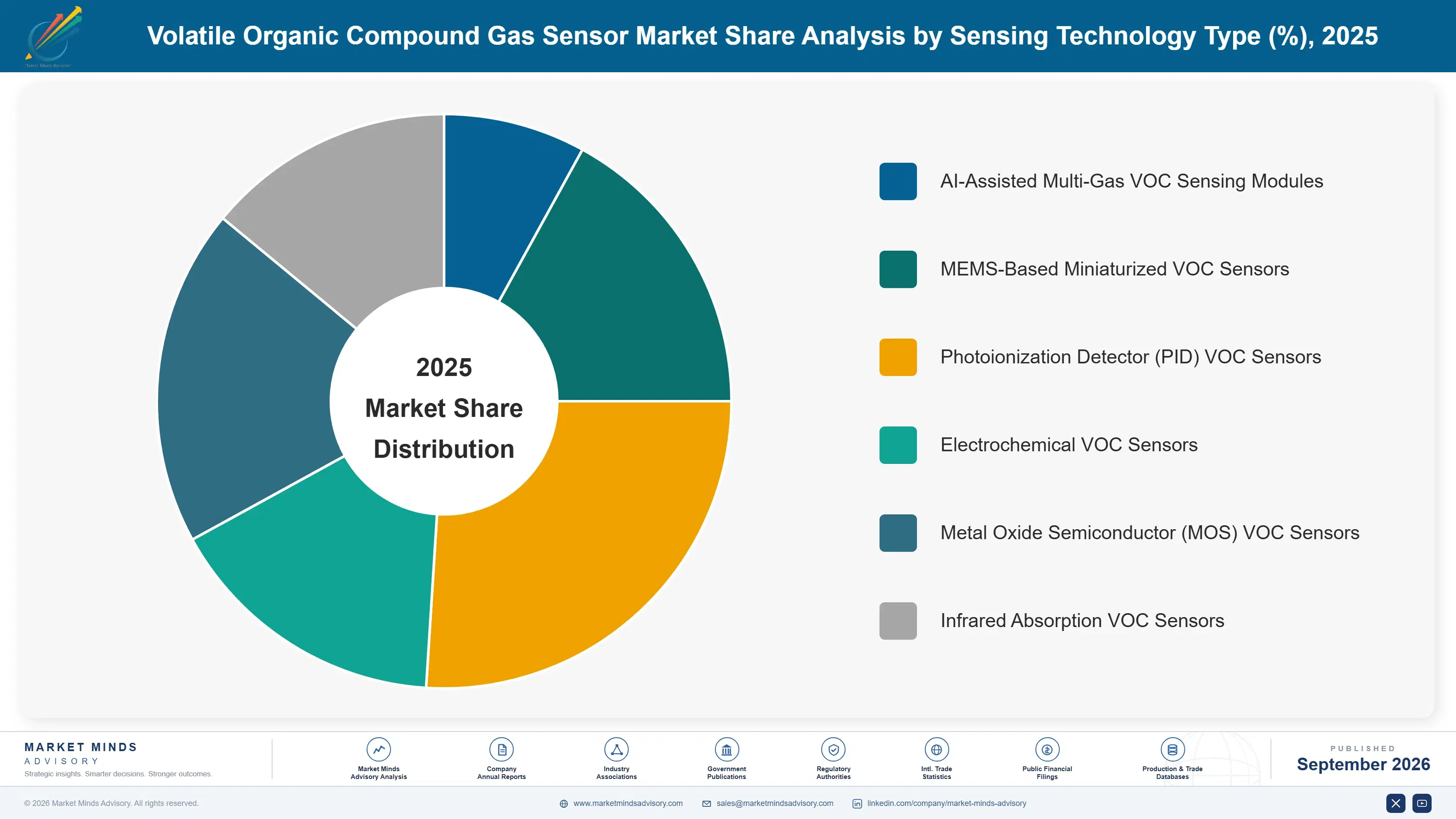
Segmentation follows sensing technology within VOC detection, spanning AI-assisted multi-gas sensing modules, MEMS-based miniaturized sensors, photoionization detector sensors, electrochemical sensors, and metal oxide semiconductor sensors, each addressing a genuinely distinct sensing technology approach rather than overlapping customer type, application category, pricing tier, deployment location, or power budget segments across this entire broader global sensing market.
volatile-organic-compound-gas-sensor-market-market-share-analysis-1789988134709

AI-Assisted Multi-Gas VOC Sensing Modules

AI-assisted multi-gas sensing modules lead growth as building operators finally have technology capable of distinguishing specific pollutant sources rather than reporting only an aggregate concentration number that leaves the appropriate response entirely to guesswork. These modules combine multiple sensing elements with machine learning classification algorithms trained to recognize the distinct chemical signatures of cleaning products, furnishings, cooking activity, and genuine ventilation failures affecting indoor air quality. Commercial office buildings and healthcare facilities are adopting this segment fastest, since actionable source identification meaningfully reduces both false alarm fatigue and the liability exposure that misdiagnosed air quality incidents can create for facility management teams. Vendors combining deep chemical sensing expertise with proprietary classification algorithms are capturing disproportionate share of this expanding investment.
CAGR 15.0%

MEMS-Based Miniaturized VOC Sensors

MEMS-based miniaturized VOC sensors are the second-fastest growing segment, driven by device makers finally having sensing elements small and power-efficient enough to embed directly into wearable devices, smartphones, and compact consumer air quality monitors that traditional larger sensing technologies could never fit into comparably sized enclosures. These sensors increasingly incorporate low-power operation modes that extend battery life considerably compared to earlier generation sensing elements requiring continuous heater operation for accurate readings. Consumer electronics and wearable device makers are adopting this segment fastest, since miniaturization finally makes VOC sensing commercially viable within their extremely tight size and power budget constraints. Vendors offering the lowest power draw are winning design sockets fastest across battery-constrained consumer device categories.
CAGR 14.0%
Full segment breakdown across 5 segments available in the complete report.

Regional Architecture and Country Demand Map

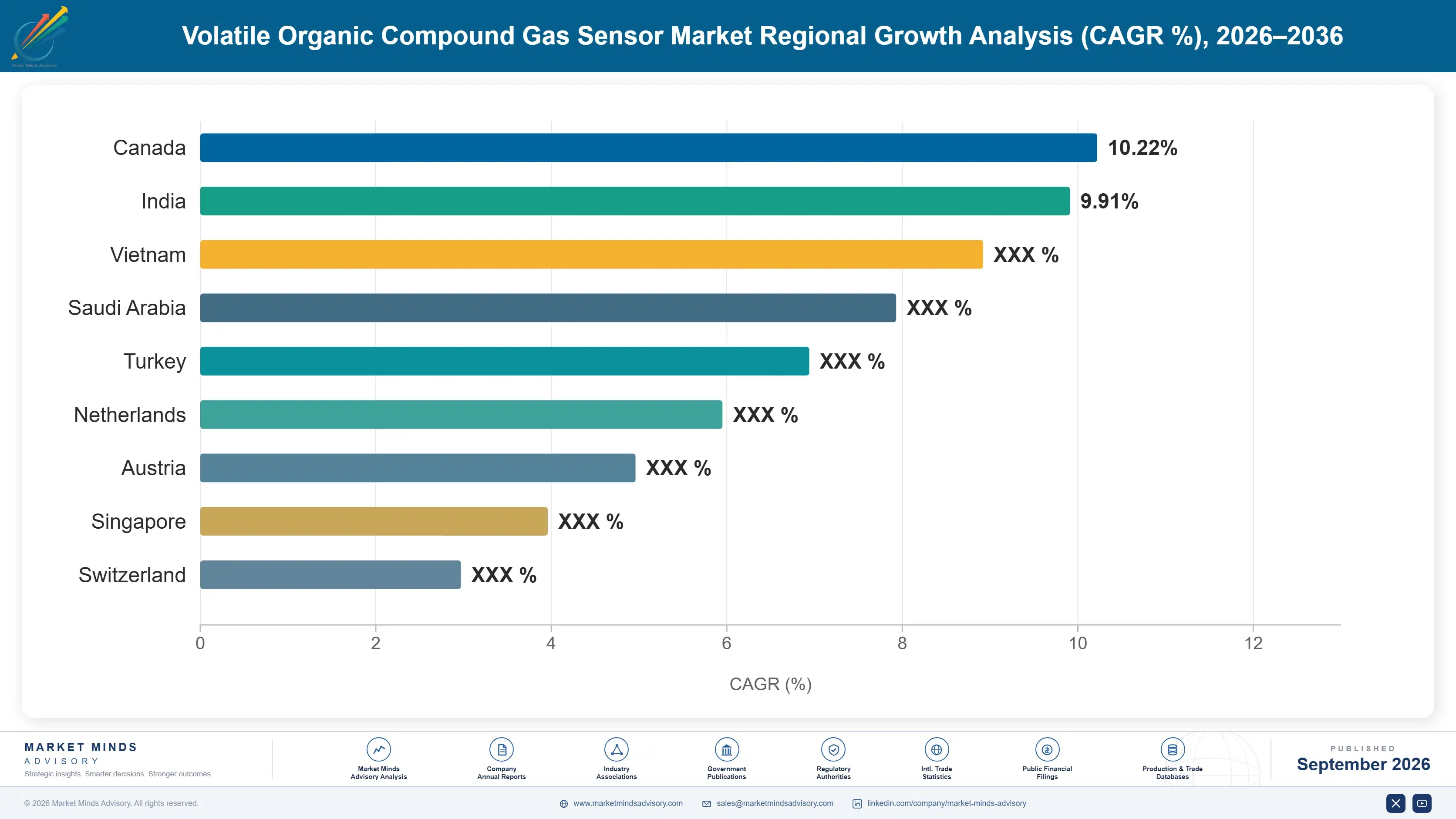
East Asia leads on concentrated electronics manufacturing capacity and acute urban air pollution concerns, while North America follows closely behind on regulatory indoor air quality standards, and South Asia and Pacific posts the fastest overall regional growth on expanding air quality monitoring investment today and going forward.

East Asia

China's massive electronics manufacturing base and severe urban air pollution challenges have driven both domestic sensor production scale and strong consumer demand for air quality monitoring devices across major metropolitan areas. Japan and South Korea maintain technologically sophisticated sensor markets that have adopted AI-assisted classification capability earlier than most other regions given their advanced electronics manufacturing infrastructure and consumer technology adoption patterns. Both countries increasingly favor vendors offering compact, low-power sensor designs suited to space-constrained residential and automotive applications common across the region. Rising domestic automotive production across the region continues supporting sustained investment in cabin air quality sensing technology broadly. Taiwan's semiconductor manufacturing base is following a similar sensor integration trajectory as adoption expands further.
Share: 30% | CAGR: 11.0% (2026 to 2036)

North America

US building codes and workplace safety regulations increasingly incorporate indoor air quality monitoring requirements, giving domestic sensor vendors including Honeywell and Amphenol continued design leadership across commercial and industrial applications. Major automakers headquartered domestically drive substantial demand for cabin air quality sensing as vehicle health features become an increasingly important competitive differentiator relative to international competitors. Canadian building and automotive sectors are following a similar adoption trajectory under comparable regulatory guidance and shared vendor relationships. Large commercial real estate operators continue driving a substantial share of near-term sensor demand as they modernize aging building ventilation infrastructure considerably. Mexican cross-border manufacturers are following a comparable adoption curve closely behind. Large commercial real estate operators continue investing steadily in ventilation modernization.
Share: 26% | CAGR: 10.5% (2026 to 2036)
Regional intelligence for 5 additional markets available in the complete report: Western Europe, South Asia and Pacific, Latin America, Middle East and Africa, Eastern Europe. Contact sales@marketmindsadvisory.com.
volatile-organic-compound-gas-sensor-market-country-cagr-analysis-1789988135239

Where VOC Sensor Vendors Should Expand Next

Beyond core sensor hardware sales, vendors are building adjacent commercial layers around AI classification software licensing, calibration and maintenance service contracts, building management system integration fees, and extended warranty programs, each extending overall contract value well past the initial installation into sustained multi-year customer relationships across large and mid-sized enterprise accounts operating everywhere worldwide.

AI Classification Software Licensing Program Tiers

Vendors are commercializing AI-assisted source classification software as a paid tier layered on top of core sensor hardware sales, since building operators increasingly value actionable pollutant identification over raw concentration readings that leave the appropriate response entirely to guesswork. This software layer now generates roughly 18 percent of total revenue at several leading vendors, well above the negligible share software represented when basic concentration sensors dominated the category. Customers accept this premium since actionable classification clearly reduces false alarm fatigue and liability exposure relative to competitor offerings lacking comparable intelligence.
Market Impact: 18% of revenue now from software licensing today

Calibration and Maintenance Service Contract Programs

Calibration and maintenance service contracts covering periodic recalibration and drift compensation are commanding meaningful incremental revenue beyond one-time hardware sales, since building operators consistently underestimate the ongoing maintenance burden that sensing elements degrading over time actually require to maintain reliable readings. Attach rates for maintenance contracts now exceed 42 percent among large commercial building customers, up sharply from a negligible share when sensors were sold as standalone hardware without ongoing support. Vendors bundling maintenance into tiered packages are seeing measurably longer customer relationships than those selling sensors as a one-time transaction.
Market Impact: 42% attach rate on maintenance contracts right now

Building Management System Integration Fee Structures

Building management system integration fees for connecting sensor data streams to existing HVAC control platforms are generating meaningful incremental revenue beyond core sensor sales, since customers consistently underestimate the technical complexity required to properly integrate sensor data into automated ventilation control workflows. These integration services now represent roughly 15 percent of first-year contract value at several leading vendors, reflecting genuine willingness to pay for faster, lower-risk deployment. Vendors offering this service report meaningfully higher customer satisfaction than those leaving integration entirely to third-party building automation contractors. Larger vendors increasingly prefer offering this integration directly rather than through third parties.
Market Impact: 15% of first-year value from integration fees now

Extended Warranty and Coverage Program Tiers

Extended warranty programs covering sensor component failure and accuracy drift beyond standard coverage periods are commanding premium pricing over basic one-year warranties, since building owners increasingly prioritize cost certainty against unexpected replacement expenses during a sensor's typical multi-year operational lifespan. These extended programs have expanded average contract value by roughly 20 percent for vendors pursuing this model, reflecting genuine customer willingness to pay for predictable long-term ownership costs. Vendors lacking extended warranty options increasingly struggle to compete for the largest commercial building accounts against competitors offering comprehensive long-term coverage already proven.
Market Impact: 20% larger contracts via extended warranty programs today

Who Controls the Margin Pool

VOC gas sensors remain moderately concentrated, with the top five vendors holding an estimated 40 percent of the market on a shipped-unit-volume basis. Sensirion and Figaro Engineering lead on breadth across sensing technology product lines, while a gap separates them from smaller specialist challengers competing mainly on niche depth rather than broad platform scale.
Current competitive activity centers on three fronts: vendors racing to embed AI-assisted source classification into existing sensing platforms to close the intelligence gap with data-driven challengers, larger sensor manufacturers acquiring specialized classification software startups rather than building comparable capability internally, and several vendors expanding automotive cabin sensing product lines to capture standard equipment design wins. Pricing pressure has intensified among mid-tier vendors competing for cost-sensitive consumer accounts larger vendors consider too small.

Emerging pressure comes from air quality software startups entering the sensing market through data platform partnerships rather than proprietary hardware development, betting classification intelligence can substitute for the deep sensing chemistry expertise established manufacturers have built over decades of research. Rankings could shift meaningfully if a major building code authority mandates a sensing standard favoring one vendor's architecture, since building owners facing compliance tend to consolidate around whichever platform already meets the requirement natively.
volatile-organic-compound-gas-sensor-market-company-positioning-matrix-1789988135769

Competitive Moat and Risk Dimensions

SENSIRION

Moat: Deep sensing chemistry expertise

Sensirion's decades of investment in proprietary sensing materials and chip-scale integration give it detection accuracy and miniaturization capability that specialized software-only entrants cannot match, letting it win design contracts prioritizing sensing fundamentals over classification software alone across every major application category and geography served today.
SENSIRION

Risk: Slower software iteration pace

As a hardware-centric manufacturer, Sensirion's AI classification software iterates more slowly than venture-backed data science specialists focused purely on machine learning model accuracy, risking share loss among customers prioritizing the most advanced source identification capability over established hardware relationships and sensing accuracy credentials built over many years.
FIGARO ENGINEERING

Moat: Strong industrial safety relationships

Figaro Engineering's long-standing relationships with industrial safety equipment manufacturers give it privileged access to gas detection applications requiring proven reliability credentials that newer entrants struggle to win without comparable field deployment history and regulatory certification experience built over many decades of dedicated engineering operation and investment.
FIGARO ENGINEERING

Risk: Limited consumer market presence

Figaro Engineering's traditional strength in industrial and safety applications has not translated as strongly into consumer air quality monitoring devices, a segment growing faster than the industrial-focused core business, risking share loss among consumer electronics customers prioritizing miniaturization and cost over industrial-grade reliability credentials built over decades.

Players Tracked

Prominent Players

Sensirion
Figaro Engineering
Amphenol
Honeywell
Bosch Sensortec

Other Key Players

ScioSense
Alphasense
Membrapor
Winsen Electronics
Nissha FIS
ams OSRAM
SPEC Sensors
Renesas Electronics
Aeroqual
Dart Sensors
GfG Instrumentation
Industrial Scientific
Drägerwerk
MSA Safety
3M

Recent Developments

MARCH 2026

Sensirion Acquires AI Classification Startup

Sensirion acquired a small AI-assisted gas classification startup specializing in machine learning models for distinguishing pollutant sources from raw sensor readings, folding the technology directly into its existing sensor platform rather than continuing to rely on third-party software partners for advanced classification capability across customers.
Signal: Large sensor manufacturers are increasingly securing AI classification capability through direct targeted acquisition rather than partnerships.
OCTOBER 2025

Figaro Engineering Signs Automotive Design Agreement

Figaro Engineering signed a multi-year design agreement with a major automaker to supply cabin air quality sensors as standard equipment across an expanding vehicle lineup, replacing a previously optional premium feature that had significantly limited the sensor's addressable vehicle production volume across the manufacturer's entire model range.
Signal: Sensor vendors are increasingly securing automotive design wins as cabin air quality becomes standard vehicle equipment.
MAY 2025

Amphenol Expands Building Management Integration

Amphenol announced expanded building management system integration capability for its VOC sensor platform, aimed at reducing the technical complexity building operators previously faced when connecting sensor data streams to existing HVAC control systems across large commercial facilities, campuses, and expanding multi-building real estate portfolios nationwide.
Signal: Vendors are increasingly investing directly in building management integration to fully reduce all customer implementation complexity.

Precision Sensing Materials Shape Vendor Margins

Precision sensing materials and MEMS fabrication together represent roughly 52 percent of cost of goods sold for VOC sensor vendors, notably higher than general electronics assembly cost structures typically face across the industry today. Sensing material and chip fabrication costs alone account for close to 30 percent, reflecting the specialized manufacturing processes required for reliable gas detection accuracy.
Precision sensing material pricing rose sharply during 2022 and 2023, following broader semiconductor supply constraints documented in major electronics industry supply chain reports published widely during that period across the entire global industry. Vendors serving high-volume automotive and consumer electronics programs absorbed meaningfully higher material costs for several consecutive quarters before securing improved supplier allocation terms roughly a year later at considerably more favorable pricing.

Smaller vendors lacking scale to negotiate favorable material supply contracts face a real cost disadvantage against larger competitors like Sensirion, who can spread sensing material and fabrication costs across a broader product portfolio and negotiate volume discounts unavailable to smaller specialists entirely. This dynamic increasingly pushes smaller vendors toward niche application markets where larger competitors see insufficient contract value to compete aggressively on price alone.
volatile-organic-compound-gas-sensor-market-cost-volatility-analysis-1789988135968

Multi-Source Material Supply Agreements

Vendors are qualifying multiple sensing material suppliers across different geographies, continents, and regions to reduce dependence on any single manufacturer, using competitive bidding processes among qualified suppliers to keep material cost growth well below customer pricing expectations each year during periods of industry-wide supply tightness, unexpected constraint, and prolonged shortage across the entire global sector.

Design Standardization Across Product Lines

Vendors are standardizing sensing element designs across multiple product tiers each year rather than developing entirely unique materials for each individual sensor variant, meaningfully reducing per-unit tooling and procurement costs while still allowing meaningful feature differentiation through software and calibration rather than proprietary materials alone across every single product line, price tier, and target market.

Vertical Integration Into Material Production

Larger manufacturers are acquiring or building in-house sensing material production capability each year to reduce reliance on third-party suppliers entirely, a highly capital-intensive strategy that smaller manufacturers cannot easily replicate without significant outside investment or a dedicated strategic partnership arrangement with a material specialist willing to share proprietary formulations, manufacturing processes, and deep technical know-how.

Portfolio Architecture for Margin Defence

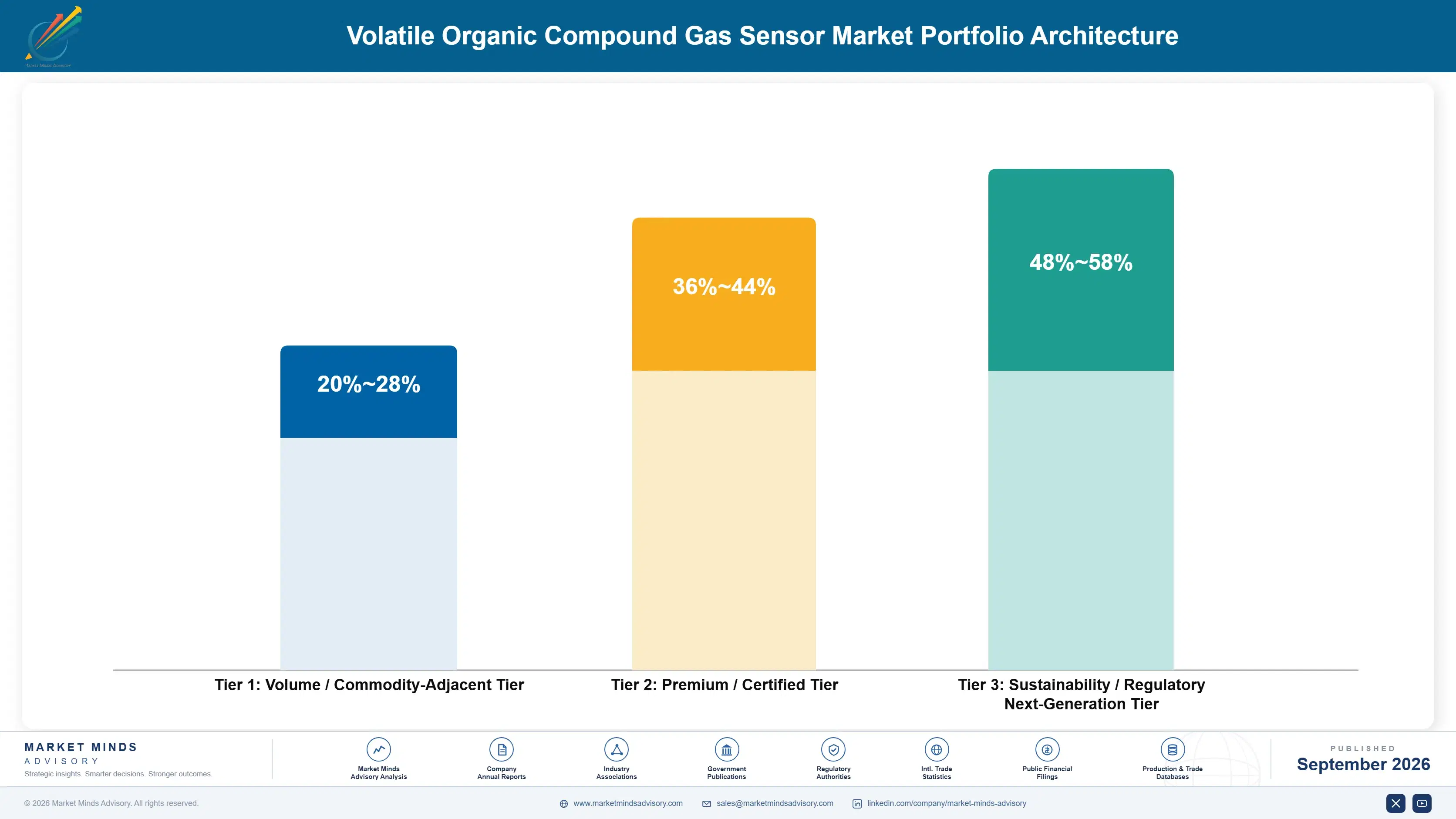
VOC gas sensors span three commercial tiers: basic single-gas detection at the volume end, certified multi-gas sensing modules meeting reliability benchmarks in the middle, and AI-assisted source classification suites at the premium top, with gross margins expanding meaningfully from the commodity tier through to next-generation modules that command significantly higher recurring revenue per customer account and application.
Volume-tier single-gas detection faces persistent price pressure from customers treating basic sensing as commoditized components, while premium AI classification suites increasingly capture disproportionate margin as customers pay for actionable source identification rather than raw concentration data alone. Vendors straddling both tiers face internal tension allocating engineering resources between defending existing sensing accounts and building the next-generation classification capability premium customers now demand.

High-value margin pools concentrate heavily around AI-assisted classification and automotive cabin sensing, where large customers pay meaningfully more for measurable reductions in false alarm fatigue and liability exposure. Smaller vendors without machine learning depth remain confined to lower-margin detection work, ceding the fastest-growing and most profitable segment entirely to larger, better-capitalized competitors with deeper research and materials science budgets. This margin gap widens further each year.

Volume / Commodity-Adjacent Tier

Basic single-gas detection sensors serving cost-sensitive applications with minimal classification capability beyond simple threshold-based alerting and basic concentration reporting functions lacking any deeper analysis or contextual awareness whatsoever for the operator.
Gross Margin: 20-28%

Premium / Certified Tier

Certified multi-gas sensing modules meeting reliability benchmarks, offering integrated detection across multiple pollutant categories that meaningfully reduces the single-gas blind spots basic sensors carry across most applications, environments, and use cases.
Gross Margin: 36-44%

Sustainability / Regulatory / Next-Generation Tier

AI-assisted source classification suites that distinguish specific pollutant origins and generate actionable ventilation recommendations, commanding the highest per-unit pricing among the largest global commercial customers, building operators, and facility managers.
Gross Margin: 48-58%
volatile-organic-compound-gas-sensor-market-portfolio-architecture-1789988136470

High-value Sub-segments and Strategic Watch-out

AI-Assisted Multi-Gas VOC Sensing Modules

This segment combines the fastest unit growth in the market with the highest per-unit pricing, as customers pay premium rates for classification that reduces false alarm fatigue and liability exposure, making it the clearest priority for vendor R&D investment over the next several years across accounts.
Gross Margin: 52-62%

MEMS-Based Miniaturized VOC Sensors

Growing quickly on device makers finally reaching compact consumer form factors, this segment carries strong margins though slightly below the AI leader, as vendors increasingly bundle miniaturization with low power draw to justify premium pricing over larger legacy sensors sold today, quite consistently and reliably.
Gross Margin: 40-48%

Photoionization Detector (PID) VOC Sensors

A large installed-base segment growing at a moderate pace, this detection category remains the anchor product most industrial customers purchase first before considering broader classification investment, anchoring overall category volume even as growth increasingly and consistently shifts toward AI-enabled products each and every year overall.
Gross Margin: 30-38%

Metal Oxide Semiconductor (MOS) VOC Sensors

Growth here trails the fastest segments, and vendors risk this category commoditizing further as basic metal oxide sensing becomes a standard feature bundled into broader consumer devices rather than sold separately as a distinct standalone component for most integrators today and going forward everywhere globally.
Gross Margin: 22-30%

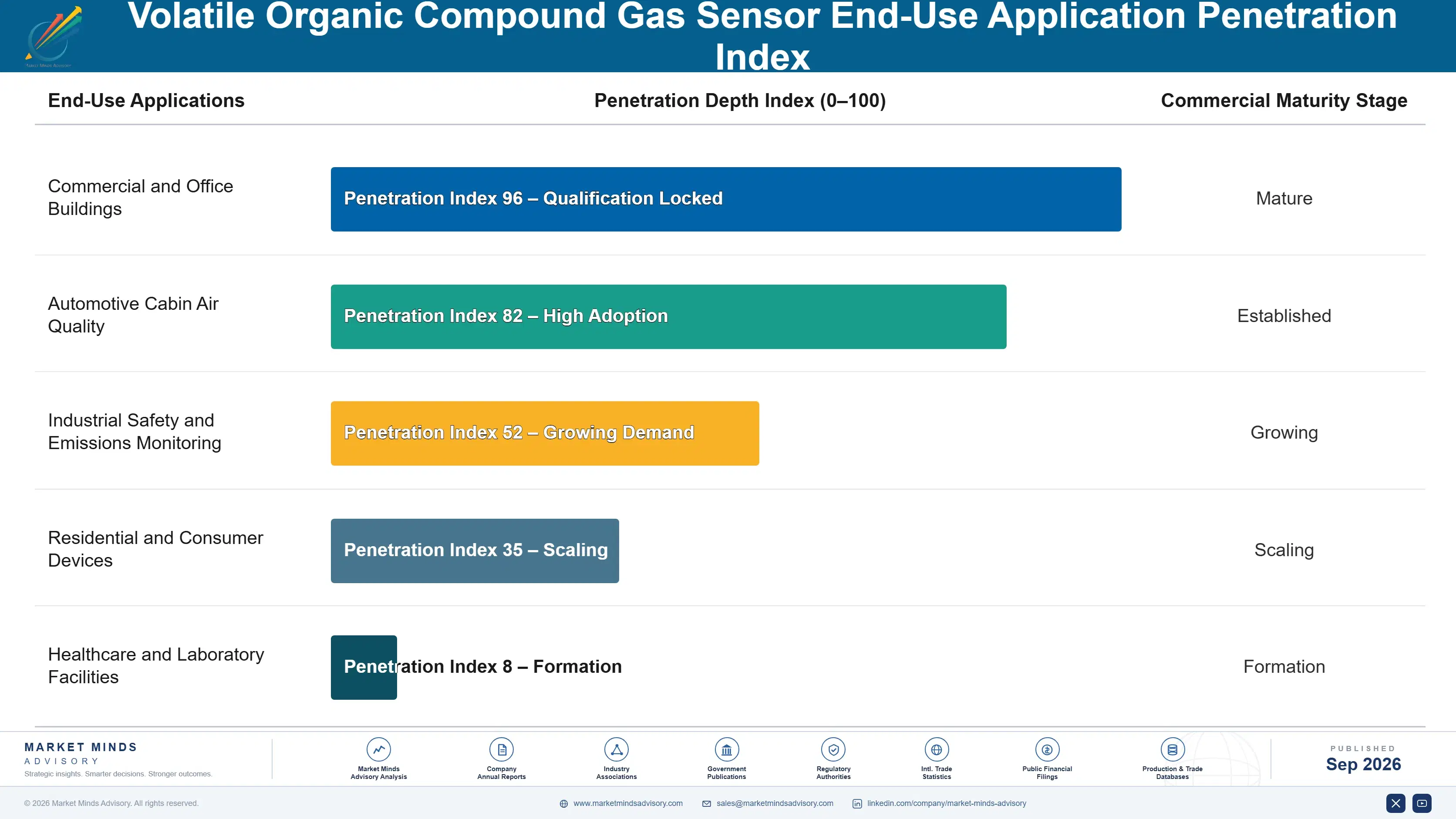
Why Sensor Contracts Compound Over Years

VOC sensor relationships increasingly function as annuity products rather than one-time hardware sales, since AI classification subscriptions, calibration contracts, and extended warranties attach to the initial installation and recur across a building's typical eight to twelve year sensor replacement cycle. Vendors capturing this attached recurring revenue build customer lifetime value multiples well above the original sensor hardware price.
Adoption depth varies meaningfully by facility scale: smaller buildings adopt shallowly, deploying basic detection without deep classification integration, while large commercial and industrial operations integrate sensor relationships deeply into HVAC control, compliance documentation, and predictive maintenance workflows, creating switching costs that keep those customers within a single vendor's product family across multiple building expansion and technology refresh cycles.

Buyer profiles are shifting generationally as facility management organizations increasingly include dedicated indoor air quality and sustainability leads who evaluate vendor selection through classification accuracy and integration flexibility criteria rather than pure detection sensitivity comparisons alone. Younger facility managers entering these roles expect measurable proof of occupant health and liability reduction before purchase, favoring vendors who can demonstrate quantified outcomes over long-standing incumbent relationships built on legacy vendor tenure.
volatile-organic-compound-gas-sensor-market-end-use-penetration-index-1789988136969

Priorities for VOC Sensor Vendors

These are among the four positions where our research anticipates prominent divergence between winners and laggards over the coming forecast period. Each is grounded in the demand model, the regulatory perimeter, and the announced capacity pipeline.
01 / AI CLASSIFICATION INVESTMENT

Build Source Identification, Not Just Detection

Building operators increasingly evaluate sensor investment on actionable pollutant identification rather than accepting raw concentration numbers that leave the appropriate response entirely to guesswork and operator intuition alone. Vendors who lead with documented classification accuracy during procurement evaluations close larger facility contracts meaningfully faster than those emphasizing detection sensitivity alone, since genuine classification capability, not raw sensing specifications, wins the largest commercial building accounts today. Vendors treating AI as a checkbox rather than a core competency are losing ground steadily.
02 / SELF-CALIBRATING SENSOR DEVELOPMENT

Build Drift Compensation Before Rivals Do

Sensor drift and the ongoing recalibration burden it creates represent a significant hidden cost that building owners consistently underestimate during initial procurement decisions, making self-calibrating sensor designs a durable competitive advantage that reduces total ownership cost meaningfully over a sensor's operational lifespan and warranty period across most commercial deployments. Vendors that build automated drift compensation capability early capture disproportionate share among facility managers prioritizing predictable long-term maintenance costs and budget certainty. Self-calibration is becoming as commercially valuable as raw detection accuracy itself.
03 / AUTOMOTIVE DESIGN WIN FOCUS

Secure Standard Equipment Positions Before Competitors

Automakers are rapidly transitioning cabin air quality sensing from an optional premium feature to standard equipment across expanding vehicle lineups, and vendors securing these design wins now will benefit from years of guaranteed production volume that competitors entering later cannot easily displace once a platform commitment has already been made and locked in. Building this capability now positions vendors ahead of the standard-equipment transition that shows no signs of reversing across the automotive industry. Design win timing is becoming a genuine competitive differentiator.
04 / BUILDING MANAGEMENT INTEGRATION

Build Native HVAC Integration Ahead of Demand

Building management system integration is becoming a baseline procurement expectation rather than a differentiator, and vendors lacking reliable data exchange capability with existing HVAC control platforms will increasingly lose facility accounts to competitors who can demonstrate reliable operational integration regardless of underlying sensing accuracy credentials already established and proven in the field. Vendors investing in integration capability now will avoid the customer dissatisfaction that fragmented, poorly integrated deployments have historically caused across the industry. Integration reliability is becoming as valuable as the sensor itself.

Engagement Snapshot From the Field

A live engagement with an industry participant carrying material or product regulatory and market exposure ahead of a defining policy shift, showing how our research translates into a defensible multi-year portfolio strategy.
MARKET MINDS ADVISORY · CLIENT ENGAGEMENT SUMMARY
Volatile Organic Compound Gas Sensor Producer Strategic Portfolio Review and Transition Roadmap 2026·Investment Scenario on Volatile Organic Compound Gas Sensor Exposure Evaluation 2025-26
CLIENT PROFILE
The client manages a portfolio of roughly 18 mid-size office buildings totaling 2.1 million square feet, with basic single-gas VOC detectors installed years ago that generated frequent false alarms tenants had learned to ignore entirely. Annual tenant complaints related to air quality exceeded 340 incidents (client-reported, unverified by MMA), a volume the property management team could no longer adequately investigate.
STRATEGIC CHALLENGE
The portfolio's aging single-gas detectors could not distinguish between genuinely hazardous conditions and benign activity like cleaning or cooking, generating false alarms that had eroded tenant trust in the monitoring system entirely. Leadership needed a modernization strategy that would restore tenant confidence in air quality alerts without requiring a complete building-wide sensor replacement across the entire portfolio simultaneously.
MMA APPROACH
MMA benchmarked the portfolio's false alarm history and tenant complaint patterns against three AI-assisted classification vendors, modeling expected false alarm reduction and tenant satisfaction improvement under each option. The engagement combined vendor technical evaluation of classification accuracy with a phased building-by-building rollout strategy prioritizing the properties generating the most tenant complaints.
KEY FINDINGS
  1. The highest-complaint 25 percent of buildings accounted for a disproportionate share of total portfolio-wide air quality complaints and repeated false alarm incidents overall.
  2. AI-assisted classification demonstrated measurably higher accuracy distinguishing genuine hazards from benign activity across a large representative sample of historical alarm data collected.
  3. Tenant surveys revealed that repeated false alarms had meaningfully eroded trust in the monitoring system well beyond what property managers had previously realized.
  4. A phased building-by-building rollout allowed the property team to validate vendor performance before committing to full portfolio-wide deployment across all the remaining properties.
CLIENT PROFILE
The client manages a portfolio of roughly 18 mid-size office buildings totaling 2.1 million square feet, with basic single-gas VOC detectors installed years ago that generated frequent false alarms tenants had learned to ignore entirely. Annual tenant complaints related to air quality exceeded 340 incidents (client-reported, unverified by MMA), a volume the property management team could no longer adequately investigate.
STRATEGIC CHALLENGE
The portfolio's aging single-gas detectors could not distinguish between genuinely hazardous conditions and benign activity like cleaning or cooking, generating false alarms that had eroded tenant trust in the monitoring system entirely. Leadership needed a modernization strategy that would restore tenant confidence in air quality alerts without requiring a complete building-wide sensor replacement across the entire portfolio simultaneously.
MMA APPROACH
MMA benchmarked the portfolio's false alarm history and tenant complaint patterns against three AI-assisted classification vendors, modeling expected false alarm reduction and tenant satisfaction improvement under each option. The engagement combined vendor technical evaluation of classification accuracy with a phased building-by-building rollout strategy prioritizing the properties generating the most tenant complaints.
KEY FINDINGS
  1. The highest-complaint 25 percent of buildings accounted for a disproportionate share of total portfolio-wide air quality complaints and repeated false alarm incidents overall.
  2. AI-assisted classification demonstrated measurably higher accuracy distinguishing genuine hazards from benign activity across a large representative sample of historical alarm data collected.
  3. Tenant surveys revealed that repeated false alarms had meaningfully eroded trust in the monitoring system well beyond what property managers had previously realized.
  4. A phased building-by-building rollout allowed the property team to validate vendor performance before committing to full portfolio-wide deployment across all the remaining properties.
RECOMMENDED STRATEGY
Phase 1: Phase 1 (Months 1-3): Deploy new AI-assisted classification sensors at the highest-complaint buildings identified in this initial detailed complaint analysis. Phase 2: Phase 2 (Months 4-8): Extend the deployment across the remaining portfolio while closely monitoring false alarm reduction and tenant feedback. Phase 3: Phase 3 (Months 9-11): Integrate all sensor data with existing building management systems and launch new tenant-facing air quality reporting.
OUTCOME
Within eleven months of completing the full portfolio-wide rollout, the client reported air quality complaints declining by roughly 64 percent (client-reported, unverified by MMA), alongside a measured improvement in tenant satisfaction scores related to building air quality, comfort, and overall trust in the monitoring system.

Frequently Asked Questions

Foundational context covering the market sizes, CAGR, scope, country, region and competition that inform every finding below. This section is provided to cover basics and most often pre-purchase conversations, answered from the MMA Primary Research Dataset.

What is the current size of the Volatile Organic Compound Gas Sensor Market?

The VOC gas sensor market was valued at $1.9 billion in 2025. It is projected to reach $2.09 billion in 2026 as indoor air quality awareness accelerates adoption.

How large will the Volatile Organic Compound Gas Sensor Market be by 2036?

The market is projected to reach $5.42 billion by 2036, up from $2.09 billion in 2026. That represents a 2.59 times expansion over the forecast decade.

What is the CAGR for the Volatile Organic Compound Gas Sensor Market 2026 to 2036?

The market is projected to grow at a 10.0 percent CAGR between 2026 and 2036. This is up from a historical CAGR of roughly 9.0 percent between 2020 and 2025.

Which segment is growing fastest?

AI-assisted multi-gas VOC sensing modules lead growth at a 15.0 percent CAGR, roughly 1.5 times the overall market rate. Building operators finally have technology that identifies specific pollutant sources.

Who are the major companies in the Volatile Organic Compound Gas Sensor Market?

Sensirion, Figaro Engineering, Amphenol, Honeywell, and Bosch Sensortec are the five largest participants by shipped-unit-volume basis. Together they hold an estimated 40 percent of the global market.

Which country is growing fastest?

India is the fastest-growing country at a 13.0 percent CAGR, driven by severe urban air pollution challenges and expanding consumer air purifier demand. Rising electronics manufacturing reinforces this trajectory further.

Report Segmentation Architecture

The full report scope spans multiple orthogonal segmentation dimensions, with cross-tabulated demand data provided for each dimension pair. Coverage extends further to regional breakdowns, trend trajectories, and the competitive detail needed to support segment-level decision-making.

By Sensing Technology Type

  • AI-Assisted Multi-Gas VOC Sensing Modules
  • MEMS-Based Miniaturized VOC Sensors
  • Photoionization Detector (PID) VOC Sensors
  • Electrochemical VOC Sensors
  • Metal Oxide Semiconductor (MOS) VOC Sensors
  • Infrared Absorption VOC Sensors

By End-Use Application

  • Commercial and Office Buildings
  • Automotive Cabin Air Quality
  • Industrial Safety and Emissions Monitoring
  • Residential and Consumer Devices
  • Healthcare and Laboratory Facilities

By Commercial Dimension

  • Original Equipment Manufacturer Direct Sales
  • Distributor and Channel Partner Sales
  • Calibration and Maintenance Service Bundles
  • Software Classification Licensing Programs

By Region

  • North America
  • Western Europe
  • East Asia
  • South Asia and Pacific
  • Latin America
  • Middle East and Africa
  • Eastern Europe

Scope, Methodology, and Coverage

Every figure in this report is reproducible from documented input assumptions. The scope below maps the historical period, the forecast horizon, the segmentation dimensions, and the countries covered, alongside the underlying primary and qualitative methodology.
Historical Period
2020 to 2025
Forecast Period
2026 to 2036
Base Year
2025 (USD billions; MMA Primary Research Dataset, September 2026)
Market Definition
The VOC gas sensor market covers sensors that detect volatile organic compounds in indoor, industrial, and automotive air using metal oxide, photoionization, electrochemical, and MEMS-based sensing technologies. It excludes generic smoke detectors and laboratory-grade gas chromatography instrumentation not embedded as compact sensor components.
Quantitative Units
USD billions (current prices); shipped unit volume where applicable
Segmentation Dimensions
By Sensing Technology Type; By End-Use Application; By Commercial Dimension; By Region
Regions Covered
North America, Western Europe, East Asia, South Asia and Pacific, Latin America, Middle East and Africa, Eastern Europe
Countries Covered
USA, China, Germany, France, UK, Japan, South Korea, India, Australia, Canada, Brazil, Mexico, Indonesia, Vietnam, Thailand, Malaysia, UAE, Saudi Arabia, South Africa, Nigeria, Turkey, Poland, Netherlands, Italy, Spain, Sweden, Switzerland, Argentina, Colombia, Singapore, and additional markets relevant to this sector
Key Companies Profiled
Sensirion, Figaro Engineering, Amphenol, Honeywell, Bosch Sensortec, ScioSense, Alphasense, Membrapor, Winsen Electronics, Nissha FIS, ams OSRAM, SPEC Sensors, Renesas Electronics, Aeroqual, Dart Sensors, GfG Instrumentation, Industrial Scientific, Drägerwerk, MSA Safety, 3M
Quantitative Methodology
Primary survey, n=3,800 respondents, Q4 2025, six countries; demand-side model with trade association cross-validation
Qualitative Methodology
47 expert interviews, Q4 2025; applied to validate demand model assumptions, identify emerging dynamics, and assess competitive positioning
Report Format
PDF and XLSX data workbook (Word format preview document)
Publisher
Market Minds Advisory
Report Code
MMA-2026-TEC-194
Published
September 2026
Contact
sales@marketmindsadvisory.com | www.marketmindsadvisory.com

Purchase the full Volatile Organic Compound Gas Sensor Market Report (2026 to 2036).

This report delivers a comprehensive analysis of the global VOC gas sensor market, spanning sensing technology segmentation, regional demand dynamics, and competitive positioning across twenty profiled companies worldwide. It includes ten-year forecasts through 2036, detailed input cost and margin analysis across three commercial tiers, and revenue diversification strategies for vendors navigating the shift toward AI-assisted source classification. The analysis draws on primary survey data, expert interviews, and company disclosures to support procurement, investment, and product strategy decisions. It closes with an anonymized client modernization case study illustrating measured complaint and satisfaction outcomes.
Sensing technology segmentation with detailed growth forecasts
Seven-region demand analysis through the 2036 forecast
Competitive benchmarking of twenty profiled global vendors
Input cost and gross margin tier breakdown analysis
Revenue diversification and recurring pricing lever analysis
Anonymized client modernization case study with outcomes

Built For The People Who Decide

From boardroom strategy to bench-side execution, this report is read cover-to-cover by leaders shaping the next decade of their industry, turning demand scenarios, market dynamics and valuation benchmarks into decisions.
CXOs/ Presidents/ VPs/ Managers
M&A and Corporate Development
Strategy Teams and R&D Heads
Procurement and Product Directors
Regulatory and Compliance Leaders
Investor Relations and Equity Analysts