

Market Minds Advisory
Voice over LTE Market

Voice over LTE Market: IMS Core, Interconnect, and Enablement Solutions for Carrier Voice Transition.

Circuit-switched voice networks are being retired worldwide, pushing remaining carriers toward IP Multimedia Subsystem infrastructure while RCS messaging and international VoLTE roaming agreements extend the category well past initial rollout completion in mature markets.

Lead Analyst

Published

September 2026

Make Smarter Decisions with Customized Research Insights

Request a free sample report and evaluate market opportunities, growth trends, and competitive dynamics relevant to your business needs.

2025 MARKET VALUE$9.5BMarket Size 2025
2036 FORECAST VALUE$20.0BBase Case , 2026 to 2036
CAGR 2026 TO 20367.0 %Bull 8.2% / Bear 5.8%
INCREMENTAL OPPORTUNITY$9.8BNet 10- year value creation
EXPANSION MULTIPLE1.97x2036 value over 2026 base
Strategic Levers
M&A Pipeline
Regional Outlook
Country Rankings
Competitive Intelligence
Segmental Deep-dive
Call-Us : 91 93563 13602

Executive Snapshot and Market Trajectory.

Voice over LTE has moved past its initial deployment phase in developed markets and into a second growth wave driven by remaining 2G and 3G network shutdowns, expanding international roaming agreements, and Rich Communication Services messaging bundled directly into the same IP Multimedia Subsystem infrastructure carriers already operate today.
Emerging market carriers completing circuit-switched sunset timelines and Rich Communication Services business messaging adoption are absorbing the largest share of new spending, with messaging integration growing fastest as brands shift customer engagement budgets away from traditional SMS toward richer, verified business messaging channels. East Asia and South Asia concentrate much of this second-wave spending, reflecting large subscriber bases still completing network modernization.
Competitive intensity remains high among a small group of established telecom equipment vendors, with Ericsson, Nokia, and Huawei holding durable incumbency advantages from decades of carrier relationships. Software-centric challengers led by Mavenir are gaining share in virtualized and cloud-native core deployments, particularly among carriers seeking to avoid vendor lock-in on newer greenfield network builds. Software-centric challengers are also targeting managed services and Rich Communication Services messaging capability as differentiators against incumbents still primarily selling hardware.
Market Definition
The market covers IP Multimedia Subsystem core infrastructure, session border controllers, testing and optimization solutions, device enablement software, and interconnect and roaming services that together deliver voice calling over Long-Term Evolution networks. It excludes underlying radio access network hardware, spectrum licensing, and consumer handset manufacturing.
Base Year Value
$9.5B in 2025 (MMA Primary Research Dataset, September 2026)
Forecast Period
2026 to 2036, eleven discrete annual values
CAGR
7.0% base case. Bull 8.2%. Bear 5.8%.
Fastest Growth Segment
RCS and Advanced Messaging Integration: 9.5% CAGR
Fastest Growth Country
India: 9.0% CAGR
Fastest Growth Region
South Asia and Pacific: 8.5% CAGR
Largest Region
East Asia: 26% of 2025 global value
Market Leaders
Ericsson, Nokia, Huawei, Samsung, ZTE. Source: MMA Analysis based on company annual reports and telecom industry disclosures.
Primary Survey
n=3,800 procurement and R&D decision-makers, Q4 2025, six countries
Methodology
Demand-side build-up, cross-validated against public data, 47 expert interviews

Voice over LTE Market Forecast Scenarios

voice-over-lte-market-size-forecast-scenario-1790001886777
Between 2020 and 2025 Voice over LTE adoption grew at an estimated 6.0% historical annual rate as most large developed-market carriers completed initial rollout, while growth in the period concentrated increasingly among emerging market operators still transitioning subscribers off older circuit-switched and 3G packet voice infrastructure entirely. Vendors report the period's growth as unusually bifurcated across regions, with fully-migrated markets contributing largely flat replacement demand.
The base case assumes continued mid-single-digit-to-high-single-digit expansion through 2036 as three mechanisms compound: remaining 2G and 3G network shutdowns forcing final subscriber migrations, expanding bilateral international roaming agreements that require interconnect infrastructure investment, and Rich Communication Services messaging monetization driving carriers to upgrade IP Multimedia Subsystem platforms they might otherwise have left untouched for several more years. Vendors report steady replacement-cycle demand even in fully-migrated markets as carriers refresh aging core equipment.
The bull case centers on Rich Communication Services business messaging revenue sharing agreements between carriers and technology platforms accelerating faster than currently modeled, pulling forward core infrastructure upgrade spending. The bear case hinges on Voice over New Radio and standalone fifth-generation voice architectures bypassing Voice over LTE core investment entirely in markets deploying fifth-generation networks from a comparatively later starting position.

Carrier Voice Transition Economics and Second-Wave Growth

Voice over LTE sits at an unusual point in its lifecycle: mature and largely complete in wealthy markets, yet still expanding meaningfully in population-dense emerging markets where circuit-switched sunset timelines lag developed-market completion by nearly a decade. This bifurcation means vendors serve simultaneously as replacement-cycle suppliers in one region and as first-time deployment partners in another within the same fiscal year.
MARKET CONCENTRATION (CR5)62%Reflects durable incumbency among established telecom equipment vendors
AVERAGE CORE DEPLOYMENT COST$18MTypical mid-tier carrier IP Multimedia Subsystem core investment
TOP DEPLOYING COUNTRY SHAREIndiaLargest single-country subscriber base completing network migration currently
GLOBAL VOLTE PENETRATION RATE78%Share of mobile voice subscribers using Voice over LTE
ROAMING AGREEMENT COVERAGE140 countriesNations with active bilateral VoLTE international roaming agreements
COGS SOFTWARE LICENSING SHARE34%Software and licensing costs as share of deployment cost
Commercial character increasingly centers on software and services layered atop already-installed hardware, as carriers monetize Rich Communication Services business messaging and expand international roaming coverage rather than purchasing entirely new core infrastructure. Enterprise buyers within carrier organizations now include messaging product teams alongside traditional network engineering groups in procurement decisions. Vendors increasingly staff dedicated messaging product specialists alongside traditional radio and core network engineers to serve this broadened buyer set effectively.
Over the next decade, expect continued consolidation of Voice over LTE core infrastructure with fifth-generation voice architecture as carriers migrate toward unified cloud-native cores serving both technologies simultaneously, while Rich Communication Services messaging becomes the primary new revenue justification for continued platform investment in already-mature developed markets. Vendors that fail to demonstrate a convergence roadmap risk losing renewal negotiations to competitors offering a clearer investment protection story.
"Nobody buys a new VoLTE core because they need voice calling anymore. They buy it because Rich Communication Services messaging finally gives carriers a believable reason to modernize infrastructure they'd otherwise run untouched for another decade."
Director, Telecommunications Infrastructure Practice · MMA Technology / Telecommunications Network Infrastructure Practice · September 2026

Market Trends

Rich Communication Services Business Messaging Adoption Accelerates

Major brands across retail, banking, and logistics are shifting customer engagement budgets from traditional SMS toward Rich Communication Services business messaging, which supports verified sender branding, rich media, and interactive buttons within the same IP Multimedia Subsystem infrastructure carriers already operate for Voice over LTE. Google's continued push to enable Rich Communication Services by default across Android devices globally has meaningfully accelerated carrier-side platform investment, since carriers now capture messaging revenue share they previously ceded entirely to over-the-top messaging applications. Carriers in India and Brazil report the fastest enterprise messaging revenue growth from domestic brand adoption.
Market Impact: Expands active roaming pairs by 35%

Remaining 2G and 3G Network Shutdowns Force Final Migration

Carriers across Latin America, Southeast Asia, and parts of Africa are finalizing 2G and 3G network shutdown timelines to reclaim spectrum for higher-capacity fourth and fifth-generation services, forcing the last wave of subscribers onto Voice over LTE or Voice over New Radio infrastructure. Regulatory bodies in several countries have set formal shutdown deadlines within the next three to five years, giving carriers a hard commercial deadline rather than an open-ended migration timeline they could otherwise indefinitely defer. This compressed timeline concentrates significant spending into a shorter window than earlier voluntary migration waves.
Market Impact: Extends core platform relevance 10 years

Market Opportunities and Growth Drivers

International VoLTE Roaming Agreement Network Expansion

Carriers are rapidly expanding bilateral Voice over LTE international roaming agreements, which let subscribers retain high-definition voice quality and faster call setup times while traveling abroad rather than falling back to older circuit-switched roaming infrastructure many carriers are simultaneously trying to retire. The GSM Association's VoLTE roaming interoperability framework has standardized much of the technical integration work, reducing the historically significant bilateral testing burden between carrier pairs from many months down to a few weeks in most cases. Interconnect vendors report substantial revenue growth from VoLTE roaming settlement services as agreement counts expand.
Market Impact: Caps messaging revenue capture 15%

Fifth-Generation Standalone Voice Architecture Convergence Accelerates

Carriers deploying standalone fifth-generation networks increasingly architect unified voice cores capable of serving both Voice over LTE and Voice over New Radio subscribers simultaneously, rather than maintaining entirely separate infrastructure for each generation of network technology. This convergence extends the commercial relevance of IP Multimedia Subsystem core vendors well beyond fourth-generation network lifecycles, since the same underlying platform now serves as the voice layer for whichever radio access technology a given subscriber's device currently connects through. Equipment vendors report unified-core deployments now represent the majority of new carrier core infrastructure orders in markets with active fifth-generation standalone rollouts underway.
Market Impact: Delays shutdown timelines 12 months

Market Restraints and Challenges

Over-the-Top Messaging Competition Limits Carrier Monetization

Rich Communication Services business messaging must compete directly against entrenched over-the-top messaging applications that many consumers and businesses already use by default, limiting how quickly carriers can convert messaging infrastructure investment into actual enterprise revenue. The root cause is that these over-the-top platforms achieved massive network effects years before Rich Communication Services reached comparable device and carrier support, leaving carriers perpetually playing catch-up on both feature parity and business adoption. This limits the near-term revenue case for further platform investment. Carriers mitigate the gap by bundling access into existing enterprise messaging partnerships rather than building independent relationships.
Market Impact: Adds $2.40 messaging ARPU per subscriber

Legacy Device Compatibility Complicates Final Migration Waves

A meaningful share of subscribers in emerging markets still use devices that lack full Voice over LTE compatibility or certification against a given carrier's specific IP Multimedia Subsystem configuration, complicating final circuit-switched shutdown timelines carriers had hoped to complete on schedule. The root cause traces to years of low-cost, feature-limited device sales into price-sensitive markets where device replacement cycles run considerably longer than in wealthier markets with faster upgrade patterns. This forces carriers to delay deadlines or subsidize device replacement, raising the effective migration cost. Carriers mitigate the exposure through targeted subsidy and trade-in programs timed to shutdown deadlines.
Market Impact: Migrates 180 million remaining subscribers
3 additional market trends, 4 additional growth drivers, and 3 additional restraints and challenges are covered in the full report. Contact sales@marketmindsadvisory.com to access the complete intelligence.

Segment CAGR and Growth Architecture

Voice over LTE is segmented by technology and solution type rather than by carrier size or geography, since procurement decisions center on which layer of the IP Multimedia Subsystem stack a given investment addresses. This lens separates core infrastructure from testing, messaging integration, and interconnect services that serve distinct vendor categories and buyer teams within a carrier organization.
voice-over-lte-market-market-share-analysis-1790001887759

RCS and Advanced Messaging Integration

Rich Communication Services and advanced messaging integration is the fastest-growing segment as carriers race to monetize business messaging before over-the-top platforms further entrench their existing consumer default position. This segment covers messaging gateway software, business messaging platform integration, and verified sender certification services that let enterprise brands reach consumers through carrier-native channels rather than third-party applications. Google's default Rich Communication Services enablement across Android devices has removed much of the historical device-support barrier that previously limited carrier messaging monetization efforts across most global markets. Carriers in India, Brazil, and Indonesia report the fastest enterprise messaging revenue growth as domestic retail and banking brands adopt the channel for transactional and promotional communication at meaningfully increasing volume each quarter.
CAGR 9.5%

VoLTE Roaming and Interconnect Services

VoLTE roaming and interconnect services represent the second-fastest-growing segment as carriers expand bilateral international roaming agreements to preserve high-definition voice quality for traveling subscribers rather than falling back to legacy circuit-switched roaming infrastructure many are simultaneously retiring. This segment includes interconnect testing, settlement and clearing house services, and roaming hub platforms that reduce the bilateral integration burden between individual carrier pairs. The GSM Association's standardized roaming interoperability framework has meaningfully accelerated agreement formation, compressing testing timelines from many months down to a few weeks in most cases across participating carrier networks. Clearing house vendors report strong growth tied to expanding agreement counts across previously unconnected carrier pairs. This settlement layer increasingly determines which vendors carriers select for broader interconnect relationships.
CAGR 9.0%
Full segment breakdown across 6 segments available in the complete report.

Regional Architecture and Country Demand Map

Developed markets have largely completed Voice over LTE deployment and now generate replacement-cycle and messaging-monetization revenue, while East Asia and South Asia continue driving first-time deployment spending tied to remaining circuit-switched network shutdown timelines. Latin America and parts of Africa follow closely, both nearing final circuit-switched shutdown completion.

North America

United States and Canadian carriers completed Voice over LTE deployment years ago and now generate revenue primarily through replacement-cycle core infrastructure upgrades and Rich Communication Services messaging monetization rather than first-time network buildout spending. AT&T, Verizon, and T-Mobile have each publicly committed to further fifth-generation standalone voice convergence, driving unified-core infrastructure orders that extend vendor relevance well beyond original fourth-generation network lifecycles. Canadian carriers are following a similar trajectory, though on a smaller absolute spending scale given the country's considerably smaller subscriber base relative to its southern neighbor. Regulatory pressure to complete final circuit-switched network retirement continues pushing incremental spending across both countries. Both governments continue coordinating spectrum reallocation policy tied to legacy network retirement.
Share: 24% | CAGR: 6.5% (2026 to 2036)

Western Europe

Major European carriers including Deutsche Telekom, Orange, and Vodafone completed core Voice over LTE rollout years ago, and current regional spending concentrates on Rich Communication Services messaging platform investment and fifth-generation voice convergence projects. The European Union's continued push for cross-border digital service harmonization has encouraged broader Rich Communication Services adoption across member states, though fragmented national telecom regulation still slows pan-European messaging platform standardization somewhat. Eastern European Union member states lag the region's wealthier core markets in completing final circuit-switched shutdown timelines, extending first-time deployment opportunity there longer than in France or Germany. Nordic carriers have moved fastest on convergence, often cited as a regional benchmark for peers. Southern European carriers trail somewhat behind.
Share: 20% | CAGR: 5.5% (2026 to 2036)
Regional intelligence for 5 additional markets available in the complete report: East Asia, South Asia and Pacific, Latin America, Middle East and Africa, Eastern Europe. Contact sales@marketmindsadvisory.com.
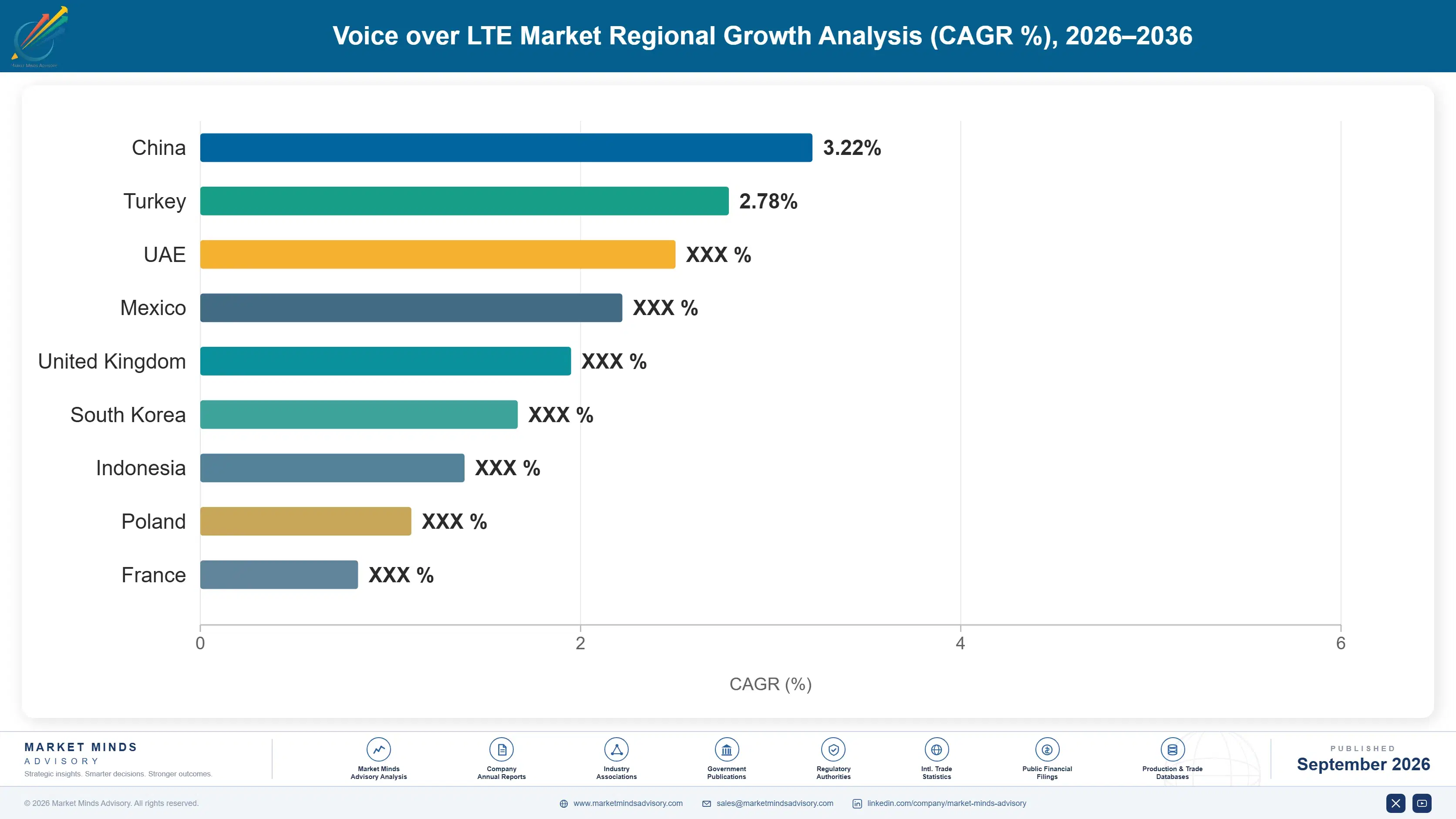
voice-over-lte-market-country-cagr-analysis-1790001888701

Where Vendors Capture Value Beyond Core Hardware

Beyond initial core infrastructure sales, vendors are building recurring revenue through Rich Communication Services messaging platform licensing, roaming settlement services, and managed network operations contracts that convert one-time deployment projects into multi-year recurring carrier relationships worth considerably more over their full contract term. This pattern mirrors how mature enterprise software vendors monetize installed customer bases long after initial deployment.

Rich Communication Services Messaging Platform Licensing

Vendors increasingly license Rich Communication Services messaging gateway software on a recurring, usage-based basis tied to enterprise message volume rather than selling it as a one-time platform purchase bundled into initial core infrastructure deals. This shift lets vendors capture ongoing revenue that scales directly with carrier messaging monetization success rather than depending entirely on new hardware refresh cycles that occur only every several years. Messaging platform licensing revenue now grows over 20% faster annually than core hardware sales across comparable carrier accounts. This lets vendors capture ongoing revenue scaling with carrier messaging success rather than infrequent hardware refresh cycles.
Market Impact: Lifts recurring licensing revenue share to roughly 40%

VoLTE Roaming Settlement and Clearing Services

Interconnect vendors increasingly offer bundled roaming settlement, clearing house, and testing services rather than selling bilateral testing engagements as standalone one-time projects between individual carrier pairs. This bundled approach captures ongoing settlement transaction revenue that scales directly with roaming traffic volume as agreement counts continue expanding across previously unconnected carrier pairs worldwide. Vendors offering integrated settlement platforms report contract values considerably higher than standalone testing engagements alone, since carriers increasingly prefer a single vendor relationship spanning testing, certification, and ongoing settlement processing. Vendors offering integrated settlement platforms report contract values roughly 30% higher than standalone testing engagements.
Market Impact: Grows roaming settlement transaction revenue nearly 28% overall

Managed Network Operations and Optimization Contracts

Equipment vendors are expanding managed services offerings covering ongoing network optimization, capacity planning, and performance monitoring for carriers who prefer to outsource specialized IP Multimedia Subsystem operational expertise rather than building it entirely in-house. These multi-year managed contracts typically carry considerably better margins than initial equipment sales alone, since they require specialized recurring engineering support rather than a single transaction. Managed services attach rates have risen roughly 45% among mid-tier carriers lacking specialized in-house telecom engineering talent. These multi-year contracts typically carry considerably better margins than initial equipment sales alone, requiring specialized recurring engineering support rather than a single transaction.
Market Impact: Expands managed services attach rate nearly 45% overall

Fifth-Generation Voice Convergence Migration Services Growth

Vendors are building dedicated migration and integration services helping carriers converge Voice over LTE and Voice over New Radio infrastructure onto unified cloud-native cores, capturing consulting and integration revenue beyond the underlying software and hardware sale itself. This convergence work requires considerable specialized expertise most carriers lack internally, creating a durable services revenue opportunity that persists well beyond the initial platform purchase decision. Vendors report convergence migration engagements now represent a meaningful and growing share of total contract value on new fifth-generation standalone core deals. Convergence engagements now represent over 25% of total contract value on new fifth-generation core deals.
Market Impact: Adds roughly $4.5 million per new contract signed

Who Controls the Margin Pool

Concentration is high at a CR5 of 62%, reflecting decades of established carrier relationships that create meaningful switching costs and a wide gap between the five leading equipment vendors and smaller software-centric challengers. Ericsson, Nokia, and Huawei together account for the bulk of installed core infrastructure across the largest carrier networks worldwide. No vendor has yet emerged as the clear preferred convergence partner.
Current competitive activity centers on three fronts: converging Voice over LTE and Voice over New Radio infrastructure onto unified cloud-native cores, expanding Rich Communication Services messaging platform capability to capture new monetization revenue, and defending installed-base positions as software-centric challengers like Mavenir target greenfield and virtualized network deployments specifically. Vendors increasingly compete on total cost of ownership across converged architectures rather than standalone Voice over LTE specifications alone.

Emerging pressure comes from cloud-native, software-centric vendors offering more flexible, disaggregated core architectures that appeal to carriers wary of traditional vendor lock-in on long-term hardware contracts. Rankings could shift meaningfully if a major hyperscale cloud provider enters carrier core infrastructure directly, or if consolidation among smaller software vendors concentrates competitive pressure among fewer, better-capitalized challengers than compete for share today. Carriers increasingly favor multi-vendor strategies to preserve negotiating leverage.
voice-over-lte-market-company-positioning-matrix-1790001889626

Competitive Moat and Risk Dimensions

ERICSSON

Moat: Deep Carrier Relationship Incumbency

Ericsson's decades-long relationships with the world's largest carriers give it renewal advantages that newer entrants struggle to overcome, particularly given the operational risk carriers associate with replacing deeply embedded core network infrastructure. Its scale also lets it invest more heavily in fifth-generation convergence research than smaller specialized competitors can readily match.
ERICSSON

Risk: Slower Cloud-Native Architecture Shift

Ericsson's traditional hardware-centric business model faces pressure from software-centric challengers offering more flexible, disaggregated cloud-native architectures that appeal to carriers wary of long-term vendor lock-in. Transitioning its own portfolio and sales organization toward this model more aggressively risks near-term margin pressure on its existing high-margin hardware business.
MAVENIR

Moat: Cloud-Native Architecture Leadership

Mavenir has built its entire platform around cloud-native, disaggregated architecture from inception, giving it credibility with carriers specifically seeking to avoid the vendor lock-in associated with traditional hardware-centric incumbents. This positioning has won it meaningful greenfield and virtualized network deployment wins against much larger established competitors.
MAVENIR

Risk: Limited Scale Against Established Incumbents

As a smaller, newer entrant, Mavenir lacks the balance sheet scale and decades of carrier relationship depth that Ericsson, Nokia, and Huawei bring to competitive tenders, particularly for the largest, most conservative carrier accounts that strongly prefer established vendor track records over newer architectural approaches.

Players Tracked

Prominent Players

Ericsson
Nokia
Huawei
Samsung
ZTE

Other Key Players

Mavenir
Metaswitch (Microsoft)
Oracle Communications
Ribbon Communications
Cisco
Amdocs
NetNumber
Comviva
Dialogic
Infobip
Sinch
Syniverse
iBasis
Mobileum
Openwave Mobility

Recent Developments

FEBRUARY 2025

Ericsson and Reliance Jio Expand Unified Core Deployment

Ericsson announced an expanded unified core network deployment agreement with Reliance Jio covering both Voice over LTE and Voice over New Radio infrastructure across additional service circles nationwide. The agreement extends an existing multi-year partnership between the two companies covering network modernization. Financial terms were not disclosed publicly.
Signal: Convergence deployments in the world's largest single carrier market validate unified-core architecture at true national scale.
JUNE 2025

Mavenir Wins Greenfield Core Deployment in Southeast Asia

Mavenir announced a greenfield cloud-native core deployment win with a regional Southeast Asian carrier, covering combined Voice over LTE and Rich Communication Services messaging infrastructure built entirely on disaggregated, cloud-native architecture. The deal represents one of the region's largest fully cloud-native core wins. Deal terms were not publicly disclosed.
Signal: Cloud-native challengers continue winning greenfield deployments where incumbent vendor lock-in concerns weigh less heavily on carrier decisions.
NOVEMBER 2025

GSMA Expands VoLTE Roaming Interoperability Framework

The GSM Association announced an expanded technical framework standardizing Voice over LTE international roaming interoperability testing, further reducing the bilateral integration burden between individual carrier pairs seeking new roaming agreements. Multiple interconnect vendors have already begun certifying platforms against the updated framework. The update takes effect for new agreements immediately.
Signal: Standardized frameworks continue accelerating roaming agreement formation and lowering integration costs industry-wide for participating carrier networks.

Software Licensing and Specialized Hardware Cost Exposure

Software licensing and specialized telecom-grade server hardware together represent roughly 34% of unit deployment cost of goods sold, sourced predominantly from specialized network equipment manufacturers and, increasingly, general-purpose cloud infrastructure providers as vendors shift toward cloud-native, virtualized core architectures rather than dedicated proprietary hardware appliances. Vendors relying more heavily on general-purpose cloud infrastructure face a somewhat different, though related, cost exposure profile.
Specialized telecom server and networking hardware component pricing rose meaningfully during the 2021 through 2022 global semiconductor shortage, with the International Energy Agency and multiple vendor annual reports documenting extended lead times across specialized networking silicon categories that delayed several publicly disclosed carrier core deployment timelines by multiple quarters industry-wide during that period. Vendors without pre-existing hardware supplier relationships experienced comparatively longer delays than those holding standing volume agreements already in place.

Smaller software-centric vendors carry somewhat different exposure than established hardware incumbents, since their cloud-native architectures depend more heavily on general-purpose cloud infrastructure pricing and availability than specialized proprietary telecom hardware supply chains. This dynamic could favor cloud-native challengers during future specialized hardware shortages, though it also exposes them to cloud infrastructure pricing volatility that hardware-centric incumbents do not face to the same degree.
voice-over-lte-market-cost-volatility-analysis-1790001889943

Multi-Cloud Infrastructure Deployment Flexibility

Cloud-native vendors increasingly architect deployments to run across multiple public cloud infrastructure providers, reducing dependency on any single provider's pricing and capacity decisions while maintaining deployment flexibility across carrier customer preferences and regional data residency requirements. Some vendors now formalize this into standing multi-provider deployment templates rather than one-off contract negotiations. Carrier customers increasingly favor this practice.

Long-Term Hardware Component Supply Agreements

Established hardware-centric vendors increasingly sign multi-year volume commitments with specialized networking silicon suppliers, trading pricing flexibility for guaranteed allocation priority during future shortage conditions that could otherwise delay carrier deployment commitments significantly. These agreements typically span multiple years and include negotiated price ceilings tied to broader semiconductor market indices. Smaller vendors often cannot secure comparable terms.

Software-Defined Architecture Component Substitution

Vendors increasingly design platforms to run on general-purpose server hardware rather than proprietary specialized appliances, widening the pool of qualified hardware suppliers and reducing exposure to any single specialized component category during shortage conditions. This approach has become increasingly common among cloud-native challengers seeking to differentiate against traditional hardware-centric incumbents. It also broadens the qualified supplier pool.

Portfolio Architecture for Margin Defence

The market organizes into three tiers reflecting deployment maturity and revenue durability. Volume-tier standard core infrastructure sold into remaining first-time deployment markets carries thinner margins driven by price competition among several established vendors, while premium convergence and messaging platform offerings bundled with managed services command considerably better economics overall. This tiering reflects both technical maturity and how much of a given deal is recurring versus one-time in nature.
Tension between commoditizing standard core hardware sales and premium recurring software and services revenue defines vendor strategy today, as traditional hardware-centric vendors face continuous margin pressure on legacy product lines while those successfully building messaging platform and managed services attach rates construct more durable, higher-margin recurring revenue streams. Vendors successfully making this shift report meaningfully steadier quarter-to-quarter revenue than peers still dependent on lumpy hardware orders.

High-value pools concentrate in Rich Communication Services messaging platform licensing, roaming settlement services, and fifth-generation convergence migration consulting, where vendors capture recurring revenue well beyond the initial core hardware transaction. Next-generation unified-core convergence services targeting carriers deploying standalone fifth-generation networks represent the newest and fastest-growing high-margin pool available today. Early movers in messaging monetization capture this expanding high-margin opportunity.

Volume / Commodity-Adjacent Tier

Standard Voice over LTE core infrastructure sold primarily on price into remaining first-time deployment markets completing circuit-switched network shutdown timelines. Replacement cycles here typically run seven to ten years before major hardware refresh.
Gross Margin: 24%-32%

Premium / Certified Tier

Converged fourth and fifth-generation voice core platforms bundled with Rich Communication Services messaging and multi-year managed services contracts. Renewal rates on these bundled contracts run considerably higher than volume-tier relationships.
Gross Margin: 40%-48%

Sustainability / Regulatory / Next-Generation Tier

Fifth-generation standalone convergence migration consulting, roaming settlement platforms, and cloud-native disaggregated architecture licensing for forward-looking carrier deployments. Margins benefit from limited direct competition and considerable specialized engineering expertise required. Demand keeps rising.
Gross Margin: 54%-62%
voice-over-lte-market-portfolio-architecture-1790001890916

High-value Sub-segments and Strategic Watch-out

RCS Messaging Platform Licensing

Recurring usage-based messaging platform licensing growing fastest as carriers monetize Rich Communication Services business messaging volume across expanding enterprise brand adoption. Source: MMA Estimate, July 2026. Source: MMA Estimate, July 2026, based on comparable carrier messaging monetization benchmarks across the region. Growth here outpaces every other tracked segment.
Gross Margin: 48%-56%

Roaming Settlement and Clearing Services

Bundled roaming testing, certification, and ongoing settlement services growing steadily as bilateral agreement counts continue expanding across previously unconnected global carrier pairs. Source: MMA Estimate, July 2026. Source: MMA Estimate, July 2026, based on disclosed clearing house transaction volume trends. Agreement counts keep climbing steadily each quarter.
Gross Margin: 38%-46%

Standard Core Infrastructure Deployment

The volume core of the market, sold primarily into remaining first-time deployment markets where price competition among established vendors keeps margins comparatively thin industry-wide. Vendor count here remains the highest of any tier given the segment's long operating history. Pricing pressure persists across most vendor tiers.
Gross Margin: 26%-32%

Legacy Circuit-Switched Interconnect Services

Declining legacy circuit-switched interconnect and gateway services facing sustained revenue decline as remaining carriers complete final network shutdown timelines over the next several years. Source: MMA Estimate, July 2026, reflecting accelerating circuit-switched shutdown completion globally. Vendors are exiting this segment gradually. Vendors with diversified portfolios are least exposed.
Gross Margin: 15%-22%

Recurring Carrier Relationships Beyond Initial Deployment

Demand behaves increasingly like an annuity rather than a one-time infrastructure sale, since carriers require continuous vendor support, software updates, and interoperability certification for the life of a core network deployment that typically runs seven to ten years before major replacement. This ongoing dependency creates durable, if slow-growing, recurring revenue for incumbent vendors well beyond initial installation. Vendors that let this relationship lapse risk losing the account at renewal.
Adoption depth varies meaningfully by carrier segment: the largest developed-market carriers tend toward comprehensive fifth-generation convergence and messaging platform adoption once they commit to a vendor relationship, while smaller emerging-market carriers often adopt only core voice functionality initially, adding messaging and roaming capability incrementally as budget allows over subsequent budget cycles. This uneven pattern means vendors must maintain both high-touch and volume-deployment sales capability.

Buyer profiles are shifting generationally as carrier messaging product teams, rather than purely network engineering groups, increasingly influence procurement decisions around Rich Communication Services platform selection, favoring vendors who can demonstrate enterprise messaging monetization outcomes rather than pure network performance specifications that engineering teams historically prioritized. Vendors slow to build this commercial fluency risk being sidelined in procurement conversations increasingly led by messaging and product teams.
voice-over-lte-market-end-use-penetration-index-1790001891828

Where MMA Sees the Real Opportunity

These are among the four positions where our research anticipates prominent divergence between winners and laggards over the coming forecast period. Each is grounded in the demand model, the regulatory perimeter, and the announced capacity pipeline.
01 / CONVERGENCE PLATFORM STRATEGY

Prioritize unified fourth and fifth-generation core investment

Vendors should prioritize unified core platforms serving both Voice over LTE and Voice over New Radio subscribers rather than maintaining separate architectures for each network generation. Carriers deploying standalone fifth-generation networks increasingly favor this convergence approach, since it extends the useful life of core infrastructure investment well beyond a single network generation's typical lifecycle. Vendors slow to offer credible convergence roadmaps risk losing renewal opportunities to competitors with a clearer multi-generation investment story, and building this capability early also strengthens negotiating position on adjacent spectrum contract renewals.
02 / MESSAGING MONETIZATION FOCUS

Build Rich Communication Services platform capability now

The vendors capturing the most durable new revenue are those helping carriers monetize Rich Communication Services messaging rather than those simply maintaining legacy voice infrastructure relationships. Building messaging gateway, verified sender certification, and enterprise brand onboarding capability positions vendors to capture recurring licensing revenue as carrier messaging monetization scales across their carrier accounts. Vendors without credible messaging platform offerings risk being perceived as legacy infrastructure suppliers rather than strategic growth partners, ceding the most commercially attractive part of the relationship to more messaging-fluent competitors.
03 / EMERGING MARKET POSITIONING

Deepen presence in remaining first-time deployment markets

Remaining first-time deployment opportunity concentrates heavily in South Asia, Southeast Asia, and parts of Africa where circuit-switched network shutdown timelines are only now reaching final completion stages. Vendors with proven low-cost, high-volume deployment models tailored to price-sensitive carrier budgets stand to capture disproportionate share of this remaining first-time deployment spending. Vendors overly focused on developed-market convergence opportunities risk ceding this meaningful growth pool to more locally focused competitors, while those pairing local pricing discipline with credible convergence roadmaps can capture both near-term and future opportunity.
04 / SOFTWARE ARCHITECTURE TRANSITION

Accelerate cloud-native disaggregated architecture roadmaps

Established hardware-centric vendors face growing competitive pressure from cloud-native challengers offering more flexible, disaggregated architectures that appeal to carriers wary of long-term vendor lock-in on traditional hardware contracts. Accelerating internal cloud-native architecture transitions, even at some near-term margin cost to existing hardware business lines, positions incumbents to defend market position against smaller, more architecturally modern competitors over the coming decade. Vendors that delay this transition too long risk losing greenfield deployment opportunities entirely, while those who move decisively now stand the best chance of defending long-term account relationships.

Engagement Snapshot From the Field

A live engagement with an industry participant carrying material or product regulatory and market exposure ahead of a defining policy shift, showing how our research translates into a defensible multi-year portfolio strategy.
MARKET MINDS ADVISORY · CLIENT ENGAGEMENT SUMMARY
Voice over LTE Producer Strategic Portfolio Review and Transition Roadmap 2026·Investment Scenario on Voice over LTE Exposure Evaluation 2025-26
CLIENT PROFILE
The client is a mid-sized mobile network operator serving approximately 28 million subscribers across a Southeast Asian national market, with a substantial remaining share of its subscriber base still connected through legacy 3G circuit-switched voice infrastructure the carrier had committed to a national regulator to retire within a defined multi-year window. The carrier's leadership had deprioritized modernization for several years given other competing capital allocation priorities.
STRATEGIC CHALLENGE
The carrier needed to migrate its remaining circuit-switched subscriber base onto Voice over LTE infrastructure within an eighteen-month regulatory deadline while simultaneously launching Rich Communication Services business messaging to create a new enterprise revenue stream that could help offset the considerable capital cost of the required infrastructure modernization program. Board members were also watching a larger rival's own modernization progress closely.
MMA APPROACH
MMA's team benchmarked core infrastructure vendor options against the carrier's specific subscriber density and device compatibility profile, evaluating both traditional hardware-centric and cloud-native disaggregated architecture approaches. MMA modeled total cost of ownership across a ten-year horizon and assessed Rich Communication Services messaging monetization potential against comparable regional carrier deployments already completed.
KEY FINDINGS
  1. A cloud-native disaggregated core architecture was projected to reduce total deployment cost by approximately 22% (client-reported, unverified by MMA) relative to traditional hardware-centric vendor proposals evaluated.
  2. Roughly 18% of the carrier's subscriber base used devices lacking full Voice over LTE certification, requiring a targeted device subsidy program to meet the regulatory shutdown deadline.
  3. Rich Communication Services business messaging was projected to generate meaningful new enterprise revenue within twelve months of launch based on comparable regional carrier benchmarks.
  4. Carrier leadership had significantly underestimated how quickly device compatibility gaps could delay the shutdown timeline without a dedicated subsidy program running in parallel.
CLIENT PROFILE
The client is a mid-sized mobile network operator serving approximately 28 million subscribers across a Southeast Asian national market, with a substantial remaining share of its subscriber base still connected through legacy 3G circuit-switched voice infrastructure the carrier had committed to a national regulator to retire within a defined multi-year window. The carrier's leadership had deprioritized modernization for several years given other competing capital allocation priorities.
STRATEGIC CHALLENGE
The carrier needed to migrate its remaining circuit-switched subscriber base onto Voice over LTE infrastructure within an eighteen-month regulatory deadline while simultaneously launching Rich Communication Services business messaging to create a new enterprise revenue stream that could help offset the considerable capital cost of the required infrastructure modernization program. Board members were also watching a larger rival's own modernization progress closely.
MMA APPROACH
MMA's team benchmarked core infrastructure vendor options against the carrier's specific subscriber density and device compatibility profile, evaluating both traditional hardware-centric and cloud-native disaggregated architecture approaches. MMA modeled total cost of ownership across a ten-year horizon and assessed Rich Communication Services messaging monetization potential against comparable regional carrier deployments already completed.
KEY FINDINGS
  1. A cloud-native disaggregated core architecture was projected to reduce total deployment cost by approximately 22% (client-reported, unverified by MMA) relative to traditional hardware-centric vendor proposals evaluated.
  2. Roughly 18% of the carrier's subscriber base used devices lacking full Voice over LTE certification, requiring a targeted device subsidy program to meet the regulatory shutdown deadline.
  3. Rich Communication Services business messaging was projected to generate meaningful new enterprise revenue within twelve months of launch based on comparable regional carrier benchmarks.
  4. Carrier leadership had significantly underestimated how quickly device compatibility gaps could delay the shutdown timeline without a dedicated subsidy program running in parallel.
RECOMMENDED STRATEGY
Phase 1: Phase 1 (Months 1-6): Deploy cloud-native core infrastructure and launch targeted device subsidy program for identified incompatible subscriber segments., coordinating closely with device manufacturers on the subsidy rollout logistics Phase 2: Phase 2 (Months 7-14): Complete subscriber migration and launch Rich Communication Services business messaging platform with initial enterprise brand partners. Phase 3: Phase 3 (Months 15-18): Finalize circuit-switched network shutdown and scale enterprise messaging partnerships across additional industry verticals., while documenting lessons learned for future regional deployments
OUTCOME
The carrier completed its circuit-switched network shutdown within the regulatory deadline and launched Rich Communication Services business messaging with several major domestic retail and banking brands as initial partners (client-reported, unverified by MMA). Projected annual enterprise messaging revenue was estimated at approximately $14 million (client-reported, unverified by MMA) within the first full year of commercial launch.

Frequently Asked Questions

Foundational context covering the market sizes, CAGR, scope, country, region and competition that inform every finding below. This section is provided to cover basics and most often pre-purchase conversations, answered from the MMA Primary Research Dataset.

What is the current size of the Voice over LTE Market?

The global Voice over LTE Market was valued at approximately $9.5 billion in 2025. Growth reflects both replacement-cycle spending in mature markets and remaining first-time deployment activity elsewhere.

How large will the Voice over LTE Market be by 2036?

MMA projects the market will reach approximately $20.01 billion by 2036, roughly double its 2026 value. Rich Communication Services messaging and network convergence both contribute meaningfully to this growth.

What is the CAGR for the Voice over LTE Market 2026 to 2036?

The market is projected to grow at a 7.0% compound annual growth rate over the forecast period. This places it within the growth specialty technology band.

Which segment is growing fastest?

RCS and Advanced Messaging Integration leads growth at a 9.5% CAGR, roughly 1.36 times the overall market growth rate. Enterprise business messaging adoption drives most of this segment's momentum.

Who are the major companies in the Voice over LTE Market?

Leading companies include Ericsson, Nokia, Huawei, Samsung, and ZTE. Together these five hold an estimated 62% combined market presence measured on installed core infrastructure revenue across major carrier networks.

Which country is growing fastest?

India leads global growth at an estimated 9.0% CAGR. Reliance Jio's Voice over LTE-only architecture and Rich Communication Services messaging adoption drive most of this pace.

Report Segmentation Architecture

The full report scope spans multiple orthogonal segmentation dimensions, with cross-tabulated demand data provided for each dimension pair. Coverage extends further to regional breakdowns, trend trajectories, and the competitive detail needed to support segment-level decision-making.

By Solution Type

  • IMS Core Network Infrastructure
  • Session Border Controllers
  • VoLTE Testing and Network Optimization Solutions
  • RCS and Advanced Messaging Integration
  • VoLTE Roaming and Interconnect Services
  • Device Enablement and IR.94 Compliance Software

By End-Use Industry

  • Mobile Network Operators
  • Fixed and Converged Telecom Operators
  • Government and Regulatory Bodies
  • Enterprise Messaging Brands
  • Managed Service Providers

By Commercial Dimension

  • Hardware and Software Licensing
  • Managed Services Contracts
  • Testing and Certification Services
  • Roaming Settlement Services

By Region

  • North America
  • Western Europe
  • East Asia
  • South Asia and Pacific
  • Latin America
  • Middle East and Africa
  • Eastern Europe

Scope, Methodology, and Coverage

Every figure in this report is reproducible from documented input assumptions. The scope below maps the historical period, the forecast horizon, the segmentation dimensions, and the countries covered, alongside the underlying primary and qualitative methodology.
Historical Period
2020 to 2025
Forecast Period
2026 to 2036
Base Year
2025 (USD billions; MMA Primary Research Dataset, September 2026)
Market Definition
The market covers IP Multimedia Subsystem core infrastructure, session border controllers, testing and optimization solutions, device enablement software, and interconnect and roaming services that together deliver voice calling over Long-Term Evolution networks. It excludes underlying radio access network hardware, spectrum licensing, and consumer handset manufacturing.
Quantitative Units
USD billions (current prices); subscriber migration counts; roaming agreement counts
Segmentation Dimensions
By Solution Type; By End-Use Industry; By Commercial Dimension; By Region
Regions Covered
North America, Western Europe, East Asia, South Asia and Pacific, Latin America, Middle East and Africa, Eastern Europe
Countries Covered
USA, China, Germany, France, UK, Japan, South Korea, India, Australia, Canada, Brazil, Mexico, Indonesia, Vietnam, Thailand, Malaysia, UAE, Saudi Arabia, South Africa, Nigeria, Turkey, Poland, Netherlands, Italy, Spain, Sweden, Switzerland, Argentina, Colombia, Singapore, and additional markets relevant to this sector
Key Companies Profiled
Ericsson, Nokia, Huawei, Samsung, ZTE, Mavenir, Metaswitch (Microsoft), Oracle Communications, Ribbon Communications, Cisco, Amdocs, NetNumber, Comviva, Dialogic, Infobip, Sinch, Syniverse, iBasis, Mobileum, Openwave Mobility
Quantitative Methodology
Primary survey, n=3,800 respondents, Q4 2025, six countries; demand-side model with trade association cross-validation
Qualitative Methodology
47 expert interviews, Q4 2025; applied to validate demand model assumptions, identify emerging dynamics, and assess competitive positioning
Report Format
PDF and XLSX data workbook (Word format preview document)
Publisher
Market Minds Advisory
Report Code
MMA-2026-TEC-231
Published
September 2026
Contact
sales@marketmindsadvisory.com | www.marketmindsadvisory.com

Purchase the full Voice over LTE Market Report (2026 to 2036).

The full report provides detailed market sizing, ten-year forecasts, and competitive benchmarking across the global carrier voice infrastructure category. It includes country-level circuit-switched shutdown timeline tracking, vendor architecture comparisons, and segment-level growth analysis across core infrastructure, messaging, and roaming services. Buyers receive access to MMA's proprietary roaming agreement coverage tracker updated quarterly throughout the subscription term. The report also includes detailed input-cost analysis for specialized telecom hardware and cloud infrastructure sourcing. Subscribers can request a customized briefing call to discuss findings relevant to their specific competitive or investment questions.
Country-level shutdown timeline tracking dashboard updates
Vendor architecture comparison scorecards by carrier
Segment-level ten-year growth forecasts by category
Competitive benchmarking covering every profiled vendor
Roaming agreement coverage tracker updated quarterly
Input-cost and supply-chain risk analysis included

Built For The People Who Decide

From boardroom strategy to bench-side execution, this report is read cover-to-cover by leaders shaping the next decade of their industry, turning demand scenarios, market dynamics and valuation benchmarks into decisions.
CXOs/ Presidents/ VPs/ Managers
M&A and Corporate Development
Strategy Teams and R&D Heads
Procurement and Product Directors
Regulatory and Compliance Leaders
Investor Relations and Equity Analysts