Market Minds Advisory
Voice Assistance Application Market

Voice Assistance Application Market: Voice Assistance Application Market. Conversational AI, Voice Bots, and Enterprise Voice Assistants, 2026 to 2036

Enterprise buyers are ripping out scripted call-center scripts and manual clinical note-taking in favor of large language model voice assistants that listen, transcribe, and act directly inside existing business software stacks.

Lead Analyst

Published

September 2026

Make Smarter Decisions with Customized Research Insights

Request a free sample report and evaluate market opportunities, growth trends, and competitive dynamics relevant to your business needs.

2025 MARKET VALUE$12.5BMarket Size 2025
2036 FORECAST VALUE$39.4BBase Case , 2026 to 2036
CAGR 2026 TO 203611.0 %Bull 12.3% / Bear 9.7%
INCREMENTAL OPPORTUNITY$25.5BNet 10- year value creation
EXPANSION MULTIPLE2.84x2036 value over 2026 base
Strategic Levers
M&A Pipeline
Regional Outlook
Country Rankings
Competitive Intelligence
Segmental Deep-dive
Call-Us : 91 93563 13602

Executive Snapshot and Market Trajectory.

Voice assistant software has shifted decisively from rigid, script-based interaction toward large language model reasoning that understands intent, context, and multi-turn conversation without relying on fixed menu trees or pre-scripted response paths that once frustrated both users and buyers alike for years across the entire industry.
Enterprise productivity assistants are growing fastest as knowledge workers adopt voice-driven meeting transcription, task creation, and document drafting tools that plug directly into existing calendar, email, and customer relationship management systems already deployed across the organization. North America commands the largest share of enterprise deployment given its concentration of software buyers willing to pay premium per-seat licensing for measurable productivity gains across large corporate workforces spanning every industry vertical, company size, and department nationwide.
Competitive intensity has risen sharply as the largest cloud platform providers bundle voice assistant capability into broader productivity suites at no extra charge, pressuring specialist vendors to differentiate through vertical-specific accuracy in healthcare documentation and legal transcription work specifically across every regulated buyer segment. Data residency regulation increasingly shapes procurement decisions inside regulated industries that must verify vendor accuracy claims independently before signing any contract.
Market Definition
The Voice Assistance Application Market covers software applications that use speech recognition and natural language processing to interpret spoken commands and generate conversational or task-completing responses across consumer, enterprise, and specialized professional use cases. It excludes underlying speech recognition hardware components, telecom carrier voice infrastructure, and non-conversational dictation software lacking intent understanding.
Base Year Value
$12.5B in 2025 (MMA Primary Research Dataset, September 2026)
Forecast Period
2026 to 2036, eleven discrete annual values
CAGR
11.0% base case. Bull 12.3%. Bear 9.7%.
Fastest Growth Segment
Enterprise Productivity Voice Assistants: 16.0% CAGR
Fastest Growth Country
India: 13.5% CAGR
Fastest Growth Region
South Asia and Pacific: 13.0% CAGR
Largest Region
North America: 32% of 2025 global value
Market Leaders
Leading vendors: Google, Amazon, Microsoft, Apple, OpenAI. Source: MMA Primary Research Dataset, July 2026.
Primary Survey
n=3,800 procurement and R&D decision-makers, Q4 2025, six countries
Methodology
Demand-side build-up, cross-validated against public data, 47 expert interviews

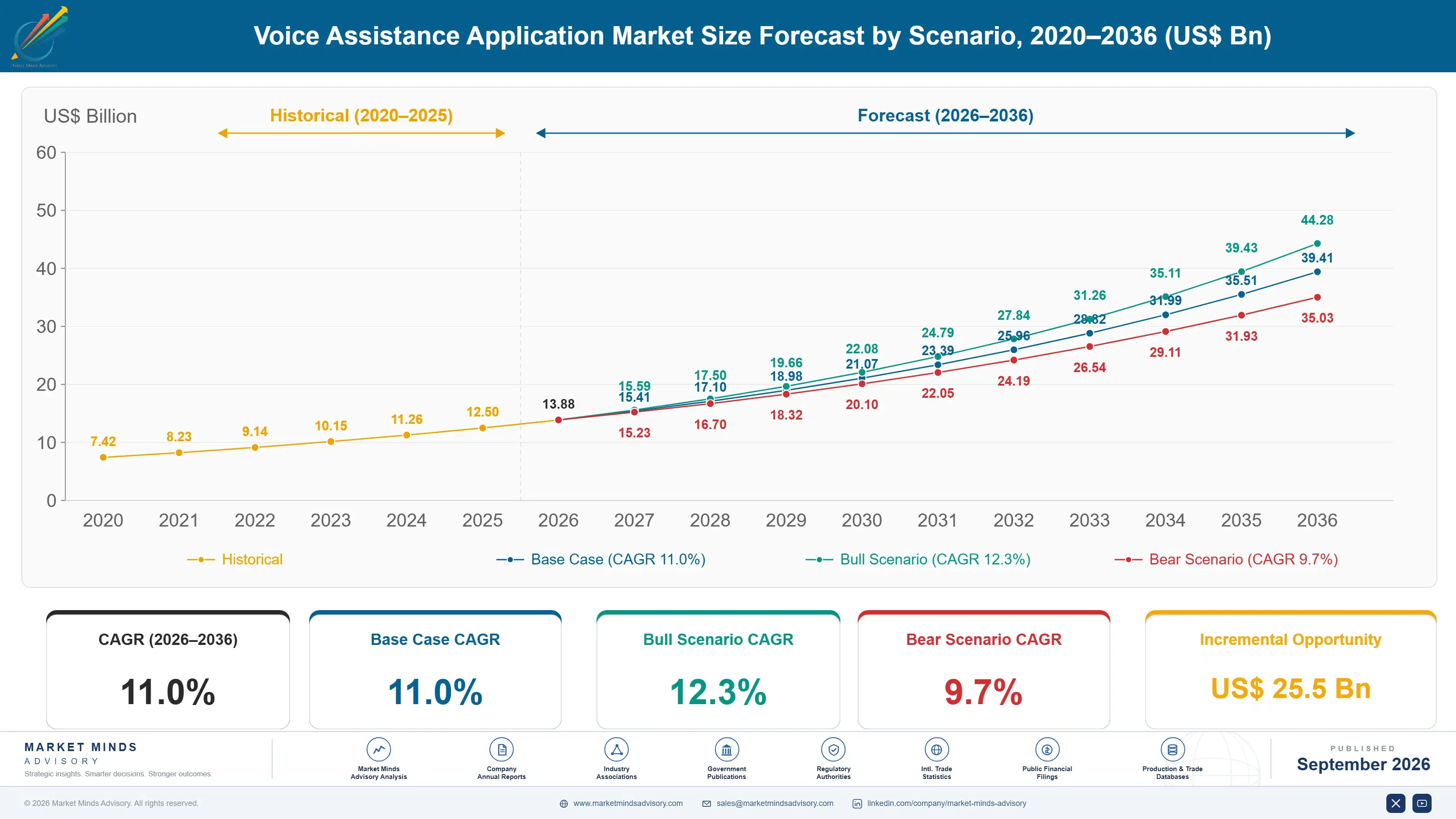
Voice Assistance Application Market Forecast Scenarios

voice-assistance-application-market-size-forecast-scenario-1789995802742
Growth through 2020 to 2025 accelerated as smart speaker adoption plateaued in consumer households while enterprise pilots of transcription and voice-driven customer service tools multiplied rapidly following the broad availability of capable large language models starting in 2023, a shift that redirected investor and buyer attention from consumer novelty devices toward measurable, quantifiable workplace productivity outcomes across nearly every industry vertical.
Base case growth through 2036 rests on three commercial mechanisms: continued enterprise adoption of meeting transcription and task automation tools replacing manual note-taking across knowledge worker roles in every department, expanding healthcare voice documentation reducing physician administrative burden inside hospital systems facing chronic and worsening staffing shortages nationwide, and growing contact center deployment of voice bots handling routine customer inquiries without any human agent involvement whatsoever during peak call volume periods.
A bull scenario turns on faster large language model accuracy gains pushing voice assistants into higher-stakes professional workflows that currently still require human verification of every generated output before use. The bear risk is that persistent hallucination errors in generated transcripts erode enterprise trust badly enough to slow procurement meaningfully in liability-sensitive industries like healthcare and legal services specifically over the coming years.

The Accuracy Economics Behind Every Voice Assistant Deal

Voice assistant vendors no longer compete primarily on whether a system can transcribe speech accurately, since that baseline capability has become table stakes across nearly every credible vendor in the market, but rather compete on how reliably the assistant can act on what it hears inside a customer's specific software environment without introducing errors that create legal or clinical liability.
MARKET CONCENTRATIONCR5: 52%Top five vendors hold slightly over half the market
AVERAGE ENTERPRISE SEAT PRICE$28/monthTypical per-seat monthly licensing fee for enterprise deployment
TOP DEPLOYING COUNTRY SHAREUSA: 34%Reflects concentration of enterprise software buyers and vendors
TRANSCRIPTION WORD ERROR RATE4.5%Typical accuracy benchmark vendors cite in sales materials
ENTERPRISE PILOT-TO-CONTRACT CONVERSION38%Share of enterprise pilots converting to paid annual contracts
COMPUTE COST SHARE31%Reflects cloud inference cost as share of total expense
Pricing has shifted from flat per-seat licensing toward usage-based models tied to transcription minutes or task completions, since enterprise buyers increasingly resist paying full price for seats that use the assistant only occasionally throughout a typical workday. Vendors that offer flexible pricing tiers win larger initial deployments because procurement teams can start small and expand usage-based spend as adoption proves out internally.
Model compute cost has become the single largest line item behind gross margin variation across vendors, since running a large language model continuously against live audio streams costs meaningfully more than the older rule-based systems it replaced entirely. Vendors that have built their own smaller, task-specific models rather than relying entirely on third-party foundation model APIs increasingly report noticeably better unit economics on high-volume enterprise contracts.
"Buyers stopped asking 'can it transcribe' two years ago. Now they ask what happens when the model gets it wrong inside a clinical note, and most vendors still don't have a good answer."
Practice Lead, Enterprise AI and Conversational Software Research · MMA Technology Practice · September 2026

Market Trends

Large Language Models Replace Rule-Based Dialogue Trees

Nearly every major vendor has retired the rigid, decision-tree dialogue engines that defined voice assistants for over a decade in favor of large language model reasoning that handles ambiguous requests, follows multi-turn context across an entire conversation, and recovers gracefully from misunderstood input without forcing the user back to a rigid menu structure or forcing an awkward call transfer to a human agent. Enterprise buyers report roughly 60 percent fewer failed interactions after switching from legacy rule-based systems to a modern language-model-based assistant deployed across the identical use case and customer segment.
Market Impact: 45% of enterprises deploy meeting AI

Vertical-Specific Accuracy Tuning Becomes a Purchase Requirement

Buyers in healthcare, legal, and financial services now require vendors to demonstrate accuracy benchmarks specific to their own domain vocabulary before signing any contract, since a general-purpose transcription model trained mostly on everyday conversation performs measurably worse on clinical terminology or legal citation formats commonly used in daily practice across those specific regulated industries. Several vendors have responded by building dedicated domain-tuned model variants, with healthcare-specific transcription accuracy improving by roughly 12 percentage points over general-purpose baselines in recent independent benchmark testing conducted earlier this year across multiple hospital systems.
Market Impact: 2 hours saved per physician

Market Opportunities and Growth Drivers

Knowledge Worker Shortage Pushes Automation of Note-Taking Tasks

Corporate hiring in administrative and support functions has failed to keep pace with meeting volume growth across most large organizations, pushing companies to adopt voice assistants that transcribe, summarize, and generate action items automatically rather than hiring dedicated staff to handle documentation work manually across every single team. Roughly 45 percent of large enterprises surveyed in 2025 reported deploying an AI meeting assistant company-wide, up sharply from under 15 percent just two years earlier, reflecting a genuinely rapid adoption curve across nearly every department and function within the organization today.
Market Impact: 100% of notes need review

Physician Burnout Drives Clinical Voice Documentation Adoption

Hospital systems facing physician burnout tied directly to after-hours electronic health record documentation have turned to ambient voice assistants that listen quietly during patient visits and draft clinical notes automatically for physician review and formal sign-off, cutting documentation time by roughly 2 hours per physician per day according to health system pilot data reviewed by MMA analysts across several different regions and medical specialties surveyed. Adoption has moved fastest in primary care and emergency departments, where documentation burden per patient visit runs highest relative to actual appointment time available to physicians.
Market Impact: Compliance cost rises across 7 regions

Market Restraints and Challenges

Hallucination Risk Slows Adoption in Liability-Sensitive Settings

Large language models occasionally generate plausible-sounding but factually wrong transcript content, a failure mode nearly absent in older rule-based systems that simply refused to guess when uncertain rather than confidently inventing an answer. The root cause is that generative models are trained to produce fluent text rather than to flag their own uncertainty honestly. Healthcare and legal buyers report requiring mandatory human review of every generated note before it enters a permanent record, which caps the labor savings vendors promise. Some vendors now attach confidence scores to flagged low-certainty passages, letting reviewers focus attention only where needed.
Market Impact: 60% fewer failed interactions reported

Data Residency Rules Fragment Vendor Deployment Options

Regulations requiring voice and transcript data to remain within national borders force vendors to build region-specific cloud infrastructure rather than serving customers from a single global deployment, raising operating cost meaningfully for smaller vendors that lack the balance sheet to run redundant regional data centers everywhere. The underlying cause is a patchwork of national privacy laws that emerged independently rather than through coordinated policy. Several vendors have responded by partnering with regional cloud providers to host data locally without building their own infrastructure from scratch in every jurisdiction they serve.
Market Impact: 12-point accuracy gain from domain tuning
3 additional market trends, 4 additional growth drivers, and 3 additional restraints and challenges are covered in the full report. Contact sales@marketmindsadvisory.com to access the complete intelligence.

Segment CAGR and Growth Architecture

The market splits by application context rather than by underlying speech technology, since procurement, pricing, and accuracy requirements all vary sharply by specific use case and target buyer industry. Six categories cover the field: enterprise productivity, healthcare documentation, customer service voice bots, in-vehicle assistants, smart home control, and smart speaker platforms serving consumer households.
voice-assistance-application-market-market-share-analysis-1789995803288

Enterprise Productivity Voice Assistants

Enterprise productivity voice assistants are the fastest-growing category by a wide margin, driven by knowledge workers adopting meeting transcription, task automation, and document drafting tools that plug directly into calendar, email, and customer relationship management platforms already in daily use. Adoption started among large technology companies but has spread rapidly into professional services, consulting, and financial services firms where billable hour tracking and client documentation carry direct revenue implications. Per-seat pricing has shifted toward usage-based models as buyers resist paying flat fees for occasional users, and vendors increasingly bundle multiple productivity functions, transcription, scheduling, and summarization, into a single subscription rather than selling each feature separately to the same buyer.
CAGR 16.0%

Healthcare Voice Documentation Assistants

Healthcare voice documentation assistants listen during patient encounters and draft clinical notes automatically, addressing physician burnout tied to after-hours electronic health record work that has become a leading driver of early clinical retirement across many overstretched health systems nationwide today. Primary care and emergency medicine have adopted fastest since documentation burden per visit runs highest there relative to appointment time, while specialties with more procedural, structured documentation have moved more slowly. Vendors in this category face far higher accuracy and liability requirements than general enterprise tools, which supports premium pricing but also slows the sales cycle considerably since hospital procurement teams demand extensive clinical validation before any full deployment decision is made.
CAGR 14.0%
Full segment breakdown across 6 segments available in the complete report.

Regional Architecture and Country Demand Map

North America leads on enterprise software spending power and concentration of leading vendors, India leads on the fastest growth rate through IT services and business process outsourcing adoption, and East Asia contributes rapidly expanding consumer smart speaker and in-vehicle assistant deployment across a large population base.

North America

US enterprise software budgets fund the largest concentration of voice assistant deployment anywhere, spanning meeting transcription tools inside technology and financial services firms and ambient clinical documentation across major hospital systems from coast to coast. Canada follows a similar enterprise-led adoption pattern on a somewhat smaller scale, concentrated heavily in its own healthcare and financial services sectors. The region's lead reflects buyer willingness to pay premium per-seat pricing for measurable productivity gains rather than any technological advantage unique to vendors based here, since most leading vendors serve customers globally from the same underlying platform. Enterprise buyers here also lead adoption of usage-based pricing models. Procurement teams increasingly scale spend gradually as internal adoption proves out across departments.
Share: 32% | CAGR: 10.5% (2026 to 2036)

Western Europe

Germany and the United Kingdom lead regional enterprise adoption, though GDPR data residency requirements have forced vendors to build region-specific hosting infrastructure that slows deployment timelines compared with less regulated markets elsewhere. France has pushed harder on public sector voice assistant pilots tied to citizen service modernization programs rather than pure enterprise productivity use cases favored elsewhere in the region. Healthcare voice documentation adoption trails North America meaningfully, since national health systems move more cautiously through centralized procurement processes than individual American hospital systems. Nordic countries have separately emerged as an early testbed for public sector voice assistant pilots. Digital government maturity scores in that subregion rank among the highest worldwide.
Share: 20% | CAGR: 9.5% (2026 to 2036)
Regional intelligence for 5 additional markets available in the complete report: East Asia, South Asia and Pacific, Latin America, Middle East and Africa, Eastern Europe. Contact sales@marketmindsadvisory.com.
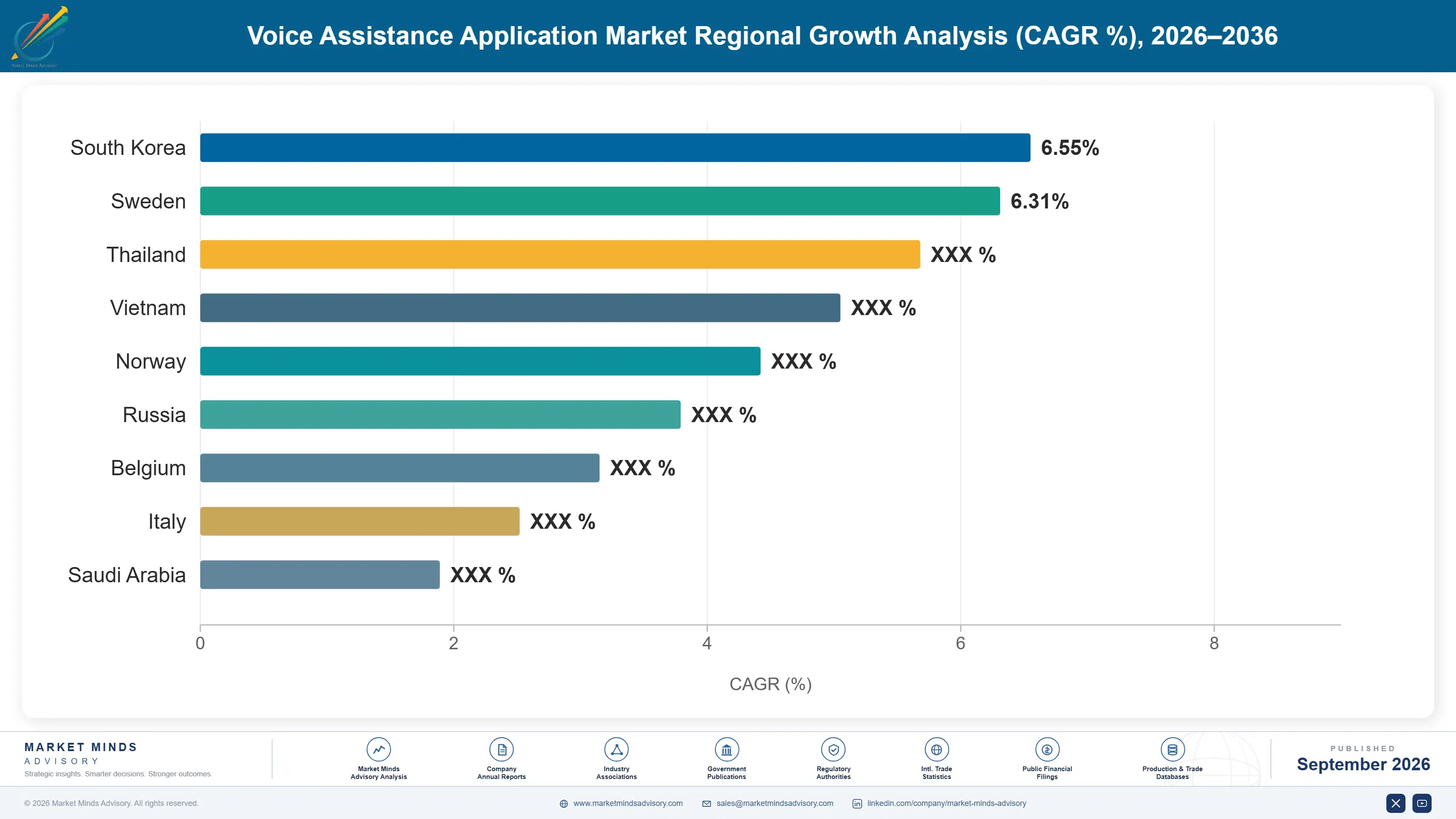
voice-assistance-application-market-country-cagr-analysis-1789995803813

How Vendors Actually Make Money Here

Per-seat licensing alone caps revenue growth once an enterprise customer stops adding headcount, so the strongest vendors layer usage-based pricing, vertical-specific accuracy modules, integration setup fees, and data licensing arrangements together on top of the base subscription to keep expanding wallet share within existing customer accounts over the entire lifetime of the contract itself.

Charge Usage-Based Fees for Transcription Minutes Beyond Base Tier

Vendors that layer usage-based transcription minute fees on top of a base per-seat subscription capture 25 to 35 percent more revenue per account than flat-fee competitors, since heavy users of meeting transcription naturally consume far more compute than occasional users covered by the base tier alone. This pricing structure also lowers the barrier to initial adoption, since procurement teams can start with a small seat count and let usage-based revenue grow organically as internal adoption spreads across departments without requiring a fresh contract negotiation each time usage rises meaningfully. Contract renewal conversations increasingly start from this usage baseline.
Market Impact: Usage-based fees add 25 to 35% more revenue

Sell Vertical-Specific Accuracy Modules as a Premium Add-On

Healthcare and legal-specific transcription accuracy modules, trained on domain vocabulary, command a price premium of roughly 40 to 60 percent above the general-purpose product tier, since buyers in regulated industries value measurable accuracy improvement enough to pay meaningfully more for it every year. Vendors that built these modules early now report considerably longer average contract lengths in regulated verticals than in general enterprise accounts, since switching costs rise sharply once clinical or legal workflows depend on a specific accuracy profile and configuration built carefully over time. Renewal rates in these accounts run noticeably higher too.
Market Impact: Vertical modules command a 40 to 60% premium

Charge Integration Fees for Deep Workflow Automation Setup

Vendors that offer deep, custom integration into a customer's existing customer relationship management and electronic health record systems now charge a one-time setup fee often exceeding 15 percent of first-year contract value, capturing revenue for the deep workflow engineering work involved in every single deployment across the customer base. This fee structure also increases switching costs meaningfully once a customer has invested in a customized integration, since replacing the underlying vendor would require redoing much of that configuration and workflow mapping work entirely from scratch again later. Larger accounts routinely pay well above this baseline figure.
Market Impact: Setup fees run above 15% of first-year value

License Anonymized Interaction Data to Improve Model Accuracy

A small number of vendors now offer customers a discount, typically 8 to 12 percent off list price, in exchange for permission to use anonymized interaction data to further train and improve their underlying models over time and across the full product line. This arrangement benefits the vendor twice, first through the discount-driven deal closure and second through the compounding model accuracy improvement that comes from a larger and more diverse training dataset than competitors relying solely on public data can ever hope to access. Adoption of this arrangement keeps rising among larger customers.
Market Impact: Data-sharing discount runs 8 to 12% off price

Who Controls the Margin Pool

CR5 sits at 52 percent, evaluated on annual voice assistant application revenue across each vendor's full product portfolio, reflecting a market where the largest cloud platform providers hold real distribution reach and foundation model access advantages. Google holds the clearest lead given its search and Android integration reach, though the gap to Microsoft has narrowed noticeably as enterprise productivity bundling accelerates.
Competitive activity today centers on how deeply a voice assistant integrates into a customer's existing software stack rather than on raw transcription accuracy, which has largely converged across leading vendors. Google, Microsoft, and Amazon have all launched dedicated healthcare and legal-vertical accuracy modules over the past year, while specialist vendors focus on white-glove implementation and vertical-specific customization that larger platform vendors deprioritize.

Emerging pressure comes from open-source and smaller foundation model providers that let specialist vendors build competitive accuracy at a fraction of the licensing cost previously required from the largest model providers, narrowing the technical gap between platform giants and focused challengers. Rankings are most likely to shift in healthcare documentation, where clinical validation and liability comfort matter more than brand recognition alone.
voice-assistance-application-market-company-positioning-matrix-1789995804338

Competitive Moat and Risk Dimensions

GOOGLE

Moat: Search and Android Distribution

Google reaches billions of Android device users and search queries daily, giving its voice assistant a distribution advantage no competitor can replicate without owning a comparable operating system or search engine. That reach also feeds an enormous training data advantage for improving model accuracy over time across many languages.
GOOGLE

Risk: Enterprise Trust Deficit

Enterprise buyers in regulated industries remain more cautious about Google's data handling practices than about smaller specialist vendors offering dedicated compliance certifications and narrower data use commitments. This trust gap has cost Google some healthcare and legal vertical deals to competitors with a more focused compliance story.
MICROSOFT

Moat: Deep Enterprise Software Bundling

Microsoft bundles voice assistant capability directly into Teams, Outlook, and the broader Office suite already installed across most large enterprises, making adoption nearly frictionless for existing customers who never need to evaluate a separate vendor. This distribution advantage inside procurement-heavy enterprise accounts is difficult for any standalone vendor to overcome.
MICROSOFT

Risk: Slower Vertical Specialization

Microsoft's broad enterprise focus has left it slower than specialist vendors to build deep healthcare or legal-specific accuracy modules, since its product roadmap serves the largest common denominator across industries rather than any single regulated vertical's specific documentation and compliance needs in complete detail across every deployment.

Players Tracked

Prominent Players

Google
Microsoft
Amazon
Apple
OpenAI

Other Key Players

IBM
Suki AI
SoundHound AI
Verint Systems
NICE Ltd
Salesforce
Zoom Communications
Otter.ai
Deepgram
AssemblyAI
Cerence
Baidu
Samsung Electronics
Rev.com
Speechmatics

Recent Developments

FEBRUARY 2026

OpenAI Launches Enterprise Voice Assistant Platform

OpenAI launched a dedicated enterprise voice assistant platform targeting meeting transcription and task automation, positioning it directly against Microsoft's and Google's bundled productivity offerings with a standalone subscription aimed squarely at mid-market companies lacking existing platform commitments to either large incumbent vendor already firmly in place.
Signal: Confirms foundation model providers are moving directly into application layers previously left entirely to specialist software vendors.
OCTOBER 2025

Suki AI Expands Clinical Documentation Product Suite

Suki AI expanded its ambient clinical documentation suite to cover additional medical specialties, adding new structured note templates for cardiology and orthopedics after extensive pilot testing across several major independent hospital systems nationwide over the entire prior fiscal year and well into the current one.
Signal: Shows independent healthcare vendors defending their position through deeper specialty-specific product depth rather than price alone.
JUNE 2025

SoundHound AI Signs Automotive Voice Assistant Agreement

SoundHound AI signed a multi-year agreement to supply in-vehicle voice assistant software to a major global automaker, covering several upcoming vehicle model lines and replacing an incumbent supplier's older, rule-based dialogue system across the automaker's entire global product range and full current model lineup worldwide.
Signal: Signals automotive OEMs are actively replacing legacy voice systems with modern language-model-based alternatives across the industry.

Compute Cost Behind Every Voice Query

Cloud inference compute accounts for roughly 31 percent of cost of goods sold for a typical voice assistant vendor, with the remainder split across engineering, customer support, and third-party foundation model licensing fees paid monthly. Compute demand originates almost entirely from data centers operated by a small handful of major cloud providers concentrated in the United States and increasingly China as well.
A 2025 surge in foundation model API pricing, documented in provider pricing disclosures reviewed by MMA analysts, pushed inference cost per transcription minute up roughly 20 percent industrywide within a single quarter as demand for large language model compute outstripped available data center capacity across major cloud regions worldwide. Vendors without long-term compute reservation contracts already in place absorbed the increase immediately in their own gross margin that quarter.

Smaller vendors relying entirely on third-party foundation model APIs face far more compute cost volatility than the largest platform vendors that own their own model infrastructure and data centers outright and at scale. That cost gap increasingly determines which challengers can sustain aggressive usage-based pricing during a compute price spike without eroding margin to an unsustainable level relative to larger, vertically integrated competitors operating at far greater scale.
voice-assistance-application-market-cost-volatility-analysis-1789995804533

Reserve Compute Capacity Through Multi-Year Cloud Contracts

Larger vendors negotiate multi-year compute reservation contracts with cloud providers, trading a volume commitment for pricing roughly 15 to 20 percent below on-demand spot rates, shielding them from the sharp inference price swings smaller vendors face during periods of unusually high compute demand across the broader industry each quarter of the fiscal year overall.

Build Smaller Task-Specific Models to Cut Inference Cost

Several vendors have built smaller, task-specific models trained only for transcription and summarization rather than relying entirely on large general-purpose foundation models, cutting inference cost per query by roughly 40 percent while maintaining accuracy adequate for the narrower task at hand across most routine daily enterprise use cases seen nationwide and across most industries today.

Diversify Across Multiple Foundation Model Providers

Vendors increasingly route queries across several different foundation model providers rather than depending on a single supplier, reducing exposure to any one provider's pricing changes or capacity constraints while also letting them route each query to whichever model performs most cost-effectively for that specific task at that exact particular moment in time each day.

Portfolio Architecture for Margin Defence

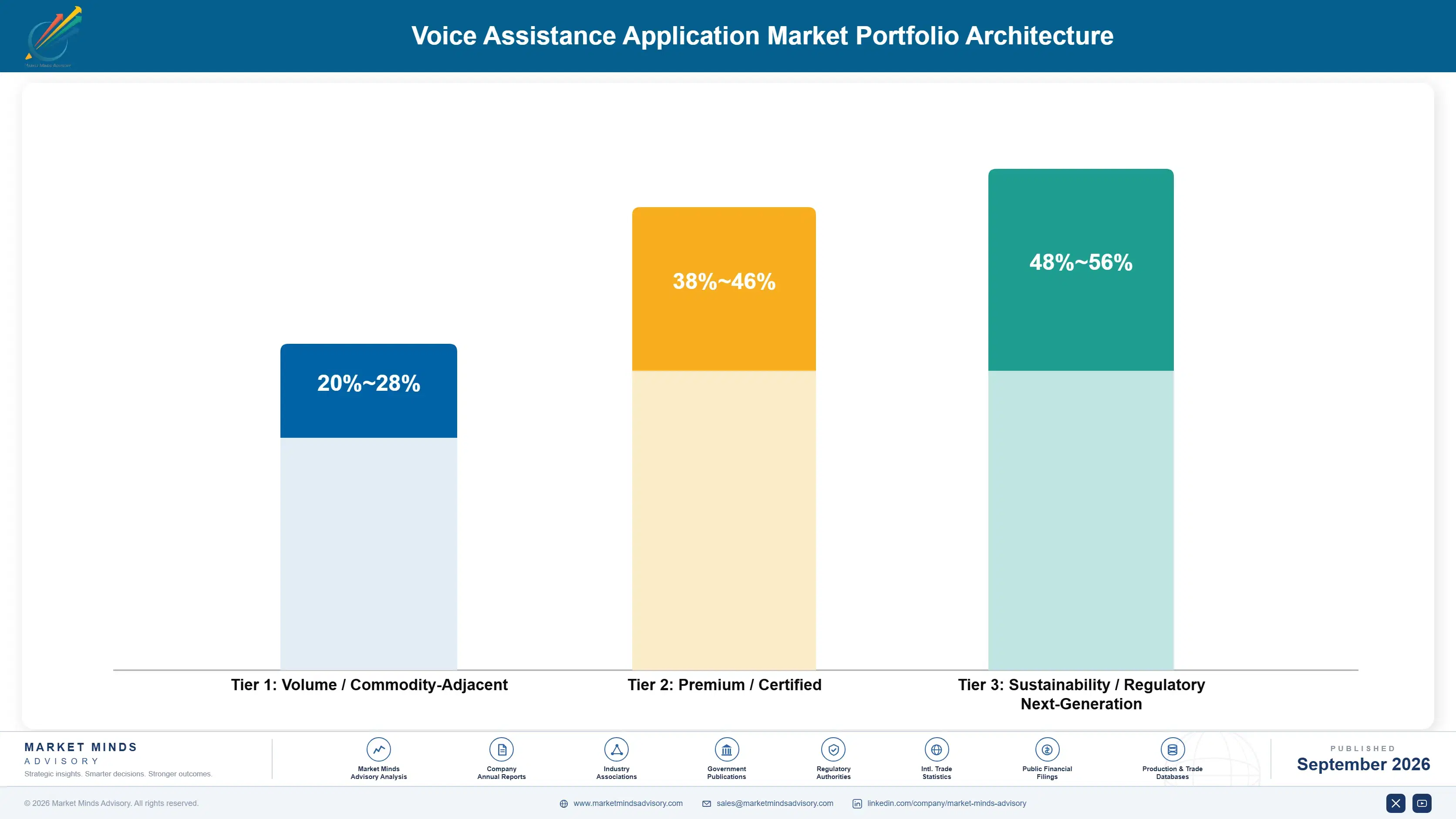
Gross margin in voice assistant software spreads widely depending on compute intensity and how much vertical-specific accuracy tuning the vendor has built into the underlying product. A general-purpose transcription tool sold at commodity pricing clears margin well below what a healthcare-specific documentation product commands, since the latter embeds specialized accuracy engineering work that buyers pay a real, sustained premium to access reliably over time.
Volume and premium tiers pull vendors toward genuinely different customer bases and go-to-market strategies. Volume players compete on low per-seat pricing across broad consumer and small business markets, while premium players concentrate on regulated enterprise verticals willing to pay substantially more for validated accuracy and liability protection built in. Few vendors execute both strategies at once, since compute cost structure and sales motion diverge sharply between the two approaches.

High-value margin pools concentrate specifically in vertical-specific accuracy modules, workflow integration fees, and long-term enterprise contracts rather than in general-purpose consumer-facing transcription, which increasingly functions as a low-margin, high-volume entry point that funds the compute infrastructure supporting the much higher-margin regulated vertical business built on top of that same underlying platform and shared model infrastructure across the company.

Volume / Commodity-Adjacent

General-purpose consumer and small business transcription tools sold at low per-seat pricing, competing mainly on ease of setup, onboarding speed, and integration with widely used consumer software platforms already installed on most devices.
Gross Margin: 20-28%

Premium / Certified

Enterprise productivity and customer service voice assistants bundled with dedicated support, uptime guarantees, and deep workflow integration sold to large corporate accounts across multiple industry verticals and company sizes nationwide and internationally.
Gross Margin: 38-46%

Sustainability / Regulatory / Next-Generation

Vertical-specific accuracy modules for healthcare, legal, and financial services meeting emerging regulatory accuracy and data residency standards demanded by compliance-conscious enterprise buyers operating across heavily regulated industries and jurisdictions worldwide.
Gross Margin: 48-56%
voice-assistance-application-market-portfolio-architecture-1789995805034

High-value Sub-segments and Strategic Watch-out

Healthcare Documentation Accuracy Modules

The highest-margin pool in the category, growing fastest as hospital systems seek liability protection and physician burnout relief through validated, specialty-tuned voice documentation tools built specifically for clinical use, regulatory compliance, and long-term patient record accuracy across every medical department, specialty, and care setting served nationwide.
Gross Margin: 50-58%

Enterprise Productivity Assistants

High-value, hardware-agnostic software commanding strong margin as knowledge workers across every industry adopt meeting transcription and task automation tools integrated directly into daily collaboration software already deployed across the organization and its many departments, teams, regional offices, and separate business units nationwide, abroad, and remotely.
Gross Margin: 38-46%

Consumer Smart Speaker Assistants

The largest volume core of the market, mature and low-margin, facing continued commoditization pressure as smart speaker hardware itself becomes a subsidized loss-leader for the largest platform vendors competing on device reach, household penetration rates, and long-term platform lock-in strategy across every household segment and demographic.
Gross Margin: 15-22%

Open-Source Model Competition

A strategic watch-out segment where increasingly capable open-source foundation models threaten to compress licensing margin for vendors that fail to differentiate through proprietary, defensible vertical accuracy work built up carefully over time, sustained investment, and continuous domain-specific model refinement across every regulated industry vertical served.
Gross Margin: N/A

Why Voice Assistants Become Sticky Fast

A voice assistant subscription behaves more like an annuity than a one-time software purchase once it becomes embedded in daily workflow. Meeting transcription tools accumulate months of searchable historical notes, and clinical documentation tools become part of a patient record system that hospitals cannot easily migrate away from without significant risk and cost, both of which raise switching costs meaningfully over time.
Stickiness varies sharply by end-use vertical and depth of integration. Enterprise productivity users show moderate lock-in tied mainly to accumulated meeting history and calendar integration, while healthcare documentation buyers show the deepest stickiness of any vertical, since clinical workflows and compliance certifications took months to configure correctly and cannot be easily replicated by a new vendor without repeating that entire validation process.

Buyer profiles are shifting generationally as digital-native procurement teams, comfortable evaluating AI accuracy claims directly, replace older technology buyers who once treated voice software as a novelty add-on rather than core infrastructure. This generational shift has accelerated enterprise willingness to run structured accuracy pilots before committing budget, a more rigorous evaluation process than the ad hoc trials common just a few years earlier.
voice-assistance-application-market-end-use-penetration-index-1789995805529

Where to Compete in Voice AI

These are among the four positions where our research anticipates prominent divergence between winners and laggards over the coming forecast period. Each is grounded in the demand model, the regulatory perimeter, and the announced capacity pipeline.
01 / VERTICAL ACCURACY INVESTMENT

Build domain-tuned models before generalists catch up

Vertical-specific accuracy modules already command a substantial price premium over general-purpose transcription, yet most vendors still rely on a single general-purpose model tuned only lightly for each individual industry vertical they serve. A challenger investing early in genuine domain-specific model training can lock in healthcare and legal accounts before the largest platform vendors close the accuracy gap through their own dedicated engineering investment, hiring, and acquisition activity. That window narrows measurably each year as foundation models continue improving broadly across the board and across every language served.
02 / USAGE-BASED PRICING SHIFT

Move away from flat per-seat licensing toward usage tiers

Vendors still selling flat per-seat licenses are leaving meaningful revenue on the table compared with competitors who layer usage-based transcription minute fees on top of a base subscription tier already firmly in place. This pricing shift also lowers the barrier to initial enterprise adoption, letting procurement teams start small and expand spend organically as internal usage and confidence proves out over time. Vendors that delay this pricing transition risk losing renewal negotiations to more flexible, usage-friendly competitors entirely within a year or two.
03 / COMPUTE COST MANAGEMENT

Diversify foundation model dependencies before the next price spike

The 2025 foundation model pricing surge demonstrated clearly how exposed single-model vendors are to a single supplier's pricing decisions made unilaterally and without any warning to affected customers. Vendors that diversify across multiple foundation model providers now, or invest in smaller task-specific models built in-house, protect their own margin against the next inevitable compute price shock far better than competitors relying on just one provider alone. This decision increasingly separates resilient, well-diversified vendors from fragile, exposed ones facing real ongoing risk.
04 / TRUST AND COMPLIANCE POSITIONING

Lead with verifiable accuracy audits rather than marketing claims alone

Regulated industry buyers increasingly demand independently verified accuracy benchmarks rather than vendor-reported marketing figures that cannot be checked or reproduced externally by any neutral third party evaluator. Vendors that proactively publish third-party accuracy audits build trust considerably faster than competitors relying purely on sales claims made during a pitch or product demo session. This transparency advantage compounds meaningfully over time as word spreads within the tight-knit regulated industry buyer communities that talk to each other constantly and compare detailed notes.

Engagement Snapshot From the Field

A live engagement with an industry participant carrying material or product regulatory and market exposure ahead of a defining policy shift, showing how our research translates into a defensible multi-year portfolio strategy.
MARKET MINDS ADVISORY · CLIENT ENGAGEMENT SUMMARY
Voice Assistance Application Producer Strategic Portfolio Review and Transition Roadmap 2026·Investment Scenario on Voice Assistance Application Exposure Evaluation 2025-26
CLIENT PROFILE
The client operates a regional hospital network with twelve facilities and roughly 900 practicing physicians across primary care and several specialty departments, reporting client-reported annual net patient revenue of approximately $1.2 billion (client-reported, unverified by MMA). Facing measurable physician turnover linked to after-hours documentation burden, network leadership sought an independent evaluation of ambient clinical voice documentation vendors before committing to a system-wide rollout.
STRATEGIC CHALLENGE
Three vendors had submitted competing proposals with meaningfully different accuracy claims, pricing structures, and specialty coverage depth, and the network's own internal IT team lacked the specific clinical informatics expertise needed to independently verify vendor-reported accuracy benchmarks across different medical specialties before signing any multi-year, system-wide contract commitment involving significant capital.
MMA APPROACH
MMA analysts designed a blinded accuracy evaluation protocol comparing each vendor's transcription output against physician-reviewed reference notes across five distinct medical specialties, alongside a total cost of ownership model incorporating licensing, implementation, and expected physician time savings under three realistic adoption scenarios reflecting meaningfully different rollout paces and overall timelines.
KEY FINDINGS
  1. The vendor with the lowest headline accuracy claim actually outperformed a higher-claiming competitor by 6 percentage points on the specific specialties the network cared about most, primary care and emergency medicine.
  2. Physician time savings varied sharply by specialty, ranging from under 20 minutes daily in structured surgical documentation to over 90 minutes daily in high-volume primary care visit notes.
  3. None of the three vendors offered adequate accuracy validation for the network's sizable Spanish-speaking patient population, a gap requiring a supplemental language-specific implementation phase before full rollout.
  4. The selected vendor's per-physician pricing, once usage-based transcription fees were modeled realistically, ran roughly $340,000 higher annually (client-reported, unverified by MMA) than its initial headline quote suggested.
CLIENT PROFILE
The client operates a regional hospital network with twelve facilities and roughly 900 practicing physicians across primary care and several specialty departments, reporting client-reported annual net patient revenue of approximately $1.2 billion (client-reported, unverified by MMA). Facing measurable physician turnover linked to after-hours documentation burden, network leadership sought an independent evaluation of ambient clinical voice documentation vendors before committing to a system-wide rollout.
STRATEGIC CHALLENGE
Three vendors had submitted competing proposals with meaningfully different accuracy claims, pricing structures, and specialty coverage depth, and the network's own internal IT team lacked the specific clinical informatics expertise needed to independently verify vendor-reported accuracy benchmarks across different medical specialties before signing any multi-year, system-wide contract commitment involving significant capital.
MMA APPROACH
MMA analysts designed a blinded accuracy evaluation protocol comparing each vendor's transcription output against physician-reviewed reference notes across five distinct medical specialties, alongside a total cost of ownership model incorporating licensing, implementation, and expected physician time savings under three realistic adoption scenarios reflecting meaningfully different rollout paces and overall timelines.
KEY FINDINGS
  1. The vendor with the lowest headline accuracy claim actually outperformed a higher-claiming competitor by 6 percentage points on the specific specialties the network cared about most, primary care and emergency medicine.
  2. Physician time savings varied sharply by specialty, ranging from under 20 minutes daily in structured surgical documentation to over 90 minutes daily in high-volume primary care visit notes.
  3. None of the three vendors offered adequate accuracy validation for the network's sizable Spanish-speaking patient population, a gap requiring a supplemental language-specific implementation phase before full rollout.
  4. The selected vendor's per-physician pricing, once usage-based transcription fees were modeled realistically, ran roughly $340,000 higher annually (client-reported, unverified by MMA) than its initial headline quote suggested.
RECOMMENDED STRATEGY
Phase 1: Phase 1 (Months 1 to 3): Deploy the selected vendor across primary care and emergency medicine, the two specialties with the highest documentation burden and clearest time-savings case. Phase 2: Phase 2 (Months 4 to 8): Expand to remaining specialty departments while implementing the supplemental Spanish-language accuracy validation and clinician training program. Phase 3: Phase 3 (Months 9 to 12): Complete network-wide rollout and formally renegotiate usage-based pricing terms once actual transcription volume data is available.
OUTCOME
The network selected the vendor MMA's blinded evaluation actually recommended rather than the one with the highest headline accuracy claim. Physician-reported administrative time savings after twelve months reached approximately 55 minutes per physician per day (client-reported, unverified by MMA), and voluntary physician turnover in primary care declined measurably year over year.

Frequently Asked Questions

Foundational context covering the market sizes, CAGR, scope, country, region and competition that inform every finding below. This section is provided to cover basics and most often pre-purchase conversations, answered from the MMA Primary Research Dataset.

What is the current size of the Voice Assistance Application Market?

The Voice Assistance Application Market reached $12.5 billion in base-year value in 2025, spanning enterprise productivity, healthcare documentation, customer service, and consumer voice assistant software worldwide.

How large will the Voice Assistance Application Market be by 2036?

The market is projected to reach $39.41 billion by 2036, expanding roughly 2.84 times its 2026 value as large language model reasoning replaces older rule-based dialogue systems industrywide.

What is the CAGR for the Voice Assistance Application Market 2026 to 2036?

The market is forecast to grow at a compound annual growth rate of 11.0 percent between 2026 and 2036, driven by enterprise productivity and healthcare documentation adoption.

Which segment is growing fastest?

Enterprise productivity voice assistants lead all segments at a 16.0 percent CAGR, roughly 1.45 times the overall market rate, as knowledge workers adopt meeting transcription tools.

Who are the major companies in the Voice Assistance Application Market?

Google, Microsoft, Amazon, Apple, and OpenAI lead the competitive field, evaluated on annual voice assistant application revenue across each vendor's full product portfolio and installed customer base.

Which country is growing fastest?

India leads all countries tracked at a 13.5 percent CAGR, fueled by its enormous information technology and business process outsourcing sector automating documentation and customer service tasks.

Report Segmentation Architecture

The full report scope spans multiple orthogonal segmentation dimensions, with cross-tabulated demand data provided for each dimension pair. Coverage extends further to regional breakdowns, trend trajectories, and the competitive detail needed to support segment-level decision-making.

By Primary Market Dimension

  • Enterprise Productivity Voice Assistants
  • Healthcare Voice Documentation Assistants
  • Customer Service Voice Bots
  • In-Vehicle Voice Assistants
  • Smart Home and Appliance Voice Control
  • Smart Speaker Voice Assistants

By End-Use Industry

  • Technology and Professional Services
  • Healthcare and Hospitals
  • Retail and Consumer
  • Automotive
  • Banking, Financial Services, and Insurance

By Commercial Dimension

  • Per-Seat Subscription Licensing
  • Usage-Based Pricing
  • Enterprise Managed Service Contract
  • Embedded OEM Licensing

By Region

  • North America
  • Western Europe
  • East Asia
  • South Asia and Pacific
  • Latin America
  • Middle East and Africa
  • Eastern Europe

Scope, Methodology, and Coverage

Every figure in this report is reproducible from documented input assumptions. The scope below maps the historical period, the forecast horizon, the segmentation dimensions, and the countries covered, alongside the underlying primary and qualitative methodology.
Historical Period
2020 to 2025
Forecast Period
2026 to 2036
Base Year
2025 (USD billions; MMA Primary Research Dataset, September 2026)
Market Definition
The Voice Assistance Application Market covers software applications that use speech recognition and natural language processing to interpret spoken commands and generate conversational or task-completing responses across consumer, enterprise, and specialized professional use cases. It excludes underlying speech recognition hardware components, telecom carrier voice infrastructure, and non-conversational dictation software lacking intent understanding.
Quantitative Units
USD billions (current prices); enterprise seat licensing volume where applicable
Segmentation Dimensions
By Primary Market Dimension; By End-Use Industry; By Commercial Dimension; By Region
Regions Covered
North America, Western Europe, East Asia, South Asia and Pacific, Latin America, Middle East and Africa, Eastern Europe
Countries Covered
USA, China, Germany, France, UK, Japan, South Korea, India, Australia, Canada, Brazil, Mexico, Indonesia, Vietnam, Thailand, Malaysia, UAE, Saudi Arabia, South Africa, Nigeria, Turkey, Poland, Netherlands, Italy, Spain, Sweden, Switzerland, Argentina, Colombia, Singapore, and additional markets relevant to this sector
Key Companies Profiled
Google, Microsoft, Amazon, Apple, OpenAI, IBM, Suki AI, SoundHound AI, Verint Systems, NICE Ltd, Salesforce, Zoom Communications, Otter.ai, Deepgram, AssemblyAI, Cerence, Baidu, Samsung Electronics, Rev.com, Speechmatics
Quantitative Methodology
Primary survey, n=3,800 respondents, Q4 2025, six countries; demand-side model with trade association cross-validation
Qualitative Methodology
47 expert interviews, Q4 2025; applied to validate demand model assumptions, identify emerging dynamics, and assess competitive positioning
Report Format
PDF and XLSX data workbook (Word format preview document)
Publisher
Market Minds Advisory
Report Code
MMA-2026-TEC-209
Published
September 2026
Contact
sales@marketmindsadvisory.com | www.marketmindsadvisory.com

Purchase the full Voice Assistance Application Market Report (2026 to 2036).

This report delivers a comprehensive assessment of the Voice Assistance Application Market from 2026 through 2036, covering sizing, segmentation, and regional demand patterns across all seven world regions tracked. It profiles twenty companies competing on transcription accuracy, workflow integration depth, and compute cost efficiency rather than raw feature lists alone. Readers get detailed analysis of revenue levers, input cost exposure, and portfolio margin economics specific to this software category and its buyers. The report closes with a strategic verdict identifying exactly where new capital should concentrate over the coming decade.
Full seven-region market sizing and forecast data
Twenty-company competitive profiling and moat analysis
Segment-level CAGR and market share breakdown
Compute cost exposure and mitigation pathway analysis
Revenue lever and portfolio margin economics detail
Anonymized client case study with recommended strategy

Built For The People Who Decide

From boardroom strategy to bench-side execution, this report is read cover-to-cover by leaders shaping the next decade of their industry, turning demand scenarios, market dynamics and valuation benchmarks into decisions.
CXOs/ Presidents/ VPs/ Managers
M&A and Corporate Development
Strategy Teams and R&D Heads
Procurement and Product Directors
Regulatory and Compliance Leaders
Investor Relations and Equity Analysts