

Market Minds Advisory
Vodka Market

Vodka Market: The Spirit Legally Required To Taste Of Nothing, And What That Costs

Vodka is the only major spirit defined by law as flavourless, which means the bottle and the story carry everything, and a consumer who stops believing either has nothing left to pay for.

Lead Analyst

Published

September 2026

Make Smarter Decisions with Customized Research Insights

Request a free sample report and evaluate market opportunities, growth trends, and competitive dynamics relevant to your business needs.

2025 MARKET VALUE$46.0BMarket Size 2025
2036 FORECAST VALUE$72.3BBase Case , 2026 to 2036
CAGR 2026 TO 20364.2 %Bull 5.4% / Bear 3.0%
INCREMENTAL OPPORTUNITY$24.4BNet 10- year value creation
EXPANSION MULTIPLE1.51x2036 value over 2026 base
Strategic Levers
M&A Pipeline
Regional Outlook
Country Rankings
Competitive Intelligence
Segmental Deep-dive
Call-Us : 91 93563 13602

Executive Snapshot and Market Trajectory

Vodka is defined as neutral and without distinctive character, which makes it the only major spirit where the liquid legally cannot be the differentiator. Everything the category earns comes from glass, distribution and narrative. That worked brilliantly for thirty years and it is now working less well.
The split between volume and value tells opposite stories about one category. Eastern Europe drinks roughly 5.4 times the global per capita average and pays a fraction of Western prices, while North America holds the largest value share on premium pricing. Super premium grows fastest at 6.3%, half again the market rate, and everything below premium is in decline. Nothing between those two poles moves at all.
Competition is fragmented, with the top five holding 38% of retail value across a field of national champions and global brands. The pressure point is age: under thirty-fives account for 29% of Western volume and are choosing tequila and whiskey, spirits where the liquid itself carries a claim. India grows at 8.4% because vodka arrives there as a young urban spirit rather than an inherited one. Nobody has answered that yet.
Market Definition
Distilled neutral spirit of agricultural origin sold as vodka under applicable regulatory definition, including unflavoured and flavoured expressions across all price tiers, measured at retail value worldwide. Coverage spans off-trade, on-trade and travel retail channels. Ready to drink premixed beverages, neutral grain spirit sold as an industrial input, and other white spirits including gin, rum and tequila are excluded from scope.
Base Year Value
$46.0B in 2025 (MMA Primary Research Dataset, August 2026)
Forecast Period
2026 to 2036, eleven discrete annual values
CAGR
4.2% base case. Bull 5.4%. Bear 3.0%.
Fastest Growth Segment
Super Premium Vodka: 6.3% CAGR
Fastest Growth Country
India: 8.4% CAGR
Fastest Growth Region
South Asia and Pacific: 6.4% CAGR
Largest Region
Eastern Europe: 31% of 2025 global value
Market Leaders
Diageo, Pernod Ricard, Bacardi Limited, Roust Corporation, Stoli Group. Source: MMA Primary Research Dataset, July 2026.
Primary Survey
n=3,800 procurement and R&D decision-makers, Q4 2025, six countries
Methodology
Demand-side build-up, cross-validated against public data, 47 expert interviews

Vodka Market Forecast Scenarios

vodka-market-2024-2034-trends-growth-size-forecast-scenario-1787664806761
The five years to 2025 were value growth on falling volume, which is a harder trick than it sounds. Premiumisation carried the category while total litres declined across most Western markets and Eastern European consumption moderated from high levels. The 3.4% historical rate conceals that split, since a category can post value growth while losing the drinkers who will define it a decade out.
The 4.2% base case rests on three mechanisms. Super premium and above continues taking value share at 6.3%, since consumers trading up buy fewer bottles at higher prices and the arithmetic still works. Indian urban demand grows at 8.4%, where vodka carries no inherited associations and recruits young drinkers directly. And Eastern European volume declines gently while price per litre rises, which holds regional value roughly flat year after year.
The 5.4% bull case turns on vodka recovering standing in cocktail culture, where bartender preference shifted decisively toward agave and brown spirits over the past decade and takes the on-trade call with it. The 3.0% bear case is generational: under thirty-fives already account for only 29% of Western volume, and a spirit that cannot make a claim about its own taste struggles to recruit them.

The Spirit That Cannot Argue For Itself

The regulatory definition is the whole commercial problem. Vodka must be neutral, without distinctive character, aroma or taste, which means a brand legally cannot claim its liquid is better in the way a single malt or a mezcal can. Everything the category has ever earned above commodity price has come from glass design, distribution muscle and narrative. Nothing else was available to it.
TOP FIVE CONCENTRATION38%Combined retail value held by the leading five groups
EASTERN EUROPE PER CAPITA5.4xVolume per adult against the global average level
PREMIUM TIER VALUE SHARE44%Retail value above the premium price threshold globally
PACKAGING COST SHARE21%Glass and closure as proportion of goods sold
UNDER THIRTY FIVE SHARE29%Western volume bought by the youngest legal cohort
GRAIN INPUT COST SHARE17%Wheat and rye against total production cost base
That worked extraordinarily well for three decades and is working less well now. Premium positioning built on filtration counts, water sources and country of origin persuaded a generation of drinkers, and the same claims read as marketing to their successors. Under thirty-fives account for 29% of Western volume, well below their share of the drinking population, and they are choosing spirits that taste of something specific.
The volume and value maps barely overlap. Eastern Europe drinks roughly 5.4 times the global per capita average at prices a Western marketer would not recognise, while North America holds the largest value share on a fraction of the litres. Anyone reading global volume statistics and global value statistics as descriptions of the same category will draw contradictory conclusions from both.
"Vodka spent thirty years persuading people that a legally flavourless liquid could taste different depending on the bottle. The remarkable thing is not that the argument is failing now; it is that it worked at all."
Director, Beverage Alcohol and Spirits Practice · MMA Food and Beverage Practice · August 2026

Market Trends

Premiumisation Continues While Total Volume Keeps Falling

Value above the premium price threshold now accounts for 44% of global retail, and super premium grows at 6.3% against a market rate of 4.2%. Consumers trading up buy fewer bottles at materially higher prices, and the arithmetic has carried category value through a decade of declining litres across most Western markets. The mechanism has limits nobody has tested properly, since premiumisation eventually runs out of consumers willing to trade further up. What happens to a category losing volume once value growth stalls is the question the industry avoids. Nobody has a good answer.
Market Impact: India grows at 8.4% annually

Agave And Brown Spirits Take The Bar Call

Bartender preference shifted decisively toward tequila, mezcal and whiskey across the past decade, and the on-trade call matters far beyond its volume because it shapes what drinkers order everywhere else. A spirit that legally cannot claim distinctive taste has little to offer a bartender building a menu around provenance and flavour. Under thirty-fives account for only 29% of Western vodka volume as a direct result. Recovering that position requires an argument about the liquid, which is precisely what the category's own regulatory definition prevents it from making. The definition is the trap.
Market Impact: Packaging absorbs 21% of goods cost

Market Opportunities and Growth Drivers

Indian Urban Demand Recruits Drinkers Without Inherited Associations

India grows at 8.4%, faster than any market covered, because vodka arrives there as a modern urban spirit rather than as something inherited from a previous generation. Domestic producers including Radico Khaitan and Allied Blenders and Distillers have built the category from a small base into a genuine competitor to whisky among younger city drinkers. State level licensing and taxation vary enormously, which favours participants with existing Indian distribution over importers. Flavoured expressions perform particularly well here, where they read as contemporary rather than as a discount tactic. Nothing here is a defence.
Market Impact: Restricts claims across 100% of output

Packaging Design Carries What The Liquid Legally Cannot

Glass and closure account for roughly 21% of cost of goods, which is far higher than any comparable spirit category, and the reason is that packaging is doing work the liquid is not permitted to do. Distinctive bottle architecture has built several of the category's largest brands from nothing within a decade. That investment is defensible commercially, since design is genuinely difficult to copy at scale and consumers demonstrably pay for it. It also means production efficiency matters less here than in any other spirit. Efficiency is not where this competes.
Market Impact: Duty falls equally across 6 tiers

Market Restraints and Challenges

Regulatory Neutrality Prevents Any Claim About Taste

Vodka must be neutral and without distinctive character under most regulatory definitions, which forbids the flavour claims that carry every competing spirit category. The root cause is legislative rather than commercial, and no producer can change it unilaterally. Commercially this pushes all differentiation into packaging, provenance narrative and distribution, none of which persuade a consumer who has decided taste is the point. Participants are responding with terroir style grain sourcing stories and with craft distillation claims, which stretch the definition without ever escaping it. The definition holds regardless of what marketing says.
Market Impact: Premium tiers hold 44% of value

Excise Duty Compresses Margin On Lower Price Tiers

Excise taxation is levied on alcohol content rather than on value in most jurisdictions, which means a value tier bottle carries the same duty as a luxury one and gives up a far larger share of its retail price to it. The root cause is fiscal policy design that treats all spirits identically by volume. Commercially this makes the bottom three tiers close to unviable in high duty markets and accelerates the exit from volume. Producers respond by migrating portfolios upward, which abandons volume rather than fixing it. Volume is being abandoned.
Market Impact: Youngest cohort takes 29% of volume
4 additional market trends, 3 additional growth drivers, and 2 additional restraints and challenges are covered in the full report. Contact sales@marketmindsadvisory.com to access the complete intelligence.

Segment CAGR and Growth Architecture

Segmentation follows price tier, since a legally neutral spirit differentiates on price position and everything that supports it rather than on formulation. Six tiers run from value bottles competing against duty to luxury expressions competing against other luxury goods entirely. Growth concentrates near the top and decline concentrates at the bottom. The middle is being hollowed out.
vodka-market-2024-2034-trends-growth-market-share-analysis-1787664807304

Super Premium Vodka

Bottles priced above mainstream premium and below the luxury threshold, typically carrying a distinctive glass architecture, a named provenance and on-trade presence in better bars. At 6.3% this is the fastest growing tier, half again the market rate of 4.2%, and it sits at the point where consumers trading up still buy regularly rather than occasionally. Luxury bottles are bought for occasions and gifting, which caps their frequency. Super premium holds enough routine purchase to compound. The tier is also where packaging investment returns most clearly, since buyers here are paying for something they can see and nothing they can legally taste. Frequency rather than price position is what makes this tier compound.
CAGR 6.3%

Ultra Premium Vodka

Expressions priced well above super premium and short of outright luxury positioning, sold heavily through on-trade, travel retail and gifting rather than through routine off-trade purchase. Growth of 5.8% is second fastest in the market and the driver is occasion rather than frequency. Travel retail matters disproportionately here, since duty free removes the excise burden that compresses everything below premium and makes the price step feel considerably smaller. The risk is that occasion led tiers depend on categories of consumption that agave spirits have been taking steadily, particularly among the younger drinkers who define what a celebration bottle looks like. Occasion led tiers are more exposed to generational change than routine purchase ever is.
CAGR 5.8%
Full segment breakdown across 6 segments available in the complete report.

Regional Architecture and Country Demand Map

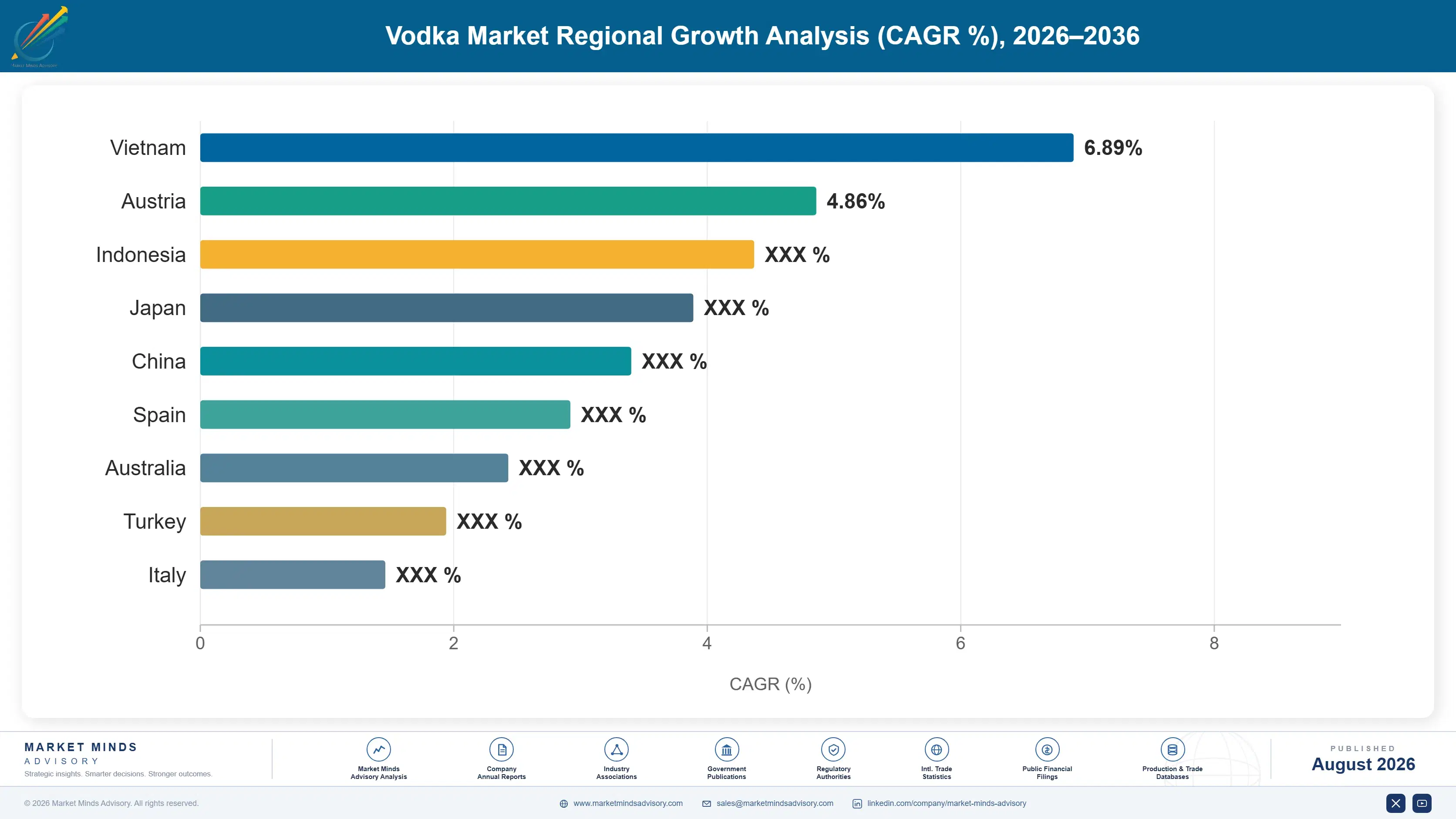
Eastern Europe holds 31%, far above the standard band, because Poland, Russia and Ukraine are the category's home market at roughly 5.4 times global per capita volume. North America follows at 27% on premium pricing. India grows fastest at 8.4%. Everything below premium is now declining.

North America

Premium pricing rather than volume carries this 27% share, since American drinkers buy far fewer litres per head than Eastern Europeans and pay several times as much for them. Vodka remains the largest spirit category by value in the United States, built on three decades of packaging led premiumisation and enormous distributor scale. The problem is demographic and visible in the data: under thirty-fives account for 29% of volume, well below their share of the drinking population, and tequila has taken the position vodka held with that cohort. Growth of 3.6% reflects continued trading up against a slowly shrinking drinker base. Value is holding while the drinker base slowly erodes beneath it.
Share: 27% | CAGR: 3.6% (2026 to 2036)

Western Europe

British, German, French and Nordic markets carry most of this 18% share, with high excise duty compressing the lower tiers and pushing the viable business steadily upmarket. Nordic state retail monopolies shape assortment decisions in a way no other Western market experiences, favouring brands that can satisfy tender criteria on price and sustainability together. Cocktail culture here moved toward agave and brown spirits earlier than in North America. Travel retail across major European hubs remains disproportionately valuable for ultra premium expressions. Growth of 2.8% is the lowest of the seven regions and reflects a genuinely mature category. High duty and monopoly assortment together shape what a producer can profitably sell here.
Share: 18% | CAGR: 2.8% (2026 to 2036)
Regional intelligence for 5 additional markets available in the complete report: East Asia, South Asia and Pacific, Latin America, Middle East and Africa, Eastern Europe. Contact sales@marketmindsadvisory.com.
vodka-market-2024-2034-trends-growth-country-cagr-analysis-1787664807823

Where This Category Still Earns

Nothing here is won on liquid quality, because the regulatory definition forbids the claim and consumers cannot verify it anyway. Value accrues to whoever owns the bottle, whoever holds the bar call, whoever recruits drinkers with no inherited associations, and whoever manages the volume decline honestly. Four routes carry weight and none involves distillation.

Own The Bottle Since The Liquid Cannot Differ

Glass and closure absorb roughly 21% of cost of goods here, far above any comparable spirit category, because packaging performs the work the liquid is legally barred from performing. Distinctive bottle architecture has built several of the largest brands in the category from nothing inside a decade, and design at that level is genuinely hard for a competitor to copy at scale. Production efficiency matters less in vodka than in any other spirit as a direct consequence. Cutting packaging cost to protect margin removes the only differentiator the category has.
Market Impact: Packaging carries 21% of the total goods cost

Defend The Bar Call Before The Shelf

Bartender preference moved toward agave and brown spirits over the past decade, and the on-trade call shapes what drinkers order in every other channel afterwards. Vodka's share of that call has fallen alongside its position with under thirty-fives, who now take only 29% of Western volume. Winning back menu placement requires investment in on-trade advocacy at a scale most brands cut first when budgets tighten. The category treats on-trade as a marketing cost when it functions as the recruitment channel for everything else. Recruitment happens at the bar, not on the shelf.
Market Impact: Recovers share among the 29% under thirty-five cohort

Follow Vodka Into Young Indian Urban Markets

India grows at 8.4%, faster than any market covered, because vodka arrives without the inherited associations that shape it everywhere else and recruits younger urban drinkers directly rather than competing for the whisky consumer. Domestic producers have built the category from a very small base. State level licensing and taxation vary enormously, which rewards participants holding existing Indian distribution and penalises importers considerably. Flavoured expressions work here as contemporary propositions rather than as the discount tactic they became across Western markets a decade ago. There is nothing here to win back.
Market Impact: Captures the 8.4% Indian growth rate through 2036

Trade Volume For Value In Eastern Europe

Eastern Europe drinks roughly 5.4 times the global per capita average and holds 31% of category value at price points no Western marketer would recognise. Consumption is moderating slowly from very high levels while price per litre rises, which holds regional value roughly flat at 3.2% growth. Managing that trade deliberately, by migrating drinkers upward rather than defending litres, is the difference between a controlled transition and a collapse. Local brands with generational positions are considerably better placed to do it than importers. Denial is considerably more expensive than management.
Market Impact: Manages the 31% of category value in decline

Who Controls the Margin Pool

Concentration is low for a global spirits category. The top five hold 38% of retail value, the basis applied consistently throughout this section, and the remainder splits between national champions with generational positions and mid-sized international groups. Diageo leads on distribution reach and portfolio breadth, and the gap to challengers reflects route to market scale rather than any brand advantage that could not be replicated with sufficient investment.
Competition runs on three fronts. Global groups compete for on-trade menu placement and travel retail listings, where the category is losing ground to agave and brown spirits collectively. Eastern European producers compete on generational brand position and local distribution in the market that holds most of the volume. And Indian producers compete for a young urban consumer nobody had previously recruited.

Rankings will move with generational recruitment rather than with brand investment, since a category losing under thirty-fives cannot buy its way back through advertising alone. The other pressure point is Eastern European volume decline, which is gradual now and matters enormously to anyone holding 31% of category value in a market that is slowly drinking less.
vodka-market-2024-2034-trends-growth-company-positioning-matrix-1787664808364

Competitive Moat and Risk Dimensions

DIAGEO

Moat: Route To Market Scale

Distribution reach across virtually every meaningful market gives listings and on-trade presence that a challenger cannot assemble at any speed, and portfolio breadth means retailers and distributors negotiate across categories rather than on vodka alone. That leverage in trade negotiation is the durable asset here, considerably more so than any individual brand position.
DIAGEO

Risk: Category Exposure To Agave

Substantial vodka exposure sits inside a portfolio also holding tequila brands taking exactly the consumers vodka is losing, which cushions group results while doing nothing for the vodka business itself. Internal capital allocation increasingly favours the categories growing, and a declining category inside a diversified group rarely receives the investment required to recover.
PERNOD RICARD

Moat: Premium Brand Equity Depth

A leading super premium position built over decades carries genuine brand recognition in the tier growing fastest at 6.3%, supported by design and provenance narrative that predates most competing premium entries. On-trade advocacy investment sustained across many years has held menu placement better than the category average through a period when vodka generally lost ground.
PERNOD RICARD

Risk: Western Market Concentration

Strength sits in mature Western markets where category volume is falling and where the youngest legal drinkers take only 29% of consumption. Presence in India, where growth runs at 8.4% and where domestic producers hold distribution advantages, is considerably weaker than the position in markets that are slowly shrinking.

Players Tracked

Prominent Players

Diageo
Pernod Ricard
Bacardi Limited
Roust Corporation
Stoli Group

Other Key Players

Brown-Forman
Campari Group
Suntory Global Spirits
William Grant and Sons
LVMH Moet Hennessy
Constellation Brands
Sazerac Company
E&J Gallo Winery
Marie Brizard Wine and Spirits
Stock Spirits Group
Luxco
Phillips Distilling
Radico Khaitan
Allied Blenders and Distillers
Amber Beverage Group

Recent Developments

FEBRUARY 2025

Indian producer expands vodka capacity for urban demand

An Indian spirits producer expanded vodka production capacity to serve urban demand growing at 8.4% annually, faster than any market covered. The expansion was organic capacity investment rather than any acquisition, and it targets younger city drinkers who carry no inherited category associations at all.
Signal: The only meaningful recruitment happening in this category is among drinkers who inherited nothing from anyone before them
MAY 2025

Nordic state retail tender revises vodka assortment criteria

A Nordic state retail monopoly revised assortment criteria for spirits tenders, weighting packaging sustainability and price alongside existing measures. Glass accounts for roughly 21% of vodka cost of goods, well above comparable categories, which makes the change commercially significant for premium expressions specifically. Assortment criteria now reach packaging.
Signal: Where a monopoly sets assortment criteria, packaging decisions stop being purely a marketing question and become a listing one
SEPTEMBER 2025

Super premium expression secures expanded travel retail distribution

A super premium vodka secured expanded travel retail distribution across major European and Gulf hubs, a channel where duty free pricing removes the excise burden that compresses tiers below premium. Super premium grows at 6.3% and travel retail contributes disproportionately to occasion led purchase. Margin follows accordingly.
Signal: Duty free removes the tax that makes the price step between tiers feel steep to consumers

What A Neutral Spirit Costs

Glass and closure account for roughly 21% of cost of goods, which is far above any comparable spirit, and grain inputs of wheat, rye and corn account for a further 17%. Energy for distillation and for glass furnace operation carries most of the remainder before excise. European glass production is concentrated among a few furnace operators, and grain sourcing traces to European and North American arable regions.
Energy rather than grain proved the binding constraint, since glass furnaces run continuously and cannot be throttled economically when gas prices move. IEA data recorded European gas prices reaching levels several times historical norms during the last energy disruption, and glass producer annual reports documented surcharges passed to beverage customers. Producers holding no forward energy cover absorbed the increase into margin as excise duty was also rising across several markets.

Exposure divides by tier rather than by scale. Value and standard bottles surrender a larger share of retail price to excise duty, levied on alcohol content rather than value, so a cost increase has nowhere to go and lands in margin. Premium bottles absorb the same increase across a much larger price. Producers concentrated in low tiers have almost no room left.
vodka-market-2024-2034-trends-growth-cost-volatility-analysis-1787664808566

Contract energy forward across the glass supply chain

Glass furnaces run continuously and cannot be throttled economically, which makes energy cost a fixed exposure rather than a variable one for anybody buying bottles. Forward contracting with glass suppliers, or participating in their hedging directly, converts an unpredictable surcharge into a known cost. Producers treating glass as a spot purchase absorbed the last disruption entirely into margin.

Migrate portfolio weight above the excise compression point

Excise is levied on alcohol content rather than on value, so a value tier bottle surrenders a far larger share of its retail price than a premium one carrying identical duty. Migrating portfolio weight upward does not fix the tax design and does move the business to where cost increases have somewhere to be absorbed. The trade is volume.

Protect packaging investment when margin pressure arrives

Glass and closure absorb 21% of cost of goods precisely because packaging performs work the liquid is legally barred from performing. Cutting bottle specification is the fastest available margin repair and it removes the only differentiator vodka has. Producers who have done it under pressure rarely recover the price position afterwards, whatever the saving looked like at the time.

Portfolio Architecture for Margin Defence

Margin architecture divides on where excise duty stops mattering. Value and standard bottles surrender an enormous share of retail price to duty levied on alcohol content rather than value, leaving margins that barely support the packaging the category depends on. Premium and super premium absorb the same duty across a much larger price and earn properly. Luxury expressions earn best and sell on occasion rather than routine, which caps how much volume they can ever carry.
The tension runs between value growth and volume collapse. Migrating a portfolio upward improves margin immediately and abandons the litres that carry factory utilisation, distributor attention and shelf presence. A producer holding both is managing a decline in one half to fund growth in the other. Nobody in the category has solved this and several have pretended the volume was never worth having.

High value pools concentrate in super premium at 6.3% and in Indian urban recruitment at 8.4%, neither of which is a manufacturing position. Everything below premium competes against duty rather than against other producers. The businesses worth building are those where price position leaves room for the packaging investment that carries a spirit legally forbidden from claiming any taste at all.

Value and Standard Bottles

Lower tier expressions where excise duty on alcohol content consumes a large share of retail price regardless of quality. The range is wide because duty regimes differ enormously between markets, which moves realised margin considerably.
Gross Margin: 14-18%

Premium and Super Premium

Bottles priced where duty becomes a manageable proportion of retail and packaging investment returns properly. Super premium grows fastest in the category at 6.3%, with enough routine purchase frequency to compound.
Gross Margin: 38-42%

Ultra Premium and Sustainability Certified

Occasion led expressions and certified sustainable packaging propositions increasingly required by state retail monopolies. The range is wide because travel retail and domestic duty paid channels realise materially different margins on identical bottles.
Gross Margin: 48-54%
vodka-market-2024-2034-trends-growth-portfolio-architecture-1787664809090

High-value Sub-segments and Strategic Watch-out

Super Premium Vodka

Fastest growing tier at 6.3% and positioned where consumers trading up still buy with routine frequency rather than only for occasions. Packaging investment returns most visibly here, since buyers are paying for something they can see and nothing they can legally taste. Frequency is what makes it compound.
Gross Margin: 40-44%

Ultra Premium Vodka

Second fastest at 5.8% and driven by occasion rather than frequency, with travel retail disproportionately important because duty free removes the excise step. Exposure sits in celebration occasions that agave spirits have been steadily taking from the category. Occasion led demand is inherently more fragile than routine purchase.
Gross Margin: 48-52%

Premium Vodka

Growing at 4.6% and carrying the largest single share of category value, which makes it the volume core rather than the growth story. Competition here is direct between global groups with comparable distribution and no defensible product claim available to any of them. Distribution decides everything here.
Gross Margin: 36-40%

Flavoured Vodka

Growing at 3.4% in Western markets where it became associated with discounting, while performing considerably better in India and Southeast Asia as a contemporary proposition. The same product reads as cheap in one region and modern in another, which complicates global brand positioning. Global positioning becomes awkward.
Gross Margin: 30-34%

How Vodka Holds Its Drinkers

Spirits demand runs on habit formed young and held for decades, which makes this category's problem more serious than its current numbers suggest. A drinker who adopts a spirit in their twenties buys it for thirty years, and one who does not is unlikely to arrive later. Under thirty-fives take only 29% of Western vodka volume, well below their share of the drinking population, and that gap compounds.
Attachment varies by market and by what the spirit represents there. Eastern European consumption is embedded in daily and social routine at roughly 5.4 times global per capita volume, and it moderates slowly rather than switching. Western premium drinkers are more mobile, since a purchase justified by packaging and story can be re-justified by a different bottle. Indian urban adopters are forming habits now with nothing to switch away from.

The buyer profile is shifting toward flavour led choice, which is the one thing vodka is legally prevented from offering. Younger drinkers across Western markets describe provenance and taste as purchase reasons where their predecessors accepted filtration counts and bottle design. That is why agave and brown spirits took the bar call. Recovering it requires an argument the definition does not permit.
vodka-market-2024-2034-trends-growth-end-use-penetration-index-1787664809621

Where Vodka Still Rewards Investment

These are among the four positions where our research anticipates prominent divergence between winners and laggards over the coming forecast period. Each is grounded in the demand model, the regulatory perimeter, and the announced capacity pipeline.
01 / PACKAGING DESIGN INVESTMENT

The bottle is the product in this category

Glass and closure absorb roughly 21% of cost of goods here, far above any comparable spirit, because packaging performs work the regulatory definition forbids the liquid from performing at all. Distinctive bottle architecture has built several of the largest brands in the category from nothing inside a single decade, and design at that level is genuinely difficult for competitors to copy at scale. Cutting bottle specification under margin pressure removes the only differentiator vodka has ever had at any price point.
02 / ON PREMISE RECRUITMENT

The bar call decides the next generation

Bartender preference moved decisively toward agave and brown spirits across the past decade, and the on-trade call shapes what drinkers order in every other channel long afterwards. Under thirty-fives now take only 29% of Western vodka volume, well below their share of the drinking population, and a spirits habit formed in someone's twenties tends to last thirty years. Advocacy investment is the first budget cut when margins tighten and functions as the recruitment channel for everything else the category sells.
03 / EMERGING URBAN RECRUITMENT

Recruit where nothing was inherited at all

India grows at 8.4%, faster than any market covered, precisely because vodka arrives there carrying none of the associations that shape how it is received in markets where it has been sold for generations. Younger urban drinkers are recruited directly rather than won from whisky, and domestic producers have built the tier from an extremely small base. State level licensing rewards participants holding existing Indian distribution and penalises importers considerably, which makes partnership the practical route in for anybody arriving late.
04 / VOLUME VALUE REBALANCING

Manage the decline rather than deny it

Eastern Europe holds 31% of category value at roughly 5.4 times the global per capita volume, and consumption there is moderating slowly from very high levels while price per litre rises to compensate. Migrating drinkers upward deliberately produces a controlled transition, while defending litres against excise duty levied on alcohol content produces neither volume nor margin. Producers pretending the volume was never worth having are simply losing it faster than necessary and forfeiting the price per litre gains that would otherwise offset it.

Engagement Snapshot From the Field

A live engagement with an industry participant carrying material or product regulatory and market exposure ahead of a defining policy shift, showing how our research translates into a defensible multi-year portfolio strategy.
MARKET MINDS ADVISORY · CLIENT ENGAGEMENT SUMMARY
Vodka Producer Strategic Portfolio Review and Transition Roadmap 2026·Investment Scenario on Vodka Exposure Evaluation 2025-26
CLIENT PROFILE
An international spirits group holding a super premium vodka brand alongside agave and brown spirits, distributing across North America and Western Europe. Vodka revenue was approximately 310 million dollars (client-reported, unverified by MMA), representing roughly a fifth of group spirits turnover. Vodka volume had declined for four consecutive years while value held roughly flat throughout.
STRATEGIC CHALLENGE
Internal capital allocation was moving steadily toward agave brands taking exactly the consumers vodka was losing, and the vodka business was being managed for cash rather than for recovery. Management wanted to know whether the decline was reversible at any investment level, or whether harvest was the correct strategy. Nobody had separated recruitment failure from switching.
MMA APPROACH
MMA analysed the client's consumer purchase data by age cohort across both regions, separating drinkers lost to switching from drinkers never recruited. On-trade menu placement was tracked against advocacy spending across five years. Forty-seven expert interviews with bartenders, distributors and category managers established what actually drives the bar call, alongside quantitative survey work across six countries.
KEY FINDINGS
  1. Losses were 4 times more attributable to failed recruitment among new legal drinkers than to existing consumers switching away from the brand.
  2. Menu placement tracked advocacy spending with a lag of roughly 2 years, meaning the current position reflected budget decisions already taken and largely forgotten.
  3. Packaging refresh proposals modelled a 6% cost saving that would have removed the design features consumers cited most often in unprompted brand recall.
  4. Indian distribution, which the group did not hold, represented growth of 8.4% annually against declining volume across both of its existing regions.
CLIENT PROFILE
An international spirits group holding a super premium vodka brand alongside agave and brown spirits, distributing across North America and Western Europe. Vodka revenue was approximately 310 million dollars (client-reported, unverified by MMA), representing roughly a fifth of group spirits turnover. Vodka volume had declined for four consecutive years while value held roughly flat throughout.
STRATEGIC CHALLENGE
Internal capital allocation was moving steadily toward agave brands taking exactly the consumers vodka was losing, and the vodka business was being managed for cash rather than for recovery. Management wanted to know whether the decline was reversible at any investment level, or whether harvest was the correct strategy. Nobody had separated recruitment failure from switching.
MMA APPROACH
MMA analysed the client's consumer purchase data by age cohort across both regions, separating drinkers lost to switching from drinkers never recruited. On-trade menu placement was tracked against advocacy spending across five years. Forty-seven expert interviews with bartenders, distributors and category managers established what actually drives the bar call, alongside quantitative survey work across six countries.
KEY FINDINGS
  1. Losses were 4 times more attributable to failed recruitment among new legal drinkers than to existing consumers switching away from the brand.
  2. Menu placement tracked advocacy spending with a lag of roughly 2 years, meaning the current position reflected budget decisions already taken and largely forgotten.
  3. Packaging refresh proposals modelled a 6% cost saving that would have removed the design features consumers cited most often in unprompted brand recall.
  4. Indian distribution, which the group did not hold, represented growth of 8.4% annually against declining volume across both of its existing regions.
RECOMMENDED STRATEGY
Phase 1: Phase one: restore on-trade advocacy spending, since menu placement tracks it with a 2 year lag and recruitment failure drives 4 times more loss than switching. Phase 2: Phase two: reject the packaging cost saving, since 6% of goods cost would remove the design features carrying unprompted consumer recall. Phase 3: Phase three: build Indian distribution through partnership, accessing 8.4% growth rather than defending two regions where volume is already declining.
OUTCOME
The client restored advocacy spending and menu placement stabilised across both regions within two years, though volume decline continued at a reduced rate. The packaging saving was rejected and price position held. An Indian distribution partnership was signed, giving the group access to the only market where its vodka volume grew at all (client-reported, unverified by MMA).

Frequently Asked Questions

Foundational context covering the market sizes, CAGR, scope, country, region and competition that inform every finding below. This section is provided to cover basics and most often pre-purchase conversations, answered from the MMA Primary Research Dataset.

What is the current size of the Vodka Market?

The market was valued at 46.0 billion dollars in 2025, measured at retail value across off-trade, on-trade and travel retail channels worldwide. It reaches an estimated 47.93 billion dollars during 2026.

How large will the Vodka Market be by 2036?

MMA forecasts 72.32 billion dollars by 2036, an increase of 24.39 billion dollars over the 2026 base. That represents an expansion multiple of 1.51 times across the forecast period.

What is the CAGR for the Vodka Market 2026 to 2036?

The base case compound annual growth rate is 4.2%, with a bull case of 5.4% and a bear case of 3.0%. Generational recruitment and premium tier momentum separate those two scenarios.

Which segment is growing fastest?

Super premium vodka grows at 6.3%, half again the market rate of 4.2%, because it sits where trading up consumers still buy with routine frequency. Ultra premium follows at 5.8%.

Who are the major companies in the Vodka Market?

Diageo, Pernod Ricard, Bacardi Limited, Roust Corporation and Stoli Group lead on retail value across global and national positions. Together they account for 38% of the market.

Which country is growing fastest?

India grows fastest at 8.4%, because vodka arrives in Indian cities without inherited associations and recruits younger urban drinkers directly rather than competing for the whisky consumer.

Report Segmentation Architecture

The full report scope spans multiple orthogonal segmentation dimensions, with cross-tabulated demand data provided for each dimension pair. Coverage extends further to regional breakdowns, trend trajectories, and the competitive detail needed to support segment-level decision-making.

By Price Tier

  • Value and Economy Vodka
  • Standard Vodka
  • Premium Vodka
  • Super Premium Vodka
  • Ultra Premium Vodka
  • Luxury and Prestige Vodka

By End-Use Industry

  • On-Premise Hospitality
  • At-Home Consumption
  • Cocktail and Mixology Preparation
  • Travel Retail and Duty Free
  • Corporate and Gifting
  • Event and Hospitality Catering

By Commercial Dimension

  • Off-Trade Retail
  • On-Trade Wholesale
  • State Retail Monopoly
  • Ecommerce and Direct Delivery
  • Travel Retail Concession
  • Independent Distributor Networks

By Region

  • North America
  • Western Europe
  • East Asia
  • South Asia and Pacific
  • Latin America
  • Middle East and Africa
  • Eastern Europe

Scope, Methodology, and Coverage

Every figure in this report is reproducible from documented input assumptions. The scope below maps the historical period, the forecast horizon, the segmentation dimensions, and the countries covered, alongside the underlying primary and qualitative methodology.
Historical Period
2020 to 2025
Forecast Period
2026 to 2036
Base Year
2025 (USD billions; MMA Primary Research Dataset, August 2026)
Market Definition
Distilled neutral spirit of agricultural origin sold as vodka under applicable regulatory definition, covering unflavoured and flavoured expressions across value, standard, premium, super premium, ultra premium and luxury price tiers, measured at retail value worldwide. Coverage spans off-trade retail, on-trade, state monopoly and travel retail channels. Ready to drink premixed beverages, neutral grain spirit sold as an industrial or pharmaceutical input, and all other spirit categories including gin, rum, tequila and whisky are excluded from scope.
Quantitative Units
USD billions (retail value); nine litre cases; USD per nine litre case by tier
Segmentation Dimensions
Price tier; end-use industry; commercial dimension; region
Regions Covered
North America, Western Europe, East Asia, South Asia and Pacific, Latin America, Middle East and Africa, Eastern Europe
Countries Covered
United States, Canada, United Kingdom, Germany, France, Sweden, Finland, Norway, Italy, Spain, Poland, Russia, Ukraine, Romania, China, Japan, South Korea, India, Australia, Brazil, Mexico, South Africa
Key Companies Profiled
Diageo, Pernod Ricard, Bacardi Limited, Roust Corporation, Stoli Group, Brown-Forman, Campari Group, Suntory Global Spirits, William Grant and Sons, LVMH Moet Hennessy, Constellation Brands, Sazerac Company, E&J Gallo Winery, Marie Brizard Wine and Spirits, Stock Spirits Group, Luxco, Phillips Distilling, Radico Khaitan, Allied Blenders and Distillers, Amber Beverage Group
Quantitative Methodology
Primary survey, n=3,800 respondents, Q4 2025, six countries; demand-side model with trade association cross-validation
Qualitative Methodology
47 expert interviews, Q4 2025; applied to validate demand model assumptions, identify emerging dynamics, and assess competitive positioning
Report Format
PDF and XLSX data workbook (Word format preview document)
Publisher
Market Minds Advisory
Report Code
MMA-2026-AGR-206
Published
August 2026
Contact
sales@marketmindsadvisory.com | www.marketmindsadvisory.com

Purchase the full Vodka Market Report (2026 to 2036).

The full report treats vodka as the only major spirit whose regulatory definition forbids it from claiming a taste, and follows what that costs a category now losing younger drinkers to spirits that can. It sizes all six price tiers independently through 2036, separates value growth from volume decline in every region, and quantifies generational recruitment against switching. Regional chapters cover all seven regions, with Eastern European volume dominance assessed separately from North American value leadership. Competitive profiling covers 20 participants on one consistent retail value measure.
Six price tiers sized independently through 2036
Volume decline separated from value growth regionally
Generational recruitment quantified against consumer switching behaviour
Excise duty compression modelled across every price tier
Packaging cost share benchmarked against comparable spirit categories
Twenty participants profiled on one consistent retail measure

Built For The People Who Decide

From boardroom strategy to bench-side execution, this report is read cover-to-cover by leaders shaping the next decade of their industry, turning demand scenarios, market dynamics and valuation benchmarks into decisions.
CXOs/ Presidents/ VPs/ Managers
M&A and Corporate Development
Strategy Teams and R&D Heads
Procurement and Product Directors
Regulatory and Compliance Leaders
Investor Relations and Equity Analysts