Market Minds Advisory
Vitamin Shot Market

Vitamin Shot Market: A Sixty Year Old Asian Habit the West Thinks It Invented

The West dates the wellness shot to about 2015 and East Asia has been drinking one daily since 1962, which is why per capita consumption there runs roughly eleven times the global average level.

Lead Analyst

Published

September 2026

Make Smarter Decisions with Customized Research Insights

Request a free sample report and evaluate market opportunities, growth trends, and competitive dynamics relevant to your business needs.

2025 MARKET VALUE$1.6BMarket Size 2025
2036 FORECAST VALUE$4.0BBase Case , 2026 to 2036
CAGR 2026 TO 20368.8 %Bull 10.0% / Bear 7.6%
INCREMENTAL OPPORTUNITY$2.3BNet 10- year value creation
EXPANSION MULTIPLE2.32x2036 value over 2026 base
Strategic Levers
M&A Pipeline
Regional Outlook
Country Rankings
Competitive Intelligence
Segmental Deep-dive
Call-Us : 91 93563 13602

Executive Snapshot and Market Trajectory

Western brands date this category to around 2015 and a wellness aisle. East Asia has been drinking a daily 100ml tonic since 1962, sold through pharmacies and convenience stores as routine rather than as self-improvement. Per capita consumption there runs roughly eleven times the global average. That gap decides everything.
That difference decides the economics. A Western shot business is built on trial and struggles to convert it, while an Asian one is built on a habit already formed and repeats at 54% within a month. Gut health shots grow fastest at 13.2%, half again the market rate, because a live culture claim is defensible where vitamin C never was. Vitamin positioning collapsed into price.
Competition is fragmented outside East Asia, with the top five holding 42% and most Western entrants operating below national distribution. The live culture shift carries a cost the category is only now pricing, since 38% of volume already requires chilled handling from filler to shelf. Regulatory scrutiny of health claims tightens the gap between what a label says and what it can prove. None of that was true a decade ago.
Market Definition
Ready to drink concentrated functional beverages sold in single serve formats of 200ml or less, delivering vitamins, minerals, botanical extracts, live cultures or amino acids as a fixed dose. Measured at retail value. Intravenous vitamin therapy, injectable preparations, powders, capsules, gummies, effervescent tablets and standard sized functional beverages above 200ml are excluded from scope.
Base Year Value
$1.6B in 2025 (MMA Primary Research Dataset, August 2026)
Forecast Period
2026 to 2036, eleven discrete annual values
CAGR
8.8% base case. Bull 10.0%. Bear 7.6%.
Fastest Growth Segment
Gut Health and Digestive Shots: 13.2% CAGR
Fastest Growth Country
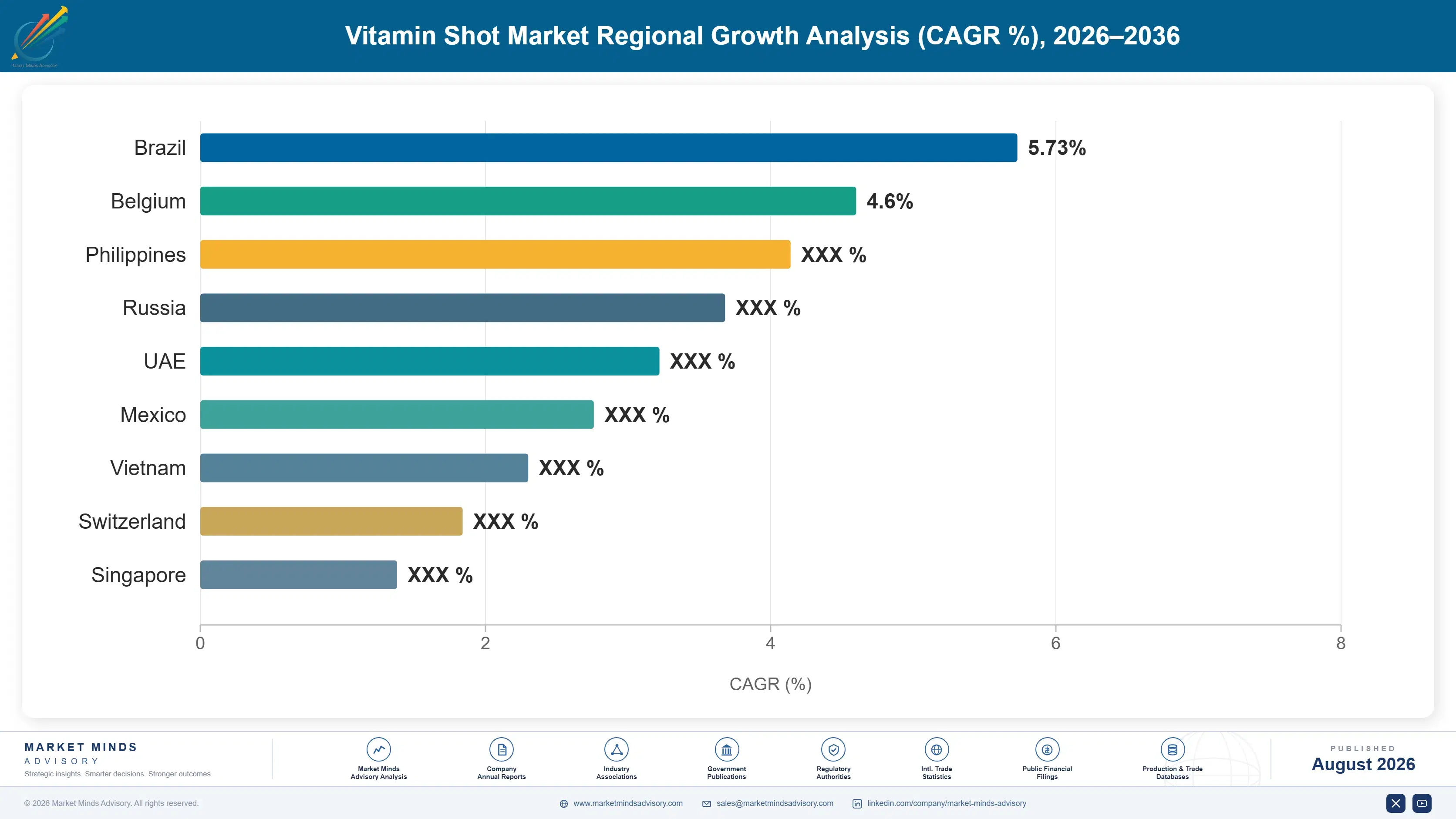
Vietnam: 14.6% CAGR
Fastest Growth Region
South Asia and Pacific: 11.0% CAGR
Largest Region
East Asia: 33% of 2025 global value
Market Leaders
Yakult Honsha, Otsuka Holdings, Taisho Pharmaceutical, Suntory Holdings, Danone. Source: MMA Primary Research Dataset, July 2026.
Primary Survey
n=3,800 procurement and R&D decision-makers, Q4 2025, six countries
Methodology
Demand-side build-up, cross-validated against public data, 47 expert interviews

Vitamin Shot Market Forecast Scenarios

vitamin-shot-market-trends-growth-size-forecast-scenario-1787664788700
The five years to 2025 split the category in two. Asian tonic volumes grew steadily on an established daily habit and unremarkable demographics, while Western wellness shots grew quickly from almost nothing and then hit the wall that every chilled premium beverage hits, which is national distribution. The 7.8% historical rate averages a mature market compounding quietly and an immature one growing fast on a very small base indeed.
The 8.8% base case rests on three mechanisms. Live culture and gut health formulations command genuine claim defensibility and grow at 13.2%, pulling category value up as they replace commodity vitamin propositions. Convenience retail keeps expanding across Southeast Asian cities, with Vietnam growing at 14.6% and the format already culturally familiar there. And pharmacy distribution in Western markets is finally opening to shots positioned as supplements rather than as drinks.
The 10.0% bull case turns on live culture shots clearing a substantiated health claim in a major regulatory jurisdiction, which would move the category from wellness marketing into something a pharmacist recommends. The 7.6% bear case is chilled distribution cost: 38% of volume now needs refrigeration end to end, and that expense falls hardest on the segment growing fastest.

Sixty Years of Daily Habit Versus Ten of Trial

The wellness shot is not a Western invention and the numbers are not close. A daily 100ml tonic has been sold through Japanese and Korean pharmacies and convenience stores since 1962, bought the way people buy coffee rather than the way they buy supplements, and per capita consumption across East Asia runs roughly eleven times the global average. Western brands entered a category that already had six decades of consumer behaviour behind it.
TOP FIVE CONCENTRATION42%Combined retail value held by the leading five companies
AVERAGE RETAIL PRICE$2.90Typical shelf price per single serve bottle globally
EAST ASIA PER CAPITA11xConsumption per head against the global average level
CHILLED DISTRIBUTION SHARE38%Volume requiring refrigerated handling from filler to shelf
REPEAT PURCHASE RATE54%Buyers returning within a month of first trial
INGREDIENT COST SHARE31%Actives and botanicals as proportion of goods sold
That history decides the problem each side faces. Asian brands sell into a habit already formed and repeat at rates a Western entrant cannot approach, with 54% of buyers returning inside a month. Western brands generate trial through wellness positioning and lose most of it, because a shot bought as an aspiration is discretionary in a way one bought as routine is not.
Growth is moving from vitamins to live cultures, and the reason is claim defensibility rather than efficacy. Anybody can put ascorbic acid in a bottle and nobody can differentiate on it, whereas a specific culture strain with published trial data is hard to copy. Gut health shots grow at 13.2%. The cost of that shift is refrigeration, which the category has not finished pricing.
"The category's great insight, that people take a dose more reliably when it arrives as one gesture in one bottle, was worked out in Tokyo in the early sixties. Everything since has been packaging."
Director, Functional Beverages and Nutrition Practice · MMA Food and Beverage Practice · August 2026

Market Trends

Live Cultures Replace Vitamins As The Defensible Claim

Ascorbic acid is a commodity anybody can buy and nobody can differentiate on, which is why vitamin positioning collapsed into price competition across most Western markets. A named culture strain carrying published human trial data is genuinely difficult to copy, and it supports a price premium that a vitamin blend cannot. Gut health shots grow at 13.2% against a market rate of 8.8%, the fastest in the category. The trade is refrigeration, since live cultures require chilled handling from filler to shelf and that cost lands on the segment growing fastest.
Market Impact: Vietnam grows at 14.6% annually

Pharmacy Channels Open To Shots Positioned As Supplements

Western shots spent a decade in chilled grocery beside juices, competing on impulse and losing most of the trial they generated. Pharmacy distribution treats the same product as a supplement with a dose, which changes both the purchase logic and the repeat rate considerably. The Asian precedent is unambiguous, since tonics have sold through pharmacy counters there since 1962 and the habit that produces is what Western brands have been unable to build. Roughly 22% of Western category value now moves through pharmacy, against almost none a decade ago. That channel shift is recent.
Market Impact: Repeat purchase reaches 54% monthly

Market Opportunities and Growth Drivers

Convenience Retail Expansion Across Southeast Asian Cities

Modern convenience retail continues opening across Vietnamese, Indonesian, Thai and Philippine cities, and the single serve tonic is among the first categories these stores stock because it sells at high frequency and needs no preparation. Vietnam grows at 14.6%, faster than any market covered. The format arrives culturally familiar rather than requiring explanation, since regional consumers already recognise the bottle from imported Japanese and Korean brands. Ambient formulations dominate here, which keeps distribution cost low and margins considerably healthier than chilled Western equivalents. Education cost is effectively zero across the region.
Market Impact: Affects 38% of category volume

Fixed Dosing Beats Powders On Compliance Not Efficacy

A shot delivers a measured dose in one gesture with no scoop, no glass of water and no decision about quantity, which is why it holds users that powders and effervescent tablets lose within weeks. Repeat purchase runs at 54% within a month across the category, and MMA primary survey work with 3,800 respondents across six countries found convenience cited ahead of perceived effectiveness in every market tested. The nutritional argument for shots over powders is weak and largely irrelevant, because compliance rather than formulation decides outcomes. Formulation is not the variable.
Market Impact: Trials cost over 3 million dollars

Market Restraints and Challenges

Chilled Distribution Costs Fall On Fastest Growing Segment

Some 38% of category volume now requires refrigerated handling from filler to retail shelf, and that share rises as live culture formulations take share from ambient vitamin blends. The root cause is biological rather than commercial, since viable cultures cannot survive ambient distribution at the counts a label claims. Commercially this restricts distribution to retailers with chilled space, roughly doubles logistics cost per case and caps geographic reach. Participants are exploring spore forming strains and encapsulation that survive ambient conditions, with mixed results so far. None has reached commercial scale yet.
Market Impact: Fastest segment at 13.2% growth

Health Claim Scrutiny Tightens Across Major Jurisdictions

Regulators across Europe and Asia have narrowed what a functional beverage may claim, and most category marketing sits well ahead of what the underlying evidence supports. The root cause is that substantiating a health claim requires human trial data costing several million dollars, which almost no brand at this scale can fund. Commercially this pushes messaging toward vague wellness language that consumers increasingly discount. Larger participants are funding strain specific clinical work precisely because it creates a claim smaller competitors cannot match. Smaller brands retreat toward language that nobody really believes.
Market Impact: Pharmacy carries 22% of Western value
3 additional market trends, 4 additional growth drivers, and 2 additional restraints and challenges are covered in the full report. Contact sales@marketmindsadvisory.com to access the complete intelligence.

Segment CAGR and Growth Architecture

Segmentation follows functional benefit platform, since the promised benefit determines formulation, distribution temperature, price point and which shelf the product sits on. Six platforms cover the category, from commodity immunity blends to live culture digestive shots. Growth tracks how hard a claim is to copy rather than how effective it actually is. Efficacy is barely relevant here.
vitamin-shot-market-trends-growth-market-share-analysis-1787664789286

Gut Health and Digestive Shots

Live culture and prebiotic formulations delivering named strains at declared counts, sold chilled and priced above every other platform in the category. At 13.2% this is the fastest growing segment, half again the market rate of 8.8%, and claim defensibility rather than consumer benefit explains the lead. A specific strain with published human trial data cannot be replicated by a competitor buying commodity ingredients, which is exactly what happened to vitamin positioning. The cost is refrigeration from filler to shelf, since viable cultures do not survive ambient distribution at claimed counts, and that limits retail reach considerably. Retailers with refrigerated space therefore decide how far the fastest growing segment can actually travel.
CAGR 13.2%

Beauty and Skin Shots

Collagen peptide, hyaluronic acid and antioxidant formulations positioned around skin, hair and nail outcomes, growing at 11.0% and second fastest in the category. Demand concentrates in East Asia, where ingestible beauty is an established category rather than an emerging one and consumers already accept the premise without persuasion. Price points are the highest in the market and repeat rates hold well among committed users. The evidence base for oral collagen remains contested among researchers, which creates regulatory exposure in jurisdictions tightening health claim scrutiny and has already forced label changes in several European markets. Demand elsewhere depends heavily on whether a brand can afford the clinical work that would settle the question properly.
CAGR 11.0%
Full segment breakdown across 6 segments available in the complete report.

Regional Architecture and Country Demand Map

East Asia holds 33%, above the standard band, because the daily tonic format originated there in 1962 and remains routine consumption rather than a wellness purchase. North America follows at 24% and Western Europe at 21%. Vietnam grows fastest at 14.6%. Live culture propositions drive category value upward.

North America

Wellness positioning built this 24% share and now limits it. Cold pressed immunity and energy shots entered through chilled grocery and juice bars, generating substantial trial and converting comparatively little of it, because a shot bought as self improvement is discretionary in a way a routine purchase is not. Pharmacy distribution is opening and changes the purchase logic materially, treating the product as a supplement with a dose rather than a premium beverage. Retailer chilled space remains the binding constraint on national distribution for most brands. Growth of 8.0% reflects channel migration more than any expansion in the underlying consumer base. Trial generation has never been the problem in this market.
Share: 24% | CAGR: 8.0% (2026 to 2036)

Western Europe

British, German and Nordic markets carry most of this 21% share, with shots established in grocery and increasingly in pharmacy. Live culture propositions have found particular traction here, and several of the category's more credible clinical substantiation programmes are European. Regulatory scrutiny of health claims is also tightest in this region, which has forced label revisions and constrains the marketing language competitors use elsewhere. That cuts both ways, since it raises the cost of entry and rewards participants who fund trial work. Growth of 7.2% is the lowest of the seven regions, reflecting a category that matured earlier here than anywhere outside Asia. Substantiation cost is becoming the real entry barrier.
Share: 21% | CAGR: 7.2% (2026 to 2036)
Regional intelligence for 5 additional markets available in the complete report: East Asia, South Asia and Pacific, Latin America, Middle East and Africa, Eastern Europe. Contact sales@marketmindsadvisory.com.
vitamin-shot-market-trends-growth-country-cagr-analysis-1787664789825

Where This Category Actually Repeats

Nothing here is won on formulation, because the ingredients are commodities and the nutritional argument against powders barely holds. Value accrues to whoever converts trial into habit, whoever owns a claim competitors cannot copy, and whoever reaches convenience retail as it opens. Four routes carry weight, and only one concerns what is in the bottle.

Sell Into Pharmacy Rather Than Wellness Aisles

A shot sitting in chilled grocery beside juices is an impulse purchase competing on price, and most of the trial it generates never repeats. The same product in pharmacy is a supplement with a dose, bought on a different logic entirely, and roughly 22% of Western category value now moves through that channel against almost none a decade ago. The Asian precedent settles the argument, since tonics have sold through pharmacy counters since 1962 and repeat at 54% within a month. Channel choice decides repeat rate more than formulation does.
Market Impact: Pharmacy now carries 22% of Western category value

Build The Chilled Chain Before The Claim

Live culture formulations grow at 13.2% and cannot survive ambient distribution at the counts their labels claim, which means the claim is worthless without refrigeration from filler to shelf. Roughly 38% of category volume already needs chilled handling and logistics cost per case runs at roughly double the ambient equivalent. Brands that launch the proposition before securing the chain lose viable counts in transit and face reformulation or recall. Securing chilled distribution first is unglamorous and it is what separates a national brand from a regional one. Distribution precedes the proposition here.
Market Impact: Covers the 38% of volume needing chilled handling

Price The Repeat Purchase Not The Trial

Western shot brands price for a premium first purchase and then watch most buyers leave, while Asian tonics price for daily consumption and hold 54% of buyers within a month. Average retail price sits near 2.90 dollars globally, and the brands earning most are frequently those charging less per bottle and selling far more of them. Subscription and multipack formats move the purchase decision from impulse to routine directly. The category's economics reward frequency over margin per unit, which is the opposite of how premium beverages normally work. Frequency is the whole model.
Market Impact: Holds the 54% of buyers repeating within a month

Follow Convenience Retail Into Southeast Asian Cities

Modern convenience retail keeps opening across Vietnamese, Indonesian, Thai and Philippine cities, and single serve tonics are among the first categories stocked because they sell at high frequency and need no preparation. Vietnam grows at 14.6%, faster than any market covered. The format arrives already familiar through imported Japanese and Korean brands, so there is no consumer education cost to fund. Ambient formulations dominate regionally, which keeps distribution economics considerably healthier than the chilled propositions Western brands are building their growth around. There is no consumer education budget required at all.
Market Impact: Captures the 14.6% Vietnamese growth rate through 2036

Who Controls the Margin Pool

Concentration is modest and geographically lopsided. The top five hold 42% of retail value, the basis applied consistently throughout this section, and almost all of that sits in East Asia where Yakult Honsha, Otsuka Holdings and Taisho Pharmaceutical operate at a scale no Western shot brand approaches. The gap between leaders and challengers is not brand strength but distribution density built over six decades of pharmacy and convenience presence.
Competition runs on three fronts. Asian incumbents compete on shelf position and habit, where the contest was largely settled decades ago. Western brands compete for chilled retail space and increasingly for pharmacy listings, which is where the interesting commercial movement is. And large food and pharmaceutical groups compete on clinical substantiation, funding strain specific trial work that smaller brands cannot afford at all.

Rankings will move with claim substantiation rather than with product launches, since a live culture proposition clearing a regulated health claim would separate its owner from a fragmented field permanently. The other pressure point is chilled distribution cost, which is rising as the fastest growing segment expands and which favours participants with existing refrigerated networks over specialists without them.
vitamin-shot-market-trends-growth-company-positioning-matrix-1787664790349

Competitive Moat and Risk Dimensions

YAKULT HONSHA

Moat: Direct Distribution Sales Network

Decades of direct home and workplace delivery through a dedicated sales force creates repeat purchase behaviour no retail listing can replicate, since the product arrives without the consumer deciding again each week. Strain specific clinical research spanning many years supports claims that competitors buying commodity cultures simply cannot make credibly.
YAKULT HONSHA

Risk: Ageing Core Consumer Base

The habit that carries this business was formed by consumers who are now considerably older than the category's growth demographic, and younger buyers in the same markets show weaker attachment to direct delivery models. Converting them through retail channels puts the company into a price contest its distribution model was built to avoid.
OTSUKA HOLDINGS

Moat: Pharmacy Channel Integration

Operating across pharmaceuticals and consumer nutrition gives genuine pharmacy channel access and clinical credibility that a beverage company cannot assemble quickly. Products positioned between supplement and drink benefit directly from that dual identity, particularly as Western markets shift shot distribution from chilled grocery toward pharmacy counters where the purchase logic differs.
OTSUKA HOLDINGS

Risk: Limited Western Shot Presence

Category strength remains concentrated in home markets where the tonic habit is established, and Western consumers do not recognise the brands that dominate Asian shelves. Building presence in markets growing from a small base requires marketing investment on a scale that competes internally against considerably higher return pharmaceutical programmes.

Players Tracked

Prominent Players

Yakult Honsha
Otsuka Holdings
Taisho Pharmaceutical
Suntory Holdings
Danone

Other Key Players

Dong-A Socio Holdings
Lotte Chilsung Beverage
Kwangdong Pharmaceutical
Meiji Holdings
Asahi Group Holdings
Kirin Holdings
Morinaga Milk Industry
Nestle
PepsiCo
Haleon
Bayer
Suja Life
Vive Organic
Symprove
Chi Forest

Recent Developments

FEBRUARY 2025

Live culture shot secures pharmacy listing across national chain

A live culture digestive shot brand secured listing across a national pharmacy chain, moving the product from chilled grocery into a channel where consumers already buy supplements on a dose logic. Repeat purchase behaviour differs materially between the two channels according to category participants. Nobody had measured it.
Signal: Channel choice decides repeat purchase far more than formulation ever did for this category in any market
MAY 2025

Strain specific human trial published for digestive shot formulation

A published human trial reported outcomes for a named culture strain used in a commercial digestive shot, giving the brand substantiation that competitors buying commodity cultures cannot claim. Trial programmes at this scale cost several million dollars and remain beyond most category participants. The barrier is money rather than science.
Signal: Clinical substantiation is the only barrier this category has that a competitor cannot quickly overcome with money alone
AUGUST 2025

Convenience retail expansion adds tonic listings across Vietnamese cities

Convenience retail chains expanding across Vietnamese cities added single serve tonic listings early in their category rollouts, reflecting high purchase frequency and no preparation requirement. Vietnam grows at 14.6% annually, faster than any market covered in this report. Ambient formulations dominate, which keeps distribution economics healthy.
Signal: The format arrives culturally familiar in Southeast Asia, so nobody has to fund consumer education there

What A Shot Costs To Fill

Actives and botanicals account for roughly 31% of cost of goods, with packaging near 24% and chilled logistics absorbing a rising share as live culture formulations expand. Ascorbic acid, the category's most common active, comes overwhelmingly from Chinese production, and specialty botanical extracts trace to a handful of origins that rarely hold buffer stock. Live cultures are produced by a small group of specialist fermentation suppliers with limited capacity.
Ascorbic acid pricing demonstrated the exposure clearly, moving sharply during the last supply disruption as Chinese production consolidated and export volumes tightened, according to China MIIT industrial output data and commentary in ingredient supplier annual reports. Brands holding no forward cover absorbed the increase directly into margin, since retail price points in this category are psychologically anchored and cannot be adjusted mid year without visible pack size reduction that consumers notice immediately.

Exposure divides by formulation rather than by scale. Ambient vitamin blends carry commodity ingredient risk, while live culture propositions carry specialist supplier concentration and logistics running at roughly double ambient cost per case. Awkwardly, the segment growing at 13.2% has the worse cost structure. Large groups with existing refrigerated networks absorb that better than specialist brands buying chilled distribution.
vitamin-shot-market-trends-growth-cost-volatility-analysis-1787664790544

Contract botanical supply ahead of the harvest season

Specialty botanical extracts trace to a handful of growing origins that rarely hold buffer stock, which leaves spot buyers exposed to weather and to whoever contracted early. Forward contracting before harvest costs a modest premium and removes the volatility that otherwise lands directly in margin. Brands treating actives as a spot purchase are absorbing avoidable risk each year.

Qualify a second live culture fermentation supplier

Live cultures come from a small group of specialist fermentation producers with limited capacity, and a single source failure stops production of the fastest growing segment. Qualification takes months because strain identity and viable counts must be verified against label claims. Doing that work before it is needed costs far less than reformulating under pressure with retail listings already committed.

Use existing refrigerated networks rather than third party chilled

Chilled logistics runs at roughly double ambient cost per case, and specialist brands buying third party distribution pay the full rate while large groups move product through networks already running. Partnership or contract manufacture within an existing chilled network converts a fixed disadvantage into shared cost. It is the clearest commercial argument for a specialist brand seeking a corporate partner.

Portfolio Architecture for Margin Defence

Margin architecture divides on claim defensibility rather than on format. Ambient vitamin blends earn least, competing on price against tablets and syrups that cost several times less per dose and differing only on convenience. Branded pharmacy tonics earn considerably better, holding price on habit and channel position built over decades. Live culture and clinically substantiated propositions earn best, because a named strain with trial data is genuinely hard for a competitor to copy.
The tension runs between margin and reach. The highest margin propositions need refrigeration from filler to shelf, which restricts distribution to retailers with chilled space and roughly doubles logistics cost per case. Ambient blends reach everywhere and earn little. A brand chasing the 13.2% growth in gut health is choosing a worse cost structure deliberately, on the argument that defensible claims outlast commodity ones.

High value pools concentrate in strain specific clinical substantiation and in pharmacy channel access, neither of which is a formulation position. Everything selling undifferentiated vitamin content competes on shelf price against formats that cost less per dose. The categories worth building are those where a competitor with a commodity ingredient list simply cannot make the same claim on a label.

Ambient Vitamin and Energy Blends

Commodity vitamin and caffeine formulations sold ambient through convenience and grocery, competing on price against tablets and syrups. Differentiation rests on convenience alone, which does not support premium pricing anywhere.
Gross Margin: 22-25%

Branded Pharmacy Tonics

Established tonic brands sold through pharmacy and convenience on habit built across decades, principally across East Asian markets. Price holds on routine consumption and channel position rather than on any formulation advantage.
Gross Margin: 44-47%

Live Culture and Clinically Substantiated

Named strain live culture and clinically supported formulations carrying published human trial data. Margin is highest and so is cost, since chilled distribution runs at roughly double the ambient rate per case.
Gross Margin: 52-55%
vitamin-shot-market-trends-growth-portfolio-architecture-1787664791067

High-value Sub-segments and Strategic Watch-out

Gut Health and Digestive Shots

Fastest growing at 13.2% on claim defensibility rather than consumer benefit, since a named strain with published trial data cannot be replicated from commodity ingredients. Refrigeration from filler to shelf is the cost of that position and it restricts retail reach. Reach is the trade for margin.
Gross Margin: 50-54%

Beauty and Skin Shots

Second fastest at 11.0% with the highest price points in the category, concentrated in East Asia where ingestible beauty needs no consumer persuasion. Regulatory scrutiny of oral collagen claims has already forced label revisions in several European markets and remains an open exposure. That exposure is not resolved.
Gross Margin: 48-52%

Energy and Focus Shots

Growing at 9.6% and carrying substantial ambient volume through convenience retail, where high purchase frequency compensates for thin margins per unit. Competition against energy drinks and coffee is direct, and differentiation on caffeine and B vitamin content is effectively impossible. Frequency carries this segment, not margin.
Gross Margin: 26-30%

Recovery and Hangover Shots

Growing at only 6.2% and constrained by occasion based consumption that generates no habit, since nobody buys one weekly on routine. Regulatory sensitivity around alcohol adjacent claims limits marketing language in several jurisdictions and caps the addressable proposition considerably. No habit forms around an irregular occasion.
Gross Margin: 24-28%

How A Shot Becomes A Habit

This category earns on frequency rather than on margin per bottle, which makes it closer to coffee than to supplements. A committed daily consumer buys several hundred units a year at modest margin, while a trial purchaser buys one at premium price and never returns. Repeat purchase runs at 54% within a month across the category and higher in East Asian markets where the format has been routine for six decades.
Stickiness varies sharply by what the consumer bought it for. Digestive and immunity propositions attach to a perceived ongoing condition and repeat reliably, since the reason to buy does not go away. Beauty formulations hold committed users well and convert poorly. Recovery and hangover shots generate no habit, because the occasion is irregular by definition and nobody plans for it.

The buyer is changing in a way that favours the Asian model. Younger Western consumers show weaker attachment to premium wellness positioning and stronger interest in routine functional consumption, which is precisely how the format has always sold in Japan and South Korea. Pharmacy channel migration follows the same logic. The category is converging on the model it started with, sixty years after that model was worked out.
vitamin-shot-market-trends-growth-end-use-penetration-index-1787664791555

Where This Category Rewards Focus

These are among the four positions where our research anticipates prominent divergence between winners and laggards over the coming forecast period. Each is grounded in the demand model, the regulatory perimeter, and the announced capacity pipeline.
01 / PHARMACY CHANNEL ACCESS

The shelf decides repeat rate, not the recipe

A shot in chilled grocery beside juices is an impulse purchase competing on price, and most of the trial it generates never converts into a second bottle. The same liquid sold through pharmacy is a supplement with a dose, bought on an entirely different logic, and roughly 22% of Western category value now moves through that channel against almost none ten years ago. Asian tonics settled this argument in 1962 and repeat at 54% within a month on exactly that logic.
02 / CLAIM DEFENSIBILITY INVESTMENT

Commodity ingredients cannot support premium prices

Anybody can put ascorbic acid in a bottle, which is exactly why vitamin positioning collapsed into price competition across most Western markets within a decade of launch. A named culture strain carrying published human trial data cannot be replicated by a competitor buying commodity ingredients at any price. Gut health shots grow at 13.2% against a market rate of 8.8% on that basis alone, and trial programmes costing several million dollars are the real barrier that nobody smaller can realistically clear at all.
03 / CHILLED NETWORK ECONOMICS

Secure the cold chain before making the claim

Live cultures cannot survive ambient distribution at the counts their labels declare, which makes the entire premium proposition worthless without refrigeration running from filler through to retail shelf. Roughly 38% of category volume already requires chilled handling and logistics cost per case runs near double the ambient equivalent. Large groups with existing refrigerated networks absorb that considerably better than specialists buying third party distribution at full commercial rates, which is the clearest argument in the category for a corporate partnership of some kind.
04 / FREQUENCY PRICING DISCIPLINE

Charge less per bottle and sell far more

Western brands price for a premium first purchase and then lose most buyers, while Asian tonics price for daily consumption and hold 54% of them within a month of their first trial purchase. Average retail price sits near 2.90 dollars globally and the businesses earning most in this category are frequently those charging well below it. The category's economics reward purchase frequency over margin per unit, which inverts how premium beverages are normally built and explains why the Asian model keeps winning.

Engagement Snapshot From the Field

A live engagement with an industry participant carrying material or product regulatory and market exposure ahead of a defining policy shift, showing how our research translates into a defensible multi-year portfolio strategy.
MARKET MINDS ADVISORY · CLIENT ENGAGEMENT SUMMARY
Vitamin Shot Producer Strategic Portfolio Review and Transition Roadmap 2026·Investment Scenario on Vitamin Shot Exposure Evaluation 2025-26
CLIENT PROFILE
A Western functional shot brand selling immunity and energy formulations through chilled grocery and juice bars across two national markets. Annual revenue was approximately 41 million dollars (client-reported, unverified by MMA), almost entirely ambient and chilled retail. Trial rates were strong and repeat purchase sat well below category average, which management had not yet diagnosed properly.
STRATEGIC CHALLENGE
Growth depended on winning new chilled listings, and retailer space was effectively exhausted in both markets. Management was considering a live culture digestive launch and wanted to know whether that would fix the repeat problem or simply add a costlier version of it. Nobody had established why buyers were leaving after a single purchase.
MMA APPROACH
MMA analysed repeat purchase by channel across the client's own scanner data, isolating grocery from the small pharmacy presence it had built almost accidentally. Live culture launch economics were costed including chilled distribution. Forty-seven expert interviews with retailers, formulators and category managers established what actually drives repeat, alongside quantitative survey work across six countries.
KEY FINDINGS
  1. Pharmacy sold buyers repeated at roughly 2.4 times the rate of grocery sold buyers on identical product, and nobody inside the business had noticed the difference.
  2. Chilled grocery listings cost more in trade investment than they returned, with 71% of trial buyers never purchasing a second bottle at all.
  3. A live culture launch would raise gross margin by roughly 9 points and raise logistics cost per case by close to 100% simultaneously.
  4. Consumers under 30 described the wellness positioning as off-putting in 5 of the 6 countries surveyed, preferring routine functional framing over aspirational language instead.
CLIENT PROFILE
A Western functional shot brand selling immunity and energy formulations through chilled grocery and juice bars across two national markets. Annual revenue was approximately 41 million dollars (client-reported, unverified by MMA), almost entirely ambient and chilled retail. Trial rates were strong and repeat purchase sat well below category average, which management had not yet diagnosed properly.
STRATEGIC CHALLENGE
Growth depended on winning new chilled listings, and retailer space was effectively exhausted in both markets. Management was considering a live culture digestive launch and wanted to know whether that would fix the repeat problem or simply add a costlier version of it. Nobody had established why buyers were leaving after a single purchase.
MMA APPROACH
MMA analysed repeat purchase by channel across the client's own scanner data, isolating grocery from the small pharmacy presence it had built almost accidentally. Live culture launch economics were costed including chilled distribution. Forty-seven expert interviews with retailers, formulators and category managers established what actually drives repeat, alongside quantitative survey work across six countries.
KEY FINDINGS
  1. Pharmacy sold buyers repeated at roughly 2.4 times the rate of grocery sold buyers on identical product, and nobody inside the business had noticed the difference.
  2. Chilled grocery listings cost more in trade investment than they returned, with 71% of trial buyers never purchasing a second bottle at all.
  3. A live culture launch would raise gross margin by roughly 9 points and raise logistics cost per case by close to 100% simultaneously.
  4. Consumers under 30 described the wellness positioning as off-putting in 5 of the 6 countries surveyed, preferring routine functional framing over aspirational language instead.
RECOMMENDED STRATEGY
Phase 1: Phase one: redirect trade investment from chilled grocery toward pharmacy listings, where repeat runs at 2.4 times the grocery rate on identical product. Phase 2: Phase two: launch live culture formulations only into pharmacy, where the 9 point margin gain covers roughly doubled chilled logistics cost. Phase 3: Phase three: reframe brand language from wellness to routine, since 5 of 6 surveyed markets showed younger consumers rejecting aspirational positioning.
OUTCOME
The client moved trade investment to pharmacy and repeat purchase across the base rose materially within three quarters, while total distribution points fell. Revenue per distribution point roughly doubled and the live culture launch went ahead in pharmacy alone rather than nationally, which kept chilled logistics cost contained (client-reported, unverified by MMA).

Frequently Asked Questions

Foundational context covering the market sizes, CAGR, scope, country, region and competition that inform every finding below. This section is provided to cover basics and most often pre-purchase conversations, answered from the MMA Primary Research Dataset.

What is the current size of the Vitamin Shot Market?

The market was valued at 1.6 billion dollars in 2025, covering ready to drink functional shots of 200ml or less sold at retail worldwide. It reaches an estimated 1.74 billion dollars during 2026.

How large will the Vitamin Shot Market be by 2036?

MMA forecasts 4.04 billion dollars by 2036, an increase of 2.30 billion dollars over the 2026 base. That represents an expansion multiple of 2.32 times across the forecast period.

What is the CAGR for the Vitamin Shot Market 2026 to 2036?

The base case compound annual growth rate is 8.8%, with a bull case of 10.0% and a bear case of 7.6%. Claim substantiation and chilled distribution cost separate those two scenarios.

Which segment is growing fastest?

Gut health and digestive shots grow at 13.2%, half again the market rate of 8.8%, because a named culture strain is defensible where vitamin content is not. Beauty shots follow at 11.0%.

Who are the major companies in the Vitamin Shot Market?

Yakult Honsha, Otsuka Holdings, Taisho Pharmaceutical, Suntory Holdings and Danone lead on retail value, with most of that concentrated in East Asia. Together they hold 42% of the market.

Which country is growing fastest?

Vietnam grows fastest at 14.6%, as modern convenience retail expands across its cities and stocks single serve tonics early because they sell at high frequency without preparation.

Report Segmentation Architecture

The full report scope spans multiple orthogonal segmentation dimensions, with cross-tabulated demand data provided for each dimension pair. Coverage extends further to regional breakdowns, trend trajectories, and the competitive detail needed to support segment-level decision-making.

By Functional Benefit Platform

  • Immunity Shots
  • Energy and Focus Shots
  • Gut Health and Digestive Shots
  • Beauty and Skin Shots
  • Sleep and Relaxation Shots
  • Recovery and Hangover Shots

By End-Use Industry

  • Preventive Wellness Consumption
  • Sports and Fitness Nutrition
  • Digestive Health Management
  • Ingestible Beauty and Personal Care
  • Occupational and Shift Work Energy
  • Clinical and Convalescent Nutrition

By Commercial Dimension

  • Convenience Retail
  • Pharmacy and Drug Retail
  • Grocery and Supermarket
  • Ecommerce and Subscription
  • Foodservice and Juice Bars
  • Direct and Home Delivery

By Region

  • North America
  • Western Europe
  • East Asia
  • South Asia and Pacific
  • Latin America
  • Middle East and Africa
  • Eastern Europe

Scope, Methodology, and Coverage

Every figure in this report is reproducible from documented input assumptions. The scope below maps the historical period, the forecast horizon, the segmentation dimensions, and the countries covered, alongside the underlying primary and qualitative methodology.
Historical Period
2020 to 2025
Forecast Period
2026 to 2036
Base Year
2025 (USD billions; MMA Primary Research Dataset, August 2026)
Market Definition
Ready to drink concentrated functional beverages sold in single serve formats of 200ml or less, delivering vitamins, minerals, botanical extracts, live cultures, collagen peptides or amino acids as a fixed dose, measured at retail value worldwide. Coverage spans ambient and chilled formulations across all retail and foodservice channels. Intravenous vitamin therapy, injectable preparations, powders, capsules, tablets, gummies, effervescent formats and functional beverages above 200ml are excluded from scope entirely.
Quantitative Units
USD billions (retail value); units sold; USD per single serve bottle by platform
Segmentation Dimensions
Functional benefit platform; end-use industry; commercial dimension; region
Regions Covered
North America, Western Europe, East Asia, South Asia and Pacific, Latin America, Middle East and Africa, Eastern Europe
Countries Covered
United States, Canada, United Kingdom, Germany, France, Netherlands, Sweden, Italy, Spain, Japan, South Korea, China, Taiwan, Vietnam, Indonesia, Thailand, India, Australia, Brazil, Mexico, Saudi Arabia, Poland
Key Companies Profiled
Yakult Honsha, Otsuka Holdings, Taisho Pharmaceutical, Suntory Holdings, Danone, Dong-A Socio Holdings, Lotte Chilsung Beverage, Kwangdong Pharmaceutical, Meiji Holdings, Asahi Group Holdings, Kirin Holdings, Morinaga Milk Industry, Nestle, PepsiCo, Haleon, Bayer, Suja Life, Vive Organic, Symprove, Chi Forest
Quantitative Methodology
Primary survey, n=3,800 respondents, Q4 2025, six countries; demand-side model with trade association cross-validation
Qualitative Methodology
47 expert interviews, Q4 2025; applied to validate demand model assumptions, identify emerging dynamics, and assess competitive positioning
Report Format
PDF and XLSX data workbook (Word format preview document)
Publisher
Market Minds Advisory
Report Code
MMA-2026-AGR-205
Published
August 2026
Contact
sales@marketmindsadvisory.com | www.marketmindsadvisory.com

Purchase the full Vitamin Shot Market Report (2026 to 2036).

The full report treats the vitamin shot as a sixty year old East Asian habit that Western brands re-entered without understanding why it worked there. It sizes all six functional benefit platforms independently through 2036, models repeat purchase by channel rather than by formulation, and quantifies the chilled distribution cost attaching to the fastest growing segment. Regional chapters cover all seven regions, with East Asian per capita consumption assessed separately from Western trial driven demand. Competitive profiling covers 20 participants on one consistent retail value measure.
Six functional benefit platforms sized independently through 2036
Repeat purchase modelled by retail channel not formulation
Chilled distribution cost quantified against fastest growing segment
East Asian per capita consumption benchmarked against every region
Claim substantiation programmes tracked by strain and jurisdiction
Twenty participants profiled on one consistent retail measure

Built For The People Who Decide

From boardroom strategy to bench-side execution, this report is read cover-to-cover by leaders shaping the next decade of their industry, turning demand scenarios, market dynamics and valuation benchmarks into decisions.
CXOs/ Presidents/ VPs/ Managers
M&A and Corporate Development
Strategy Teams and R&D Heads
Procurement and Product Directors
Regulatory and Compliance Leaders
Investor Relations and Equity Analysts