Market Minds Advisory
Visual Electrophysiology Testing Devices Market

Visual Electrophysiology Testing Devices Market: Visual Electrophysiology: Function Versus Structure, Gene Therapy Endpoints and the Patients Hardest to Test

Imaging beat electrophysiology for thirty years because a picture is easier to read than a waveform, and gene therapy reversed that argument by needing objective proof that photoreceptors actually still work.

Lead Analyst

Alice Ballenger

Published

August 2026

Make Smarter Decisions with Customized Research Insights

Request a free sample report and evaluate market opportunities, growth trends, and competitive dynamics relevant to your business needs.

2025 MARKET VALUE$0.2BMarket Size 2025
2036 FORECAST VALUE$0.6BBase Case , 2026 to 2036
CAGR 2026 TO 20369.2 %Bull 10.4% / Bear 8.0%
INCREMENTAL OPPORTUNITY$0.3BNet 10- year value creation
EXPANSION MULTIPLE2.42x2036 value over 2026 base
Strategic Levers
M&A Pipeline
Regional Outlook
Country Rankings
Competitive Intelligence
Segmental Deep-dive
Call-Us : 91 93563 13602

Executive Snapshot and Market Trajectory.

This is the only ophthalmic test that measures function rather than structure, and it spent thirty years losing to imaging anyway. A scan gives a picture that reads immediately. An electroretinogram needs dilation, 20 minutes of dark adaptation, an electrode nobody enjoys and a trained reader to interpret it.
Gene therapy reversed the argument. Structural imaging shows that photoreceptors are present and cannot show whether they work, and every inherited retinal disease trial requires an objective functional endpoint. Regulatory acceptance of electroretinogram based endpoints made this a required capability at every trial site, which pulled equipment back into centres that had abandoned it a decade earlier. Nobody buys this equipment on reimbursement economics alone.
Portable systems then changed who could be tested at all. Full field recording on an infant traditionally meant sedation and a specialist centre, while handheld devices using skin electrodes and shortened protocols test a child in a clinic room. Roughly 41% of inherited retinal disease presents before the tenth birthday, so the population needing functional assessment most was the one hardest to reach. Accessibility rather than diagnostic depth is what explains the fastest growth here.
Market Definition
Devices used for objective electrophysiological assessment of visual pathway function, covering full field electroretinography systems, pattern electroretinography systems, multifocal electroretinography systems, visual evoked potential systems, handheld and portable testing systems, and electrooculography and specialty systems, together with electrodes and analysis software. Measured at manufacturer selling value. Retinal imaging systems, optical coherence tomography, perimetry, general neurophysiology equipment and therapeutic products are excluded.
Base Year Value
$0.2B in 2025 (MMA Primary Research Dataset, August 2026)
Forecast Period
2026 to 2036, eleven discrete annual values
CAGR
9.2% base case. Bull 10.4%. Bear 8.0%.
Fastest Growth Segment
Handheld and Portable Testing Systems: 13.8% CAGR
Fastest Growth Country
China: 14.8% CAGR
Fastest Growth Region
South Asia and Pacific: 11.4% CAGR
Largest Region
North America: 30% of 2025 global value
Market Leaders
Diagnosys, LKC Technologies, Metrovision, Roland Consult, Konan Medical. Source: MMA Primary Research Dataset, July 2026.
Primary Survey
n=3,800 procurement and R&D decision-makers, Q4 2025, six countries
Methodology
Demand-side build-up, cross-validated against public data, 47 expert interviews

Visual Electrophysiology Testing Devices Market Forecast Scenarios

visual-electrophysiology-testing-devices-market-size-forecast-scenario-1787641667071
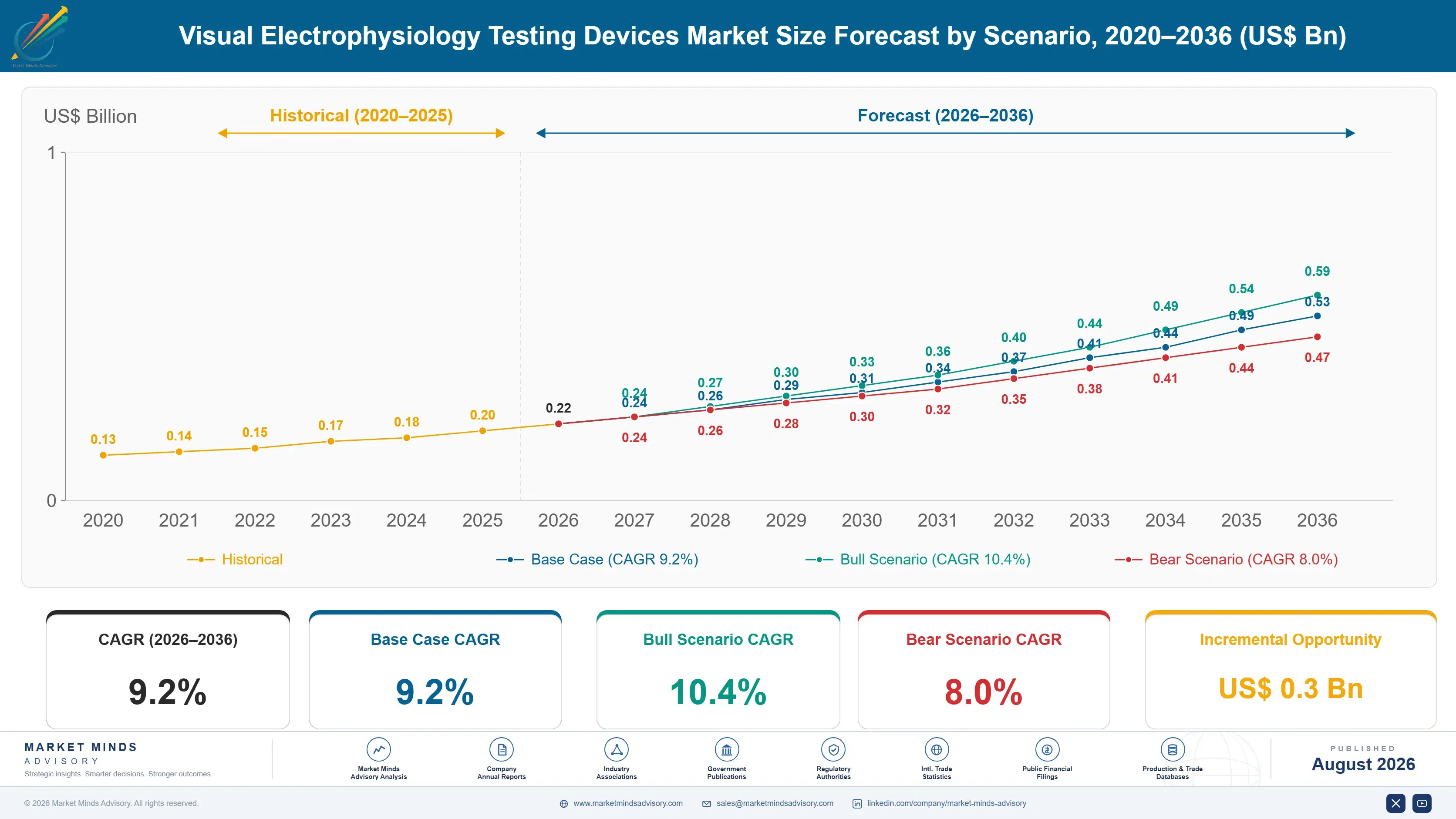
The five years to 2025 reversed a long decline. Electrophysiology had been losing ground to structural imaging for decades, with centres retiring equipment as optical coherence tomography answered most clinical questions faster and more legibly. Inherited retinal disease gene therapy trials then required objective functional endpoints that imaging cannot provide. The 8.0% historical rate reflects a genuine turn rather than continuation of anything before it.
The 9.2% base case rests on three mechanisms. Gene therapy and cell therapy programmes in ophthalmology continue expanding, and each trial site requires functional endpoint capability regardless of what imaging it already holds. Portable systems keep extending testing into paediatric and community settings where full field protocols were never practical. And Chinese ophthalmology capacity keeps expanding into inherited disease diagnosis, with China growing faster than any market covered. That is three separate demand routes.
The 10.4% bull case turns on an approved ophthalmic gene therapy requiring functional monitoring in routine care rather than only in trials, which would move equipment from research centres into clinical practice. The 8.0% bear case is interpretation capacity: only about one centre in six holding equipment has a trained reader, and machines without readers do not generate repeat purchases.

The Test That Measures Whether Anything Works

Structure won this argument for thirty years because it was easier rather than because it was better. An optical coherence tomography scan produces an image a clinician reads in seconds, reimburses reliably and needs no patient preparation. A full field electroretinogram requires dilation, 20 minutes of dark adaptation, a corneal electrode most patients dislike and a waveform that means nothing without training. Centres retired equipment steadily throughout that period.
TOP FIVE CONCENTRATION74%Combined installed base held by the leading manufacturers
DARK ADAPTATION REQUIREMENT20 minutesPreparation time before a full field recording can begin
PAEDIATRIC DISEASE ONSET SHARE41%Inherited retinal disease presenting before the tenth birthday
TRIAL SITE REQUIREMENT100%Gene therapy sites needing objective functional endpoint capability
SYSTEM SERVICE LIFE12 yearsTypical working life before a centre replaces equipment
TRAINED INTERPRETER AVAILABILITY1 per 6Centres holding equipment with a trained reader available
Gene therapy made the distinction matter again. Imaging demonstrates that photoreceptors are still present and cannot demonstrate that they respond to light, which is exactly the question a therapy restoring function has to answer. Regulators accepted electroretinogram derived endpoints, and every inherited retinal disease trial site now requires the capability regardless of what imaging equipment it already operates.
Portable systems then addressed the population that needed testing most. Roughly 41% of inherited retinal disease presents before a child's tenth birthday, and full field protocols on a young child historically meant sedation in a specialist centre. Handheld devices using skin electrodes and shortened protocols record in a clinic room without anaesthesia, which converts an assessment that rarely happened into one that routinely can.
"Ophthalmology spent two decades getting very good at photographing retinas and rather worse at knowing whether they worked. It took a therapy that restores function to remind everybody those are different questions."
Director, Ophthalmic Devices and Diagnostics Practice · MMA Medical Devices and Diagnostics Practice · August 2026

Market Trends

Gene Therapy Endpoints Made Function Measurable Again

Structural imaging shows photoreceptors are present and says nothing about whether they respond to light, which is the only question that matters when assessing a therapy intended to restore function. Regulators accepted electroretinogram derived endpoints for inherited retinal disease programmes, and every trial site now requires the capability whatever imaging it holds already. That pulled equipment into centres that had retired theirs during two decades of imaging dominance. Trial driven demand is small in unit terms and disproportionately important, because it re-established a clinical rationale the field had been losing steadily.
Market Impact: China grows at 14.8% annually
Portable Systems Reach Patients Protocols Previously Excluded

Roughly 41% of inherited retinal disease presents before a child's tenth birthday, and full field electroretinography on a young child traditionally meant sedation, a specialist centre and a scheduling burden that meant the test frequently never happened. Handheld systems using skin electrodes and shortened protocols record in an ordinary clinic room without anaesthesia. Growth runs at 13.8% against a market rate of 9.2%, fastest in the market. Signal quality is lower than corneal electrode recording under laboratory conditions, which matters less than obtaining any objective measurement at all from a child.
Market Impact: Serves 2 clinical specialties directly

Market Opportunities and Growth Drivers

Ophthalmology Capacity Expands Across Chinese Cities

Chinese ophthalmic hospital capacity has expanded substantially and inherited retinal disease diagnosis has moved from a handful of academic centres into provincial hospitals with genetic testing capability alongside. China grows at 14.8%, faster than any market covered, and equipment is specified during facility planning rather than added afterwards. Domestic manufacturers supply basic systems at prices imported equipment cannot approach, while trial capable centres buy Western platforms for protocol compliance. Both routes expand the installed base and the second one carries considerably better economics for established suppliers. Neither route is going away.
Market Impact: 1 centre in 6 reads confidently

Visual Evoked Potentials Serve Neurology as Well as Ophthalmology

Visual evoked potential testing assesses the pathway from retina to visual cortex and is used in multiple sclerosis, optic neuritis and paediatric neurology as much as in ophthalmic practice, which gives it a customer base twice the size of any purely ophthalmic modality. Growth of 11.2% is second fastest in the market. Neurology departments buy on different criteria and frequently already hold evoked potential platforms for auditory and somatosensory testing, which makes the visual module an addition rather than a capital decision. Purchasing decisions therefore move faster than in ophthalmic departments.
Market Impact: Preparation consumes 20 minutes

Market Restraints and Challenges

Interpretation Capacity Limits Where Equipment Is Useful

Only about one centre in six holding electrophysiology equipment has a clinician trained to interpret the recordings confidently, which means much of the installed base produces waveforms nobody reads with authority. The root cause is that interpretation training sits outside standard ophthalmology curricula and requires exposure to abnormal traces that a low volume centre never accumulates. Commercially this caps utilisation and undermines replacement purchases when equipment ages. Manufacturers respond with automated analysis, reference databases and remote reading services, which help without producing expertise anybody can rely on entirely. The gap remains wide.
Market Impact: Required at 100% of trial sites

Reimbursement Favours Imaging Over Functional Testing

Structural imaging reimburses reliably in most systems and takes minutes, while electrophysiology reimburses modestly and occupies a room, a technician and 20 minutes of dark adaptation before recording even begins. The root cause is that fee schedules reward procedures that are quick and legible rather than informative, and nobody has successfully argued the case for revision. Commercially this makes the equipment difficult to justify outside trial sites and specialist centres. Manufacturers respond by shortening protocols and by positioning portable systems where room time is not the constraint. Neither approach changes fee schedules.
Market Impact: Reaches 41% presenting before ten
3 additional market trends, 4 additional growth drivers, and 2 additional restraints and challenges are covered in the full report. Contact sales@marketmindsadvisory.com to access the complete intelligence.

Segment CAGR and Growth Architecture

Segmentation follows test modality, since modality determines which part of the visual pathway is assessed, how long recording takes and which specialty buys the equipment. Six modalities cover the field, from full field recording under dark adaptation to a handheld device used at a bedside. Growth follows accessibility rather than diagnostic depth. Depth is not the constraint.
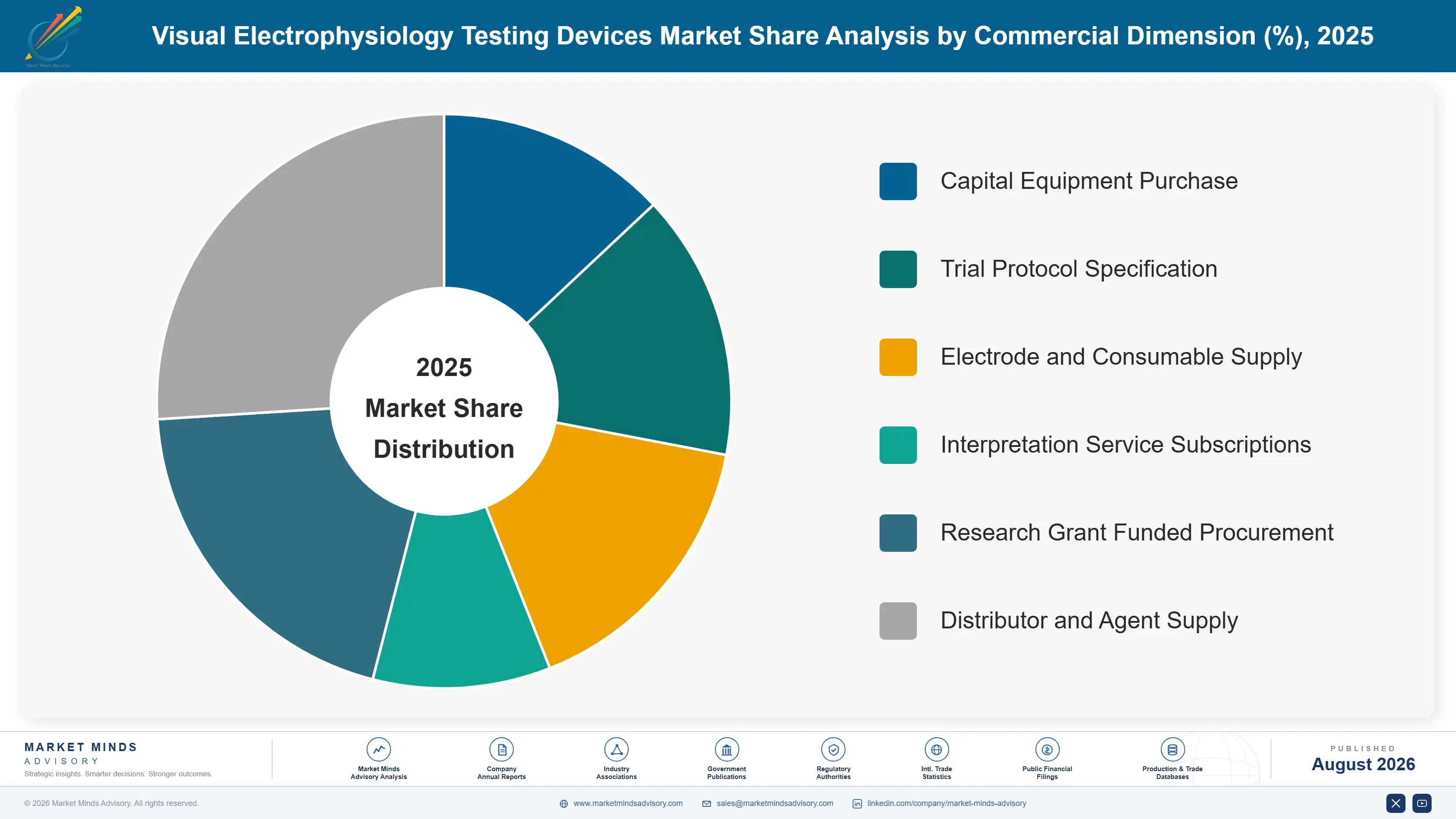
visual-electrophysiology-testing-devices-market-market-share-analysis-1787641667634

Handheld and Portable Testing Systems

Battery powered devices using skin or lower eyelid electrodes and shortened stimulus protocols, recording in an ordinary clinic room or at a bedside without sedation or a darkened laboratory. At 13.8% this is the fastest growing modality in the market, half again the market rate of 9.2%, and accessibility rather than diagnostic depth explains the lead entirely. Roughly 41% of inherited retinal disease presents before a child's tenth birthday, and conventional protocols on that population meant sedation in a specialist centre. Signal quality is measurably lower than corneal electrode recording, which matters far less than obtaining any objective functional measurement from a patient who would otherwise go untested. That trade favours access decisively.
CAGR 13.8%

Visual Evoked Potential Systems

Systems recording cortical responses to visual stimulation, assessing the whole pathway from retina through optic nerve to visual cortex rather than the retina alone. Growth of 11.2% is second fastest in the market, and the reason is a customer base spanning neurology as well as ophthalmology. Multiple sclerosis, optic neuritis and paediatric developmental assessment all use the test routinely, and neurology departments frequently already operate evoked potential platforms for auditory and somatosensory recording. That makes the visual module an addition to existing equipment rather than a standalone capital decision, which shortens the purchasing process considerably. Recording takes less time than full field protocols because dark adaptation is unnecessary, which suits clinics where room time is scarce.
CAGR 11.2%
Full segment breakdown across 6 segments available in the complete report.

Regional Architecture and Country Demand Map

North America holds the largest share at 30%, on gene therapy trial concentration and specialist centre density. Western Europe and East Asia follow at 24% each. China grows fastest of any market covered at 14.8% on ophthalmic capacity expansion. Interpretation capacity constrains use in every region.

North America

Trial concentration rather than clinical volume explains this 30% share. Inherited retinal disease gene therapy programmes are concentrated in American academic centres, and each site requires objective functional endpoint capability regardless of what imaging it already operates, which reinstated equipment purchasing after two decades of decline. Interpretation expertise is also deepest here, with a small community of clinicians who read electrophysiology confidently and train others. Reimbursement remains considerably more favourable to imaging than to functional testing, which limits use outside specialist and trial settings. Growth of 8.6% reflects trial expansion alongside a clinical base that has not yet recovered its former size. Trial concentration rather than clinical demand carries this position.
Share: 30% | CAGR: 8.6% (2026 to 2036)

Western Europe

Academic and specialist centre density shapes this 24% share. British, German, French and Dutch inherited retinal disease services hold long established electrophysiology capability and much of the standards work defining recording protocols originated in European laboratories. National health systems fund the testing modestly, and equipment replacement cycles run long against constrained capital budgets. European gene therapy trial sites drive incremental purchasing much as American ones do. Interpretation training is more structured here than elsewhere, with several centres running formal programmes. Growth of 7.6% is the lowest of the seven regions, reflecting mature capability and slow replacement rather than any lack of clinical interest. Replacement rather than new installation drives most purchasing.
Share: 24% | CAGR: 7.6% (2026 to 2036)
Regional intelligence for 5 additional markets available in the complete report: East Asia, South Asia and Pacific, Latin America, Middle East and Africa, Eastern Europe. Contact sales@marketmindsadvisory.com.
visual-electrophysiology-testing-devices-market-country-cagr-analysis-1787641668175

Where This Category Actually Grows

Nothing here is won on signal fidelity, because the best recording nobody can interpret is worth less than a rough one somebody reads. Value accrues to whoever serves trial sites that must have the capability, whoever reaches patients protocols excluded, and whoever solves interpretation. Four routes carry weight, and only one concerns the recording itself.

Serve the Trial Sites That Have No Choice

Every inherited retinal disease gene therapy site requires objective functional endpoint capability, because structural imaging cannot show whether photoreceptors respond to light and regulators accepted electroretinogram derived endpoints on exactly that basis. Those sites buy regardless of reimbursement economics, and protocol compliance requires platforms matching what the trial specifies rather than the cheapest available. Trial volume is small in units and disproportionately valuable, since it re-established a clinical rationale the field had spent two decades losing. Suppliers written into trial protocols hold positions for the programme's duration. Every one of those sites purchases within 12 months of activation.
Market Impact: Capability required at 100% of active gene therapy sites

Reach the Patients Conventional Protocols Excluded

Roughly 41% of inherited retinal disease presents before a child's tenth birthday, and full field recording on that population historically meant sedation, a darkened specialist room and scheduling that frequently meant no test happened at all. Handheld systems using skin electrodes record in an ordinary clinic room and grow at 13.8% against a market rate of 9.2%. Signal quality is lower and an objective measurement from a child who would otherwise go untested is worth considerably more than a perfect recording that never takes place. Growth of 13.8% follows access rather than fidelity.
Market Impact: Reaches the 41% of patients presenting before age ten

Sell Interpretation Alongside the Recording Hardware

Only about one centre in six holding equipment has a clinician who reads electrophysiology confidently, which means much of the installed base produces waveforms nobody trusts. That caps utilisation and kills replacement purchases twelve years later. Automated analysis, reference databases and remote expert reading address the constraint that actually limits whether a system gets used, and they generate recurring revenue the capital sale never does. Manufacturers treating interpretation as the customer's problem are watching their own installed base sit idle. Service revenue recurs across a 12 year installed life, and 5 centres in 6 lack the reader entirely.
Market Impact: Serves the 5 centres in 6 without readers

Follow Ophthalmic Capacity Building Into China

China grows at 14.8%, faster than any market covered, as ophthalmic hospital capacity expands and inherited retinal disease diagnosis moves from academic centres into provincial hospitals with genetic testing alongside. Equipment gets specified during facility planning rather than added later, which means a supplier present at that stage faces no incumbent. Trial capable centres buy Western platforms for protocol compliance while basic systems go to domestic manufacturers, so positioning against the trial requirement rather than against price is the workable route in. Domestic pricing is not a contest worth entering at all.
Market Impact: Captures the 14.8% Chinese growth rate through 2036

Who Controls the Margin Pool

Concentration is high in a genuinely small market. The top five hold 74% of the installed base and associated consumable and software revenue, the basis applied consistently here, in a category where total annual equipment volume is measured in hundreds of systems rather than thousands. Diagnosys leads on trial protocol adoption and standards alignment, and the distance to competitors reflects presence in gene therapy programmes more than anything technical.
Competition runs on three fronts. Established manufacturers compete for trial protocol specification and academic centre relationships, which are research collaborations more than commercial contests. Portable system developers compete on accessibility and ease of use against conventional platforms that were never designed for children. Domestic Chinese manufacturers compete on price for basic clinical systems in the fastest growing market anywhere.

Rankings will move with gene therapy programme outcomes rather than with product development, since an approved therapy requiring functional monitoring in routine care would move equipment from research into clinical practice. That would reprice the whole category. The other pressure point is interpretation capacity, which limits utilisation everywhere and which no manufacturer has yet solved convincingly at scale.
visual-electrophysiology-testing-devices-market-company-positioning-matrix-1787641668702

Competitive Moat and Risk Dimensions

DIAGNOSYS

Moat: Trial Protocol Standardisation

Specification within inherited retinal disease trial protocols commits sites to matching platforms for the programme duration, since endpoint comparability across centres requires identical recording conditions. Alignment with international standards documentation reinforces that position, because protocols reference those standards directly and equipment demonstrating compliance is difficult for a sponsor to argue against.
DIAGNOSYS

Risk: Small Absolute Market

Total annual equipment volume across this entire category is measured in hundreds of systems, which limits how much development investment any position can justify and makes the business vulnerable to a single programme outcome. A gene therapy field disappointment would remove the clinical rationale that reinstated purchasing after two decades of decline.
LKC TECHNOLOGIES

Moat: Portable System Position

Handheld recording capability addresses the population that conventional protocols excluded, and roughly 41% of inherited retinal disease presents before a child's tenth birthday. Establishing clinical acceptance for skin electrode recording took years of comparative validation work, and that evidence base is referenced when centres justify purchasing to their own institutions.
LKC TECHNOLOGIES

Risk: Signal Quality Argument

Skin electrode recording produces measurably smaller signals than corneal electrodes under laboratory conditions, and academic centres holding conventional platforms raise that comparison whenever portable systems are proposed. The counter argument is that an imperfect measurement from a tested child beats a perfect one from a child nobody could test, which is persuasive clinically and awkward in a specification comparison.

Players Tracked

Prominent Players

Diagnosys
LKC Technologies
Metrovision
Roland Consult
Konan Medical

Other Key Players

Natus Medical
Neurosoft
Tomey Corporation
Nidek
Kowa Company
Electro-Diagnostic Imaging
Micromedical Devices
CSO Italia
Optos
Haag-Streit
Chongqing Vision Star
Phoenix Technology Group
Ocuscience
Intelligent Hearing Systems
Shanghai Yizhi Medical

Recent Developments

MARCH 2025

Gene therapy trial protocol specifies functional endpoint platform

An inherited retinal disease gene therapy programme specified a particular electrophysiology platform across all participating sites, requiring identical recording conditions so endpoint data would remain comparable between centres. Sites without that equipment purchased it as a condition of participation regardless of what imaging capability they already operated.
Signal: Protocol specification commits every participating site to one platform for the whole programme duration, regardless of reimbursement
JUNE 2025

Portable recording validated against conventional protocols in children

A comparative study reported skin electrode portable recording against conventional corneal electrode protocols in paediatric patients, finding reduced signal amplitude alongside clinically adequate diagnostic agreement. Roughly two in five inherited retinal disease cases present before the tenth birthday, and conventional protocols on that population require sedation.
Signal: An imperfect measurement from a tested child beats a perfect one from an untested one every time
SEPTEMBER 2025

Remote interpretation service launched for electrophysiology recordings

A manufacturer launched remote expert interpretation for electrophysiology recordings, addressing the constraint that only about one centre in six holding equipment has a clinician who reads waveforms confidently. Recurring service revenue accompanies each interpreted study rather than ending with the capital sale. Utilisation rather than capability is the binding constraint.
Signal: Interpretation capacity limits utilisation everywhere and nobody had built a service answering it at any scale before this

What These Systems Cost to Build

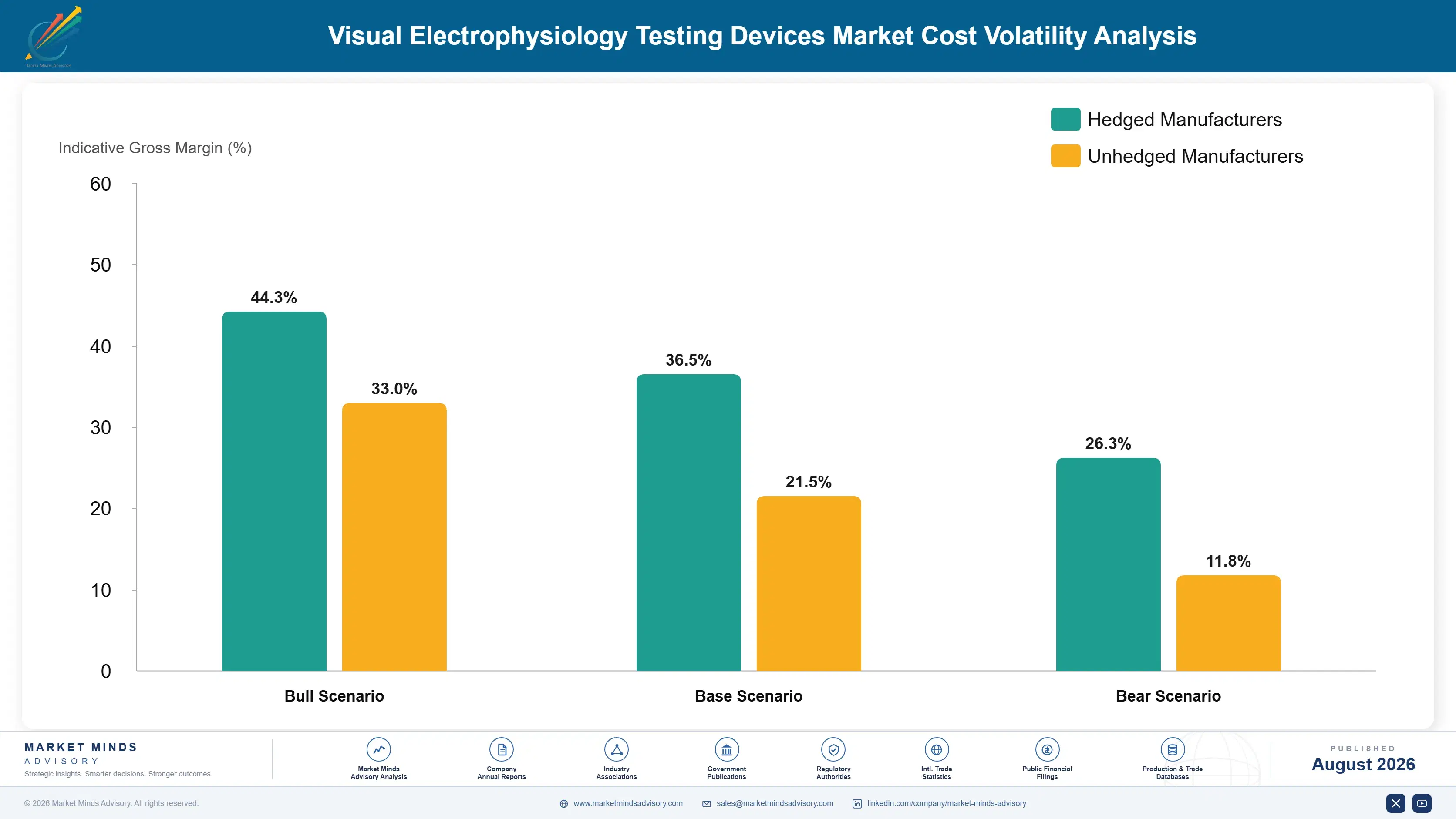
Low volume electronics manufacturing dominates the cost structure. Amplifiers, analogue to digital conversion, stimulus generation and shielding account for roughly 41% of system cost of goods, with software development, regulatory compliance and clinical validation absorbing most of the remainder across production runs measured in hundreds of units annually. Specialised low noise amplifier components come from a limited number of suppliers, and volumes are far too small to command any priority.
Component availability rather than price was the constraint that mattered, since semiconductor allocation during the last shortage placed a manufacturer building hundreds of systems annually at the very back of every queue. Company annual reports across the medical device sector documented lead times extending well beyond a year for parts that cost a few dollars. Electrode consumables tracked medical polymer and silver chloride pricing separately.

Exposure divides by volume rather than by product. A manufacturer producing hundreds of units annually cannot negotiate meaningfully with any semiconductor supplier and cannot justify holding large safety stocks either, which leaves component availability as a permanent operational risk. Software and validation costs are effectively fixed and spread across tiny volumes, which is why system prices look high relative to the electronics inside them
visual-electrophysiology-testing-devices-market-cost-volatility-analysis-1787641668900

Design around widely available amplifier components

Specialised low noise components deliver marginally better signal quality and place a low volume manufacturer at the back of every allocation queue when supply tightens. Designing around widely available parts costs some performance and removes a risk that stops production entirely. Given interpretation rather than signal fidelity limits clinical utility, that trade is more favourable than a specification sheet suggests.

Hold safety stock on components that stop production

A system cannot ship without every part and the components at risk cost a few dollars each, which makes holding deep inventory on critical items cheap relative to the revenue a stopped line forfeits. Low volume manufacturers manage working capital too tightly to do this. The calculation favours inventory once the cost of a year long lead time is included.

Build recurring revenue to offset fixed development cost

Software, regulatory and validation costs are fixed and spread across production volumes measured in hundreds, which is why systems price high relative to their components. Interpretation services, database subscriptions and electrode consumables generate revenue that recurs across a twelve year service life. That shifts the business away from depending on capital sales in a market too small to sustain them.

Portfolio Architecture for Margin Defence

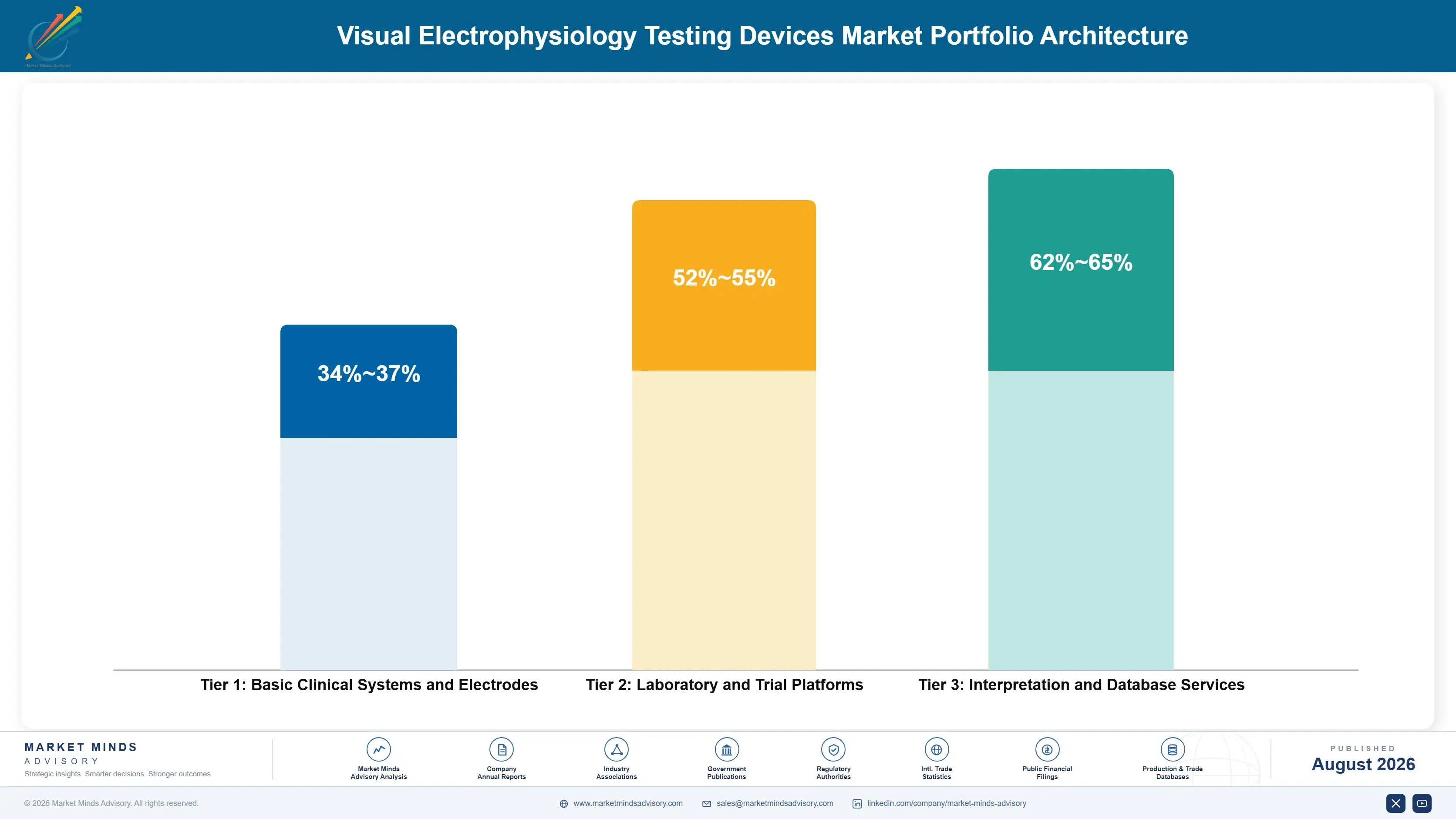
Margin architecture reflects a market too small for volume economics. Conventional systems earn moderately, priced high against the electronics inside them because software, validation and regulatory costs spread across hundreds of units annually rather than thousands. Electrodes and consumables earn across a twelve year service life. Interpretation services and reference database subscriptions earn best, because they address the constraint that actually determines whether a system gets used at all.
The tension is that the growth and the installed base sit in different places. Portable systems grow at 13.8% and reach patients conventional protocols excluded, at lower prices and lower margins than laboratory platforms. Trial site purchasing is small in units and specified rather than sold. A supplier building for accessibility earns less per system, and one building only for trial sites depends on programme outcomes nobody controls.

High value pools concentrate in trial protocol specification and in interpretation services, neither of which is a hardware position. Everything selling systems alone competes in a market of hundreds of units a year against domestic Chinese manufacturers in the fastest growing geography. Recurring revenue is the route to a business that does not depend entirely on capital sales in a category this size.

Basic Clinical Systems and Electrodes

Entry level recording systems and disposable electrodes sold into general ophthalmic practice, increasingly contested by domestic manufacturers in the fastest growing markets. Volume is modest and differentiation limited to service coverage.
Gross Margin: 34-37%

Laboratory and Trial Platforms

Full capability systems specified within gene therapy trial protocols where endpoint comparability requires identical recording conditions across every participating site. Margin holds on protocol specification rather than on any technical advantage.
Gross Margin: 52-55%

Interpretation and Database Services

Remote expert reading, automated analysis and normative reference database subscriptions addressing the constraint that limits whether equipment gets used. Margin is the best available and the revenue recurs across a twelve year service life.
Gross Margin: 62-65%
visual-electrophysiology-testing-devices-market-portfolio-architecture-1787641669408

High-value Sub-segments and Strategic Watch-out

Handheld and Portable Testing Systems

The fastest growing modality at 13.8%, reaching the paediatric population that conventional protocols effectively excluded through sedation and specialist centre requirements. Signal quality is lower and clinical utility is considerably higher for patients who would otherwise never be tested. Access rather than fidelity explains the growth rate.
Gross Margin: 44-47%

Visual Evoked Potential Systems

Second fastest at 11.2% on a customer base spanning neurology as well as ophthalmology, covering multiple sclerosis, optic neuritis and paediatric developmental assessment. Neurology departments frequently add the visual module to platforms they already operate. That makes the visual module an addition rather than a capital decision entirely.
Gross Margin: 48-51%

Full Field Electroretinography Systems

Growing at 7.6% and carrying most of the trial protocol specification, since endpoint comparability requires the controlled recording conditions only a laboratory platform provides. Twenty minutes of dark adaptation remains the practical barrier to routine clinical use. Trial specification rather than clinical volume sustains this position.
Gross Margin: 52-55%

Electrooculography and Specialty Systems

Growing at only 4.2% and confined to a narrow set of diagnoses where nothing else provides the information, principally certain macular dystrophies. Installed base is small, replacement is slow and no development activity is changing that. Nothing in the development pipeline appears likely to change that position.
Gross Margin: 38-41%

How This Small Market Repeats

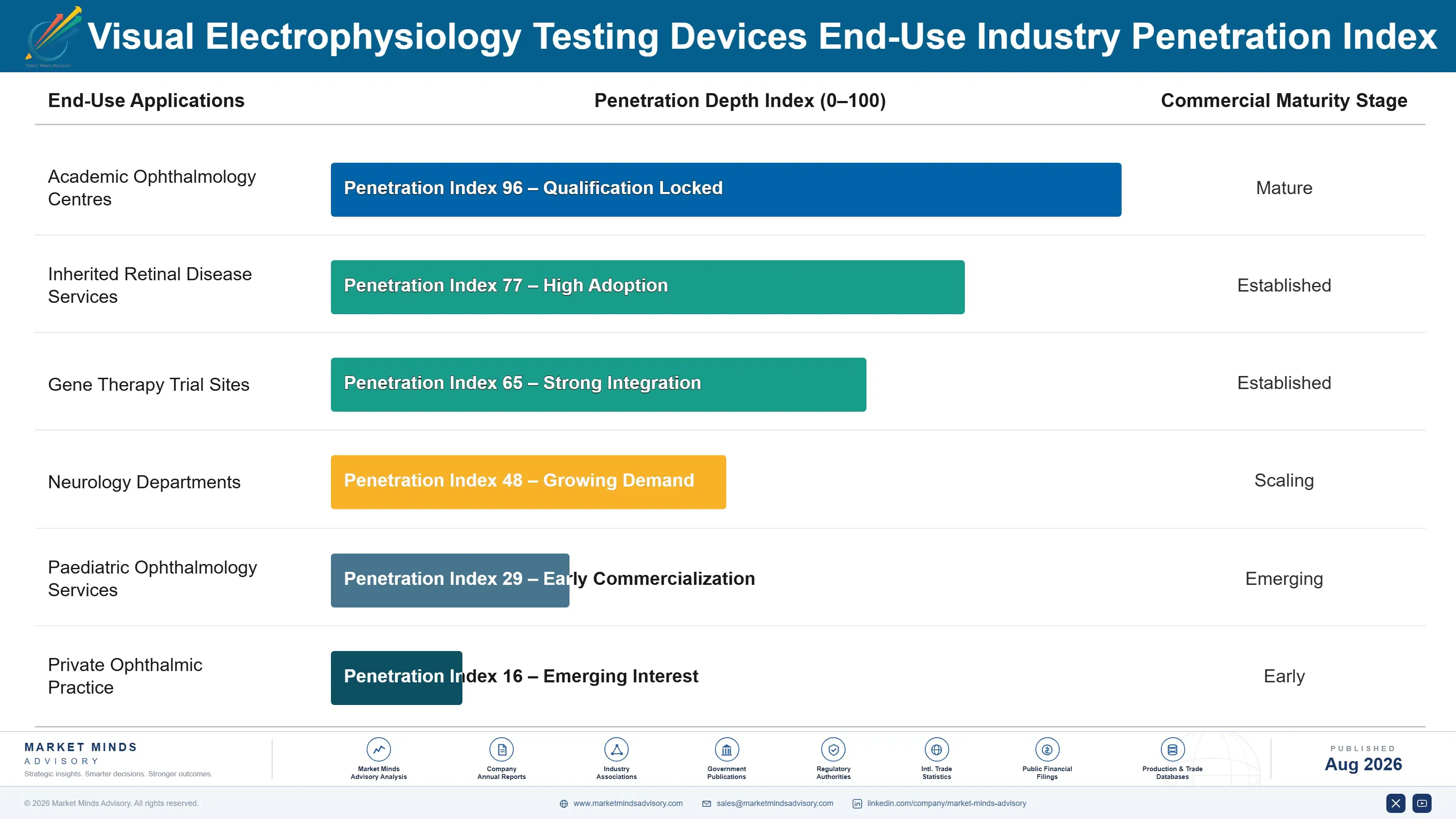
Capital purchases here are rare events and everything else follows them. A system installed today runs for around twelve years, consuming electrodes, software updates and increasingly interpretation services across that period, and a centre replaces it only when it fails or a trial protocol demands newer capability. That makes each installation a long relationship in a market where total annual equipment volume is measured in hundreds of systems.
Stickiness depends on whether anybody uses the machine. A centre with a trained interpreter and regular caseload replaces equipment when it ages and buys consumables continuously. A centre where only about one in six holds a confident reader lets the system sit, buys nothing and does not replace it. Trial sites are stickiest during a programme and frequently stop when it concludes.

The purchaser changed from a clinician to a trial sponsor and back again. Equipment was once bought by an interested ophthalmologist building a diagnostic service, then by trial sites complying with protocol specifications written by sponsors. If an approved therapy requires functional monitoring in routine care, the clinician becomes the buyer again at larger volumes. That single regulatory outcome matters more to this market than anything a manufacturer does.
visual-electrophysiology-testing-devices-market-end-use-penetration-index-1787641669906

Where This Category Rewards Focus

These are among the four positions where our research anticipates prominent divergence between winners and laggards over the coming forecast period. Each is grounded in the demand model, the regulatory perimeter, and the announced capacity pipeline.
01 / TRIAL PROTOCOL SPECIFICATION

Sponsors buy where reimbursement never would

Every inherited retinal disease gene therapy site requires objective functional endpoint capability, because structural imaging shows photoreceptors are present and cannot show whether they respond to light at all. Regulators accepted electroretinogram derived endpoints on exactly that basis, and sites purchase regardless of reimbursement economics that would otherwise never justify the equipment. Suppliers written into trial protocols hold positions for the whole programme duration, since endpoint comparability requires identical recording conditions across every single participating centre, which no cheaper alternative can satisfy.
02 / EXCLUDED POPULATION ACCESS

A rough recording beats one that never happens

Roughly 41% of inherited retinal disease presents before a child's tenth birthday, and full field protocols on that population traditionally required sedation, a darkened specialist room and scheduling that frequently meant the test simply never took place. Handheld systems using skin electrodes record in an ordinary clinic room and grow at 13.8% against a market rate of 9.2%. Signal amplitude is measurably lower, which matters considerably less than obtaining any objective functional measurement from a child nobody could previously test at all.
03 / INTERPRETATION CAPACITY BUILDING

Five centres in six cannot read what they record

Only about one centre in six holding electrophysiology equipment has a clinician who interprets waveforms confidently, which means most of the installed base produces recordings nobody trusts enough to act on. That caps utilisation, kills consumable consumption and prevents replacement purchases twelve years later when the system ages out. Automated analysis, normative databases and remote expert reading address the constraint that actually decides whether equipment gets used, and they generate recurring revenue no capital sale ever does across a twelve year installed life.
04 / GREENFIELD CAPACITY ACCESS

New hospitals specify before anyone else arrives

China grows at 14.8%, faster than any market covered, as ophthalmic hospital capacity expands and inherited retinal disease diagnosis moves from a handful of academic centres into provincial hospitals with genetic testing alongside it. Equipment is specified during facility planning rather than added afterwards, which means a supplier present at that stage faces no incumbent to displace anywhere. Positioning against trial protocol requirements rather than against domestic pricing is the only workable route into those accounts for any Western supplier holding protocol credentials.

Engagement Snapshot From the Field

A live engagement with an industry participant carrying material or product regulatory and market exposure ahead of a defining policy shift, showing how our research translates into a defensible multi-year portfolio strategy.
MARKET MINDS ADVISORY · CLIENT ENGAGEMENT SUMMARY
Visual Electrophysiology Testing Devices Producer Strategic Portfolio Review and Transition Roadmap 2026·Investment Scenario on Visual Electrophysiology Testing Devices Exposure Evaluation 2025-26
CLIENT PROFILE
An ophthalmic electrophysiology manufacturer supplying laboratory grade recording systems to academic centres and trial sites across Europe and North America. Annual revenue was approximately 28 million dollars (client-reported, unverified by MMA), almost entirely from capital equipment and electrodes. No portable system existed in the range and no interpretation service was offered to customers anywhere. at that point.
STRATEGIC CHALLENGE
Growth depended entirely on gene therapy trial site purchasing, which management recognised as concentrated and outside its control, while portable competitors were taking paediatric volume the company could not serve. Management wanted to know whether to develop a portable system, build interpretation services, or concentrate on defending trial specifications. Nobody had measured how much of the installed base was actually being used.
MMA APPROACH
MMA surveyed utilisation across the client's installed base, establishing how many systems were used regularly and what determined the difference. Portable development and interpretation service options were costed against the volume each would reach. Forty-seven expert interviews with ophthalmologists, trial coordinators and electrophysiology interpreters established what limits use of installed equipment and what would change it.
KEY FINDINGS
  1. Roughly 63% of installed systems recorded fewer than two studies a month, and the presence of a confident interpreter explained the difference in almost every case examined.
  2. Centres with regular caseloads consumed 5 times the electrode volume of low use sites and replaced equipment on schedule, while low use sites replaced nothing at all.
  3. Portable system development required an estimated 3 years against a paediatric population representing roughly 41% of inherited retinal disease presentations. and rising diagnosis rates.
  4. Interpreters in 29 of the 47 interviews said remote reading would be used immediately if available, and none of the client's competitors offered it at that point.
CLIENT PROFILE
An ophthalmic electrophysiology manufacturer supplying laboratory grade recording systems to academic centres and trial sites across Europe and North America. Annual revenue was approximately 28 million dollars (client-reported, unverified by MMA), almost entirely from capital equipment and electrodes. No portable system existed in the range and no interpretation service was offered to customers anywhere. at that point.
STRATEGIC CHALLENGE
Growth depended entirely on gene therapy trial site purchasing, which management recognised as concentrated and outside its control, while portable competitors were taking paediatric volume the company could not serve. Management wanted to know whether to develop a portable system, build interpretation services, or concentrate on defending trial specifications. Nobody had measured how much of the installed base was actually being used.
MMA APPROACH
MMA surveyed utilisation across the client's installed base, establishing how many systems were used regularly and what determined the difference. Portable development and interpretation service options were costed against the volume each would reach. Forty-seven expert interviews with ophthalmologists, trial coordinators and electrophysiology interpreters established what limits use of installed equipment and what would change it.
KEY FINDINGS
  1. Roughly 63% of installed systems recorded fewer than two studies a month, and the presence of a confident interpreter explained the difference in almost every case examined.
  2. Centres with regular caseloads consumed 5 times the electrode volume of low use sites and replaced equipment on schedule, while low use sites replaced nothing at all.
  3. Portable system development required an estimated 3 years against a paediatric population representing roughly 41% of inherited retinal disease presentations. and rising diagnosis rates.
  4. Interpreters in 29 of the 47 interviews said remote reading would be used immediately if available, and none of the client's competitors offered it at that point.
RECOMMENDED STRATEGY
Phase 1: Phase one: launch a remote interpretation service, since 63% of installed systems sit underused and 29 of 47 interpreters would use reading support immediately. Phase 2: Phase two: develop a portable system over 3 years, reaching the paediatric population that represents roughly 41% of disease presentations. Phase 3: Phase three: defend trial protocol specification actively, since those sites purchase regardless of the reimbursement economics that constrain everyone else.
OUTCOME
The client launched remote interpretation within a year and electrode consumption across previously low use sites rose materially as those centres began recording regularly. Service revenue became a recurring line for the first time, and portable development was funded from it rather than from capital sales the small market could not expand (client-reported, unverified by MMA).

Frequently Asked Questions

Foundational context covering the market sizes, CAGR, scope, country, region and competition that inform every finding below. This section is provided to cover basics and most often pre-purchase conversations, answered from the MMA Primary Research Dataset.

What is the current size of the Visual Electrophysiology Testing Devices Market?

The market was valued at 0.22 billion dollars in 2025, covering electroretinography, visual evoked potential, portable and specialty testing systems worldwide. It reaches an estimated 0.24 billion dollars during 2026.

How large will the Visual Electrophysiology Testing Devices Market be by 2036?

MMA forecasts 0.58 billion dollars by 2036, an increase of 0.34 billion dollars over the 2026 base. That represents an expansion multiple of 2.42 times across the forecast period.

What is the CAGR for the Visual Electrophysiology Testing Devices Market 2026 to 2036?

The base case compound annual growth rate is 9.2%, with a bull case of 10.4% and a bear case of 8.0%. Gene therapy outcomes and interpretation capacity separate those scenarios.

Which segment is growing fastest?

Handheld and portable systems grow at 13.8%, half again the market rate of 9.2%, by reaching children conventional protocols excluded. Visual evoked potential systems follow at 11.2%.

Who are the major companies in the Visual Electrophysiology Testing Devices Market?

Diagnosys, LKC Technologies, Metrovision, Roland Consult and Konan Medical lead on installed base and associated consumable revenue worldwide. Together they account for 74% of the market.

Which country is growing fastest?

China grows fastest at 14.8%, as ophthalmic hospital capacity expands and inherited retinal disease diagnosis reaches provincial hospitals with genetic testing capability alongside the equipment itself.

Report Segmentation Architecture

The full report scope spans multiple orthogonal segmentation dimensions, with cross-tabulated demand data provided for each dimension pair. Coverage extends further to regional breakdowns, trend trajectories, and the competitive detail needed to support segment-level decision-making.

By Test Modality

  • Full Field Electroretinography Systems
  • Pattern Electroretinography Systems
  • Multifocal Electroretinography Systems
  • Visual Evoked Potential Systems
  • Handheld and Portable Testing Systems
  • Electrooculography and Specialty Systems

By End-Use Industry

  • Academic Ophthalmology Centres
  • Inherited Retinal Disease Services
  • Gene Therapy Trial Sites
  • Neurology Departments
  • Paediatric Ophthalmology Services
  • Private Ophthalmic Practice

By Commercial Dimension

  • Capital Equipment Purchase
  • Trial Protocol Specification
  • Electrode and Consumable Supply
  • Interpretation Service Subscriptions
  • Research Grant Funded Procurement
  • Distributor and Agent Supply

By Region

  • North America
  • Western Europe
  • East Asia
  • South Asia and Pacific
  • Latin America
  • Middle East and Africa
  • Eastern Europe

Scope, Methodology, and Coverage

Every figure in this report is reproducible from documented input assumptions. The scope below maps the historical period, the forecast horizon, the segmentation dimensions, and the countries covered, alongside the underlying primary and qualitative methodology.
Historical Period
2020 to 2025
Forecast Period
2026 to 2036
Base Year
2025 (USD billions; MMA Primary Research Dataset, August 2026)
Market Definition
Devices used for objective electrophysiological assessment of visual pathway function worldwide, covering full field electroretinography systems, pattern electroretinography systems, multifocal electroretinography systems, visual evoked potential systems, handheld and portable testing systems, and electrooculography and specialty systems, together with electrodes, analysis software and interpretation services. Measured at manufacturer selling value. Retinal imaging systems, optical coherence tomography, perimetry and visual field equipment, general neurophysiology platforms without visual capability, and therapeutic products are excluded from scope.
Quantitative Units
USD billions (current prices); systems installed; USD per system and per study by modality
Segmentation Dimensions
Test modality; end-use industry; commercial dimension; region
Regions Covered
North America, Western Europe, East Asia, South Asia and Pacific, Latin America, Middle East and Africa, Eastern Europe
Countries Covered
United States, Canada, United Kingdom, Germany, France, Netherlands, Italy, Spain, China, Japan, South Korea, Taiwan, India, Australia, Singapore, Brazil, Mexico, Saudi Arabia, Israel, Poland
Key Companies Profiled
Diagnosys, LKC Technologies, Metrovision, Roland Consult, Konan Medical, Natus Medical, Neurosoft, Tomey Corporation, Nidek, Kowa Company, Electro-Diagnostic Imaging, Micromedical Devices, CSO Italia, Optos, Haag-Streit, Chongqing Vision Star, Phoenix Technology Group, Ocuscience, Intelligent Hearing Systems, Shanghai Yizhi Medical
Quantitative Methodology
Primary survey, n=3,800 respondents, Q4 2025, six countries; demand-side model with trade association cross-validation
Qualitative Methodology
47 expert interviews, Q4 2025; applied to validate demand model assumptions, identify emerging dynamics, and assess competitive positioning
Report Format
PDF and XLSX data workbook (Word format preview document)
Publisher
Market Minds Advisory
Report Code
MMA-2026-MED-133
Published
August 2026
Contact
sales@marketmindsadvisory.com | www.marketmindsadvisory.com

Purchase the full Visual Electrophysiology Testing Devices Market Report (2026 to 2036).

The full report treats visual electrophysiology as a functional test that lost thirty years to imaging on legibility rather than on merit, and that gene therapy endpoints have made necessary again. It sizes all six test modalities independently through 2036, models installed base utilisation against interpreter availability, and quantifies the paediatric population that conventional protocols effectively excluded. Regional chapters cover all seven regions, with trial site concentration assessed separately from clinical adoption. Competitive profiling covers 20 participants on one consistent installed base measure, with trial protocol positions tracked separately.
Six test modalities sized independently through 2036
Installed base utilisation modelled against interpreter availability
Paediatric excluded population quantified by disease onset age
Trial protocol specification tracked by programme and platform
Trial site concentration assessed separately from clinical adoption
Twenty participants profiled on one consistent installed base

Built For The People Who Decide

From boardroom strategy to bench-side execution, this report is read cover-to-cover by leaders shaping the next decade of their industry, turning demand scenarios, market dynamics and valuation benchmarks into decisions.
CXOs/ Presidents/ VPs/ Managers
M&A and Corporate Development
Strategy Teams and R&D Heads
Procurement and Product Directors
Regulatory and Compliance Leaders
Investor Relations and Equity Analysts