Market Minds Advisory
Virtual Hiring Tools Market

Virtual Hiring Tools Market: Virtual Hiring Tools Market: Remote Assessment, Candidate Verification and Compliance Load, 2026 to 2036

Assistants broke the asynchronous interview, and about 46% of recorded answers now show signs of outside help. Buyers stopped paying for assessment and started paying for proof of identity instead.

Lead Analyst

Published

September 2026

Make Smarter Decisions with Customized Research Insights

Request a free sample report and evaluate market opportunities, growth trends, and competitive dynamics relevant to your business needs.

2025 MARKET VALUE$3.4BMarket Size 2025
2036 FORECAST VALUE$9.3BBase Case , 2026 to 2036
CAGR 2026 TO 20369.6 %Bull 10.8% / Bear 8.4%
INCREMENTAL OPPORTUNITY$5.6BNet 10- year value creation
EXPANSION MULTIPLE2.51x2036 value over 2026 base
Strategic Levers
M&A Pipeline
Regional Outlook
Country Rankings
Competitive Intelligence
Segmental Deep-dive
Call-Us : 91 93563 13602

Executive Snapshot and Market Trajectory.

The flagship product of this category stopped working and almost nobody says so plainly. Recorded answers to asynchronous interview questions now show signs of outside assistance in roughly 46% of cases, so the format measures preparation software rather than the candidate. That is a measurement failure, not a fashion one.
Identity and integrity verification grows at 14.4%, half again the market rate of 9.6%, because employers discovered that the person hired was sometimes not the person interviewed. Scheduling and coordination grows at 11.8% on much duller merits: it saves 6.4 coordinator hours per filled requisition and carries no compliance exposure at all. India grows fastest of the countries covered at 14.2%. Scheduling attracts no regulatory attention whatever.
North America holds 33% of subscription revenue, above the usual band, since enterprise spending per employee on hiring software exceeds any other region several times over. Concentration is very low at 29%. Only 31% of automated scoring deployments carry a published bias audit, and several vendors withdrew scoring from affected markets instead. Employers running the remainder are exposed, most of them without having noticed at all. Few have priced that exposure at all.
Market Definition
This market covers software used to conduct hiring remotely, including live video interviewing platforms, asynchronous video interviewing, remote skills assessment and testing, candidate identity and integrity verification, interview scheduling and coordination, and virtual career events and sourcing platforms. It excludes applicant tracking systems and core human resources records, payroll and onboarding software, background screening services, job boards and advertising, and staffing agency or recruitment process outsourcing services.
Base Year Value
$3.4B in 2025 (MMA Primary Research Dataset, September 2026)
Forecast Period
2026 to 2036, eleven discrete annual values
CAGR
9.6% base case. Bull 10.8%. Bear 8.4%.
Fastest Growth Segment
Candidate Identity And Integrity Verification: 14.4% CAGR
Fastest Growth Country
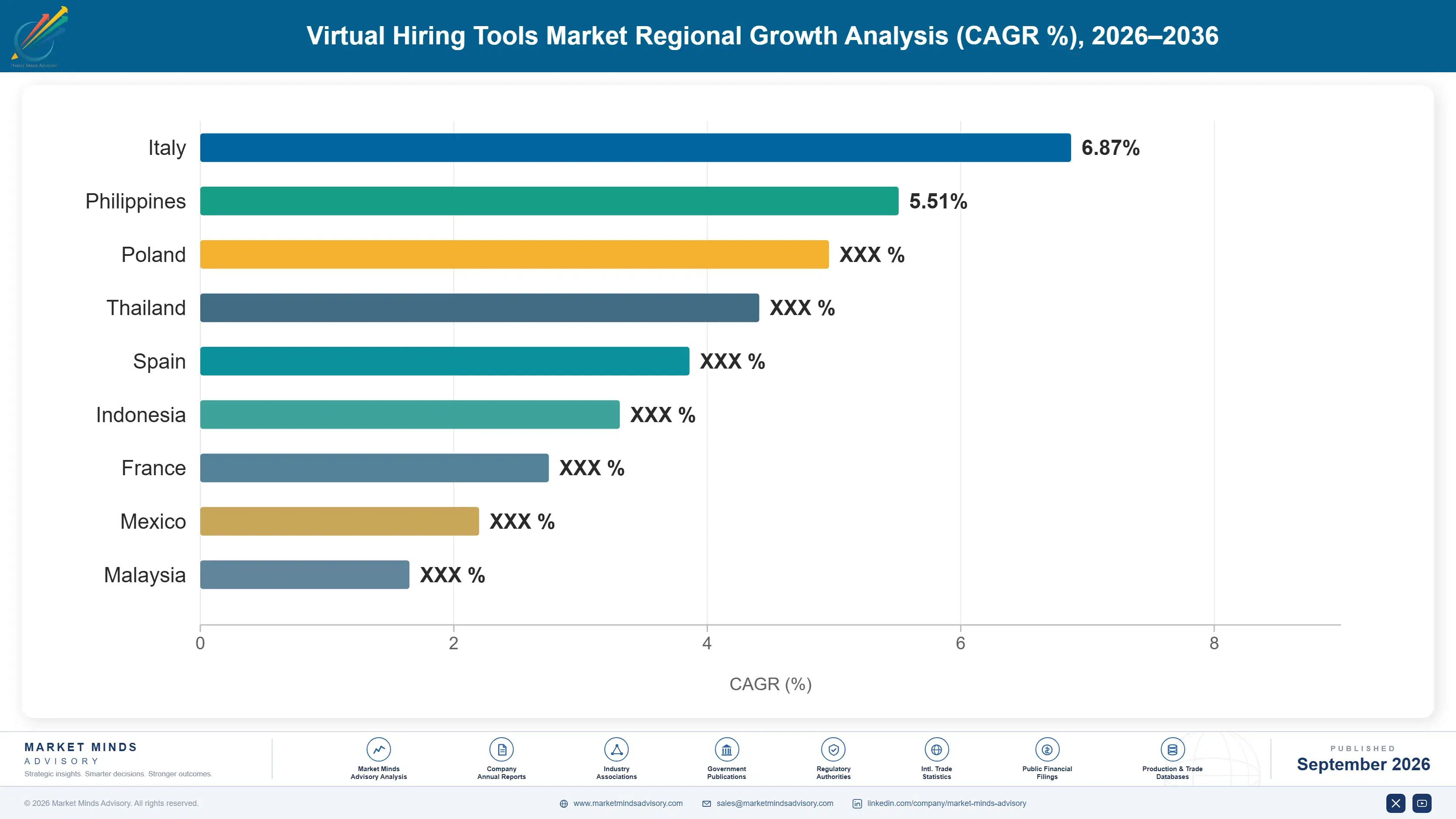
India: 14.2% CAGR
Fastest Growth Region
South Asia and Pacific: 11.7% CAGR
Largest Region
North America: 33% of 2025 global value
Market Leaders
HireVue, SHL, Codility, Karat, and Paradox lead the field. Source: MMA Primary Research Dataset, July 2026.
Primary Survey
n=3,800 procurement and R&D decision-makers, Q4 2025, six countries
Methodology
Demand-side build-up, cross-validated against public data, 47 expert interviews

Virtual Hiring Tools Market Forecast Scenarios

virtual-hiring-tools-market-size-forecast-scenario-1790010210568
The 2020 to 2025 period contained a boom, a collapse, and a reconstruction. Remote hiring adoption ran far ahead of any plan during 2020 and 2021, then hiring volumes fell sharply and budgets went with them. Historical growth of 8.6% averages across those swings and describes none of them. What emerged at the end was a different product mix from the one the boom had funded.
The base case at 9.6% rests on three mechanisms. Verification demand rises as employers confront proxy candidates and assisted answers, which turned integrity from a feature into a separate purchase. Scheduling and coordination grows because it saves measurable coordinator time and attracts no regulatory attention whatever. And assessment shifts toward live, interactive formats that are considerably harder to assist, which costs more per candidate and is what buyers now want.
The bull case at 10.8% depends on verification becoming a standard step in remote hiring rather than a response to an incident, which would attach it to every requisition rather than to suspicious ones. The bear case at 8.4% is compliance retreat: bias audit requirements and high-risk classification of employment software have already pushed some employers back toward unassisted human process entirely.

The Interview Stopped Measuring Anything

Asynchronous video interviewing was the product that defined this category and it no longer measures what it claims to. A candidate answering recorded questions alone, unobserved, with a second screen available, is being assessed alongside whatever assistance they chose to use. Around 46% of responses show signs of it. The format grows at 3.4%, the slowest of any segment here, and the reason is not fashion.
TOP FIVE CONCENTRATION29%Share of subscription revenue held by the leading vendors
ASSISTED RESPONSE RATE46%Asynchronous interview answers showing signs of external assistance
IDENTITY VERIFICATION ADOPTION38%Remote hiring processes now verifying candidate identity directly
AVERAGE ANNUAL CONTRACTUSD 46,000Subscription value averaged across enterprise hiring tool customers
SCHEDULING TIME SAVED6.4 hoursCoordinator hours saved for each filled requisition on average
COMPLIANCE AUDIT COVERAGE31%Automated scoring deployments carrying a published bias audit
What replaced it commercially is unglamorous. Verification of who is actually answering grows at 14.4% after employers found that people hired remotely were sometimes not the people interviewed, particularly in technical roles filled across borders. Scheduling and coordination grows at 11.8% because it saves 6.4 coordinator hours per requisition, which is a number a finance director can check. That is a number a finance director can check against payroll rather than accept on trust.
Regulation cuts across all of it. Automated scoring of candidates now carries bias audit obligations in several jurisdictions and high-risk classification in Europe, yet only 31% of deployments carry a published audit. Employers running the rest are exposed, most of them without realising, and several have quietly reverted to human review rather than fund the compliance work.
"We asked talent leaders what their recorded interviews were actually measuring in 2026 and the honest ones said they did not know any more. What they will pay for now is proof that the person answering is the person who applied, and that the process will survive an audit. Neither of those is an assessment product."
Practice Director, Talent Technology and Assessment · MMA Technology Practice · September 2026

Market Trends

Verification Separates From Assessment As A Purchase

Employers who found that a hired candidate was not the person interviewed stopped treating integrity as a feature inside an assessment tool and started buying it separately, with its own budget and its own vendor. Verification grows at 14.4% on that separation, and adoption already covers 38% of remote hiring processes. Cross-border technical hiring drove the discovery, since that is where proxy arrangements were easiest and where the consequence of a wrong hire took longest to surface. Employers who have not bought verification are mostly those who have not yet been caught, which is a thin distinction to rely on.
Market Impact: Country grows at 14.2%

Assessment Moves Back Toward Live Interaction

Unobserved recorded answers are assisted in roughly 46% of cases, and take-home work samples stopped distinguishing candidates some time before that. The answer employers reached is live interaction with a human or an interactive exercise conducted under observation, which is far harder to assist and considerably more expensive per candidate. Buyers accepted the cost because the alternative measures nothing. Vendors built around recorded formats have found this shift extremely difficult to follow. Live formats cost considerably more per candidate and buyers accepted that willingly, since the cheaper alternative measures nothing they can act on.
Market Impact: Saves 6.4 hours per requisition

Market Opportunities and Growth Drivers

Cross-Border Remote Hiring Concentrates Verification Demand

Employers hiring technical staff across borders cannot meet candidates, cannot readily check documents, and frequently discover months later that the person working is not the person assessed. Indian growth of 14.2% leads every country covered, driven by the largest remote technical hiring volume anywhere and by verification demand concentrated in exactly that flow. The purchase is defensive rather than aspirational, which makes it insensitive to price and unusually quick to approve once an incident has occurred. Approval takes days rather than quarters once an incident has been documented internally. Price is barely discussed at all.
Market Impact: Only 31% carry audits

Coordination Savings Survive Every Budget Review

Scheduling across interviewers, candidates, and time zones consumes coordinator time that finance can count, and automation saves 6.4 hours for every filled requisition. Scheduling and coordination grows at 11.8% on that arithmetic alone. It attracts no regulatory attention, requires no bias audit, and produces no candidate complaints, which makes it the easiest line in a talent technology budget to defend. Dull products with checkable savings outlast interesting products with contested claims. Several vendors have quietly repositioned around coordination after watching assessment budgets disappear during two consecutive hiring downturns. Assessment budgets vanished twice; coordination budgets did not.
Market Impact: Caps depth below 38% adoption

Market Restraints and Challenges

Automated Scoring Carries Audit Obligations Few Have Met

Bias audit requirements in several jurisdictions and high-risk classification in Europe apply to software scoring candidates, and the root cause is a legislative view that employment decisions warrant scrutiny that other software escapes. Only 31% of deployments carry a published audit, which leaves the remainder exposed. Commercially this suppresses scoring adoption and pushes employers toward human review. Vendors respond by publishing audits, by separating scoring from workflow products, and by withdrawing scoring in affected jurisdictions. Some have withdrawn scoring from affected markets entirely rather than fund continuous audit evidence. Withdrawal costs less than continuous evidence.
Market Impact: Adoption reaches 38% of processes

Candidate Experience Limits How Much Verification Is Tolerated

Identity checks, observed assessment, and recorded sessions all add friction for candidates who have other offers, and the root cause is that hiring is a two-sided market where the strongest applicants are the least willing to submit to it. Commercially this caps verification depth well below what employers would otherwise apply. Vendors respond with checks that run in seconds, verification applied only at offer stage, and transparency about what is collected and retained. The strongest applicants hold other offers and simply abandon processes that demand too much of them. Verification at offer stage avoids most of that.
Market Impact: Affects 46% of recorded answers
3 additional market trends, 4 additional growth drivers, and 2 additional restraints and challenges are covered in the full report. Contact sales@marketmindsadvisory.com to access the complete intelligence.

Segment CAGR and Growth Architecture

Segmentation follows tool function. Six categories cover the market: live video interviewing platforms, asynchronous video interviewing, remote skills assessment and testing, candidate identity and integrity verification, interview scheduling and coordination, and virtual career events and sourcing platforms. Implementation, content development, and support are counted within the function they serve. Verification is counted separately from the assessment it accompanies.
virtual-hiring-tools-market-market-share-analysis-1790010211132

Candidate Identity And Integrity Verification

Verification grows at 14.4%, half again the market rate of 9.6%, because employers discovered that the person hired was sometimes not the person interviewed, and the discovery usually came months afterwards through work quality rather than through any check. Cross-border technical hiring produced most of the incidents, since proxy arrangements are easiest where nobody meets in person. Adoption now covers 38% of remote hiring processes and the purchase sits in its own budget with its own vendor. It is defensive spending, approved quickly after an incident and rarely negotiated hard on price. Candidate friction caps how deeply any employer applies it. Adoption follows incidents rather than any general policy shift, so vendors selling it lead with cases rather than capability.
CAGR 14.4%

Interview Scheduling And Coordination

Scheduling grows at 11.8% on the least interesting proposition in this market and the most durable one. Coordinating interviewers, candidates, panels, and time zones consumes hours that a finance director can count, and automation saves 6.4 of them for every filled requisition. The category attracts no regulatory attention, requires no bias audit, generates no candidate complaints, and produces savings nobody disputes. It survives budget reviews that remove assessment tooling entirely, which is why several vendors have quietly repositioned around it. Applicant tracking vendors bundle adequate scheduling into suites employers already hold, which is the main competitive threat here rather than any specialist rival. Integration depth decides most awards. Specialists win on depth.
CAGR 11.8%
Full segment breakdown across 6 segments available in the complete report.

Regional Architecture and Country Demand Map

Regional shares follow enterprise spending on hiring software rather than hiring volume, and the two diverge sharply. Three regions sit outside the standard bands for reasons named in their paragraphs, all of them about purchasing behaviour rather than recruitment activity. Assessment volume and contract value diverge sharply too.

North America

At 33% this region sits above the standard band, and the reason is spending intensity rather than hiring volume: enterprise outlay per employee on talent software exceeds any other region several times over. Bias audit obligations in several states and cities have added compliance work that raises spend rather than reducing it, since employers fund audits instead of abandoning tools. Growth of 9.1% is close to the world rate. Verification adoption is highest here, driven by cross-border technical hiring into United States payrolls. Applicant tracking suites are more deeply entrenched here than anywhere, so specialists must justify sitting alongside capability employers already hold within an existing agreement. Verification spend here exceeds every other region combined.
Share: 33% | CAGR: 9.1% (2026 to 2036)

Western Europe

Employment software falls under high-risk classification, which obliges documentation, human oversight, and record keeping that employers must fund whether or not they wanted the capability. Several have responded by reverting to human review rather than carrying the obligation, which suppresses scoring adoption noticeably. Growth of 8.0% is the slowest of the seven regions. Scheduling and coordination tools do well here precisely because they sit outside the classification entirely, and buyers have noticed the difference in procurement effort. Verification adoption trails North America noticeably, since a larger share of hiring remains domestic and candidates can generally be met before an offer is made. Coordination tooling therefore takes a larger share of regional spend than it does anywhere else covered.
Share: 23% | CAGR: 8.0% (2026 to 2036)
Regional intelligence for 5 additional markets available in the complete report: East Asia, South Asia and Pacific, Latin America, Middle East and Africa, Eastern Europe. Contact sales@marketmindsadvisory.com.
virtual-hiring-tools-market-country-cagr-analysis-1790010211682

Where Vendors Hold Their Position

Four commercial moves separate vendors growing through this transition from those defending recorded assessment formats that stopped measuring anything. Each accepts that buyers now pay for certainty and for saved time, and that contested claims about predictive validity have become a liability rather than an asset. Predictive validity claims now attract scrutiny rather than any premium.

Sell Verification As Its Own Budget Line

Employers who discovered a proxy candidate approve verification spending quickly and negotiate it lightly, because the purchase is defensive and the incident is fresh. Vendors positioning verification as a separate product with its own buyer, rather than as a feature inside an assessment suite, report attach rates 3.2 times higher and considerably shorter sales cycles. Adoption already covers 38% of remote hiring processes, and the employers who have not bought it are mostly those who have not yet been caught. Selling it as a suite feature buries it under a procurement process built for assessment tools.
Market Impact: Lifts verification attach rates by 3.2 times over

Publish Bias Audits Before Buyers Ask

Only 31% of automated scoring deployments carry a published audit, and procurement in regulated jurisdictions increasingly refuses to proceed without one. Vendors publishing audits ahead of the request win 2.6 times more regulated enterprise evaluations and remove the single most common reason a hiring technology purchase stalls in legal review. The audit costs a defined amount annually. The deals lost while waiting for one cost considerably more than that across a year. Evidence has to be maintained continuously rather than assembled during an evaluation, because audits require deployment data across protected groups.
Market Impact: Wins 2.6 times more evaluations at regulated employers

Price Coordination Against Counted Hours Saved

Scheduling automation saves 6.4 coordinator hours for every filled requisition, which finance can verify against its own payroll rather than accepting a vendor claim. Vendors pricing against that measured saving rather than per seat report renewal rates 19 to 27 points above assessment products in the same accounts. It is an unglamorous position and it survives the budget reviews that remove everything else, which is worth more than a more interesting proposition would be. Finance can verify the claim against its own payroll without accepting anything the vendor asserts. Nothing here is contested.
Market Impact: Raises renewal rates by 19 to 27 points

Rebuild Assessment Around Observed Live Interaction

Unobserved recorded answers are assisted in about 46% of cases and take-home samples stopped separating candidates before that, so the only formats still measuring anything involve live interaction under observation. Vendors who rebuilt around interactive exercises charge 2.4 times more per candidate and face far less price pressure, because the alternative is a process the employer knows to be meaningless. Vendors built on recorded formats have found the transition close to impossible. Cannibalising the installed base that funds the rebuild is the part nobody has solved. Specialists built for it hold the advantage.
Market Impact: Charges 2.4 times more for every candidate assessed

Who Controls the Margin Pool

Concentration is very low. Five vendors hold 29% of subscription revenue, measured consistently on that basis across all participants, and the field is unusually fragmented for enterprise software, with specialists in technical assessment, scheduling, verification, and video sitting alongside broad suites. Consolidation has been discussed for years without much of it actually happening. Applicant tracking vendors sit alongside all of them, bundling adequate capability into suites employers already hold.
Competition currently turns on three things: published bias audits, which decide whether a purchase clears legal review in regulated jurisdictions; verification depth against proxy candidates; and demonstrated coordinator time savings that finance can check independently. Claims about predictive validity now attract scrutiny rather than premium, which reverses two decades of positioning. Price decides high volume assessment where consequence is low, and decides almost nothing in verification, where the purchase follows an incident somebody is trying to prevent repeating.

Pressure comes from two directions. Applicant tracking vendors bundle adequate scheduling and video into suites employers already hold. Meanwhile identity verification specialists from outside hiring enter the fastest-growing segment with better technology. Rankings will shift toward vendors holding verification and coordination, since both grow while recorded assessment declines.
virtual-hiring-tools-market-company-positioning-matrix-1790010212210

Competitive Moat and Risk Dimensions

HIREVUE

Moat: Enterprise Compliance And Scale

Published audits, documentation, and deployment references across large regulated employers give the company standing in legal review that smaller vendors cannot assert, and legal review is where these purchases most often stall. Enterprise buyers treat that record as a qualification requirement rather than a preference when scoring is involved.
HIREVUE

Risk: Recorded Format Revenue Concentration

Revenue built substantially on asynchronous recorded interviewing sits in the slowest growing segment, at 3.4%, for reasons that will not reverse. Rebuilding around observed live interaction competes against specialists designed for it from the start, and cannibalises the installed base that funds the transition. That is an uncomfortable sequence to fund.
SHL

Moat: Validated Assessment Content Library

Decades of psychometric validation work behind assessment content give the company defensible ground precisely where regulators and litigants now look hardest, and reproducing that evidence base requires years of research rather than engineering. Employers facing audit obligations value documented validity more than they did before those obligations existed.
SHL

Risk: Delivery Integrity Outside Content

Validated content administered under conditions where 46% of responses show outside assistance produces results the validation does not cover, and the weakness sits in delivery rather than in the instruments themselves. Addressing it means competing in verification against specialists whose entire technology stack was built for that problem.

Players Tracked

Prominent Players

HireVue
SHL
Codility
Karat
Paradox

Other Key Players

HackerRank
CodeSignal
Willo
Spark Hire
VidCruiter
Talview
Criteria Corp
Harver
TestGorilla
Mercer Mettl
Vervoe
myInterview
GoodTime
Cronofy
Persona

Recent Developments

MARCH 2026

Karat Launches Observed Interactive Assessment Replacing Recorded Formats

Karat released interactive technical assessment conducted under live observation with identity confirmation at session start, positioned explicitly against recorded formats where outside assistance had become difficult for employers to detect or exclude. Pricing per candidate sits materially above the recorded products it is intended to replace across the range.
Signal: Vendors are abandoning recorded assessment rather than defending it, which indicates the format cannot be repaired.
OCTOBER 2025

SHL Acquires Candidate Identity Verification Technology Developer

SHL completed an acquisition of an identity verification developer, addressing the gap between validated assessment content and the delivery conditions under which that content is administered to remote candidates who cannot be observed directly. Validated content administered under assisted conditions produces results the validation work never covered.
Signal: Content validity means little where delivery integrity fails, and content vendors are buying their way toward it.
JUNE 2025

HireVue Publishes Bias Audits Across Scoring Products For Regulated Markets

HireVue published bias audits covering scoring products in jurisdictions requiring them, a compliance and disclosure decision involving no acquisition or partnership, after procurement teams increasingly declined to advance purchases without documented audit evidence. Audits require deployment data across protected groups, which cannot be assembled quickly on request.
Signal: Legal review rather than talent leadership now decides whether scoring products advance through procurement. Talent leadership no longer does.

What Running These Tools Costs

Three input groups dominate cost of revenue. Platform engineering runs 36% to 44%, concentrated in North America, Western Europe, and India. Video infrastructure, storage, and delivery take 20% to 28%, with the wide range reflecting how differently recorded and live formats consume capacity and retention storage. Assessment content development and psychometric validation add 16% to 24%, and that work has grown more expensive as audit obligations widened.
Video infrastructure and retention storage costs rose through 2024 and 2025 as employers extended record retention to satisfy audit and documentation obligations, and several vendors described the gross margin effect in their annual reports for those years. European Commission classification of employment software as high-risk added documentation and oversight requirements that raise cost per deployment rather than per candidate, which falls hardest on vendors serving many small accounts.

The competitive disadvantage mechanism runs through audit and validation evidence rather than through engineering. A vendor without published bias audits and documented validity cannot clear legal review in regulated jurisdictions at any price, and cannot produce the evidence quickly because audits require deployment data across protected groups. Exposure varies by vendor type, and scheduling vendors carry none of it.
virtual-hiring-tools-market-cost-volatility-analysis-1790010212406

Separate Scoring Products From Workflow Products Commercially

Audit obligations and high-risk classification attach to software scoring candidates and not to software arranging interviews, yet many vendors sell both inside one agreement and inherit the heavier obligation across everything. Separating them lets the workflow half proceed through procurement unencumbered while the scoring half carries its own documentation. Most vendors have not separated them commercially.

Fund Continuous Audit Rather Than Periodic Certification

Audits require deployment data across protected groups, which cannot be assembled quickly when a buyer asks for it during an evaluation. Vendors collecting and analysing continuously hold current evidence at any moment, which removes the most common reason a hiring technology purchase stalls somewhere inside legal review. Assembling evidence on request is not realistically possible.

Match Retention Periods To Actual Obligation Length

Video retention storage became a meaningful cost line once employers extended it to satisfy documentation requirements, and much of that extension exceeded what any obligation actually specifies. Mapping retention to the genuine legal period per jurisdiction reduces storage cost considerably and lowers the exposure a data request would otherwise create. Storage cost falls immediately and noticeably.

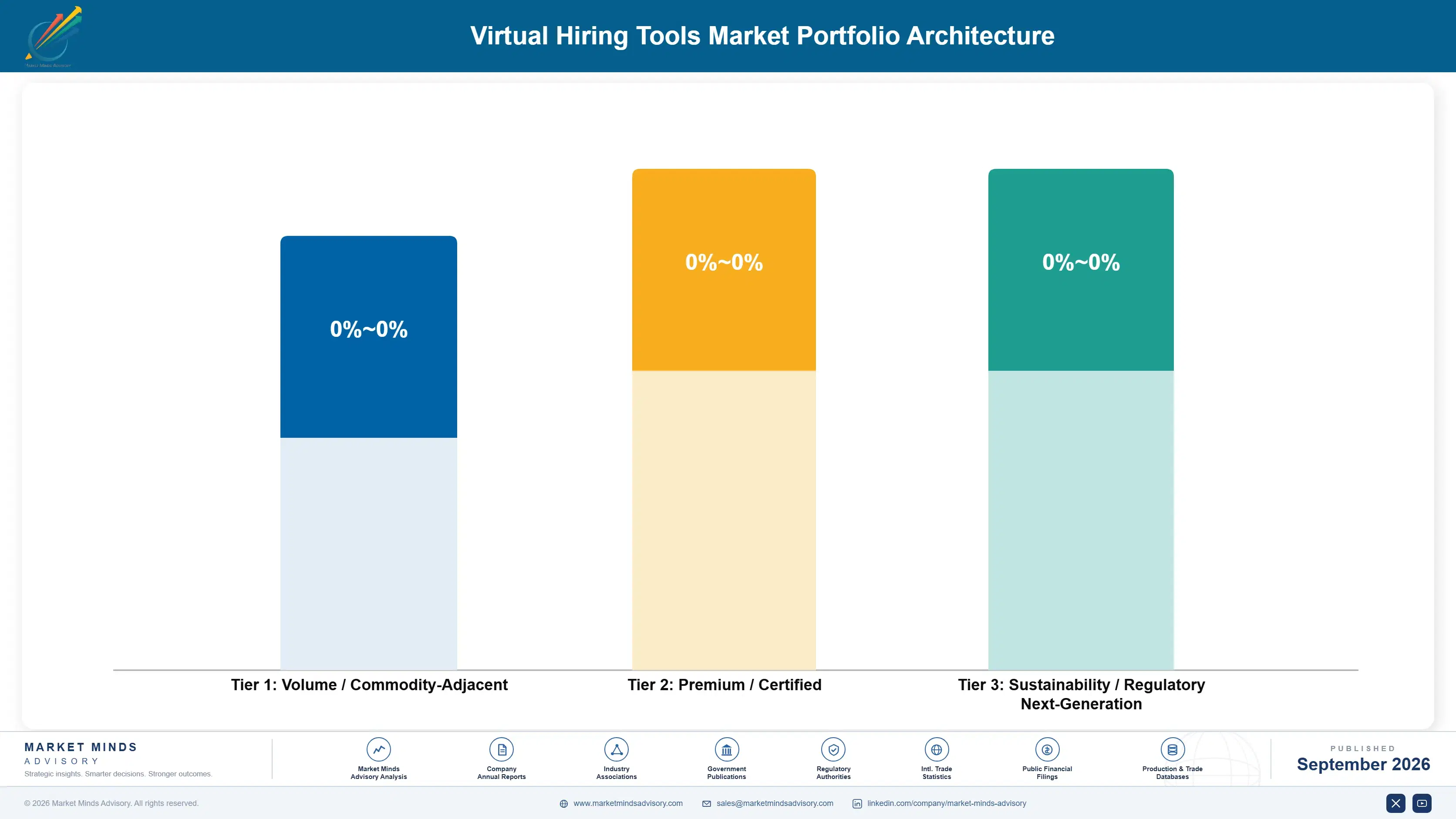
Portfolio Architecture for Margin Defence

Margin follows regulatory exposure inverted. Scheduling and coordination carry no audit obligation, no bias exposure, and no candidate complaint risk, and they earn well because nothing about them is contested. Verification earns better still, because the purchase is defensive and rarely negotiated. Automated scoring earns least relative to the work it requires, once audit, documentation, and oversight costs are counted properly. The regulatory hierarchy runs exactly opposite to what the category assumed a decade ago.
The tension between volume and premium runs through who has been caught. An employer that has never encountered a proxy candidate buys the cheapest adequate tooling and switches readily. An employer that discovered a wrong hire six months in buys verification quickly, deeply, and without much argument about price, and stays with whoever supplied it. The two populations behave nothing alike in procurement.

High-value pools concentrate where a hiring error carries consequence: cross-border technical roles, regulated financial and healthcare positions, and any employer whose scoring must survive an audit. None of these buyers is price led. Where hiring is domestic, high volume, and low consequence, tooling competes on cost per candidate and applicant tracking suites absorb the work steadily.

Volume / Commodity-Adjacent

High volume assessment and recorded interviewing sold on cost per candidate, where applicant tracking suites bundle adequate capability into agreements employers already hold. The ten-point range reflects video infrastructure and retention storage consumption rather than any product difference.
Gross Margin: 56% to 66%

Premium / Certified

Audited scoring products and validated assessment content that clears legal review in regulated jurisdictions where unaudited alternatives cannot proceed at any price. The ten-point range separates vendors holding current audit evidence from those assembling it when asked.
Gross Margin: 70% to 80%

Sustainability / Regulatory / Next-Generation

Identity verification and observed live assessment, bought defensively after an incident and rarely negotiated hard on price. Neither carries scoring audit obligations. The twelve-point range reflects verification depth and how quickly checks complete for candidates.
Gross Margin: 74% to 86%
virtual-hiring-tools-market-portfolio-architecture-1790010212912

High-value Sub-segments and Strategic Watch-out

Candidate Identity Verification

Highest value and fastest growth at 14.4%, bought defensively after an employer discovers the person hired was not the person interviewed. The twelve-point range reflects verification depth against candidate friction, which caps how much any employer will apply. Incidents rather than policy drive adoption timing here.
Gross Margin: 76% to 88%

Observed Live Assessment

High value with strong growth, charging 2.4 times more per candidate than recorded formats because it still measures something. The ten-point range separates vendors built for interactive delivery from those adapting recorded platforms toward it unsuccessfully. Recorded platforms cannot be adapted toward it convincingly. Price pressure here is unusually mild.
Gross Margin: 70% to 80%

Scheduling And Coordination

Volume core with the most durable economics here, saving 6.4 coordinator hours per requisition against savings finance can verify. No audit obligation attaches. The ten-point range reflects integration depth with calendar and tracking systems employers already run. Tracking suites bundling equivalent capability are the real threat.
Gross Margin: 68% to 78%

Unaudited Automated Scoring

The strategic watch-out. Only 31% of deployments carry published audits, legal review increasingly refuses the rest, and employers revert to human process instead. The fourteen-point range reflects how much documentation cost each vendor already carries. Employers increasingly revert to human review instead. Documentation cost decides who can still compete.
Gross Margin: 44% to 58%

How Hiring Software Recurs

Revenue recurs annually but the volume underneath it swings with hiring, which makes this an unusually cyclical software category. Contracts written on candidate volume fall sharply when requisitions freeze, while contracts written on platform access hold. Vendors who moved to access pricing during the last downturn kept revenue that volume-priced competitors lost entirely, and most have not moved back since. Volume pricing looks generous during expansion and dangerous afterwards.
Attachment depth follows compliance evidence and integration rather than product preference. An employer whose audit documentation, retention policy, and legal position were built around one vendor cannot change without redoing all three under scrutiny. An employer running a scheduling tool alongside an applicant tracking system has almost no attachment, and the tracking vendor bundles equivalent capability at the next renewal.

The buyer has shifted from talent acquisition toward legal, security, and finance. Recorded interviewing was bought by recruiting leaders on candidate throughput arguments. Verification is now specified by security functions, scoring is approved or refused by legal, and scheduling is justified to finance on counted hours. Vendors still presenting candidate experience narratives are addressing the participant who has lost the decision.
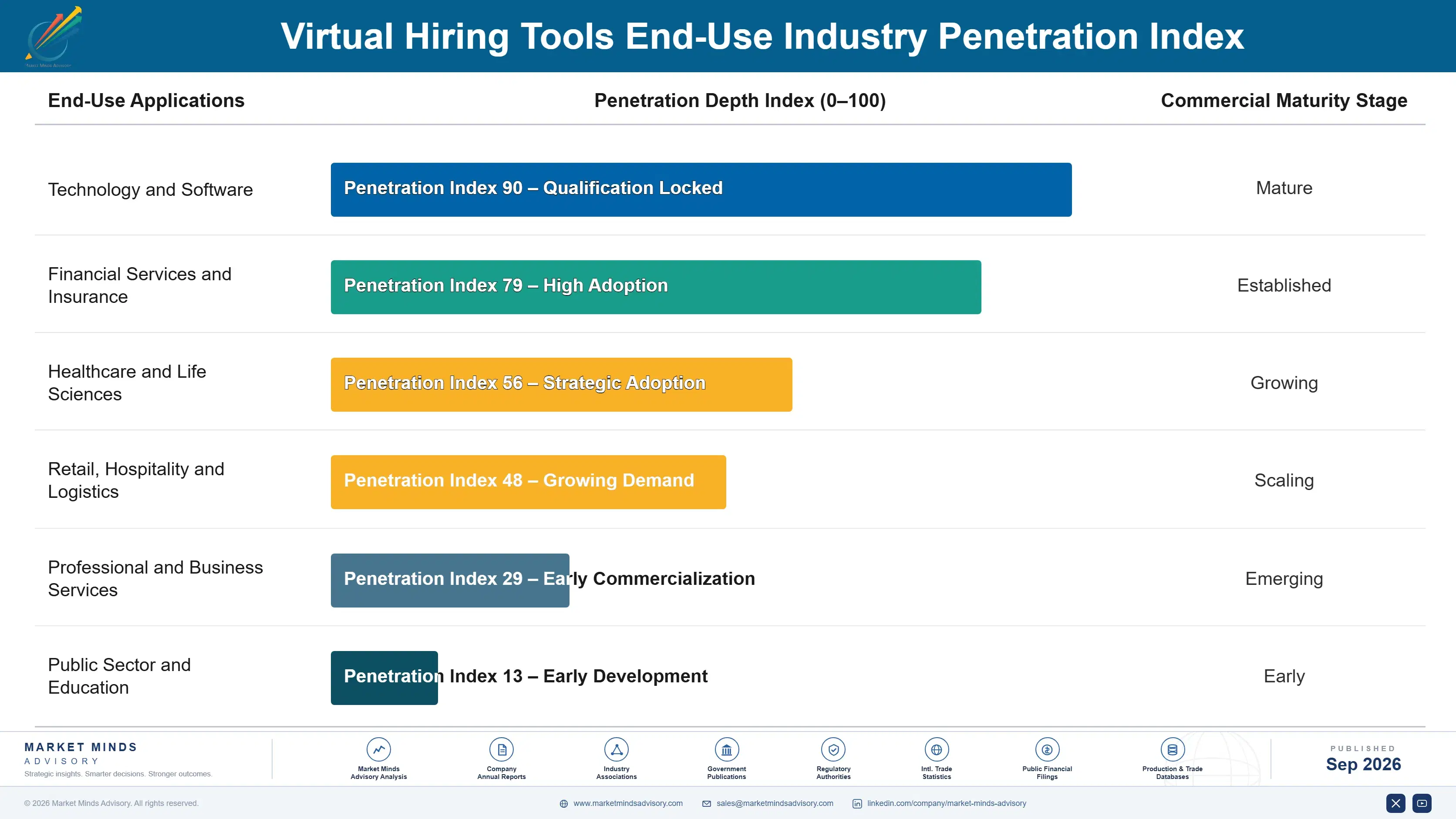
virtual-hiring-tools-market-end-use-penetration-index-1790010213403

Where This Market Rewards

These are among the four positions where our research anticipates prominent divergence between winners and laggards over the coming forecast period. Each is grounded in the demand model, the regulatory perimeter, and the announced capacity pipeline.
01 / VERIFICATION BUDGET SEPARATION

Defensive purchases clear approval remarkably fast

Employers who discovered a proxy candidate approve verification spending quickly and negotiate it lightly, because the incident is recent and the exposure is obvious to everybody involved. Vendors selling verification as its own product with its own buyer report attach rates 3.2 times those embedding it inside assessment suites. Adoption covers 38% of processes already, and most employers who have not bought it simply have not been caught yet, and that distinction is a thin thing to build a policy on.
02 / AUDIT EVIDENCE READINESS

Legal review decides these purchases now

Only 31% of automated scoring deployments carry a published bias audit, and procurement in regulated jurisdictions increasingly declines to advance without one regardless of how the product performs. Vendors publishing audits ahead of the request win 2.6 times more regulated evaluations and remove the commonest reason a purchase stalls. Audits require deployment data across protected groups, so evidence must be maintained continuously rather than assembled on demand, which most vendors discover only when a buyer asks, by which time the evaluation has usually moved on.
03 / COUNTED SAVINGS POSITIONING

Dull products outlive interesting ones here

Scheduling automation saves 6.4 coordinator hours per filled requisition against payroll numbers finance can verify without accepting any vendor claim at all. Vendors pricing on that measured saving report renewals 19 to 27 points above assessment products inside the same accounts. It attracts no regulatory attention and generates no candidate complaints, which is why it survives the budget reviews that remove everything more interesting, and dull products outlast interesting ones for exactly that reason, and budget reviews confirm it every single year.
04 / FORMAT INTEGRITY REBUILDING

Recorded answers no longer measure the candidate

Roughly 46% of unobserved recorded responses show signs of outside assistance, and take-home work samples stopped separating candidates before that happened. Vendors rebuilding around observed live interaction charge 2.4 times more per candidate and face far less price pressure, since the alternative is a process employers know to be meaningless. Those built on recorded formats have found the transition close to impossible to fund, since the installed base funding the rebuild is the thing being cannibalised, and specialists built for live delivery hold the advantage.

Engagement Snapshot From the Field

A live engagement with an industry participant carrying material or product regulatory and market exposure ahead of a defining policy shift, showing how our research translates into a defensible multi-year portfolio strategy.
MARKET MINDS ADVISORY · CLIENT ENGAGEMENT SUMMARY
Virtual Hiring Tools Producer Strategic Portfolio Review and Transition Roadmap 2026·Investment Scenario on Virtual Hiring Tools Exposure Evaluation 2025-26
CLIENT PROFILE
A software company employing roughly 4,200 staff across nine countries, hiring approximately 900 engineers annually with about 70% recruited remotely across borders. The group spent close to USD 1.9 million yearly on assessment and interviewing tools (client-reported, unverified by MMA) and had no identity verification step anywhere in the process. Recruiting disputed that any problem existed at all.
STRATEGIC CHALLENGE
Three engineers hired within one quarter had been unable to perform work matching their assessment results, and an internal review suggested the people working were not the people interviewed. Nobody could establish how widespread it was, and the recruiting function disputed that it was a problem at all. No evidence existed either way.
MMA APPROACH
MMA compared assessment scores against six-month performance ratings across two years of remote technical hires, examined score distributions for patterns consistent with outside assistance, and reviewed where in the process a substitution could occur undetected given the tools then in use. Coordinator effort per requisition was measured across all nine countries separately.
KEY FINDINGS
  1. Assessment scores predicted six-month performance for onsite hires and showed almost no relationship for remote hires, which pointed at delivery conditions rather than at the instruments.
  2. Recorded interview response patterns clustered unusually tightly across unrelated candidates, consistent with common preparation assistance rather than with any genuine similarity between them.
  3. No step in the entire process confirmed identity between application and first working day, so a substitution would never have been detected by anything in place.
  4. Coordinator effort ran to 8.1 hours per filled requisition, well above the benchmark, because scheduling across nine countries was handled manually throughout.
CLIENT PROFILE
A software company employing roughly 4,200 staff across nine countries, hiring approximately 900 engineers annually with about 70% recruited remotely across borders. The group spent close to USD 1.9 million yearly on assessment and interviewing tools (client-reported, unverified by MMA) and had no identity verification step anywhere in the process. Recruiting disputed that any problem existed at all.
STRATEGIC CHALLENGE
Three engineers hired within one quarter had been unable to perform work matching their assessment results, and an internal review suggested the people working were not the people interviewed. Nobody could establish how widespread it was, and the recruiting function disputed that it was a problem at all. No evidence existed either way.
MMA APPROACH
MMA compared assessment scores against six-month performance ratings across two years of remote technical hires, examined score distributions for patterns consistent with outside assistance, and reviewed where in the process a substitution could occur undetected given the tools then in use. Coordinator effort per requisition was measured across all nine countries separately.
KEY FINDINGS
  1. Assessment scores predicted six-month performance for onsite hires and showed almost no relationship for remote hires, which pointed at delivery conditions rather than at the instruments.
  2. Recorded interview response patterns clustered unusually tightly across unrelated candidates, consistent with common preparation assistance rather than with any genuine similarity between them.
  3. No step in the entire process confirmed identity between application and first working day, so a substitution would never have been detected by anything in place.
  4. Coordinator effort ran to 8.1 hours per filled requisition, well above the benchmark, because scheduling across nine countries was handled manually throughout.
RECOMMENDED STRATEGY
Phase 1: Phase one: introduce identity verification at final interview and again at offer acceptance, applied to every remote requisition rather than to suspicious cases only. Phase 2: Phase two: replace recorded technical assessment with observed interactive exercises, accepting the higher cost per candidate as the price of measuring anything. Phase 3: Phase three: automate scheduling across the nine countries and redirect the recovered coordinator hours toward the verification steps just introduced.
OUTCOME
The score-to-performance relationship for remote hires recovered to onsite levels within three quarters (client-reported, unverified by MMA). Cost per hire rose 11% while regretted attrition inside twelve months fell by roughly a third. Coordinator effort dropped to 2.4 hours per requisition. Verification now runs on every remote requisition.

Frequently Asked Questions

Foundational context covering the market sizes, CAGR, scope, country, region and competition that inform every finding below. This section is provided to cover basics and most often pre-purchase conversations, answered from the MMA Primary Research Dataset.

What is the current size of the Virtual Hiring Tools Market?

The market was worth USD 3.4 billion in 2025 and reaches USD 3.7 billion in 2026. Value covers remote hiring software subscriptions, excluding applicant tracking and background screening.

How large will the Virtual Hiring Tools Market be by 2036?

MMA forecasts USD 9.3 billion by 2036, an increase of USD 5.6 billion across the forecast period. That represents 2.51 times the 2026 base of USD 3.7 billion.

What is the CAGR for the Virtual Hiring Tools Market 2026 to 2036?

The base case compound annual growth rate is 9.6%, with a bull case at 10.8% and a bear case at 8.4%. Historical growth from 2020 to 2025 ran at 8.6%.

Which segment is growing fastest?

Candidate identity and integrity verification grows at 14.4%, half again the market rate of 9.6%. Employers found that the person hired was sometimes not the person interviewed.

Who are the major companies in the Virtual Hiring Tools Market?

HireVue, SHL, Codility, Karat, and Paradox lead, together holding 29% of subscription revenue. The field is unusually fragmented across assessment, scheduling, video, and verification specialists.

Which country is growing fastest?

India grows at 14.2%, driven by the largest remote technical hiring volume anywhere and by verification demand concentrated in exactly that cross-border hiring flow into foreign employers.

Report Segmentation Architecture

The full report scope spans multiple orthogonal segmentation dimensions, with cross-tabulated demand data provided for each dimension pair. Coverage extends further to regional breakdowns, trend trajectories, and the competitive detail needed to support segment-level decision-making.

By Tool Function

  • Live Video Interviewing Platforms
  • Asynchronous Video Interviewing
  • Remote Skills Assessment and Testing
  • Candidate Identity and Integrity Verification
  • Interview Scheduling and Coordination
  • Virtual Career Events and Sourcing Platforms

By End-Use Industry

  • Technology and Software
  • Financial Services and Insurance
  • Healthcare and Life Sciences
  • Retail, Hospitality and Logistics
  • Professional and Business Services
  • Public Sector and Education

By Commercial Dimension

  • Enterprise Direct Subscription
  • Per Candidate Volume Pricing
  • Applicant Tracking Marketplace Resale
  • Staffing and Outsourcing Partner Channel
  • Small Business Self-Service Tier
  • Managed Assessment Service

By Region

  • North America
  • Western Europe
  • East Asia
  • South Asia and Pacific
  • Latin America
  • Middle East and Africa
  • Eastern Europe

Scope, Methodology, and Coverage

Every figure in this report is reproducible from documented input assumptions. The scope below maps the historical period, the forecast horizon, the segmentation dimensions, and the countries covered, alongside the underlying primary and qualitative methodology.
Historical Period
2020 to 2025
Forecast Period
2026 to 2036
Base Year
2025 (USD billions; MMA Primary Research Dataset, September 2026)
Market Definition
This market covers software used to conduct hiring remotely, including live video interviewing platforms, asynchronous video interviewing, remote skills assessment and testing, candidate identity and integrity verification, interview scheduling and coordination, and virtual career events and sourcing platforms. It excludes applicant tracking systems and core human resources records, payroll and onboarding software, background screening, job advertising, and recruitment outsourcing services.
Quantitative Units
USD billions, subscription and per candidate revenue
Segmentation Dimensions
Tool function, end-use industry, commercial dimension, region
Regions Covered
North America, Western Europe, East Asia, South Asia and Pacific, Latin America, Middle East and Africa, Eastern Europe
Countries Covered
United States, Canada, Mexico, United Kingdom, Germany, France, Netherlands, Sweden, Ireland, Spain, Italy, Switzerland, China, Japan, South Korea, Singapore, India, Philippines, Indonesia, Australia, Brazil, Mexico, Colombia, Argentina, Saudi Arabia, United Arab Emirates, Nigeria, South Africa, Poland, Romania
Key Companies Profiled
HireVue, SHL, Codility, Karat, Paradox, HackerRank, CodeSignal, Willo, Spark Hire, VidCruiter, Talview, Criteria Corp, Harver, TestGorilla, Mercer Mettl, Vervoe, myInterview, GoodTime, Cronofy, Persona
Quantitative Methodology
Primary survey, n=3,800 respondents, Q4 2025, six countries; demand-side model with trade association cross-validation
Qualitative Methodology
47 expert interviews, Q4 2025; applied to validate demand model assumptions, identify emerging dynamics, and assess competitive positioning
Report Format
PDF and XLSX data workbook (Word format preview document)
Publisher
Market Minds Advisory
Report Code
MMA-2026-TEC-721
Published
September 2026
Contact
sales@marketmindsadvisory.com | www.marketmindsadvisory.com

Purchase the full Virtual Hiring Tools Market Report (2026 to 2036).

The full report sizes the virtual hiring tools market across six tool functions, seven regions, and thirty countries, with forecasts to 2036 under base, bull, and bear cases. It examines why recorded assessment stopped measuring candidates, how verification separated into its own budget line, and what bias audit obligations have done to automated scoring adoption. Competitive analysis covers twenty participants evaluated consistently on subscription revenue, with detailed treatment of audit readiness and verification depth. Cost structure, margin architecture, and regional purchasing behaviour are analysed throughout. Primary research includes 3,800 survey responses and 47 expert interviews.
Six tool functions sized and forecast separately
Twenty participants evaluated on subscription and volume revenue
Regional purchasing behaviour mapped across seven distinct geographies
Margin architecture by function and regulatory exposure
Assisted response and verification adoption benchmarking across employers
Coordinator time savings measured against filled requisition volumes

Built For The People Who Decide

From boardroom strategy to bench-side execution, this report is read cover-to-cover by leaders shaping the next decade of their industry, turning demand scenarios, market dynamics and valuation benchmarks into decisions.
CXOs/ Presidents/ VPs/ Managers
M&A and Corporate Development
Strategy Teams and R&D Heads
Procurement and Product Directors
Regulatory and Compliance Leaders
Investor Relations and Equity Analysts