Market Minds Advisory
Virtual Customer Premises Equipment Market

Virtual Customer Premises Equipment Market: Virtual Customer Premises Equipment Market. Cloud-Native Edge Virtualization Reshapes Carrier Network Investment

Carriers are pushing network functions further toward cloud-native edge orchestration as 5G rollout accelerates, forcing vCPE vendors to prove multi-vendor virtual network function interoperability while enterprises demand simplified single-pane management.

Lead Analyst

Published

September 2026

Make Smarter Decisions with Customized Research Insights

Request a free sample report and evaluate market opportunities, growth trends, and competitive dynamics relevant to your business needs.

2025 MARKET VALUE$3.2BMarket Size 2025
2036 FORECAST VALUE$13.8BBase Case , 2026 to 2036
CAGR 2026 TO 203614.2 %Bull 15.5% / Bear 12.9%
INCREMENTAL OPPORTUNITY$10.1BNet 10- year value creation
EXPANSION MULTIPLE3.77x2036 value over 2026 base
Strategic Levers
M&A Pipeline
Regional Outlook
Country Rankings
Competitive Intelligence
Segmental Deep-dive
Call-Us : 91 93563 13602

Executive Snapshot and Market Trajectory.

Cloud-native edge virtualization is reshaping carrier network investment faster than any prior networking infrastructure cycle, as 5G rollout accelerates demand for orchestration platforms that manage virtual network functions across distributed edge locations, access points, regional data centers, and enterprise branch sites nationwide and globally.
Carriers and enterprise customers face simultaneous pressure from legacy CPE hardware replacement cycles, expanding SD-WAN virtualization demand across distributed enterprise branch locations, and rising competition from cloud-native orchestration platforms that reduce reliance on proprietary hardware. India's expanding telecom subscriber base and network virtualization investment are pulling vCPE adoption into domestic carriers faster than incumbents anticipated, while North American carriers continue funding the highest-value orchestration platform development contracts across most network segments and enterprise customer categories.
Competitive intensity concentrates among five vendors controlling roughly forty-six percent of global revenue, though cloud-native orchestration specialists are winning carrier contracts faster than hardware incumbents expected just two years ago and continue gaining ground steadily across most segments, geographic markets, and customer categories. Regulatory pressure around network security certification adds validation cost that smaller vendors increasingly struggle to absorb without dedicated compliance engineering teams and legal counsel.
Market Definition
The Virtual Customer Premises Equipment Market covers software and orchestration platforms that virtualize network functions traditionally delivered through dedicated hardware appliances at customer sites. It excludes physical routing and switching hardware sold independently of virtualization software and standalone cloud computing infrastructure services.
Base Year Value
$3.2B in 2025 (MMA Primary Research Dataset, September 2026)
Forecast Period
2026 to 2036, eleven discrete annual values
CAGR
14.2% base case. Bull 15.5%. Bear 12.9%.
Fastest Growth Segment
Cloud-Native Edge Virtualization Software: 19.4% CAGR
Fastest Growth Country
India: 17.0% CAGR
Fastest Growth Region
South Asia and Pacific: 16.2% CAGR
Largest Region
North America: 33% of 2025 global value
Market Leaders
Cisco, VMware, Juniper Networks, Nokia, and Ciena lead the field. Source: MMA Analysis, July 2026.
Primary Survey
n=3,800 procurement and R&D decision-makers, Q4 2025, six countries
Methodology
Demand-side build-up, cross-validated against public data, 47 expert interviews

Virtual Customer Premises Equipment Market Forecast Scenarios

virtual-customer-premises-equipment-market-size-forecast-scenario-1789980849129
The 2020 to 2025 period saw vCPE demand track broader network functions virtualization adoption closely, growing at a 13.0 percent compound annual rate as carriers began transitioning away from dedicated hardware appliances toward software-defined network architecture and design. Early SD-WAN deployments dominated this period before orchestration platforms and cloud-native edge virtualization emerged as distinct product categories.
Base case forecasts assume continued 5G rollout expanding edge virtualization demand, rising enterprise SD-WAN adoption replacing legacy hardware appliances across distributed branch locations, and growing carrier preference for cloud-native orchestration over proprietary hardware platforms. These three mechanisms combine to sustain a 14.2 percent compound annual growth rate through 2036, with India and North America contributing the largest incremental volume gains as domestic telecom infrastructure expands and carrier orchestration budgets continue funding high-value platform development.
A bull scenario reaching 15.5 percent growth depends on faster-than-expected 5G edge deployment accelerating cloud-native virtualization demand across mid-tier carriers not yet committed to full network transformation. A bear scenario falling to 12.9 percent would likely follow a broader carrier capital expenditure slowdown reducing willingness to fund new orchestration platform categories across most network segments.

Cloud-Native Orchestration Displaces Hardware Appliances

Carriers increasingly retire dedicated hardware appliances in favor of software-based network functions running on general-purpose universal CPE platforms, cutting capital expenditure while gaining flexibility to reconfigure network services remotely without on-site technician visits across most deployment scenarios, geographic regions, and enterprise segments.
MARKET CONCENTRATIONCR5 46%Top five vendors hold under half of global platform revenue
AVERAGE DEPLOYMENT COST$65KTypical enterprise branch deployment cost varies by function count
TOP PRODUCING COUNTRYUnited States 28%Leading vendor headquarters concentration drives orchestration platform development
HARDWARE REDUCTION RATE42%Average decline in dedicated hardware appliances following vCPE deployment
SD-WAN ATTACH RATE58%Share of enterprise deployments bundling SD-WAN virtualization capability directly
ENGINEERING COST SHARE56%Orchestration software development dominates ongoing vendor cost base entirely
SD-WAN virtualization increasingly bundles directly into broader vCPE orchestration platforms rather than deploying as a standalone product category, since enterprises prefer unified management across all virtualized network functions through a single administrative console rather than juggling separate vendor dashboards and interfaces today. This shift pressures standalone SD-WAN vendors to build broader orchestration capability rapidly or risk losing enterprise contracts to comprehensive vCPE platform vendors offering integrated function management across the entire distributed branch network estate.
Cloud-native edge virtualization increasingly displaces traditional on-premises hardware architecture, since containerized network functions can be deployed, scaled, and updated remotely without requiring physical technician site visits for routine configuration changes and periodic updates. Vendors increasingly offer zero-touch provisioning capability that automatically configures new branch deployments, letting carriers and enterprises expand network footprint without proportionally expanding field technician headcount and installation scheduling burden across most geographic regions and markets.
"The hardware box was never the product, it was always the software running on top of it. Vendors still selling appliances instead of orchestration platforms will lose carrier contracts within years."
Senior Analyst, Network Virtualization and Carrier Infrastructure Practice · MMA Technology Practice · September 2026

Market Trends

Cloud-Native Orchestration Displaces Legacy Hardware Appliances

Carriers increasingly deploy cloud-native orchestration platforms that manage virtual network functions across distributed edge locations, replacing dedicated hardware appliances that required physical technician site visits for every configuration change or capacity upgrade across the network. This shift requires vendors to invest heavily in containerized software architecture and remote provisioning capability rather than relying on established hardware appliance product lines that worked effectively for decades without requiring continuous software update infrastructure. Vendors that delay this transition risk losing design wins to competitors offering more accessible, cloud-native orchestration alternatives already deployed at scale across leading carrier networks.
Market Impact: India adds 900 million connected subscribers
SD-WAN Virtualization Consolidates Into Unified Platforms

Enterprises increasingly demand unified vCPE platforms that bundle SD-WAN virtualization directly with broader orchestration capability, rather than deploying standalone SD-WAN products requiring separate management consoles and vendor relationships across their distributed branch network, remote offices, edge locations, and regional data centers. This consolidation trend pulls purchasing decisions toward comprehensive platform vendors capable of delivering multiple virtual network functions through a single administrative interface rather than juggling point solutions from different suppliers. Vendors offering unified platforms increasingly win renewal contracts over competitors providing only standalone SD-WAN capability lacking broader orchestration integration.
Market Impact: Adds 32 percent edge orchestration demand

Market Opportunities and Growth Drivers

India Expands Telecom Network Virtualization Investment

India's massive telecom subscriber base, combined with aggressive network modernization programs from major domestic carriers, continues driving rapid network functions virtualization adoption as operators seek to reduce dependency on imported dedicated hardware appliances. This domestic infrastructure investment pulls vCPE licensing volume directly into Indian carrier networks, favoring vendors with established local support and language localization over global vendors serving India remotely through regional distribution partners lacking dedicated technical presence. Domestic carriers increasingly bundle orchestration platform upgrades into broader 5G network modernization initiatives, accelerating adoption timelines considerably across most network segments.
Market Impact: Extends deployment timelines by 6 months

5G Rollout Expands Edge Orchestration Demand

Carriers continue expanding 5G network deployment across most major markets, and 5G architecture fundamentally requires distributed edge computing and orchestration capability that legacy centralized network management approaches cannot deliver effectively at the required latency and scale. This technology requirement pulls orchestration platform investment directly into carrier 5G capital expenditure budgets rather than solely traditional enterprise SD-WAN spending, expanding the addressable commercial market meaningfully beyond historical branch office connectivity demand patterns. Vendors serving carrier 5G programs increasingly prioritize edge computing integration over legacy centralized architecture specifications that mattered more in prior network generations.
Market Impact: Adds 6 to 9 months delay

Market Restraints and Challenges

Multi-Vendor Interoperability Complexity Slows Carrier Deployment

Carriers deploying orchestration platforms alongside virtual network functions from multiple different software vendors face substantial interoperability complexity when integrating components that were not originally designed to work together within a unified management framework. The root cause traces to inconsistent application programming interface standards across virtual network function vendors that predate current industry interoperability initiatives, requiring custom integration engineering work that automated tools cannot fully replace. Vendors are increasingly participating in industry interoperability testing consortiums and adopting standardized orchestration frameworks to reduce integration burden for carriers deploying multi-vendor network function stacks.
Market Impact: Cuts hardware deployment cost 40 percent

Security Certification Requirements Burden Smaller Vendors

Rising network security certification requirements have pushed compliance testing costs meaningfully higher for vCPE orchestration platforms, and smaller vendors without dedicated security engineering teams increasingly cannot absorb this cost across a limited carrier customer base and revenue scale and market reach. The root cause lies in expanding cybersecurity certification standards across critical telecommunications infrastructure that require far more extensive security testing than enterprise software historically required. Some smaller vendors are pursuing shared security testing consortium arrangements and third-party certification partnerships to access compliant testing infrastructure without bearing full certification cost independently.
Market Impact: Lifts platform bundling revenue 35 percent
3 additional market trends, 4 additional growth drivers, and 2 additional restraints and challenges are covered in the full report. Contact sales@marketmindsadvisory.com to access the complete intelligence.

Segment CAGR and Growth Architecture

The Virtual Customer Premises Equipment Market segments by product type across six categories spanning universal CPE hardware platforms, virtual network function software, SD-WAN virtualization software, network function virtualization orchestration platforms, managed vCPE services, and cloud-native edge virtualization software used across carrier networks. Edge virtualization and orchestration platforms lead growth, reflecting 5G rollout demand across most markets.
virtual-customer-premises-equipment-market-market-share-analysis-1789980849676

Cloud-Native Edge Virtualization Software

Cloud-native edge virtualization software deploys network functions as containerized applications running on distributed edge computing infrastructure rather than dedicated hardware appliances, addressing 5G architecture requirements for low-latency distributed processing that centralized network management cannot deliver effectively at required scale, speed, and reliability. Demand for this category grows fastest among all six segments, propelled by carrier 5G rollout programs requiring distributed edge orchestration capability across thousands of access points simultaneously rather than centralized data center processing alone. Vendors offering mature edge virtualization capture disproportionate new design wins versus competitors still relying primarily on centralized architecture unable to meet 5G latency requirements across most carrier network deployment programs and customer segments worldwide.
CAGR 19.4%

Network Function Virtualization Orchestration Platforms

Network function virtualization orchestration platforms coordinate the deployment, scaling, and lifecycle management of virtual network functions across distributed carrier and enterprise infrastructure, addressing the operational complexity that manual configuration approaches cannot handle at modern network scale, speed, volume, and geographic distribution across most deployment types and architectures. Growth in this category tracks rising enterprise and carrier recognition that manual network function management cannot scale to match the growing complexity of distributed, multi-vendor virtualized infrastructure deployments across most industries and network types. Vendors increasingly bundle orchestration capability directly into broader vCPE platforms, letting customers gain unified management visibility without deploying separate standalone orchestration tools across their distributed network infrastructure and edge deployments.
CAGR 16.5%
Full segment breakdown across 6 segments available in the complete report.

Regional Architecture and Country Demand Map

Regional vCPE demand concentrates where major carrier network investment and vendor headquarters intersect most heavily, with North America leading substantially above the standard regional band today and consistently across most segments, while South Asia and Pacific grows fastest on telecom infrastructure and 5G network modernization investment programs.

North America

United States carrier network investment concentration drives regional share above the standard band (justification: AT&T's landmark domain 2.0 NFV transformation program plus dominant vendor headquarters concentration among Cisco, VMware, and Juniper Networks across most product categories, platforms, and technology stacks). Major carriers continue funding some of the largest orchestration platform development contracts globally, reinforcing the region's role as the primary innovation hub for this category and its adjacent product lines. Canadian carriers contribute meaningful additional demand through parallel network virtualization modernization programs and initiatives. Federal cybersecurity mandates continue expanding vCPE security certification requirements across most major carrier networks, reinforcing North America's position as the primary global engineering and revenue hub.
Share: 33% | CAGR: 14.8% (2026 to 2036)

East Asia

China's expanding telecom infrastructure investment drives substantial regional demand, as major domestic carriers deploy network functions virtualization to support rapidly expanding 5G network coverage across most provinces, metropolitan areas, rural regions, coastal cities, industrial zones, border territories, and remote mountainous areas. Japan and South Korea contribute additional demand through advanced carrier network modernization programs requiring precise orchestration capability for dense urban 5G deployment. Regional technology companies increasingly build domestic vCPE platforms rather than relying entirely on Western vendors, reflecting broader technology sovereignty priorities across major regional economies and governments. Regional carriers increasingly adopt hybrid deployment models combining domestic and international vendor platforms across their expanding network infrastructure and coverage areas.
Share: 23% | CAGR: 15.2% (2026 to 2036)
Regional intelligence for 5 additional markets available in the complete report: Western Europe, South Asia and Pacific, Latin America, Middle East and Africa, Eastern Europe. Contact sales@marketmindsadvisory.com.
virtual-customer-premises-equipment-market-country-cagr-analysis-1789980850209

Capturing Value From Edge Orchestration Demand

vCPE vendors can expand margin capture beyond raw platform licensing by pursuing four distinct commercial paths tied to edge orchestration differentiation, unified platform bundling, security certification services, and regional support infrastructure built across multiple carrier and enterprise customer relationships spanning several years, renewal cycles, expanding service categories, evolving security requirements, and geographic markets worldwide.

Premium Pricing for Edge Orchestration Capability

Vendors offering mature cloud-native edge orchestration capability can charge premium pricing, typically 30 to 40 percent above centralized architecture platform pricing, since carriers facing 5G latency requirements will pay for proven distributed processing capability that legacy centralized platforms cannot deliver reliably or consistently across most deployment scenarios. This premium persists until enough competitors achieve comparable edge orchestration maturity, typically a two-to-three-year window across most carrier customer segments and network types. Vendors that invest early in edge architecture capture outsized margin during this window before broader industry adoption compresses pricing back toward standard levels.
Market Impact: Adds a 30 to 40 percent price premium

Unified Platform Bundling Revenue Growth Model

Vendors offering unified vCPE platforms that bundle SD-WAN, security, and orchestration capability capture more predictable, higher-lifetime-value revenue streams that typically lift total contract value by 30 to 40 percent compared to selling standalone point solutions requiring separate management consoles, vendor contracts, and support arrangements across most deployment types and organizational sizes. This bundling strategy also deepens customer dependency on continuous vendor platform updates across all bundled functions, reducing churn risk versus customers free to switch vendors at each renewal cycle without meaningful integration cost or migration disruption across their network infrastructure.
Market Impact: Lifts contract value by 30 to 40 percent

Security Certification Fast-Track Service Program Offering

Vendors offering pre-cleared network security certification documentation and compliance frameworks can charge carriers a meaningful premium, since carriers avoid 6 to 9 months of independent certification work by adopting vendor-provided compliant frameworks directly instead of navigating certification requirements independently across every jurisdiction, network type, regulatory authority, compliance standard, and formal audit process. This service captures value from regulatory complexity that would otherwise burden internal security and compliance teams considerably, while strengthening vendor lock-in as carriers become dependent on vendor certification maintenance across multiple jurisdictions and evolving security requirements over time.
Market Impact: Cuts certification review time by 60 percent overall

Managed Orchestration Services for Smaller Carriers

Vendors increasingly offer managed orchestration services that handle deployment, monitoring, and troubleshooting on behalf of smaller carriers lacking dedicated in-house network operations teams, generating recurring service revenue exceeding 35 percent above pure platform licensing alone across most contract types and customer segments served today across multiple regions and network categories. This managed services model lets smaller carriers access enterprise-grade orchestration capability without building internal expertise, while vendors capture higher-margin service revenue and deeper customer relationships that reduce competitive switching risk across multi-year managed service contracts and renewal periods and cycles.
Market Impact: Adds over 35 percent recurring service revenue overall

Who Controls the Margin Pool

Market concentration sits at 46 percent among the top five vendors measured by platform and subscription revenue, and Cisco holds a meaningful lead over its closest challenger, VMware, in carrier orchestration deployment volume specifically. The gap between the leader and the next challenger has narrowed as VMware expands its own edge virtualization portfolio aggressively following its Broadcom acquisition integration. Below the top five, dozens of specialized orchestration and SD-WAN vendors compete on differentiation rather than direct hardware substitution.
Current competitive activity centers on edge orchestration depth, unified platform bundling, and security certification services that increasingly determine carrier vendor selection more than raw hardware throughput specifications alone. Juniper Networks and Nokia have both announced expanded edge orchestration capability this year to compete against cloud-native specialists, while Ciena continues deepening its optical and packet network integration offerings aimed at large carrier customers.

Emerging pressure comes from cloud-native orchestration specialists winning carrier contracts faster than hardware incumbents expected, threatening to compress pricing across standard universal CPE hardware categories first. Rankings could shift meaningfully if a specialized vendor secures broad adoption across multiple hyperscale carrier customers simultaneously, validating a software-first model that reduces carrier dependency on any single hardware manufacturer's platform.
virtual-customer-premises-equipment-market-company-positioning-matrix-1789980850738

Competitive Moat and Risk Dimensions

CISCO SYSTEMS INC

Moat: Deep carrier infrastructure relationships

Cisco maintains longstanding infrastructure relationships with major global carriers spanning routing, switching, and security product lines, letting it bundle vCPE orchestration into broader network modernization contracts that specialized vendors cannot easily match. This bundled positioning gives Cisco disproportionate access to carrier capital expenditure budget decisions beyond pure orchestration platform evaluation alone.
CISCO SYSTEMS INC

Risk: Slower cloud-native transition pace

Cisco's large installed base of hardware-centric carrier relationships creates organizational inertia that slows its transition toward fully cloud-native orchestration models compared to newer, software-first competitors. Carriers increasingly prioritizing containerized edge deployment could shift meaningful contract share toward faster-moving challengers if Cisco's transition pace does not accelerate.
VMWARE INC

Moat: Broad virtualization platform expertise

VMware brings decades of server and network virtualization expertise that transfers directly into vCPE orchestration platform development, letting it compete credibly against networking-native incumbents on software architecture sophistication. This virtualization heritage lets VMware win carrier contracts emphasizing software flexibility over pure hardware performance benchmarks that mattered more historically.
VMWARE INC

Risk: Integration uncertainty following acquisition

VMware's recent acquisition by Broadcom introduces integration uncertainty around long-term product roadmap prioritization and customer support continuity that competitors are actively using to win over cautious carrier customers. Continued uncertainty could accelerate customer migration toward competitors offering more stable ownership structures and clearer long-term product commitments.

Players Tracked

Prominent Players

Cisco Systems Inc
VMware Inc
Juniper Networks Inc
Nokia Corporation
Ciena Corporation

Other Key Players

Fortinet Inc
Palo Alto Networks Inc
ADVA Optical Networking SE
Casa Systems Inc
Netsia Inc
RAD Data Communications Ltd
Versa Networks Inc
Aryaka Networks Inc
Lanner Electronics Inc
Advantech Co Ltd
Radisys Corporation
Adtran Inc
DZS Inc
Netcracker Technology Corporation
Amdocs Limited

Recent Developments

JANUARY 2026

Cisco Systems announced expanded cloud-native edge orchestration capabilities integrated directly into its existing carrier networking platform, targeting improved support for distributed 5G edge computing deployments across multiple carrier customers and regions worldwide. The update includes new containerized network function support and simplified multi-vendor integration tools and interfaces.
Signal: Confirms edge orchestration capability as the primary competitive differentiator among leading platform vendors today and going forward.
OCTOBER 2025

Juniper Networks completed a multi-year supply agreement with a major European carrier to deploy comprehensive vCPE orchestration across its expanding 5G network infrastructure and enterprise connectivity services and offerings nationwide. The agreement includes ongoing software updates and security certification maintenance services covering multiple network segments.
Signal: Reflects continued specialized vendor expansion into large European carrier network modernization contracts and long-term strategic partnerships.
MAY 2025

Nokia launched an expanded version of its orchestration platform supporting automated security certification documentation generation for carriers facing tightening network security requirements across multiple regulatory jurisdictions simultaneously and continuously. The launch targets carriers seeking reduced compliance mapping burden ahead of upcoming deadlines across several major regulated markets.
Signal: Signals accelerating vendor investment in compliance automation targeting previously underserved regulated carrier segments and industries broadly.

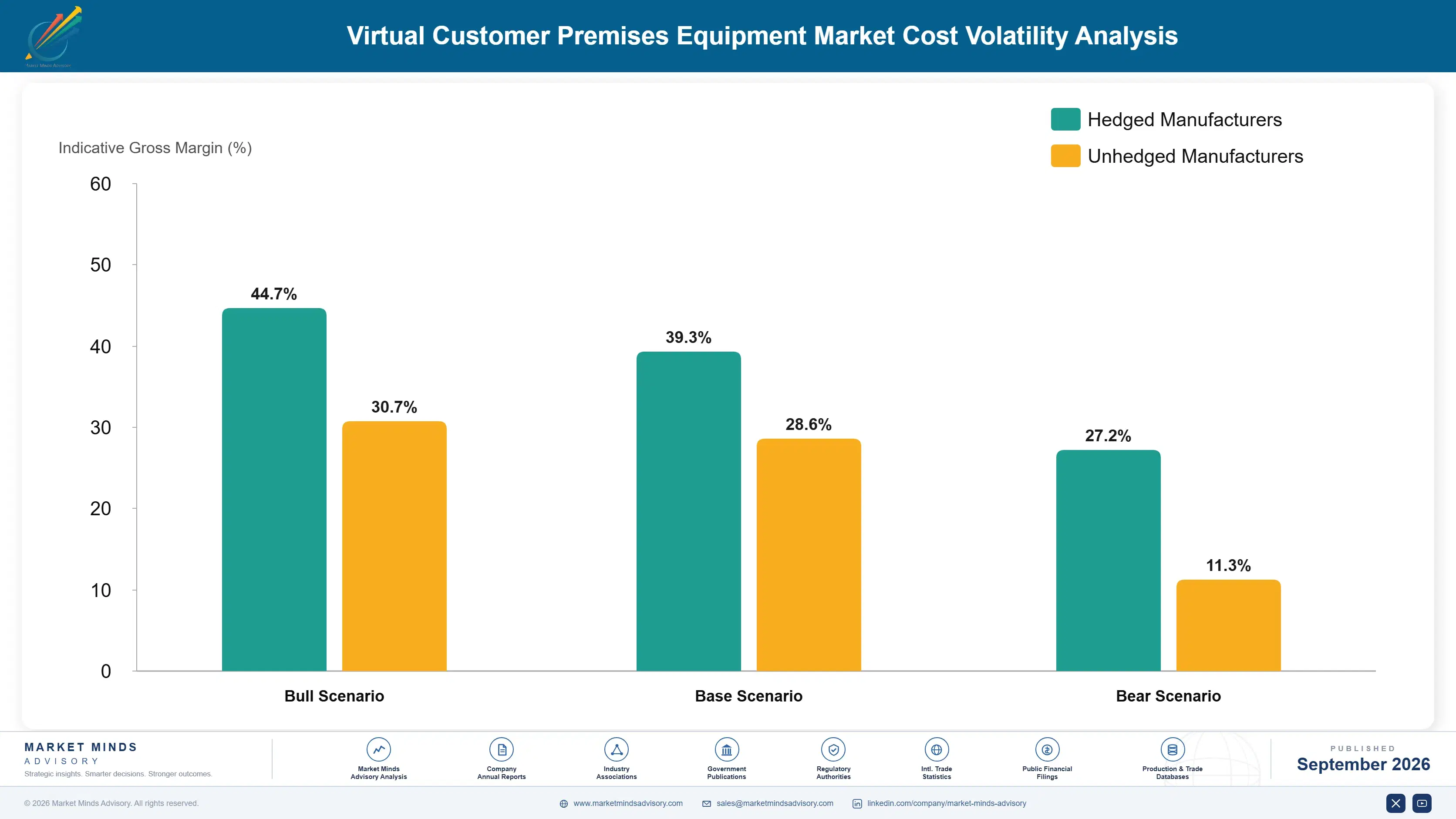
Orchestration Engineering Talent Cost Exposure

Software engineering talent and cloud computing infrastructure together represent roughly 54 percent of vendor cost of goods sold, sourced primarily from specialized networking software engineers based across North America and India, alongside semiconductor components for universal CPE hardware purchased from third-party chip manufacturers. Interoperability testing and certification labor adds further meaningful cost exposure for multi-vendor orchestration platforms.
Networking software engineering talent compensation spiked sharply during 2021 and 2022 as broader technology sector demand for specialized cloud-native developers competed for a constrained global talent pool simultaneously, according to industry compensation surveys published during that period. Several vendors reported compressed gross margins during that period as talent acquisition costs outpaced their ability to pass higher engineering costs through to carrier customers under existing multi-year fixed-price subscription agreements negotiated earlier.

Smaller vendors without dedicated interoperability testing teams face proportionally higher per-customer support costs than vertically integrated majors like Cisco and VMware, which amortize software development investment across a much larger carrier customer base and product portfolio. Vendors headquartered in regions with weaker currencies also face amplified dollar-denominated talent costs, widening the competitive cost gap against vendors with diversified global engineering footprints.
virtual-customer-premises-equipment-market-cost-volatility-analysis-1789980850935

Build Shared Orchestration Frameworks Across Products

Vendors increasingly build shared, reusable orchestration frameworks and testing infrastructure that serve multiple product lines simultaneously, reducing per-feature engineering cost by amortizing platform development investment across a broader product portfolio and customer base overall. This design shift lowers marginal cost for each additional network function support while accelerating time to market for new features.

Negotiate Multi-Year Cloud Compute Contracts

Locking multi-year cloud compute contracts at fixed or partially hedged pricing protects vendors against spot market volatility that has repeatedly compressed margins during recent development infrastructure demand spikes. This pricing certainty lets finance teams plan software development budgets several years ahead with materially reduced exposure to sudden compute price swings tied to broader industry demand.

Diversify Software Engineering Talent Sourcing

Sourcing networking software engineering talent from multiple regional talent pools rather than a single concentrated location reduces exposure to localized wage inflation or talent shortages tied to competing technology sector demand across major hiring markets. This diversification strategy adds modest coordination complexity but meaningfully reduces single-region dependency risk across the vendor's broader engineering talent base and pipeline.

Portfolio Architecture for Margin Defence

Vendor economics split into three tiers by orchestration sophistication and edge computing integration depth across most product categories offered today. Volume-tier standard universal CPE hardware and basic virtual network functions carry gross margins around 28 to 36 percent, while premium unified orchestration platforms reach 42 to 50 percent margins consistently. Cloud-native edge virtualization software commands the widest margin range given technical barriers protecting early movers from immediate competitive pressure.
Tension between volume and premium tiers centers on engineering resource allocation: vendors must decide how much edge orchestration investment to commit toward premium carrier 5G customers versus maintaining broad standard hardware product lines serving budget-constrained enterprise segments. Most large vendors now prioritize edge orchestration and software investment, accepting narrower standard hardware margins to secure future design-in position across upcoming 5G network modernization cycles.

High-value margin pools concentrate overwhelmingly in cloud-native edge virtualization software and unified orchestration platforms, where technical barriers protect early movers from immediate price competition across most carrier customer segments and network types. Standard universal CPE hardware increasingly commoditizes as more vendors, including regional manufacturers, achieve comparable baseline functionality, compressing margins toward the lower end of the volume tier band across most established global markets and network architectures.

Standard universal CPE hardware and basic virtual network functions serving budget-constrained enterprise segments, priced primarily on deployment volume and baseline connectivity rather than orchestration sophistication, edge computing depth, or platform maturity.
Gross Margin: 28-36%

Unified orchestration platforms meeting carrier 5G network requirements, commanding pricing power from certification barriers and platform integration depth competitors cannot easily replicate quickly across comparable customer segments, network architectures, and geographic markets.
Gross Margin: 42-50%

Cloud-native edge virtualization software addressing distributed 5G computing and latency requirements, where technical barriers and platform maturity drive the widest margin variance across vendors, deployments, customer segments, and network types today.
Gross Margin: 32-55%
virtual-customer-premises-equipment-market-portfolio-architecture-1789980851442

High-value Sub-segments and Strategic Watch-out

Cloud-Native Edge Virtualization Software

Growing fastest among all six segments as 5G rollout accelerates distributed edge computing demand, commanding premium pricing and durable technical barriers that protect early movers from immediate competitive price pressure across most segments, network types, customer categories, geographic markets, pricing tiers, and deployment models today.

Network Function Virtualization Orchestration Platforms

Carrier network modernization demand drives strong secondary growth here, though moderate near-term margin pressure reflects intensifying competition among vendors racing to standardize orchestration capability across next-generation network deployment architectures, customer categories, geographic markets, pricing models, support structures, licensing terms, renewal cycles, and contract types worldwide.

Universal CPE Hardware Platforms

The largest volume segment by unit count, providing steady baseline revenue at comparatively thin margins as commoditization intensifies with growing regional manufacturing capacity entering global supply chains and carrier procurement decisions consistently and predictably over multiple budget years, renewal cycles, planning periods, and contract terms.

Legacy Proprietary Hardware Appliances

A strategic watch-out segment facing sustained functional decline as cloud-native alternatives accelerate adoption, risking stranded manufacturing capacity for vendors slow to redirect engineering investment toward orchestration and virtualization categories instead of legacy hardware appliances entirely and permanently across most markets, network types, and customer segments.

Subscription Economics Anchor Carrier Renewal Revenue

Vendor relationships operate on annuity-like economics once a carrier deploys orchestration platforms across its network infrastructure, since replacing embedded virtualization software requires re-architecting network management workflows across every deployed branch and edge location simultaneously. A typical carrier contract generates recurring subscription and software update revenue across a five-to-seven-year network technology lifecycle, with new virtual network function modules extending the relationship well beyond initial platform deployment.
Adoption stickiness varies meaningfully by end-use vertical: large carrier customers show the deepest stickiness given regulatory certification documentation tied to specific certified orchestration software and network security standards. Smaller enterprise customers show comparatively higher churn as generic SD-WAN commoditizes faster across competing vendor platforms. Government and defense customers show extremely high stickiness tied to security clearance and procurement certification requirements that discourage frequent vendor switching.

Buyer profiles are shifting generationally as procurement authority moves from traditional network operations teams toward dedicated cloud architecture and DevOps engineers who prioritize orchestration automation and API accessibility over legacy hardware performance specifications alone. Younger network architects increasingly favor vendors offering transparent, well-documented orchestration APIs over vendors competing purely on hardware throughput benchmarks and historical installed base relationships.
virtual-customer-premises-equipment-market-end-use-penetration-index-1789980851931

vCPE Vendor Investment Priorities

These are among the four positions where our research anticipates prominent divergence between winners and laggards over the coming forecast period. Each is grounded in the demand model, the regulatory perimeter, and the announced capacity pipeline.
01 / EDGE ORCHESTRATION INVESTMENT

Accelerate edge orchestration development ahead of 5G rollout maturity

5G architecture fundamentally requires distributed edge computing capability that centralized network management approaches cannot deliver at required latency, and vendors offering mature edge orchestration capture disproportionate design wins among carriers deploying 5G infrastructure across most network segments and geographic regions today. Vendors that delay this investment risk losing carrier contracts entirely to competitors offering more accessible, better-tested edge orchestration alternatives within the next several network modernization cycles. Building this capability now protects future carrier relationships before broader industry adoption compresses pricing and competitive advantage.
02 / UNIFIED PLATFORM BUNDLING STRATEGY

Bundle SD-WAN and orchestration into single unified platforms

Enterprises increasingly demand unified vCPE platforms managing all virtualized network functions through a single administrative console rather than juggling separate vendor dashboards for SD-WAN, security, and orchestration capability across most deployment scenarios and organizational sizes. Vendors offering only standalone point solutions risk losing enterprise contracts to competitors capable of delivering comprehensive platform bundling through one qualified vendor relationship. Bundling captures incremental contract value while deepening customer dependency on a single trusted vendor relationship over multiple renewal cycles and network expansions.
03 / SECURITY CERTIFICATION AUTOMATION STRATEGY

Automate security certification documentation ahead of tightening carrier mandates

Network security certification requirements continue tightening across major regulated telecommunications markets simultaneously, and certification complexity is rising faster than most vendors' internal compliance teams can currently support adequately across most jurisdictions and network categories today. Vendors without automated compliance documentation generation increasingly lose carrier contracts to competitors offering pre-built regulatory mapping that reduces internal legal and security team burden considerably. Building this automation capability now captures regulated carrier customers before competitors establish comparable compliance-focused offerings across the same regulated telecommunications markets.
04 / MANAGED SERVICES EXPANSION STRATEGY

Expand managed orchestration services targeting smaller carrier customers

Smaller carriers increasingly lack the in-house network operations expertise required to operate sophisticated orchestration platforms effectively without dedicated vendor support and ongoing monitoring assistance across most deployment scenarios, network types, organizational structures, and staffing levels today. Vendors offering managed services capture materially higher-margin recurring revenue than pure platform licensing while deepening customer relationships that reduce competitive switching risk considerably. Expanding this capability now captures underserved smaller carrier segments before competitors establish comparable managed service offerings across the same customer base.

Engagement Snapshot From the Field

A live engagement with an industry participant carrying material or product regulatory and market exposure ahead of a defining policy shift, showing how our research translates into a defensible multi-year portfolio strategy.
MARKET MINDS ADVISORY · CLIENT ENGAGEMENT SUMMARY
Virtual Customer Premises Equipment Producer Strategic Portfolio Review and Transition Roadmap 2026·Investment Scenario on Virtual Customer Premises Equipment Exposure Evaluation 2025-26
CLIENT PROFILE
The client is a mid-tier regional telecommunications carrier serving several southeastern United States markets, generating annual revenue of approximately 420 million dollars (client-reported, unverified by MMA). The company operated legacy hardware-based CPE infrastructure across its enterprise customer base, facing rising maintenance costs as hardware appliances aged toward end of vendor support life and warranty coverage.
STRATEGIC CHALLENGE
Management needed to decide whether to replace aging hardware appliances with a single-vendor unified vCPE orchestration platform, pursue a best-of-breed approach combining separate SD-WAN and security virtualization tools from multiple vendors, or delay replacement while extending existing hardware support contracts through additional maintenance agreements, warranty extensions, and lengthy vendor negotiations.
MMA APPROACH
MMA conducted primary interviews with the client's network engineering and enterprise sales teams alongside benchmarking analysis of deployment cost and customer retention outcomes among comparable regional carriers pursuing unified versus best-of-breed vCPE approaches across North America over a seven-week engagement period covering multiple vendor options, configurations, and available pricing tiers.
KEY FINDINGS
  1. Extending existing hardware support contracts would have increased total maintenance cost substantially as vendor end-of-life support pricing continued rising each renewal cycle.
  2. A unified vCPE orchestration platform cut total enterprise customer deployment and management time by roughly 45 percent compared to the best-of-breed alternative considered.
  3. Best-of-breed sourcing offered marginally lower unit software costs but required substantially more internal integration engineering effort than the client's network team could justify.
  4. Enterprise customer feedback indicated strong preference for unified platform management over juggling multiple separate vendor dashboards across different network function categories and support teams.
CLIENT PROFILE
The client is a mid-tier regional telecommunications carrier serving several southeastern United States markets, generating annual revenue of approximately 420 million dollars (client-reported, unverified by MMA). The company operated legacy hardware-based CPE infrastructure across its enterprise customer base, facing rising maintenance costs as hardware appliances aged toward end of vendor support life and warranty coverage.
STRATEGIC CHALLENGE
Management needed to decide whether to replace aging hardware appliances with a single-vendor unified vCPE orchestration platform, pursue a best-of-breed approach combining separate SD-WAN and security virtualization tools from multiple vendors, or delay replacement while extending existing hardware support contracts through additional maintenance agreements, warranty extensions, and lengthy vendor negotiations.
MMA APPROACH
MMA conducted primary interviews with the client's network engineering and enterprise sales teams alongside benchmarking analysis of deployment cost and customer retention outcomes among comparable regional carriers pursuing unified versus best-of-breed vCPE approaches across North America over a seven-week engagement period covering multiple vendor options, configurations, and available pricing tiers.
KEY FINDINGS
  1. Extending existing hardware support contracts would have increased total maintenance cost substantially as vendor end-of-life support pricing continued rising each renewal cycle.
  2. A unified vCPE orchestration platform cut total enterprise customer deployment and management time by roughly 45 percent compared to the best-of-breed alternative considered.
  3. Best-of-breed sourcing offered marginally lower unit software costs but required substantially more internal integration engineering effort than the client's network team could justify.
  4. Enterprise customer feedback indicated strong preference for unified platform management over juggling multiple separate vendor dashboards across different network function categories and support teams.
RECOMMENDED STRATEGY
Phase 1: Phase one: deploy the unified vCPE platform across the highest-priority enterprise customer accounts within two quarters and phases entirely and quickly. Phase 2: Phase two: migrate remaining enterprise customers gradually as existing hardware support contracts approach their scheduled expiration dates and renewal windows. Phase 3: Phase three: expand managed orchestration services to smaller enterprise customers lacking dedicated internal network operations expertise, staffing, and budget resources.
OUTCOME
Within twelve months, the client reported deployment time improvements of roughly 45 percent and reduced enterprise customer churn tied to hardware support concerns and warranty expiration anxieties across the region (client-reported, unverified by MMA). The unified platform now anchors the client's ongoing network modernization strategy.

Frequently Asked Questions

Foundational context covering the market sizes, CAGR, scope, country, region and competition that inform every finding below. This section is provided to cover basics and most often pre-purchase conversations, answered from the MMA Primary Research Dataset.

What is the current size of the Virtual Customer Premises Equipment Market?

The Virtual Customer Premises Equipment Market reached 3.2 billion dollars in 2025, the base year for this report's forecast. Growth continues at a 14.2 percent compound annual rate through 2036, driven by 5G rollout and cloud-native edge virtualization adoption.

How large will the Virtual Customer Premises Equipment Market be by 2036?

The market is projected to reach 13.77 billion dollars by 2036, representing a 3.77 times expansion from its 2026 value. Cloud-native edge virtualization and orchestration platforms drive most of this incremental growth across nearly every covered region.

What is the CAGR for the Virtual Customer Premises Equipment Market 2026 to 2036?

The base case compound annual growth rate is 14.2 percent across the ten-year forecast window. Bull case scenarios reach 15.5 percent on faster 5G edge deployment, while bear case scenarios fall to 12.9 percent on capital expenditure slowdowns.

Which segment is growing fastest?

Cloud-Native Edge Virtualization Software grows fastest at a 19.4 percent compound annual rate, roughly 1.37 times the overall market average. Network Function Virtualization Orchestration Platforms follow as the second-fastest visible segment at 16.5 percent.

Who are the major companies in the Virtual Customer Premises Equipment Market?

Cisco, VMware, Juniper Networks, Nokia, and Ciena lead the field, together representing roughly 46 percent combined concentration. Fortinet and Palo Alto Networks also maintain meaningful competitive positions across several major regional markets.

Which country is growing fastest?

India leads country-level growth at a 17.0 percent compound annual rate, outpacing the broader South Asia and Pacific region overall. Expanding telecom subscriber base and network virtualization investment drive this acceleration across most major Indian carriers.

Report Segmentation Architecture

The full report scope spans multiple orthogonal segmentation dimensions, with cross-tabulated demand data provided for each dimension pair. Coverage extends further to regional breakdowns, trend trajectories, and the competitive detail needed to support segment-level decision-making.

By Primary Market Dimension

  • Universal CPE Hardware Platforms
  • Virtual Network Function Software
  • SD-WAN Virtualization Software
  • Network Function Virtualization Orchestration Platforms
  • Managed vCPE Services
  • Cloud-Native Edge Virtualization Software

By End-Use Industry

  • Telecommunications Carriers
  • Enterprise and Corporate Networks
  • Government and Defense
  • Financial Services and Banking

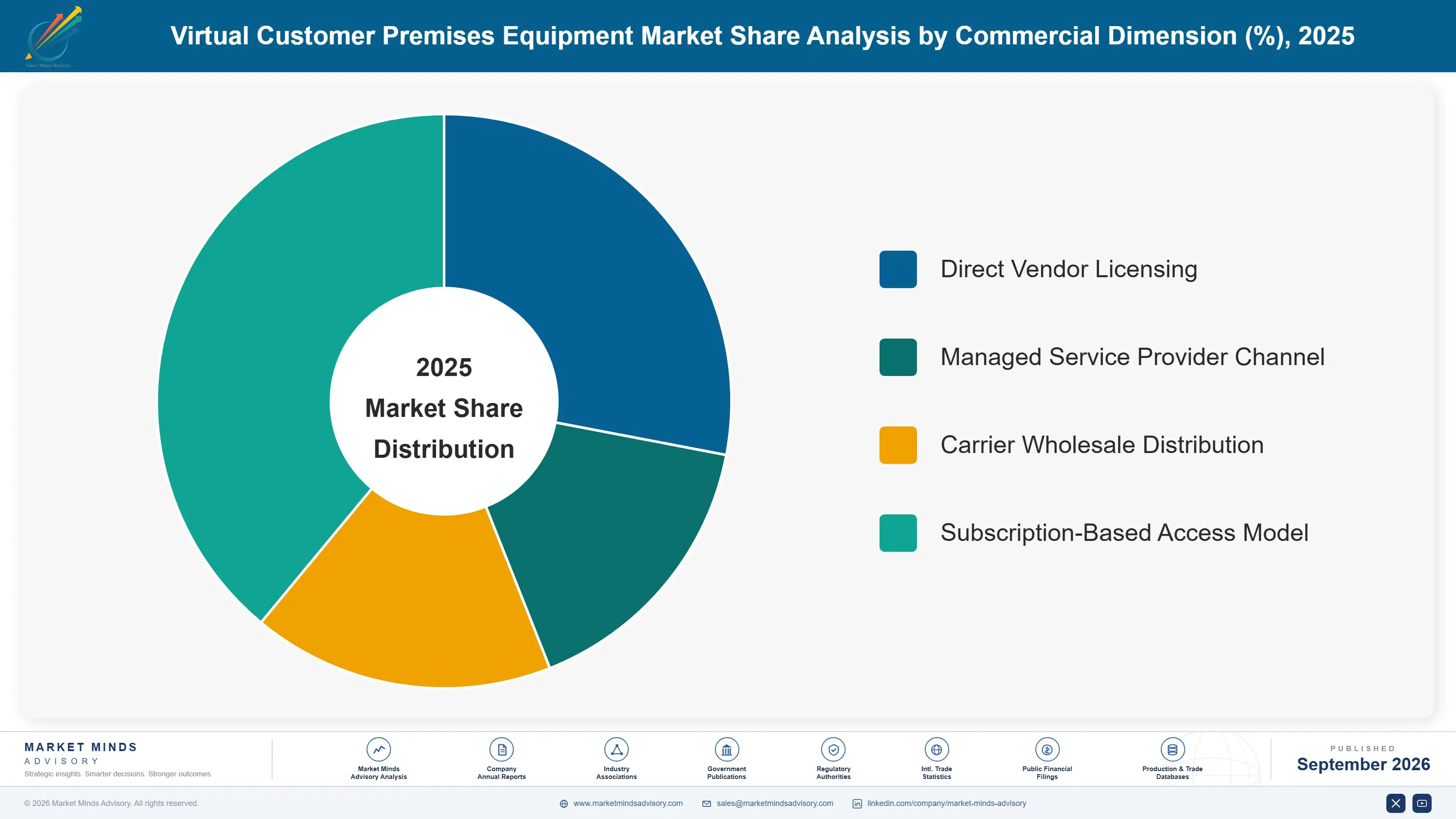
By Commercial Dimension

  • Direct Vendor Licensing
  • Managed Service Provider Channel
  • Carrier Wholesale Distribution
  • Subscription-Based Access Model

By Region

  • North America
  • East Asia
  • Western Europe
  • South Asia and Pacific
  • Latin America
  • Middle East and Africa
  • Eastern Europe

Scope, Methodology, and Coverage

Every figure in this report is reproducible from documented input assumptions. The scope below maps the historical period, the forecast horizon, the segmentation dimensions, and the countries covered, alongside the underlying primary and qualitative methodology.
Historical Period
2020 to 2025
Forecast Period
2026 to 2036
Base Year
2025 (USD billions; MMA Primary Research Dataset, September 2026)
Market Definition
The Virtual Customer Premises Equipment Market covers software and orchestration platforms that virtualize network functions traditionally delivered through dedicated hardware appliances at customer sites. It excludes physical routing and switching hardware sold independently of virtualization software and standalone cloud computing infrastructure services.
Quantitative Units
USD Billion
Segmentation Dimensions
Product Type, End-Use Industry, Commercial Dimension, Region
Regions Covered
North America, East Asia, Western Europe, South Asia and Pacific, Latin America, Middle East and Africa, Eastern Europe
Countries Covered
United States, China, India, Germany, United Kingdom, Japan, Brazil, and 30 additional countries
Key Companies Profiled
Cisco Systems Inc, VMware Inc, Juniper Networks Inc, Nokia Corporation, Ciena Corporation, Fortinet Inc, Palo Alto Networks Inc, ADVA Optical Networking SE, Casa Systems Inc, Netsia Inc, RAD Data Communications Ltd, Versa Networks Inc, Aryaka Networks Inc, Lanner Electronics Inc, Advantech Co Ltd, Radisys Corporation, Adtran Inc, DZS Inc, Netcracker Technology Corporation, Amdocs Limited
Quantitative Methodology
Primary survey, n=3,800 respondents, Q4 2025, six countries; demand-side model with trade association cross-validation
Qualitative Methodology
47 expert interviews, Q4 2025; applied to validate demand model assumptions, identify emerging dynamics, and assess competitive positioning
Report Format
PDF and XLSX data workbook (Word format preview document)
Publisher
Market Minds Advisory
Report Code
MMA-2026-TEC-217
Published
September 2026
Contact
sales@marketmindsadvisory.com | www.marketmindsadvisory.com

Purchase the full Virtual Customer Premises Equipment Market Report (2026 to 2036).

This report examines the global Virtual Customer Premises Equipment Market across product type, end-use industry, and commercial dimension through 2036. It quantifies 5G edge orchestration adoption, unified platform bundling, and security certification services as primary mechanisms shaping vendor strategy and margin capture. Coverage spans competitive positioning among five leading vendors and fifteen additional challengers across seven world regions, with detailed input cost and portfolio analysis included. The analysis draws on primary survey data spanning 3,800 respondents and 47 expert interviews conducted across six countries in the fourth quarter of 2025.
Full regional breakdown across all seven markets
Ten-year forecast scenarios with bull and bear cases
Detailed competitive profiles of twenty major vendors
Segment-level growth rates and margin economics analysis
Input cost exposure and mitigation strategy analysis
Anonymized client case study with strategic recommendations

Built For The People Who Decide

From boardroom strategy to bench-side execution, this report is read cover-to-cover by leaders shaping the next decade of their industry, turning demand scenarios, market dynamics and valuation benchmarks into decisions.
CXOs/ Presidents/ VPs/ Managers
M&A and Corporate Development
Strategy Teams and R&D Heads
Procurement and Product Directors
Regulatory and Compliance Leaders
Investor Relations and Equity Analysts