Market Minds Advisory
Virology Specimen Collection Market

Virology Specimen Collection Market: Stockpile Economics, Transport Media That Decide Results and a Government Customer

Roughly 18% of the preparedness stockpile is discarded unused every year, which means a meaningful share of this entire market is bought specifically in order to be thrown away later.

Lead Analyst

Alice Ballenger

Published

September 2026

Make Smarter Decisions with Customized Research Insights

Request a free sample report and evaluate market opportunities, growth trends, and competitive dynamics relevant to your business needs.

2025 MARKET VALUE$2.6BMarket Size 2025
2036 FORECAST VALUE$5.4BBase Case , 2026 to 2036
CAGR 2026 TO 20366.8 %Bull 8.0% / Bear 5.6%
INCREMENTAL OPPORTUNITY$2.6BNet 10- year value creation
EXPANSION MULTIPLE1.93x2036 value over 2026 base
Strategic Levers
M&A Pipeline
Regional Outlook
Country Rankings
Competitive Intelligence
Segmental Deep-dive
Call-Us : 91 93563 13602

Executive Snapshot and Market Trajectory

The pandemic taught this industry a lesson that proved to be wrong. Demand rose roughly twentyfold, manufacturers built capacity to match it, and the market then collapsed back to something close to its former size. Much of that capacity was written off. Facilities across several countries were abandoned entirely.
What survived was not the plant but the standing order. Public health agencies across most developed countries now hold preparedness stockpiles with rotation obligations, so roughly 46% of volume moves through government procurement rather than laboratory purchasing, and around 18% of stockpiled consumables expire unused each year. A meaningful share of this market is bought in order to be discarded. Nobody says that out loud.
The swab was the part everyone photographed and the transport medium is the part that decides results. A specimen collected perfectly and carried in a medium that lets the virus degrade produces a false negative. Inactivating molecular media grow fastest at 10.2%, half again the market rate of 6.8%, because they let a sample travel on a motorbike at 35 degrees without refrigeration. That is a logistics achievement rather than an analytical one.
Market Definition
Devices and media used to collect, stabilise and transport viral specimens for diagnostic testing, covering flocked and foam swabs, viral transport media, inactivating molecular transport media, saliva and self collection devices, dried specimen collection cards, and specimen transport and triple packaging systems. Measured at manufacturer selling value. Diagnostic assays and reagents, blood collection tubes for clinical chemistry, laboratory instruments and personal protective equipment are excluded.
Base Year Value
$2.6B in 2025 (MMA Primary Research Dataset, August 2026)
Forecast Period
2026 to 2036, eleven discrete annual values
CAGR
6.8% base case. Bull 8.0%. Bear 5.6%.
Fastest Growth Segment
Inactivating Molecular Transport Media: 10.2% CAGR
Fastest Growth Country
India: 12.4% CAGR
Fastest Growth Region
South Asia and Pacific: 9.0% CAGR
Largest Region
North America: 30% of 2025 global value
Market Leaders
Copan Diagnostics, Becton Dickinson, Thermo Fisher Scientific, Puritan Medical Products, Sarstedt. Source: MMA Primary Research Dataset, July 2026.
Primary Survey
n=3,800 procurement and R&D decision-makers, Q4 2025, six countries
Methodology
Demand-side build-up, cross-validated against public data, 47 expert interviews

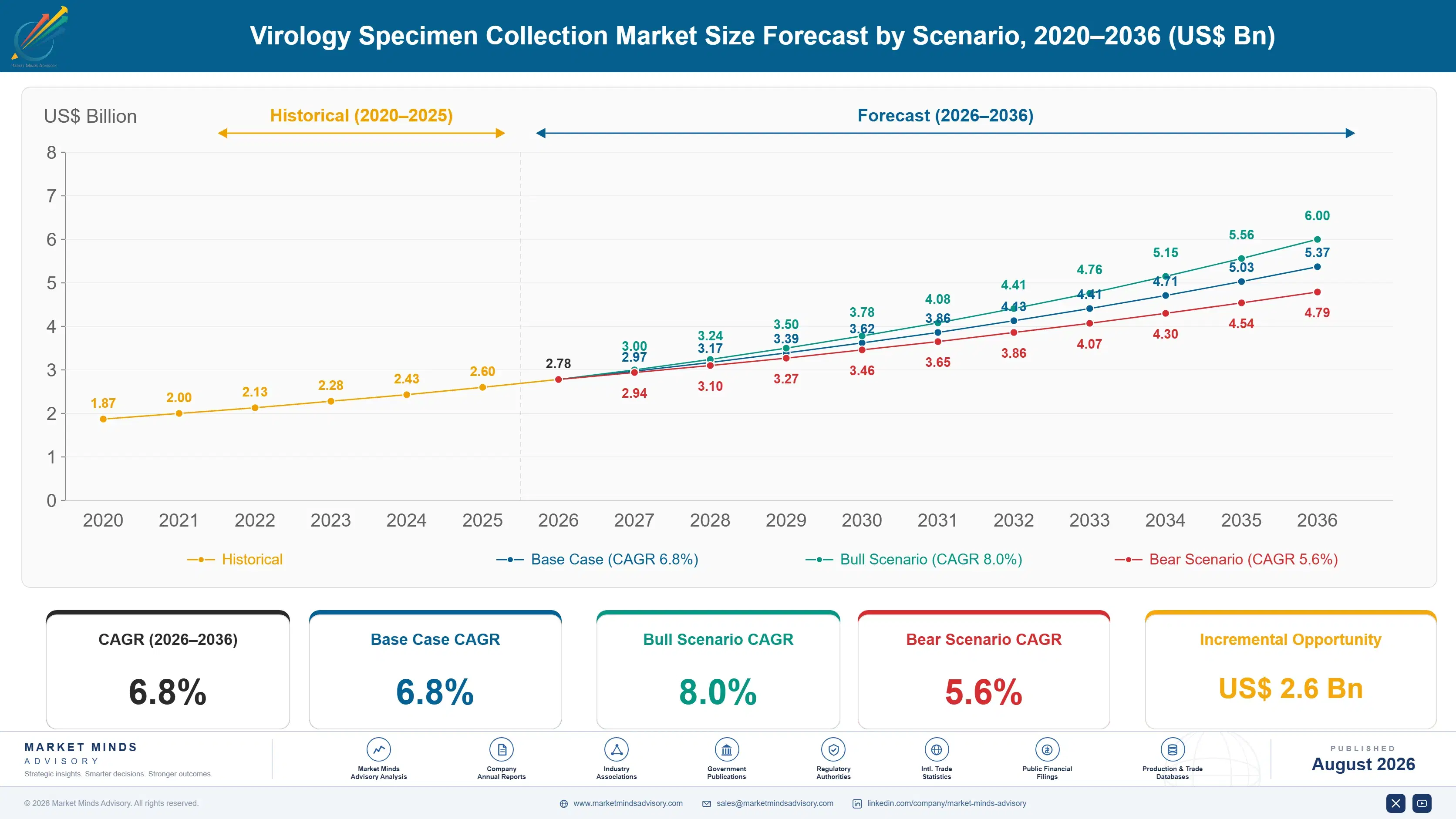
Virology Specimen Collection Market Forecast Scenarios

virology-specimen-collection-market-size-forecast-scenario-1787641643957
The five years to 2025 contained a spike and a reckoning inside a single period. Collection consumable demand rose roughly twentyfold through 2020 and 2021, manufacturers and new entrants built capacity against forecasts that assumed permanence, and volumes then fell back sharply as testing normalised. Written down assets and closed lines followed. The 5.6% historical rate averages an event and its aftermath, describing neither.
The 6.8% base case rests on three mechanisms. Preparedness stockpiling has become permanent policy in most developed countries, generating rotation demand where roughly 18% of inventory expires unused each year regardless of whether anything happens. Inactivating molecular media keep displacing conventional viral transport by removing cold chain and biosafety handling requirements together. And public health laboratory networks keep expanding across South Asia and Africa, with India growing faster than any market covered.
The 8.0% bull case turns on respiratory syndromic surveillance becoming routine rather than seasonal, which would convert episodic testing into continuous sample flow. The 5.6% bear case is stockpile fatigue: preparedness budgets compete against present day health spending, and a government several years from the last emergency finds rotation costs increasingly difficult to defend. Rotation costs become steadily harder to defend.

Buying Consumables in Order to Discard Them

This industry built capacity against a demand curve that did not survive. Collection consumable volumes reached roughly twenty times baseline during the pandemic, entrants arrived with new lines, and the market then returned to something close to its former size plus a modest permanent increment. Written off equipment across several countries is what remains of that investment thesis.
TOP FIVE CONCENTRATION52%Combined unit volume supplied by the largest manufacturers
STOCKPILE EXPIRY RATE18%Preparedness stockpile inventory discarded unused every single year
PUBLIC PROCUREMENT SHARE46%Volume moving through government rather than laboratory purchasing
COLD CHAIN FREE SHARE37%Samples transported without any refrigeration requirement being attached
UNIT PRICE PER COLLECTIONUSD 1.40Typical cost of one complete collection device set
PEAK DEMAND MULTIPLE20xPandemic volume relative to the current baseline demand
The permanent change was a customer rather than a volume. Roughly 46% of demand now moves through public health preparedness procurement rather than routine laboratory purchasing, with stockpile contracts specifying quantities, shelf life and rotation schedules. Around 18% of that inventory expires unused annually and is replaced, which means a substantial part of this market exists to be discarded. Nobody in the industry describes it that way in public.
Attention still concentrates on the wrong component. A swab collects material and a transport medium determines whether the virus survives long enough to be detected, so a formulation that degrades a sample produces a false negative indistinguishable from an absent infection. Inactivating media that kill the pathogen while preserving nucleic acid remove refrigeration and biosafety handling at once, and roughly 37% of samples now travel without cold chain.
"Everybody remembers the swab shortage and almost nobody remembers that half the samples in some programmes were arriving in media nobody had validated for the conditions they travelled through. The swab was never the hard part."
Director, Diagnostics Consumables and Public Health Supply Practice · MMA Medical Devices and Diagnostics Practice · August 2026

Market Trends

Inactivating Media Remove Cold Chain and Biosafety Together

Conventional viral transport media keep a virus alive so it can be cultured, which requires refrigeration in transit and handling precautions in the laboratory because the sample remains infectious. Inactivating molecular media kill the pathogen while stabilising nucleic acid for amplification, removing both requirements at once. Growth runs at 10.2% against a market rate of 6.8%, fastest in the market, and roughly 37% of samples now travel with no refrigeration at all. The advantage is logistical rather than analytical, which matters enormously where a sample reaches a laboratory on a motorbike in tropical heat.
Market Impact: India grows at 12.4% annually
Preparedness Stockpiles Create Demand Independent of Disease

Public health agencies across most developed countries now hold collection consumable stockpiles under rotation obligations, generating demand that continues whether or not anything is circulating. Roughly 18% of stockpiled inventory expires unused each year and gets replaced, and 46% of total market volume now moves through public procurement rather than laboratory purchasing. The demand is unusually predictable and entirely policy dependent, which makes it both attractive and fragile. Suppliers holding framework agreements with agencies enjoy visibility that laboratory customers have never provided anywhere. Visibility is unusually good and entirely policy dependent.
Market Impact: Self collection grows 8.8% yearly

Market Opportunities and Growth Drivers

Public Laboratory Networks Expand Across Asia and Africa

National public health laboratory networks continue expanding across South Asia and Africa, funded partly domestically and partly through international health security programmes established after the pandemic exposed how little surveillance capacity existed. India grows at 12.4%, faster than any market covered, as state laboratories gain molecular capability that previously sat only in a handful of national institutes. Each new site consumes collection consumables continuously rather than episodically. Inactivating media suit these networks particularly well, since cold chain across those distances is unreliable and frequently absent. Positions taken while equipping rarely get disturbed.
Market Impact: Rotation discards 18% unused

Self Collection Shifts Sampling Out of Clinical Settings

Saliva devices and self administered nasal swabs move specimen collection away from a clinician entirely, which removes appointment capacity as a constraint on testing volume and removes exposure risk from the collection process. Growth of 8.8% is second fastest in the market, driven by sexual health, respiratory surveillance and workplace screening programmes where attendance is the practical barrier rather than willingness. Sample quality concerns that dominated early discussion have largely been answered by validation data. Postal return systems make the logistics work, provided the medium tolerates ambient transit. Postal return works where media tolerate ambient transit.
Market Impact: Peak reached 20 times baseline

Market Restraints and Challenges

Stockpile Budgets Compete Against Present Day Spending

Preparedness stockpiles generate roughly 46% of market volume and every rotation cycle discards around 18% of inventory unused, which is an expenditure a health ministry must defend against services treating patients today. The root cause is that preparedness spending buys an option nobody wants to exercise, and its value is invisible until the moment it is not. Commercially this makes a large share of demand politically contingent. Suppliers respond with extended shelf life formulations, vendor managed inventory and rotation into routine clinical use, all of which reduce visible waste. Visible waste is the political problem.
Market Impact: Frees 37% of samples entirely

Capacity Written Off Once Will Not Be Rebuilt Quickly

Demand reached roughly twenty times baseline during the pandemic and manufacturers who expanded to meet it wrote off much of that capacity when volumes normalised, which makes anybody reluctant to invest against the next surge. The root cause is that surge demand is genuinely unforecastable and the downside of building for it is now well documented across several company reports. Commercially this means the next emergency will find capacity short again. Responses include reserved capacity agreements funded by governments, which transfer the risk to whoever benefits from readiness. Nobody wants to repeat the write off.
Market Impact: Rotation replaces 18% annually
3 additional market trends, 4 additional growth drivers, and 2 additional restraints and challenges are covered in the full report. Contact sales@marketmindsadvisory.com to access the complete intelligence.

Segment CAGR and Growth Architecture

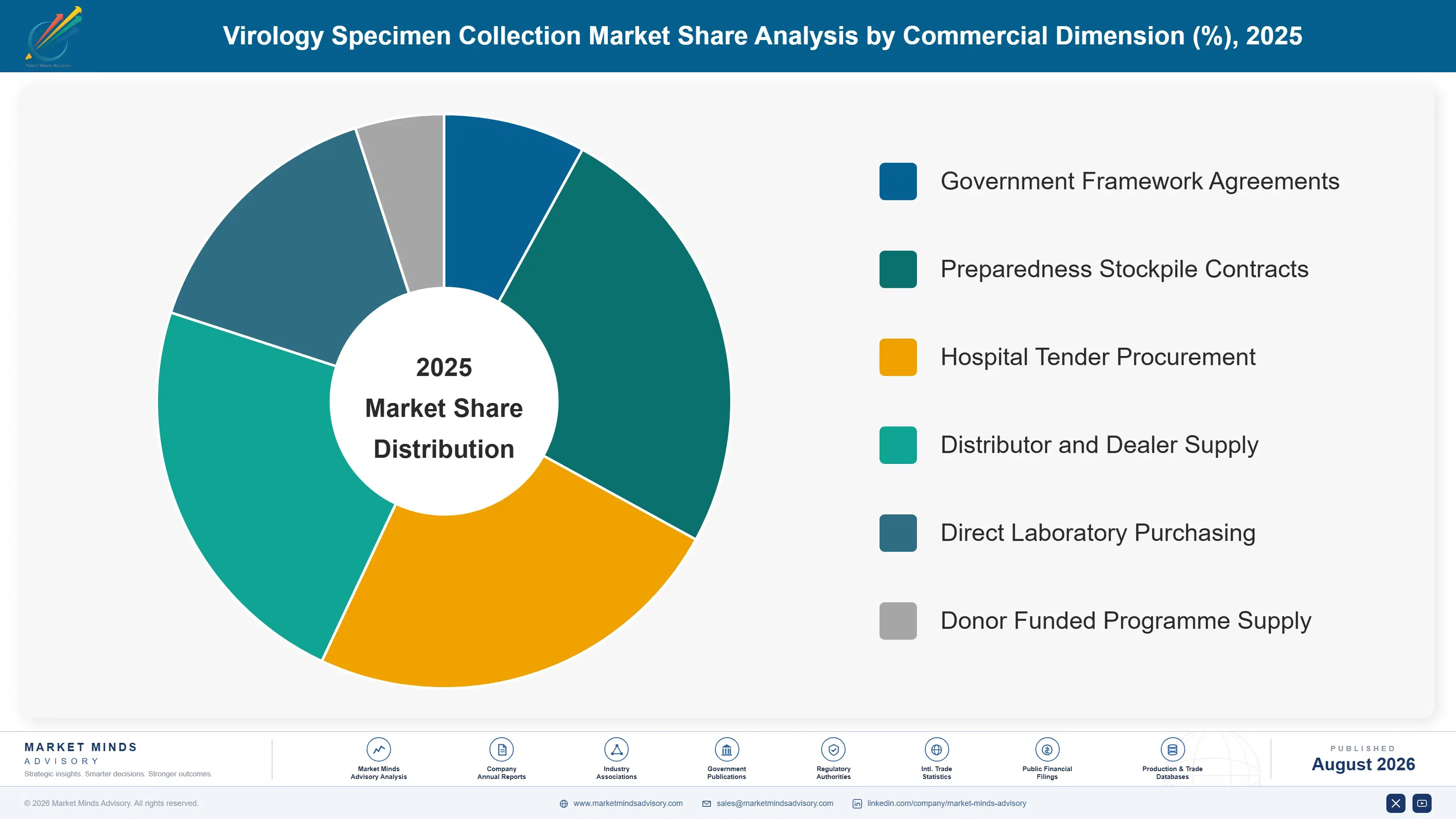
Segmentation follows collection product type, since type determines whether a sample survives transit, who collects it and how it is purchased. Six product types cover the field, from a flocked swab to a triple packaging system for shipment. Growth follows transport conditions and collection setting rather than any analytical improvement. Detection chemistry decides very little.
virology-specimen-collection-market-market-share-analysis-1787641644511

Inactivating Molecular Transport Media

Formulations that lyse the pathogen on contact while stabilising nucleic acid for amplification, removing infectivity and the refrigeration requirement at the same time. At 10.2% this is the fastest growing product type in the market, half again the market rate of 6.8%, and the advantage is logistical rather than analytical. Roughly 37% of samples now travel without cold chain, which matters most where transport takes hours through tropical heat on unrefrigerated vehicles. The trade is that the sample cannot be cultured afterwards, so laboratories needing viral isolation for characterisation or sequencing still require conventional media alongside. Most surveillance programmes have accepted that split deliberately. Reference sites keep conventional media alongside for characterisation work.
CAGR 10.2%

Saliva and Self Collection Devices

Saliva collection tubes, self administered nasal swabs and postal return kits that remove a clinician from the sampling process entirely. Growth of 8.8% is second fastest in the market, driven by programmes where attendance rather than willingness limits testing volume, including sexual health screening, respiratory surveillance and workplace programmes. Sample quality concerns that dominated early discussion have been largely settled by validation studies, though collection technique variability remains higher than clinician sampling. The logistics only work where the medium tolerates ambient postal transit for several days, which is why self collection and inactivating chemistry developed together rather than separately. Collection technique variability remains higher than clinician sampling produces. Postal transit is the practical constraint.
CAGR 8.8%
Full segment breakdown across 6 segments available in the complete report.

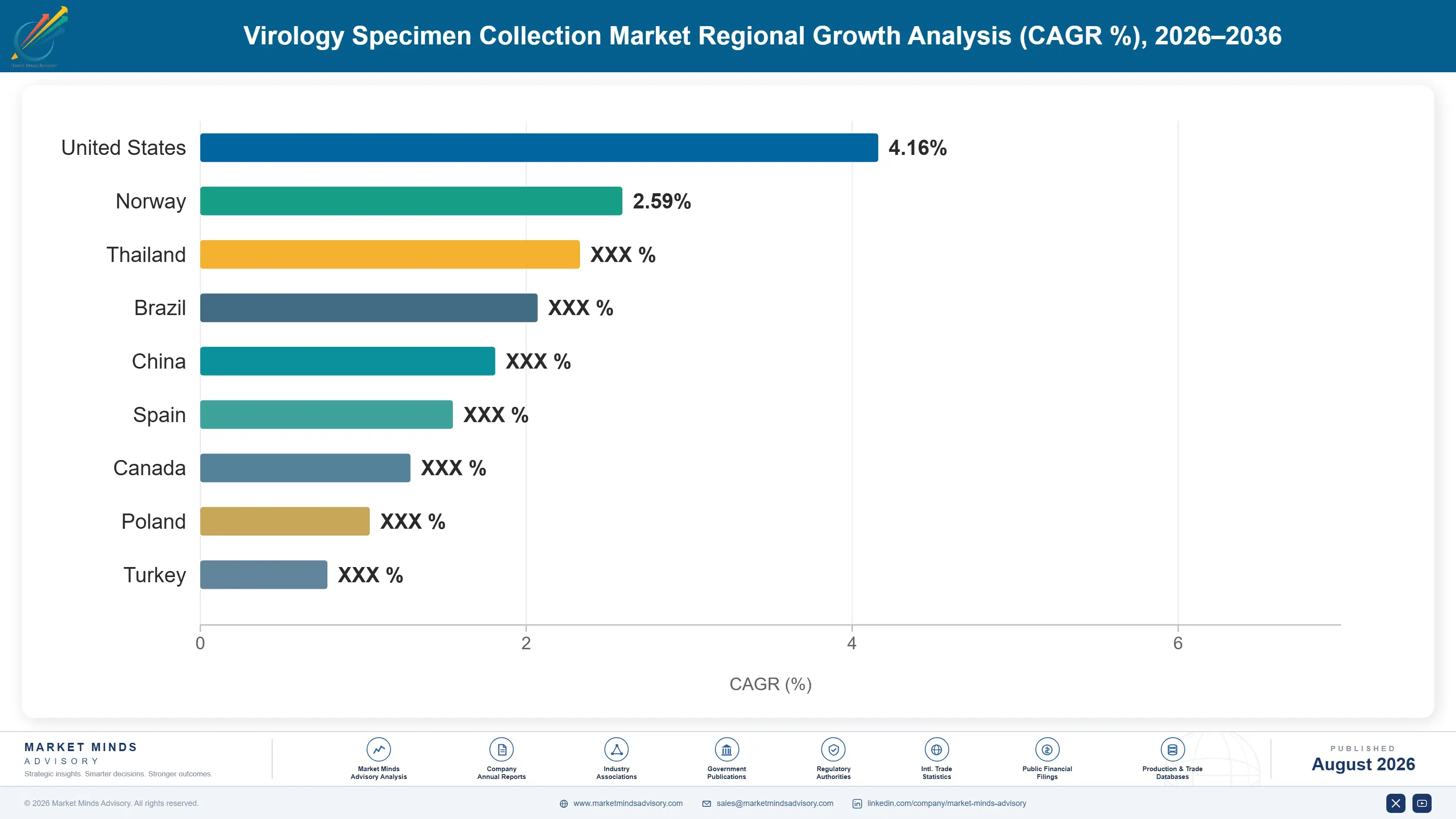
Regional Architecture and Country Demand Map

North America holds the largest share at 30%, on preparedness stockpiling and testing intensity no other region matches. Western Europe and East Asia follow closely at 23% each. India grows fastest of any market covered at 12.4% on laboratory network expansion. Stockpile policy shapes half of it.

North America

Preparedness policy and testing intensity together explain this 30% share. American federal and state stockpiling programmes hold collection consumables under rotation obligations at a scale no other country approaches, and those contracts generate demand independent of what is circulating in any given year. Domestic manufacturing capability became a procurement criterion after supply failures during the pandemic, which favours American producers regardless of price comparison. Routine laboratory testing volumes are also higher per capita than elsewhere, supported by reimbursement that funds respiratory panels readily. Growth of 6.2% reflects stable clinical volume alongside stockpile rotation that continues whether or not anything is happening. Domestic manufacturing became a scored procurement criterion after earlier supply failures.
Share: 30% | CAGR: 6.2% (2026 to 2036)

Western Europe

Public health system procurement shapes this 23% share considerably. National agencies across Britain, Germany, France and the Nordic countries maintain preparedness inventories, though at smaller scale than American programmes and with more visible political scrutiny of what expires unused. Central procurement produces large tenders decided on price, supply security and increasingly European manufacturing presence following pandemic supply disruption. Routine testing volumes are lower per capita than North America because reimbursement is tighter and respiratory panel use more restricted. Growth of 5.2% is the lowest of the seven regions, reflecting mature testing programmes and stockpile budgets under continuous pressure. Expiry waste attracts considerably more political scrutiny here than elsewhere. Tenders reward European manufacturing presence.
Share: 23% | CAGR: 5.2% (2026 to 2036)
Regional intelligence for 5 additional markets available in the complete report: East Asia, South Asia and Pacific, Latin America, Middle East and Africa, Eastern Europe. Contact sales@marketmindsadvisory.com.
virology-specimen-collection-market-country-cagr-analysis-1787641645061

Where This Market Actually Earns

Nothing here is won on swab design, which is mature and widely copied. Value accrues to whoever holds a government framework agreement, whoever solves transport conditions rather than analytical performance, and whoever can supply from within a customer's own borders. Four routes carry weight, and only one concerns what the product does to a sample.

Hold Framework Agreements With Public Health Agencies

Roughly 46% of volume moves through public procurement rather than laboratory purchasing, and stockpile contracts specify quantities, shelf life and rotation schedules years in advance. That demand is unusually predictable and continues whether or not anything is circulating, since around 18% of inventory expires unused annually and is replaced regardless. Suppliers holding framework agreements have visibility no laboratory customer has ever provided. Winning those agreements turns on supply security, shelf life and domestic manufacturing presence rather than on any clinical performance argument at all. Laboratory customers never provided that visibility.
Market Impact: Secures the 46% now moving through government procurement

Solve the Transport Condition, Not the Assay

A specimen collected perfectly and carried in a medium that degrades it produces a false negative indistinguishable from an absent infection, and transport conditions vary enormously between a hospital corridor and a motorbike in tropical heat. Inactivating molecular media grow at 10.2% against a market rate of 6.8% because they remove refrigeration and biosafety handling at once, and roughly 37% of samples now travel with no cold chain. That is a logistics achievement rather than an analytical one, and it decides more test results than any detection chemistry does. Nobody photographs the medium.
Market Impact: Frees 37% of samples from cold chain entirely

Manufacture Inside the Customer's Own Borders

Supply failures during the pandemic made domestic manufacturing capability a procurement criterion rather than a preference, and public health agencies now weight local production heavily in stockpile tenders regardless of unit price comparison. That is a durable advantage available to any supplier willing to place capacity where the contracts are, and it cannot be answered by importing at a lower cost. Unit price near 1.40 dollars leaves little room for freight anyway. Suppliers without local presence are competing on a dimension the tender has already decided against them. Capital rather than cleverness answers it.
Market Impact: Answers tenders covering 46% of all market volume

Follow Laboratory Network Building Into New Geographies

Public health laboratory networks continue expanding across South Asia and Africa, funded domestically and through international health security programmes, and each new site consumes collection consumables continuously rather than during outbreaks. India grows at 12.4%, faster than any market covered, as state laboratories gain molecular capability. Ambient stable media matter more here than anywhere, since cold chain is unreliable or absent entirely across the distances involved. Suppliers present when networks are being equipped hold positions that later tenders rarely disturb. Later tenders rarely disturb an equipped network. Presence during equipping is what matters.
Market Impact: Captures the 12.4% Indian national market growth rate

Who Controls the Margin Pool

Concentration is moderate and the composition changed permanently during the pandemic. The top five supply 52% of unit volume, the basis applied consistently here, after several entrants arrived during the surge and most departed when volumes normalised. Copan leads on flocked swab and transport media systems with validation depth built over decades, and the distance to challengers reflects that evidence base rather than manufacturing scale.
Competition runs on three fronts. Established manufacturers compete for public health framework agreements on supply security, shelf life and domestic production presence rather than on analytical performance. Chinese producers compete on price for volume where no local content requirement applies, at costs Western manufacturers cannot approach. Molecular media specialists compete on formulation performance under real transport conditions, which is a narrower and more technical contest.

Rankings will move with procurement policy rather than with product development, since domestic manufacturing requirements can reallocate a national tender in a single cycle. Several suppliers have placed capacity accordingly. The other pressure point is stockpile budget pressure, which threatens the most predictable revenue in this market and is entirely outside any supplier's influence to protect.
virology-specimen-collection-market-company-positioning-matrix-1787641645579

Competitive Moat and Risk Dimensions

COPAN DIAGNOSTICS

Moat: Validation Evidence Depth

Decades of published validation across pathogens, sample types and transport conditions give laboratories confidence that a collection system performs as claimed, which matters enormously when a false negative is indistinguishable from an absent infection. That evidence base cannot be assembled quickly and is referenced directly in procurement specifications across many national programmes.
COPAN DIAGNOSTICS

Risk: Price Competition From Volume

Chinese manufacturers supply swabs and transport media at costs no European producer can approach, and where a tender applies no local content requirement price decides the outcome. At a unit price near 1.40 dollars, validation depth commands a premium only where the buyer is technically sophisticated enough to value it properly.
BECTON DICKINSON

Moat: Integrated Laboratory Position

Presence across collection devices, laboratory instruments and diagnostic systems means a customer buys a workflow rather than a consumable, and specimen collection sits inside a relationship covering far more than swabs. That breadth also supports national tenders spanning multiple product categories where a single supplier arrangement is administratively simpler.
BECTON DICKINSON

Risk: Surge Capacity Reluctance

Capacity built during the pandemic was largely written off when volumes normalised, and no manufacturer wants to repeat that experience against demand nobody can forecast. That reluctance is rational and leaves the next emergency short of supply, which governments are beginning to address through reserved capacity agreements the industry has not yet standardised.

Players Tracked

Prominent Players

Copan Diagnostics
Becton Dickinson
Thermo Fisher Scientific
Puritan Medical Products
Sarstedt

Other Key Players

DNA Genotek
Longhorn Vaccines and Diagnostics
Hardy Diagnostics
Medical Wire and Equipment
Trinity Biotech
Micronic
Greiner Bio-One
Deltalab
Jiangsu Rongye Technology
Miraclean Technology
Zhejiang Gongdong Medical
Yocon Biology
Alpha Laboratories
Zeptometrix
Improve Medical

Recent Developments

FEBRUARY 2025

National agency renews stockpile contract with rotation obligations

A national public health agency renewed multi year framework agreements for collection consumable stockpiles, specifying quantities, shelf life and rotation schedules that generate demand independent of circulating disease. Roughly a fifth of held inventory expires unused each cycle and is replaced under the same arrangement regardless of any outbreak.
Signal: Stockpile rotation produces the most predictable demand in this market and the most politically fragile one
MAY 2025

Supplier places manufacturing capacity inside key procurement market

A collection consumable manufacturer established production capacity within a major national market, responding to procurement criteria that weight domestic manufacturing heavily after pandemic supply failures. Unit prices near a dollar and a half leave little room for freight, which makes local production commercially sensible as well as politically necessary.
Signal: Domestic manufacturing became a procurement criterion that importing at a far lower cost simply cannot answer
SEPTEMBER 2025

Surveillance programme standardises on ambient stable transport media

A regional public health surveillance programme standardised on inactivating molecular transport media across its laboratory network, removing cold chain requirements for sample transport in conditions where refrigeration was unreliable or unavailable entirely. Culture capability was retained separately at reference sites for characterisation work. The split was deliberate.
Signal: Programmes are now splitting collection deliberately, using ambient media for detection and culture media for characterisation

What a Collection Device Costs

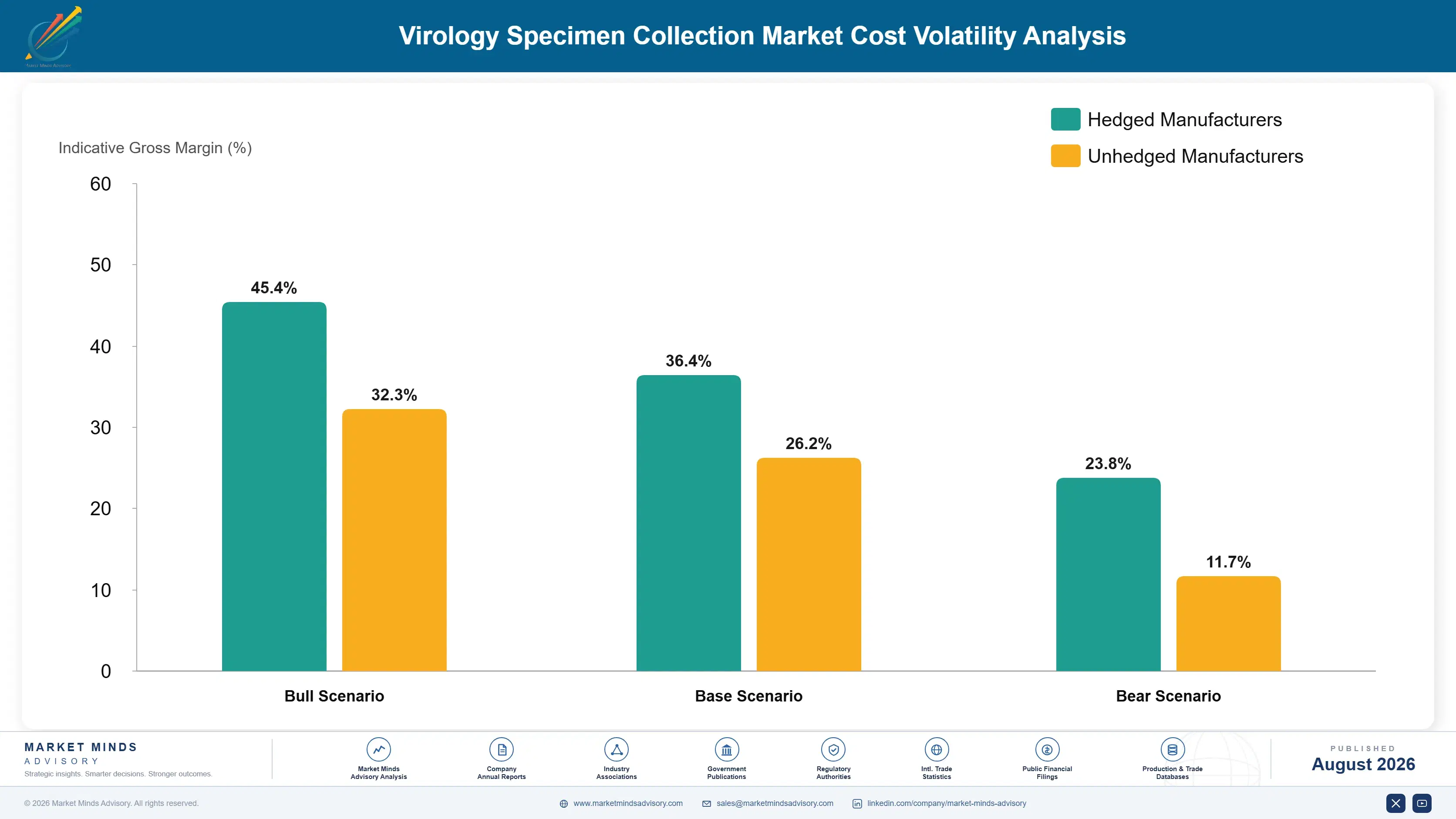
Component and formulation cost sit close to the surface on a product selling near 1.40 dollars. Medical grade polymers for swab shafts and tubes account for roughly 29% of cost of goods, flocking fibre and adhesives a further 14%, and transport media chemistry including buffers, guanidinium salts and stabilisers around 22%. Guanidinium and several stabilisers come from few chemical suppliers in Europe, China and India.
Guanidinium thiocyanate supply became the constraint that mattered during the pandemic, since it appears in both transport media and extraction chemistry and demand rose across every application simultaneously. Prices moved sharply and allocation determined who could produce at all. Company annual reports across the diagnostics sector documented the disruption. Polymer and sterilisation costs moved separately, tracking petrochemical feedstock and ethylene oxide capacity constraints. Allocation rather than price decided who could produce at all.

Exposure divides by formulation dependence rather than by company size. A manufacturer producing inactivating media carries concentrated guanidinium exposure on its fastest growing line, while conventional media use simpler chemistry. Swab only producers carry polymer and sterilisation risk that is volatile but widely sourced. At 1.40 dollars a unit none of this passes through quickly under a multi year framework.
virology-specimen-collection-market-cost-volatility-analysis-1787641645775

Qualify multiple guanidinium and stabiliser sources

Guanidinium salts appear in both transport media and extraction chemistry, so demand rises across every application at once during an event and allocation rather than price decides who produces. Qualifying alternative suppliers requires formulation validation across pathogens and storage conditions, which nobody undertakes while supply is comfortable. Manufacturers holding alternatives kept producing through the last disruption while competitors could not.

Index government framework agreements to input benchmarks

Multi year stockpile contracts fix pricing on a product selling near a dollar and a half, which leaves a manufacturer absorbing chemistry and polymer movement across the whole term. Indexation clauses are unusual in public procurement and worth pursuing, since the alternative is a contingency that makes the bid harder to win. Public buyers rarely offer indexation unprompted.

Extend shelf life to reduce rotation waste and cost

Roughly 18% of stockpile inventory expires unused each year, which is a cost the customer sees clearly and dislikes intensely. Longer shelf life formulations reduce rotation frequency and make preparedness spending easier for a ministry to defend. That is a customer problem rather than a supplier one, which makes solving it commercially valuable. It is a customer problem worth solving.

Portfolio Architecture for Margin Defence

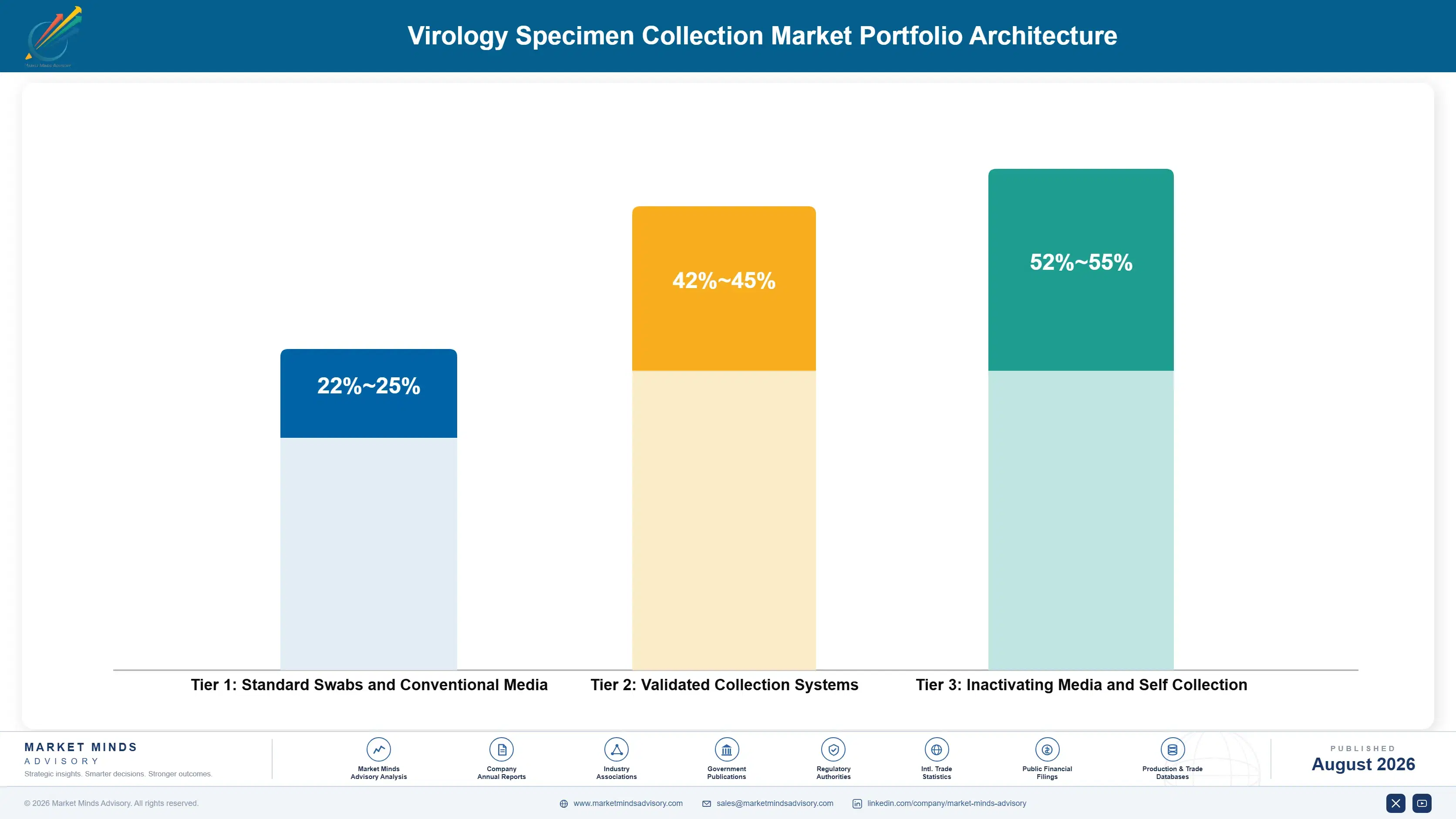
Margin architecture follows formulation difficulty rather than device complexity. Plain swabs are commodity products made by many manufacturers and priced accordingly, with Chinese producers setting the floor. Conventional transport media earn modestly on straightforward chemistry. Inactivating molecular media and validated self collection systems earn best, because formulation performance under real transport conditions is genuinely difficult to reproduce and buyers who understand that will pay for it.
The tension is between the customer who buys most and the customer who values most. Public health procurement takes roughly 46% of volume and decides on price, supply security and domestic manufacturing rather than on formulation performance. Sophisticated laboratory customers value validation depth and pay for it, at a fraction of the volume. A portfolio built for tenders earns thin margins on large contracts and one built for laboratories misses most of the market.

High value pools concentrate in inactivating media and validated self collection systems, both of which solve a transport or access problem rather than a detection one. Everything selling plain swabs and conventional media competes against Chinese producers with capacity built during the pandemic and never written off. Domestic manufacturing presence is the only tender defence, and it costs capital.

Standard Swabs and Conventional Media

Flocked and foam swabs alongside conventional viral transport media produced by many manufacturers worldwide and priced against Chinese capacity built during the pandemic. Differentiation is close to absent and tenders decide on price.
Gross Margin: 22-25%

Validated Collection Systems

Collection systems carrying published validation across pathogens, sample types and transport conditions that procurement specifications reference directly. Margin holds because a false negative is indistinguishable from absence and sophisticated buyers understand the difference.
Gross Margin: 42-45%

Inactivating Media and Self Collection

Ambient stable inactivating chemistry and validated self collection devices that remove cold chain, biosafety handling and clinician attendance from the process. Margin is the best available because the problems solved are logistical rather than analytical.
Gross Margin: 52-55%
virology-specimen-collection-market-portfolio-architecture-1787641646280

High-value Sub-segments and Strategic Watch-out

Inactivating Molecular Transport Media

The fastest growing product type at 10.2% and the best margin in the market, earned by removing refrigeration and biosafety handling rather than by detecting anything better. Roughly 37% of samples now travel with no cold chain at all. Culture capability is retained separately at reference sites.
Gross Margin: 52-55%

Saliva and Self Collection Devices

Second fastest at 8.8% as programmes move sampling away from clinicians entirely, removing appointment capacity as the constraint on testing volume. Ambient stable chemistry and self collection developed together rather than as separate innovations. Validation data has largely settled the sample quality argument that dominated early discussion.
Gross Margin: 48-51%

Flocked and Foam Swabs

Growing at 5.4% and the most contested product in the market, since Chinese capacity built during the pandemic remains in place and prices accordingly. Validation depth commands a premium only where a buyer is sophisticated enough to value it. Pandemic capacity never left the market.
Gross Margin: 22-25%

Viral Transport Media

Growing at only 3.2% as inactivating chemistry takes detection volume, leaving conventional media confined to laboratories needing viral culture for characterisation and sequencing work. That role is genuine, permanent and considerably smaller than it was. Sequencing and characterisation work keeps this role permanent, at considerably smaller volume.
Gross Margin: 26-29%

How This Demand Actually Recurs

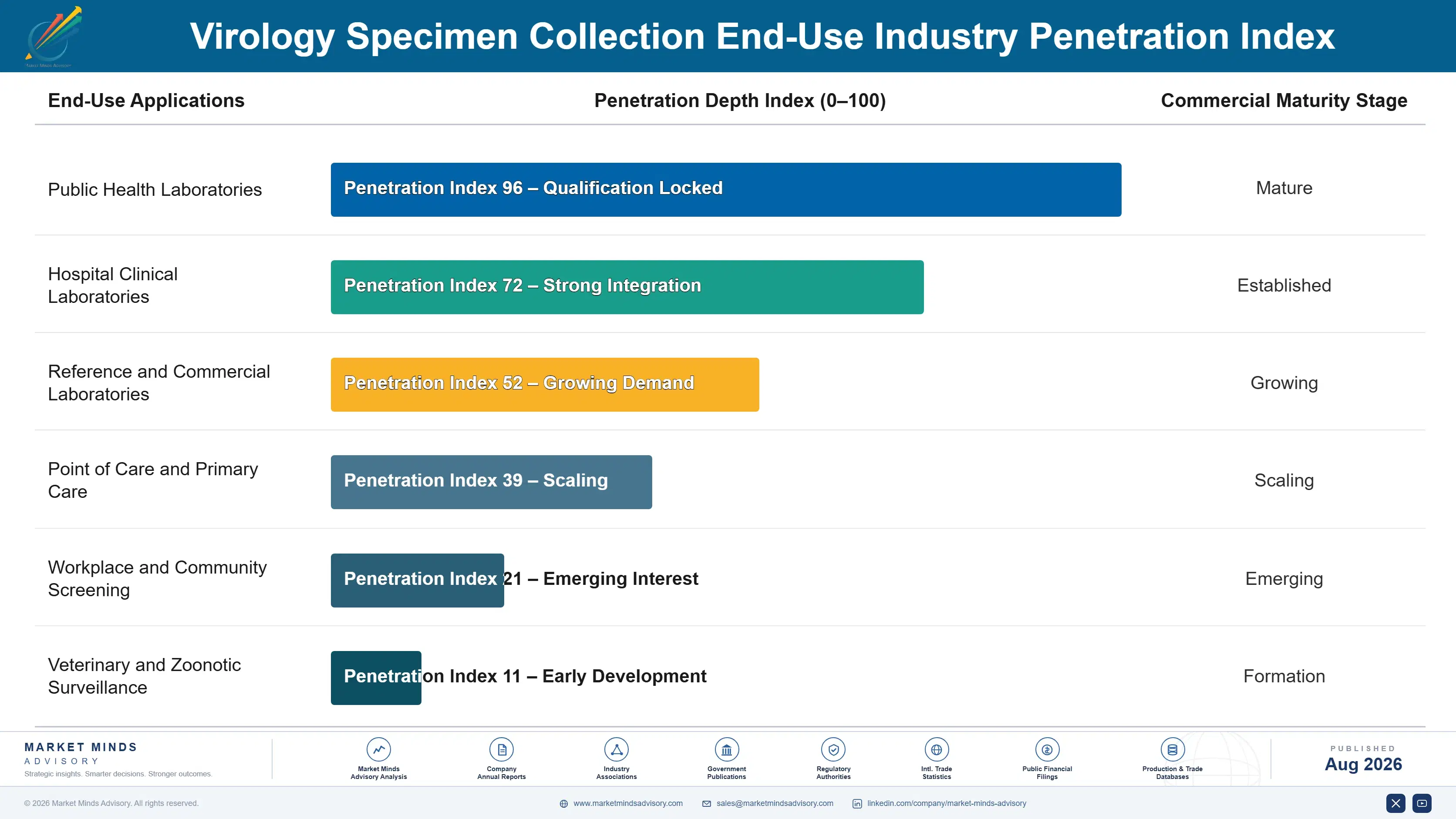
Two completely different demand patterns sit inside one market. Routine laboratory testing consumes collection devices in proportion to clinical activity, which is seasonal and reasonably forecastable. Stockpile rotation consumes them on a schedule set by shelf life rather than by disease, replacing roughly 18% of held inventory each year whether or not anything happens. The second is more predictable and depends entirely on a policy somebody could reverse.
Stickiness varies sharply by customer. A public health agency holding a framework agreement rarely changes supplier mid term, since retendering is administratively heavy and validation of a new system against existing protocols takes months. Clinical laboratories switch more readily on price where products are interchangeable, which most swabs are. Programmes standardised on a specific inactivating chemistry are stickiest, since the workflow was validated around it.

The buyer moved from a laboratory manager to a procurement official during the pandemic and has not moved back. Roughly 46% of volume now runs through public tenders evaluating supply security, shelf life, domestic manufacturing presence and price, with clinical performance treated as a threshold rather than a differentiator. Suppliers whose commercial capability is technical rather than institutional are addressing a buyer who values something else entirely.
virology-specimen-collection-market-end-use-penetration-index-1787641646774

Where This Market Rewards Focus

These are among the four positions where our research anticipates prominent divergence between winners and laggards over the coming forecast period. Each is grounded in the demand model, the regulatory perimeter, and the announced capacity pipeline.
01 / GOVERNMENT FRAMEWORK ACCESS

Half this market is a procurement relationship now

Roughly 46% of volume moves through public health procurement rather than laboratory purchasing, with stockpile contracts specifying quantities, shelf life and rotation schedules years ahead of any delivery. That demand continues whether or not anything is circulating, since around 18% of inventory expires unused annually and is replaced under the same agreement regardless. Winning those contracts turns on supply security, shelf life and domestic manufacturing presence rather than on any clinical performance argument a technical team might prefer to make.
02 / TRANSPORT CONDITION FOCUS

The medium decides more results than the assay

A specimen collected perfectly and carried in a medium that degrades it produces a false negative indistinguishable from an absent infection, and transport conditions vary from a hospital corridor to a motorbike in tropical heat. Inactivating molecular media grow at 10.2% against a market rate of 6.8% because they remove refrigeration and biosafety handling simultaneously, and roughly 37% of samples now travel with no cold chain at all. That is a logistics achievement rather than an analytical one, and it determines more outcomes than detection chemistry does.
03 / LOCAL CAPACITY PLACEMENT

Importing cheaply cannot answer a sovereignty criterion

Supply failures during the pandemic made domestic manufacturing capability a formal procurement criterion rather than a preference, and public health agencies now weight local production heavily in stockpile tenders regardless of what unit price comparison would suggest. At around 1.40 dollars a unit there is very little room for freight anyway, which makes local capacity commercially sensible as well as politically necessary. Suppliers without a presence inside the customer's borders are competing on a dimension the tender has already decided against them.
04 / NETWORK EQUIPPING PRESENCE

New laboratories choose once and rarely revisit

Public health laboratory networks keep expanding across South Asia and Africa, funded domestically and through international health security programmes established after the pandemic exposed how little surveillance capacity existed. India grows at 12.4%, faster than any market covered, as state laboratories gain molecular capability that previously sat in a handful of national institutes. Ambient stable media matter more in these geographies than anywhere else, and suppliers present while networks are being equipped hold positions that subsequent tenders rarely disturb at all.

Engagement Snapshot From the Field

A live engagement with an industry participant carrying material or product regulatory and market exposure ahead of a defining policy shift, showing how our research translates into a defensible multi-year portfolio strategy.
MARKET MINDS ADVISORY · CLIENT ENGAGEMENT SUMMARY
Virology Specimen Collection Producer Strategic Portfolio Review and Transition Roadmap 2026·Investment Scenario on Virology Specimen Collection Exposure Evaluation 2025-26
CLIENT PROFILE
A European diagnostics consumables manufacturer producing flocked swabs and conventional viral transport media, supplying clinical laboratories across Europe and selected export markets. Annual revenue was approximately 96 million dollars (client-reported, unverified by MMA), with 71% from swabs and conventional media. Capacity added during the pandemic ran well below utilisation and no inactivating chemistry was in the range.
STRATEGIC CHALLENGE
Volumes had fallen back sharply after the pandemic while Chinese competitors held prices the company could not match, and two national tenders had been lost on domestic manufacturing criteria rather than on price or quality. Management wanted to know whether to close excess capacity, invest in inactivating chemistry, or place production inside key markets. Each option had a different champion and no evidence.
MMA APPROACH
MMA modelled demand separately for routine laboratory and stockpile procurement channels, which the company had never distinguished in forecasting. Tender award criteria were analysed across nineteen national procurements to establish what actually decides outcomes. Forty-seven expert interviews with procurement officials, laboratory directors and surveillance programme managers established how collection systems are selected and what disqualifies a bidder entirely.
KEY FINDINGS
  1. Stockpile procurement accounted for roughly 46% of addressable volume and had been excluded from the company's forecasting entirely, since it had never been separated from laboratory demand.
  2. Domestic manufacturing presence was a scored criterion in 14 of the 19 tenders examined, and a disqualifying threshold in 4 of them regardless of any price advantage offered.
  3. Inactivating media carried gross margin roughly 2.2 times conventional transport media, and the client's existing formulation capability could be extended within about 18 months.
  4. Procurement officials in 31 of the 47 interviews named shelf life ahead of clinical performance, because rotation waste is the cost their own budgets visibly carry.
CLIENT PROFILE
A European diagnostics consumables manufacturer producing flocked swabs and conventional viral transport media, supplying clinical laboratories across Europe and selected export markets. Annual revenue was approximately 96 million dollars (client-reported, unverified by MMA), with 71% from swabs and conventional media. Capacity added during the pandemic ran well below utilisation and no inactivating chemistry was in the range.
STRATEGIC CHALLENGE
Volumes had fallen back sharply after the pandemic while Chinese competitors held prices the company could not match, and two national tenders had been lost on domestic manufacturing criteria rather than on price or quality. Management wanted to know whether to close excess capacity, invest in inactivating chemistry, or place production inside key markets. Each option had a different champion and no evidence.
MMA APPROACH
MMA modelled demand separately for routine laboratory and stockpile procurement channels, which the company had never distinguished in forecasting. Tender award criteria were analysed across nineteen national procurements to establish what actually decides outcomes. Forty-seven expert interviews with procurement officials, laboratory directors and surveillance programme managers established how collection systems are selected and what disqualifies a bidder entirely.
KEY FINDINGS
  1. Stockpile procurement accounted for roughly 46% of addressable volume and had been excluded from the company's forecasting entirely, since it had never been separated from laboratory demand.
  2. Domestic manufacturing presence was a scored criterion in 14 of the 19 tenders examined, and a disqualifying threshold in 4 of them regardless of any price advantage offered.
  3. Inactivating media carried gross margin roughly 2.2 times conventional transport media, and the client's existing formulation capability could be extended within about 18 months.
  4. Procurement officials in 31 of the 47 interviews named shelf life ahead of clinical performance, because rotation waste is the cost their own budgets visibly carry.
RECOMMENDED STRATEGY
Phase 1: Phase one: develop inactivating media within existing formulation capability, since margin runs roughly 2.2 times conventional and development takes about 18 months. Phase 2: Phase two: place manufacturing capacity inside two key procurement markets, where domestic presence scored in 14 of 19 tenders and disqualified bidders in 4. Phase 3: Phase three: prioritise extended shelf life validation, since 31 of 47 procurement officials named it ahead of clinical performance entirely.
OUTCOME
The client launched an inactivating media range within twenty months and established manufacturing inside one priority market. Two national tenders previously lost on domestic criteria were subsequently won, and stockpile revenue became a separately forecast channel for the first time rather than an unexplained variance (client-reported, unverified by MMA).

Frequently Asked Questions

Foundational context covering the market sizes, CAGR, scope, country, region and competition that inform every finding below. This section is provided to cover basics and most often pre-purchase conversations, answered from the MMA Primary Research Dataset.

What is the current size of the Virology Specimen Collection Market?

The market was valued at 2.6 billion dollars in 2025, covering swabs, transport media, self collection devices, dried cards and transport packaging. It reaches an estimated 2.78 billion dollars during 2026.

How large will the Virology Specimen Collection Market be by 2036?

MMA forecasts 5.37 billion dollars by 2036, an increase of 2.59 billion dollars over the 2026 base. That represents an expansion multiple of 1.93 times across the forecast period.

What is the CAGR for the Virology Specimen Collection Market 2026 to 2036?

The base case compound annual growth rate is 6.8%, with a bull case of 8.0% and a bear case of 5.6%. Stockpile policy and surveillance expansion separate those scenarios.

Which segment is growing fastest?

Inactivating molecular transport media grow at 10.2%, half again the market rate of 6.8%, by removing cold chain requirements. Saliva and self collection devices follow at 8.8%.

Who are the major companies in the Virology Specimen Collection Market?

Copan Diagnostics, Becton Dickinson, Thermo Fisher Scientific, Puritan Medical Products and Sarstedt lead on unit volume supplied worldwide. Together they account for 52% of the market.

Which country is growing fastest?

India grows fastest at 12.4%, as state public health laboratories across the country gain molecular capability that previously existed only within a handful of national institutes.

Report Segmentation Architecture

The full report scope spans multiple orthogonal segmentation dimensions, with cross-tabulated demand data provided for each dimension pair. Coverage extends further to regional breakdowns, trend trajectories, and the competitive detail needed to support segment-level decision-making.

By Collection Product Type

  • Flocked and Foam Swabs
  • Viral Transport Media
  • Inactivating Molecular Transport Media
  • Saliva and Self Collection Devices
  • Dried Specimen Collection Cards
  • Specimen Transport and Triple Packaging Systems

By End-Use Industry

  • Public Health Laboratories
  • Hospital Clinical Laboratories
  • Reference and Commercial Laboratories
  • Point of Care and Primary Care
  • Workplace and Community Screening
  • Veterinary and Zoonotic Surveillance

By Commercial Dimension

  • Government Framework Agreements
  • Preparedness Stockpile Contracts
  • Hospital Tender Procurement
  • Distributor and Dealer Supply
  • Direct Laboratory Purchasing
  • Donor Funded Programme Supply

By Region

  • North America
  • Western Europe
  • East Asia
  • South Asia and Pacific
  • Latin America
  • Middle East and Africa
  • Eastern Europe

Scope, Methodology, and Coverage

Every figure in this report is reproducible from documented input assumptions. The scope below maps the historical period, the forecast horizon, the segmentation dimensions, and the countries covered, alongside the underlying primary and qualitative methodology.
Historical Period
2020 to 2025
Forecast Period
2026 to 2036
Base Year
2025 (USD billions; MMA Primary Research Dataset, August 2026)
Market Definition
Devices, media and packaging used to collect, stabilise and transport viral specimens for diagnostic testing worldwide, covering flocked and foam swabs, viral transport media, inactivating molecular transport media, saliva and self collection devices, dried specimen collection cards, and specimen transport and triple packaging systems. Measured at manufacturer selling value across clinical, public health and surveillance applications. Diagnostic assays and reagents, nucleic acid extraction kits, blood collection tubes for clinical chemistry, laboratory instruments and personal protective equipment are excluded from scope.
Quantitative Units
USD billions (current prices); collection devices supplied; USD per device set by product type
Segmentation Dimensions
Collection product type; end-use industry; commercial dimension; region
Regions Covered
North America, Western Europe, East Asia, South Asia and Pacific, Latin America, Middle East and Africa, Eastern Europe
Countries Covered
United States, Canada, United Kingdom, Germany, France, Italy, Netherlands, Sweden, China, Japan, South Korea, Taiwan, India, Australia, Indonesia, Brazil, Mexico, Saudi Arabia, South Africa, Poland
Key Companies Profiled
Copan Diagnostics, Becton Dickinson, Thermo Fisher Scientific, Puritan Medical Products, Sarstedt, DNA Genotek, Longhorn Vaccines and Diagnostics, Hardy Diagnostics, Medical Wire and Equipment, Trinity Biotech, Micronic, Greiner Bio-One, Deltalab, Jiangsu Rongye Technology, Miraclean Technology, Zhejiang Gongdong Medical, Yocon Biology, Alpha Laboratories, Zeptometrix, Improve Medical
Quantitative Methodology
Primary survey, n=3,800 respondents, Q4 2025, six countries; demand-side model with trade association cross-validation
Qualitative Methodology
47 expert interviews, Q4 2025; applied to validate demand model assumptions, identify emerging dynamics, and assess competitive positioning
Report Format
PDF and XLSX data workbook (Word format preview document)
Publisher
Market Minds Advisory
Report Code
MMA-2026-MED-132
Published
August 2026
Contact
sales@marketmindsadvisory.com | www.marketmindsadvisory.com

Purchase the full Virology Specimen Collection Market Report (2026 to 2036).

The full report treats specimen collection as a market whose customer changed permanently during the pandemic, since roughly half the volume now moves through government stockpile procurement that buys inventory partly in order to discard it. It sizes all six product types independently through 2036, models routine laboratory demand separately from stockpile rotation, and analyses tender award criteria across nineteen national procurements. Regional chapters cover all seven regions, with manufacturing capability assessed separately from testing demand. Competitive profiling covers 20 participants on one consistent unit volume basis.
Six product types sized independently through 2036
Routine laboratory demand modelled separately from stockpile rotation
Tender award criteria analysed across nineteen national procurements
Transport condition performance mapped against media formulation type
Manufacturing capability assessed separately from testing demand
Twenty participants profiled on one consistent volume basis

Built For The People Who Decide

From boardroom strategy to bench-side execution, this report is read cover-to-cover by leaders shaping the next decade of their industry, turning demand scenarios, market dynamics and valuation benchmarks into decisions.
CXOs/ Presidents/ VPs/ Managers
M&A and Corporate Development
Strategy Teams and R&D Heads
Procurement and Product Directors
Regulatory and Compliance Leaders
Investor Relations and Equity Analysts