Market Minds Advisory
Vinyl Ester Market

Vinyl Ester Market: Corrosion-Resistant Composites Meet Chemical Processing Demand 

Flue gas desulfurization equipment upgrades, desalination infrastructure buildout, and tightening VOC emission rules are pulling vinyl ester resin producers toward higher-performance novolac and low-styrene chemistries that commodity formulations cannot match.

Lead Analyst

Bilal Shaikh

Published

September 2026

Make Smarter Decisions with Customized Research Insights

Request a free sample report and evaluate market opportunities, growth trends, and competitive dynamics relevant to your business needs.

2025 MARKET VALUE$2.8BMarket Size 2025
2036 FORECAST VALUE$5.8BBase Case , 2026 to 2036
CAGR 2026 TO 20366.8 %Bull 8.1% / Bear 5.5%
INCREMENTAL OPPORTUNITY$2.8BNet 10- year value creation
EXPANSION MULTIPLE1.93x2036 value over 2026 base
Strategic Levers
M&A Pipeline
Regional Outlook
Country Rankings
Competitive Intelligence
Segmental Deep-dive
Call-Us : 91 93563 13602

Executive Snapshot and Market Trajectory

Vinyl ester resin demand is shifting away from general-purpose corrosion protection into more technically demanding chemical processing and flue gas applications, where novolac-based chemistries justify their price premium through genuine heat and chemical resistance advantages. This shift rewards formulation chemistry investment over pure production scale.
Commercial demand splits between infrastructure buyers specifying corrosion-resistant tanks and piping for chemical plants and desalination facilities, and marine and transportation manufacturers using standard bisphenol A-based resin for fiberglass-reinforced structures. China accounts for close to a third of global consumption, driven by its expanding chemical processing infrastructure and flue gas desulfurization equipment installations. Growth here concentrates disproportionately in Asian markets expanding both industrial and desalination infrastructure. India's tightening emission standards add further demand behind China.
Competition remains moderately concentrated, with the top five holding just over half of global capacity. INEOS Composites and AOC hold the deepest technical relationships with chemical processing equipment fabricators, while tightening VOC emission regulation is pushing several producers toward low-styrene and styrene-free formulations faster than cost alone would justify. Newer entrants remain years behind on the accumulated formulation expertise this segment requires. This dynamic favors technically established suppliers over new competitors.
Market Definition
This market covers vinyl ester resins, including bisphenol A-based, novolac-based, brominated fire-retardant, and specialty low-VOC formulations, used in corrosion-resistant composites, chemical processing equipment, and fiberglass-reinforced structures. It excludes unsaturated polyester resins, epoxy resins, and finished fiberglass-reinforced plastic products sold as complete assemblies.
Base Year Value
$2.8B in 2025 (MMA Primary Research Dataset, August 2026)
Forecast Period
2026 to 2036, eleven discrete annual values
CAGR
6.8% base case. Bull 8.1%. Bear 5.5%.
Fastest Growth Segment
Novolac-Based Vinyl Ester Resins: 9.7% CAGR
Fastest Growth Country
China: 8.8% CAGR
Fastest Growth Region
South Asia and Pacific: 8.8% CAGR
Largest Region
East Asia: 29% of 2025 global value
Market Leaders
INEOS Composites, AOC LLC, Swancor Holding Co. Ltd., Scott Bader Company Limited, CCP Composites Co. Ltd. Source: MMA Analysis based on company annual reports.
Primary Survey
n=3,800 procurement and R&D decision-makers, Q4 2025, six countries
Methodology
Demand-side build-up, cross-validated against public data, 47 expert interviews

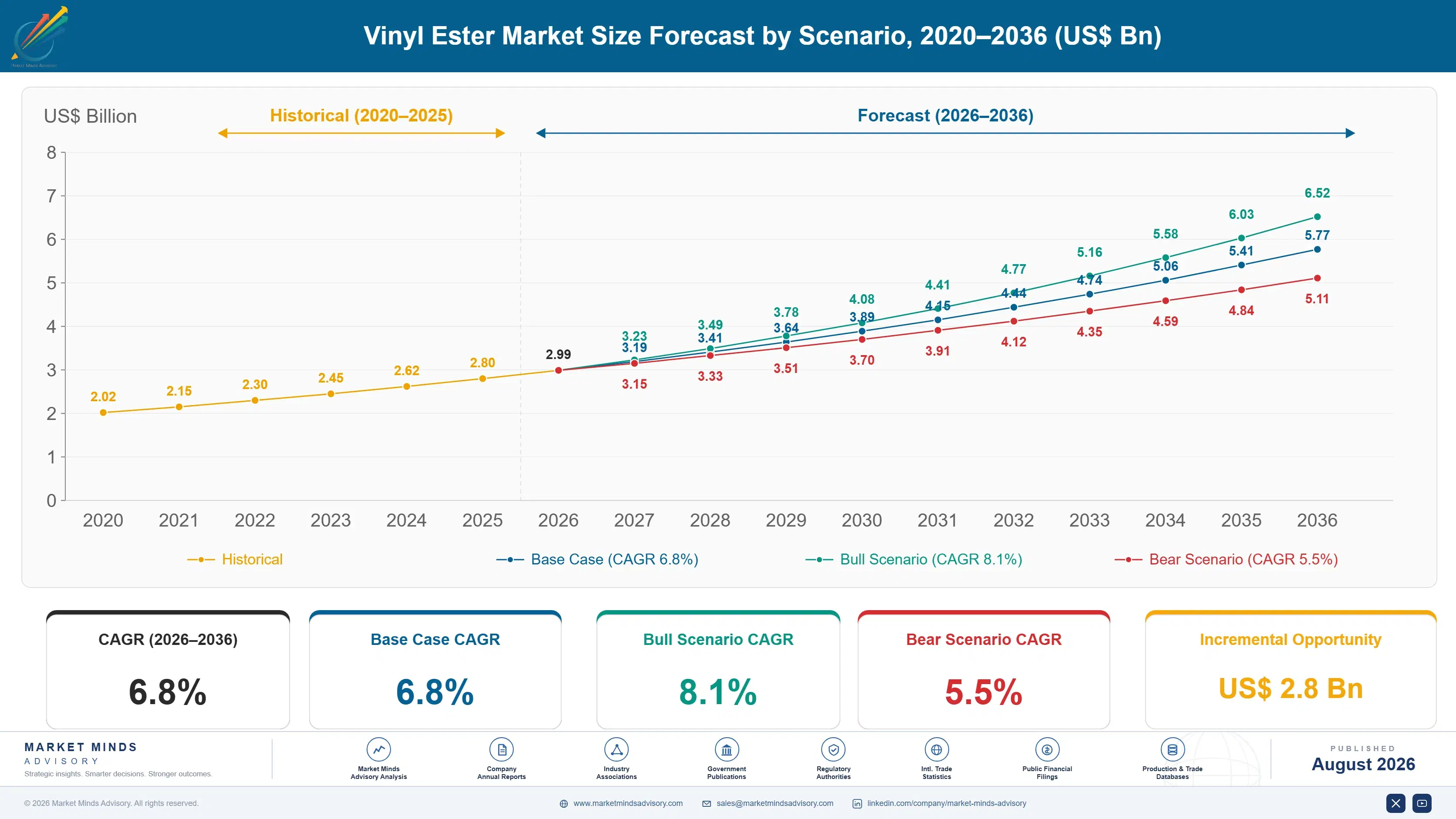
Vinyl Ester Market Forecast Scenarios

vinyl-ester-market-trends-size-forecast-scenario-1787311066878
Vinyl ester demand grew steadily through 2020 to 2025 as chemical processing and desalination infrastructure investment continued despite broader industrial demand volatility. The market grew at an estimated 6.0% historical CAGR across the period, with novolac-based grades consistently outpacing standard bisphenol A-based resin growth after 2022. Marine and transportation fabrication volume grew more modestly, tracking broader industrial production cycles.
The base case assumes 6.8% CAGR through 2036, driven by three mechanisms operating together. First, continued flue gas desulfurization equipment installation and chemical processing capacity expansion, particularly across Asia, sustains novolac-grade demand growth well ahead of the commodity resin base. Second, desalination infrastructure investment in water-scarce regions keeps pulling corrosion-resistant composite material demand higher. Third, tightening VOC emission regulation in Europe and parts of Asia is accelerating low-styrene and styrene-free resin adoption ahead of pure cost economics.
The bull case (8.1% CAGR) assumes faster-than-expected chemical processing and desalination capacity buildout across Asia and the Middle East pulls novolac-grade demand forward. The bear case (5.5% CAGR) reflects the risk that industrial capital spending slows more than currently expected, delaying chemical processing and desalination infrastructure projects that anchor the premium segment of this market.

Chemical Resistance Economics Reshape Resin Specification

Vinyl ester economics increasingly separate along chemical resistance requirements rather than application category alone, since novolac-based grades command meaningfully higher pricing tied to their superior performance in high-temperature, high-corrosion chemical processing environments that standard bisphenol A-based resin cannot reliably serve. This performance-driven pricing structure rewards producers with deep formulation chemistry expertise over those competing purely on commodity volume
CR5 CONCENTRATION54%share held by the top five global producers
AVERAGE SELLING PRICE$2.20-6.80/kgrange spanning standard grade to novolac-grade resin formulations
TOP PRODUCING COUNTRY SHAREChina, 27%share of global vinyl ester production capacity today
CAPACITY UTILIZATION72%average operating rate across dedicated vinyl ester production lines
TRADE INTENSITY36%of finished resin volume crossing borders before fabrication
FEEDSTOCK COST SHARE56% of COGSepoxy precursor and styrene monomer inputs combined together
Chemical processing buyers and marine or transportation fabricators behave very differently as customers. Chemical processing buyers specify resin against detailed corrosion and temperature performance data, running lengthy qualification testing before approving a formulation change, while marine and transportation fabricators remain more price-sensitive and switch suppliers more readily when comparable performance is available at lower cost. This divergence in buying behavior requires distinctly different commercial approaches for each customer type.
Over the next decade, two forces will determine winners. Continued chemical processing and desalination infrastructure investment will keep expanding the addressable premium novolac segment, while tightening VOC regulation adds a second, regulation-driven growth vector that rewards producers investing early in low-styrene resin technology. Producers investing successfully in both vectors stand to capture the broadest share of growth.
"Vinyl ester gets lumped in with unsaturated polyester resin in a lot of casual industry talk, but the novolac grades going into a flue gas scrubber liner are a completely different economic animal from the resin going into a boat hull. Producers that understand this split are pricing far better than those still treating it as one commodity market."
Director, Specialty Resins and Composites Practice · MMA Chemicals and Materials

Market Trends

Flue Gas Desulfurization Upgrades Drive Novolac-Grade Demand

Power generation and industrial facilities across China, India, and parts of Southeast Asia continue installing and upgrading flue gas desulfurization equipment to meet tightening air quality standards, and the corrosion-resistant linings inside these scrubbers increasingly specify novolac-based vinyl ester resin for its superior performance under sustained high-temperature acidic exposure. Standard bisphenol A-based resin degrades faster under these conditions, making novolac grades the specified material despite a meaningful price premium once total lifecycle replacement cost is considered. This demand has grown steadily as standards tighten further, giving producers a durable, regulation-linked driver.
Market Impact: Adds 1.2 million kg demand
Low-Styrene Resin Formulations Respond to VOC Regulation

European Union and select Asian VOC emission regulations targeting fiberglass-reinforced plastic fabrication facilities are pushing resin producers to commercialize low-styrene and styrene-free vinyl ester formulations that reduce volatile organic compound emissions during fabrication without compromising mechanical performance. Several producers have introduced reformulated grades meeting these tighter emission thresholds, and fabricators facing the most stringent regional regulation have begun specifying these formulations even where cost runs higher than standard styrene-based resin. This transition remains most advanced in Europe, where regulatory pressure has built furthest, though similar standards are gradually emerging in other markets as well.
Market Impact: Adds 7% desalination-linked resin d

Market Opportunities and Growth Drivers

Chemical Processing Capacity Expansion Sustains Premium Demand

Chemical processing capacity expansion across Asia and the Middle East, tied to growing petrochemical and specialty chemical production, continues driving demand for corrosion-resistant tanks, piping, and equipment linings built with novolac-grade vinyl ester resin. This expansion has made chemical processing infrastructure the single largest end-use driver of premium vinyl ester demand growth, commanding meaningfully higher pricing than marine or transportation applications given the performance and qualification requirements involved. Resin producers securing early qualification with fabricators serving new capacity gain multi-year revenue visibility, and fabricators favor suppliers with proven performance track records.
Market Impact: Cuts margin 7% in volatility

Desalination Infrastructure Investment Expands Corrosion-Resistant Demand

Water-scarce regions, particularly across the Middle East and parts of Asia, continue investing in desalination infrastructure that requires corrosion-resistant piping and equipment able to withstand sustained exposure to concentrated brine and seawater over multi-decade asset lifespans. This demand has proven more resilient than some analysts expected given broader infrastructure spending volatility, since desalination capacity additions tend to follow water security planning cycles that persist regardless of near-term economic conditions. Producers serving this demand maintain close technical relationships with engineering procurement and construction firms managing these large infrastructure projects. This relationship depth has proven durable across multiple project cycles.
Market Impact: Adds 18 percent production cost pre

Market Restraints and Challenges

Styrene Monomer Price Volatility Compresses Margins

Styrene monomer, a key feedstock, is priced on volatile global petrochemical markets that vinyl ester producers cannot fully control, and while most supply agreements pass through some feedstock cost, the conversion margin itself faces pressure whenever styrene prices spike sharply within a contract period before pricing formulas can reset. This volatility has squeezed smaller producers without long-term feedstock hedging programs during recent periods of rapid price movement, forcing some to delay planned capacity investment until pricing stabilized more predictably across the broader market. Larger producers with sophisticated hedging capability have weathered these swings more comfortably than smaller regional players.
Market Impact: Adds 8% novolac-grade segment volum

Novolac-Grade Production Requires Specialized Process Control

Producing novolac-based vinyl ester resin at consistent quality requires more specialized process control and formulation expertise than standard bisphenol A-based grades, limiting how many producers can credibly serve the premium chemical processing segment regardless of raw material access. This technical barrier has kept the novolac segment more concentrated than the broader vinyl ester market, where formulation requirements are less demanding. Smaller producers are addressing this through technical licensing partnerships, though this approach adds cost and complexity compared to in-house formulation expertise that larger competitors maintain directly. This barrier has persisted for years given the accumulated process knowledge required.
Market Impact: Adds 6% low-styrene formulation dem
3 additional market trends, 4 additional growth drivers, and 3 additional restraints and challenges are covered in the full report. Contact sales@marketmindsadvisory.com to access the complete intelligence.

Segment CAGR and Growth Architecture

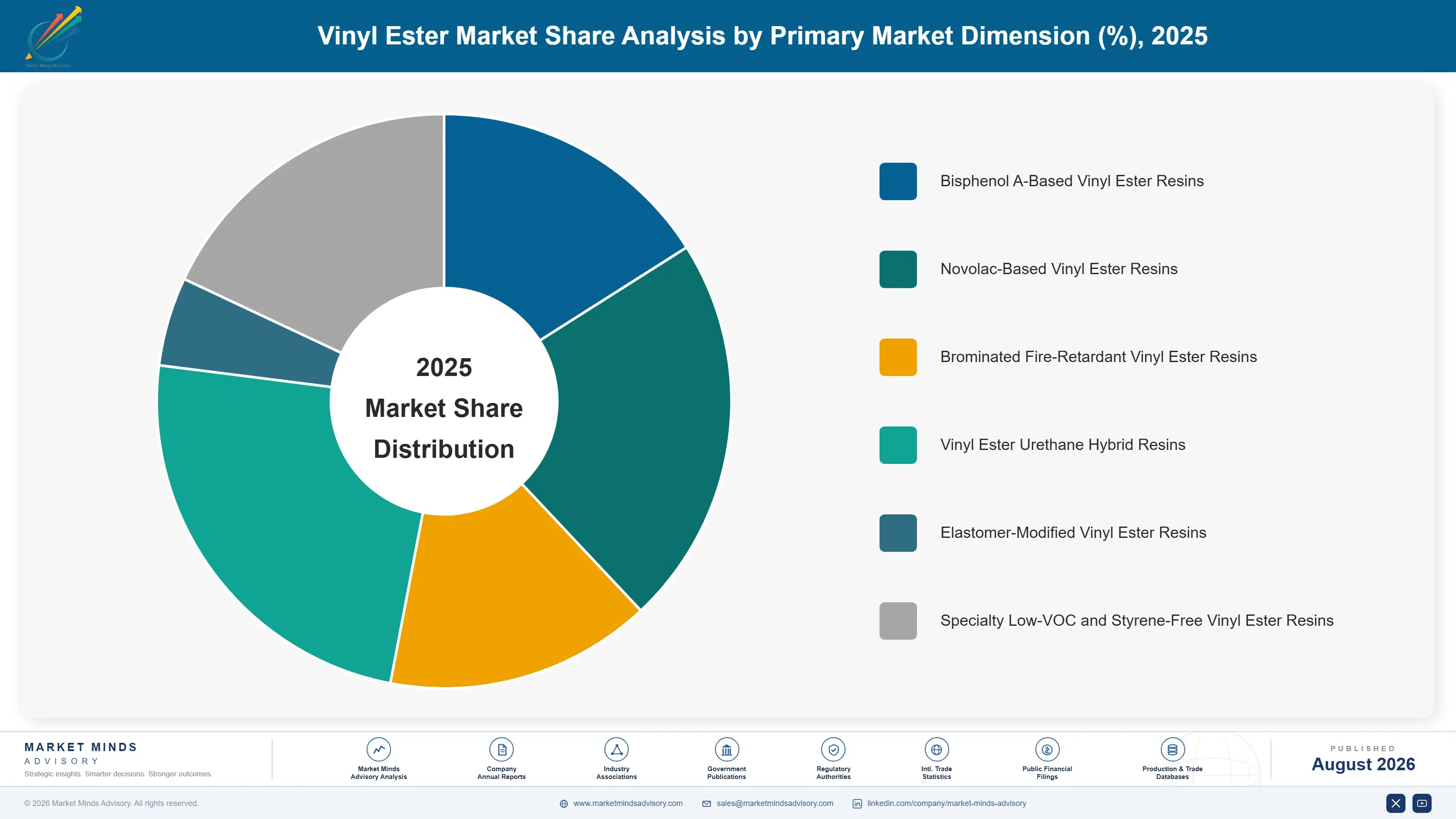
MMA segments this market by resin chemistry type, the classification fabricators and specifiers use when selecting vinyl ester material for a given application. This lens separates bisphenol A-based, novolac-based, brominated fire-retardant, and specialty low-VOC formulations by underlying chemical structure rather than end application alone, reflecting genuinely different production processes. This structure keeps commercial economics analytically distinct.
vinyl-ester-market-trends-market-share-analysis-1787311067412

Novolac-Based Vinyl Ester Resins

Novolac-based vinyl ester resins are the fastest-growing segment by a wide margin, expanding directly alongside chemical processing and flue gas desulfurization equipment demand as specifiers require superior high-temperature and chemical resistance performance that standard bisphenol A-based resin cannot reliably provide. This performance advantage justifies a meaningful price premium once total lifecycle replacement cost is considered against the shorter service life of lower-performance alternatives in demanding chemical environments. INEOS Composites and AOC hold the deepest technical positions in this segment, having invested years in formulation chemistry refinement to achieve consistent quality at commercial scale. Chinese producers including CCP Composites have scaled cost-competitive novolac capacity domestically, though established Western producers retain leadership in the most demanding specifications.
CAGR 9.7%

Specialty Low-VOC and Styrene-Free Vinyl Ester Resins

Specialty low-VOC and styrene-free vinyl ester resin demand is expanding faster than the broader commodity base, driven by tightening European Union and Asian VOC emission regulation targeting fiberglass-reinforced plastic fabrication facilities. This segment commands meaningfully higher pricing than standard styrene-based formulations, reflecting the additional formulation chemistry investment required to maintain mechanical performance while reducing volatile organic compound content during fabrication. Scott Bader and other European producers maintain strong positions given established regional regulatory expertise and early formulation development work. Growth here remains concentrated in regions facing the most immediate regulatory pressure, giving producers serving this segment a regionally concentrated but rapidly scaling revenue opportunity. This growth is largely independent of chemical processing demand cycles.
CAGR 8.4%
Full segment breakdown across 6 segments available in the complete report.

Regional Architecture and Country Demand Map

East Asia leads vinyl ester consumption given China's expanding chemical processing and flue gas desulfurization equipment installations, with North America and Western Europe following through mature chemical processing and marine fabrication industries. South Asia posts the fastest regional growth given tightening industrial emission standards nationally.

North America

United States chemical processing and marine fabrication industries anchor North American vinyl ester demand, with the Gulf Coast's concentration of petrochemical infrastructure supporting steady corrosion-resistant equipment replacement and expansion activity. AOC maintains significant domestic production capacity serving both chemical processing and transportation fabrication customers directly. Canada contributes through smaller marine and industrial fabrication demand rather than large-scale chemical processing infrastructure comparable to the Gulf Coast concentration. Desalination and water treatment infrastructure investment in water-stressed states adds a smaller but growing demand pool for corrosion-resistant piping and equipment. Growth trails East Asia's faster-expanding chemical processing capacity buildout but benefits from steady replacement demand across the region's mature industrial base. Continued Gulf Coast investment should support steady demand growth.
Share: 24% | CAGR: 7.2% (2026 to 2036)

Western Europe

Germany and the United Kingdom anchor European vinyl ester demand through established chemical processing and marine fabrication industries, with Scott Bader, headquartered in the United Kingdom, maintaining deep technical relationships across the region. European Union VOC emission regulation is most advanced in this region, driving low-styrene and styrene-free formulation adoption faster here than in any other market globally. France and the Netherlands contribute additional chemical processing and desalination-linked demand tied to their own industrial infrastructure. This regulatory leadership positions European producers well to export formulation expertise as similar standards gradually emerge elsewhere. Growth trails faster-expanding Asian markets given the region's already mature chemical processing capacity base. Continued industrial modernization investment should support steady demand growth over the coming years.
Share: 20% | CAGR: 5.3% (2026 to 2036)
Regional intelligence for 5 additional markets available in the complete report: East Asia, South Asia and Pacific, Latin America, Middle East and Africa, Eastern Europe. Contact sales@marketmindsadvisory.com.
vinyl-ester-market-trends-country-cagr-analysis-1787311068256

Where Vinyl Ester Producers Can Expand Margins

Producers create outsized value not from standard resin tonnage but from novolac formulation depth, low-VOC technology, and long-term equipment fabricator relationships. The levers below identify where margin expands fastest, moving beyond commodity resin sales toward premium chemical-resistant grades, regulatory-driven formulations, and application-specific technical support. This favors producers investing ahead of visible reformulation demand signals.

Novolac Formulation Depth Commands Premium Pricing

Producers that achieve consistent novolac-grade quality at commercial scale capture meaningfully higher realized pricing than standard bisphenol A-based resin, often 2 to 3 times the price per kilogram for equivalent volume, because chemical processing customers pay for the superior high-temperature and corrosion resistance performance this chemistry provides over standard alternatives. This formulation expertise requires years of process development and quality control investment, but producers that achieve it gain access to the highest-margin segment of the entire market well ahead of competitors still selling on standard commodity positioning alone. Several producers have captured outsized share of new chemical processing contracts.
Market Impact: Adds 300 to 400 basis points gross

Low-VOC Technology Wins Regulatory-Driven Business Consistently

Producers that commercialize low-styrene and styrene-free formulations meeting tightening VOC emission regulation win business from fabricators facing regulatory pressure more consistently than competitors offering only standard styrene-based alternatives. This capability requires sustained formulation research investment, but producers achieving it capture pricing 15 to 25% above standard resin given the regulatory value fabricators place on a compliant, qualified alternative that avoids costly facility emission upgrades. Several producers have won major fabricator contracts through sustained formulation investment made well ahead of regulatory deadlines taking effect. This early positioning has proven durable across multiple regulatory cycles.
Market Impact: Adds a 15 to 25 percent pricing pre

Chemical Processing Technical Support Deepens Relationships

Producers that embed application engineers to support chemical processing equipment fabricators, addressing specific corrosion and temperature performance requirements for individual projects, capture value well beyond raw resin sales through deepened technical relationships. INEOS Composites and AOC both operate dedicated technical centers alongside major fabricators, providing performance testing capability that smaller resin-only suppliers cannot match. This engineering layer typically adds 12 to 18% to effective pricing beyond raw material value. Producers offering this support report measurably deeper fabricator relationships than commodity resin sellers competing purely on price. This engineering layer has become a meaningful differentiator among fabricators evaluating competing resin suppliers.
Market Impact: Adds a 12 to 18 percent effective p

Long-Term Fabricator Supply Qualification Partnerships Pay Off

Producers that invest in joint qualification programs with equipment fabricators, embedding technical staff to co-develop resin specifications for specific chemical processing or desalination project requirements, secure supply relationships that persist for the full duration of large infrastructure programs once qualified. Qualification with a major fabricator typically takes 6 to 12 months but results in multi-year supply commitments that are difficult for competitors to displace afterward, since requalifying an alternative resin supplier carries real performance validation cost that most fabricators avoid absorbing without strong cause. Producers value this predictability highly. This predictability supports better capacity planning.
Market Impact: Secures a 6 to 12 month qualificati

Who Controls the Margin Pool

CR5 stands at 54%, reflecting meaningful concentration given the specialized formulation chemistry involved in premium novolac-grade production, a barrier that has kept this market more consolidated than broader commodity resin categories. The gap between these five leaders and smaller regional producers is widest in novolac formulation depth, where established players have accumulated years of process refinement. This gap has persisted given the capital involved in matching formulation depth.
Competition currently plays out across three dimensions: novolac formulation depth among leaders serving chemical processing fabricators, low-VOC technology development among producers targeting European and Asian emission regulation, and capacity expansion timed to Chinese flue gas equipment and chemical processing growth among a broader group of regional producers. Chinese producers compete primarily on standard-grade volume and price, where formulation barriers remain lower than in novolac applications.

Emerging pressure comes from two directions. Chinese producers are investing in novolac formulation capability to reduce reliance on imported material, though quality consistency remains a gap relative to established suppliers. Low-VOC technology could also reorder competitive rankings if regulatory pressure accelerates faster than currently expected, favoring producers with early technical investment over pure-volume competitors. Neither trend is likely to reorder the top five within a few years.
vinyl-ester-market-trends-company-positioning-matrix-1787311069169

Competitive Moat and Risk Dimensions

INEOS COMPOSITES

Moat: Deepest Novolac Formulation Expertise

INEOS Composites holds extensive novolac-grade formulation technical depth, built over decades of process refinement inherited through its acquisition of established composite resin operations, giving it preferred supplier status across major chemical processing equipment fabricators requiring the most demanding performance specifications. This positioning is difficult for smaller competitors to replicate quickly.
INEOS COMPOSITES

Risk: Integration Complexity Following Acquisition

INEOS Composites continues integrating operations following its acquisition of legacy composite resin business lines, and this integration complexity has occasionally slowed decision-making on capacity investment relative to more singularly focused specialty resin competitors. Rivals that moved faster on comparable investment decisions have taken notice of this gap.
AOC LLC

Moat: Broad North American Production Scale

AOC operates the largest dedicated vinyl ester and unsaturated polyester resin production base in North America, giving it scale advantages in serving both premium chemical processing and standard marine and transportation fabrication customers across the region. This scale advantage supports competitive pricing across both premium and standard product lines.
AOC LLC

Risk: Limited Asian Manufacturing Footprint

AOC's production capacity remains concentrated in North America and Europe, limiting its ability to serve rapidly growing Asian chemical processing and flue gas equipment demand as flexibly as producers with established regional manufacturing presence closer to these markets. This positioning could weaken further as Chinese producers continue expanding regional capacity.

Players Tracked

Prominent Players

INEOS Composites
AOC LLC
Swancor Holding Co. Ltd.
Scott Bader Company Limited
CCP Composites Co. Ltd.

Other Key Players

Interplastic Corporation
Polynt Composites
DIC Corporation
Showa Denko K.K.
Nan Ya Plastics Corporation
Jiangsu Sanmu Group
Wuxi Xingye Resin Co. Ltd.
Changzhou Tianma Group Co. Ltd.
Huntsman Corporation
Sino Polymer Co. Ltd.
Reichhold LLC
Cray Valley SA
Hexion Inc.
Satyen Polymers Pvt. Ltd.
Composite Resins Australia Pty Ltd.

Recent Developments

MARCH 2025

INEOS Composites Expands Novolac-Grade Capacity in the United States

INEOS Composites announced completion of a capacity expansion at its United States production facility, adding qualified novolac-grade vinyl ester capacity to serve growing chemical processing and flue gas desulfurization equipment demand. The expansion follows several years of formulation process refinement inherited through its prior composite resin acquisition.
Signal: Confirms leading producers are dedicating
AUGUST 2025

CCP Composites Expands Vinyl Ester Capacity at Chinese Facility

CCP Composites announced completion of a capacity expansion at its Chinese production facility, adding qualified vinyl ester capacity to serve growing domestic flue gas equipment demand. The expansion follows several years of quality improvement work narrowing the gap with established Western suppliers on novolac specifications.
Signal: Signals Chinese producers are scaling capa
JANUARY 2026

Scott Bader and a Major Fabricator Sign Low-VOC Resin Supply Agreement

Scott Bader signed a multi-year supply agreement with a major European fiberglass fabricator covering low-styrene vinyl ester resin meeting tightening regional VOC emission requirements. The agreement secures forward volume for Scott Bader while giving the fabricator a compliant formulation ahead of regulation. More agreements are expected across the region.
Signal: Signals fabricators are increasingly secur

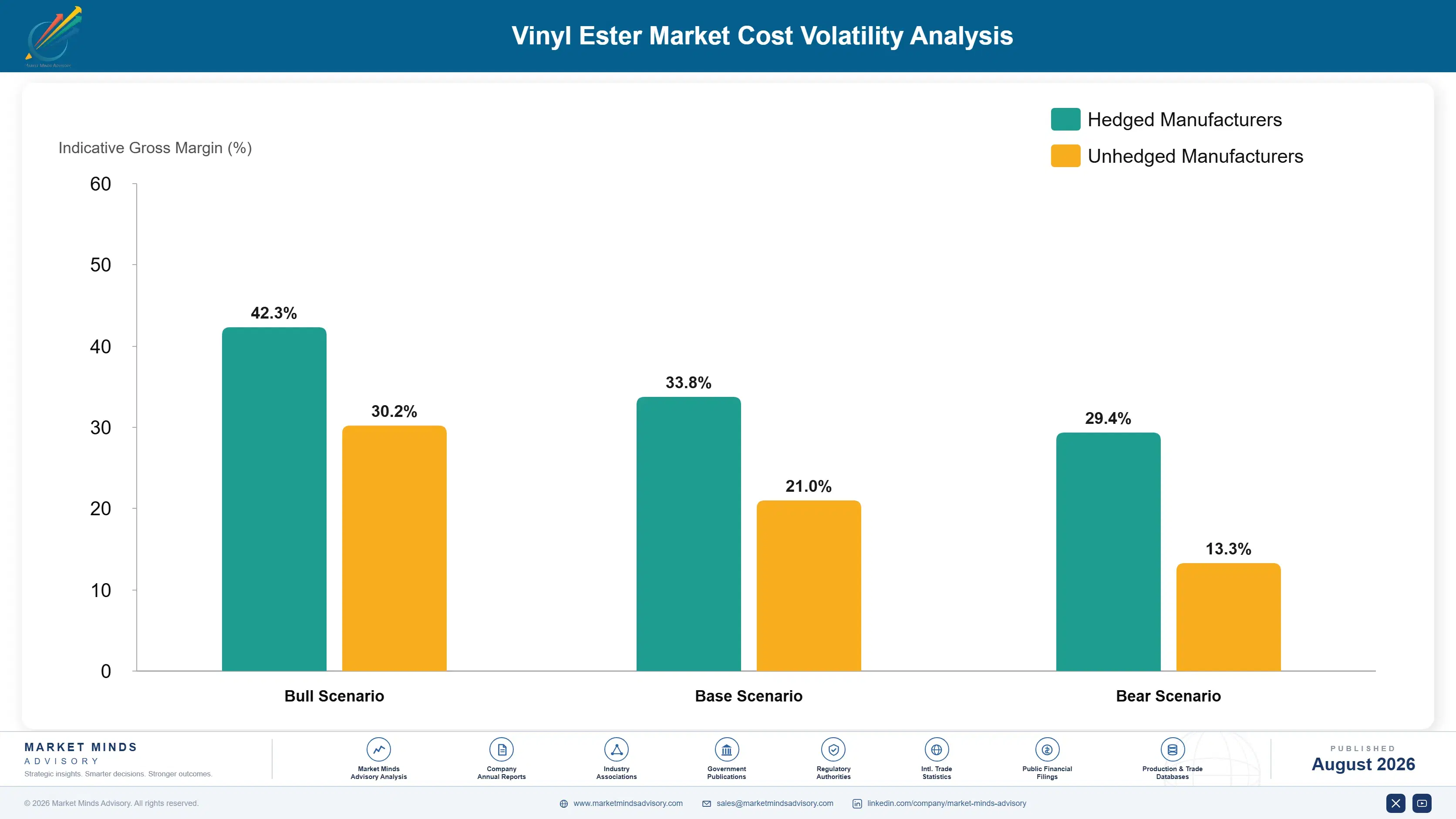
Styrene and Epoxy Precursor Feedstock Exposure

Styrene monomer and epoxy precursor feedstocks together account for roughly 56% of cost of goods sold across vinyl ester production, with styrene pricing tied directly to global petrochemical exchange markets rather than resin-specific supply dynamics. Producers without long-term feedstock hedging programs face direct exposure to styrene price swings within contract pricing reset periods. Larger producers with formal hedging programs manage this exposure more effectively than smaller regional pl
Styrene monomer prices spiked sharply during 2022, documented in company annual reports across the sector, as broader petrochemical demand and supply constraints pulled global styrene markets tighter than in prior years. Several resin producers reported compressed conversion margins during this period, since customer pricing on longer-term chemical processing contracts could not be renegotiated quickly enough to reflect rising feedstock cost, illustrating how directly feedstock volatility can affect near-term profitability.

This exposure disadvantages smaller producers relative to larger competitors with sophisticated hedging programs and diversified feedstock sourcing, widening margin gaps during volatile pricing periods that are difficult to close through efficiency gains alone. Producers without formal hedging programs absorb volatility directly in margin, while larger integrated players like AOC hedge exposure through diversified sourcing and financial instruments.
vinyl-ester-market-trends-cost-volatility-analysis-1787311069567

Styrene Futures Hedging Programs

Producers with dedicated treasury functions use styrene futures contracts to lock in feedstock costs ahead of production runs, reducing exposure to spot price volatility. This approach requires sophisticated financial expertise but has become increasingly standard among larger producers following recent volatile pricing periods. Larger producers with dedicated finance teams have adopted this discipline most consistently across recent volatile periods.

Frequent Pricing Formula Resets With Customers

Several producers have renegotiated customer contracts to reset styrene-linked pricing formulas monthly rather than quarterly, reducing the lag between feedstock cost movement and realized customer pricing. This shift protects conversion margin more effectively during periods of rapid price movement. Customers have generally accepted these terms given the mutual benefit of reduced pricing uncertainty. This shift has become more common recently.

Long-Term Feedstock Supply Contracts

Larger producers are locking in multi-year styrene and epoxy precursor supply contracts at fixed or formula-based pricing, trading some upside flexibility for predictable production costs. This approach requires established supplier relationships but provides more predictable feedstock costs than spot market purchasing. This approach requires established supplier relationships built over years of purchasing history. This shift has become more common recently.

Portfolio Architecture for Margin Defence

MMA organizes this market into three tiers by chemistry type and margin profile. The volume tier covers standard bisphenol A-based resin sold into marine and transportation fabrication, competing primarily on price and feedstock cost position. The premium tier covers novolac-grade resin qualified for demanding chemical processing and flue gas applications, commanding higher margins through formulation barriers. The sustainability tier captures low-VOC and styrene-free formulations still scaling
Volume tier producers compete on price and feedstock cost position with moderate margins, while premium tier suppliers protect pricing power through formulation barriers that keep new entrants out for years. This creates real tension inside diversified producers, since capital allocated to sustaining standard capacity competes directly with capital needed to fund novolac formulation development, and most large producers now favor the latter given superior long-term returns.

The highest-value pools concentrate in novolac-grade resin for chemical processing applications and low-VOC formulations meeting tightening emission regulation, where technical barriers and durable fabricator relationships combine to support the strongest pricing power in the entire market. Desalination-linked corrosion-resistant grades are emerging as a further high-value pool as water security investment continues.

Volume / Commodity-Adjacent Tier

Standard bisphenol A-based vinyl ester resin sold into marine and transportation fabrication, competing primarily on price and feedstock cost position with limited technical differentiation between qualified suppliers. Feedstock cost position and scale dominate competitiveness in this tier.
Gross Margin: 16-22%

Premium / Certified Tier

Novolac-grade resin qualified for demanding chemical processing and flue gas desulfurization applications, commanding higher margins through formulation barriers and long-term fabricator supply relationships. Suppliers here typically hold multi-year qualified customer contracts built through sustained technical collaboration.
Gross Margin: 30-40%

Sustainability / Regulatory / Next-Generation Tier

Low-VOC and styrene-free formulations positioned ahead of tightening emission regulation, commanding premium pricing from technically demanding early-adopter fabricator customers. Scale remains modest today but growth here outpaces the rest of the market by a wide margin as regulation tightens.
Gross Margin: 28-38%
vinyl-ester-market-trends-portfolio-architecture-1787311070453

High-value Sub-segments and Strategic Watch-out

Novolac-Grade Chemical Processing Resins

This segment combines the highest formulation barriers in the market with the fastest unit growth, as chemical processing and flue gas equipment demand pushes toward higher-performance specifications. Producers with proven formulation expertise hold a durable advantage. New entrants face years of process development before reaching comparable formulation quality.
Gross Margin: 34-44%

Low-VOC and Styrene-Free Formulations

Tightening emission regulation across multiple regions is driving steady demand growth largely independent of broader industrial cycles, with established formulation research providing meaningful competitive protection against new entrants lacking comparable technical depth. Established formulation research provides meaningful protection against new entrants lacking equivalent technical depth.
Gross Margin: 30-38%

Standard Bisphenol A-Based Marine Grades

The largest volume base by tonnage, this segment covers standard-grade resin sold into marine and transportation fabrication, where competition is driven mostly by price and feedstock position rather than deep technical differentiation. Integrated producers with strong feedstock positions consistently outcompete smaller sellers lacking scale advantages.
Gross Margin: 14-20%

Chinese Novolac Capacity Buildout

Chinese producers are investing in novolac formulation capability to reduce import reliance, and continued technical improvement could eventually pressure established Western pricing, a trajectory worth monitoring by current leaders. Established Western producers are watching this trajectory closely as Chinese quality consistency keeps improving steadily. This trend bears close watching.
Gross Margin: 16-24%

Qualification Depth Across Buyer Types

Once a resin producer is qualified into a chemical processing equipment fabricator's approved material list, that relationship typically persists for the full duration of ongoing infrastructure programs, since requalifying an alternative supplier carries real performance validation cost that most fabricators avoid absorbing without strong cause. This creates durable, low-churn revenue characteristics once qualification is achieved, distinct from the more competitive initial qualification-seeking
Adoption depth varies sharply by vertical. Chemical processing fabricators show the deepest stickiness, since resin specification changes require extensive performance requalification testing that most fabricators avoid mid-program. Desalination equipment suppliers show similarly strong stickiness tied to multi-decade asset planning cycles. Marine and transportation fabricators show the least stickiness of the three, since product redesigns occur more frequently and reopen sourcing decisions more often than long-lived infrastructure programs ever do.

Buyer profiles are shifting generationally as fabricators increasingly weigh regulatory compliance and emission credentials, not just price and performance, as explicit material selection criteria. Younger procurement and engineering teams increasingly favor suppliers with credible low-VOC positioning, a consideration barely present in sourcing decisions before recent regulatory pressure intensified significantly. This generational shift is still early but already visible in how procurement teams weigh supplier proposals.
vinyl-ester-market-trends-end-use-penetration-index-1787311071286

Where MMA Sees the Opportunity

These are among the four positions where our research anticipates prominent divergence between winners and laggards over the coming forecast period. Each is grounded in the demand model, the regulatory perimeter, and the announced capacity pipeline.
01 / NOVOLAC FORMULATION INVESTMENT

Deepen Novolac Formulation Capability Ahead of Demand Growth

Novolac-grade resin commands the strongest pricing power in the entire market, and producers that invest in formulation chemistry and quality control now position themselves ahead of continued chemical processing and flue gas equipment demand growth through 2036. This capability requires years of process development, but producers that achieve consistent commercial-scale quality gain access to the highest-margin segment of the entire market well ahead of competitors still selling standard commodity grades. Waiting until demand is obviously large risks ceding this formulation advantage to producers who invested earlier.
02 / LOW-VOC TECHNOLOGY DEVELOPMENT

Commercialize Low-VOC Formulations Ahead of Regulatory Deadlines

Tightening VOC emission regulation is creating genuine competitive advantage for producers with commercialized low-styrene and styrene-free technology, and this advantage will sharpen as regulatory deadlines approach and fabricators need proven, qualified alternatives. Producers that invest in this technology now, ahead of firm regulatory deadlines, position themselves as the credible qualified suppliers fabricators need rather than scrambling competitors trying to qualify technology under regulatory time pressure. This positioning also extends naturally to other regions as similar standards spread beyond Europe over the coming years.
03 / CHEMICAL PROCESSING TECHNICAL SUPPORT

Build Dedicated Technical Support for Chemical Processing Customers

Chemical processing fabricators face genuine performance validation challenges when specifying resin for demanding corrosion and temperature environments, a barrier that generic resin suppliers competing purely on price cannot solve for customers. Producers that embed application engineers to support fabricator qualification work deepen relationships and improve retention meaningfully compared to commodity resin sellers who risk losing ground as this dynamic intensifies. This capability requires technical staff investment but is considerably less capital-intensive than building new novolac production capacity from scratch, making it accessible to mid-scale producers.
04 / CHINESE CAPACITY RESPONSE

Defend Technical Differentiation Against Chinese Cost Competition

Chinese producers are scaling standard-grade capacity aggressively and investing in novolac formulation capability, threatening to commoditize segments that once commanded meaningful technical differentiation premiums. Producers that concentrate investment in novolac and low-VOC formulations, where Chinese technical capability remains less developed, protect margin more effectively than those competing head-on in standard commodity grades. This repositioning requires deliberate capital reallocation toward genuinely differentiated technical segments where Chinese competitors remain years behind on formulation depth and quality consistency, a gap likely to persist for several more years.

Engagement Snapshot From the Field

A live engagement with an industry participant carrying material or product regulatory and market exposure ahead of a defining policy shift, showing how our research translates into a defensible multi-year portfolio strategy.
MARKET MINDS ADVISORY · CLIENT ENGAGEMENT SUMMARY
Vinyl Ester Producer Strategic Portfolio Review and Transition Roadmap 2026·Investment Scenario on Vinyl Ester Exposure Evaluation 2025-26
CLIENT PROFILE
The client is a mid-scale chemical processing equipment fabricator generating approximately $290 million in annual revenue (client-reported, unverified by MMA) from corrosion-resistant tank and piping systems serving petrochemical and flue gas desulfurization customers. The company sourced novolac-grade resin from a single supplier and was evaluating diversification amid growing concerns about feedstock-driven price volatility. The company had built its reputation on reliable long-term project delivery.
STRATEGIC CHALLENGE
The client needed to decide whether to qualify a second novolac-grade resin supplier, adding approximately $1.8 million (client-reported, unverified by MMA) in qualification testing cost, or maintain its existing single-supplier relationship despite periodic pricing pressure during styrene market volatility that had squeezed project margins on fixed-price contracts. The decision carried real cost and schedule implications either way.
MMA APPROACH
MMA's advisory team conducted primary interviews with resin producers about current novolac-grade capacity and pricing stability, and analyzed historical feedstock volatility patterns to assess realistic single-supplier risk during future styrene price spikes. The analysis weighed qualification cost and schedule impact against the project-level risk of relying on a single resin source.
KEY FINDINGS
  1. Interview data indicated that novolac-grade resin pricing had moved independently across the two candidate suppliers during the most recent styrene price spike, suggesting genuine diversification benefit rather than uniform market-wide pricing.
  2. Second-supplier qualification for novolac-grade material typically took 8 to 10 months, within the client's project planning horizon if initiated during a period of lower near-term project volume.
  3. The incremental qualification cost represented less than 1% of the client's annual resin procurement budget, a modest expense relative to the margin protection diversification could provide.
  4. Comparable fabricators maintaining dual-qualified resin suppliers reported measurably better fixed-price contract margin protection during the most recent feedstock volatility period than single-sourced peers.
CLIENT PROFILE
The client is a mid-scale chemical processing equipment fabricator generating approximately $290 million in annual revenue (client-reported, unverified by MMA) from corrosion-resistant tank and piping systems serving petrochemical and flue gas desulfurization customers. The company sourced novolac-grade resin from a single supplier and was evaluating diversification amid growing concerns about feedstock-driven price volatility. The company had built its reputation on reliable long-term project delivery.
STRATEGIC CHALLENGE
The client needed to decide whether to qualify a second novolac-grade resin supplier, adding approximately $1.8 million (client-reported, unverified by MMA) in qualification testing cost, or maintain its existing single-supplier relationship despite periodic pricing pressure during styrene market volatility that had squeezed project margins on fixed-price contracts. The decision carried real cost and schedule implications either way.
MMA APPROACH
MMA's advisory team conducted primary interviews with resin producers about current novolac-grade capacity and pricing stability, and analyzed historical feedstock volatility patterns to assess realistic single-supplier risk during future styrene price spikes. The analysis weighed qualification cost and schedule impact against the project-level risk of relying on a single resin source.
KEY FINDINGS
  1. Interview data indicated that novolac-grade resin pricing had moved independently across the two candidate suppliers during the most recent styrene price spike, suggesting genuine diversification benefit rather than uniform market-wide pricing.
  2. Second-supplier qualification for novolac-grade material typically took 8 to 10 months, within the client's project planning horizon if initiated during a period of lower near-term project volume.
  3. The incremental qualification cost represented less than 1% of the client's annual resin procurement budget, a modest expense relative to the margin protection diversification could provide.
  4. Comparable fabricators maintaining dual-qualified resin suppliers reported measurably better fixed-price contract margin protection during the most recent feedstock volatility period than single-sourced peers.
RECOMMENDED STRATEGY
Phase 1: Phase 1 (Months 1-3): Initiate qualification testing with the second novolac-grade supplier during a period of lower near-term project volume to minimize schedule disruption. Phase 2: Phase 2 (Months 4-9): Complete performance validation testing and finalize supply agreement terms with the qualified second supplier for a defined volume allocation. Phase 3: Phase 3 (Months 10-12): Integrate the second supplier into standard procurement rotation, using dual-sourcing to negotiate more favorable pricing terms with both suppliers.
OUTCOME
The client completed second-supplier qualification within 9 months and reported improved fixed-price contract margin protection during a subsequent styrene price increase, avoiding the full margin compression a single-sourced competitor experienced during the same period. The client estimated dual-sourcing preserved approximately 3 percentage points (client-reported, unverified by MMA) of project margin that would otherwise have been lost to feedstock volatility.

Frequently Asked Questions

Foundational context covering the market sizes, CAGR, scope, country, region and competition that inform every finding below. This section is provided to cover basics and most often pre-purchase conversations, answered from the MMA Primary Research Dataset.

What is the current size of the Vinyl Ester Market?

The Vinyl Ester Market was valued at $2.8 billion in 2025. MMA projects it will reach $2.99 billion in 2026 as chemical processing and desalination demand both continue expanding.

How large will the Vinyl Ester Market be by 2036?

MMA forecasts the market will reach $5.77 billion by 2036, up from $2.99 billion in 2026. That represents a 1.93 times expansion over the ten-year forecast window.

What is the CAGR for the Vinyl Ester Market 2026 to 2036?

The market is projected to grow at a 6.8% CAGR between 2026 and 2036. MMA's bull and bear scenarios range from 8.1% to 5.5% depending on chemical processing capacity buildout pace.

Which segment is growing fastest?

Novolac-Based Vinyl Ester Resins is the fastest-growing segment, expanding at a 9.7% CAGR, roughly 1.43 times the overall market rate as chemical processing and flue gas equipment demand accelerates.

Who are the major companies in the Vinyl Ester Market?

INEOS Composites, AOC, Swancor, Scott Bader, and CCP Composites lead the market, together holding an estimated 54% of global production capacity. This concentration reflects the specialized formulation chemistry required for premium grades.

Which country is growing fastest?

China is the fastest-growing country market, expanding at an estimated 8.8% CAGR as chemical processing and flue gas desulfurization equipment installation continue rapid expansion. Tightening national air quality standards continue to support this growth trajectory.

Report Segmentation Architecture

The full report scope spans multiple orthogonal segmentation dimensions, with cross-tabulated demand data provided for each dimension pair. Coverage extends further to regional breakdowns, trend trajectories, and the competitive detail needed to support segment-level decision-making.

By Primary Market Dimension

  • Bisphenol A-Based Vinyl Ester Resins
  • Novolac-Based Vinyl Ester Resins
  • Brominated Fire-Retardant Vinyl Ester Resins
  • Vinyl Ester Urethane Hybrid Resins
  • Elastomer-Modified Vinyl Ester Resins
  • Specialty Low-VOC and Styrene-Free Vinyl Ester Resins

By End-Use Industry

  • Chemical Processing Equipment
  • Marine and Shipbuilding
  • Transportation and Automotive
  • Desalination and Water Treatment
  • Power Generation and Flue Gas Equipment

By Commercial Dimension

  • Equipment Fabricator Direct Supply
  • Marine and Transportation Fabricator Supply
  • Distribution and Trading
  • Contract Formulation Services

By Region

  • North America
  • Western Europe
  • East Asia
  • South Asia and Pacific
  • Latin America
  • Middle East and Africa
  • Eastern Europe

Scope, Methodology, and Coverage

Every figure in this report is reproducible from documented input assumptions. The scope below maps the historical period, the forecast horizon, the segmentation dimensions, and the countries covered, alongside the underlying primary and qualitative methodology.
Historical Period
2020 to 2025
Forecast Period
2026 to 2036
Base Year
2025 (USD billions; MMA Primary Research Dataset, August 2026)
Market Definition
This report covers vinyl ester resins, including bisphenol A-based, novolac-based, brominated fire-retardant, and specialty low-VOC formulations, used in corrosion-resistant composites, chemical processing equipment, and fiberglass-reinforced structures. It excludes unsaturated polyester resins, epoxy resins, and finished fiberglass-reinforced plastic products sold as complete assemblies.
Quantitative Units
USD billions (current prices); metric tons of production capacity where applicable
Segmentation Dimensions
By Resin Chemistry Type; By End-Use Industry; By Commercial Dimension; By Region
Regions Covered
North America, Western Europe, East Asia, South Asia and Pacific, Latin America, Middle East and Africa, Eastern Europe
Countries Covered
USA, China, Germany, France, UK, Japan, South Korea, India, Australia, Canada, Brazil, Mexico, Indonesia, Vietnam, Thailand, Malaysia, UAE, Saudi Arabia, South Africa, Nigeria, Turkey, Poland, Netherlands, Italy, Spain, Sweden, Switzerland, Argentina, Colombia, Singapore, and additional markets relevant to this sector
Key Companies Profiled
INEOS Composites, AOC LLC, Swancor Holding Co. Ltd., Scott Bader Company Limited, CCP Composites Co. Ltd., Interplastic Corporation, Polynt Composites, DIC Corporation, Showa Denko K.K., Nan Ya Plastics Corporation, Jiangsu Sanmu Group, Wuxi Xingye Resin Co. Ltd., Changzhou Tianma Group Co. Ltd., Huntsman Corporation, Sino Polymer Co. Ltd., Reichhold LLC, Cray Valley SA, Hexion Inc., Satyen Polymers Pvt. Ltd., Composite Resins Australia Pty Ltd.
Quantitative Methodology
Primary survey, n=3,800 respondents, Q4 2025, six countries; demand-side model with trade association cross-validation
Qualitative Methodology
47 expert interviews, Q4 2025; applied to validate demand model assumptions, identify emerging dynamics, and assess competitive positioning
Report Format
PDF and XLSX data workbook (Word format preview document)
Publisher
Market Minds Advisory
Report Code
MMA-2026-CHM-109
Published
August 2026
Contact
sales@marketmindsadvisory.com | www.marketmindsadvisory.com

Purchase the full Vinyl Ester Market Report (2026 to 2036).

The full Vinyl Ester Market report delivers ten-year forecasts across all seven regions, six product segments, and the full competitive landscape of twenty profiled producers. It includes detailed analysis of novolac formulation economics, low-VOC technology development, and demand drivers spanning chemical processing, desalination, and marine fabrication. Buyers receive segment-level margin benchmarking across the volume, premium, and sustainability tiers identified in this summary. The report also includes primary survey data from 3,800 respondents and 47 expert interviews conducted in the fourth quarter of 2025, supporting every demand and pricing assumption in the forecast.
Ten-year regional and segment-level forecast models
Competitive profiles covering twenty resin producers
Novolac formulation economics and cost analysis
Low-VOC technology and regulatory timeline mapping
Portfolio margin benchmarking across three commercial tiers
Primary survey and expert interview data appendix

Built For The People Who Decide

From boardroom strategy to bench-side execution, this report is read cover-to-cover by leaders shaping the next decade of their industry, turning demand scenarios, market dynamics and valuation benchmarks into decisions.
CXOs/ Presidents/ VPs/ Managers
M&A and Corporate Development
Strategy Teams and R&D Heads
Procurement and Product Directors
Regulatory and Compliance Leaders
Investor Relations and Equity Analysts