Market Minds Advisory
Vietnam Plastic Drum Market

Vietnam Plastic Drum Market: A Returnable Asset Nobody Returns, Certification Barriers and Bulk Container Substitution

Roughly 44% of industrial drums never return to any formal reconditioning channel, because a used drum is worth more as a water tank or a fish farm float than as reconditioned packaging.

Lead Analyst

Bilal Shaikh

Published

September 2026

Make Smarter Decisions with Customized Research Insights

Request a free sample report and evaluate market opportunities, growth trends, and competitive dynamics relevant to your business needs.

2025 MARKET VALUE$0.2BMarket Size 2025
2036 FORECAST VALUE$0.5BBase Case , 2026 to 2036
CAGR 2026 TO 20369.2 %Bull 10.4% / Bear 8.0%
INCREMENTAL OPPORTUNITY$0.3BNet 10- year value creation
EXPANSION MULTIPLE2.43x2036 value over 2026 base
Strategic Levers
M&A Pipeline
Regional Outlook
Country Rankings
Competitive Intelligence
Segmental Deep-dive
Call-Us : 91 93563 13602

Executive Snapshot and Market Trajectory

A drum is a returnable asset that everybody treats as packaging. A two hundred litre container costs around 28 dollars new and can be reconditioned about four times, so the economics of this category turn entirely on whether anyone gets it back. Nobody in the industry models it that way.
In Vietnam roughly 44% never do. A used drum finds a second life as a water tank, a fish farm float or a construction site container, and at those prices the informal market outbids reconditioners for the same asset. That is not leakage to be engineered away. It is a competing bid, and it sets the floor under new drum demand more reliably than any industrial growth forecast does.
Certification decides who competes for the valuable volume. Hazardous chemical drums require a United Nations design type approval costing roughly 46,000 dollars in testing per design, which excludes most small converters from agrochemical and specialty chemical work entirely. Meanwhile bulk containers replace five drums each, and their inner bottles grow fastest at 13.8%, half again the market rate of 9.2%. Drum only suppliers watch that volume disappear. Converters holding both positions fare considerably better.
Market Definition
Rigid plastic drums and industrial containers between twenty and two hundred and twenty litres manufactured and sold within Vietnam, covering tight head drums, open head drums, jerrycans and small industrial containers, intermediate bulk container inner bottles, reconditioned and reused drums, and multilayer and fluorinated barrier drums. Measured at converter and reconditioner selling value. Bottles and containers below twenty litres, steel drums, flexible bulk containers, closures and resin production are excluded.
Base Year Value
$0.2B in 2025 (MMA Primary Research Dataset, August 2026)
Forecast Period
2026 to 2036, eleven discrete annual values
CAGR
9.2% base case. Bull 10.4%. Bear 8.0%.
Fastest Growth Segment
Intermediate Bulk Container Inner Bottles: 13.8% CAGR
Fastest Growth Country
Dong Nai: 12.4% CAGR
Fastest Growth Region
South Asia and Pacific: 11.4% CAGR
Largest Region
South Asia and Pacific: 87% of 2025 global value
Market Leaders
Tan Phu Vietnam, Duy Tan Plastics, Greif, Mauser Packaging Solutions, Thai Containers Group. Source: MMA Primary Research Dataset, July 2026.
Primary Survey
n=3,800 procurement and R&D decision-makers, Q4 2025, six countries
Methodology
Demand-side build-up, cross-validated against public data, 47 expert interviews

Vietnam Plastic Drum Market Forecast Scenarios

vietnam-plastic-drum-market-size-forecast-scenario-1787641620241
The five years to 2025 tracked industrial output rather than packaging innovation. Vietnamese chemical, agrochemical, lubricant and food ingredient manufacturing expanded steadily, and drum demand followed the volume of liquid needing to move. Reconditioning capacity grew slowly against an informal market that kept outbidding it for used containers. The 8.0% historical rate reflects industrial expansion with almost nothing changing in how the category works.
The 9.2% base case rests on three mechanisms. Chemical and agrochemical manufacturing keeps expanding across the southern industrial provinces, and each new plant specifies drum requirements from the start. Multinational customers keep pushing certified packaging and documented handling that only qualified converters can supply. And bulk container adoption keeps rising among larger users, which reduces drum count while raising inner bottle demand within the same supplier base. Nothing about that substitution is reversible.
The 10.4% bull case turns on formal reconditioning capturing meaningfully more of the used drum flow, which would build a genuine circular business where an informal one currently sits. The 8.0% bear case is bulk container substitution accelerating: each unit replaces about five drums, and a rapid shift among large chemical users would cut drum volume faster than inner bottle demand replaces it.

The Asset That Never Comes Back

The commercial question in this category is not how many drums get made but how many come back. A container costing around 28 dollars new can be washed, tested and reused roughly four times before it fails inspection, which means a reconditioner competing for used drums is competing against the cost of a new one. In Vietnam that competition has a third bidder nobody planned for.
TOP FIVE CONCENTRATION38%Combined drum volume supplied by the largest converters
INFORMAL DIVERSION RATE44%Drums never returning to any formal reconditioning channel
NEW DRUM UNIT PRICEUSD 28Typical cost of a new two hundred litre drum
RECONDITIONING CYCLE COUNT4Times a drum can be reprocessed before failing inspection
CERTIFIED DESIGN APPROVAL COSTUSD 46,000Testing cost to approve one hazardous goods design
BULK CONTAINER SUBSTITUTION5 to 1Drums replaced by each intermediate bulk container deployed
Roughly 44% of drums never reach any formal channel because a used container is worth more doing something else. Cut in half it becomes a water tank, sealed it becomes a fish farm float, intact it becomes a site container for building materials. Those buyers pay cash and ask nothing about prior contents. Reconditioners cannot match the price and regulators cannot see the flow.
Certification separates the valuable work from the rest. A drum carrying hazardous chemicals needs United Nations design type approval requiring drop, stack, leakproofness and hydraulic testing costing roughly 46,000 dollars per design, repeated whenever resin or geometry changes. That excludes most small converters from agrochemical and specialty chemical volume entirely, which is why concentration in that tier runs far above the market overall.
"You can build the best reconditioning line in the country and still lose every drum to a man with a truck who will pay cash at the gate. He is not a competitor anybody modelled, and he sets the price of your feedstock."
Director, Industrial Packaging and Materials Practice · MMA Packaging and Materials Practice · August 2026

Market Trends

Bulk Containers Quietly Remove Drums From Large Users

One intermediate bulk container replaces roughly five drums and cuts handling, storage footprint and residue waste at the same time, which is why multinational chemical customers specify them wherever volumes allow. The substitution is slow because it requires filling equipment, handling infrastructure and a return logistics arrangement that smaller users cannot justify. Inner bottles for those containers grow at 13.8% against a market rate of 9.2%, fastest in the market, so the drum industry supplies the thing displacing its own product. Converters holding both positions are considerably better placed than those holding only drums.
Market Impact: Dong Nai grows at 12.4% annually

Informal Reuse Outbids Formal Reconditioning for Feedstock

Roughly 44% of used industrial drums never reach a formal reconditioning channel, because a container is worth more as a water tank, a fish farm float or a building site vessel than as reconditioned packaging. Those buyers pay cash at the gate and ask nothing about previous contents. Reconditioners therefore compete for feedstock against an informal market with lower costs and no compliance obligations whatever, which caps how much circular capacity can be built profitably. Reconditioned drums still grow at 11.6%, second fastest in the market, on the flow that does reach them.
Market Impact: Approval costs 46,000 dollars each

Market Opportunities and Growth Drivers

Southern Industrial Expansion Specifies Packaging From the Start

Chemical, agrochemical, lubricant and food ingredient manufacturing continues expanding across Dong Nai, Binh Duong and Ba Ria Vung Tau, and each new plant specifies container requirements at design stage rather than inheriting arrangements. Dong Nai grows at 12.4%, faster than anywhere else covered, on industrial park development and chemical processing investment together. A converter present when a facility is being planned supplies it for years, since packaging changes involve requalification that nobody undertakes casually. Those decisions are made by engineering rather than procurement teams. Engineering rather than procurement makes that call.
Market Impact: Diversion removes 44% of drums

Multinational Customers Demand Certified and Documented Supply

Chemical and agrochemical multinationals operating in Vietnam require United Nations certified packaging with documented design approval, batch traceability and handling records that domestic customers rarely request. Certification testing costs roughly 46,000 dollars per design and must be repeated when resin or geometry changes, which prices most small converters out entirely. That produces a two tier market where certified suppliers hold the highest value volume on multi year terms and everybody else competes for general industrial work. The gap widens with every new compliance requirement introduced. Every new requirement widens that gap further.
Market Impact: Substitution removes 5 drums each

Market Restraints and Challenges

Informal Diversion Prevents Any Circular Business Scaling

Roughly 44% of used drums leave the industrial system entirely for water storage, aquaculture and construction uses that pay cash and require no documentation. The root cause is that a serviceable container has genuine utility value in a developing economy that exceeds what a reconditioner can pay while covering washing, testing and compliance costs. Commercially this caps reconditioning capacity below what drum volumes would suggest. Responses include deposit schemes with large customers, closed loop arrangements on certified drums and collection contracts, all of which work only where a single customer controls the flow.
Market Impact: Each container replaces 5 drums

Bulk Container Substitution Erodes Drum Volume Steadily

Each intermediate bulk container deployed removes roughly five drums from circulation, and multinational chemical users keep converting wherever volumes and handling infrastructure allow it. The root cause is straightforward logistics arithmetic that favours fewer, larger containers on every dimension a customer measures. Commercially this shrinks the drum population even as industrial output grows. Converters respond by supplying inner bottles for those containers, which grows at 13.8% and captures the substitution rather than resisting it, though at different volumes and margins than drums delivered. Volume and margin differ from drums, which is uncomfortable but preferable.
Market Impact: Informal channels take 44% of drums
3 additional market trends, 4 additional growth drivers, and 2 additional restraints and challenges are covered in the full report. Contact sales@marketmindsadvisory.com to access the complete intelligence.

Segment CAGR and Growth Architecture

Segmentation follows container format, since format determines certification requirement, customer type, machinery and whether the container ever returns. Six formats cover Vietnamese output, from a jerrycan to an inner bottle inside a caged bulk container. Growth follows handling economics and substitution rather than any change in what industry produces. Industrial output changes very little of it.
vietnam-plastic-drum-market-market-share-analysis-1787641620773

Intermediate Bulk Container Inner Bottles

Blow moulded inner bottles supplied into caged bulk containers, replaced at each reconditioning cycle while the steel cage and pallet remain in service for far longer. At 13.8% this is the fastest growing format in the market, half again the market rate of 9.2%, and its growth comes directly from drums being displaced. One bulk container replaces roughly five drums and cuts handling, storage footprint and residue waste simultaneously, which multinational chemical users find compelling wherever volumes allow. Converters supplying inner bottles capture that substitution rather than losing to it, though the volume and margin profile differs considerably from supplying drums into the same application. Resisting the shift has failed everywhere it has been attempted.
CAGR 13.8%

Reconditioned and Reused Drums

Used drums washed, tested, repaired and returned to service, which a container can survive roughly four times before failing inspection and being ground for recycling. Growth of 11.6% is second fastest in the market and the constraint is feedstock rather than demand, since roughly 44% of used drums are bought by informal buyers paying cash for water tanks and fish farm floats. Reconditioners compete for the same asset without the cost advantage of ignoring compliance entirely. Where a single large customer controls the return flow, closed loop arrangements work well and margins are the best in the category. Where a single customer controls return flow, margins are the best in the whole category.
CAGR 11.6%
Full segment breakdown across 6 segments available in the complete report.

Regional Architecture and Country Demand Map

South Asia and Pacific holds 87% of the market by definition, since scope covers Vietnamese production and consumption. Remaining shares represent resin origin, technology supply and comparable market structure rather than demand. Dong Nai grows fastest of any area covered. Certification decides the valuable tier.

South Asia and Pacific

Scope places this market here entirely, so the 87% share sits far outside the standard band by construction and everything else represents supply origin or comparable structure. Within Vietnam the southern industrial provinces dominate, with Dong Nai growing at 12.4%, faster than anywhere covered, on chemical processing and industrial park development. Binh Duong and Ba Ria Vung Tau follow closely, the latter with petrochemical and lubricant activity that generates heavy drum consumption. Northern industrial zones around Hai Phong and Bac Ninh carry electronics and food processing demand with a different container mix. Regional growth of 11.4% reflects Vietnamese industrial expansion inside a wider Southeast Asian packaging market where Thai and Indonesian converters also compete.
Share: 87% | CAGR: 11.4% (2026 to 2036)

East Asia

Resin and technology origin explain this 4% share rather than any demand within a Vietnamese scope. Chinese, South Korean and Taiwanese producers supply most of the high molecular weight polyethylene that Vietnamese drum converters require, a grade quite different from bottle resin and with fewer qualified sources. Chinese blow moulding machinery dominates the smaller converters on capital cost while European equipment serves the certified tier. Chinese and Korean reconditioning practice is also considerably more formalised than Vietnamese equivalents, which offers a useful picture of where the market may go. Growth of 10.2% reflects regional supply capacity rather than any consumption in scope. Drum grade resin has fewer qualified sources than bottle grade does.
Share: 4% | CAGR: 10.2% (2026 to 2036)
Regional intelligence for 5 additional markets available in the complete report: North America, Western Europe, Latin America, Middle East and Africa, Eastern Europe. Contact sales@marketmindsadvisory.com.
vietnam-plastic-drum-market-country-cagr-analysis-1787641621380

Where Drum Converters Actually Earn

Nothing here is won on moulding capability, which is widely available and improving. Value accrues to whoever holds certification competitors cannot fund, whoever controls a return flow the informal market cannot reach, and whoever supplies the containers displacing drums. Four routes carry weight, and three of them concern what happens after the drum leaves.

Fund Certification That Competitors Cannot Justify

United Nations design type approval for hazardous goods packaging costs roughly 46,000 dollars in drop, stack, leakproofness and hydraulic testing per design, repeated whenever resin or geometry changes. That excludes most small Vietnamese converters from agrochemical and specialty chemical volume entirely, which is where multi year contracts and better margins sit. Certification is therefore a barrier a larger converter can build deliberately rather than a compliance cost to minimise. Every additional certified design widens a gap that competitors cannot close without matching the investment. Every new design widens the gap further.
Market Impact: Each approval costs about 46,000 dollars to establish

Close the Loop Where One Customer Controls Return

Roughly 44% of used drums are diverted to informal buyers paying cash for water tanks and fish farm floats, which reconditioners cannot outbid while carrying washing, testing and compliance costs. The exception is a single large customer whose drums all return to one site, where a deposit or closed loop arrangement works because the flow never enters the open market. Reconditioned drums grow at 11.6% on the volume that does return, and margins there are the best in the category. Chasing open market feedstock is competing against somebody with no costs at all.
Market Impact: Recovers drums lost to the 44% informal diversion

Supply the Container That Replaces Your Drums

Each intermediate bulk container removes roughly five drums from circulation, and multinational chemical users keep converting wherever handling infrastructure allows. A converter supplying inner bottles for those containers captures the substitution rather than losing to it, and inner bottles grow at 13.8% against a market rate of 9.2%. The volume and margin profile differs from drums, which is uncomfortable, and the alternative is watching the volume disappear to somebody else entirely. Resisting the shift has not worked anywhere it has been attempted. Accepting it early beats losing the account. Volume moves regardless of what anyone prefers.
Market Impact: Captures the 13.8% growth from the ongoing substitution

Get Specified During Industrial Plant Design

Chemical, agrochemical and lubricant plants across Dong Nai, Binh Duong and Ba Ria Vung Tau specify container requirements at design stage rather than through later procurement, and Dong Nai grows at 12.4%, faster than anywhere covered. A converter present when a facility is planned supplies it for years, because changing packaging involves requalification nobody undertakes casually once production runs. Those decisions sit with engineering rather than purchasing teams, which is a different commercial relationship entirely from the one most converters maintain. Engineering teams decide, not purchasing departments. That is a different relationship entirely.
Market Impact: Captures the 12.4% Dong Nai provincial growth rate

Who Controls the Margin Pool

This market is fragmented with a sharp division inside it. The top five supply 38% of drum and container volume in Vietnam, the basis applied consistently here, and the split that matters separates converters holding United Nations certification from those that do not. Tan Phu leads on certified industrial volume, and the distance to smaller converters reflects testing investment rather than moulding capacity.
Competition runs on three fronts. Certified converters compete for chemical and agrochemical contracts on approval coverage, traceability and supply reliability across multi year terms. Uncertified converters compete on price for general industrial containers where no hazardous goods requirement applies. Reconditioners compete against informal buyers for used drums, which is a contest on cash price rather than on capability. Nothing much connects the three contests.

Rankings will move as bulk container substitution proceeds, since converters without inner bottle capability lose volume they cannot replace. International packaging groups with Vietnamese operations hold that capability already. The other pressure point is certification cost, which keeps rising as customers demand more approved designs and effectively concentrates the valuable tier further with every requirement added. Certification cost keeps rising with every requirement added.
vietnam-plastic-drum-market-company-positioning-matrix-1787641621980

Competitive Moat and Risk Dimensions

TAN PHU VIETNAM

Moat: Certified Design Portfolio

A portfolio of United Nations approved designs across drum sizes and closure types carries considerable value where each approval costs roughly 46,000 dollars in testing and must be repeated when resin or geometry changes. That investment excludes smaller converters from hazardous goods volume entirely and cannot be matched quickly by anybody deciding to compete for the same contracts.
TAN PHU VIETNAM

Risk: Bulk Container Displacement

Each intermediate bulk container deployed removes roughly five drums from circulation, and multinational chemical customers keep converting wherever handling infrastructure permits it. A portfolio weighted toward drums faces steady volume erosion from a substitution driven by logistics arithmetic that no packaging argument reverses. Drum only portfolios lose volume steadily.
GREIF

Moat: Global Account Relationships

Relationships with multinational chemical companies established at head office level travel into Vietnam with the customer, which means volume arrives through a global agreement rather than a local tender. Reconditioning capability across markets also supports closed loop arrangements that domestic converters cannot offer at comparable scale or documentation standard.
GREIF

Risk: Local Cost Base Disadvantage

General industrial drum volume where no certification applies is won on price, and domestic Vietnamese converters operate with lower overhead and shorter decision chains. That leaves an international operator concentrated in the certified tier, which is valuable and considerably smaller than the market it sits inside.

Players Tracked

Prominent Players

Tan Phu Vietnam
Duy Tan Plastics
Greif
Mauser Packaging Solutions
Thai Containers Group

Other Key Players

Nhua Sai Gon
Long Thanh Plastic
Dai Dong Tien
Bao Van Plastic
Nam Viet Plastic
Rang Dong Holding
Time Technoplast
Schutz
Balmer Lawrie
Sotralentz Packaging
Hoover Ferguson
Snyder Industries
Nhua Binh Minh
Viet Han Plastic
An Phat Holdings

Recent Developments

MARCH 2025

Chemical multinational converts Vietnamese supply to bulk containers

A multinational chemical producer converted a substantial share of its Vietnamese liquid supply from drums to intermediate bulk containers, citing handling cost, storage footprint and residue waste reduction together. Each container removes roughly five drums from circulation, and logistics arithmetic rather than packaging preference drove the change.
Signal: Substitution here follows the handling arithmetic that no packaging argument has ever successfully reversed anywhere yet
JUNE 2025

Converter adds certified designs for agrochemical drum supply

A Vietnamese converter completed United Nations design type approval for additional drum configurations aimed at agrochemical customers, investing in drop, stack and hydraulic testing that smaller competitors cannot justify. Certified designs open contract volume that uncertified converters cannot bid for regardless of price offered. Price is not the variable.
Signal: Certification investment builds a real competitive barrier deliberately rather than merely satisfying any compliance requirement here
SEPTEMBER 2025

Closed loop drum arrangement launched with single large customer

A reconditioner established a closed loop return arrangement with a large chemical customer whose drums all return to one site, keeping the containers out of the open market where informal buyers pay cash. Open market feedstock competition had made reconditioning economics unworkable at the volumes required.
Signal: Closed loop works only where one customer controls the flow before informal buyers can reach it

What a Drum Costs to Produce

High molecular weight polyethylene dominates the bill of materials and it is not the same resin bottles use. That grade accounts for roughly 71% of new drum cost of goods, with electricity for extrusion blow moulding adding around 13% and labour, closures and testing covering the remainder. Supply comes principally from Chinese, South Korean, Taiwanese and Gulf producers, with considerably fewer qualified sources than commodity bottle resin has.
Polyethylene pricing moved with ethylene feedstock and energy through the period, and Vietnamese converters absorbed most of it because industrial customers negotiate annual terms while resin reprices far more often. EIA petrochemical price series document the underlying movement, and company annual reports across the industrial packaging sector recorded the margin effect. Electricity costs rose alongside as industrial tariffs adjusted, which matters for a process running heavy extrusion equipment continuously.

Exposure divides by tier rather than by scale. Certified converters supplying multinational customers pass resin movement through more readily, since those contracts frequently carry indexation and the customer values supply security above unit price. Uncertified converters selling general industrial drums on price absorb everything. Reconditioners face a different problem, competing for feedstock against informal buyers whose only cost is a truck.
vietnam-plastic-drum-market-cost-volatility-analysis-1787641622181

Qualify multiple sources for high molecular weight grades

Drum grade polyethylene has considerably fewer qualified sources than bottle resin, and switching requires requalifying every certified design because approval is tied to the material as well as the geometry. Holding a second qualified grade costs testing money and prevents an interruption stopping certified production. Converters that never qualified an alternative discover it at the wrong moment.

Index industrial contracts against polyethylene benchmarks

Resin represents roughly 71% of new drum cost and reprices far more frequently than an annual industrial contract does, which leaves converters absorbing swings across most of their cost base. Indexation tied to published benchmarks transfers that to a formula rather than a negotiation. Multinational customers accept it far more readily than domestic industrial buyers do.

Secure closed loop feedstock before open market competition

Reconditioning economics fail on open market feedstock, since informal buyers pay cash and carry no washing, testing or compliance cost at all. Arrangements with single large customers whose drums all return to one site keep containers out of that competition entirely. Those agreements take time and depend on a customer valuing documented disposal, which multinationals do.

Portfolio Architecture for Margin Defence

Margin architecture follows certification and control of the return flow. General industrial drums with no hazardous goods requirement are made by many converters and priced accordingly, with resin pass through determining whether anything is earned. Certified drums earn considerably better because the approval investment excludes competitors. Closed loop reconditioning earns best of all, since a returned container costs a fraction of a new one and the customer values documented handling.
The tension is that the best margins depend on things a converter only partly controls. Certification is purchasable with capital and time. Return flow is not, because roughly 44% of drums are bought by informal purchasers whose price a compliant business cannot match. A reconditioning investment without secured feedstock is a bet on outbidding somebody carrying no costs.

High value pools concentrate in certified hazardous goods supply and in closed loop reconditioning with single large customers, both of which competitors cannot enter quickly. Everything else is exposed to imported resin pricing and to regional converters bidding for the same industrial contracts. Bulk container substitution is meanwhile removing drum volume from beneath all of it, which inner bottle capability is the only real answer to.

General Industrial Drums

Uncertified containers for non hazardous liquids produced by many converters and priced against imported resin nobody controls. Volume fills plants and margin depends entirely on whether polymer movement passes through to customers.
Gross Margin: 10-13%

Certified Hazardous Goods Drums

United Nations approved designs for chemical and agrochemical customers where testing investment excludes most competitors from bidding at all. Margin holds on approval coverage and documentation rather than on any manufacturing advantage.
Gross Margin: 22-25%

Closed Loop Reconditioning and Bulk Bottles

Reconditioned drums returned through controlled customer arrangements alongside inner bottles for intermediate bulk containers. Margin is the best available because feedstock is secured and the format is displacing drums rather than defending them.
Gross Margin: 30-33%
vietnam-plastic-drum-market-portfolio-architecture-1787641622696

High-value Sub-segments and Strategic Watch-out

Intermediate Bulk Container Inner Bottles

The fastest growing format at 13.8% and the only real answer to substitution, since each container replaces roughly five drums permanently. Converters holding both positions capture the shift while drum only suppliers watch volume disappear entirely. Margin differs from drums and beats losing the account entirely.
Gross Margin: 28-31%

Reconditioned and Reused Drums

Second fastest at 11.6% and the best margin in the category where feedstock is secured through a closed loop customer arrangement. Open market feedstock competition against informal cash buyers makes the economics unworkable at any meaningful scale. Feedstock security rather than reconditioning capability decides whether it works.
Gross Margin: 30-33%

HDPE Tight Head Drums

Growing at 8.6% and carrying the largest share of certified chemical volume, where United Nations approval costing roughly 46,000 dollars per design keeps most Vietnamese converters out of the contest entirely. Volume is stable and contracts run long. Requalification makes switching supplier slow enough that nobody bothers.
Gross Margin: 18-21%

HDPE Open Head Drums

Growing at only 7.4% in solids, paste and food ingredient applications where certification requirements are lighter and many converters compete. Informal diversion is highest here, since an open head container converts most easily to other uses. An open head container converts most easily into something else entirely.
Gross Margin: 10-13%

How Drum Demand Actually Repeats

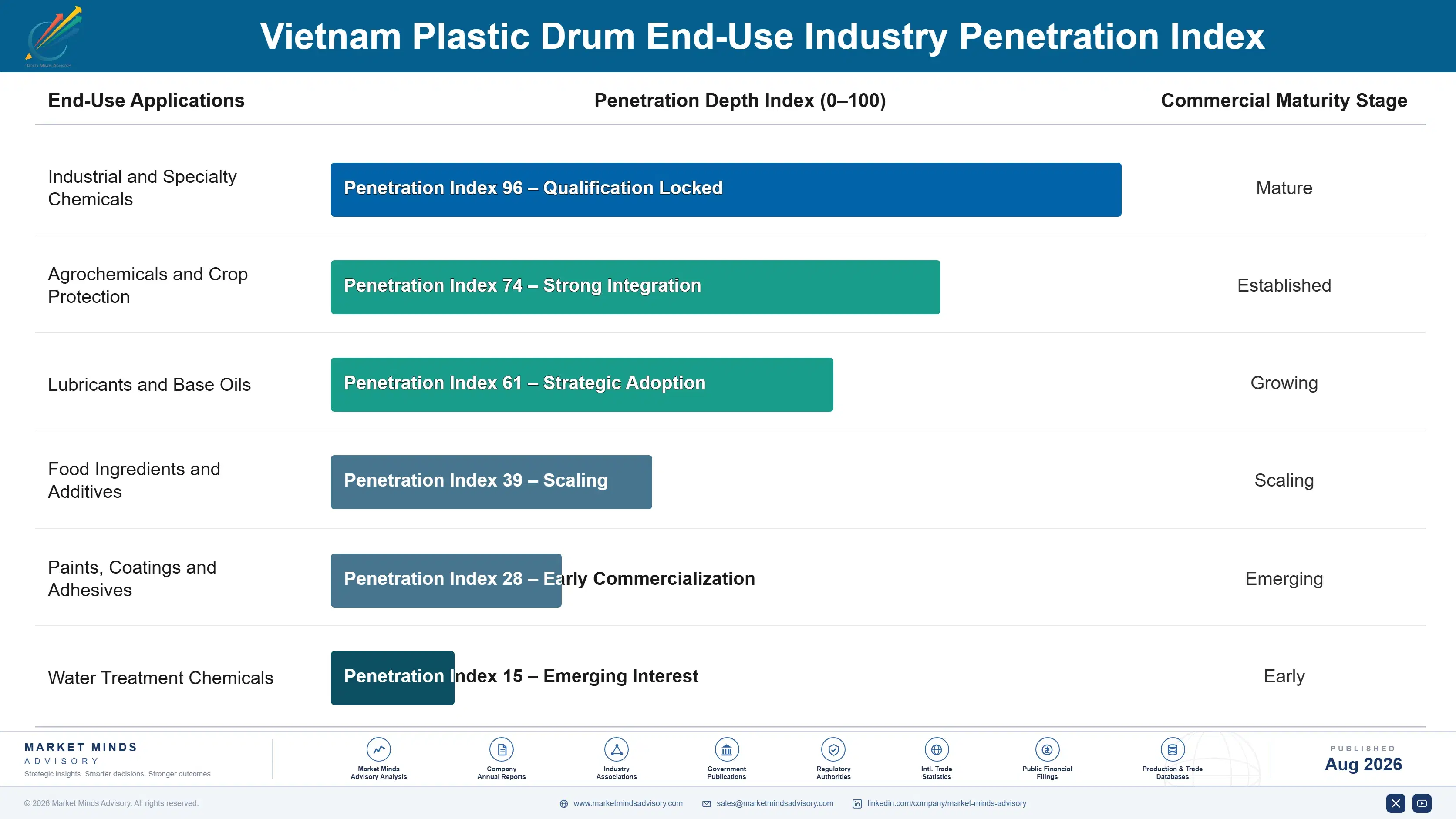
New drum demand is set by how many containers fail to come back rather than by how much liquid moves. A drum survives roughly four reconditioning cycles, so a system returning most containers needs far fewer new units than one losing 44% to informal buyers each time. Vietnam's diversion rate therefore props up new drum demand in a way nobody in the industry says out loud, and formalising recovery would reduce the volume converters sell.
Stickiness follows certification and requalification rather than relationship. A chemical customer using a certified drum design cannot switch supplier without requalifying the packaging against its own hazardous goods documentation, which is slow and rarely worth doing. General industrial buyers switch on price at every order. Closed loop reconditioning customers are stickiest of all, since the arrangement involves logistics both parties built together.

The specifier moved upstream and the buyer stayed put. Container requirements are increasingly written during plant design by engineering teams weighing handling, storage and compliance, years before any procurement conversation happens. Purchasing then negotiates price against a specification it cannot change. Converters whose commercial coverage reaches only procurement are visiting people implementing a decision somebody else already made.
vietnam-plastic-drum-market-end-use-penetration-index-1787641623217

Where Drum Value Actually Sits

These are among the four positions where our research anticipates prominent divergence between winners and laggards over the coming forecast period. Each is grounded in the demand model, the regulatory perimeter, and the announced capacity pipeline.
01 / CERTIFICATION BARRIER BUILDING

Approval cost is a moat rather than an overhead

United Nations design type approval for hazardous goods packaging costs roughly 46,000 dollars per design in drop, stack, leakproofness and hydraulic testing, and must be repeated whenever resin or geometry changes anywhere. That excludes most small Vietnamese converters from agrochemical and specialty chemical volume entirely, which is exactly where multi year contracts and better margins sit. A larger converter should be adding certified designs deliberately in order to widen a gap that competitors cannot possibly close without matching the same investment.
02 / RETURN FLOW CONTROL

You cannot outbid a man paying cash for tanks

Roughly 44% of used drums leave the industrial system for water storage, aquaculture and construction, bought by informal purchasers paying cash and carrying no washing, testing or compliance cost whatsoever. A reconditioner competing for open market feedstock is bidding against somebody with no costs at all, which is not a contest capital investment wins. Closed loop arrangements with single large customers keep containers out of that market entirely, and reconditioned drums grow at 11.6% on precisely the flow that stays inside a controlled system.
03 / SUBSTITUTION PARTICIPATION CHOICE

Supply the container replacing your own product

Each intermediate bulk container removes roughly five drums from circulation, and multinational chemical users keep converting wherever handling infrastructure allows, driven by logistics arithmetic no packaging argument reverses. Inner bottles for those containers grow at 13.8% against a market rate of 9.2%, so a converter can capture the substitution rather than lose to it entirely. The volume and margin profile differs uncomfortably from supplying drums, and the alternative is watching that volume move to a competitor who accepted the change first.
04 / DESIGN STAGE ACCESS

Packaging gets chosen before procurement is involved

Chemical, agrochemical and lubricant plants across Dong Nai, Binh Duong and Ba Ria Vung Tau specify container requirements during facility design, and Dong Nai grows at 12.4%, faster than any area covered in this market. A converter selected at that stage supplies for years, because changing packaging afterwards requires requalification against hazardous goods documentation that no operator undertakes casually. Those decisions sit with engineering teams rather than purchasing, which is a completely different commercial relationship from the one most converters currently maintain.

Engagement Snapshot From the Field

A live engagement with an industry participant carrying material or product regulatory and market exposure ahead of a defining policy shift, showing how our research translates into a defensible multi-year portfolio strategy.
MARKET MINDS ADVISORY · CLIENT ENGAGEMENT SUMMARY
Vietnam Plastic Drum Producer Strategic Portfolio Review and Transition Roadmap 2026·Investment Scenario on Vietnam Plastic Drum Exposure Evaluation 2025-26
CLIENT PROFILE
A Vietnamese industrial packaging converter producing HDPE drums and jerrycans from two sites in the southern provinces, supplying chemical, lubricant and food ingredient customers. Annual revenue was approximately 41 million dollars (client-reported, unverified by MMA), with 76% from uncertified general industrial containers. Two certified designs existed, no reconditioning capability had been built and no inner bottle production ran.
STRATEGIC CHALLENGE
Two chemical customers had converted substantial volume to intermediate bulk containers and a third had signalled the same intention, while general industrial drum pricing had eroded at successive renewals. Management wanted to know whether to invest in certification, reconditioning or inner bottle capability. A reconditioning proposal had been prepared assuming open market feedstock availability.
MMA APPROACH
MMA modelled drum volume at risk from bulk container substitution by customer and application, which the company had never quantified. Reconditioning feedstock economics were tested against informal market pricing observed at collection points. Forty-seven expert interviews with chemical plant engineers, procurement leads, reconditioners and informal collectors established where used drums actually go and what determines packaging selection.
KEY FINDINGS
  1. Roughly 38% of the client's drum volume sat with customers whose handling infrastructure already supported bulk container conversion, and substitution was a matter of timing rather than possibility.
  2. Informal collectors paid roughly 2.1 times what a compliant reconditioner could offer for used drums, which made the open market feedstock assumption in the internal proposal unworkable.
  3. Certified design volume carried gross margin roughly 2 times general industrial drums, and only 4 converters in the country held approvals across the relevant size range.
  4. Plant engineers rather than procurement selected packaging in 41 of the 47 facilities examined, typically during design and several years before any supply contract existed.
CLIENT PROFILE
A Vietnamese industrial packaging converter producing HDPE drums and jerrycans from two sites in the southern provinces, supplying chemical, lubricant and food ingredient customers. Annual revenue was approximately 41 million dollars (client-reported, unverified by MMA), with 76% from uncertified general industrial containers. Two certified designs existed, no reconditioning capability had been built and no inner bottle production ran.
STRATEGIC CHALLENGE
Two chemical customers had converted substantial volume to intermediate bulk containers and a third had signalled the same intention, while general industrial drum pricing had eroded at successive renewals. Management wanted to know whether to invest in certification, reconditioning or inner bottle capability. A reconditioning proposal had been prepared assuming open market feedstock availability.
MMA APPROACH
MMA modelled drum volume at risk from bulk container substitution by customer and application, which the company had never quantified. Reconditioning feedstock economics were tested against informal market pricing observed at collection points. Forty-seven expert interviews with chemical plant engineers, procurement leads, reconditioners and informal collectors established where used drums actually go and what determines packaging selection.
KEY FINDINGS
  1. Roughly 38% of the client's drum volume sat with customers whose handling infrastructure already supported bulk container conversion, and substitution was a matter of timing rather than possibility.
  2. Informal collectors paid roughly 2.1 times what a compliant reconditioner could offer for used drums, which made the open market feedstock assumption in the internal proposal unworkable.
  3. Certified design volume carried gross margin roughly 2 times general industrial drums, and only 4 converters in the country held approvals across the relevant size range.
  4. Plant engineers rather than procurement selected packaging in 41 of the 47 facilities examined, typically during design and several years before any supply contract existed.
RECOMMENDED STRATEGY
Phase 1: Phase one: abandon the open market reconditioning proposal, since informal collectors pay roughly 2.1 times what compliant economics can support. Phase 2: Phase two: invest in certification across the relevant size range, where margin runs roughly 2 times general industrial and only 4 converters qualify. Phase 3: Phase three: add inner bottle capability, since 38% of existing drum volume sits with customers who can convert to bulk containers.
OUTCOME
The client cancelled the reconditioning investment and redirected the capital into certification and inner bottle capability. Certified volume grew to a meaningful share of revenue within eighteen months, and the company retained two customers that converted to bulk containers by supplying their inner bottles instead of losing the accounts entirely (client-reported, unverified by MMA).

Frequently Asked Questions

Foundational context covering the market sizes, CAGR, scope, country, region and competition that inform every finding below. This section is provided to cover basics and most often pre-purchase conversations, answered from the MMA Primary Research Dataset.

What is the current size of the Vietnam Plastic Drum Market?

The market was valued at 0.19 billion dollars in 2025, covering plastic drums and industrial containers between twenty and two hundred and twenty litres. It reaches an estimated 0.21 billion dollars during 2026.

How large will the Vietnam Plastic Drum Market be by 2036?

MMA forecasts 0.51 billion dollars by 2036, an increase of 0.30 billion dollars over the 2026 base. That represents an expansion multiple of 2.43 times across the forecast period.

What is the CAGR for the Vietnam Plastic Drum Market 2026 to 2036?

The base case compound annual growth rate is 9.2%, with a bull case of 10.4% and a bear case of 8.0%. Recovery formalisation and bulk container substitution separate those scenarios.

Which segment is growing fastest?

Intermediate bulk container inner bottles grow at 13.8%, half again the market rate of 9.2%, as containers replace drums. Reconditioned and reused drums follow at 11.6%.

Who are the major companies in the Vietnam Plastic Drum Market?

Tan Phu Vietnam, Duy Tan Plastics, Greif, Mauser Packaging Solutions and Thai Containers Group lead on drum and container volume supplied. Together they account for 38% of the market.

Which country is growing fastest?

The market is defined as Vietnamese production and consumption, and Dong Nai grows fastest of any province at 12.4% on chemical processing and industrial park development.

Report Segmentation Architecture

The full report scope spans multiple orthogonal segmentation dimensions, with cross-tabulated demand data provided for each dimension pair. Coverage extends further to regional breakdowns, trend trajectories, and the competitive detail needed to support segment-level decision-making.

By Container Format

  • HDPE Tight Head Drums
  • HDPE Open Head Drums
  • Jerrycans and Small Industrial Containers
  • Intermediate Bulk Container Inner Bottles
  • Reconditioned and Reused Drums
  • Multilayer and Fluorinated Barrier Drums

By End-Use Industry

  • Industrial and Specialty Chemicals
  • Agrochemicals and Crop Protection
  • Lubricants and Base Oils
  • Food Ingredients and Additives
  • Paints, Coatings and Adhesives
  • Water Treatment Chemicals

By Commercial Dimension

  • Direct Industrial Supply
  • Multinational Global Agreements
  • Design Stage Specification
  • Closed Loop Return Arrangements
  • Distributor and Trade Supply
  • Reconditioning Service Contracts

By Region

  • North America
  • Western Europe
  • East Asia
  • South Asia and Pacific
  • Latin America
  • Middle East and Africa
  • Eastern Europe

Scope, Methodology, and Coverage

Every figure in this report is reproducible from documented input assumptions. The scope below maps the historical period, the forecast horizon, the segmentation dimensions, and the countries covered, alongside the underlying primary and qualitative methodology.
Historical Period
2020 to 2025
Forecast Period
2026 to 2036
Base Year
2025 (USD billions; MMA Primary Research Dataset, August 2026)
Market Definition
Rigid plastic drums and industrial containers between twenty and two hundred and twenty litres manufactured, reconditioned and sold within Vietnam, covering HDPE tight head drums, HDPE open head drums, jerrycans and small industrial containers, intermediate bulk container inner bottles, reconditioned and reused drums, and multilayer and fluorinated barrier drums. Measured at converter and reconditioner selling value. Bottles and containers below twenty litres, steel and fibre drums, flexible bulk containers, closures sold separately, and resin production are excluded from scope.
Quantitative Units
USD billions (current prices); drums and containers produced; USD per unit by container format
Segmentation Dimensions
Container format; end-use industry; commercial dimension; region
Regions Covered
North America, Western Europe, East Asia, South Asia and Pacific, Latin America, Middle East and Africa, Eastern Europe
Countries Covered
Vietnam, Thailand, Indonesia, Malaysia, Singapore, Philippines, China, South Korea, Taiwan, Japan, India, Australia, United States, Germany, Netherlands, France, Brazil, Mexico, Saudi Arabia, Poland
Key Companies Profiled
Tan Phu Vietnam, Duy Tan Plastics, Greif, Mauser Packaging Solutions, Thai Containers Group, Nhua Sai Gon, Long Thanh Plastic, Dai Dong Tien, Bao Van Plastic, Nam Viet Plastic, Rang Dong Holding, Time Technoplast, Schutz, Balmer Lawrie, Sotralentz Packaging, Hoover Ferguson, Snyder Industries, Nhua Binh Minh, Viet Han Plastic, An Phat Holdings
Quantitative Methodology
Primary survey, n=3,800 respondents, Q4 2025, six countries; demand-side model with trade association cross-validation
Qualitative Methodology
47 expert interviews, Q4 2025; applied to validate demand model assumptions, identify emerging dynamics, and assess competitive positioning
Report Format
PDF and XLSX data workbook (Word format preview document)
Publisher
Market Minds Advisory
Report Code
MMA-2026-PAC-106
Published
August 2026
Contact
sales@marketmindsadvisory.com | www.marketmindsadvisory.com

Purchase the full Vietnam Plastic Drum Market Report (2026 to 2036).

The full report treats industrial drums as a returnable asset that most of the market never gets back, since informal buyers outbid reconditioners for containers worth more as water tanks than as packaging. It sizes all six container formats independently through 2036, models drum volume at risk from bulk container substitution by customer application, and quantifies certification investment against the contract volume it opens. Regional chapters cover all seven regions, with resin origin and specification authority assessed separately from Vietnamese demand. Competitive profiling covers 20 participants on one consistent volume supplied basis.
Six container formats sized independently through 2036
Drum volume at substitution risk modelled by customer application
Certification investment quantified against contract volume opened
Informal and formal recovery flows measured separately by format
Resin origin and specification authority assessed separately from demand
Twenty participants profiled on one consistent volume basis

Built For The People Who Decide

From boardroom strategy to bench-side execution, this report is read cover-to-cover by leaders shaping the next decade of their industry, turning demand scenarios, market dynamics and valuation benchmarks into decisions.
CXOs/ Presidents/ VPs/ Managers
M&A and Corporate Development
Strategy Teams and R&D Heads
Procurement and Product Directors
Regulatory and Compliance Leaders
Investor Relations and Equity Analysts