

Market Minds Advisory
Video Surveillance Storage Market

Video Surveillance Storage Market: Video Surveillance Storage Market. AI Analytics and Retention Mandates Force a Storage Overhaul

Rising camera resolution and AI-driven video analytics are multiplying the raw footage volume every surveillance system must retain, forcing operators still running on-premise NVR boxes toward scalable cloud and hybrid storage architectures.

Lead Analyst

Published

September 2026

Make Smarter Decisions with Customized Research Insights

Request a free sample report and evaluate market opportunities, growth trends, and competitive dynamics relevant to your business needs.

2025 MARKET VALUE$8.4BMarket Size 2025
2036 FORECAST VALUE$28.6BBase Case , 2026 to 2036
CAGR 2026 TO 203611.8 %Bull 13.1% / Bear 10.5%
INCREMENTAL OPPORTUNITY$19.3BNet 10- year value creation
EXPANSION MULTIPLE3.05x2036 value over 2026 base
Strategic Levers
M&A Pipeline
Regional Outlook
Country Rankings
Competitive Intelligence
Segmental Deep-dive
Call-Us : 91 93563 13602

Executive Snapshot and Market Trajectory.

A single AI analytics upgrade can triple the storage footprint of an existing camera network almost overnight, and that simple math alone is now the single biggest line item security integrators must carefully negotiate on every enterprise surveillance contract signed today across nearly every industry vertical worldwide.
Retail loss prevention, smart city public safety deployments, and critical infrastructure protection together drive most enterprise demand, each pushing operators toward tiered storage architectures that balance cost against retention length required by policy or contract terms. East Asia's enormous installed base of public and private security cameras, concentrated overwhelmingly in China, gives the region an outsized role in global storage demand that dwarfs its share of total camera manufacturing revenue alone today.
Five vendors hold under half of global unit and capacity sales, a fragmented landscape reflecting how differently storage gets bought depending on whether the buyer wants on-premise hardware, hybrid architecture, or fully managed cloud VSaaS instead of a fixed choice. Tightening video retention mandates in several jurisdictions are pushing operators toward longer storage windows, favoring flexible vendors over rigid fixed-array hardware sold as a single unit.
Market Definition
The video surveillance storage market covers hardware, software, and cloud-based systems used to store, manage, and retrieve recorded video footage from security camera networks, including NVR/DVR appliances, SAN/NAS arrays, and video-surveillance-as-a-service cloud platforms. It excludes the cameras themselves and video analytics software sold independently of storage capacity.
Base Year Value
$8.4B in 2025 (MMA Primary Research Dataset, September 2026)
Forecast Period
2026 to 2036, eleven discrete annual values
CAGR
11.8% base case. Bull 13.1%. Bear 10.5%.
Fastest Growth Segment
Cloud/VSaaS Storage: 17.9% CAGR
Fastest Growth Country
India: 15.2% CAGR
Fastest Growth Region
South Asia and Pacific: 13.8% CAGR
Largest Region
East Asia: 30% of 2025 global value
Market Leaders
Dahua Technology, Hikvision, Western Digital, Seagate Technology, and Milestone Systems lead the market. Source: MMA Primary Research Dataset, July 2026.
Primary Survey
n=3,800 procurement and R&D decision-makers, Q4 2025, six countries
Methodology
Demand-side build-up, cross-validated against public data, 47 expert interviews

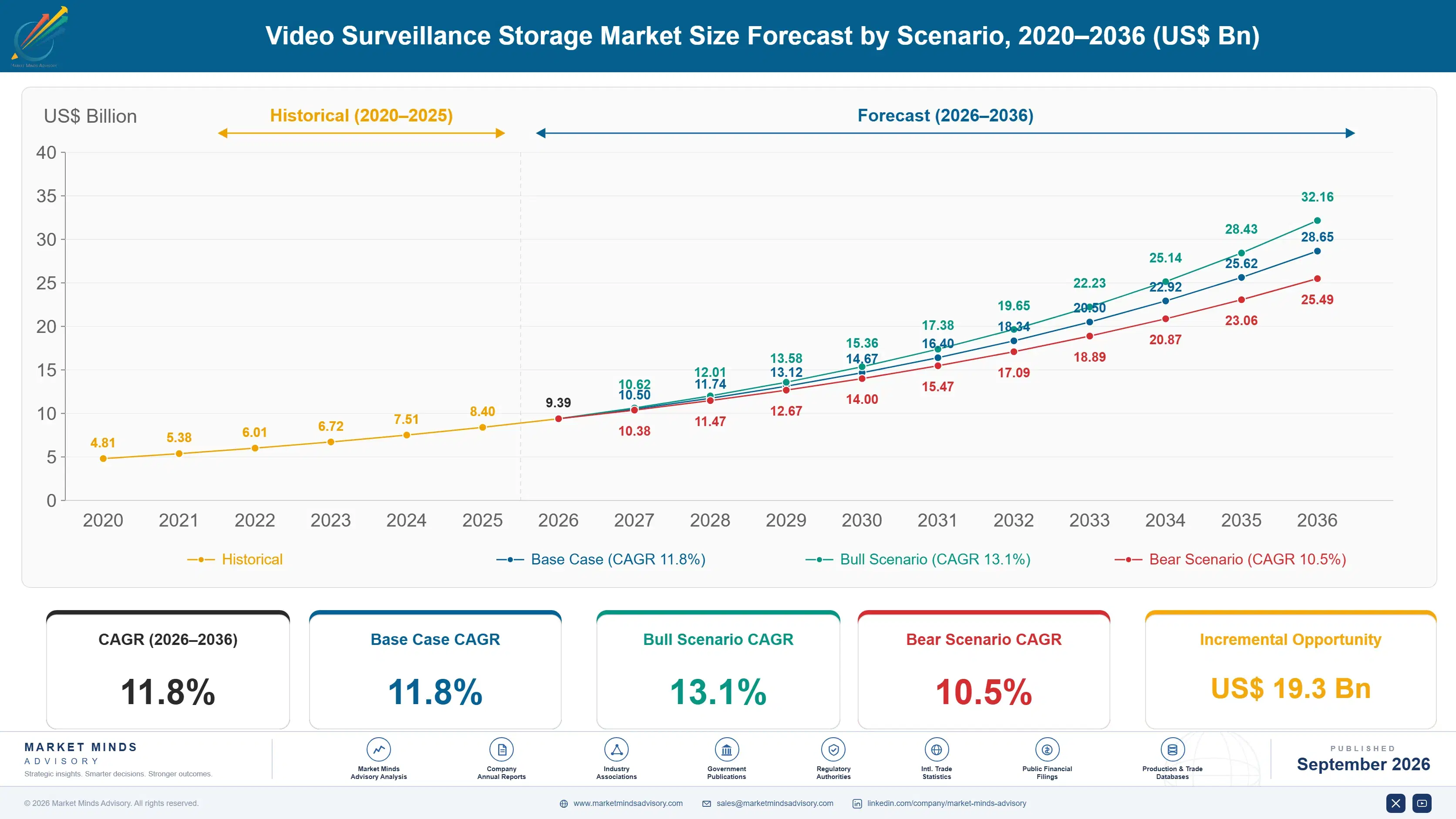
Video Surveillance Storage Market Forecast Scenarios

video-surveillance-storage-market-size-forecast-scenario-1790002786507
Between 2020 and 2025 the market grew at roughly 10.8% a year as pandemic-era supply chain disruption slowed camera and storage hardware shipments before a strong rebound in smart city projects and enterprise security spending pulled demand forward again through the back half of the period across most major deployment regions worldwide, particularly across East Asia and Europe.
The base case assumes 11.8% annual growth through 2036, built on three mechanisms: rising camera resolution and AI-driven video analytics that multiply raw footage volume requiring long-term storage capacity across every camera deployment, expanding cloud and VSaaS adoption that shifts spending from one-time hardware purchases toward recurring subscription revenue streams, and tightening video retention mandates across several jurisdictions that extend required storage windows well beyond historical norms established years ago.
A bull case near 13.1% follows if additional national governments mandate longer video retention periods similar to those already active in parts of Europe and East Asia today and beyond. The principal bear risk, a slowdown in enterprise capital spending that delays smart city and surveillance infrastructure projects across major economies worldwide, would instead pull growth toward 10.5%.

Video Surveillance Storage Market Overview

Video surveillance storage sits at the point where a camera's raw footage either becomes usable evidence or vanishes into an overwritten buffer, and that intersection has turned a once-simple hard drive purchase into a genuine architecture decision. Buyers no longer choose storage purely on capacity per dollar. They increasingly demand tiered retention, AI-friendly indexing, and cloud failover that satisfies both operational needs and legal evidentiary requirements.
MARKET CONCENTRATIONCR5 46%Top five vendors hold under half of global capacity sales
AVERAGE SELLING PRICE$120-8,500Price spans consumer NVR units to enterprise storage arrays
LEADING PRODUCING COUNTRYChina, 34% shareChinese manufacturers concentrate storage hardware and camera production
CLOUD STORAGE ADOPTION31% of new deploymentsEnterprise buyers increasingly favor managed cloud storage subscriptions
TRADE INTENSITY37% import shareMany national markets rely heavily on imported storage hardware
INPUT COST SHARE46%Hard disk drives and NAND flash components dominate unit cost
China hosts a disproportionate share of storage hardware and camera manufacturing, reflecting the country's enormous domestic surveillance camera installed base and vertically integrated supply chains built over many years. East Asia more broadly is the largest single demand pool by volume, driven by extensive public security deployments and a growing enterprise sector adopting cloud-based video management alongside traditional on-premise hardware.
Cloud storage adoption is accelerating faster than the overall market, since it lets smaller operators avoid large upfront hardware purchases in favor of predictable monthly costs that scale directly with camera count over time. Import dependence remains significant across most national markets outside East Asia, since storage hardware manufacturing concentrates in a relatively small number of production centers worldwide.
"Storage used to be an afterthought bolted onto a camera contract. Now it's the line item that decides whether the whole deployment gets approved, because nobody wants to explain a gap in the footage during a lawsuit."
Director, Security and Surveillance Practice · MMA Technology Practice · September 2026

Market Trends

AI video analytics multiply required storage capacity per camera

Deploying object detection, facial recognition, or license plate recognition analytics onto an existing camera network typically increases the metadata and higher-resolution recording associated with each triggered event, multiplying the effective storage footprint well beyond what the raw video stream alone would ever require. Operators upgrading analytics capability increasingly discover their existing storage arrays reach capacity far sooner than originally planned, forcing an unplanned hardware or cloud capacity expansion mid-contract. Storage vendors are responding with tiered architectures that separate raw footage from analytics-flagged event clips, each retained on different cost profiles.
Market Impact: 600 million cameras under public deployment

Hybrid cloud architectures displace pure on-premise storage deployments

Enterprise security teams are increasingly adopting hybrid storage architectures that keep recent, frequently accessed footage on local hardware while automatically archiving older recordings to cloud storage tiers priced specifically for infrequent access patterns and long retention windows. This approach balances the low-latency retrieval operators need for active investigations against the lower per-terabyte cost that cloud archival tiers offer for long-term retention compliance requirements. Storage vendors and cloud providers have both introduced purpose-built connectors that automate this tiering process without requiring manual intervention from security operations staff on a daily basis.
Market Impact: 4x data volume at 4K resolution

Market Opportunities and Growth Drivers

Smart city public safety programmes drive large-scale storage procurement

Municipal governments across East Asia, the Middle East, and parts of Europe are expanding public safety camera networks as part of broader smart city initiatives, each new deployment requiring storage infrastructure sized for retention periods often set by national security regulations rather than pure operational preference. These programmes typically procure storage at a scale that dwarfs ordinary commercial security contracts, giving vendors that win a single municipal contract meaningful revenue visibility over a multi-year deployment schedule. China's public security camera network expansion alone represents one of the largest storage procurement programmes tracked anywhere in the world.
Market Impact: 2,800 dollar cost increase yearly

Rising camera resolution multiplies raw footage volume requiring storage

The industry-wide shift from standard-definition and early high-definition cameras toward 4K and higher resolution sensors has multiplied the raw data volume each camera generates per hour of recording, directly increasing the storage capacity required to maintain equivalent retention periods across every deployment. Enterprise buyers replacing aging camera fleets increasingly discover that matching resolution upgrades with proportional storage expansion is non-negotiable rather than optional, since under-provisioned storage forces earlier footage deletion than intended. This resolution-driven capacity growth compounds independently of camera count increases, adding a second, distinct source of storage demand.
Market Impact: 35% lower cloud adoption rurally

Market Restraints and Challenges

Extended retention mandates strain smaller operator storage budgets

Jurisdictions extending mandatory video retention periods from weeks to months or years impose a storage cost burden that falls disproportionately on smaller retailers and property managers operating with fixed security budgets rather than dedicated infrastructure funding. The root cause is that regulators set retention mandates uniformly regardless of operator size, but larger enterprises can amortize storage cost across a much bigger camera fleet than a single small business location realistically can. Several storage vendors have introduced tiered subscription pricing scaled to camera count specifically to lower this barrier for smaller operators.
Market Impact: 3x storage growth after analytics upgrade

Bandwidth constraints limit cloud storage adoption in remote locations

Remote and rural surveillance deployments, including agricultural sites, pipeline monitoring stations, and border security installations, often lack the reliable, high-bandwidth internet connectivity that cloud storage architectures depend on for continuous footage upload throughout the entire day and night without any interruption. The underlying cause is that broadband infrastructure investment has historically prioritized population centers over sparsely populated areas where much critical infrastructure monitoring actually occurs day to day. Several vendors now offer edge storage appliances that buffer footage locally and upload during available connectivity windows, partially mitigating this ongoing constraint.
Market Impact: 28% annual hybrid architecture growth
4 additional market trends, 3 additional growth drivers, and 3 additional restraints and challenges are covered in the full report. Contact sales@marketmindsadvisory.com to access the complete intelligence.

Segment CAGR and Growth Architecture

Video surveillance storage segments cleanly by deployment architecture, the dimension that determines both cost structure and operational fit for a given customer or facility type over time. This framework separates on-premise NVR/DVR appliances, network-attached and storage-area network arrays, cloud/VSaaS platforms, hybrid cloud-edge architectures, and edge/in-camera storage, avoiding overlap between hardware configuration and delivery model.
Section default visual

Cloud/VSaaS Storage

Cloud/VSaaS storage is pulling ahead of every other configuration as smaller operators and multi-site enterprises convert what was once large upfront hardware capital expenditure into predictable monthly operating expense tied directly to camera count and required retention length across every site and location. These platforms eliminate the need for on-site IT staff to manage storage hardware, patch firmware, or plan capacity expansions manually, a genuine advantage for retail chains and small businesses lacking dedicated technical resources of their own. Security integrators increasingly favor recommending cloud storage because it generates recurring commission revenue rather than a single hardware sale, aligning incentives across the entire sales channel from installer to end customer.
CAGR 17.9%

Network-Attached and Storage-Area Network Arrays

Network-attached and storage-area network arrays remain the largest single configuration by installed capacity worldwide today, continuing to serve large enterprise and government deployments that require predictable, low-latency local access to footage for active investigations and compliance audits conducted on a regular basis across many facilities nationwide and internationally each year consistently. Their appeal lies in complete control over data residency and security, a genuine requirement for government and critical infrastructure customers facing strict data sovereignty regulations that prohibit offsite storage of sensitive footage entirely under any circumstance. Large-scale smart city and transportation authority deployments continue generating steady replacement and expansion demand for this established, proven architecture across many jurisdictions worldwide.
CAGR 9.1%
Full segment breakdown across 7 segments available in the complete report.

Regional Architecture and Country Demand Map

East Asia leads on the scale of China's public security camera network, the largest in the world by installed device count, while North America and Western Europe follow closely behind on mature enterprise cloud storage adoption and stringent data retention regulation across their entire region.

East Asia

China operates the largest public security camera network in the world, spanning hundreds of millions of installed devices across urban and rural districts as part of ongoing national public safety initiatives that require substantial centralized storage infrastructure at massive scale. Domestic storage and camera manufacturers, including Dahua and Hikvision, supply the overwhelming majority of this demand directly, benefiting from vertically integrated supply chains and proximity to government procurement programmes across the country. South Korean and Japanese enterprises add a smaller but technically sophisticated demand layer, favoring hybrid cloud architectures over purely on-premise deployments common in the region's public sector installations. Ongoing five-year public safety infrastructure plans keep this demand pool expanding steadily each year.
Share: 30% | CAGR: 12.5% (2026 to 2036)

North America

The United States hosts a large and diversified commercial security market spanning retail loss prevention, critical infrastructure protection, and a rapidly expanding smart city segment adopting cloud-based storage architectures ahead of most other regions globally today. Enterprise buyers increasingly favor hybrid deployments that balance local retrieval speed against cloud archival cost savings, a preference reinforced by state-level data retention regulations that vary considerably across jurisdictions nationwide. Canadian enterprise and municipal demand adds meaningful incremental volume behind the much larger American market, growing at a broadly comparable pace overall. Federal infrastructure funding aimed at municipal safety systems adds a further incremental demand layer nationwide. This trend is expected to continue through the remainder of the decade across most states.
Share: 26% | CAGR: 12.9% (2026 to 2036)
Regional intelligence for 5 additional markets available in the complete report: Western Europe, South Asia and Pacific, Latin America, Middle East and Africa, Eastern Europe. Contact sales@marketmindsadvisory.com.
video-surveillance-storage-market-market-share-analysis-1790002787043

Where Margin Concentrates in Video Storage

Manufacturers and cloud providers capture the widest margins where storage becomes a recurring subscription relationship rather than a one-time hardware sale, and where retention mandates or analytics adoption force capacity expansion regardless of camera count growth alone. Four levers stand out as the clearest paths to expanding gross margin over the coming decade ahead.

Convert hardware buyers into recurring cloud subscribers

Vendors that migrate existing on-premise hardware customers toward hybrid or fully cloud-based storage subscriptions capture recurring revenue well beyond the original hardware sale, transforming a one-time transaction into an ongoing commercial relationship worth far more over its entire operating lifetime and beyond that. Several leading vendors have introduced trade-in programmes that credit existing hardware value toward a cloud subscription, lowering the switching barrier for customers hesitant to abandon familiar on-premise systems entirely. Enterprises accepting this migration report blended margin improvements of roughly 14 percentage points compared with pure hardware sales.
Market Impact: 14 percentage point margin uplift from cloud migration

Win exclusive framework status on smart city procurement programmes

Securing preferred-supplier status on a national or municipal smart city storage framework locks in multi-year volume and effectively excludes competitors from that specific programme's procurement cycle for the full contract duration ahead of any renewal. Governments increasingly run centralized procurement covering hundreds of camera sites simultaneously, and winning that single framework delivers guaranteed order flow that smaller competitors cannot match through individual municipal sales relationships. Manufacturers that invest early in government-specific certification typically hold their position for the full multi-year contract term, worth an estimated 16% revenue premium over spot sales.
Market Impact: 16% revenue premium earned on multi-year framework contracts

Bundle AI-ready storage tiers with analytics software partners

Storage vendors partnering directly with video analytics software providers to offer pre-integrated, analytics-optimized storage tiers capture margin that would otherwise flow entirely to standalone software vendors selling separately through their own independent channels and pricing models. This bundled approach also reduces integration friction for enterprise buyers who would otherwise need to validate compatibility between separate hardware and software purchases from different vendors entirely on their own initiative. Vendors offering these bundled packages report gross margins on the combined offering near 52%, meaningfully above what either component generates when sold independently.
Market Impact: 52% gross margin achieved on bundled analytics offerings

License compliance and retention management software directly

Compliance software platforms used by legal and security operations teams increasingly pay storage vendors for retention policy automation and chain-of-custody documentation that integrates directly with the underlying storage infrastructure managing the footage. This creates a software-like revenue stream layered on top of the original storage sale, carrying margins that substantially exceed those available on the physical storage hardware itself. Early adopters of this model report that compliance software licensing revenue, while still a modest share of total sales, carries gross margins above 64% and grows independently of new capacity shipment volume.
Market Impact: 64% gross margin achieved on compliance software licensing

Who Controls the Margin Pool

Five vendors, measured by unit and capacity shipment volume, hold under half of global video surveillance storage sales, leaving the remainder split among specialist NVR makers, cloud providers, and regional systems integrators. Dahua and Hikvision lead this group given their vertically integrated camera-plus-storage offerings across East Asia, and the gap to the third-ranked player is wide enough that challengers compete mainly for the remaining enterprise and government segments outside China.
Current competitive activity centres on hybrid cloud-edge architecture and AI-analytics integration, with vendors racing to bundle tiered storage that automatically routes footage between local and cloud tiers based on access frequency. Several producers have added compliance and retention management software to previously standalone hardware, letting a single sales relationship cover both storage and legal documentation needs.

Emerging pressure is coming from hyperscale cloud providers entering the VSaaS storage market directly, testing whether specialized surveillance vendors can defend their integration advantage against generic cloud infrastructure priced aggressively. Rankings are most likely to shift in North America and Western Europe, where enterprise buyers show greater willingness to adopt cloud-native architectures than incumbents in China's hardware-dominated market currently face.
video-surveillance-storage-market-country-cagr-analysis-1790002787572

Competitive Moat and Risk Dimensions

DAHUA TECHNOLOGY

Moat: Vertically integrated camera-storage bundling

Dahua sells camera hardware, storage appliances, and video management software as a single integrated system, letting the company win specification battles on total system reliability and support rather than competing purely on storage component pricing alone. This bundling advantage is difficult for pure-play storage vendors to replicate without a comparable camera manufacturing business behind them.
DAHUA TECHNOLOGY

Risk: Limited access to Western markets

Dahua faces increasing procurement restrictions in the United States and parts of Europe tied to national security concerns around Chinese-manufactured surveillance hardware, limiting its addressable market in some of the highest-margin enterprise and government segments. Diversifying toward markets without similar restrictions requires sustained investment in regional manufacturing and certification.
HIKVISION

Moat: Massive manufacturing scale advantage

Hikvision's sheer manufacturing scale, the largest in the entire global surveillance industry, gives it cost advantages in storage hardware production that smaller competitors cannot easily match, supporting aggressive pricing in price-sensitive commercial and residential segments across most developing markets worldwide and beyond into new territories.
HIKVISION

Risk: Reputational exposure limits enterprise wins

Hikvision faces similar procurement restrictions to Dahua in Western markets, compounded by reputational concerns among some enterprise customers wary of association with the brand regardless of actual product performance or security characteristics. This constrains its ability to win premium enterprise contracts outside markets where such concerns carry less commercial weight.

Players Tracked

Prominent Players

Dahua Technology
Hikvision
Western Digital
Seagate Technology
Milestone Systems

Other Key Players

Axis Communications
Genetec
Avigilon (Motorola Solutions)
Uniview Technologies
Verkada
Eagle Eye Networks
Arcules
Qumulo
NetApp
Synology
QNAP Systems
Nice Systems
Vivotek
Bosch Security Systems
Honeywell Security

Recent Developments

MARCH 2026

Western Digital launched a new enterprise storage line specifically optimized for AI video analytics workloads, featuring higher sustained write speeds designed to handle the increased recording volume analytics-triggered events generate. The launch targets systems integrators building analytics-heavy deployments for retail and smart city customers rather than general-purpose surveillance storage buyers.
Signal: Storage hardware makers are increasingly engineering specifically for analytics workloads rather than generic video recording use cases.
OCTOBER 2025

Milestone Systems and a major cloud infrastructure provider signed a partnership agreement integrating Milestone's video management software directly with the provider's cloud storage tiers, rather than requiring customers to build custom integrations themselves. The partnership targets enterprise customers seeking a single validated architecture spanning software and cloud storage.
Signal: Software and cloud infrastructure partnerships are steadily reducing integration friction for enterprise surveillance buyers across every deployment size.

Hard Drive and NAND Cost Exposure

Hard disk drives and NAND flash memory components together account for roughly 46% of unit cost of goods sold, sourced primarily from a small number of drive manufacturers concentrated in the United States, Japan, and Thailand, alongside NAND flash fabrication capacity concentrated in South Korea, Japan, and the United States. Enclosure and controller board components, sourced more regionally, add a further meaningful cost layer.
Global hard drive supply constraints during 2023, documented in multiple manufacturer annual reports and the US Census Bureau's manufacturing survey data, forced several storage vendors to extend lead times and raise prices on high-capacity drives specifically used in surveillance storage arrays across most product lines. Vendors unable to secure priority allocation from major drive manufacturers lost specification slots on time-sensitive enterprise and government tenders during this period.

Smaller manufacturers carry disproportionately more of this exposure because they lack the volume commitments and direct drive manufacturer relationships that larger competitors, including those with in-house drive production, use to secure priority allocation and preferential pricing. Vendors dependent on distributor channels rather than direct component sourcing relationships face longer lead times and higher per-unit costs, a persistent disadvantage that compounds during periods of genuine supply constraint.
video-surveillance-storage-market-company-positioning-matrix-1790002787769

Qualify drives from multiple manufacturers across two regions

Storage vendors increasingly qualify surveillance-grade hard drives from both US and Asian manufacturers rather than relying on a single supplier relationship, reducing the chance that one regional disruption halts production entirely across an entire product line. Western Digital and Seagate have both expanded qualified component sourcing options in recent product generations released to market.

Hold strategic drive inventory ahead of known demand cycles

Some vendors now hold larger safety stock of high-capacity drives ahead of known demand spikes tied to smart city procurement cycles, accepting higher working capital cost in exchange for reduced exposure to sudden allocation shortages during periods of scarcity. This approach requires accurate forecasting of government procurement timelines well in advance of actual orders being placed.

Portfolio Architecture for Margin Defence

Vendors organize product portfolios across three margin tiers that mirror how customers actually buy storage, ranging from basic consumer and small-business NVR appliances purchased on price alone to fully managed, analytics-optimized cloud platforms specified for enterprise deployment regardless of cost. Volume tier products carry the thinnest margins but the highest unit sales, while certified premium systems command significantly higher recurring revenue from customers that prioritize compliance and scalability over sticker price.
The tension between volume and premium tiers shows up most clearly in small business purchasing behavior, where budget constraints keep basic on-premise units selling steadily even as larger enterprises push toward hybrid cloud alternatives. High-value margin pools concentrate disproportionately in smart city and government procurement, where retention mandates and long-term service contracts justify premium pricing that ordinary commercial customers would resist paying.

Next-generation product lines integrating AI-ready tiered storage with automated compliance reporting are still a small share of total revenue but carry the highest margins in the entire portfolio, reflecting genuine software differentiation rather than hardware premium alone. Vendors investing here are positioning for a future where analytics-driven storage management makes basic, unmanaged capacity effectively obsolete for enterprise use.

Basic on-premise NVR appliances and consumer-grade NAS storage sold primarily on price to small businesses and residential customers with limited camera counts and modest retention requirements for everyday daily use.
Gross Margin

Hybrid cloud-edge architectures and validated enterprise arrays specified by larger businesses and government buyers that must demonstrate documented retention compliance and reliable local access consistently across every single deployed site.
Gross Margin

AI-analytics-optimized cloud platforms with automated compliance reporting, positioned for a regulatory and operational environment that increasingly treats intelligent, tiered storage management as standard rather than optional practice going forward for everyone.
Gross Margin
video-surveillance-storage-market-cost-volatility-analysis-1790002788270

High-value Sub-segments and Strategic Watch-out

Cloud/VSaaS Storage

High-value and high-growth simultaneously, this segment benefits from both smaller operator adoption and enterprise migration away from hardware ownership, commanding recurring subscription revenue while adding volume faster than any other configuration in the entire market today across nearly every region. Manufacturers are prioritizing this configuration in future product roadmaps.

Network-Attached and Storage-Area Network Arrays

High-value with moderate but steady growth, these arrays carry solid margins tied to data sovereignty requirements, expanding gradually as government and critical infrastructure buyers maintain strict local control over sensitive footage across their entire facility networks. Replacement cycles here tend to run longer than in other categories.

On-Premise NVR/DVR Appliances

The volume core of the market, generating the largest unit sales base even as growth slows relative to cloud and hybrid alternatives, remaining essential for small business and residential deployments across every region tracked in this annual report. Rental and financing programmes are helping sustain unit volume in this category.

Edge/In-Camera Storage

A strategic watch-out segment where growth depends heavily on camera manufacturers embedding sufficient onboard storage capacity, creating demand that is real but sensitive to component cost trends and manufacturer design choices made each fiscal year. Manufacturer decisions here carry outsized influence on overall segment trajectory.

Recurring Storage Subscription Economics

Video surveillance storage generates something close to annuity economics once a customer adopts a cloud or hybrid subscription model, because every active camera continues generating footage requiring storage regardless of broader capital spending cycles. Capacity expansion follows camera count growth or retention policy changes rather than discretionary upgrade decisions, giving vendors offering subscription models unusually predictable long-term revenue visibility across their customer base.
Adoption depth varies sharply by end-use vertical. Government and critical infrastructure customers exhibit the deepest stickiness, having standardized architecture around specific validated platforms tied directly to data sovereignty and security certification requirements that discourage switching vendors mid-contract. Retail and small business customers show comparatively looser loyalty, frequently choosing storage based on price and camera bundle deals rather than any fixed long-term architectural standard.

A generational shift in buyer profile is underway as younger security operations managers, more comfortable evaluating cloud dashboards and analytics integration than raw storage capacity specifications, increasingly influence purchasing decisions once made almost entirely by facilities or IT staff. This shift favors vendors who can present a compelling software and analytics story alongside traditional storage capacity claims that dominated buying conversations for decades.
Section default visual

MMA Verdict on Surveillance Storage

These are among the four positions where our research anticipates prominent divergence between winners and laggards over the coming forecast period. Each is grounded in the demand model, the regulatory perimeter, and the announced capacity pipeline.
01 / CLOUD MIGRATION STRATEGY

Actively convert hardware customers before competitors capture them

Vendors treating cloud migration as a passive, customer-initiated option rather than an active sales motion risk losing existing hardware customers to competitors offering aggressive trade-in and migration incentives first, before any counter-offer is made. Converting a hardware relationship into a cloud subscription generates meaningfully higher lifetime revenue per customer than defending the original one-time hardware sale indefinitely against inevitable erosion. The window to lead this conversion before customers migrate to a competitor's cloud platform instead is closing fast within the next few years.
02 / ANALYTICS INTEGRATION STRATEGY

Partner with analytics vendors rather than building in-house capability

Storage vendors attempting to build competitive video analytics capability entirely in-house risk diverting engineering resources away from their core storage architecture strength toward a discipline where established analytics specialists already hold a meaningful head start built over years. Partnering with analytics vendors to offer pre-integrated, bundled storage tiers captures much of the same commercial benefit without the multi-year investment required to build comparable capability internally from scratch. This approach also preserves flexibility to switch analytics partners as the technology continues evolving rapidly.
03 / GEOGRAPHIC EXPANSION PRIORITY

Prioritize India and Southeast Asia public safety expansion

East Asian demand already carries deep penetration among domestic manufacturers with vertically integrated camera-plus-storage offerings and strong government relationships built over many years of continuous engagement across the region. India's rapidly expanding public safety and commercial security camera deployment offers considerably more room for genuine share gain than defending position in China's already saturated, domestically dominated market segment. Vendors building local cloud infrastructure and service capability early will capture this growth well before competitors arrive in meaningful force across the subcontinent.
04 / COMPLIANCE SOFTWARE STRATEGY

Treat retention compliance tools as a licensable product line

Retention policy automation and chain-of-custody documentation carry genuine value to legal and security operations teams that extends well beyond the immediate storage sale they were originally developed to support in the first place at launch. Vendors currently give this capability away as a bundled feature rather than pricing it as a separate, high-margin product line worth real recurring revenue over time. Charging for compliance software, even modestly at first, converts an underused software asset into a durable, recurring revenue stream.

Engagement Snapshot From the Field

A live engagement with an industry participant carrying material or product regulatory and market exposure ahead of a defining policy shift, showing how our research translates into a defensible multi-year portfolio strategy.
MARKET MINDS ADVISORY · CLIENT ENGAGEMENT SUMMARY
Video Surveillance Storage Producer Strategic Portfolio Review and Transition Roadmap 2026·Investment Scenario on Video Surveillance Storage Exposure Evaluation 2025-26
CLIENT PROFILE
The client is a national retail chain operating several thousand stores across the United States, each equipped with an aging on-premise NVR system approaching end of hardware life. The chain sought to modernize its surveillance storage architecture while simultaneously reducing the operational burden that maintaining thousands of individual on-site hardware appliances placed on its limited internal IT staff.
STRATEGIC CHALLENGE
The chain needed to migrate thousands of individual store locations toward a hybrid cloud storage architecture without disrupting loss prevention operations at all during the transition, all while managing the migration within a fixed annual technology budget that limited how many stores could convert simultaneously in any single rollout phase.
MMA APPROACH
MMA conducted a comparative assessment of leading hybrid storage platforms against the chain's specific bandwidth constraints, retention requirements, and existing loss prevention workflow needs across its entire store network nationwide. The engagement included a phased migration plan sequencing conversion by store cluster to manage cost within annual budget cycles effectively.
KEY FINDINGS
  1. Phased migration reduced per-store IT support costs by an estimated 35%, based on client-reported operational data collected across the first year of rollout.
  2. Hybrid architecture cut local hardware failure incidents by roughly 60% across the network, according to client-reported maintenance ticket data shared during the engagement review.
  3. Cloud archival tiers reduced total storage cost per store by approximately 20% compared with the prior on-premise-only architecture, per client-reported budget figures.
  4. Store clusters completing migration first reported measurably faster loss prevention footage retrieval times overall, according to client-reported operational feedback surveys conducted afterward.
CLIENT PROFILE
The client is a national retail chain operating several thousand stores across the United States, each equipped with an aging on-premise NVR system approaching end of hardware life. The chain sought to modernize its surveillance storage architecture while simultaneously reducing the operational burden that maintaining thousands of individual on-site hardware appliances placed on its limited internal IT staff.
STRATEGIC CHALLENGE
The chain needed to migrate thousands of individual store locations toward a hybrid cloud storage architecture without disrupting loss prevention operations at all during the transition, all while managing the migration within a fixed annual technology budget that limited how many stores could convert simultaneously in any single rollout phase.
MMA APPROACH
MMA conducted a comparative assessment of leading hybrid storage platforms against the chain's specific bandwidth constraints, retention requirements, and existing loss prevention workflow needs across its entire store network nationwide. The engagement included a phased migration plan sequencing conversion by store cluster to manage cost within annual budget cycles effectively.
KEY FINDINGS
  1. Phased migration reduced per-store IT support costs by an estimated 35%, based on client-reported operational data collected across the first year of rollout.
  2. Hybrid architecture cut local hardware failure incidents by roughly 60% across the network, according to client-reported maintenance ticket data shared during the engagement review.
  3. Cloud archival tiers reduced total storage cost per store by approximately 20% compared with the prior on-premise-only architecture, per client-reported budget figures.
  4. Store clusters completing migration first reported measurably faster loss prevention footage retrieval times overall, according to client-reported operational feedback surveys conducted afterward.
RECOMMENDED STRATEGY
Phase 1: Phase one: pilot the hybrid architecture across a small cluster of stores to validate bandwidth and workflow fit thoroughly before wider rollout. Phase 2: Phase two: expand migration by regional store cluster over eighteen months, sequencing conversion carefully by annual budget availability each year. Phase 3: Phase three: retire remaining legacy on-premise hardware entirely and standardize compliance reporting fully across the entire full store network nationwide.
OUTCOME
The chain completed its hybrid storage migration within the planned budget and timeline, reporting measurable improvements in IT support cost, hardware reliability, and storage cost per store, all figures client-reported and unverified by MMA. The engagement also established a phased migration template applicable to other multi-site retail operators facing similar modernization pressure.

Frequently Asked Questions

Foundational context covering the market sizes, CAGR, scope, country, region and competition that inform every finding below. This section is provided to cover basics and most often pre-purchase conversations, answered from the MMA Primary Research Dataset.

What is the current size of the Video Surveillance Storage Market?

The global video surveillance storage market was valued at $8.4 billion in 2025. This figure covers on-premise, cloud, and hybrid storage systems used to store recorded security footage.

How large will the Video Surveillance Storage Market be by 2036?

The market is projected to reach $28.65 billion by 2036, up from a 2026 base of $9.39 billion. That represents roughly a 3.05 times expansion over the forecast period.

What is the CAGR for the Video Surveillance Storage Market 2026 to 2036?

The market is expected to grow at an 11.8% compound annual growth rate over this period. Growth is driven primarily by AI analytics adoption and rising camera resolution requirements.

Which segment is growing fastest?

Cloud/VSaaS storage is the fastest-growing segment tracked in this report, expanding at roughly 17.9% annually through 2036. That is about 1.52 times the overall market growth rate.

Who are the major companies in the Video Surveillance Storage Market?

Dahua Technology, Hikvision, Western Digital, Seagate Technology, and Milestone Systems lead the market by unit and capacity volume. Together they hold roughly 46% of global sales.

Which country is growing fastest?

India is the fastest-growing national market tracked in this report, expanding at roughly 15.2% annually. Growth is tied to expanding public safety and commercial security camera deployment.

Report Segmentation Architecture

The full report scope spans multiple orthogonal segmentation dimensions, with cross-tabulated demand data provided for each dimension pair. Coverage extends further to regional breakdowns, trend trajectories, and the competitive detail needed to support segment-level decision-making.

        By Region

        • North America
        • Western Europe
        • East Asia
        • South Asia and Pacific
        • Latin America
        • Middle East and Africa
        • Eastern Europe

        Scope, Methodology, and Coverage

        Every figure in this report is reproducible from documented input assumptions. The scope below maps the historical period, the forecast horizon, the segmentation dimensions, and the countries covered, alongside the underlying primary and qualitative methodology.
        Historical Period
        2020 to 2025
        Forecast Period
        2026 to 2036
        Base Year
        2025 (USD billions; MMA Primary Research Dataset, September 2026)
        Market Definition
        The video surveillance storage market covers hardware, software, and cloud-based systems used to store, manage, and retrieve recorded video footage from security camera networks, including NVR/DVR appliances, SAN/NAS arrays, and video-surveillance-as-a-service cloud platforms. It excludes the cameras themselves, video analytics software sold independently of storage capacity, and general-purpose enterprise data storage not specific to surveillance applications.
        Quantitative Units
        USD billions
        Segmentation Dimensions
        Regions Covered
        North America, Western Europe, East Asia, South Asia and Pacific, Latin America, Middle East and Africa, Eastern Europe
        Countries Covered
        Key Companies Profiled
        Dahua Technology, Hikvision, Western Digital, Seagate Technology, Milestone Systems, Axis Communications, Genetec, Avigilon (Motorola Solutions), Uniview Technologies, Verkada, Eagle Eye Networks, Arcules, Qumulo, NetApp, Synology, QNAP Systems, Nice Systems, Vivotek, Bosch Security Systems, Honeywell Security
        Quantitative Methodology
        Primary survey, n=3,800 respondents, Q4 2025, six countries; demand-side model with trade association cross-validation
        Qualitative Methodology
        47 expert interviews, Q4 2025; applied to validate demand model assumptions, identify emerging dynamics, and assess competitive positioning
        Report Format
        PDF and XLSX data workbook (Word format preview document)
        Publisher
        Market Minds Advisory
        Report Code
        MMA-2026-TEC-281
        Published
        September 2026
        Contact
        sales@marketmindsadvisory.com | www.marketmindsadvisory.com

        Purchase the full Video Surveillance Storage Market Report (2026 to 2036).

        This report provides a comprehensive analysis of the global video surveillance storage market, covering market sizing, segmentation, competitive dynamics, and regional demand patterns through 2036. It examines the shift toward hybrid cloud architectures and AI-analytics-optimized storage driven by rising camera resolution and tightening video retention mandates worldwide. The analysis includes detailed profiles of leading storage manufacturers and cloud providers, input cost exposure, and revenue diversification strategies available to vendors operating in this space. Readers gain a structured view of where margin concentrates across product tiers and which regional markets offer the strongest growth opportunity over the coming decade.
        Full 2026 to 2036 forecast across all major segments
        Detailed competitive profiles of five leading vendors
        Regional demand analysis across all seven global regions
        Input cost exposure and mitigation strategy assessment
        Revenue lever analysis for margin expansion opportunities
        Anonymized client case study on cloud storage migration

        Built For The People Who Decide

        From boardroom strategy to bench-side execution, this report is read cover-to-cover by leaders shaping the next decade of their industry, turning demand scenarios, market dynamics and valuation benchmarks into decisions.
        CXOs/ Presidents/ VPs/ Managers
        M&A and Corporate Development
        Strategy Teams and R&D Heads
        Procurement and Product Directors
        Regulatory and Compliance Leaders
        Investor Relations and Equity Analysts