Market Minds Advisory
Video Intercom Device Market

Video Intercom Device Market: Video Intercom Device Market. Trends and Forecast 2026 to 2036

China's residential high-rise construction boom and rising urban security spending are driving rapid replacement of analog buzzer systems with IP-connected video intercoms, even as wireless retrofit demand accelerates across older buildings worldwide.

Lead Analyst

Published

September 2026

Make Smarter Decisions with Customized Research Insights

Request a free sample report and evaluate market opportunities, growth trends, and competitive dynamics relevant to your business needs.

2025 MARKET VALUE$2.4BMarket Size 2025
2036 FORECAST VALUE$5.2BBase Case , 2026 to 2036
CAGR 2026 TO 20367.2 %Bull 8.3% / Bear 6.1%
INCREMENTAL OPPORTUNITY$2.6BNet 10- year value creation
EXPANSION MULTIPLE2.00x2036 value over 2026 base
Strategic Levers
M&A Pipeline
Regional Outlook
Country Rankings
Competitive Intelligence
Segmental Deep-dive
Call-Us : 91 93563 13602

Executive Snapshot and Market Trajectory.

Video intercom adoption is shifting decisively from analog buzzer systems toward IP-connected devices offering smartphone integration, facial recognition, and remote visitor management across residential and commercial buildings worldwide, a transition accelerating each year as construction codes and buyer expectations both keep rising steadily nationwide.
China's massive multi-tenant residential construction pipeline remains the single largest demand driver, with developers increasingly specifying IP-based intercoms as a standard building amenity rather than an optional upgrade for buyers moving in this year and beyond. Wireless and Wi-Fi intercom systems are growing fastest of all product types since they let property owners retrofit older buildings without the disruptive rewiring analog and wired IP systems both typically require during installation and initial setup considerably.
Chinese manufacturers including Hikvision and Dahua Technology dominate global unit shipment volume through aggressive price competition, while European incumbents like Comelit and Legrand defend premium multi-tenant contracts through design quality and building code compliance expertise built over decades of sustained market presence. Smart home platform integration is reshaping competitive positioning as buyers increasingly expect intercom systems to interoperate with broader home automation platforms already installed in their properties nationwide.
Market Definition
The Video Intercom Device Market covers hardware systems that combine audio, video, and access control functionality for building entry management, including analog, IP-based, and wireless intercom devices sold for residential and commercial installation. It excludes standalone doorbell cameras without integrated two-way intercom communication and general video surveillance equipment lacking dedicated entry access control functionality.
Base Year Value
$2.4B in 2025 (MMA Primary Research Dataset, September 2026)
Forecast Period
2026 to 2036, eleven discrete annual values
CAGR
7.2% base case. Bull 8.3%. Bear 6.1%.
Fastest Growth Segment
Wireless and Wi-Fi Video Intercom Systems: 11.0% CAGR
Fastest Growth Country
China: 12.5% CAGR
Fastest Growth Region
South Asia and Pacific: 9.0% CAGR
Largest Region
East Asia: 32% of 2025 global value
Market Leaders
Leading participants include Hikvision, Dahua Technology, Akuvox, Comelit Group, and Legrand.
Primary Survey
n=3,800 procurement and R&D decision-makers, Q4 2025, six countries
Methodology
Demand-side build-up, cross-validated against public data, 47 expert interviews

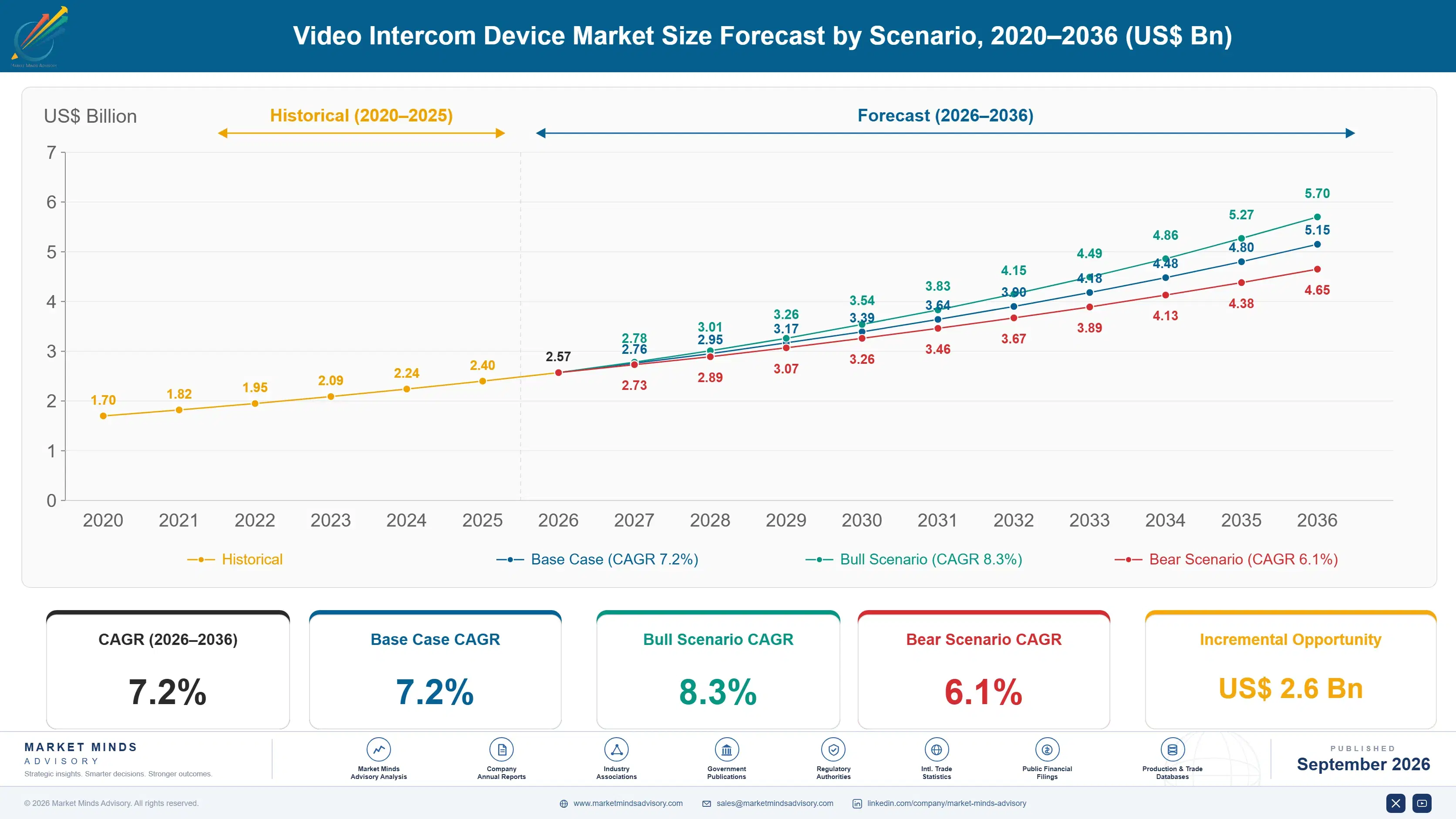
Video Intercom Device Market Forecast Scenarios

video-intercom-devices-market-size-forecast-scenario-1788414127700
Video intercom demand grew steadily through the historical period as China's residential construction boom and rising urban security spending pushed developers toward standardizing intercom systems across new multi-tenant buildings nationwide and quite consistently. The 6.5% historical growth rate reflects gradual analog-to-IP transition rather than any single disruptive event reshaping the category meaningfully during these years.
The base case assumes continued Chinese residential construction volume, accelerating wireless retrofit demand in older Western buildings, and rising smartphone integration expectations among property buyers who increasingly treat video intercom access as a standard amenity rather than a premium feature reserved for luxury developments. These three mechanisms support 7.2% compound annual growth through 2036, with commercial and multi-tenant segments outpacing single-family residential installations as building owners prioritize centralized access management systems over standalone unit-level devices.
A bull case turns on accelerating smart building code mandates requiring IP-based access control in new commercial construction across multiple major markets simultaneously and consistently. A bear case centers on a sharp Chinese residential construction slowdown, since the country's new-build volume drives a disproportionate share of global unit shipments industry-wide and would meaningfully depress overall category growth.

The China Construction Cycle Behind Global Shipment Volume

Manufacturing concentrates heavily in China, where Hikvision and Dahua Technology combine low-cost component sourcing with vertically integrated production to undercut Western and Japanese competitors on unit price consistently across most product categories sold worldwide. This cost advantage has pushed average selling prices down steadily even as feature complexity, including facial recognition and cloud connectivity, has risen considerably across most product tiers sold today.
MARKET CONCENTRATION44% CR5top five manufacturers hold nearly half global shipments
AVERAGE SELLING PRICE$85 per unittypical price point for a multi-tenant IP intercom unit
TOP PRODUCING COUNTRY58% Chinashare of global video intercom unit manufacturing output
IP TRANSITION RATE61% of shipmentsproportion now shipped as IP-based rather than analog
MULTI-TENANT PENETRATION47% of installsshare of units installed in apartment and condominium buildings
RETROFIT DEMAND SHARE34% of revenueportion tied to existing building upgrades rather than new construction
The transition from analog to IP-based systems is well underway but far from complete, with roughly 61% of current shipments now IP-connected while a meaningful installed base of older analog systems remains in active service across aging multi-tenant buildings worldwide today. Building owners typically replace intercom systems only during broader renovation cycles rather than proactively upgrading standalone hardware ahead of schedule or budget.
Multi-tenant residential installations represent the largest single demand pool, driven overwhelmingly by new construction specification requirements in China and other rapidly urbanizing markets across East Asia and South Asia region broadly. Retrofit demand in mature Western markets grows more slowly but carries meaningfully higher margins, since installation labor cost typically exceeds hardware cost in established buildings undergoing renovation work today.
"Everyone in this category is really just riding China's construction cycle, whether they admit it or not. The manufacturers who survive the next downturn will be the ones who built a real retrofit and replacement business outside that single market."
Senior Analyst, Building Security and Access Control Practice · MMA Construction and Industrial Equipment Practice · September 2026

Market Trends

Facial Recognition Integration Becomes Standard Premium Feature

Video intercom manufacturers are rapidly embedding facial recognition capability into mid-tier and premium product lines, moving the feature from a luxury add-on toward a standard expectation among multi-tenant building developers seeking differentiated amenities to market to prospective tenants. Roughly 34% of new IP-based intercom shipments now include facial recognition as a built-in capability, up sharply from negligible penetration just a few years earlier. This shift is compressing margins on units lacking the feature while creating a genuine premium tier for manufacturers who have invested in reliable recognition algorithms that perform consistently across lighting conditions and camera angles.
Market Impact: China drives 58% of volume
Wireless Retrofit Demand Accelerates in Mature Building Stock

Property owners across North America and Western Europe increasingly choose wireless video intercom systems specifically to avoid the disruptive rewiring that analog and wired IP alternatives require in older multi-tenant buildings never originally designed with structured cabling in mind for such devices at all. This retrofit-driven demand has pushed wireless and Wi-Fi intercom shipment growth to 11.0% annually, the fastest of any product category tracked in this report, as building owners prioritize installation speed and tenant disruption minimization over marginal reliability differences between wired and wireless connectivity options currently available.
Market Impact: Platform-integrated units command a 22% premium

Market Opportunities and Growth Drivers

China's Residential Construction Pipeline Sustains Unit Volume

China's multi-tenant residential construction pipeline, despite recent sector-wide financial stress among major developers, continues delivering millions of new housing units annually that require standardized building entry and access control systems specified during initial construction planning rather than added afterward by individual unit owners. Video intercom systems have become a near-universal specification requirement in new Chinese apartment developments, driving roughly 58% of global unit manufacturing volume through this single national construction cycle alone. This concentration makes the broader global market unusually sensitive to shifts in Chinese property sector policy and developer financing conditions specifically.
Market Impact: Compliance reviews delayed launches 4 months

Smart Home Platform Integration Expands Addressable Demand

Video intercom systems increasingly integrate directly with broader smart home and building automation platforms, letting residents control door access, view visitor video, and receive delivery notifications through the same single unified application already managing lighting, climate, and security systems throughout their entire property nationwide and consistently. This integration capability has expanded the addressable buyer base beyond security-focused purchasers toward broader smart home enthusiasts seeking a unified control experience, with integrated-platform units now commanding price premiums of roughly 22% over standalone intercom devices lacking comparable third-party platform connectivity options available today.
Market Impact: China exposure risks 58% of volume

Market Restraints and Challenges

Data Privacy Regulation Complicates Facial Recognition Deployment

Facial recognition-equipped intercom systems face growing regulatory scrutiny across multiple jurisdictions concerned about biometric data collection and storage in shared residential spaces where individuals cannot easily opt out of being recorded entering their own building. This regulatory pressure originates from broader biometric privacy legislation never specifically designed with building access intercoms in mind, creating genuine compliance ambiguity for manufacturers selling into multiple regulatory environments simultaneously. Several manufacturers have responded by offering on-device processing options that avoid transmitting biometric data to cloud servers, adding cost but reducing regulatory exposure for property owners.
Market Impact: Facial recognition penetration reached 34%

Chinese Construction Slowdown Threatens Global Volume Concentration

The broader Chinese property sector's ongoing financial stress, affecting several major residential developers, creates meaningful downside risk for a video intercom market where China represents 58% of global unit manufacturing and a substantial share of end demand simultaneously. This concentration exists because intercom specification decisions get made during initial construction planning, meaning a construction slowdown directly and immediately reduces intercom order volume rather than merely delaying it. Manufacturers are responding by expanding retrofit and replacement sales channels in mature Western markets to reduce dependence on any single national construction cycle.
Market Impact: Wireless retrofit demand grows 11.0% yearly
4 additional market trends, 3 additional growth drivers, and 2 additional restraints and challenges are covered in the full report. Contact sales@marketmindsadvisory.com to access the complete intelligence.

Segment CAGR and Growth Architecture

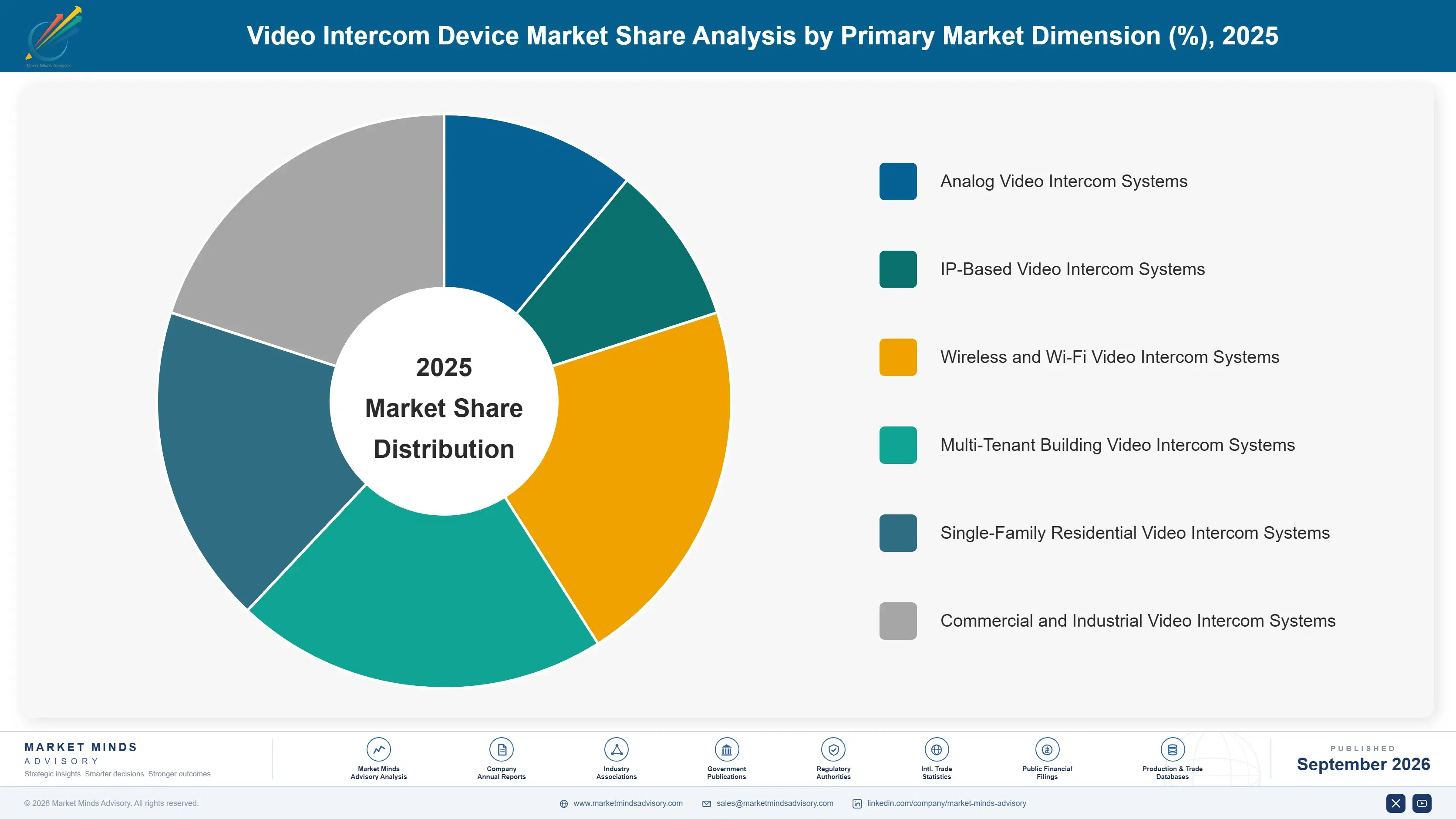
The Video Intercom Device Market segments by connectivity technology, spanning analog through IP-based and wireless systems, then by installation context across multi-tenant, single-family, and commercial buildings serving distinct property owner needs, budgets, and building age today. Wireless and IP-based systems are pulling ahead of legacy analog installations as the fastest-growing categories overall this decade.
video-intercom-devices-market-market-share-analysis-1788414128257

Wireless and Wi-Fi Video Intercom Systems

Wireless and Wi-Fi video intercom systems represent the fastest-growing segment, expanding at 11.0% annually as property owners across mature Western markets prioritize retrofit installations that avoid the disruptive rewiring analog and wired IP systems both require in older multi-tenant buildings across most established neighborhoods. This segment benefits directly from improving wireless reliability and battery life that have made these systems viable replacements for wired alternatives in demanding building access applications previously reserved for hardwired installations exclusively. Adoption concentrates among renovation projects and older buildings lacking structured cabling, a growing addressable pool as building stock across North America and Western Europe continues aging steadily each year without major infrastructure upgrades planned.
CAGR 11.0%

IP-Based Video Intercom Systems

IP-based video intercom systems form the second-fastest segment, growing at 9.5% annually as developers specify network-connected devices offering smartphone integration, cloud storage, and remote visitor management as standard building amenities rather than optional premium upgrades reserved for luxury developments only anymore today. This segment benefits from falling component costs that have brought IP system pricing close to parity with legacy analog alternatives, removing what was previously the primary barrier to broader adoption across mainstream residential construction projects nationwide. Demand concentrates heavily in new multi-tenant residential construction across China and other rapidly urbanizing East Asian markets where developers now increasingly treat connected intercom access as table stakes for buyer expectations today.
CAGR 9.5%
Full segment breakdown across 6 segments available in the complete report.

Regional Architecture and Country Demand Map

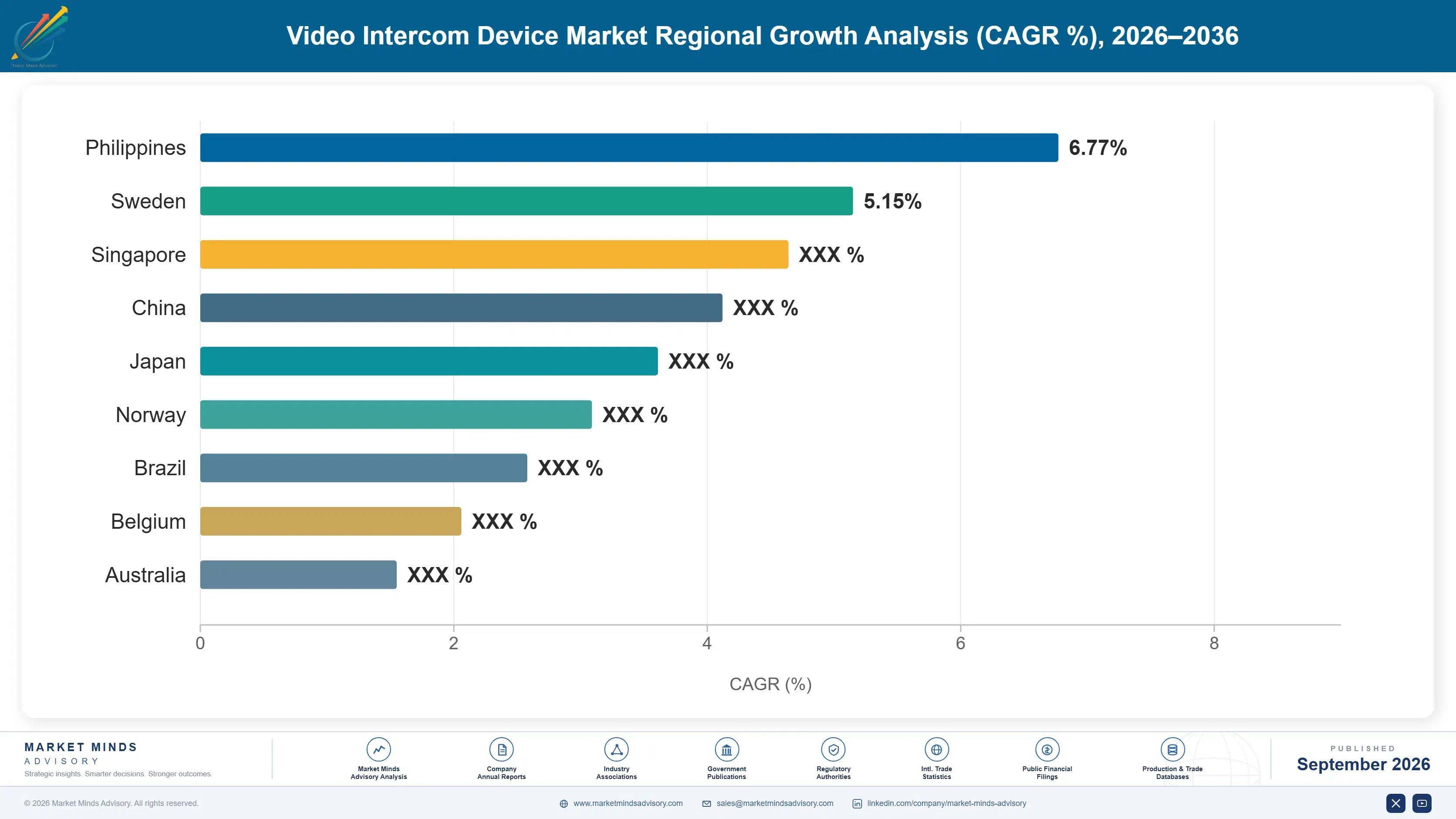
East Asia dominates the Video Intercom Device Market given China's massive multi-tenant residential construction volume and near-universal intercom specification requirements built into most new developments nationwide, while North America and Western Europe drive steady retrofit demand across their own considerably older and aging building stock instead.

East Asia

China alone drives roughly 58% of global unit manufacturing volume, a concentration rooted in the country's multi-tenant residential construction pipeline delivering millions of new housing units annually that specify video intercom systems as a near-universal building amenity from initial design onward. Hikvision and Dahua Technology, both Chinese manufacturers, dominate global shipment volume through vertically integrated production and aggressive price competition that smaller international rivals struggle to match on cost alone. Japan and South Korea contribute smaller but steady demand tied to ongoing apartment renovation cycles and stringent building security expectations. This regional concentration explains why global market growth tracks Chinese property sector conditions unusually closely compared to most other hardware categories tracked in this report.
Share: 32% | CAGR: 8.2% (2026 to 2036)

North America

The United States and Canada represent the largest retrofit-driven market outside East Asia, as property owners managing aging multi-tenant buildings increasingly choose wireless video intercom systems specifically to avoid disruptive rewiring during renovation projects. Ring, owned by Amazon, and other smart home platform vendors have expanded consumer awareness of video intercom functionality well beyond traditional multi-tenant building contexts into single-family residential demand that barely existed as a distinct category a decade ago. Commercial office and institutional buildings contribute steady replacement demand tied to standard equipment lifecycle refresh cycles. Growth here trails the global average given the region's more mature installed base and slower new construction volume relative to rapidly urbanizing markets.
Share: 22% | CAGR: 6.5% (2026 to 2036)
Regional intelligence for 5 additional markets available in the complete report: Western Europe, South Asia and Pacific, Latin America, Middle East and Africa, Eastern Europe. Contact sales@marketmindsadvisory.com.
video-intercom-devices-market-country-cagr-analysis-1788414128784

Where Intercom Manufacturers Capture Recurring Value

Manufacturers expand revenue beyond one-time hardware sales by pricing facial recognition and cloud storage as ongoing subscription add-ons, bundling installation and maintenance services directly into multi-tenant building contracts, licensing platform integration to third-party smart home platforms, and selling extended warranty coverage on premium multi-tenant building contracts specifically negotiated at each annual contract renewal cycle.

Cloud Storage Subscriptions for Video History Retention

Manufacturers increasingly bundle a baseline hardware sale with an ongoing cloud storage subscription that retains visitor video history and enables remote access from mobile devices, converting what was historically a single upfront hardware transaction into a recurring revenue relationship with the property owner or resident. Subscription attach rates now reach roughly 42% among IP-based intercom installations in North America and Western Europe, where residents value remote monitoring highly enough to pay monthly fees. This recurring revenue stream now generates meaningfully higher lifetime value per installed unit than the original hardware sale alone did previously.
Market Impact: Cloud storage subscriptions reach a 42% attach rate

Bundled Installation and Maintenance Service Contracts

Manufacturers and distributors increasingly bundle professional installation and ongoing maintenance service directly into multi-tenant building contracts, capturing service revenue that previously went entirely to independent third-party installers with no direct relationship to the hardware manufacturer at all, weakening long-term customer loyalty considerably. This bundled approach has lifted average contract value by roughly 28% compared to hardware-only sales, since building owners value having a single accountable vendor responsible for both equipment performance and ongoing system upkeep across the building's entire access control infrastructure over its full operational lifetime and warranty period.
Market Impact: Bundled service contracts lift contract value roughly 28%

Smart Home Platform Licensing and Integration Fees

Manufacturers negotiate licensing arrangements with major smart home platform operators to ensure their intercom devices integrate smoothly with broader home automation platforms already installed in customer properties, capturing integration fees alongside the underlying hardware sale itself as a distinct revenue line. This lever matters most for manufacturers targeting single-family residential buyers who expect their intercom to work within an existing smart home setup covering lighting, climate, and security devices from multiple different vendors simultaneously. Integration-certified units already command price premiums of roughly 18% over non-certified equivalent hardware lacking this compatibility.
Market Impact: Platform integration adds roughly an 18% price premium

Extended Warranty and Premium Support Packages

Manufacturers sell extended warranty coverage and premium technical support packages specifically to multi-tenant building owners and property management companies who cannot tolerate extended system downtime affecting building access for dozens or hundreds of individual residents simultaneously. These packages typically carry gross margins roughly 2 times higher than the underlying hardware sale itself, since actual warranty claim rates run considerably lower than what customers pay for the peace of mind these premium support contracts provide. Adoption concentrates among larger multi-tenant developments where downtime risk affects considerably more residents per incident than smaller single-family installations.
Market Impact: Extended warranty packages carry roughly 2x hardware margins

Who Controls the Margin Pool

Hikvision, Dahua Technology, Akuvox, Comelit Group, and Legrand together hold an estimated 44% combined share of tracked shipment revenue, a moderate concentration that leaves substantial room for regional and specialty players. Hikvision and Dahua lead decisively on unit volume through vertically integrated Chinese manufacturing, while Comelit and Legrand defend premium multi-tenant contracts through design quality and long-standing European building code compliance expertise.
Competitive activity centers on the analog-to-IP transition and smart home platform compatibility, since building owners increasingly evaluate intercom systems on their ability to interoperate with broader automation platforms rather than as standalone security hardware. Manufacturers are racing to add facial recognition and cloud connectivity to mid-tier product lines previously limited to basic audio and video functionality, narrowing the feature gap between premium and mainstream product tiers considerably.

Pressure is building from smart home platform vendors including Amazon's Ring, which are expanding video doorbell functionality toward genuine intercom-equivalent capability and threatening to blur category boundaries entirely. Rankings could shift meaningfully if Chinese manufacturers extend their price advantage into premium multi-tenant segments currently defended by European incumbents through design reputation and regulatory compliance expertise built over decades of market presence.
video-intercom-devices-market-company-positioning-matrix-1788414129303

Competitive Moat and Risk Dimensions

HIKVISION

Moat: Vertically Integrated Manufacturing Scale

Hikvision controls chip design, camera manufacturing, and final assembly within its own vertically integrated supply chain, letting it undercut competitors on unit price while maintaining acceptable margins at massive shipment volume. This scale advantage compounds as Hikvision reinvests cost savings into research and development, widening the gap with smaller manufacturers lacking comparable manufacturing control across their own supply chains.
HIKVISION

Risk: Geopolitical Export Restriction Exposure

Hikvision faces export restrictions and procurement bans in several Western markets tied to broader geopolitical tensions and security concerns about Chinese-manufactured surveillance equipment specifically. These restrictions limit Hikvision's addressable market in premium government and institutional building contracts across North America and parts of Western Europe, pushing the company toward deeper reliance on emerging markets less affected by these restrictions.
COMELIT GROUP

Moat: European Design and Compliance Reputation

Comelit has built a multi-decade reputation among European architects and building developers for design quality and reliable compliance with regional building safety codes that many Asian competitors struggle to match consistently. This reputation lets Comelit command premium pricing in specification-driven multi-tenant contracts where architects and developers prioritize proven reliability over marginal cost savings on hardware alone.
COMELIT GROUP

Risk: Limited Manufacturing Scale Cost Disadvantage

Comelit's smaller manufacturing scale relative to Chinese competitors leaves it unable to match Hikvision or Dahua on unit price, confining Comelit largely to premium segments where price sensitivity matters less than design and compliance reputation. This limits Comelit's addressable market in price-sensitive emerging market segments where Chinese manufacturers increasingly compete aggressively on cost alone.

Players Tracked

Prominent Players

Hikvision
Dahua Technology
Akuvox
Comelit Group
Legrand

Other Key Players

Fermax
ABB
Aiphone
Panasonic
Honeywell
Zicom Electronic Security Systems
2N Telekomunikace
Ubiquiti
Ring
Nortek Security and Control
Vivint
Control4
Optex
TCS Telecom Circuits
Bosch Security Systems

Recent Developments

FEBRUARY 2025

Hikvision launched a new mid-tier video intercom line embedding facial recognition capability previously reserved exclusively for its premium product tier, targeting price-sensitive multi-tenant developers seeking advanced security features without flagship pricing. The launch reflects broader industry movement toward standardizing recognition capability across most product tiers rather than premium tiers alone.
Signal: Confirms facial recognition is migrating from premium exclusivity toward mainstream mid-tier product expectation across the industry broadly.
SEPTEMBER 2025

Legrand acquired a smaller European smart home integration software company to strengthen its BTicino intercom line's compatibility with third-party building automation platforms, addressing rising buyer expectations for smooth platform interoperability across devices. The acquisition expands Legrand's software capability beyond its traditional hardware manufacturing core competency considerably.
Signal: Signals hardware manufacturers acquiring software capability to defend against rising platform integration competitive pressure right now.
APRIL 2025

Ring, owned by Amazon, expanded its video doorbell product line to include genuine two-way intercom functionality with building entry access control, moving the product closer to direct competition with traditional multi-tenant video intercom systems. This expansion targets single-family residential buyers previously outside the traditional intercom market entirely.
Signal: Marks a consumer smart home vendor's direct entry into traditional building intercom market territory more decisively.

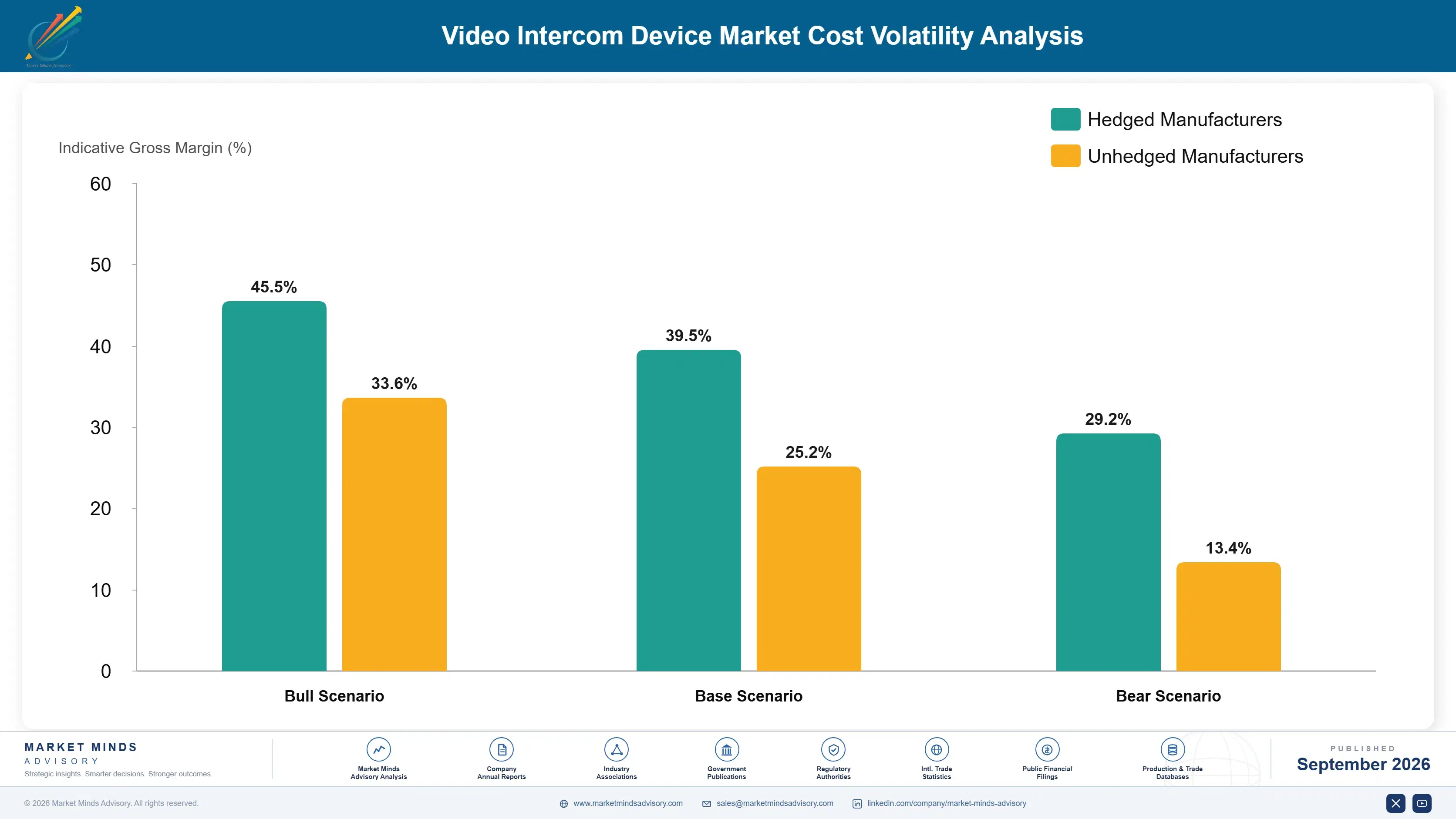
Semiconductor Component Cost Exposure

Video intercom manufacturers carry a materials-heavy cost structure typical of consumer electronics hardware: semiconductor components including image sensors and processors represent roughly 30% to 40% of unit cost, with the remainder split between display panels, plastic and metal enclosures, and printed circuit board assembly, most sourced from suppliers concentrated heavily across East Asian electronics supply chains.
Semiconductor supply disruptions during 2021 and 2022, well documented in company annual reports across the consumer electronics sector, forced several intercom manufacturers to substitute alternative image sensor suppliers at meaningfully higher unit cost or delay shipments entirely during peak component shortage periods. One manufacturer disclosed component cost increases exceeding 25% during the worst months of the shortage, a margin hit that took several quarters to fully pass through to customer pricing given existing multi-tenant contract commitments already signed.

Manufacturers without direct semiconductor supplier relationships or scale purchasing power face a durable cost disadvantage against vertically integrated competitors like Hikvision, who negotiate component pricing directly with chip fabricators at volumes smaller manufacturers cannot match. This dynamic concentrates pricing power among the largest manufacturers even as brand reputation and design quality remain genuinely distributed across many smaller regional competitors serving specific geographic markets.
video-intercom-devices-market-cost-volatility-analysis-1788414129498

Multi-Source Component Qualification Programs

Manufacturers increasingly qualify multiple alternative image sensor and processor suppliers well in advance of any actual shortage, letting them switch sourcing quickly without redesigning circuit boards or requalifying finished products for regulatory compliance requirements. This approach adds modest upfront engineering cost but meaningfully reduces exposure to any single supplier's capacity constraints during future disruptions.

Long-Term Component Supply Agreements

Larger manufacturers negotiate multi-year supply agreements directly with semiconductor fabricators, locking in guaranteed component allocation and more predictable pricing in exchange for committed purchase volume commitments spanning several years of projected production output. This approach favors manufacturers with the balance sheet strength to commit to large volume purchases well in advance of actual customer demand.

Portfolio Architecture for Margin Defence

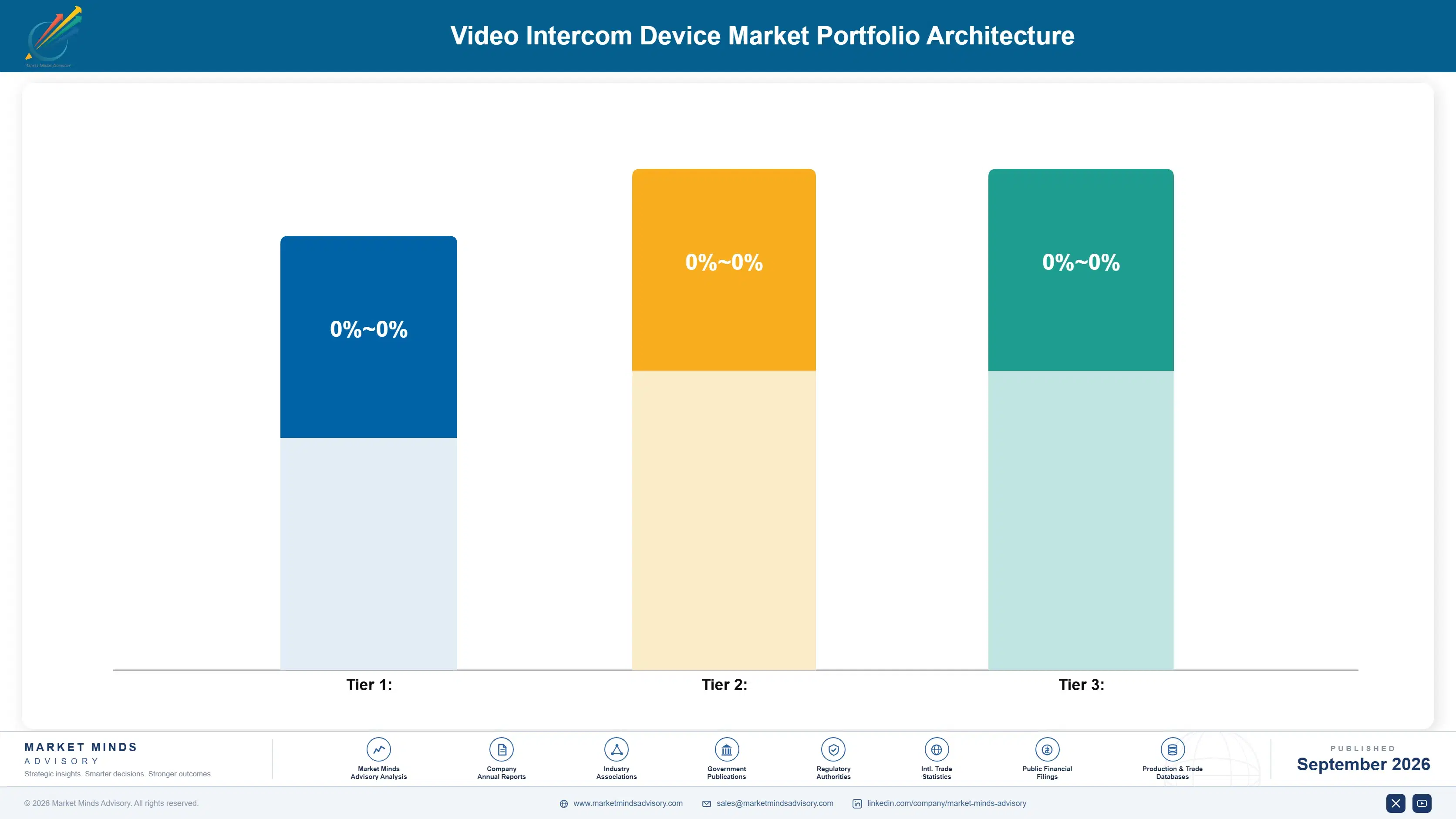
Video intercom revenue organizes into three commercially distinct tiers separated by connectivity technology and feature depth rather than by manufacturer size alone. Volume tiers cover basic analog and entry-level IP systems sold at high shipment volume, while premium tiers add facial recognition and cloud connectivity. The newest tier bundles smart home platform integration commanding the steepest margins across the category.
Gross margins vary considerably across tiers because analog and basic IP hardware faces intense price competition from Chinese manufacturers operating at massive scale, while premium features like facial recognition and platform integration carry software components that scale at near-zero marginal cost once developed. Premium and next-generation tiers therefore capture disproportionate profit relative to their share of total unit shipment volume across the category.

High-value pools concentrate overwhelmingly in premium multi-tenant contracts bundling facial recognition, cloud subscriptions, and installation services rather than in commodity analog hardware, which faces relentless price pressure from Chinese manufacturing scale. The volume tier remains essential for maintaining overall unit shipment volume and brand visibility, but incremental profit growth increasingly comes from premium tier expansion and recurring subscription revenue rather than additional hardware unit sales alone.

Basic analog and entry-level IP systems sold at high shipment volume through price-competitive Chinese manufacturing, priced to maximize unit sales with gross margins in the 20% to 30% range given intense competition.
Gross Margin

Mid-tier and premium IP systems bundling facial recognition and cloud storage subscriptions, carrying gross margins between 40% and 50% as recurring subscription revenue supplements the initial hardware sale considerably over the contract lifetime.
Gross Margin

Smart home platform-integrated systems commanding gross margins above 55% because software integration and certification fees carry near-zero marginal cost once initial development work is complete and fully certified for use.
Gross Margin
video-intercom-devices-market-portfolio-architecture-1788414129991

High-value Sub-segments and Strategic Watch-out

Wireless and Wi-Fi Video Intercom Systems

High-value and high-growth, this segment combines the fastest expansion rate in the market with strong retrofit demand as older buildings across mature Western markets seek installation without disruptive rewiring costs or extended tenant disruption periods, a pattern likely to persist across most markets for many years to come.

IP-Based Video Intercom Systems

High-value with moderate growth, IP systems command premium pricing over analog alternatives and benefit from falling component costs even as growth trails the fastest wireless retrofit segment considerably across most global markets tracked closely in this study and reported throughout this section of the report.

Analog Video Intercom Systems

Volume core of the market in absolute unit terms within legacy installed base, though analog systems face steadily eroding share as building owners upgrade to IP-based alternatives during standard renovation and replacement cycles nationwide, internationally, and across nearly every single regional market covered here today.

Commercial and Industrial Video Intercom Systems

Strategic watch-out segment, growing steadily as commercial buildings adopt intercom systems for delivery and visitor management, but facing uncertain long-term differentiation as residential-focused vendors expand aggressively into commercial applications more forcefully over the coming several years and well beyond that distant horizon entirely and permanently.

The Recurring Value of Intercom Hardware

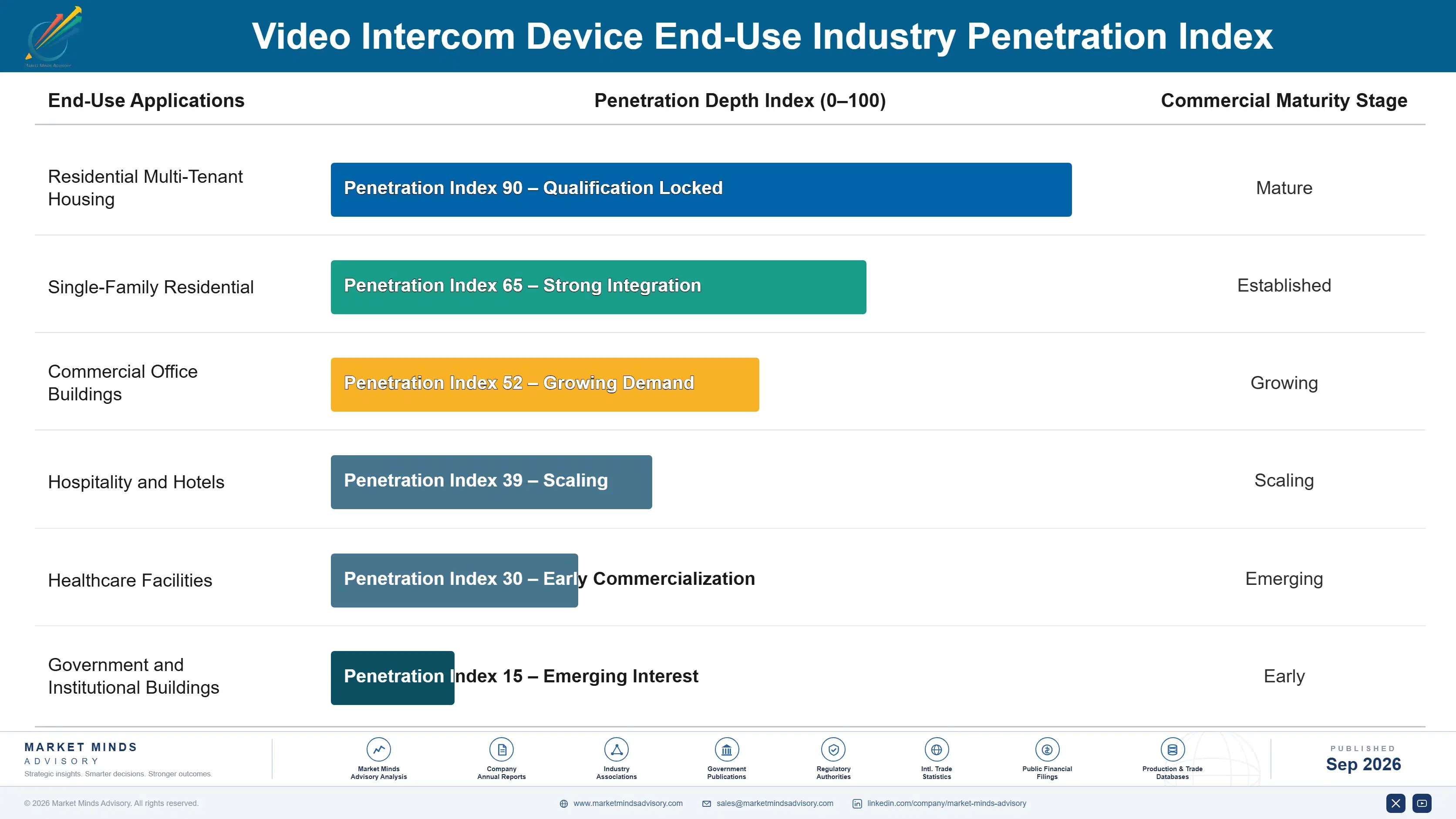
Video intercom revenue increasingly behaves like an annuity once cloud storage and platform integration subscriptions attach to the initial hardware sale, since property owners rarely churn subscriptions given the switching cost of replacing installed building-wide hardware entirely across every occupied unit. Subscription renewal rates already exceed 75% at annual renewal points, reflecting how deeply these recurring services embed into ongoing building operations.
Adoption stickiness varies by end-use vertical considerably across the category. Multi-tenant residential buildings show the deepest dependency given centralized building-wide contracts covering every unit simultaneously, while single-family residential buyers show shallower engagement since individual homeowners can switch vendors more easily than an entire building's property management company facing coordination costs across many separate tenant households and lease agreements.

A generational shift is underway in who specifies these systems during construction planning. Property developers increasingly treat video intercom selection as a technology procurement decision handled by dedicated smart building teams rather than a security equipment purchase made by facilities management alone. Younger property management executives with technology backgrounds are displacing longtime security equipment specialists in these purchasing decisions, reflecting the category's genuinely evolving commercial and technical logic today.
video-intercom-devices-market-end-use-penetration-index-1788414130474

Where Manufacturers Should Focus Next

These are among the four positions where our research anticipates prominent divergence between winners and laggards over the coming forecast period. Each is grounded in the demand model, the regulatory perimeter, and the announced capacity pipeline.
01 / CHINA EXPOSURE HEDGING

Expand retrofit sales channels outside China to reduce concentration

China currently drives roughly 58% of global unit manufacturing volume, creating meaningful concentration risk for any manufacturer whose sales depend heavily on that single country's residential construction cycle continuing at its current pace. Manufacturers should actively build out retrofit and replacement sales channels in mature Western markets where demand depends less on new construction volume and more on aging building stock requiring periodic hardware upgrades. This diversification matters most for manufacturers currently overexposed to new-build specification contracts concentrated in a single country.
02 / RECURRING REVENUE TRANSITION

Prioritize subscription attach rate over pure hardware unit volume

Cloud storage and platform integration subscriptions already generate meaningfully higher lifetime value per installed unit than the original hardware sale alone. Yet many manufacturers still measure commercial success primarily through unit shipment volume rather than subscription attach and retention rates that better predict long-term profitability. Manufacturers should restructure sales incentives and product design decisions around maximizing subscription attach rate at the point of hardware sale, since this recurring revenue stream proves far more resilient during construction cycle downturns than one-time hardware transactions alone.
03 / FACIAL RECOGNITION COMPLIANCE

Build on-device processing options ahead of tightening regulation

Facial recognition-equipped intercom systems face growing regulatory scrutiny across multiple jurisdictions concerned about biometric data collection in shared residential spaces where individuals cannot easily opt out of being recorded entering their own building. Manufacturers should invest now in on-device processing capability that avoids transmitting biometric data to external cloud servers, since retrofitting this capability after regulation tightens proves far more disruptive than building it into product architecture from the outset. This positioning also serves as a genuine competitive differentiator with increasingly privacy-conscious buyers evaluating multiple vendors.
04 / PLATFORM INTEGRATION STRATEGY

Pursue smart home platform certification before competitors close the gap

Integration-certified units already command price premiums of roughly 18% over non-certified equivalent hardware lacking comparable compatibility with third-party systems. Yet many smaller manufacturers still treat smart home platform compatibility as a lower priority than core hardware feature development and unit cost reduction efforts. Manufacturers should pursue certification with major smart home platform operators proactively rather than reactively, since buyers increasingly expect intercom systems to interoperate with existing home automation setups spanning lighting, climate, and security devices from multiple vendors simultaneously.

Engagement Snapshot From the Field

A live engagement with an industry participant carrying material or product regulatory and market exposure ahead of a defining policy shift, showing how our research translates into a defensible multi-year portfolio strategy.
MARKET MINDS ADVISORY · CLIENT ENGAGEMENT SUMMARY
Video Intercom Device Producer Strategic Portfolio Review and Transition Roadmap 2026·Investment Scenario on Video Intercom Device Exposure Evaluation 2025-26
CLIENT PROFILE
A regional property management firm overseeing roughly 60 multi-tenant residential buildings across three metropolitan areas had inherited a patchwork of analog and early-generation IP intercom systems installed by previous building owners over many years and multiple prior ownership transitions, creating inconsistent tenant experience and rising maintenance cost across its expanding portfolio of aging properties nationwide.
STRATEGIC CHALLENGE
Leadership needed to standardize on a single intercom platform across the portfolio to simplify maintenance contracts and tenant support, while facing budget constraints that ruled out replacing all buildings simultaneously and required a carefully sequenced, phased multi-year rollout plan instead of an immediate wholesale replacement across every managed property in the portfolio.
MMA APPROACH
MMA benchmarked five candidate manufacturers against the firm's specific requirements for wireless retrofit compatibility, cloud subscription pricing, and smart home platform integration, then modeled total cost of ownership across a five-year phased rollout scenario covering all sixty buildings in the portfolio and their considerably varying tenant populations and unique needs.
KEY FINDINGS
  1. Wireless retrofit systems reduced installation cost by roughly 40% compared to wired IP alternatives requiring new cabling (client-reported, unverified by MMA) across older buildings in the portfolio.
  2. Standardizing on a single manufacturer's platform cut ongoing maintenance contract cost by an estimated 25% through consolidated vendor relationships (client-reported, unverified by MMA) and reduced staff training needs.
  3. Tenant satisfaction scores rose measurably in buildings that received cloud-connected smartphone integration compared to buildings still awaiting the phased upgrade rollout (client-reported, unverified by MMA) schedule.
  4. The firm's five-year phased rollout plan balanced capital budget constraints against the urgency of replacing the oldest and least reliable analog systems first (client-reported, unverified by MMA) across the portfolio.
CLIENT PROFILE
A regional property management firm overseeing roughly 60 multi-tenant residential buildings across three metropolitan areas had inherited a patchwork of analog and early-generation IP intercom systems installed by previous building owners over many years and multiple prior ownership transitions, creating inconsistent tenant experience and rising maintenance cost across its expanding portfolio of aging properties nationwide.
STRATEGIC CHALLENGE
Leadership needed to standardize on a single intercom platform across the portfolio to simplify maintenance contracts and tenant support, while facing budget constraints that ruled out replacing all buildings simultaneously and required a carefully sequenced, phased multi-year rollout plan instead of an immediate wholesale replacement across every managed property in the portfolio.
MMA APPROACH
MMA benchmarked five candidate manufacturers against the firm's specific requirements for wireless retrofit compatibility, cloud subscription pricing, and smart home platform integration, then modeled total cost of ownership across a five-year phased rollout scenario covering all sixty buildings in the portfolio and their considerably varying tenant populations and unique needs.
KEY FINDINGS
  1. Wireless retrofit systems reduced installation cost by roughly 40% compared to wired IP alternatives requiring new cabling (client-reported, unverified by MMA) across older buildings in the portfolio.
  2. Standardizing on a single manufacturer's platform cut ongoing maintenance contract cost by an estimated 25% through consolidated vendor relationships (client-reported, unverified by MMA) and reduced staff training needs.
  3. Tenant satisfaction scores rose measurably in buildings that received cloud-connected smartphone integration compared to buildings still awaiting the phased upgrade rollout (client-reported, unverified by MMA) schedule.
  4. The firm's five-year phased rollout plan balanced capital budget constraints against the urgency of replacing the oldest and least reliable analog systems first (client-reported, unverified by MMA) across the portfolio.
RECOMMENDED STRATEGY
Phase 1: Phase one replaced the fifteen oldest analog systems first, prioritizing buildings with the highest maintenance call volume and tenant complaints. Phase 2: Phase two standardized remaining buildings onto the selected wireless platform over three years, aligning replacement timing with existing lease renewal cycles. Phase 3: Phase three layered cloud subscription and smart home integration services onto all upgraded buildings to generate ongoing recurring revenue opportunities.
OUTCOME
The firm completed its first-phase rollout across fifteen buildings within budget and reduced average maintenance response time by roughly 35% (client-reported, unverified by MMA), while establishing a standardized vendor relationship expected to simplify the remaining four-year portfolio-wide rollout considerably across all remaining properties and tenant populations.

Frequently Asked Questions

Foundational context covering the market sizes, CAGR, scope, country, region and competition that inform every finding below. This section is provided to cover basics and most often pre-purchase conversations, answered from the MMA Primary Research Dataset.

What is the current size of the Video Intercom Device Market?

The Video Intercom Device Market reached an estimated $2.4 billion in global revenue in 2025. This figure covers analog, IP-based, and wireless intercom hardware sold for residential and commercial building access control.

How large will the Video Intercom Device Market be by 2036?

MMA projects the market will reach approximately $5.16 billion by 2036, driven mainly by wireless retrofit demand and IP system adoption in new construction. That represents roughly a doubling from 2026 levels.

What is the CAGR for the Video Intercom Device Market 2026 to 2036?

The market is forecast to grow at a 7.2% compound annual rate between 2026 and 2036. Bull and bear scenarios range between roughly 6.1% and 8.3% depending on China's construction cycle strength.

Which segment is growing fastest?

Wireless and Wi-Fi video intercom systems lead all segments, expanding at an estimated 11.0% annually. That is well above the overall market's 7.2% average growth rate through the forecast period to 2036.

Who are the major companies in the Video Intercom Device Market?

Hikvision, Dahua Technology, Akuvox, Comelit Group, and Legrand form the five leading manufacturers tracked in this report. Together they hold an estimated 44% combined share of tracked shipment revenue as of 2025.

Which country is growing fastest?

China posts the fastest national growth rate in the study, expanding at an estimated 12.5% annually. Its massive multi-tenant residential construction pipeline drives unusually rapid intercom specification and adoption there.

Report Segmentation Architecture

The full report scope spans multiple orthogonal segmentation dimensions, with cross-tabulated demand data provided for each dimension pair. Coverage extends further to regional breakdowns, trend trajectories, and the competitive detail needed to support segment-level decision-making.

By Primary Market Dimension

  • Analog Video Intercom Systems
  • IP-Based Video Intercom Systems
  • Wireless and Wi-Fi Video Intercom Systems
  • Multi-Tenant Building Video Intercom Systems
  • Single-Family Residential Video Intercom Systems
  • Commercial and Industrial Video Intercom Systems

By End-Use Industry

  • Residential Multi-Tenant Housing
  • Single-Family Residential
  • Commercial Office Buildings
  • Hospitality and Hotels
  • Healthcare Facilities
  • Government and Institutional Buildings

By Commercial Dimension

  • New Construction Specification
  • Retrofit and Renovation Installation
  • Direct-to-Property-Manager Sales
  • Third-Party Installer Distribution

By Region

  • North America
  • Western Europe
  • East Asia
  • South Asia and Pacific
  • Latin America
  • Middle East and Africa
  • Eastern Europe

Scope, Methodology, and Coverage

Every figure in this report is reproducible from documented input assumptions. The scope below maps the historical period, the forecast horizon, the segmentation dimensions, and the countries covered, alongside the underlying primary and qualitative methodology.
Historical Period
2020 to 2025
Forecast Period
2026 to 2036
Base Year
2025 (USD billions; MMA Primary Research Dataset, September 2026)
Market Definition
The Video Intercom Device Market covers hardware systems that combine audio, video, and access control functionality for building entry management, including analog, IP-based, and wireless intercom devices sold for residential and commercial installation. It excludes standalone doorbell cameras without integrated two-way intercom communication and general video surveillance equipment lacking dedicated entry access control functionality.
Quantitative Units
USD Billion, CAGR (%), Share (%), 2020 to 2036
Segmentation Dimensions
By Primary Market Dimension; By End-Use Industry; By Commercial Dimension; By Region
Regions Covered
North America, Western Europe, East Asia, South Asia and Pacific, Latin America, Middle East and Africa, Eastern Europe
Countries Covered
China, Japan, South Korea, United States, Canada, Germany, France, United Kingdom, Italy, Spain, India, Australia, Vietnam, Indonesia, Brazil, Mexico, Argentina, Colombia, United Arab Emirates, Saudi Arabia, Israel, South Africa, Poland, Russia, Ukraine, and additional markets relevant to this sector.
Key Companies Profiled
Hikvision, Dahua Technology, Akuvox, Comelit Group, Legrand, Fermax, ABB, Aiphone, Panasonic, Honeywell, Zicom Electronic Security Systems, 2N Telekomunikace, Ubiquiti, Ring, Nortek Security and Control, Vivint, Control4, Optex, TCS Telecom Circuits, Bosch Security Systems
Quantitative Methodology
Primary survey, n=3,800 respondents, Q4 2025, six countries; demand-side model with trade association cross-validation
Qualitative Methodology
47 expert interviews, Q4 2025; applied to validate demand model assumptions, identify emerging dynamics, and assess competitive positioning
Report Format
PDF and XLSX data workbook (Word format preview document)
Publisher
Market Minds Advisory
Report Code
MMA-2026-CON-605
Published
September 2026
Contact
sales@marketmindsadvisory.com | www.marketmindsadvisory.com

Purchase the full Video Intercom Device Market Report (2026 to 2036).

This report delivers a comprehensive assessment of the global Video Intercom Device Market, covering sizing, segmentation, and competitive dynamics across analog, IP-based, and wireless product categories worldwide today. It examines regional manufacturing concentration, revenue diversification strategies, and semiconductor component cost exposure shaping manufacturer profitability through 2036 in detail. The analysis draws on primary survey data, expert interviews, and company disclosures to size the opportunity precisely and rigorously. Buyers gain a structured view of where competitive advantage concentrates as smart home platform integration reshapes category boundaries.
Ten-year market sizing and forecast model through 2036
Six-segment connectivity-based market breakdown and analysis
Seven-region manufacturing and demand concentration analysis
Competitive benchmarking of twenty tracked hardware vendors
Semiconductor component cost exposure and mitigation assessment
Anonymized property management client engagement case study

Built For The People Who Decide

From boardroom strategy to bench-side execution, this report is read cover-to-cover by leaders shaping the next decade of their industry, turning demand scenarios, market dynamics and valuation benchmarks into decisions.
CXOs/ Presidents/ VPs/ Managers
M&A and Corporate Development
Strategy Teams and R&D Heads
Procurement and Product Directors
Regulatory and Compliance Leaders
Investor Relations and Equity Analysts