Market Minds Advisory
Video Encoders Market

Video Encoders Market: Video Encoders Market. AI Adaptive Bitrate Reshapes Streaming Economics

Streaming platforms are demanding AI-assisted adaptive bitrate encoding as content libraries and viewer bandwidth variability grow, pushing encoder vendors to compete on per-title optimization rather than raw compression ratio specifications alone.

Lead Analyst

Published

September 2026

Make Smarter Decisions with Customized Research Insights

Request a free sample report and evaluate market opportunities, growth trends, and competitive dynamics relevant to your business needs.

2025 MARKET VALUE$4.2BMarket Size 2025
2036 FORECAST VALUE$12.6BBase Case , 2026 to 2036
CAGR 2026 TO 203610.5 %Bull 11.7% / Bear 9.3%
INCREMENTAL OPPORTUNITY$8.0BNet 10- year value creation
EXPANSION MULTIPLE2.71x2036 value over 2026 base
Strategic Levers
M&A Pipeline
Regional Outlook
Country Rankings
Competitive Intelligence
Segmental Deep-dive
Call-Us : 91 93563 13602

Executive Snapshot and Market Trajectory.

Streaming platforms are demanding AI-assisted adaptive bitrate encoding as content libraries and viewer bandwidth variability grow considerably worldwide, forcing encoder vendors to compete on per-title optimization intelligence rather than raw compression ratio specifications that dominated procurement decisions across the industry for decades.
AI-assisted adaptive bitrate and cloud-based encoding drive fastest adoption, since converting fixed-bitrate encoding ladders into content-aware, per-title optimized profiles delivers meaningfully better viewer quality at lower bandwidth cost than static encoding presets could achieve alone across large content libraries. North America leads deployment given concentrated streaming platform and broadcast equipment vendor headquarters, while surveillance and security encoders increasingly extend beyond simple compression into embedded analytics that legacy standalone hardware could never support at comparable cost.
A moderately concentrated group of established broadcast equipment vendors competes alongside cloud-native software encoding specialists, with per-title optimization algorithm sophistication increasingly separating winners from vendors offering fixed bitrate ladders without genuine content-aware intelligence built into the platform itself. Codec licensing and patent pool requirements across jurisdictions continue to reshape which vendors can deploy identical encoding architectures across multi-country streaming operations without extensive licensing negotiation and legal review work.
Market Definition
The video encoders market covers hardware appliances and software systems that compress raw video signals into distribution-ready formats for broadcast, live streaming, IPTV, and surveillance applications. It excludes consumer camera encoding chips embedded in smartphones and generic video editing software lacking dedicated encoding infrastructure focus.
Base Year Value
$4.2B in 2025 (MMA Primary Research Dataset, September 2026)
Forecast Period
2026 to 2036, eleven discrete annual values
CAGR
10.5% base case. Bull 11.7%. Bear 9.3%.
Fastest Growth Segment
AI-Assisted Adaptive Bitrate Encoding Systems: 16.0% CAGR
Fastest Growth Country
India: 14.0% CAGR
Fastest Growth Region
South Asia and Pacific: 13.0% CAGR
Largest Region
North America: 32% of 2025 global value
Market Leaders
Harmonic Inc, AWS Elemental, Ateme, MediaKind, Haivision
Primary Survey
n=3,800 procurement and R&D decision-makers, Q4 2025, six countries
Methodology
Demand-side build-up, cross-validated against public data, 47 expert interviews

Video Encoders Market Forecast Scenarios

video-encoders-market-size-forecast-scenario-1789988114335
Video encoder demand grew steadily through 2020 to 2023 as streaming platform subscriber growth accelerated during pandemic-driven viewing habit shifts that many operators had previously underestimated in scale, then continued expanding from 2024 as AI-assisted per-title encoding matured enough to replace static bitrate ladders across mainstream production workflows, lifting the historical growth rate to roughly 9.5 percent annually across the category.
Base case growth to 2036 rests on three commercial mechanisms: streaming platforms consolidating fragmented fixed-bitrate encoding pipelines onto unified AI-assisted per-title optimization systems that reduce bandwidth cost meaningfully, cloud-based encoding services expanding as content libraries grow beyond what on-premise hardware capacity can economically support, and codec standards proliferation driving demand for encoders supporting multiple concurrent compression formats simultaneously. These mechanisms reinforce each other across different content categories, sustaining above-average growth without depending on any single dominant catalyst.
A bull scenario centers on a major codec standard achieving universal device compatibility that eliminates the multi-format encoding overhead streaming platforms currently absorb, which would compress infrastructure costs considerably within a single technology cycle. The bear risk is prolonged bandwidth cost deflation reducing the value of encoding efficiency gains, which has historically slowed encoder upgrade cycles industry-wide for a year or more.

Where Per-Title Optimization Determines Bandwidth Cost

AI-assisted encoding intelligence has become the primary purchasing criterion, since streaming platforms managing massive content libraries cannot afford the bandwidth waste that fixed bitrate ladders impose across viewers with vastly different network conditions and device capabilities. Vendors that once competed narrowly on raw compression ratio benchmarks now compete on per-title optimization sophistication, which shifts engineering investment toward machine learning capability rather than codec implementation efficiency alone.
MARKET CONCENTRATIONCR5 45%a moderately concentrated base of broadcast and cloud encoding vendors
AVERAGE BANDWIDTH SAVINGS25-35% with AI encodingbandwidth reduction achieved through AI-assisted per-title optimization versus fixed ladders
TOP ADOPTING COUNTRY SHAREUS 30%concentrated streaming platform and broadcast equipment vendor headquarters presence
CLOUD ENCODING ADOPTION RATE52% of new deploymentsnew video workflows now using cloud-based rather than on-premise encoding
CODEC TRANSITION TIMELINE3-5 years typicalaverage industry timeline from new codec release to broad adoption
LICENSING COST SHARE18% of total spendcodec patent pool fees versus hardware and software development cost
Cloud-based encoding adoption continues accelerating as content libraries scale beyond what on-premise hardware capacity can economically support without substantial capital investment in equipment that sits idle during lower-demand periods. Codec licensing costs remain a meaningful line item, particularly for vendors supporting multiple concurrent compression standards simultaneously, which keeps smaller vendors at a cost disadvantage relative to larger competitors able to spread licensing fees across substantially larger deployed volumes.
Multi-codec support is becoming a baseline expectation rather than a differentiator, concentrating advantage among vendors who can demonstrate reliable encoding across every major standard that different device categories require for playback compatibility. Meanwhile several vendors are extending AI-assisted encoding into real-time live streaming applications previously considered too latency-sensitive for machine learning optimization, which could meaningfully expand the addressable market within the next several product cycles.
"Every vendor claims their encoder saves bandwidth; the honest ones show you the per-title curve, not a cherry-picked demo clip. The platforms actually cutting their content delivery bill are the ones treating encoding as a data science problem, not a codec checkbox."
Director, Media Technology and Streaming Infrastructure Practice · MMA Hardware and Software Systems for Compressing and Encoding Video for Distribution Practice · September 2026

Market Trends

AI Per-Title Optimization Replaces Fixed Bitrate Ladders

Streaming platforms are increasingly replacing static bitrate ladders applied uniformly across an entire content library with AI-assisted per-title optimization that analyzes each piece of content's specific complexity to generate a customized encoding profile. This shift has cut bandwidth consumption by roughly 25 to 35 percent at platforms running mature per-title optimization compared to fixed ladder approaches applied identically regardless of actual content characteristics or viewer device conditions. Roughly 52 percent of new video encoding deployments now use cloud-based per-title optimization capability, up sharply from a much smaller share just three years earlier when the technology remained largely experimental.
Market Impact: 30%+ bandwidth cost reduction reported

Cloud Encoding Displaces On-Premise Hardware Investment

Content owners and streaming platforms are increasingly shifting encoding workloads from dedicated on-premise hardware appliances to cloud-based software encoding services that scale elastically with content volume rather than requiring fixed capital investment sized for peak demand periods. This transition eliminates the substantial capital expenditure and idle capacity waste that on-premise hardware historically required during lower-demand periods between major content releases or live events. Cloud-based encoding now represents roughly 52 percent of new deployments industry-wide, up meaningfully from a much smaller share when on-premise hardware dominated the category just several years earlier.
Market Impact: 65% cite quality-of-experience as driver

Market Opportunities and Growth Drivers

Content Delivery Bandwidth Costs Drive Encoding Investment

Streaming platforms managing rapidly growing content libraries and subscriber bases face escalating content delivery network bandwidth costs that scale directly with the volume of data transmitted to viewers, making encoding efficiency a direct lever for controlling one of the largest operating expense categories these platforms carry. Every percentage point of bandwidth reduction achieved through better encoding translates into measurable cost savings at scale across millions of monthly viewing hours delivered globally. Platforms report that AI-assisted per-title optimization can reduce content delivery costs by a meaningful percentage annually once fully deployed across an entire content library.
Market Impact: Licensing adds 12-18% to unit costs

Viewer Quality Expectations Rise With Device Diversity

Viewers increasingly access streaming content across a wide range of devices and network conditions than ever before, from high-bandwidth home broadband connections to constrained mobile networks, making uniform encoding profiles increasingly inadequate for delivering consistently acceptable quality across this diverse viewing environment and evolving device landscape. Content-aware encoding that adapts to both content complexity and delivery conditions has become necessary to maintain competitive viewer satisfaction as streaming competition intensifies across the industry broadly. Roughly 65 percent of streaming platforms now cite quality-of-experience metrics as a primary encoding technology investment driver.
Market Impact: Migrations often take 2-3 years

Market Restraints and Challenges

Codec Patent Licensing Complexity Raises Costs

Vendors implementing modern video codecs must navigate multiple overlapping patent pools controlled by different licensing entities, each demanding royalties calculated through varying methodologies that make total licensing cost forecasting genuinely difficult for encoder vendors planning product pricing strategies. The root cause is that video codec standards development involves contributions from dozens of companies, each holding patents on specific technical elements that require separate licensing negotiation and payment. The commercial impact is that smaller vendors face proportionally higher licensing costs than larger competitors able to negotiate volume-based rates. Vendors are mitigating this by supporting royalty-free codec alternatives alongside traditional licensed standards.
Market Impact: 25-35% bandwidth savings achieved

Legacy Infrastructure Integration Slows Migration Timelines

Broadcasters and content owners running established on-premise encoding infrastructure face significant integration complexity when migrating workflows to cloud-based or AI-assisted encoding platforms, since existing content management and distribution systems were often built around assumptions specific to legacy hardware encoding architectures. The root cause is that broadcast infrastructure investments typically carry multi-decade depreciation schedules that discourage premature replacement even when newer technology offers meaningful efficiency gains. This has caused many established broadcasters to delay AI-assisted encoding adoption considerably longer than newer streaming-native competitors. Vendors are mitigating this by offering hybrid deployment models that integrate with existing legacy infrastructure.
Market Impact: 52% of deployments now cloud-based
3 additional market trends, 4 additional growth drivers, and 3 additional restraints and challenges are covered in the full report. Contact sales@marketmindsadvisory.com to access the complete intelligence.

Segment CAGR and Growth Architecture

Segmentation follows encoding function and deployment model, spanning AI-assisted adaptive bitrate encoding, cloud-based software encoding and transcoding, edge and on-premise hardware appliances, surveillance and security encoders, and live broadcast encoders, each addressing a genuinely distinct technical function rather than overlapping customer type, content category, or pricing model segments within this entire broader global industry.
video-encoders-market-market-share-analysis-1789988114873

AI-Assisted Adaptive Bitrate Encoding Systems

AI-assisted adaptive bitrate encoding systems lead growth as streaming platforms finally have technology capable of generating content-aware encoding profiles rather than applying identical fixed bitrate ladders across libraries containing vastly different visual complexity and motion characteristics. These systems analyze each piece of content individually to determine the optimal encoding parameters that deliver acceptable quality at the lowest possible bandwidth, meaningfully reducing content delivery costs that scale directly with data volume transmitted to viewers. Large streaming platforms with massive content libraries are adopting this segment fastest, since their scale generates enough bandwidth cost savings to make sophisticated per-title optimization investment genuinely worthwhile relative to smaller operations. Vendors combining machine learning depth with broad codec support capture disproportionate share.
CAGR 16.0%

Cloud-Based Software Video Encoding and Transcoding Services

Cloud-based software encoding and transcoding services are the second-fastest growing segment, driven by content owners and platforms shifting workloads from dedicated on-premise hardware onto elastic cloud infrastructure that scales with content volume rather than requiring fixed capital investment sized for peak demand periods. These services increasingly incorporate the same AI-assisted optimization capability found in premium hardware encoders, letting smaller content producers access enterprise-grade encoding intelligence without the substantial upfront hardware investment previously required. Mid-size streaming platforms and content producers are adopting this segment fastest, since cloud economics let them access sophisticated encoding capability without the capital risk that dedicated hardware historically required. Vendors offering reliable hybrid deployment options win share fastest.
CAGR 15.0%
Full segment breakdown across 5 segments available in the complete report.

Regional Architecture and Country Demand Map

North America leads on concentrated streaming platform and encoder vendor headquarters, while East Asia follows closely behind on rapid video platform expansion, and South Asia and Pacific posts the fastest overall regional growth on rapidly expanding streaming subscriber bases across the entire region and market.

North America

US streaming platforms and broadcast equipment vendors maintain the deepest encoding technology development capability of any region, giving domestic companies including Harmonic and AWS Elemental continued innovation leadership across AI-assisted encoding research and development. Major content owners headquartered domestically drive substantial demand for premium per-title optimization capability given the scale of their content libraries and bandwidth cost exposure. Canadian streaming and broadcast companies are following a similar adoption trajectory under comparable technology investment priorities. Large technology and media companies continue driving a substantial share of near-term AI-assisted encoding demand as they scale content libraries and viewer bases considerably. Mexican cross-border media companies are following a comparable adoption curve closely behind.
Share: 32% | CAGR: 11.5% (2026 to 2036)

East Asia

China's massive domestic video platform sector is driving substantial encoding technology investment as companies scale content delivery to hundreds of millions of viewers across highly variable network conditions nationwide. Japan and South Korea maintain technologically sophisticated media sectors that have adopted AI-assisted encoding selectively among their largest streaming and broadcast operations. Both countries increasingly favor vendors offering strong local codec compliance and regulatory certification given the region's distinct content licensing requirements. Rising domestic streaming subscriber growth across the region continues supporting sustained investment in encoding efficiency technology broadly across the sector. Taiwan and Southeast Asian technology hubs are following a similar trajectory as adoption expands further. Rising domestic content production continues supporting this sustained investment trajectory strongly.
Share: 24% | CAGR: 11.5% (2026 to 2036)
Regional intelligence for 5 additional markets available in the complete report: Western Europe, South Asia and Pacific, Latin America, Middle East and Africa, Eastern Europe. Contact sales@marketmindsadvisory.com.
video-encoders-market-country-cagr-analysis-1789988115393

Where Encoder Vendors Should Expand Revenue

Beyond core encoder licensing, vendors are building adjacent commercial layers around usage-based cloud encoding pricing, AI model optimization subscriptions, codec licensing bundling services, and managed workflow support, each extending overall contract value well past the initial platform license into sustained multi-year customer relationships across large and mid-sized enterprise accounts operating in every region worldwide.

Usage-Based Encoding Volume Pricing Tier Structures

Vendors are shifting pricing models toward usage-based fees tied to encoding volume rather than flat per-channel licensing, since content owners processing massive libraries generate far more platform value than smaller customers paying identical flat fees under legacy pricing structures. This usage-based component now generates roughly 30 percent of total contract value at several leading vendors, up meaningfully from a negligible share when flat licensing dominated the category just a few years ago. Customers accept this pricing since it aligns cost directly with the encoding volume actually driving measurable bandwidth savings for their content operations.
Market Impact: 30% of contract value now priced on usage

AI Model Optimization Subscription Program Structures

AI model optimization subscriptions letting customers continuously improve per-title encoding accuracy on their own content library are commanding premium recurring revenue beyond base encoder licensing, since customized models trained on a customer's specific content characteristics produce meaningfully better bandwidth savings than generic pre-trained alternatives. Attach rates for AI optimization subscriptions now exceed 40 percent among large streaming platform customers, up sharply from a negligible share when the technology first launched as an experimental add-on. Vendors bundling optimization into tiered packages are seeing measurably longer contract terms than those selling encoding as a standalone commodity.
Market Impact: 40% attach rate on AI subscriptions right now

Codec Licensing Bundling Service Program Structures

Codec licensing bundling services that simplify the complex multi-patent-pool royalty landscape into a single consolidated fee are generating meaningful incremental revenue beyond core platform sales, since customers consistently underestimate the administrative burden of managing separate licensing relationships across multiple codec patent holders simultaneously. These services now represent roughly 15 percent of first-year contract value at several leading vendors, reflecting genuine willingness to pay for simplified licensing administration. Vendors offering this service report meaningfully higher customer satisfaction than those leaving customers to navigate codec licensing complexity entirely on their own. Larger vendors increasingly prefer offering this bundling directly.
Market Impact: 15% of first-year value from bundling services now

Managed Workflow Support Service Contract Programs

Managed workflow support services helping customers optimize encoding pipeline configuration and troubleshoot integration challenges are generating meaningful incremental revenue beyond software licensing, since customers consistently underestimate the engineering complexity required to properly configure encoding workflows for their specific content and distribution requirements. These services have expanded average contract value by roughly 22 percent for vendors pursuing this model, reflecting genuine willingness to pay for faster, lower-risk deployment. Vendors lacking managed support capability increasingly struggle to compete for the largest enterprise accounts against competitors offering dedicated technical support already proven in production.
Market Impact: 22% larger contracts via managed support work today

Who Controls the Margin Pool

Video encoders remain moderately concentrated, with the top five vendors holding an estimated 45 percent of the market on a deployed-channel-count basis. Harmonic and AWS Elemental lead on breadth across broadcast and cloud encoding product lines, while a meaningful gap separates them from smaller specialist challengers who compete mainly on niche codec support rather than broad platform scale.
Current competitive activity centers on three fronts: vendors racing to embed AI-assisted per-title optimization into existing encoding platforms to close the efficiency gap with data-driven challengers, larger broadcast equipment companies acquiring specialized cloud encoding startups rather than building comparable capability internally, and several vendors expanding multi-codec support to reduce customer licensing complexity. Pricing pressure has intensified modestly among mid-tier vendors competing for mid-market accounts that larger players consider too small to prioritize.

Emerging pressure comes from hyperscaler cloud providers extending native encoding services directly to customers rather than relying entirely on third-party encoder software, betting that infrastructure-level integration can substitute for specialized encoding vendor relationships built over decades. Rankings could shift meaningfully if a major cloud provider bundles genuinely competitive AI-assisted encoding at heavily subsidized pricing, since that would compress the addressable market for standalone specialist vendors currently commanding premium licensing fees.
video-encoders-market-company-positioning-matrix-1789988115917

Competitive Moat and Risk Dimensions

HARMONIC INC

Moat: Deepest broadcast industry relationships

Harmonic's decades of broadcast equipment deployment across nearly every major television network and cable operator give it design relationships and certification credentials that cloud-native challengers take years to replicate, letting it win the largest broadcast infrastructure contracts spanning multiple technology generations and equipment refresh cycles.
HARMONIC INC

Risk: Slower cloud transition pace

As a hardware-heritage vendor, Harmonic's transition to cloud-native software delivery has proceeded more slowly than venture-backed cloud encoding specialists focused purely on software-first architecture, risking share loss among customers prioritizing rapid cloud deployment over established broadcast hardware relationships built over many decades of sustained investment.
AWS ELEMENTAL

Moat: Deep cloud infrastructure integration

AWS Elemental's tight integration with the broader Amazon Web Services cloud infrastructure gives it a natural advantage for customers already running content delivery and storage workloads on AWS, letting it win accounts where infrastructure consolidation matters as much as encoding capability itself and overall pricing.
AWS ELEMENTAL

Risk: Perceived vendor lock-in concerns

Some customers hesitate to deepen dependence on AWS Elemental given concerns about cloud vendor lock-in and the difficulty of migrating encoding workflows to alternative infrastructure later, a perception that can cost the company multi-cloud-preferring customers even where its encoding capability matches costlier standalone alternatives on paper.

Players Tracked

Prominent Players

Harmonic Inc
AWS Elemental
Ateme
MediaKind
Haivision

Other Key Players

Wowza Media Systems
Telestream
Bitmovin
NETINT Technologies
Zixi
Imagine Communications
Grass Valley
EVS Broadcast Equipment
Vitec
Beamr
MulticoreWare
V-Nova
MainConcept
Intel
NAGRA

Recent Developments

MARCH 2026

Harmonic Inc Acquires AI Encoding Startup

Harmonic Inc acquired a small AI-assisted encoding startup specializing in machine learning models for per-title bandwidth optimization, folding the technology directly into its existing broadcast and streaming platform rather than continuing to rely on third-party analytics partners for advanced encoding intelligence across large customer deployments.
Signal: Large broadcast equipment vendors are increasingly securing AI encoding capability through targeted acquisition rather than partnership.
NOVEMBER 2025

AWS Elemental Expands Multi-Codec Support

AWS Elemental expanded its multi-codec support to include additional next-generation compression standards, aimed at reducing the licensing complexity customers previously faced when supporting multiple concurrent codec requirements across different device categories and content distribution agreements simultaneously across their entire global platform infrastructure and content workflows.
Signal: Vendors are increasingly expanding codec support to simplify customer licensing complexity across every single device category.
JUNE 2025

Ateme Signs Cloud Migration Partnership

Ateme signed a multi-year technology partnership with a major streaming platform to migrate its encoding workflows from on-premise hardware onto cloud-based infrastructure, replacing a previously capital-intensive hardware refresh cycle that had constrained the platform's ability to scale content library growth efficiently across every region served.
Signal: Vendors are increasingly partnering directly with platforms to accelerate cloud migration away from legacy hardware systems.

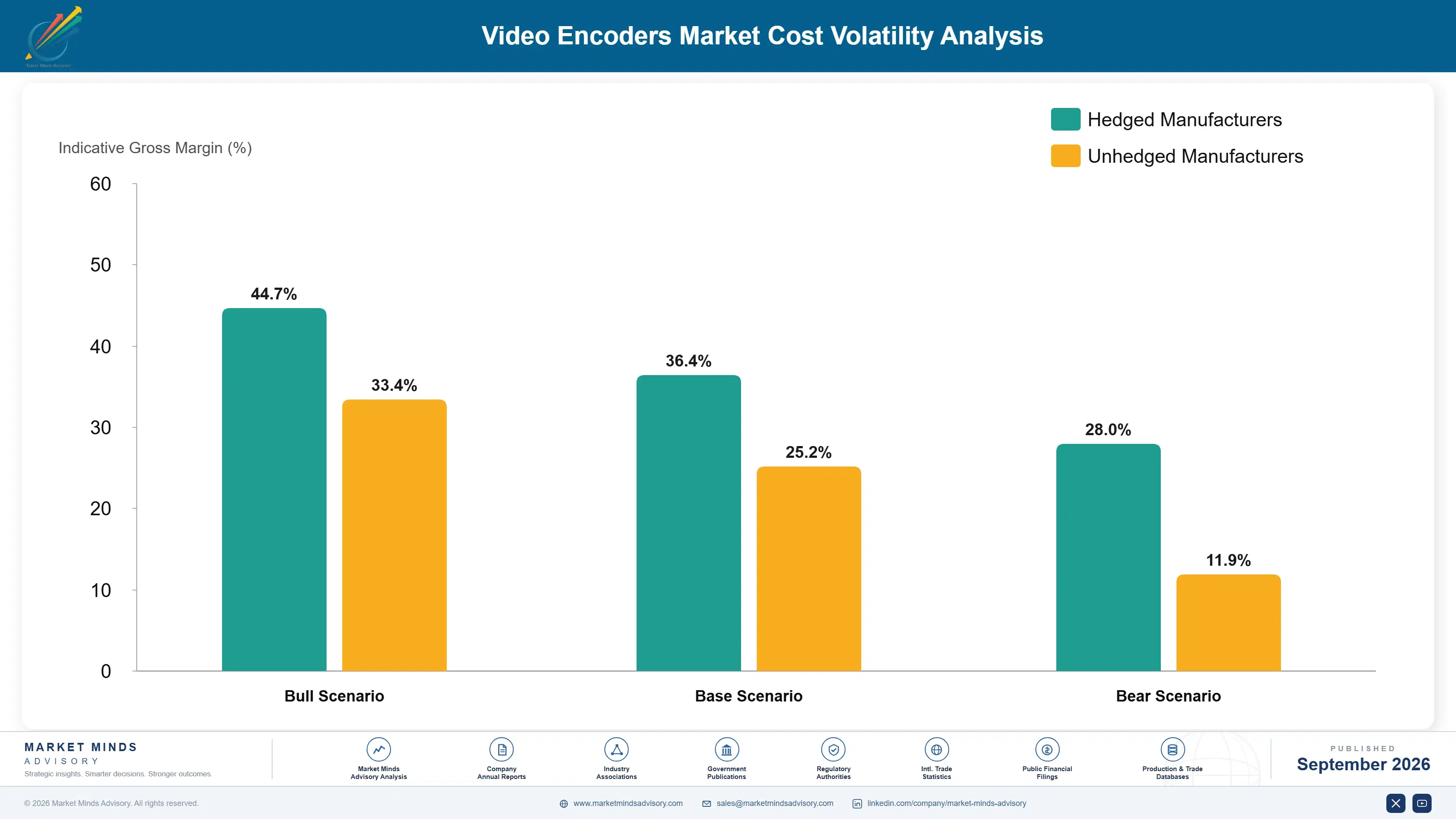
Codec Licensing and Compute Costs Drive Margins

Codec patent licensing fees and cloud compute infrastructure together represent roughly 48 percent of cost of goods sold for video encoder vendors, notably higher than general enterprise software categories operating without codec licensing obligations. Licensing fees alone account for close to 26 percent, scaling with the number of distinct codec standards a vendor's platform supports.
Cloud compute pricing for AI-assisted encoding workloads rose sharply during 2023, following surging enterprise demand for machine learning infrastructure across all software categories simultaneously, as documented in major cloud providers' published pricing update announcements that year. Vendors training per-title optimization models on large content libraries absorbed meaningfully higher compute costs for several quarters before optimizing model architecture and training efficiency to reduce per-title compute expense.

Smaller vendors lacking scale to negotiate favorable codec licensing and cloud pricing face a real cost disadvantage against larger competitors like Harmonic, who can spread licensing fees and compute costs across a broader customer base and negotiate volume discounts unavailable to smaller specialists. This dynamic increasingly pushes smaller vendors toward niche codec categories where larger competitors see insufficient contract value to compete aggressively on price alone.
video-encoders-market-cost-volatility-analysis-1789988116117

Royalty-Free Codec Alternative Support

Vendors are supporting royalty-free codec alternatives alongside traditional licensed standards across their entire product portfolio and full customer base, reducing overall licensing cost exposure for customers willing to accept marginally different compression efficiency in exchange for eliminating patent pool royalty payments entirely on those specific workflows and deployments across their platforms and product lines.

Model Efficiency Optimization Investment

Vendors are investing in more efficient machine learning model architectures that require less compute per encoding decision, reducing cloud hosting costs per customer meaningfully while maintaining optimization accuracy, a technical investment smaller vendors are adopting more slowly given the significant upfront engineering cost required for the full transition to work reliably at meaningful scale.

Multi-Cloud Compute Contract Negotiation

Larger vendors are negotiating compute contracts across multiple different cloud providers simultaneously to secure meaningful volume discounts and avoid single-vendor lock-in, using competitive bids between major providers to keep AI training cost growth well below customer contract price escalators each and every renewal cycle and annual budget planning period across the entire global organization.

Portfolio Architecture for Margin Defence

Video encoders span three commercial tiers: basic fixed-bitrate encoding at the volume end, certified multi-codec platforms meeting broadcast reliability benchmarks in the middle, and AI-assisted per-title optimization suites at the premium top, with gross margins expanding meaningfully from the commodity tier through to next-generation platforms that command significantly higher recurring revenue per customer account and content library.
Volume-tier fixed-bitrate encoding faces persistent price pressure from customers treating basic compression as commoditized infrastructure, while premium AI optimization suites increasingly capture disproportionate margin as customers pay for bandwidth savings rather than encoding mechanics alone. Vendors straddling both tiers face internal tension allocating engineering resources between defending existing encoding accounts and building the next-generation optimization capability premium customers now demand.

High-value margin pools concentrate heavily around AI-assisted per-title optimization and cloud-based encoding services, where large content owners pay meaningfully more for measurable reductions in bandwidth cost and content delivery expense. Smaller vendors without machine learning depth remain confined to lower-margin encoding work, ceding the fastest-growing and most profitable segment entirely to larger, better-capitalized competitors with deeper research and codec licensing budgets. This margin gap widens further each year.

Volume / Commodity-Adjacent Tier

Basic fixed-bitrate encoding software serving smaller content producers with minimal optimization capability beyond simple static compression profiles applied uniformly across content libraries without any differentiation or per-title content analysis whatsoever.
Gross Margin: 20-28%

Premium / Certified Tier

Certified multi-codec platforms meeting broadcast reliability benchmarks, offering standardized encoding across every major compression standard that reduces device compatibility risk considerably for content distributors and their many downstream distribution partners.
Gross Margin: 36-44%

Sustainability / Regulatory / Next-Generation Tier

AI-assisted per-title optimization suites that analyze content complexity and generate customized encoding profiles, commanding the highest per-title pricing among the largest streaming customers worldwide and across every major region and market.
Gross Margin: 48-58%
video-encoders-market-portfolio-architecture-1789988116618

High-value Sub-segments and Strategic Watch-out

AI-Assisted Adaptive Bitrate Encoding Systems

This segment combines the fastest unit growth in the market with the highest per-title pricing, as customers pay premium rates for optimization that eliminates bandwidth waste inherent in fixed ladders, making it the clearest priority for vendor R&D investment over the next several years across accounts.
Gross Margin: 52-62%

Cloud-Based Software Video Encoding and Transcoding Services

Growing quickly and reliably on content owners consolidating fragmented on-premise encoding, this segment carries strong margins though slightly below the AI leader, as vendors increasingly bundle cloud services with optimization to justify premium pricing over standalone hardware sold widely today, quite consistently and repeatedly overall.
Gross Margin: 42-50%

Edge and On-Premise Hardware Encoder Appliances

A large installed-base segment growing steadily at a moderate pace today, this hardware category remains the anchor product most broadcasters purchase first before considering broader cloud investment, anchoring overall category volume even as growth increasingly and consistently shifts toward newer software products each and every year overall.
Gross Margin: 30-38%

Surveillance and Security Video Encoders

Growth here trails the fastest segments quite consistently today, and vendors risk this category commoditizing further as basic compression becomes a standard feature bundled into broader security platforms rather than sold separately as a distinct standalone product for most integrators everywhere, indeed going forward overall.
Gross Margin: 26-34%

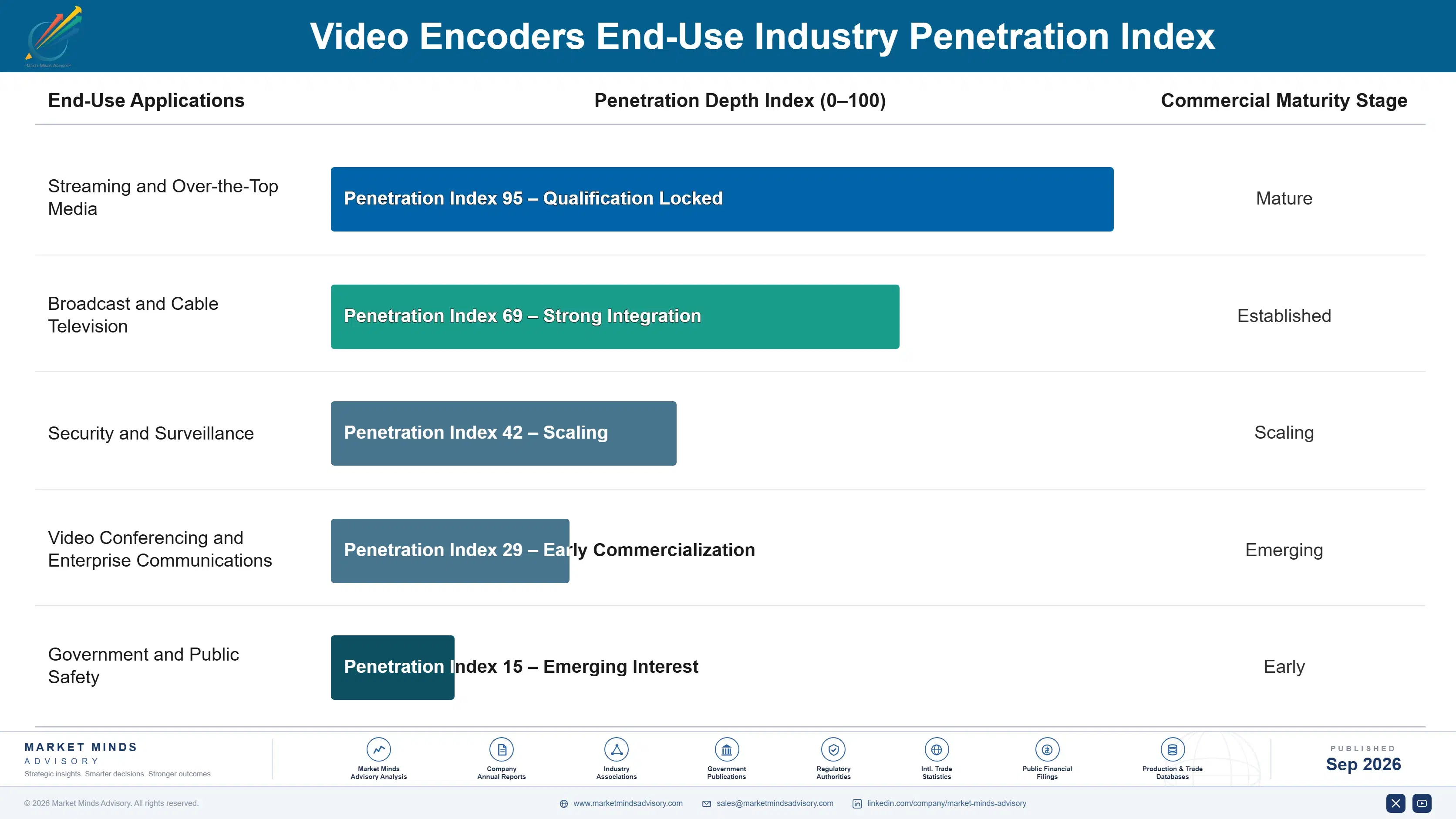
Why Encoding Contracts Compound Over Time

Video encoder subscriptions increasingly function as annuity products rather than one-time software purchases, since usage-based encoding fees, AI model subscriptions, and managed support attach to the base platform and recur across a customer's typical five to eight year vendor relationship. Vendors capturing this attached recurring revenue build customer lifetime value multiples well above the original license price.
Adoption depth varies meaningfully by content complexity: simple content categories adopt shallowly, deploying encoding primarily for basic compression without deep per-title optimization, while premium streaming platforms integrate encoding relationships deeply into bandwidth cost management and quality-of-experience workflows, creating switching costs that keep those customers within a single vendor's product family across multiple content library expansions, technology refresh cycles, and successive contract renewals.

Buyer profiles are shifting generationally as media companies increasingly include dedicated video engineering and infrastructure cost leads who evaluate vendor selection through bandwidth savings and AI optimization criteria rather than pure codec compliance comparisons alone. Younger technology leaders entering these roles expect measurable proof of cost reduction before purchase, favoring vendors who can demonstrate quantified outcomes over long-standing incumbent relationships built on legacy vendor tenure and history.
video-encoders-market-end-use-penetration-index-1789988117111

Priorities for Video Encoder Vendors

These are among the four positions where our research anticipates prominent divergence between winners and laggards over the coming forecast period. Each is grounded in the demand model, the regulatory perimeter, and the announced capacity pipeline.
01 / AI OPTIMIZATION CREDIBILITY

Prove Bandwidth Savings, Not Feature Claims

Streaming platforms increasingly evaluate encoding investment on documented bandwidth savings data rather than accepting vendor claims about AI-assisted optimization capability at face value, and vendors who lead with measured per-title results during procurement evaluations close larger platform contracts meaningfully faster than those emphasizing feature breadth alone across their sales conversations. Genuine optimization results, not marketing claims, win the largest streaming accounts today. Vendors treating AI as a checkbox rather than a core competency are losing ground steadily to more credible competitors.
02 / CLOUD MIGRATION SUPPORT

Build Migration Tools Before Legacy Customers Churn

Broadcasters running established on-premise infrastructure represent a substantial addressable market that pure cloud-native vendors cannot serve without significant additional investment in legacy integration and hybrid deployment capability built specifically for that particular transition purpose and each broadcaster's unique existing workflow requirements and legacy technology constraints. Vendors offering dedicated migration support are winning larger, more complex broadcaster accounts than competitors requiring full cloud conversion before adoption can even begin at all. Migration capability is becoming as commercially valuable as cloud-native architecture itself.
03 / CODEC LICENSING SIMPLIFICATION

Build Bundled Licensing Before Competitors Do

Codec patent licensing complexity continues frustrating customers navigating multiple overlapping patent pools with varying royalty calculation methodologies across every major jurisdiction, and vendors offering simplified, bundled licensing arrangements are winning accounts that competitors requiring customers to negotiate separately with each patent holder simply cannot match on administrative simplicity, cost predictability, or overall customer experience and satisfaction. Building this capability now positions vendors ahead of customers increasingly prioritizing licensing simplicity over marginal compression efficiency gains. Licensing simplification is becoming a genuine competitive differentiator.
04 / RECURRING REVENUE EXPANSION

Build Usage-Based Pricing Before Rivals Do

Flat per-channel licensing undervalues high-volume encoding customers relative to the platform value they actually extract, making usage-based pricing and AI subscription revenue the more durable profit pools within this category over the coming several years of continued category maturation, consolidation, and vendor rationalization across the broader industry. Vendors that shift pricing models early capture meaningfully higher customer lifetime value and materially better account expansion than those still selling flat subscriptions alone. Waiting cedes the most profitable accounts to faster-moving competitors.

Engagement Snapshot From the Field

A live engagement with an industry participant carrying material or product regulatory and market exposure ahead of a defining policy shift, showing how our research translates into a defensible multi-year portfolio strategy.
MARKET MINDS ADVISORY · CLIENT ENGAGEMENT SUMMARY
Video Encoders Producer Strategic Portfolio Review and Transition Roadmap 2026·Investment Scenario on Video Encoders Exposure Evaluation 2025-26
CLIENT PROFILE
The client is a mid-size streaming platform serving roughly 3.5 million subscribers, with an aging fixed-bitrate encoding infrastructure that applied identical compression profiles across its entire content library regardless of individual title complexity. Annual content delivery network bandwidth costs exceeded $18 million (client-reported, unverified by MMA), a cost growing faster than subscriber revenue itself each year.
STRATEGIC CHALLENGE
The platform's fixed-bitrate encoding approach wasted meaningful bandwidth on simple content that required far less compression complexity than the uniform encoding ladder provided, while occasionally under-serving complex action content during high-motion scenes. Leadership needed a modernization strategy that would introduce AI-assisted per-title optimization without disrupting existing content delivery workflows or requiring a complete infrastructure rebuild.
MMA APPROACH
MMA benchmarked the platform's existing bandwidth costs and encoding quality against three AI-assisted encoding vendors, modeling expected bandwidth savings and quality improvement under each option. The engagement combined vendor technical evaluation of optimization accuracy with a phased migration strategy that preserved existing content delivery network integration to minimize disruption risk.
KEY FINDINGS
  1. A significant share of the platform's content library was substantially over-encoded relative to its actual visual complexity, wasting meaningful bandwidth unnecessarily each month.
  2. AI-assisted per-title optimization demonstrated measurably better bandwidth efficiency than the existing fixed ladder across a very large representative sample of tested content.
  3. Complex action content occasionally required higher bitrates than the fixed ladder allocated, indicating quality gaps that the new approach could directly and immediately address.
  4. A phased migration approach avoided the significant disruption risk that converting the entire content library simultaneously would have introduced into production workflows.
CLIENT PROFILE
The client is a mid-size streaming platform serving roughly 3.5 million subscribers, with an aging fixed-bitrate encoding infrastructure that applied identical compression profiles across its entire content library regardless of individual title complexity. Annual content delivery network bandwidth costs exceeded $18 million (client-reported, unverified by MMA), a cost growing faster than subscriber revenue itself each year.
STRATEGIC CHALLENGE
The platform's fixed-bitrate encoding approach wasted meaningful bandwidth on simple content that required far less compression complexity than the uniform encoding ladder provided, while occasionally under-serving complex action content during high-motion scenes. Leadership needed a modernization strategy that would introduce AI-assisted per-title optimization without disrupting existing content delivery workflows or requiring a complete infrastructure rebuild.
MMA APPROACH
MMA benchmarked the platform's existing bandwidth costs and encoding quality against three AI-assisted encoding vendors, modeling expected bandwidth savings and quality improvement under each option. The engagement combined vendor technical evaluation of optimization accuracy with a phased migration strategy that preserved existing content delivery network integration to minimize disruption risk.
KEY FINDINGS
  1. A significant share of the platform's content library was substantially over-encoded relative to its actual visual complexity, wasting meaningful bandwidth unnecessarily each month.
  2. AI-assisted per-title optimization demonstrated measurably better bandwidth efficiency than the existing fixed ladder across a very large representative sample of tested content.
  3. Complex action content occasionally required higher bitrates than the fixed ladder allocated, indicating quality gaps that the new approach could directly and immediately address.
  4. A phased migration approach avoided the significant disruption risk that converting the entire content library simultaneously would have introduced into production workflows.
RECOMMENDED STRATEGY
Phase 1: Phase 1 (Months 1-3): Validate new AI-assisted encoding performance against a large, representative sample of the platform's entire content library. Phase 2: Phase 2 (Months 4-7): Migrate the highest-volume content categories to per-title optimization while closely and continuously monitoring the bandwidth impact. Phase 3: Phase 3 (Months 8-10): Extend optimization across the entire remaining content library and fully retire the older legacy fixed encoding ladder.
OUTCOME
Within ten months of completing the full migration, the platform reported content delivery bandwidth costs declining by roughly 29 percent (client-reported, unverified by MMA), alongside measurably improved viewer-reported streaming quality scores across its complex action content library and its entire full catalog and platform overall.

Frequently Asked Questions

Foundational context covering the market sizes, CAGR, scope, country, region and competition that inform every finding below. This section is provided to cover basics and most often pre-purchase conversations, answered from the MMA Primary Research Dataset.

What is the current size of the Video Encoders Market?

The video encoders market was valued at $4.2 billion in 2025. It is projected to reach $4.64 billion in 2026 as AI-assisted encoding adoption accelerates.

How large will the Video Encoders Market be by 2036?

The market is projected to reach $12.59 billion by 2036, up from $4.64 billion in 2026. That represents a 2.71 times expansion over the forecast decade.

What is the CAGR for the Video Encoders Market 2026 to 2036?

The market is projected to grow at a 10.5 percent CAGR between 2026 and 2036. This is up from a historical CAGR of roughly 9.5 percent between 2020 and 2025.

Which segment is growing fastest?

AI-assisted adaptive bitrate encoding systems lead growth at a 16.0 percent CAGR, roughly 1.52 times the overall market rate. Streaming platforms finally have technology that generates content-aware encoding profiles.

Who are the major companies in the Video Encoders Market?

Harmonic Inc, AWS Elemental, Ateme, MediaKind, and Haivision are the five largest participants by deployed-channel-count basis. Together they hold an estimated 45 percent of the global market.

Which country is growing fastest?

India is the fastest-growing country at a 14.0 percent CAGR, driven by rapidly expanding streaming subscriber bases and falling mobile data costs. Rising technology talent reinforces this trajectory further.

Report Segmentation Architecture

The full report scope spans multiple orthogonal segmentation dimensions, with cross-tabulated demand data provided for each dimension pair. Coverage extends further to regional breakdowns, trend trajectories, and the competitive detail needed to support segment-level decision-making.

By Encoding Function Type

  • AI-Assisted Adaptive Bitrate Encoding Systems
  • Cloud-Based Software Video Encoding and Transcoding
  • Edge and On-Premise Hardware Encoder Appliances
  • Surveillance and Security Video Encoders
  • Live Broadcast Video Encoders
  • Multi-Codec Compliance and Transcoding Gateways

By End-Use Industry

  • Streaming and Over-the-Top Media
  • Broadcast and Cable Television
  • Security and Surveillance
  • Video Conferencing and Enterprise Communications
  • Government and Public Safety

By Commercial Dimension

  • Enterprise Direct Licensing
  • Usage-Based Cloud Encoding Pricing
  • Managed Workflow Support Services
  • Codec Licensing Bundling Programs

By Region

  • North America
  • Western Europe
  • East Asia
  • South Asia and Pacific
  • Latin America
  • Middle East and Africa
  • Eastern Europe

Scope, Methodology, and Coverage

Every figure in this report is reproducible from documented input assumptions. The scope below maps the historical period, the forecast horizon, the segmentation dimensions, and the countries covered, alongside the underlying primary and qualitative methodology.
Historical Period
2020 to 2025
Forecast Period
2026 to 2036
Base Year
2025 (USD billions; MMA Primary Research Dataset, September 2026)
Market Definition
The video encoders market covers hardware appliances and software systems that compress raw video signals into distribution-ready formats for broadcast, live streaming, IPTV, and surveillance applications. It excludes consumer camera encoding chips embedded in smartphones and generic video editing software lacking dedicated encoding infrastructure focus.
Quantitative Units
USD billions (current prices); deployed channel count where applicable
Segmentation Dimensions
By Encoding Function Type; By End-Use Industry; By Commercial Dimension; By Region
Regions Covered
North America, Western Europe, East Asia, South Asia and Pacific, Latin America, Middle East and Africa, Eastern Europe
Countries Covered
USA, China, Germany, France, UK, Japan, South Korea, India, Australia, Canada, Brazil, Mexico, Indonesia, Vietnam, Thailand, Malaysia, UAE, Saudi Arabia, South Africa, Nigeria, Turkey, Poland, Netherlands, Italy, Spain, Sweden, Switzerland, Argentina, Colombia, Singapore, and additional markets relevant to this sector
Key Companies Profiled
Harmonic Inc, AWS Elemental, Ateme, MediaKind, Haivision, Wowza Media Systems, Telestream, Bitmovin, NETINT Technologies, Zixi, Imagine Communications, Grass Valley, EVS Broadcast Equipment, Vitec, Beamr, MulticoreWare, V-Nova, MainConcept, Intel, NAGRA
Quantitative Methodology
Primary survey, n=3,800 respondents, Q4 2025, six countries; demand-side model with trade association cross-validation
Qualitative Methodology
47 expert interviews, Q4 2025; applied to validate demand model assumptions, identify emerging dynamics, and assess competitive positioning
Report Format
PDF and XLSX data workbook (Word format preview document)
Publisher
Market Minds Advisory
Report Code
MMA-2026-TEC-193
Published
September 2026
Contact
sales@marketmindsadvisory.com | www.marketmindsadvisory.com

Purchase the full Video Encoders Market Report (2026 to 2036).

This report delivers a comprehensive analysis of the global video encoders market, spanning encoding function segmentation, regional demand dynamics, and competitive positioning across twenty profiled companies worldwide. It includes ten-year forecasts through 2036, detailed input cost and margin analysis across three commercial tiers, and revenue diversification strategies for vendors navigating the shift toward AI-assisted per-title optimization. The analysis draws on primary survey data, expert interviews, and company disclosures to support procurement, investment, and product strategy decisions. It closes with an anonymized client modernization case study illustrating measured bandwidth and quality outcomes.
Encoding function segmentation with detailed growth forecasts
Seven-region demand analysis through the 2036 forecast
Competitive benchmarking of twenty profiled global vendors
Input cost and gross margin tier breakdown analysis
Revenue diversification and recurring pricing lever analysis
Anonymized client modernization case study with outcomes

Built For The People Who Decide

From boardroom strategy to bench-side execution, this report is read cover-to-cover by leaders shaping the next decade of their industry, turning demand scenarios, market dynamics and valuation benchmarks into decisions.
CXOs/ Presidents/ VPs/ Managers
M&A and Corporate Development
Strategy Teams and R&D Heads
Procurement and Product Directors
Regulatory and Compliance Leaders
Investor Relations and Equity Analysts