Market Minds Advisory
Vibe Coding Market

Vibe Coding Market: Vibe Coding Market. Trends and Forecast 2026 to 2036

Natural language app generation is collapsing the distance between an idea and working software, pulling non-technical founders and product managers into a coding market long reserved exclusively for trained professional software engineers.

Lead Analyst

Published

September 2026

Make Smarter Decisions with Customized Research Insights

Request a free sample report and evaluate market opportunities, growth trends, and competitive dynamics relevant to your business needs.

2025 MARKET VALUE$4.2BMarket Size 2025
2036 FORECAST VALUE$24.8BBase Case , 2026 to 2036
CAGR 2026 TO 203617.5 %Bull 18.8% / Bear 16.2%
INCREMENTAL OPPORTUNITY$19.8BNet 10- year value creation
EXPANSION MULTIPLE5.02x2036 value over 2026 base
Strategic Levers
M&A Pipeline
Regional Outlook
Country Rankings
Competitive Intelligence
Segmental Deep-dive
Call-Us : 91 93563 13602

Executive Snapshot and Market Trajectory.

Full-stack app scaffolding platforms are pulling non-technical users into software creation faster than any prior developer tool category in recent memory, compressing timelines from idea to working prototype dramatically across most industries, use cases, and various company sizes nationwide and abroad.
Enterprise adoption is accelerating as engineering leaders recognize measurable productivity gains on routine coding tasks, even as debate continues over code quality and long-term maintainability of AI-generated codebases across most organizations and engineering teams nationwide and abroad today. India and other markets with large developer populations are adopting these tools fastest as junior engineers use AI assistance to compress the experience gap with senior colleagues considerably more rapidly and consistently.
A handful of well-funded startups are racing established technology incumbents for developer mindshare, with switching costs remaining genuinely low given most tools integrate with existing code editors rather than requiring wholesale workflow replacement entirely across most engineering organizations and teams nationwide and abroad. Enterprise governance and security tooling is emerging as a distinct commercial category as companies seek to control AI-generated code quality and intellectual property exposure across their engineering organizations and broader teams.
Market Definition
The Vibe Coding Market covers software platforms that generate, scaffold, deploy, or substantially modify application code from natural language prompts rather than traditional manual programming, measured by subscription and usage-based revenue. It excludes traditional integrated development environments lacking generative AI capability and standalone chatbot products not directly producing deployable application code.
Base Year Value
$4.2B in 2025 (MMA Primary Research Dataset, September 2026)
Forecast Period
2026 to 2036, eleven discrete annual values
CAGR
17.5% base case. Bull 18.8%. Bear 16.2%.
Fastest Growth Segment
Full-Stack App Scaffolding and Deployment Platforms: 20.0% CAGR
Fastest Growth Country
India: 24.0% CAGR
Fastest Growth Region
South Asia and Pacific: 19.5% CAGR
Largest Region
North America: 30% of 2025 global value
Market Leaders
Leading participants include GitHub Copilot, Cursor, Replit, Anthropic, and Vercel.
Primary Survey
n=3,800 procurement and R&D decision-makers, Q4 2025, six countries
Methodology
Demand-side build-up, cross-validated against public data, 47 expert interviews

Vibe Coding Market Forecast Scenarios

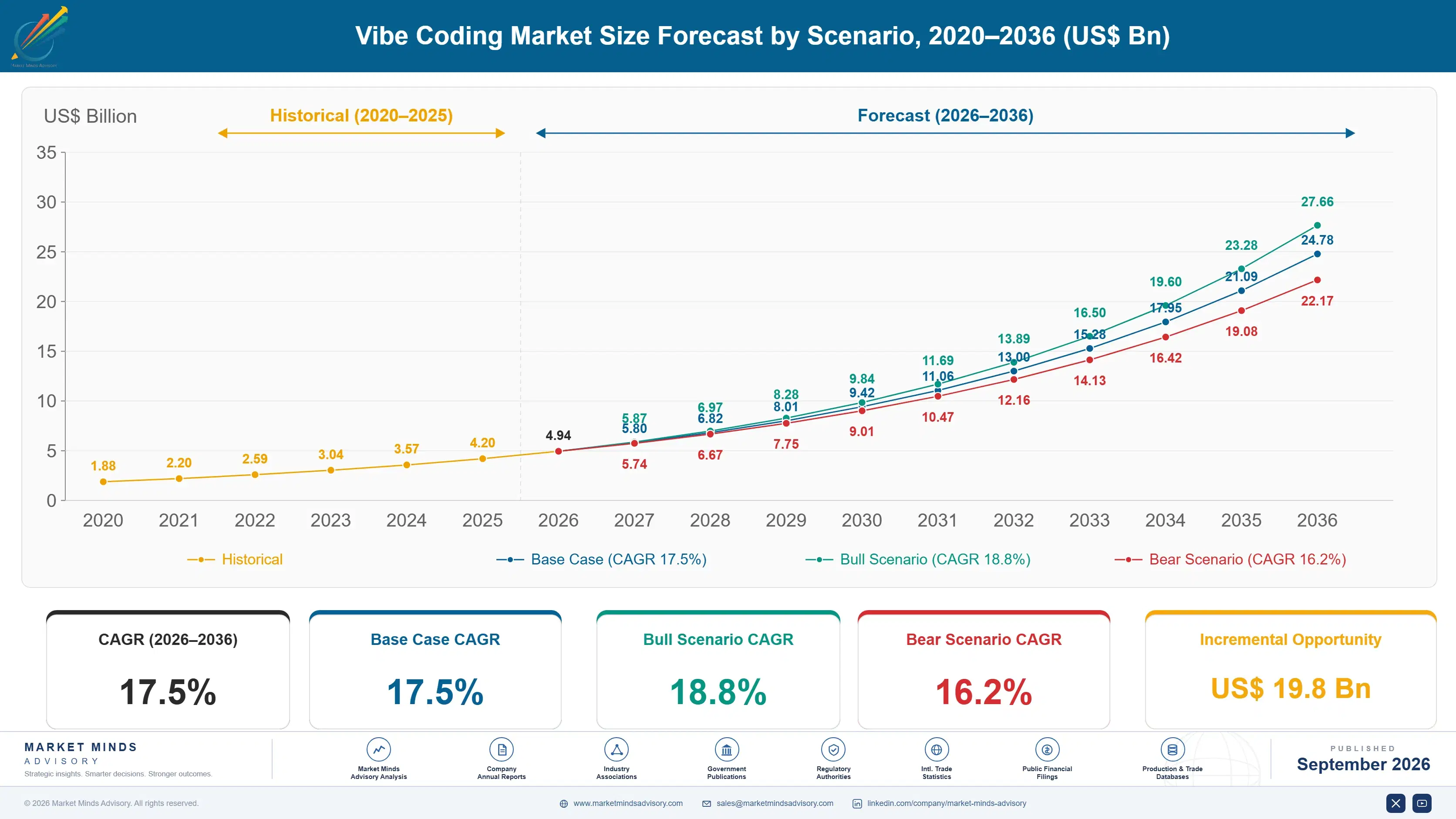
vibe-coding-market-size-forecast-scenario-1788414108849
Between 2020 and 2025 the market grew at a 16.0% historical rate as large language models rapidly improved code generation quality, transforming early autocomplete tools into genuine full application scaffolding platforms within just a few short years of intense competitive iteration and venture-funded rapid product development across most major markets and geographies worldwide today and consistently.
The base case assumes continued enterprise adoption acceleration, expanding full-stack scaffolding platform capability, and rising demand for AI coding governance and security tools as organizations scale usage nationwide. India and other large developer population markets sustain the fastest incremental adoption as junior engineers use AI assistance to compress the experience gap with senior colleagues. Consolidation among leading platforms continues as venture capital funding concentrates around demonstrated enterprise traction rather than experimental early-stage products.
A bull case turns on faster-than-expected enterprise governance tooling adoption winning over large regulated-industry customers currently hesitant about AI-generated code liability exposure and considerable compliance risk. A bear case centers on underlying foundation model providers integrating coding capability directly into their core products, disintermediating standalone vibe coding platforms that currently depend on model provider application programming interfaces.

The Model Dependency Behind Platform Economics

Nearly all vibe coding platforms build atop a small number of foundation model providers, creating a genuine dependency risk that could reshape competitive dynamics quickly if underlying model pricing or access terms change materially in ways platform vendors cannot fully control or predict in advance, particularly as model providers increasingly build competing coding products of their own that bypass third-party platforms entirely and directly.
MARKET CONCENTRATION48% CR5Top five platforms hold combined revenue share globally today
AVERAGE SEAT PRICE$32/monthTypical monthly subscription cost per individual developer license
TOP ADOPTING COUNTRY36% United StatesLargest concentration of platform revenue and enterprise deployments worldwide
ENTERPRISE ADOPTION RATE41%Portion of mid-sized and large companies using these platforms formally
FOUNDATION MODEL DEPENDENCY88%Portion of platforms built primarily on third-party model providers
DEVELOPER RETENTION RATE72%Share of paying users still active twelve months after signup
Enterprise governance concerns around code quality, security vulnerabilities, and intellectual property exposure are creating a distinct and increasingly lucrative product category separate from individual developer productivity tools sold primarily on convenience and speed of iteration, since large organizations require detailed audit trails and access controls that consumer-oriented tools rarely provide by default or without meaningful additional engineering investment and integration work.
Developer retention economics differ meaningfully from typical software-as-a-service benchmarks, since switching between coding platforms carries genuinely low friction given most tools integrate with existing editors rather than requiring wholesale workflow migration across an entire engineering organization, making individual developer habit and preference a considerably more durable retention driver than formal enterprise contracts alone in most competitive situations and pricing negotiations.
"The moat here isn't the model, since everyone has access to roughly the same underlying intelligence. It's whoever builds the workflow developers actually trust enough to stop reading the generated code line by line."
Senior Analyst, Developer Tools and AI Software Practice · MMA Technology Practice · September 2026

Market Trends

Full-Stack Scaffolding Platforms Expand Beyond Prototyping

Platforms originally designed for rapid prototyping and demo generation are expanding capability toward production-grade application deployment, closing the gap between quick proof-of-concept generation and genuinely deployable, maintainable software that businesses can rely on long-term across most use cases. This expansion reflects genuine user demand, since early adopters consistently requested deployment infrastructure, database integration, and authentication capability beyond simple code generation alone and unaided. Vendors offering integrated deployment and hosting alongside code generation report meaningfully higher customer retention than vendors requiring users to manually deploy generated code through separate infrastructure providers and services.
Market Impact: Model capability gains lifted success 40%
Enterprise Governance Tools Emerge as Distinct Category

Enterprise buyers are increasingly purchasing dedicated governance and security tooling layered atop core coding platforms, addressing concerns about code quality consistency, intellectual property exposure, and security vulnerabilities that individual developer tools were not originally designed to address at organizational scale and complexity. This category has grown from a peripheral add-on into a genuine standalone purchasing decision as chief information security officers and engineering leadership demand auditability comparable to traditional software development lifecycle controls. Vendors offering dedicated governance capability report meaningfully higher enterprise contract values than vendors selling individual developer licenses alone.
Market Impact: Talent-constrained adoption rose 33% yearly

Market Opportunities and Growth Drivers

Rapid Foundation Model Improvement Expands Use Case Coverage

Successive generations of foundation language models have dramatically improved code generation accuracy and complexity handling, directly expanding what tasks these platforms can reliably automate beyond simple boilerplate generation toward genuinely complex application logic. This improvement trajectory has proven remarkably consistent across model generations, giving platform vendors confidence to build increasingly ambitious product roadmaps around continued model capability gains rather than treating current limitations as permanent constraints. Platforms with tight integration to the latest available models report meaningfully higher user satisfaction than platforms relying on older, less capable model versions still in production.
Market Impact: Model dependency affects 88% of vendors

Developer Talent Scarcity Accelerates AI Assistance Adoption

Persistent scarcity of experienced software engineering talent, particularly in rapidly digitizing economies building out domestic technology sectors, is pushing companies toward AI coding assistance as a practical substitute for hiring additional senior engineers immediately, quickly, and cost-effectively across most organizations. This scarcity-driven adoption is particularly pronounced in markets like India, where junior engineers use AI assistance to compress the experience gap with senior colleagues on complex technical tasks requiring specialized expertise. Companies facing the tightest talent constraints report the fastest and most enthusiastic adoption of these platforms across their engineering organizations.
Market Impact: Trust concerns delay adoption 8 months

Market Restraints and Challenges

Foundation Model Dependency Threatens Platform Differentiation

Vibe coding platforms building atop third-party foundation models face genuine competitive exposure if model providers decide to integrate coding capability directly into their own core products, disintermediating platforms currently dependent on application programming interface access. The root cause traces to platforms lacking proprietary model technology of their own, meaning their core value proposition rests on workflow, integration, and user experience rather than fundamental intelligence differentiation. Some platforms are responding by building proprietary fine-tuning capability and switching between multiple model providers to reduce single-vendor dependency, though these mitigation strategies add meaningful engineering complexity.
Market Impact: Production deployment usage grew 52% yearly

Code Quality Concerns Slow Enterprise Trust and Adoption

Enterprise engineering leaders remain genuinely cautious about production deployment of substantial amounts of AI-generated code given persistent concerns about maintainability, security vulnerabilities, and technical debt accumulation that manual code review processes were not originally designed to catch at scale. This caution is rooted in real documented incidents of AI-generated code introducing subtle bugs and security flaws that passed initial review before causing production problems later. Vendors are responding by building automated testing and security scanning directly into their platforms, though building genuine enterprise trust still requires extended track records that newer platforms have not yet accumulated.
Market Impact: Enterprise governance contracts grew 65% yearly
3 additional market trends, 4 additional growth drivers, and 2 additional restraints and challenges are covered in the full report. Contact sales@marketmindsadvisory.com to access the complete intelligence.

Segment CAGR and Growth Architecture

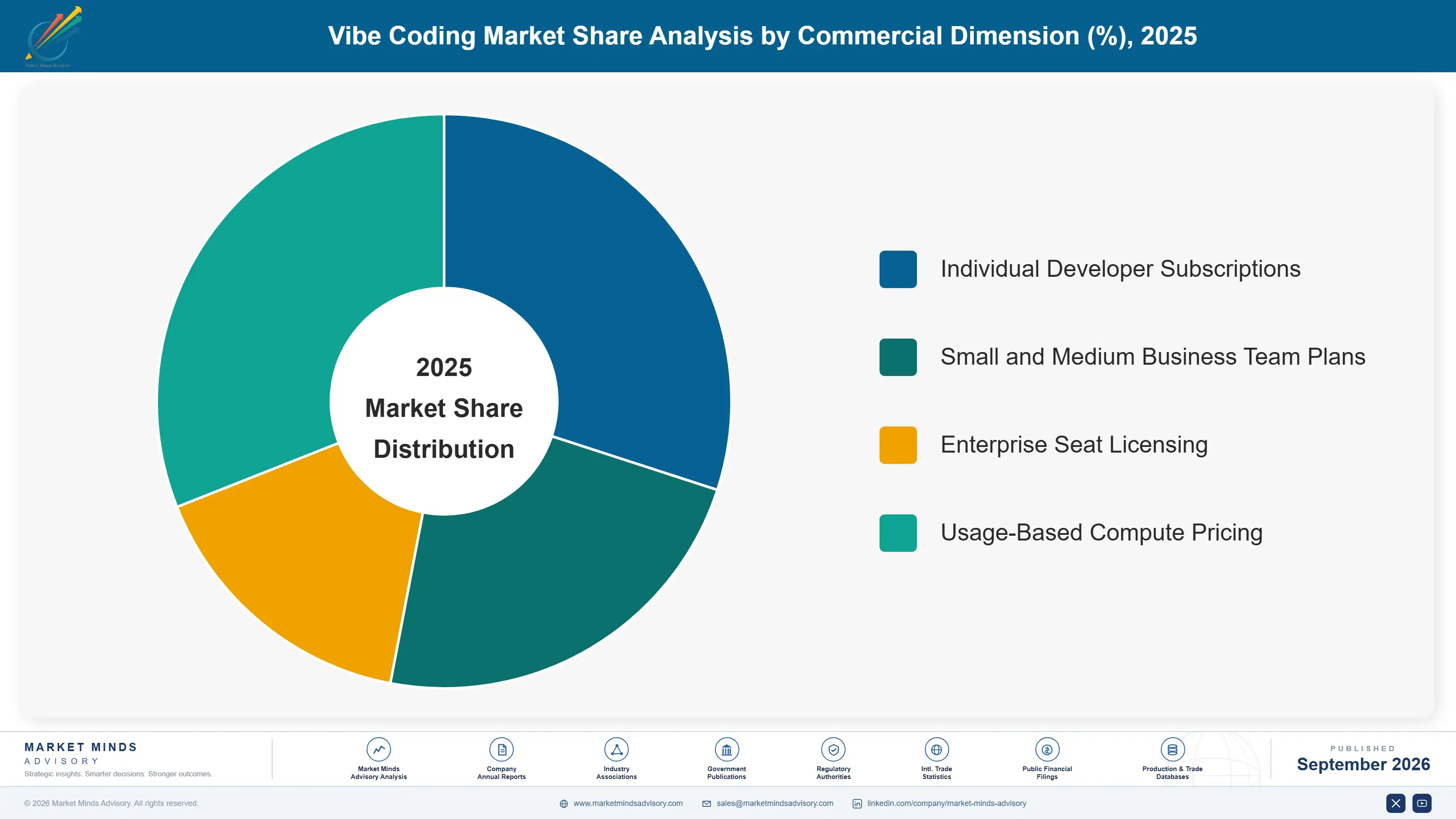
The Vibe Coding Market segments by capability, spanning pair programming and autocomplete through full-stack scaffolding, code review, and enterprise governance tools designed for distinct user needs, skill levels, and evolving workflow requirements across most industries. Full-stack scaffolding and no-code AI builders are pulling growth ahead of traditional autocomplete tools as one-shot application generation matures.
vibe-coding-market-market-share-analysis-1788414109388

Full-Stack App Scaffolding and Deployment Platforms

Full-stack app scaffolding and deployment platforms represent the fastest-growing segment, expanding at 20.0% annually as one-shot application generation matures from simple prototype demonstrations into genuinely deployable, production-capable software addressing real business needs, use cases, and customer requirements nationwide. This segment benefits from integrated deployment infrastructure, database provisioning, and authentication capability that eliminate the manual assembly work previously required after initial code generation, compressing the path from idea to working application dramatically. Adoption concentrates among non-technical founders and product managers building initial versions of new products, a customer base expanding rapidly as these platforms lower the technical barrier to entry for software creation that previously required formal engineering training and experience.
CAGR 20.0%

No-Code and Low-Code AI Builders

No-code and low-code AI builders form the second-fastest segment, growing at 18.5% annually as visual interface generation combines with natural language prompting to serve users entirely unwilling to touch underlying code directly regardless of platform sophistication, capability, or overall feature depth and completeness today and consistently. This segment differs meaningfully from pure code generation tools by abstracting away code visibility entirely, appealing to business users who value speed and simplicity over customization depth or code ownership rights. Demand concentrates among small businesses and internal enterprise tooling teams building simple internal applications, a customer base valuing rapid deployment over the deeper technical control that professional developers typically require for complex production systems.
CAGR 18.5%
Full segment breakdown across 6 segments available in the complete report.

Regional Architecture and Country Demand Map

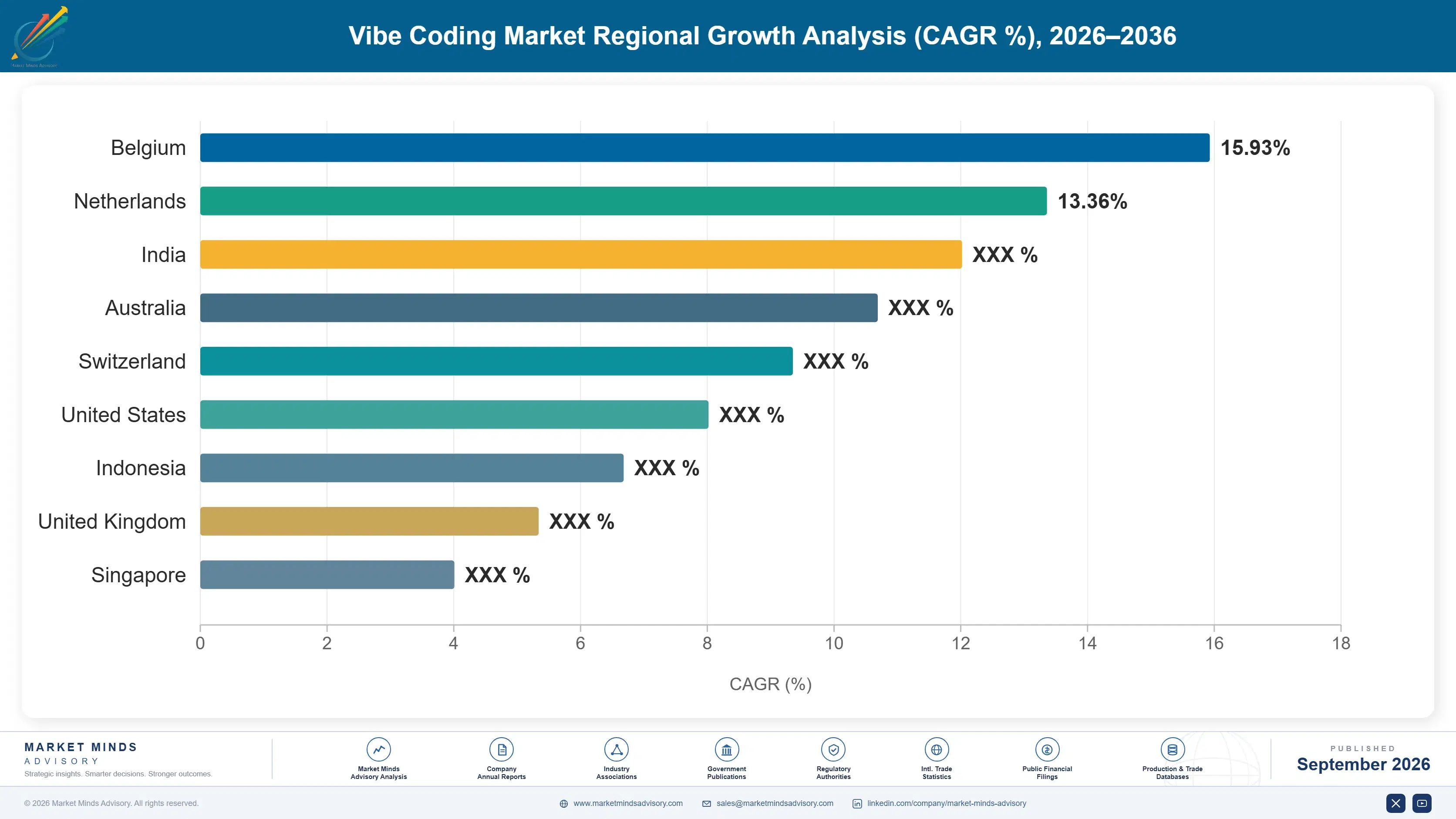
North America leads Vibe Coding Market adoption on the strength of its concentrated AI coding tool vendor base, while East Asia and South Asia and Pacific post the fastest expansion as enterprise developer populations there adopt generative coding platforms across startups, outsourcing firms, and large domestic technology employers.

North America

Five of the market's most consequential vendors, GitHub Copilot, Cursor, Replit, Anthropic, and Vercel, are headquartered in the United States, giving the region an outsized share of platform revenue and early access to frontier model releases from OpenAI and Anthropic. Enterprise procurement teams at large technology employers negotiate seat licenses in the thousands, and roughly 41% of surveyed enterprises here report formal AI coding tool adoption policies already in place. Canada contributes a growing cluster of applied AI startups clustered around Toronto and Waterloo, though the United States accounts for most regional revenue. Venture funding into coding agent startups exceeded several billion dollars across 2024 and 2025, sustaining an unusually deep competitive field for a market this young.
Share: 30% | CAGR: 18.0% (2026 to 2036)

Western Europe

Germany, France, and the United Kingdom host a smaller but increasingly capable cluster of developer tooling startups, and enterprise software buyers across the region show particular caution around code provenance and intellectual property exposure when adopting generative coding platforms. Regulatory attention under the EU AI Act shapes procurement conversations more directly here than in most other regions, pushing vendors toward auditable output logging and explicit training data disclosure. French and German software exporters have begun embedding AI coding assistants into internal pipelines to offset a persistent shortage of mid-level engineering talent. Adoption still trails North America meaningfully, held back by works council negotiations at large employers and by slower procurement cycles that favor established incumbent tooling vendors over newer entrants.
Share: 19% | CAGR: 16.0% (2026 to 2036)
Regional intelligence for 5 additional markets available in the complete report: East Asia, South Asia and Pacific, Latin America, Middle East and Africa, Eastern Europe. Contact sales@marketmindsadvisory.com.
vibe-coding-market-country-cagr-analysis-1788414109901

Where Vibe Coding Platforms Capture Durable Margin

Vibe coding vendors expand revenue beyond flat per-seat subscriptions by layering usage-based compute pricing, enterprise governance add-ons, vertical-specific compliance templates, and multi-model orchestration coordination fees on top of core generation capability, each targeting a distinct willingness to pay across individual developers, growing startups, and large regulated enterprise software buyers navigating procurement carefully and deliberately today.

Usage-Based Compute Pricing for Heavy Generation Workloads

Vendors increasingly meter revenue against tokens generated or agent runtime rather than charging a flat monthly seat fee, capturing more value from power users who run extended multi-step coding agents against large codebases throughout the day. This shift lets platforms price closer to actual foundation model costs while still offering entry-level flat tiers for casual users, expanding blended average revenue per account by an estimated 27% among enterprise accounts adopting usage-based tiers within the first year. Early movers including Cursor and Replit have already restructured pricing this way, and rivals are following as compute remains the largest cost line item.
Market Impact: Usage-based tiers lift enterprise ARPA roughly 27% yearly

Enterprise Governance and Compliance Add-On Modules

Security teams at regulated employers will not approve unrestricted generative coding tool access without audit logging, code provenance tracking, and policy enforcement controls, creating a premium add-on category layered on top of base subscriptions. Vendors selling governance modules report attach rates approaching 38% among enterprise accounts above five hundred seats, with governance add-ons commanding price premiums of 40% or more over the base per-seat fee. This category expands fastest among financial services and healthcare buyers facing regulatory scrutiny over AI-generated code in production, giving vendors a defensible upsell path once initial developer adoption has already occurred organically across teams.
Market Impact: Governance add-ons carry roughly a 40% price premium

Vertical Template Libraries for Regulated Industries

Generic code generation underperforms in industries carrying specific compliance patterns, so vendors are building pre-validated template libraries for healthcare, financial services, and government software that embed required security controls directly into generated output from the first prompt onward. These vertical packages command list prices roughly 55% above horizontal subscription tiers because they reduce manual compliance review work legal and security teams would otherwise perform on every generated code block. Early enterprise pilots in banking and insurance suggest template-driven onboarding cuts internal review cycles meaningfully, a selling point vendors use directly in procurement conversations against generalist platforms lacking industry-specific guardrails.
Market Impact: Vertical templates price about 55% above horizontal tiers

Model Orchestration Layers That Reduce Vendor Lock-In

Enterprises increasingly demand the ability to route coding tasks across multiple foundation models rather than depending on a single provider whose pricing or availability could shift without warning, and vendors offering orchestration layers charge a coordination fee for this flexibility. Platforms supporting multi-model routing report enterprise contract values running roughly 22% higher than single-model competitors, since buyers value the negotiating leverage and resilience this provides against any one model provider's outages or price increases. This lever matters most to the largest accounts, which run enough generation volume that model-level price differences meaningfully affect total delivery cost.
Market Impact: Multi-model routing lifts contract value about 22% higher

Who Controls the Margin Pool

GitHub Copilot, Cursor, Replit, Anthropic, and Vercel together hold an estimated 48% combined share of tracked platform revenue, a concentration that leaves room for challengers given the category's youth. GitHub Copilot leads on distribution through its Microsoft and GitHub relationship, while Cursor has built the strongest reputation among professional engineers for code quality and agentic workflow depth.
Competitive activity centers on agentic capability, meaning how autonomously a tool can plan, execute, and verify multi-step coding tasks without constant human review at each step. Vendors are racing to add browser automation, terminal execution, and automated testing loops into their agents, while foundation model providers including OpenAI, Google, and Anthropic increasingly compete directly with the developer tool companies that depend on their models for core functionality.

Pressure is building from two directions at once. Open-weight models are narrowing the capability gap that justified premium pricing, and large enterprise vendors including JetBrains and Microsoft are bundling coding assistance directly into existing developer suites at effectively no incremental cost. Rankings could shift if a foundation model provider decides to compete downstream rather than license models to independent tool builders, a scenario executives now describe as their single largest strategic risk.
vibe-coding-market-company-positioning-matrix-1788414110421

Competitive Moat and Risk Dimensions

GITHUB COPILOT

Moat: Distribution Through Developer Platform

GitHub's ownership of the largest code hosting platform gives Copilot default visibility to more than 100 million developer accounts without a separate sales motion. Bundling into existing GitHub and Microsoft enterprise agreements lets Copilot win seats through procurement inertia rather than head-to-head technical evaluation, a durable advantage pure-play startups without a platform cannot easily replicate regardless of model quality.
GITHUB COPILOT

Risk: Model Quality Perception Gap

Professional developers frequently cite Cursor and other newer entrants as producing higher-quality code suggestions and more coherent multi-file edits than Copilot's current agent mode. If this perception gap persists among the most demanding power users who influence broader team tooling decisions, Copilot risks losing its most vocal advocates even while retaining casual, less price-sensitive enterprise seats through its distribution advantage.
CURSOR

Moat: Power User Trust and Advocacy

Cursor built its reputation organically through word of mouth among senior engineers before pursuing enterprise sales motions, giving it credibility that marketing spend alone cannot buy. This grassroots trust translates into strong retention, with the company reporting usage-based revenue run rates expanding rapidly through 2025 as its user base upgrades from individual accounts into paid team plans across growing startups.
CURSOR

Risk: Foundation Model Dependency Exposure

Cursor builds its product atop foundation models it does not own, meaning any pricing change, capacity constraint, or capability shift from Anthropic or OpenAI directly affects Cursor's cost structure and product quality without warning. This dependency limits Cursor's ability to differentiate purely on model output quality, pushing the company to compete increasingly on workflow design and interface experience instead.

Players Tracked

Prominent Players

GitHub Copilot
Cursor
Replit
Anthropic
Vercel

Other Key Players

OpenAI
Google
Amazon
Windsurf
Sourcegraph
Tabnine
JetBrains
Bolt.new
Lovable
Magic AI
Poolside AI
Cognition Labs
Augment Code
Warp
Zed Industries

Recent Developments

MARCH 2025

Cursor's parent company Anysphere closed a large venture funding round led by prominent technology investors, valuing the company well above its prior round and providing capital to expand engineering headcount and sales capacity. The round reflected investor confidence in usage-based revenue growth trends reported through early 2025.
Signal: Signals investor conviction that agentic coding tools justify premium valuations well above earlier funding rounds this cycle.
OCTOBER 2025

GitHub expanded Copilot's agent mode to support autonomous multi-file editing and automated pull request generation across enterprise repositories, moving the product beyond inline autocomplete into genuine task delegation territory. The release targeted enterprise customers seeking measurable productivity gains rather than individual developers evaluating the tool casually.
Signal: Marks the incumbent's decisive push from simple inline autocomplete toward autonomous multi-step task execution across enterprise repositories.
JANUARY 2026

Replit announced a strategic partnership with a major cloud infrastructure provider to offer integrated deployment and hosting directly within its coding platform, reducing the number of separate vendors non-technical founders must manage when shipping a finished application into production for paying customers across most industries nationwide.
Signal: Reflects deployment infrastructure becoming a key competitive battleground well beyond raw code generation quality alone today.

Foundation Model Cost Exposure

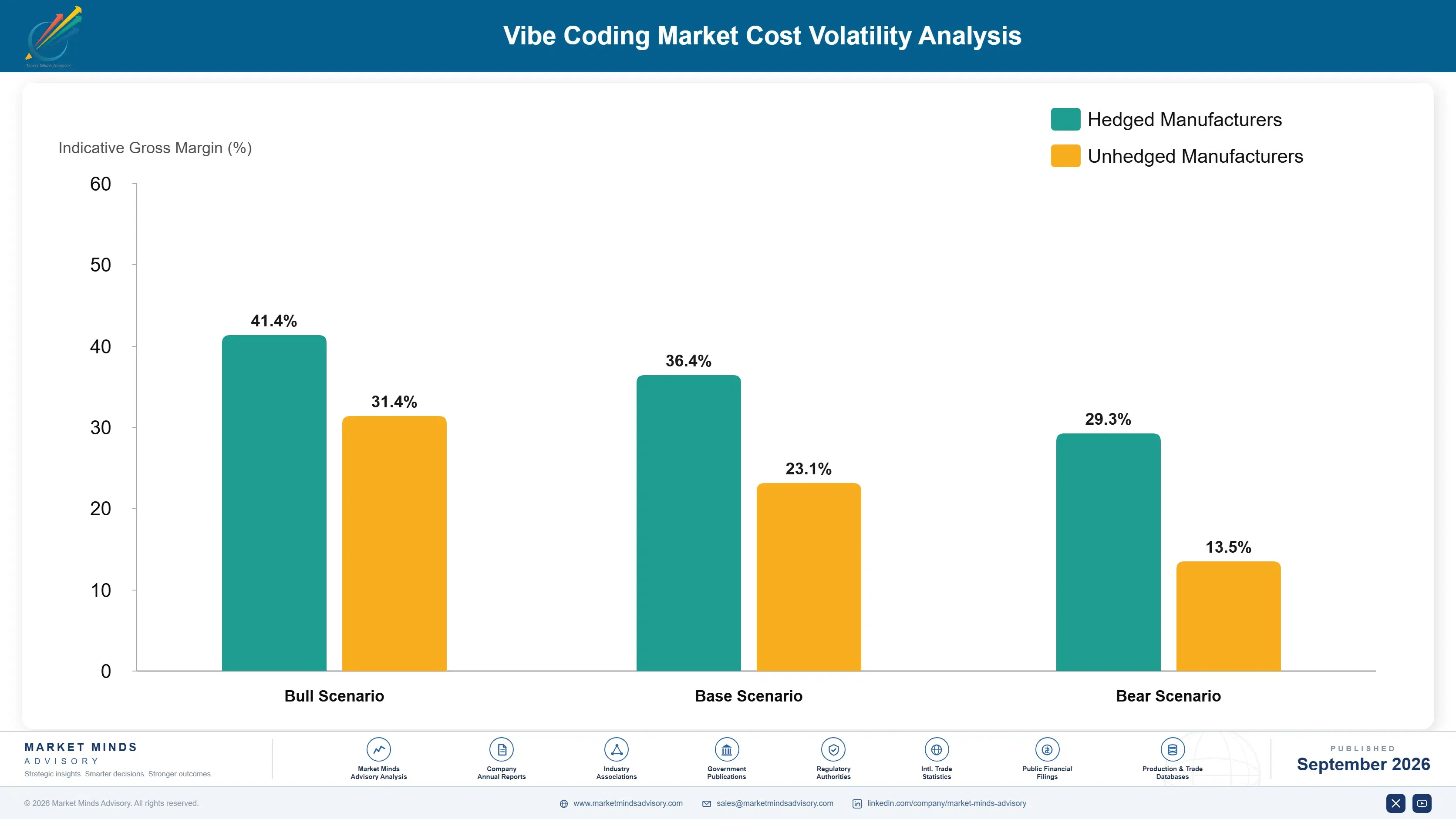
Vibe coding vendors carry an unusual cost structure for a software category: foundation model inference charges from providers including OpenAI, Anthropic, and Google routinely consume 35% to 45% of gross revenue, alongside senior engineering compensation that represents a further 20% of operating cost given the specialized talent these platforms require to build reliable agentic systems.
OpenAI's pricing changes to its GPT model family across 2024 and 2025 forced several coding tool vendors to renegotiate customer pricing or absorb margin compression within a single fiscal quarter, according to vendor disclosures in company investor communications. One mid-sized platform reported gross margin declining by roughly 8 percentage points following an unplanned inference cost increase, illustrating how directly model pricing volatility flows through to vendor profitability given thin negotiating leverage.

Vendors without proprietary model technology face a durable cost disadvantage against foundation model providers who increasingly compete downstream themselves, since those providers can subsidize their own coding products with inference priced at cost while independent tool builders pay full commercial rates. Larger vendors with committed-spend agreements negotiate meaningfully better per-token pricing than smaller competitors, widening the margin gap between well-funded platforms and thinly capitalized startups.
vibe-coding-market-cost-volatility-analysis-1788414110616

Multi-Model Routing to Reduce Single-Vendor Exposure

Vendors increasingly route generation tasks across several foundation models based on task complexity and cost, reserving expensive frontier models for difficult work while routing routine completions to cheaper open-weight alternatives running on rented infrastructure. This blended approach can cut average inference cost per request by roughly 30% without materially degrading output quality for simpler coding tasks handled daily.

Committed-Spend Agreements With Model Providers

Larger vendors negotiate multi-year committed-spend contracts directly with foundation model providers, locking in per-token pricing well below public API rates in exchange for guaranteed minimum volume commitments spanning several years of projected usage. This approach favors well-capitalized incumbents able to commit tens of millions of dollars upfront over smaller startups still raising early venture rounds.

Portfolio Architecture for Margin Defence

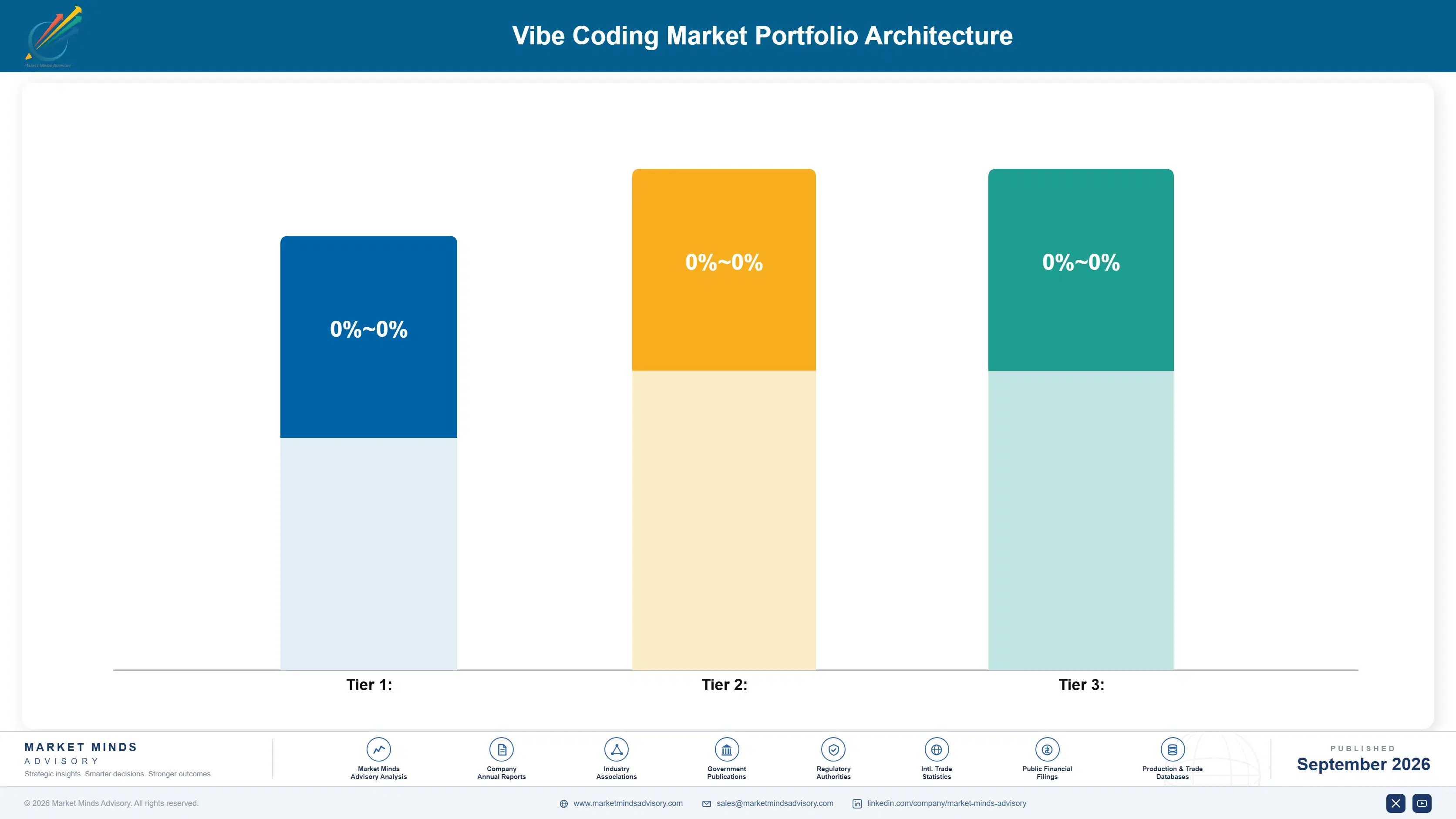
Vibe coding platforms organize into three commercially distinct tiers separated primarily by governance depth and workflow autonomy rather than raw generation capability alone. Volume tiers serve individual developers and small teams on flat monthly subscriptions, while premium tiers add enterprise governance controls and usage-based pricing on top. The newest tier bundles compliance-grade auditability that regulated buyers increasingly require before signing.
Gross margins vary substantially across tiers because foundation model inference cost scales with usage while subscription revenue does not always scale proportionally, creating margin pressure at the volume end that pushes vendors to encourage upgrades aggressively. Premium and next-generation tiers carry meaningfully better unit economics once accounts pass a moderate usage threshold, since governance and compliance features carry near-zero marginal inference cost beyond initial development work.

High-value pools concentrate overwhelmingly in enterprise governance and vertical compliance tooling rather than in raw code generation, which is rapidly commoditizing as foundation models converge on similar baseline capability across most vendors competing today. The volume tier remains important for user acquisition and word-of-mouth credibility among engineers, but incremental profit growth increasingly comes from premium upsells rather than net new seat additions.

Flat monthly subscriptions for individual developers and small teams using core autocomplete and generation features, priced to maximize adoption volume with gross margins in the 55% to 65% range given rising per-user inference costs.
Gross Margin

Enterprise seat licenses bundled with governance modules, audit logging, and priority support, carrying gross margins between 68% and 78% as usage-based compute costs are passed through directly to enterprise buyers.
Gross Margin

Vertical compliance packages and multi-model orchestration tools built for regulated industries, commanding gross margins above 75% because compliance engineering costs are largely fixed rather than scaling with usage volume growth.
Gross Margin
vibe-coding-market-portfolio-architecture-1788414111116

High-value Sub-segments and Strategic Watch-out

Full-Stack App Scaffolding and Deployment Platforms

High-value and high-growth, this segment combines the fastest expansion rate in the market with strong monetization potential as one-shot generation matures into genuinely production-ready deployable software, attracting the heaviest venture investment and executive attention across the sector currently, a pattern likely to continue through the forecast window.

Enterprise AI Coding Governance and Security Tools

High-value with moderate growth, governance tooling commands premium pricing and strong retention among regulated enterprise buyers even though seat count expansion trails the faster-growing generation and scaffolding segments considerably across most enterprise accounts today, particularly within financial services and healthcare buyers facing heavy regulatory scrutiny now.

AI Pair Programming and Autocomplete Tools

Volume core of the market, autocomplete remains the largest segment by seat count and the primary entry point for new users, though pricing power here is weakest given intense competition among many well-funded rivals chasing the same individual developer accounts nationwide and internationally across most markets today.

No-Code and Low-Code AI Builders

Strategic watch-out segment, growing fast and expanding the addressable buyer base beyond professional developers entirely, but facing uncertain long-term retention as generated applications hit complexity ceilings requiring real engineering support eventually as products mature, scale, add features, and attract far more demanding enterprise customers over time.

The Annuity Economics of Coding Assistance

Vibe coding revenue behaves like a genuine annuity once a development team adopts a platform as its default workflow tool, because switching costs compound as engineers build muscle memory around a specific tool's prompt patterns and keyboard shortcuts. Renewal rates among enterprise accounts already exceed 85% after the first contract year, reflecting how deeply these tools embed into daily engineering routines.
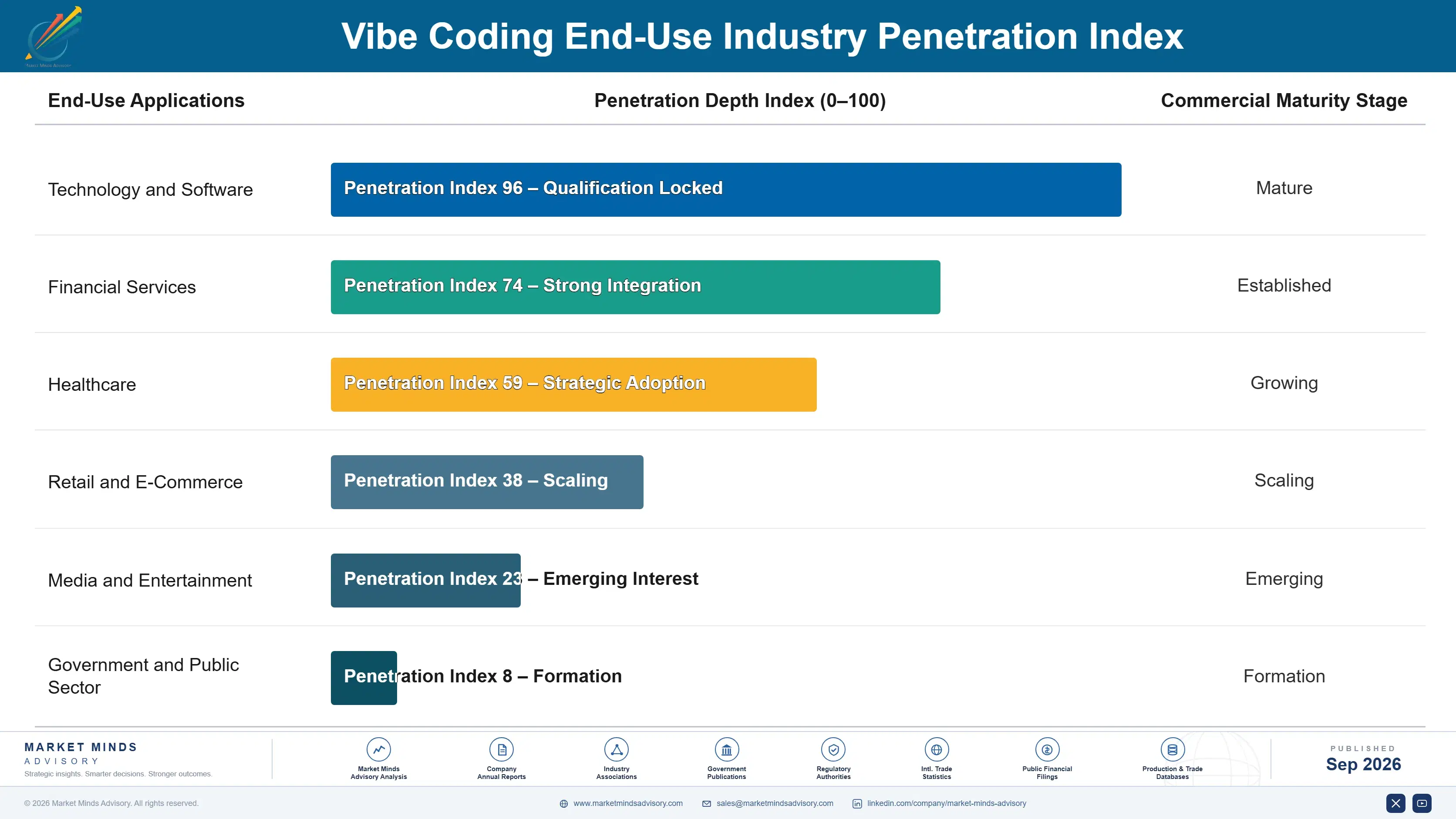
Adoption depth varies considerably by end-use vertical. Financial services and healthcare engineering teams adopt cautiously given compliance exposure, layering governance tooling on top of base generation capability before allowing production use. Consumer software and gaming studios, by contrast, adopt aggressively and give engineers wide latitude to use whatever tool ships features fastest, producing much higher usage intensity per seat than regulated industries typically show.

A generational shift is underway in who holds purchasing authority. Engineering managers increasingly evaluate coding assistants the way they once evaluated cloud infrastructure vendors, running formal proof-of-concept trials before committing budget. Meanwhile a new cohort of non-technical buyers, product managers and founders without formal programming training, now purchases these tools directly, expanding the addressable buyer base well beyond the traditional software engineering organization entirely.
vibe-coding-market-end-use-penetration-index-1788414111601

Where Enterprise Buyers Should Focus Next

These are among the four positions where our research anticipates prominent divergence between winners and laggards over the coming forecast period. Each is grounded in the demand model, the regulatory perimeter, and the announced capacity pipeline.
01 / PLATFORM SELECTION DISCIPLINE

Choose platforms by workflow fit, not raw model benchmark scores

Benchmark leaderboards change monthly as foundation models leapfrog one another, making them a poor basis for a multi-year enterprise procurement decision. Engineering leaders should instead pilot candidate platforms against their own actual codebase and measure completion acceptance rates, since a tool ranking second on public benchmarks often outperforms the leader on a specific team's real production code. Vendor lock-in risk also matters more than headline capability once a team has trained months of workflow habits around one particular tool's interface and prompt conventions.
02 / GOVERNANCE INVESTMENT TIMING

Build governance controls before scaling seats past pilot phase

Enterprises that delay audit logging and code provenance tracking until after wide rollout typically discover compliance gaps only when a security review or customer audit forces the question, at which point retrofitting controls across thousands of existing seats proves far costlier than building them in from the start. Governance tooling should be evaluated and budgeted alongside the initial platform selection decision, not treated as a later add-on purchase. Regulated industries in particular face this timing risk most acutely given examiner scrutiny.
03 / VENDOR DIVERSIFICATION STRATEGY

Avoid single foundation model dependency wherever contractually possible

Any platform built entirely atop one foundation model provider inherits that provider's pricing decisions, capacity constraints, and strategic priorities without recourse, a risk that materialized concretely during 2024 and 2025 pricing changes across several major model providers serving this market. Enterprise buyers should favor platforms offering multi-model routing or at minimum a documented migration path to alternative models should pricing or availability shift unexpectedly without warning. This diversification discipline protects budget predictability across the multi-year software contracts enterprises increasingly sign with these vendors.
04 / TALENT STRATEGY REALIGNMENT

Reallocate junior engineering hiring toward review and verification skills

As generation handles an increasing share of routine coding tasks, the scarce and valuable skill shifts from writing code quickly toward reviewing generated output critically and catching subtle logical errors before they reach production systems used by customers. Engineering organizations should adjust junior hiring criteria and training programs accordingly, prioritizing candidates who demonstrate strong code review judgment over those who simply write syntactically correct code fastest today. This realignment matters most for organizations planning multi-year technical hiring pipelines and career ladders now.

Engagement Snapshot From the Field

A live engagement with an industry participant carrying material or product regulatory and market exposure ahead of a defining policy shift, showing how our research translates into a defensible multi-year portfolio strategy.
MARKET MINDS ADVISORY · CLIENT ENGAGEMENT SUMMARY
Vibe Coding Producer Strategic Portfolio Review and Transition Roadmap 2026·Investment Scenario on Vibe Coding Exposure Evaluation 2025-26
CLIENT PROFILE
A venture-backed fintech startup with roughly 140 engineers had built its core lending platform using three separate AI coding assistants adopted organically by different teams over eighteen months, creating inconsistent code quality, duplicated licensing spend, and no centralized visibility into how generated code entered production systems handling sensitive customer financial data on a daily basis nationwide.
STRATEGIC CHALLENGE
Leadership needed to consolidate onto a single governed platform before an upcoming SOC 2 audit, but engineering teams resisted standardization, having each grown attached to their preferred tool's specific workflow habits and prompt conventions built up over many months of daily, intensive production use across the entire company organization and beyond.
MMA APPROACH
MMA conducted structured interviews across all engineering pods, benchmarked the three incumbent tools directly against the client's actual codebase for acceptance rate and defect introduction, and modeled total cost of ownership under three distinct consolidation scenarios ranging from single-vendor consolidation to managed multi-model routing across all engineering teams involved company-wide.
KEY FINDINGS
  1. The three incumbent tools showed acceptance rates varying by 22 percentage points on the client's own codebase, far more than published vendor benchmarks suggested (client-reported, unverified by MMA).
  2. Licensing spend across three overlapping subscriptions ran roughly 60% higher than a single consolidated enterprise agreement would have cost at comparable seat count (client-reported, unverified by MMA).
  3. Engineers using governance-enabled tooling introduced measurably fewer production defects per pull request than those using ungoverned personal accounts (client-reported, unverified by MMA) over the same period.
  4. Migration resistance concentrated among senior engineers with the longest tenure on their preferred tool, not junior staff as leadership had originally assumed before the engagement began (client-reported, unverified by MMA).
CLIENT PROFILE
A venture-backed fintech startup with roughly 140 engineers had built its core lending platform using three separate AI coding assistants adopted organically by different teams over eighteen months, creating inconsistent code quality, duplicated licensing spend, and no centralized visibility into how generated code entered production systems handling sensitive customer financial data on a daily basis nationwide.
STRATEGIC CHALLENGE
Leadership needed to consolidate onto a single governed platform before an upcoming SOC 2 audit, but engineering teams resisted standardization, having each grown attached to their preferred tool's specific workflow habits and prompt conventions built up over many months of daily, intensive production use across the entire company organization and beyond.
MMA APPROACH
MMA conducted structured interviews across all engineering pods, benchmarked the three incumbent tools directly against the client's actual codebase for acceptance rate and defect introduction, and modeled total cost of ownership under three distinct consolidation scenarios ranging from single-vendor consolidation to managed multi-model routing across all engineering teams involved company-wide.
KEY FINDINGS
  1. The three incumbent tools showed acceptance rates varying by 22 percentage points on the client's own codebase, far more than published vendor benchmarks suggested (client-reported, unverified by MMA).
  2. Licensing spend across three overlapping subscriptions ran roughly 60% higher than a single consolidated enterprise agreement would have cost at comparable seat count (client-reported, unverified by MMA).
  3. Engineers using governance-enabled tooling introduced measurably fewer production defects per pull request than those using ungoverned personal accounts (client-reported, unverified by MMA) over the same period.
  4. Migration resistance concentrated among senior engineers with the longest tenure on their preferred tool, not junior staff as leadership had originally assumed before the engagement began (client-reported, unverified by MMA).
RECOMMENDED STRATEGY
Phase 1: Phase one consolidated all teams onto the highest-acceptance-rate platform within ninety days, with governance logging enabled from day one for every new account. Phase 2: Phase two migrated historical generated code through an automated compliance scan to flag any prior output requiring manual security review before the audit. Phase 3: Phase three established a standing platform evaluation cadence so future tool switches happen deliberately rather than through organic team-level adoption drift.
OUTCOME
The client passed its SOC 2 audit on schedule and reduced combined coding tool licensing spend by approximately 35% within two quarters (client-reported, unverified by MMA), while engineering leadership reported improved cross-team code review consistency and meaningfully fewer production incidents traced back to AI-generated code company-wide.

Frequently Asked Questions

Foundational context covering the market sizes, CAGR, scope, country, region and competition that inform every finding below. This section is provided to cover basics and most often pre-purchase conversations, answered from the MMA Primary Research Dataset.

What is the current size of the Vibe Coding Market?

The Vibe Coding Market reached an estimated $4.2 billion in global platform revenue in 2025. This figure covers subscription and usage-based spending across natural language code generation, scaffolding, review, and governance tools sold worldwide.

How large will the Vibe Coding Market be by 2036?

MMA projects the market will reach approximately $24.8 billion by 2036, driven mainly by full-stack scaffolding platforms and enterprise governance tooling. That represents roughly a five-fold expansion from 2026 levels over the ten-year forecast window.

What is the CAGR for the Vibe Coding Market 2026 to 2036?

The market is forecast to grow at a 17.5% compound annual rate between 2026 and 2036. Bull and bear scenarios range between roughly 16.2% and 18.8% depending on foundation model progress.

Which segment is growing fastest?

Full-stack app scaffolding and deployment platforms lead all segments, expanding at an estimated 20.0% annually. That is more than one times the overall market's 17.5% average growth rate through 2036.

Who are the major companies in the Vibe Coding Market?

GitHub Copilot, Cursor, Replit, Anthropic, and Vercel form the five leading platforms tracked in this report. Together they hold an estimated 48% combined share of tracked platform revenue as of 2025.

Which country is growing fastest?

India posts the fastest national growth rate in the study, expanding at an estimated 24.0% annually. Its enormous professional developer population and cost-conscious IT services sector both drive this rapid platform adoption.

Report Segmentation Architecture

The full report scope spans multiple orthogonal segmentation dimensions, with cross-tabulated demand data provided for each dimension pair. Coverage extends further to regional breakdowns, trend trajectories, and the competitive detail needed to support segment-level decision-making.

By Primary Market Dimension

  • Natural Language to Code Generation Platforms
  • AI Pair Programming and Autocomplete Tools
  • Full-Stack App Scaffolding and Deployment Platforms
  • AI Code Review and Debugging Assistants
  • No-Code and Low-Code AI Builders
  • Enterprise AI Coding Governance and Security Tools

By End-Use Industry

  • Technology and Software
  • Financial Services
  • Healthcare
  • Retail and E-Commerce
  • Media and Entertainment
  • Government and Public Sector

By Commercial Dimension

  • Individual Developer Subscriptions
  • Small and Medium Business Team Plans
  • Enterprise Seat Licensing
  • Usage-Based Compute Pricing

By Region

  • North America
  • Western Europe
  • East Asia
  • South Asia and Pacific
  • Latin America
  • Middle East and Africa
  • Eastern Europe

Scope, Methodology, and Coverage

Every figure in this report is reproducible from documented input assumptions. The scope below maps the historical period, the forecast horizon, the segmentation dimensions, and the countries covered, alongside the underlying primary and qualitative methodology.
Historical Period
2020 to 2025
Forecast Period
2026 to 2036
Base Year
2025 (USD billions; MMA Primary Research Dataset, September 2026)
Market Definition
The Vibe Coding Market covers software platforms that generate, scaffold, deploy, or substantially modify application code from natural language prompts rather than traditional manual programming, measured by subscription and usage-based revenue. It excludes traditional integrated development environments lacking generative AI capability and standalone chatbot products not directly producing deployable application code.
Quantitative Units
USD Billion, CAGR (%), Share (%), 2020 to 2036
Segmentation Dimensions
By Primary Market Dimension; By End-Use Industry; By Commercial Dimension; By Region
Regions Covered
North America, Western Europe, East Asia, South Asia and Pacific, Latin America, Middle East and Africa, Eastern Europe
Countries Covered
United States, Canada, Germany, France, United Kingdom, China, Japan, South Korea, India, Australia, Brazil, Mexico, Argentina, United Arab Emirates, Saudi Arabia, Israel, South Africa, Poland, Romania, Ukraine, and additional markets relevant to this sector.
Key Companies Profiled
GitHub Copilot, Cursor, Replit, Anthropic, Vercel, OpenAI, Google, Amazon, Windsurf, Sourcegraph, Tabnine, JetBrains, Bolt.new, Lovable, Magic AI, Poolside AI, Cognition Labs, Augment Code, Warp, Zed Industries
Quantitative Methodology
Primary survey, n=3,800 respondents, Q4 2025, six countries; demand-side model with trade association cross-validation
Qualitative Methodology
47 expert interviews, Q4 2025; applied to validate demand model assumptions, identify emerging dynamics, and assess competitive positioning
Report Format
PDF and XLSX data workbook (Word format preview document)
Publisher
Market Minds Advisory
Report Code
MMA-2026-TEC-603
Published
September 2026
Contact
sales@marketmindsadvisory.com | www.marketmindsadvisory.com

Purchase the full Vibe Coding Market Report (2026 to 2036).

This report delivers a comprehensive assessment of the global Vibe Coding Market, covering market sizing, segmentation, and competitive dynamics across natural language code generation, scaffolding, and governance platforms worldwide. It examines regional adoption patterns across seven world regions, revenue diversification strategies, and foundation model cost exposure shaping vendor profitability through 2036. The analysis draws on primary survey data, expert interviews, and company disclosures to size the opportunity precisely and rigorously. Buyers gain a structured view of where competitive advantage concentrates as the category matures rapidly across enterprise and individual developer segments alike.
Ten-year market sizing and forecast model through 2036
Six-segment capability-based market breakdown and analysis
Seven-region demand, share, and growth rate analysis
Competitive benchmarking of twenty tracked platform vendors
Foundation model dependency and cost exposure assessment
Anonymized client engagement case study with outcomes

Built For The People Who Decide

From boardroom strategy to bench-side execution, this report is read cover-to-cover by leaders shaping the next decade of their industry, turning demand scenarios, market dynamics and valuation benchmarks into decisions.
CXOs/ Presidents/ VPs/ Managers
M&A and Corporate Development
Strategy Teams and R&D Heads
Procurement and Product Directors
Regulatory and Compliance Leaders
Investor Relations and Equity Analysts