Market Minds Advisory
Veterinary Video Endoscopy Market

Veterinary Video Endoscopy Market: Minimally Invasive Diagnostics and the Specialty Practice Adoption Shift

High-definition flexible videoendoscopes are displacing fiber-optic legacy systems as specialty veterinary practices expand minimally invasive diagnostic and surgical capability, forcing manufacturers to defend installed base loyalty against integrated imaging platforms built for multi-species workflows.

Lead Analyst

Alice Ballenger

Published

September 2026

Make Smarter Decisions with Customized Research Insights

Request a free sample report and evaluate market opportunities, growth trends, and competitive dynamics relevant to your business needs.

2025 MARKET VALUE$0.3BMarket Size 2025
2036 FORECAST VALUE$0.8BBase Case , 2026 to 2036
CAGR 2026 TO 20368.0 %Bull 9.2% / Bear 6.8%
INCREMENTAL OPPORTUNITY$0.4BNet 10- year value creation
EXPANSION MULTIPLE2.16x2036 value over 2026 base
Strategic Levers
M&A Pipeline
Regional Outlook
Country Rankings
Competitive Intelligence
Segmental Deep-dive
Call-Us : 91 93563 13602

Executive Snapshot and Market Trajectory

High-definition flexible videoendoscopes are displacing fiber-optic legacy systems as specialty veterinary practices expand minimally invasive diagnostic capability, and practice directors increasingly select vendors on image resolution rather than acquisition price alone this capital budgeting cycle across most referral practices. Bundled accessory and service contracts increasingly factor into that decision too.
Gastrointestinal and respiratory diagnostics drive most system demand, but flexible videoendoscopy systems are pulling share fastest as high-definition imaging supports more confident client communication during procedures. North America holds the deepest installed base on specialty referral practice density and pet insurance-supported diagnostic spend, while China's specialty practice infrastructure growth is closing the adoption gap from a smaller starting point. Manufacturers with strong East Asian distribution keep capturing disproportionate placement growth.
Five manufacturers hold roughly fifty-two percent of system revenue, leaving meaningful room for veterinary-specialist and regional challengers to compete on price and accessory depth. Widening comparative data on diagnostic yield and a growing body of specialty practice procurement literature are reshaping which endoscopy platforms practices default to across both diagnostic and minimally invasive surgical applications nationwide this decade. Manufacturers watch this shift closely nationwide. Practice budgets shift accordingly this cycle across most major segments.
Market Definition
This market covers video endoscopy systems used for veterinary diagnostic and minimally invasive surgical procedures, including flexible videoendoscopes, rigid videoendoscopes, and video laparoscopy systems. It excludes surgical instruments used alongside these systems, general anesthesia equipment, and standalone imaging displays sold separately.
Base Year Value
$0.3B in 2025 (MMA Primary Research Dataset, August 2026)
Forecast Period
2026 to 2036, eleven discrete annual values
CAGR
8.0% base case. Bull 9.2%. Bear 6.8%.
Fastest Growth Segment
Flexible Videoendoscopy Systems: 11.9% CAGR
Fastest Growth Country
China: 11.4% CAGR
Fastest Growth Region
South Asia and Pacific: 10.0% CAGR
Largest Region
North America: 31% of 2025 global value
Market Leaders
Karl Storz, Olympus, STERIS, ELMED Medical Systems, MILA International. Source: MMA Analysis based on company annual reports.
Primary Survey
n=3,800 procurement and R&D decision-makers, Q4 2025, six countries
Methodology
Demand-side build-up, cross-validated against public data, 47 expert interviews

Veterinary Video Endoscopy Market Forecast Scenarios

veterinary-video-endoscopy-market-size-forecast-scenario-1787310125800
System revenue grew steadily across 2020 to 2025 as specialty veterinary practices expanded minimally invasive diagnostic capability alongside rising companion animal healthcare spend. Growth decelerated briefly in 2021 amid deferred elective diagnostic procedures during the pandemic before resuming its prior trajectory through the remainder of the historical period into 2025. Specialty referral practices led this early adoption before diffusing into general practice settings.
The base case assumes continued double-digit growth in flexible videoendoscopy adoption, expanding pet insurance coverage supporting advanced diagnostic spend across major markets, and steady replacement demand as first-generation systems reach their seven-year capital replacement mark. Practice capital budget cycles, veterinarian training capacity, and integration complexity with existing diagnostic workflows remain the binding constraints on faster diffusion across smaller general practices. Vendor training program capacity continues expanding to reach smaller regional practices gradually.
The bull case rests on expanding pet insurance coverage pulling forward advanced diagnostic demand industry-wide and accelerating premium platform conversion. The bear case centers on general practice capital budget constraints, which could stretch purchasing decisions and depress new system placements through the middle of the forecast period nationwide. Manufacturers are watching both scenarios closely as insurance coverage expands nationwide.

Image Resolution as the Defining Capital Purchase Criterion

Veterinary video endoscopy sits at the intersection of specialty diagnostic medicine and precision optics, and the category's growth increasingly tracks which platforms can deliver diagnostic-grade image resolution for the gastrointestinal and respiratory conditions that dominate small animal specialty case volume. Procurement criteria are shifting accordingly at high-volume specialty practices this budget cycle. Manufacturers who can document that diagnostic depth fastest win at the point of co
MARKET CONCENTRATION (CR5)52%top five holders control most global system revenue
AVERAGE SYSTEM PRICE$42,000typical flexible videoendoscopy tower cost with standard configuration
LEADING COUNTRY SHARE27%United States dominates global installed base by far
FLEXIBLE SCOPE ATTACH RATE41%new practice purchases now including flexible endoscopy capability
CAPITAL REPLACEMENT CYCLE7 yearstypical interval before full endoscopy tower replacement occurs
SERVICE REVENUE SHARE33%portion of category revenue from recurring support and consumables
Commercially, the category behaves like a hybrid capital and consumable business: the endoscopy tower itself carries meaningful upfront pricing, but reusable accessories, service contracts, and disposable components sustain manufacturer revenue well past the initial system sale across a typical seven-year replacement cycle. Accessory attach rate increasingly drives blended margin more than tower pricing alone. Manufacturers with strong accessory attach rates are outperforming tower-only competitors on blended margin.
The next decade will be shaped by flexible videoendoscopy becoming standard rather than premium, expanding minimally invasive surgical volume beyond diagnostic applications alone, and specialty practice budget committees demanding demonstrated diagnostic yield improvements before approving new capital purchases nationwide. Manufacturers investing early in expanded clinical evidence stand to capture disproportionate long-term share. Manufacturers who fund comparative diagnostic studies stand to capture disproportionate formulary share.
"A fiber-optic scope from fifteen years ago still technically works, but it cannot show a client the polyp on a screen the way a video tower can, and that visual sell is increasingly what justifies the capital spend to practice owners."
Director, Veterinary Technology Practice · MMA Medical Devices Practice &m

Market Trends

Flexible Videoendoscopy Displaces Fiber-Optic Legacy Systems

Flexible videoendoscopes with high-definition digital sensors are displacing fiber-optic legacy systems, letting veterinarians display real-time diagnostic imagery on screen for client communication while capturing documentation for medical records. Early comparative data shows meaningfully higher diagnostic confidence when practitioners can share live imagery with clients during consultation rather than describing findings verbally after fiber-optic examination alone. Three of the five leading manufacturers now offer flexible videoendoscopy platforms as their flagship veterinary offering, and two smaller competitors have announced comparable systems entering trials in 2026 targeting expanded species applications. Practice teams increasingly treat flexible imaging as baseline, not an upsell.
Market Impact: Adds 68,000 annual diagnostic proce
Minimally Invasive Surgery Expands Laparoscopy Demand

Rising client preference for minimally invasive surgical options is expanding the addressable base for video laparoscopy systems beyond diagnostic applications, as comparative data documents faster recovery times compared with traditional open surgical approaches. Seven peer-reviewed studies published since 2023 document reduced postoperative complication rates using laparoscopic technique across multiple procedure types in companion animal surgery. Veterinary surgical societies have updated procedural guidance to reference laparoscopic approaches explicitly as an accepted alternative for an expanding range of elective procedures this forecast period. Manufacturers extending validated procedure coverage fastest are capturing this expanding demand ahead of slower rivals across major markets.
Market Impact: Lengthens sales cycles by 2 months

Market Opportunities and Growth Drivers

Rising Companion Animal Gastrointestinal Diagnoses Drive Demand

Rising companion animal gastrointestinal disease diagnoses, supported by longer pet lifespans and increased owner willingness to pursue advanced diagnostic workup, continue expanding the addressable base for endoscopic examination and biopsy procedures. Several large specialty referral centers report meaningfully higher endoscopy case volume over the past five years as gastrointestinal diagnostic protocols and referral pathways have both matured across major specialty networks. This diagnosis-driven growth is pulling incremental capital purchasing decisions toward practices with proven endoscopic diagnostic workflow support, reinforcing incumbent advantage among manufacturers with the deepest existing specialty relationships. Manufacturers with dedicated gastroenterology teams are capturing this volume fastest.
Market Impact: Delays purchases by 5 months

Referral Network Consolidation Standardizes Procurement Decisions

Continued consolidation of independent specialty practices into larger corporate veterinary networks is standardizing endoscopy procurement decisions and favoring manufacturers with proven multi-site platform reliability and dedicated technical support teams. Several large corporate veterinary networks report meaningfully higher system utilization rates since consolidating individual practice purchases into centralized, professionally managed procurement processes. This consolidation-driven standardization is pulling incremental capital spend toward manufacturers with the broadest proven multi-site track record, reinforcing incumbent advantage among the largest existing suppliers nationwide. Manufacturers positioned early in this consolidation trend stand to gain disproportionate long-term formulary share across major corporate networks nationwide.
Market Impact: Delays full adoption by 6 months

Market Restraints and Challenges

General Practice Capital Budget Constraints Delay Purchases

General veterinary practices face lengthening capital approval cycles for flexible videoendoscopy towers priced above $35,000, with many smaller practices unable to justify the investment against uncertain case volume projections. The root cause is thinner general practice operating margins colliding with rising equipment costs and uncertain return on investment timelines for lower-volume diagnostic use. The commercial impact falls hardest on manufacturers without flexible leasing or shared-use financing options, who report meaningfully longer sales cycles at general practices than at well-funded specialty referral centers. Manufacturers are mitigating this through expanded equipment leasing programs and shared-access consortium pricing models.
Market Impact: Adds 41% flexible scope attach rate

Veterinarian Training Capacity Limits Faster Adoption

Endoscopic diagnostic and procedural technique requires substantially more specialized training than standard physical examination, and the limited number of experienced proctors available for hands-on training constrains how quickly general practitioners can build endoscopy interpretation capability. The root cause is a shortage of dedicated endoscopy specialists outside major referral hubs willing to provide extended on-site training support. The commercial impact shows up directly in slower system utilization ramp-up at general practices without established endoscopy expertise, delaying full return on capital investment. Manufacturers are mitigating this by funding dedicated proctorship programs and simulation-based curricula that shorten the onboarding timeline meaningfully.
Market Impact: Expands laparoscopy demand by 21%
3 additional market trends, 4 additional growth drivers, and 2 additional restraints and challenges are covered in the full report. Contact sales@marketmindsadvisory.com to access the complete intelligence.

Segment CAGR and Growth Architecture

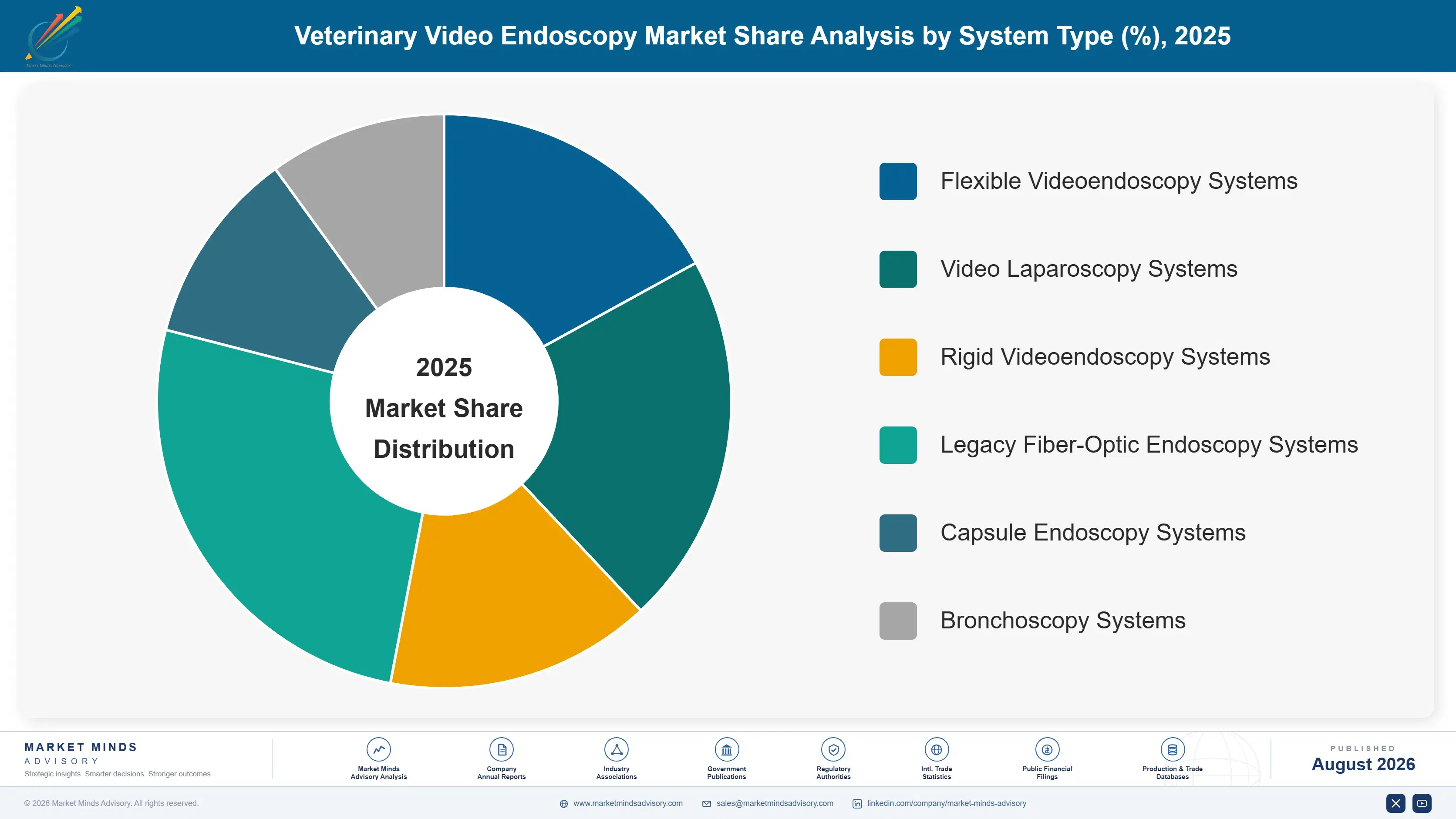
The market segments by system technology platform, the classification specialty practice procurement teams actually use when comparing competing systems for capital purchase decisions. Flexible videoendoscopy systems lead all categories on growth as high-definition imaging earns broader practitioner preference across most diagnostic applications this forecast cycle. Video laparoscopy systems remain the established choice for minimally invasive surgical procedures.
veterinary-video-endoscopy-market-market-share-analysis-1787310126332

Flexible Videoendoscopy Systems

Flexible videoendoscopy systems use high-definition digital sensors to display real-time diagnostic imagery on screen, letting veterinarians communicate findings directly to clients while capturing documentation for medical records simultaneously. Growing at 11.9% annually, roughly 1.5 times the overall market rate, this segment is pulling share from every other system category as comparative data documents higher diagnostic confidence with visual client communication. Three of the five leading manufacturers now offer flexible videoendoscopy as their flagship veterinary offering, and two smaller competitors have systems entering trials in 2026. Specialty practice procurement teams increasingly specify flexible capability as a baseline requirement. Payers in select markets are also beginning to recognize this diagnostic confidence advantage in coverage policy decisions.
CAGR 11.9%

Video Laparoscopy Systems

Video laparoscopy systems support minimally invasive surgical procedures including ovariohysterectomy, gastropexy, and biopsy collection, offering faster patient recovery compared with traditional open surgical approaches. Growing at 10.2% annually, this segment benefits from rising client preference for minimally invasive options and growing surgeon comfort with laparoscopic technique across expanding procedure types. Specialty surgical practices remain the primary demand driver, using laparoscopy for elective procedures where reduced recovery time provides a meaningful client value proposition over traditional surgery. Manufacturers continue expanding instrument compatibility and procedure-specific accessory kits to broaden adoption beyond the most common elective applications. This positioning keeps the segment relevant even as flexible endoscopy adoption accelerates industry-wide across specialty practices.
CAGR 10.2%
Full segment breakdown across 6 segments available in the complete report.

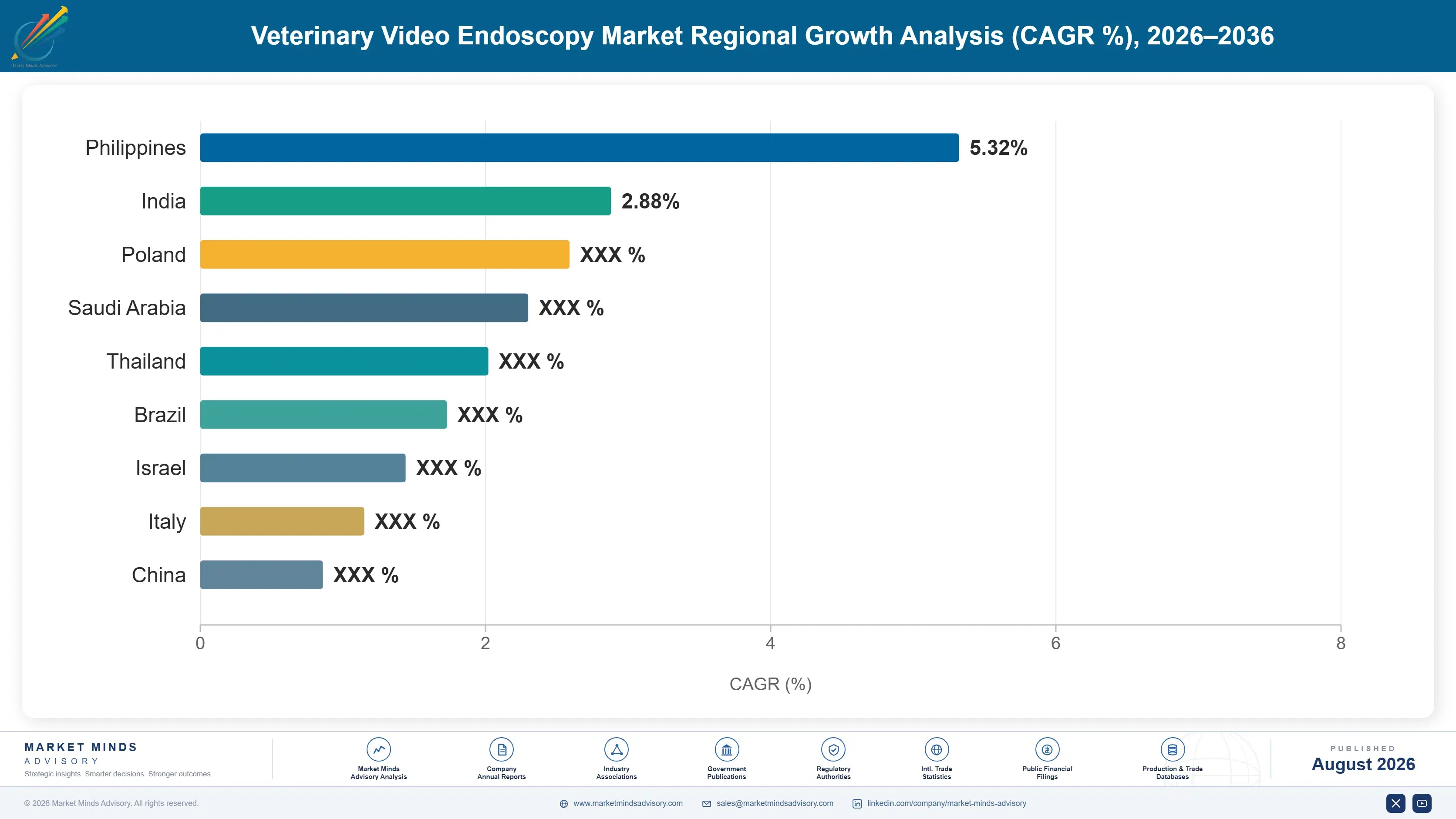
Regional Architecture and Country Demand Map

North America leads on specialty referral practice density and pet insurance-supported diagnostic spend, followed by East Asia's expanding specialty practice infrastructure investment. Western Europe trails on slower capital replacement cycles relative to underlying case volume growth. South Asia and Pacific posts the fastest regional growth off a smaller established base.

North America

United States capital spending dominates this region on the strength of its dense specialty referral practice network and consistent premium platform replacement cycles among corporate and academic institutions. Canada's smaller, more fragmented practice system adds modest volume but moves at a slower capital approval pace than comparable American institutions. Rising gastrointestinal and respiratory diagnostic case volume continues pulling purchasing decisions toward flexible videoendoscopy platforms faster than in any other market. Corporate referral network capital budgets remain comparatively well funded, and flexible scope attach rates on new system purchases keep rising steadily across most major specialty hospital networks nationwide this forecast period. Corporate networks continue expanding capital budgets each fiscal year.
Share: 31% | CAGR: 8.6% (2026 to 2036)

Western Europe

Capital purchasing here moves through practice-level budget decisions layered under varying national veterinary reimbursement structures, which slows adoption of premium flexible platforms relative to the pace of United States purchasing decisions. Germany and the United Kingdom carry the largest procedural volumes, supported by established specialty veterinary practice networks within their respective national systems. France's dedicated veterinary specialty accreditation framework has meaningfully standardized diagnostic capital investment since its introduction across regional referral networks. Growth trails the global average as fragmented practice ownership and slower pet insurance penetration limit incremental expansion relative to the faster-growing corporate networks emerging across North America. Distribution partnerships continue expanding to reach smaller, independent practices. Payer scrutiny is expected to intensify further as budget pressure grows.
Share: 22% | CAGR: 6.5% (2026 to 2036)
Regional intelligence for 5 additional markets available in the complete report: East Asia, South Asia and Pacific, Latin America, Middle East and Africa, Eastern Europe. Contact sales@marketmindsadvisory.com.
veterinary-video-endoscopy-market-country-cagr-analysis-1787310126859

Where Endoscopy Manufacturers Can Still Expand Margin

Flexible scope attach rates, reusable accessory revenue, and service contract depth offer the clearest paths to margin expansion as core tower pricing faces growing referral network scrutiny across major specialty systems evaluating capital purchases and service bundles this annual budget cycle nationwide. particularly among corporate specialty networks standardizing endoscopy formularies across multiple sites. nationwide.

Flexible Scope Platform Upgrade Growth Program

Flexible videoendoscopy platforms command a documented price premium of roughly 40 to 55 percent over standard rigid systems, reflecting the added digital sensor hardware and control software bundled into each unit. Manufacturers with cleared flexible platforms are using capital replacement cycle timing, roughly seven years post-purchase, to convert existing practice accounts rather than compete solely for new placements. This lever depends on continued practice willingness to fund the premium tier, which comparative diagnostic yield data increasingly supports as clinical evidence accumulates across larger multi-site studies. Manufacturers publishing detailed comparative diagnostic data are winning practice trust fastest across major markets.
Market Impact: Adds a documented 40-55% price prem

Reusable Accessory Attachment Rate Growth Program

Reusable accessories including biopsy forceps, retrieval baskets, and cleaning solutions, priced around $180 per accessory kit, represent a growing recurring revenue stream that increasingly determines which platform a practice standardizes on across its diagnostic and surgical service lines. Practices with higher accessory attach rates generate meaningfully higher consumable revenue per system annually than those relying primarily on basic starter kits. This lever scales fastest among manufacturers with the broadest procedure-specific accessory portfolios, and it is increasingly cited by practice directors as a deciding factor when consolidating vendor relationships. Manufacturers view this as a durable, long-horizon account investment.
Market Impact: Adds roughly $180 in accessory reve

Extended Service and Repair Contract Bundles

Extended service and repair contracts, which keep optical fiber and sensor calibration within manufacturer specification tolerances, represent a growing services opportunity priced around $4,200 annually as practices extend equipment life beyond the standard seven-year replacement cycle. Manufacturers bundling multi-year repair agreements into initial purchase contracts report improved win rates in competitive practice procurement processes, particularly among cost-conscious mid-sized practices. This lever requires sustained field service infrastructure investment but creates a durable differentiation point that smaller manufacturers currently struggle to replicate. This evidence investment increasingly separates winners from laggards industry-wide. Smaller manufacturers struggle to fund comparable service scale at this level.
Market Impact: Extends annual contract value by ro

Veterinarian Endoscopy Training Certification Program Offering

Structured veterinarian endoscopy training and certification programs, often bundled into new system contracts at no additional charge for the first year, are increasingly monetized as standalone paid offerings priced near $2,400 per veterinarian once practices seek to onboard additional diagnostic staff after initial installation. Manufacturers offering certified training pathways report stronger platform loyalty and lower switching rates among trained veterinarians compared with practices relying solely on peer-to-peer informal instruction. This lever remains underdeveloped industry-wide, leaving meaningful room to expand. Manufacturers see this as durable investment rather than a one-time sales tactic.
Market Impact: Generates roughly $2,400 per newly

Who Controls the Margin Pool

Five manufacturers control roughly fifty-two percent of system revenue, and the gap between the top three and the remaining two leaders is meaningful: Karl Storz, Olympus, and STERIS each carry established multi-decade human and veterinary endoscopy sales infrastructure that ELMED Medical Systems and MILA International are still building out region by region across additional specialty applications. Independent referral practices weigh this infrastructure gap heavily during vendor selection.
Current competitive activity centers on three fronts: flexible videoendoscopy platform launches backed by growing diagnostic yield data, accessory portfolio expansion aimed at deepening recurring revenue relationships with existing practice accounts, and comparative-effectiveness trial funding designed to sway practice directors ahead of major capital budget cycles. Manufacturers with dedicated veterinary clinical support teams are winning a disproportionate share of these accounts.

Emerging pressure is coming from smaller, veterinary-specific specialists like EndoDynamics and Vimian Group, which lack the broad human endoscopy portfolios of the largest incumbents but are pursuing narrow, defensible positioning built specifically for companion animal workflows. Rankings among the top five could shift meaningfully if a veterinary-specific player's diagnostic data proves durable enough to win share from human-imaging-adapted incumbents ahead of the next forecast cycle.
veterinary-video-endoscopy-market-company-positioning-matrix-1787310127382

Competitive Moat and Risk Dimensions

KARL STORZ SE & CO. KG

Moat: Broad Endoscopy Portfolio Scale

Karl Storz's decades-long presence across human and veterinary endoscopy gives it engineering depth and manufacturing scale that veterinary-specific competitors cannot replicate quickly. Its broad imaging portfolio also lets sales teams offer proven, field-tested hardware adapted for veterinary use at competitive pricing relative to purpose-built alternatives.
KARL STORZ SE & CO. KG

Risk: Slower Veterinary-Specific Customization

Karl Storz's veterinary-adapted platforms trail purpose-built competitors on workflow features specifically designed for multi-species anatomy and practice-specific accessory compatibility. Its scale advantage in commercial infrastructure does not automatically translate into workflow leadership on the veterinary-specific dimension increasingly driving practice procurement decisions nationwide. Purpose-built rivals continue widening this workflow gap steadily.
OLYMPUS CORPORATION

Moat: Deep Diagnostic Imaging Expertise

Olympus built its reputation specifically on diagnostic imaging depth rather than pure hardware breadth, giving it a defensible position among veterinarians who prioritize image resolution and diagnostic confidence over console-level integration. This diagnostic-first positioning continues attracting specialty practice accounts even as competitors introduce comparable flexible platforms.
OLYMPUS CORPORATION

Risk: Narrower Laparoscopy Portfolio Breadth

As a diagnostic imaging-focused business without the broadest surgical laparoscopy instrument portfolio, Olympus carries less bundling leverage than diversified competitors like Karl Storz across large referral network contracts. Practices seeking single-vendor procurement simplicity increasingly favor manufacturers offering integrated diagnostic and surgical portfolios nationwide. Larger diversified rivals continue widening this portfolio gap across most major markets.

Players Tracked

Prominent Players

Karl Storz SE & Co. KG
Olympus Corporation
STERIS plc
ELMED Medical Systems, Inc.
MILA International, Inc.

Other Key Players

EndoDynamics
Vimian Group AB
Richard Wolf GmbH
Fujifilm Healthcare Corporation
Sopro-Comeg GmbH
Welch Allyn, Inc.
Optomic S.L.
Xion Medical GmbH
Aesculap, Inc.
Endoscopy Support Services, Inc.
Guangzhou Vet Medical Instrument Co., Ltd.
Shanghai Well.D Medical Electronics Co., Ltd.
Kaixin Medical Instruments Co., Ltd.
Medical Illumination International, LLC
Veterinary Specialty Products, LLC

Recent Developments

MARCH 2025

Olympus Launches Expanded Flexible Videoendoscopy Platform

Olympus launched an expanded flexible videoendoscopy platform purpose-built for multi-species diagnostic workflows, featuring integrated documentation software compatibility. The launch followed a multi-site diagnostic study documenting meaningfully improved client communication outcomes across participating specialty referral practices nationwide. Specialty referral practices report strong early adoption interest in the integration.
Signal: Signals manufacturers are prioritizing wor
AUGUST 2025

Karl Storz Acquires a Veterinary Accessory Developer

Karl Storz completed the acquisition of a privately held veterinary endoscopy accessory developer to strengthen its procedure-specific instrument portfolio. The deal brings in-house veterinary-specific design capability Karl Storz previously accessed through a licensing arrangement with a third party. The veterinary endoscopy accessory market continues expanding given rising specialty demand.
Signal: Indicates diversified incumbents are movin
JANUARY 2026

MILA International and a Regional Practice Network Sign Training Partnership

MILA International signed a multi-year training partnership agreement with a regional veterinary practice network to expand proctorship capacity across underserved general practice markets. The agreement is among the largest training investments announced in the category to date. Competitors are watching this partnership's outcomes closely. Rival manufacturers have taken note.
Signal: Suggests training capacity investment is b

Optical Fiber and Sensor Component Exposure

Video endoscopy systems depend on precision optical fiber bundles, high-sensitivity digital image sensors, and specialized light source components, together representing a substantial share of unit cost of goods sold across the category. Optical fiber and digital sensors are sourced predominantly from a small number of qualified suppliers in Japan, Germany, and the United States. Limited supplier diversification remains a persistent constraint across this precision component category.
Digital sensor and optical component supply constraints during 2021 and 2022 extended lead times for critical endoscopy components, a disruption documented in company annual report supply chain disclosures across the sector during that period. Several manufacturers responded by qualifying secondary component suppliers and increasing safety stock of critical parts, though full supply chain normalization took roughly eighteen months to complete across the industry, according to sector-wide supply data.

Smaller manufacturers without long-term supply agreements or dual-sourced sensor and optical components face proportionally higher exposure to input cost inflation and allocation constraints during periods of tight supply. The largest manufacturers' scale purchasing agreements and vertically integrated component manufacturing capacity provide meaningful cost and supply certainty advantages that smaller, veterinary-focused entrants have not yet been able to replicate at comparable volume.
veterinary-video-endoscopy-market-cost-volatility-analysis-1787310127578

Dual-Sourcing Critical Digital Sensor Components

Leading manufacturers now qualify at least two independent suppliers for high-sensitivity digital image sensors used in videoendoscopy systems, reducing single-source exposure meaningfully across production lines. This dual-sourcing strategy adds qualification cost upfront but has measurably shortened recovery time during subsequent supply disruptions, according to recent company disclosures and supplier audits. Multiple manufacturers have adopted this approach industry-wide recently.

Long-Term Optical Fiber Supply Agreements

Multi-year supply agreements with qualified optical fiber and light source manufacturers lock in pricing and allocation priority during periods of tight capacity across the broader photonics industry. The largest manufacturers have used scale purchasing volume to secure priority allocation status that smaller competitors cannot easily match, according to recent annual report disclosures. This advantage compounds meaningfully during extended shortage periods.

Increased Safety Stock for Critical Components

Manufacturers have raised safety stock levels for the highest-risk components identified during the 2021 to 2022 supply disruption, trading modest inventory carrying cost increases for meaningfully reduced production disruption risk during future supply shocks across the broader imaging device category and its qualified suppliers worldwide. Carrying costs remain modest relative to the disruption risk avoided.

Portfolio Architecture for Margin Defence

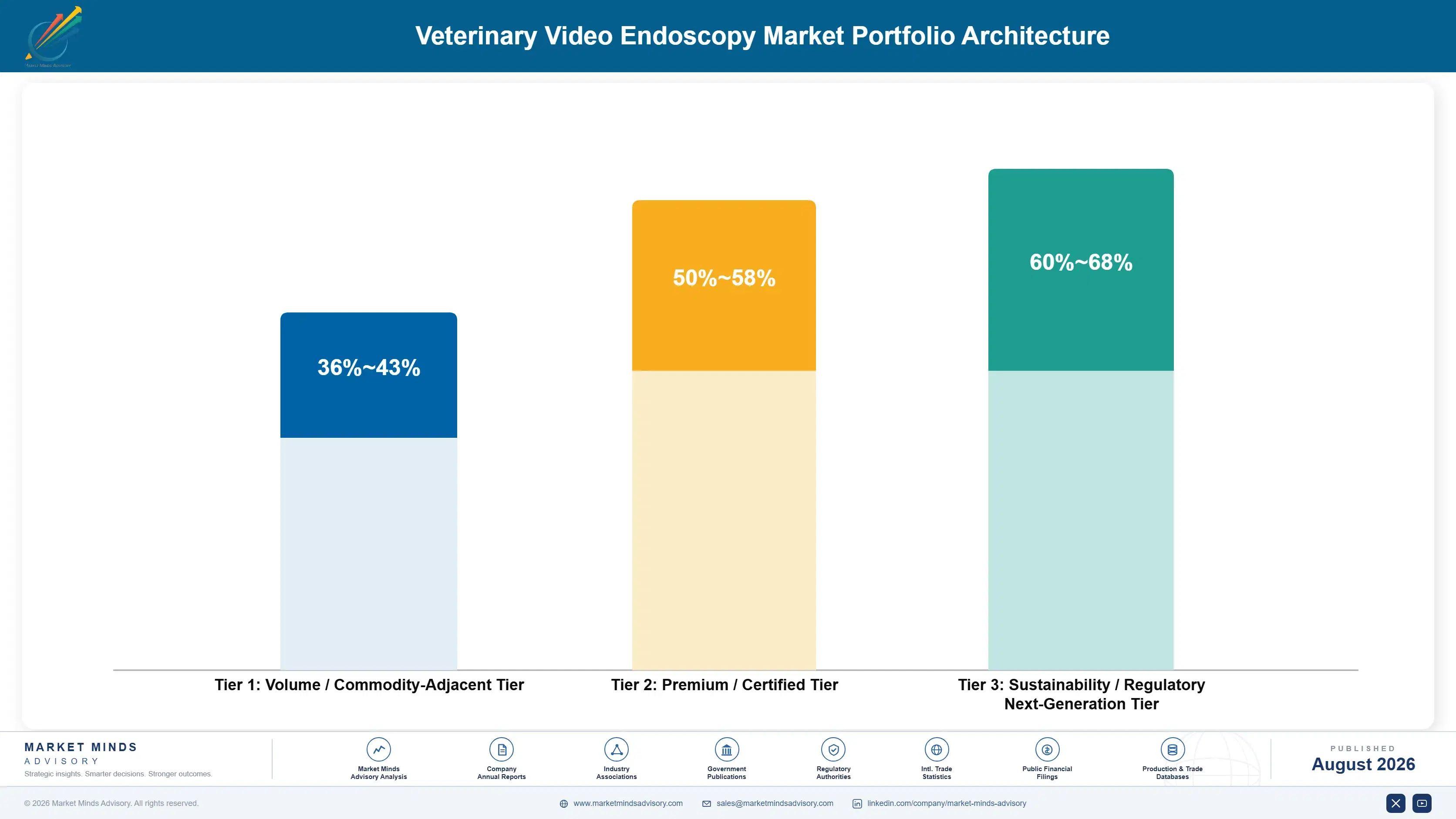
The category's margin architecture separates into three tiers: volume-adjacent legacy fiber-optic and rigid systems carrying the thinnest margins around thirty-seven percent, video laparoscopy systems carrying stronger margins in the mid-fifties, and flexible videoendoscopy systems commanding the highest prices and margins as diagnostic evidence continues to strengthen across the specialty practice base. This tiering broadly mirrors how procurement committees evaluate competing vendor bids each
Manufacturers face a persistent tension between defending legacy fiber-optic and rigid system volume, which remains familiar to a large cohort of established general practitioners, and pushing specialty practices toward premium flexible platforms that carry meaningfully better unit economics but require additional training investment to sell effectively across busy practices nationwide. Practice budget committees increasingly scrutinize this trade-off during annual capital renewal negotiations.

High-value margin pools concentrate specifically in flexible videoendoscopy systems and their associated accessory and service revenue, where diagnostic image quality and recurring consumable fees combine to lift blended margins well above the legacy baseline across the broader portfolio and installed base this forecast period. Manufacturers investing early in this convergence stand to capture disproportionate long-term value. Manufacturers without comparable service breadth risk losing formulary share over time.

Volume / Commodity-Adjacent Tier

Legacy fiber-optic and rigid endoscopy systems sold primarily on established clinical track record and price competitiveness against newer flexible platforms entering the market. General practices with constrained budgets remain the primary buyer segment.
Gross Margin: 36-43%

Premium / Certified Tier

Video laparoscopy systems carrying documented minimally invasive surgical evidence and broader surgeon familiarity than newer combination platforms, positioned as the established middle tier across most general veterinary practices nationwide. Mid-sized practices unable to justify premium costs frequently select this tier.
Gross Margin: 50-58%

Sustainability / Regulatory / Next-Generation Tier

Flexible videoendoscopy systems bundled with accessory subscriptions and value-based contracting structures tied to documented diagnostic yield outcomes across large specialty referral network populations and corporate hospitals. Corporate referral networks pursuing formulary consolidation lead adoption in this tier.
Gross Margin: 60-68%
veterinary-video-endoscopy-market-portfolio-architecture-1787310128078

High-value Sub-segments and Strategic Watch-out

Flexible Videoendoscopy Systems

The fastest-growing, highest-margin segment as specialty practices increasingly specify flexible capability as a baseline diagnostic requirement nationwide. Manufacturers with cleared platforms are converting the installed base ahead of scheduled capital replacement, capturing premium pricing across corporate relationships. Payer coverage recognition continues expanding. across major regions.
Gross Margin: 58-64%

Video Laparoscopy Systems

A large, established, mid-margin segment benefiting from rising client preference for minimally invasive options and growing surgeon comfort with laparoscopic technique across expanding procedure types nationwide. Manufacturers continue expanding instrument compatibility each product cycle to broaden adoption further. Larger practices lead early adoption of these expanded procedure types.
Gross Margin: 54-60%

Rigid Videoendoscopy Systems

A steady, mid-margin segment sold primarily on established track record and price competitiveness, facing gradual share erosion as flexible platforms earn broader specialty practice recognition across most major reimbursement geographies this period. Independent practices remain the primary buyers for now. Manufacturers continue defending price against flexible platform encroachment.
Gross Margin: 40-46%

Legacy Fiber-Optic Endoscopy Systems

A shrinking segment losing share to flexible and rigid videoendoscopy systems with superior image quality, though it retains a niche among general practices prioritizing lower upfront capital cost over diagnostic resolution. Independent practices with tighter budgets favor this segment still. Manufacturers continue serving this legacy segment steadily overall.
Gross Margin: 32-38%

Practice Capital Cycle and Accessory Economics

Revenue in this category behaves like a hybrid capital and consumable annuity once a practice commits to an endoscopy tower: the initial system sale is followed by a predictable seven-year replacement cycle, periodic service and repair contracts, and continuous reusable accessory and disposable component consumption tied directly to case volume rather than tower pricing alone. This recurring structure gives manufacturers meaningful revenue visibility beyond the initial capital sale.
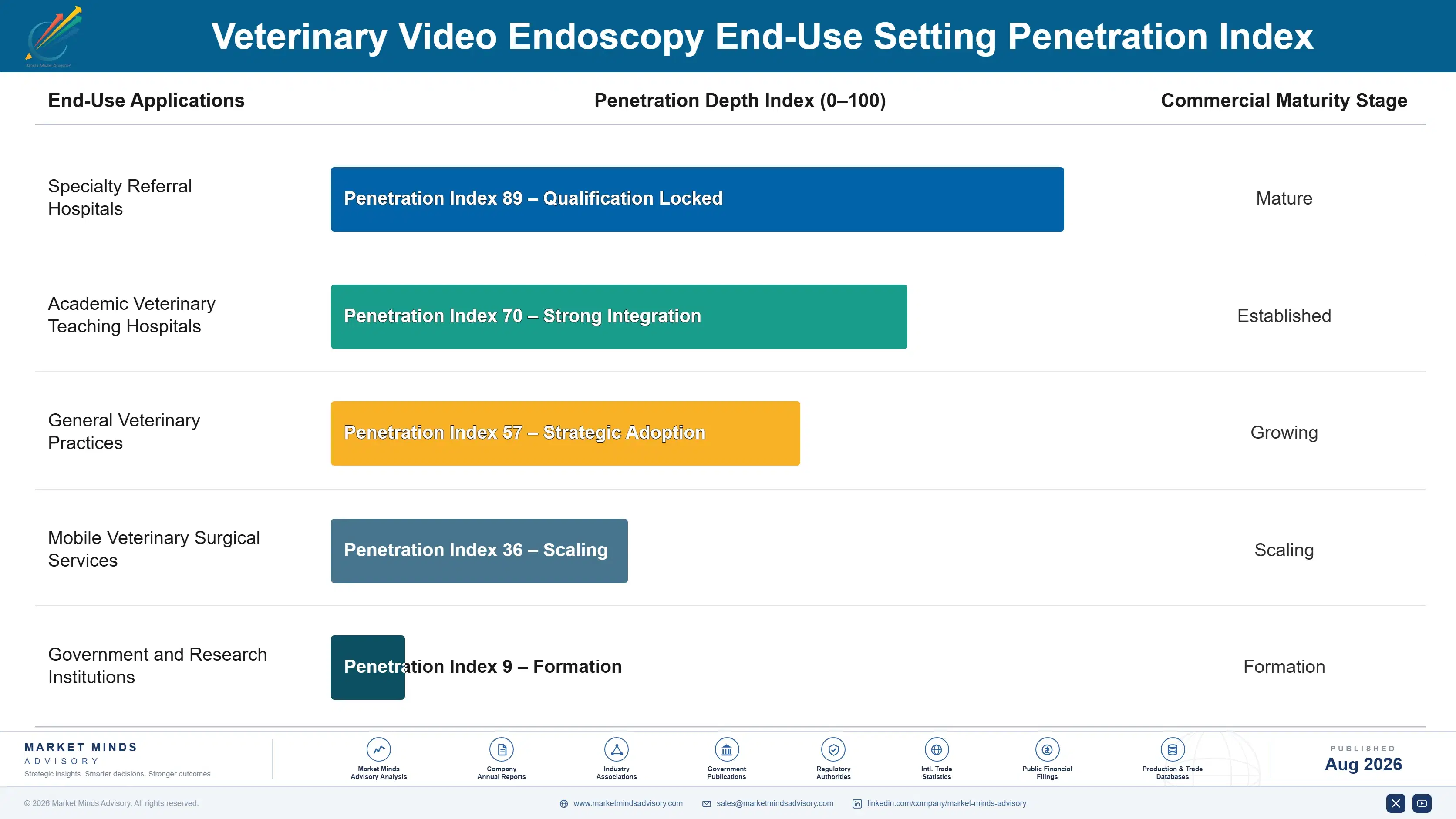
Adoption depth varies meaningfully by clinical vertical. Internal medicine and surgical specialty programs show the deepest, most consistent flexible endoscopy adoption, while general practice and mixed-animal programs adopt more selectively, reserving advanced diagnostics for higher-complexity cases after exhausting simpler physical examination options already familiar to their staff. Emergency and critical care programs represent a smaller but growing adoption segment as rapid diagnostic capability increasingly informs urgent treatment decisions.

A generational shift in buyer profile is underway as younger veterinarians trained during the flexible endoscopy era default to evidence-based platform selection, while an older cohort trained on legacy fiber-optic technique shows more brand loyalty rooted in decades of prior clinical familiarity and established supplier relationships. Manufacturers increasingly tailor sales approaches differently across these two distinct veterinarian cohorts to maximize conversion.
veterinary-video-endoscopy-market-end-use-penetration-index-1787310128566

What Endoscopy Makers Should Do

These are among the four positions where our research anticipates prominent divergence between winners and laggards over the coming forecast period. Each is grounded in the demand model, the regulatory perimeter, and the announced capacity pipeline.
01 / FLEXIBLE PORTFOLIO INVESTMENT

Flexible endoscopy is becoming standard of care within four years.

Three of five leading manufacturers already offer flexible videoendoscopy platforms as their flagship veterinary offering, and two smaller competitors have systems entering trials in 2026 across expanded species applications. Manufacturers still selling primarily rigid systems by 2029 will find themselves competing only on price against platforms with stronger diagnostic yield evidence backed by multi-site studies at major referral centers. The investment case for flexible imaging has moved from optional differentiation to a defensive necessity for defending practice contract position nationwide.
02 / ACCESSORY PORTFOLIO STRATEGY

Reusable accessory revenue can outgrow tower hardware margin over time.

Reusable accessories priced around $180 per kit represent a growing recurring revenue stream that increasingly determines which platform a practice standardizes on across its diagnostic and surgical service lines and staff training programs. Practices with higher accessory attach rates generate meaningfully higher consumable revenue per system annually than those relying primarily on basic starter kits across comparable case volumes. Manufacturers building deeper accessory portfolios now will lock in account loyalty before tower-only competitors catch up across most major markets nationwide.
03 / TRAINING PARTNERSHIP STRATEGY

Early training partnerships set precedent for expanding practice capacity.

MILA International's January 2026 training partnership with a regional veterinary practice network expands proctorship capacity across underserved general practice markets, a structure other manufacturers and practice networks are watching closely this budget cycle across the industry. Manufacturers with strong training infrastructure have the most to gain from moving early into similar partnerships ahead of competitors. Those without comparable programs risk being locked out of preferred referral status as these partnerships proliferate nationwide over the next several years across most major regions.
04 / COMPONENT SUPPLY RESILIENCE

Dual-sourcing critical digital sensors is now a competitive requirement.

The 2021 to 2022 sensor and optical component disruption showed clearly that single-sourced manufacturers faced longer production delays than dual-sourced competitors, directly affecting their ability to fulfill practice orders during a period of strong underlying demand growth nationwide across most geographies. Smaller manufacturers without the purchasing scale to negotiate dual-sourcing agreements remain more exposed to future disruptions. This supply resilience gap increasingly factors into practice procurement decisions alongside clinical evidence and pricing considerations across most major regions and referral networks.

Engagement Snapshot From the Field

A live engagement with an industry participant carrying material or product regulatory and market exposure ahead of a defining policy shift, showing how our research translates into a defensible multi-year portfolio strategy.
MARKET MINDS ADVISORY · CLIENT ENGAGEMENT SUMMARY
Veterinary Video Endoscopy Producer Strategic Portfolio Review and Transition Roadmap 2026·Investment Scenario on Veterinary Video Endoscopy Exposure Evaluation 2025-26
CLIENT PROFILE
The client is a regional specialty veterinary practice operating three locations across a metropolitan area, performing several thousand diagnostic and minimally invasive surgical procedures annually across internal medicine and surgical specialty services. The practice's capital planning committee had flagged rising endoscopy tower and accessory spend as a category requiring closer review ahead of its next annual budgeting cycle, prompting the engagement.
STRATEGIC CHALLENGE
The practice needed to rationalize its endoscopy formulary, which had grown to include three separate manufacturer systems across different locations, without disrupting existing veterinarian workflows or patient care continuity. Leadership also wanted a defensible framework for evaluating flexible videoendoscopy platforms against the rigid systems still used at some locations. Consistency across all three locations was another key priority.
MMA APPROACH
MMA conducted structured interviews with the practice's veterinarians and capital planning committee members, benchmarked system pricing and diagnostic yield data against comparable regional specialty practices, and modeled the total cost of ownership across a three-year formulary consolidation scenario. The analysis incorporated both published comparative-effectiveness literature and practice-specific procedural outcomes data by location.
KEY FINDINGS
  1. Diagnostic follow-up costs under the rigid-system-only locations exceeded the incremental cost of standardized flexible platforms across the practice's own site-level data (client-reported, unverified by MMA).
  2. Consolidating from three systems to two preferred vendors was projected to reduce annual device spend meaningfully while preserving veterinarian choice across most case volume (client-reported, unverified by MMA).
  3. Flexible platform adoption among the practice's veterinarians correlated with measurably higher diagnostic yield per procedure compared with rigid systems still in use at some locations.
  4. Veterinarians newly trained through manufacturer-sponsored proctorship programs showed measurably higher confidence interpreting flexible endoscopy imaging than those relying on informal peer instruction alone.
CLIENT PROFILE
The client is a regional specialty veterinary practice operating three locations across a metropolitan area, performing several thousand diagnostic and minimally invasive surgical procedures annually across internal medicine and surgical specialty services. The practice's capital planning committee had flagged rising endoscopy tower and accessory spend as a category requiring closer review ahead of its next annual budgeting cycle, prompting the engagement.
STRATEGIC CHALLENGE
The practice needed to rationalize its endoscopy formulary, which had grown to include three separate manufacturer systems across different locations, without disrupting existing veterinarian workflows or patient care continuity. Leadership also wanted a defensible framework for evaluating flexible videoendoscopy platforms against the rigid systems still used at some locations. Consistency across all three locations was another key priority.
MMA APPROACH
MMA conducted structured interviews with the practice's veterinarians and capital planning committee members, benchmarked system pricing and diagnostic yield data against comparable regional specialty practices, and modeled the total cost of ownership across a three-year formulary consolidation scenario. The analysis incorporated both published comparative-effectiveness literature and practice-specific procedural outcomes data by location.
KEY FINDINGS
  1. Diagnostic follow-up costs under the rigid-system-only locations exceeded the incremental cost of standardized flexible platforms across the practice's own site-level data (client-reported, unverified by MMA).
  2. Consolidating from three systems to two preferred vendors was projected to reduce annual device spend meaningfully while preserving veterinarian choice across most case volume (client-reported, unverified by MMA).
  3. Flexible platform adoption among the practice's veterinarians correlated with measurably higher diagnostic yield per procedure compared with rigid systems still in use at some locations.
  4. Veterinarians newly trained through manufacturer-sponsored proctorship programs showed measurably higher confidence interpreting flexible endoscopy imaging than those relying on informal peer instruction alone.
RECOMMENDED STRATEGY
Phase 1: Phase 1 (Months 1-3): Complete a practice-wide device utilization and diagnostic yield audit across all three existing systems to establish a defensible baseline. Phase 2: Phase 2 (Months 4-8): Negotiate consolidated preferred-vendor agreements with two manufacturers, incorporating value-based pricing terms tied to documented diagnostic outcomes. Phase 3: Phase 3 (Months 9-14): Implement a phased transition plan for the remaining locations, prioritizing flexible platform migration wherever clinically appropriate.
OUTCOME
The practice adopted a two-vendor preferred formulary within eight months of the engagement's conclusion, incorporating value-based pricing terms for a portion of its annual device volume. Leadership reported improved budget predictability heading into the following capital cycle and stronger negotiating position in subsequent vendor renewal discussions (client-reported, unverified by MMA).

Frequently Asked Questions

Foundational context covering the market sizes, CAGR, scope, country, region and competition that inform every finding below. This section is provided to cover basics and most often pre-purchase conversations, answered from the MMA Primary Research Dataset.

What is the current size of the Veterinary Video Endoscopy Market?

The market stood at USD 0.35 billion in 2025, based on MMA Primary Research Dataset findings. Flexible videoendoscopy adoption is the primary driver of accelerating system revenue growth.

How large will the Veterinary Video Endoscopy Market be by 2036?

MMA projects the market will reach USD 0.82 billion by 2036 under the base case scenario, representing roughly 2.16 times the 2026 opening value across the eleven-year forecast period.

What is the CAGR for the Veterinary Video Endoscopy Market 2026 to 2036?

The base case CAGR is 8.0% annually. MMA's bull scenario reaches 9.2% while the bear scenario, reflecting general practice capital budget constraints, runs closer to 6.8% over the forecast period.

Which segment is growing fastest?

Flexible videoendoscopy systems lead at 11.9% CAGR, roughly 1.5 times the overall market rate, as high-definition imaging earns broader practitioner and procurement committee preference now.

Who are the major companies in the Veterinary Video Endoscopy Market?

Karl Storz, Olympus, STERIS, ELMED Medical Systems, and MILA International lead the market, together controlling an estimated 52% of global revenue on a consistent basis.

Which country is growing fastest?

China posts the fastest national growth at 11.4% CAGR, driven by expanding specialty practice infrastructure and rising urban pet ownership. Domestic manufacturers are also gaining share in lower-tier practices.

Report Segmentation Architecture

The full report scope spans multiple orthogonal segmentation dimensions, with cross-tabulated demand data provided for each dimension pair. Coverage extends further to regional breakdowns, trend trajectories, and the competitive detail needed to support segment-level decision-making.

By System Type

  • Flexible Videoendoscopy Systems
  • Video Laparoscopy Systems
  • Rigid Videoendoscopy Systems
  • Legacy Fiber-Optic Endoscopy Systems
  • Capsule Endoscopy Systems
  • Bronchoscopy Systems

By End-Use Setting

  • Specialty Referral Hospitals
  • Academic Veterinary Teaching Hospitals
  • General Veterinary Practices
  • Mobile Veterinary Surgical Services
  • Government and Research Institutions

By Clinical Application

  • Gastrointestinal Diagnostics
  • Respiratory Diagnostics
  • Minimally Invasive Surgery
  • Urogenital Diagnostics

By Region

  • North America
  • Western Europe
  • East Asia
  • South Asia and Pacific
  • Latin America
  • Middle East and Africa
  • Eastern Europe

Scope, Methodology, and Coverage

Every figure in this report is reproducible from documented input assumptions. The scope below maps the historical period, the forecast horizon, the segmentation dimensions, and the countries covered, alongside the underlying primary and qualitative methodology.
Historical Period
2020 to 2025
Forecast Period
2026 to 2036
Base Year
2025 (USD billions; MMA Primary Research Dataset, August 2026)
Market Definition
This market covers video endoscopy systems used for veterinary diagnostic and minimally invasive surgical procedures, including flexible videoendoscopes, rigid videoendoscopes, and video laparoscopy systems. It excludes surgical instruments used alongside these systems, general anesthesia equipment, and standalone imaging displays sold separately.
Quantitative Units
USD billions (current prices); unit system placements where applicable
Segmentation Dimensions
By System Type; By End-Use Setting; By Clinical Application; By Region
Regions Covered
North America, Western Europe, East Asia, South Asia and Pacific, Latin America, Middle East and Africa, Eastern Europe
Countries Covered
USA, China, Germany, France, UK, Japan, South Korea, India, Australia, Canada, Brazil, Mexico, Indonesia, Vietnam, Thailand, Malaysia, UAE, Saudi Arabia, South Africa, Nigeria, Turkey, Poland, Netherlands, Italy, Spain, Sweden, Switzerland, Argentina, Colombia, Singapore, and additional markets relevant to this sector
Key Companies Profiled
Karl Storz SE & Co. KG, Olympus Corporation, STERIS plc, ELMED Medical Systems Inc., MILA International Inc., EndoDynamics, Vimian Group AB, Richard Wolf GmbH, Fujifilm Healthcare Corporation, Sopro-Comeg GmbH, Welch Allyn Inc., Optomic S.L., Xion Medical GmbH, Aesculap Inc., Endoscopy Support Services Inc., Guangzhou Vet Medical Instrument Co. Ltd., Shanghai Well.D Medical Electronics Co. Ltd., Kaixin Medical Instruments Co. Ltd., Medical Illumination International LLC, Veterinary Specialty Products LLC
Quantitative Methodology
Primary survey, n=3,800 respondents, Q4 2025, six countries; demand-side model with trade association cross-validation
Qualitative Methodology
47 expert interviews, Q4 2025; applied to validate demand model assumptions, identify emerging dynamics, and assess competitive positioning
Report Format
PDF and XLSX data workbook (Word format preview document)
Publisher
Market Minds Advisory
Report Code
MMA-2026-MED-129
Published
August 2026
Contact
sales@marketmindsadvisory.com | www.marketmindsadvisory.com

Purchase the full Veterinary Video Endoscopy Market Report (2026 to 2036).

The full report provides a complete competitive and commercial analysis of the global veterinary video endoscopy market, including detailed segmentation by system type, end-use setting, and clinical application. It profiles twenty manufacturers across established and emerging platform technologies, with country-level sizing across thirty individual markets worldwide. The report includes specialty practice capital budgeting trend tracking and a value-based contracting outlook through 2036. Buyers receive full access to the underlying primary survey and expert interview datasets referenced throughout the analysis and appendices. It also includes a dedicated flexible platform adoption comparison section.
Country-level market sizing through 2036 forecast
Twenty-company competitive profiling and moat analysis
Specialty practice capital budgeting trend tracking
Flexible endoscopy technology roadmap and outlook
Value-based contracting case examples and precedent
Primary survey and expert interview datasets included

Built For The People Who Decide

From boardroom strategy to bench-side execution, this report is read cover-to-cover by leaders shaping the next decade of their industry, turning demand scenarios, market dynamics and valuation benchmarks into decisions.
CXOs/ Presidents/ VPs/ Managers
M&A and Corporate Development
Strategy Teams and R&D Heads
Procurement and Product Directors
Regulatory and Compliance Leaders
Investor Relations and Equity Analysts