Market Minds Advisory
Veterinary Vaccine Adjuvants Market

Veterinary Vaccine Adjuvants Market: A Rounding Error That Decides Efficacy, and a Formulation Lock Lasting Decades

The adjuvant decides whether a vaccine works and accounts for around 3% of the cost of a finished dose, which is the widest gap between importance and spend anywhere in animal health.

Lead Analyst

Alice Ballenger

Published

September 2026

Make Smarter Decisions with Customized Research Insights

Request a free sample report and evaluate market opportunities, growth trends, and competitive dynamics relevant to your business needs.

2025 MARKET VALUE$0.3BMarket Size 2025
2036 FORECAST VALUE$0.8BBase Case , 2026 to 2036
CAGR 2026 TO 20367.6 %Bull 8.8% / Bear 6.4%
INCREMENTAL OPPORTUNITY$0.4BNet 10- year value creation
EXPANSION MULTIPLE2.08x2036 value over 2026 base
Strategic Levers
M&A Pipeline
Regional Outlook
Country Rankings
Competitive Intelligence
Segmental Deep-dive
Call-Us : 91 93563 13602

Executive Snapshot and Market Trajectory

The adjuvant decides whether a veterinary vaccine works and costs almost nothing. An antigen alone frequently produces a weak or short lived response, while the adjuvant sets magnitude, duration and which arm of the immune system responds at all. It accounts for roughly 3% of finished dose cost of goods.
That gap between importance and spend would matter less if the component were easy to change. It is not. Switching adjuvant makes a vaccine a different product requiring new efficacy and safety data in every registered market, which takes about four years, so an adjuvant chosen at development stage holds the formulation for a commercial life averaging 28 years. A supplier winning that decision keeps it for a generation.
Veterinary formulation also tolerates reactogenicity human medicine would refuse, which is why oil emulsions dominate production animal vaccines. That tolerance is narrowing. Injection site lesions downgrade roughly 2.4% of carcasses at inspection, and companion animal owners will not accept a lump on a cat. Immunostimulant adjuvants grow fastest at 11.4%, half again the market rate of 7.6%. Reactogenicity is finally becoming a commercial number somebody pays for. Owners will not accept a lump.
Market Definition
Adjuvant materials and formulation systems supplied to veterinary vaccine manufacturers, covering aluminium salt adjuvants, oil emulsion adjuvants, saponin based adjuvants, polymer and carbomer adjuvants, immunostimulant and receptor agonist adjuvants, and liposome and nanoparticle delivery systems. Measured at supplier selling value into vaccine manufacture. Finished veterinary vaccines, antigen production, human vaccine adjuvants, preservatives, stabilisers and vaccine filling equipment are excluded.
Base Year Value
$0.3B in 2025 (MMA Primary Research Dataset, August 2026)
Forecast Period
2026 to 2036, eleven discrete annual values
CAGR
7.6% base case. Bull 8.8%. Bear 6.4%.
Fastest Growth Segment
Immunostimulant and Receptor Agonist Adjuvants: 11.4% CAGR
Fastest Growth Country
India: 13.4% CAGR
Fastest Growth Region
South Asia and Pacific: 9.8% CAGR
Largest Region
East Asia: 28% of 2025 global value
Market Leaders
Seppic, Croda International, Merck KGaA, SPI Pharma, Desert King International. Source: MMA Primary Research Dataset, July 2026.
Primary Survey
n=3,800 procurement and R&D decision-makers, Q4 2025, six countries
Methodology
Demand-side build-up, cross-validated against public data, 47 expert interviews

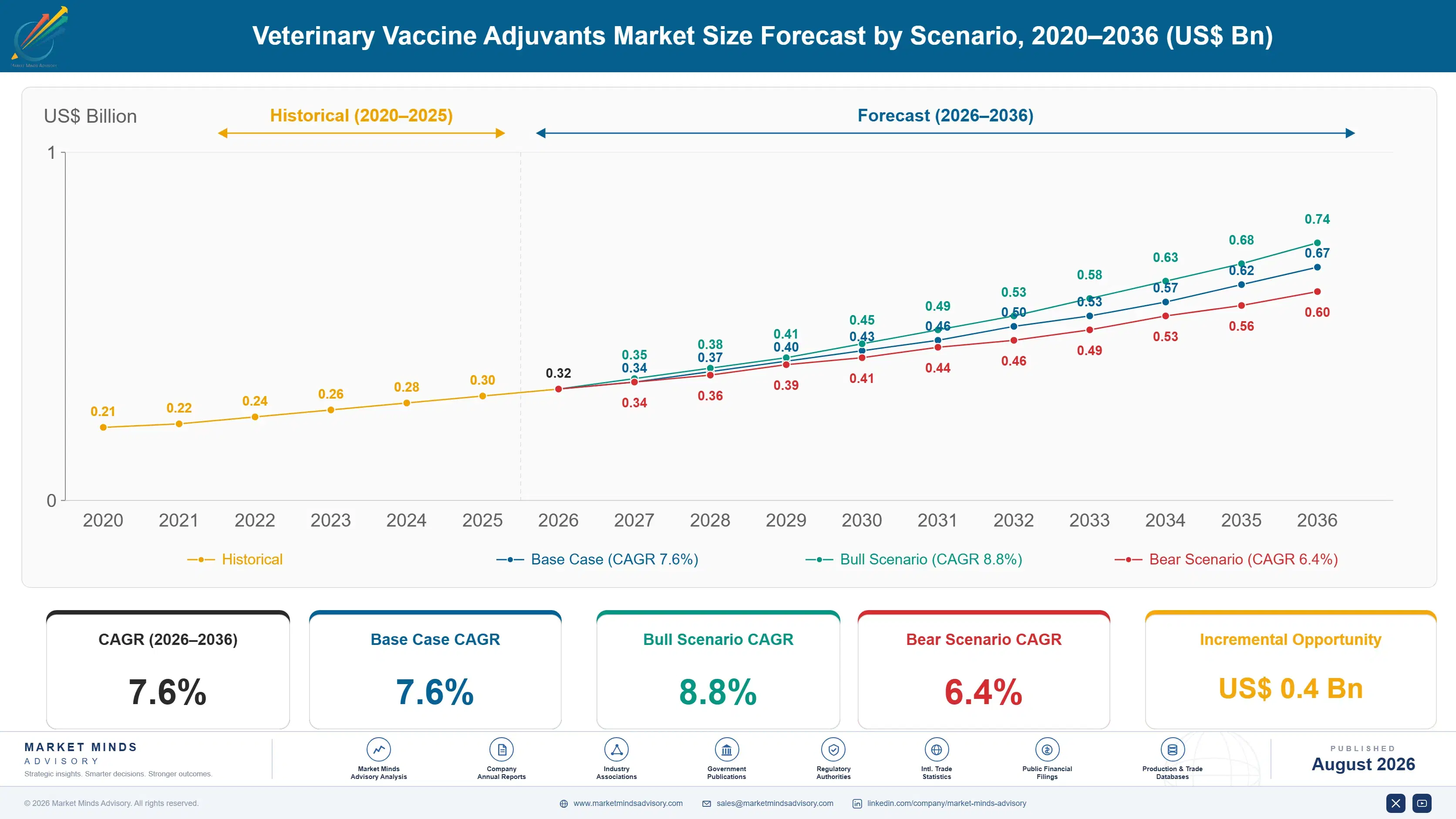
Veterinary Vaccine Adjuvants Market Forecast Scenarios

veterinary-vaccine-adjuvants-market-size-forecast-scenario-1787641578942
The five years to 2025 were driven by disease events rather than by formulation science. African swine fever, avian influenza and foot and mouth outbreaks all raised vaccine production volumes across affected regions, and adjuvant demand followed the doses rather than any change in what was chosen. Companion animal vaccine volumes grew steadily alongside. The 6.4% historical rate reflects dose volume rather than any premium mix shift.
The 7.6% base case rests on three mechanisms. Reactogenicity concerns keep pushing formulation away from crude oil emulsions toward better tolerated systems, driven by carcass condemnation costs in production animals and by owner expectations in companion species. Novel antigen platforms including subunit and vectored constructs need more sophisticated adjuvants than whole killed vaccines ever did. And Indian and Chinese vaccine manufacturing capacity keeps expanding, with India growing faster than any market covered.
The 8.8% bull case turns on a major production animal vaccine reformulating away from oil emulsion at scale, which would signal to the whole industry that the tolerance for injection site reactions has genuinely ended. The 6.4% bear case is formulation inertia: a four year requalification and a 28 year product life together mean almost nothing changes unless something forces it.

Three Percent of Cost, All of the Efficacy

Almost nobody outside formulation understands what this component does. An antigen presented to an immune system without help frequently produces a response too weak or too short to protect anything, and the adjuvant determines magnitude, duration and whether the response is antibody driven or cell mediated. It also accounts for roughly 3% of finished dose cost of goods, the widest gap between clinical importance and commercial spend in animal health.
TOP FIVE CONCENTRATION62%Combined supply volume held by leading adjuvant producers
ADJUVANT COST SHARE3%Portion of finished vaccine dose cost of goods
FORMULATION CHANGE TIMELINE4 yearsTime to requalify a vaccine after switching adjuvant
INJECTION SITE CONDEMNATION2.4%Carcasses downgraded for injection lesions at meat inspection
PRODUCT COMMERCIAL LIFETIME28 yearsTypical span a veterinary vaccine formulation remains marketed
ALUMINIUM FORMULATION SHARE41%Doses still formulated on conventional mineral salt adjuvants
The commercial consequence of that gap is a lock rather than a bargain. Changing adjuvant makes a vaccine a different product in regulatory terms, requiring fresh efficacy and safety data in every market where it is registered, which takes around four years and costs considerably more than the adjuvant ever will. A supplier winning a formulation at development stage therefore holds it across a commercial life averaging 28 years.
Veterinary practice has also tolerated reactogenicity that human vaccine development would refuse outright. Oil emulsions producing injection site granulomas remain standard in poultry and pig vaccines because the animal reaches slaughter before the lesion matters clinically. That tolerance is narrowing: roughly 2.4% of carcasses are downgraded at inspection, and no owner accepts a permanent lump on a cat.
"Manufacturers negotiate adjuvant pricing to the last cent on a component worth three percent of the dose, then spend four years and a fortune if they ever want to change it. The negotiation is on entirely the wrong variable."
Director, Animal Health Chemicals and Biologics Practice · MMA Chemicals and Materials Practice · August 2026

Market Trends

Reactogenicity Tolerance Narrows on Two Separate Fronts

Oil emulsion adjuvants producing injection site granulomas have been standard in production animal vaccines for decades, on the reasoning that an animal reaches slaughter before the lesion matters. Meat inspection has made that reasoning expensive: roughly 2.4% of carcasses are downgraded for injection site lesions, and processors increasingly pass that cost back through supply contracts. Companion animal owners were never tolerant at all, and feline injection site sarcoma made the profession considerably more cautious. Immunostimulant adjuvants grow at 11.4% against a market rate of 7.6% substantially on this pressure rather than on efficacy claims.
Market Impact: India grows at 13.4% annually

Novel Antigen Platforms Demand More Sophisticated Adjuvants

Whole killed and modified live vaccines carry enough intrinsic immune signalling that a simple mineral salt or oil emulsion suffices, which is why roughly 41% of doses still use aluminium. Subunit, recombinant and vectored constructs present purified antigen with none of that signalling, and they require adjuvants that supply it deliberately through receptor agonists or particulate delivery. Liposome and nanoparticle systems grow at 9.8%, second fastest in the market, entirely on this dependency. Antigen platform choice therefore determines adjuvant choice years before any commercial conversation happens. Commercial conversations arrive years afterwards.
Market Impact: Campaigns consume 3 years of volume

Market Opportunities and Growth Drivers

Asian Vaccine Manufacturing Capacity Keeps Expanding

Indian and Chinese veterinary vaccine manufacturers supply enormous dose volumes for domestic livestock populations and increasingly for export, and each new production line specifies adjuvant at formulation stage rather than inheriting a choice. India grows at 13.4%, faster than any country covered, on foot and mouth, brucellosis and poultry vaccine programmes running at national scale. Suppliers present during formulation development capture positions lasting decades, while those arriving after registration face a four year requalification nobody will fund. Local technical support during development matters more than pricing at that moment. Pricing decides very little.
Market Impact: Requalification takes 4 years

Disease Events Raise Dose Volumes Across Whole Regions

African swine fever, avian influenza and foot and mouth outbreaks each raise vaccine production sharply across affected regions, and adjuvant demand follows dose volume immediately since formulation is already fixed. Emergency vaccination campaigns consume in months what routine programmes use in years, which strains adjuvant supply chains that were sized against steady demand. Suppliers holding inventory and flexible manufacturing capacity capture that volume while competitors quote lead times. Nobody can forecast the events, which makes buffer capacity a strategic choice rather than an efficiency failure. Buffer capacity becomes a strategic choice rather than inefficiency.
Market Impact: Adjuvant is 3% of dose cost

Market Restraints and Challenges

Requalification Cost Freezes Formulations for Decades

Switching adjuvant makes a vaccine a different product in regulatory terms, requiring new efficacy and safety data in every registered market, which takes around four years and costs far more than any adjuvant saving could recover. The root cause is that regulators treat the formulation as a whole rather than as an antigen with an interchangeable helper, which is scientifically correct and commercially immovable. Products therefore run on their original adjuvant across a 28 year life. Suppliers respond by competing exclusively at development stage, where the decision is actually made and never revisited afterwards.
Market Impact: Lesions downgrade 2.4% of carcasses

Three Percent Cost Share Removes Any Pricing Leverage

The adjuvant represents roughly 3% of finished dose cost of goods, which means a supplier improving efficacy cannot capture value through pricing because the customer measures the component against a bill of materials rather than against vaccine performance. The root cause is that value created downstream in efficacy and reduced reactogenicity accrues to the vaccine manufacturer entirely. Commercially this caps what innovation earns. Responses include supplying formulation development services alongside material, licensing on royalty terms rather than unit pricing, and bundling technical support that manufacturers would otherwise build. Value created downstream stays downstream.
Market Impact: Aluminium still carries 41% of doses
3 additional market trends, 4 additional growth drivers, and 2 additional restraints and challenges are covered in the full report. Contact sales@marketmindsadvisory.com to access the complete intelligence.

Segment CAGR and Growth Architecture

Segmentation follows adjuvant class, since class determines immune response type, reactogenicity, cost and which antigen platforms it can support. Six classes cover the field, from aluminium salts used for a century to receptor agonists designed for purified subunit antigens. Growth follows tolerability pressure and antigen platform change rather than any pricing dynamic. Price barely enters the choice.
veterinary-vaccine-adjuvants-market-market-share-analysis-1787641579502

Immunostimulant and Receptor Agonist Adjuvants

Defined molecules acting on specific innate immune receptors to direct the type and magnitude of response, rather than relying on the depot effect and inflammation that older adjuvants produce. At 11.4% this is the fastest growing class in the market, half again the market rate of 7.6%, and the driver is tolerability alongside precision. These systems produce far less injection site reaction than oil emulsions while directing cell mediated responses that killed antigen alone cannot generate. Cost per dose runs well above aluminium or emulsion alternatives, which matters less than it appears when the adjuvant is around 3% of a dose. Regulatory familiarity is improving as more products carry them.
CAGR 11.4%

Liposome and Nanoparticle Delivery Systems

Particulate carriers presenting antigen in a form immune cells recognise as foreign material rather than as soluble protein, frequently combined with receptor agonists in a single system. Growth of 9.8% is second fastest in the market and it tracks antigen platform change directly, since subunit and recombinant constructs carry none of the intrinsic signalling that whole killed vaccines provide. Manufacturing complexity is considerably higher than for an emulsion, requiring controlled particle size and stability across a supply chain that may not be refrigerated throughout. That complexity limits adoption in cost sensitive production animal vaccines while suiting companion animal products well. Companion animal products absorb the cost far more comfortably than production animal programmes do.
CAGR 9.8%
Full segment breakdown across 6 segments available in the complete report.

Regional Architecture and Country Demand Map

East Asia holds the largest share at 28%, on Chinese veterinary vaccine manufacturing volume that exceeds anywhere else. Western Europe follows at 24% on adjuvant technology supply. India grows fastest of any country covered at 13.4% on national vaccination programmes. Requalification cost freezes everything else.

East Asia

Dose volume rather than formulation sophistication gives this region its 28% share. Chinese veterinary vaccine manufacture is the largest anywhere by dose count, serving pig, poultry and aquaculture populations at a scale no other market approaches, and domestic adjuvant supply covers much of it at prices imported materials cannot match. Formulation choices skew toward aluminium and conventional oil emulsions, which suits cost sensitive production animal programmes. Japanese and Korean manufacture is smaller, more sophisticated and uses considerably more advanced adjuvant systems in companion animal products. Regional growth of 8.6% follows Chinese dose volume alongside gradual formulation upgrading in premium categories. Domestic adjuvant supply covers most of that volume at prices imports cannot approach.
Share: 28% | CAGR: 8.6% (2026 to 2036)

Western Europe

Technology supply rather than dose volume explains this 24% share. French, British and German suppliers developed much of the adjuvant technology used worldwide and continue supplying it into vaccine manufacture globally, so regional revenue includes export supply as well as domestic formulation. European veterinary medicine regulation is stricter on reactogenicity than most, which has driven adoption of better tolerated systems ahead of other markets. Meat inspection standards also make injection site lesions commercially visible sooner here. Growth of 6.0% is the lowest of the seven regions, reflecting a mature manufacturing base rather than any technology disadvantage. Export supply into global vaccine manufacture carries much of the regional revenue recorded here.
Share: 24% | CAGR: 6.0% (2026 to 2036)
Regional intelligence for 5 additional markets available in the complete report: North America, South Asia and Pacific, Latin America, Middle East and Africa, Eastern Europe. Contact sales@marketmindsadvisory.com.
veterinary-vaccine-adjuvants-market-country-cagr-analysis-1787641580029

Where Adjuvant Suppliers Actually Win

Nothing here is won at a procurement negotiation, because the component is 3% of a dose and the decision was made years earlier. Value accrues to whoever is present during formulation development, whoever answers the reactogenicity problem, and whoever supports novel antigen platforms that need help older adjuvants cannot give. Four routes carry weight, and none is pricing.

Win the Formulation Before It Reaches Registration

Changing adjuvant after registration requires new efficacy and safety data in every market, takes around four years and costs far more than any material saving recovers, so the decision is effectively made once and held across a commercial life averaging 28 years. That makes development stage presence the entire commercial contest and procurement negotiations largely irrelevant. Suppliers embedding technical staff with vaccine developers during formulation work capture positions competitors cannot later contest at any price. Those arriving after registration are quoting into a decision nobody will reopen. Nobody reopens a registered formulation.
Market Impact: Holds formulations across a 28 year commercial lifetime

Solve the Injection Site Problem Commercially

Roughly 2.4% of carcasses are downgraded at meat inspection for injection site lesions, and processors increasingly pass that cost back through supply contracts rather than absorbing it. That converts reactogenicity from a welfare argument into a per carcass number a producer can calculate, which is the first time this has been commercially visible. Immunostimulant adjuvants grow at 11.4% against a market rate of 7.6% substantially on that pressure. Suppliers quantifying condemnation savings reach a buyer that efficacy data alone never has, and that buyer sits downstream of the vaccine manufacturer.
Market Impact: Addresses the 2.4% carcass condemnation cost head on

Follow Novel Antigen Platforms Into Formulation

Subunit, recombinant and vectored antigens carry none of the intrinsic immune signalling that whole killed vaccines provide, which means they simply do not work with the aluminium salts still carrying roughly 41% of doses. Liposome and nanoparticle systems grow at 9.8% and receptor agonists at 11.4% on that dependency alone. Antigen platform choice determines adjuvant requirements years before any commercial discussion, so suppliers tracking development pipelines rather than current product registrations see the opportunity first. Technical partnership at that stage is worth more than any material specification. Pipeline tracking beats registration tracking.
Market Impact: Serves platforms that the 41% aluminium base cannot

Build Positions in Expanding Manufacturing Markets

India grows at 13.4%, faster than any country covered, and Chinese and Southeast Asian capacity keeps expanding, with new production lines specifying adjuvants at formulation stage rather than inheriting decades old choices. That makes these the most accessible markets anywhere for a supplier seeking new positions, since nothing has to be displaced. Local technical support during formulation development decides the outcome far more than pricing does, because a developer choosing a material wants help making it work. Suppliers without local presence are competing on a specification sheet. Specification sheets persuade nobody there.
Market Impact: Captures the 13.4% Indian national market growth rate

Who Controls the Margin Pool

Concentration is high for a specialty chemical market. The top five supply 62% of adjuvant volume into veterinary vaccine manufacture, the basis applied consistently here, and positions are unusually stable because formulations rarely change once registered. Seppic leads on emulsion and polymer systems with an installed formulation base built across decades, and the distance to competitors reflects incumbency rather than any current technical advantage.
Competition runs on three fronts. Established suppliers compete at development stage for new formulation positions, which is a technical partnership rather than a commercial negotiation. Domestic Asian producers compete on price for conventional aluminium and emulsion volume in cost sensitive production animal programmes. Novel adjuvant developers compete for licensing and partnership with vaccine manufacturers rather than selling material at all.

Rankings will move only where new formulations are being developed, since existing positions are locked by requalification cost for decades. That concentrates the entire competitive contest into the small proportion of products under development at any moment. The other pressure point is vaccine manufacturers developing proprietary adjuvant systems internally, which several have done to avoid depending on a supplier for something that determines whether their product works.
veterinary-vaccine-adjuvants-market-company-positioning-matrix-1787641580553

Competitive Moat and Risk Dimensions

SEPPIC

Moat: Installed Formulation Base

Adjuvant systems written into vaccine registrations across decades generate supply positions that cannot be contested without a four year requalification nobody will fund, which makes the installed base close to permanent. Technical support capability during formulation development also keeps the company present at the only moment when a new position can actually be won anywhere.
SEPPIC

Risk: Reactogenicity Profile Exposure

A portfolio weighted toward oil emulsions sits in the technology most exposed to narrowing tolerance for injection site reactions, with roughly 2.4% of carcasses downgraded at inspection and companion animal expectations tightening further. Existing registrations are safe, but new formulation opportunities increasingly specify systems producing less local reaction.
CRODA INTERNATIONAL

Moat: Novel Delivery Technology

Lipid and particulate delivery capability developed across human and animal health applies directly to the subunit and vectored antigens that older adjuvants cannot support, positioning the company where formulation development is actually moving. That technology base took years to build and transfers between species without requiring redevelopment from first principles.
CRODA INTERNATIONAL

Risk: Manufacturing Complexity Cost

Particulate and lipid systems require controlled particle size and stability across supply chains that are frequently not refrigerated throughout, which raises cost well above emulsions in a component already only 3% of dose cost. That limits adoption in production animal vaccines, where the largest dose volumes sit and price sensitivity is severe.

Players Tracked

Prominent Players

Seppic
Croda International
Merck KGaA
SPI Pharma
Desert King International

Other Key Players

InvivoGen
Phibro Animal Health
Nof Corporation
Adjuvatis
Vaxine
Lubrizol Life Science
Ashland
Evonik Industries
Nikko Chemicals
Brenntag
Zoetis
Boehringer Ingelheim Animal Health
Ceva Sante Animale
Virbac
Hipra

Recent Developments

MARCH 2025

Meat processor passes injection site condemnation costs to producers

A large meat processing group revised supply contracts to pass carcass downgrade costs from injection site lesions back to producers rather than absorbing them, making reactogenicity a per animal figure a farmer can calculate. Vaccine purchasing conversations in that supply chain changed within a single season afterwards.
Signal: Reactogenicity became a commercial number the moment somebody upstream in the chain had to pay for it
JUNE 2025

Indian manufacturer selects novel adjuvant for national programme vaccine

An Indian veterinary vaccine manufacturer selected an immunostimulant adjuvant system for a new national programme product, choosing at formulation stage rather than adapting an existing registration. New production lines in expanding manufacturing markets specify adjuvants freshly rather than inheriting decades old formulation decisions. Nothing had to be displaced.
Signal: Expanding manufacturing markets are where new formulation positions can still realistically be won at all today
SEPTEMBER 2025

Vaccine manufacturer develops proprietary adjuvant system internally

An animal health company announced a proprietary adjuvant platform developed internally for use across its own vaccine pipeline, citing the strategic risk of depending on an external supplier for the component determining whether a product works. Several competitors have pursued similar internal capability over recent years.
Signal: Manufacturers strongly dislike depending on any third party at all for the ingredient that decides efficacy

What an Adjuvant System Costs

Raw material composition varies enormously by adjuvant class. Oil emulsion systems rest on highly refined mineral or squalene oils and specialised surfactants accounting for roughly 54% of cost of goods, while saponin adjuvants depend on Quillaja saponaria bark extract from Chilean plantations and receptor agonists on synthesised molecules whose cost sits in chemistry rather than materials. Aluminium salts are inexpensive commodity chemistry throughout.
Quillaja bark supply was the constraint that mattered most, since the tree grows in a limited Chilean range and demand rose across human and animal vaccine applications simultaneously. Plantation expansion has improved availability, and company annual reports across the specialty ingredients sector documented the pricing movement. Refined oil and surfactant costs tracked petrochemical feedstock through 2022, and squalene remains dependent on shark liver or plant sources.

Exposure divides by adjuvant class rather than by company size. A saponin weighted supplier carries agricultural and geographic concentration risk on a single tree species in one country. An emulsion supplier carries petrochemical exposure that is volatile but broadly sourced. Synthetic receptor agonists carry chemistry costs that are high but stable. At 3% of dose cost none of this reaches the manufacturer as pricing pressure worth arguing about.
veterinary-vaccine-adjuvants-market-cost-volatility-analysis-1787641580748

Secure plantation supply for saponin raw material

Quillaja saponaria grows in a limited Chilean range and demand rose across human and animal applications at once, which made wild harvesting unsustainable and supply unpredictable. Plantation investment and grower agreements secure volume and improve consistency, since extract composition varies with tree age. The investment horizon runs to years, which deters everybody until a shortage arrives.

Qualify plant derived squalene alongside marine sources

Squalene from shark liver carries supply, sustainability and reputational exposure that plant derived alternatives from olive and amaranth avoid entirely. Qualification requires demonstrating equivalent physical properties and adjuvant performance, which is straightforward technically and slow regulatorily. Suppliers that completed the work early carry an answer to a question customers increasingly ask before selecting a formulation.

Price on formulation support rather than material volume

At roughly 3% of dose cost the material itself cannot capture the value an adjuvant creates in efficacy and tolerability, and unit pricing negotiations will never change that. Charging for formulation development support, stability work and regulatory dossier contribution reaches value the material price cannot. Manufacturers accept it readily because they would otherwise build that capability themselves at greater cost.

Portfolio Architecture for Margin Defence

Margin architecture follows how difficult a system is to replicate. Aluminium salts are commodity chemistry sold on price into formulations that have used them for a century. Oil emulsions earn moderately on formulation know how and consistency requirements that matter more than the ingredients suggest. Receptor agonists and particulate systems earn best, because the chemistry is proprietary and the performance is genuinely difficult to reproduce.
The tension is that the highest margin systems reach the smallest dose volumes. Production animal vaccines consume the overwhelming majority of doses worldwide and select on cost, which favours aluminium and emulsion. Companion animal and premium products use sophisticated adjuvants at a fraction of the volume. A portfolio weighted toward advanced systems earns well on very little, and one weighted toward commodity chemistry earns almost nothing on a great deal.

High value pools concentrate in proprietary adjuvant systems written into new formulations and in the technical services that accompany them, both of which lock for decades once registered. Everything selling conventional chemistry into existing formulations competes on price against domestic Asian producers with lower cost bases. That competition is intensifying in exactly the markets where dose volumes are largest.

Aluminium Salt Adjuvants

Commodity mineral salt chemistry carrying roughly 41% of doses in formulations that have used it for a century. Competition is entirely on price against domestic producers, and nothing differentiates one supplier's material from another.
Gross Margin: 16-19%

Oil Emulsion and Polymer Systems

Refined oil emulsions and carbomer systems where formulation know how, droplet consistency and batch reproducibility matter far more than the ingredients themselves. Margin holds on manufacturing capability rather than on any proprietary chemistry.
Gross Margin: 38-41%

Receptor Agonist and Particulate Systems

Proprietary immunostimulants and particulate delivery platforms supporting antigen types that conventional adjuvants cannot. Margin is the best available and positions lock for decades once written into a registered formulation anywhere.
Gross Margin: 58-61%
veterinary-vaccine-adjuvants-market-portfolio-architecture-1787641581249

High-value Sub-segments and Strategic Watch-out

Immunostimulant and Receptor Agonist Adjuvants

The fastest growing class at 11.4% and the best margin available, driven by narrowing tolerance for injection site reactions rather than by efficacy claims. Cost per dose runs well above alternatives, which matters little when the adjuvant is 3% of a dose. Regulatory familiarity keeps improving.
Gross Margin: 58-61%

Liposome and Nanoparticle Delivery Systems

Second fastest at 9.8% and tracking antigen platform change directly, since subunit and recombinant constructs cannot generate protective responses on mineral salts. Manufacturing complexity limits adoption in cost sensitive production animal programmes considerably. Controlled particle size and stability across an unrefrigerated supply chain is the genuine manufacturing difficulty here.
Gross Margin: 54-57%

Oil Emulsion Adjuvants

Growing at 7.2% and still carrying enormous production animal dose volumes on formulations registered decades ago. Injection site reactogenicity is the vulnerability, and roughly 2.4% carcass condemnation is making that commercially visible for the first time. Existing registrations are safe while new formulation opportunities increasingly specify something else entirely.
Gross Margin: 38-41%

Aluminium Salt Adjuvants

Growing at only 3.2% and carrying roughly 41% of doses on formulations nobody will requalify, since a four year regulatory process cannot be justified for a component worth 3% of cost. It persists by regulatory inertia rather than by merit. Nobody requalifies for a component worth this little.
Gross Margin: 16-19%

How Formulation Positions Actually Pay

This is among the longest annuities in specialty chemicals. An adjuvant written into a vaccine registration is supplied for that product's entire commercial life, which averages 28 years, because changing it requires four years of requalification data nobody will fund for a component worth 3% of dose cost. The position is won once during development and then generates volume that tracks the vaccine's own commercial success rather than anything the supplier does afterwards.
Stickiness is therefore regulatory rather than commercial, which is unusual and absolute. No amount of competitive pricing dislodges an incumbent from a registered formulation, and no service failure short of supply interruption does either. What does change positions is a manufacturer developing a proprietary internal system, which several have pursued precisely because depending on an external supplier for the component determining efficacy makes them uncomfortable.

The buyer sits in research rather than in procurement, which most suppliers organise against poorly. Formulation scientists select adjuvants during development, weighing immune response profile, stability, regulatory precedent and manufacturability. Procurement negotiates price years later on a decision it cannot influence. Suppliers whose commercial organisations call on purchasing departments are visiting people who cannot change anything that matters.
veterinary-vaccine-adjuvants-market-end-use-penetration-index-1787641581740

Where Adjuvant Suppliers Should Focus

These are among the four positions where our research anticipates prominent divergence between winners and laggards over the coming forecast period. Each is grounded in the demand model, the regulatory perimeter, and the announced capacity pipeline.
01 / DEVELOPMENT STAGE PRESENCE

The decision is made once and held forever

Changing an adjuvant after registration requires fresh efficacy and safety data in every market, takes around four years and costs far more than any material saving could ever recover on a component worth 3% of dose cost. Formulations therefore run on their original adjuvant across a commercial life averaging 28 years, which makes development stage presence the entire competitive contest. Suppliers embedding technical staff with vaccine developers during formulation work capture positions that competitors cannot later contest at any price whatsoever.
02 / REACTOGENICITY COST COMMERCIALISATION

Injection lesions finally became a number somebody pays

Roughly 2.4% of carcasses are downgraded at meat inspection for injection site lesions, and processors have begun passing that cost back to producers through supply contracts rather than absorbing it themselves. That converts reactogenicity from a welfare argument into a per animal figure a farmer can calculate, which is the first time it has been commercially visible in production animals. Immunostimulant adjuvants grow at 11.4% against a market rate of 7.6% substantially on that pressure rather than on any efficacy claim.
03 / ANTIGEN PLATFORM TRACKING

Purified antigens simply will not work on aluminium

Subunit, recombinant and vectored antigens carry none of the intrinsic immune signalling that whole killed vaccines provide, which means they cannot generate protective responses on the mineral salts still carrying roughly 41% of doses today. Liposome and particulate systems grow at 9.8% and receptor agonists at 11.4% on that dependency alone rather than on any commercial preference. Suppliers tracking development pipelines rather than current product registrations see those opportunities several years before any procurement conversation could possibly begin at all.
04 / NEW CAPACITY ACCESS

Expanding manufacturers have nothing to displace

India grows at 13.4%, faster than any country covered, and Chinese and Southeast Asian vaccine capacity keeps expanding, with new production lines specifying adjuvants at formulation stage rather than inheriting decades old choices from an existing registration. That makes these markets the most accessible anywhere for a supplier seeking new positions, because nothing has to be displaced and no requalification is required. Local technical support during development decides those outcomes far more reliably than pricing or specification comparison ever will.

Engagement Snapshot From the Field

A live engagement with an industry participant carrying material or product regulatory and market exposure ahead of a defining policy shift, showing how our research translates into a defensible multi-year portfolio strategy.
MARKET MINDS ADVISORY · CLIENT ENGAGEMENT SUMMARY
Veterinary Vaccine Adjuvants Producer Strategic Portfolio Review and Transition Roadmap 2026·Investment Scenario on Veterinary Vaccine Adjuvants Exposure Evaluation 2025-26
CLIENT PROFILE
A specialty chemical supplier producing oil emulsion and aluminium adjuvants for veterinary vaccine manufacturers across Europe and North America. Annual adjuvant revenue was approximately 58 million dollars (client-reported, unverified by MMA), with 79% from formulations registered more than fifteen years ago. No receptor agonist or particulate system existed in the portfolio and commercial coverage ran through purchasing contacts.
STRATEGIC CHALLENGE
Revenue had been flat for five years while newer adjuvant classes grew, and the company had not won a new formulation position in three years despite competitive pricing. Management wanted to know whether to develop advanced systems, acquire capability, or optimise the existing business for cash. Nobody internally could explain why price competitiveness was not producing new positions.
MMA APPROACH
MMA mapped how adjuvant selection actually happens across fourteen vaccine development programmes, identifying who decides and when. Portfolio revenue was modelled by registration age to establish how much was locked and how much was genuinely contestable. Forty-seven expert interviews with formulation scientists, regulatory affairs leads and procurement managers established what determines selection and what determines nothing at all.
KEY FINDINGS
  1. Adjuvant selection was made by formulation scientists during development in every one of the fourteen programmes examined, and procurement was involved only in pricing afterwards.
  2. Roughly 79% of client revenue was locked into registered formulations no competitor could contest, and the remaining contestable share was smaller than management assumed.
  3. Formulation scientists in 38 of the 47 interviews said technical support during development mattered more than material price when selecting an adjuvant supplier.
  4. New formulation opportunities in Asian manufacturing markets outnumbered European ones by roughly 4 times, and the client had no technical presence in any of them.
CLIENT PROFILE
A specialty chemical supplier producing oil emulsion and aluminium adjuvants for veterinary vaccine manufacturers across Europe and North America. Annual adjuvant revenue was approximately 58 million dollars (client-reported, unverified by MMA), with 79% from formulations registered more than fifteen years ago. No receptor agonist or particulate system existed in the portfolio and commercial coverage ran through purchasing contacts.
STRATEGIC CHALLENGE
Revenue had been flat for five years while newer adjuvant classes grew, and the company had not won a new formulation position in three years despite competitive pricing. Management wanted to know whether to develop advanced systems, acquire capability, or optimise the existing business for cash. Nobody internally could explain why price competitiveness was not producing new positions.
MMA APPROACH
MMA mapped how adjuvant selection actually happens across fourteen vaccine development programmes, identifying who decides and when. Portfolio revenue was modelled by registration age to establish how much was locked and how much was genuinely contestable. Forty-seven expert interviews with formulation scientists, regulatory affairs leads and procurement managers established what determines selection and what determines nothing at all.
KEY FINDINGS
  1. Adjuvant selection was made by formulation scientists during development in every one of the fourteen programmes examined, and procurement was involved only in pricing afterwards.
  2. Roughly 79% of client revenue was locked into registered formulations no competitor could contest, and the remaining contestable share was smaller than management assumed.
  3. Formulation scientists in 38 of the 47 interviews said technical support during development mattered more than material price when selecting an adjuvant supplier.
  4. New formulation opportunities in Asian manufacturing markets outnumbered European ones by roughly 4 times, and the client had no technical presence in any of them.
RECOMMENDED STRATEGY
Phase 1: Phase one: redirect commercial coverage from procurement to formulation science, since 38 of 47 scientists named technical support ahead of material price. Phase 2: Phase two: establish technical presence in Asian manufacturing markets, where new formulation opportunities outnumber European ones by roughly 4 times. Phase 3: Phase three: license rather than develop a receptor agonist capability, since existing revenue is locked and cash is better spent reaching new formulations.
OUTCOME
The client rebuilt its commercial organisation around formulation development support within three quarters and opened technical offices in two Asian markets. Three new formulation positions were secured within eighteen months after three years of none, each carrying supply for a product life measured in decades (client-reported, unverified by MMA).

Frequently Asked Questions

Foundational context covering the market sizes, CAGR, scope, country, region and competition that inform every finding below. This section is provided to cover basics and most often pre-purchase conversations, answered from the MMA Primary Research Dataset.

What is the current size of the Veterinary Vaccine Adjuvants Market?

The market was valued at 0.34 billion dollars in 2025, covering mineral salt, emulsion, saponin, polymer, immunostimulant and particulate adjuvant systems. It reaches an estimated 0.37 billion dollars during 2026.

How large will the Veterinary Vaccine Adjuvants Market be by 2036?

MMA forecasts 0.77 billion dollars by 2036, an increase of 0.40 billion dollars over the 2026 base. That represents an expansion multiple of 2.08 times across the forecast period.

What is the CAGR for the Veterinary Vaccine Adjuvants Market 2026 to 2036?

The base case compound annual growth rate is 7.6%, with a bull case of 8.8% and a bear case of 6.4%. Reactogenicity pressure and formulation inertia separate those scenarios.

Which segment is growing fastest?

Immunostimulant and receptor agonist adjuvants grow at 11.4%, half again the market rate of 7.6%, on narrowing tolerance for injection reactions. Particulate delivery systems follow at 9.8%.

Who are the major companies in the Veterinary Vaccine Adjuvants Market?

Seppic, Croda International, Merck KGaA, SPI Pharma and Desert King International lead on supply volume into veterinary vaccine manufacture. Together they account for 62% of the market.

Which country is growing fastest?

India grows fastest at 13.4%, on national foot and mouth, brucellosis and poultry vaccination programmes alongside domestic vaccine manufacturing capacity that keeps on expanding steadily.

Report Segmentation Architecture

The full report scope spans multiple orthogonal segmentation dimensions, with cross-tabulated demand data provided for each dimension pair. Coverage extends further to regional breakdowns, trend trajectories, and the competitive detail needed to support segment-level decision-making.

By Adjuvant Class

  • Aluminium Salt Adjuvants
  • Oil Emulsion Adjuvants
  • Saponin Based Adjuvants
  • Polymer and Carbomer Adjuvants
  • Immunostimulant and Receptor Agonist Adjuvants
  • Liposome and Nanoparticle Delivery Systems

By End-Use Industry

  • Poultry Vaccine Manufacture
  • Swine Vaccine Manufacture
  • Ruminant Vaccine Manufacture
  • Companion Animal Vaccine Manufacture
  • Aquaculture Vaccine Manufacture
  • Equine Vaccine Manufacture

By Commercial Dimension

  • Formulation Development Partnerships
  • Long Term Supply Agreements
  • Technology Licensing Arrangements
  • Distributor and Agent Supply
  • Contract Manufacturing Supply
  • Public Programme Procurement

By Region

  • North America
  • Western Europe
  • East Asia
  • South Asia and Pacific
  • Latin America
  • Middle East and Africa
  • Eastern Europe

Scope, Methodology, and Coverage

Every figure in this report is reproducible from documented input assumptions. The scope below maps the historical period, the forecast horizon, the segmentation dimensions, and the countries covered, alongside the underlying primary and qualitative methodology.
Historical Period
2020 to 2025
Forecast Period
2026 to 2036
Base Year
2025 (USD billions; MMA Primary Research Dataset, August 2026)
Market Definition
Adjuvant materials and formulation systems supplied to veterinary vaccine manufacturers worldwide, covering aluminium salt adjuvants, oil emulsion adjuvants, saponin based adjuvants, polymer and carbomer adjuvants, immunostimulant and receptor agonist adjuvants, and liposome and nanoparticle delivery systems, together with associated formulation development services. Measured at supplier selling value into vaccine manufacture. Finished veterinary vaccines, antigen production and supply, human vaccine adjuvants, preservatives and stabilisers, and vaccine filling and packaging equipment are excluded from scope.
Quantitative Units
USD billions (current prices); doses formulated; USD per thousand doses by adjuvant class
Segmentation Dimensions
Adjuvant class; end-use industry; commercial dimension; region
Regions Covered
North America, Western Europe, East Asia, South Asia and Pacific, Latin America, Middle East and Africa, Eastern Europe
Countries Covered
China, Japan, South Korea, India, Vietnam, Thailand, Australia, France, Germany, United Kingdom, Netherlands, Spain, United States, Canada, Brazil, Argentina, Mexico, Egypt, South Africa, Poland
Key Companies Profiled
Seppic, Croda International, Merck KGaA, SPI Pharma, Desert King International, InvivoGen, Phibro Animal Health, Nof Corporation, Adjuvatis, Vaxine, Lubrizol Life Science, Ashland, Evonik Industries, Nikko Chemicals, Brenntag, Zoetis, Boehringer Ingelheim Animal Health, Ceva Sante Animale, Virbac, Hipra
Quantitative Methodology
Primary survey, n=3,800 respondents, Q4 2025, six countries; demand-side model with trade association cross-validation
Qualitative Methodology
47 expert interviews, Q4 2025; applied to validate demand model assumptions, identify emerging dynamics, and assess competitive positioning
Report Format
PDF and XLSX data workbook (Word format preview document)
Publisher
Market Minds Advisory
Report Code
MMA-2026-CHM-151
Published
August 2026
Contact
sales@marketmindsadvisory.com | www.marketmindsadvisory.com

Purchase the full Veterinary Vaccine Adjuvants Market Report (2026 to 2036).

The full report treats the adjuvant as the component that decides whether a veterinary vaccine works while accounting for a rounding error in its cost, which explains why procurement negotiations are the wrong conversation entirely. It sizes all six adjuvant classes independently through 2036, models revenue locked into registered formulations against genuinely contestable opportunity, and maps where formulation decisions are actually taken and by whom. Regional chapters cover all seven regions, with manufacturing capacity assessed separately from technology supply. Competitive profiling covers 20 participants on one consistent supply volume basis.
Six adjuvant classes sized independently through 2036
Locked and contestable revenue separated by registration age
Formulation decision points mapped across development programmes
Reactogenicity cost quantified through carcass condemnation data
Manufacturing capacity assessed separately from technology supply
Twenty participants profiled on one consistent volume basis

Built For The People Who Decide

From boardroom strategy to bench-side execution, this report is read cover-to-cover by leaders shaping the next decade of their industry, turning demand scenarios, market dynamics and valuation benchmarks into decisions.
CXOs/ Presidents/ VPs/ Managers
M&A and Corporate Development
Strategy Teams and R&D Heads
Procurement and Product Directors
Regulatory and Compliance Leaders
Investor Relations and Equity Analysts