

Market Minds Advisory
Veterinary Telehealth Market

Veterinary Telehealth Market: A Legal Definition as the Constraint, and the Vet to Vet Market Nobody Built

Most jurisdictions still require a clinical relationship established in person before any medicine may be practised remotely, which is the whole difference between running a service and running a business.

Lead Analyst

Alice Ballenger

Published

September 2026

Make Smarter Decisions with Customized Research Insights

Request a free sample report and evaluate market opportunities, growth trends, and competitive dynamics relevant to your business needs.

2025 MARKET VALUE$0.4BMarket Size 2025
2036 FORECAST VALUE$1.8BBase Case , 2026 to 2036
CAGR 2026 TO 203614.2 %Bull 15.4% / Bear 13.0%
INCREMENTAL OPPORTUNITY$1.3BNet 10- year value creation
EXPANSION MULTIPLE3.77x2036 value over 2026 base
Strategic Levers
M&A Pipeline
Regional Outlook
Country Rankings
Competitive Intelligence
Segmental Deep-dive
Call-Us : 91 93563 13602

Executive Snapshot and Market Trajectory

The constraint here is a legal definition rather than any technology. Almost every jurisdiction requires a veterinarian client patient relationship before medicine may be practised, and only around 23% permit that relationship to be established remotely. Everywhere else a remote consultation may advise and triage but cannot diagnose or prescribe.
That is why roughly 61% of revenue in this market is advice rather than medicine. The pandemic already ran the experiment, with many jurisdictions temporarily permitting remote establishment and millions of consultations following, and the predicted harms did not appear in any measurable form. Most permissions lapsed regardless, because professional bodies rather than evidence decide this and their members earn from in person visits. Nothing about that is likely to change quickly.
The genuinely valuable use is not consumer facing at all. A general practitioner reaching a specialist within about 18 minutes rather than referring a patient three hours away is billable, clinically useful and legally uncontroversial, since both parties are veterinarians. Specialist teleconsulting grows at 18.4% and almost nobody is building for it, because the owner facing application is more interesting to investors. Investors preferred the owner facing application.
Market Definition
Remote veterinary consultation, triage and monitoring services delivered through digital platforms, covering teletriage and advice services, telemedicine consultations, veterinary to veterinary specialist teleconsulting, remote monitoring and wearable data services, practice integrated virtual care platforms, and behavioural and nutrition virtual programmes. Measured at consultation and platform revenue. In person practice revenue, teleradiology reading services, pet insurance products, retail pharmacy fulfilment and practice management software are excluded.
Base Year Value
$0.4B in 2025 (MMA Primary Research Dataset, August 2026)
Forecast Period
2026 to 2036, eleven discrete annual values
CAGR
14.2% base case. Bull 15.4%. Bear 13.0%.
Fastest Growth Segment
Telemedicine Consultations: 21.3% CAGR
Fastest Growth Country
Australia: 25.8% CAGR
Fastest Growth Region
South Asia and Pacific: 16.4% CAGR
Largest Region
North America: 32% of 2025 global value
Market Leaders
Vetster, Airvet, Chewy, Zoetis, Covetrus. Source: MMA Primary Research Dataset, July 2026.
Primary Survey
n=3,800 procurement and R&D decision-makers, Q4 2025, six countries
Methodology
Demand-side build-up, cross-validated against public data, 47 expert interviews

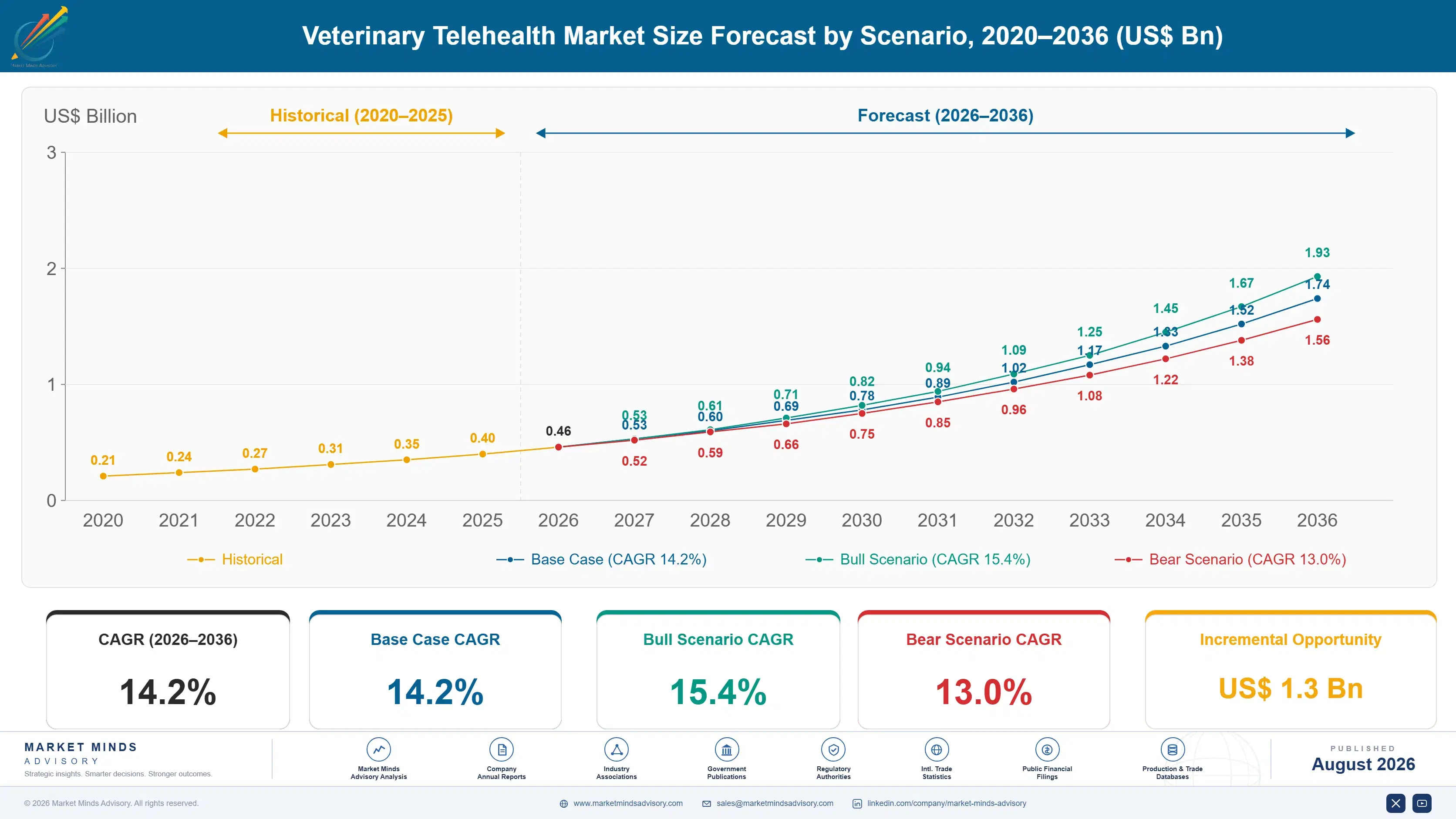
Veterinary Telehealth Market Forecast Scenarios

veterinary-telehealth-market-size-forecast-scenario-1787641560163
The five years to 2025 were an experiment followed by a retreat. Emergency provisions during the pandemic permitted remote establishment of clinical relationships across many jurisdictions, consultation volumes rose sharply, and platforms raised capital on the assumption that the change would hold. Most provisions lapsed and volumes fell back toward triage and advice. The 13.0% historical rate averages a regulatory window against the years either side of it.
The 14.2% base case rests on three mechanisms. Jurisdictions continue liberalising remote relationship establishment one at a time, and each change converts a triage market into a medicine market overnight in that territory. Veterinary to veterinary specialist consulting keeps growing because it faces no regulatory obstacle whatever and addresses a genuine referral bottleneck. And practice integrated platforms keep replacing standalone consumer applications as clinics realise remote care extends their relationships.
The 15.4% bull case turns on a major jurisdiction permanently permitting remote relationship establishment, which would reprice every platform operating there. The 13.0% bear case is professional resistance hardening: bodies representing veterinarians whose income depends on in person visits have blocked liberalisation repeatedly and may continue doing so regardless of evidence. Evidence has not moved them so far.

Where a Legal Definition Sets the Ceiling

Every business model in this market runs into the same sentence in a regulation. Practising veterinary medicine requires an established veterinarian client patient relationship, and only around 23% of jurisdictions allow that relationship to be formed remotely. Elsewhere a platform may triage, advise and reassure but may not diagnose, prescribe or treat, which is the difference between a service somebody pays 42 dollars for and a business with a defensible model.
TOP FIVE CONCENTRATION32%Combined consultation volume handled by the leading platforms
ADVICE ONLY REVENUE SHARE61%Portion of revenue from triage rather than medicine
REMOTE RELATIONSHIP PERMITTED23%Jurisdictions allowing remote establishment of a clinical relationship
AVERAGE CONSULTATION PRICEUSD 42Typical owner payment for one remote veterinary consultation
IN PERSON CONVERSION RATE34%Remote consultations resulting in a physical clinic visit
SPECIALIST RESPONSE TIME18 minutesTypical wait for a specialist to answer a colleague
The experiment has already been run and the results have largely been set aside. Emergency provisions during the pandemic suspended the in person requirement across many jurisdictions, millions of consultations took place, and no measurable pattern of harm emerged from any of it. Most of those permissions lapsed anyway, because professional bodies rather than outcome evidence decide this question and their members earn from physical visits.
Meanwhile the least contested application receives the least attention. A general practitioner facing a difficult case can reach a board certified specialist within about 18 minutes instead of referring an animal to a hospital hours away, and the consultation is billable, valuable and legally straightforward because both parties are veterinarians. Almost every platform built for owners instead, where the regulation is hardest.
"Investors funded consumer applications into markets where the product cannot legally practise medicine. The unregulated, clinically useful, immediately billable version of this was sitting there the whole time, and it involved two veterinarians talking to each other."
Director, Veterinary Technology and Digital Health Practice · MMA Healthcare Technology Practice · August 2026

Market Trends

Jurisdiction by Jurisdiction Liberalisation Converts Triage Into Medicine

Around 23% of jurisdictions now permit a clinical relationship to be established remotely, and each addition converts a triage and advice market into one where diagnosis and prescription become possible overnight. Telemedicine consultations grow at 21.3% against a market rate of 14.2%, concentrated almost entirely in territories where the change has happened. Australia grows at 25.8%, faster than any country covered, on state level permissions alongside distances that make in person attendance genuinely difficult. Platforms operating across multiple jurisdictions run different products in each, which is an operational burden nobody anticipated when building them.
Market Impact: Specialist opinions return in 18 minutes

Practice Integrated Platforms Displace Standalone Consumer Applications

Standalone consumer telehealth applications competed against the practice relationship and largely lost, because an owner with a regular veterinarian prefers to reach that veterinarian rather than a stranger on a platform. Practice integrated virtual care extends an existing relationship instead, and roughly 34% of remote consultations convert into a physical visit at the same practice, which turns telehealth into a channel rather than a substitute. Clinics that resisted virtual care as a threat now use it to triage after hours contacts and to schedule appointments more efficiently. The commercial model shifted from consumer subscription to practice software licensing.
Market Impact: Australia grows at 25.8% annually

Market Opportunities and Growth Drivers

Specialist Teleconsulting Solves a Genuine Referral Bottleneck

Board certified veterinary specialists are scarce and concentrated in referral centres, so a general practitioner facing a difficult case either refers a patient hours away or manages it alone. Remote specialist consultation returns an opinion within about 18 minutes, is billable to both parties, and faces no regulatory obstacle whatever because both participants are licensed veterinarians. Growth of 18.4% is second fastest in the market and it requires no change in any law anywhere. Very few platforms have built for this, since consumer applications attract capital and professional tools do not.
Market Impact: Only 23% of jurisdictions permit

Geography Makes Remote Care Necessary Rather Than Convenient

Rural and remote populations across Australia, Canada, parts of the United States and much of Latin America sit hours from the nearest veterinary practice, which makes remote consultation a question of access rather than convenience. Australia grows at 25.8%, faster than any country covered, on exactly that combination of distance and state level regulatory permission. Production animal work in these regions also benefits, since a remote assessment can determine whether a visit is needed at all before somebody drives three hours. Regulators are considerably more sympathetic where the alternative is no veterinary attention.
Market Impact: Advice supplies 61% of revenue

Market Restraints and Challenges

Professional Bodies Decide This Question, Not Evidence

Emergency provisions during the pandemic permitted remote relationship establishment across many jurisdictions, millions of consultations followed and no measurable pattern of harm emerged, yet most permissions lapsed anyway. The root cause is that veterinary regulation is set by professional bodies representing members whose income depends on physical visits, which produces a conflict nobody in the profession is comfortable naming aloud. Commercially this makes regulatory forecasting close to impossible. Platforms respond by building in permissive jurisdictions first, by pursuing vet to vet models that need no permission, and by funding outcome research.
Market Impact: Only 23% of jurisdictions permit it

Advice Only Services Struggle to Justify Their Own Price

Roughly 61% of revenue comes from triage and advice rather than medicine, and an owner paying around 42 dollars for a consultation that ends with advice to visit a practice frequently concludes they could have skipped the step. The root cause is that value in a medical consultation comes largely from what can be done afterwards, and a service prohibited from diagnosing or prescribing cannot deliver that. Retention on consumer subscriptions is correspondingly poor. Platforms respond by bundling triage into insurance products and practice memberships where the consultation is not separately priced.
Market Impact: Converts 34% into clinic visits
3 additional market trends, 4 additional growth drivers, and 2 additional restraints and challenges are covered in the full report. Contact sales@marketmindsadvisory.com to access the complete intelligence.

Segment CAGR and Growth Architecture

Segmentation follows service type, since type determines what may legally be done, who pays and whether any regulation applies at all. Six service types cover the field, from consumer triage through to a specialist advising a colleague. Growth concentrates where regulation permits medicine and where no regulation applies in the first place. Demand barely enters the question.
veterinary-telehealth-market-market-share-analysis-1787641560692

Telemedicine Consultations

Remote consultations where a veterinarian may diagnose, prescribe and manage treatment because the jurisdiction permits a clinical relationship to be established remotely. At 21.3% this is the fastest growing service type, half again the market rate of 14.2%, and its growth is entirely a function of where regulation allows it rather than where demand exists. Only around 23% of jurisdictions currently permit remote establishment, so the addressable market expands through legislative change rather than through commercial effort. Platforms operating across borders run substantially different products in each territory, which creates an operational and compliance burden that consumer facing businesses consistently underestimated at launch. Expansion arrives through legislation rather than through selling.
CAGR 21.3%

Veterinary to Veterinary Specialist Teleconsulting

Board certified specialists advising general practitioners on cases remotely, returning an opinion within about 18 minutes rather than requiring a referral to a hospital hours away. Growth of 18.4% is second fastest in the market and it faces no regulatory obstacle at all, since both participants are licensed veterinarians and no new clinical relationship is being formed with any animal. The consultation is billable to the referring practice and frequently avoids a referral entirely, which the owner appreciates and the specialist finds efficient. Very few platforms have built for this properly, because professional tools attract considerably less capital than consumer applications do. The referring practice bills the consultation on to the owner directly.
CAGR 18.4%
Full segment breakdown across 6 segments available in the complete report.

Regional Architecture and Country Demand Map

North America holds the largest share at 32%, where state level regulatory variation makes it several markets rather than one. Western Europe follows at 23%. Australia grows fastest of any country covered at 25.8%, on distance and permissive state regulation. Professional bodies set every ceiling.

North America

Regulatory fragmentation makes this 32% share several markets rather than one. Veterinary practice is regulated state by state and province by province, and a handful now permit remote establishment of a clinical relationship while most still require an in person examination first. Platforms therefore operate different products across a single country, which is an operational burden no other consumer health category carries to the same degree. Consumer telehealth investment concentrated here and largely disappointed, while practice integrated virtual care has grown steadily. Corporate veterinary groups increasingly deploy their own virtual channels rather than partnering. Growth of 13.6% reflects a market whose ceiling is set by fifty separate regulatory bodies. Fifty regulators decide it.
Share: 32% | CAGR: 13.6% (2026 to 2036)

Western Europe

Professional regulation shapes this 23% share more than technology or demand does. British, German and Nordic veterinary bodies have examined remote prescribing repeatedly and reached differing conclusions, with some permitting limited remote prescribing under defined conditions and others maintaining a strict in person requirement. Insurance penetration in Britain and Sweden supports telehealth bundled into policies, where the consultation is not separately priced and retention problems largely disappear. Practice integrated virtual care has been adopted more readily here than standalone consumer applications ever were. Growth of 12.6% is the lowest of the seven regions, reflecting cautious professional bodies rather than any absence of consumer interest. Bundling into insurance resolves the retention problem entirely.
Share: 23% | CAGR: 12.6% (2026 to 2036)
Regional intelligence for 5 additional markets available in the complete report: East Asia, South Asia and Pacific, Latin America, Middle East and Africa, Eastern Europe. Contact sales@marketmindsadvisory.com.
veterinary-telehealth-market-country-cagr-analysis-1787641561206

Where This Market Actually Has Value

Nothing here is won on application quality, because the binding constraint is a sentence in a regulation rather than anything a product does. Value accrues to whoever operates where medicine is permitted, whoever serves veterinarians rather than owners, and whoever extends an existing practice relationship. Four routes carry weight, and only one of them requires a law to change.

Build Where Medicine Is Actually Permitted

Only around 23% of jurisdictions allow a clinical relationship to be established remotely, and telemedicine consultations grow at 21.3% against a market rate of 14.2% almost entirely inside them. Everywhere else a platform may triage and advise at around 42 dollars a consultation without diagnosing or prescribing, which is a service rather than a business. Concentrating operations, product development and marketing on permissive territories produces far better returns than spreading thinly across markets where the product cannot practise. Australia grows at 25.8% for exactly this reason. Spreading effort thinly returns very little.
Market Impact: Operates within the 23% permitting actual medicine today

Serve Veterinarians Rather Than Animal Owners

Specialist teleconsulting grows at 18.4% and faces no regulatory obstacle whatever, since both participants are licensed veterinarians and no new clinical relationship is formed with any animal. A general practitioner reaching a specialist within about 18 minutes avoids a referral hours away, and the consultation is billable to the practice rather than to an owner. Almost nobody has built properly for this because professional tools attract far less capital than consumer applications. That is a commercial opportunity created entirely by where investor attention happens to point. Investor attention created that gap entirely.
Market Impact: Grows 18.4% with no regulatory obstacle at all

Extend the Practice Relationship, Not Replace It

Standalone consumer platforms competed against the practice relationship and lost, because an owner with a regular veterinarian prefers that veterinarian to a stranger. Practice integrated virtual care converts roughly 34% of remote consultations into a physical visit at the same clinic, which makes it a channel rather than a substitute and turns the practice from an opponent into a customer. The commercial model becomes software licensing to clinics instead of subscription selling to households, which retains considerably better and costs far less to acquire. Clinics become customers rather than competitors.
Market Impact: Converts 34% of consultations into physical clinic visits

Bundle Triage Where It Is Not Separately Priced

Roughly 61% of revenue is triage and advice, and an owner paying 42 dollars for a consultation that ends with advice to visit a practice frequently feels the step was avoidable. Bundling that triage into insurance policies, practice memberships and retail subscriptions removes the separate price and the resulting judgement about value. Retention improves substantially because nobody cancels a component they did not choose individually. Platforms selling standalone consultations are asking consumers to evaluate a service the regulation has deliberately limited. Nobody cancels a component they never chose. Standalone pricing invites the wrong question.
Market Impact: Repositions the 61% of advice only category revenue

Who Controls the Margin Pool

This market is fragmented and the composition keeps changing. The top five handle 32% of consultation volume and associated platform revenue, the basis applied consistently here, and the list combines venture funded consumer platforms with animal health companies and retailers who added virtual care to existing relationships. Vetster leads on consultation volume, and the gap to others reflects consumer acquisition spending rather than any durable position. Composition keeps shifting toward companies that already own customers.
Competition runs on three fronts that barely overlap. Consumer platforms compete for owner acquisition and retention in a category where regulation limits what they can deliver. Practice integrated providers compete for clinic software contracts against practice management vendors adding virtual modules. Specialist teleconsulting networks compete for veterinarian membership on specialist depth and response time rather than on anything consumer facing.

Rankings will move with regulation rather than with product, since a jurisdiction permitting remote relationship establishment reprices every platform operating there overnight. Consolidation among consumer platforms has already begun as acquisition economics disappointed. The other pressure point is animal health companies and retailers building virtual care into existing customer relationships, where acquisition cost is close to zero.
veterinary-telehealth-market-company-positioning-matrix-1787641561764

Competitive Moat and Risk Dimensions

VETSTER

Moat: Multi Jurisdiction Compliance Capability

Operating across territories with different rules on remote relationship establishment requires running materially different products and clinical protocols in each, which is an operational capability competitors underestimate until they attempt it. That compliance infrastructure also positions the platform to expand immediately wherever a jurisdiction liberalises rather than building from scratch afterwards.
VETSTER

Risk: Consumer Acquisition Economics

Standalone consumer platforms pay to acquire owners who already have a veterinarian they would rather reach, and retention on advice only services is poor when roughly 61% of consultations cannot deliver medicine. Animal health companies and retailers adding virtual care to existing relationships acquire the same customer at close to zero cost.
CHEWY

Moat: Existing Customer Relationship

Adding virtual care to an established retail and pharmacy relationship removes acquisition cost almost entirely, since the customer already transacts regularly and the consultation attaches to purchases rather than standing alone. That also allows telehealth to be bundled rather than separately priced, which resolves the value judgement standalone platforms keep losing.
CHEWY

Risk: Clinical Independence Perception

A consultation offered by a company that also sells the products a veterinarian might recommend raises a conflict question that professional bodies notice and owners eventually consider. Regulatory scrutiny of prescribing within commercially integrated models is rising, and the same integration that removes acquisition cost is what attracts the attention.

Players Tracked

Prominent Players

Vetster
Airvet
Chewy
Zoetis
Covetrus

Other Key Players

Dutch Pet
Pawp
Fuzzy Pet Health
TeleVet
GuardianVets
Anipanion
PetDesk
Vetstoria
Digitail
VetTriage
Joii Pet Care
FirstVet
PawSquad
Whiskers Worldwide
MedVet Now

Recent Developments

MARCH 2025

Additional jurisdiction permits remote clinical relationship establishment

A further regulatory jurisdiction permitted veterinarians to establish a clinical relationship remotely under defined conditions, converting a triage market into one where diagnosis and prescribing became possible. Platforms already operating there under advice only terms reported an immediate change in what they could offer and charge for.
Signal: A single regulatory sentence converts a triage service into a medical business overnight in that territory
JUNE 2025

Consumer telehealth platform acquired after acquisition costs disappoint

A venture funded consumer veterinary telehealth platform was acquired following a period in which owner acquisition costs exceeded lifetime value on advice only consultations. The acquirer held existing customer relationships through retail and pharmacy, where the same customer costs almost nothing to reach. The economics settled it.
Signal: Owning the customer relationship already beats paying to acquire one for any advice only consultation anywhere
SEPTEMBER 2025

Specialist teleconsulting network expands across general practice membership

A veterinary specialist teleconsulting network expanded its general practitioner membership, offering board certified opinions within minutes on cases that would otherwise require referral. The service faces no regulatory obstacle because both participants are licensed veterinarians and no new patient relationship is formed. Referrals fall accordingly.
Signal: The unregulated version of veterinary telehealth was available all along and attracted almost nobody at all

What a Remote Consultation Costs

Clinician time dominates everything else in this business. Veterinarian compensation for consultation hours accounts for roughly 58% of delivery cost, with platform engineering, compliance and customer acquisition covering the remainder. Clinicians are contracted locally in each jurisdiction because veterinary registration is territory specific, which removes any possibility of delivering consultations from a lower cost location the way human telehealth sometimes attempts.
Veterinary compensation rose sharply through the period as clinical practice competed for the same scarce clinicians, which raised the hourly cost of staffing a remote consultation queue considerably. Company annual reports across the animal health sector documented the underlying wage movement. Customer acquisition cost moved separately and more damagingly, as digital advertising pricing rose while advice only consultations struggled to justify a 42 dollar price to owners who then visited a practice anyway.

Exposure divides by customer ownership rather than by scale. A platform paying to acquire each owner carries both clinician cost and acquisition cost against a consultation that may not repeat. A company adding virtual care to an existing retail, insurance or practice relationship carries only the clinician cost, since the customer arrives already. That difference determines which businesses survive, and it has already resolved several.
veterinary-telehealth-market-cost-volatility-analysis-1787641562078

Attach consultations to an existing customer relationship

Acquisition cost frequently exceeds the value of an advice only consultation, and no operational improvement closes a gap of that shape. Attaching virtual care to retail, insurance or practice relationships removes acquisition entirely, since the customer already transacts. That requires a relationship most platforms do not have, which is why several were acquired instead.

Use asynchronous formats to raise clinician utilisation

A scheduled video consultation occupies clinician time whether or not the case requires it, while asynchronous message and image review lets a veterinarian handle several cases in the same period. Utilisation improves materially and clinicians frequently prefer the flexibility. Some presentations genuinely require live interaction, so triage into the right format matters most. Clinicians frequently prefer it too.

Contract clinicians across time zones within a jurisdiction

Registration is territory specific, but a large jurisdiction spans several time zones, which allows overnight coverage without paying unsocial hours premiums to everybody. Contracting clinicians across a country rather than around a single office lowers the cost of after hours capacity considerably. This works in large territories and does nothing in small ones, which shapes coverage economics.

Portfolio Architecture for Margin Defence

Margin architecture follows whether the customer had to be bought. Consumer advice only consultations earn poorly, because acquisition cost sits against a 42 dollar transaction that frequently does not repeat. Practice integrated licensing earns better, since the clinic pays for software and brings its own clients. Specialist teleconsulting earns best, since the buyer is a practice with a genuine problem and no regulatory friction applies.
The tension is between the segment with the growth and the segment with the economics. Telemedicine consultations grow at 21.3% and only exist where regulation permits, which is around 23% of jurisdictions and not a set anybody can influence. Specialist teleconsulting grows at 18.4% with no regulatory dependency at all but requires building for veterinarians rather than owners, which is a smaller and considerably less exciting market to describe.

High value pools concentrate in professional applications and in virtual care attached to existing relationships, both of which avoid the acquisition problem that has consumed most of the capital raised in this category. Everything selling standalone consultations to owners is paying to acquire a customer for a service regulation has deliberately limited. Several have already been acquired by companies that owned the relationship instead.

Consumer Advice and Triage

Standalone consultations sold to owners at around 42 dollars where regulation prohibits diagnosis and prescribing entirely. Acquisition cost sits against a transaction that frequently does not repeat, which is why so many of these businesses have been acquired.
Gross Margin: 18-21%

Practice Integrated Virtual Care

Software licensed to clinics that extends an existing client relationship rather than competing with it, converting roughly a third of consultations into physical visits. The practice supplies the clients, which removes acquisition cost from the model entirely.
Gross Margin: 48-51%

Specialist Teleconsulting Networks

Board certified specialists advising general practitioners within minutes on cases that would otherwise require referral hours away. No regulatory obstacle applies and the buyer is a practice with a genuine clinical problem to solve.
Gross Margin: 62-65%
veterinary-telehealth-market-portfolio-architecture-1787641562677

High-value Sub-segments and Strategic Watch-out

Telemedicine Consultations

The fastest growing service type at 21.3% and entirely dependent on regulation permitting remote relationship establishment, which only around 23% of jurisdictions currently allow. Growth arrives through legislative change rather than through any commercial effort a platform can make. Nobody can accelerate a legislature. Legislatures set the pace.
Gross Margin: 44-47%

Veterinary to Veterinary Teleconsulting

Second fastest at 18.4% with no regulatory obstacle whatever, since both participants are licensed veterinarians and no new patient relationship is formed. Almost nobody built for it, because professional tools attract far less capital than consumer applications. The buyer is a practice with a real clinical problem.
Gross Margin: 62-65%

Practice Integrated Virtual Platforms

Growing at 15.0% as clinics realise remote care extends their relationships rather than threatening them, converting roughly 34% of consultations into visits. The commercial model shifted from consumer subscription to software licensing, which retains considerably better. Clinics supply their own clients, which removes acquisition cost.
Gross Margin: 48-51%

Teletriage and Advice Services

Growing at 13.6% and carrying roughly 61% of category revenue on consultations that cannot legally deliver medicine. Owners paying separately for advice to visit a practice frequently conclude the step was avoidable, which is why bundling works better. Bundling removes the value judgement entirely. Retention improves considerably.
Gross Margin: 18-21%

How Remote Demand Actually Repeats

Repeat behaviour is where this category has consistently disappointed. An owner paying around 42 dollars for a consultation that ends with advice to visit a practice draws an obvious conclusion about whether to do it again, and standalone platform retention reflects that. Where the consultation is bundled into insurance, a practice membership or a retail subscription, the question never arises and usage continues, which is why bundled models retain so much better.
Stickiness follows the underlying relationship rather than the platform. An owner with a regular veterinarian reaches that practice when it offers virtual care, and roughly 34% of those consultations convert into a physical visit at the same clinic. A veterinarian using a specialist teleconsulting network stays because response time and specialist depth matter professionally. Standalone consumer platforms hold neither relationship and compete for attention against both.

The buyer changed as the model did. Early platforms sold subscriptions to owners, marketing convenience against a practice appointment. The purchasing decision now sits increasingly with clinics licensing virtual care software, insurers bundling triage into policies and retailers attaching consultation to existing accounts. Platforms whose commercial organisations were built for consumer acquisition are selling into a market that stopped buying that way.
veterinary-telehealth-market-end-use-penetration-index-1787641563176

Where This Category Rewards Focus

These are among the four positions where our research anticipates prominent divergence between winners and laggards over the coming forecast period. Each is grounded in the demand model, the regulatory perimeter, and the announced capacity pipeline.
01 / REGULATORY TERRITORY SELECTION

A sentence in the rules decides what you sell

Only around 23% of jurisdictions permit a clinical relationship to be established remotely, and telemedicine consultations grow at 21.3% against a market rate of 14.2% almost entirely inside those territories. Everywhere else a platform may triage and advise at around 42 dollars without diagnosing or prescribing, which is a service rather than a business anyone should fund. Concentrating product, operations and marketing on permissive jurisdictions returns considerably more than spreading effort across markets where the product cannot legally practise medicine.
02 / PROFESSIONAL MARKET PRIORITY

Two veterinarians talking need nobody's permission

Specialist teleconsulting grows at 18.4% with no regulatory obstacle whatever, because both participants are licensed veterinarians and no new clinical relationship is formed with any animal at all. A general practitioner reaching a board certified specialist within about 18 minutes avoids a referral hours away, and the consultation is billable to the practice rather than to an owner deciding whether it was worth it. Almost nobody built for this properly, entirely because professional tools attract far less investor attention than consumer applications do.
03 / CUSTOMER RELATIONSHIP OWNERSHIP

Paying to acquire owners never made this work

Standalone consumer platforms pay to acquire owners who already have a veterinarian they would rather reach, against a 42 dollar consultation that frequently does not repeat and cannot legally deliver medicine in most territories. Companies attaching virtual care to existing retail, insurance or practice relationships acquire the same customer at close to zero cost and bundle the consultation so nobody prices it separately. That difference is large enough to determine survival, and it has already resolved several businesses through acquisition.
04 / ACCESS CASE FRAMING

Regulators move where the alternative is nothing

Australia grows at 25.8%, faster than any country covered, because state regulators extended remote prescribing where the nearest practice sits hours away and the realistic alternative is no veterinary attention rather than a shorter drive. Framing liberalisation as an access question for rural and remote populations has succeeded repeatedly where convenience arguments have failed completely. Platforms funding outcome research and building rural service capability are pursuing the argument that actually moves professional bodies rather than the one that annoys them.

Engagement Snapshot From the Field

A live engagement with an industry participant carrying material or product regulatory and market exposure ahead of a defining policy shift, showing how our research translates into a defensible multi-year portfolio strategy.
MARKET MINDS ADVISORY · CLIENT ENGAGEMENT SUMMARY
Veterinary Telehealth Producer Strategic Portfolio Review and Transition Roadmap 2026·Investment Scenario on Veterinary Telehealth Exposure Evaluation 2025-26
CLIENT PROFILE
A venture funded veterinary telehealth platform offering consumer consultations across eleven jurisdictions, of which only three permitted remote establishment of a clinical relationship. Annual revenue was approximately 34 million dollars (client-reported, unverified by MMA), almost entirely from consumer subscriptions and single consultations. No practice integration existed and no professional facing product had been built. Capital markets had turned against the category.
STRATEGIC CHALLENGE
Owner acquisition cost had exceeded lifetime value for six consecutive quarters and retention on advice only consultations was poor, while capital markets had turned against consumer health platforms generally. Management wanted to know whether the model could work at all, and if so in which markets. The board still believed the regulatory environment would liberalise broadly within two years.
MMA APPROACH
MMA modelled unit economics separately for permissive and restrictive jurisdictions, which the company had never separated in reporting. Regulatory liberalisation probability was assessed jurisdiction by jurisdiction against professional body composition and precedent rather than against stated intentions. Forty-seven expert interviews with veterinarians, regulators, practice owners and platform users established what drives both regulatory decisions and repeat usage.
KEY FINDINGS
  1. Unit economics were positive in the three permissive jurisdictions and substantially negative in the other eight, and the blended reporting had concealed that difference entirely.
  2. Regulators in 29 of the 47 interviews indicated that access arguments for rural populations moved them where convenience arguments had never done so at all.
  3. Practice integrated deployment converted roughly 34% of consultations into physical visits, which made clinics customers rather than competitors for the same owners.
  4. Specialist teleconsulting required no regulatory change, carried gross margin above 60% and had no meaningful competitor building for it in any of the eleven markets.
CLIENT PROFILE
A venture funded veterinary telehealth platform offering consumer consultations across eleven jurisdictions, of which only three permitted remote establishment of a clinical relationship. Annual revenue was approximately 34 million dollars (client-reported, unverified by MMA), almost entirely from consumer subscriptions and single consultations. No practice integration existed and no professional facing product had been built. Capital markets had turned against the category.
STRATEGIC CHALLENGE
Owner acquisition cost had exceeded lifetime value for six consecutive quarters and retention on advice only consultations was poor, while capital markets had turned against consumer health platforms generally. Management wanted to know whether the model could work at all, and if so in which markets. The board still believed the regulatory environment would liberalise broadly within two years.
MMA APPROACH
MMA modelled unit economics separately for permissive and restrictive jurisdictions, which the company had never separated in reporting. Regulatory liberalisation probability was assessed jurisdiction by jurisdiction against professional body composition and precedent rather than against stated intentions. Forty-seven expert interviews with veterinarians, regulators, practice owners and platform users established what drives both regulatory decisions and repeat usage.
KEY FINDINGS
  1. Unit economics were positive in the three permissive jurisdictions and substantially negative in the other eight, and the blended reporting had concealed that difference entirely.
  2. Regulators in 29 of the 47 interviews indicated that access arguments for rural populations moved them where convenience arguments had never done so at all.
  3. Practice integrated deployment converted roughly 34% of consultations into physical visits, which made clinics customers rather than competitors for the same owners.
  4. Specialist teleconsulting required no regulatory change, carried gross margin above 60% and had no meaningful competitor building for it in any of the eleven markets.
RECOMMENDED STRATEGY
Phase 1: Phase one: withdraw consumer operations from the eight restrictive jurisdictions, since unit economics were substantially negative in every one of them. Phase 2: Phase two: launch a specialist teleconsulting product, which needs no regulatory change and carries gross margin above 60% with no competitor present. Phase 3: Phase three: reframe liberalisation advocacy around rural access, since 29 of 47 regulators responded to that argument rather than convenience.
OUTCOME
The client withdrew consumer operations from six jurisdictions within two quarters and launched a specialist teleconsulting product the following year. Blended contribution turned positive for the first time, the professional product reached profitability faster than the consumer business ever had, and two further jurisdictions liberalised on access grounds (client-reported, unverified by MMA).

Frequently Asked Questions

Foundational context covering the market sizes, CAGR, scope, country, region and competition that inform every finding below. This section is provided to cover basics and most often pre-purchase conversations, answered from the MMA Primary Research Dataset.

What is the current size of the Veterinary Telehealth Market?

The market was valued at 0.42 billion dollars in 2025, covering remote consultation, triage, monitoring and specialist teleconsulting services worldwide. It reaches an estimated 0.48 billion dollars during 2026.

How large will the Veterinary Telehealth Market be by 2036?

MMA forecasts 1.81 billion dollars by 2036, an increase of 1.33 billion dollars over the 2026 base. That represents an expansion multiple of 3.77 times across the forecast period.

What is the CAGR for the Veterinary Telehealth Market 2026 to 2036?

The base case compound annual growth rate is 14.2%, with a bull case of 15.4% and a bear case of 13.0%. Regulatory liberalisation and professional resistance separate those scenarios.

Which segment is growing fastest?

Telemedicine consultations grow at 21.3%, half again the market rate of 14.2%, wherever regulation permits remote relationship establishment. Specialist teleconsulting between veterinarians follows closely at 18.4%.

Who are the major companies in the Veterinary Telehealth Market?

Vetster, Airvet, Chewy, Zoetis and Covetrus lead on consultation volume and associated platform revenue across every major market. Together they account for 32% of the market.

Which country is growing fastest?

Australia grows fastest at 25.8%, on state level permissions for remote prescribing combined with distances that make in person attendance genuinely difficult for many owners.

Report Segmentation Architecture

The full report scope spans multiple orthogonal segmentation dimensions, with cross-tabulated demand data provided for each dimension pair. Coverage extends further to regional breakdowns, trend trajectories, and the competitive detail needed to support segment-level decision-making.

By Service Type

  • Teletriage and Advice Services
  • Telemedicine Consultations
  • Veterinary to Veterinary Specialist Teleconsulting
  • Remote Monitoring and Wearable Data Services
  • Practice Integrated Virtual Care Platforms
  • Behavioural and Nutrition Virtual Programmes

By End-Use Industry

  • Companion Animal Owners
  • General Practice Clinics
  • Specialty Referral Hospitals
  • Equine Owners and Trainers
  • Production Animal Operations
  • Rural and Remote Communities

By Commercial Dimension

  • Consumer Subscription Models
  • Pay Per Consultation
  • Practice Software Licensing
  • Insurance Bundled Provision
  • Retail and Pharmacy Integration
  • Professional Membership Networks

By Region

  • North America
  • Western Europe
  • East Asia
  • South Asia and Pacific
  • Latin America
  • Middle East and Africa
  • Eastern Europe

Scope, Methodology, and Coverage

Every figure in this report is reproducible from documented input assumptions. The scope below maps the historical period, the forecast horizon, the segmentation dimensions, and the countries covered, alongside the underlying primary and qualitative methodology.
Historical Period
2020 to 2025
Forecast Period
2026 to 2036
Base Year
2025 (USD billions; MMA Primary Research Dataset, August 2026)
Market Definition
Remote veterinary consultation, triage, monitoring and professional advisory services delivered through digital platforms worldwide, covering teletriage and advice services, telemedicine consultations, veterinary to veterinary specialist teleconsulting, remote monitoring and wearable data services, practice integrated virtual care platforms, and behavioural and nutrition virtual programmes. Measured at consultation and platform revenue. In person practice revenue, teleradiology reading services, pet insurance products, retail pharmacy fulfilment, practice management software and connected device hardware sales are excluded from scope.
Quantitative Units
USD billions (current prices); consultations delivered; USD per consultation by service type
Segmentation Dimensions
Service type; end-use industry; commercial dimension; region
Regions Covered
North America, Western Europe, East Asia, South Asia and Pacific, Latin America, Middle East and Africa, Eastern Europe
Countries Covered
United States, Canada, United Kingdom, Sweden, Germany, Netherlands, France, Spain, China, Japan, South Korea, Australia, New Zealand, India, Thailand, Brazil, Mexico, Saudi Arabia, Israel, Poland
Key Companies Profiled
Vetster, Airvet, Chewy, Zoetis, Covetrus, Dutch Pet, Pawp, Fuzzy Pet Health, TeleVet, GuardianVets, Anipanion, PetDesk, Vetstoria, Digitail, VetTriage, Joii Pet Care, FirstVet, PawSquad, Whiskers Worldwide, MedVet Now
Quantitative Methodology
Primary survey, n=3,800 respondents, Q4 2025, six countries; demand-side model with trade association cross-validation
Qualitative Methodology
47 expert interviews, Q4 2025; applied to validate demand model assumptions, identify emerging dynamics, and assess competitive positioning
Report Format
PDF and XLSX data workbook (Word format preview document)
Publisher
Market Minds Advisory
Report Code
MMA-2026-TEC-122
Published
August 2026
Contact
sales@marketmindsadvisory.com | www.marketmindsadvisory.com

Purchase the full Veterinary Telehealth Market Report (2026 to 2036).

The full report treats veterinary telehealth as a category constrained by a legal definition rather than by technology, since most jurisdictions require a clinical relationship established in person before medicine may be practised at all. It sizes all six service types independently through 2036, models unit economics separately for permissive and restrictive jurisdictions, and assesses liberalisation probability against professional body composition rather than stated intentions. Regional chapters cover all seven regions, with professional applications assessed separately from consumer platforms. Competitive profiling covers 20 participants on one consistent consultation volume basis.
Six service types sized independently through 2036
Unit economics modelled separately by regulatory permissiveness
Liberalisation probability assessed jurisdiction by jurisdiction
Professional teleconsulting assessed separately from consumer platforms
Acquisition cost compared against bundled relationship models
Twenty participants profiled on one consistent consultation basis

Built For The People Who Decide

From boardroom strategy to bench-side execution, this report is read cover-to-cover by leaders shaping the next decade of their industry, turning demand scenarios, market dynamics and valuation benchmarks into decisions.
CXOs/ Presidents/ VPs/ Managers
M&A and Corporate Development
Strategy Teams and R&D Heads
Procurement and Product Directors
Regulatory and Compliance Leaders
Investor Relations and Equity Analysts