Market Minds Advisory
Veterinary Procedure Lights Market

Veterinary Procedure Lights Market: New Build Dependence, Colour Fidelity and the Fixture That Never Fails

A modern veterinary surgical light runs for forty-two thousand hours before it dims noticeably, which means almost nobody replaces one and the whole market now lives on new construction instead.

Lead Analyst

Alice Ballenger

Published

September 2026

Make Smarter Decisions with Customized Research Insights

Request a free sample report and evaluate market opportunities, growth trends, and competitive dynamics relevant to your business needs.

2025 MARKET VALUE$0.2BMarket Size 2025
2036 FORECAST VALUE$0.5BBase Case , 2026 to 2036
CAGR 2026 TO 20367.2 %Bull 8.4% / Bear 5.9%
INCREMENTAL OPPORTUNITY$0.2BNet 10- year value creation
EXPANSION MULTIPLE2.00x2036 value over 2026 base
Strategic Levers
M&A Pipeline
Regional Outlook
Country Rankings
Competitive Intelligence
Segmental Deep-dive
Call-Us : 91 93563 13602

Executive Snapshot and Market Trajectory

Light-emitting diode fixtures rated for 42,000 operating hours effectively removed replacement demand from this category, which means 64% of units now go into new or refurbished practices. Demand tracks veterinary construction rather than installed base, and that is an entirely different market to forecast and to sell into.
Ceiling-mounted LED surgical lights compound at 10.8%, exactly 1.50 times the market rate, because a practice building a dedicated theatre specifies a ceiling fixture and a practice retrofitting an existing room usually cannot. East Asia holds 30% of value, the largest position, combining rapid practice construction with the manufacturing base supplying almost every veterinary light sold worldwide. Ceiling fixtures realise roughly USD 3,600 each on installation.
Five suppliers ship 36% of light units, which is very fragmented because the product is manufactured competently by many Chinese producers and branded by many distributors. Colour rendering near 96 is the one specification that genuinely separates surgical fixtures. Corporate groups now specify 37% of installations centrally as part of practice fit-out packages agreed with architects and project managers a year before anybody orders any equipment, which moves the whole sale upstream.
Market Definition
Covers illumination fixtures used for veterinary examination, treatment and surgical procedures, spanning ceiling-mounted LED surgical lights, integrated camera and recording light heads, mobile floor-stand procedure lights, wall-mounted examination lights, surgical headlamps and loupe illumination, and dental and minor procedure lights. Sizing captures fixture, mounting and accessory revenue at realised practice price across companion animal, equine and production animal settings. Excludes general practice and building lighting, human medical surgical lights, veterinary imaging and endoscopy illumination, ultraviolet disinfection lighting, laboratory and microscope illumination, and surgical tables or ceiling pendant systems sold separately.
Base Year Value
$0.2B in 2025 (MMA Primary Research Dataset, August 2026)
Forecast Period
2026 to 2036, eleven discrete annual values
CAGR
7.2% base case. Bull 8.4%. Bear 5.9%.
Fastest Growth Segment
Ceiling-Mounted LED Surgical Lights: 10.8% CAGR
Fastest Growth Country
India: 9.9% CAGR
Fastest Growth Region
South Asia and Pacific: 9.3% CAGR
Largest Region
East Asia: 30% of 2025 global value
Market Leaders
Eickemeyer, Burtons Medical Equipment, Avante Health Solutions, Technik Manufacturing, Shanghai Huifeng Medical. Source: MMA Analysis based on company annual reports.
Primary Survey
n=3,800 procurement and R&D decision-makers, Q4 2025, six countries
Methodology
Demand-side build-up, cross-validated against public data, 47 expert interviews

Veterinary Procedure Lights Market Forecast Scenarios

veterinary-procedure-lights-market-size-forecast-scenario-1787309966355
Growth of 6.0% across 2020 to 2025 tracked veterinary practice construction almost exactly. Companion animal ownership rose sharply during 2020 and 2021, caseloads followed and corporate groups invested heavily in new sites and refurbishments to absorb the demand. Halogen replacement finished during the same period, which removed the last genuine replacement cycle this category had, since diode fixtures rarely fail within their rated life.
The base case of 7.2% rests on three mechanisms. Veterinary practice construction and refurbishment continue at elevated rates, and 64% of fixtures now go into those projects rather than replacing anything. Corporate groups specify centrally as part of fit-out packages, which favours suppliers present at the design stage rather than at the point of purchase. And Asian practice construction is expanding rapidly from a base where dedicated surgical theatres barely existed a decade ago.
The bull case of 8.4% assumes veterinary construction sustains current rates as corporate groups continue consolidating and rebuilding acquired sites, which would keep new build demand growing well ahead of any underlying practice count. The bear case of 5.9% reflects two pressures: construction slowing as corporate acquisition activity cools, and Chinese manufacturers taking branded volume directly wherever distribution allows them in.

A Market Built On Construction

The defining commercial fact here is that the product stopped wearing out. A light-emitting diode surgical fixture rated for 42,000 operating hours will outlast the practice partnership that bought it, and halogen replacement finished years ago. That removed the replacement cycle every equipment category depends upon, and left a market where 64% of units go into new premises. Demand therefore tracks veterinary construction activity rather than the installed base, which is a very different thing
TOP FIVE CONCENTRATION36%Light units shipped by the leading veterinary suppliers globally
AVERAGE FIXTURE PRICEUSD 3,600Realised practice price for one ceiling-mounted surgical light
COLOUR RENDERING INDEX96 CRIFidelity of tissue colour across the illuminated surgical field
FIXTURE SERVICE LIFE42,000 hoursRated operating life before light output falls materially
NEW BUILD DEMAND SHARE64%Fixtures installed in new or refurbished practices rather than replacements
CORPORATE SPECIFICATION SHARE37%Fixtures specified centrally by consolidated veterinary practice groups
The second fact is that manufacturing is not the barrier. Chinese producers make competent surgical fixtures in volume, and much of what sells under Western veterinary brands is manufactured there and specified rather than designed. What separates a surgical light is colour rendering near 96, shadow management across a moving field, and arm stability through a long procedure. Those things are engineered and increasingly available from the same Chinese producers.
Two forces determine the next decade. Corporate groups now specify 37% of installations centrally as part of practice fit-out packages, which moves the sale to design stage months before anyone orders. And Asian veterinary construction is expanding from a base where dedicated surgical theatres barely existed, which is where most unit growth originates.
"Nobody in this category talks about the awkward part, which is that they built a product too good to replace. The lights last longer than the practices do. Everything now depends on somebody deciding to build a new theatre, and that means the sale happens with an architect eighteen months before it happens with a vet."
Director, Veterinary Practice Infrastructure Practice · MMA Medical Devices / Ve

Market Trends

Dedicated theatre construction drives ceiling fixture specification

A practice building a purpose-designed surgical theatre specifies a ceiling-mounted fixture, and a practice retrofitting a converted consulting room usually cannot because the ceiling structure will not carry it. That single constraint means ceiling fixtures compound at 10.8% against 7.2% for the market and track theatre construction rather than practice numbers. Corporate groups rebuilding acquired sites are the main source of that construction. Mobile floor-stand lights serve the retrofit population instead and grow considerably more slowly as a direct result. Forecasting this segment is therefore an architectural question rather than a clinical one.
Market Impact: Holds 30% of global fixture value

Central fit-out specification moves the sale to design stage

Corporate groups specify 37% of fixtures centrally as part of practice fit-out packages agreed with architects and project managers, frequently a year or more before any equipment is ordered. That moves the commercial decision to a design conversation most veterinary equipment suppliers have no presence in at all. Suppliers listed on a group standard specification are installed automatically across every subsequent build. Those not listed reach only the independent practices making individual decisions, which is a shrinking population. Losing a group standard removes an entire pipeline at once rather than gradually.
Market Impact: Grows camera light heads at 9.0%

Market Opportunities and Growth Drivers

Asian veterinary construction builds theatres that never existed

Companion animal practice across China, India and Southeast Asia is being built rather than upgraded, and dedicated surgical theatres barely existed across most of the region a decade ago. That produces ceiling fixture demand from a standing start rather than replacement demand from an installed base. East Asia holds 30% of category value at 8.2% growth and South Asia and Pacific grows at 9.3%. Domestic manufacturers supply almost all of it at prices Western suppliers cannot approach anywhere. Design-stage reach rather than product capability decides who is installed in those projects.
Market Impact: Runs 42,000 hours before dimming

Camera integration turns a fixture into a teaching record

Light heads with integrated cameras record procedures for teaching, referral communication and client explanation, which converts a lighting purchase into something a practice can point at commercially. Referral hospitals adopt them for case documentation and corporate groups for internal training across sites. The segment grows at 9.0%. Image quality has improved enough that recordings are genuinely usable rather than merely present, and pricing has fallen toward what a busy referral practice will approve without extended argument. Client consent and data handling arrive with it and nobody in the channel raises them.
Market Impact: Prices roughly 45% below Western br

Market Restraints and Challenges

Fixture longevity removes the replacement cycle entirely

A light-emitting diode fixture rated for 42,000 operating hours outlasts the practice ownership that installed it, and the root cause is simply that the technology succeeded: there is no filament to fail and no bulb to change. Halogen replacement finished years ago. Suppliers respond by concentrating commercially on new construction and refurbishment, by pursuing corporate fit-out specifications agreed at design stage, and by adding camera and recording capability that gives a practice a reason to upgrade a fixture that still works perfectly well. Nothing else anybody has tried creates replacement demand in this category at all.
Market Impact: Installs in 64% new build projects

Chinese manufacture removes the barrier suppliers relied upon

Chinese producers manufacture competent surgical fixtures in volume, and the root cause of the pressure is that much of what sells under Western veterinary brands is already made there and specified rather than engineered. Colour rendering and arm stability are increasingly available from the same producers directly. Suppliers respond by holding distribution and service relationships rather than manufacturing, by specifying genuinely differentiated optical performance, and by bundling fixtures into fit-out packages where the individual price disappears. Direct Chinese selling under own brands keeps compressing catalogue pricing further every single year now.
Market Impact: Specifies 37% of fixtures centrally
3 additional market trends, 4 additional growth drivers, and 2 additional restraints and challenges are covered in the full report. Contact sales@marketmindsadvisory.com to access the complete intelligence.

Segment CAGR and Growth Architecture

Segmentation follows the fixture class, because mounting method determines which practices can install it, which project it belongs to and what price it commands. Animal type, practice setting and geography all matter commercially but cut across every fixture class, so they belong in later discussion. Six fixture classes cover current veterinary procedure lighting practice worldwide.
veterinary-procedure-lights-market-market-share-analysis-1787309966883

Ceiling-Mounted LED Surgical Lights

Ceiling-mounted surgical fixtures compound at 10.8%, exactly 1.50 times the market rate, and construction rather than clinical preference explains it. A purpose-built theatre takes a ceiling fixture and a converted consulting room usually cannot, because the ceiling structure will not carry the mounting load without reinforcement nobody budgets for. Three commercial features follow. Demand tracks theatre construction rather than practice count, which makes forecasting an architectural question. Corporate fit-out specification decides most installations before any vet is consulted. And colour rendering near 96 is the one specification that separates fixtures technically. Chinese producers increasingly supply that specification directly, which narrows the engineering argument that Western brands can honestly make considerably.
CAGR 10.8%

Integrated Camera and Recording Light Heads

Camera-integrated light heads grow at 9.0%, second fastest, and they are the only development giving a practice a reason to replace a fixture that still works. Recording procedures supports teaching, referral communication and client explanation, which converts a lighting purchase into something with a visible commercial return. Referral hospitals and corporate training programmes adopt them fastest. Image quality has improved enough that recordings are genuinely usable, and pricing has fallen toward what a busy referral practice approves without argument. Data handling and client consent are the awkward parts nobody discusses enthusiastically. Corporate groups adopt them for internal training across sites, which is a genuinely different purchasing rationale from clinical illumination entirely.
CAGR 9.0%
Full segment breakdown across 6 segments available in the complete report.

Regional Architecture and Country Demand Map

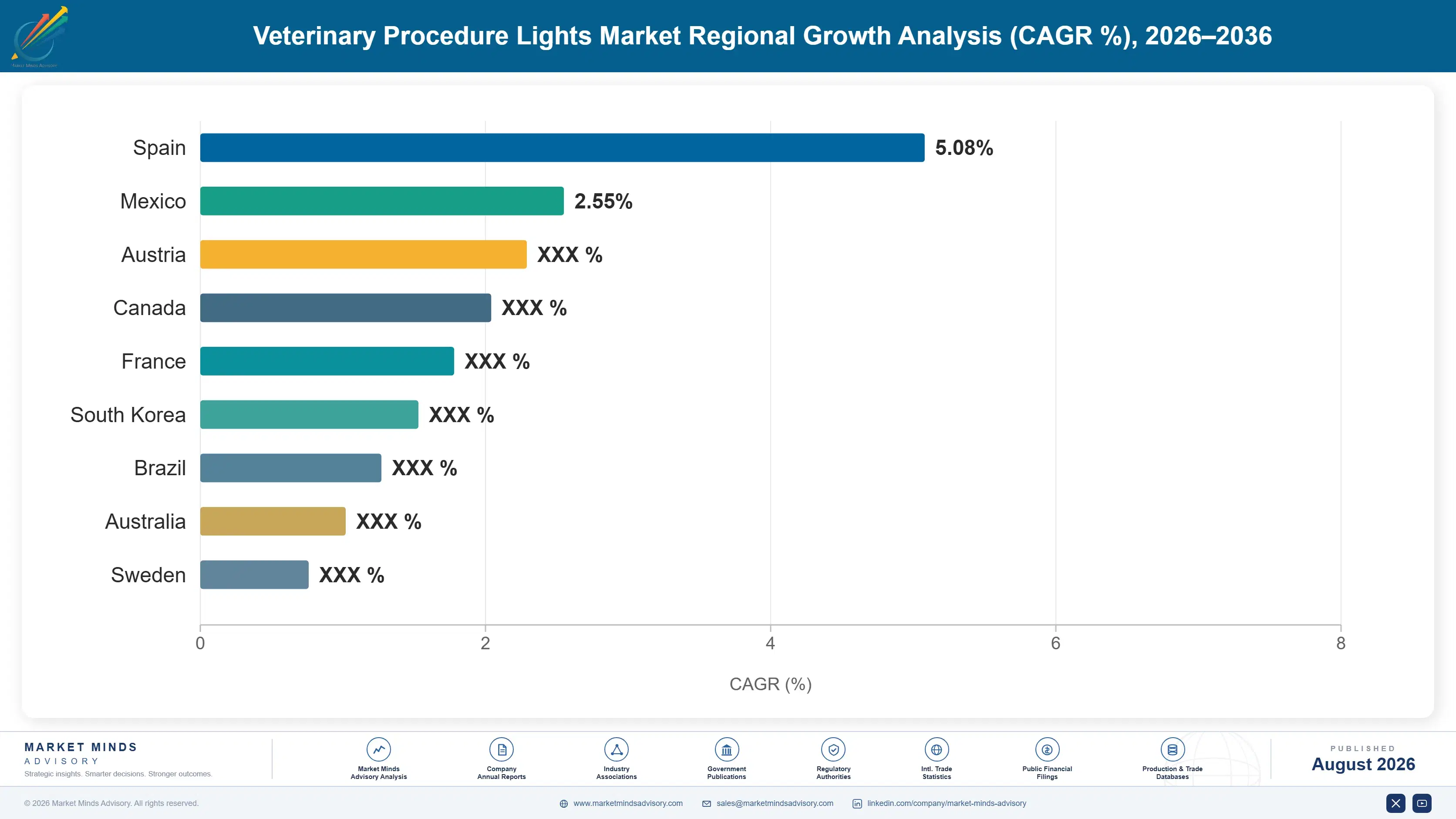
East Asia leads at 30% of value, combining rapid practice construction with the manufacturing base supplying almost every veterinary light sold worldwide. North America follows at 26% on fit-out specification value. South Asia and Pacific grows fastest, led by India at 9.9%, on urban practice construction.

North America

Twenty-six percent of global value sits in North America, growing at 6.5%, and corporate fit-out specification explains most of it. Groups rebuilding acquired practices specify lighting centrally with architects and project managers, frequently a year before installation, which rewards suppliers present at design stage over those calling on practices. Realised fixture pricing runs above other regions. Camera-integrated heads are adopted fastest here through referral hospitals and corporate training programmes. Independent practice purchasing is shrinking as consolidation continues and increasingly follows whatever the groups have specified. Chinese direct selling has reached catalogue channels here and compresses pricing wherever a practice buys a fixture on written specification alone rather than through a project.
Share: 26% | CAGR: 6.5% (2026 to 2036)

Western Europe

Growth of 5.7% is the slowest of any region, and 22% of value reflects mature practice estates with limited new construction. British and Nordic corporate groups specify centrally in the same way as North American ones, while German and French practice remains more fragmented and buys fixture by fixture. Eickemeyer and Burtons hold strong positions built on veterinary-specific distribution rather than adapted human product. Refurbishment rather than new build drives most demand, which favours mobile floor-stand fixtures over ceiling mounting in converted rooms. Chinese manufacture supplies much of what sells under European veterinary brands already, which narrows the engineering differentiation those brands can genuinely claim for themselves any longer at all.
Share: 22% | CAGR: 5.7% (2026 to 2036)
Regional intelligence for 5 additional markets available in the complete report: East Asia, South Asia and Pacific, Latin America, Middle East and Africa, Eastern Europe. Contact sales@marketmindsadvisory.com.
veterinary-procedure-lights-market-country-cagr-analysis-1787309967391

Four Ways To Reach The Project

The product no longer wears out and 64% of units go into construction projects specified months before anyone orders equipment. The levers that matter reach the design stage, secure group standards and give practices a reason to replace a fixture that still works. Each carries returns tested against disclosed supplier economics and primary interview evidence.

Get onto corporate group standard specifications

Corporate groups specify 37% of fixtures centrally as part of fit-out packages, and a supplier on the group standard is installed automatically across every subsequent build without competing again. Suppliers holding group specifications report installation volume roughly 5 times higher than practice-level selling delivers. It requires procurement and design-stage relationships that veterinary equipment organisations built around clinical selling have never developed, and losing a standard removes an entire pipeline at once rather than gradually. Independent practices increasingly follow whatever the groups in their market have already standardised on for themselves.
Market Impact: Installs roughly 5 times more fixtu

Reach architects and project managers before the vets

Practice fit-out specifications are agreed with architects and project managers a year or more before equipment is ordered, and by the time a veterinary supplier calls on the practice the lighting decision was taken long ago. Suppliers building design-stage relationships report project win rates roughly 55% above those calling reactively. It means commercial effort with people who never treat an animal and cannot evaluate colour rendering, which veterinary sales organisations find genuinely uncomfortable. Architects value single accountable suppliers and delivery certainty far above any optical specification that a supplier chooses to present.
Market Impact: Lifts project win rates roughly 55%

Sell camera integration as the reason to replace

A fixture rated for 42,000 hours gives a practice no reason to replace it, and camera integration is the only development that does. Recording supports teaching, referral communication and client explanation, which a practice can point at commercially rather than merely appreciate. Suppliers leading with camera capability report replacement sales roughly 3 times higher than lighting performance arguments generate. Data handling and client consent questions come with it and nobody in the channel raises them enthusiastically. Referral hospitals and corporate training programmes are where the argument lands most easily of all.
Market Impact: Generates roughly 3 times more repl

Hold distribution and service rather than manufacturing

Chinese producers manufacture competent fixtures including high colour rendering and stable arms, and much of what sells under Western veterinary brands is already made there. Suppliers concentrating investment on veterinary distribution, installation and service rather than on manufacturing report gross margin roughly 12 points above those defending owned production. It concedes that the product is not the differentiator, which engineering-led organisations resist strongly and which the sourcing evidence settles regardless. Installation and service capability is what a project manager actually pays a premium for anyway in any given construction project.
Market Impact: Lifts gross margin roughly 12 point

Who Controls the Margin Pool

Five suppliers ship 36% of light units, the basis on which MMA assesses every participant here, and that fragmentation follows directly from manufacturing being widely available. Chinese producers make competent fixtures for many brands at once. Eickemeyer leads on European veterinary distribution depth. Burtons Medical Equipment holds strong practice fit-out and installation positions across British and Commonwealth markets.
Competitive activity runs along three lines. Corporate group standard specification is the primary contest, since one listing installs fixtures across every subsequent build. Design-stage presence with architects and project managers determines who reaches the specification at all. And camera integration is the only product development giving practices a reason to replace working fixtures.

Pressure arrives from two directions. Chinese manufacturers increasingly sell directly under their own brands at roughly 45% below Western pricing, and veterinary distributors carry them willingly. Meanwhile human medical lighting companies including Dr. Mach and Waldmann enter veterinary channels with genuine optical engineering that veterinary specialists cannot match. Rankings shift toward participants holding group specifications and design-stage relationships, because manufacturing and product performance no longer separate anybody meaningfully. Installation capability in each market is what limits how far any of it travels.
veterinary-procedure-lights-market-company-positioning-matrix-1787309967908

Competitive Moat and Risk Dimensions

EICKEMEYER

Moat: Veterinary distribution depth in Europe

The company built veterinary-specific distribution across European markets over decades and carries lighting inside a catalogue covering hundreds of practice equipment lines, which means fixtures travel inside an established relationship rather than competing alone. Practice familiarity with the brand is genuine. Its installation and service capability is difficult for a manufacturer selling through third parties to replicate.
EICKEMEYER

Risk: Limited design-stage presence

The company's strength lies in selling to practices while 37% of fixtures are now specified centrally with architects and project managers a year earlier. Catalogue relationships reach the wrong stage of the decision entirely. Building design-stage and corporate procurement capability requires commercial skills quite different from the distributor and practice selling it has always relied on.
BURTONS MEDICAL EQUIPMENT

Moat: Practice fit-out and installation position

The company supplies and installs whole practice fit-outs rather than individual equipment items, which places it at the design stage where specification is decided rather than at purchase. That position is unusually well suited to how corporate groups now buy. Installation capability across a wide equipment range also makes it a single accountable contractor, which project managers value highly.
BURTONS MEDICAL EQUIPMENT

Risk: Geographic concentration exposure

The company's fit-out position is concentrated in British and Commonwealth markets where corporate consolidation is advanced but total construction volume is modest against Asian growth. Extending that model requires local installation capability in every new market. Chinese manufacturers selling directly also compress the equipment margin that fit-out contracting depends upon to be worthwhile.

Players Tracked

Prominent Players

Eickemeyer
Burtons Medical Equipment
Avante Health Solutions
Technik Manufacturing
Shanghai Huifeng Medical

Other Key Players

Midmark
Skytron
Steris
Getinge
Dr. Mach
Rimsa
KLS Martin
Waldmann
Hillrom
Kruuse
Shinva Medical Instrument
Nanjing Perlove Medical
Beijing Aeonmed
Narang Medical
Jorgensen Laboratories

Recent Developments

APRIL 2025

Eickemeyer launched an integrated camera surgical light head

The launch adds recording capability aimed at referral hospitals and corporate training programmes, giving practices a reason to replace fixtures that still work perfectly well on lighting performance alone. It was an organic product development programme rather than an acquisition, joint venture or partnership arrangement of any kind whatsoever.
Signal: Camera capability exists precisely because
OCTOBER 2025

Midmark expanded veterinary practice fit-out package bundling

The company extended bundled equipment and lighting packages aimed squarely at corporate group construction and refurbishment programmes, positioning itself at design stage rather than competing on individual fixture specification much later. It was an organic commercial development rather than any acquisition or partnership arrangement whatsoever.
Signal: Bundling into fit-out packages hides the f
JANUARY 2026

Avante Health Solutions acquired a veterinary lighting manufacturer

The acquisition brings owned fixture manufacture and design capability alongside the group's existing veterinary equipment distribution and service network, at a point when most competing product is contract manufactured in China instead. Terms were not disclosed. It was an outright acquisition rather than a supply arrangement.
Signal: Buying manufacture while every single comp

Emitters, Aluminium And Optics

Cost structure sits mostly in components nobody in this category manufactures. Light-emitting diode emitters and driver electronics account for roughly 29% of fixture cost of goods, sourced through the same channels serving architectural and industrial lighting. Aluminium heat sinks, arm castings and mounting hardware contribute 26%. Optical lenses, reflectors and diffusers add 17%, with spring-arm mechanics and coating making the balance.
The 2021 and 2022 period affected each component line at once. SEMI reported foundry capacity fully allocated across the window, which lengthened driver electronics lead times materially, while US Census Bureau import data recorded sharply higher aluminium values through 2022. IEA data recorded industrial energy prices well above prior averages, raising casting and coating cost. Container freight from Asia multiplied several times over on bulky fixtures. Participants disclosed elevated input and logistics costs in reports for those years.

Exposure varies by manufacturing model and by contract structure, and the mechanism is project pricing agreed months ahead against variable component cost. Suppliers contract manufacturing in China carried freight and component movement with fit-out prices already quoted. Those with owned Western production carried energy and aluminium instead. Chinese manufacturers selling domestically avoided freight entirely and gained share across every price-sensitive market.
veterinary-procedure-lights-market-cost-volatility-analysis-1787309968102

Quote fit-out projects with component cost adjustment clauses

Practice fit-out specifications are agreed months before installation and equipment is quoted at that point, which transferred the whole 2021 and 2022 component and freight movement onto suppliers. Adjustment clauses tied to published benchmarks share that exposure, and project managers accept them more readily than suppliers expect once the timing gap is explained. Those quoting firm absorbed the movement entirely.

Design fixtures around multiply-sourced driver electronics

Driver electronics competed for foundry capacity against architectural and industrial lighting and lost across 2021 and 2022, delaying fixture deliveries into construction programmes with fixed handover dates. Designing around parts with several qualified suppliers costs some efficiency and removes that exposure. Photometric revalidation is required after any driver change, so most suppliers do this at product refresh instead.

Contract ocean freight rather than buying spot capacity

Surgical light fixtures ship awkwardly and consume container volume out of proportion to their value, and spot freight rates multiplied several times across 2021 and 2022 against quoted project prices. Annual contracted rates cost more in calm periods and remove that exposure when rates move sharply. Regional assembly of arms and mounting hardware reduces shipped volume further.

Portfolio Architecture for Margin Defence

Portfolio economics separate on whether the fixture is bought alone or inside a project. Mobile floor-stand and wall-mounted examination lights earn gross margin in the low thirties, competing against Chinese manufacturers on catalogue price alone. Ceiling fixtures earn considerably more, because installation, mounting engineering and colour rendering matter and the price sits inside a construction budget. Camera-integrated heads earn most of all, since the recording capability is what a practic
The volume and premium tension runs through the channel rather than the product. Catalogue selling to independent practices moves units at commodity margin against Chinese competition. Fit-out contracting moves fixtures inside projects where the price is rarely itemised, at better margin and much longer sales cycles. Suppliers attempting both carry two commercial organisations, and those performing best accepted that rather than pretending one team could.

High-value pools concentrate in three places: corporate group standard specifications that install automatically across every build, design-stage fit-out positions where fixtures disappear into project pricing, and camera-integrated heads that create replacement demand where none otherwise exists. None is large in absolute revenue. Each is defended by procurement relationships, installation capability or feature differentiation rather than manufacture, which Chinese producers do perfectly well.

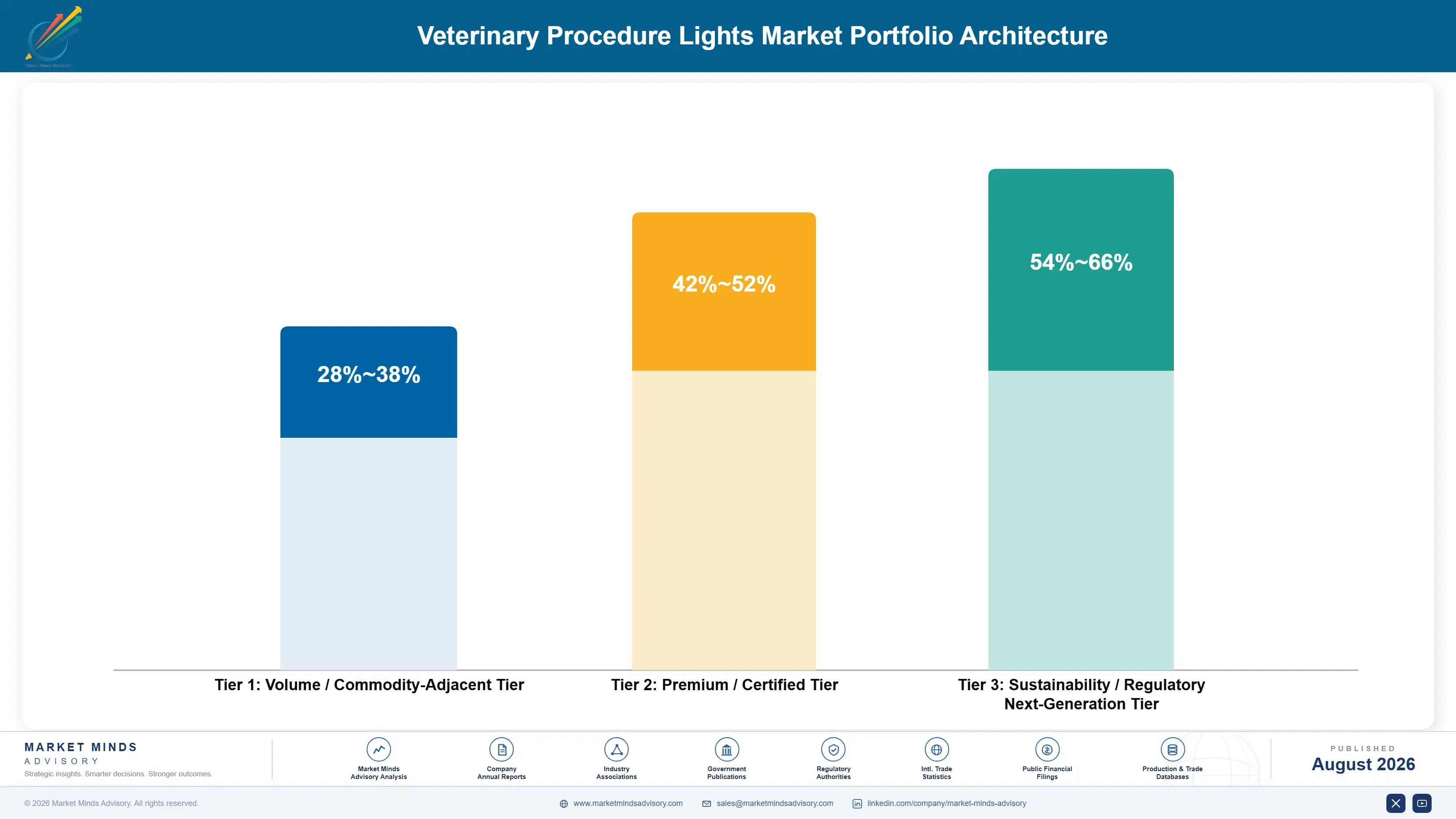
Volume / Commodity-Adjacent Tier

Mobile floor-stand procedure lights, wall-mounted examination lights and dental or minor procedure fixtures sold through catalogue channels. Chinese manufacturers set pricing and nothing about these fixtures differentiates one supplier from another.
Gross Margin: 28-38%

Premium / Certified Tier

Ceiling-mounted LED surgical fixtures and surgical headlamp systems supplied with installation. Mounting engineering, colour rendering and service capability defend pricing. The ten-point range reflects the gap between project-bundled and catalogue-sold economics.
Gross Margin: 42-52%

Sustainability / Regulatory / Next-Generation Tier

Integrated camera and recording light heads supplied into referral hospitals and corporate training programmes. Recording capability rather than illumination defends pricing entirely. The twelve-point range reflects specified against individually purchased installation economics.
Gross Margin: 54-66%
veterinary-procedure-lights-market-portfolio-architecture-1787309968605

High-value Sub-segments and Strategic Watch-out

Corporate group standard listings

One specification installing fixtures across every subsequent build without competing again, which makes losing a standard an entire pipeline gone at once. Procurement relationships decide it. Design-stage presence is the way in. Veterinary equipment organisations very rarely hold any of of those relationships in place already.
Gross Margin: 50-62%

Camera-integrated replacement demand

The only development giving a practice any reason to replace a fixture rated for forty-two thousand hours that still works. Recording has visible commercial value. Consent and data handling questions come attached. Referral hospitals and training programmes adopt it fastest of anybody, in almost every market.
Gross Margin: 56-66%

Catalogue fixture volume

Competing against Chinese manufacturers on price where nothing distinguishes one fixture from another to a buyer reading a specification sheet. It funds catalogue overhead rather than growth. Direct Chinese selling keeps compressing it. Nothing about the fixtures themselves distinguishes one supplier from the next here.
Gross Margin: 28-38%

Asian first-build theatre projects

Dedicated surgical theatres being constructed where none existed a decade ago, which creates ceiling fixture demand from nothing rather than from replacement. Domestic manufacturers hold it comfortably. Design-stage reach is the only entry. Project timing is genuinely the only thing genuinely worth forecasting in this segment.
Gross Margin: 34-46%

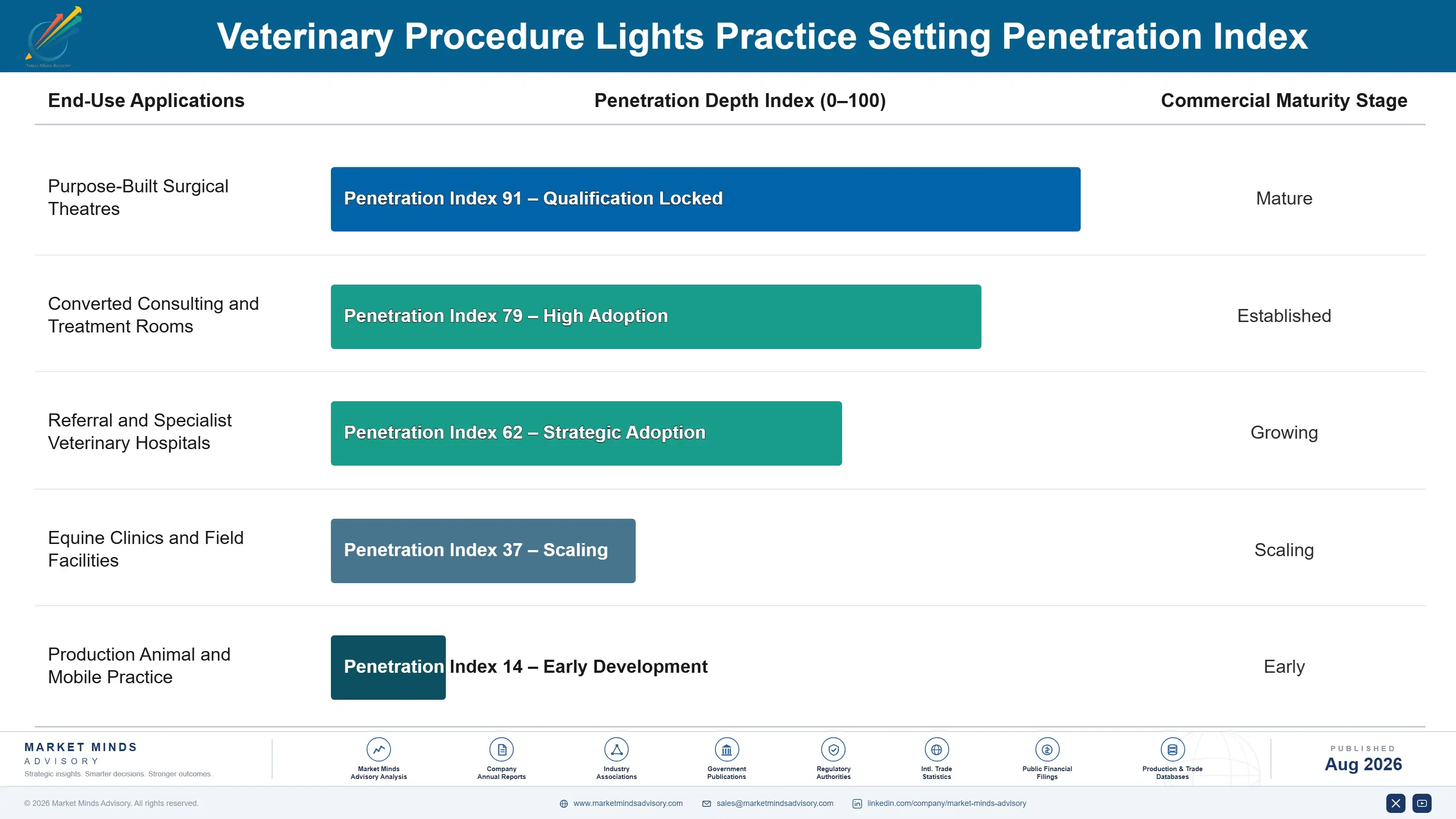
Why This Demand Barely Repeats

Demand here is close to a one-time purchase, which is unusual and commercially awkward. A fixture rated for 42,000 operating hours will run for the working life of a practice partnership, and there is no consumable, no service contract worth much and no replacement cycle to plan around. What generates the next unit is a construction or refurbishment project, and 64% of sales already come from exactly that. Camera integration is the only development creating replacement demand, and it does so for
Adoption depth varies sharply by construction activity rather than by clinical need. Corporate groups rebuilding acquired practices install ceiling fixtures as standard because the theatre is designed around them. Independent practices converting a consulting room install mobile floor-stand lights because the ceiling will not carry the load. Referral hospitals adopt camera integration for documentation and teaching. Production animal and mixed practice uses portable examination lighting almost exclusively and specifies nothing at all.

Buyer profiles have moved furthest from the clinician of any category MMA covers. An architect draws the theatre, a project manager assembles the fit-out package, a procurement team approves the group standard, and a veterinary surgeon works under whichever fixture arrives.
veterinary-procedure-lights-market-end-use-penetration-index-1787309969092

What We Would Do Here

These are among the four positions where our research anticipates prominent divergence between winners and laggards over the coming forecast period. Each is grounded in the demand model, the regulatory perimeter, and the announced capacity pipeline.
01 / GROUP STANDARD CAPTURE

Win the standard once, install it a hundred times

Corporate groups now specify 37% of fixtures centrally as part of fit-out packages, and a supplier listed on a group standard is installed automatically across every subsequent build without competing again anywhere. Suppliers holding group specifications report installation volume roughly 5 times higher than practice-level selling has ever managed to deliver to them. It demands procurement relationships veterinary equipment organisations built around clinical selling have never developed, and losing a standard removes an entire pipeline at once rather than gradually over time.
02 / DESIGN STAGE PRESENCE

Call on the architect, not on the practice

Practice fit-out specifications are agreed with architects and project managers a year or more before any equipment is ordered, so by the time a veterinary supplier reaches the practice the lighting decision was settled long ago. Suppliers building design-stage relationships report project win rates roughly 55% above competitors calling reactively on practices later. It means commercial effort directed at people who never treat an animal and cannot evaluate colour rendering, which veterinary sales organisations find genuinely uncomfortable to actually do.
03 / REPLACEMENT REASON CREATION

Sell the camera, because the light never dies

A fixture rated for 42,000 operating hours gives a practice no reason whatsoever to replace it, and camera integration is the only development anybody has found that changes that. Recording supports teaching, referral communication and client explanation, which a practice can point at commercially rather than merely appreciate quietly. Suppliers leading with camera capability report replacement sales roughly 3 times higher than lighting performance arguments ever generate, and the consent and data handling questions come attached to it regardless of that.
04 / MANUFACTURING POSITION CONCESSION

Stop defending production nobody needs you for

Chinese producers manufacture competent surgical fixtures including high colour rendering and stable mounting arms, and much of what already sells under Western veterinary brands is made there and specified rather than engineered. Suppliers concentrating investment on veterinary distribution, installation and service rather than owned manufacturing report gross margin roughly 12 points above those defending production. It concedes that the product is no longer the differentiator, which engineering-led organisations resist and which the sourcing evidence settles for them anyway in the end.

Engagement Snapshot From the Field

A live engagement with an industry participant carrying material or product regulatory and market exposure ahead of a defining policy shift, showing how our research translates into a defensible multi-year portfolio strategy.
MARKET MINDS ADVISORY · CLIENT ENGAGEMENT SUMMARY
Veterinary Procedure Lights Producer Strategic Portfolio Review and Transition Roadmap 2026·Investment Scenario on Veterinary Procedure Lights Exposure Evaluation 2025-26
CLIENT PROFILE
A Western European veterinary equipment distributor with procedure lighting revenue near EUR 21 million annually (client-reported, unverified by MMA), a catalogue business selling to independent practices, contract-manufactured fixtures branded as its own, no fit-out or installation capability, and no relationships with architects or corporate procurement teams. Roughly 84% of revenue came from catalogue orders placed by individual practices.
STRATEGIC CHALLENGE
Unit volume had declined for three consecutive years while veterinary construction activity rose across its markets, and management proposed a catalogue price reduction to defend share against Chinese direct sellers. The board doubted price competition against contract manufacturers was survivable, and nobody had established where the growing construction demand was actually being served from.
MMA APPROACH
MMA traced fixture specification for 118 veterinary construction and refurbishment projects across four markets, identifying who specified, when, and which supplier was installed. Forty-seven expert interviews with corporate procurement leads, veterinary architects, project managers and practice principals established how specifications were set. The client's commercial model was benchmarked against suppliers winning those projects.
KEY FINDINGS
  1. Eighty-one of 118 projects had lighting specified at design stage by an architect or project manager, and the client had no relationship with any of them in any of the four markets reviewed.
  2. Corporate group standard specifications accounted for most repeat installation volume, and the client had never been invited to tender for a single group standard anywhere.
  3. Catalogue price competition against Chinese direct sellers had produced volume decline and margin decline together in every market, with no account retained by price alone.
  4. Practices that had installed camera-integrated heads had replaced working fixtures to do so, which was the only replacement demand observed anywhere in the sample at all.
CLIENT PROFILE
A Western European veterinary equipment distributor with procedure lighting revenue near EUR 21 million annually (client-reported, unverified by MMA), a catalogue business selling to independent practices, contract-manufactured fixtures branded as its own, no fit-out or installation capability, and no relationships with architects or corporate procurement teams. Roughly 84% of revenue came from catalogue orders placed by individual practices.
STRATEGIC CHALLENGE
Unit volume had declined for three consecutive years while veterinary construction activity rose across its markets, and management proposed a catalogue price reduction to defend share against Chinese direct sellers. The board doubted price competition against contract manufacturers was survivable, and nobody had established where the growing construction demand was actually being served from.
MMA APPROACH
MMA traced fixture specification for 118 veterinary construction and refurbishment projects across four markets, identifying who specified, when, and which supplier was installed. Forty-seven expert interviews with corporate procurement leads, veterinary architects, project managers and practice principals established how specifications were set. The client's commercial model was benchmarked against suppliers winning those projects.
KEY FINDINGS
  1. Eighty-one of 118 projects had lighting specified at design stage by an architect or project manager, and the client had no relationship with any of them in any of the four markets reviewed.
  2. Corporate group standard specifications accounted for most repeat installation volume, and the client had never been invited to tender for a single group standard anywhere.
  3. Catalogue price competition against Chinese direct sellers had produced volume decline and margin decline together in every market, with no account retained by price alone.
  4. Practices that had installed camera-integrated heads had replaced working fixtures to do so, which was the only replacement demand observed anywhere in the sample at all.
RECOMMENDED STRATEGY
Phase 1: Phase 1 (0 to 9 months): Abandon the catalogue price reduction, and build a design-stage calling capability targeting veterinary architects and project managers. Phase 2: Phase 2 (9 to 24 months): Pursue corporate group standard listings in the two markets where consolidation is furthest advanced, and add installation capability. Phase 3: Phase 3 (24 to 42 months): Introduce a camera-integrated head range, and quote fit-out projects with component cost adjustment clauses attached.
OUTCOME
The catalogue price reduction was cancelled before implementation. Design-stage calling capability was built with three hires and produced specified positions on eleven projects within four quarters (client-reported, unverified by MMA). One corporate group standard listing was won. Installation capability was added in one market rather than two, and the camera-integrated range was sourced rather than developed.

Frequently Asked Questions

Foundational context covering the market sizes, CAGR, scope, country, region and competition that inform every finding below. This section is provided to cover basics and most often pre-purchase conversations, answered from the MMA Primary Research Dataset.

What is the current size of the Veterinary Procedure Lights Market?

MMA sizes the global veterinary procedure lights market at USD 0.21 billion in 2025, rising to USD 0.23 billion in 2026. That covers fixture, mounting and accessory revenue at realised practice price across all animal settings.

How large will the Veterinary Procedure Lights Market be by 2036?

MMA forecasts USD 0.46 billion by 2036, an expansion multiple of 2.00 times the 2026 base. That represents roughly USD 0.23 billion of incremental revenue across the forecast period.

What is the CAGR for the Veterinary Procedure Lights Market 2026 to 2036?

The base case compounds at 7.2% annually, with a bull case of 8.4% and a bear case of 5.9%. Whether veterinary construction sustains current rates decides which case materialises.

Which segment is growing fastest?

Ceiling-mounted LED surgical lights compound at 10.8%, exactly 1.50 times the market rate. Purpose-built theatres take ceiling fixtures and converted consulting rooms cannot carry the mounting load.

Who are the major companies in the Veterinary Procedure Lights Market?

The top five suppliers ship 36% of light units, led by Eickemeyer and Burtons Medical Equipment. Twenty participants are profiled in full, spanning veterinary, human medical and Chinese manufacturers.

Which country is growing fastest?

India compounds at 9.9%, ahead of every other national market MMA tracks here. Urban companion animal practice construction specifying equipment for the first time drives that growth.

Report Segmentation Architecture

The full report scope spans multiple orthogonal segmentation dimensions, with cross-tabulated demand data provided for each dimension pair. Coverage extends further to regional breakdowns, trend trajectories, and the competitive detail needed to support segment-level decision-making.

By Fixture Class

  • Ceiling-Mounted LED Surgical Lights
  • Integrated Camera and Recording Light Heads
  • Mobile Floor-Stand Procedure Lights
  • Wall-Mounted Examination Lights
  • Surgical Headlamps and Loupe Illumination
  • Dental and Minor Procedure Lights

By Practice Setting

  • Purpose-Built Surgical Theatres
  • Converted Consulting and Treatment Rooms
  • Referral and Specialist Veterinary Hospitals
  • Equine Clinics and Field Facilities
  • Production Animal and Mobile Practice

By Purchasing Channel

  • Corporate Group Standard Specification
  • Practice Fit-Out and Construction Projects
  • Veterinary Catalogue and Distributor Supply
  • Direct Manufacturer Online Sales

By Region

  • North America
  • Western Europe
  • East Asia
  • South Asia and Pacific
  • Latin America
  • Middle East and Africa
  • Eastern Europe

Scope, Methodology, and Coverage

Every figure in this report is reproducible from documented input assumptions. The scope below maps the historical period, the forecast horizon, the segmentation dimensions, and the countries covered, alongside the underlying primary and qualitative methodology.
Historical Period
2020 to 2025
Forecast Period
2026 to 2036
Base Year
2025 (USD billions; MMA Primary Research Dataset, August 2026)
Market Definition
The market comprises illumination fixtures used for veterinary examination, treatment and surgical procedures, spanning ceiling-mounted LED surgical lights, integrated camera and recording light heads, mobile floor-stand procedure lights, wall-mounted examination lights, surgical headlamps and loupe illumination, and dental and minor procedure lights. Sizing captures fixture, mounting and accessory revenue at realised practice price across companion animal, equine and production animal settings. General building lighting, human medical surgical lights, veterinary imaging and endoscopy illumination, ultraviolet disinfection lighting, laboratory and microscope illumination, and separately sold surgical tables or ceiling pendant systems are outside scope.
Quantitative Units
USD billions (current prices); thousand fixture units shipped annually; USD per fixture at realised practice price
Segmentation Dimensions
By Fixture Class; By Practice Setting; By Purchasing Channel; By Region
Regions Covered
North America, Western Europe, East Asia, South Asia and Pacific, Latin America, Middle East and Africa, Eastern Europe
Countries Covered
China, USA, Japan, South Korea, Germany, UK, France, Netherlands, Sweden, Italy, Spain, Switzerland, Austria, India, Australia, New Zealand, Canada, Brazil, Mexico, Argentina, Colombia, Indonesia, Thailand, Vietnam, UAE, Saudi Arabia, Qatar, Turkey, South Africa, Poland, Czech Republic, and additional markets relevant to this sector
Key Companies Profiled
Eickemeyer, Burtons Medical Equipment, Avante Health Solutions, Technik Manufacturing, Shanghai Huifeng Medical, Midmark, Skytron, Steris, Getinge, Dr. Mach, Rimsa, KLS Martin, Waldmann, Hillrom, Kruuse, Shinva Medical Instrument, Nanjing Perlove Medical, Beijing Aeonmed, Narang Medical, Jorgensen Laboratories.
Quantitative Methodology
Primary survey, n=3,800 respondents, Q4 2025, six countries; demand-side model with trade association cross-validation
Qualitative Methodology
47 expert interviews, Q4 2025; applied to validate demand model assumptions, identify emerging dynamics, and assess competitive positioning
Report Format
PDF and XLSX data workbook (Word format preview document)
Publisher
Market Minds Advisory
Report Code
MMA-2026-MED-361
Published
August 2026
Contact
sales@marketmindsadvisory.com | www.marketmindsadvisory.com

Purchase the full Veterinary Procedure Lights Market Report (2026 to 2036).

The full report sizes the veterinary procedure lights market across six fixture classes, five practice settings, four purchasing channels and seven regions, with annual forecasts to 2036 in revenue and fixture units. It traces lighting specification across a large sample of veterinary construction and refurbishment projects, identifying who specified and when, which is the analysis that shows how far the decision has moved from practices to design teams. Twenty participants are assessed on a consistent fixture units basis, with corporate group standard listings and design-stage capability mapped separately. Contract manufacturing dependence is quantified supplier by supplier.
Six fixture classes sized and forecast annually
Specification traced across veterinary construction and refurbishment projects
Twenty participants on consistent fixture units shipped basis
Corporate group standard listings mapped supplier by supplier
Design-stage commercial capability compared across every participant
Contract manufacturing dependence quantified supplier by supplier

Built For The People Who Decide

From boardroom strategy to bench-side execution, this report is read cover-to-cover by leaders shaping the next decade of their industry, turning demand scenarios, market dynamics and valuation benchmarks into decisions.
CXOs/ Presidents/ VPs/ Managers
M&A and Corporate Development
Strategy Teams and R&D Heads
Procurement and Product Directors
Regulatory and Compliance Leaders
Investor Relations and Equity Analysts