Market Minds Advisory
Veterinary Point-of-Care Diagnostics Market

Veterinary Point-of-Care Diagnostics Market: Consumable Economics, Reference Laboratory Substitution and Tests Nobody Needed Today

Roughly 62% of in clinic tests are run on stable patients where a next day laboratory result would have done, which is what a minimum annual consumable commitment is designed to produce.

Lead Analyst

Alice Ballenger

Published

September 2026

Make Smarter Decisions with Customized Research Insights

Request a free sample report and evaluate market opportunities, growth trends, and competitive dynamics relevant to your business needs.

2025 MARKET VALUE$3.1BMarket Size 2025
2036 FORECAST VALUE$8.0BBase Case , 2026 to 2036
CAGR 2026 TO 20369.0 %Bull 10.2% / Bear 7.8%
INCREMENTAL OPPORTUNITY$4.6BNet 10- year value creation
EXPANSION MULTIPLE2.37x2036 value over 2026 base
Strategic Levers
M&A Pipeline
Regional Outlook
Country Rankings
Competitive Intelligence
Segmental Deep-dive
Call-Us : 91 93563 13602

Executive Snapshot and Market Trajectory

This is the razor and blade model executed better than almost anywhere in healthcare. Analysers are placed at minimal capital cost and roughly 81% of supplier revenue arrives afterwards through consumables, under agreements committing a practice to a minimum annual spend for six years. Practices rarely read those terms closely.
The real contest is not between analyser manufacturers. Every test run in clinic is one the reference laboratory does not perform, and the same companies frequently own both, so they are optimising a split between their own divisions. In clinic molecular systems grow fastest at 13.5%, half again the market rate of 9.0%, and roughly 44% of that volume comes straight out of send out testing rather than being newly created demand.
Speed is the clinical argument, and it matters only when the answer changes what happens next. Roughly 38% of in clinic tests are genuinely time critical, which means most run because the analyser is there and the commitment must be met. That is uncomfortable, and it is precisely why minimum spend contracts exist in the first place at all. Practices short of target run panels nobody ordered.
Market Definition
Diagnostic testing performed within veterinary practices rather than sent to a reference laboratory, covering clinical chemistry analysers, haematology analysers, rapid lateral flow immunoassays, in clinic molecular and PCR systems, urinalysis and point of care cytology, and blood gas and electrolyte analysers. Measured at supplier selling value including instruments, consumables and cartridges. Reference laboratory send out testing services, diagnostic imaging, therapeutic products and practice management software are excluded.
Base Year Value
$3.1B in 2025 (MMA Primary Research Dataset, August 2026)
Forecast Period
2026 to 2036, eleven discrete annual values
CAGR
9.0% base case. Bull 10.2%. Bear 7.8%.
Fastest Growth Segment
In-Clinic Molecular and PCR Systems: 13.5% CAGR
Fastest Growth Country
China: 15.2% CAGR
Fastest Growth Region
South Asia and Pacific: 11.2% CAGR
Largest Region
North America: 32% of 2025 global value
Market Leaders
IDEXX Laboratories, Zoetis, Mars Petcare Science and Diagnostics, Fujifilm, Thermo Fisher Scientific. Source: MMA Primary Research Dataset, July 2026.
Primary Survey
n=3,800 procurement and R&D decision-makers, Q4 2025, six countries
Methodology
Demand-side build-up, cross-validated against public data, 47 expert interviews

Veterinary Point-of-Care Diagnostics Market Forecast Scenarios

veterinary-point-of-care-diagnostics-market-size-forecast-scenario-1787641541883
The five years to 2025 were shaped by placement economics rather than by any diagnostic advance. Analyser placement on minimum consumable commitment reached practices that could never have bought equipment outright, and the installed base expanded considerably faster than test demand did. Reference laboratory volume moved in house at the same time. The 7.8% historical rate reflects analysers reaching more practices rather than more animals being tested.
The 9.0% base case rests on three mechanisms. In clinic molecular testing keeps taking volume from reference laboratories for infectious disease panels where a same visit answer genuinely changes treatment. Digital cytology with image analysis is bringing a discipline that required a specialist into general practice for the first time. And Asian veterinary hospital construction keeps specifying in clinic diagnostics at design stage, with China growing faster than any market covered.
The 10.2% bull case turns on molecular panels reaching price points that make routine infectious screening viable rather than reserved for suspected cases. The 7.8% bear case is practice margin: a minimum consumable commitment is a fixed cost, and practices under pressure scrutinise agreements they signed when caseloads were higher than they are now. Renewals are where that resentment surfaces.

Placing Analysers and Selling Cartridges

The instrument is not the product and never was. Analysers are placed at minimal capital cost, sometimes free, against agreements committing a practice to a minimum annual consumable spend across roughly six years, and about 81% of supplier revenue arrives that way. That model put diagnostic capability into practices that could never have funded equipment outright, which is a genuine achievement and also a commitment nobody reads carefully at signing.
TOP FIVE CONCENTRATION76%Combined installed analyser base held by leading suppliers
CONSUMABLE REVENUE SHARE81%Portion of supplier revenue arriving after analyser placement
CONTRACT COMMITMENT TERM6 yearsTypical minimum spend period on a placed analyser
CLINICALLY TIME CRITICAL SHARE38%Tests where same visit results change what happens
REFERENCE LABORATORY SUBSTITUTION44%In clinic volume displaced from send out laboratories
COST PER CHEMISTRY PANELUSD 14Consumable cost of running one in clinic panel
The competitive question is unusual because the alternative is a laboratory the supplier may also own. Roughly 44% of in clinic test volume is displaced from send out testing rather than newly created, and the largest companies in this market operate reference laboratories alongside their analyser businesses. They are therefore managing a transfer between divisions at different margins rather than winning share from anybody.
Clinical urgency justifies the model and does not describe most of its use. Around 38% of in clinic tests are genuinely time critical, meaning a same visit result changes what happens next, and the remainder would have been served perfectly well by a next day reference report. Those tests get run because the analyser is present and the commitment has to be satisfied.
"The contract does not ask whether the patient needed the test today. It asks whether the practice hit its annual number, and practices that fall short find themselves running panels in December that nobody would have ordered in June."
Director, Veterinary Diagnostics and Laboratory Practice · MMA Medical Devices and Diagnostics Practice · August 2026

Market Trends

Molecular Testing Moves Infectious Panels Into the Clinic

In clinic polymerase chain reaction systems now return infectious disease panel results within an hour rather than the day or two a reference laboratory requires, which genuinely changes treatment for respiratory, diarrhoeal and vector borne presentations. Growth runs at 13.5% against a market rate of 9.0%, fastest in the market, and roughly 44% of that volume transfers directly out of send out testing. Cartridge cost remains high enough to restrict use to suspected cases rather than routine screening. Suppliers owning reference laboratories are watching a profitable send out category migrate into a lower margin in clinic one they also supply.
Market Impact: Consumables supply 81% of revenue
Digital Cytology Brings a Specialist Discipline Into Practice

Cytology traditionally required either a clinical pathologist or a general practitioner willing to interpret slides beyond their training, which meant most samples went to a reference laboratory and took days. Digital slide scanning with image analysis and remote pathologist review compresses that to hours while keeping the specialist in the loop. Urinalysis and point of care cytology grows at 11.2%, second fastest in the market, largely on this development. The economics are unusual because the pathologist is still involved, so this is a workflow change rather than a substitution of expertise.
Market Impact: China grows at 15.2% annually

Market Opportunities and Growth Drivers

Placement Contracts Convert Capital Barriers Into Commitments

Analysers placed at minimal capital cost against a minimum annual consumable commitment reach practices that could never have justified an outright purchase, which is why installed base expanded considerably faster than test demand over the past decade. Roughly 81% of supplier revenue arrives through consumables afterwards, across agreements running about six years. The model transfers capital risk from the practice to the supplier and transfers volume risk in the opposite direction, which suits both parties until a practice caseload falls below what the commitment assumed. Neither party examines that trade closely.
Market Impact: Commitments run about 6 years

Asian Hospital Construction Specifies Diagnostics at Design Stage

Urban veterinary hospitals across China, Korea and Southeast Asia are being built rather than converted, and in clinic diagnostic capability is specified during design alongside imaging and surgical facilities rather than added afterwards. China grows at 15.2%, faster than any country covered, on that construction alongside companion animal ownership rising sharply within a decade. Reference laboratory networks in these markets are less developed than in Western ones, which makes in clinic testing the default rather than the alternative. Suppliers present at design stage capture placements without competing against an incumbent.
Market Impact: Only 38% are time critical

Market Restraints and Challenges

Minimum Commitments Become Fixed Costs Practices Resent

A minimum annual consumable commitment across roughly six years is a fixed cost regardless of caseload, and practices whose volumes fall below the assumption run tests nobody clinically required in order to satisfy it. The root cause is that the placement model transfers volume risk to the practice in exchange for removing capital risk, which is a fair trade nobody examines closely at signing. Commercially this generates resentment that surfaces at renewal. Suppliers respond with flexible commitment structures and usage based terms, which reduce revenue predictability and improve retention considerably.
Market Impact: Displaces 44% from reference laboratories

Most In Clinic Testing Is Not Actually Time Critical

Around 38% of in clinic tests genuinely change what happens at that visit, and the remainder would have been served adequately by a next day reference laboratory result at lower cost. The root cause is that the clinical argument for point of care testing was constructed around emergency and critical presentations and then applied to routine wellness screening where it does not hold. Commercially this leaves the category exposed if practice economics tighten and clinicians reconsider what they order. Suppliers respond by emphasising same visit client conversations and treatment initiation rather than diagnostic urgency alone.
Market Impact: Cytology grows 11.2% annually
3 additional market trends, 4 additional growth drivers, and 2 additional restraints and challenges are covered in the full report. Contact sales@marketmindsadvisory.com to access the complete intelligence.

Segment CAGR and Growth Architecture

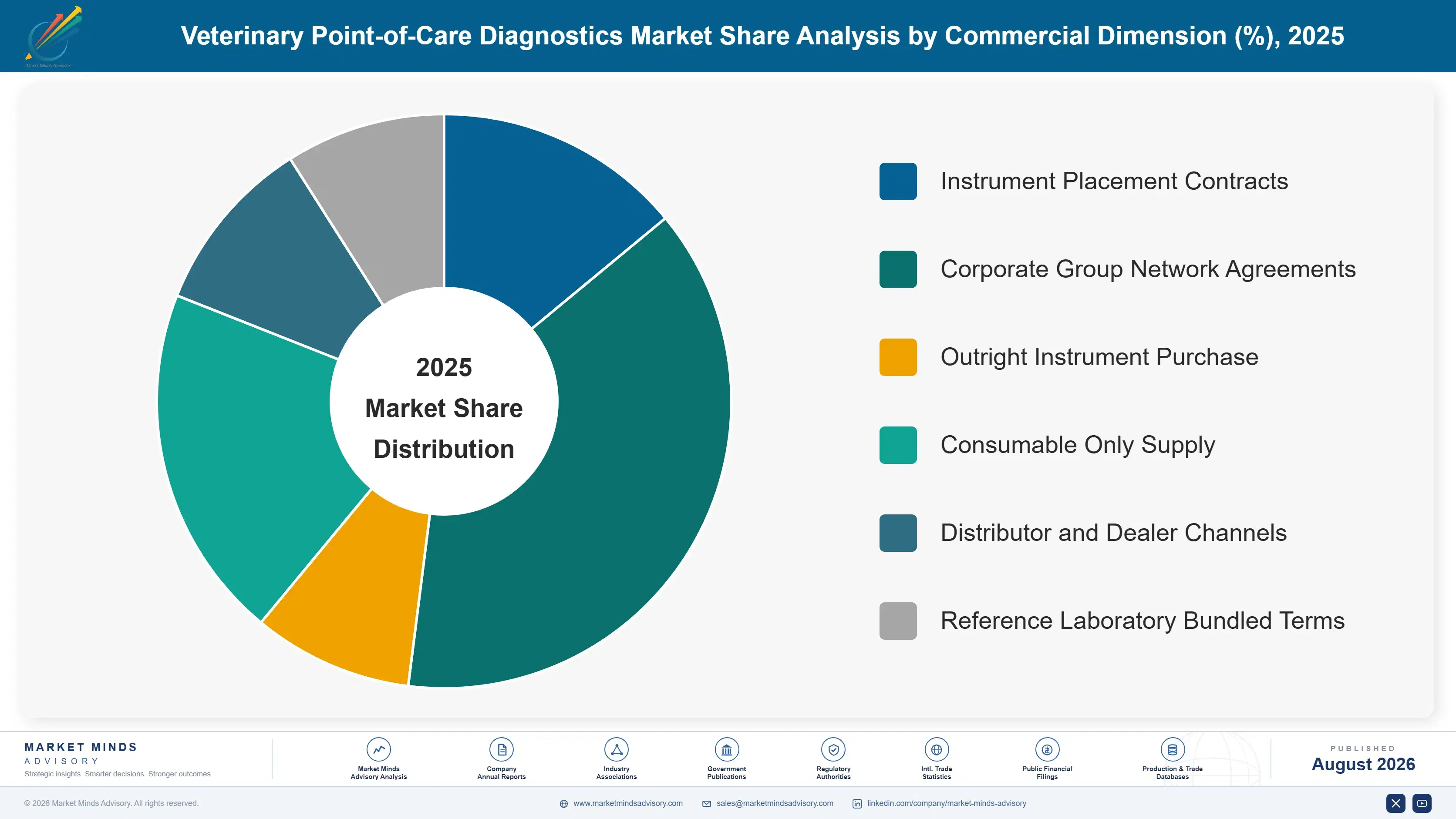
Segmentation follows test platform, since platform determines what a practice can answer without sending anything away and how much consumable revenue each placement generates. Six platforms cover in clinic testing, from a rapid lateral flow strip to a molecular system returning a panel within an hour. Growth follows what genuinely cannot wait for a laboratory.
veterinary-point-of-care-diagnostics-market-market-share-analysis-1787641542453

In-Clinic Molecular and PCR Systems

Cartridge based polymerase chain reaction platforms returning infectious disease panel results within about an hour, covering respiratory, diarrhoeal, vector borne and tick borne pathogens. At 13.5% this is the fastest growing platform in the market, half again the market rate of 9.0%, and it is one of the few areas where the same visit argument genuinely holds, since treatment for an infectious presentation changes materially on the result. Roughly 44% of the volume transfers directly out of reference laboratory testing rather than being newly created. Cartridge cost remains high enough that routine screening is not yet viable, which caps use at suspected cases and keeps utilisation below what the placement economics would prefer.
CAGR 13.5%

Urinalysis and Point of Care Cytology

Automated urinalysis alongside digital slide scanning and image analysis that brings cytology into general practice with remote pathologist review attached. Growth of 11.2% is second fastest in the market, and the development that matters is workflow rather than technology, since the specialist remains in the process while the turnaround falls from days to hours. Practices that previously sent every cytology sample away can now offer a same visit conversation with an owner about a mass or a fluid sample. The economics differ from other platforms because a reading fee accompanies each study, which suits suppliers holding both instrument and pathologist capability. Practices gain a same visit conversation about a mass they previously had to defer.
CAGR 11.2%
Full segment breakdown across 6 segments available in the complete report.

Regional Architecture and Country Demand Map

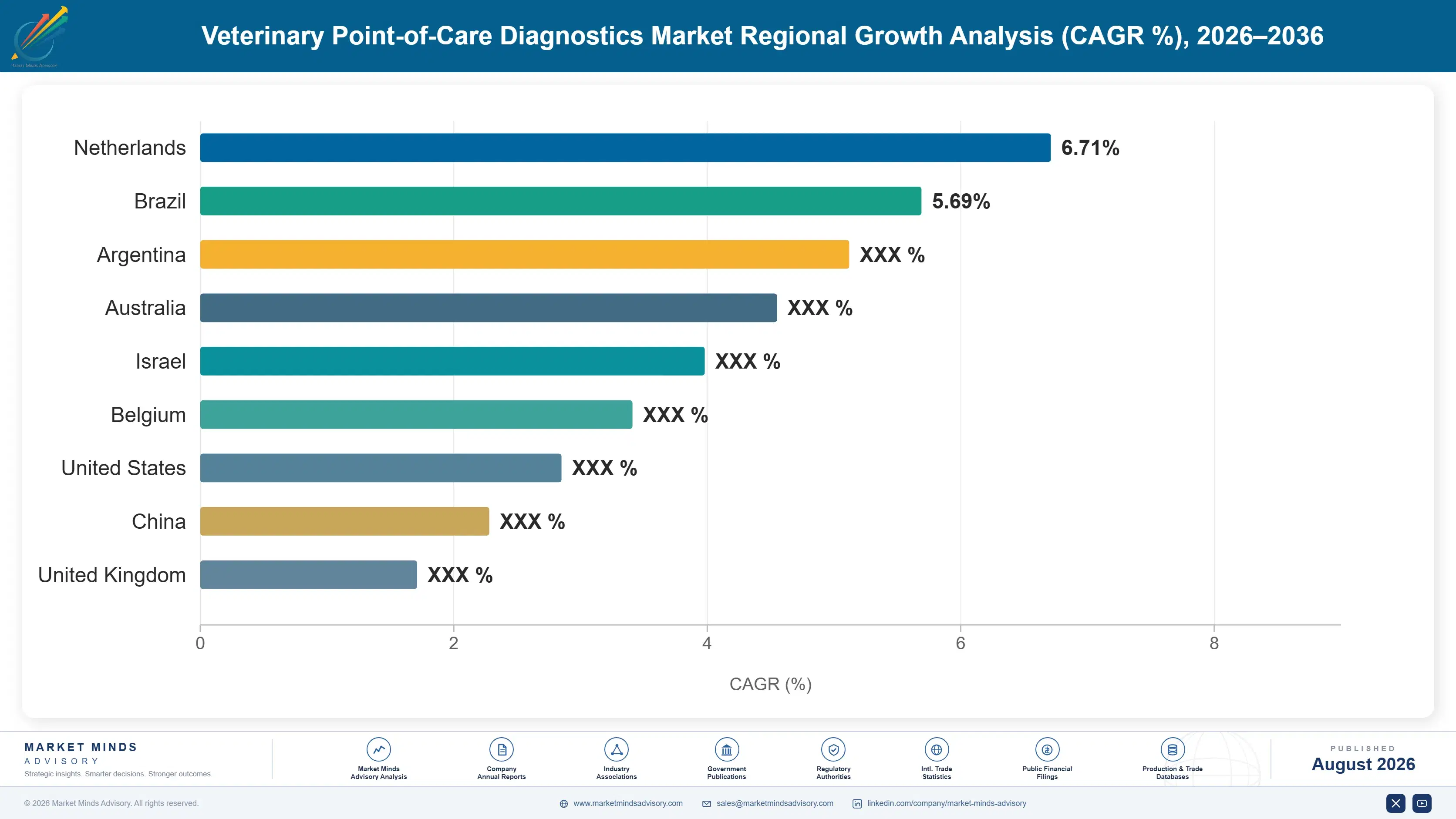
North America holds the largest share at 32%, on installed analyser density and testing intensity no other region matches. Western Europe follows at 23%. China grows fastest of any country covered at 15.2%, on hospitals built with diagnostics specified at design stage. Reference laboratory strength shapes everything.

North America

Testing intensity rather than animal numbers explains this 32% share. American practices run more diagnostic tests per patient than anywhere else, supported by owner willingness to fund workups and by placement contracts that made analysers accessible to practices of every size. The reference laboratory networks here are also the most developed in the world, which means the in clinic and send out businesses compete directly and frequently sit inside the same company. Corporate veterinary groups increasingly negotiate diagnostics centrally across estates, which changes placement contracting from a practice decision to a network one. Growth of 8.4% reflects a mature installed base where new placements largely replace existing ones. Corporate groups negotiate estates centrally.
Share: 32% | CAGR: 8.4% (2026 to 2036)

Western Europe

Reference laboratory strength shapes this 23% share considerably. Well established send out networks across Britain, Germany and the Netherlands offer fast turnaround at low cost, which weakens the in clinic argument for anything that is not genuinely time critical. Insurance penetration in Britain and the Nordic markets supports diagnostic workups that uninsured markets decline, raising test volume overall. Placement contracts face more regulatory and commercial scrutiny here than in North America, with some markets questioning minimum commitment structures. Growth of 7.4% is the lowest of the seven regions, reflecting a mature market where the send out alternative is genuinely competitive on both time and cost. Send out alternatives compete genuinely on time and cost.
Share: 23% | CAGR: 7.4% (2026 to 2036)
Regional intelligence for 5 additional markets available in the complete report: East Asia, South Asia and Pacific, Latin America, Middle East and Africa, Eastern Europe. Contact sales@marketmindsadvisory.com.
veterinary-point-of-care-diagnostics-market-country-cagr-analysis-1787641542983

Where This Model Actually Earns

Nothing here is won on analyser specification, because the instrument is placed rather than sold and most practices never compare them. Value accrues to whoever secures the placement and the commitment, whoever holds tests that genuinely cannot wait, and whoever manages the transfer from their own reference laboratory carefully. Four routes carry weight, and only one is diagnostic.

Secure the Placement Before Anyone Compares Instruments

Analysers are placed at minimal capital cost against a minimum annual commitment across roughly six years, and about 81% of supplier revenue arrives afterwards through consumables at around 14 dollars per chemistry panel. The decision is made once and the revenue recurs daily, which makes placement the entire commercial contest and the instrument comparison largely theatre. Practices rarely evaluate analysers on performance, because the differences are small and the contract terms are not. Suppliers competing on specification are answering a question the buyer is not actually asking here. Contract terms are what actually differ.
Market Impact: Locks in 81% of revenue for 6 years

Own the Tests That Genuinely Cannot Wait

Only around 38% of in clinic tests are time critical, and that share is where the clinical argument holds without qualification. Molecular infectious panels returning within an hour change treatment materially and grow at 13.5% against a market rate of 9.0%, while routine chemistry on a stable patient would be served perfectly well by a next day reference result. Concentrating development and commercial effort on genuinely urgent testing builds a position that survives any tightening of practice economics. The rest of the volume exists because a contract requires it. That volume exists to satisfy a number.
Market Impact: Serves the 38% of tests genuinely time critical

Manage the Transfer From Your Own Laboratory

Roughly 44% of in clinic volume is displaced from reference laboratories rather than newly created, and the largest suppliers own both businesses, which makes this an internal margin transfer rather than a competitive win. Managing which tests move and which stay is a portfolio decision most organisations handle by letting divisions compete internally, which optimises neither. Companies that decided deliberately which categories belong in clinic and which belong in the laboratory protect total margin rather than watching it migrate to whichever division sells harder. Very few organisations have taken that decision deliberately.
Market Impact: Governs the 44% of test volume being displaced

Specify Into Asian Hospitals at Design Stage

China grows at 15.2%, faster than any country covered, with urban veterinary hospitals built rather than converted and diagnostics specified during design alongside imaging and surgery. Reference laboratory networks in these markets are far less developed, which makes in clinic testing the default rather than the alternative and removes the substitution question entirely. Suppliers present when a facility is being designed capture placements without competing against an incumbent contract. Those arriving after opening are waiting six years for a commitment to expire before any conversation becomes possible. Design stage presence decides everything here.
Market Impact: Captures the full 15.2% Chinese national market growth

Who Controls the Margin Pool

Concentration is high and vertically unusual. The top five hold 76% of the installed analyser base and associated consumable volume, the basis applied consistently here, and several of them operate reference laboratories competing directly with their own in clinic products. IDEXX leads across both channels with the deepest installed base, and the distance to challengers reflects placement contract coverage rather than any instrument advantage.
Competition runs on three fronts. Established suppliers compete for placements on contract terms, service coverage and integration with practice management systems rather than on analytical performance. Instrument free rapid test suppliers compete on price into practices unwilling to sign commitments at all. Reference laboratories compete against in clinic testing on cost and breadth, frequently while owned by the same parent as the analyser.

Rankings will move as corporate veterinary groups centralise diagnostics procurement, since a network agreement replaces hundreds of individual placement contracts and changes the negotiation entirely. That process is well advanced in North America and beginning elsewhere. The other pressure point is Chinese domestic manufacture, supplying chemistry and haematology into the fastest growing market at prices established suppliers have not attempted.
veterinary-point-of-care-diagnostics-market-company-positioning-matrix-1787641543509

Competitive Moat and Risk Dimensions

IDEXX LABORATORIES

Moat: Integrated Channel Control

Operating reference laboratories, in clinic analysers, rapid tests and practice software together means a practice buys a diagnostic workflow rather than an instrument, and the company captures the test wherever the practice chooses to run it. Placement contract coverage across the installed base also means most competitive opportunities are locked for years at any given moment.
IDEXX LABORATORIES

Risk: Internal Margin Transfer

Roughly 44% of in clinic volume is displaced from reference laboratories, and where the company owns both the shift moves revenue between divisions at different margins rather than adding any. Managing that deliberately requires deciding which categories belong where, and internal competition tends to optimise for whichever division sells harder instead.
ZOETIS

Moat: Therapeutic Portfolio Adjacency

Presence across therapeutics, vaccines and diagnostics means practice conversations happen constantly rather than only when an analyser decision arises, and a diagnostic result frequently leads directly to a product the same company supplies. That adjacency also supports corporate group negotiations covering several categories at once rather than diagnostics alone.
ZOETIS

Risk: Later Installed Base Position

Placement contracts run about six years, which means an installed base built later faces competitive opportunities that only arise as existing agreements expire rather than whenever a better product appears. Catching a leader with deeper coverage requires either waiting for renewals or buying out commitments, and the second option is expensive at scale.

Players Tracked

Prominent Players

IDEXX Laboratories
Zoetis
Mars Petcare Science and Diagnostics
Fujifilm
Thermo Fisher Scientific

Other Key Players

Woodley Equipment Company
Arkray
Boule Diagnostics
Randox Laboratories
Bionote
Skyla
Eurolyser Diagnostica
MEGACOR Diagnostik
Biopanda Reagents
Nova Biomedical
Biogal Galed Labs
Virbac
Neogen Corporation
Vetlab Supplies
Alfa Scientific Designs

Recent Developments

FEBRUARY 2025

Corporate veterinary group negotiates diagnostics centrally across estate

A large corporate veterinary group replaced hundreds of individual practice placement contracts with a single network diagnostics agreement, negotiating instrument coverage, consumable pricing and reference laboratory terms together. Suppliers reported that one negotiation now determines placement across an entire estate rather than practice by practice over years.
Signal: Network agreements now replace hundreds of separate placement contracts and change the whole negotiation entirely thereafter
MAY 2025

Molecular panel pricing reduced to widen clinical indication

A supplier reduced cartridge pricing on in clinic infectious disease molecular panels, aiming to move usage from suspected cases toward broader clinical screening. Cartridge cost has been the binding constraint on utilisation rather than turnaround, which had already reached about an hour from sample to result.
Signal: Cartridge cost rather than turnaround time is what actually limits how often molecular testing gets used
SEPTEMBER 2025

Digital cytology platform integrates remote pathologist review

A diagnostics supplier integrated digital slide scanning with remote clinical pathologist review, compressing cytology turnaround from days to hours while retaining specialist interpretation. Practices gain a same visit conversation with owners about masses and fluid samples that previously required waiting for a reference laboratory report.
Signal: Keeping the specialist while removing all the delay is a workflow change rather than any substitution

What a Cartridge Costs to Produce

Consumable manufacturing dominates the economics because that is where the revenue sits. Reagents, antibodies, enzymes and molecular primers account for roughly 38% of cost of goods on a chemistry or molecular cartridge, with precision plastic moulding, assembly and packaging covering most of the remainder. Antibody and enzyme supply comes from few specialist producers in Europe and North America, and requalification requires full analytical validation everywhere.
Reagent and biological input pricing moved through the period as demand from human diagnostics competed for the same antibody and enzyme capacity, particularly during and after pandemic testing expansion. Company annual reports across the diagnostics sector documented the resulting supply and cost pressure. Precision moulding costs tracked polymer feedstock and energy, both of which moved sharply through 2022. Cartridge tooling investment discourages design changes once production begins.

Exposure divides by consumable complexity rather than by company size. A molecular cartridge carries concentrated biological input risk with few qualified alternatives, while a chemistry slide carries polymer and reagent cost that is easier to source. Suppliers weighted toward molecular carry the fastest growth and the tightest input position at once, which is uncomfortable where cartridge cost already limits usage.
veterinary-point-of-care-diagnostics-market-cost-volatility-analysis-1787641543706

Qualify second sources for antibodies and enzymes

Biological inputs come from very few specialist producers and requalification requires full analytical validation in every registered market, which nobody undertakes until supply tightens. Holding qualified alternatives costs validation effort during comfortable periods and protects production during difficult ones. Suppliers that qualified early maintained cartridge supply while competitors rationed allocation to their largest accounts and lost placements as a result.

Design cartridges for shared moulding tool families

Cartridge tooling investment is substantial and each distinct design multiplies it, which is why suppliers frequently carry more tool variants than any technical requirement justifies. Designing across shared tool families reduces capital and simplifies production changeover considerably. Consumable design is frozen early and rarely revisited, so the saving reaches only future products. Tooling capital falls accordingly.

Reduce cartridge cost to widen clinical indication

Cartridge cost rather than turnaround limits how often molecular testing is used, since a panel priced for suspected cases will never support routine screening. Reducing cost per cartridge expands indication and raises volume per placed instrument, which improves utilisation against fixed commitments. That favours volume over unit margin, and suppliers with contracts to fill benefit most.

Portfolio Architecture for Margin Defence

Margin architecture follows how locked the revenue is. Instruments earn almost nothing and are frequently placed free, since they exist to create a consumable obligation rather than to generate a sale. Chemistry and haematology consumables earn well under commitment contracts across roughly six years. Molecular cartridges earn best per unit and worst on volume, because cartridge cost restricts usage to suspected cases rather than routine screening.
The tension is between the platform growing fastest and the platform filling commitments. Molecular grows at 13.5% and generates modest cartridge volume per placement. Chemistry generates volume every day on stable patients where a laboratory would have done, which is what satisfies a minimum annual spend. A portfolio optimised for clinical value produces less contracted revenue than one optimised for routine throughput, which nobody says aloud.

High value pools concentrate in molecular testing where the same visit argument genuinely holds and in digital cytology where a reading fee accompanies each study. Everything else earns on volume that a reference laboratory could have served, and that volume is exposed if practice economics tighten or if a network agreement renegotiates commitments downward across an entire estate at once.

Instruments and Rapid Test Strips

Analysers placed at minimal cost to create a consumable obligation, alongside instrument free lateral flow strips sold on price to practices unwilling to sign any commitment. Neither generates meaningful margin on its own terms.
Gross Margin: 12-15%

Chemistry and Haematology Consumables

Slides, rotors and reagent packs consumed daily under minimum annual commitments running about six years. Margin holds because the contract removes competitive comparison for the duration and volume follows caseload automatically.
Gross Margin: 62-65%

Molecular Cartridges and Digital Cytology

Infectious disease panels returning within an hour and digital slide studies carrying a pathologist reading fee. Margin is the best available and volume is limited by cartridge cost rather than by any clinical reluctance to use them.
Gross Margin: 68-71%
veterinary-point-of-care-diagnostics-market-portfolio-architecture-1787641544200

High-value Sub-segments and Strategic Watch-out

In-Clinic Molecular and PCR Systems

The fastest growing platform at 13.5% and the one where the same visit argument genuinely holds without qualification. Cartridge cost restricts use to suspected cases rather than routine screening, which caps volume per placement well below what the economics would prefer. Pricing rather than clinical reluctance is the limit.
Gross Margin: 68-71%

Urinalysis and Point of Care Cytology

Second fastest at 11.2% on digital slide scanning with remote pathologist review compressing turnaround from days to hours. A reading fee accompanies each study, which suits suppliers holding both instrument and pathologist capability together. The pathologist stays involved throughout, which makes this a workflow change rather than substitution.
Gross Margin: 64-67%

Clinical Chemistry Analysers

Growing at 7.6% and generating the daily volume that actually satisfies minimum annual commitments, largely on stable patients a reference laboratory would have served. That is the least defensible volume in the category if practice economics tighten. A reference laboratory would have served most of it perfectly adequately.
Gross Margin: 62-65%

Blood Gas and Electrolyte Analysers

Growing at only 5.2% and confined largely to emergency and critical care settings where the results genuinely cannot wait. Installed base is small, utilisation is high and the clinical case is stronger than anywhere else in this category. The clinical case here is stronger than anywhere else in the category.
Gross Margin: 58-61%

How Cartridge Revenue Actually Recurs

Revenue here recurs by contract rather than by preference. An analyser placed today produces consumable purchasing under a minimum annual commitment across roughly six years, and about 81% of supplier revenue arrives that way at around 14 dollars per chemistry panel. The decision happens once, the obligation runs for years, and a practice falling short runs tests to satisfy it.
Stickiness is contractual first and behavioural second. During a commitment nothing moves regardless of what a competitor offers, which is why placement coverage matters more than product comparison. At renewal the decision reopens fully, and practices that resented the fixed cost during a difficult period frequently move. Corporate groups negotiating centrally have compressed hundreds of individual renewal moments into a single network conversation with far larger consequences.

The buyer moved from the practice to the group. Diagnostics were once selected by a veterinarian who wanted the capability and signed whatever placement contract was offered. Corporate groups now negotiate instrument coverage, consumable pricing and reference laboratory terms together across an estate, with commercial teams who understand exactly what a minimum commitment is worth. Suppliers built around practice level placement are calling on somebody who no longer signs.
veterinary-point-of-care-diagnostics-market-end-use-penetration-index-1787641544695

Where This Model Rewards Focus

These are among the four positions where our research anticipates prominent divergence between winners and laggards over the coming forecast period. Each is grounded in the demand model, the regulatory perimeter, and the announced capacity pipeline.
01 / PLACEMENT CONTRACT COVERAGE

The instrument comparison is largely commercial theatre

Analysers are placed at minimal capital cost against minimum annual consumable commitments running about six years, and roughly 81% of supplier revenue arrives afterwards at around 14 dollars per chemistry panel. The decision happens once and the obligation runs for years, which makes placement coverage the entire commercial contest rather than any analytical performance difference. Suppliers competing on specification are answering a question practices are not asking, because the differences between instruments are small and the contract terms very much are not.
02 / CLINICAL URGENCY CONCENTRATION

Only a third of these tests genuinely cannot wait

Around 38% of in clinic tests change what happens at that visit and the remainder would have been served perfectly well by a next day reference laboratory report at considerably lower cost. Molecular infectious panels returning within an hour genuinely alter treatment and grow at 13.5% against a market rate of 9.0%, while routine chemistry on a stable patient exists largely to satisfy a contract. Concentrating development and commercial effort on genuinely urgent testing builds a position that survives any tightening of practice economics ahead.
03 / INTERNAL CHANNEL MANAGEMENT

Most of this volume came from your own laboratory

Roughly 44% of in clinic test volume is displaced from reference laboratories rather than newly created, and the largest companies in this market own both businesses, so the movement transfers margin between divisions rather than winning anything. Organisations that let divisions compete internally optimise neither, and total margin drifts toward whichever side sells harder in any given year. Deciding deliberately which test categories belong in clinic and which belong in a laboratory is a portfolio decision very few have actually taken.
04 / DESIGN STAGE SPECIFICATION

New hospitals have no incumbent contract to displace

China grows at 15.2%, faster than any country covered, with urban veterinary hospitals built rather than converted and diagnostics specified during design alongside imaging and surgical facilities. Reference laboratory networks in those markets are far less developed, which makes in clinic testing the default rather than an alternative requiring justification against send out costs. Suppliers present when a facility is being designed capture those placements uncontested, while anyone arriving afterwards waits roughly six years for a commitment to expire first.

Engagement Snapshot From the Field

A live engagement with an industry participant carrying material or product regulatory and market exposure ahead of a defining policy shift, showing how our research translates into a defensible multi-year portfolio strategy.
MARKET MINDS ADVISORY · CLIENT ENGAGEMENT SUMMARY
Veterinary Point-of-Care Diagnostics Producer Strategic Portfolio Review and Transition Roadmap 2026·Investment Scenario on Veterinary Point-of-Care Diagnostics Exposure Evaluation 2025-26
CLIENT PROFILE
A veterinary diagnostics supplier operating both a reference laboratory network and an in clinic analyser business across three European markets. Annual diagnostics revenue was approximately 390 million dollars (client-reported, unverified by MMA), split roughly evenly between the two channels. The divisions operated with separate commercial teams, separate targets and no coordinated view of which tests belonged where.
STRATEGIC CHALLENGE
Total diagnostics revenue had grown slowly while in clinic volume rose and reference laboratory volume fell, suggesting the company was moving its own business between divisions at declining blended margin. Management wanted to know which test categories genuinely belonged in clinic and which should stay in the laboratory. Neither division wanted that question answered by anybody other than itself.
MMA APPROACH
MMA modelled contribution by test category across both channels, including instrument placement cost, cartridge margin and laboratory fixed cost absorption, which had never been compared on a single basis. Clinical urgency was assessed by category against actual practice ordering behaviour. Forty-seven expert interviews with practice owners, group buyers and clinical pathologists established what practices genuinely need in clinic.
KEY FINDINGS
  1. Blended contribution fell 21% as volume moved in clinic, because laboratory fixed costs were absorbed across a shrinking base while cartridge margins sat below laboratory equivalents.
  2. Clinicians in 31 of the 47 interviews said a next day result would have been clinically adequate for the majority of chemistry panels they ran in clinic.
  3. Molecular infectious panels and blood gas testing were the only categories where practice ordering matched genuine clinical urgency in more than 70% of cases.
  4. Corporate groups negotiating centrally achieved consumable pricing roughly 26% below individual practice contracts, and that share of the estate was rising each year.
CLIENT PROFILE
A veterinary diagnostics supplier operating both a reference laboratory network and an in clinic analyser business across three European markets. Annual diagnostics revenue was approximately 390 million dollars (client-reported, unverified by MMA), split roughly evenly between the two channels. The divisions operated with separate commercial teams, separate targets and no coordinated view of which tests belonged where.
STRATEGIC CHALLENGE
Total diagnostics revenue had grown slowly while in clinic volume rose and reference laboratory volume fell, suggesting the company was moving its own business between divisions at declining blended margin. Management wanted to know which test categories genuinely belonged in clinic and which should stay in the laboratory. Neither division wanted that question answered by anybody other than itself.
MMA APPROACH
MMA modelled contribution by test category across both channels, including instrument placement cost, cartridge margin and laboratory fixed cost absorption, which had never been compared on a single basis. Clinical urgency was assessed by category against actual practice ordering behaviour. Forty-seven expert interviews with practice owners, group buyers and clinical pathologists established what practices genuinely need in clinic.
KEY FINDINGS
  1. Blended contribution fell 21% as volume moved in clinic, because laboratory fixed costs were absorbed across a shrinking base while cartridge margins sat below laboratory equivalents.
  2. Clinicians in 31 of the 47 interviews said a next day result would have been clinically adequate for the majority of chemistry panels they ran in clinic.
  3. Molecular infectious panels and blood gas testing were the only categories where practice ordering matched genuine clinical urgency in more than 70% of cases.
  4. Corporate groups negotiating centrally achieved consumable pricing roughly 26% below individual practice contracts, and that share of the estate was rising each year.
RECOMMENDED STRATEGY
Phase 1: Phase one: define which test categories belong in clinic and which stay in the laboratory, since blended contribution fell 21% while divisions competed internally. Phase 2: Phase two: concentrate in clinic investment on molecular and blood gas testing, the only categories where urgency matched ordering in over 70% of cases. Phase 3: Phase three: build a single corporate group negotiating team immediately, since central agreements already price 26% below individual practice contracts.
OUTCOME
The client established a single diagnostics portfolio function with authority over both channels within two quarters and stopped promoting in clinic chemistry into practices with good laboratory access. Blended contribution recovered over the following year, and corporate group negotiations moved from two competing teams to one (client-reported, unverified by MMA).

Frequently Asked Questions

Foundational context covering the market sizes, CAGR, scope, country, region and competition that inform every finding below. This section is provided to cover basics and most often pre-purchase conversations, answered from the MMA Primary Research Dataset.

What is the current size of the Veterinary Point-of-Care Diagnostics Market?

The market was valued at 3.1 billion dollars in 2025, covering in clinic chemistry, haematology, rapid tests, molecular, urinalysis and blood gas platforms. It reaches an estimated 3.38 billion dollars during 2026.

How large will the Veterinary Point-of-Care Diagnostics Market be by 2036?

MMA forecasts 8.00 billion dollars by 2036, an increase of 4.62 billion dollars over the 2026 base. That represents an expansion multiple of 2.37 times across the forecast period.

What is the CAGR for the Veterinary Point-of-Care Diagnostics Market 2026 to 2036?

The base case compound annual growth rate is 9.0%, with a bull case of 10.2% and a bear case of 7.8%. Cartridge pricing and practice margin pressure separate those scenarios.

Which segment is growing fastest?

In clinic molecular and PCR systems grow at 13.5%, half again the market rate of 9.0%, on infectious panels that change treatment. Urinalysis and cytology follow at 11.2%.

Who are the major companies in the Veterinary Point-of-Care Diagnostics Market?

IDEXX Laboratories, Zoetis, Mars Petcare Science and Diagnostics, Fujifilm and Thermo Fisher Scientific lead on installed analyser base and consumable volume. Together they account for 76% of the market.

Which country is growing fastest?

China grows fastest at 15.2%, as urban veterinary hospitals are built with diagnostics specified at design stage in markets where reference laboratory networks barely exist.

Report Segmentation Architecture

The full report scope spans multiple orthogonal segmentation dimensions, with cross-tabulated demand data provided for each dimension pair. Coverage extends further to regional breakdowns, trend trajectories, and the competitive detail needed to support segment-level decision-making.

By Test Platform

  • Clinical Chemistry Analysers
  • Haematology Analysers
  • Rapid Lateral Flow Immunoassays
  • In-Clinic Molecular and PCR Systems
  • Urinalysis and Point of Care Cytology
  • Blood Gas and Electrolyte Analysers

By End-Use Industry

  • Companion Animal General Practice
  • Emergency and Critical Care Centres
  • Specialty Referral Hospitals
  • Equine Veterinary Practice
  • Production Animal Veterinary Services
  • Shelter and Charity Clinics

By Commercial Dimension

  • Instrument Placement Contracts
  • Corporate Group Network Agreements
  • Outright Instrument Purchase
  • Consumable Only Supply
  • Distributor and Dealer Channels
  • Reference Laboratory Bundled Terms

By Region

  • North America
  • Western Europe
  • East Asia
  • South Asia and Pacific
  • Latin America
  • Middle East and Africa
  • Eastern Europe

Scope, Methodology, and Coverage

Every figure in this report is reproducible from documented input assumptions. The scope below maps the historical period, the forecast horizon, the segmentation dimensions, and the countries covered, alongside the underlying primary and qualitative methodology.
Historical Period
2020 to 2025
Forecast Period
2026 to 2036
Base Year
2025 (USD billions; MMA Primary Research Dataset, August 2026)
Market Definition
Diagnostic testing performed within veterinary practices rather than sent to a reference laboratory worldwide, covering clinical chemistry analysers, haematology analysers, rapid lateral flow immunoassays, in clinic molecular and PCR systems, urinalysis and point of care cytology, and blood gas and electrolyte analysers, together with the consumables and cartridges they consume. Measured at supplier selling value. Reference laboratory send out testing services, diagnostic imaging equipment, therapeutic products, practice management software and anaesthesia monitoring are excluded from scope.
Quantitative Units
USD billions (current prices); analysers placed and tests run; USD per test by platform
Segmentation Dimensions
Test platform; end-use industry; commercial dimension; region
Regions Covered
North America, Western Europe, East Asia, South Asia and Pacific, Latin America, Middle East and Africa, Eastern Europe
Countries Covered
United States, Canada, United Kingdom, Germany, Netherlands, France, Sweden, Spain, China, Japan, South Korea, Taiwan, India, Australia, Thailand, Brazil, Mexico, Saudi Arabia, Israel, Poland
Key Companies Profiled
IDEXX Laboratories, Zoetis, Mars Petcare Science and Diagnostics, Fujifilm, Thermo Fisher Scientific, Woodley Equipment Company, Arkray, Boule Diagnostics, Randox Laboratories, Bionote, Skyla, Eurolyser Diagnostica, MEGACOR Diagnostik, Biopanda Reagents, Nova Biomedical, Biogal Galed Labs, Virbac, Neogen Corporation, Vetlab Supplies, Alfa Scientific Designs
Quantitative Methodology
Primary survey, n=3,800 respondents, Q4 2025, six countries; demand-side model with trade association cross-validation
Qualitative Methodology
47 expert interviews, Q4 2025; applied to validate demand model assumptions, identify emerging dynamics, and assess competitive positioning
Report Format
PDF and XLSX data workbook (Word format preview document)
Publisher
Market Minds Advisory
Report Code
MMA-2026-MED-131
Published
August 2026
Contact
sales@marketmindsadvisory.com | www.marketmindsadvisory.com

Purchase the full Veterinary Point-of-Care Diagnostics Market Report (2026 to 2036).

The full report treats veterinary point of care testing as a placement and commitment business rather than a diagnostics one, since the instrument is given away and the contract determines everything that follows. It sizes all six test platforms independently through 2036, models contribution across in clinic and reference laboratory channels on a single basis, and separates genuinely time critical testing from volume that exists to satisfy a commitment. Regional chapters cover all seven regions, with reference laboratory strength assessed separately from in clinic adoption. Competitive profiling covers 20 participants on one consistent installed base measure.
Six test platforms sized independently through 2036
Contribution modelled across in clinic and laboratory channels
Time critical testing separated from commitment driven volume
Placement contract coverage mapped against renewal timing
Reference laboratory strength assessed separately from in clinic adoption
Twenty participants profiled on one consistent installed base

Built For The People Who Decide

From boardroom strategy to bench-side execution, this report is read cover-to-cover by leaders shaping the next decade of their industry, turning demand scenarios, market dynamics and valuation benchmarks into decisions.
CXOs/ Presidents/ VPs/ Managers
M&A and Corporate Development
Strategy Teams and R&D Heads
Procurement and Product Directors
Regulatory and Compliance Leaders
Investor Relations and Equity Analysts