Market Minds Advisory
Veterinary Glucometers Market

Veterinary Glucometers Market: Continuous Monitoring Reshapes Companion Animal Diabetes Care

Rising companion animal diabetes diagnosis and pet owner willingness to fund continuous monitoring are pushing veterinary practices toward connected glucose systems, forcing legacy handheld glucometer makers to rebuild portfolios around cloud-integrated monitoring.

Lead Analyst

Alice Ballenger

Published

September 2026

Make Smarter Decisions with Customized Research Insights

Request a free sample report and evaluate market opportunities, growth trends, and competitive dynamics relevant to your business needs.

2025 MARKET VALUE$0.4BMarket Size 2025
2036 FORECAST VALUE$1.1BBase Case , 2026 to 2036
CAGR 2026 TO 20368.8 %Bull 10.1% / Bear 7.5%
INCREMENTAL OPPORTUNITY$0.6BNet 10- year value creation
EXPANSION MULTIPLE2.32x2036 value over 2026 base
Strategic Levers
M&A Pipeline
Regional Outlook
Country Rankings
Competitive Intelligence
Segmental Deep-dive
Call-Us : 91 93563 13602

Executive Snapshot and Market Trajectory

Veterinary glucometers demand keeps expanding as rising companion animal diabetes diagnosis pushes veterinary practices toward continuous glucose monitoring systems, replacing standalone handheld glucometer protocols across most chronic diabetes management categories served by veterinary practices worldwide today.
Continuous glucose monitoring systems are growing at roughly 1.61x the market average as veterinarians pursue real-time glycemic data that handheld spot-check devices cannot deliver for animals requiring intensive insulin titration. North America holds the largest revenue base on dense veterinary care infrastructure and high per-capita pet care spending, while East Asia is compounding fastest as China's expanding companion animal ownership and veterinary clinic investment pulls monitoring demand into the category nationwide.
Competitive intensity concentrates among five diversified veterinary diagnostics companies that increasingly bundle glucometer hardware, cloud-based monitoring platforms, and clinical calibration support into a single diabetes management pathway, leaving smaller regional manufacturers to compete on price for standard handheld formats alone. Species-specific calibration accuracy and monitoring reliability, not price alone, increasingly determine which suppliers win multi-year veterinary practice contracts across major markets.
Market Definition
The veterinary glucometers market covers devices used to measure and monitor blood glucose levels in companion and production animals, spanning continuous glucose monitoring systems, handheld point-of-care glucometers, cloud-connected and app-integrated monitoring systems, test strips and consumables, and veterinary-specific calibrated glucometers. General veterinary laboratory analyzers and unrelated diagnostic imaging equipment are excluded from market scope.
Base Year Value
$0.4B in 2025 (MMA Primary Research Dataset, August 2026)
Forecast Period
2026 to 2036, eleven discrete annual values
CAGR
8.8% base case. Bull 10.1%. Bear 7.5%.
Fastest Growth Segment
Continuous Glucose Monitoring Systems: 14.2% CAGR
Fastest Growth Country
China: 11.2% CAGR
Fastest Growth Region
South Asia and Pacific: 10.8% CAGR
Largest Region
North America: 32% of 2025 global value
Market Leaders
Zoetis Inc, IDEXX Laboratories Inc, Heska Corporation, Abbott Laboratories, Nova Biomedical Corporation. Source: MMA Analysis based on company annual reports.
Primary Survey
n=3,800 procurement and R&D decision-makers, Q4 2025, six countries
Methodology
Demand-side build-up, cross-validated against public data, 47 expert interviews

Veterinary Glucometers Market Forecast Scenarios

veterinary-glucometers-market-size-forecast-scenario-1787310150464
Between 2020 and 2025 the market grew at an estimated 7.8% historical CAGR, expanding steadily as companion animal diabetes diagnosis rates increased and continuous monitoring technology matured across major veterinary research hubs throughout the historical period. Companies investing early in continuous monitoring capability captured a disproportionate share of this accelerating demand base ahead of slower-moving handheld device competitors.
The base case assumes 8.8% CAGR through 2036, anchored in three commercial mechanisms: expanding companion animal diabetes diagnosis across major developed and emerging markets requiring proportional monitoring capacity, rising clinical validation of continuous and cloud-connected mechanisms sustaining base device demand, and growing veterinary practice preference for continuous data over intermittent handheld spot-checks alone. Rising pet owner willingness to fund advanced monitoring adds a further reinforcing tailwind as the category matures.
A bull scenario, near 10.1% CAGR, assumes faster continuous monitoring validation and accelerated companion animal diagnosis expansion pull premium device orders forward across more species categories worldwide. The bear case, near 7.5% CAGR, assumes broader veterinary capital spending tightens considerably and practices extend existing handheld glucometer protocols rather than converting to continuous formats on the standard replacement cycle industry-wide.

Continuous Monitoring Reshapes Diabetes Management Standards

Three forces are converging on veterinary glucometers demand simultaneously: expanding companion animal diabetes diagnosis requiring proportional monitoring capacity, rising clinical validation of continuous and cloud-connected mechanisms sustaining base device demand, and growing veterinary practice preference for continuous data over intermittent handheld spot-checks alone. Veterinary practices that once relied entirely on periodic handheld testing now specify continuous monitoring and cloud d
MARKET CONCENTRATION54%Combined revenue share held by top five veterinary diagnostics companies
AVERAGE SYSTEM ASP$285Blended average price for a complete continuous monitoring system
TOP PRODUCING COUNTRYUnited StatesLeading country for installed veterinary diagnostic monitoring capacity
MEASUREMENT ACCURACY RATE96%Blended validated accuracy across leading glucose monitoring systems
DIAGNOSED CASE COVERAGE SHARE37%Share of diagnosed diabetic animals reached by structured monitoring
CONTINUOUS MONITORING ADOPTION SHARE26%Share of monitoring volume using continuous rather than handheld formats
Commercially, the category increasingly resembles a chronic disease management and monitoring partnership bundled around cloud analytics and calibration support rather than a transactional device purchase. Veterinary practices and device suppliers commit to recurring multi-year monitoring relationships spanning hardware, software, and calibration, since fragmenting these functions across multiple providers creates glycemic data continuity gaps that a unified relationship avoids.
Over the next decade, expect continuous and cloud-connected formats to keep gaining share within the broader veterinary diagnostics budget as sensor costs decline and validation evidence accumulates, continued consolidation among smaller regional manufacturers unable to fund continuous monitoring platform development, and growing scrutiny of measurement accuracy performance driving faster adoption cycles across major veterinary diabetes management programmes worldwide.
"Managing a diabetic pet used to mean a stressful clinic visit and a single blood draw that captured one moment in time. Now a continuous monitor can track glucose trends over days without repeated needle sticks, and that shift from single-point to continuous data has completely changed how veterinarians titrate insulin."
Director, Veterinary Diagnostics Practice · MMA Companion Animal Diagnostic Moni

Market Trends

Veterinary Practices Shift Toward Continuous Glucose Monitoring

Academic and community veterinary practices are increasingly adopting continuous glucose monitoring systems capable of tracking glycemic trends without repeated blood draws, replacing what were historically handheld spot-check protocols requiring stressful repeated clinic visits across most chronic diabetes management categories served today. Each new continuous monitoring commitment requires suppliers to demonstrate consistent measurement accuracy validation alongside existing hardware capabilities, an evidence bar that has tightened considerably over the past several years. Practices completing successful continuous adoption report meaningfully improved insulin titration outcomes, reinforcing continuous monitoring as the standard specification for new diagnostic investment nationwide and internationally.
Market Impact: Adds 620,000 annual diagnosed cases

Cloud-Connected Data Sharing Standardizes Across Practices

Veterinary practices and pet owner networks are increasingly deploying cloud-connected app-integrated monitoring platforms as a default specification rather than relying on standalone device readings alone, replacing what were historically isolated device measurements built around manual logbook recording across most chronic disease monitoring environments. Each new cloud integration commitment requires suppliers to demonstrate reliable data transmission and reporting alongside existing device capabilities, a validation expectation that has tightened over the past several years. Practices completing expanded integration report meaningfully improved owner engagement, reinforcing cloud-connected monitoring as the standard specification for new investment.
Market Impact: Adds 15% to continuous monitoring v

Market Opportunities and Growth Drivers

Companion Animal Diabetes Diagnosis Drives Base Demand

Expanding companion animal diabetes diagnosis across major developed and emerging markets continues driving surging veterinary glucometers demand, proportionally expanding requirements for monitoring capacity capable of serving a broad range of species categories across both established canine and feline applications and expanding equine applications. Companies report that veterinary practices increasingly expect dedicated continuous and cloud-connected formats specifically for their chronic disease management requirements rather than relying on handheld devices alone. This diagnosis growth is expanding the addressable monitoring market well beyond the traditional canine and feline categories that historically drove most category demand across the wider veterinary diagnostics supply chain.
Market Impact: Limits 22% of eligible smaller manu

Pet Owner Spending Growth Sustains Base Demand

Continued expansion of pet owner willingness to fund advanced diagnostic technology across major developed and emerging markets is sustaining steady demand for both continuous and handheld monitoring formats required to reach increasingly broad diagnosed populations without traditional clinic-visit-only limitations. Companies report that dedicated home monitoring partnerships can meaningfully reduce delayed complication cost that far exceeds the incremental cost of upgraded continuous monitoring investment. This spending growth is expanding the addressable monitoring market well beyond the developed markets that historically drove most category demand, pulling emerging veterinary care hubs into the buying pool for the first time.
Market Impact: Adds 16% to adoption delay risk

Market Restraints and Challenges

Species-Specific Calibration Complexity Limits Broad Deployment

Veterinary glucometers manufacturers face meaningful species-specific calibration complexity that limits broad deployment, and the root cause is that glucose metabolism and hematocrit levels vary significantly across dog, cat, and equine species, requiring distinct calibration algorithms that many smaller manufacturers lack the research capacity to validate consistently across every target species. The commercial impact falls hardest on manufacturers seeking broad multi-species deployment, since calibration validation across additional species can delay product launches and limit near-term commercial rollout. Companies are mitigating this by pursuing species-specific clinical validation studies and modular calibration platforms.
Market Impact: Lifts continuous monitoring adoptio

Owner Cost Sensitivity Constrains Broader Adoption Pace

Veterinary glucometers adoption carries meaningful owner cost sensitivity that constrains adoption pace, and the root cause is that continuous monitoring systems and ongoing sensor replacement costs represent a substantial recurring expense that many pet owners cannot sustain without pet insurance coverage, which remains far less widespread than human health insurance in most markets. The commercial impact falls hardest on veterinary practices attempting to recommend continuous monitoring broadly, since owner cost hesitation can delay treatment adoption and limit near-term prescribing volume. Companies are mitigating this by pursuing pet insurance partnership programmes and owner financing arrangements.
Market Impact: Lifts cloud integration adoption 17
4 additional market trends, 3 additional growth drivers, and 4 additional restraints and challenges are covered in the full report. Contact sales@marketmindsadvisory.com to access the complete intelligence.

Segment CAGR and Growth Architecture

Segmentation follows monitoring technology and clinical function, the single dimension veterinary practices specify against when structuring a glucometer procurement decision. Continuous, handheld, cloud-connected, consumable, and species-calibrated formats each serve a distinct monitoring function, keeping hardware and software dimensions cleanly separate across every diagnostic category served worldwide by veterinarians, manufacturers, and owners alike today.
veterinary-glucometers-market-market-share-analysis-1787310150992

Continuous Glucose Monitoring Systems

Continuous glucose monitoring systems use subcutaneous sensors and wireless data transmission to track glycemic trends over days without repeated blood draws, supporting more comprehensive insulin titration data than intermittent handheld spot-checks can provide across most chronic diabetes management categories. Adoption is concentrated among academic veterinary hospitals and specialty endocrinology practices seeking continuous glycemic data for animals undergoing active insulin dose adjustment. Growth outpaces the broader market by roughly 1.61x as sensor validation accumulates and veterinarians increasingly prioritize continuous data over periodic clinic-visit testing alone. Companies with proven continuous monitoring capability are capturing outsized share, since building trust in a new continuous monitoring brand requires sustained clinical evidence most veterinary practices are reluctant to adopt without demonstrated performance.
CAGR 14.2%

Cloud-Connected and App-Integrated Monitoring Systems

Cloud-connected and app-integrated monitoring systems combine glucose sensing hardware with mobile applications that allow pet owners and veterinarians to track glycemic trends remotely, supporting more consistent owner engagement than paper-based logbook tracking can provide across most home monitoring categories. Adoption is concentrated among veterinary practices and specialty referral networks seeking to meet growing remote monitoring demand across major developed markets. Growth remains strong as mobile application software matures and veterinarians increasingly view cloud connectivity as a meaningful driver of treatment adherence beyond in-clinic testing alone. Companies completing expanded cloud integration report meaningfully improved practice retention, reinforcing connected monitoring as a standard specification within premium diabetes programmes across major veterinary networks worldwide today.
CAGR 11.6%
Full segment breakdown across 6 segments available in the complete report.

Regional Architecture and Country Demand Map

North America holds the largest revenue base on dense veterinary care infrastructure and high per-capita pet care spending, while East Asia is compounding fastest as China's expanding companion animal ownership and veterinary clinic investment pulls monitoring demand into the category nationwide across every hub today.

North America

United States veterinary practices and academic veterinary hospitals, concentrated around major companion animal care hubs, anchor the region's demand base as dense veterinary infrastructure and high per-capita pet care spending drive proportional monitoring demand across both continuous and handheld pathways. Canadian veterinary networks continue steady device adoption tied to established veterinary care procurement systems covering major regional markets. Broadening companion animal diabetes diagnosis coverage across major academic and community practices continues accelerating continuous monitoring adoption well ahead of many international peer markets facing less developed veterinary infrastructure. Growth trails East Asia and South Asia because the region's monitoring installed base is comparatively larger and more mature relative to the expanding pet ownership investment driving growth elsewhere in the forecast.
Share: 32% | CAGR: 9.3% (2026 to 2036)

Western Europe

German and United Kingdom veterinary research institutions, operating under some of the world's most established companion animal care funding frameworks, sustain steady demand for both continuous and handheld monitoring formats tied to national and European Union veterinary regulation. French veterinary networks continue expanding continuous monitoring investment tied to growing pet insurance coverage demand covering major regional care clusters. Regional device manufacturers maintain strong domestic penetration built on established practice procurement relationships across the continent. Regional growth trails East Asia and South Asia as the market's already high diagnostic penetration limits the incremental upside further pet ownership investment expansion alone can provide relative to less mature markets elsewhere in the forecast ahead.
Share: 24% | CAGR: 7.3% (2026 to 2036)
Regional intelligence for 5 additional markets available in the complete report: East Asia, South Asia and Pacific, Latin America, Middle East and Africa, Eastern Europe. Contact sales@marketmindsadvisory.com.
veterinary-glucometers-market-country-cagr-analysis-1787310151512

Monetizing Cloud Analytics and Calibration Support

Companies are shifting commercial models toward cloud analytics subscription programmes, calibration support service contracts, and multi-year monitoring bundling agreements rather than one-time hardware sales, since veterinary practice demand for ongoing analytics and calibration support now rivals raw hardware pricing as a vendor selection criterion. This mirrors a broader shift across veterinary diagnostics categories toward relationship-based commercial structures.

Offering Cloud Analytics Subscription Access Programs

Companies are increasingly offering cloud analytics subscription programmes that provide continuous data tracking and reporting updates across a veterinary practice's full deployed device fleet, converting what was historically a one-time hardware procurement decision into recurring subscription revenue tied directly to a practice's monitoring volume growth. Companies report subscription attach rates above 31% among practices completing their first continuous monitoring integration, with renewal rates exceeding 75% once a practice experiences a full monitoring cycle without a service disruption. This analytics assurance increasingly determines vendor selection ahead of raw hardware pricing during practice decisions.
Market Impact: Lifts recurring subscription revenu

Bundling Sensor Calibration and Support Service Programs

Companies are increasingly bundling sensor calibration monitoring and clinical support services into device purchases, converting a previously separate maintenance engagement into predictable recurring revenue while reducing the risk of a practice disengaging after deployment without adequate calibration workflow support across every affiliated site. Bundled calibration support typically reduces a practice's own maintenance burden meaningfully during the deployment window and ongoing sensor accuracy monitoring cycle across departments and clinical teams. Companies report calibration support attach rates rising fastest among practices completing their first continuous fleet deployment, with roughly 25% of new customers now including bundled support services.
Market Impact: Cuts practice calibration downtime

Offering Multi-Practice Device Bundling and Standardization Programs

Companies with dedicated multi-site deployment infrastructure are increasingly offering bundled device programmes that give veterinary network groups a lower cost path to comprehensive monitoring standardization without negotiating individual devices separately for each practice served today or in the future. This bundled device path typically reduces a network's per-practice device cost meaningfully compared with individual site purchases, with bundled programmes now supporting roughly 22% of total new device deployments completed annually across major veterinary networks nationwide. Companies report bundling attach rates rising fastest among networks seeking comprehensive multi-site standardization without significant per-practice investment burden.
Market Impact: Cuts network-wide device cost by ro

Structuring Multi-Region Deployment and Support Agreements

Companies are increasingly structuring multi-year deployment and support agreements that extend consistent device brand standards and pricing across a veterinary group's entire regional practice network rather than negotiating each market independently, giving veterinary groups consistent device standards across every operating location served today and going forward. Veterinary groups report cost of ownership reductions of roughly 15% once deployment standardization eliminates the redundant vendor management overhead multiple incompatible device brand standards previously required across the network. Companies with proven multi-region deployment track records are capturing outsized share of these agreements ahead of smaller competitors.
Market Impact: Cuts network-wide deployment cost b

Who Controls the Margin Pool

The top five companies hold roughly 54% combined share, a moderate to high concentration reflecting both the substantial calibration validation and cloud software development investment required for meaningful participation and the fragmented base of smaller regional manufacturers serving local veterinary practice relationships. The gap between leading vendors and smaller producers is widening as networks restrict shortlists to companies with demonstrated validation depth and integration reliabi
Current competitive activity centers on three fronts: continuous monitoring system expansion targeting chronic diabetes management demand, cloud analytics platform investment supporting broader owner engagement, and multi-region deployment agreement development supporting broader network access. Several regional companies are pursuing partnerships with veterinary research institutions rather than building internal calibration validation infrastructure independently, a faster but margin-diluting route to participation.

Emerging pressure comes from Chinese and Indian veterinary diagnostics vendors moving up the value chain from basic uncertified handheld formats into certified continuous and cloud-connected systems sold initially to domestic practices but increasingly targeting export markets as clinical credibility accumulates. Rankings among the top five could shift if a leader fails to close its cloud integration gap, since veterinary practices increasingly evaluate validation depth ahead of price.
veterinary-glucometers-market-company-positioning-matrix-1787310152032

Competitive Moat and Risk Dimensions

ZOETIS INC

Moat: Deep species calibration validation portfolio

Zoetis's years of accumulated species-specific calibration validation data and clinical certification history give it durable credibility among veterinary practices who weigh proven measurement accuracy evidence heavily, since qualifying a new device brand without comparable validation depth carries meaningful clinical and reimbursement continuity risk. That credibility compounds with every additional validation study Zoetis publishes.
ZOETIS INC

Risk: Slower niche species customization

Zoetis's scale and broad calibration technology portfolio can slow its response to niche exotic species customization requests that smaller specialized companies serve more quickly, occasionally costing it customers among veterinary practices prioritizing rapid custom calibration development over comprehensive platform convenience across smaller emerging clinical categories nationwide.
IDEXX LABORATORIES INC

Moat: Strong cloud analytics data depth

IDEXX's long-standing investment in veterinary cloud analytics and remote monitoring technology gives it a design-in advantage with veterinary practices seeking a partner that already understands chronic disease workflow nuance rather than building that expertise from scratch. That data depth compounds with every additional dataset IDEXX adds across new clinical categories and practice partnerships.
IDEXX LABORATORIES INC

Risk: Premium pricing limits access

IDEXX's premium continuous monitoring pricing structure can limit its reach among smaller, budget-constrained veterinary practices that prioritize lower cost handheld formats over integrated continuous capability, occasionally ceding entry-tier accounts to lower-cost regional competitors focused on price-sensitive procurement segments across smaller, less well-funded markets and emerging regions.

Players Tracked

Prominent Players

Zoetis Inc
IDEXX Laboratories Inc
Heska Corporation
Abbott Laboratories
Nova Biomedical Corporation

Other Key Players

Bionime Corporation
Woodley Equipment Company Ltd
Roche Diagnostics International Ltd
ARKRAY Inc
EDAN Instruments Inc
Trividia Health Inc
i-SENS Inc
Sinocare Inc
Elanco Animal Health Incorporated
Antech Diagnostics Inc
Scil Animal Care Company GmbH
Advanced Instruments LLC
Mindray Medical International Limited
Sensor Technology Ltd
VetScan Diagnostics Pvt Ltd

Recent Developments

MAY 2025

Zoetis Commissions New Continuous Monitoring Research Center

Zoetis commissioned a new dedicated continuous glucose monitoring research center for species-specific calibration testing, adding meaningful research capacity to address surging demand from veterinary practices requiring rapid validation data across their expanding diagnostic programmes worldwide today. The center supports faster development of new calibration algorithms for additional species categories.
Signal: Confirms continuous monitoring capacity ex
SEPTEMBER 2025

IDEXX Signs Multi-Region Deployment Agreement

IDEXX signed a multi-year deployment agreement with a major regional veterinary practice network, covering consistent device standards and direct facility access across dozens of affiliated clinical locations nationwide. The agreement is a deployment arrangement rather than a joint venture or acquisition, extending IDEXX's multi-region presence considerably.
Signal: Highlights deployment standardization bund
FEBRUARY 2026

Heska Acquires Regional Cloud Software Developer

Heska completed the acquisition of a regional cloud analytics software developer, strengthening its continuous monitoring capability and expanding its ability to support veterinary practices navigating precision diagnostics requirements across every major market worldwide today. The deal reinforces Heska's positioning across the broader veterinary glucometers market.
Signal: Signals continued consolidation of special

Biosensor Strip and Electronics Component Cost Exposure

Biosensor test strip materials, wireless transmission electronics, and enzymatic reagent coatings together represent an estimated 38 to 48% of veterinary glucometers cost of goods sold across most vendors. Biosensor strip and electronics component sourcing remains concentrated among a small number of qualified semiconductor and biosensor manufacturing suppliers, creating a narrower supply base than most broader medical device categories rely upon for comparable production inputs.
Semiconductor and biosensor enzymatic material price volatility during 2021 and 2022 raised production costs broadly, and several companies flagged the disruption in annual reports as a persistent cost pressure affecting multiple diagnostic device technology categories across the sector, per NIST semiconductor supply chain reporting. Several companies disclosed that biosensor sourcing constraints stretched device production timelines beyond expected windows during the tightest period, forcing some smaller vendors to delay launches or rely on costlier alternative sourcing arrangements.

Smaller regional vendors carry disproportionate exposure to these input swings since they lack the purchasing scale to negotiate multi-year fixed pricing directly with biosensor and electronics suppliers the top five companies secure more easily through long-standing relationships. This gap is widest for vendors dependent on spot market biosensor capacity, leaving them vulnerable to margin compression during input cost increases.
veterinary-glucometers-market-cost-volatility-analysis-1787310152227

Long-Term Biosensor Supply Contracts

Leading companies now lock multi-year pricing directly with biosensor and electronics suppliers serving their primary device development needs, avoiding the spot market cost volatility that stretched device production timelines during the 2021 to 2022 shortage and protecting launch schedules against disruption across major markets worldwide throughout sustained periods of semiconductor supply constraint and elevated pricing.

Vertical Integration Into Biosensor Manufacturing

Top five companies increasingly build internal biosensor and enzymatic coating manufacturing capability rather than relying entirely on third-party semiconductor contractors, smoothing production timelines and insulating device quality from the sourcing volatility smaller regional vendors remain exposed to directly, a practice that has become standard operational policy since biosensor demand accelerated considerably across the industry and among smaller producers.

Diversified Biosensor Sourcing Across Multiple Suppliers

Companies without full vertical integration are increasingly qualifying multiple biosensor and electronics component partners across different geographic regions, reducing exposure to any single hub's capacity constraints or price inflation and giving companies greater negotiating leverage during periodic biosensor pricing renewal discussions spanning multiple continents, regulatory jurisdictions, and electronics producing regions served by their development networks.

Portfolio Architecture for Margin Defence

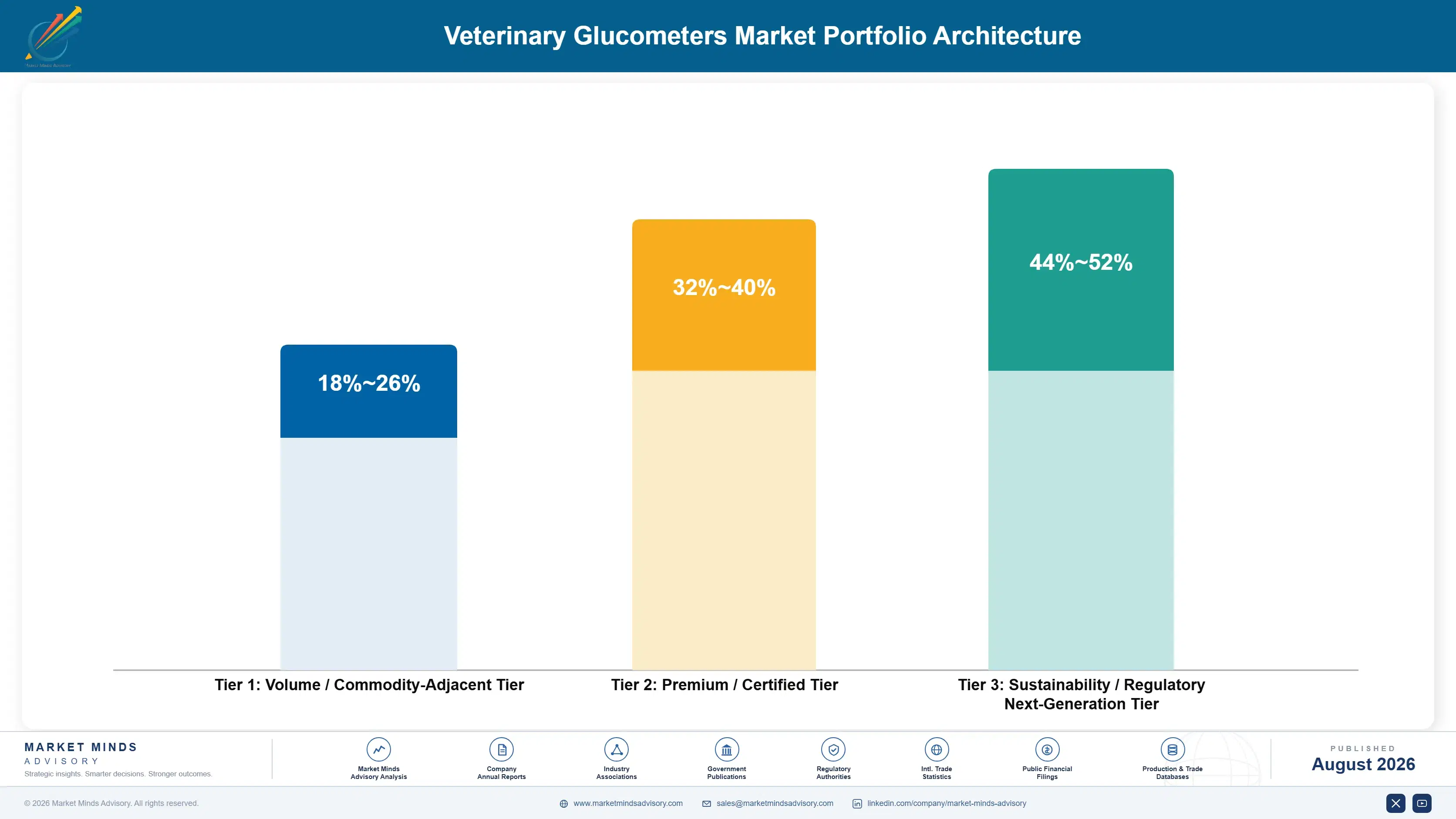
Portfolio architecture splits across three tiers: entry priced standard handheld glucometers competing largely on subscription cost, certified continuous and species-calibrated systems carrying validation evidence value that commands a durable price premium, and next generation cloud-connected bundles paired with calibration and remote monitoring services. Margins widen meaningfully as validation and integration barriers concentrate hardest at the entry tier.
The volume versus premium tension is sharpest in handheld tools, where regional manufacturer competition has compressed prices fastest, pushing established companies to defend share through validation bundling rather than matching commodity pricing directly on subscription cost alone. Continuous and cloud-connected platforms retain the strongest pricing power because validation investment and multi-year integration relationships discourage switching mid-contract, a dynamic strengthening considerably as adoption broadens across every major care setting.

High value margin pools concentrate in continuous and cloud-connected platforms paired with continuous calibration and monitoring service contracts, where recurring subscription revenue and high switching costs together support gross margins well above the portfolio average. Companies are prioritizing capital toward this tier even though it remains a minority of total deployment volume shipped today, betting the mix shifts decisively within the decade ahead as validation evidence broadens.

Volume / Commodity-Adjacent Tier

Basic standard handheld glucometers competing primarily on subscription price against numerous regional manufacturers, with limited service attach and thin per-unit margins across most transactions and smaller veterinary practices throughout North America and Asia.
Gross Margin: 18-26%

Premium / Certified Tier

Certified continuous and species-calibrated systems serving complex chronic disease management applications, where validation evidence depth and integration support durable pricing power across the industry and every managed veterinary network account served today.
Gross Margin: 32-40%

Sustainability / Regulatory / Next-Generation Tier

Cloud-connected bundles paired with calibration, monitoring, and clinical support services, sold on recurring predictive assurance value rather than subscription pricing alone, increasingly the default specification for new investment across major veterinary networks worldwide.
Gross Margin: 44-52%
veterinary-glucometers-market-portfolio-architecture-1787310152725

High-value Sub-segments and Strategic Watch-out

Continuous Monitoring Calibration and Support Contracts

High value, high growth layer combining continuous monitoring attach with recurring calibration and support service fees; margins scale directly with active veterinary practice deployment volume and partnership intensity across large networks worldwide, rewarding companies investing earliest and most consistently in calibration capacity, staffing, and clinical training.
Gross Margin: 46-54%

Chronic Disease Multi-Region Deployment Programs

High value, moderate growth segment tied to expanding chronic disease demand, growing steadily as veterinary networks commission multi-region continuous and cloud-connected programmes from first launch across major research hub regions worldwide, currently expanding monitoring capacity to keep pace with rising overall demand.
Gross Margin: 32-40%

Handheld Glucometer Distribution Channels

Volume core segment generating steady recurring subscription revenue from mid-sized veterinary networks requiring consistent device supply across established diagnostic configurations globally, reliably and predictably each year regardless of broader device pricing cycles affecting the wider industry and prevailing macroeconomic and demographic conditions worldwide today.
Gross Margin: 18-26%

Legacy Manual Testing Adjacent Formats

Strategic watch out segment where declining practice preference and stable generic pricing limit growth further, requiring companies to defend remaining share through deployment reliability rather than volume expansion into new veterinary markets facing continued substitution pressure from newer continuous monitoring classes worldwide today and beyond.
Gross Margin: 8-16%

Calibration Contracts Anchor Recurring Revenue

Veterinary glucometers economics function increasingly like an annuity once a calibration relationship is established, since cloud analytics subscriptions, sensor calibration support, and periodic device updates generate recurring revenue for years after the initial monitoring contract closes. This recurring layer now represents a growing share of total category revenue and is the primary reason companies compete aggressively on initial veterinary practice acquisition even at thin entry tier mar
Adoption depth varies sharply by end use vertical. Large academic veterinary hospitals run near saturated continuous and cloud-connected coverage and generate mostly renewal and calibration demand, while smaller regional and community veterinary practices are still building out first time continuous coverage, generating a different mix of new customer acquisition revenue layered on the maturing platform base.

Buyer profiles are shifting generationally as younger technology-focused veterinary practice owners who expect cloud integration and embedded software workflow support increasingly influence category growth alongside veteran veterinarians who remember when glucose monitoring meant a single handheld reading taken during a stressful clinic visit. This is accelerating demand for companies with strong calibration and cloud integration capability even among veterinary networks who historically evaluated device suppliers purely on subscription cost and clinical familiarity alone.
veterinary-glucometers-market-end-use-penetration-index-1787310153209

Where Monitoring Strategy Should Focus

These are among the four positions where our research anticipates prominent divergence between winners and laggards over the coming forecast period. Each is grounded in the demand model, the regulatory perimeter, and the announced capacity pipeline.
01 / CONTINUOUS MONITORING INVESTMENT

Prioritize measurement accuracy depth over marginal pricing

Subscription pricing has become a secondary consideration across most large veterinary network decisions, no longer the primary differentiator given rising expectations for validated continuous measurement accuracy across every major clinical category. Veterinary practices now evaluate continuous validation depth and cloud integration reliability ahead of marginal price savings that once justified switching vendors on their own. Companies that continue competing primarily on standard subscription pricing risk losing share to validation-focused rivals bundling validation, calibration support, and platforms into a single recurring relationship that is harder to unwind once established.
02 / SERVICE MONETIZATION STRATEGY

Shift commercial models toward cloud analytics and calibration revenue

Handheld device margins will keep compressing as regional manufacturers gain share at the entry tier of the category across most emerging markets. Companies that convert cloud analytics subscriptions, calibration support, and multi-practice bundling into contracted recurring revenue will outperform peers still pricing primarily around one-time hardware sales alone. This shift also raises veterinary network switching costs meaningfully, since replacing a device vendor requires displacing an entrenched, multi-year analytics and calibration relationship built over years of accumulated clinical trust and historical predictive data.
03 / REGIONAL GROWTH PRIORITIZATION

Weight investment toward South Asia and East Asia over mature markets

South Asia and East Asia are compounding faster than Western Europe on both share and CAGR, driven by expanding companion animal ownership investment, rising domestic veterinary care capability, and first time diagnostic access across previously underserved regional veterinary networks. Companies weighting deployment and validation investment toward these regions ahead of competitors will capture a disproportionate share of new device deployment revenue. Mature markets, running mostly on renewal demand, simply cannot replicate that category of growth at comparable scale or rate over the coming decade of forecast activity.
04 / OWNER FINANCING RESPONSE

Expand pet insurance partnership programmes ahead of adoption scrutiny

The gap between rising continuous monitoring adoption interest and available pet insurance financing coverage represents a substantial growth opportunity that most companies are not yet equipped to capture efficiently given the specialized insurance partnership infrastructure required. Companies that invest early in dedicated pet insurance financing programmes will be better positioned to capture broad owner deployment accounts without the extended credibility-building timelines currently limiting some competitors. Companies ignoring this opportunity risk ceding financing-secured revenue to competitors who have already solved the owner affordability problem.

Engagement Snapshot From the Field

A live engagement with an industry participant carrying material or product regulatory and market exposure ahead of a defining policy shift, showing how our research translates into a defensible multi-year portfolio strategy.
MARKET MINDS ADVISORY · CLIENT ENGAGEMENT SUMMARY
Veterinary Glucometers Producer Strategic Portfolio Review and Transition Roadmap 2026·Investment Scenario on Veterinary Glucometers Exposure Evaluation 2025-26
CLIENT PROFILE
The client is a regional academic veterinary hospital network operating diabetes management across eight affiliated clinical facilities and multiple metropolitan markets, reporting annual healthcare technology procurement spending in the low tens of millions of dollars across its portfolio (client-reported, unverified by MMA). Its existing sourcing relied on fragmented regional device brands with inconsistent continuous monitoring capability across its facility network.
STRATEGIC CHALLENGE
Facing rising demand for continuous glycemic data and increasing competitive pressure from cloud-integrated peer networks, clinical leadership sought to consolidate device vendor partnerships toward fewer validation-capable suppliers within twelve months, without exceeding the allocated clinical budget or disrupting existing workflow schedules across every active facility.
MMA APPROACH
MMA benchmarked five candidate device vendor suppliers against calibration validation depth, cloud integration reliability, and total cost of ownership over a five year horizon, then modeled consolidation sequencing to minimize clinical workflow disruption across the client's highest volume facilities during the phased vendor standardization programme currently under review by clinical leadership.
KEY FINDINGS
  1. Three of five candidate suppliers evaluated could not demonstrate consistent continuous monitoring coverage across all of the client's active clinical facilities reviewed.
  2. Consolidated device vendor procurement reduced projected annual healthcare technology costs by 21% versus continued fragmented regional sourcing across comparable deployment volumes, based on modeling completed during evaluation (client-reported, unverified by MMA).
  3. Centralizing calibration and cloud software management was projected to cut technology operations administrative workload meaningfully across the client's regional facility network, according to internal operations modeling completed by the client.
  4. Facilities facing the most imminent continuous monitoring demand growth carried the highest near term consolidation priority, reprioritizing the client's original sequencing considerably ahead of the initial twelve month plan.
CLIENT PROFILE
The client is a regional academic veterinary hospital network operating diabetes management across eight affiliated clinical facilities and multiple metropolitan markets, reporting annual healthcare technology procurement spending in the low tens of millions of dollars across its portfolio (client-reported, unverified by MMA). Its existing sourcing relied on fragmented regional device brands with inconsistent continuous monitoring capability across its facility network.
STRATEGIC CHALLENGE
Facing rising demand for continuous glycemic data and increasing competitive pressure from cloud-integrated peer networks, clinical leadership sought to consolidate device vendor partnerships toward fewer validation-capable suppliers within twelve months, without exceeding the allocated clinical budget or disrupting existing workflow schedules across every active facility.
MMA APPROACH
MMA benchmarked five candidate device vendor suppliers against calibration validation depth, cloud integration reliability, and total cost of ownership over a five year horizon, then modeled consolidation sequencing to minimize clinical workflow disruption across the client's highest volume facilities during the phased vendor standardization programme currently under review by clinical leadership.
KEY FINDINGS
  1. Three of five candidate suppliers evaluated could not demonstrate consistent continuous monitoring coverage across all of the client's active clinical facilities reviewed.
  2. Consolidated device vendor procurement reduced projected annual healthcare technology costs by 21% versus continued fragmented regional sourcing across comparable deployment volumes, based on modeling completed during evaluation (client-reported, unverified by MMA).
  3. Centralizing calibration and cloud software management was projected to cut technology operations administrative workload meaningfully across the client's regional facility network, according to internal operations modeling completed by the client.
  4. Facilities facing the most imminent continuous monitoring demand growth carried the highest near term consolidation priority, reprioritizing the client's original sequencing considerably ahead of the initial twelve month plan.
RECOMMENDED STRATEGY
Phase 1: Phase 1 (Months 1-4): Complete technical and validation evaluation of the three highest-scoring candidate suppliers identified through careful independent review. Phase 2: Phase 2 (Months 5-9): Execute supplier consolidation across the highest volume clinical facilities in strict priority sequence today and beyond. Phase 3: Phase 3 (Months 10-12): Finalize network-wide vendor standardization and centralized calibration dashboard fully enabled nationwide, with clinical leadership sign-off completed across every active site.
OUTCOME
The academic veterinary hospital network completed vendor consolidation across all priority facilities within the twelve month window and reported meaningfully improved insulin titration outcomes during subsequent internal reviews (client-reported, unverified by MMA). Clinical leadership gained centralized calibration visibility previously unavailable across its distributed regional facility network and vendor partner base.

Frequently Asked Questions

Foundational context covering the market sizes, CAGR, scope, country, region and competition that inform every finding below. This section is provided to cover basics and most often pre-purchase conversations, answered from the MMA Primary Research Dataset.

What is the current size of the Veterinary Glucometers Market?

The global veterinary glucometers market reached an estimated $0.42 billion in 2025. Growth is driven by expanding companion animal diabetes diagnosis and rising continuous monitoring clinical validation worldwide.

How large will the Veterinary Glucometers Market be by 2036?

The market is projected to reach approximately $1.06 billion by 2036, roughly 2.32 times its 2026 value. Continuous glucose monitoring systems drive most of the added value across the category.

What is the CAGR for the Veterinary Glucometers Market 2026 to 2036?

The base case CAGR is 8.8% through 2036. Bull and bear scenarios range from roughly 7.5% to 10.1%, depending on continuous monitoring validation pace and diagnosis expansion speed.

Which segment is growing fastest?

Continuous glucose monitoring systems lead at a 14.2% CAGR, about 1.61x the overall market rate. Growth is concentrated among academic veterinary hospitals and specialty endocrinology practices.

Who are the major companies in the Veterinary Glucometers Market?

Zoetis, IDEXX Laboratories, Heska, Abbott, and Nova Biomedical lead the category. Combined, the top five companies hold roughly 54% of global revenue on a consistent basis.

Which country is growing fastest?

China leads country level growth at an estimated 11.2% CAGR. Expanding companion animal ownership and veterinary clinic investment are driving demand across the region's care base.

Report Segmentation Architecture

The full report scope spans multiple orthogonal segmentation dimensions, with cross-tabulated demand data provided for each dimension pair. Coverage extends further to regional breakdowns, trend trajectories, and the competitive detail needed to support segment-level decision-making.

By Monitoring Technology and Clinical Function

  • Continuous Glucose Monitoring Systems
  • Handheld Point-of-Care Glucometers
  • Cloud-Connected and App-Integrated Monitoring Systems
  • Test Strips and Consumables
  • Veterinary-Specific Calibrated Glucometers

By End-Use Care Setting

  • Academic Veterinary Hospitals
  • Community Veterinary Practices
  • Specialty Endocrinology and Referral Centers
  • Home Monitoring and Owner-Managed Care

By Commercial Dimension

  • Direct Veterinary Practice Procurement Contracts
  • Group Purchasing Organization Agreements
  • Multi-Region Deployment Agreements
  • Pet Insurance and Financing Agreements

By Region

  • North America
  • Western Europe
  • East Asia
  • South Asia and Pacific
  • Latin America
  • Middle East and Africa
  • Eastern Europe

Scope, Methodology, and Coverage

Every figure in this report is reproducible from documented input assumptions. The scope below maps the historical period, the forecast horizon, the segmentation dimensions, and the countries covered, alongside the underlying primary and qualitative methodology.
Historical Period
2020 to 2025
Forecast Period
2026 to 2036
Base Year
2025 (USD billions; MMA Primary Research Dataset, August 2026)
Market Definition
The veterinary glucometers market covers devices used to measure and monitor blood glucose levels in companion and production animals, spanning continuous glucose monitoring systems, handheld point-of-care glucometers, cloud-connected and app-integrated monitoring systems, test strips and consumables, and veterinary-specific calibrated glucometers. General veterinary laboratory analyzers and unrelated diagnostic imaging equipment are excluded from market scope.
Quantitative Units
USD billions (current prices); active device units where disclosed
Segmentation Dimensions
By Monitoring Technology and Clinical Function; By End-Use Care Setting; By Commercial Dimension; By Region
Regions Covered
North America, Western Europe, East Asia, South Asia and Pacific, Latin America, Middle East and Africa, Eastern Europe
Countries Covered
USA, China, Germany, France, UK, Japan, South Korea, India, Australia, Canada, Brazil, Mexico, Thailand, Singapore, Indonesia, UAE, Saudi Arabia, South Africa, Egypt, Turkey, Poland, Netherlands, Italy, Spain, Switzerland, Argentina, Colombia, Czech Republic, and additional markets relevant to this sector
Key Companies Profiled
Zoetis Inc, IDEXX Laboratories Inc, Heska Corporation, Abbott Laboratories, Nova Biomedical Corporation, Bionime Corporation, Woodley Equipment Company Ltd, Roche Diagnostics International Ltd, ARKRAY Inc, EDAN Instruments Inc, Trividia Health Inc, i-SENS Inc, Sinocare Inc, Elanco Animal Health Incorporated, Antech Diagnostics Inc, Scil Animal Care Company GmbH, Advanced Instruments LLC, Mindray Medical International Limited, Sensor Technology Ltd, VetScan Diagnostics Pvt Ltd
Quantitative Methodology
Primary survey, n=3,800 respondents, Q4 2025, six countries; demand-side model with trade association cross-validation
Qualitative Methodology
47 expert interviews, Q4 2025; applied to validate demand model assumptions, identify emerging dynamics, and assess competitive positioning
Report Format
PDF and XLSX data workbook (Word format preview document)
Publisher
Market Minds Advisory
Report Code
MMA-2026-MED-215
Published
August 2026
Contact
sales@marketmindsadvisory.com | www.marketmindsadvisory.com

Purchase the full Veterinary Glucometers Market Report (2026 to 2036).

The full report delivers a complete quantitative and qualitative assessment of the global veterinary glucometers market through 2036. It includes detailed segmentation by monitoring technology, care setting, and commercial channel, alongside country level sizing across twenty-eight markets covering every major companion animal demand center. Competitive profiles cover twenty companies with calibration validation depth, cloud integration reach, and platform benchmarking assessed on a consistent revenue basis. Buyers also receive access to the underlying primary survey and expert interview datasets referenced throughout the analysis, along with editable data tables.
Segment level CAGR and sizing tables
Regional and country level market breakdowns
Twenty company competitive profiles and benchmarks
Detailed calibration validation benchmarking matrix for every profiled company
Input cost and supply chain risk analysis
Complete primary survey and expert interview datasets included

Built For The People Who Decide

From boardroom strategy to bench-side execution, this report is read cover-to-cover by leaders shaping the next decade of their industry, turning demand scenarios, market dynamics and valuation benchmarks into decisions.
CXOs/ Presidents/ VPs/ Managers
M&A and Corporate Development
Strategy Teams and R&D Heads
Procurement and Product Directors
Regulatory and Compliance Leaders
Investor Relations and Equity Analysts