Market Minds Advisory
Veterinary Electrosurgery Market

Veterinary Electrosurgery Market: Anaesthesia Time Economics, Corporate Procurement and the Consumable Annuity

Every minute an animal spends anaesthetised carries real risk and real cost, and vessel sealing removes seventeen of them from a routine spay, which conventional ligature technique never could manage.

Lead Analyst

Alice Ballenger

Published

September 2026

Make Smarter Decisions with Customized Research Insights

Request a free sample report and evaluate market opportunities, growth trends, and competitive dynamics relevant to your business needs.

2025 MARKET VALUE$0.3BMarket Size 2025
2036 FORECAST VALUE$0.7BBase Case , 2026 to 2036
CAGR 2026 TO 20368.6 %Bull 9.9% / Bear 7.4%
INCREMENTAL OPPORTUNITY$0.4BNet 10- year value creation
EXPANSION MULTIPLE2.29x2036 value over 2026 base
Strategic Levers
M&A Pipeline
Regional Outlook
Country Rankings
Competitive Intelligence
Segmental Deep-dive
Call-Us : 91 93563 13602

Executive Snapshot and Market Trajectory

Anaesthesia time is the currency of veterinary surgery, because it carries the clinical risk, the nursing cost and the theatre throughput all at once. Advanced vessel sealing removes roughly 17 minutes from a routine procedure against conventional ligation, and that single number is why the segment is finally converting now.
Advanced bipolar vessel sealing systems compound at 12.9%, exactly 1.50 times the market rate, and the argument now reaches corporate group procurement rather than individual vets. North America holds 32% of value, the largest position, because companion animal spend per patient and corporate practice consolidation are both further advanced there than anywhere else. Generators realise roughly USD 8,400 each and stay in place for twelve years.
Five suppliers ship 58% of consumable units, and position rests on the generator installed in the practice rather than on instrument design, because a placed unit takes that supplier's consumables for twelve years. Corporate groups now own 31% of companion animal practices. That shift is changing who decides and on what evidence entirely. Instrument cost per procedure is what still excludes low-throughput practices from converting to it at all even today.
Market Definition
Covers electrosurgical systems used in veterinary practice, spanning advanced bipolar vessel sealing systems, single-use electrode and handpiece consumables, surgical smoke evacuation systems, monopolar electrosurgical generators, conventional bipolar forceps and cables, and electrosurgical accessories and return electrodes. Sizing captures generator, instrument and consumable revenue at realised practice price across companion animal, equine and production animal settings. Excludes surgical lasers and cryosurgery, human medical electrosurgery, veterinary anaesthesia and monitoring equipment, surgical instruments without electrosurgical function, veterinary imaging and diagnostics, and animal health pharmaceuticals.
Base Year Value
$0.3B in 2025 (MMA Primary Research Dataset, August 2026)
Forecast Period
2026 to 2036, eleven discrete annual values
CAGR
8.6% base case. Bull 9.9%. Bear 7.4%.
Fastest Growth Segment
Advanced Bipolar Vessel Sealing Systems: 12.9% CAGR
Fastest Growth Country
India: 11.2% CAGR
Fastest Growth Region
South Asia and Pacific: 10.7% CAGR
Largest Region
North America: 32% of 2025 global value
Market Leaders
Medtronic, Erbe Elektromedizin, Symmetry Surgical, Eickemeyer, B. Braun Melsungen. Source: MMA Analysis based on company annual reports.
Primary Survey
n=3,800 procurement and R&D decision-makers, Q4 2025, six countries
Methodology
Demand-side build-up, cross-validated against public data, 47 expert interviews

Veterinary Electrosurgery Market Forecast Scenarios

veterinary-electrosurgery-market-size-forecast-scenario-1787309959164
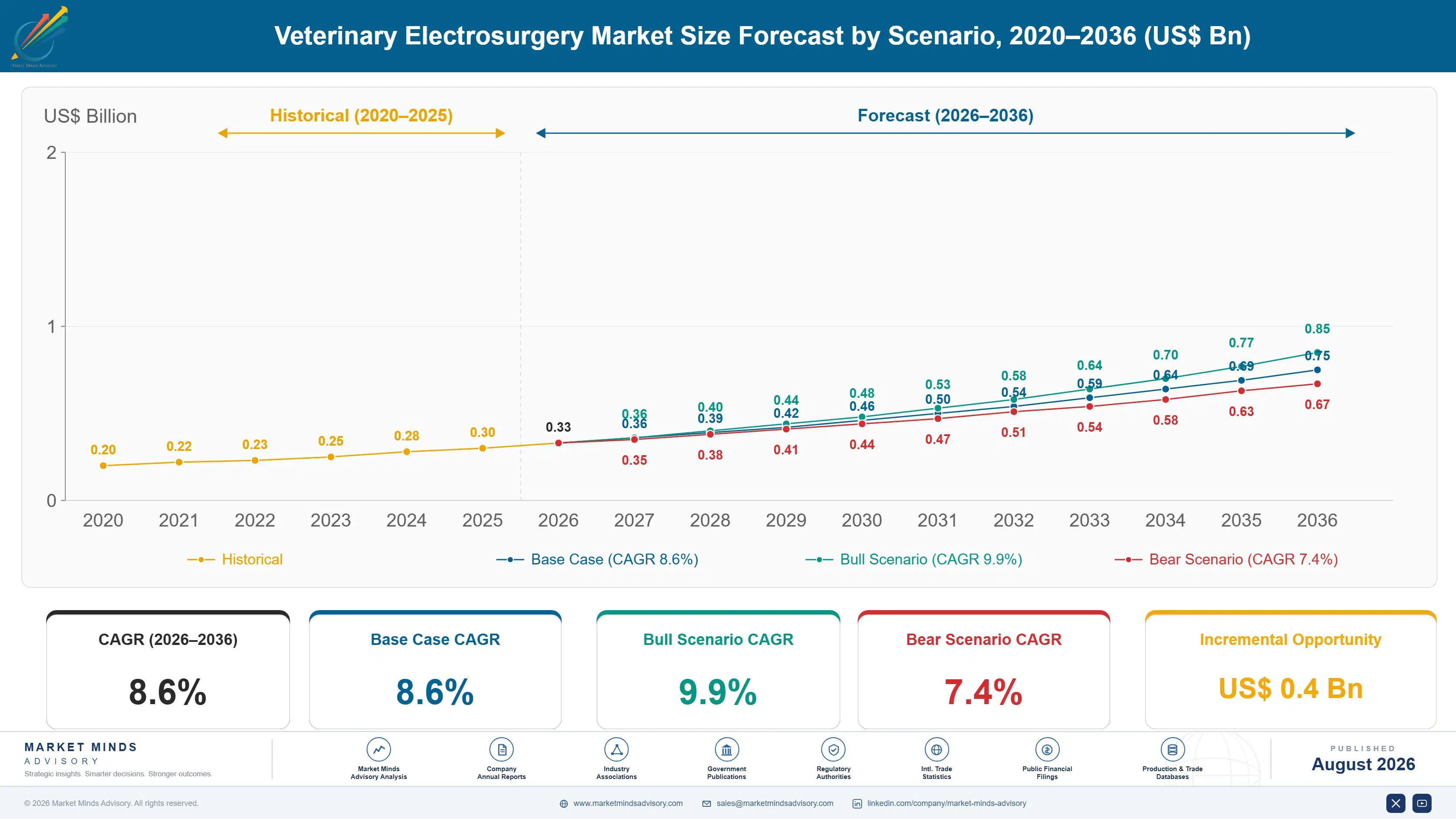
Growth of 7.3% across 2020 to 2025 was driven by two developments that arrived together. Companion animal ownership rose sharply during 2020 and 2021 and veterinary caseloads have not returned to prior levels since, while corporate consolidation of practices accelerated throughout the period. Vessel sealing conversion began as instrument pricing fell toward what a busy practice could justify against saved anaesthesia time.
The base case of 8.6% rests on three mechanisms. Vessel sealing keeps converting from conventional ligation because 17 minutes of anaesthesia removed from a routine procedure is measurable in throughput and in clinical risk together. Corporate groups keep consolidating practices and buying capital equipment on standardised specifications. And Asian companion animal ownership is rising quickly from a very low base, with veterinary surgical capability being built rather than upgraded alongside it.
The bull case of 9.9% assumes corporate group standardisation on vessel sealing becomes the default specification rather than a practice-level option, which would convert generator placement into a portfolio decision made once across hundreds of sites. The bear case of 7.4% reflects two pressures: companion animal caseloads normalising toward pre-2020 levels, and Asian instrument manufacturers taking consumable volume wherever generator compatibility allows it.

Seventeen Minutes Is The Whole Argument

Veterinary surgery buys human technology roughly a decade late at prices a small business can justify, and the justification is almost always anaesthesia time. Every anaesthetised minute carries mortality risk owners understand viscerally, nursing cost the practice pays directly, and theatre occupancy limiting procedures per day. Vessel sealing removes roughly 17 minutes from a routine ovariohysterectomy, which is a complete commercial argument on its own.
TOP FIVE CONCENTRATION58%Consumable units shipped by the leading veterinary suppliers
AVERAGE GENERATOR PRICEUSD 8,400Realised practice price for one electrosurgical generator unit
ANAESTHESIA TIME SAVED17 minutesReduction per procedure using advanced vessel sealing instead
CORPORATE GROUP OWNERSHIP31%Companion animal practices owned by consolidated corporate groups
SINGLE-USE CONVERSION38%Electrode volume supplied sterile rather than reprocessed between patients
GENERATOR REPLACEMENT CYCLE12 yearsInterval between electrosurgical generator replacement decisions in practices
The purchasing structure matters just as much. A practice buys a generator for roughly USD 8,400, keeps it for twelve years and buys that supplier's instruments throughout, which makes the placement the commercial asset and the consumable the annuity. What has changed is who decides. Corporate groups now own 31% of companion animal practices and specify capital equipment centrally, which moved the decision from a vet who liked a representative to a procurement team comparing total cost across sites.
Two forces determine the next decade. Corporate standardisation converts individual placements into portfolio decisions taken once and applied everywhere, which raises the stakes on each enormously. And Asian companion animal ownership is growing from a base so low that veterinary surgical capability is being built rather than upgraded, at instrument pricing Western suppliers cannot serve.
"Veterinary surgeons have always known that vessel sealing is faster, and for twenty years they could not afford it. What changed is not the technology, which is human kit at a lower price. It is that a corporate group counting anaesthesia minutes across four hundred practices can build a business case a single-site vet never could."
Director, Veterinary Surgical Systems Practice · MMA Medical Devices / Veterinar

Market Trends

Anaesthesia time converts vessel sealing into a throughput argument

Advanced bipolar vessel sealing removes roughly 17 minutes from a routine ovariohysterectomy against conventional ligation, and that time carries mortality risk, nursing cost and theatre occupancy simultaneously. No other argument in veterinary surgery combines clinical and commercial benefit that cleanly. The segment compounds at 12.9% against 8.6% for the market. Instrument cost per procedure is what limited adoption for two decades, and pricing has now fallen far enough that a busy small animal practice can justify it on saved theatre time alone. Corporate groups counting minutes across hundreds of sites build a case no single practice could.
Market Impact: Grows regional value at 10.7% yearl
Corporate consolidation moves purchasing from vets to procurement

Corporate groups own 31% of companion animal practices and keep acquiring, and they specify capital equipment centrally against standardised total cost comparisons rather than leaving it to individual clinical preference. That changes the sale completely: a supplier now presents anaesthesia time, consumable cost per procedure and service coverage to a procurement team across hundreds of sites. Winning a group specification places generators at scale, and losing one removes a whole territory at once. Independent practices increasingly follow group specifications anyway, since distributors stock what the groups have already standardised on.
Market Impact: Holds caseloads above 2019 levels

Market Opportunities and Growth Drivers

Asian companion animal ownership builds surgical capability from nothing

Companion animal ownership across China, India and Southeast Asia is rising very quickly from a low base, and veterinary surgical capability is being built rather than upgraded, which means practices are specifying equipment for the first time rather than replacing it. East Asia holds 22% of category value at 9.6% growth and South Asia and Pacific grows at 10.7%. Domestic instrument manufacturers supply most of that demand at price points Western suppliers cannot approach, so value growth trails caseload growth considerably. No incumbent generator constrains the choice, which favours whoever reaches the practice first.
Market Impact: Opens decisions every 12 years

Elevated caseloads since 2020 sustain theatre throughput pressure

Companion animal ownership rose sharply during 2020 and 2021 and veterinary caseloads have not returned to prior levels, while veterinary and nurse recruitment has been difficult across every developed market. That leaves practices with more surgical demand than theatre and staffing capacity can comfortably meet, which is exactly the condition that makes 17 saved minutes worth paying for. Practices under throughput pressure adopt vessel sealing considerably faster than those with spare capacity, regardless of clinical opinion. Veterinary and nurse recruitment difficulty compounds it across every developed market simultaneously and continuously.
Market Impact: Costs 14% of procedure revenue

Market Restraints and Challenges

Generator replacement cycles put decisions twelve years apart

A practice buys an electrosurgical generator for roughly USD 8,400 and keeps it for twelve years, and the root cause of slow conversion is that instrument compatibility follows the generator, so a challenger reaches the practice only at replacement or on outright failure. Clinical arguments presented between those moments change nothing. Suppliers respond by placing generators at nominal capital cost against instrument commitment, by targeting corporate groups where specification refreshes come sooner, and by offering trade-in programmes that create a decision point. Corporate specification refreshes arrive considerably sooner than individual practice replacement does.
Market Impact: Removes 17 anaesthesia minutes per

Instrument cost per procedure limits which practices can convert

A single-use vessel sealing instrument costs a meaningful share of what a practice charges for a routine spay, and the root cause is that veterinary procedure pricing is set against owner willingness to pay rather than against any reimbursement schedule. High-throughput and corporate practices absorb it and low-volume rural practices frequently cannot. Suppliers respond by offering reusable instrument options with limited use counts, by pricing tiered instrument ranges, and by concentrating commercially on the practices where throughput genuinely justifies it. Low-volume rural and mixed practices frequently continue with conventional ligation indefinitely.
Market Impact: Standardises across 31% of practice
3 additional market trends, 4 additional growth drivers, and 2 additional restraints and challenges are covered in the full report. Contact sales@marketmindsadvisory.com to access the complete intelligence.

Segment CAGR and Growth Architecture

Segmentation follows the device class, because each class carries a distinct purchasing pathway, replacement cycle and price basis. Animal type, practice setting and geography all matter commercially but cut across every device class, so they belong in later discussion. Six device classes cover current veterinary electrosurgery practice worldwide, and their commercial behaviour differs considerably between them.
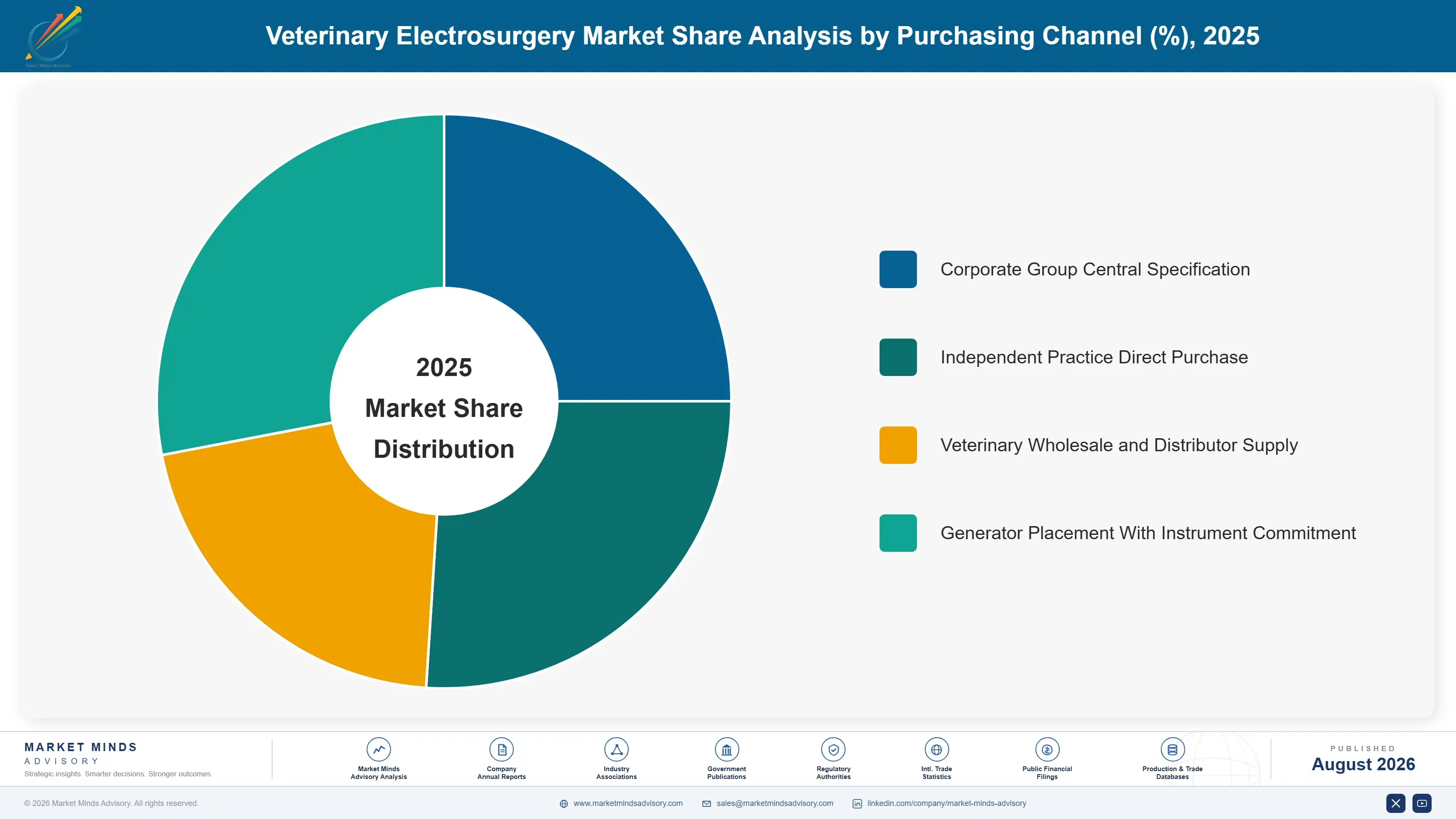
veterinary-electrosurgery-market-market-share-analysis-1787309959693

Advanced Bipolar Vessel Sealing Systems

Vessel sealing compounds at 12.9%, exactly 1.50 times the market rate, on an argument that took two decades to become affordable rather than to become true. Removing roughly 17 minutes of anaesthesia from a routine procedure carries mortality risk, nursing cost and theatre occupancy benefits at once, which nothing else in veterinary surgery matches. Three commercial features follow. Instrument cost per procedure still excludes low-throughput practices entirely. Corporate group specification is now the decisive sale rather than individual clinical preference. And generator compatibility means the placement decides consumable supply for twelve years afterwards. Instrument pricing fell far enough only recently for a busy small animal practice to justify the instrument cost.
CAGR 12.9%

Single-Use Electrode and Handpiece Consumables

Single-use consumables grow at 10.4%, second fastest, and conversion has reached 38% of electrode volume on infection control and convenience grounds together. A veterinary practice reprocessing electrodes between patients carries validation burden it is poorly equipped to demonstrate, and nursing time spent cleaning instruments is time not spent on caseload. Cost per procedure runs higher than reprocessing appears to. Commercially this is the annuity that makes generator placement worth competing for at all, and cross-compatible consumables are the one thing that breaks the link. Nursing time spent reprocessing electrodes is time not spent on a caseload most practices already cannot meet. Cross-compatible consumables are the one thing breaking that link.
CAGR 10.4%
Full segment breakdown across 6 segments available in the complete report.

Regional Architecture and Country Demand Map

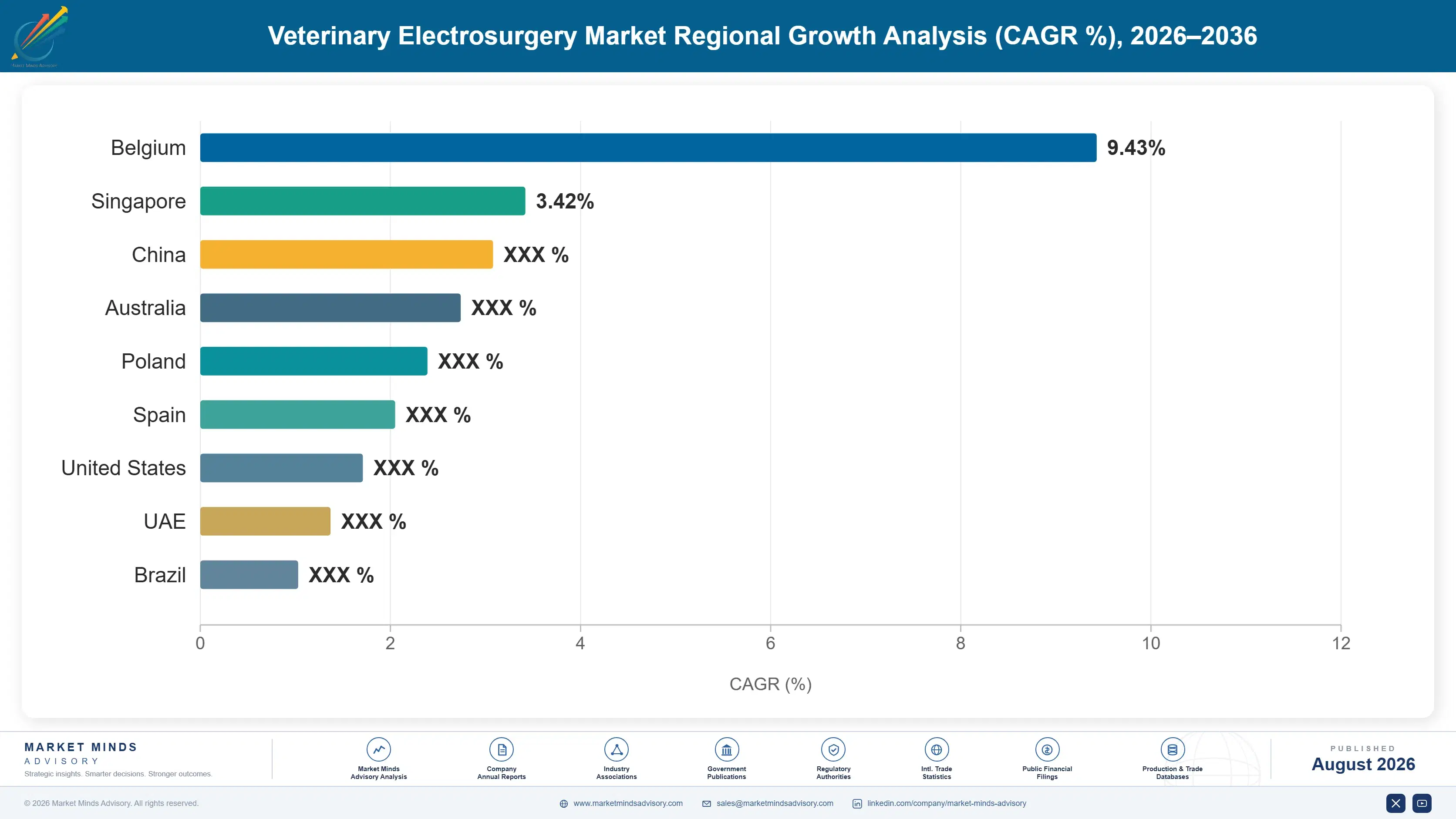
North America holds 32% of value because companion animal spend per patient and corporate practice consolidation are both furthest advanced there. Western Europe follows at 24%. East Asia follows at 22% on rapid pet ownership growth. South Asia and Pacific grows fastest, led by India at 11.2%.

North America

Thirty-two percent of global value sits in North America, growing at 7.9%, and the reason is spending per animal rather than animal numbers. Note: companion animal veterinary expenditure per patient here runs several times any other region, and corporate consolidation has gone furthest, which lifts equipment specification and consumable pricing well above global norms. Corporate groups now specify capital equipment centrally across hundreds of sites, which has changed the sale from clinical relationship to procurement comparison. Independent practices increasingly follow group specifications rather than setting their own. Vessel sealing conversion is furthest advanced here for the same throughput reasons, and instrument cost per procedure is most readily absorbed by practices here.
Share: 32% | CAGR: 7.9% (2026 to 2036)

Western Europe

Twenty-four percent of value and 7.1% growth reflect mature companion animal veterinary markets with corporate consolidation advancing steadily behind North America. British and Nordic corporate groups specify centrally in much the same way. German veterinary practice is more fragmented and more clinically conservative, which slows vessel sealing conversion regardless of the throughput argument. Erbe and Eickemeyer hold strong regional positions built on veterinary-specific distribution rather than adapted human product. Equine and production animal electrosurgery is a genuine niche across the region. Corporate account capability rather than clinical relationship increasingly decides who wins specifications, and several established suppliers have been slow to build it. Distributor reach still matters considerably for the independents.
Share: 24% | CAGR: 7.1% (2026 to 2036)
Regional intelligence for 5 additional markets available in the complete report: East Asia, South Asia and Pacific, Latin America, Middle East and Africa, Eastern Europe. Contact sales@marketmindsadvisory.com.
veterinary-electrosurgery-market-country-cagr-analysis-1787309960201

Four Ways To Place The Generator

A generator lasts twelve years and takes that supplier's instruments throughout, and corporate groups now specify centrally across hundreds of practices at once. The levers that matter reach group procurement, make the throughput argument in money, and place generators before a practice ever decides. Each carries returns tested against disclosed supplier economics and primary interview evidence.

Win corporate group specifications, not individual practices

Corporate groups own 31% of companion animal practices and specify capital equipment centrally, which means one specification decision places generators across hundreds of sites and one loss removes a territory entirely. Suppliers building dedicated corporate account capability report placement volume roughly 4 times higher than practice-level selling delivers. It requires procurement-facing commercial skills and total cost modelling that veterinary sales organisations built around clinical relationships have never needed to develop at all. Independent practices increasingly follow whatever the groups have already standardised on, which compounds the effect of every specification won.
Market Impact: Places roughly 4 times more generat

Quantify anaesthesia minutes in money, not in risk

Veterinary surgeons already accept that vessel sealing is faster and have done for two decades, so repeating the clinical argument changes nothing. Converting 17 saved minutes into nursing hours, theatre slots and additional procedures per day is what a procurement team can actually approve. Suppliers presenting that arithmetic report conversion roughly 55% faster than those presenting clinical evidence. It requires practice economics capability rather than clinical education, which is a genuinely different commercial skill set. Procurement teams approve money, and clinical evidence does not translate into money on its own anywhere.
Market Impact: Converts practices roughly 55% fast

Place generators against instrument commitment, not capital

A practice replaces its generator once every twelve years and buys that supplier's instruments throughout, which makes placement the only entry point a challenger ever gets at an account. Placing at nominal capital cost against multi-year instrument commitment converts a capital request nobody budgeted into a consumable line, and suppliers doing this report placement rates roughly 160% above outright equipment sales. It consumes working capital and requires declining commitments that will never deliver the instrument volume promised. Cross-compatible instruments undermine the model wherever a practice notices that they exist at all.
Market Impact: Lifts placements roughly 160% above

Reach new practices before any generator is installed

Asian and Latin American companion animal practices are being equipped for the first time rather than upgraded, which means no incumbent generator constrains the choice and the twelve-year cycle starts from whoever arrives first. Suppliers targeting new practice openings report acquisition cost per placement roughly 40% below competitive replacement wins. It requires distribution reach into markets where pricing is severe and margins are thin, which most Western suppliers have historically declined to build properly. The twelve-year cycle then starts from whichever supplier happened to arrive first at that particular practice.
Market Impact: Cuts acquisition cost roughly 40% b

Who Controls the Margin Pool

Five suppliers ship 58% of consumable units, the basis on which MMA assesses every participant here, and concentration follows installed generator bases rather than instrument design. Medtronic leads on vessel sealing technology adapted from its human surgical business. Erbe Elektromedizin holds the strongest European position built on veterinary-specific distribution rather than adapted product.
Competitive activity runs along three lines. Corporate group specification is the primary contest, because one decision now places generators across hundreds of practices. Instrument cost per procedure is where vessel sealing conversion is either enabled or blocked in mid-sized practices. And veterinary-specific distribution reach determines who is present when a new practice equips for the first time.

Pressure arrives from two directions. Chinese and Indian instrument manufacturers supply consumables at prices Western suppliers cannot approach wherever generator compatibility permits it, and compatibility is exactly what practices increasingly ask about. Meanwhile human surgical companies keep entering veterinary channels with adapted product at attractive pricing. Rankings shift toward participants holding corporate group specifications and closed consumable compatibility, because those two decide who owns the twelve-year annuity behind each placement. Distribution reach into first-time equipping markets is the third position worth holding.
veterinary-electrosurgery-market-company-positioning-matrix-1787309960720

Competitive Moat and Risk Dimensions

MEDTRONIC

Moat: Vessel sealing technology and scale

The company brings vessel sealing technology developed for human surgery into veterinary channels at pricing its scale makes possible, and clinical familiarity among surgeons trained alongside human theatre practice supports adoption. Its instrument range breadth covers procedure types smaller veterinary specialists cannot economically serve. Corporate procurement teams recognise the brand from their own healthcare experience.
MEDTRONIC

Risk: Veterinary channel attention limits

Veterinary electrosurgery is very small within an enormous human surgical business, which means distribution investment, veterinary-specific product development and practice-level support compete against human programmes with vastly greater revenue. Veterinary specialists cultivate practice relationships far more attentively. Corporate groups also negotiate hard against a supplier they know sells the same technology elsewhere at different prices.
ERBE ELEKTROMEDIZIN

Moat: Veterinary distribution and product focus

The company built veterinary-specific distribution and product configurations rather than adapting human equipment, which shows in generator interfaces, instrument sizing and service arrangements designed around how practices actually work. European veterinary distributors carry it as a primary line rather than an afterthought. That focus produces practice-level loyalty that scale advantages alone do not generate anywhere.
ERBE ELEKTROMEDIZIN

Risk: Corporate procurement scale disadvantage

Corporate groups specifying across hundreds of practices negotiate on total cost in ways that favour suppliers with greater manufacturing scale and broader portfolios to trade against. Practice-level loyalty matters considerably less once a group specifies centrally. Building corporate account capability requires commercial skills quite different from the distributor and clinical relationships the company has traditionally relied upon.

Players Tracked

Prominent Players

Medtronic
Erbe Elektromedizin
Symmetry Surgical
Eickemeyer
B. Braun Melsungen

Other Key Players

Apyx Medical
Olympus
Ethicon
KLS Martin
Bowa Medical
Utah Medical Products
DRE Veterinary
Jorgensen Laboratories
Vetamac
Burtons Medical Equipment
Surgical Holdings
Everost
Jiangsu Kangjin Medical
Sklar Surgical Instruments
Kruuse

Recent Developments

MAY 2025

Medtronic launched a veterinary-specific vessel sealing instrument range

The launch covers instrument sizes and jaw configurations designed for small animal anatomy rather than adapted from human product, addressing a fit complaint veterinary surgeons had raised for years. It was an organic product development programme rather than an acquisition, joint venture or partnership arrangement of any kind whatsoever.
Signal: Designing for small animal anatomy rather
OCTOBER 2025

Erbe agreed expanded veterinary distribution across Asian markets

The agreement extends veterinary-specific distribution into markets where companion animal practices are equipping for the first time and no incumbent generator constrains the specification choice. Terms were not disclosed. It was a distribution agreement rather than an acquisition, joint venture or equity investment of any kind.
Signal: Reaching first-time practices matters beca
FEBRUARY 2026

Symmetry Surgical acquired a veterinary electrosurgery distributor

The acquisition brings direct veterinary channel access and corporate group relationships that a manufacturer selling through third parties could not build itself, addressing the procurement shift that corporate consolidation has now produced. Terms were not disclosed. It was an outright acquisition rather than a distribution arrangement.
Signal: Buying the distribution and group relation

Semiconductors, Alloys And Polymers

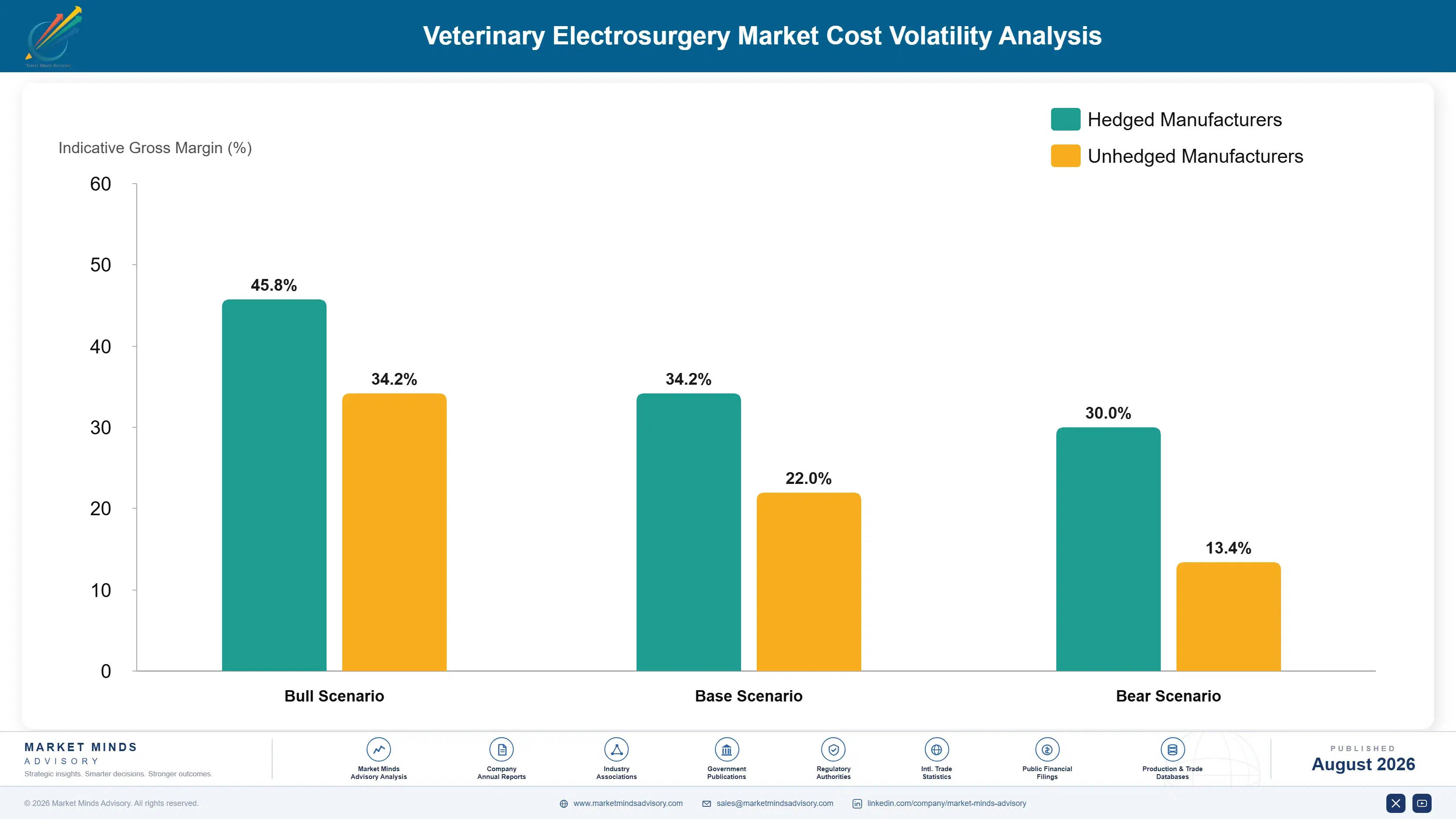
Cost structure divides between a capital electronic device and a disposable instrument. Power semiconductors, control electronics and transformers are roughly 36% of generator cost of goods, through channels serving industrial and medical electronics. Stainless steel, tungsten and specialised jaw alloys contribute 27% of instrument cost. Polymer housings, silicone cable insulation and packaging add 21%, with sterilisation and validation making up the balance on single-use ranges.
The 2021 and 2022 period tested both halves at once. SEMI reported foundry capacity fully allocated across the window, which lengthened lead times for the power and control semiconductors generators depend upon, while polymer and alloy prices rose sharply as feedstock and energy costs climbed. IEA data recorded industrial energy prices well above prior averages. US Census Bureau data recorded higher landed values for surgical instruments in the same period.

Exposure varies by product half and by channel, and the mechanism is distributor and corporate contract pricing against variable component cost. Generator-weighted suppliers faced component availability rather than price, which delayed placements the whole consumable annuity depends upon. Instrument-weighted suppliers absorbed polymer and alloy movement against contracts signed earlier. Asian manufacturers with domestic component supply were insulated and gained consumable share wherever compatibility allowed.
veterinary-electrosurgery-market-cost-volatility-analysis-1787309960915

Design generators around mature multiply-sourced semiconductor nodes

Power and control semiconductors inside generators competed for foundry capacity against consumer and automotive electronics and lost across 2021 and 2022, delaying the placements every consumable annuity depends upon. Designing to mature nodes with several qualified suppliers costs some capability and removes that exposure permanently. Generator revalidation is substantial, so most do this at platform refresh.

Index corporate group contracts to alloy and polymer benchmarks

Multi-year corporate group contracts transferred the whole 2021 and 2022 alloy and polymer movement onto suppliers with no recovery mechanism available at all. Indexation to published benchmarks shares that exposure, and group procurement teams accept it more readily at renewal than suppliers expect once the arithmetic is shown. Those who never raised it absorbed the movement as margin compression instead.

Qualify alternative sterilisation for compatible instrument materials

Ethylene oxide sterilisation faces tightening emission requirements raising cost and reducing available capacity across surgical consumables generally. Instrument materials tolerating electron beam or gamma processes can be requalified, removing that exposure for part of the range. Polymer housings and cable insulation frequently do not tolerate radiation well, so conversion is partial rather than complete across any portfolio.

Portfolio Architecture for Margin Defence

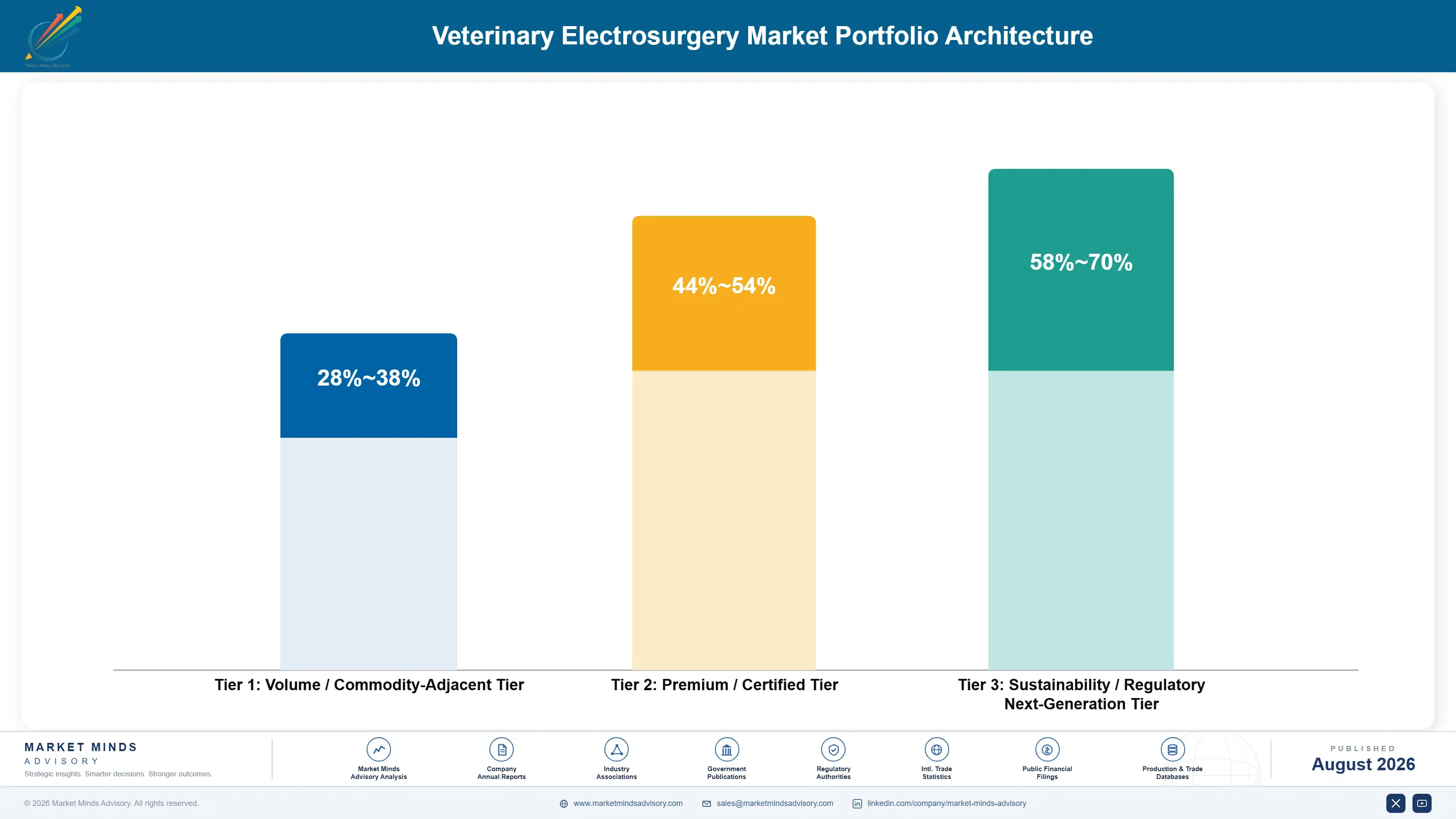
Portfolio economics separate on whether the generator protects the consumable. Conventional bipolar forceps, cables and return electrodes earn gross margin in the low thirties, competing against Asian manufacturers wherever compatibility is open. Monopolar generators frequently earn very little, because placement at nominal capital cost is how the instrument annuity begins. Single-use consumables earn considerably more, and vessel sealing instruments earn most because the anaesthesia time argume
The volume and premium tension runs through the placement decision and corporate specification. Aggressive placement wins twelve years of instrument supply and every concession compresses the annuity the placement exists to create. Corporate groups negotiating across hundreds of sites have sharpened that arithmetic, because one specification carries far more volume and pricing pressure than any single practice did.

High-value pools concentrate in three places: vessel sealing instruments where the throughput argument carries pricing, corporate group specifications that place generators at scale, and first-time practice equipping in Asian and Latin American markets where no incumbent constrains the choice. None is large in absolute revenue terms. Each is defended by throughput economics, procurement relationships or distribution reach rather than by device engineering, which human surgical companies replicate very readily.

Volume / Commodity-Adjacent Tier

Conventional bipolar forceps, cables, return electrodes and general accessories. Asian manufacturers set pricing wherever generator compatibility is open, and nothing about these products differentiates one supplier from another commercially anywhere in the world.
Gross Margin: 28-38%

Premium / Certified Tier

Monopolar generators, single-use electrode and handpiece consumables and smoke evacuation systems. Generator compatibility and infection control practice defend pricing. The ten-point range reflects closed against open compatibility economics across practices.
Gross Margin: 44-54%

Sustainability / Regulatory / Next-Generation Tier

Advanced bipolar vessel sealing systems and their dedicated instruments. Anaesthesia time economics and corporate specification defend pricing entirely. The twelve-point range reflects group-specified against practice-level purchasing economics throughout every developed market.
Gross Margin: 58-70%
veterinary-electrosurgery-market-portfolio-architecture-1787309961419

High-value Sub-segments and Strategic Watch-out

Vessel sealing instrument annuities

Where 17 saved anaesthesia minutes support pricing no commodity electrode approaches, and generator compatibility protects the stream for twelve years. Corporate specification decides who holds it. Instrument cost still excludes low-throughput practices entirely. Pricing fell far enough far enough for that only very recently indeed.
Gross Margin: 60-70%

Corporate group specifications

One decision placing generators across hundreds of practices and one loss removing a whole territory, which raises the stakes on every negotiation enormously. Procurement skills matter more than clinical relationships now. Independents follow group specifications anyway. Total cost modelling is what actually wins these tenders now.
Gross Margin: 54-66%

Open compatibility consumable volume

The weakest position in the category, competing against Asian manufacturers wherever a generator accepts third-party instruments at equivalent specification. Closed compatibility is the only real defence. Practices increasingly ask about it directly. Nothing about the consumables themselves distinguishes one supplier from another anywhere in this tier.
Gross Margin: 28-38%

First-time practice equipping markets

Asian and Latin American practices specifying equipment for the first time, where no incumbent generator constrains the choice at all. Distribution reach rather than product decides it. Acquisition cost per placement is considerably lower. Most Western suppliers have never ever troubled to build out that reach.
Gross Margin: 42-54%

How Practice Demand Actually Recurs

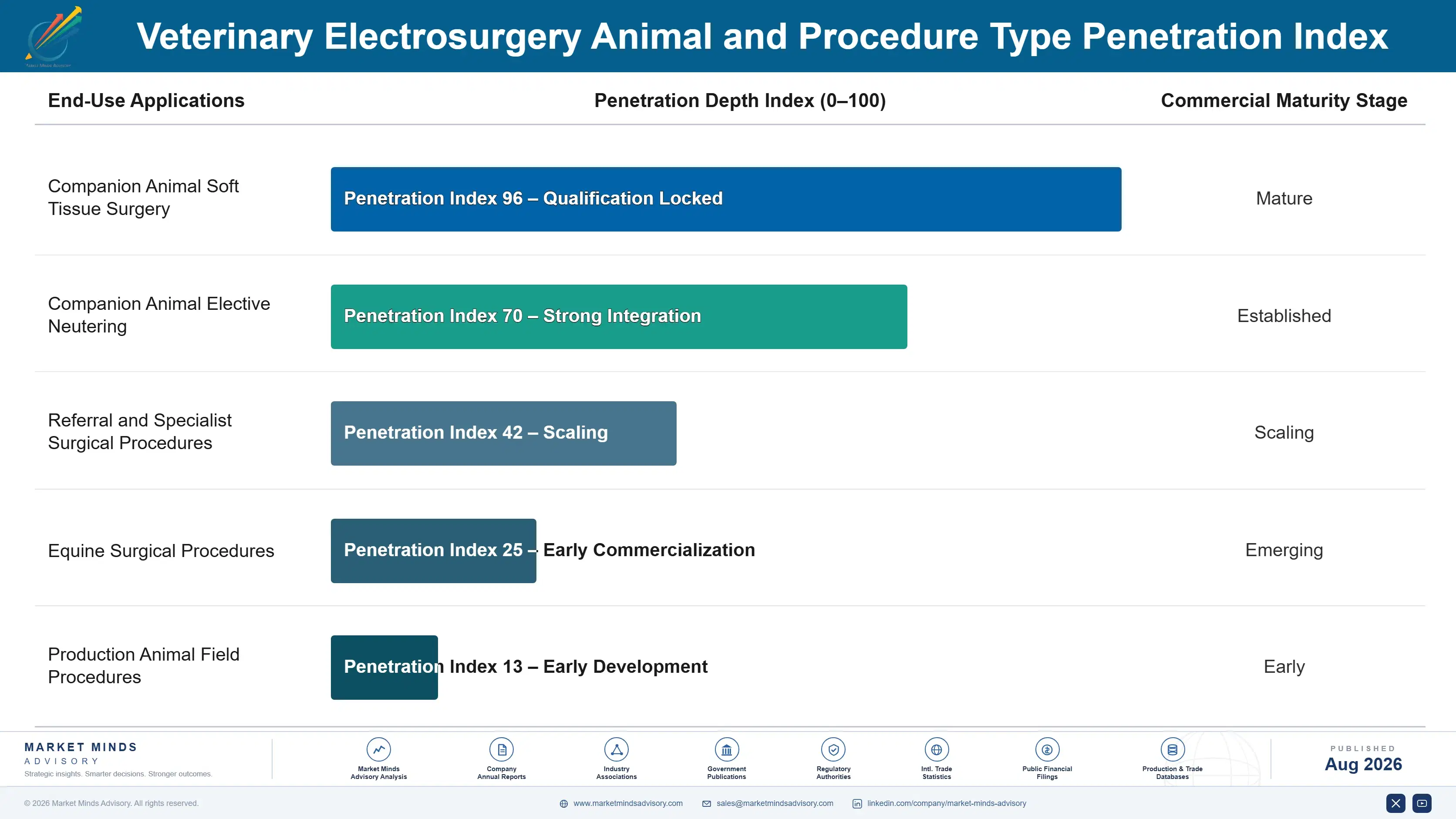
Demand behaves as a consumable annuity anchored by a capital placement, and the anchor lasts an unusually long time. A practice buys a generator, keeps it for twelve years and consumes that supplier's instruments at a rate set by its surgical caseload, which no commercial effort changes. Single-use conversion strengthens the annuity because an instrument is consumed per procedure rather than reprocessed across many. Cross-compatible consumables are the only thing that lets a practice separate th
Adoption depth varies sharply by caseload and ownership. High-throughput corporate practices adopt vessel sealing deepest, since saved anaesthesia minutes convert into additional procedures a day that the group counts across sites. Referral and specialist hospitals adopt everything early because case complexity justifies it. Mid-sized independent practices adopt selectively on instrument cost per procedure. Low-volume rural and mixed practices frequently cannot justify vessel sealing at all and continue with conventional ligation.

Buyer profiles have moved from the vet to the group. Equipment was once chosen by a practice principal who liked a representative and trusted a demonstration. Now a procurement team compares total cost across hundreds of sites, and the demonstration reaches somebody who will never operate.
veterinary-electrosurgery-market-end-use-penetration-index-1787309961909

What We Would Do Here

These are among the four positions where our research anticipates prominent divergence between winners and laggards over the coming forecast period. Each is grounded in the demand model, the regulatory perimeter, and the announced capacity pipeline.
01 / CORPORATE ACCOUNT CAPABILITY

Sell to group procurement, not to practice principals

Corporate groups own 31% of companion animal practices and specify capital equipment centrally, which means a single specification decision places generators across hundreds of sites while one loss removes an entire territory at once. Suppliers building dedicated corporate account capability report placement volume roughly 4 times higher than practice-level selling has ever delivered to them. It demands procurement-facing skills and total cost modelling that veterinary sales organisations built around clinical relationships have never had any reason at all to develop before now.
02 / THROUGHPUT ECONOMICS TRANSLATION

Convert saved minutes into money before presenting them

Veterinary surgeons have accepted for two decades that vessel sealing is faster, so repeating the clinical argument to them changes absolutely nothing about a purchasing decision. Translating 17 saved minutes into nursing hours, theatre slots and additional daily procedures is what a procurement team can actually approve, and suppliers presenting that arithmetic report conversion roughly 55% faster than competitors presenting clinical evidence instead. It needs practice economics capability rather than clinical education, which is a genuinely different commercial skill from the one they have.
03 / PLACEMENT OVER CAPITAL SALE

Give the generator away and keep the instruments

A practice replaces its electrosurgical generator roughly once every twelve years and consumes that supplier's instruments throughout, which makes placement the only realistic entry point a challenger ever gets at any account. Placing at nominal capital cost against multi-year instrument commitment converts a capital request nobody budgeted into a consumable line, and placement rates run roughly 160% above outright equipment sales. It consumes working capital and demands the discipline to decline commitments that will never deliver the promised instrument volume.
04 / FIRST-TIME MARKET REACH

Arrive before the practice buys anything at all

Asian and Latin American companion animal practices are being equipped for the first time rather than upgraded, which means no incumbent generator constrains the specification and the twelve-year cycle begins with whoever happens to arrive first. Suppliers targeting new practice openings report acquisition cost per placement roughly 40% below what competitive replacement wins cost them elsewhere. It requires distribution reach into markets where pricing is severe and margins are genuinely thin, which most Western suppliers have historically declined to build out at all.

Engagement Snapshot From the Field

A live engagement with an industry participant carrying material or product regulatory and market exposure ahead of a defining policy shift, showing how our research translates into a defensible multi-year portfolio strategy.
MARKET MINDS ADVISORY · CLIENT ENGAGEMENT SUMMARY
Veterinary Electrosurgery Producer Strategic Portfolio Review and Transition Roadmap 2026·Investment Scenario on Veterinary Electrosurgery Exposure Evaluation 2025-26
CLIENT PROFILE
A Western European veterinary equipment manufacturer with electrosurgery revenue near EUR 38 million annually (client-reported, unverified by MMA), a well-regarded generator and instrument range, distribution through third-party veterinary wholesalers in most markets, no corporate account team, and a sales organisation calling on practice principals. Roughly 81% of revenue came from independent practices in markets where corporate consolidation was accelerating.
STRATEGIC CHALLENGE
Generator placements had declined for three consecutive years despite growing veterinary caseloads, and management proposed a generator feature refresh to differentiate against larger competitors. The board suspected the losses reflected who was now deciding rather than what the product did, but nobody had analysed where the lost placements had actually gone.
MMA APPROACH
MMA reconstructed 94 generator placement decisions across six markets, coding each by decision maker, criterion and winning supplier. Forty-seven expert interviews with corporate group procurement leads, practice principals, veterinary surgeons and wholesale distributors established how specifications were actually set. The client's commercial model was then benchmarked against suppliers winning corporate specifications.
KEY FINDINGS
  1. Sixty-one of 94 placements were decided by corporate group procurement rather than by any individual practice, and the client had never been invited to tender for a single one of those specifications.
  2. Every corporate specification reviewed had been decided on total cost including instrument consumption over the equipment life, and the client had no model capable of presenting that comparison.
  3. Generator features raised by management as differentiators were mentioned by no procurement lead interviewed, and by only two of the practice principals in the sample.
  4. Third-party wholesalers carrying the client's range had no relationship with corporate group procurement, which left the client entirely absent from wherever the decisions were actually being taken.
CLIENT PROFILE
A Western European veterinary equipment manufacturer with electrosurgery revenue near EUR 38 million annually (client-reported, unverified by MMA), a well-regarded generator and instrument range, distribution through third-party veterinary wholesalers in most markets, no corporate account team, and a sales organisation calling on practice principals. Roughly 81% of revenue came from independent practices in markets where corporate consolidation was accelerating.
STRATEGIC CHALLENGE
Generator placements had declined for three consecutive years despite growing veterinary caseloads, and management proposed a generator feature refresh to differentiate against larger competitors. The board suspected the losses reflected who was now deciding rather than what the product did, but nobody had analysed where the lost placements had actually gone.
MMA APPROACH
MMA reconstructed 94 generator placement decisions across six markets, coding each by decision maker, criterion and winning supplier. Forty-seven expert interviews with corporate group procurement leads, practice principals, veterinary surgeons and wholesale distributors established how specifications were actually set. The client's commercial model was then benchmarked against suppliers winning corporate specifications.
KEY FINDINGS
  1. Sixty-one of 94 placements were decided by corporate group procurement rather than by any individual practice, and the client had never been invited to tender for a single one of those specifications.
  2. Every corporate specification reviewed had been decided on total cost including instrument consumption over the equipment life, and the client had no model capable of presenting that comparison.
  3. Generator features raised by management as differentiators were mentioned by no procurement lead interviewed, and by only two of the practice principals in the sample.
  4. Third-party wholesalers carrying the client's range had no relationship with corporate group procurement, which left the client entirely absent from wherever the decisions were actually being taken.
RECOMMENDED STRATEGY
Phase 1: Phase 1 (0 to 9 months): Cancel the generator feature refresh, and build a total cost of ownership model covering instrument consumption over equipment life. Phase 2: Phase 2 (9 to 24 months): Establish a direct corporate account team, and pursue group specifications in the three markets where consolidation is furthest advanced. Phase 3: Phase 3 (24 to 42 months): Place generators against instrument commitment in group accounts, and build distribution into first-time equipping markets.
OUTCOME
The feature refresh was cancelled before engineering commitment. A total cost model was built and used in three group tenders within four quarters, winning one of them (client-reported, unverified by MMA). A corporate account team was established with two hires rather than the four proposed. First-time market distribution work began in one market and remains at an early stage.

Frequently Asked Questions

Foundational context covering the market sizes, CAGR, scope, country, region and competition that inform every finding below. This section is provided to cover basics and most often pre-purchase conversations, answered from the MMA Primary Research Dataset.

What is the current size of the Veterinary Electrosurgery Market?

MMA sizes the global veterinary electrosurgery market at USD 0.29 billion in 2025, rising to USD 0.31 billion in 2026. That covers generator, instrument and consumable revenue at realised practice price across all animal settings.

How large will the Veterinary Electrosurgery Market be by 2036?

MMA forecasts USD 0.71 billion by 2036, an expansion multiple of 2.29 times the 2026 base. That represents roughly USD 0.4 billion of incremental revenue across the forecast period.

What is the CAGR for the Veterinary Electrosurgery Market 2026 to 2036?

The base case compounds at 8.6% annually, with a bull case of 9.9% and a bear case of 7.4%. Whether corporate groups standardise on vessel sealing decides which case materialises.

Which segment is growing fastest?

Advanced bipolar vessel sealing systems compound at 12.9%, exactly 1.50 times the market rate. Removing roughly 17 anaesthesia minutes from a routine procedure is the entire commercial argument.

Who are the major companies in the Veterinary Electrosurgery Market?

The top five suppliers ship 58% of consumable units, led by Medtronic and Erbe Elektromedizin. Twenty participants are profiled in full, spanning generator, instrument and veterinary distribution suppliers.

Which country is growing fastest?

India compounds at 11.2%, ahead of every other national market MMA tracks here. Urban companion animal practice expanding and equipping for the first time drives that growth.

Report Segmentation Architecture

The full report scope spans multiple orthogonal segmentation dimensions, with cross-tabulated demand data provided for each dimension pair. Coverage extends further to regional breakdowns, trend trajectories, and the competitive detail needed to support segment-level decision-making.

By Device Class

  • Advanced Bipolar Vessel Sealing Systems
  • Single-Use Electrode and Handpiece Consumables
  • Surgical Smoke Evacuation Systems
  • Monopolar Electrosurgical Generators
  • Conventional Bipolar Forceps and Cables
  • Electrosurgical Accessories and Return Electrodes

By Animal and Procedure Type

  • Companion Animal Soft Tissue Surgery
  • Companion Animal Elective Neutering
  • Referral and Specialist Surgical Procedures
  • Equine Surgical Procedures
  • Production Animal Field Procedures

By Purchasing Channel

  • Corporate Group Central Specification
  • Independent Practice Direct Purchase
  • Veterinary Wholesale and Distributor Supply
  • Generator Placement With Instrument Commitment

By Region

  • North America
  • Western Europe
  • East Asia
  • South Asia and Pacific
  • Latin America
  • Middle East and Africa
  • Eastern Europe

Scope, Methodology, and Coverage

Every figure in this report is reproducible from documented input assumptions. The scope below maps the historical period, the forecast horizon, the segmentation dimensions, and the countries covered, alongside the underlying primary and qualitative methodology.
Historical Period
2020 to 2025
Forecast Period
2026 to 2036
Base Year
2025 (USD billions; MMA Primary Research Dataset, August 2026)
Market Definition
The market comprises electrosurgical systems used in veterinary practice, spanning advanced bipolar vessel sealing systems, single-use electrode and handpiece consumables, surgical smoke evacuation systems, monopolar electrosurgical generators, conventional bipolar forceps and cables, and electrosurgical accessories and return electrodes. Sizing captures generator, instrument and consumable revenue at realised practice price across companion animal, equine and production animal settings. Surgical lasers and cryosurgery, human medical electrosurgery, veterinary anaesthesia and monitoring equipment, non-electrosurgical instruments, veterinary imaging and diagnostics, and animal health pharmaceuticals are outside scope.
Quantitative Units
USD billions (current prices); million consumable units shipped annually; USD per generator at realised practice price
Segmentation Dimensions
By Device Class; By Animal and Procedure Type; By Purchasing Channel; By Region
Regions Covered
North America, Western Europe, East Asia, South Asia and Pacific, Latin America, Middle East and Africa, Eastern Europe
Countries Covered
USA, Canada, UK, Germany, France, Netherlands, Sweden, Denmark, Italy, Spain, Switzerland, Austria, Japan, China, South Korea, Taiwan, India, Australia, New Zealand, Brazil, Mexico, Argentina, Colombia, Indonesia, Thailand, UAE, Saudi Arabia, Turkey, South Africa, Poland, Czech Republic, and additional markets relevant to this sector
Key Companies Profiled
Medtronic, Erbe Elektromedizin, Symmetry Surgical, Eickemeyer, B. Braun Melsungen, Apyx Medical, Olympus, Ethicon, KLS Martin, Bowa Medical, Utah Medical Products, DRE Veterinary, Jorgensen Laboratories, Vetamac, Burtons Medical Equipment, Surgical Holdings, Everost, Jiangsu Kangjin Medical, Sklar Surgical Instruments, Kruuse.
Quantitative Methodology
Primary survey, n=3,800 respondents, Q4 2025, six countries; demand-side model with trade association cross-validation
Qualitative Methodology
47 expert interviews, Q4 2025; applied to validate demand model assumptions, identify emerging dynamics, and assess competitive positioning
Report Format
PDF and XLSX data workbook (Word format preview document)
Publisher
Market Minds Advisory
Report Code
MMA-2026-MED-354
Published
August 2026
Contact
sales@marketmindsadvisory.com | www.marketmindsadvisory.com

Purchase the full Veterinary Electrosurgery Market Report (2026 to 2036).

The full report sizes the veterinary electrosurgery market across six device classes, five animal and procedure types, four purchasing channels and seven regions, with annual forecasts to 2036 in revenue and consumable units. It reconstructs generator placement decisions across a large sample, coding each by who decided and on what criterion, which is the analysis that quantifies how far corporate consolidation has already moved specification away from practices. Twenty participants are assessed on a consistent consumable units basis, with corporate account capability and consumable compatibility exposure mapped separately. Anaesthesia time economics are modelled by procedure type and practice caseload.
Six device classes sized and forecast annually
Generator placement decisions coded by decision maker
Twenty participants on consistent consumable units basis
Corporate account capability mapped supplier by supplier
Consumable compatibility exposure quantified for every participant
Anaesthesia time economics modelled by procedure and caseload

Built For The People Who Decide

From boardroom strategy to bench-side execution, this report is read cover-to-cover by leaders shaping the next decade of their industry, turning demand scenarios, market dynamics and valuation benchmarks into decisions.
CXOs/ Presidents/ VPs/ Managers
M&A and Corporate Development
Strategy Teams and R&D Heads
Procurement and Product Directors
Regulatory and Compliance Leaders
Investor Relations and Equity Analysts