Market Minds Advisory
Veterinary Computed Tomography (CT) Scanner Market

Veterinary Computed Tomography (CT) Scanner Market: Multi-Slice Adoption and the Specialty Referral Diagnostics Shift

Multi-slice CT systems delivering faster scan times are displacing single-slice scanners as specialty veterinary referral centers expand advanced diagnostic capability across major companion animal healthcare markets and referral networks nationwide.

Lead Analyst

Alice Ballenger

Published

September 2026

Make Smarter Decisions with Customized Research Insights

Request a free sample report and evaluate market opportunities, growth trends, and competitive dynamics relevant to your business needs.

2025 MARKET VALUE$0.6BMarket Size 2025
2036 FORECAST VALUE$1.5BBase Case , 2026 to 2036
CAGR 2026 TO 20368.2 %Bull 9.4% / Bear 6.9%
INCREMENTAL OPPORTUNITY$0.8BNet 10- year value creation
EXPANSION MULTIPLE2.19x2036 value over 2026 base
Strategic Levers
M&A Pipeline
Regional Outlook
Country Rankings
Competitive Intelligence
Segmental Deep-dive
Call-Us : 91 93563 13602

Executive Snapshot and Market Trajectory

Multi-slice CT systems delivering faster scan times and finer resolution are displacing single-slice scanners as specialty veterinary referral centers expand advanced diagnostic capability, and hospital directors increasingly select vendors on scan speed rather than acquisition price alone this capital budgeting cycle. Bundled service support increasingly factors into that decision too.
Companion animal orthopedic and oncologic imaging drive most system demand, but multi-slice CT systems are pulling share fastest as faster scan times reduce anesthesia exposure for sedated patients. North America holds the deepest installed base on specialty referral center density and pet insurance-supported diagnostic spend, while China's referral infrastructure growth is closing the adoption gap from a smaller starting point. Manufacturers with strong East Asian distribution keep capturing disproportionate placement growth.
Five manufacturers hold roughly fifty-eight percent of system revenue, leaving meaningful room for veterinary-specialist and regional challengers to compete on price and workflow depth. Widening comparative data on anesthesia time reduction and a growing body of referral hospital procurement literature are reshaping which scanner platforms specialty practices default to across both companion animal and equine imaging nationwide this decade. Manufacturers watch this shift closely nationwide.
Market Definition
This market covers computed tomography scanners designed or adapted for veterinary diagnostic imaging, including multi-slice, single-slice, and cone-beam systems used in companion animal and specialty referral practice. It excludes MRI systems, digital radiography equipment, and the anesthesia and positioning equipment used alongside these scanners.
Base Year Value
$0.6B in 2025 (MMA Primary Research Dataset, August 2026)
Forecast Period
2026 to 2036, eleven discrete annual values
CAGR
8.2% base case. Bull 9.4%. Bear 6.9%.
Fastest Growth Segment
Multi-Slice CT Systems: 12.2% CAGR
Fastest Growth Country
China: 11.8% CAGR
Fastest Growth Region
South Asia and Pacific: 10.2% CAGR
Largest Region
North America: 32% of 2025 global value
Market Leaders
GE HealthCare, Siemens Healthineers, Canon Medical, Epica Animal Health, Asto CT. Source: MMA Analysis based on company annual reports.
Primary Survey
n=3,800 procurement and R&D decision-makers, Q4 2025, six countries
Methodology
Demand-side build-up, cross-validated against public data, 47 expert interviews

Veterinary Computed Tomography (CT) Scanner Market Forecast Scenarios

veterinary-computed-tomography-ct-scanner-market-size-forecast-scenario-1787310119071
System revenue grew steadily across 2020 to 2025 as specialty veterinary referral centers expanded advanced imaging capability alongside rising companion animal healthcare spend. Growth decelerated briefly in 2021 amid deferred elective imaging procedures during the pandemic before resuming its prior trajectory through the remainder of the historical period into 2025. Specialty referral centers led this early adoption before diffusing into general practice settings.
The base case assumes continued double-digit growth in multi-slice adoption, expanding pet insurance coverage supporting advanced diagnostic spend across major markets, and steady replacement demand as first-generation single-slice scanners reach their nine-year capital replacement mark. Referral center capital budget cycles, radiologist training capacity, and integration complexity with existing anesthesia workflows remain the binding constraints on faster diffusion across smaller general practices. Vendor training program capacity continues expanding to reach smaller regional practices gradually.
The bull case rests on expanding pet insurance coverage pulling forward advanced imaging demand industry-wide and accelerating premium platform conversion. The bear case centers on general practice capital budget constraints, which could stretch purchasing decisions and depress new system placements through the middle of the forecast period nationwide. Manufacturers are watching both scenarios closely as insurance coverage expands nationwide.

Scan Speed as the Defining Capital Purchase Criterion

Veterinary CT scanning sits at the intersection of specialty referral medicine and precision imaging hardware, and the category's growth increasingly tracks which platforms can minimize anesthesia exposure time for sedated companion animal patients while delivering diagnostic-grade resolution. Procurement criteria are shifting accordingly at high-volume referral centers this budget cycle. Manufacturers who can shorten that scan window fastest win at the point of committee selection each cycle.
MARKET CONCENTRATION (CR5)58%top five holders control most global system revenue
AVERAGE SYSTEM PRICE$310,000typical multi-slice scanner cost with standard configuration included
LEADING COUNTRY SHARE28%United States dominates global installed base by far
MULTI-SLICE ATTACH RATE37%new referral center purchases now including multi-slice capability
CAPITAL REPLACEMENT CYCLE9 yearstypical interval before full scanner platform replacement occurs
SERVICE REVENUE SHARE29%portion of category revenue from recurring support and consumables
Commercially, the category behaves like a hybrid capital and service business: the scanner console itself carries substantial upfront pricing, but service contracts, contrast media, and software licensing sustain manufacturer revenue well past the initial system sale across a typical nine-year replacement cycle. Service attach rate increasingly drives blended margin more than console pricing alone. Manufacturers with strong service attach rates are outperforming console-only competitors on blended margin.
The next decade will be shaped by multi-slice becoming standard rather than premium, expanding pet insurance coverage supporting advanced diagnostic spend beyond specialty referral centers alone, and referral hospital budget committees demanding demonstrated anesthesia-time efficiency gains before approving new capital purchases nationwide. Manufacturers investing early in expanded workflow data stand to capture disproportionate long-term share. Manufacturers funding comparative workflow studies capture disproportionate formulary share.
"A sedated Labrador does not hold still for a three-minute single-slice scan the way a cooperative human patient does. That is the entire commercial argument for multi-slice, and referral centers have caught on fast."
Director, Veterinary Technology Practice · MMA Medical Devices Practice &m

Market Trends

Multi-Slice Systems Reduce Companion Animal Anesthesia Exposure

Multi-slice CT systems complete full-body companion animal scans substantially faster than single-slice predecessors, letting referral centers reduce anesthesia exposure time for sedated patients while improving daily case throughput. Early comparative data shows meaningfully lower anesthesia-related complication rates when scan time drops below the threshold that keeps patients under sedation longest. Three of the five leading manufacturers now ship multi-slice platforms as their flagship veterinary offering, and two smaller competitors have announced comparable systems entering trials in 2026 targeting expanded companion animal applications. Referral center procurement teams increasingly treat multi-slice speed as baseline, not an upsell.
Market Impact: Adds 85,000 annual oncology scans
Pet Insurance Coverage Expands Advanced Diagnostic Access

Expanding pet insurance coverage across major markets is reducing the out-of-pocket cost barrier for advanced imaging, directly driving referral volume toward specialty centers offering CT diagnostic capability. Several large pet insurance providers report meaningfully higher policyholder utilization of advanced imaging benefits over the past five years as coverage plans have expanded diagnostic imaging reimbursement tiers. This coverage-driven volume growth is pulling incremental capital purchasing decisions toward referral centers with the highest insurance-supported case volume, reinforcing incumbent advantage among manufacturers with the deepest existing specialty relationships. Manufacturers with the deepest specialty distribution are capturing this incremental volume fastest across major markets.
Market Impact: Lengthens sales cycles by 2 months

Market Opportunities and Growth Drivers

Rising Companion Animal Oncology Diagnoses Drive Imaging Demand

Rising companion animal oncology diagnoses, supported by longer pet lifespans and increased owner willingness to pursue advanced treatment, continue expanding the addressable base for CT staging and treatment planning imaging. Several large oncology-focused referral centers report meaningfully higher CT case volume over the past five years as oncologic imaging protocols and referral pathways have both matured across major specialty networks. This diagnosis-driven growth is pulling incremental capital purchasing decisions toward referral centers with proven oncologic imaging workflow support, reinforcing incumbent advantage among manufacturers with the deepest existing specialty relationships. Manufacturers with dedicated oncology imaging teams are capturing this volume fastest.
Market Impact: Delays purchases by 6 months

Referral Network Consolidation Standardizes Procurement Decisions

Continued consolidation of independent specialty referral practices into larger corporate veterinary networks is standardizing imaging procurement decisions and favoring manufacturers with proven multi-site platform reliability and dedicated technical support teams. Several large corporate veterinary networks report meaningfully higher scanner utilization rates since consolidating individual practice purchases into centralized, professionally managed procurement processes. This consolidation-driven standardization is pulling incremental capital spend toward manufacturers with the broadest proven multi-site track record, reinforcing incumbent advantage among the largest existing suppliers nationwide. Manufacturers positioned early in this consolidation trend stand to gain disproportionate long-term formulary share across major corporate networks.
Market Impact: Delays interpretation by 3 days

Market Restraints and Challenges

General Practice Capital Budget Constraints Delay Purchases

General veterinary practices face lengthening capital approval cycles for CT platforms priced above $250,000, with many smaller practices unable to justify the investment against uncertain case volume projections. The root cause is thinner general practice operating margins colliding with rising equipment costs and uncertain return on investment timelines for lower-volume imaging use. The commercial impact falls hardest on manufacturers without flexible leasing or shared-use financing options, who report meaningfully longer sales cycles at general practices than at well-funded specialty referral centers. Manufacturers are mitigating this through expanded equipment leasing programs and shared-access consortium pricing models.
Market Impact: Adds 37% multi-slice attach rate

Radiologist Interpretation Capacity Limits Faster Adoption

Veterinary radiologist interpretation capacity remains limited relative to growing CT scan volume, and the shortage of board-certified veterinary radiologists constrains how quickly referral centers can process increasing case loads without outsourcing interpretation. The root cause is a persistent shortage of veterinary radiology training program graduates relative to expanding specialty referral demand across major markets. The commercial impact shows up directly in longer turnaround times for scan interpretation, delaying treatment decisions and reducing the perceived value of faster scan acquisition. Manufacturers are mitigating this by partnering with teleradiology providers offering remote interpretation services.
Market Impact: Expands insured case volume by 22%
3 additional market trends, 4 additional growth drivers, and 2 additional restraints and challenges are covered in the full report. Contact sales@marketmindsadvisory.com to access the complete intelligence.

Segment CAGR and Growth Architecture

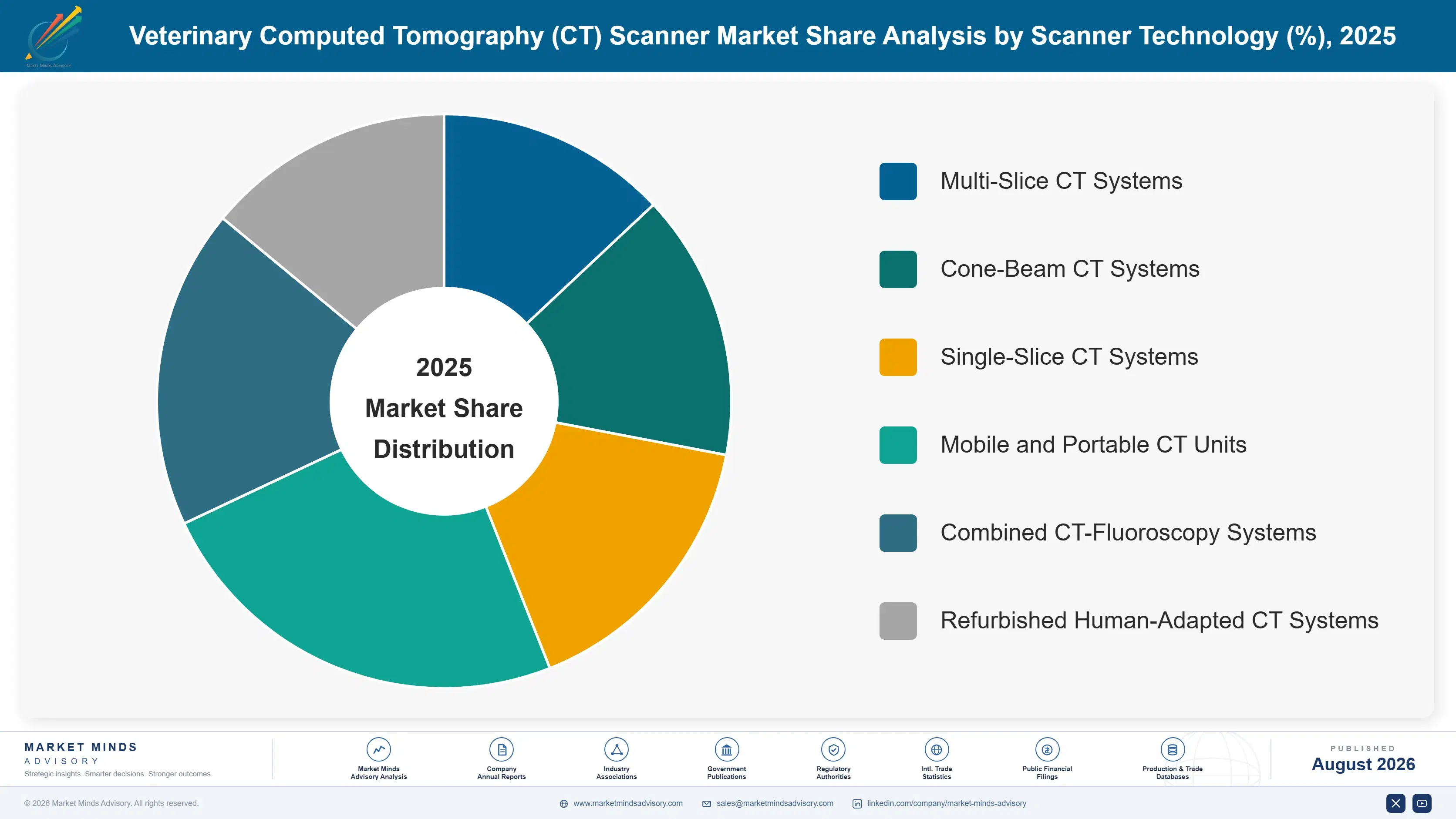
The market segments by scanner technology platform, the classification referral center procurement teams actually use when comparing competing systems for capital purchase decisions. Multi-slice CT systems lead all categories on growth as faster scan speed earns broader referral hospital preference across most companion animal applications this forecast cycle. Cone-beam systems remain the established choice for smaller practices seeking lower commitment.
veterinary-computed-tomography-ct-scanner-market-market-share-analysis-1787310119654

Multi-Slice CT Systems

Multi-slice CT systems complete full-body companion animal scans substantially faster than single-slice predecessors, letting referral centers reduce anesthesia exposure time while improving daily case throughput across busy specialty practices. Growing at 12.2% annually, roughly 1.5 times the overall market rate, this segment is pulling share from every other platform category as comparative data documents lower anesthesia-related complication rates with faster scan acquisition. Three of the five leading manufacturers now offer multi-slice platforms as their flagship veterinary offering, and two smaller competitors have systems entering trials in 2026. Referral center procurement teams increasingly specify multi-slice capability as a baseline requirement. Insurance carriers in select markets are also beginning to recognize this efficiency advantage in coverage decisions.
CAGR 12.2%

Cone-Beam CT Systems

Cone-beam CT systems offer a lower-cost entry point into three-dimensional imaging capability, particularly well suited for dental, skull, and extremity imaging where full-body multi-slice capability is unnecessary. Growing at 10.5% annually, this segment benefits from strong demand among general practices and smaller specialty clinics seeking advanced imaging without the capital commitment of a full multi-slice system. General veterinary practices and smaller specialty clinics remain the primary demand driver, using cone-beam systems for applications where standard radiography does not provide adequate diagnostic detail. Manufacturers continue expanding field-of-view and image quality to broaden adoption beyond dental-focused applications. This positioning keeps the segment relevant even as multi-slice adoption accelerates across larger specialty networks.
CAGR 10.5%
Full segment breakdown across 6 segments available in the complete report.

Regional Architecture and Country Demand Map

North America leads on specialty referral center density and pet insurance-supported diagnostic spend, followed by East Asia's expanding referral infrastructure investment. Western Europe trails on slower capital replacement cycles relative to underlying case volume growth. South Asia and Pacific posts the fastest regional growth off a smaller established base nationwide.

North America

United States capital spending dominates this region on the strength of its dense specialty veterinary referral center network and consistent premium platform replacement cycles among corporate and academic institutions. Canada's smaller, more fragmented practice system adds modest volume but moves at a slower capital approval pace than comparable American institutions. Rising pet insurance coverage continues pulling capital purchasing decisions toward multi-slice platforms faster than in any other market. Corporate referral network capital budgets remain comparatively well funded, and multi-slice attach rates on new system purchases keep rising steadily across most major specialty hospital networks nationwide this forecast period. Corporate networks continue expanding capital budgets each fiscal year. Multi-slice attach rates continue climbing quarter over quarter.
Share: 32% | CAGR: 8.9% (2026 to 2036)

Western Europe

Capital purchasing here moves through practice-level budget decisions layered under varying national veterinary reimbursement structures, which slows adoption of premium multi-slice platforms relative to the pace of United States purchasing decisions. Germany and the United Kingdom carry the largest procedural volumes, supported by established specialty veterinary referral networks within their respective national systems. France's dedicated veterinary specialty accreditation framework has meaningfully standardized imaging capital investment since its introduction across regional referral networks. Growth trails the global average as fragmented practice ownership and slower pet insurance penetration limit incremental expansion relative to the faster-growing corporate networks emerging across North America. Distribution partnerships continue expanding to reach smaller, independent practices. Payer scrutiny is expected to intensify further as budget pressure grows.
Share: 22% | CAGR: 6.7% (2026 to 2036)
Regional intelligence for 5 additional markets available in the complete report: East Asia, South Asia and Pacific, Latin America, Middle East and Africa, Eastern Europe. Contact sales@marketmindsadvisory.com.
veterinary-computed-tomography-ct-scanner-market-country-cagr-analysis-1787310120238

Where CT Manufacturers Can Still Expand Margin

Multi-slice attach rates, service contract depth, and workflow software revenue offer the clearest paths to margin expansion as core console pricing faces growing referral network scrutiny across major specialty systems evaluating capital purchases and service bundles this annual budget cycle across most regions nationwide. particularly among corporate specialty networks standardizing imaging formularies across multiple sites. across most regions nationwide.

Multi-Slice Platform Upgrade Conversion Growth Program

Multi-slice CT platforms command a documented price premium of roughly 35 to 50 percent over standard single-slice consoles, reflecting the added detector array hardware and control software bundled into each unit. Manufacturers with cleared multi-slice platforms are using capital replacement cycle timing, roughly nine years post-purchase, to convert existing referral center accounts rather than compete solely for new placements. This lever depends on continued referral center willingness to fund the premium tier, which comparative workflow efficiency data increasingly supports as anesthesia-time evidence accumulates across larger multi-site studies. Manufacturers publishing comparative workflow data are winning referral center trust fastest.
Market Impact: Adds a documented 35-50% price prem

Service and Extended Warranty Contract Bundles

Extended service and warranty contracts, which keep detector calibration within manufacturer specification tolerances, represent a growing services opportunity priced around $32,000 annually as referral centers extend equipment life beyond the standard nine-year replacement cycle. Manufacturers bundling multi-year service agreements into initial purchase contracts report improved win rates in competitive referral center procurement processes, particularly among cost-conscious corporate veterinary networks. This lever requires sustained field service infrastructure investment but creates a durable differentiation point that smaller manufacturers currently struggle to replicate. Manufacturers view this as a durable, long-horizon account investment. Smaller manufacturers struggle to fund comparable service scale at this level.
Market Impact: Extends annual contract value by ro

Anesthesia Workflow Software Subscription Growth Strategy

Anesthesia workflow software subscriptions layered on top of the base scanner sale, priced around $8,500 annually per system, are becoming a durable recurring revenue stream as manufacturers add automated scan protocol optimization and sedation-time tracking capability. Referral centers using subscription-tier software report meaningfully shorter average anesthesia time per case than those on legacy manual protocol arrangements, directly improving throughput and patient safety outcomes. This lever scales fastest among the two largest manufacturers with dedicated software development teams. Manufacturers increasingly cite this as a deciding factor when consolidating vendor relationships. Smaller manufacturers lacking software teams struggle to match this offering.
Market Impact: Adds roughly $8,500 in new recurrin

Veterinary Radiologist Training Certification Program Offering

Structured veterinary radiologist training and certification programs, often bundled into new system contracts at no additional charge for the first year, are increasingly monetized as standalone paid offerings priced near $2,800 per radiologist once referral centers seek to onboard additional interpretation staff after initial installation. Manufacturers offering certified training pathways report stronger platform loyalty and lower switching rates among trained radiologists compared with centers relying solely on peer-to-peer informal instruction. This lever remains underdeveloped industry-wide, leaving meaningful room to expand. Manufacturers see this as durable investment rather than a one-time sales tactic.
Market Impact: Generates roughly $2,800 per newly

Who Controls the Margin Pool

Five manufacturers control roughly fifty-eight percent of system revenue, and the gap between the top three and the remaining two leaders is meaningful: GE HealthCare, Siemens Healthineers, and Canon Medical each carry established multi-decade human imaging sales infrastructure adapted for veterinary use that Epica Animal Health and Asto CT are still building out region by region as veterinary-specific specialists. Independent referral centers weigh this infrastructure gap heavily during vendor
Current competitive activity centers on three fronts: multi-slice platform launches backed by growing anesthesia-time efficiency data, service contract bundling aimed at deepening recurring revenue relationships with existing referral center accounts, and workflow software portfolio expansion designed to differentiate on throughput rather than image quality alone. Manufacturers with dedicated veterinary clinical support teams are winning a disproportionate share of these accounts.

Emerging pressure is coming from veterinary-specific specialists like Epica Animal Health and Asto CT, which lack the broad human imaging portfolios of the largest incumbents but are pursuing narrow, defensible positioning built specifically for companion animal workflows. Rankings among the top five could shift meaningfully if a veterinary-specific player's workflow efficiency data proves durable enough to win share from human-imaging-adapted incumbents ahead of the next forecast cycle.
veterinary-computed-tomography-ct-scanner-market-company-positioning-matrix-1787310120753

Competitive Moat and Risk Dimensions

GE HEALTHCARE TECHNOLOGIES INC.

Moat: Broad Human Imaging Portfolio Scale

GE HealthCare's decades-long presence across human diagnostic imaging gives it engineering depth and manufacturing scale that veterinary-specific competitors cannot replicate quickly. Its broad imaging portfolio also lets sales teams offer proven, field-tested hardware adapted for veterinary use at competitive pricing relative to purpose-built alternatives. Long-standing distributor relationships also protect against price-based displacement.
GE HEALTHCARE TECHNOLOGIES INC.

Risk: Slower Veterinary Workflow Customization

GE HealthCare's veterinary-adapted platforms trail purpose-built competitors on workflow features specifically designed for companion animal positioning and anesthesia integration. Its scale advantage in commercial infrastructure does not automatically translate into workflow leadership on the veterinary-specific dimension increasingly driving referral center procurement decisions nationwide. Purpose-built rivals continue widening this workflow gap steadily.
EPICA ANIMAL HEALTH

Moat: Purpose-Built Veterinary Workflow Design

Epica Animal Health built its platforms specifically for veterinary workflow from the ground up rather than adapting human imaging hardware, giving it a defensible position among referral centers that prioritize anesthesia-minimized scan protocols. This veterinary-first positioning continues attracting specialty accounts even as human-imaging incumbents introduce comparable veterinary-adapted platforms.
EPICA ANIMAL HEALTH

Risk: Narrower Manufacturing Scale and Reach

As a veterinary-specific manufacturer without the broad human imaging manufacturing scale of diversified competitors, Epica Animal Health carries less purchasing leverage and slower international expansion capacity than incumbents like GE HealthCare across large corporate referral network contracts nationwide. Larger diversified rivals continue widening this scale gap across most major markets.

Players Tracked

Prominent Players

GE HealthCare Technologies Inc.
Siemens Healthineers AG
Canon Medical Systems Corporation
Epica Animal Health
Asto CT, Inc.

Other Key Players

Xoran Technologies LLC
Universal Medical Systems, Inc.
NeuroLogica Corporation
Hallmarq Veterinary Imaging Ltd.
IMV Imaging Ltd.
E-Woo Technology Co., Ltd.
Shenzhen Anke High-Tech Co., Ltd.
Neusoft Medical Systems Co., Ltd.
United Imaging Healthcare Co., Ltd.
Fujifilm Healthcare Corporation
Vetology Innovations, LLC
Sound Technologies, Inc.
MinXray, Inc.
Del Medical Imaging Corporation
Konica Minolta, Inc.

Recent Developments

MARCH 2025

Epica Animal Health Launches Expanded Multi-Slice Platform

Epica Animal Health launched an expanded multi-slice CT platform purpose-built for companion animal workflows, featuring integrated anesthesia monitoring compatibility. The launch followed a multi-site workflow study documenting meaningfully reduced anesthesia exposure time across participating specialty referral centers nationwide. Specialty referral centers report strong early interest in the integration.
Signal: Signals veterinary-specific manufacturers
AUGUST 2025

Canon Medical Acquires a Veterinary Software Developer

Canon Medical completed the acquisition of a privately held veterinary imaging software developer to strengthen its anesthesia workflow optimization capability. The deal brings in-house veterinary-specific algorithm development capability Canon previously accessed through a licensing arrangement with a third party. The veterinary imaging software market continues expanding rapidly given referral growth.
Signal: Indicates human-imaging incumbents are mov
JANUARY 2026

Asto CT and a Regional Referral Network Sign Service Agreement

Asto CT signed a multi-year service and shared-access agreement with a regional veterinary referral network tying a portion of pricing to documented case throughput improvements across the network's specialty sites. The agreement is among the largest of its kind announced in the category to date.
Signal: Suggests value-based service contracting i

Detector Array and X-Ray Tube Exposure

CT scanner production depends on precision detector array components, X-ray tube assemblies, and specialized cooling systems, together representing a substantial share of unit cost of goods sold across the category. Detector arrays and X-ray tubes are sourced predominantly from a small number of qualified suppliers in the United States, Germany, and Japan. Limited supplier diversification remains a persistent constraint across this precision component category.
X-ray tube and detector component supply constraints during 2021 and 2022 extended lead times for critical scanner components, a disruption documented in company annual report supply chain disclosures across the sector during that period. Several manufacturers responded by qualifying secondary component suppliers and increasing safety stock of critical parts, though full supply chain normalization took roughly eighteen months to complete across the industry, according to sector-wide supply data.

Smaller manufacturers without long-term supply agreements or dual-sourced detector and tube components face proportionally higher exposure to input cost inflation and allocation constraints during periods of tight supply. The largest manufacturers' scale purchasing agreements and vertically integrated component manufacturing capacity provide meaningful cost and supply certainty advantages that smaller, veterinary-focused entrants have not yet been able to replicate at comparable volume.
veterinary-computed-tomography-ct-scanner-market-cost-volatility-analysis-1787310120949

Dual-Sourcing Critical Detector Array Components

Leading manufacturers now qualify at least two independent suppliers for precision detector array components used in CT scanners, reducing single-source exposure meaningfully across production lines. This dual-sourcing strategy adds qualification cost upfront but has measurably shortened recovery time during subsequent supply disruptions, according to recent company disclosures and supplier audits. Multiple manufacturers have adopted this approach industry-wide recently.

Long-Term X-Ray Tube Supply Agreements

Multi-year supply agreements with qualified X-ray tube manufacturers lock in pricing and allocation priority during periods of tight capacity across the broader medical imaging industry. The largest manufacturers have used scale purchasing volume to secure priority allocation status that smaller competitors cannot easily match, according to recent annual report disclosures. This advantage compounds meaningfully during extended shortage periods.

Increased Safety Stock for Critical Components

Manufacturers have raised safety stock levels for the highest-risk components identified during the 2021 to 2022 supply disruption, trading modest inventory carrying cost increases for meaningfully reduced production disruption risk during future supply shocks across the broader imaging device category and its qualified suppliers worldwide. Carrying costs remain modest relative to the disruption risk avoided.

Portfolio Architecture for Margin Defence

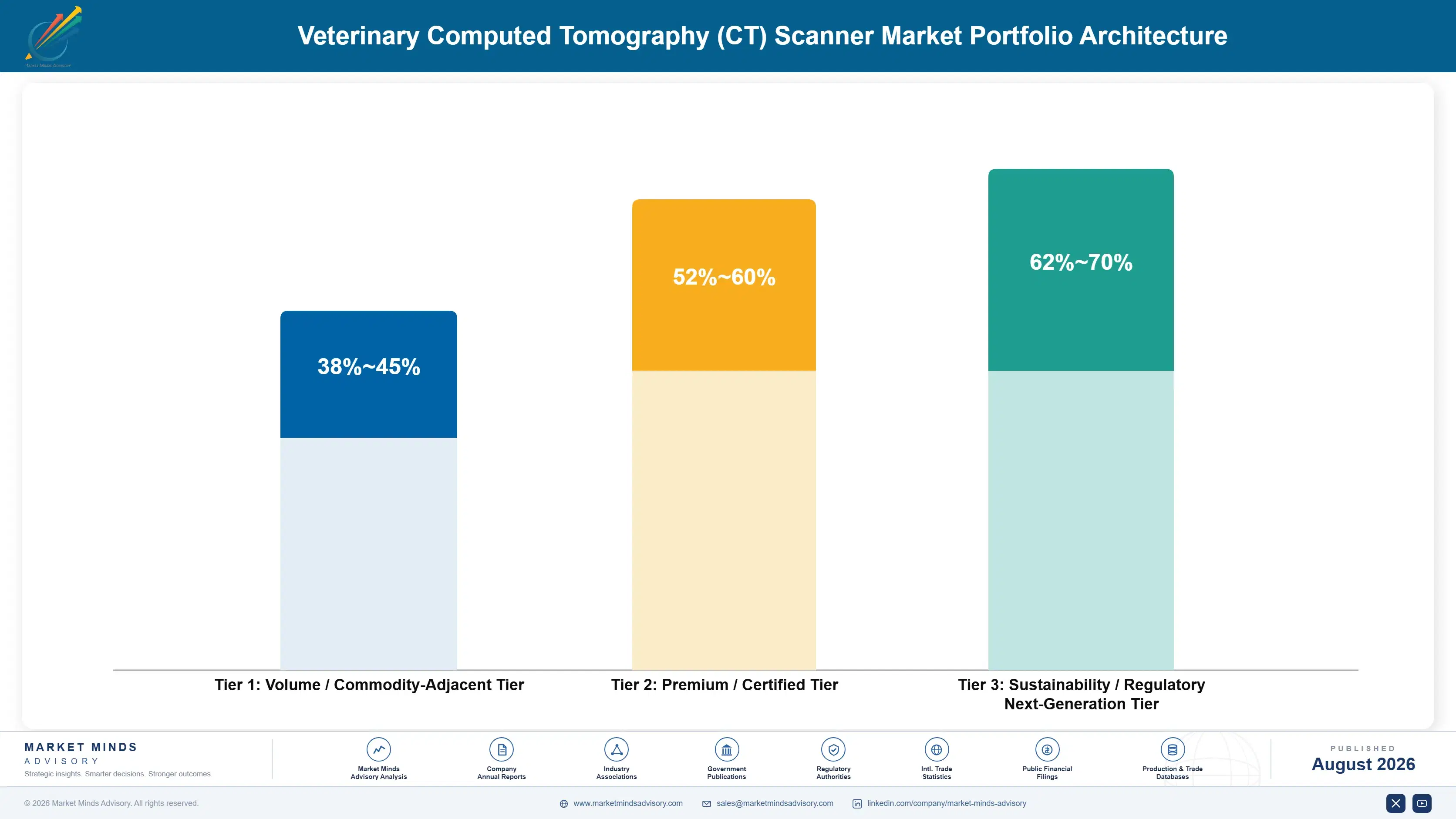
The category's margin architecture separates into three tiers: volume-adjacent single-slice and mobile CT systems carrying the thinnest margins around forty-one percent, cone-beam systems carrying stronger margins in the high fifties, and multi-slice systems commanding the highest prices and margins as workflow efficiency evidence continues to strengthen across the specialty referral base. This tiering broadly mirrors how procurement committees evaluate competing vendor bids each budget cycle.
Manufacturers face a persistent tension between defending single-slice and mobile volume, which remains familiar to a large cohort of established general practices, and pushing referral centers toward premium multi-slice platforms that carry meaningfully better unit economics but require additional radiologist training investment to sell effectively across busy specialty practices nationwide. Budget committees increasingly scrutinize this trade-off during annual capital renewal negotiations.

High-value margin pools concentrate specifically in multi-slice systems and their associated service contract and workflow software revenue, where scan speed and recurring support fees combine to lift blended margins well above the single-slice baseline across the broader portfolio and installed base this forecast period. Manufacturers investing early in this convergence stand to capture disproportionate long-term value. Manufacturers without comparable service breadth risk losing formulary share over time.

Volume / Commodity-Adjacent Tier

Single-slice and mobile CT systems sold primarily on established clinical track record and price competitiveness against newer multi-slice platforms entering the market. General practices with constrained budgets remain the primary buyer segment.
Gross Margin: 38-45%

Premium / Certified Tier

Cone-beam CT systems carrying documented three-dimensional imaging capability and broader accessibility than full multi-slice platforms, positioned as the established middle tier across most general veterinary practices nationwide. Mid-sized practices unable to justify premium costs frequently select this tier.
Gross Margin: 52-60%

Sustainability / Regulatory / Next-Generation Tier

Multi-slice systems bundled with service contracts and workflow software subscriptions tied to documented anesthesia-time efficiency outcomes across large specialty referral network populations and corporate hospitals. Corporate referral networks pursuing formulary consolidation lead adoption in this tier.
Gross Margin: 62-70%
veterinary-computed-tomography-ct-scanner-market-portfolio-architecture-1787310121503

High-value Sub-segments and Strategic Watch-out

Multi-Slice CT Systems

The fastest-growing, highest-margin segment as referral centers increasingly specify multi-slice capability as a baseline procurement requirement nationwide. Manufacturers with cleared platforms are converting the installed base ahead of scheduled capital replacement, capturing premium pricing across corporate network relationships. Payer coverage recognition continues expanding. nationwide. nationwide.
Gross Margin: 60-66%

Cone-Beam CT Systems

A large, established, mid-margin segment benefiting from strong demand among general practices and smaller specialty clinics seeking advanced imaging without the capital commitment of a full multi-slice system nationwide. Manufacturers continue refining field-of-view and image quality each product cycle. Larger practices lead early adoption of this complementary segment.
Gross Margin: 54-60%

Single-Slice CT Systems

A steady, mid-margin segment sold primarily on established track record and price competitiveness, facing gradual share erosion as multi-slice platforms earn broader referral center procurement recognition across most major reimbursement geographies this period. Manufacturers continue defending price nationwide against multi-slice encroachment. Independent practices remain the primary buyers for now.
Gross Margin: 40-46%

Mobile and Portable CT Units

A shrinking segment losing share to fixed installations with superior throughput and image quality, though it retains a niche among mobile diagnostic service providers and smaller practices lacking dedicated imaging suites. Manufacturers continue serving this segment steadily where it remains cost-effective. Independent providers with tighter budgets favor this segment.
Gross Margin: 34-40%

Referral Center Capital Cycle Economics

Revenue in this category behaves like a hybrid capital and service annuity once a referral center commits to a scanner platform: the initial console sale is followed by a predictable nine-year replacement cycle, periodic service and calibration contracts, and continuous contrast media and workflow software consumption tied directly to case volume rather than console pricing alone. This recurring structure gives manufacturers meaningful revenue visibility beyond the initial capital sale.
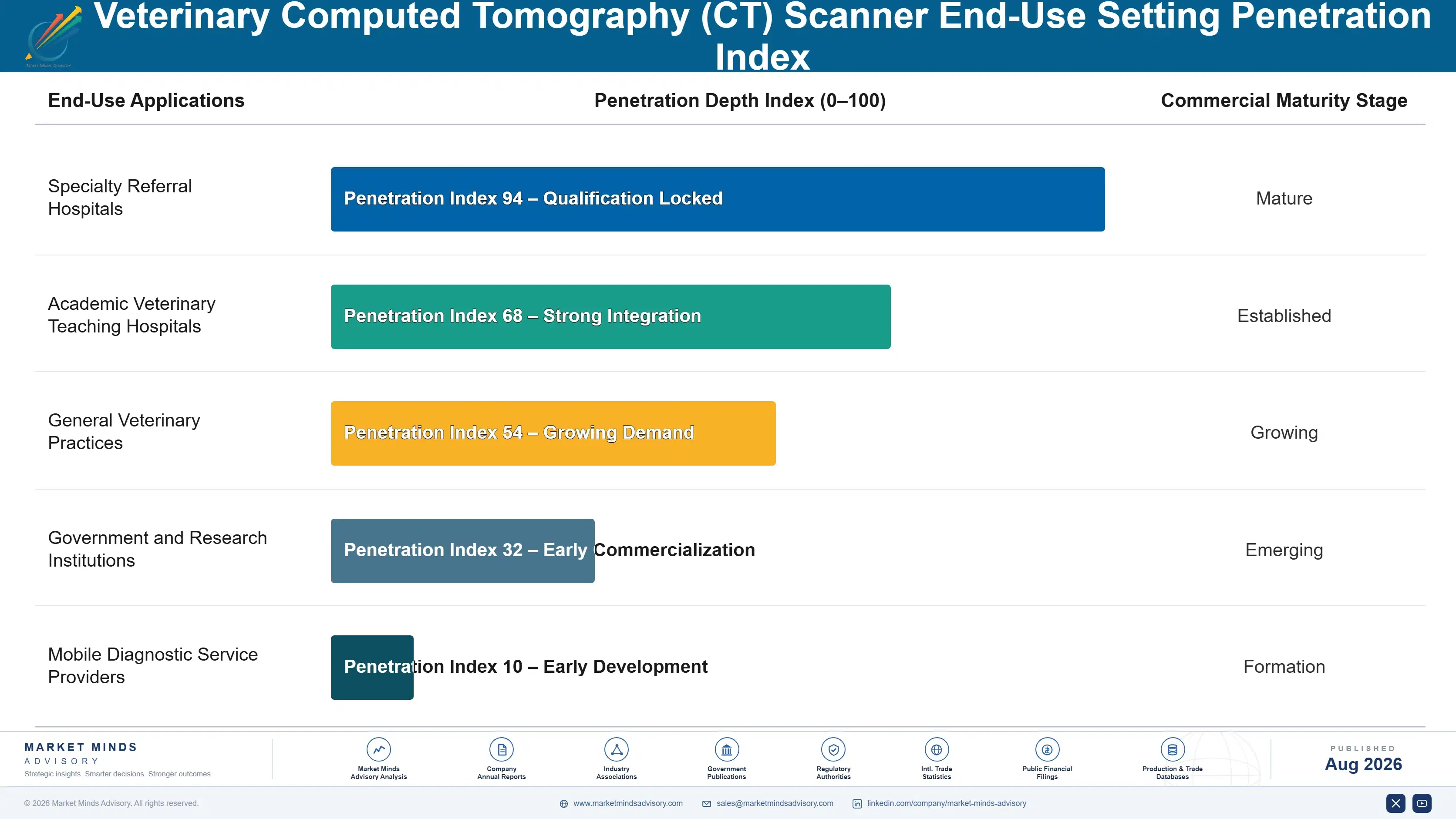
Adoption depth varies meaningfully by clinical vertical. Oncology and orthopedic specialty programs show the deepest, most consistent multi-slice adoption, while general practice and mixed-animal programs adopt more selectively, reserving advanced imaging for higher-complexity cases after exhausting simpler radiography options already familiar to their staff. Emergency and critical care programs represent a smaller but growing adoption segment as rapid diagnostic imaging increasingly informs urgent treatment decisions.

A generational shift in buyer profile is underway as younger veterinarians trained during the multi-slice era default to evidence-based platform selection, while an older cohort trained on legacy single-slice technique shows more brand loyalty rooted in decades of prior clinical familiarity and established supplier relationships. Manufacturers increasingly tailor sales approaches differently across these two distinct veterinarian cohorts to maximize conversion.
veterinary-computed-tomography-ct-scanner-market-end-use-penetration-index-1787310122120

What CT Manufacturers Should Do

These are among the four positions where our research anticipates prominent divergence between winners and laggards over the coming forecast period. Each is grounded in the demand model, the regulatory perimeter, and the announced capacity pipeline.
01 / MULTI-SLICE PORTFOLIO INVESTMENT

Multi-slice is becoming table stakes, not a differentiator, within four years.

Three of five leading manufacturers already ship multi-slice platforms as their flagship veterinary offering, and two smaller competitors have systems entering trials in 2026 across expanded companion animal applications. Manufacturers still selling primarily single-slice systems by 2029 will find themselves competing only on price against platforms with stronger workflow efficiency evidence backed by multi-site studies at major referral centers. The investment case for multi-slice has moved from optional differentiation to a defensive necessity for defending referral center contract position nationwide.
02 / SERVICE CONTRACT STRATEGY

Bundling service contracts deepens referral center account relationships.

Referral centers using manufacturer-provided service contracts report meaningfully better uptime and lower unplanned downtime than those managing calibration independently without dedicated support from a supplier, particularly across large multi-site corporate networks. Manufacturers building dedicated field service teams now will lock in referral center loyalty before larger, well-resourced competitors catch up on service depth across comparable account relationships. This service investment increasingly separates preferred suppliers from commodity vendors as referral network procurement consolidates further nationwide across most major regions and corporate alliances.
03 / VALUE-BASED CONTRACT STRATEGY

Early value-based agreements set precedent for pricing throughput outcomes.

Asto CT's January 2026 service agreement with a regional veterinary referral network ties pricing explicitly to documented case throughput improvements, a structure other manufacturers and referral networks are watching closely this budget cycle across the industry. Manufacturers with strong throughput data have the most to gain from moving early into similar contracts ahead of competitors. Those without comparable data risk being locked out of preferred network status as these agreements proliferate nationwide over the next several years across most major regions.
04 / COMPONENT SUPPLY RESILIENCE

Dual-sourcing critical detector components is now a competitive requirement.

The 2021 to 2022 detector and tube component disruption showed clearly that single-sourced manufacturers faced longer production delays than dual-sourced competitors, directly affecting their ability to fulfill referral center orders during a period of strong underlying demand growth nationwide across most geographies. Smaller manufacturers without the purchasing scale to negotiate dual-sourcing agreements remain more exposed to future disruptions. This supply resilience gap increasingly factors into referral center procurement decisions alongside clinical evidence and pricing considerations across most major regions and referral networks.

Engagement Snapshot From the Field

A live engagement with an industry participant carrying material or product regulatory and market exposure ahead of a defining policy shift, showing how our research translates into a defensible multi-year portfolio strategy.
MARKET MINDS ADVISORY · CLIENT ENGAGEMENT SUMMARY
Veterinary Computed Tomography (CT) Scanner Producer Strategic Portfolio Review and Transition Roadmap 2026·Investment Scenario on Veterinary Computed Tomography (CT) Scanner Exposure Evaluation 2025-26
CLIENT PROFILE
The client is a regional veterinary referral network operating four specialty hospitals across a metropolitan area, performing several thousand advanced imaging procedures annually across oncology, orthopedic, and neurology specialty services. The network's capital planning committee had flagged rising imaging platform and service spend as a category requiring closer review ahead of its next annual budgeting cycle, prompting the engagement.
STRATEGIC CHALLENGE
The network needed to rationalize its scanner formulary, which had grown to include three separate manufacturer platforms across different hospital sites, without disrupting existing veterinarian workflows or patient care continuity. Leadership also wanted a defensible framework for evaluating multi-slice platforms against the single-slice systems already in wide use across the network.
MMA APPROACH
MMA conducted structured interviews with the network's veterinary radiologists and capital planning committee members, benchmarked platform pricing and case throughput data against comparable regional referral networks, and modeled the total cost of ownership across a three-year formulary consolidation scenario. The analysis incorporated both published comparative-effectiveness literature and network-specific procedural outcomes data.
KEY FINDINGS
  1. Anesthesia-related complication costs under the fragmented single-slice fleet exceeded the incremental cost of standardized multi-slice platforms across the network's own site-level data (client-reported, unverified by MMA).
  2. Consolidating from three platforms to two preferred vendors was projected to reduce annual device spend meaningfully while preserving radiologist choice across most case volume (client-reported, unverified by MMA).
  3. Multi-slice platform adoption among the network's radiologists correlated with measurably shorter average anesthesia time per case compared with single-slice systems still in use.
  4. Radiologists newly trained through manufacturer-sponsored programs showed measurably higher confidence interpreting multi-slice imaging independently than staff relying on informal peer instruction alone.
CLIENT PROFILE
The client is a regional veterinary referral network operating four specialty hospitals across a metropolitan area, performing several thousand advanced imaging procedures annually across oncology, orthopedic, and neurology specialty services. The network's capital planning committee had flagged rising imaging platform and service spend as a category requiring closer review ahead of its next annual budgeting cycle, prompting the engagement.
STRATEGIC CHALLENGE
The network needed to rationalize its scanner formulary, which had grown to include three separate manufacturer platforms across different hospital sites, without disrupting existing veterinarian workflows or patient care continuity. Leadership also wanted a defensible framework for evaluating multi-slice platforms against the single-slice systems already in wide use across the network.
MMA APPROACH
MMA conducted structured interviews with the network's veterinary radiologists and capital planning committee members, benchmarked platform pricing and case throughput data against comparable regional referral networks, and modeled the total cost of ownership across a three-year formulary consolidation scenario. The analysis incorporated both published comparative-effectiveness literature and network-specific procedural outcomes data.
KEY FINDINGS
  1. Anesthesia-related complication costs under the fragmented single-slice fleet exceeded the incremental cost of standardized multi-slice platforms across the network's own site-level data (client-reported, unverified by MMA).
  2. Consolidating from three platforms to two preferred vendors was projected to reduce annual device spend meaningfully while preserving radiologist choice across most case volume (client-reported, unverified by MMA).
  3. Multi-slice platform adoption among the network's radiologists correlated with measurably shorter average anesthesia time per case compared with single-slice systems still in use.
  4. Radiologists newly trained through manufacturer-sponsored programs showed measurably higher confidence interpreting multi-slice imaging independently than staff relying on informal peer instruction alone.
RECOMMENDED STRATEGY
Phase 1: Phase 1 (Months 1-3): Complete a network-wide device utilization and anesthesia-time audit across all three existing platforms to establish a defensible baseline. Phase 2: Phase 2 (Months 4-8): Negotiate consolidated preferred-vendor agreements with two manufacturers, incorporating value-based pricing terms tied to documented throughput outcomes. Phase 3: Phase 3 (Months 9-14): Implement a phased transition plan for existing platforms approaching replacement, prioritizing multi-slice migration where clinically appropriate.
OUTCOME
The network adopted a two-vendor preferred formulary within eight months of the engagement's conclusion, incorporating value-based pricing terms for a portion of its annual device volume. Leadership reported improved budget predictability heading into the following capital cycle and stronger negotiating position in subsequent vendor renewal discussions (client-reported, unverified by MMA).

Frequently Asked Questions

Foundational context covering the market sizes, CAGR, scope, country, region and competition that inform every finding below. This section is provided to cover basics and most often pre-purchase conversations, answered from the MMA Primary Research Dataset.

What is the current size of the Veterinary Computed Tomography (CT) Scanner Market?

The market stood at USD 0.62 billion in 2025, based on MMA Primary Research Dataset findings. Multi-slice CT adoption is the primary driver of accelerating system revenue growth.

How large will the Veterinary Computed Tomography (CT) Scanner Market be by 2036?

MMA projects the market will reach USD 1.47 billion by 2036 under the base case scenario, representing roughly 2.19 times the 2026 opening value across the eleven-year forecast period.

What is the CAGR for the Veterinary Computed Tomography (CT) Scanner Market 2026 to 2036?

The base case CAGR is 8.2% annually. MMA's bull scenario reaches 9.4% while the bear scenario, reflecting general practice capital budget constraints, runs closer to 6.9% over the forecast period.

Which segment is growing fastest?

Multi-slice CT systems lead at 12.2% CAGR, roughly 1.5 times the overall market rate, as faster scan speed earns broader referral hospital and procurement committee preference.

Who are the major companies in the Veterinary Computed Tomography (CT) Scanner Market?

GE HealthCare, Siemens Healthineers, Canon Medical, Epica Animal Health, and Asto CT lead the market, together controlling an estimated 58% of global revenue on a consistent basis.

Which country is growing fastest?

China posts the fastest national growth at 11.8% CAGR, driven by expanding specialty referral infrastructure and rising urban pet ownership. Domestic manufacturers are also gaining share in lower-tier practices.

Report Segmentation Architecture

The full report scope spans multiple orthogonal segmentation dimensions, with cross-tabulated demand data provided for each dimension pair. Coverage extends further to regional breakdowns, trend trajectories, and the competitive detail needed to support segment-level decision-making.

By Scanner Technology

  • Multi-Slice CT Systems
  • Cone-Beam CT Systems
  • Single-Slice CT Systems
  • Mobile and Portable CT Units
  • Combined CT-Fluoroscopy Systems
  • Refurbished Human-Adapted CT Systems

By End-Use Setting

  • Specialty Referral Hospitals
  • Academic Veterinary Teaching Hospitals
  • General Veterinary Practices
  • Government and Research Institutions
  • Mobile Diagnostic Service Providers

By Animal Type

  • Companion Animal Imaging
  • Equine Imaging
  • Exotic and Zoo Animal Imaging
  • Livestock Diagnostic Imaging

By Region

  • North America
  • Western Europe
  • East Asia
  • South Asia and Pacific
  • Latin America
  • Middle East and Africa
  • Eastern Europe

Scope, Methodology, and Coverage

Every figure in this report is reproducible from documented input assumptions. The scope below maps the historical period, the forecast horizon, the segmentation dimensions, and the countries covered, alongside the underlying primary and qualitative methodology.
Historical Period
2020 to 2025
Forecast Period
2026 to 2036
Base Year
2025 (USD billions; MMA Primary Research Dataset, August 2026)
Market Definition
This market covers computed tomography scanners designed or adapted for veterinary diagnostic imaging, including multi-slice, single-slice, and cone-beam systems used in companion animal and specialty referral practice. It excludes MRI systems, digital radiography equipment, and the anesthesia and positioning equipment used alongside these scanners.
Quantitative Units
USD billions (current prices); unit system placements where applicable
Segmentation Dimensions
By Scanner Technology; By End-Use Setting; By Animal Type; By Region
Regions Covered
North America, Western Europe, East Asia, South Asia and Pacific, Latin America, Middle East and Africa, Eastern Europe
Countries Covered
USA, China, Germany, France, UK, Japan, South Korea, India, Australia, Canada, Brazil, Mexico, Indonesia, Vietnam, Thailand, Malaysia, UAE, Saudi Arabia, South Africa, Nigeria, Turkey, Poland, Netherlands, Italy, Spain, Sweden, Switzerland, Argentina, Colombia, Singapore, and additional markets relevant to this sector
Key Companies Profiled
GE HealthCare Technologies Inc., Siemens Healthineers AG, Canon Medical Systems Corporation, Epica Animal Health, Asto CT Inc., Xoran Technologies LLC, Universal Medical Systems Inc., NeuroLogica Corporation, Hallmarq Veterinary Imaging Ltd., IMV Imaging Ltd., E-Woo Technology Co. Ltd., Shenzhen Anke High-Tech Co. Ltd., Neusoft Medical Systems Co. Ltd., United Imaging Healthcare Co. Ltd., Fujifilm Healthcare Corporation, Vetology Innovations LLC, Sound Technologies Inc., MinXray Inc., Del Medical Imaging Corporation, Konica Minolta Inc.
Quantitative Methodology
Primary survey, n=3,800 respondents, Q4 2025, six countries; demand-side model with trade association cross-validation
Qualitative Methodology
47 expert interviews, Q4 2025; applied to validate demand model assumptions, identify emerging dynamics, and assess competitive positioning
Report Format
PDF and XLSX data workbook (Word format preview document)
Publisher
Market Minds Advisory
Report Code
MMA-2026-MED-127
Published
August 2026
Contact
sales@marketmindsadvisory.com | www.marketmindsadvisory.com

Purchase the full Veterinary Computed Tomography (CT) Scanner Market Report (2026 to 2036).

The full report provides a complete competitive and commercial analysis of the global veterinary CT scanner market, including detailed segmentation by scanner technology, end-use setting, and animal type. It profiles twenty manufacturers across established and emerging platform technologies, with country-level sizing across thirty individual markets worldwide. The report includes referral network capital budgeting trend tracking and a value-based contracting outlook through 2036. Buyers receive full access to the underlying primary survey and expert interview datasets referenced throughout the analysis and appendices. It also includes a dedicated multi-slice adoption comparison section.
Country-level market sizing through 2036 forecast
Twenty-company competitive profiling and moat analysis
Referral network capital budgeting trend tracking
Multi-slice CT technology roadmap and outlook
Value-based contracting case examples and precedent
Primary survey and expert interview datasets included

Built For The People Who Decide

From boardroom strategy to bench-side execution, this report is read cover-to-cover by leaders shaping the next decade of their industry, turning demand scenarios, market dynamics and valuation benchmarks into decisions.
CXOs/ Presidents/ VPs/ Managers
M&A and Corporate Development
Strategy Teams and R&D Heads
Procurement and Product Directors
Regulatory and Compliance Leaders
Investor Relations and Equity Analysts