Market Minds Advisory
Veterinary Autoimmune Disease Therapeutics Market

Veterinary Autoimmune Disease Therapeutics Market: One Indication, Owner Compliance Economics and a Payer With No Insurance

Roughly 42% of owners never finish a daily oral course, which is why a monoclonal injection given in the clinic is beating a tablet on compliance rather than on any efficacy argument at all.

Lead Analyst

Alice Ballenger

Published

September 2026

Make Smarter Decisions with Customized Research Insights

Request a free sample report and evaluate market opportunities, growth trends, and competitive dynamics relevant to your business needs.

2025 MARKET VALUE$2.2BMarket Size 2025
2036 FORECAST VALUE$6.0BBase Case , 2026 to 2036
CAGR 2026 TO 20369.6 %Bull 10.8% / Bear 8.4%
INCREMENTAL OPPORTUNITY$3.6BNet 10- year value creation
EXPANSION MULTIPLE2.50x2036 value over 2026 base
Strategic Levers
M&A Pipeline
Regional Outlook
Country Rankings
Competitive Intelligence
Segmental Deep-dive
Call-Us : 91 93563 13602

Executive Snapshot and Market Trajectory

This is one disease with a very large market attached to it. Canine atopic dermatitis accounts for roughly 78% of category revenue, and it is chronic, visible, distressing to watch and never cured. The dog scratches, the owner sees it every day, and the owner pays for years.
The science also arrived in the wrong order. Human medicine reached monoclonal antibodies after decades of small molecule immunosuppression and priced them far higher. Here a monoclonal injection given in the clinic every few weeks is winning against a daily tablet, and not on efficacy. Roughly 42% of owners never complete an oral course, and an injection removes compliance from the equation entirely.
The payer is a household with no insurance behind it. Only around 17% of treated animals carry any cover, so this is almost entirely out of pocket at roughly 78 dollars a month across an average 4.2 years of therapy. The price ceiling is set by discretionary household budget rather than by any health economic argument, which makes a pharmaceutical category unusually exposed to consumer confidence. Consumer confidence matters more here than in human medicine.
Market Definition
Therapeutics used to treat immune mediated and autoimmune disease in companion and production animals, covering monoclonal antibody therapies, Janus kinase inhibitors, calcineurin inhibitor therapies, corticosteroid therapies, conventional cytotoxic immunosuppressants, and topical and localised immunomodulators. Measured at manufacturer selling value. Antiparasitics, antimicrobials, vaccines, allergen immunotherapy preparations, diagnostic testing and veterinary nutrition products are excluded.
Base Year Value
$2.2B in 2025 (MMA Primary Research Dataset, August 2026)
Forecast Period
2026 to 2036, eleven discrete annual values
CAGR
9.6% base case. Bull 10.8%. Bear 8.4%.
Fastest Growth Segment
Monoclonal Antibody Therapies: 14.4% CAGR
Fastest Growth Country
China: 17.8% CAGR
Fastest Growth Region
South Asia and Pacific: 11.8% CAGR
Largest Region
North America: 31% of 2025 global value
Market Leaders
Zoetis, Elanco Animal Health, Boehringer Ingelheim Animal Health, Dechra Pharmaceuticals, Virbac. Source: MMA Primary Research Dataset, July 2026.
Primary Survey
n=3,800 procurement and R&D decision-makers, Q4 2025, six countries
Methodology
Demand-side build-up, cross-validated against public data, 47 expert interviews

Veterinary Autoimmune Disease Therapeutics Market Forecast Scenarios

veterinary-autoimmune-disease-therapeutics-market-size-forecast-scenario-1787641466597
The five years to 2025 were shaped by a pandemic pet ownership surge and its aftermath. Household animal acquisition rose sharply during lockdowns and veterinary visit volumes followed, then normalised as those animals aged and discretionary spending tightened. Atopic dermatitis diagnosis rates rose throughout, partly genuine and partly better recognition. The 8.4% historical rate blends an acquisition spike with a spending squeeze that arrived immediately afterwards.
The 9.6% base case rests on three mechanisms. Monoclonal antibody therapy keeps taking share from oral products because it removes owner compliance from the treatment, and compliance is the practical limit on outcome in veterinary medicine rather than pharmacology. Indications beyond atopic dermatitis are slowly being addressed, with immune mediated arthritis and enteropathy attracting genuine development attention. And companion animal ownership keeps expanding across Asian urban markets, with China growing faster than anywhere covered.
The 10.8% bull case turns on a monoclonal reaching a second major indication at scale, which would reduce the category's dependence on one disease considerably. The 8.4% bear case is household spending: with only 17% of treated animals insured, a chronic therapy costing 78 dollars a month is discretionary in a way no human prescription is.

One Itch, Four Years and No Insurance

Canine atopic dermatitis is not the largest indication in this category so much as it is the category. Roughly 78% of revenue comes from it, and the commercial profile is close to ideal: chronic, incurable, highly visible and distressing to watch. An animal scratching itself raw in a living room generates willingness to pay that a silent internal condition never does.
TOP FIVE CONCENTRATION84%Combined revenue held by leading animal health companies
ATOPIC DERMATITIS SHARE78%Portion of category revenue from a single canine indication
ORAL COURSE COMPLETION58%Owners completing a prescribed daily oral therapy course
MONTHLY TREATMENT COSTUSD 78Typical owner spend per month on chronic therapy
INSURANCE COVERAGE RATE17%Share of treated animals carrying any health insurance
AVERAGE TREATMENT DURATION4.2 yearsLength of continuous therapy once a diagnosis is made
Compliance rather than pharmacology sets the practical outcome. Only around 58% of owners complete a prescribed daily oral course, because giving a dog a tablet every day for years is genuinely difficult and the animal cannot be reasoned with. A monoclonal antibody injection administered in the clinic every few weeks removes that variable entirely, which is why it grows fastest despite offering no efficacy advantage in most comparisons.
The economics run through a household budget with almost nothing behind it. Only around 17% of treated animals carry health insurance in most markets, so a therapy costing roughly 78 dollars a month across an average 4.2 years is paid directly by an owner making a discretionary choice every month. That sets a pricing ceiling from disposable income rather than any value argument.
"In human medicine you price a chronic therapy against what a payer will fund. Here you price it against what somebody will spend on a dog before deciding the scratching is tolerable, which is a different exercise entirely."
Director, Animal Health and Companion Animal Practice · MMA Animal Health and Veterinary Medicine Practice · August 2026

Market Trends

Injectable Biologics Remove Owner Compliance From Treatment

Only around 58% of owners complete a prescribed daily oral course, and the shortfall is not carelessness so much as the practical difficulty of medicating an unwilling animal every day for years. A monoclonal antibody injection given in the clinic every few weeks transfers that responsibility from the owner to the practice, which improves outcomes without improving the molecule. Monoclonal therapies grow at 14.4% against a market rate of 9.6%, fastest in the market. Revenue also shifts from the pharmacy shelf to the consultation, which practices notice and manufacturers should.
Market Impact: China grows at 17.8% annually

Development Attention Moves Beyond Atopic Dermatitis

Roughly 78% of category revenue rests on one canine indication, which is a concentration nobody in the industry is comfortable with even while it funds everything. Immune mediated polyarthritis, chronic enteropathy and immune mediated haemolytic anaemia are all attracting development attention, and each represents a population currently treated with corticosteroids and conventional immunosuppressants borrowed from human medicine decades ago. Janus kinase inhibitors grow at 12.2%, second fastest in the market, partly on off label use in exactly these indications. Formal approval would convert that quietly established practice into labelled revenue.
Market Impact: Therapy continues for 4.2 years

Market Opportunities and Growth Drivers

Asian Urban Pet Ownership Expands the Treated Population

Companion animal ownership across Chinese, Korean and Southeast Asian cities has risen sharply over a decade, and those owners increasingly treat animals as household members rather than as property, which changes what they will spend on chronic care entirely. China grows at 17.8%, faster than any country covered, on ownership growth alongside veterinary capability expanding into second and third tier cities. Diagnosis rates for atopic dermatitis rise with clinical capability rather than with disease prevalence. The addressable population in these markets is expanding faster than anything demographic in Western markets can match.
Market Impact: Only 17% of animals insured

Chronic Duration Makes Each Diagnosis a Multi Year Annuity

Atopic dermatitis is managed rather than cured, and average continuous therapy runs around 4.2 years once a diagnosis is made, which turns each treated animal into a recurring revenue relationship rather than a course of treatment. Practices build recheck schedules around it and manufacturers build refill and adherence programmes on top. The economics reward acquisition of newly diagnosed animals far more than they reward switching established ones, since a switch captures the remainder of a duration while a new diagnosis captures the whole of it. Recheck schedules are built around it.
Market Impact: Depends on 78% single indication

Market Restraints and Challenges

Owner Budgets Cap Pricing With Almost No Insurance Behind Them

Only around 17% of treated animals carry any health insurance in most markets, so a chronic therapy at roughly 78 dollars a month is a discretionary household decision renewed continuously rather than a funded prescription. The root cause is that pet insurance penetration remains low almost everywhere outside Sweden and the United Kingdom, and nothing suggests rapid change. Commercially this ties a pharmaceutical category to consumer confidence in a way human medicines are not. Manufacturers respond with adherence programmes, practice payment plans and tiered product ranges rather than with pricing arguments nobody funds.
Market Impact: Removes 42% compliance failure rate

Single Indication Concentration Leaves the Category Exposed

Roughly 78% of revenue depends on canine atopic dermatitis, which means a safety signal, a generic entry or a genuinely superior competitor in that one indication reprices the whole category at once. The root cause is that development economics in animal health rarely justify pursuing smaller indications, since trial costs are real and the treated populations are modest. Commercially this is a concentration risk everybody recognises and few address. Responses include label expansion into immune mediated arthritis and enteropathy, and acquisition of developers already working in those areas. Few companies have acted on it yet.
Market Impact: Reduces 78% single indication dependence
3 additional market trends, 4 additional growth drivers, and 2 additional restraints and challenges are covered in the full report. Contact sales@marketmindsadvisory.com to access the complete intelligence.

Segment CAGR and Growth Architecture

Segmentation follows drug class, since class determines administration route, who carries the compliance burden and what an owner pays each month. Six classes cover the field, from a monoclonal injection given by a veterinarian to a corticosteroid tablet costing almost nothing. Growth follows administration route considerably more than it follows mechanism. Mechanism barely enters the decision.
veterinary-autoimmune-disease-therapeutics-market-market-share-analysis-1787641467133

Monoclonal Antibody Therapies

Species specific antibodies neutralising cytokines involved in itch and inflammation, administered by injection in the clinic every few weeks rather than daily by the owner. At 14.4% this is the fastest growing class in the market, half again the market rate of 9.6%, and administration route explains more of that than mechanism does. Only around 58% of owners complete a daily oral course, so a therapy the practice administers converts a compliance problem into a recheck appointment. Manufacturing is considerably more demanding and more expensive than small molecule production, and pricing reflects it, yet owners accept the cost where the alternative is a tablet they know they will forget. Cold chain is the practical limit.
CAGR 14.4%

Janus Kinase Inhibitors

Oral small molecules blocking cytokine signalling, giving rapid control of itch and inflammation with a dosing schedule owners can manage more easily than older immunosuppressants required. Growth of 12.2% is second fastest in the market, supported both by the labelled atopic dermatitis indication and by substantial off label use in immune mediated arthritis and enteropathy where nothing better exists. The oral route is the weakness and the strength at once: cheaper to manufacture and easier to dispense, but dependent on an owner remembering every day for years. Practices frequently use these for initial control and move animals to injectable maintenance afterwards. Initial control then injectable maintenance has become a common protocol in developed practice.
CAGR 12.2%
Full segment breakdown across 6 segments available in the complete report.

Regional Architecture and Country Demand Map

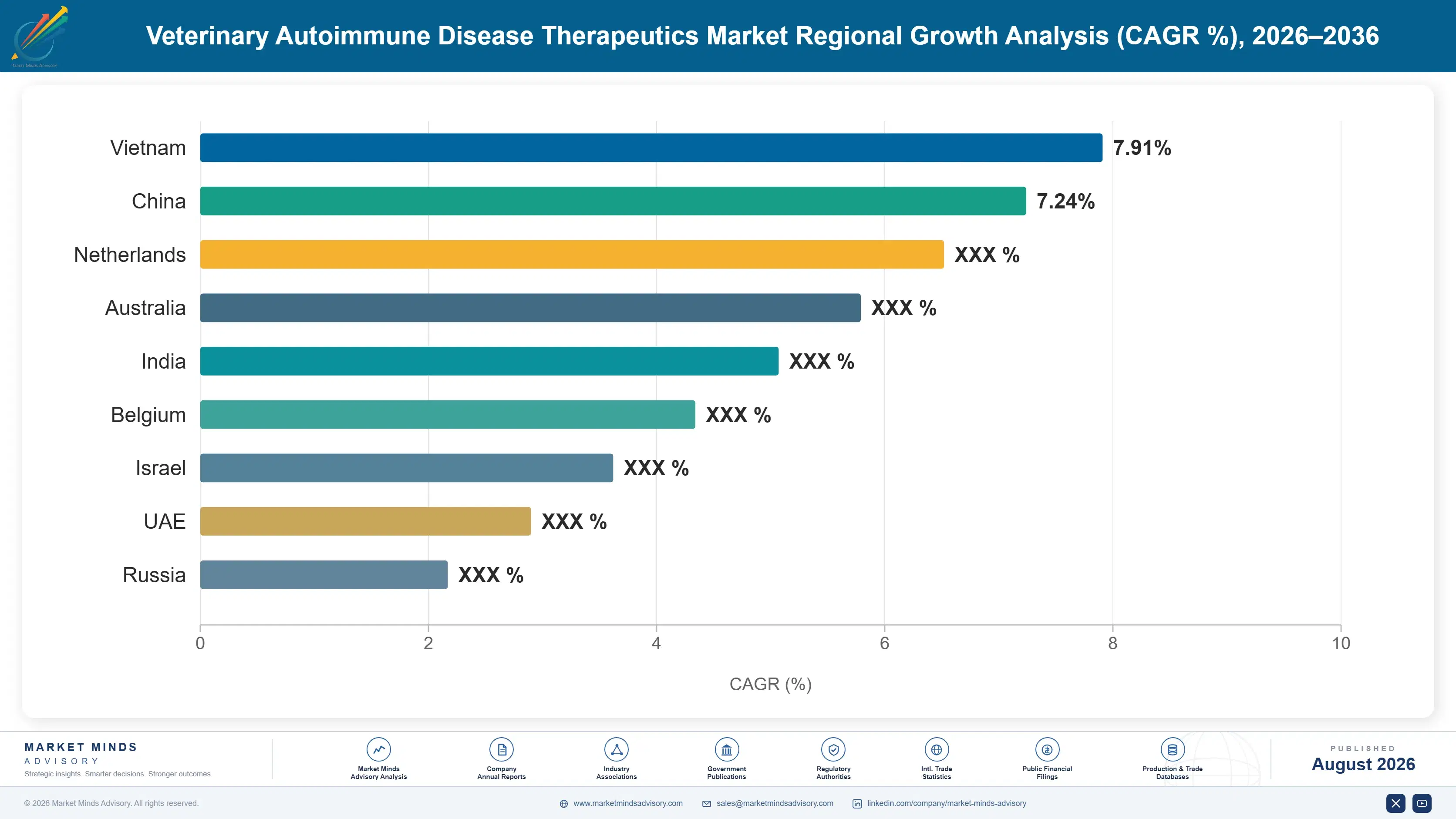
North America holds the largest share at 31%, on companion animal spending no other region matches. Western Europe follows at 25% with higher insurance penetration. China grows fastest of any country covered at 17.8% on urban ownership expansion. Diagnosis capability decides market size in every market covered.

North America

Willingness to spend rather than animal numbers explains this 31% share. American owners spend more per companion animal than anywhere else and treat chronic conditions in dogs that would go untreated in most markets, which is what supports a therapy costing around 78 dollars a month across four years. Insurance penetration remains low at well under a fifth of treated animals, so almost all of it is out of pocket. Corporate veterinary group consolidation has changed purchasing, with formulary decisions increasingly made centrally rather than by individual practices. Canadian patterns follow closely at smaller scale. Growth of 9.0% reflects a market where the diagnosis rate is already high and expansion depends on treatment initiation.
Share: 31% | CAGR: 9.0% (2026 to 2036)

Western Europe

Insurance penetration gives this 25% share a different foundation from North America. Swedish and British pet insurance coverage is among the highest anywhere, which removes some of the discretionary character from chronic therapy decisions and supports longer treatment duration in those markets specifically. German and Dutch veterinary practice is technically advanced with strong dermatology referral networks that improve diagnosis rates considerably. Southern European ownership patterns and spending levels differ substantially, with treatment of chronic skin disease far less routine. Regulatory approval pathways add time and cost relative to North America. Growth of 8.0% is the lowest of the seven regions, reflecting high existing penetration alongside constrained household spending. Insurance changes the spending decision.
Share: 25% | CAGR: 8.0% (2026 to 2036)
Regional intelligence for 5 additional markets available in the complete report: East Asia, South Asia and Pacific, Latin America, Middle East and Africa, Eastern Europe. Contact sales@marketmindsadvisory.com.
veterinary-autoimmune-disease-therapeutics-market-country-cagr-analysis-1787641467660

Where This Category Actually Grows

Nothing here is won on a mechanism argument, because the owner cannot evaluate one and the animal cannot report an outcome. Value accrues to whoever removes the daily dosing burden, whoever captures a newly diagnosed animal before anyone else, and whoever reaches populations where ownership itself is expanding. Four routes carry weight, and none of them is pharmacology.

Move the Dose Into the Clinic Appointment

Only around 58% of owners complete a prescribed daily oral course, and the failures are not careless owners so much as the reality of medicating an unwilling animal every day for four years. Monoclonal injections administered in the practice grow at 14.4% against a market rate of 9.6% because they convert compliance into a booked appointment. Revenue moves from the pharmacy shelf into the consultation, which improves practice economics and gives the veterinarian a reason to advocate. Manufacturers still competing on onset of action are answering a question that owner behaviour already settled.
Market Impact: Removes the 42% owner compliance failure rate entirely

Capture the Animal at First Diagnosis

Average continuous therapy runs around 4.2 years once atopic dermatitis is diagnosed, which means a newly diagnosed animal is worth the whole of that duration while a switch captures only the remainder. Commercial effort aimed at first line prescribing therefore returns considerably more than effort aimed at converting established patients, and the difference compounds across a practice's caseload. Diagnosis support, dermatology referral relationships and initiation programmes all reach that moment. Manufacturers running switch campaigns are competing for the smaller half of the available value in every account they visit. Inertia is the real competitor here.
Market Impact: Secures the full 4.2 year treatment duration entirely

Follow Ownership Growth Into Asian Urban Markets

China grows at 17.8%, faster than any country covered, on urban companion animal ownership that has risen sharply within a decade alongside veterinary capability reaching second and third tier cities. Diagnosis rates track clinical capability rather than disease prevalence, so each new practice with dermatology competence converts animals that were previously untreated. Regional growth of 11.8% across South Asia and Pacific follows the same logic from a smaller base. Building veterinary education and diagnostic support ahead of product demand reaches this expansion before competitors arrive with a price list. Education travels further than pricing does.
Market Impact: Captures the 17.8% Chinese national market growth rate

Convert Off Label Practice Into Labelled Indications

Janus kinase inhibitors grow at 12.2% partly on substantial off label use in immune mediated arthritis and enteropathy, where corticosteroids and human derived immunosuppressants remain the alternative. That practice is already established, which means a formal approval converts existing prescribing into labelled revenue rather than creating demand from nothing. Trial costs are real and treated populations modest, which is why nobody has done it, but the concentration risk from 78% dependence on one indication makes the argument stronger than the individual business case suggests. Nobody has attempted it seriously yet, which is itself an opportunity.
Market Impact: Reduces the 78% single indication concentration risk materially

Who Controls the Margin Pool

Concentration is very high even by animal health standards. The top five hold 84% of category revenue, the basis applied consistently here, and the leading position is more concentrated still because one company holds both the dominant oral and the dominant injectable product in atopic dermatitis. Zoetis leads by a distance that reflects first mover advantage in a category it substantially created rather than any current barrier.
Competition runs on three fronts. Branded innovators compete for first line prescribing at the point of diagnosis, which is a veterinarian relationship built through education and dermatology support. Generic and established product suppliers compete on price for corticosteroids and conventional immunosuppressants that still carry substantial volume. Emerging biologics developers compete for acquisition rather than for market share, since distribution at scale is beyond them.

Rankings will move when patent protection on the dominant products expires, which is the single largest scheduled event in this category. Generic entry into a market where 78% of revenue rests on one indication would reprice everything at once. The other pressure point is emerging biologic developers, several of whom hold species specific antibody platforms that large companies would rather own than compete against.
veterinary-autoimmune-disease-therapeutics-market-company-positioning-matrix-1787641468183

Competitive Moat and Risk Dimensions

ZOETIS

Moat: Dual Format Category Position

Holding both the dominant oral and the dominant injectable therapy in canine atopic dermatitis means a veterinarian moving a patient between formats stays inside the same portfolio, and a practice standardising its dermatology protocol standardises on one supplier. That position was built by creating the category rather than by entering it, which is not a thing competitors can replicate.
ZOETIS

Risk: Patent Expiry Concentration

Roughly 78% of category revenue rests on one indication and a substantial share of that on products approaching the end of protection, which means a single scheduled event reprices an unusually large proportion of the business. Generic entry in animal health is fast where the molecule is straightforward, and the oral product is considerably more exposed than the biologic.
ELANCO ANIMAL HEALTH

Moat: Broad Practice Relationships

Presence across parasiticides, vaccines and therapeutics gives access to practices through products they buy constantly rather than only when a dermatology case arrives, which matters when the commercial contest is for first line prescribing at diagnosis. Corporate veterinary group formulary discussions also cover whole portfolios rather than single categories now.
ELANCO ANIMAL HEALTH

Risk: Late Position in Biologics

Monoclonal therapies grow at 14.4% and the established positions were taken years ago by a competitor that created the format, leaving a challenger competing on a mechanism argument that owner compliance behaviour has already decided. Building species specific antibody capability from behind requires either substantial development time or an acquisition at a price the growth rate has already inflated.

Players Tracked

Prominent Players

Zoetis
Elanco Animal Health
Boehringer Ingelheim Animal Health
Dechra Pharmaceuticals
Virbac

Other Key Players

Merck Animal Health
Ceva Sante Animale
Vetoquinol
Bimeda
Norbrook Laboratories
Chanelle Pharma
Invetx
Torigen Pharmaceuticals
Ourofino Saude Animal
Huvepharma
Phibro Animal Health
Nextmune
Piedmont Animal Health
Jurox
Bioiberica

Recent Developments

FEBRUARY 2025

Species specific antibody developer acquired by animal health group

An animal health company acquired a developer holding species specific monoclonal antibody platform technology, citing pipeline breadth beyond dermatology rather than any single candidate. Monoclonal therapies grow faster than anything else in this category, and platform capability has become considerably harder to acquire at a reasonable price.
Signal: Antibody platform capability is being bought rather than built because the growth rate keeps raising the price
MAY 2025

Corporate veterinary group standardises dermatology treatment protocol

A large corporate veterinary group standardised its atopic dermatitis treatment protocol across practices, moving formulary decisions from individual clinics to a central clinical committee. Suppliers reported that a single protocol decision now determines prescribing across hundreds of locations rather than being negotiated practice by practice.
Signal: Corporate consolidation has now turned hundreds of separate prescribing decisions into a single committee conversation instead
SEPTEMBER 2025

Trial reports Janus kinase inhibitor results in immune mediated enteropathy

A clinical trial reported outcomes for a Janus kinase inhibitor in canine chronic immune mediated enteropathy, an indication where corticosteroids and human derived immunosuppressants have been the practical default for decades. Off label use in the indication was already substantial before any formal evidence appeared at all.
Signal: Formal approval here would convert established off label practice into labelled revenue rather than create demand

What These Therapies Cost to Make

Cost structure separates completely by molecule type. Monoclonal antibody production in mammalian cell culture accounts for roughly 31% of cost of goods, with fill finish, cold chain and release taking the remainder, and capacity sourced from few contract manufacturers in Europe and North America. Small molecule Janus kinase inhibitors and conventional immunosuppressants invert that entirely, with active ingredient a modest share and packaging, distribution and regulatory compliance dominating.
Biologics manufacturing capacity was the binding constraint through the period, since animal health competes for the same cell culture capacity as human pharmaceutical programmes and sits lower in most contract manufacturers' priority ordering. Company annual reports across the animal health sector documented capacity and cost pressure in detail. Active pharmaceutical ingredient supply for small molecules moved separately, tracking Chinese and Indian production capacity and the energy costs behind it.

Exposure divides by portfolio composition rather than by company size. A company weighted toward injectable biologics carries capacity risk it cannot resolve quickly, since qualifying a facility takes years. A small molecule portfolio carries cheaper inputs but faces generic entry the moment protection lapses. The fastest growing products carry the tightest supply position, which is an awkward combination.
veterinary-autoimmune-disease-therapeutics-market-cost-volatility-analysis-1787641468380

Secure dedicated cell culture capacity on long agreements

Animal health biologics compete for contract manufacturing capacity against human pharmaceutical programmes and generally lose that priority contest when supply tightens. Dedicated capacity agreements cost more per batch and remove the risk of a growing product running short of supply. Qualifying a second site takes months of comparability work, cheaper completed before demand outruns the first.

Dual source active ingredients for small molecule products

Janus kinase inhibitor and conventional immunosuppressant actives come predominantly from Chinese and Indian manufacturers, and single sourcing leaves a product exposed to regulatory action or energy driven disruption at one site. Qualifying alternatives requires stability and bioequivalence work in every registered market. Companies holding qualified second sources maintained supply through disruptions that stopped competitors entirely.

Build cold chain capability into emerging market expansion

Injectable biologics require reliable refrigerated distribution, which limits where they can be sold regardless of owner willingness to pay for them. Expanding into Chinese second tier cities and Southeast Asian markets requires cold chain investment ahead of demand rather than alongside it. Manufacturers building distribution early reached those markets while competitors were still assessing demand.

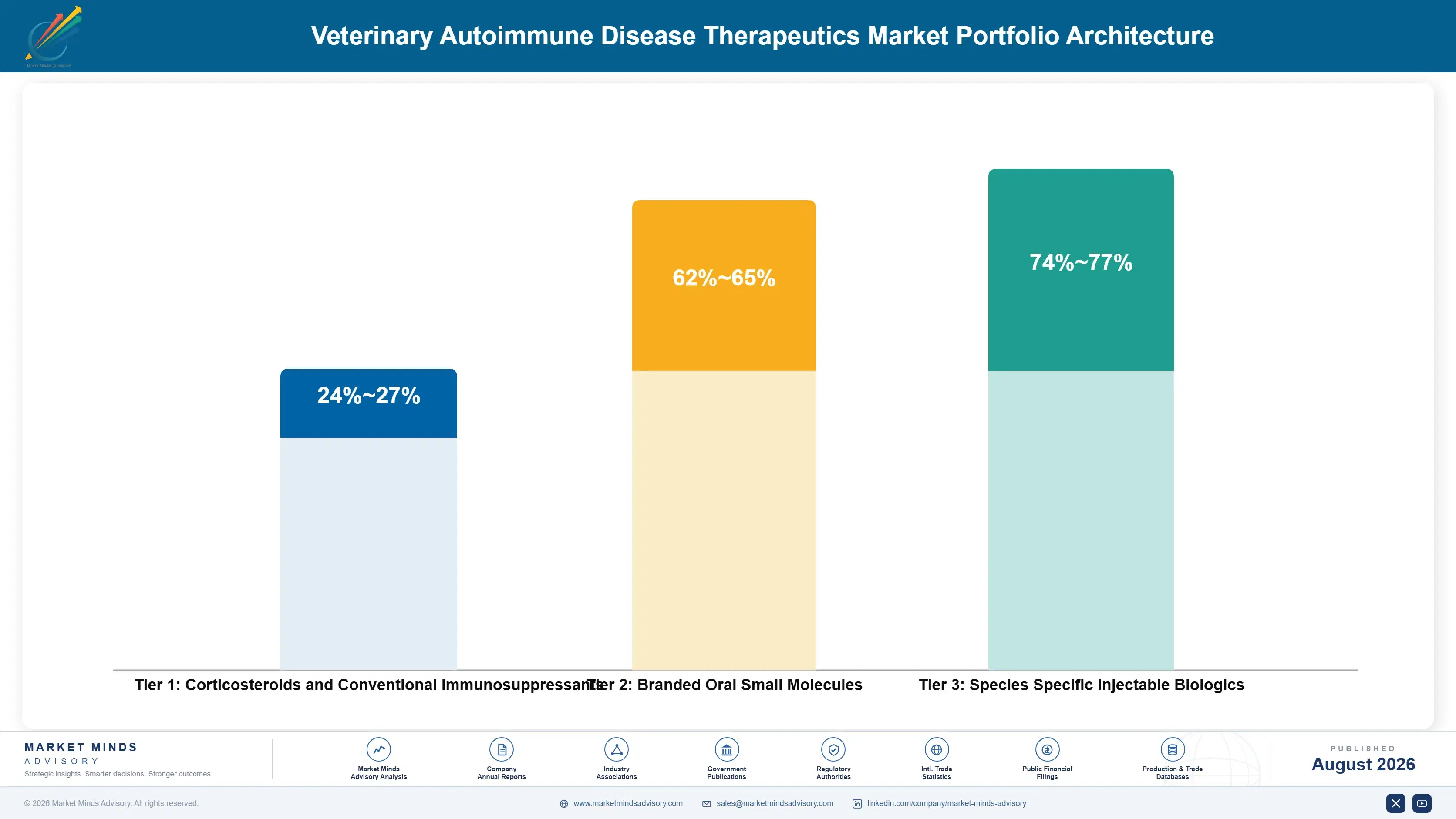
Portfolio Architecture for Margin Defence

Margin architecture follows protection and format together. Corticosteroids and conventional immunosuppressants are long off patent and earn commodity margins on substantial remaining volume. Small molecule branded products earn well while protection lasts and face rapid generic entry afterwards, since these molecules are straightforward to copy. Injectable biologics earn best and hold longest, because species specific antibodies are considerably harder to replicate than a tablet.
The tension is between the format that earns and the format that reaches. Injectable biologics require cold chain and a clinic visit, which limits them to markets and practices equipped for both. Oral products reach everywhere including price sensitive markets where a monthly injection is impossible. A portfolio weighted entirely toward biologics forfeits most of the growth happening in Asian and Latin American markets it cannot physically supply.

High value pools concentrate in injectable biologics for developed market practices and in first line prescribing at the point of diagnosis, where a 4.2 year duration is captured whole. Everything competing for established patients is competing for a partial duration against an incumbent with an existing relationship. Generic entry after patent expiry will reprice the oral tier substantially, and the biologic tier considerably less.

Corticosteroids and Conventional Immunosuppressants

Long off patent molecules borrowed from human medicine decades ago, still carrying substantial volume in price sensitive markets and in indications nothing newer addresses. Margin is thin and competition is entirely on price and availability.
Gross Margin: 24-27%

Branded Oral Small Molecules

Janus kinase inhibitors and calcineurin inhibitors sold at branded pricing while protection lasts, reaching markets and price points injectable biologics cannot. Generic entry after expiry is fast because these molecules are straightforward to reproduce.
Gross Margin: 62-65%

Species Specific Injectable Biologics

Monoclonal antibodies administered in clinic that convert owner compliance into a booked appointment. Margin is the best available and protection holds longest, since species specific antibodies are considerably harder to copy than small molecules.
Gross Margin: 74-77%
veterinary-autoimmune-disease-therapeutics-market-portfolio-architecture-1787641468885

High-value Sub-segments and Strategic Watch-out

Monoclonal Antibody Therapies

The fastest growing class at 14.4% and the best margin in the market, winning on administration route rather than on any efficacy advantage over oral alternatives. Cold chain and clinic administration restrict reach, which is why growth concentrates in developed market practices. Reach is the trade off.
Gross Margin: 74-77%

Janus Kinase Inhibitors

Second fastest at 12.2%, supported by labelled dermatology use and by substantial off label prescribing in arthritis and enteropathy. The oral route reaches markets biologics cannot, and generic entry after expiry will be considerably faster here than for antibodies. Off label use is already substantial here.
Gross Margin: 62-65%

Calcineurin Inhibitor Therapies

Growing at 5.8% and holding a middle position as an established oral option with a long clinical record and generic competition already present. It remains useful where newer products are unaffordable, which describes a large share of the markets growing fastest. Generic competition is already present.
Gross Margin: 44-47%

Corticosteroid Therapies

Growing at only 2.4% and used mainly for acute control and in markets where nothing else is affordable, despite well documented consequences of prolonged administration. Volume remains substantial and will persist wherever monthly therapy costs exceed what owners can spend. Nothing displaces it in those markets.
Gross Margin: 24-27%

How Owners Keep Paying Monthly

Each diagnosis is an annuity with a known duration. Atopic dermatitis is managed rather than cured, and continuous therapy runs around 4.2 years on average, so a treated animal represents recurring revenue across a period visible from the moment of diagnosis. That makes acquisition at first diagnosis worth considerably more than any switch, since a switch captures only whatever duration remains after somebody else had the animal first.
Stickiness depends heavily on who administers the dose. An animal on injectable maintenance returns to the practice on a schedule, which builds a relationship that persists and makes switching a conversation somebody has to start deliberately. An oral prescription is refilled or quietly abandoned, and roughly 42% of courses are never completed. Insured animals stay on therapy considerably longer than uninsured ones.

The decision maker is a household, not a clinician or a payer. Veterinarians recommend and owners decide monthly, weighing roughly 78 dollars against household circumstances that change. Younger owners in Asian urban markets treat animals as family and fund chronic care accordingly, which is what makes those markets grow faster than developed ones. Manufacturers reasoning about clinical value address a decision turning on affection and income.
veterinary-autoimmune-disease-therapeutics-market-end-use-penetration-index-1787641469406

Where This Category Rewards Focus

These are among the four positions where our research anticipates prominent divergence between winners and laggards over the coming forecast period. Each is grounded in the demand model, the regulatory perimeter, and the announced capacity pipeline.
01 / ADMINISTRATION ROUTE PRIORITY

Compliance beats pharmacology in every real comparison

Only around 58% of owners complete a prescribed daily oral course, and the shortfall reflects the practical difficulty of medicating an unwilling animal every day for four years rather than any carelessness. Monoclonal injections administered in the practice grow at 14.4% against a market rate of 9.6% because they convert that problem into a booked appointment, without offering an efficacy advantage in most published comparisons. Manufacturers still competing on onset of action are answering a question that owner behaviour settled some years ago now.
02 / FIRST DIAGNOSIS CAPTURE

A switch buys the remainder, not the duration

Continuous therapy runs around 4.2 years once atopic dermatitis is diagnosed, which means capturing a newly diagnosed animal is worth the entire duration while converting an established patient captures only whatever remains of it. Commercial effort aimed at first line prescribing therefore returns considerably more per veterinarian relationship than any switch campaign can, and the difference compounds across a practice caseload. Diagnosis support and dermatology referral relationships reach that moment, while price comparison material arrives far too late to matter.
03 / CONCENTRATION RISK MANAGEMENT

Seventy eight percent of revenue sits on one disease

Roughly 78% of category revenue depends on canine atopic dermatitis, so a safety signal, a generic entry or a superior competitor in that single indication reprices the entire business at once. Janus kinase inhibitors already see substantial off label use in immune mediated arthritis and enteropathy, which means formal approval would convert established prescribing into labelled revenue rather than build demand from nothing. Trial costs are real and populations modest, but the concentration argument is considerably stronger than any individual business case.
04 / OWNERSHIP GROWTH ACCESS

Diagnosis capability determines how large a market becomes

China grows at 17.8%, faster than any country covered, on urban companion animal ownership that has risen sharply and on veterinary capability reaching second and third tier cities for the first time. Diagnosis rates in this category track clinical capability rather than disease prevalence, so every practice acquiring dermatology competence converts animals that were previously undiagnosed rather than untreated. Building veterinary education and diagnostic support ahead of product demand reaches that expansion before any competitor arrives holding a price list.

Engagement Snapshot From the Field

A live engagement with an industry participant carrying material or product regulatory and market exposure ahead of a defining policy shift, showing how our research translates into a defensible multi-year portfolio strategy.
MARKET MINDS ADVISORY · CLIENT ENGAGEMENT SUMMARY
Veterinary Autoimmune Disease Therapeutics Producer Strategic Portfolio Review and Transition Roadmap 2026·Investment Scenario on Veterinary Autoimmune Disease Therapeutics Exposure Evaluation 2025-26
CLIENT PROFILE
An animal health company selling oral immunosuppressant and corticosteroid products into companion animal practice across North America and Western Europe. Annual dermatology revenue was approximately 260 million dollars (client-reported, unverified by MMA), almost entirely from oral products. No injectable biologic existed in the range and commercial effort was directed largely at switching established patients from competitor products.
STRATEGIC CHALLENGE
Volume had grown slowly while injectable biologics took share in exactly the accounts the company had held for years, and two corporate veterinary groups had standardised protocols that excluded its products. Management wanted to know whether to develop a biologic, acquire one, or defend the oral position. Nobody had measured what a newly diagnosed animal was actually worth against a switched one.
MMA APPROACH
MMA modelled patient lifetime value by acquisition point, separating animals captured at first diagnosis from those switched later in a treatment course. Biologic development, acquisition and licensing routes were costed against time to market. Forty-seven expert interviews with veterinarians, dermatology referral specialists and corporate group formulary members established how prescribing decisions are actually made and when they become fixed.
KEY FINDINGS
  1. Animals captured at first diagnosis generated roughly 2.6 times the lifetime revenue of animals switched later, because the average remaining duration after a switch was far shorter than assumed.
  2. Veterinarians in 35 of the 47 interviews said they rarely change a therapy that is working, which meant switch campaigns were competing against inertia rather than against a competitor.
  3. Biologic development from a standing start required an estimated 6 years against licensing an existing platform delivering a product within roughly 30 months.
  4. Corporate group formulary decisions now covered 41% of the client's addressable practices, up from a small fraction four years earlier, and were made centrally.
CLIENT PROFILE
An animal health company selling oral immunosuppressant and corticosteroid products into companion animal practice across North America and Western Europe. Annual dermatology revenue was approximately 260 million dollars (client-reported, unverified by MMA), almost entirely from oral products. No injectable biologic existed in the range and commercial effort was directed largely at switching established patients from competitor products.
STRATEGIC CHALLENGE
Volume had grown slowly while injectable biologics took share in exactly the accounts the company had held for years, and two corporate veterinary groups had standardised protocols that excluded its products. Management wanted to know whether to develop a biologic, acquire one, or defend the oral position. Nobody had measured what a newly diagnosed animal was actually worth against a switched one.
MMA APPROACH
MMA modelled patient lifetime value by acquisition point, separating animals captured at first diagnosis from those switched later in a treatment course. Biologic development, acquisition and licensing routes were costed against time to market. Forty-seven expert interviews with veterinarians, dermatology referral specialists and corporate group formulary members established how prescribing decisions are actually made and when they become fixed.
KEY FINDINGS
  1. Animals captured at first diagnosis generated roughly 2.6 times the lifetime revenue of animals switched later, because the average remaining duration after a switch was far shorter than assumed.
  2. Veterinarians in 35 of the 47 interviews said they rarely change a therapy that is working, which meant switch campaigns were competing against inertia rather than against a competitor.
  3. Biologic development from a standing start required an estimated 6 years against licensing an existing platform delivering a product within roughly 30 months.
  4. Corporate group formulary decisions now covered 41% of the client's addressable practices, up from a small fraction four years earlier, and were made centrally.
RECOMMENDED STRATEGY
Phase 1: Phase one: redirect commercial effort from switching toward first diagnosis capture, where lifetime value runs roughly 2.6 times higher per animal. Phase 2: Phase two: license a biologic platform rather than develop one, since 6 years to market misses the growth entirely at 14.4% annually. Phase 3: Phase three: build a dedicated corporate group formulary function immediately, since central decisions now cover 41% of all addressable practices.
OUTCOME
The client restructured its commercial organisation around diagnosis support and dermatology referral relationships within two quarters and signed a biologic licensing agreement the following year. First line prescribing share rose materially in the accounts where the new approach was deployed, and the company regained formulary position with one of the two corporate groups (client-reported, unverified by MMA).

Frequently Asked Questions

Foundational context covering the market sizes, CAGR, scope, country, region and competition that inform every finding below. This section is provided to cover basics and most often pre-purchase conversations, answered from the MMA Primary Research Dataset.

What is the current size of the Veterinary Autoimmune Disease Therapeutics Market?

The market was valued at 2.2 billion dollars in 2025, covering monoclonal, small molecule and conventional immunosuppressant therapies for animals. It reaches an estimated 2.41 billion dollars during 2026.

How large will the Veterinary Autoimmune Disease Therapeutics Market be by 2036?

MMA forecasts 6.03 billion dollars by 2036, an increase of 3.62 billion dollars over the 2026 base. That represents an expansion multiple of 2.50 times across the forecast period.

What is the CAGR for the Veterinary Autoimmune Disease Therapeutics Market 2026 to 2036?

The base case compound annual growth rate is 9.6%, with a bull case of 10.8% and a bear case of 8.4%. Indication expansion and household spending separate those scenarios.

Which segment is growing fastest?

Monoclonal antibody therapies grow at 14.4%, half again the market rate of 9.6%, because clinic administration removes owner compliance. Janus kinase inhibitors follow at 12.2%.

Who are the major companies in the Veterinary Autoimmune Disease Therapeutics Market?

Zoetis, Elanco Animal Health, Boehringer Ingelheim Animal Health, Dechra Pharmaceuticals and Virbac lead on category revenue worldwide. Together they account for 84% of the market.

Which country is growing fastest?

China grows fastest at 17.8%, on urban companion animal ownership rising sharply alongside veterinary dermatology capability reaching second and third tier cities for the first time.

Report Segmentation Architecture

The full report scope spans multiple orthogonal segmentation dimensions, with cross-tabulated demand data provided for each dimension pair. Coverage extends further to regional breakdowns, trend trajectories, and the competitive detail needed to support segment-level decision-making.

By Drug Class

  • Monoclonal Antibody Therapies
  • Janus Kinase Inhibitors
  • Calcineurin Inhibitor Therapies
  • Corticosteroid Therapies
  • Conventional Cytotoxic Immunosuppressants
  • Topical and Localised Immunomodulators

By End-Use Industry

  • Companion Animal General Practice
  • Veterinary Dermatology Referral
  • Corporate Veterinary Groups
  • Academic Veterinary Hospitals
  • Equine Practice
  • Production Animal Veterinary Services

By Commercial Dimension

  • Practice Dispensed Supply
  • Corporate Group Formulary Contracts
  • Veterinary Distributor Channels
  • Online Pharmacy Fulfilment
  • Direct Practice Ordering
  • Compounding and Speciality Supply

By Region

  • North America
  • Western Europe
  • East Asia
  • South Asia and Pacific
  • Latin America
  • Middle East and Africa
  • Eastern Europe

Scope, Methodology, and Coverage

Every figure in this report is reproducible from documented input assumptions. The scope below maps the historical period, the forecast horizon, the segmentation dimensions, and the countries covered, alongside the underlying primary and qualitative methodology.
Historical Period
2020 to 2025
Forecast Period
2026 to 2036
Base Year
2025 (USD billions; MMA Primary Research Dataset, August 2026)
Market Definition
Therapeutics used to treat immune mediated and autoimmune disease in companion and production animals worldwide, covering monoclonal antibody therapies, Janus kinase inhibitors, calcineurin inhibitor therapies, corticosteroid therapies, conventional cytotoxic immunosuppressants, and topical and localised immunomodulators. Measured at manufacturer selling value across all distribution channels. Antiparasitic products, antimicrobials, vaccines, allergen specific immunotherapy preparations, diagnostic testing, veterinary nutrition and dermatological shampoos without immunomodulatory action are excluded from scope.
Quantitative Units
USD billions (current prices); animals treated; USD per animal per month by drug class
Segmentation Dimensions
Drug class; end-use industry; commercial dimension; region
Regions Covered
North America, Western Europe, East Asia, South Asia and Pacific, Latin America, Middle East and Africa, Eastern Europe
Countries Covered
United States, Canada, United Kingdom, Germany, France, Netherlands, Sweden, Spain, China, Japan, South Korea, Taiwan, India, Australia, Thailand, Brazil, Chile, Saudi Arabia, Israel, Poland
Key Companies Profiled
Zoetis, Elanco Animal Health, Boehringer Ingelheim Animal Health, Dechra Pharmaceuticals, Virbac, Merck Animal Health, Ceva Sante Animale, Vetoquinol, Bimeda, Norbrook Laboratories, Chanelle Pharma, Invetx, Torigen Pharmaceuticals, Ourofino Saude Animal, Huvepharma, Phibro Animal Health, Nextmune, Piedmont Animal Health, Jurox, Bioiberica
Quantitative Methodology
Primary survey, n=3,800 respondents, Q4 2025, six countries; demand-side model with trade association cross-validation
Qualitative Methodology
47 expert interviews, Q4 2025; applied to validate demand model assumptions, identify emerging dynamics, and assess competitive positioning
Report Format
PDF and XLSX data workbook (Word format preview document)
Publisher
Market Minds Advisory
Report Code
MMA-2026-HLT-148
Published
August 2026
Contact
sales@marketmindsadvisory.com | www.marketmindsadvisory.com

Purchase the full Veterinary Autoimmune Disease Therapeutics Market Report (2026 to 2036).

The full report treats veterinary autoimmune therapy as one indication carrying an entire category, since canine atopic dermatitis accounts for roughly 78% of revenue and nothing else comes close. It sizes all six drug classes independently through 2036, models patient lifetime value by acquisition point rather than by prescription volume, and quantifies the compliance gap that decides which administration route wins. Regional chapters cover all seven regions, with ownership growth assessed separately from diagnosis capability. Competitive profiling covers 20 participants on one consistent category revenue basis.
Six drug classes sized independently through 2036
Patient lifetime value modelled by acquisition point
Compliance gap quantified across oral and injectable routes
Ownership growth assessed separately from diagnosis capability
Patent expiry repricing scenarios modelled by drug class
Twenty participants profiled on one consistent revenue basis

Built For The People Who Decide

From boardroom strategy to bench-side execution, this report is read cover-to-cover by leaders shaping the next decade of their industry, turning demand scenarios, market dynamics and valuation benchmarks into decisions.
CXOs/ Presidents/ VPs/ Managers
M&A and Corporate Development
Strategy Teams and R&D Heads
Procurement and Product Directors
Regulatory and Compliance Leaders
Investor Relations and Equity Analysts