Market Minds Advisory
Ventral Hernia Treatment Market

Ventral Hernia Treatment Market: Recurrence Economics, Mesh Reputation and a Patient Population Other Surgery Creates

Roughly 18% of abdominal incisions become a hernia within five years, which means this entire market is generated by operations performed for something else and shrinks as those incisions get smaller.

Lead Analyst

Alice Ballenger

Published

September 2026

Make Smarter Decisions with Customized Research Insights

Request a free sample report and evaluate market opportunities, growth trends, and competitive dynamics relevant to your business needs.

2025 MARKET VALUE$2.4BMarket Size 2025
2036 FORECAST VALUE$4.7BBase Case , 2026 to 2036
CAGR 2026 TO 20366.4 %Bull 7.6% / Bear 5.2%
INCREMENTAL OPPORTUNITY$2.2BNet 10- year value creation
EXPANSION MULTIPLE1.86x2036 value over 2026 base
Strategic Levers
M&A Pipeline
Regional Outlook
Country Rankings
Competitive Intelligence
Segmental Deep-dive
Call-Us : 91 93563 13602

Executive Snapshot and Market Trajectory

This market is created by other surgery. Around 18% of abdominal incisions develop an incisional hernia within five years, so the patient population is generated by operations performed for something else entirely. As minimally invasive technique reduced incision size, it quietly reduced the pipeline feeding this business.
The commercial problem inside it is reputation. Mesh litigation and patient advocacy have made the word itself something patients arrive frightened of, and roughly 34% now raise material concerns before the surgeon mentions any. Biosynthetic resorbable mesh grows fastest at 9.6%, half again the market rate of 6.4%, largely because a material that dissolves answers a fear that clinical evidence has not. Surgeons offer it because outright refusal is a considerably worse outcome.
The economics that matter are recurrence. Roughly 22% of repairs fail and require a further operation, each larger, harder and considerably more expensive than the first. A device is therefore worth what it prevents rather than what it costs. Purchasing runs through value analysis committees comparing mesh price per square centimetre, which is the wrong number by a wide margin. Recurrence lands on a different budget line entirely.
Market Definition
Devices and materials used to repair ventral and incisional abdominal wall hernias, covering permanent synthetic mesh, biologic mesh, biosynthetic resorbable mesh, mesh fixation devices, robotic hernia instrumentation, and component separation and closure devices. Measured at manufacturer selling value. Inguinal and femoral hernia repair, hiatal and diaphragmatic hernia devices, general laparoscopic platforms, wound closure products and abdominal wall imaging are excluded.
Base Year Value
$2.4B in 2025 (MMA Primary Research Dataset, August 2026)
Forecast Period
2026 to 2036, eleven discrete annual values
CAGR
6.4% base case. Bull 7.6%. Bear 5.2%.
Fastest Growth Segment
Biosynthetic Resorbable Mesh: 9.6% CAGR
Fastest Growth Country
Mexico: 11.2% CAGR
Fastest Growth Region
South Asia and Pacific: 8.6% CAGR
Largest Region
North America: 32% of 2025 global value
Market Leaders
Becton Dickinson, Medtronic, Johnson and Johnson MedTech, Baxter International, Integra LifeSciences. Source: MMA Primary Research Dataset, July 2026.
Primary Survey
n=3,800 procurement and R&D decision-makers, Q4 2025, six countries
Methodology
Demand-side build-up, cross-validated against public data, 47 expert interviews

Ventral Hernia Treatment Market Forecast Scenarios

ventral-hernia-treatment-market-size-forecast-scenario-1787641448214
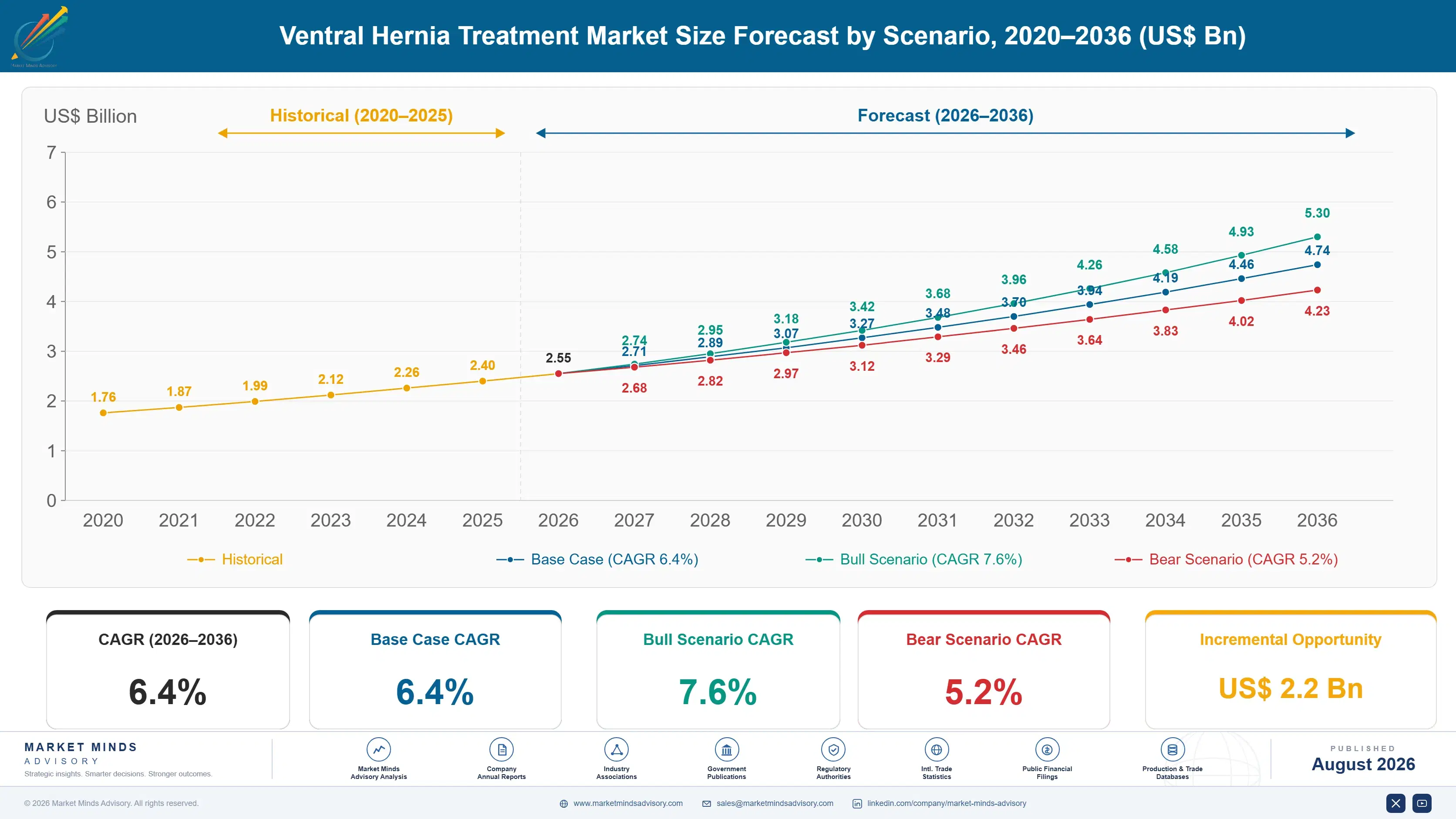
The five years to 2025 were shaped by litigation and by robotics arriving together. Mesh litigation reached settlements and public awareness at the same time that robotic platforms made complex abdominal wall reconstruction technically accessible to more surgeons. Procedure volumes grew while material choices shifted away from permanent synthetics faster than any evidence supported. The 5.2% historical rate averages rising procedure counts against falling average material prices.
The 6.4% base case rests on three mechanisms. Biosynthetic resorbable materials keep taking share on patient acceptance rather than on outcome data, which is a durable driver because the concern is not going away. Robotic ventral repair continues expanding beyond high volume centres, and robotic cases use more fixation and more expensive materials than open repair does. And obesity prevalence keeps rising across Latin America, the Gulf and Southeast Asia, raising incidence and repair difficulty together.
The 7.6% bull case turns on recurrence evidence becoming purchasing criteria, since a device preventing a reoperation is worth many times a mesh price. The 5.2% bear case is the incision pipeline: as minimally invasive and robotic primary surgery reduce incision length further, incisional hernia incidence falls and the population feeding this market falls with it.

A Market Other Operations Keep Creating

Nobody develops a ventral hernia without a reason and the commonest reason is a previous operation. Roughly 18% of abdominal incisions become an incisional hernia within five years, which means the addressable population here is a by-product of surgery performed for cancer, obesity, transplant or trauma. Rising obesity raises both the incidence and the difficulty of repair, while smaller incisions reduce the pipeline.
TOP FIVE CONCENTRATION72%Combined procedure volume served by leading device suppliers
INCISIONAL HERNIA INCIDENCE18%Abdominal incisions developing a hernia within five years
REPAIR RECURRENCE RATE22%Repairs failing and requiring a further operation eventually
PATIENT MESH CONCERN34%Patients raising material concerns before the surgeon does
MESH COST PER REPAIRUSD 1,180Typical material cost for a single ventral repair
ROBOTIC PROCEDURE SHARE38%Ventral repairs performed on a robotic surgical platform
Material choice has become a conversation the patient starts. Mesh litigation and advocacy have made synthetic implants something roughly 34% of patients raise before the surgeon does, arriving with a position already formed. That has driven biosynthetic resorbable adoption at 9.6% growth, faster than anything else in the market, on an argument about permanence rather than about published recurrence data.
The number that should decide purchasing is recurrence. Around 22% of repairs fail and each reoperation is larger, technically harder and considerably more expensive than the original, frequently requiring component separation and a longer stay. A material preventing one reoperation justifies a substantial premium over the roughly 1,180 dollars a typical repair consumes. Value analysis committees comparing price per square centimetre are measuring the wrong thing entirely.
"Hospitals negotiate mesh down by forty dollars a sheet and then pay for a redo repair that costs thirty thousand. The arithmetic is not subtle and almost nobody in a procurement meeting is being shown it."
Director, Surgical Devices and Abdominal Wall Practice · MMA Medical Devices and Diagnostics Practice · August 2026

Market Trends

Patients Now Arrive With a Position on Mesh

Litigation coverage and patient advocacy have made synthetic implant material a subject roughly 34% of patients raise before the surgeon mentions it, frequently arriving with a firm view formed elsewhere. Surgeons respond by offering resorbable or biosynthetic alternatives regardless of what the recurrence evidence supports, because a patient who refuses mesh entirely is a worse clinical outcome than one who accepts a compromise material. Biosynthetic resorbable products grow at 9.6% against a market rate of 6.4% substantially on this mechanism. Manufacturers arguing published data against a formed patient position are losing an argument that was never clinical.
Market Impact: Mexico grows at 11.2% annually
Robotic Platforms Bring Complex Reconstruction to More Surgeons

Abdominal wall reconstruction involving component separation and retromuscular mesh placement was previously confined to specialist centres and specific surgeons, since the technique is demanding through open or conventional laparoscopic approaches. Robotic platforms have made those steps accessible to a considerably wider group, and roughly 38% of ventral repairs now use one. Robotic cases consume more fixation, more expensive mesh and larger sheets than open equivalents. Instrumentation for hernia specific robotic steps grows at 8.2%, second fastest in the market, and it travels with platform installation rather than competing against it.
Market Impact: Recurrence affects 22% of repairs

Market Opportunities and Growth Drivers

Obesity Prevalence Raises Both Incidence and Difficulty

Abdominal wall hernia incidence rises with body mass index and so does repair complexity, since a larger defect under greater intra-abdominal pressure demands wider mesh, more fixation and frequently component separation. Mexico grows at 11.2%, faster than any country covered, on obesity prevalence among the highest recorded anywhere alongside expanding surgical capacity. Bariatric surgery adds a further mechanism, since the abdominal access itself creates incisional hernia risk in exactly the population most likely to develop one. Device consumption per procedure rises with patient weight considerably faster than procedure counts do.
Market Impact: Incidence falls below 18% steadily

Reoperation Costs Make Recurrence the Purchasing Argument

Roughly 22% of ventral repairs recur and each reoperation is larger, technically harder and considerably more expensive than the first, frequently requiring component separation, longer theatre time and extended stay. A material or technique preventing one reoperation therefore justifies a premium many multiples of the roughly 1,180 dollars a typical repair consumes in materials. Health systems paying for both operations have the incentive to act on this and increasingly do, particularly where bundled payment covers the episode. Manufacturers able to demonstrate recurrence reduction reach a budget holder that mesh pricing never does.
Market Impact: Committees compare 1,180 dollar budgets

Market Restraints and Challenges

Shrinking Incisions Reduce the Population Feeding This Market

Around 18% of abdominal incisions develop an incisional hernia, so the patient population here is manufactured by other surgery, and minimally invasive and robotic primary procedures keep making those incisions shorter. The root cause is genuine progress elsewhere in surgery, which nobody in this market can or should want to slow. Commercially it means the demographic tailwind from obesity is partly offset by a shrinking source population. Manufacturers respond by focusing on complex and recurrent repair where device consumption per case is highest, and by expanding in markets where open surgery remains common.
Market Impact: Concerns raised by 34% of patients

Value Analysis Committees Buy on Price Per Centimetre

Hospital purchasing for surgical implants runs through value analysis committees comparing mesh cost per square centimetre against clinically similar products, which is a rational process applied to the wrong variable. The root cause is that recurrence appears years later on a different budget line and frequently at a different institution, so nobody in the purchasing meeting carries the cost of a redo. Commercially this caps pricing on materials with genuine outcome advantages. Manufacturers respond with health economic evidence, episode based contracting and outcome guarantees, all of which take years to establish.
Market Impact: Robotic share reaches 38% of repairs
3 additional market trends, 4 additional growth drivers, and 2 additional restraints and challenges are covered in the full report. Contact sales@marketmindsadvisory.com to access the complete intelligence.

Segment CAGR and Growth Architecture

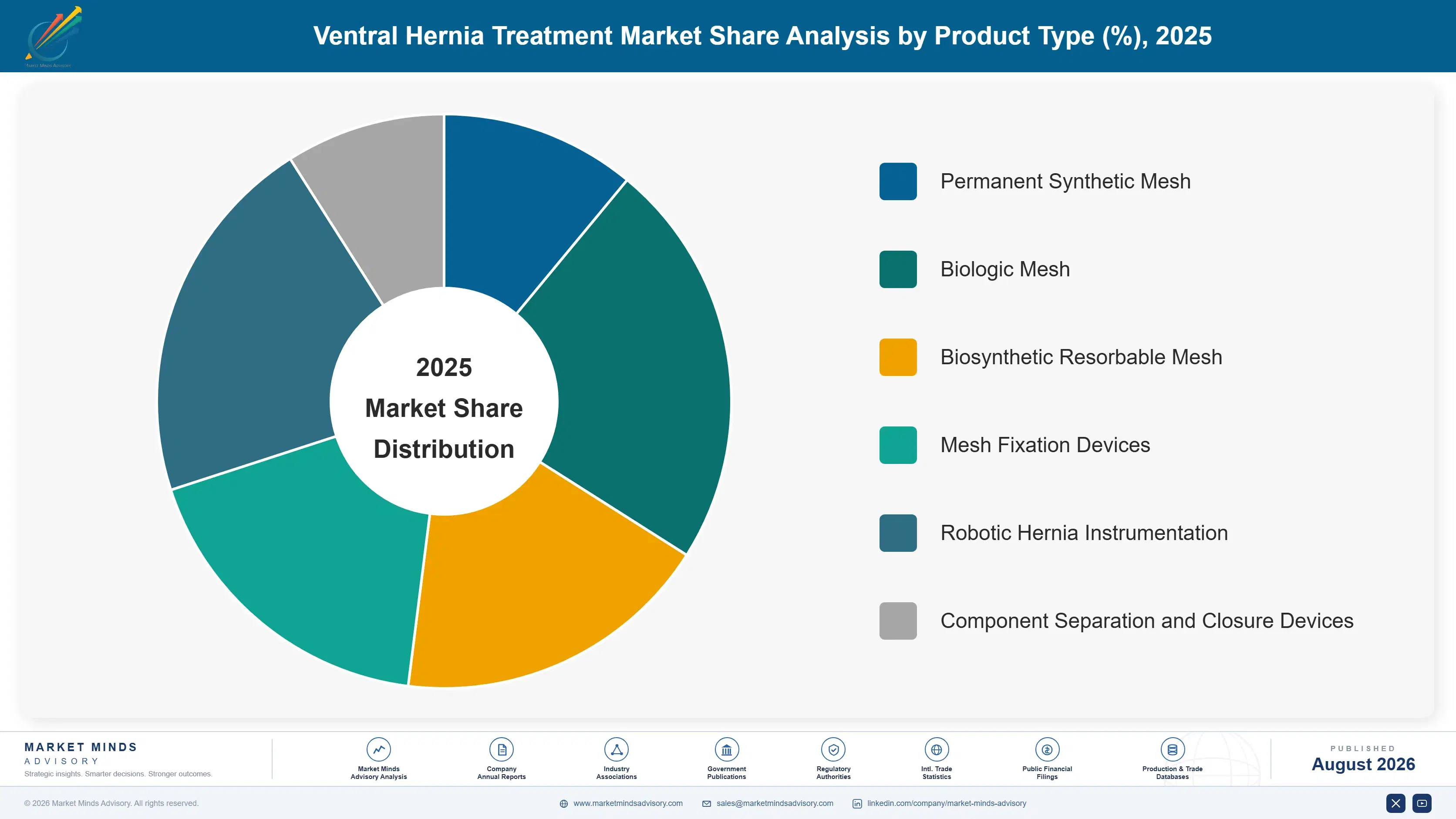
Segmentation follows product type, since type determines what the patient will accept, what the surgeon can place and what the hospital pays for. Six types cover the field, from permanent synthetic mesh to instrumentation used only on a robotic platform. Growth follows patient acceptance and technique access rather than published recurrence performance. Evidence follows rather than leads.
ventral-hernia-treatment-market-market-share-analysis-1787641448760

Biosynthetic Resorbable Mesh

Materials providing mechanical support during healing and then resorbing over months, leaving reinforced native tissue rather than a permanent implant. At 9.6% this is the fastest growing type in the market, half again the market rate of 6.4%, and patient acceptance rather than recurrence evidence explains most of that. Roughly 34% of patients raise material concerns before the surgeon does, and a mesh that dissolves answers the question permanent synthetic cannot. Clinical positioning centres on contaminated and higher risk fields where permanent implants carry infection concerns, which is a genuine indication. Pricing sits well above permanent synthetic, and hospitals accept it where the patient conversation has already happened. Nobody argues the point very hard any more.
CAGR 9.6%

Robotic Hernia Instrumentation

Instruments, fixation devices and accessories designed for hernia specific steps performed on a robotic surgical platform, including retromuscular dissection and component separation. Growth of 8.2% is second fastest in the market, and roughly 38% of ventral repairs now use a robotic platform. The commercial position is unusual because this equipment travels with platform installation rather than competing for a purchasing decision of its own, and surgeons adopting robotic hernia repair consume more fixation and larger mesh than they did through open approaches. Robotic access has also brought complex abdominal wall reconstruction to surgeons who previously referred those cases onward. Referral patterns have changed as a result, raising volume at centres that previously sent these cases away.
CAGR 8.2%
Full segment breakdown across 6 segments available in the complete report.

Regional Architecture and Country Demand Map

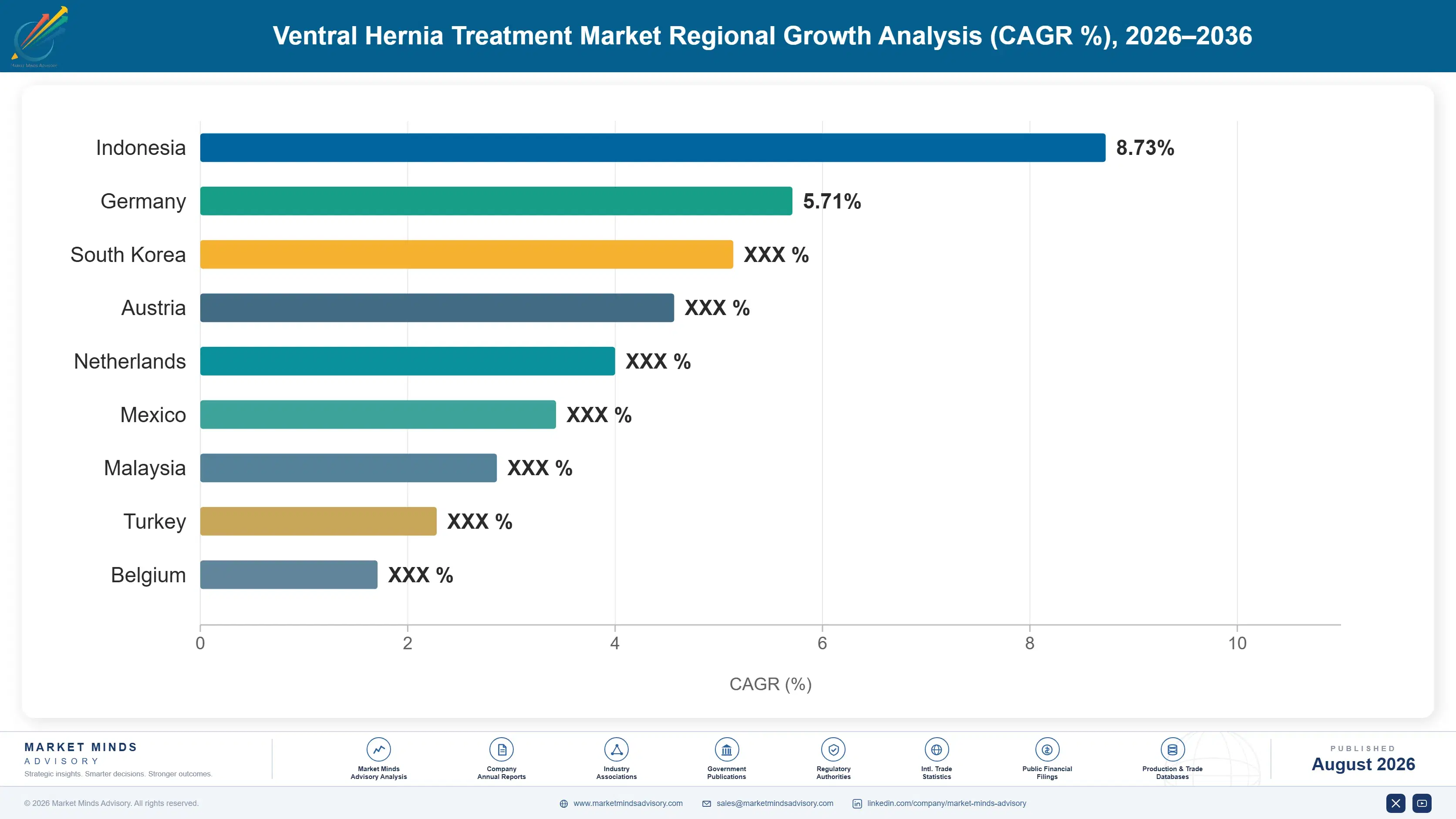
North America holds the largest share at 32%, on obesity prevalence, abdominal surgery volume and device pricing no other region matches. Western Europe follows at 24%. Mexico grows fastest of any country covered at 11.2% on obesity and surgical capacity. Obesity drives complexity everywhere. Complexity outruns volume.

North America

Obesity prevalence and device pricing together explain this 32% share. American abdominal surgery volume is substantial, obesity rates are among the highest in the developed world, and both raise incisional hernia incidence and repair complexity simultaneously. Mesh litigation reached its highest profile here, which is why roughly a third of patients arrive with a formed position on implant material and why biosynthetic products have taken share fastest. Robotic ventral repair adoption leads the world, supported by reimbursement that accommodates the additional theatre time. Specialist abdominal wall reconstruction centres have emerged, concentrating complex and recurrent cases where device consumption per procedure is highest. Growth of 5.8% reflects a mature market shifting materially in mix.
Share: 32% | CAGR: 5.8% (2026 to 2036)

Western Europe

Reimbursement structure rather than clinical conservatism explains why this 24% share grows slowest of the seven regions. Diagnosis related group payment for hernia repair rarely distinguishes between materials, so a hospital choosing a biosynthetic mesh absorbs the difference itself, which slows adoption regardless of surgeon preference. German and Dutch abdominal wall reconstruction practice is technically advanced with strong specialist centres and registry participation that produces genuinely useful recurrence data. British provision runs through waiting lists that have lengthened considerably. Mesh concern among patients exists but has not reached American levels. Growth of 4.8% reflects funding that has not adjusted to material cost differences. Registry participation produces genuinely useful data here.
Share: 24% | CAGR: 4.8% (2026 to 2036)
Regional intelligence for 5 additional markets available in the complete report: East Asia, South Asia and Pacific, Latin America, Middle East and Africa, Eastern Europe. Contact sales@marketmindsadvisory.com.
ventral-hernia-treatment-market-country-cagr-analysis-1787641449275

Where This Market Actually Pays

Nothing here is won on a recurrence trial alone, because the patient arrives with a view and the committee buys on price. Value accrues to whoever answers the material conversation, whoever travels with robotic platform adoption, and whoever can put recurrence cost in front of a budget holder who carries it. Four routes carry weight, and only one is clinical.

Answer the Patient Conversation, Not the Trial

Roughly 34% of patients raise implant material concerns before the surgeon does, arriving with a position formed by litigation coverage rather than by evidence. Biosynthetic resorbable products grow at 9.6% against a market rate of 6.4% because a material that dissolves resolves that conversation, whatever recurrence data says. Surgeons offer it because a patient refusing repair entirely is a worse outcome than one accepting a compromise material. Manufacturers arguing published evidence against a formed patient position are losing an argument that stopped being clinical some years ago. The conversation happens before the consultation now.
Market Impact: Addresses the 34% of patients now raising concerns

Travel With Robotic Surgical Platform Installation

Roughly 38% of ventral repairs now use a robotic platform, and hernia specific instrumentation moves with that installation rather than competing for a separate purchasing decision. Robotic cases also consume more fixation, larger mesh sheets and more expensive materials than open equivalents, so platform adoption raises consumption per procedure independently of case volume. Robotic instrumentation grows at 8.2%, second fastest in the market. Building relationships with platform manufacturers and with the surgeons adopting the approach reaches this demand well before any tender process would. Platform relationships matter more than tender processes here.
Market Impact: Follows the 38% robotic share of all repairs

Sell Recurrence Cost to Whoever Pays for Both

Roughly 22% of ventral repairs recur, and a reoperation is larger, harder and many multiples more expensive than the roughly 1,180 dollars a typical repair consumes in materials. Value analysis committees compare price per square centimetre because recurrence lands years later on a different budget line. Health systems paying for the whole episode, particularly under bundled payment, do carry that cost and respond to the arithmetic. Reaching that budget holder rather than the committee is the single highest value commercial move available in this market. Bundled payment expansion is the mechanism to watch.
Market Impact: Prevents 22% recurrence against 1,180 dollar material budgets

Concentrate on Complex and Recurrent Repair Volume

Device consumption per procedure rises sharply with defect size, patient weight and previous repair attempts, since those cases need larger mesh, more fixation and frequently component separation. Specialist abdominal wall reconstruction centres concentrate exactly that work and are emerging across North America and Western Europe. Mexico grows at 11.2% on obesity prevalence driving both incidence and complexity together. Focusing commercial effort on complex volume rather than on total procedure count reaches considerably more revenue per surgeon relationship built. Specialist centres concentrate exactly that work, and each relationship reaches several times the revenue a general department does.
Market Impact: Captures the 11.2% Mexican national market growth rate

Who Controls the Margin Pool

Concentration is high for a surgical materials market. The top five serve 72% of procedure volume and associated device revenue, the basis applied consistently here, reflecting decades of surgeon relationships and hospital contracting rather than any technology barrier. Becton Dickinson leads on breadth across mesh types and fixation, with the distance to challengers reflecting portfolio completeness rather than performance in any single category.
Competition runs on three fronts. Established suppliers compete for hospital contracts on portfolio breadth and price per square centimetre, which is a procurement conversation more than a clinical one. Biosynthetic specialists compete on the patient material conversation and on contaminated field indications. Robotic instrumentation competes alongside platform adoption rather than against other instruments, which is a different commercial motion entirely.

Rankings will move if recurrence evidence reaches purchasing criteria, since that would reward materials currently unable to justify their pricing to a committee. Bundled payment expansion is the mechanism most likely to make it happen. The other pressure point is domestic manufacture in China and India, which serves the largest procedure volumes at prices established suppliers have not attempted to match. Neither pressure is reversible.
ventral-hernia-treatment-market-company-positioning-matrix-1787641449813

Competitive Moat and Risk Dimensions

BECTON DICKINSON

Moat: Portfolio Breadth Position

Holding permanent synthetic, biologic and biosynthetic materials alongside fixation devices means a hospital contracting for hernia supply can source everything from one agreement, and a shift in surgeon material preference moves volume within the portfolio rather than away from it. Contracting relationships built across decades also cover far more than hernia products alone.
BECTON DICKINSON

Risk: Litigation Reputation Exposure

Mesh litigation attached to the category has shaped patient attitudes durably, and roughly 34% now raise material concerns before a surgeon does. A supplier closely associated with permanent synthetic mesh carries that association into every patient conversation, regardless of the recurrence evidence supporting the products in question.
MEDTRONIC

Moat: Robotic Platform Adjacency

Robotic surgical platform capability places hernia instrumentation alongside a system the hospital has already committed to, which removes the separate purchasing decision competitors must win. Roughly 38% of ventral repairs already use a robotic platform, and each installation carries instrument consumption with it for the working life of the system.
MEDTRONIC

Risk: Material Portfolio Depth

Instrumentation strength does not answer the material conversation that patients increasingly start, and biosynthetic resorbable products growing at 9.6% sit largely with competitors and specialists. A supplier strong in access and fixation but thin in the materials patients ask about is present at the operation and absent from the decision preceding it.

Players Tracked

Prominent Players

Becton Dickinson
Medtronic
Johnson and Johnson MedTech
Baxter International
Integra LifeSciences

Other Key Players

Cook Medical
W L Gore and Associates
Aspide Medical
Betatech Medical
Herniamesh
THT Bio-Science
Dipromed
FEG Textiltechnik
Via Surgical
Deep Blue Medical Advances
Tela Bio
B Braun
CooperSurgical
Lotus Surgicals
Meril Life Sciences

Recent Developments

FEBRUARY 2025

Registry publishes long term recurrence data across mesh categories

A national hernia registry published extended follow up comparing recurrence across permanent synthetic, biologic and biosynthetic materials in ventral repair, with differences that varied considerably by defect size and contamination status. Manufacturers on every side found supportive findings within the same dataset, which limited its commercial effect.
Signal: Registry data rarely settles a material argument, because defect variation lets everybody find supportive numbers somewhere
JUNE 2025

Health system adopts bundled payment covering hernia reoperation

A large integrated health system extended bundled episode payment for ventral hernia repair to include reoperations within a defined period, placing recurrence cost on the same budget as the original procedure. Material selection discussions in that system shifted away from price per square centimetre almost immediately afterwards.
Signal: Recurrence becomes a purchasing criterion the moment somebody sitting in the room actually pays for it
SEPTEMBER 2025

Robotic hernia instrumentation range expands for complex reconstruction

A robotic platform manufacturer expanded hernia specific instrumentation covering retromuscular dissection and component separation, bringing techniques previously confined to specialist centres within reach of a wider surgeon group. Consumption of mesh and fixation per case rises noticeably when these approaches are adopted. Referral patterns shifted too.
Signal: Making a complex technique widely accessible raises device consumption per case well beyond the instruments themselves

What a Mesh Costs to Produce

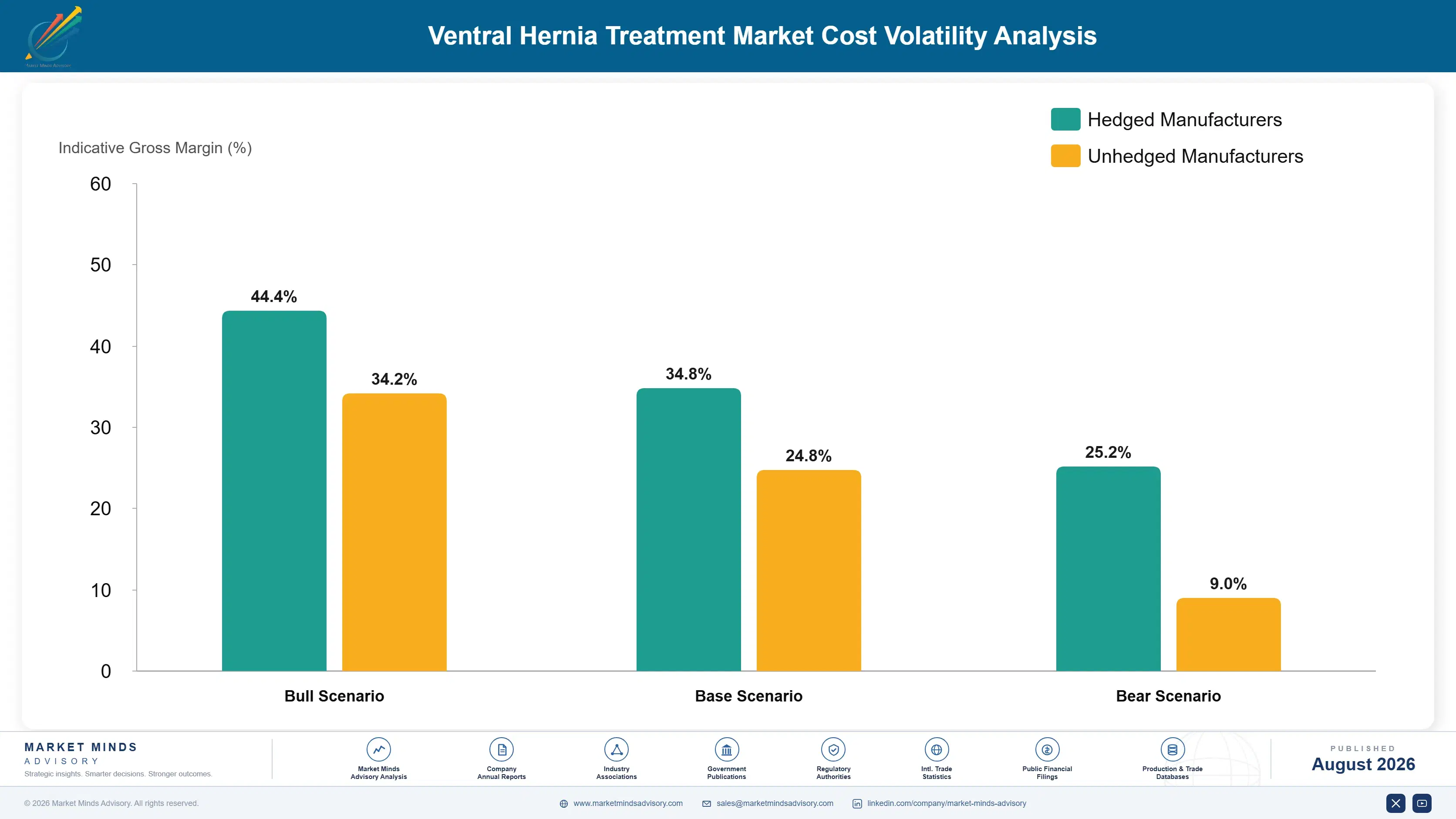
Cost structure differs completely by material class. Permanent synthetic mesh is knitted from polypropylene or polyester monofilament, where polymer accounts for a small share of cost and knitting, cutting, packaging and sterilisation dominate. Biologic and biosynthetic materials invert that entirely, with tissue sourcing, decellularisation processing or specialty resorbable polymer accounting for roughly 48% of cost of goods, sourced from very few qualified suppliers in Europe and North America.
Polymer and processing costs moved for different reasons through the period. Medical grade polypropylene tracked petrochemical feedstock movements documented in EIA price series, while specialty resorbable polymers used in biosynthetic products are produced by very few manufacturers at volumes where any demand shift moves pricing noticeably. Ethylene oxide sterilisation capacity constraints following facility closures added cost across every material class and lengthened lead times considerably.

Exposure divides by material class rather than by company size. A supplier weighted toward permanent synthetic carries commodity polymer exposure it can largely absorb, since polymer is a small share of a mesh selling for hundreds of dollars. A biosynthetic supplier carries concentrated specialty input risk on roughly half its cost base with almost no qualified alternative. That is uncomfortable for exactly the products growing fastest.
ventral-hernia-treatment-market-cost-volatility-analysis-1787641450013

Qualify second sources for specialty resorbable polymer

Resorbable polymers used in biosynthetic mesh come from very few qualified producers, and requalifying a source requires biocompatibility, degradation profile and stability work in every market where the device is registered. Holding an alternative looks unnecessary until demand from another device category tightens supply. Manufacturers that qualified alternatives early maintained production while competitors rationed to their largest accounts.

Secure sterilisation capacity on multi year terms

Ethylene oxide facility closures reduced regional sterilisation availability without warning and pushed smaller manufacturers to the back of allocation queues. Multi year capacity commitments cost more per cycle and remove the risk of finished mesh waiting unsterilised while a supply commitment lapses. Alternative modalities suit some materials and require validation best completed before capacity becomes scarce again.

Standardise sheet sizes across the material portfolio

Manufacturers frequently offer different size ranges across material classes for historical reasons, which fragments tooling, packaging and inventory without any clinical justification. Consolidating onto common dimensions reduces cutting waste, simplifies sterilisation loading and cuts the number of separate stock items hospitals hold. Surgeons rarely notice and procurement functions generally welcome the simplification. Inventory complexity falls at every level.

Portfolio Architecture for Margin Defence

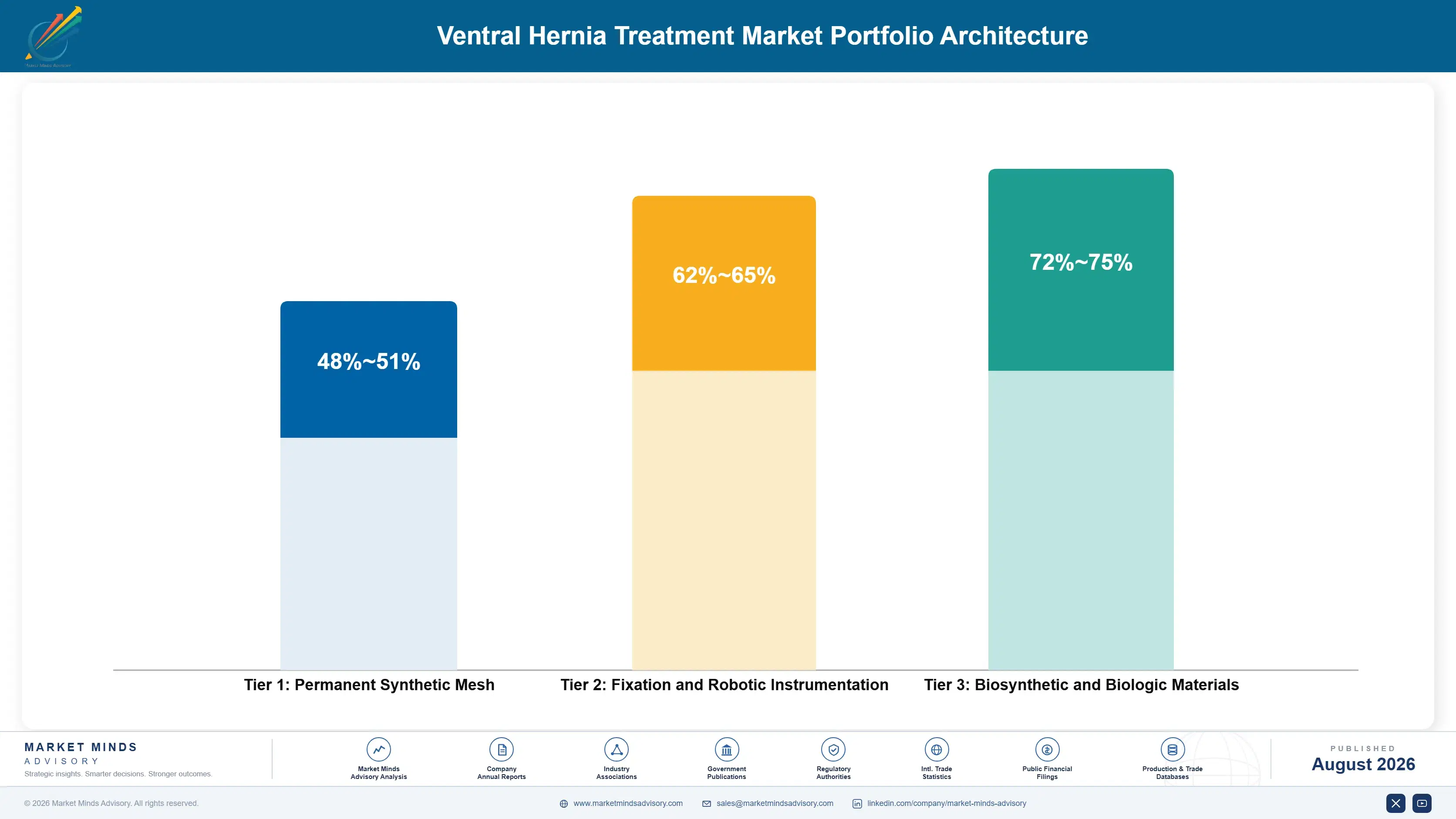
Margin architecture follows how contested the purchasing decision is. Permanent synthetic mesh is compared on price per square centimetre against clinically similar products and earns accordingly, which is why forty dollars a sheet gets negotiated away routinely. Fixation devices earn better on procedural preference. Biosynthetic and biologic materials earn best, because the patient conversation removes the price comparison before procurement ever runs it.
The tension is that the products earning most carry the input risk. Biosynthetic materials depend on specialty resorbable polymer from very few qualified producers accounting for roughly half of cost of goods, while permanent synthetic depends on commodity polymer that is a small share of a mesh selling for hundreds. Growth and supply fragility sit in exactly the same place, which is uncomfortable and not widely discussed.

High value pools concentrate in biosynthetic materials answering the patient conversation and in complex reconstruction cases consuming multiple products per procedure. Everything sold into a standard repair through a value analysis committee faces price per centimetre comparison against products a surgeon considers interchangeable. Domestic manufacture in China and India is compressing that comparison further across the largest procedure volumes anywhere.

Permanent Synthetic Mesh

Knitted polypropylene and polyester products compared on price per square centimetre against clinically similar alternatives by hospital committees. Volume is substantial and pricing is negotiated hard, with domestic manufacture compressing it further in the largest markets.
Gross Margin: 48-51%

Fixation and Robotic Instrumentation

Tacks, sutures, adhesives and hernia specific robotic instruments selected on surgeon preference and procedural fit rather than on unit price alone. Margin holds because the choice sits with the operator rather than with a procurement comparison.
Gross Margin: 62-65%

Biosynthetic and Biologic Materials

Resorbable and tissue derived materials answering the patient conversation about permanent implants and indicated for contaminated fields. Margin is the best available because the material decision is frequently made before procurement compares anything at all.
Gross Margin: 72-75%
ventral-hernia-treatment-market-portfolio-architecture-1787641450554

High-value Sub-segments and Strategic Watch-out

Biosynthetic Resorbable Mesh

The fastest growing material at 9.6% and the best margin in the market, driven by patient acceptance rather than by published recurrence advantage. Specialty resorbable polymer supply is concentrated in very few producers, which puts growth and input fragility in the same place. That is not widely discussed.
Gross Margin: 72-75%

Robotic Hernia Instrumentation

Second fastest at 8.2% and unusual in travelling with platform installation rather than competing for its own purchasing decision. Robotic cases consume more fixation and larger mesh than open equivalents, which raises consumption independently of procedure counts. Complex reconstruction has reached surgeons who previously referred those cases elsewhere entirely.
Gross Margin: 62-65%

Permanent Synthetic Mesh

Growing at only 3.8% and carrying most of the volume alongside the litigation association that shapes patient attitudes. Price per square centimetre comparison at value analysis committees caps pricing regardless of recurrence performance in any particular product. Domestic manufacture compresses pricing further in the largest procedure markets anywhere.
Gross Margin: 48-51%

Biologic Mesh

Growing at 2.4%, the slowest in the market, as biosynthetic materials take the contaminated field indications biologics once held at considerably lower cost. Tissue sourcing and processing costs are high and the clinical advantage over biosynthetic alternatives is increasingly difficult to demonstrate. Cost per unit remains stubbornly high.
Gross Margin: 68-71%

How This Patient Population Forms

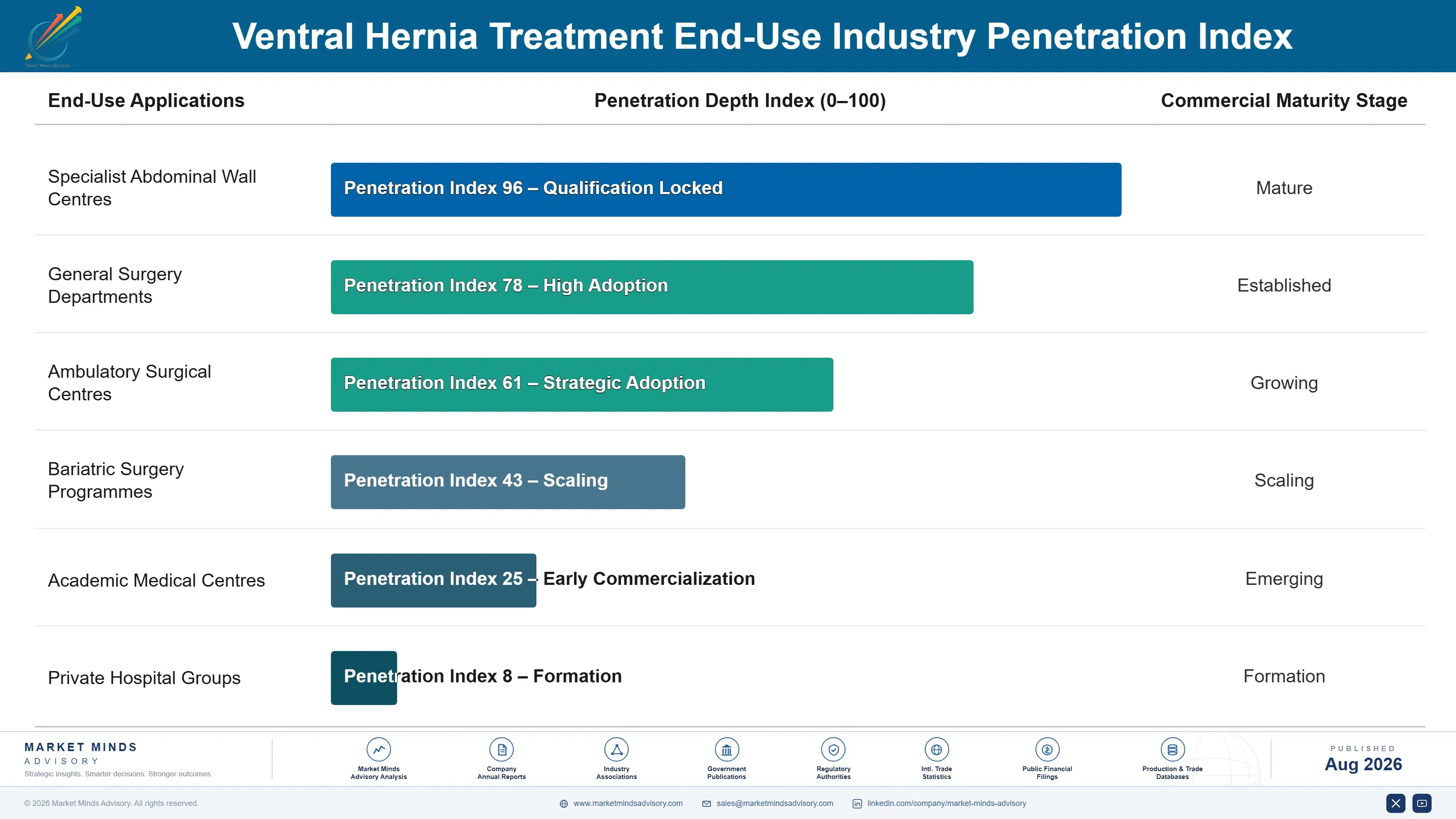
Demand here is manufactured elsewhere in the hospital. Roughly 18% of abdominal incisions develop an incisional hernia within five years, so every cancer resection, transplant and bariatric procedure is quietly generating a future ventral repair. That gives the market a forward pipeline visible from primary surgery volumes, and it also means minimally invasive progress in other specialties reduces it without anyone here having a say.
Stickiness sits with the surgeon rather than the hospital. Abdominal wall surgeons develop strong material and fixation preferences through their own recurrence experience and change them rarely, since a technique that has worked across hundreds of cases carries more weight than any trial. Hospital contracting restricts choice but rarely overrides a specialist on complex cases.

The conversation now starts before the consultation. Material selection was once entirely a surgical decision explained to the patient afterwards, if at all. Roughly 34% of patients now raise implant concerns first, having formed a view from litigation coverage and patient communities, and surgeons increasingly select materials that avoid an argument rather than materials the evidence favours. Manufacturers selling to surgeons alone are reaching the second decision maker rather than the first.
ventral-hernia-treatment-market-end-use-penetration-index-1787641451055

Where This Market Rewards Focus

These are among the four positions where our research anticipates prominent divergence between winners and laggards over the coming forecast period. Each is grounded in the demand model, the regulatory perimeter, and the announced capacity pipeline.
01 / PATIENT CONVERSATION POSITIONING

The material argument stopped being clinical years ago

Roughly 34% of patients raise implant material concerns before the surgeon mentions anything, arriving with a position formed by litigation coverage rather than by any recurrence evidence they have read. Biosynthetic resorbable materials grow at 9.6% against a market rate of 6.4% precisely because a mesh that dissolves resolves that conversation regardless of what the published data supports. Manufacturers arguing evidence against a formed patient view are losing an argument that moved out of the clinical domain some years ago now.
02 / RECURRENCE COST SELLING

Find the budget holder who pays for both operations

Roughly 22% of ventral repairs recur and a reoperation is larger, technically harder and many multiples more expensive than the roughly 1,180 dollars a typical repair consumes in materials. Value analysis committees compare price per square centimetre because recurrence appears years later on a different budget line and frequently at another institution entirely. Health systems under bundled episode payment do carry that cost, and material discussions in those systems change almost immediately, which identifies exactly who should be receiving the commercial call.
03 / ROBOTIC ADJACENCY CAPTURE

Instrumentation arrives with a platform, not a tender

Roughly 38% of ventral repairs now use a robotic platform and hernia specific instrumentation travels with that installation rather than competing for its own purchasing decision, which is an unusually favourable commercial position. Robotic cases also consume more fixation, larger mesh sheets and more expensive materials than open equivalents, raising consumption per procedure independently of any change in case volume. Building relationships with platform manufacturers and with early adopting surgeons reaches this demand well ahead of any procurement process starting.
04 / COMPLEXITY VOLUME FOCUS

Device consumption rises faster than procedure counts

Defect size, patient weight and previous repair attempts each raise consumption sharply, since those cases all require larger mesh, more fixation and frequently component separation with extended theatre time. Mexico grows at 11.2%, faster than any country covered anywhere, on obesity prevalence among the highest recorded driving both incidence and complexity together. Concentrating commercial effort on specialist reconstruction centres rather than on total procedure count reaches considerably more revenue for every single surgeon relationship a company actually manages to build.

Engagement Snapshot From the Field

A live engagement with an industry participant carrying material or product regulatory and market exposure ahead of a defining policy shift, showing how our research translates into a defensible multi-year portfolio strategy.
MARKET MINDS ADVISORY · CLIENT ENGAGEMENT SUMMARY
Ventral Hernia Treatment Producer Strategic Portfolio Review and Transition Roadmap 2026·Investment Scenario on Ventral Hernia Treatment Exposure Evaluation 2025-26
CLIENT PROFILE
A surgical materials manufacturer supplying permanent synthetic hernia mesh and fixation devices to hospitals across North America and Western Europe. Annual hernia revenue was approximately 310 million dollars (client-reported, unverified by MMA), with 84% from permanent synthetic products. No biosynthetic material was in the range and no robotic platform relationship existed. Pricing eroded at every renewal.
STRATEGIC CHALLENGE
Revenue had been flat for three years while biosynthetic competitors grew, and pricing on synthetic mesh had eroded at every contract renewal. Management wanted to know whether patient attitudes toward mesh were a temporary reaction or a durable shift, and whether to develop, acquire or partner for a biosynthetic product. Clinical affairs argued the evidence did not support the shift.
MMA APPROACH
MMA modelled material selection by procedure type and patient presentation, separating decisions driven by clinical indication from those driven by patient preference. Biosynthetic development, acquisition and partnership routes were costed against time to market. Forty-seven expert interviews with abdominal wall surgeons, patients who had undergone repair and value analysis committee members established how material decisions are actually reached in practice.
KEY FINDINGS
  1. Surgeons in 34 of the 47 interviews reported selecting a resorbable material at least partly because of patient concern rather than clinical indication, which none had documented anywhere.
  2. Patient preference influenced material choice in an estimated 29% of elective ventral repairs, and that share had roughly doubled over four years.
  3. Biosynthetic development from a standing start required an estimated 5 years to market against acquisition delivering a registered product within 12 months.
  4. Contracts in health systems under bundled episode payment showed materially less price pressure on premium materials than in fee for service settings examined.
CLIENT PROFILE
A surgical materials manufacturer supplying permanent synthetic hernia mesh and fixation devices to hospitals across North America and Western Europe. Annual hernia revenue was approximately 310 million dollars (client-reported, unverified by MMA), with 84% from permanent synthetic products. No biosynthetic material was in the range and no robotic platform relationship existed. Pricing eroded at every renewal.
STRATEGIC CHALLENGE
Revenue had been flat for three years while biosynthetic competitors grew, and pricing on synthetic mesh had eroded at every contract renewal. Management wanted to know whether patient attitudes toward mesh were a temporary reaction or a durable shift, and whether to develop, acquire or partner for a biosynthetic product. Clinical affairs argued the evidence did not support the shift.
MMA APPROACH
MMA modelled material selection by procedure type and patient presentation, separating decisions driven by clinical indication from those driven by patient preference. Biosynthetic development, acquisition and partnership routes were costed against time to market. Forty-seven expert interviews with abdominal wall surgeons, patients who had undergone repair and value analysis committee members established how material decisions are actually reached in practice.
KEY FINDINGS
  1. Surgeons in 34 of the 47 interviews reported selecting a resorbable material at least partly because of patient concern rather than clinical indication, which none had documented anywhere.
  2. Patient preference influenced material choice in an estimated 29% of elective ventral repairs, and that share had roughly doubled over four years.
  3. Biosynthetic development from a standing start required an estimated 5 years to market against acquisition delivering a registered product within 12 months.
  4. Contracts in health systems under bundled episode payment showed materially less price pressure on premium materials than in fee for service settings examined.
RECOMMENDED STRATEGY
Phase 1: Phase one: acquire rather than develop a biosynthetic product, since 5 years to market misses a shift already influencing 29% of elective repairs. Phase 2: Phase two: redirect commercial effort toward health systems under bundled episode payment, where premium material pricing faces materially less pressure. Phase 3: Phase three: build a platform relationship for robotic instrumentation, since 38% of repairs now use one and instruments travel with installation.
OUTCOME
The client acquired a biosynthetic mesh business within a year and restructured its commercial coverage around bundled payment health systems. Biosynthetic products reached 18% of hernia revenue at materially better margins within two years, and synthetic price erosion slowed in the accounts where recurrence cost was being carried by the buyer (client-reported, unverified by MMA).

Frequently Asked Questions

Foundational context covering the market sizes, CAGR, scope, country, region and competition that inform every finding below. This section is provided to cover basics and most often pre-purchase conversations, answered from the MMA Primary Research Dataset.

What is the current size of the Ventral Hernia Treatment Market?

The market was valued at 2.4 billion dollars in 2025, covering synthetic, biologic and biosynthetic mesh, fixation devices and robotic hernia instrumentation. It reaches an estimated 2.55 billion dollars during 2026.

How large will the Ventral Hernia Treatment Market be by 2036?

MMA forecasts 4.74 billion dollars by 2036, an increase of 2.19 billion dollars over the 2026 base. That represents an expansion multiple of 1.86 times across the forecast period.

What is the CAGR for the Ventral Hernia Treatment Market 2026 to 2036?

The base case compound annual growth rate is 6.4%, with a bull case of 7.6% and a bear case of 5.2%. Recurrence based purchasing and incision size trends separate those scenarios.

Which segment is growing fastest?

Biosynthetic resorbable mesh grows at 9.6%, half again the market rate of 6.4%, driven by patient acceptance rather than recurrence evidence. Robotic hernia instrumentation follows at 8.2%.

Who are the major companies in the Ventral Hernia Treatment Market?

Becton Dickinson, Medtronic, Johnson and Johnson MedTech, Baxter International and Integra LifeSciences lead on procedure volume served and device revenue. Together they account for 72% of the market.

Which country is growing fastest?

Mexico grows fastest at 11.2%, on obesity prevalence among the highest recorded anywhere alongside expanding surgical capacity and substantial inbound medical tourism from North America.

Report Segmentation Architecture

The full report scope spans multiple orthogonal segmentation dimensions, with cross-tabulated demand data provided for each dimension pair. Coverage extends further to regional breakdowns, trend trajectories, and the competitive detail needed to support segment-level decision-making.

By Product Type

  • Permanent Synthetic Mesh
  • Biologic Mesh
  • Biosynthetic Resorbable Mesh
  • Mesh Fixation Devices
  • Robotic Hernia Instrumentation
  • Component Separation and Closure Devices

By End-Use Industry

  • Specialist Abdominal Wall Centres
  • General Surgery Departments
  • Ambulatory Surgical Centres
  • Bariatric Surgery Programmes
  • Academic Medical Centres
  • Private Hospital Groups

By Commercial Dimension

  • Hospital Contract Supply
  • Group Purchasing Agreements
  • Bundled Episode Contracting
  • Robotic Platform Bundling
  • Distributor and Agent Supply
  • Direct Surgeon Preference Items

By Region

  • North America
  • Western Europe
  • East Asia
  • South Asia and Pacific
  • Latin America
  • Middle East and Africa
  • Eastern Europe

Scope, Methodology, and Coverage

Every figure in this report is reproducible from documented input assumptions. The scope below maps the historical period, the forecast horizon, the segmentation dimensions, and the countries covered, alongside the underlying primary and qualitative methodology.
Historical Period
2020 to 2025
Forecast Period
2026 to 2036
Base Year
2025 (USD billions; MMA Primary Research Dataset, August 2026)
Market Definition
Devices and materials used to repair ventral and incisional abdominal wall hernias worldwide, covering permanent synthetic mesh, biologic mesh, biosynthetic resorbable mesh, mesh fixation devices, robotic hernia instrumentation, and component separation and closure devices. Measured at manufacturer selling value across hospital and ambulatory settings. Inguinal and femoral hernia repair products, hiatal and diaphragmatic hernia devices, general laparoscopic and robotic platforms, wound closure products and abdominal imaging are excluded from scope.
Quantitative Units
USD billions (current prices); repairs performed; USD per repair by product type and setting
Segmentation Dimensions
Product type; end-use industry; commercial dimension; region
Regions Covered
North America, Western Europe, East Asia, South Asia and Pacific, Latin America, Middle East and Africa, Eastern Europe
Countries Covered
United States, Canada, Mexico, Germany, Netherlands, United Kingdom, France, Italy, Spain, China, Japan, South Korea, India, Australia, Thailand, Brazil, Colombia, Saudi Arabia, South Africa, Poland
Key Companies Profiled
Becton Dickinson, Medtronic, Johnson and Johnson MedTech, Baxter International, Integra LifeSciences, Cook Medical, W L Gore and Associates, Aspide Medical, Betatech Medical, Herniamesh, THT Bio-Science, Dipromed, FEG Textiltechnik, Via Surgical, Deep Blue Medical Advances, Tela Bio, B Braun, CooperSurgical, Lotus Surgicals, Meril Life Sciences
Quantitative Methodology
Primary survey, n=3,800 respondents, Q4 2025, six countries; demand-side model with trade association cross-validation
Qualitative Methodology
47 expert interviews, Q4 2025; applied to validate demand model assumptions, identify emerging dynamics, and assess competitive positioning
Report Format
PDF and XLSX data workbook (Word format preview document)
Publisher
Market Minds Advisory
Report Code
MMA-2026-MED-129
Published
August 2026
Contact
sales@marketmindsadvisory.com | www.marketmindsadvisory.com

Purchase the full Ventral Hernia Treatment Market Report (2026 to 2036).

The full report treats ventral hernia as a market manufactured by other surgery, since roughly 18% of abdominal incisions become a hernia and minimally invasive progress elsewhere quietly shrinks the pipeline. It sizes all six product types independently through 2036, models material selection by clinical indication against patient preference, and quantifies recurrence cost against the material pricing that value analysis committees actually compare. Regional chapters cover all seven regions, with obesity driven complexity assessed separately from procedure volume. Competitive profiling covers 20 participants on one consistent procedure volume basis.
Six product types sized independently through 2036
Material selection modelled by indication against patient preference
Recurrence cost quantified against committee level material pricing
Obesity driven complexity assessed separately from procedure volume
Bundled payment contracting compared against fee for service pricing
Twenty participants profiled on one consistent procedure basis

Built For The People Who Decide

From boardroom strategy to bench-side execution, this report is read cover-to-cover by leaders shaping the next decade of their industry, turning demand scenarios, market dynamics and valuation benchmarks into decisions.
CXOs/ Presidents/ VPs/ Managers
M&A and Corporate Development
Strategy Teams and R&D Heads
Procurement and Product Directors
Regulatory and Compliance Leaders
Investor Relations and Equity Analysts