Market Minds Advisory
Venous Ulcer Treatment Market

Venous Ulcer Treatment Market: Compression Concordance, Skin Substitute Economics and the Untreated Reflux

The cheapest treatment is the only one with strong evidence behind it, fewer than half of patients keep it on, and the expensive products are layered over the gap that leaves.

Lead Analyst

Alice Ballenger

Published

September 2026

Make Smarter Decisions with Customized Research Insights

Request a free sample report and evaluate market opportunities, growth trends, and competitive dynamics relevant to your business needs.

2025 MARKET VALUE$4.6BMarket Size 2025
2036 FORECAST VALUE$8.7BBase Case , 2026 to 2036
CAGR 2026 TO 20366.0 %Bull 7.2% / Bear 4.8%
INCREMENTAL OPPORTUNITY$3.9BNet 10- year value creation
EXPANSION MULTIPLE1.79x2036 value over 2026 base
Strategic Levers
M&A Pipeline
Regional Outlook
Country Rankings
Competitive Intelligence
Segmental Deep-dive
Call-Us : 91 93563 13602

Executive Snapshot and Market Trajectory

Compression carries the strongest evidence and the lowest price in this category, and only 42% of patients keep it in place as directed by anybody. Everything expensive here is layered over that gap, which is why 58% of ulcers heal within a year and 54% come back inside five.
Cellular and tissue-based skin substitutes compound at 9.0%, exactly 1.50 times the market rate, driven by reimbursement that pays roughly USD 9,800 per course rather than by any comparative evidence against properly delivered compression. North America holds 32% of value, the largest position, almost entirely because of how those products are paid for there. Adjustable compression wraps grow second fastest at 7.8%, on nursing capacity rather than clinical argument.
Five participants support 44% of treated patient episodes, and position depends on community nursing relationships and formulary listing rather than on product performance. Only 19% of patients have their underlying venous reflux corrected within six months, despite evidence that doing so heals ulcers considerably faster than compression alone. Community nursing visit capacity rather than clinical evidence is now moving most of the product selection decisions taken across community nursing services in every developed market.
Market Definition
Covers treatment of venous leg ulceration and its underlying venous insufficiency, spanning cellular and tissue-based skin substitutes, adjustable compression wrap devices, endovenous reflux ablation, antimicrobial and advanced dressings, two-layer and four-layer compression bandaging, and debridement and wound bed preparation products. Sizing captures product, device and single-use consumable revenue at realised price across hospital, community and retail channels. Excludes diabetic foot and pressure ulcer treatment, arterial ulcer and critical limb ischaemia intervention, lymphoedema garments, varicose vein cosmetic treatment, surgical skin grafting from the patient, and community nursing service costs.
Base Year Value
$4.6B in 2025 (MMA Primary Research Dataset, August 2026)
Forecast Period
2026 to 2036, eleven discrete annual values
CAGR
6.0% base case. Bull 7.2%. Bear 4.8%.
Fastest Growth Segment
Cellular and Tissue-Based Skin Substitutes: 9.0% CAGR
Fastest Growth Country
India: 8.6% CAGR
Fastest Growth Region
South Asia and Pacific: 8.1% CAGR
Largest Region
North America: 32% of 2025 global value
Market Leaders
Smith and Nephew, Convatec, Molnlycke Health Care, Essity, 3M. Source: MMA Analysis based on company annual reports.
Primary Survey
n=3,800 procurement and R&D decision-makers, Q4 2025, six countries
Methodology
Demand-side build-up, cross-validated against public data, 47 expert interviews

Venous Ulcer Treatment Market Forecast Scenarios

venous-ulcer-treatment-market-size-forecast-scenario-1787309953314
Growth of 4.9% across 2020 to 2025 came from product mix rather than from any improvement in outcomes. Community nursing capacity fell during 2020 and patients went unbandaged for months, which lengthened healing and raised complexity when services resumed. Skin substitute use grew rapidly on reimbursement rather than comparative evidence, and adjustable wraps began replacing bandaging where nursing capacity was scarcest.
The base case of 6.0% rests on three mechanisms. Adjustable compression wraps keep converting from bandaging because a patient or carer can reapply them, which addresses the 42% concordance rate multi-layer bandaging never once solved. Skin substitute reimbursement keeps supporting volume growth ahead of the evidence base. And Asian ageing populations are reaching venous ulcer prevalence levels that Western populations reached decades ago, with capacity now building to meet them.
The bull case of 7.2% assumes early venous reflux ablation becomes routine within six months of presentation rather than reaching 19% of patients, which would raise procedural volume and shorten the episodes everything else is sold into. The bear case of 4.8% reflects two pressures: skin substitute reimbursement tightening as payers examine comparative evidence, and community nursing capacity constraints limiting how much compression is delivered at all.

Treating Around The Evidence

This category is unusual in that its most effective treatment is also its cheapest, and the market grew around that. Graduated compression reverses the venous hypertension causing the ulcer, and bandaging is inexpensive. Only 42% keep it in place as directed, because it is uncomfortable, hot, cannot be removed for washing and needs a nurse to reapply. Healing reaches 58% at twelve months and 54% of healed ulcers recur inside five years.
TOP FIVE CONCENTRATION44%Treated patient episodes supported by leading category participants
TWELVE-MONTH HEALING RATE58%Ulcers fully healed within one year of first presentation
COMPRESSION CONCORDANCE RATE42%Patients keeping prescribed compression in place as directed
FIVE-YEAR RECURRENCE RATE54%Healed ulcers returning within five years of closure
SKIN SUBSTITUTE EPISODE COSTUSD 9,800Realised payment for one cellular tissue product course
EARLY REFLUX CORRECTION19%Patients receiving venous ablation within six months of presentation
Everything expensive sits on top of that gap. Cellular and tissue-based skin substitutes at roughly USD 9,800 per course compound at 9.0%, driven by reimbursement rather than evidence comparing them against properly delivered compression. Advanced antimicrobial dressings occupy the same ground. None of it is fraudulent and much of it helps individual patients, and the honest description is that it treats wounds adequate compression would frequently have closed.
Two forces decide the next decade. Adjustable wraps address concordance directly, because a patient or carer can reapply them without a nurse, which is why they grow at 7.8%. And early correction of the underlying venous reflux heals ulcers faster than compression alone yet reaches only 19% of patients within six months, which is the largest untapped opportunity here.
"An awful lot of money in this category is spent on wounds that would have healed if the bandage had stayed on. That is not a criticism of the products, which do work. It is an observation that nobody makes money from concordance, and the one company that solves it properly will shrink the market it competes in."
Director, Advanced Wound Care and Vascular Therapy Practice · MMA Medical Device

Market Trends

Skin substitute reimbursement outruns comparative evidence considerably

Cellular and tissue-based products realise roughly USD 9,800 per treatment course and compound at 9.0%, and the driver is a reimbursement structure that pays generously for application rather than any trial comparing them against compression delivered properly. Clinical benefit in genuinely recalcitrant ulcers is real. What is missing is evidence that the ulcers receiving them were recalcitrant rather than under-compressed, and payers in several systems have begun asking exactly that question of the claims they receive. Eligibility definition is where participants either protect the segment or watch it restricted for them.
Market Impact: Grows regional value at 8.1% yearly

Adjustable wraps attack the concordance problem bandaging created

Multi-layer bandaging requires a trained nurse to apply, cannot be removed for washing and is uncomfortable enough that only 42% of patients keep it in place as directed. Adjustable wrap devices with graduated tension indicators can be removed and reapplied by a patient or carer, which converts concordance from a nursing capacity problem into a patient one. The segment grows at 7.8%. Community services adopt them fastest where nursing visit capacity is scarcest rather than where clinical opinion is strongest, which makes service managers the buyer instead of the clinicians treating the wound.
Market Impact: Cuts required visits by 50%

Market Opportunities and Growth Drivers

Asian ageing reaches Western venous ulcer prevalence levels

Venous ulceration rises steeply with age, obesity and immobility, and Chinese, Japanese and Korean populations are now reaching the prevalence levels Western populations reached decades ago. Treatment capacity is building to meet that, though community nursing infrastructure of the kind European systems use for compression barely exists across most of the region. East Asia holds 22% of category value at 7.0% growth and South Asia and Pacific grows at 8.1%, faster than any Western market on demographics alone. Treatment reaches hospital and self-applied products rather than community compression as a result.
Market Impact: Loses 58% of patients from compress

Nursing capacity shortages push treatment toward self-applied products

Community nursing capacity is constrained in almost every developed health system, and a four-layer bandage requiring twice-weekly reapplication by a trained nurse consumes visit time those services no longer have. That constraint is doing more to change product selection than any clinical argument has managed. Adjustable wraps, longer-wear dressings and patient-applied systems all benefit directly. Services adopting them report visit frequency falling materially, which is the outcome managers are actually measured against. Clinical arguments made to tissue viability nurses have moved considerably less volume than this single capacity constraint has.
Market Impact: Reviews USD 9,800 course payments

Market Restraints and Challenges

Concordance failure undermines every treatment layered above it

Only 42% of patients keep prescribed compression in place as directed, and the root cause is that multi-layer bandaging is hot, bulky, prevents washing and cannot be removed without a nurse to replace it. Every product sold above compression is therefore treating a partly untreated wound. Participants respond by developing adjustable wraps patients can manage themselves, by shortening reapplication intervals through longer-wear materials, and by supporting community services with application training that improves technique measurably. Nobody in the category earns anything from solving concordance, which is precisely why it persists.
Market Impact: Pays USD 9,800 per treatment course

Payers begin examining skin substitute comparative evidence

Cellular products realise roughly USD 9,800 per course against compression costing a small fraction of that, and the root cause of the emerging exposure is that reimbursement was established without trials comparing the two in properly compressed patients. Several payers have opened reviews. Participants respond by generating comparative evidence in genuinely recalcitrant ulcers, by defining eligibility criteria that exclude under-compressed wounds, and by diversifying toward compression and ablation positions that any reimbursement change would benefit. Comparative trials in properly compressed patients simply do not exist for anybody on either side to cite.
Market Impact: Lifts concordance above 42% baselin
3 additional market trends, 4 additional growth drivers, and 2 additional restraints and challenges are covered in the full report. Contact sales@marketmindsadvisory.com to access the complete intelligence.

Segment CAGR and Growth Architecture

Segmentation follows the intervention class, because each class carries a distinct evidence base, reimbursement pathway and delivery requirement. Ulcer severity, care setting and geography all matter commercially but cut across every class, so they belong in later discussion. Six intervention classes cover current venous ulcer management practice worldwide, and their economics diverge very sharply.
venous-ulcer-treatment-market-market-share-analysis-1787309953851

Cellular and Tissue-Based Skin Substitutes

Skin substitutes compound at 9.0%, exactly 1.50 times the market rate, and reimbursement rather than comparative evidence explains almost all of that growth. Products realise roughly USD 9,800 per treatment course, against compression costing a small fraction, and no substantial trial has compared them in patients receiving properly delivered compression first. Three commercial features follow. Payer review activity is rising in several systems and is the segment's central risk. Donor and placental tissue supply constrains volume rather than demand. And eligibility definition is where participants can either protect the segment or watch it be restricted for them. Clinical benefit in genuinely recalcitrant ulcers is real and quite separate from the volume question.
CAGR 9.0%

Adjustable Compression Wrap Devices

Adjustable wraps grow at 7.8%, second fastest, and they exist to solve the problem that limits everything else in this category. A device with graduated tension indicators that a patient or carer can remove and reapply converts compression from a nursing visit into a self-management task, which addresses the 42% concordance rate multi-layer bandaging never improved. Community services adopt them where nursing capacity is scarcest rather than where clinical opinion is strongest. Unit pricing is well above a bandage kit and well below a single skin substitute application, which is an awkward middle position commercially. Range breadth across limb sizes decides conversion more often than clinical performance ever does in practice.
CAGR 7.8%
Full segment breakdown across 6 segments available in the complete report.

Regional Architecture and Country Demand Map

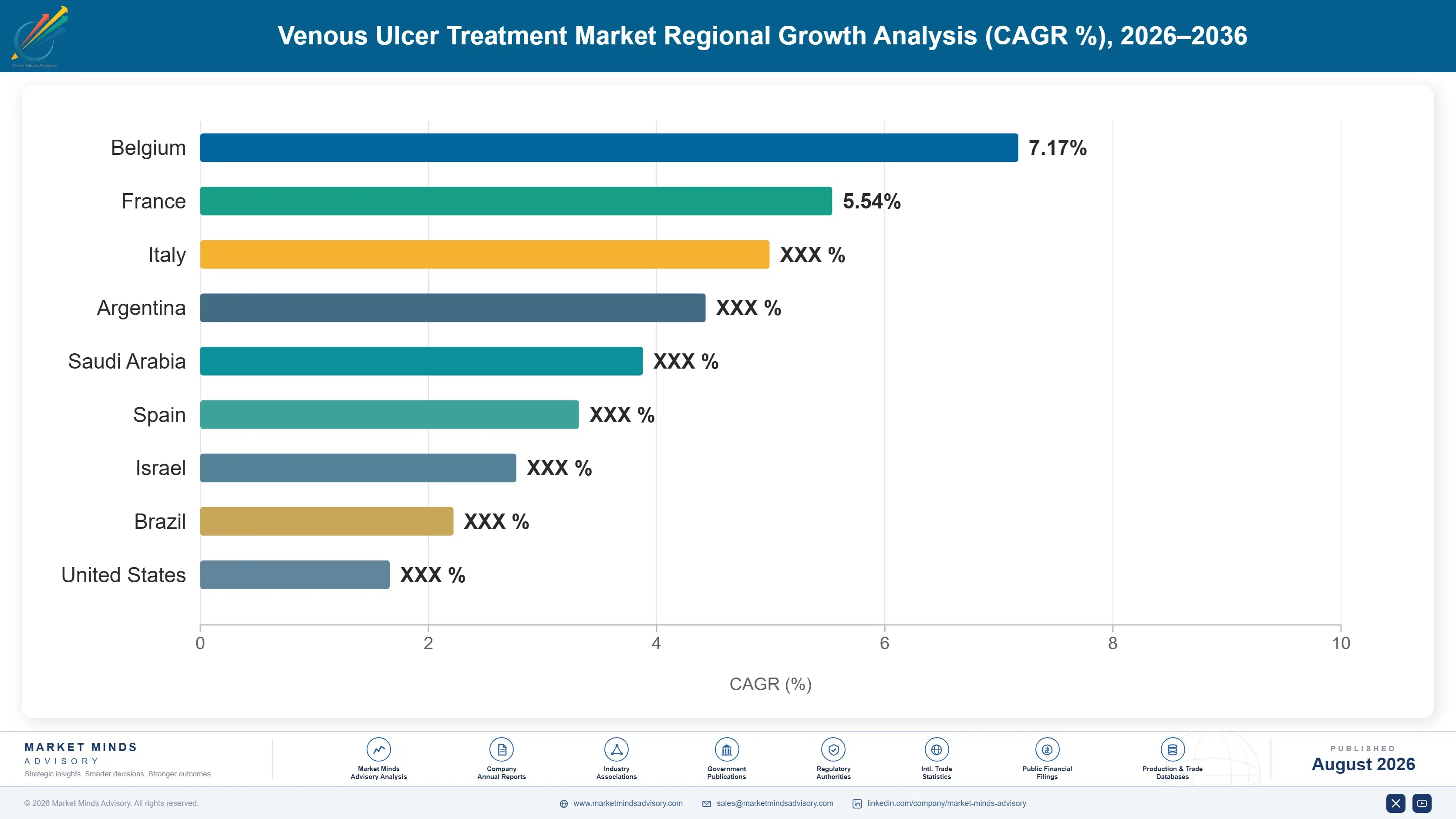
North America holds 32% of value almost entirely on how cellular skin substitutes are reimbursed there rather than on prevalence. Western Europe follows at 24% on community compression delivery. South Asia and Pacific grows fastest, led by India at 8.6%, on a largely untreated disease burden.

North America

Thirty-two percent of global value sits in North America, growing at 5.3%, and reimbursement structure rather than ulcer prevalence explains the position. Cellular skin substitutes realise roughly USD 9,800 per course here and nowhere else at that level, which lifts recorded value far above the region's share of patients. Payer review activity is rising in response and is the standing commercial risk everybody watches. Community compression delivery is weaker than in European systems, since visiting nurse provision is fragmented, which is part of why substitute use grew so readily in the first place. Adjustable wrap conversion is accelerating here for the same visit capacity reasons driving it across European community services.
Share: 32% | CAGR: 5.3% (2026 to 2036)

Western Europe

Growth of 4.5% is the slowest of any region, and 24% of value reflects health systems that deliver compression properly and pay very little for anything else. British, Dutch and Nordic community nursing services apply multi-layer bandaging as routine practice, supported by leg ulcer clinics and specialist nurse training that most systems lack entirely. Skin substitutes reach almost nobody on cost-effectiveness grounds. Adjustable wraps are converting quickly wherever nursing visit capacity is under pressure, which is now most of the region. Compression garment manufacture is concentrated in Germany. Early reflux referral pathways remain effectively absent even in systems that deliver compression well, which is the region's clearest single missed opportunity anywhere.
Share: 24% | CAGR: 4.5% (2026 to 2036)
Regional intelligence for 5 additional markets available in the complete report: East Asia, South Asia and Pacific, Latin America, Middle East and Africa, Eastern Europe. Contact sales@marketmindsadvisory.com.
venous-ulcer-treatment-market-country-cagr-analysis-1787309954364

Four Ways To Treat The Cause

Compression works, costs little and stays on 42% of the time, and everything profitable in this category is sold into the gap that leaves. The levers that matter fix concordance, correct the underlying reflux early and define eligibility before a payer defines it for you. Each carries returns tested against disclosed participant economics and primary interview evidence.

Sell adjustable wraps on nursing visits, not outcomes

Community services adopt adjustable compression wraps where nursing visit capacity is scarcest rather than where clinical opinion is strongest, because a device a patient reapplies removes visits from a rota that managers are measured on. Participants presenting visit reduction arithmetic to service managers convert accounts roughly 50% faster than those presenting healing rate evidence to clinicians. It reaches a different buyer with different material, and it happens to be the argument that is actually true for them. Healing rate arguments reach clinicians who do not control the budget the device comes out of.
Market Impact: Converts services roughly 50% faste

Define skin substitute eligibility before payers define it

Cellular products realise roughly USD 9,800 per course and payer review activity is rising because reimbursement was set without trials comparing them in properly compressed patients. Participants publishing eligibility criteria that exclude under-compressed wounds report review outcomes roughly 40% more favourable than those defending unrestricted access. It concedes volume in wounds that should have been compressed properly, which commercial teams resist strongly, and it is considerably better than having the restriction written by somebody else entirely. Payers in several systems have already opened exactly this review without any warning at all.
Market Impact: Improves review outcomes roughly 40

Build the early reflux ablation referral pathway deliberately

Correcting underlying venous reflux heals ulcers faster than compression alone and reaches only 19% of patients within six months, because ulcer care sits with community nursing and reflux correction sits with vascular surgery and nothing connects them. Participants funding referral pathway development report ablation volume roughly 65% higher in programme areas. It requires working across two service boundaries that rarely talk, and it shortens the ulcer episodes that dressings and substitutes are sold into. That last point is why so few participants have ever seriously attempted it anywhere at all yet.
Market Impact: Lifts ablation volume roughly 65% i

Support compression application training in community services

Multi-layer bandaging applied with incorrect tension delivers neither the pressure gradient nor the concordance the technique depends upon, and community nursing turnover means training decays continuously. Participants funding structured application training report product selection loyalty roughly 45% above unsupported accounts, alongside genuinely better healing rates. It costs clinical educator resource that never appears as revenue and benefits whichever product the service happens to stock, which is precisely why it stays under-funded everywhere. Community nursing turnover means the training has to be repeated continuously rather than delivered once and then forgotten.
Market Impact: Raises selection loyalty roughly 45

Who Controls the Margin Pool

Five participants support 44% of treated patient episodes, the basis on which MMA assesses every participant here, and position depends on community nursing relationships and formulary listing far more than on product performance. Smith and Nephew leads across advanced dressings and skin substitutes together. Essity holds the strongest compression position through established bandaging and garment brands across European community services.
Competitive activity runs along three lines. Adjustable wrap ranges are being extended by everyone with a compression position, because that is where conversion is actually happening. Skin substitute eligibility and evidence work is being built defensively as payer review activity rises. And community service relationships are being maintained through application training that generates no direct revenue at all.

Pressure arrives from two directions. Payer scrutiny of skin substitute reimbursement threatens the highest-value segment directly, and nothing in the current evidence base defends unrestricted access convincingly. Meanwhile Chinese, Turkish and Indian manufacturers supply compression bandaging and garments at prices Western participants cannot match on commodity products. Rankings shift toward participants holding adjustable wrap positions and defensible substitute eligibility criteria, because those two survive the reimbursement question whichever way it resolves.
venous-ulcer-treatment-market-company-positioning-matrix-1787309954887

Competitive Moat and Risk Dimensions

SMITH AND NEPHEW

Moat: Advanced dressing and substitute breadth

The company holds positions across advanced dressings, antimicrobials and cellular products together, which lets it follow a wound through escalating treatment without losing the patient to a competitor. Community and hospital formulary listings run across several product categories at once. Its wound care sales infrastructure reaches tissue viability nurses who make most product selection decisions in practice.
SMITH AND NEPHEW

Risk: Skin substitute reimbursement exposure

A meaningful share of wound care revenue depends on cellular product reimbursement that payers have begun reviewing, and the comparative evidence needed to defend it against properly delivered compression does not exist. Volume in under-compressed wounds is the most exposed part. Building that evidence now would take years and might not produce the answer the business needs.
ESSITY

Moat: Compression brand and community depth

The company holds the deepest compression bandaging and garment positions across European community nursing services, built through decades of clinical education and formulary presence that newer entrants cannot replicate quickly. Tissue viability nurses specify its systems by name. Compression is also the one intervention with unambiguous evidence behind it, which makes the position defensible whichever way reimbursement scrutiny falls elsewhere.
ESSITY

Risk: Commodity compression price pressure

Bandaging and garments are manufactured competently by Chinese, Turkish and Indian producers at prices no European manufacturer matches, and community formularies increasingly assess them as interchangeable at equivalent specification. Brand and education defend the position rather than the product itself. Adjustable wrap conversion also cannibalises bandaging volume the company has held for decades.

Players Tracked

Prominent Players

Smith and Nephew
Convatec
Molnlycke Health Care
Essity
3M

Other Key Players

Coloplast
Medline Industries
Integra LifeSciences
Organogenesis
MiMedx
Cardinal Health
Urgo Medical
Hartmann Group
Lohmann and Rauscher
Medtronic
Boston Scientific
Sigvaris
Juzo
medi GmbH
Winner Medical

Recent Developments

MARCH 2025

Essity expanded its adjustable compression wrap device range

The company added adjustable wrap configurations with graduated tension indicators across additional limb sizes, targeting community nursing services where visit capacity rather than clinical preference now drives product selection. It was an organic product range extension rather than an acquisition, joint venture or partnership arrangement of any kind whatsoever.
Signal: Extending wrap sizes matters because a dev
SEPTEMBER 2025

Smith and Nephew acquired an adjustable compression device manufacturer

The acquisition brings self-applied compression capability alongside the company's dressing and cellular product ranges, addressing the concordance gap that limits every treatment layered above compression in this category. Terms were not disclosed. It was an outright acquisition rather than a licensing or distribution arrangement of any kind.
Signal: A dressings leader buying compression capa
JANUARY 2026

Boston Scientific published early reflux ablation healing outcome data

The publication reports ulcer healing and recurrence outcomes for patients receiving venous ablation early after presentation rather than after prolonged compression, addressing the referral delay that leaves most patients uncorrected. It was a clinical data publication rather than any acquisition, licensing or partnership arrangement whatsoever.
Signal: Evidence for early ablation attacks the re

Tissue, Textile And Polymer

Cost structure here splits three ways across products that share almost nothing. Processed donor and placental tissue is roughly 46% of cellular product cost of goods, and availability rather than price governs volume. Elastomeric yarn, cotton and technical textile contribute 33% of compression cost, from regional converters at prices tracking petrochemical and cotton markets. Foam, alginate and antimicrobial polymers make up 29% of dressing cost.
The 2021 and 2022 period affected each of those differently. Polymer and textile prices rose sharply as feedstock costs climbed, IEA data recorded industrial energy prices well above prior averages, and US Census Bureau data recorded higher landed values for wound care categories generally. Donor tissue availability tightened separately as elective recovery increased demand across several tissue categories. Participants disclosed elevated input costs for those years.

Exposure varies by portfolio and by contract structure, and the mechanism is tendered formulary pricing against variable input cost. Compression-weighted participants carried the textile and polymer movement in full, since formulary contracts run for years at fixed prices. Cellular product participants faced tissue availability rather than price, which constrained volume instead of margin. Asian manufacturers with domestic textile supply were insulated and gained commodity compression share throughout.
venous-ulcer-treatment-market-cost-volatility-analysis-1787309955082

Index long formulary contracts to textile and polymer benchmarks

Community formulary contracts running several years at fixed prices transferred the whole 2021 and 2022 input movement onto manufacturers with no recovery mechanism available. Indexation to published polymer or textile benchmarks shares that exposure, and health system procurement accepts it more readily at renewal than manufacturers expect. Those who never raised it absorbed the movement as margin compression.

Diversify donor tissue processing across qualified partners

Processed donor and placental tissue is 46% of cellular product cost and availability rather than price constrains volume, which is an unusual exposure for a medical product. Multiple qualified processing partners spread that risk and let volume continue when one source tightens. Qualification requires validation and regulatory notification, and synthetic alternatives remain clinically inferior for this application on current evidence.

Source technical textile regionally for regional demand

Elastomeric yarn and technical textile are a third of compression product cost and freight adds materially on bulky low-value goods shipped across continents. Regional converting for regional demand removes that exposure and shortens lead times community services genuinely value. Capital commitment is modest against the volumes involved, which is why several European manufacturers already did it.

Portfolio Architecture for Margin Defence

Portfolio economics separate on reimbursement structure rather than clinical contribution. Compression bandaging and garments earn gross margin in the low thirties, competing against Asian and Turkish manufacturers at equivalent specification. Advanced antimicrobial dressings earn considerably more, defended by formulary listing and tissue viability nurse preference. Cellular skin substitutes earn most, because reimbursement pays roughly USD 9,800 per course for a product nobody has yet had to d
The tension is that the highest-earning position is least defensible clinically while the lowest-earning one carries the only unambiguous evidence. Payer review activity is rising and nothing in the evidence base defends unrestricted substitute access. A participant holding compression, wraps and substitutes together is positioned whichever way that resolves, while one holding substitutes alone cannot win a review on evidence it lacks.

High-value pools concentrate in three places: adjustable wraps where nursing capacity constraints drive conversion regardless of reimbursement, cellular products in genuinely recalcitrant ulcers where eligibility can be defended, and endovenous ablation where early correction shortens episodes and creates procedural volume. None is large against total dressing volume. Each is defended by service relationships, eligibility definition or referral pathway rather than product performance, which is broadly comparable across suppliers.

Volume / Commodity-Adjacent Tier

Two-layer and four-layer compression bandaging, basic compression garments and simple debridement products supplied through community formulary tender. Asian and Turkish manufacturers set pricing at equivalent specification across most markets worldwide without exception.
Gross Margin: 28-38%

Premium / Certified Tier

Antimicrobial and advanced dressings, adjustable compression wrap devices and endovenous ablation consumables. Formulary listing, nurse preference and procedural relationships defend pricing. The ten-point range reflects listed against unlisted formulary economics.
Gross Margin: 48-58%

Sustainability / Regulatory / Next-Generation Tier

Cellular and tissue-based skin substitutes reimbursed at course-level payment rates. Reimbursement structure rather than comparative evidence defends pricing entirely. The twelve-point range reflects the gap between defended eligibility and unrestricted access positions.
Gross Margin: 64-76%
venous-ulcer-treatment-market-portfolio-architecture-1787309955578

High-value Sub-segments and Strategic Watch-out

Defensible substitute eligibility positions

Where criteria excluding under-compressed wounds protect the segment against a review that unrestricted access cannot survive on current evidence. Volume is conceded deliberately. It is far better than having somebody else write the restriction. Payer review activity is rising across several major systems already now.
Gross Margin: 66-76%

Adjustable wrap conversion accounts

Driven by community nursing visit capacity rather than by any clinical argument, which makes service managers the buyer instead of clinicians. Pricing sits awkwardly between bandage and substitute. Concordance is the one problem worth solving. Range breadth across limb sizes decides most of these conversions in practice.
Gross Margin: 50-58%

Commodity compression tender volume

The intervention with the best evidence and the weakest economics, competing against Asian and Turkish manufacturers at equivalent specification on formulary price. Brand and education defend it rather than product. Wrap conversion cannibalises it steadily. Formulary contracts run for years at fixed prices throughout their whole term.
Gross Margin: 28-38%

Early reflux ablation pathways

Reaching only 19% of patients within six months because ulcer care and vascular surgery sit in different services that rarely communicate with each other. Pathway funding is the opening nobody has attempted yet. Episodes shorten when it works. Vascular surgeons rarely see these patients in time.
Gross Margin: 56-68%

How Ulcer Demand Actually Persists

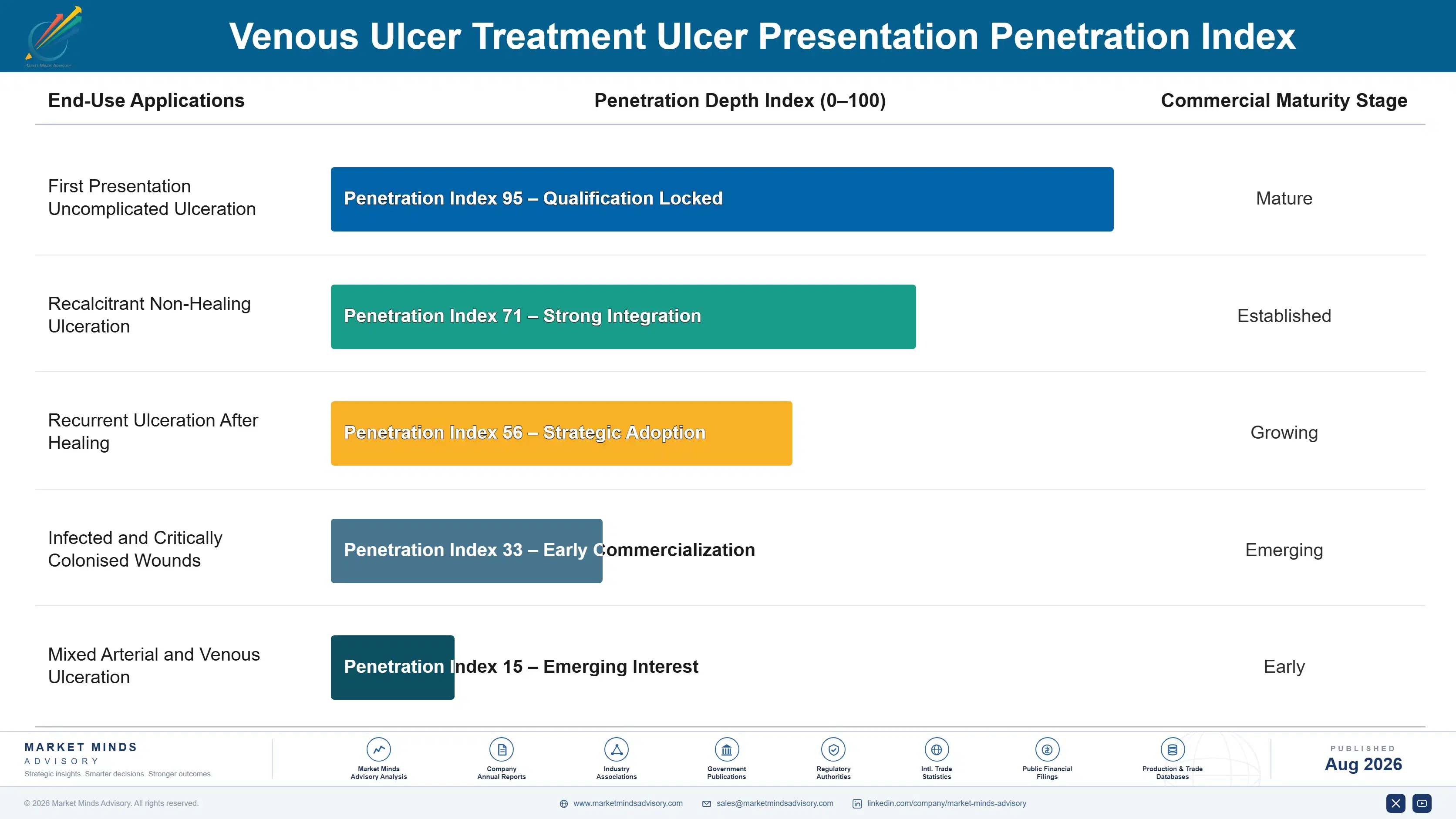
Demand here is chronic, recurrent and unusually long-lived per patient. A venous ulcer consumes dressings, compression and nursing visits continuously for months, and 54% of healed ulcers return within five years, which means the same patient re-enters the category repeatedly across a decade. That produces a genuine annuity, and the uncomfortable corollary is that faster healing and lower recurrence both shrink it. Nobody in the category has a commercial reason to solve recurrence properly, whic
Adoption depth varies sharply by service structure rather than by clinical opinion. European community nursing services with leg ulcer clinics deliver compression consistently and use few expensive products. North American care is fragmented across wound centres, podiatry and home health, which is where skin substitute use concentrates. Vascular surgery sees a small minority of patients early enough to correct reflux usefully. Public systems in cost-constrained markets deliver basic dressings and little compression at all.

Buyer profiles are unusually dispersed for a chronic condition. A tissue viability nurse selects the dressing, a service manager weighs visit capacity, a payer decides whether an expensive product is available, and a vascular surgeon rarely sees the patient in time to change any of it.
venous-ulcer-treatment-market-end-use-penetration-index-1787309956063

What We Would Do Here

These are among the four positions where our research anticipates prominent divergence between winners and laggards over the coming forecast period. Each is grounded in the demand model, the regulatory perimeter, and the announced capacity pipeline.
01 / VISIT CAPACITY SELLING

Sell wraps on nursing rotas, not on healing rates

Community services adopt adjustable compression wraps wherever nursing visit capacity is scarcest rather than wherever clinical opinion happens to be strongest, because a device the patient reapplies removes visits from a rota managers are measured against. Participants presenting visit reduction arithmetic to service managers convert accounts roughly 50% faster than those presenting healing rate evidence to clinicians instead. It reaches a different buyer with entirely different material, and it happens to be the argument that is genuinely true for them.
02 / ELIGIBILITY DEFINITION CONTROL

Write the substitute criteria before a payer does

Cellular products realise roughly USD 9,800 per course and payer review activity is rising precisely because reimbursement was established without trials comparing them in properly compressed patients anywhere. Participants publishing eligibility criteria that exclude under-compressed wounds report review outcomes roughly 40% more favourable than competitors defending unrestricted access do. It concedes volume in wounds that should have been compressed properly, which commercial teams resist strongly, and it is considerably better than having the restriction written for you by somebody else.
03 / REFERRAL PATHWAY BUILDING

Connect ulcer care to vascular surgery deliberately

Correcting the underlying venous reflux heals ulcers faster than compression alone and reaches only 19% of patients within six months, because ulcer care sits with community nursing while reflux correction sits with vascular surgery and nothing connects the two. Participants funding referral pathway development report ablation volume roughly 65% higher across the programme areas they fund. It means working across two service boundaries that rarely talk to each other, and it shortens the episodes dressings and substitutes are sold into anyway.
04 / APPLICATION TRAINING INVESTMENT

Fund the bandaging technique nobody teaches properly

Multi-layer bandaging applied at incorrect tension delivers neither the pressure gradient nor the concordance the whole technique depends upon, and community nursing turnover means training decays continuously across every single service. Participants funding structured application training report product selection loyalty roughly 45% above comparable unsupported accounts, alongside genuinely better healing rates. It costs clinical educator resource that never appears as revenue and benefits whichever product the service happens to stock, which is exactly why it remains chronically under-funded almost everywhere.

Engagement Snapshot From the Field

A live engagement with an industry participant carrying material or product regulatory and market exposure ahead of a defining policy shift, showing how our research translates into a defensible multi-year portfolio strategy.
MARKET MINDS ADVISORY · CLIENT ENGAGEMENT SUMMARY
Venous Ulcer Treatment Producer Strategic Portfolio Review and Transition Roadmap 2026·Investment Scenario on Venous Ulcer Treatment Exposure Evaluation 2025-26
CLIENT PROFILE
A Western European wound care manufacturer with venous ulcer revenue near EUR 132 million annually (client-reported, unverified by MMA), a portfolio weighted toward compression bandaging and advanced dressings, a small adjustable wrap range launched two years earlier, no cellular product position, and a sales organisation calling on tissue viability nurses. Roughly 68% of revenue came from community formulary contracts under continuous price pressure.
STRATEGIC CHALLENGE
Bandaging volume had declined for three consecutive years while venous ulcer prevalence rose, and management proposed entering cellular skin substitutes to capture higher-value treatment. The board doubted that entering a segment under payer review was sensible, and nobody had established where the client's declining bandaging volume was actually going instead.
MMA APPROACH
MMA traced product selection across 76 community nursing services in five markets, coding each change by who decided and on what basis. Forty-seven expert interviews with tissue viability nurses, community service managers, vascular surgeons and formulary pharmacists established how decisions were actually taken. The client's wrap range was then benchmarked against the products winning those conversions.
KEY FINDINGS
  1. Bandaging volume was lost to adjustable wraps rather than to competing bandages, and in 58 of 76 services a manager had decided on visit capacity grounds rather than any clinician.
  2. The client's wrap range covered fewer limb sizes than the products winning conversions, and services rejected it on fit rather than on price or clinical performance in every case reviewed.
  3. Cellular skin substitutes reached almost no patients in the five markets reviewed, and three of five payers confirmed they were actively reviewing the reimbursement that exists elsewhere.
  4. Vascular surgeons in every market described referral pathways from community ulcer care as effectively absent, and none had been approached by any manufacturer about developing one.
CLIENT PROFILE
A Western European wound care manufacturer with venous ulcer revenue near EUR 132 million annually (client-reported, unverified by MMA), a portfolio weighted toward compression bandaging and advanced dressings, a small adjustable wrap range launched two years earlier, no cellular product position, and a sales organisation calling on tissue viability nurses. Roughly 68% of revenue came from community formulary contracts under continuous price pressure.
STRATEGIC CHALLENGE
Bandaging volume had declined for three consecutive years while venous ulcer prevalence rose, and management proposed entering cellular skin substitutes to capture higher-value treatment. The board doubted that entering a segment under payer review was sensible, and nobody had established where the client's declining bandaging volume was actually going instead.
MMA APPROACH
MMA traced product selection across 76 community nursing services in five markets, coding each change by who decided and on what basis. Forty-seven expert interviews with tissue viability nurses, community service managers, vascular surgeons and formulary pharmacists established how decisions were actually taken. The client's wrap range was then benchmarked against the products winning those conversions.
KEY FINDINGS
  1. Bandaging volume was lost to adjustable wraps rather than to competing bandages, and in 58 of 76 services a manager had decided on visit capacity grounds rather than any clinician.
  2. The client's wrap range covered fewer limb sizes than the products winning conversions, and services rejected it on fit rather than on price or clinical performance in every case reviewed.
  3. Cellular skin substitutes reached almost no patients in the five markets reviewed, and three of five payers confirmed they were actively reviewing the reimbursement that exists elsewhere.
  4. Vascular surgeons in every market described referral pathways from community ulcer care as effectively absent, and none had been approached by any manufacturer about developing one.
RECOMMENDED STRATEGY
Phase 1: Phase 1 (0 to 9 months): Abandon the cellular substitute entry plan, and extend the adjustable wrap range across the missing limb sizes immediately. Phase 2: Phase 2 (9 to 24 months): Rebuild commercial calling around service managers and visit capacity, and fund structured bandaging application training. Phase 3: Phase 3 (24 to 42 months): Develop early reflux referral pathways with vascular services in three markets, and index formulary contracts to textile benchmarks.
OUTCOME
The cellular substitute entry was cancelled before any acquisition spend. Wrap range extension completed within four quarters and conversion wins improved materially in services that had previously rejected it (client-reported, unverified by MMA). Service manager calling capability was built in three markets. Application training was funded and referral pathway work started in one market rather than three.

Frequently Asked Questions

Foundational context covering the market sizes, CAGR, scope, country, region and competition that inform every finding below. This section is provided to cover basics and most often pre-purchase conversations, answered from the MMA Primary Research Dataset.

What is the current size of the Venous Ulcer Treatment Market?

MMA sizes the global venous ulcer treatment market at USD 4.6 billion in 2025, rising to USD 4.88 billion in 2026. That covers product, device and single-use consumable revenue across hospital, community and retail channels.

How large will the Venous Ulcer Treatment Market be by 2036?

MMA forecasts USD 8.74 billion by 2036, an expansion multiple of 1.79 times the 2026 base. That represents roughly USD 3.86 billion of incremental revenue across the forecast period.

What is the CAGR for the Venous Ulcer Treatment Market 2026 to 2036?

The base case compounds at 6.0% annually, with a bull case of 7.2% and a bear case of 4.8%. Whether early reflux correction becomes routine practice decides which case materialises.

Which segment is growing fastest?

Cellular and tissue-based skin substitutes compound at 9.0%, exactly 1.50 times the market rate. Reimbursement paying roughly USD 9,800 per course rather than comparative evidence drives that growth.

Who are the major companies in the Venous Ulcer Treatment Market?

The top five participants support 44% of treated patient episodes, led by Smith and Nephew and Essity. Twenty participants are profiled in full, spanning compression, dressing, cellular and ablation suppliers.

Which country is growing fastest?

India compounds at 8.6%, ahead of every other national market MMA tracks here. A substantial and largely untreated venous ulcer burden with building treatment capacity drives that growth.

Report Segmentation Architecture

The full report scope spans multiple orthogonal segmentation dimensions, with cross-tabulated demand data provided for each dimension pair. Coverage extends further to regional breakdowns, trend trajectories, and the competitive detail needed to support segment-level decision-making.

By Intervention Class

  • Cellular and Tissue-Based Skin Substitutes
  • Adjustable Compression Wrap Devices
  • Endovenous Reflux Ablation
  • Antimicrobial and Advanced Dressings
  • Two-Layer and Four-Layer Compression Bandaging
  • Debridement and Wound Bed Preparation

By Ulcer Presentation

  • First Presentation Uncomplicated Ulceration
  • Recalcitrant Non-Healing Ulceration
  • Recurrent Ulceration After Healing
  • Infected and Critically Colonised Wounds
  • Mixed Arterial and Venous Ulceration

By Care Setting

  • Community Nursing and District Services
  • Specialist Leg Ulcer and Wound Clinics
  • Hospital Vascular Surgery Departments
  • Home Health and Self-Managed Care

By Region

  • North America
  • Western Europe
  • East Asia
  • South Asia and Pacific
  • Latin America
  • Middle East and Africa
  • Eastern Europe

Scope, Methodology, and Coverage

Every figure in this report is reproducible from documented input assumptions. The scope below maps the historical period, the forecast horizon, the segmentation dimensions, and the countries covered, alongside the underlying primary and qualitative methodology.
Historical Period
2020 to 2025
Forecast Period
2026 to 2036
Base Year
2025 (USD billions; MMA Primary Research Dataset, August 2026)
Market Definition
The market comprises treatment of venous leg ulceration and its underlying venous insufficiency, spanning cellular and tissue-based skin substitutes, adjustable compression wrap devices, endovenous reflux ablation, antimicrobial and advanced dressings, two-layer and four-layer compression bandaging, and debridement and wound bed preparation products. Sizing captures product, device and single-use consumable revenue at realised price across hospital, community and retail channels. Diabetic foot and pressure ulcer treatment, arterial ulcer and critical limb ischaemia intervention, lymphoedema garments, cosmetic varicose vein treatment, autologous surgical skin grafting, and community nursing service costs are outside scope.
Quantitative Units
USD billions (current prices); million treated patient episodes annually; USD per episode at realised price
Segmentation Dimensions
By Intervention Class; By Ulcer Presentation; By Care Setting; By Region
Regions Covered
North America, Western Europe, East Asia, South Asia and Pacific, Latin America, Middle East and Africa, Eastern Europe
Countries Covered
USA, Canada, UK, Germany, Netherlands, Sweden, Denmark, France, Italy, Spain, Switzerland, Austria, Japan, China, South Korea, Taiwan, India, Australia, Brazil, Mexico, Argentina, Colombia, Indonesia, Thailand, Vietnam, UAE, Saudi Arabia, Turkey, South Africa, Poland, Czech Republic, and additional markets relevant to this sector
Key Companies Profiled
Smith and Nephew, Convatec, Molnlycke Health Care, Essity, 3M, Coloplast, Medline Industries, Integra LifeSciences, Organogenesis, MiMedx, Cardinal Health, Urgo Medical, Hartmann Group, Lohmann and Rauscher, Medtronic, Boston Scientific, Sigvaris, Juzo, medi GmbH, Winner Medical.
Quantitative Methodology
Primary survey, n=3,800 respondents, Q4 2025, six countries; demand-side model with trade association cross-validation
Qualitative Methodology
47 expert interviews, Q4 2025; applied to validate demand model assumptions, identify emerging dynamics, and assess competitive positioning
Report Format
PDF and XLSX data workbook (Word format preview document)
Publisher
Market Minds Advisory
Report Code
MMA-2026-MED-347
Published
August 2026
Contact
sales@marketmindsadvisory.com | www.marketmindsadvisory.com

Purchase the full Venous Ulcer Treatment Market Report (2026 to 2036).

The full report sizes the venous ulcer treatment market across six intervention classes, five ulcer presentations, four care settings and seven regions, with annual forecasts to 2036 in revenue and treated patient episodes. It traces product selection decisions across a large sample of community nursing services, coding each by who decided and on what basis, which is the analysis that explains why visit capacity now moves more volume than clinical evidence does. Twenty participants are assessed on a consistent treated patient episodes basis, with adjustable wrap range breadth and cellular product eligibility exposure mapped separately. Reflux referral pathway maturity is assessed market by market.
Six intervention classes sized and forecast annually
Product selection decisions traced across community nursing services
Twenty participants on consistent treated patient episodes basis
Adjustable wrap range breadth compared supplier by supplier
Cellular product reimbursement exposure quantified market by market
Early reflux referral pathway maturity assessed by market

Built For The People Who Decide

From boardroom strategy to bench-side execution, this report is read cover-to-cover by leaders shaping the next decade of their industry, turning demand scenarios, market dynamics and valuation benchmarks into decisions.
CXOs/ Presidents/ VPs/ Managers
M&A and Corporate Development
Strategy Teams and R&D Heads
Procurement and Product Directors
Regulatory and Compliance Leaders
Investor Relations and Equity Analysts