Market Minds Advisory
Venous Stents Market

Venous Stents Market: The Engineering Got Solved, the Patient Selection Did Not

About a quarter of people with no symptoms at all show iliac vein compression on imaging. The question was never whether the stent opens the vein, it is whether that particular vein needed opening.

Lead Analyst

Alice Ballenger

Published

September 2026

Make Smarter Decisions with Customized Research Insights

Request a free sample report and evaluate market opportunities, growth trends, and competitive dynamics relevant to your business needs.

2025 MARKET VALUE$0.6BMarket Size 2025
2036 FORECAST VALUE$1.6BBase Case , 2026 to 2036
CAGR 2026 TO 20369.6 %Bull 10.8% / Bear 8.4%
INCREMENTAL OPPORTUNITY$0.9BNet 10- year value creation
EXPANSION MULTIPLE2.48x2036 value over 2026 base
Strategic Levers
M&A Pipeline
Regional Outlook
Country Rankings
Competitive Intelligence
Segmental Deep-dive
Call-Us : 91 93563 13602

Executive Snapshot and Market Trajectory

Dedicated venous stents took a decade to engineer because veins are thin-walled, collapsible, and cross a hip joint that bends. Those problems are largely solved now. What remains unsolved is which patients actually benefit, since roughly 25% of people with no symptoms whatsoever show iliac vein compression on imaging.
Growth runs at 9.6% on procedure conversion and on device availability rather than on any settled expansion of the indication itself. Intravascular ultrasound catheters grow fastest at 14.4%, exactly 1.50 times the market rate, as sizing confirmation moves from optional practice toward expected practice almost everywhere. Hybrid zone stents for the inguinal segment follow at 12.9% on fracture resistance across a flexing vessel segment.
Concentration reaches 79% across the top five measured on annual dedicated venous stent units implanted, high because purpose-built devices took years to develop and because one significant product withdrawal thinned the field further back in 2021. North America holds 41%, far above its framework band, on an implantation rate roughly 5.4 times comparable Western European practice for a similar disease burden. China grows fastest at 12.4%, from a very low base indeed.
Market Definition
This market covers devices used in endovascular treatment of chronic iliofemoral venous obstruction, measured at manufacturer realised prices, spanning dedicated iliofemoral venous stents, intravascular ultrasound catheters used for venous sizing, hybrid zone stents for the inguinal segment, adjunctive thrombectomy and vessel preparation devices, venous balloon dilatation catheters, and repurposed non-dedicated stents. Arterial stents used arterially, inferior vena cava filters, compression therapy, anticoagulant medicines, and superficial venous ablation fall outside scope.
Base Year Value
$0.6B in 2025 (MMA Primary Research Dataset, August 2026)
Forecast Period
2026 to 2036, eleven discrete annual values
CAGR
9.6% base case. Bull 10.8%. Bear 8.4%.
Fastest Growth Segment
Intravascular Ultrasound Catheters: 14.4% CAGR
Fastest Growth Country
China: 12.4% CAGR
Fastest Growth Region
South Asia and Pacific: 11.6% CAGR
Largest Region
North America: 41% of 2025 global value
Market Leaders
Becton Dickinson, Medtronic, Cook Medical, OptiMed, Philips. Source: MMA Analysis based on company annual reports.
Primary Survey
n=3,800 procurement and R&D decision-makers, Q4 2025, six countries
Methodology
Demand-side build-up, cross-validated against public data, 47 expert interviews

Venous Stents Market Forecast Scenarios

venous-stents-market-size-forecast-scenario-1787299895462
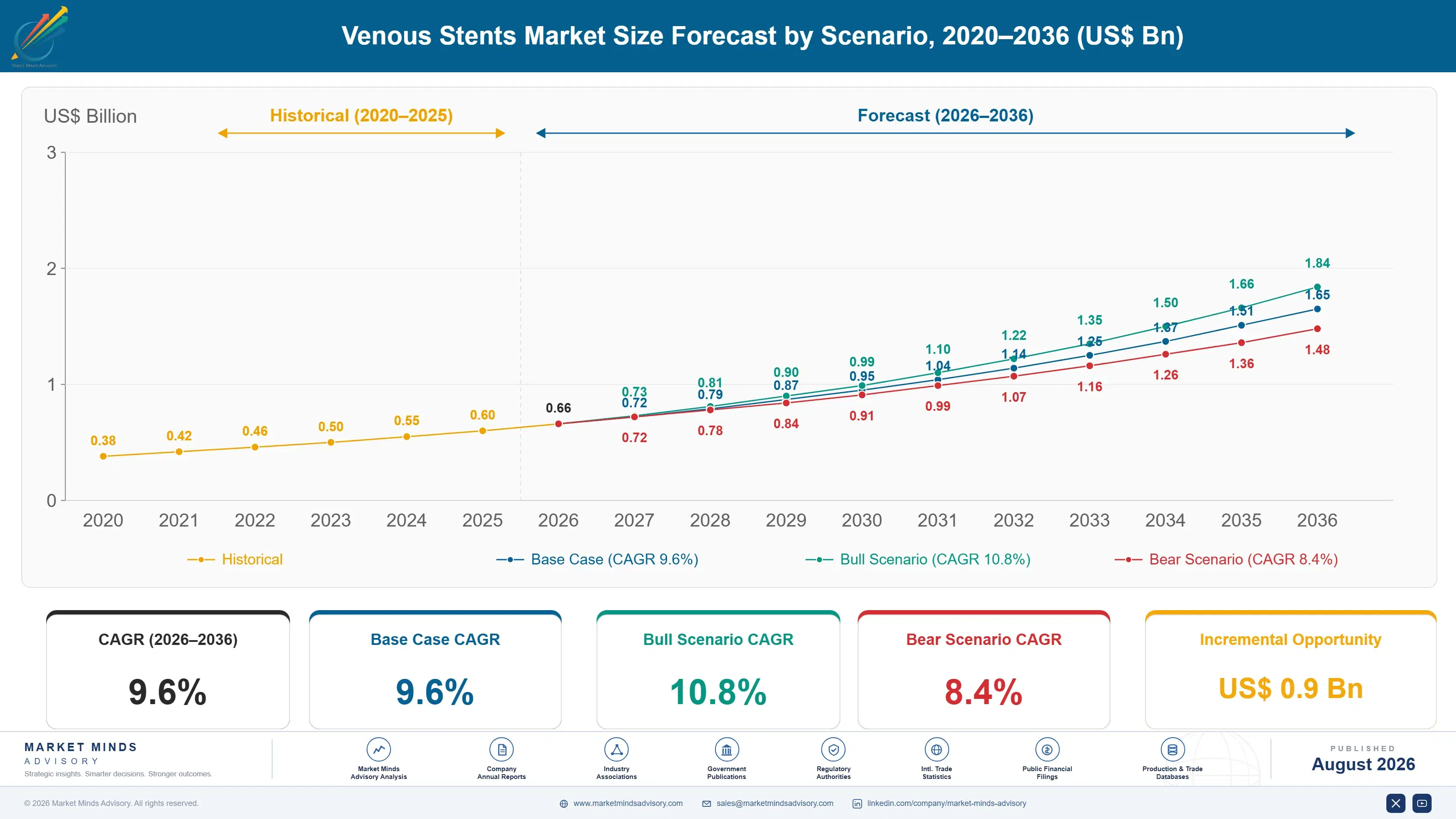
The 2020 to 2025 period ran at 8.2% and the shape of it was set by one event. Dedicated venous stents had arrived and adoption was accelerating when a significant product was withdrawn in 2021 following post-approval data showing higher than expected adverse events. That thinned the field, slowed enthusiasm, and pushed operators toward more careful sizing. Growth resumed afterward on a more cautious and better-documented footing.
Three mechanisms carry the 9.6% base case. Post-thrombotic syndrome treatment is the largest, since chronic obstruction after deep vein thrombosis produces genuine disability that stenting demonstrably relieves in properly selected patients. Intravascular ultrasound adoption is the second, growing at 14.4% as sizing confirmation moves toward expected practice. And Chinese procedure growth is the third, expanding at 12.4% from a very low base as domestic manufacturers made the procedure economically viable in provincial hospitals.
The 10.8% bull case rests on randomised evidence establishing which patients genuinely benefit, which would convert a contested indication into a defensible one and open reimbursement in systems currently holding back. The 8.4% bear case is payer scrutiny of high-volume outpatient practice, since a procedure rate 5.4 times European levels attracts exactly the attention that reduces it.

A Solved Device and an Unsolved Question

The engineering brief here pulls in two directions at once and that shaped the whole category. A venous stent must resist external compression from an artery crossing above it, which demands high radial resistive force, while remaining flexible enough to survive a four centimetre segment at the inguinal ligament that loads every time the patient walks. Early attempts repurposed arterial and biliary devices, and those migrated, fractured, or crushed. Purpose-built designs took a decade and largel
TOP FIVE CONCENTRATION79%High because dedicated venous devices took years to develop
ASYMPTOMATIC COMPRESSION PREVALENCE25%Of the general population showing iliac vein compression on imaging
ULTRASOUND SIZING USE58%Of procedures where sizing is confirmed before stent deployment
TWO YEAR PRIMARY PATENCY79%Across dedicated devices in reported post-approval clinical follow-up
INGUINAL FRACTURE ZONE4 centimetresWhere hip flexion loads the device most severely during walking
PROCEDURE RATE RATIO5.4 timesUnited States implantation against comparable Western European practice
The clinical question proved harder than the metallurgy. Iliac vein compression appears on imaging in roughly 25% of people with no symptoms at all, which means finding it in a symptomatic patient does not establish that it caused anything. Intravascular ultrasound is the accepted way to judge whether a lesion is significant, and it is used in about 58% of procedures. The other 42% are treated on venography and judgment.
That gap shows up geographically. United States implantation runs roughly 5.4 times comparable Western European rates, which is either serious underuse in Europe or serious overuse in America, and the field has not resolved which. Payers have begun asking, and the 2021 withdrawal made everybody more careful.
"We built a stent that survives a hip joint, which was genuinely hard. Then we discovered a quarter of healthy people have the lesion we were treating. The metallurgy problem was the easy one and nobody in this field wants to say that out loud."
Director, Interventional Vascular Devices and Venous Disease Practice · MMA Medi

Market Trends

Ultrasound Sizing Moved From Optional Toward Expected

Venography shows a vein in two dimensions and consistently underestimates the degree of compression, while intravascular ultrasound measures the lumen directly and identifies lesions venography misses entirely. Use sits near 58% of procedures, which is far higher than five years ago and far lower than guidance implies it should be. Growth runs at 14.4% against 9.6% for the market. The commercial consequence is a consumable catheter attached to a growing share of procedures, which is a considerably better revenue pattern than the implant itself provides. Guidance and practice have not converged yet.
Market Impact: Patency reaches 79% at two years
The Inguinal Segment Drove A Separate Device Class

A stent crossing the inguinal ligament passes through roughly four centimetres of vessel that flexes with every step, and fracture, kinking, and in-stent restenosis concentrate there rather than anywhere else along the construct. Designs balancing radial resistive force above with flexibility across that zone have emerged as a distinct product class rather than as a variant. Growth runs at 12.9%, second fastest in this market. Operators increasingly select two different devices for one construct, which raises device revenue per procedure meaningfully. Any simple unit count of this market therefore understates what a single procedure now consumes in device terms.
Market Impact: China grows at 12.4% annually

Market Opportunities and Growth Drivers

Post-Thrombotic Syndrome Produces Genuine Measurable Disability

Chronic iliofemoral obstruction after deep vein thrombosis causes swelling, venous claudication, and ulceration that conservative management handles poorly, and stenting relieves it demonstrably in properly selected patients. This is the indication where nobody disputes the benefit and where two year primary patency near 79% across dedicated devices is genuinely good. It also happens to be the smaller share of procedures performed, since non-thrombotic compression is far more commonly diagnosed. The defensible indication and the volume indication are not the same one. That distinction matters more than anything else here. Volume and defensibility diverge here.
Market Impact: Present in 25% without symptoms

Chinese Procedure Volume Is Expanding From Almost Nothing

Venous intervention barely existed across Chinese vascular practice a decade ago, and dedicated device availability plus specialist training have changed that quickly. Domestic manufacturers now supply stents at a fraction of imported pricing, which makes the procedure economically viable in provincial hospitals that could never have justified Western devices. China contributes the fastest national growth rate in this forecast at 12.4%. Deep vein thrombosis incidence across the population is substantial, so the post-thrombotic pool alone supports considerable growth without touching contested indications. Training capacity rather than device supply has been the practical limit on how fast provincial adoption spreads.
Market Impact: United States rate 5.4 times higher

Market Restraints and Challenges

A Quarter Of Healthy People Have The Lesion

Iliac vein compression appears on cross-sectional imaging in roughly 25% of people with no venous symptoms at all, which means identifying it in a symptomatic patient proves nothing about causation. The root cause is anatomical: the right iliac artery crosses the left iliac vein in most people and compresses it to some degree. Commercial impact is an indication that resists the clean definition payers require, and randomised evidence separating benefit from coincidence remains limited. Registries, ultrasound sizing thresholds, and society appropriateness criteria are the partial answers available. None of them settles the question properly.
Market Impact: Growing at 14.4% annually

A Fivefold Procedure Gap Invites Payer Scrutiny

United States implantation runs roughly 5.4 times comparable Western European rates for populations with similar venous disease burden, and outpatient vascular centres account for a disproportionate share of that difference. The root cause is a reimbursement structure that pays well for the procedure in an office setting combined with an indication nobody can define tightly. Commercial impact is exposure to coverage restriction that would hit volume rather than price. Suppliers are responding with appropriateness registries and outcome reporting to establish which practice patterns hold up. Volume loss cannot be answered with a price response.
Market Impact: Growing at 12.9% annually
3 additional market trends, 4 additional growth drivers, and 2 additional restraints and challenges are covered in the full report. Contact sales@marketmindsadvisory.com to access the complete intelligence.

Segment CAGR and Growth Architecture

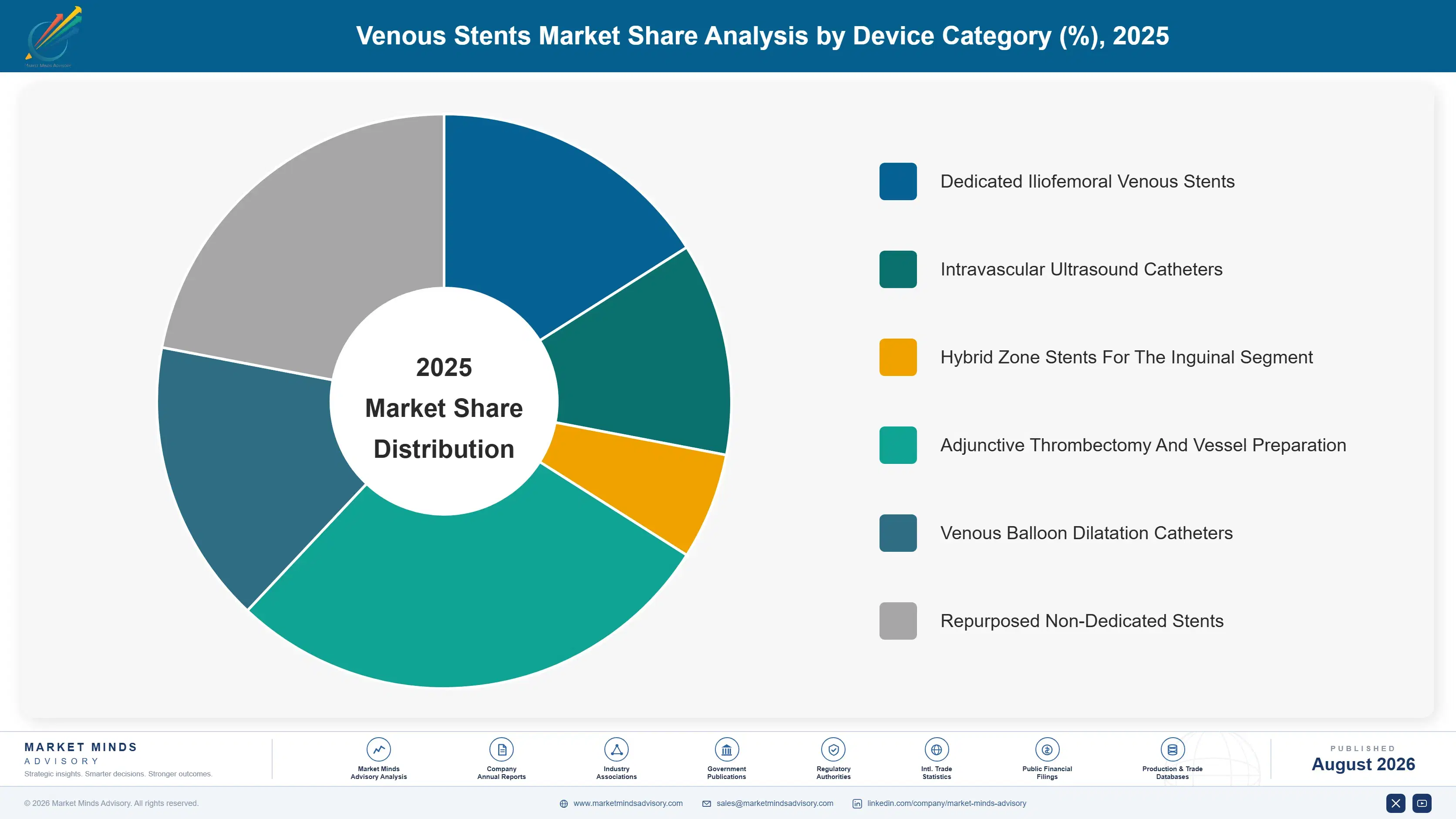
Segmentation follows the device category consumed within a procedure, because that determines whether revenue is implant or consumable, which supplier type competes for it, how many units a single construct requires, and what an operator realises clinically from using it. Patient indication and anatomical level both cut across every category rather than separating them cleanly.
venous-stents-market-market-share-analysis-1787299895989

Intravascular Ultrasound Catheters

The fastest category at 14.4%, exactly 1.50 times the market rate, and commercially the most interesting because it attaches a consumable to a procedure whose implant volume is contested. Venography represents a three-dimensional vein in two dimensions and consistently understates compression, while ultrasound measures the lumen directly and finds lesions plain imaging misses. Use sits near 58% of procedures against guidance implying it should be considerably higher. Every additional point of adoption adds a catheter to a case that was happening anyway, which makes this the one segment growing without depending on the indication debate resolving. Nothing else in this category has that property. Every added point of adoption is revenue on existing volume.
CAGR 14.4%

Hybrid Zone Stents For The Inguinal Segment

Second fastest at 12.9%, and a genuinely distinct product class rather than a variant, created by four centimetres of vessel at the inguinal ligament that flexes with every step a patient takes. Fracture, kinking, and in-stent restenosis concentrate in that zone rather than anywhere else along a construct. Designs trading some radial resistive force for flexibility across it have separated from the devices used higher in the iliac segment. Operators increasingly build one construct from two device types, which raises implant revenue per procedure and complicates any simple unit count of the market. Suppliers offering only one of the two device types are competing for half a case. Losing the other half usually loses the follow-up too.
CAGR 12.9%
Full segment breakdown across 6 segments available in the complete report.

Regional Architecture and Country Demand Map

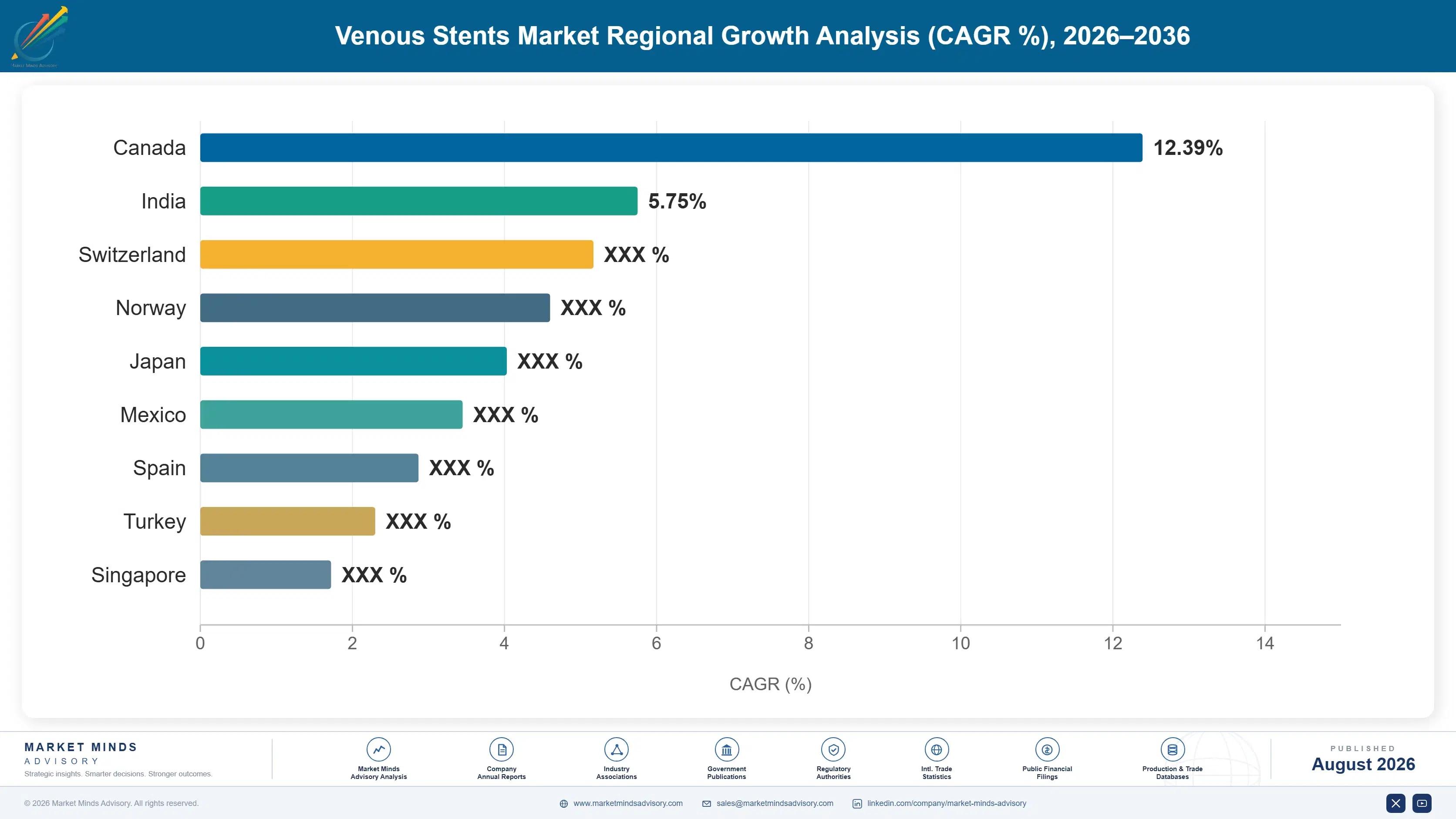
Practice pattern rather than disease burden sets the shape here, and the difference between regions is larger than epidemiology can explain. North America sits far above its framework band on an implantation rate several times European levels, which is also the source of the field's scrutiny problem.

North America

Forty-one percent, far above the framework band, and the justification is practice pattern rather than disease: implantation runs roughly 5.4 times comparable Western European rates across populations with broadly similar venous disease burden. Office-based and outpatient vascular centres account for a disproportionate share of that difference, supported by reimbursement that pays well outside the hospital setting. Device pricing also sits above European levels. Growth at 8.6% falls below the global rate, which is the clearest signal in this market that payer scrutiny of high-volume outpatient practice has begun to bite rather than merely being discussed. Canadian practice sits far closer to European patterns on both indication discipline and setting. Device pricing here also sits well above European levels.
Share: 41% | CAGR: 8.6% (2026 to 2036)

Western Europe

Practice here is markedly more conservative and considerably better documented, with German centres in particular contributing much of the early dedicated device development and much of the published follow-up data that the field relies on. National systems apply appropriateness criteria more consistently and reimburse the procedure in hospital settings rather than office ones, which removes the volume incentive that shapes American practice. Intravascular ultrasound use runs higher than the global average. Growth at 8.0% is the slowest of any region, reflecting deliberate restraint rather than any shortage of patients who might qualify. Registry participation across German and Dutch centres is considerably better than anywhere else, which is why the published follow-up the whole field relies on comes disproportionately from here.
Share: 22% | CAGR: 8.0% (2026 to 2036)
Regional intelligence for 5 additional markets available in the complete report: East Asia, South Asia and Pacific, Latin America, Middle East and Africa, Eastern Europe. Contact sales@marketmindsadvisory.com.
venous-stents-market-country-cagr-analysis-1787299896496

Building Around A Contested Indication

The device works and the patient selection does not, with compression visible in 25% of asymptomatic people and a United States procedure rate 5.4 times European practice. Value comes from attaching consumables to procedures regardless of indication, from funding the evidence nobody else will, from the two-device construct, and from the defensible post-thrombotic pool.

Attach A Consumable To Every Procedure Performed

Implant volume depends on an indication debate no supplier can settle, while an intravascular ultrasound catheter attaches to a case that is happening regardless of how that debate resolves. Use sits near 58% of procedures against guidance implying it should be far higher, so each point of adoption adds a catheter to existing volume. Building or acquiring ultrasound catheter capability costs in the region of 45 million dollars and produces revenue insulated from the coverage restriction that threatens implant volume directly. No competitive response protects implant volume from a coverage decision.
Market Impact: Ultrasound capability costs around 45 million dollars overall

Fund The Randomised Evidence Nobody Else Will

The indication resists the clean definition payers require because randomised evidence separating genuine benefit from incidental anatomy barely exists, and every supplier has waited for somebody else to generate it. A properly powered trial costs perhaps 60 million dollars across enrolment and follow-up. Whoever funds it defines the appropriateness criteria that follow and shapes which devices those criteria describe. The alternative is continued coverage erosion decided by payers working from claims data rather than from clinical evidence. Waiting has cost the field a decade already, and payers are now deciding the question from claims data instead.
Market Impact: A randomised trial costs about 60 million dollars

Sell The Construct Rather Than The Single Device

Fracture and restenosis concentrate in roughly four centimetres at the inguinal ligament, and operators increasingly build one construct from a high radial force device above and a flexible design across that zone. A supplier offering both captures the whole construct and roughly 1.7 times the implant revenue per procedure. One offering a single design competes for half a case and often loses the other half to a competitor who then owns the follow-up relationship. Very few suppliers have built the range to do this properly. Range completeness is the whole argument here.
Market Impact: The full construct yields 1.7 times the revenue

Build Deliberately In Post-Thrombotic Rather Than Compression

Chronic obstruction after deep vein thrombosis produces disability nobody disputes and responds to stenting with two year patency near 79%, while non-thrombotic compression carries the volume and all of the scrutiny. Weighting clinical evidence, training, and commercial effort toward the post-thrombotic population builds a position that survives whatever coverage restriction eventually arrives. It is a smaller pool today and a considerably more defensible one, and suppliers weighted toward the contested group are carrying a risk they have not priced. The pool is smaller and it will not be restricted. Coverage restriction will not reach it.
Market Impact: Two year patency reaches 79% in this group

Who Controls the Margin Pool

Concentration reaches 79% across the top five measured on annual dedicated venous stent units implanted, which is high and follows from how difficult these devices were to develop. Purpose-built venous stents took roughly a decade of iteration after repurposed arterial and biliary devices failed in the vein, and one significant product withdrawal in 2021 removed a competitor and made everybody else more cautious. The gap between leader and challenger is narrow and turns on individual device perf
Competitive activity runs on three fronts. Fracture resistance across the inguinal segment is the first, since that is where reported failures concentrate and where a distinct product class has emerged. Sizing consumables are the second, attaching revenue to procedures regardless of implant choice. Post-approval outcome data is the third, and after 2021 it carries weight with operators that no marketing claim does.

Pressure comes from two directions. Chinese manufacturers supply dedicated venous stents domestically at a fraction of Western pricing in the fastest growing market anywhere. And payer scrutiny of high-volume outpatient practice threatens the volume rather than the price, which no competitive or commercial response addresses at all.
venous-stents-market-company-positioning-matrix-1787299897016

Competitive Moat and Risk Dimensions

BECTON DICKINSON

Moat: Longest dedicated venous track record

Accumulated post-approval follow-up across a dedicated venous device carries unusual weight in a field where one product was withdrawn on exactly that kind of data. Operators choosing an implant that stays in a patient for decades read outcome registries far more carefully than they read a specification sheet. Years of published follow-up cannot be assembled quickly by anybody arriving now.
BECTON DICKINSON

Risk: Concentrated in scrutinised American volume

The strongest position sits in the market where implantation runs 5.4 times European rates and where payers have begun examining outpatient practice patterns seriously. Coverage restriction there would remove volume rather than compress price, and no commercial response addresses that. Depth in a market under review is exposure however good the device performs clinically.
MEDTRONIC

Moat: Breadth across venous intervention

Holding thrombectomy, vessel preparation, and stent products across the venous pathway means a single supplier is present through the whole procedure rather than for one step of it. That breadth secures the relationship with an interventional service regardless of which implant a given case requires. It also spreads exposure across categories that face different regulatory and reimbursement risks.
MEDTRONIC

Risk: Limited sizing consumable position

Intravascular ultrasound is the fastest growing category here at 14.4% and it attaches revenue to procedures regardless of which implant is chosen or whether the indication debate resolves. A supplier without that capability is exposed to exactly the implant volume risk the consumable insulates against. Acquiring the capability is expensive and building it is slow.

Players Tracked

Prominent Players

Becton Dickinson
Medtronic
Cook Medical
OptiMed
Philips

Other Key Players

Boston Scientific
W. L. Gore & Associates
Terumo
Cordis
Vesper Medical
Lifetech Scientific
MicroPort
Zylox-Tonbridge
Shanghai HeartCare Medical
Penumbra
Inari Medical
AngioDynamics
Veryan Medical
Bentley InnoMed
iVascular

Recent Developments

JANUARY 2025

Society publishes appropriateness criteria for iliac vein stenting

A vascular society issued appropriateness criteria for iliofemoral venous stenting, specifying imaging thresholds and symptom requirements before intervention in non-thrombotic compression. The publication was independent society guidance rather than any manufacturer-sponsored programme, commercial research arrangement, or payer-commissioned work. Symptom duration and imaging evidence were both specified as prerequisites for intervention.
Signal: Defining who should be treated is the field's central unresolved problem and societies moved before payers did
APRIL 2025

Manufacturer launches dedicated device for the inguinal segment

A device manufacturer introduced a stent designed specifically for the flexing segment at the inguinal ligament, trading radial resistive force for fracture resistance across roughly four centimetres. The launch was a product introduction rather than any joint venture, acquisition, or licensing arrangement with a competing stent manufacturer.
Signal: The inguinal zone has separated into its own device class rather than remaining a variant specification
AUGUST 2025

Payer restricts outpatient iliac vein stenting coverage pending documentation

A large payer introduced prior authorisation requirements for iliac vein stenting performed in office-based settings, requiring imaging documentation and failed conservative therapy before approval. The change was a coverage policy decision rather than any enforcement action, litigation settlement, or agreement with providers. Existing authorisations were unaffected.
Signal: Coverage restriction attacks procedure volume directly, and no competitive or pricing response can ever address it

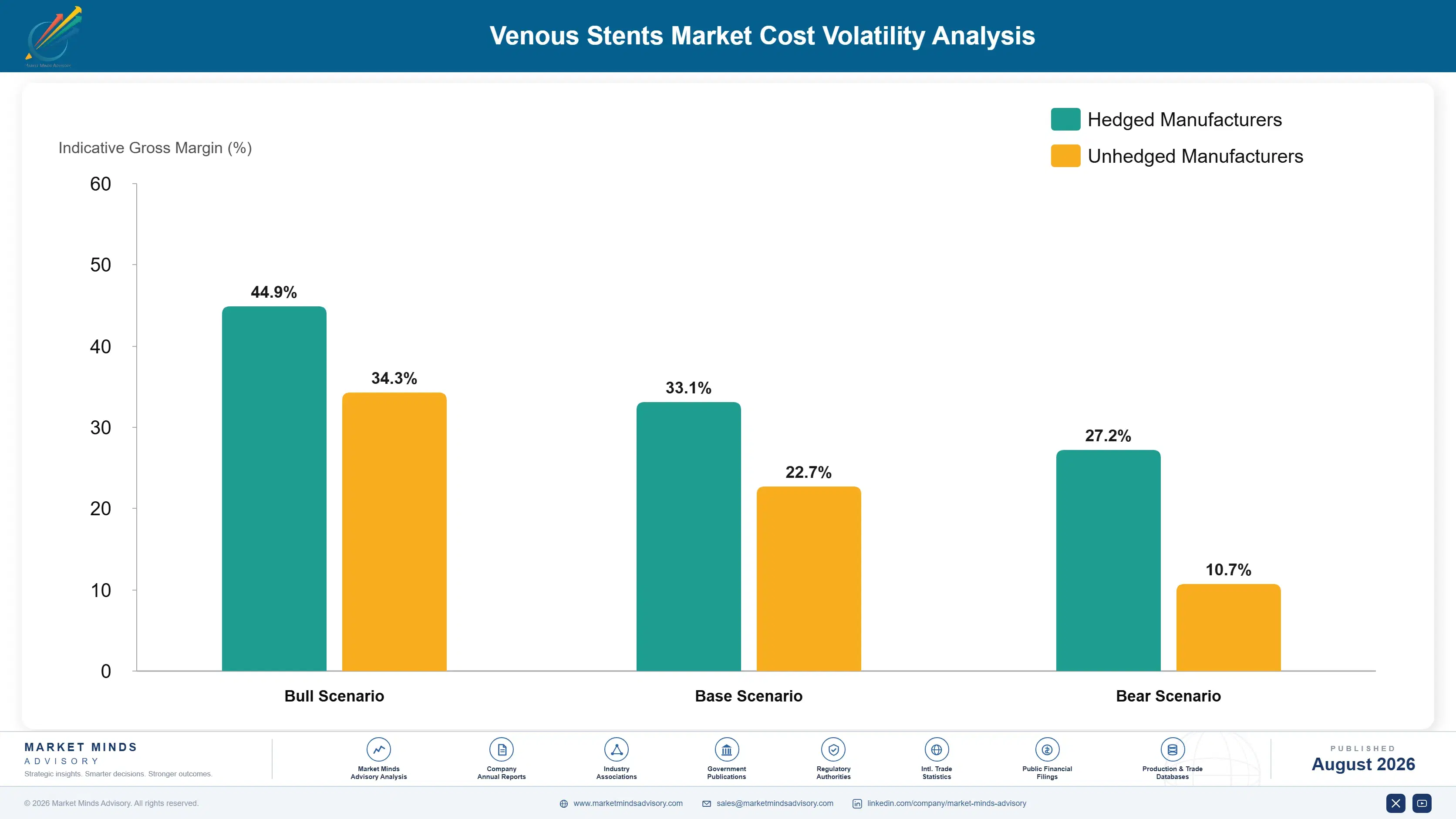
Nitinol and Very Little Else

Nitinol tubing and wire dominate at roughly 31% of cost of goods, supplied by a small number of specialist producers with the metallurgical control these devices require. Laser cutting, shape setting, and electropolishing add about 22%, delivery catheter assembly around 19%, and sterilisation, packaging, and regulatory documentation carry the remainder. Very little about this cost base is contestable, since every supplier buys similar alloy through similar processes.
Nickel and titanium alloy supply concentration is the exposure that matters. United States Census Bureau trade reporting documented substantial movement in nickel-titanium alloy import volumes and values through recent years, and medical-grade nitinol is produced by relatively few qualified suppliers because the transformation temperature control these devices need is genuinely demanding. Manufacturers holding one qualified alloy source absorbed the movement rather than switching, since requalification touches the device's mechanical behaviour directly.

The competitive disadvantage mechanism runs through qualification rather than through purchasing. Changing nitinol supplier alters radial force and fatigue performance in ways that require bench testing and regulatory notification, which takes months and cannot be started once supply has tightened. Exposure also varies by portfolio breadth, since several device families spread the qualification burden that a single-product supplier carries alone.
venous-stents-market-cost-volatility-analysis-1787299897211

Qualify a second medical-grade nitinol supplier in advance

Transformation temperature and fatigue behaviour both depend on the specific alloy and its processing history, so changing supplier alters how the device performs mechanically and requires bench testing plus regulatory notification. That work takes months and cannot begin once supply has already tightened upstream somewhere. The qualification cost is modest against an alloy shortage.

Bring laser cutting and shape setting in house where volume allows

Cutting, shape setting, and electropolishing together carry about 22% of cost of goods and determine fatigue performance more than almost anything else in the process. Contract processing means paying margin on the step that most affects clinical outcome while controlling it least. Integration requires volume to justify the capital, which is why only the larger manufacturers can realistically pursue it.

Spread alloy qualification across several device families

A manufacturer holding a single product carries its entire supply risk on one alloy specification, and has no way at all to move volume when that specification tightens somewhere upstream of it. Several device families sharing qualified alloy sources let production shift between them, and the qualification cost amortises across a far wider revenue base.

Portfolio Architecture for Margin Defence

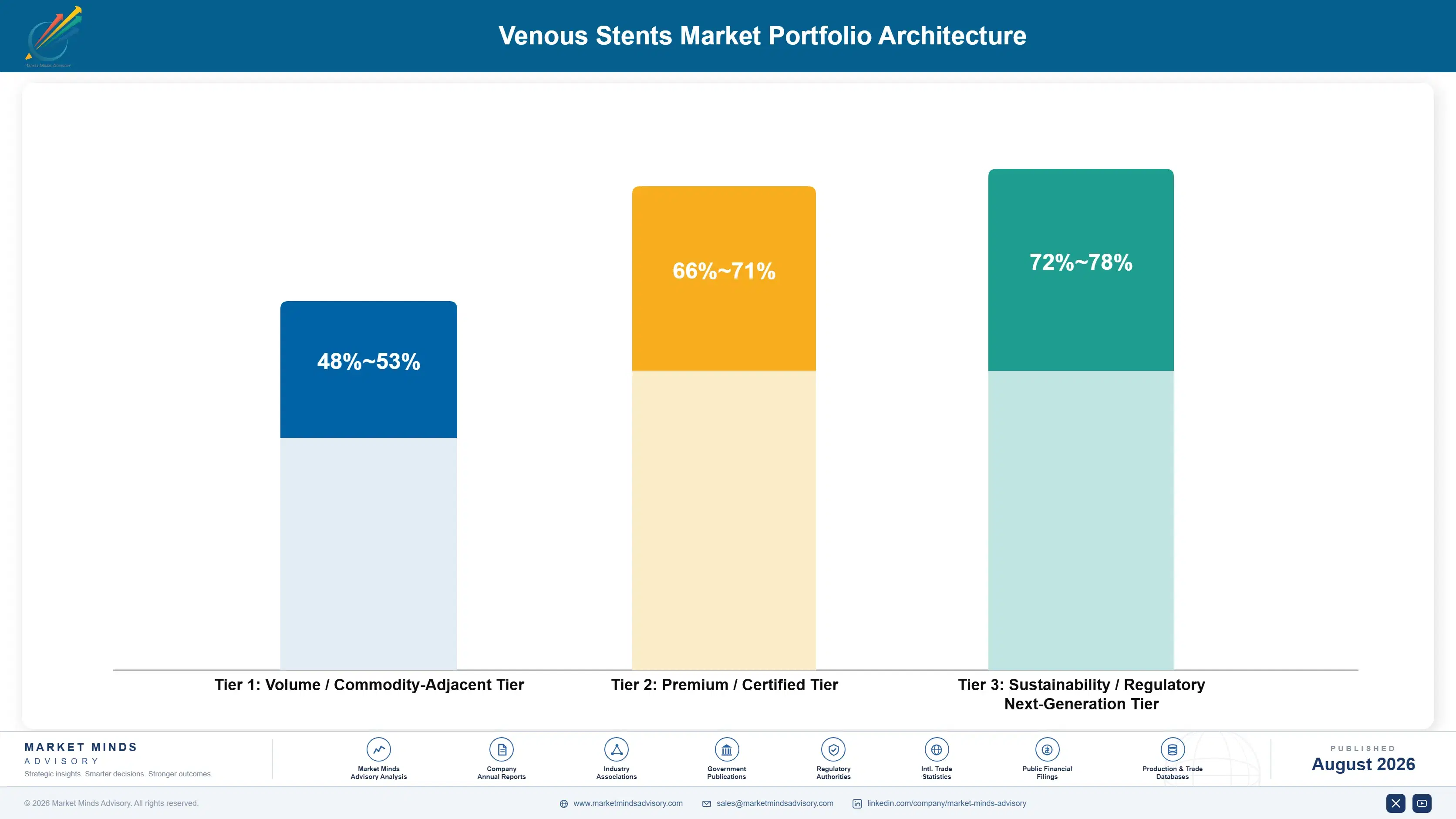
Three tiers describe this business and the spread is set by how exposed each is to the indication debate. Repurposed and commodity stents sit at the bottom, competing on price in markets where dedicated device pricing is unaffordable. Dedicated iliofemoral stents sit higher on published outcome data. Sizing consumables and inguinal segment devices occupy a third tier, one insulated from the debate and the other addressing where failures concentrate.
The tension is that implant volume funds everything while carrying all the regulatory and coverage risk. A supplier present only in consumables has revenue insulated from coverage restriction and no relationship with the interventionalist choosing the implant, which is where clinical preference actually forms. Suppliers who tried to enter through consumables alone found they were selling into procedures other companies had won.

High-value pools concentrate where the clinical argument is unambiguous. Post-thrombotic obstruction produces disability nobody disputes, responds with two year patency near 79%, and attracts none of the scrutiny falling on non-thrombotic compression, which makes it the most durable position available here. Suppliers weighted toward the contested indication are carrying a coverage risk they have never priced into any forecast they publish.

Volume / Commodity-Adjacent Tier

Repurposed non-dedicated stents and value-tier dedicated devices sold where Western pricing is unaffordable. Thin and falling margin under domestic Asian competition, but the volume that establishes an operator relationship in markets where the procedure is only now becoming routine.
Gross Margin: 48-53%

Premium / Certified Tier

Dedicated iliofemoral venous stents supported by published post-approval follow-up, which carries unusual weight since one product was withdrawn on exactly that evidence. Margin reflects outcome data and operator confidence rather than any manufacturing difference between competing devices.
Gross Margin: 66-71%

Sustainability / Regulatory / Next-Generation Tier

Intravascular ultrasound sizing catheters and dedicated inguinal segment devices addressing where failures concentrate. Best margin, and the sizing consumable is the only revenue here insulated from whatever coverage restriction the indication debate eventually produces.
Gross Margin: 72-78%
venous-stents-market-portfolio-architecture-1787299897710

High-value Sub-segments and Strategic Watch-out

Intravascular Ultrasound Catheters

Fastest growth at 14.4%, exactly 1.50 times the market rate, attaching a consumable to procedures happening regardless of how the indication debate resolves. Use near 58% against guidance implying far higher leaves considerable headroom without needing any new patients. Nothing else here is insulated that way.
Gross Margin: 72-78%

Inguinal Segment Devices

Strong margin and 12.9% growth from a distinct product class created by four centimetres of flexing vessel where fracture and restenosis concentrate. Operators building constructs from two device types raise implant revenue per procedure by roughly 1.7 times. Fracture concentrates almost entirely in that zone.
Gross Margin: 72-78%

Non-Thrombotic Compression Volume

The volume core carrying most implant units and all of the scrutiny, since compression appears in 25% of asymptomatic people and the United States procedure rate runs 5.4 times European practice. Coverage restriction here removes volume that no pricing response recovers. Prior authorisation is already spreading across plans.
Gross Margin: 66-71%

Post-Thrombotic Treatment Pool

The most defensible position available, treating disability nobody disputes with two year patency near 79% and attracting none of the appropriateness scrutiny falling elsewhere. Smaller today and considerably more durable through whatever coverage decisions eventually arrive. It is where any durable position should be built.
Gross Margin: 66-71%

How These Implants Accumulate

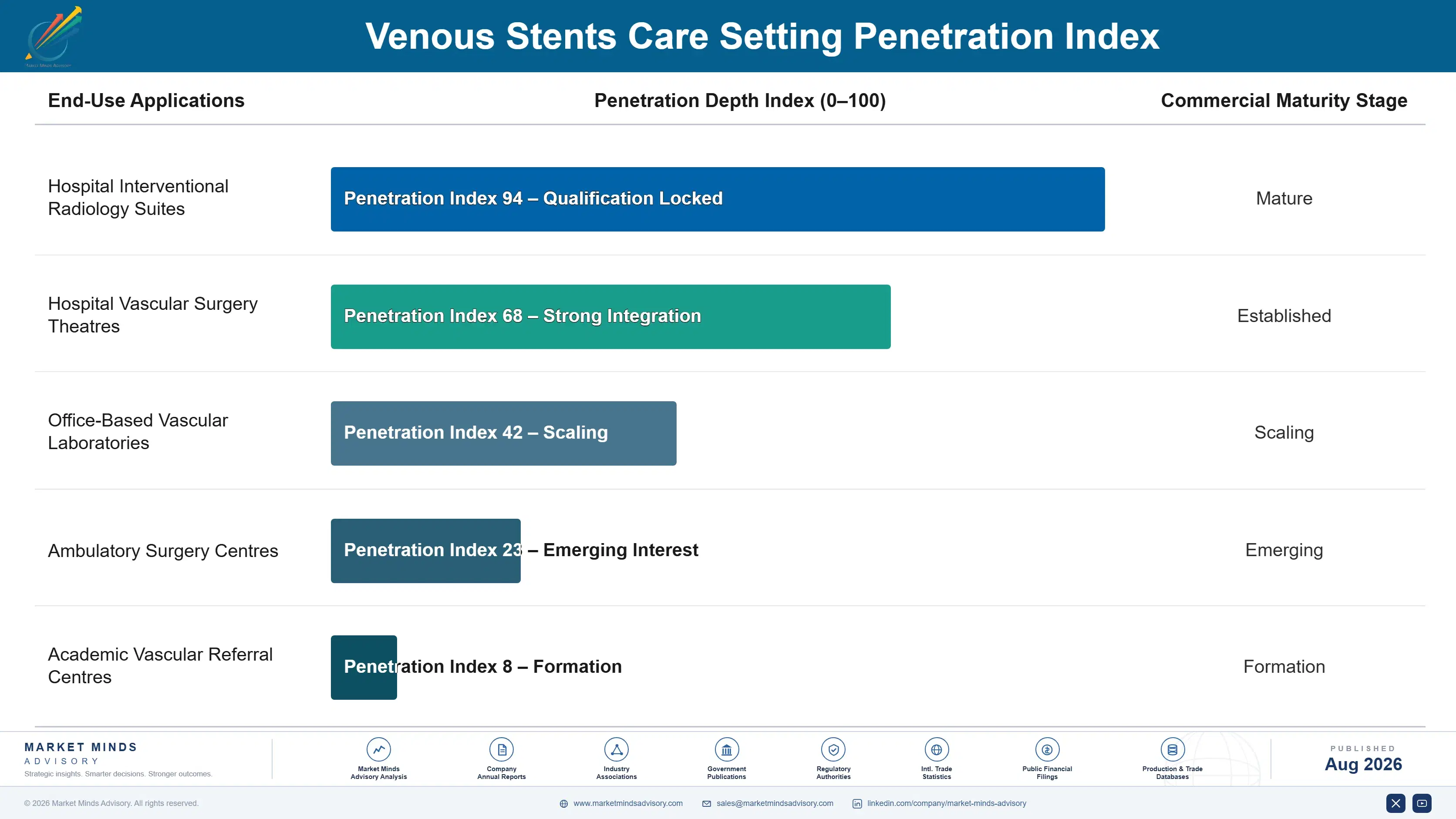
Demand accumulates per procedure and never repeats for that patient, which makes this an acquisition business rather than an annuity one. A stent goes in once and stays for decades, generating no further revenue unless it fails and requires reintervention, which is an outcome nobody wants to build a forecast on. What does repeat is the consumable attached to each case, and that is the only recurring revenue anywhere in this category regardless of which implant an operator selects.
Stickiness forms around the operator rather than the institution. An interventionalist who has followed a device through several years of surveillance imaging and seen it perform develops a preference that survives procurement pressure, because the implant stays in the patient long after any contract expires. Post-approval outcome data drives that preference far more than specification comparison does, particularly since 2021. Consumable choice sticks less firmly and moves with hospital purchasing.

Buyer profiles have shifted toward payers without those payers ever entering the room. Operators still select the device, and prior authorisation increasingly decides whether the case happens at all. That makes coverage policy the most important commercial variable here, and no supplier negotiates it with the person choosing the device.
venous-stents-market-end-use-penetration-index-1787299898195

What We Would Tell a Board

These are among the four positions where our research anticipates prominent divergence between winners and laggards over the coming forecast period. Each is grounded in the demand model, the regulatory perimeter, and the announced capacity pipeline.
01 / CONSUMABLE REVENUE INSULATION

Attach revenue to the case, not to the indication

Implant volume depends entirely on an appropriateness debate that no supplier can settle and that payers are already deciding from claims data instead of evidence. An intravascular ultrasound catheter attaches to procedures happening regardless of how that debate concludes, and use sits near 58% against guidance implying it should be far higher. Building or acquiring that sizing capability costs around 45 million dollars and produces the only revenue in this entire category that is genuinely insulated from a coverage restriction.
02 / APPROPRIATENESS EVIDENCE FUNDING

Somebody defines the criteria and it should be you

Iliac vein compression appears in roughly 25% of people with no symptoms, so randomised evidence separating genuine benefit from incidental anatomy is the only thing that converts a contested indication into a defensible one. A properly powered trial costs perhaps 60 million dollars across enrolment and follow-up, and every supplier has spent a decade waiting for somebody else to fund it. Whoever does defines the appropriateness criteria that follow and shapes which devices those criteria end up describing for everybody else afterward.
03 / CONSTRUCT RANGE COMPLETENESS

Half a construct loses the follow-up relationship too

Fracture and restenosis concentrate in roughly four centimetres at the inguinal ligament, and operators increasingly build a single construct from a high radial force device above and a flexible design across that zone. A supplier offering both of those captures roughly 1.7 times the implant revenue per procedure and owns the surveillance relationship that follows. One offering a single design competes for half the case and hands the other half, and usually the surveillance relationship with it, straight to a competitor.
04 / INDICATION MIX DISCIPLINE

Build where nobody disputes that it works

Chronic obstruction after deep vein thrombosis produces disability nobody argues about and responds to stenting with two year patency near 79%, while non-thrombotic compression carries most of the volume and almost all of the appropriateness scrutiny currently building. Weighting evidence generation, training, and commercial coverage toward the post-thrombotic population builds a position that survives whatever coverage decisions eventually arrive from payers. Suppliers concentrated in the contested group are carrying a volume risk they have never priced into anything they publish.

Engagement Snapshot From the Field

A live engagement with an industry participant carrying material or product regulatory and market exposure ahead of a defining policy shift, showing how our research translates into a defensible multi-year portfolio strategy.
MARKET MINDS ADVISORY · CLIENT ENGAGEMENT SUMMARY
Venous Stents Producer Strategic Portfolio Review and Transition Roadmap 2026·Investment Scenario on Venous Stents Exposure Evaluation 2025-26
CLIENT PROFILE
An interventional device manufacturer with approximately 96 million dollars in annual venous revenue (client-reported, unverified by MMA), selling a single dedicated iliofemoral stent across North America and Western Europe. The business held no sizing consumable, no dedicated inguinal segment device, and had commercial coverage weighted very heavily toward high-volume outpatient vascular centres across both regions.
STRATEGIC CHALLENGE
A large payer had introduced prior authorisation for office-based iliac vein stenting and management expected volume pressure to spread. The proposed response was to expand commercial coverage into additional outpatient centres before restrictions widened. The board wanted an independent read on whether chasing that volume was sensible given what was happening to coverage across the market.
MMA APPROACH
We modelled the client's implant volume by indication, separating post-thrombotic obstruction from non-thrombotic compression across every account. Payer coverage policies were reviewed across the eleven largest plans. Construct composition was analysed to establish how often a second device type was used alongside the client's stent, and sizing consumable attachment was measured across the same procedures.
KEY FINDINGS
  1. Around 71% of the client's implant volume sat in non-thrombotic compression, which is exactly the indication attracting appropriateness scrutiny and prior authorisation requirements.
  2. A second inguinal segment device from a competitor was used alongside the client's stent in almost half of constructs, giving that competitor the surveillance relationship afterward.
  3. Sizing consumables were used in 61% of the client's procedures and every one of those catheters was supplied by somebody else entirely.
  4. Coverage policies at four of the eleven plans reviewed already contained language that would restrict a majority of the client's current volume within two years.
CLIENT PROFILE
An interventional device manufacturer with approximately 96 million dollars in annual venous revenue (client-reported, unverified by MMA), selling a single dedicated iliofemoral stent across North America and Western Europe. The business held no sizing consumable, no dedicated inguinal segment device, and had commercial coverage weighted very heavily toward high-volume outpatient vascular centres across both regions.
STRATEGIC CHALLENGE
A large payer had introduced prior authorisation for office-based iliac vein stenting and management expected volume pressure to spread. The proposed response was to expand commercial coverage into additional outpatient centres before restrictions widened. The board wanted an independent read on whether chasing that volume was sensible given what was happening to coverage across the market.
MMA APPROACH
We modelled the client's implant volume by indication, separating post-thrombotic obstruction from non-thrombotic compression across every account. Payer coverage policies were reviewed across the eleven largest plans. Construct composition was analysed to establish how often a second device type was used alongside the client's stent, and sizing consumable attachment was measured across the same procedures.
KEY FINDINGS
  1. Around 71% of the client's implant volume sat in non-thrombotic compression, which is exactly the indication attracting appropriateness scrutiny and prior authorisation requirements.
  2. A second inguinal segment device from a competitor was used alongside the client's stent in almost half of constructs, giving that competitor the surveillance relationship afterward.
  3. Sizing consumables were used in 61% of the client's procedures and every one of those catheters was supplied by somebody else entirely.
  4. Coverage policies at four of the eleven plans reviewed already contained language that would restrict a majority of the client's current volume within two years.
RECOMMENDED STRATEGY
Phase 1: Phase 1 (months one to nine): stop expanding outpatient coverage and reweight commercial effort toward post-thrombotic referral centres instead. Referral centres carry the defensible indication. Phase 2: Phase 2 (months nine to twenty-four): develop or acquire an inguinal segment device to compete for the whole construct rather than half of it. Phase 3: Phase 3 (months twenty-four to forty-two): build a sizing consumable position and contribute to appropriateness evidence generation. Somebody will define the criteria eventually.
OUTCOME
The outpatient expansion was cancelled. Post-thrombotic volume grew as coverage shifted toward referral centres, an inguinal segment device entered development, and construct share improved in accounts where clinical support had been redirected (client-reported, unverified by MMA). Exposure to prior authorisation fell materially across the account base.

Frequently Asked Questions

Foundational context covering the market sizes, CAGR, scope, country, region and competition that inform every finding below. This section is provided to cover basics and most often pre-purchase conversations, answered from the MMA Primary Research Dataset.

What is the current size of the Venous Stents Market?

The market is valued at USD 0.58 billion in 2025, rising to USD 0.64 billion in 2026. Scope covers devices used in endovascular treatment of chronic iliofemoral venous obstruction.

How large will the Venous Stents Market be by 2036?

MMA forecasts USD 1.59 billion by 2036, an increase of USD 0.95 billion over the 2026 base. That represents an expansion multiple of 2.48 times across the forecast period.

What is the CAGR for the Venous Stents Market 2026 to 2036?

The base case CAGR is 9.6%, with a bull case of 10.8% and a bear case of 8.4%. The historical rate from 2020 to 2025 was 8.2%, held back by a product withdrawal.

Which segment is growing fastest?

Intravascular ultrasound catheters at 14.4%, exactly 1.50 times the market rate. They attach a consumable to procedures happening regardless of how the indication debate eventually resolves.

Who are the major companies in the Venous Stents Market?

Becton Dickinson, Medtronic, Cook Medical, OptiMed, and Philips lead on annual dedicated venous stent units implanted. The top five hold 79%, since purpose-built devices took a decade to develop.

Which country is growing fastest?

China at 12.4%, driven by domestic manufacturers supplying dedicated stents at a fraction of imported pricing, which made the procedure viable in provincial hospitals for the first time.

Report Segmentation Architecture

The full report scope spans multiple orthogonal segmentation dimensions, with cross-tabulated demand data provided for each dimension pair. Coverage extends further to regional breakdowns, trend trajectories, and the competitive detail needed to support segment-level decision-making.

By Device Category

  • Dedicated Iliofemoral Venous Stents
  • Intravascular Ultrasound Catheters
  • Hybrid Zone Stents For The Inguinal Segment
  • Adjunctive Thrombectomy And Vessel Preparation
  • Venous Balloon Dilatation Catheters
  • Repurposed Non-Dedicated Stents

By Care Setting

  • Hospital Interventional Radiology Suites
  • Hospital Vascular Surgery Theatres
  • Office-Based Vascular Laboratories
  • Ambulatory Surgery Centres
  • Academic Vascular Referral Centres

By Payer Channel

  • Commercial Insurance With Prior Authorisation
  • Medicare And Public Reimbursement
  • National Health System Hospital Budgets
  • Private Hospital Direct Purchase
  • Patient Self-Pay And Assistance

By Region

  • North America
  • Western Europe
  • East Asia
  • South Asia and Pacific
  • Latin America
  • Middle East and Africa
  • Eastern Europe

Scope, Methodology, and Coverage

Every figure in this report is reproducible from documented input assumptions. The scope below maps the historical period, the forecast horizon, the segmentation dimensions, and the countries covered, alongside the underlying primary and qualitative methodology.
Historical Period
2020 to 2025
Forecast Period
2026 to 2036
Base Year
2025 (USD billions; MMA Primary Research Dataset, August 2026)
Market Definition
This market comprises devices used in endovascular treatment of chronic iliofemoral venous obstruction arising from non-thrombotic compression or post-thrombotic disease, measured at manufacturer realised prices across all care settings. Category coverage spans dedicated iliofemoral venous stents, intravascular ultrasound catheters used for venous lesion assessment and sizing, hybrid zone stents designed for the flexing inguinal segment, adjunctive thrombectomy and vessel preparation devices used within the same procedure, venous balloon dilatation catheters, and repurposed non-dedicated stents implanted venously. Arterial stents used in arterial indications, inferior vena cava filters, compression stockings and conservative therapy, anticoagulant and antiplatelet medicines, superficial venous ablation, and varicose vein treatment fall outside scope.
Quantitative Units
USD billions (current prices); dedicated stent units implanted; devices per construct; realised price per unit
Segmentation Dimensions
By Device Category; By Care Setting; By Payer Channel; By Region
Regions Covered
North America, Western Europe, East Asia, South Asia and Pacific, Latin America, Middle East and Africa, Eastern Europe
Countries Covered
USA, Canada, Germany, France, Italy, Spain, UK, Netherlands, Belgium, Switzerland, Austria, Sweden, Poland, Czechia, Turkey, China, Japan, South Korea, Taiwan, India, Australia, Singapore, Thailand, Malaysia, Brazil, Mexico, Colombia, Argentina, Saudi Arabia, UAE, Israel, South Africa, and additional markets relevant to this sector
Key Companies Profiled
Becton Dickinson, Medtronic, Cook Medical, OptiMed, Philips, Boston Scientific, W. L. Gore & Associates, Terumo, Cordis, Vesper Medical, Lifetech Scientific, MicroPort, Zylox-Tonbridge, Shanghai HeartCare Medical, Penumbra, Inari Medical, AngioDynamics, Veryan Medical, Bentley InnoMed, iVascular
Quantitative Methodology
Primary survey, n=3,800 respondents, Q4 2025, six countries; demand-side model with trade association cross-validation
Qualitative Methodology
47 expert interviews, Q4 2025; applied to validate demand model assumptions, identify emerging dynamics, and assess competitive positioning
Report Format
PDF and XLSX data workbook (Word format preview document)
Publisher
Market Minds Advisory
Report Code
MMA-2026-MED-483
Published
August 2026
Contact
sales@marketmindsadvisory.com | www.marketmindsadvisory.com

Purchase the full Venous Stents Market Report (2026 to 2036).

The full report sizes venous stents across six device categories, five care settings, five payer channels, and seven regions, with country detail for the thirty largest markets. Implant volume is separated by indication into post-thrombotic obstruction and non-thrombotic compression, since coverage scrutiny falls almost entirely on the second and the two carry very different durability. Procedure rates are benchmarked by country against comparable venous disease burden to quantify practice variation. Competitive profiling covers twenty companies on annual dedicated units implanted. Intravascular ultrasound attachment and construct composition are measured across procedures.
Implant volume separated by thrombotic and non-thrombotic indication
Procedure rates benchmarked against comparable venous disease burden
Payer coverage policies tracked across major plans and systems
Ultrasound sizing attachment measured across procedures by country
Construct composition analysed across single and multi-device builds
Post-approval patency outcomes compiled by dedicated device family

Built For The People Who Decide

From boardroom strategy to bench-side execution, this report is read cover-to-cover by leaders shaping the next decade of their industry, turning demand scenarios, market dynamics and valuation benchmarks into decisions.
CXOs/ Presidents/ VPs/ Managers
M&A and Corporate Development
Strategy Teams and R&D Heads
Procurement and Product Directors
Regulatory and Compliance Leaders
Investor Relations and Equity Analysts