Market Minds Advisory
Vegan Vitamins and Supplements Market

Vegan Vitamins and Supplements Market: Excipient Certification, Algal Omega-3 Economics and Substitutions That Actually Work Better

Gelatin capsules, lanolin vitamin D and stearate flow agents disqualify more formulations than any active ingredient does, and certification bodies check exactly those before they check anything a consumer would notice.

Lead Analyst

Lisa Gevelber

Published

September 2026

Make Smarter Decisions with Customized Research Insights

Request a free sample report and evaluate market opportunities, growth trends, and competitive dynamics relevant to your business needs.

2025 MARKET VALUE$6.2BMarket Size 2025
2036 FORECAST VALUE$18.8BBase Case , 2026 to 2036
CAGR 2026 TO 203610.6 %Bull 11.8% / Bear 9.4%
INCREMENTAL OPPORTUNITY$11.9BNet 10- year value creation
EXPANSION MULTIPLE2.74x2036 value over 2026 base
Strategic Levers
M&A Pipeline
Regional Outlook
Country Rankings
Competitive Intelligence
Segmental Deep-dive
Call-Us : 91 93563 13602

Executive Snapshot and Market Trajectory

The hard part of a vegan supplement is almost never the active ingredient. It is the gelatin capsule, the lanolin-derived vitamin D and the magnesium stearate flow agent, and certification bodies check those before they look at anything a consumer would recognise. Consumers notice none of it. Certification bodies do.
Algal omega-3 carries the growth on a substitution that genuinely works better, since cultivating the algae that produce EPA and DHA removes the fish, the trawler and the heavy metal question together. Vegan vitamin D3 grows nearly as fast because lanolin disqualifies whole formulations. East Asia holds the largest share on Indian and Chinese manufacturing plus domestic demand rooted in long-standing vegetarian dietary practice.
Concentration reads at 24% for the top five, genuinely low and reflecting how many small brands built positions while large supplement companies treated vegan as a niche label rather than a formulation constraint. Contract manufacturers with dedicated vegan lines have become the practical gatekeepers, since cross-contamination from gelatin handling ends a certification faster than any ingredient decision. Manufacturers who committed segregated capacity early hold positions formulation capability alone does not deliver anybody.
Market Definition
This market covers dietary supplements formulated entirely without animal-derived ingredients or processing aids, spanning algal omega-3 supplements, vegan vitamin D3, plant-based protein and amino acid supplements, vegan multivitamin and mineral formulations, and fermentation-derived vitamin B12 products. Vegetarian products permitting dairy or egg derivatives, general supplements that happen to lack animal ingredients without certification, and vegan foods not sold as supplements are excluded.
Base Year Value
$6.2B in 2025 (MMA Primary Research Dataset, August 2026)
Forecast Period
2026 to 2036, eleven discrete annual values
CAGR
10.6% base case. Bull 11.8%. Bear 9.4%.
Fastest Growth Segment
Algal Omega-3 Supplements: 15.9% CAGR
Fastest Growth Country
India: 14.6% CAGR
Fastest Growth Region
South Asia and Pacific: 12.9% CAGR
Largest Region
East Asia: 27% of 2025 global value
Market Leaders
Nestlé Health Science, Bayer, Nature's Bounty, Garden of Life and Deva Nutrition lead on vegan supplement revenue. Source: MMA Primary Research Dataset, July 2026.
Primary Survey
n=3,800 procurement and R&D decision-makers, Q4 2025, six countries
Methodology
Demand-side build-up, cross-validated against public data, 47 expert interviews

Vegan Vitamins and Supplements Market Forecast Scenarios

vegan-vitamins-supplements-market-size-forecast-scenario-1787375380780
Growth ran at 9.5% annually between 2020 and 2025, and the composition changed considerably partway through. Early demand came from committed vegan consumers buying a small range of specialist products. What followed was broader, as mainstream buyers avoiding animal ingredients for environmental, digestive or religious reasons began choosing vegan formulations without describing themselves as vegan at all.
The base case at 10.6% rests on three mechanisms. Algal omega-3 keeps taking share from fish oil as marine sustainability pressure builds and the cost gap narrows, which reaches buyers who never considered a vegan product. Certification requirements keep pushing formulations toward dedicated vegan contract manufacturing. And Indian demand grows quickly on a population where vegetarian dietary practice is long established and supplement penetration is still rising from a low base.
The bull case at 11.8% turns on algal omega-3 reaching cost parity with fish oil, which would remove the last commercial argument for marine sourcing in supplement applications. The bear case at 9.4% reflects certification cost and complexity deterring smaller brands, since a formulation can fail on an excipient nobody thought about and reformulating late is expensive.

Excipients Disqualify More Products Than Actives

Ask a formulator what makes a supplement difficult to veganise and they will not mention the vitamin. They will mention the gelatin capsule shell, the lanolin-derived cholecalciferol, the magnesium stearate that may or may not be plant-sourced, and the shellac coating. Roughly 31% of formulations submitted for certification fail on an excipient rather than on any active ingredient. Consumers see none of that.
TOP FIVE CONCENTRATION24%Genuinely low, with small brands holding positions large companies missed
CERTIFICATION FAILURE RATE31%Share of submitted formulations failing on excipients rather than actives
ALGAL COST MULTIPLE1.7 times fish oilAlgal production cost relative to comparable fish oil
DEDICATED LINE SHARE46%Portion manufactured on lines handling no animal derived materials
PRICE PREMIUM38%Vegan certified advantage over comparable conventional supplement products
CERTIFICATION CYCLE6 monthsTypical time to achieve vegan certification for a new formulation
That makes contract manufacturing the practical gatekeeper. Cross-contamination from gelatin handling on shared equipment ends a certification faster than any formulation error, so brands increasingly require dedicated lines handling no animal-derived material at all. Around 46% of vegan supplement volume is now produced that way, and manufacturers who invested in segregated capacity hold positions that formulation capability alone does not deliver.
Algal omega-3 is the substitution that genuinely improves on what it replaces. Fish accumulate EPA and DHA by eating algae, so cultivating the algae directly removes the fish, the trawler and the heavy metal question in a single step. Production cost still runs around 1.7 times fish oil, though the gap keeps narrowing, and marine sustainability pressure has driven more adoption than vegan positioning ever achieved on its own.
"Half this industry still thinks vegan supplements are about swapping a fish oil for a seed oil. The certification bodies are looking at your capsule shell, your flow agent and whether the line ran gelatin last Tuesday."
Director, Nutraceuticals and Alternative Ingredients Practice · MMA Nutraceuticals Practice · August 2026

Market Trends

Excipient Sourcing Decides Certification More Than Active Selection

Gelatin capsule shells, lanolin-derived vitamin D3, magnesium stearate of uncertain origin and shellac coatings disqualify formulations that look entirely plant-based on the front of the pack. Roughly 31% of submissions fail certification on an excipient rather than on any active ingredient, and reformulating late is expensive and slow. Certification bodies check these specifically because they are where products actually fail. Formulators who have been caught out once check them thereafter, and the ones who have not keep failing. Reformulating after a failed submission costs testing, time and frequently an entire launch window.
Market Impact: Segment grows at 15.9% annually
Dedicated Manufacturing Lines Become The Practical Requirement

Cross-contamination from gelatin handling on shared equipment ends a certification faster than any formulation error, which has pushed brands toward contract manufacturers running lines that handle no animal-derived material at all. Roughly 46% of volume is now produced on dedicated capacity, and that share keeps climbing as certification bodies tighten what they accept. Manufacturers who invested in segregated lines hold positions formulation capability alone does not deliver. The capital was committed before the requirement became general. Certification bodies keep tightening what they will accept on shared equipment. Capital was committed before the requirement became general.
Market Impact: India grows at 14.6% annually

Market Opportunities and Growth Drivers

Algal Omega-3 Improves On What It Replaces

Most vegan substitutions ask a consumer to accept something slightly worse for a reason they care about. Algal omega-3 does not. Fish accumulate EPA and DHA by eating algae, so cultivating the algae directly removes the fish, the trawler and the heavy metal question together, and marine sustainability pressure reaches buyers who never considered a vegan product. Production cost runs around 1.7 times fish oil and keeps narrowing. The segment grows at 15.9% annually on that combination. Buyers who reject the vegan label still buy the product on that argument.
Market Impact: Certification takes 6 months typically

Indian Vegetarian Practice Meets Rising Supplement Penetration

India has the largest vegetarian population anywhere and dietary avoidance of animal products is long established rather than a recent choice, which produces demand behaving quite differently from Western vegan buying. Supplement penetration is still rising from a low base, and formulations that would need certification elsewhere are simply the default here. Indian demand grows near 14.6% annually. Domestic manufacturers formulate without animal derivatives as a matter of course rather than as a deliberate positioning decision. Certification is barely a consideration in the domestic market at all. Domestic manufacturers formulate this way by default.
Market Impact: Costs 1.7 times fish oil equivalent

Market Restraints and Challenges

Certification Complexity Deters Smaller Brands From Committing

A formulation can fail certification on an excipient nobody in the business thought about, and discovering that late means reformulating, retesting and resubmitting at considerable cost. The root cause is that certification examines the whole supply chain including processing aids that never appear on a label. Commercially this deters smaller brands and pushes them toward uncertified vegan claims that carry less weight. Participants are responding with pre-submission audits, certified excipient supplier lists, and contract manufacturers offering certification support. Uncertified claims carry very little weight with scrutinising buyers. Retailers increasingly require verification before listing.
Market Impact: Excipients cause 31% of failures

Algal Omega-3 Supply Concentration Limits Formulator Options

Algal EPA and DHA production sits with a handful of fermentation producers holding the strain libraries and capacity to do it at commercial scale, which leaves formulators with very few genuine alternatives. The root cause is that strain development and fermentation capacity both require capital and years that few companies have committed. Commercially this caps supply during demand surges and limits negotiating position. Participants are responding with multi-year supply agreements, dual qualification where possible, and blended inclusion levels. Spot buyers are served last whenever fermentation capacity tightens. Blended inclusion levels are one partial answer.
Market Impact: Dedicated lines carry 46% of volume
3 additional market trends, 4 additional growth drivers, and 2 additional restraints and challenges are covered in the full report. Contact sales@marketmindsadvisory.com to access the complete intelligence.

Segment CAGR and Growth Architecture

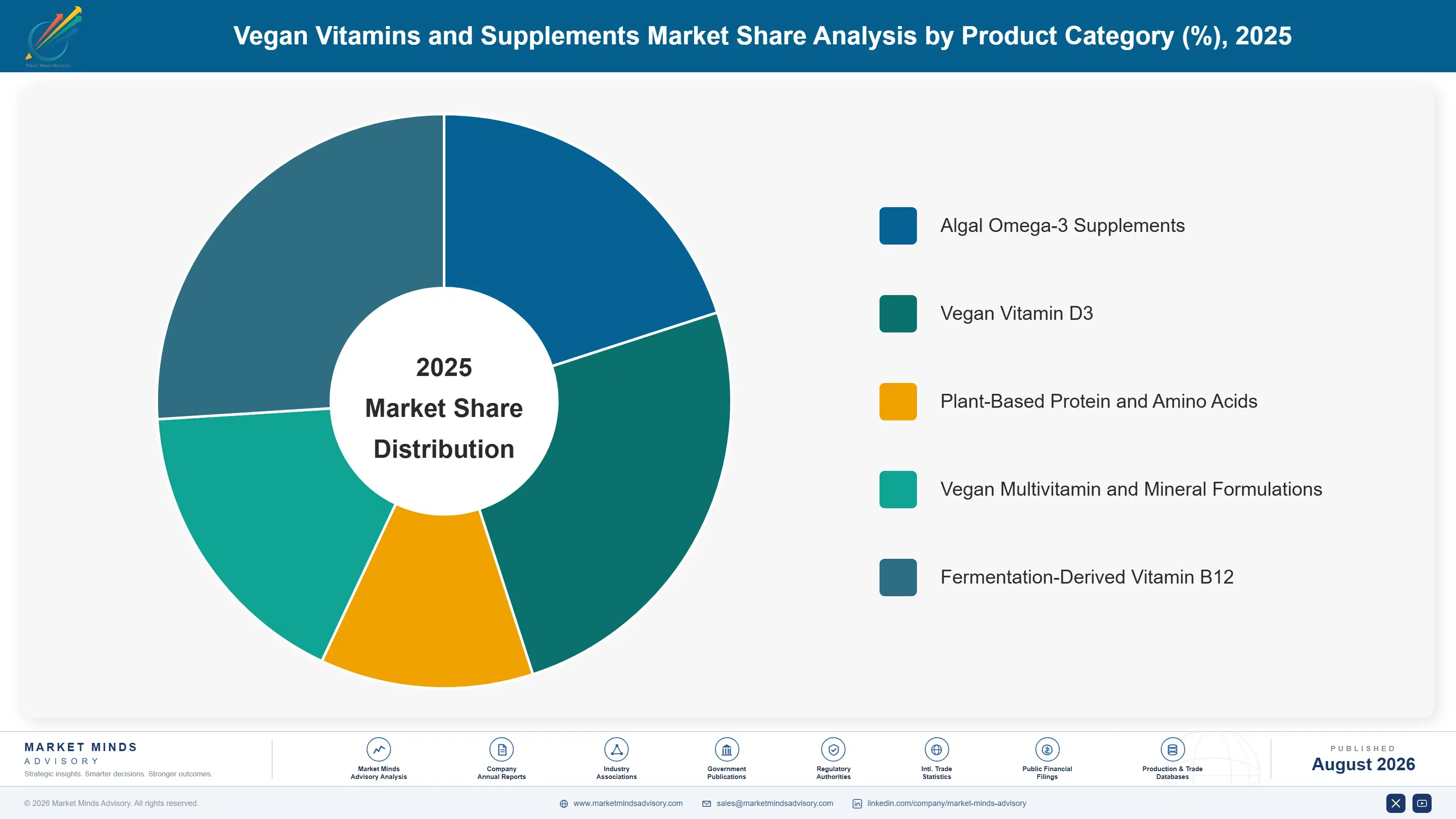
Five product categories divide this market on the ingredient challenge each one solves rather than on the health benefit claimed. That reflects how formulation actually works, since the commercial difficulty in a vegan supplement lies in sourcing a compliant version of a specific nutrient rather than in deciding what the product should do. Sourcing decides the whole outcome.
vegan-vitamins-supplements-market-market-share-analysis-1787375381325

Algal Omega-3 Supplements

Growing at 12.9% and the fastest part of this market. Algal omega-3 replaces fish oil with the organism that actually produces the fatty acids in the first place, which is a genuinely better argument than most vegan substitutions can make. Fish accumulate EPA and DHA by eating algae; cultivating the algae directly removes the fish, the trawler and the heavy metal question in one step. Supply is concentrated among a handful of fermentation producers with the strain libraries and capacity to do it at scale. Cost per gram remains above fish oil but the gap has narrowed considerably, and marine sustainability pressure has done more for adoption than vegan positioning ever did.
CAGR 15.9%

Vegan Vitamin D3

Growing at 11.0% on plant-derived and fermentation-produced vitamin D3, which matters more than its share suggests because lanolin from sheep's wool supplies almost all conventional D3 and no vegan multivitamin can use it. Lichen extraction was the original route and remains the premium one, while fermentation approaches are scaling and closing the cost gap. This is the ingredient that determines whether an entire formulation can carry a vegan certification at all, which gives it commercial weight far beyond the inclusion level. Certification bodies check it specifically, and formulators who have been caught out once check it thereafter. Fermentation routes are scaling and closing the cost gap against lichen extraction steadily. Formulators check this ingredient first.
CAGR 11.0%
Full segment breakdown across 5 segments available in the complete report.

Regional Architecture and Country Demand Map

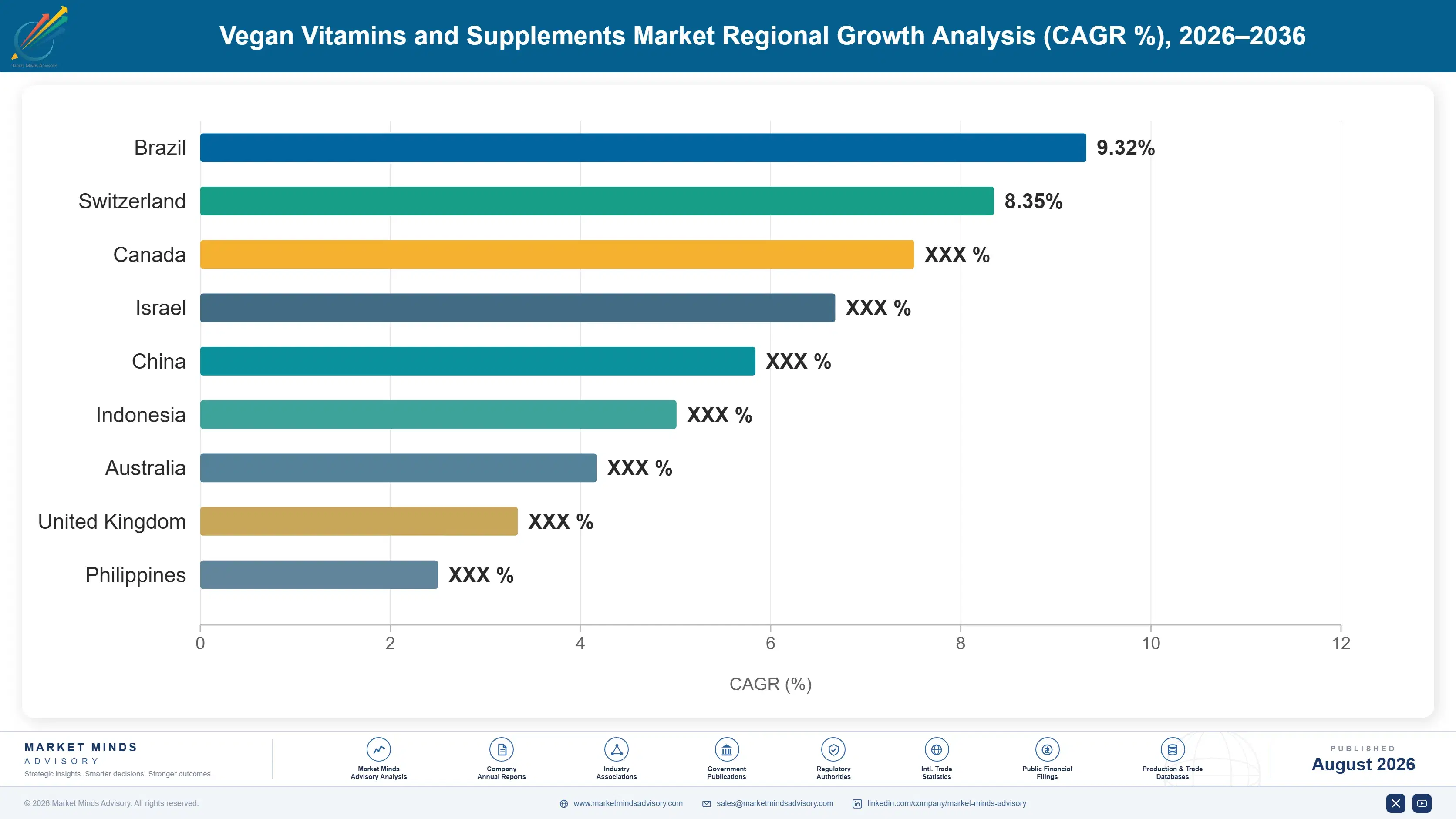
East Asia holds 27% of global value on Chinese manufacturing scale and growing domestic demand. North America follows at 25% on certified retail development, while South Asia and Pacific grows fastest as Indian vegetarian practice meets rising supplement penetration from a low base. Certification is strictest in Western Europe.

East Asia

Chinese manufacturing supplies a great deal of the world's vegan supplement production, including capsule shells, fermentation-derived vitamins and algal ingredients, which gives the region a supply position that consumption figures alone would understate considerably. Domestic demand is growing quickly among younger urban consumers. Japanese and Korean markets are smaller and weighted toward premium certified products with demanding quality expectations. Buddhist dietary practice supports a long-standing base of animal-product avoidance across parts of the region that predates any Western vegan movement. Certification frameworks vary by market and are generally less developed than European or American equivalents. Regional supply position considerably exceeds what consumption figures alone would suggest. Buddhist dietary practice predates any Western movement.
Share: 27% | CAGR: 11.7% (2026 to 2036)

North America

Certified vegan retail is more developed here than anywhere and American consumers recognise certification marks, which is the precondition for a category built on a claim rather than on a visible product difference. Dedicated manufacturing lines are well established among contract manufacturers serving the segment. Growth increasingly comes from mainstream buyers avoiding animal ingredients for environmental or digestive reasons rather than from committed vegans. Marine sustainability pressure has done more for algal omega-3 adoption here than vegan positioning achieved on its own. Canadian demand follows American patterns closely with somewhat tighter claim substantiation requirements applying. Mainstream buyers now drive more growth than committed vegan consumers do. Certification marks are genuinely recognised by buyers.
Share: 25% | CAGR: 11.1% (2026 to 2036)
Regional intelligence for 5 additional markets available in the complete report: Western Europe, South Asia and Pacific, Latin America, Middle East and Africa, Eastern Europe. Contact sales@marketmindsadvisory.com.
vegan-vitamins-supplements-market-country-cagr-analysis-1787375381846

Where Vegan Supplement Margin Is Won

Four positions separate brands building durable businesses from those making an uncertified claim and hoping nobody checks: auditing excipients before submission, securing dedicated manufacturing capacity, contracting algal omega-3 supply ahead of demand, and positioning on sustainability rather than on veganism alone to reach mainstream buyers. Only the last of those costs nothing at all to attempt.

Audit Excipients Before Submitting For Certification

Roughly 31% of formulations fail certification on gelatin shells, lanolin vitamin D, stearates of uncertain origin or shellac coatings rather than on any active ingredient, and discovering that at submission means reformulating, retesting and resubmitting. Pre-submission excipient audits cut failure rates by 60% to 75% and remove months from launch timelines. The work costs almost nothing against a failed submission, and most brands still learn this the expensive way instead. Certification bodies check processing aids that never appear on any label, which is precisely where the gaps sit. Most brands still discover this at submission.
Market Impact: Cuts certification failures by as much as 75%

Secure Dedicated Manufacturing Capacity Before Requirements Tighten

Cross-contamination from gelatin handling on shared equipment ends a certification faster than any formulation error, and certification bodies keep tightening what they accept on shared lines. Roughly 46% of volume already runs on dedicated capacity. Brands contracting that capacity now avoid the scramble when requirements tighten further, and manufacturers who committed the capital early hold pricing power of 20% to 28% over shared-line alternatives that will eventually stop qualifying. Shared line volume will need somewhere to go as standards tighten further, and dedicated capacity takes time to build. Contracting now avoids the scramble later.
Market Impact: Commands pricing 28% above shared line manufacturing capacity

Contract Algal Omega-3 Supply Ahead Of Demand

Algal EPA and DHA production sits with a handful of fermentation producers holding the strain libraries and capacity, which leaves formulators with very few genuine alternatives when demand surges. Multi-year supply agreements secure allocation and predictable cost on the single most expensive input in most vegan portfolios, where cost runs around 1.7 times fish oil. Brands without them discover during a tight period that the material simply is not available at any acceptable price. Allocation during the last tight period went entirely to brands holding agreements. Spot buyers were served last, and told so.
Market Impact: Secures input costing 1.7 times fish oil equivalent

Position On Sustainability Rather Than Veganism Alone

Marine sustainability pressure has driven more algal omega-3 adoption than vegan positioning ever achieved, because it reaches buyers who would never have picked up a product labelled vegan and were not looking for one. Brands leading on the sustainability argument reach an addressable population 3 to 4 times larger than committed vegan consumers alone. The formulation does not change at all. Only the argument does, which makes it the cheapest repositioning available anywhere here. It reaches people who were never looking for a vegan product at all. The formulation itself does not change at all.
Market Impact: Expands addressable buyers by up to 4 times

Who Controls the Margin Pool

Concentration reads at 24% for the top five measured on vegan supplement revenue, the basis used throughout this section, and it is genuinely low for consumer health. Nestlé Health Science and Bayer bring corporate scale and regulatory capability. Nature's Bounty holds mainstream retail reach. Garden of Life and Deva built specialist positions while larger companies treated vegan as a label rather than a formulation constraint.
Competition runs on three fronts. Excipient sourcing discipline is the first and it decides whether a product certifies at all. Dedicated manufacturing access is the second, and certification bodies keep tightening what they accept on shared lines. Algal omega-3 supply security is the third, and it determines whether a brand can grow its highest-value products when demand surges. None of the three is a marketing argument.

Pressure arrives from two directions. Mainstream supplement companies are entering with regulatory capability and retail relationships that specialist brands cannot assemble quickly. Separately, contract manufacturers with dedicated lines are launching their own private label ranges. Rankings will shift toward brands holding secured algal supply and dedicated capacity rather than those competing on certification marks alone. Certification marks alone stopped being a defensible position some time ago.
vegan-vitamins-supplements-market-company-positioning-matrix-1787375382372

Competitive Moat and Risk Dimensions

NESTLÉ HEALTH SCIENCE

Moat: Regulatory and supply chain depth

Regulatory affairs capability and supply chain documentation systems built for clinical nutrition transfer directly into the excipient traceability that vegan certification actually examines, which is where most formulations fail. Scale also supports securing algal omega-3 allocation on terms that smaller brands cannot negotiate when fermentation capacity tightens against demand.
NESTLÉ HEALTH SCIENCE

Risk: Late to specialist positioning

Specialist brands built consumer credibility in vegan supplements while large health companies treated the category as a labelling exercise rather than a formulation discipline. Corporate ownership also works against a brand in a segment where buyers are unusually alert to commercial motive and frequently prefer companies that appear to have arrived through conviction.
GARDEN OF LIFE

Moat: Certified specialist brand credibility

Consumer credibility built specifically around certification and clean sourcing gives the brand trust that larger competitors find difficult to manufacture, particularly among buyers who scrutinise excipient lists rather than front labels. Established relationships with certified ingredient suppliers and dedicated contract manufacturers also shorten the qualification work each new formulation requires.
GARDEN OF LIFE

Risk: Scale against corporate entrants

Corporate competitors bring regulatory capability, algal supply negotiating position and retail relationships that a specialist brand cannot match as the category moves mainstream. Contract manufacturers with dedicated lines launching private label ranges also compete directly using the same certified supply chain the brand depends on.

Players Tracked

Prominent Players

Nestlé Health Science
Bayer
Nature's Bounty
Garden of Life
Deva Nutrition

Other Key Players

Reckitt Benckiser
Haleon
Herbalife
Amway
Solgar
NOW Foods
Nature's Way
Future Kind
MyKind Organics
Ritual
Vivo Life
Terranova
Viridian Nutrition
Himalaya Wellness
Patanjali Ayurved

Recent Developments

FEBRUARY 2025

Certification body tightens cross-contamination requirements for shared lines

A vegan certification body tightened its requirements covering shared manufacturing equipment, requiring documented cleaning validation between animal-derived and vegan production runs and removing several products that had certified under previous cross-contamination standards. Several brands were given a transition period to contract dedicated capacity instead. Reviews continue into 2026.
Signal: Certification bodies are moving toward dedicated capacity requirements rather than validated cleaning between separate production runs
JUNE 2025

Algal omega-3 capacity expanded under multi-year offtake agreements

A fermentation producer expanded algal EPA and DHA capacity underwritten by multi-year offtake agreements with supplement brands, reflecting formulator concern that supply concentration would leave them exposed during any period of surging demand. Capacity comes on stream during 2027 under committed terms. Several brands signed as underwriters of the expansion.
Signal: Brands are underwriting fermentation capacity because algal supply concentration leaves them genuinely exposed to allocation otherwise
OCTOBER 2025

Contract manufacturer launches private label vegan supplement range

A contract manufacturer operating dedicated vegan production lines launched its own private label range, competing directly with the brands it produces for using the certified supply chain and segregated capacity those brands had helped to justify building. Several brand customers were not informed in advance.
Signal: Dedicated capacity holders moving into private label compete using the supply chain their own customers helped build

What Drives Vegan Supplement Cost

Actives account for roughly 41% of manufactured cost, with algal omega-3 the dominant line wherever it appears and running several times the cost of most other ingredients in a formulation. Certified excipients and capsule shells add around 16%, since plant-derived alternatives to gelatin and stearates carry premiums. Certification, audit and documentation contribute about 9%, packaging roughly 13%, and dedicated line manufacturing close to 14%.
Algal omega-3 pricing has fallen steadily as fermentation capacity scaled but remains around 1.7 times fish oil, while fish oil itself moved sharply through 2023 and 2024 on Peruvian anchovy quota decisions tracked in national statistical office and United States Department of Agriculture data. Fermentation energy costs rose across the same period according to International Energy Agency figures. Brands absorbed most of both movements. Neither movement was passed through.

The disadvantage mechanism is certified excipient premiums spread across small production runs, and it falls hardest on brands without volume. Plant-derived capsule shells, stearates and coatings cost more than conventional equivalents, and a small brand buying in modest quantities pays considerably more per unit than a large one. Exposure also varies by manufacturing route, since dedicated line capacity carries a cost premium that shared-line producers avoid entirely.
vegan-vitamins-supplements-market-cost-volatility-analysis-1787375382573

Contract algal omega-3 supply on multi-year committed terms

Algal EPA and DHA is the most expensive input in most vegan portfolios and production sits with very few fermentation producers, which leaves spot buyers exposed in any surge. Multi-year agreements secure allocation and predictable cost on the line that matters most. The commitment carries volume risk, and brands that skipped it found the material unavailable rather than merely expensive.

Aggregate certified excipient purchasing across product lines

Plant-derived capsule shells, stearates and coatings carry premiums that fall hardest on small production runs, and most brands buy them separately for each formulation. Consolidating purchasing across the whole range secures better terms on the same materials. The requirement is standardising excipient choices across formulations, which formulation teams resist until somebody shows them the purchasing arithmetic.

Audit excipients before committing to certification submission

Roughly a third of submissions fail on processing aids nobody examined, and reformulating after a failure costs testing, time and frequently a launch window. Pre-submission auditing costs very little against that. The work needs a supplier documentation chain covering every processing aid rather than only the ingredients that appear on a label, which is where most brands discover their gaps.

Portfolio Architecture for Margin Defence

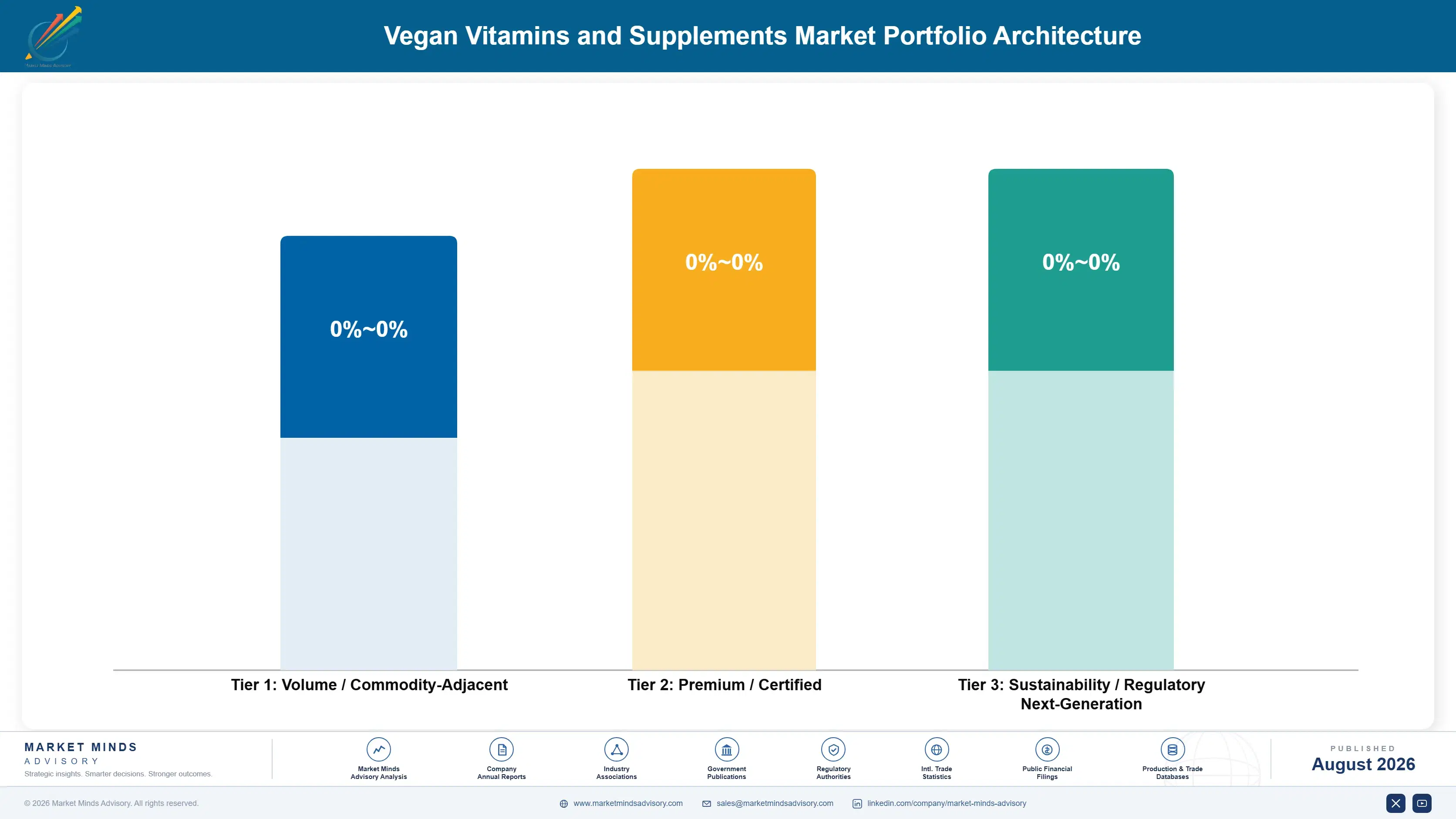
Portfolio economics here divide on certification status and manufacturing route rather than on nutrient. Uncertified products making a plant-based claim without verification compete on price against everything else on the shelf, and buyers who scrutinise excipient lists ignore them entirely because the claim carries no weight without somebody checking it. Retailers increasingly require certification before they will list anything at all.
The middle tier is certified product manufactured on shared lines with validated cleaning. Certification supports a premium near 38% over conventional supplements and consumers recognise the marks. Margins reach the low thirties, though certification bodies keep tightening cross-contamination requirements and some of this volume will need dedicated capacity before long. Standards revisions keep moving that line, and shared line volume has to go somewhere.

Above both sits certified product on dedicated lines with secured algal supply. Dedicated capacity removes the cross-contamination question entirely, secured algal supply protects the highest-value products when fermentation capacity tightens, and margins reach the high forties. The position requires contracted manufacturing access and multi-year ingredient agreements that smaller brands cannot negotiate at all. Smaller brands cannot negotiate either arrangement on any terms.

Volume / Commodity-Adjacent

Uncertified products making plant-based claims without verification. The range reflects ingredient cost and promotional depth rather than commercial skill, and scrutinising buyers disregard the claim entirely. Retail listing is increasingly refused without it.
Gross Margin: 18 to 26%

Premium / Certified

Certified product manufactured on shared lines with validated cleaning between runs. The range reflects certification body recognition in the market and how much of the excipient chain is documented properly.
Gross Margin: 29 to 37%

Sustainability / Regulatory / Next-Generation

Certified product on dedicated lines with secured algal omega-3 supply. The wide range reflects whether ingredient agreements are multi-year and whether the manufacturing capacity is contracted or merely available. Very few brands hold both.
Gross Margin: 42 to 52%
vegan-vitamins-supplements-market-portfolio-architecture-1787375383077

High-value Sub-segments and Strategic Watch-out

Dedicated Line Certified Products

High value and high growth together as certification bodies tighten what shared lines may claim. The wide range reflects whether manufacturing capacity is contracted or simply available, and whether algal supply is secured on multi-year terms. Standards revisions keep expanding this tier. Contracted capacity is the requirement.
Gross Margin: 42 to 52%

Algal Omega-3 Product Ranges

High value on the fastest growth in the category, selling a substitution that genuinely improves on fish oil. The range reflects ingredient cost against retail pricing, which supply concentration moves more than demand ever does. Supply concentration moves pricing more than demand. Fish oil comparison keeps narrowing steadily.
Gross Margin: 38 to 47%

Certified Multivitamin Formulations

The volume core of this market and where excipient discipline matters most, since a multivitamin touches more processing aids than any other format. The range reflects documentation depth and manufacturing route across the formulation. Multivitamins touch the most processing aids. Documentation depth decides the outcome here.
Gross Margin: 29 to 37%

Uncertified Plant-Based Claims

The strategic watch-out. Volumes look real but scrutinising buyers disregard unverified claims, retailers increasingly require certification for listing, and the position offers no defence at all. The range reflects promotional depth rather than merit. Retailers increasingly refuse to list them. No defence exists at this position.
Gross Margin: 18 to 26%

How Vegan Supplement Demand Repeats

Repeat behaviour here is unusually strong for a supplement category and the reason is that dietary commitment does not lapse the way a wellness intention does. A consumer avoiding animal products is not going to switch back to a gelatin capsule next month, so once a brand is trusted the relationship holds. That trust is built on certification and excipient transparency rather than on any efficacy claim.
Stickiness varies sharply by buyer motivation. Committed dietary buyers hold best by a wide margin, since the alternative is not another product but no product. Religious dietary buyers hold equally well for the same reason. Environmental and sustainability buyers hold reasonably, though they will switch to a competitor with a better argument. Trial buyers curious about plant-based positioning hold worst and rarely return after a first purchase.

The buyer profile has broadened considerably. Early demand came from committed vegans buying a narrow range of specialist products from small brands. Today's growth buyer is frequently avoiding animal ingredients for environmental, digestive or religious reasons without describing themselves as vegan at all, and reaches these products through a sustainability argument rather than through any dietary identity.
vegan-vitamins-supplements-market-end-use-penetration-index-1787375383564

Where To Compete And Why

These are among the four positions where our research anticipates prominent divergence between winners and laggards over the coming forecast period. Each is grounded in the demand model, the regulatory perimeter, and the announced capacity pipeline.
01 / EXCIPIENT AUDIT DISCIPLINE

Products fail on flow agents

Roughly 31% of formulations fail certification on gelatin shells, lanolin vitamin D, stearates of uncertain origin or shellac coatings rather than on any active ingredient anybody was thinking about. Discovering that at submission means reformulating, retesting and resubmitting, frequently missing a launch window entirely. Pre-submission excipient audits cut failure rates by 60% to 75% and cost almost nothing against a failed submission, yet a great many brands still learn this the expensive way instead of the cheap one that was always available to them.
02 / DEDICATED CAPACITY CONTRACTING

Shared lines are running out

Cross-contamination from gelatin handling on shared equipment ends a certification faster than any formulation error, and certification bodies keep tightening what they will accept on shared manufacturing lines. Roughly 46% of volume already runs on dedicated capacity and that share climbs with every standards revision. Brands contracting capacity now avoid the scramble later, while manufacturers who committed the capital early hold pricing power of 20% to 28% over shared-line alternatives that will eventually stop qualifying under the revised standard altogether.
03 / ALGAL SUPPLY SECURITY

Very few producers, no alternatives

Algal EPA and DHA production sits with a handful of fermentation producers holding the strain libraries and capacity to do it at scale, which leaves formulators with almost no genuine alternatives when demand surges unexpectedly. Multi-year agreements secure allocation and predictable cost on the most expensive input in most vegan portfolios. Brands without them discover during a tight period that the material is unavailable rather than merely expensive, which is a different and considerably worse problem than paying more would ever be.
04 / SUSTAINABILITY ARGUMENT FRAMING

Reach buyers who reject the label

Marine sustainability pressure has driven considerably more algal omega-3 adoption than vegan positioning ever achieved, because it reaches buyers who would never pick up a product labelled vegan and were not looking for one. Brands leading on that argument address a population 3 to 4 times larger than committed vegan consumers alone. The formulation does not change at all, only the argument does, which makes it the cheapest repositioning available anywhere in this whole category, and remarkably few brands have made it.

Engagement Snapshot From the Field

A live engagement with an industry participant carrying material or product regulatory and market exposure ahead of a defining policy shift, showing how our research translates into a defensible multi-year portfolio strategy.
MARKET MINDS ADVISORY · CLIENT ENGAGEMENT SUMMARY
Vegan Vitamins and Supplements Producer Strategic Portfolio Review and Transition Roadmap 2026·Investment Scenario on Vegan Vitamins and Supplements Exposure Evaluation 2025-26
CLIENT PROFILE
A European specialist vegan supplement brand with annual revenue near $54 million (client-reported, unverified by MMA), selling certified multivitamins, omega-3 and single-nutrient products across six countries. The business held strong consumer credibility and good certification standing, but manufactured entirely on shared contract lines and bought algal omega-3 on annual terms with no forward commitment of any kind.
STRATEGIC CHALLENGE
A certification body had tightened cross-contamination requirements and two of the client's products had been flagged for review, while algal omega-3 had been allocated during a tight period leaving the highest-margin range short of stock. Management needed to decide between contracting dedicated capacity, securing multi-year algal supply, or reformulating away from the exposure.
MMA APPROACH
MMA modelled contribution by product and manufacturing route across four years of the client's own data, benchmarked certification standing and supply arrangements against competitors, and assessed dedicated line and multi-year ingredient options against required commitment. Twenty-three expert interviews with certification bodies, contract manufacturers and algal producers established what each route genuinely required.
KEY FINDINGS
  1. The certification body was moving toward dedicated capacity requirements across the whole standard rather than for individual products, which meant the flagged reviews were an early signal rather than an isolated problem.
  2. Competitors holding dedicated line contracts were realising roughly 23% higher pricing on comparable formulations, with the difference resting entirely on certification standing rather than on product.
  3. Algal omega-3 allocation during the tight period had gone to brands holding multi-year agreements, and the client had been told directly that spot buyers would be served last in any future shortage.
  4. Excipient documentation across the client's range covered ingredients thoroughly but processing aids inconsistently, which was exactly where the certification body had begun looking more closely.
CLIENT PROFILE
A European specialist vegan supplement brand with annual revenue near $54 million (client-reported, unverified by MMA), selling certified multivitamins, omega-3 and single-nutrient products across six countries. The business held strong consumer credibility and good certification standing, but manufactured entirely on shared contract lines and bought algal omega-3 on annual terms with no forward commitment of any kind.
STRATEGIC CHALLENGE
A certification body had tightened cross-contamination requirements and two of the client's products had been flagged for review, while algal omega-3 had been allocated during a tight period leaving the highest-margin range short of stock. Management needed to decide between contracting dedicated capacity, securing multi-year algal supply, or reformulating away from the exposure.
MMA APPROACH
MMA modelled contribution by product and manufacturing route across four years of the client's own data, benchmarked certification standing and supply arrangements against competitors, and assessed dedicated line and multi-year ingredient options against required commitment. Twenty-three expert interviews with certification bodies, contract manufacturers and algal producers established what each route genuinely required.
KEY FINDINGS
  1. The certification body was moving toward dedicated capacity requirements across the whole standard rather than for individual products, which meant the flagged reviews were an early signal rather than an isolated problem.
  2. Competitors holding dedicated line contracts were realising roughly 23% higher pricing on comparable formulations, with the difference resting entirely on certification standing rather than on product.
  3. Algal omega-3 allocation during the tight period had gone to brands holding multi-year agreements, and the client had been told directly that spot buyers would be served last in any future shortage.
  4. Excipient documentation across the client's range covered ingredients thoroughly but processing aids inconsistently, which was exactly where the certification body had begun looking more closely.
RECOMMENDED STRATEGY
Phase 1: Phase one: complete excipient and processing aid documentation across the whole range, since the certification body is examining exactly that and the work requires records rather than reformulation. Phase 2: Phase two: contract dedicated manufacturing capacity ahead of the standards revision, accepting the cost premium as the price of certification standing. Phase 3: Phase three: negotiate multi-year algal omega-3 supply to secure allocation, since spot buying has already cost the highest-margin range a selling season.
OUTCOME
The client cleared both flagged products and contracted dedicated capacity within eleven months (client-reported, unverified by MMA). A three-year algal supply agreement was signed, the omega-3 range returned to full availability, and blended gross margin improved by roughly eight points despite the dedicated line premium.

Frequently Asked Questions

Foundational context covering the market sizes, CAGR, scope, country, region and competition that inform every finding below. This section is provided to cover basics and most often pre-purchase conversations, answered from the MMA Primary Research Dataset.

What is the current size of the Vegan Vitamins and Supplements Market?

The global vegan vitamins and supplements market was valued at $6.20 billion in 2025, reaching an estimated $6.86 billion in 2026. That covers supplements formulated entirely without animal-derived ingredients or processing aids.

How large will the Vegan Vitamins and Supplements Market be by 2036?

MMA forecasts the market reaching $18.79 billion by 2036, an increase of $11.93 billion over the 2026 base. That represents an expansion multiple of 2.74 times across the forecast period.

What is the CAGR for the Vegan Vitamins and Supplements Market 2026 to 2036?

The base case compound annual growth rate is 10.6%, with a bull case of 11.8% and a bear case of 9.4%. Historical growth between 2020 and 2025 ran at 9.5% annually.

Which segment is growing fastest?

Algal omega-3 supplements grow at 15.9%, a full 1.50 times the market rate, on a substitution that genuinely improves on fish oil. Vegan vitamin D3 follows at 11.0% annually.

Who are the major companies in the Vegan Vitamins and Supplements Market?

Nestlé Health Science, Bayer, Nature's Bounty, Garden of Life and Deva Nutrition lead on vegan supplement revenue. Together they account for roughly 24%, genuinely low for consumer health.

Which country is growing fastest?

India grows fastest at 14.6% annually, combining the largest vegetarian population anywhere with supplement penetration still rising from a low base. China follows on urban demand growth.

Report Segmentation Architecture

The full report scope spans multiple orthogonal segmentation dimensions, with cross-tabulated demand data provided for each dimension pair. Coverage extends further to regional breakdowns, trend trajectories, and the competitive detail needed to support segment-level decision-making.

By Product Category

  • Algal Omega-3 Supplements
  • Vegan Vitamin D3
  • Plant-Based Protein and Amino Acids
  • Vegan Multivitamin and Mineral Formulations
  • Fermentation-Derived Vitamin B12

By End-Use Industry

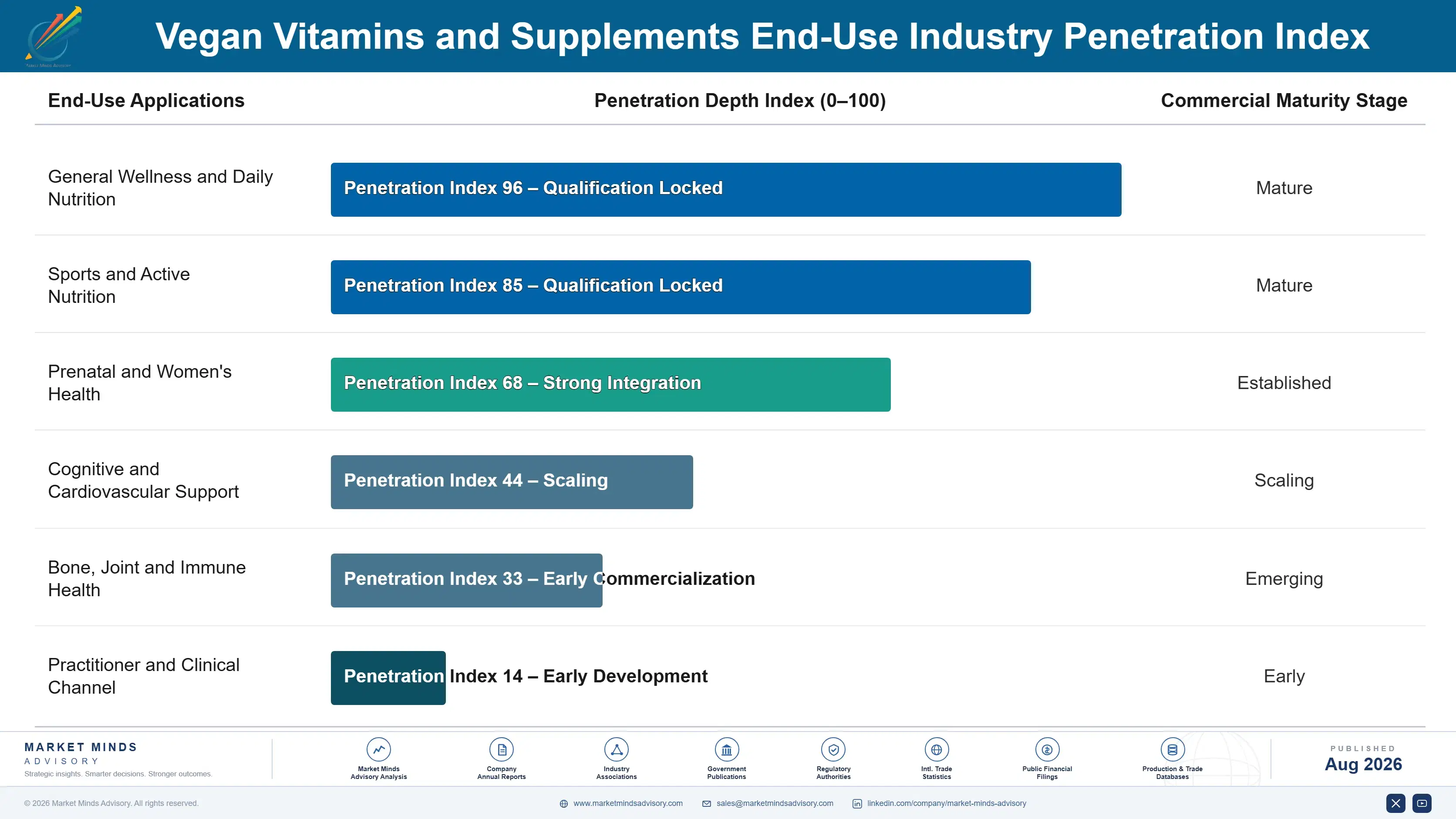
  • General Wellness and Daily Nutrition
  • Sports and Active Nutrition
  • Prenatal and Women's Health
  • Cognitive and Cardiovascular Support
  • Bone, Joint and Immune Health
  • Practitioner and Clinical Channel

By Commercial Dimension

  • Certified Brand Retail Distribution
  • Direct-to-Consumer Online and Subscription
  • Retailer Private Label Supply
  • Health Food and Specialty Retail
  • Practitioner and Professional Channel

By Region

  • North America
  • Western Europe
  • East Asia
  • South Asia and Pacific
  • Latin America
  • Middle East and Africa
  • Eastern Europe

Scope, Methodology, and Coverage

Every figure in this report is reproducible from documented input assumptions. The scope below maps the historical period, the forecast horizon, the segmentation dimensions, and the countries covered, alongside the underlying primary and qualitative methodology.
Historical Period
2020 to 2025
Forecast Period
2026 to 2036
Base Year
2025 (USD billions; MMA Primary Research Dataset, August 2026)
Market Definition
This report covers dietary supplements formulated entirely without animal-derived ingredients or processing aids and carrying recognised vegan certification, spanning algal omega-3 supplements, vegan vitamin D3, plant-based protein and amino acid supplements, vegan multivitamin and mineral formulations, and fermentation-derived vitamin B12 products, across certified brand retail, direct, private label, specialty and practitioner channels. Vegetarian products permitting dairy or egg derivatives, uncertified supplements that happen to lack animal ingredients, vegan foods not sold as supplements, and cosmetic products are excluded from the sizing.
Quantitative Units
USD billions at brand realised value; volume in million units; realised pricing in USD per unit.
Segmentation Dimensions
By product category; by end-use industry; by commercial dimension; by region.
Regions Covered
North America, Western Europe, East Asia, South Asia and Pacific, Latin America, Middle East and Africa, Eastern Europe
Countries Covered
United States, Canada, Mexico, Brazil, Argentina, United Kingdom, Germany, France, Netherlands, Italy, Spain, Poland, Turkey, Saudi Arabia, China, Japan, South Korea, India, Australia, South Africa.
Key Companies Profiled
Nestlé Health Science, Bayer, Nature's Bounty, Garden of Life, Deva Nutrition, Reckitt Benckiser, Haleon, Herbalife, Solgar, NOW Foods, Nature's Way, Ritual, Terranova, Himalaya Wellness and others.
Quantitative Methodology
Primary survey, n=3,800 respondents, Q4 2025, six countries; demand-side model with trade association cross-validation
Qualitative Methodology
47 expert interviews, Q4 2025; applied to validate demand model assumptions, identify emerging dynamics, and assess competitive positioning
Report Format
PDF and XLSX data workbook (Word format preview document)
Publisher
Market Minds Advisory
Report Code
MMA-2026-HLT-173
Published
August 2026
Contact
sales@marketmindsadvisory.com | www.marketmindsadvisory.com

Purchase the full Vegan Vitamins and Supplements Market Report (2026 to 2036).

The full report sizes the vegan vitamins and supplements market across five product categories, six end-use areas and seven regions, with unit volume and realised pricing detail behind every value estimate. It profiles twenty companies on certification standing, manufacturing route and algal supply security. Regional chapters cover certification frameworks, dietary practice and retail structure by market. Cost analysis quantifies algal omega-3, certified excipient and dedicated line exposure by brand scale. Certification analysis maps standards, cross-contamination requirements and the specific excipients that most commonly cause certification failures.
Unit volume and realised pricing by product category
Certification standards and cross-contamination requirements compared directly
Excipient failure analysis across submitted formulations reviewed
Algal omega-3 supply concentration and allocation risk assessed
Competitive position assessments across twenty companies
Dedicated manufacturing capacity availability mapped by region

Built For The People Who Decide

From boardroom strategy to bench-side execution, this report is read cover-to-cover by leaders shaping the next decade of their industry, turning demand scenarios, market dynamics and valuation benchmarks into decisions.
CXOs/ Presidents/ VPs/ Managers
M&A and Corporate Development
Strategy Teams and R&D Heads
Procurement and Product Directors
Regulatory and Compliance Leaders
Investor Relations and Equity Analysts