Market Minds Advisory
Vegan Confectionery Market

Vegan Confectionery Market: Milk Chocolate Texture, Gelatin Substitution and Cocoa Costs That Punish Reformulation

Dark chocolate was never the problem and milk chocolate always was, while gelatin substitution in gummies runs slower on the line and cocoa pricing has punished everybody attempting either one.

Lead Analyst

Lisa Gevelber

Published

September 2026

Make Smarter Decisions with Customized Research Insights

Request a free sample report and evaluate market opportunities, growth trends, and competitive dynamics relevant to your business needs.

2025 MARKET VALUE$2.4BMarket Size 2025
2036 FORECAST VALUE$6.7BBase Case , 2026 to 2036
CAGR 2026 TO 20369.8 %Bull 11.0% / Bear 8.6%
INCREMENTAL OPPORTUNITY$4.1BNet 10- year value creation
EXPANSION MULTIPLE2.55x2036 value over 2026 base
Strategic Levers
M&A Pipeline
Regional Outlook
Country Rankings
Competitive Intelligence
Segmental Deep-dive
Call-Us : 91 93563 13602

Executive Snapshot and Market Trajectory

Dark chocolate was never the difficulty in vegan confectionery. Most of it is already dairy-free and always was. The commercial problem is milk chocolate, which is what people actually mean when they say chocolate, and it took a decade of formulation work to get right. It was worth the wait.
Plant-based milk chocolate carries the growth now that oat-based systems have reached the point where blind comparisons stop being awkward. Gelatin-free gummies grow nearly as fast against a conventional volume still 68% gelatin-based. Western Europe holds the largest share because the category was created in British and German retail, where vegan population shares are the highest anywhere and certified confectionery has genuine shelf presence.
Concentration reads at 27% for the top five, low because specialist brands built the category while the large confectionery groups treated it as a niche label. Cocoa pricing has been brutal, which matters disproportionately here because plant-based milk chocolate raises cocoa butter content to compensate for absent milk solids. Reformulation timing turned out to matter more than anybody expected. Brands buying cocoa forward held their premiums; spot buyers widened them uncomfortably.
Market Definition
This market covers confectionery formulated entirely without animal-derived ingredients, spanning plant-based milk chocolate, gelatin-free gummies and jellies, dairy-free dark chocolate confectionery, vegan caramels and fudge, and coated and panned products using non-animal glazes. Conventional dark chocolate not marketed or certified as vegan, vegetarian products permitting dairy, sugar-free confectionery that is not also vegan, and vegan bakery are excluded.
Base Year Value
$2.4B in 2025 (MMA Primary Research Dataset, August 2026)
Forecast Period
2026 to 2036, eleven discrete annual values
CAGR
9.8% base case. Bull 11.0%. Bear 8.6%.
Fastest Growth Segment
Plant-Based Milk Chocolate: 14.7% CAGR
Fastest Growth Country
India: 13.9% CAGR
Fastest Growth Region
South Asia and Pacific: 12.1% CAGR
Largest Region
Western Europe: 28% of 2025 global value
Market Leaders
Mondelez International, Nestlé, Mars, Hershey Company and Kinnerton Confectionery lead on vegan confectionery revenue. Source: MMA Primary Research Dataset, July 2026.
Primary Survey
n=3,800 procurement and R&D decision-makers, Q4 2025, six countries
Methodology
Demand-side build-up, cross-validated against public data, 47 expert interviews

Vegan Confectionery Market Forecast Scenarios

vegan-confectionery-market-trends-size-forecast-scenario-1787458109498
Growth ran at 8.5% annually between 2020 and 2025, and the shape of it changed considerably partway through. The early period was specialist brands selling to committed vegans through health food retail. What followed was mainstream, as large confectionery groups launched plant-based variants of established brands and put them on ordinary shelves beside the originals rather than in a separate aisle.
The base case at 9.8% rests on three mechanisms. Plant-based milk chocolate formulation keeps improving, and oat-based systems have reached quality that converts buyers who were never looking for a vegan product. Gelatin substitution continues against a conventional gummy volume still overwhelmingly animal-based. And Indian demand grows quickly on a population where vegetarian dietary practice is long established and gelatin avoidance is entirely ordinary. None of the three requires a new technology arriving.
The bull case at 11.0% turns on cocoa pricing normalising, which would relieve pressure on formulations carrying elevated cocoa butter content to compensate for absent milk solids. The bear case at 8.6% reflects cocoa staying elevated and premiums widening to the point where mainstream buyers stop trading across, since a 42% premium is defensible and a considerably larger one is not.

Milk Chocolate Was Always The Real Problem

A great deal of dark chocolate has always been vegan without anybody labelling it, which is why the category took so long to become commercially interesting. The difficulty was milk chocolate. Milk solids contribute creaminess, melt behaviour and a mouthfeel that early oat and rice formulations did not reproduce, and consumers noticed immediately. Dark chocolate never needed solving and the label added nothing to it.
TOP FIVE CONCENTRATION27%Low, with specialist brands holding positions large companies missed
PRICE PREMIUM42%Vegan advantage over comparable conventional confectionery products typically
GELATIN GUMMY SHARE68%Portion of conventional gummy volume still using animal gelatin
COCOA COST SHARE39% of COGSCocoa contribution to finished chocolate confectionery manufactured cost
DEDICATED LINE SHARE34%Portion produced on lines handling no dairy at all
REFORMULATION CYCLE11 monthsTypical time to reformulate and launch a plant-based variant
Oat-based systems changed that. They came closest to the target and are now good enough that blind comparison stops being embarrassing for the manufacturer, which is a low bar that took a decade to clear. Cocoa butter content rises to compensate for absent milk solids, and that has run directly into a cocoa market that punished anybody carrying elevated butter inclusion through 2024 and beyond.
Gummies are a separate problem with the same character. Gelatin delivers a chew, a clean melt and a bloom strength that pectin and starch systems reach only through careful work, and texture is the whole proposition in a gummy. Roughly 68% of conventional gummy volume still uses animal gelatin, so the substitution opportunity is genuinely large. Pectin lines also run slower, which raises unit cost measurably.
"Everybody congratulated themselves for years about dairy-free dark chocolate, which mostly already was. The companies that actually built something here spent that time working out how to make oat chocolate that nobody could tell apart."
Director, Confectionery and Plant-Based Foods Practice · MMA Confectionery Practice · August 2026

Market Trends

Plant-Based Milk Chocolate Finally Reaches Acceptable Sensory Parity

Milk solids contribute creaminess, melt behaviour and mouthfeel that early rice and coconut formulations did not reproduce, and consumers noticed immediately in a category bought entirely on eating experience. Oat-based systems came closest and have now reached quality where blind comparison stops embarrassing the manufacturer. That converts buyers who were never looking for a vegan product and simply picked up a bar. Cocoa butter content rises to compensate for the absent milk solids, which raises cost considerably against current cocoa pricing. A decade of formulation work finally produced something buyers pick up twice.
Market Impact: Addresses 68% of gummy volume

Large Groups Place Plant Variants Beside Original Brands

Specialist brands built this category through health food retail while large confectionery groups watched, and the groups then entered by launching plant-based versions of established brands positioned on ordinary shelves beside the originals rather than in a separate aisle. That placement decision did more for mainstream adoption than any product improvement, because it removes the trip to a different part of the shop. Premiums near 42% hold at that placement. Specialist brands now compete against familiar names carrying real distribution. A trip to a different aisle was the barrier nobody had priced properly.
Market Impact: India grows at 13.9% annually

Market Opportunities and Growth Drivers

Gelatin Substitution Addresses A Conventional Volume Still Overwhelmingly Animal-Based

Roughly 68% of conventional gummy volume still uses animal gelatin, which makes the addressable substitution genuinely large rather than marginal. Pectin, starch and agar systems reach acceptable chew and melt through careful formulation rather than by simple replacement, and texture is the entire proposition in a gummy so there is nowhere to hide a compromise. Katjes built a substantial business on getting there first in Germany. Others have followed considerably more slowly than the opportunity size suggests they should. The throughput penalty is what has kept the opportunity open this long.
Market Impact: Cocoa is 39% of manufactured cost

Indian Vegetarian Practice Makes Gelatin Avoidance Entirely Ordinary

India has the largest vegetarian population anywhere and gelatin avoidance is a long-standing dietary norm rather than a recent choice, which means confectionery formulated without it is simply expected rather than positioned as an alternative. Indian demand grows near 13.9% annually as packaged confectionery consumption rises from a low base. Domestic manufacturers formulate without animal derivatives as a matter of course, so the growth requires distribution and marketing rather than any reformulation work at all. Certification is barely a consideration in the domestic market at all. Distribution rather than reformulation is the requirement.
Market Impact: Cuts line output by 22%

Market Restraints and Challenges

Cocoa Pricing Punishes Formulations Carrying Elevated Butter Content

Plant-based milk chocolate raises cocoa butter inclusion to compensate for absent milk solids, which was manageable when cocoa was cheap and became painful when it was not. The root cause is West African crop failure and disease pressure that no manufacturer influences. Commercially this widens the premium against conventional milk chocolate at exactly the moment mainstream buyers were starting to trade across. Participants are responding with recipe optimisation, alternative fat systems, forward cocoa purchasing and pack size adjustment rather than headline price increases. Premiums have widened at exactly the wrong commercial moment.
Market Impact: Segment grows at 14.7% annually

Pectin Gummy Lines Run Slower And Raise Unit Cost

Pectin and starch depositing runs at lower line speeds than gelatin systems and requires longer setting times, which reduces output per shift in a category where line speed determines unit economics. The root cause is that pectin gels through a different mechanism requiring controlled acidification and cooling. Commercially this raises cost per unit on products already carrying a premium. Participants are responding with modified pectin systems, depositing equipment upgrades, and dedicated lines where throughput can be optimised for the formulation. Setting times cannot simply be shortened by running the line faster.
Market Impact: Premiums hold near 42% at shelf
3 additional market trends, 4 additional growth drivers, and 2 additional restraints and challenges are covered in the full report. Contact sales@marketmindsadvisory.com to access the complete intelligence.

Segment CAGR and Growth Architecture

Five product categories divide this market on the formulation problem each one solves rather than on flavour or occasion. That reflects where the commercial difficulty genuinely sits, since replacing milk solids in chocolate and replacing gelatin in a gummy are entirely different technical exercises requiring different capability, equipment and cost structures. Capability rather than positioning decides this.
vegan-confectionery-market-trends-market-share-analysis-1787458110035

Plant-Based Milk Chocolate

Growing at 14.7% and comfortably the fastest part of this market. Plant-based milk chocolate is the hardest technical problem in vegan confectionery and the most valuable one to solve, because milk chocolate is what most people mean when they say chocolate and dark chocolate was never the difficulty. Milk solids contribute creaminess, melt behaviour and a specific mouthfeel that early oat and rice formulations simply did not reproduce. Oat-based systems have come closest and are now good enough that blind comparisons stop being embarrassing. Cocoa butter content rises to compensate, which raises cost against a cocoa market that has been anything but kind recently. Sensory parity is the whole commercial argument here now.
CAGR 14.7%

Gelatin-Free Gummies and Jellies

Growing at 12.4% on gummies and jellies formulated with pectin, starch or agar instead of gelatin, which sounds like a simple substitution and is not. Gelatin delivers a specific chew, a clean melt and a bloom strength that pectin systems reach only through careful formulation, and texture is the entire proposition in a gummy. Roughly 68% of conventional gummy volume still uses animal gelatin, so the addressable substitution is large. Katjes built a whole business on getting there first in Germany. Production also runs slower on pectin systems, which raises unit cost in a category where line speed matters considerably. Texture is where these products succeed or fail entirely. Nowhere to hide a compromise.
CAGR 12.4%
Full segment breakdown across 5 segments available in the complete report.

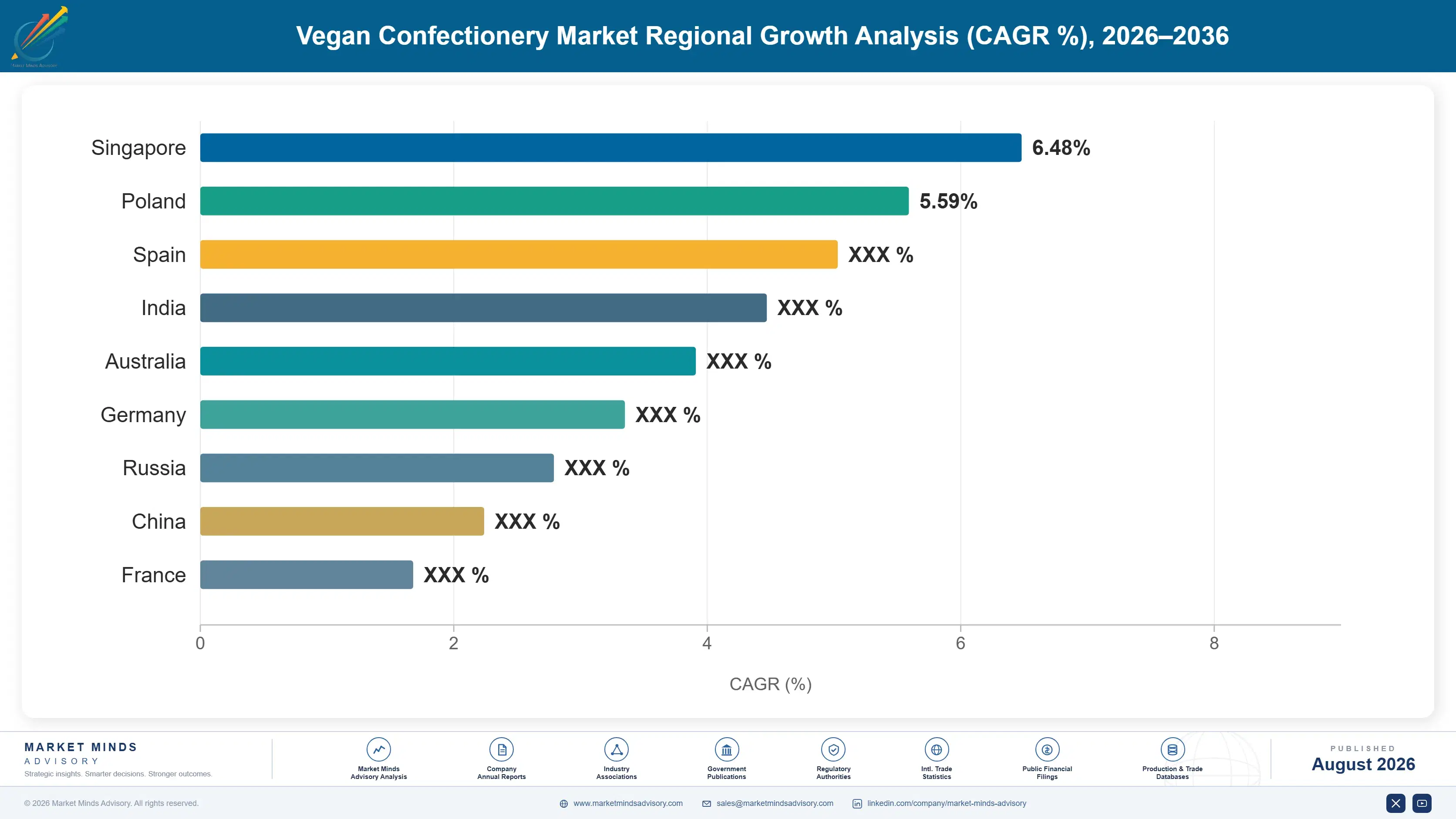
Regional Architecture and Country Demand Map

Western Europe holds 28% of global value because the category was created in British and German retail, where vegan population shares are the highest anywhere. North America follows at 24%, while South Asia and Pacific grows fastest on Indian vegetarian practice and rising confectionery consumption.

Western Europe

Note: Western Europe sits above the standard share band because this category was created in British and German retail and those two markets still hold the highest vegan population shares anywhere, which no realistic allocation avoids. British retailers put plant-based confectionery on ordinary shelves earlier than anybody, which did more for adoption than any formulation improvement did. Germany is the largest single market and Katjes built a substantial gelatin-free gummy business there years ahead of competitors. Certification recognition is strong and consumers check labels. Cocoa pricing has hit European manufacturers hard given elevated butter inclusion in plant-based milk chocolate, and premiums have widened uncomfortably as a result. Consumers here genuinely check labels before buying.
Share: 28% | CAGR: 8.3% (2026 to 2036)

North America

Mainstream retail placement drove adoption here and the large confectionery groups moved faster than in most markets, putting plant-based variants of familiar brands beside the originals rather than in a separate section. That single decision reached buyers who would never have visited a health food aisle. Specialist brands built genuine positions first and now compete against familiar names carrying real distribution. Gelatin-free gummy adoption trails European practice, with conventional gummy volume still heavily animal-based. Canadian demand follows American patterns closely. Cocoa cost pressure has been absorbed through pack size adjustment more often than through headline price increases here. Mainstream placement reached buyers who would never visit a health food aisle.
Share: 24% | CAGR: 10.3% (2026 to 2036)
Regional intelligence for 5 additional markets available in the complete report: East Asia, South Asia and Pacific, Latin America, Middle East and Africa, Eastern Europe. Contact sales@marketmindsadvisory.com.
vegan-confectionery-market-trends-country-cagr-analysis-1787458110550

Where Vegan Confectionery Margin Is Won

Four positions separate brands building durable businesses from those selling a label to a shrinking group of committed buyers: solving milk chocolate texture properly, taking gelatin-free gummy share while incumbents hesitate, winning mainstream shelf placement beside conventional products, and buying cocoa forward against a market that has punished everybody. Only the first is genuinely hard to copy.

Solve Milk Chocolate Texture Rather Than Selling Dark

Most dark chocolate was already dairy-free and labelling it changed nothing commercially, which is why the category stalled for years. Plant-based milk chocolate is the hard problem and the valuable one, since milk chocolate is what most people mean by chocolate. Oat-based systems reaching sensory parity convert buyers who never wanted a vegan product, and brands holding that formulation realise 35% to 44% higher volume per listing than dark-led ranges. The work is genuine and it is done once. Relabelling dark chocolate was never going to build a business. Everybody knew that eventually.
Market Impact: Lifts volume per listing by up to 44%

Take Gelatin-Free Gummy Share While Incumbents Hesitate

Roughly 68% of conventional gummy volume still uses animal gelatin and most large manufacturers have moved slowly, partly because pectin depositing runs slower and cuts line output by around 22%. That cost is real and it is also the barrier keeping the opportunity open. Brands accepting the throughput penalty now take share that will be considerably harder to win once incumbents commit dedicated lines to it, which several are finally beginning to do. Incumbents are finally committing dedicated depositing lines to it. Pectin systems reach chew and melt through work, not substitution.
Market Impact: Addresses the 68% of gummy volume still remaining

Win Mainstream Shelf Placement Beside Conventional Products

Placement beside the original product rather than in a separate plant-based section did more for adoption than any formulation improvement, because it removes a trip to a different part of the shop for a buyer who was not looking. Brands achieving mainstream placement hold premiums near 42% while reaching 3 to 4 times the shopper base a health food aisle delivers. Winning it requires retailer confidence in rate of sale rather than any product argument. Rate of sale evidence is what buyers actually want to see. Placement is negotiated, not designed.
Market Impact: Reaches up to 4 times the shopper base

Buy Cocoa Forward Against A Punishing Market

Plant-based milk chocolate raises cocoa butter inclusion to compensate for absent milk solids, so cocoa runs near 39% of manufactured cost and hits this category harder than conventional confectionery. Forward purchasing and multi-year sourcing arrangements smoothed roughly 30% of the recent swing for buyers who committed early. Those buying spot through the peak have widened premiums to the point where mainstream trade-across stalls, which is the commercial damage nobody wanted. Conventional milk chocolate simply does not carry this exposure at all. Milk solids are cheaper than the butter replacing them.
Market Impact: Smooths roughly 30% of the raw cocoa swing

Who Controls the Margin Pool

Concentration reads at 27% for the top five measured on vegan confectionery revenue, the basis used throughout this section, and it is low because specialist brands built the category while large groups treated it as a label. Mondelez, Nestlé, Mars and Hershey have all launched plant variants of established brands. Kinnerton holds a specialist position built on dedicated dairy-free manufacturing.
Competition runs on three fronts. Milk chocolate formulation capability is the first and the one that separates serious participants from brands selling relabelled dark chocolate. Gelatin-free gummy capability is the second, and it remains genuinely open. Mainstream shelf placement is the third, and it depends on retailer confidence rather than on any product argument a brand can make. None of the three is a positioning argument.

Pressure arrives from two directions. Large groups placing plant variants beside original brands reach shoppers that specialist brands never could, using distribution built over decades. Separately, cocoa pricing squeezes everybody carrying elevated butter inclusion. Rankings will shift toward participants holding both milk chocolate formulation and mainstream placement rather than either capability on its own. Holding either capability alone is no longer sufficient here.
vegan-confectionery-market-trends-company-positioning-matrix-1787458111068

Competitive Moat and Risk Dimensions

MONDELEZ INTERNATIONAL

Moat: Brand recognition and distribution

Placing plant-based variants of established brands beside the originals on ordinary shelves reaches shoppers who would never visit a health food aisle, which is a distribution position specialist brands cannot construct at any spend. Manufacturing scale also absorbs the reformulation and cocoa butter cost that plant-based milk chocolate carries above conventional lines.
MONDELEZ INTERNATIONAL

Risk: Cannibalisation of conventional volume

Plant-based variants displace conventional products the group also sells at higher volume and frequently better margin, which limits how hard the category can be pushed internally. Specialist brands with genuine credibility among buyers who scrutinise ingredients also hold positioning that a mainstream confectionery name finds difficult to claim convincingly.
KINNERTON CONFECTIONERY

Moat: Dedicated dairy-free manufacturing capability

Manufacturing capacity built to handle no dairy at all removes the cross-contamination question that shared confectionery lines cannot fully answer, which matters to buyers with allergies as well as to certification bodies. That capability also serves private label and contract customers, spreading capacity cost across considerably more volume than an own-brand business alone generates.
KINNERTON CONFECTIONERY

Risk: Scale against mainstream entrants

Large confectionery groups bring distribution, brand recognition and cocoa purchasing power that a specialist manufacturer cannot match as the category moves onto mainstream shelves. Dedicated capacity is also a fixed commitment that becomes expensive if plant-based volume growth slows against the capital already committed to serving it.

Players Tracked

Prominent Players

Mondelez International
Nestlé
Mars
Hershey Company
Kinnerton Confectionery

Other Key Players

Ferrero
Lindt and SprĂĽngli
Barry Callebaut
Valrhona
Katjes
Haribo
Trolli
Vego Chocolate
Ombar
Doisy and Dam
Hu Master Holdings
Endangered Species Chocolate
Alter Eco
Booja-Booja
Candy Kittens

Recent Developments

FEBRUARY 2025

Oat-based milk chocolate reformulation reaches mainstream shelf placement

A confectionery manufacturer moved an oat-based milk chocolate range from speciality distribution onto mainstream grocery shelves beside its conventional equivalents, reaching a shopper base that plant-based sections had never delivered despite several years of listing there. Rate of sale in the first quarter exceeded the speciality listing entirely.
Signal: Shelf placement decisions reach considerably more new buyers than any formulation improvement has yet managed to
JUNE 2025

Dedicated pectin depositing line commissioned for gelatin-free gummies

A confectionery producer commissioned a dedicated pectin depositing line optimised for the slower setting times these systems require, accepting reduced throughput against gelatin equipment in exchange for a formulation position competitors have been slow to build. Throughput runs materially below comparable gelatin equipment. Setting times cannot be shortened.
Signal: Dedicated equipment is how the throughput penalty on pectin systems finally gets managed properly at scale
OCTOBER 2025

Multi-year cocoa sourcing agreements signed after price disruption

Several confectionery manufacturers signed multi-year cocoa sourcing arrangements following price disruption that hit plant-based ranges hardest, since elevated cocoa butter inclusion compensating for absent milk solids raises exposure well above conventional formulations. Terms run across several harvest years. Spot buyers were left carrying the full increase.
Signal: Plant milk chocolate carries cocoa exposure well above conventional lines through its own elevated butter inclusion

What Drives Vegan Confectionery Cost

Cocoa accounts for roughly 39% of chocolate confectionery manufactured cost and the share runs higher in plant-based milk chocolate, where cocoa butter inclusion rises to compensate for absent milk solids. Plant milk powders including oat and rice add around 14%. Sugar and glucose contribute about 11%, packaging roughly 15% given premium presentation, and manufacturing energy and labour close to 16% across a typical operation.
Cocoa pricing rose to unprecedented levels through 2024 on West African crop failure and disease pressure, according to International Cocoa Organization market data, and remained elevated well beyond what most manufacturers had hedged against. Plant milk powder costs moved separately on oat and rice agricultural conditions tracked in United States Department of Agriculture data. Manufacturers absorbed a great deal of both. Neither cost was fully passed through.

The disadvantage mechanism is elevated cocoa butter inclusion, and it falls specifically on plant-based milk chocolate rather than on the category generally. Conventional milk chocolate uses milk solids to deliver creaminess; plant-based formulations use more cocoa butter instead, which raises exposure to exactly the input that has been most volatile. Exposure varies by formulation, since oat-based systems require less butter compensation than early rice and coconut approaches did.
vegan-confectionery-market-trends-cost-volatility-analysis-1787458111263

Buy cocoa forward on multi-year sourcing arrangements

Cocoa is close to 40% of manufactured cost and plant-based formulations carry elevated butter inclusion, which makes spot exposure genuinely uncomfortable in a market that has moved as far as this one. Multi-year arrangements smoothed roughly 30% of the recent swing for early committers. The commitment carries volume risk if demand softens, and that is the honest price of predictability.

Optimise formulations to reduce butter compensation

Oat-based systems require less cocoa butter compensation than early rice and coconut formulations did, and further work on emulsification and particle size reduces it again. Every point of butter inclusion removed cuts exposure to the most volatile input. The work takes months of development and the benefit recurs across every unit made afterwards, which makes the arithmetic straightforward.

Manage pack size rather than headline shelf pricing

Premiums near 42% are defensible and considerably larger ones stall mainstream trade-across entirely, which makes headline price increases commercially dangerous in a category still recruiting buyers. Pack size adjustment holds the shelf price point while recovering cost. Consumers do notice eventually and the approach has limits, so it buys time for formulation and sourcing work rather than solving anything permanently.

Portfolio Architecture for Margin Defence

Portfolio economics here divide on formulation difficulty rather than on brand strength. Dairy-free dark chocolate relabelled as vegan is the weakest position in the category, because most dark chocolate always was dairy-free and the label adds nothing a consumer will pay for beyond what the product already delivered. Cocoa pricing squeezes it with no premium available to absorb the pressure.
The middle tier is gelatin-free gummies and jellies. Pectin and starch systems reach acceptable texture through real formulation work, the addressable conventional volume is still 68% gelatin-based, and margins reach the high twenties despite line output running around 22% below gelatin equipment. The throughput penalty is what keeps competitors out. Incumbents are only now beginning to commit capacity to it. Dedicated depositing changes that arithmetic.

Above both sits plant-based milk chocolate on mainstream shelf placement. Oat-based systems reaching sensory parity convert buyers who never wanted a vegan product, placement beside conventional equivalents reaches a shopper base health food aisles never delivered, and margins reach the low forties. The position requires formulation capability and retailer confidence together, which is why so few brands genuinely hold it. Retailer confidence is the harder half.

Volume / Commodity-Adjacent

Dairy-free dark chocolate relabelled as vegan without any reformulation. The range reflects cocoa cost and promotional depth rather than commercial skill, and the label adds almost nothing buyers will pay for.
Gross Margin: 16 to 24%

Premium / Certified

Gelatin-free gummies and jellies formulated with pectin, starch or agar systems. The range reflects line throughput achieved against gelatin equipment and whether dedicated depositing capacity is available. Throughput is the barrier.
Gross Margin: 25 to 33%

Sustainability / Regulatory / Next-Generation

Plant-based milk chocolate holding mainstream shelf placement beside conventional products. The wide range reflects cocoa butter inclusion against current pricing and whether formulation has reached genuine sensory parity. Few brands hold both.
Gross Margin: 36 to 46%
vegan-confectionery-market-trends-portfolio-architecture-1787458111760

High-value Sub-segments and Strategic Watch-out

Mainstream Placed Plant Milk Chocolate

High value and high growth together, converting buyers who never wanted a vegan product at all. The wide range reflects cocoa butter inclusion against current pricing and whether the formulation has genuinely reached sensory parity. Retailer confidence in rate of sale decides placement. Formulation alone is insufficient.
Gross Margin: 36 to 46%

Gelatin-Free Gummies And Jellies

High value on strong growth against a conventional volume still overwhelmingly gelatin-based. The range reflects line throughput against gelatin equipment, since pectin depositing runs slower and cuts output measurably per shift. That penalty is also what keeps competitors out of it. Incumbents moved slowly here.
Gross Margin: 25 to 33%

Dedicated Dairy-Free Contract Manufacturing

A steady position serving brands and private label that need cross-contamination assurance shared lines cannot provide. The range reflects capacity utilisation, since dedicated equipment is a fixed commitment requiring volume to justify it. Allergy buyers value the assurance as much as certifiers do. Utilisation decides the return.
Gross Margin: 22 to 30%

Relabelled Dark Chocolate Ranges

The strategic watch-out. Volumes look real but the product was always dairy-free, the label adds nothing buyers pay for, and cocoa pricing squeezes it without any premium to absorb the pressure. The range reflects cocoa cost alone. Buyers know the product was always dairy-free. No premium is available.
Gross Margin: 16 to 24%

How Vegan Confectionery Demand Repeats

Confectionery repeats on habit and impulse rather than on any considered decision, which makes this category behave unlike most plant-based food. A buyer who enjoys a bar picks it up again without thinking about the formulation at all. That works entirely in favour of products reaching sensory parity and entirely against products that ask for tolerance, since nobody tolerates a disappointing chocolate bar twice.
Stickiness varies sharply by buyer motivation. Committed dietary buyers hold best, because the alternative is not another brand but no confectionery at all. Allergy-driven buyers hold equally well and value dedicated manufacturing specifically. Environmental and curiosity buyers hold only while the product genuinely satisfies, and they are where the growth now comes from. Gift and seasonal purchase holds least, following occasion rather than preference.

The buyer profile has broadened decisively. Early demand came from committed vegans buying a narrow specialist range through health food retail. Today's growth buyer picked up a bar on an ordinary shelf beside a conventional one, may not have registered the plant-based label at all, and bought it again because it tasted right. That is a considerably larger population and a far less forgiving one.
vegan-confectionery-market-trends-end-use-penetration-index-1787458112244

Where To Compete And Why

These are among the four positions where our research anticipates prominent divergence between winners and laggards over the coming forecast period. Each is grounded in the demand model, the regulatory perimeter, and the announced capacity pipeline.
01 / MILK CHOCOLATE FORMULATION

Dark chocolate was never the problem

Most dark chocolate was already dairy-free and labelling it changed nothing commercially, which is why this category stalled for years while everybody congratulated themselves. Plant-based milk chocolate is the hard problem and the valuable one, since milk chocolate is what people mean when they say chocolate. Brands holding oat-based systems at genuine sensory parity realise 35% to 44% higher volume per listing than dark-led ranges, and the formulation work is genuinely done once rather than repeated season after season indefinitely.
02 / GELATIN SUBSTITUTION TIMING

Slower lines keep the door open

Roughly 68% of conventional gummy volume still uses animal gelatin and most large manufacturers have moved slowly, partly because pectin depositing cuts line output by around 22% against gelatin equipment. That throughput penalty is a real cost and it is simultaneously the barrier keeping this opportunity open to smaller brands. Accepting it now takes share that becomes considerably harder to win once incumbents commit dedicated depositing lines, which several of them finally are beginning to do properly after several years of hesitation.
03 / SHELF PLACEMENT NEGOTIATION

Aisles decide more than recipes

Placing plant-based products beside the conventional originals rather than in a separate section did more for mainstream adoption than any formulation improvement achieved, because it removes a trip to a different part of the shop. Brands winning that placement hold premiums near 42% while reaching 3 to 4 times the shopper base a health food aisle delivers. Winning it requires retailer confidence in rate of sale rather than any product argument a brand can realistically make on its own behalf.
04 / COCOA EXPOSURE MANAGEMENT

Butter inclusion doubles the pain

Plant-based milk chocolate raises cocoa butter inclusion to compensate for absent milk solids, so cocoa runs near 39% of manufactured cost and hits this category considerably harder than conventional confectionery does. Forward purchasing smoothed roughly 30% of the recent swing for brands that committed early enough to matter. Those buying spot through the peak widened premiums to the point where mainstream trade-across stalled, which is precisely the commercial damage that nobody in this whole category ever wanted to cause itself.

Engagement Snapshot From the Field

A live engagement with an industry participant carrying material or product regulatory and market exposure ahead of a defining policy shift, showing how our research translates into a defensible multi-year portfolio strategy.
MARKET MINDS ADVISORY · CLIENT ENGAGEMENT SUMMARY
Vegan Confectionery Producer Strategic Portfolio Review and Transition Roadmap 2026·Investment Scenario on Vegan Confectionery Exposure Evaluation 2025-26
CLIENT PROFILE
A European specialist plant-based confectionery brand with annual revenue near $46 million (client-reported, unverified by MMA), selling chocolate and gummy ranges across five countries. Roughly 71% of revenue came from dairy-free dark chocolate, with a plant-based milk chocolate range that had never reached the sensory standard the business needed and no gummy production at all.
STRATEGIC CHALLENGE
Cocoa pricing had compressed margin across the whole range while large groups placed plant variants of familiar brands on mainstream shelves the client could not access. Management needed to decide between defending speciality distribution, investing in milk chocolate reformulation, or entering gelatin-free gummies where incumbents had been slow to commit.
MMA APPROACH
MMA modelled contribution by product and channel across four years of the client's own data, benchmarked sensory performance against competing oat-based formulations through blind panel testing, and assessed gummy entry through contract and owned production routes. Twenty-one expert interviews with retail category buyers, confectionery technologists and contract manufacturers tested each option.
KEY FINDINGS
  1. Dark chocolate contribution had fallen for six consecutive quarters as cocoa pricing rose, with no premium available to absorb it because the product was always dairy-free and buyers knew that.
  2. Blind panel testing placed the client's milk chocolate well behind two competing oat-based formulations, and retail buyers had cited exactly that gap when declining mainstream placement.
  3. Retail buyers stated plainly that mainstream shelf placement depended on rate of sale confidence rather than on plant-based positioning, and the client's product had never generated it.
  4. Gelatin-free gummy entry through contract manufacturing was achievable within nine months, and two contract manufacturers already held pectin depositing capacity the client could access.
CLIENT PROFILE
A European specialist plant-based confectionery brand with annual revenue near $46 million (client-reported, unverified by MMA), selling chocolate and gummy ranges across five countries. Roughly 71% of revenue came from dairy-free dark chocolate, with a plant-based milk chocolate range that had never reached the sensory standard the business needed and no gummy production at all.
STRATEGIC CHALLENGE
Cocoa pricing had compressed margin across the whole range while large groups placed plant variants of familiar brands on mainstream shelves the client could not access. Management needed to decide between defending speciality distribution, investing in milk chocolate reformulation, or entering gelatin-free gummies where incumbents had been slow to commit.
MMA APPROACH
MMA modelled contribution by product and channel across four years of the client's own data, benchmarked sensory performance against competing oat-based formulations through blind panel testing, and assessed gummy entry through contract and owned production routes. Twenty-one expert interviews with retail category buyers, confectionery technologists and contract manufacturers tested each option.
KEY FINDINGS
  1. Dark chocolate contribution had fallen for six consecutive quarters as cocoa pricing rose, with no premium available to absorb it because the product was always dairy-free and buyers knew that.
  2. Blind panel testing placed the client's milk chocolate well behind two competing oat-based formulations, and retail buyers had cited exactly that gap when declining mainstream placement.
  3. Retail buyers stated plainly that mainstream shelf placement depended on rate of sale confidence rather than on plant-based positioning, and the client's product had never generated it.
  4. Gelatin-free gummy entry through contract manufacturing was achievable within nine months, and two contract manufacturers already held pectin depositing capacity the client could access.
RECOMMENDED STRATEGY
Phase 1: Phase one: reformulate milk chocolate to oat-based systems reaching genuine sensory parity, since this is the barrier retail buyers named directly and the work is done once. Phase 2: Phase two: enter gelatin-free gummies through contract manufacturing rather than capital investment, taking share while incumbents remain slow to commit lines. Phase 3: Phase three: return to retail buyers with reformulated product and rate of sale evidence, pursuing mainstream placement beside conventional equivalents.
OUTCOME
The client reformulated its milk chocolate range within ten months and cleared blind panel comparison against competing products (client-reported, unverified by MMA). Two mainstream listings were secured, gummy revenue reached $6 million in the first year through contract production, and blended gross margin improved by roughly nine points despite continued cocoa pressure.

Frequently Asked Questions

Foundational context covering the market sizes, CAGR, scope, country, region and competition that inform every finding below. This section is provided to cover basics and most often pre-purchase conversations, answered from the MMA Primary Research Dataset.

What is the current size of the Vegan Confectionery Market?

The global vegan confectionery market was valued at $2.40 billion in 2025, reaching an estimated $2.64 billion in 2026. That covers confectionery formulated entirely without animal-derived ingredients across chocolate and sugar categories.

How large will the Vegan Confectionery Market be by 2036?

MMA forecasts the market reaching $6.72 billion by 2036, an increase of $4.08 billion over the 2026 base. That represents an expansion multiple of 2.55 times across the forecast period.

What is the CAGR for the Vegan Confectionery Market 2026 to 2036?

The base case compound annual growth rate is 9.8%, with a bull case of 11.0% and a bear case of 8.6%. Historical growth between 2020 and 2025 ran at 8.5% annually.

Which segment is growing fastest?

Plant-based milk chocolate grows at 14.7%, a full 1.50 times the market rate, now that oat-based systems have reached sensory parity. Gelatin-free gummies and jellies follow at 12.4%.

Who are the major companies in the Vegan Confectionery Market?

Mondelez International, Nestlé, Mars, Hershey Company and Kinnerton Confectionery lead on vegan confectionery revenue. Together they account for roughly 27%, low because specialists built the category.

Which country is growing fastest?

India grows fastest at 13.9% annually, combining long-established vegetarian dietary practice with packaged confectionery consumption rising from a low base. China follows on urban demand.

Report Segmentation Architecture

The full report scope spans multiple orthogonal segmentation dimensions, with cross-tabulated demand data provided for each dimension pair. Coverage extends further to regional breakdowns, trend trajectories, and the competitive detail needed to support segment-level decision-making.

By Product Category

  • Plant-Based Milk Chocolate
  • Gelatin-Free Gummies and Jellies
  • Dairy-Free Dark Chocolate Confectionery
  • Vegan Caramels and Fudge
  • Coated and Panned Confectionery

By End-Use Industry

  • Everyday Impulse and Countline
  • Sharing and Bagged Formats
  • Gifting and Seasonal Confectionery
  • Children's Confectionery
  • Premium and Craft Chocolate
  • Foodservice and Hospitality Supply

By Commercial Dimension

  • Mainstream Grocery Distribution
  • Health Food and Specialty Retail
  • Retailer Private Label Supply
  • Direct-to-Consumer Online Sales
  • Contract and Dedicated Line Manufacturing

By Region

  • North America
  • Western Europe
  • East Asia
  • South Asia and Pacific
  • Latin America
  • Middle East and Africa
  • Eastern Europe

Scope, Methodology, and Coverage

Every figure in this report is reproducible from documented input assumptions. The scope below maps the historical period, the forecast horizon, the segmentation dimensions, and the countries covered, alongside the underlying primary and qualitative methodology.
Historical Period
2020 to 2025
Forecast Period
2026 to 2036
Base Year
2025 (USD billions; MMA Primary Research Dataset, August 2026)
Market Definition
This report covers confectionery formulated entirely without animal-derived ingredients, spanning plant-based milk chocolate, gelatin-free gummies and jellies, dairy-free dark chocolate confectionery marketed or certified as vegan, vegan caramels and fudge, and coated and panned products using non-animal glazes, across mainstream grocery, specialty retail, private label, direct and contract manufacturing channels. Conventional dark chocolate not marketed or certified as vegan, vegetarian products permitting dairy or honey, sugar-free confectionery that is not also vegan, and vegan bakery or dessert products are excluded from the sizing.
Quantitative Units
USD billions at manufacturer realised value; volume in thousand tonnes; realised pricing in USD per kilogram.
Segmentation Dimensions
By product category; by end-use industry; by commercial dimension; by region.
Regions Covered
North America, Western Europe, East Asia, South Asia and Pacific, Latin America, Middle East and Africa, Eastern Europe
Countries Covered
United Kingdom, Germany, France, Netherlands, Italy, Spain, Poland, Turkey, United States, Canada, Mexico, Brazil, Argentina, China, Japan, South Korea, India, Australia, Saudi Arabia, South Africa.
Key Companies Profiled
Mondelez International, Nestlé, Mars, Hershey Company, Kinnerton Confectionery, Ferrero, Lindt and Sprüngli, Barry Callebaut, Katjes, Haribo, Vego Chocolate, Ombar, Hu Master Holdings, Alter Eco and others.
Quantitative Methodology
Primary survey, n=3,800 respondents, Q4 2025, six countries; demand-side model with trade association cross-validation
Qualitative Methodology
47 expert interviews, Q4 2025; applied to validate demand model assumptions, identify emerging dynamics, and assess competitive positioning
Report Format
PDF and XLSX data workbook (Word format preview document)
Publisher
Market Minds Advisory
Report Code
MMA-2026-AGR-180
Published
August 2026
Contact
sales@marketmindsadvisory.com | www.marketmindsadvisory.com

Purchase the full Vegan Confectionery Market Report (2026 to 2036).

The full report sizes the vegan confectionery market across five product categories, six consumption occasions and seven regions, with tonnage and realised pricing detail behind every value estimate. It profiles twenty companies on formulation capability, shelf placement and dedicated manufacturing access. Regional chapters cover vegan population shares, retail structure and certification recognition by market. Cost analysis quantifies cocoa, plant milk powder and throughput exposure by formulation route. Sensory analysis assesses how far plant-based milk chocolate formulations have closed the gap against their conventional equivalents in practice.
Tonnage and realised pricing by product category
Cocoa exposure modelled by butter inclusion level
Sensory parity assessment across plant milk chocolate formulations
Gelatin substitution rates and line throughput economics compared
Competitive position assessments across twenty companies
Shelf placement and retail listing structures by market

Built For The People Who Decide

From boardroom strategy to bench-side execution, this report is read cover-to-cover by leaders shaping the next decade of their industry, turning demand scenarios, market dynamics and valuation benchmarks into decisions.
CXOs/ Presidents/ VPs/ Managers
M&A and Corporate Development
Strategy Teams and R&D Heads
Procurement and Product Directors
Regulatory and Compliance Leaders
Investor Relations and Equity Analysts