Market Minds Advisory
Vegan Collagen Peptides Market

Vegan Collagen Peptides Market: Vegan Collagen Peptides Market: Most Of This Category Contains No Collagen, And The Part That Does Costs Twenty-Three Times More, 2026 to 2036

Only about 17% of category volume contains any collagen protein at all. Recombinant production runs roughly 23 times animal-derived cost, and 71% of it goes to topical rather than ingestible use.

Lead Analyst

Published

September 2026

Make Smarter Decisions with Customized Research Insights

Request a free sample report and evaluate market opportunities, growth trends, and competitive dynamics relevant to your business needs.

2025 MARKET VALUE$0.8BMarket Size 2025
2036 FORECAST VALUE$3.5BBase Case , 2026 to 2036
CAGR 2026 TO 203614.6 %Bull 15.9% / Bear 13.3%
INCREMENTAL OPPORTUNITY$2.6BNet 10- year value creation
EXPANSION MULTIPLE3.89x2036 value over 2026 base
Strategic Levers
M&A Pipeline
Regional Outlook
Country Rankings
Competitive Intelligence
Segmental Deep-dive
Call-Us : 91 93563 13602

Executive Snapshot and Market Trajectory.

Collagen is an animal protein, so most of what is sold as vegan collagen is not collagen. Around 17% of category volume contains any collagen protein at all. The rest supplies amino acids and cofactors meant to support the body's own synthesis. Both are sold under one word.
Yeast-fermented recombinant collagen peptides grow at 21.9%, half again the market rate of 14.6%, and are genuine collagen produced without an animal. Bacterial-fermented recombinant collagen follows at 18.6%. Mineral and cofactor support systems grow slowest of the six classes at 9.4%, despite carrying a large share of what consumers actually buy under the collagen name. Only around 9% of products in the whole category state a measured molecular weight distribution.
East Asia holds 43% of demand, with Chinese growth of 19.8% leading every market covered on recombinant production and cosmetic consumption together. Recombinant material costs roughly 23 times animal-derived collagen peptide, and about 71% of it goes into topical products because ingestible authorisation has not arrived in Europe at all. Oral efficacy evidence is contested even for animal collagen, and builder blends inherit that expectation while supplying none of the material the research examined.
Market Definition
This market covers non-animal collagen peptides and collagen-support ingredient systems for nutrition, supplement, and cosmetic formulation, including yeast-fermented recombinant collagen peptides, bacterial-fermented recombinant collagen, plant-expressed recombinant collagen, plant peptide and botanical support actives, amino acid collagen-builder blends, and mineral and cofactor support systems. It excludes bovine, porcine, marine and poultry collagen, gelatin and hydrolysed gelatin, finished consumer supplements, injectable collagen biomaterials, and cell-cultured animal collagen.
Base Year Value
$0.8B in 2025 (MMA Primary Research Dataset, September 2026)
Forecast Period
2026 to 2036, eleven discrete annual values
CAGR
14.6% base case. Bull 15.9%. Bear 13.3%.
Fastest Growth Segment
Yeast-Fermented Recombinant Collagen Peptides: 21.9% CAGR
Fastest Growth Country
China: 19.8% CAGR
Fastest Growth Region
South Asia and Pacific: 16.6% CAGR
Largest Region
East Asia: 43% of 2025 global value
Market Leaders
Jinbo Biological Pharmaceutical, Giant Biogene Holding, Geltor, Evonik Industries, and Bloomage Biotechnology lead the field. Source: MMA Primary Research Dataset, July 2026.
Primary Survey
n=3,800 procurement and R&D decision-makers, Q4 2025, six countries
Methodology
Demand-side build-up, cross-validated against public data, 47 expert interviews

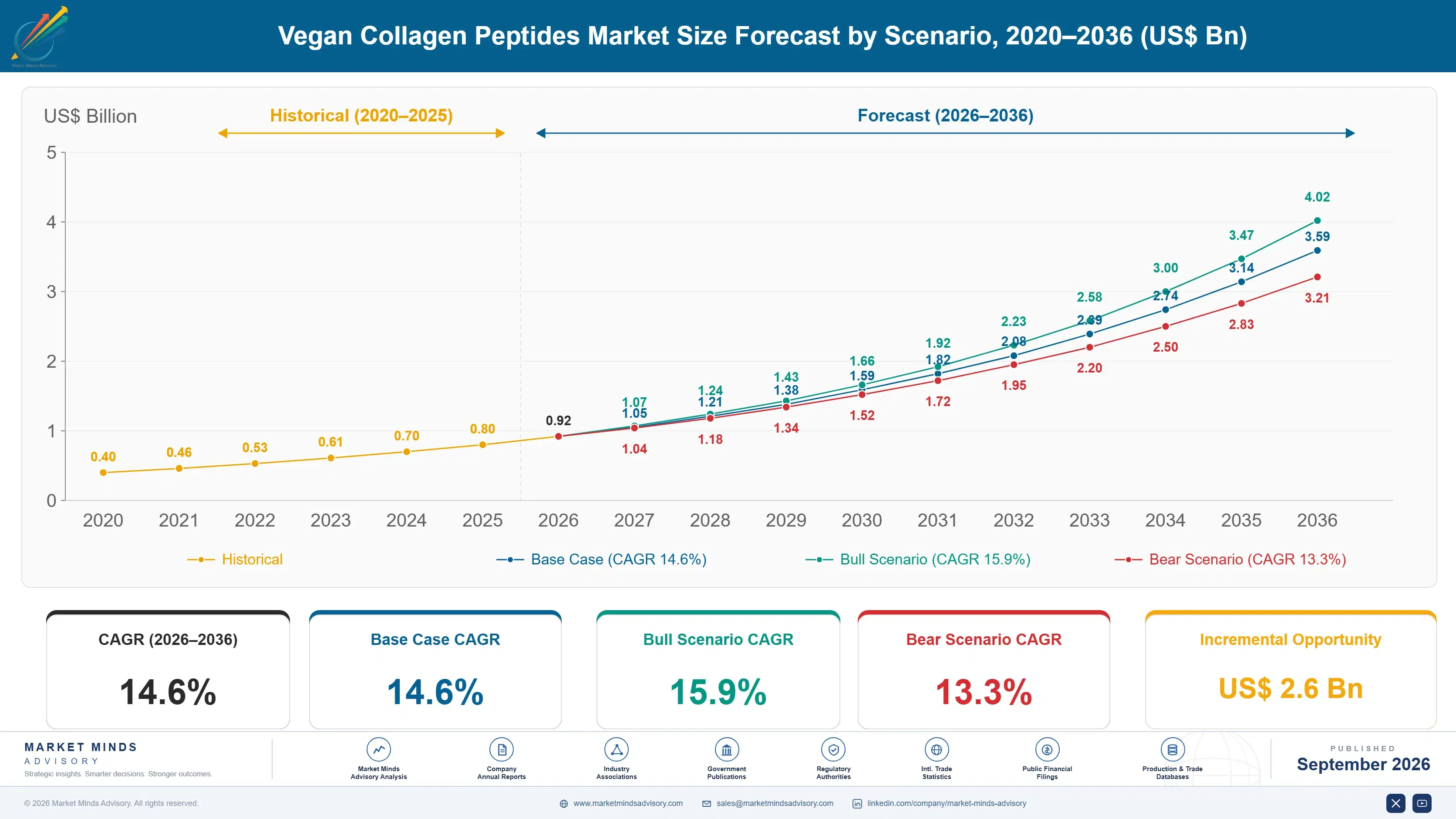
Vegan Collagen Peptides Market Forecast Scenarios

vegan-collagen-peptides-market-size-forecast-scenario-1790017973617
Growth from 2020 to 2025 ran at 13.4% and came overwhelmingly from amino acid builder blends rather than from anything containing collagen. Those products were cheap to formulate, easy to market under an established word, and required no regulatory novelty at all. Recombinant collagen scaled in parallel on a much smaller base, almost entirely in Chinese cosmetic applications where authorisation was straightforward.
The base case at 14.6% rests on three mechanisms. Chinese recombinant production keeps driving down cost per kilogram while regional cosmetic demand absorbs the output, with country growth of 19.8% leading every market covered. Builder blends keep expanding on plant-based positioning that needs no novel authorisation anywhere. And topical recombinant applications keep growing because cosmetic regulatory routes are considerably faster than food ones. None of the three assumes a European ingestible authorisation arrives during the period.
The bull case at 15.9% depends on ingestible authorisation arriving in Europe or North America, which would open the application where consumers already expect collagen to work. The bear case at 13.3% is claim scrutiny: an advertising authority ruling on products carrying the collagen name without containing collagen would remove positioning from roughly 83% of category volume.

The Word Doing All The Work

Collagen is a structural protein that animals make and plants do not, so a plant cannot contain it. What the category calls vegan collagen splits into two different things sharing a word. Amino acid builder blends supply glycine, proline, vitamin C, silica, and similar cofactors intended to support the body's own synthesis, and they contain no collagen. Recombinant collagen, produced by engineered yeast or bacteria, genuinely is collagen.
TOP FIVE CONCENTRATION37%Share of category revenue held by the leading producers
ACTUAL COLLAGEN CONTENT17%Category volume containing any collagen protein at all
RECOMBINANT COST MULTIPLE23 timesProduction cost against animal-derived collagen peptide of equivalent grade
COSMETIC APPLICATION SHARE71%Recombinant volume going to topical rather than ingestible use
PEPTIDE SIZE DISCLOSURE9%Products stating measured molecular weight distribution on specification
EUROPEAN INGESTIBLE APPROVALS0Authorisations for recombinant collagen in European ingestible applications
About 17% of category volume is the second kind, and it costs roughly 23 times what animal-derived collagen peptide costs to produce. That multiple is falling as fermentation titres improve, and it is the single number that decides how far this category can go. About 71% of recombinant volume goes into topical cosmetics, because cosmetic routes are far quicker than food ones.
The evidence position is uncomfortable in both directions. Oral collagen peptide efficacy is contested even for animal-derived material, and builder blends inherit the expectation created by that research without supplying the substance it studied. Recombinant collagen has the substance and very little clinical work behind it in ingestible use. Only about 9% of products disclose measured molecular weight distribution, which is what peptide performance actually depends on.
"Most of this category does not contain collagen and puts the word on the front, and the part that genuinely does contain it mostly cannot be eaten yet in Europe. Both facts are widely known inside the industry and almost never appear in a marketing deck."
Practice Director, Nutrition Ingredients and Industrial Biotechnology · MMA Chemicals and Materials Practice · September 2026

Market Trends

Recombinant Cost Falls Toward A Usable Multiple

Yeast-fermented recombinant collagen peptides grow at 21.9%, fastest of the six classes, and the whole trajectory depends on one number. Production currently costs roughly 23 times animal-derived collagen peptide, down from considerably higher multiples five years ago, and fermentation titre improvement is what closes the gap. Chinese producers have driven most of that progress by running at cosmetic volumes that fund strain development. At a multiple in single figures the category stops being a premium curiosity and starts competing on comparable terms. Downstream purification rather than fermentation is where most of the remaining cost actually sits.
Market Impact: Country grows at 19.8%
Cosmetics Absorb What Food Rules Will Not Permit

About 71% of recombinant collagen volume goes to topical applications, and the reason is regulatory rather than technical. Cosmetic ingredient routes are considerably faster than novel food authorisation in every major market, and no European approval exists for recombinant collagen in ingestible use. That routes the material toward skin care, where a molecule too large to penetrate meaningfully is nonetheless sold on film formation and hydration. Producers are pursuing food authorisation, and the timelines run in years rather than quarters. Consumers expect collagen to be something they drink, so the topical route reaches a weaker version of the argument.
Market Impact: Blends hold 83% volume

Market Opportunities and Growth Drivers

Chinese Producers Built The Recombinant Category

China grows at 19.8%, faster than any country covered, and Chinese producers established recombinant collagen as a commercial cosmetic ingredient well ahead of Western entrants. East Asia holds 43% of world demand on that basis. Domestic regulatory routes for cosmetic use were straightforward, domestic demand absorbed early output at premium prices, and that revenue funded the strain and titre work that has since driven cost down. Western producers entering now face a cost position built over several years of continuous production. Titre improvement compounds annually and cannot be compressed into a short catch-up programme.
Market Impact: Only 17% contains collagen

Plant Positioning Needs No Regulatory Novelty

Amino acid builder blends and botanical support actives together carry most of category volume, and their commercial advantage is that they require no novel authorisation anywhere. Glycine, proline, vitamin C, and silica are established ingredients, so a formulator can launch in any market immediately. That regulatory simplicity, rather than any performance argument, is why the segment holding roughly 83% of volume grew fastest in the category's first decade and still dominates units. It is also why the segment attracts the regulatory attention now building around ingredient naming, since the advantage rests on a word.
Market Impact: Exactly 0 European approvals

Market Restraints and Challenges

The Category Name Describes A Minority Of It

Only around 17% of category volume contains collagen protein, and the root cause is that the word was commercially available before the substance was. Builder blends inherit an expectation created by research on animal-derived collagen peptide while supplying none of the material that research examined. Commercially the exposure is rising, since advertising authorities in several markets have begun examining ingredient naming. Producers respond by separating builder and recombinant positioning clearly, and by publishing what a product actually contains rather than what it supports. Clarity helps the expensive product considerably more than it damages the cheap one.
Market Impact: Multiple stands at 23 times

Ingestible Authorisation Has Not Arrived In Europe

No European authorisation exists for recombinant collagen in ingestible applications, and the root cause is that novel food assessment runs on timelines measured in years while cosmetic routes take months. Commercially this pushes about 71% of recombinant volume into topical products, where the application argument is weaker than the ingestible one consumers expect. Producers respond by filing early, by building the cosmetic business as a funding base, and by pursuing authorisation in faster jurisdictions first. Filing early is the only response that works, since the assessment timetable cannot be shortened by commercial urgency once it has begun.
Market Impact: Topical takes 71% volume
3 additional market trends, 4 additional growth drivers, and 2 additional restraints and challenges are covered in the full report. Contact sales@marketmindsadvisory.com to access the complete intelligence.

Segment CAGR and Growth Architecture

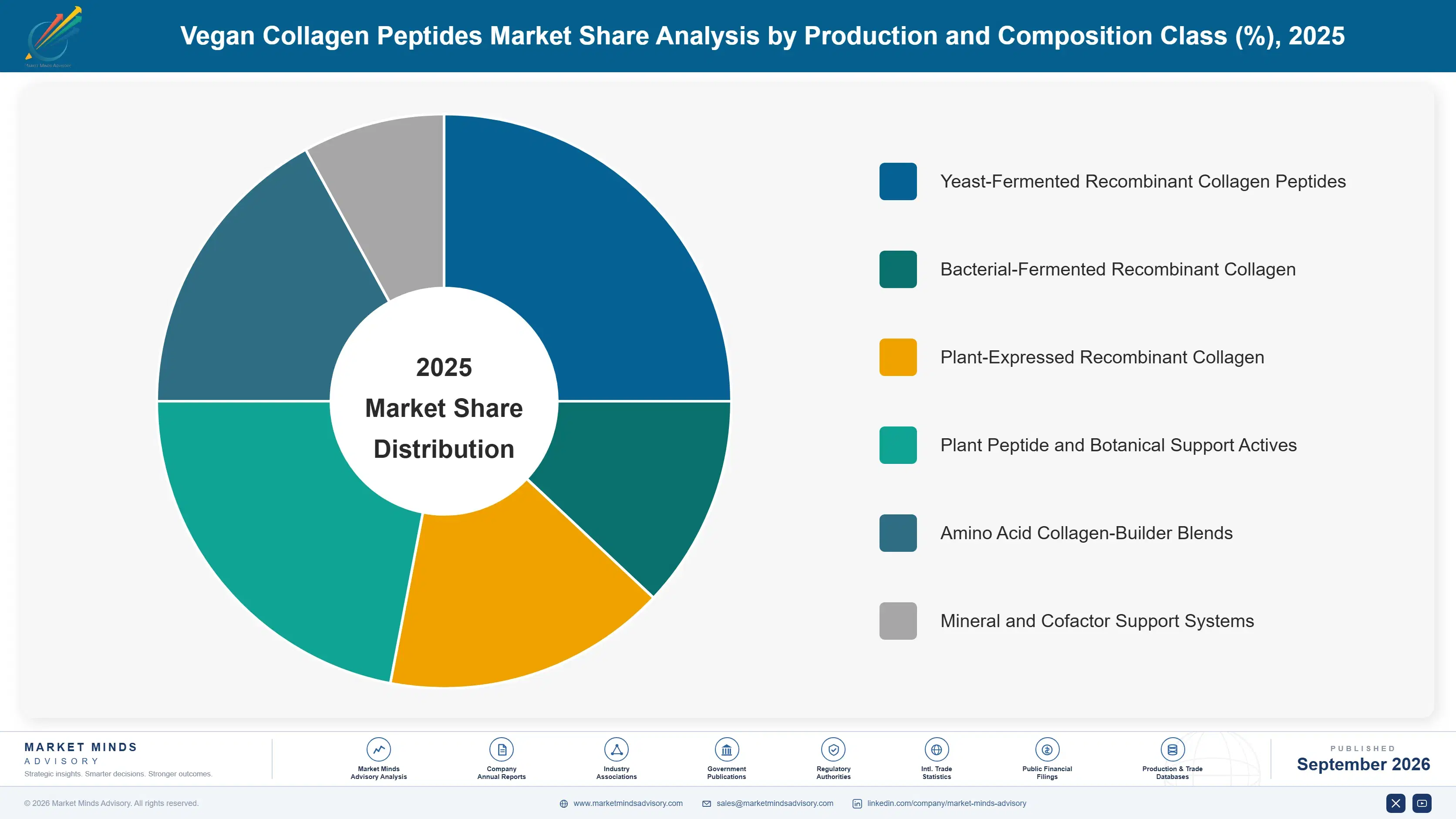
Segmentation follows production and composition class across six categories: yeast-fermented recombinant collagen peptides, bacterial-fermented recombinant collagen, plant-expressed recombinant collagen, plant peptide and botanical support actives, amino acid collagen-builder blends, and mineral and cofactor support systems. Application, purity grade, and regulatory status sit as separate dimensions entirely. Animal-derived collagen, gelatin, and cell-cultured collagen fall outside the defined scope.
vegan-collagen-peptides-market-market-share-analysis-1790017974223

Yeast-Fermented Recombinant Collagen Peptides

Yeast-fermented recombinant collagen grows at 21.9%, half again the market rate of 14.6%, and is the only part of this category that is genuinely collagen produced without an animal. Engineered Pichia and Saccharomyces strains express human collagen sequences that can be hydrolysed into peptides of specified size, which is a level of control animal extraction cannot offer at all. The constraint is cost: production runs roughly 23 times animal-derived peptide, and fermentation titre is the entire game. Chinese producers hold the accumulated strain position because cosmetic demand funded years of continuous improvement. Downstream purification remains the largest single cost group rather than the fermentation itself. Western entrants face a cost position built over years of continuous output.
CAGR 21.9%

Bacterial-Fermented Recombinant Collagen

Bacterial-fermented recombinant collagen grows at 18.6% on faster fermentation cycles and lower feedstock cost than yeast systems achieve. The trade is post-translational: bacterial hosts do not hydroxylate proline the way eukaryotic systems do, so the resulting protein needs co-expressed enzymes or accepts a different structural profile, which matters more for material applications than for peptide ones. That makes bacterial routes well suited to hydrolysed peptide production and less suited to intact collagen for biomaterials. Cost per kilogram sits below yeast systems and purification burden runs comparable. Regulatory files are less advanced, which currently limits access to the applications that pay most. Producers holding bacterial routes compete on peptide cost rather than intact protein applications.
CAGR 18.6%
Full segment breakdown across 6 segments available in the complete report.

Regional Architecture and Country Demand Map

Regional shares reflect where non-animal collagen ingredients are formulated into finished products rather than where they are produced. Three regions sit outside the standard bands, for reasons named in their own paragraphs and summarised below for operator review. Regulatory routes and application mix vary sharply between them.

East Asia

At 43% this sits far above the standard band, and the justification is that Chinese producers established recombinant collagen as a commercial cosmetic ingredient years before Western entrants and Chinese consumers absorbed the output at premium prices. Chinese growth of 19.8% leads every country covered. Domestic cosmetic regulatory routes were straightforward, which let production scale while European and American approval processes were still beginning. Korean and Japanese formulation buys recombinant material for premium skin care at high purity. That early revenue funded the strain development that has since driven cost multiples down substantially. Regional formulators specify recombinant material by sequence and characterisation more often than buyers elsewhere, which reflects how long the ingredient has been commercially available to them.
Share: 43% | CAGR: 15.6% (2026 to 2036)

North America

Ingestible applications carry proportionally more of the regional market than anywhere else, driven by a supplement culture that adopted animal collagen peptides early and looked for plant-based alternatives afterwards. Growth of 14.2% runs close to the world rate. Regulatory routes for recombinant collagen in food are clearer here than in Europe, though still slower than cosmetic pathways. Advertising authorities have begun examining ingredient naming where products carry the collagen word without containing collagen. Builder blends dominate volume overwhelmingly and recombinant material remains a premium niche. Direct selling and specialist supplement retail reach consumers that conventional grocery does not, and those channels adopted the plant-based framing earlier than mass retail did. Recombinant material is beginning to appear in premium skin care.
Share: 20% | CAGR: 14.2% (2026 to 2036)
Regional intelligence for 5 additional markets available in the complete report: Western Europe, South Asia and Pacific, Latin America, Middle East and Africa, Eastern Europe. Contact sales@marketmindsadvisory.com.
vegan-collagen-peptides-market-country-cagr-analysis-1790017974744

Where Producers Build Real Position

Four commercial moves matter in a category where the name describes a minority of the volume and the genuine product mostly cannot be eaten yet. Each rests on separating what a product contains from what it is called, which is where nearly all the confusion in this market originates. None of the four requires the cost multiple to fall first.

Separate Builder And Recombinant Positioning Clearly

Only about 17% of category volume contains collagen protein while the rest supplies precursors and cofactors, and the two are sold under one word. Producers positioning them as distinct propositions rather than as grades of the same thing report price realisation 2.8 times higher on recombinant material. The confusion currently suppresses the premium the genuine product should command, because a buyer comparing labels sees the same word twice. Clarity helps the expensive product considerably more than it hurts the cheap one. Advertising authorities examining ingredient naming will force the separation eventually anyway.
Market Impact: Raises achieved price realisation to 2.8 times higher

Treat Fermentation Titre As The Whole Strategy

Recombinant production costs roughly 23 times animal-derived collagen peptide, and titre improvement is what closes that gap rather than scale or marketing. Producers running continuous strain development programmes report cost per kilogram falling 1.9 times faster than those optimising downstream processing alone. At a multiple in single figures the addressable application set changes completely. Chinese producers hold their position because cosmetic revenue funded years of uninterrupted strain work rather than because of any single breakthrough. Downstream purification does not scale with titre the way fermentation does, so strain work alone produces expensive material faster.
Market Impact: Cuts cost per kilogram 1.9 times faster overall

File Ingestible Authorisation Years Before Demand

No European authorisation exists for recombinant collagen in ingestible use, and novel food assessment runs in years while cosmetic routes take months. Producers filing early report reaching ingestible markets 3.2 times sooner than those waiting for commercial certainty before starting. Consumers expect collagen to be something they drink, so the ingestible application is where the category's eventual value sits. Beginning the file when the market is ready guarantees arriving several years after somebody else did. Cosmetic revenue is the practical funding source while the ingestible file proceeds, which is exactly the sequence Chinese producers followed to build their position.
Market Impact: Reaches ingestible markets 3.2 times sooner than waiters

Publish Measured Molecular Weight Distribution Data

Only around 9% of products state measured molecular weight distribution, which is what peptide performance actually depends on and what a formulator needs to specify against. Producers publishing it with method documentation report specification retention 2.4 times higher than those supplying against a protein content figure alone. The measurement is routine analytical work costing very little. Its absence means a genuinely well-characterised peptide competes on price against material nobody has characterised at all. It also makes a specification defensible against a cheaper competitor whose material nobody has characterised at all, which is where most of the value sits.
Market Impact: Raises specification retention rates to 2.4 times higher

Who Controls the Margin Pool

Concentration is moderate. Five producers hold 37% of category revenue, measured consistently on that basis across all participants, and the field divides sharply into Chinese recombinant producers with accumulated strain positions, Western biotechnology entrants, and a long tail of amino acid and botanical blend suppliers competing in an entirely different cost bracket. The leader to challenger gap is wide in recombinant production and almost absent in builder blends.
Competition currently turns on three dimensions: fermentation titre and downstream purification cost, which determines whether recombinant material can reach beyond premium cosmetics; regulatory file position on ingestible applications, where years of lead time cannot be bought later; and analytical characterisation, since almost nobody publishes peptide size distribution. Price decides in builder blends, which carry roughly 83% of category volume and involve no capability a competitor could not assemble within weeks.

Pressure builds from two directions. Chinese producers hold a cost position built over years of continuous cosmetic-funded production. Claim scrutiny on ingredient naming is building in several markets. Rankings will shift toward producers holding titre advantage and advanced regulatory files rather than early brand recognition. Producers holding only builder blend volume face the most exposed position in the field.
vegan-collagen-peptides-market-company-positioning-matrix-1790017975273

Competitive Moat and Risk Dimensions

JINBO BIOLOGICAL PHARMACEUTICAL

Moat: Strain Position And Production Continuity

Years of continuous recombinant collagen production funded by domestic cosmetic demand have produced accumulated strain and titre improvements that a competitor entering now cannot compress into a short programme. That position compounds annually and is the single largest determinant of cost per kilogram in this category.
JINBO BIOLOGICAL PHARMACEUTICAL

Risk: Narrow Regulatory File Breadth

A cost position built on domestic cosmetic routes does not automatically extend to European or American ingestible applications, where novel food assessment runs in years. Competitors filing early elsewhere could reach the ingestible market first despite carrying a materially worse cost structure into it. Filing timelines cannot be compressed by commercial urgency later.
GELTOR

Moat: Designed Sequence And Characterisation

Capability to design specific collagen sequences and characterise the resulting peptides precisely gives a formulation argument that undifferentiated recombinant material cannot make. In a category where only about 9% of products disclose molecular weight distribution, published characterisation is a genuine and currently rare differentiator. Formulators can specify against it, which competitors cannot match.
GELTOR

Risk: Cost Position Against Chinese Producers

Design and characterisation capability does not close a cost gap built on years of continuous production at scale. Competing on specification against material priced substantially lower works in premium cosmetics and becomes considerably harder as recombinant cost multiples continue falling toward commodity territory. That gap narrows only if the cost multiple stops falling.

Players Tracked

Prominent Players

Jinbo Biological Pharmaceutical
Giant Biogene Holding
Geltor
Evonik Industries
Bloomage Biotechnology

Other Key Players

Trautec Medical
Chuangjian Medical
Jellatech
Provenance Bio
Cambrium
Conagen
Ginkgo Bioworks
DSM-Firmenich
BASF
Lonza
Croda International
Ashland
Seppic
Shandong Focusfreda Biotech
Zhejiang Kangte Biotechnology

Recent Developments

MARCH 2026

Geltor Publishes Molecular Weight Distribution Across Peptide Range

Geltor released measured molecular weight distribution data with method documentation across its recombinant collagen peptide products. The disclosure puts a specifiable figure where protein content alone has stood across most of the category. Sequence identity was published alongside the distribution figures for each individual product.
Signal: Characterisation is the differentiator available while cost gaps remain wide. Specification beats protein content as a competitive basis.
SEPTEMBER 2025

Jinbo Expands Recombinant Collagen Fermentation Capacity

Jinbo Biological Pharmaceutical completed an organic expansion of recombinant collagen fermentation capacity, funded internally with no partner involved. Titre improvement rather than additional vessel volume accounted for most of the throughput gain achieved. Downstream purification capacity was expanded alongside the fermentation vessels rather than afterwards.
Signal: Titre rather than capacity is where the cost curve actually moves. Vessel volume alone produces expensive material faster.
MAY 2025

Evonik Acquires Recombinant Protein Purification Specialist

Evonik Industries completed an acquisition of a downstream purification specialist for recombinant proteins. The transaction was an outright acquisition rather than a joint venture or minority stake, with purification cost cited as the stated rationale. Process engineering staff transferred with the business under the agreed terms.
Signal: Downstream cost exceeds fermentation cost in recombinant collagen production. The largest cost group is finally attracting the investment.

What Recombinant Collagen Costs

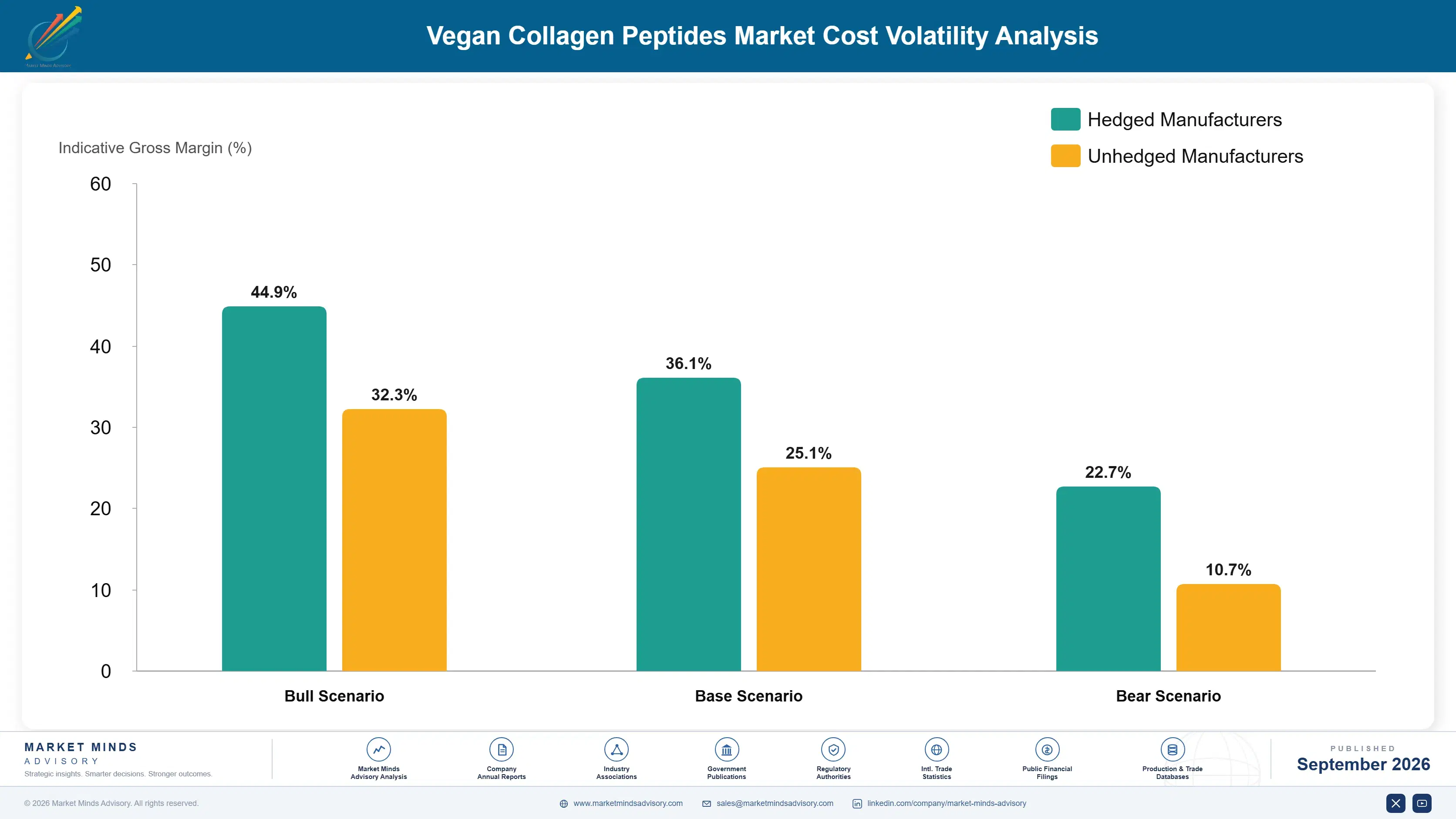
Three cost groups dominate recombinant routes, and the balance surprises people expecting fermentation to lead. Downstream purification and characterisation run 32% to 40% of cost of goods sold, the largest single group. Fermentation feedstock takes 22% to 30%, and the eight-point range separates producers sited near cheap agricultural sugar from those buying on world markets. Energy and utilities account for 20% to 28%, reflecting the fermentation process itself.
Sugar and glucose feedstock pricing moved through 2024 and 2025 on harvest conditions and competing industrial demand, and United States Department of Agriculture crop statistics documented the underlying movements across the period. Industrial electricity pricing moved separately on regional generation mix, with Energy Information Administration series recording that divergence. Several producers described purification consumable costs as the faster-rising line in their annual reports. The three exposures moved independently throughout.

The competitive disadvantage mechanism runs through purification rather than through fermentation. A producer optimising strain performance while leaving downstream processing unchanged finds cost per kilogram barely moves, because purification does not scale with titre in the way fermentation does. Exposure therefore varies by process integration rather than by fermentation capacity, and producers without downstream capability are permanently capped whatever their strains achieve.
vegan-collagen-peptides-market-cost-volatility-analysis-1790017975470

Invest Downstream Before Adding Fermentation Capacity

Purification and characterisation account for the largest single cost group in recombinant production, and adding vessel volume without addressing it simply produces more expensive material faster. Downstream investment moves cost per kilogram in a way additional fermentation capacity cannot, and it is where most producers underinvest relative to where their money actually goes. It is where most producers underinvest.

Fund Continuous Strain Work From Cosmetic Revenue

Cosmetic applications reach market on regulatory timelines measured in months while ingestible routes run in years, which makes topical revenue the practical funding source for strain development. Chinese producers built their cost position exactly this way, and the sequence matters more than the total capital committed at any single point. Sequence matters more than total capital committed at any point.

Contract Sugar And Power On Separate Calendars

Agricultural sugar and industrial electricity follow harvest conditions and generation mix respectively, with no meaningful relationship between them in any period. Contracting the two separately rather than through one procurement view prevents a single approach from carrying exposure to markets that move entirely independently of each other. Harvest conditions and generation mix answer to different authorities entirely.

Portfolio Architecture for Margin Defence

Margin follows what a product actually contains and how well it is characterised. Mineral and cofactor support systems compete close to commodity terms on ingredients available from any supplier. Amino acid builder blends earn moderately on formulation and branding rather than substance. Recombinant peptides earn well on genuine scarcity, and designed-sequence characterised peptides earn most, because a formulator can specify against them.
The tension between volume and premium runs through what the buyer is actually purchasing. A supplement brand buying a builder blend is buying a claim structure and a cost, and switches on price at every review because the ingredients are available everywhere. A cosmetic formulator specifying a recombinant peptide by sequence and molecular weight distribution is buying something no competitor supplies, and that specification holds for the product's life.

High-value pools concentrate in characterised recombinant peptides for premium skin care, in designed sequences addressing specific formulation problems, and eventually in ingestible applications once authorisation arrives. Where the product is an amino acid builder blend sold on plant-based positioning, every input is a commodity, formulation is trivial, and the contest runs entirely on brand and distribution.

Volume / Commodity-Adjacent

Amino acid builder blends and mineral cofactor systems assembled from ingredients available to any supplier at commodity prices. The ten-point range reflects sourcing and blending scale rather than any capability a formulator would pay a premium to obtain.
Gross Margin: 22% to 32%

Premium / Certified

Plant peptide and botanical support actives with formulation support, and undifferentiated recombinant material supplied on protein content. The fourteen-point range separates genuine production capability from traders reselling material they did not make.
Gross Margin: 40% to 54%

Sustainability / Regulatory / Next-Generation

Designed-sequence recombinant peptides with published molecular weight characterisation and advanced regulatory files. The sixteen-point range reflects strain position and analytical depth, neither of which can be assembled on a short timescale.
Gross Margin: 58% to 74%
vegan-collagen-peptides-market-portfolio-architecture-1790017975973

High-value Sub-segments and Strategic Watch-out

Designed Sequence Recombinant Peptides

Highest value in the category, offering a formulator something no alternative supplier provides at any price today. The sixteen-point range reflects sequence design and characterisation capability, which only a handful of producers currently hold anywhere. Formulators can specify against a sequence in a way they cannot against protein content.
Gross Margin: 60% to 76%

Characterised Recombinant Collagen Peptides

High value where published molecular weight distribution lets a formulator specify properly, in a field where only around 9% disclose it. The fourteen-point range reflects analytical practice rather than any difference in the underlying material. Uncharacterised material competes on price alone and generally wins on it.
Gross Margin: 48% to 62%

Plant Peptide And Botanical Actives

Volume core carrying a plant-based positioning that needs no novel authorisation in any market worldwide. The twelve-point range reflects extraction and standardisation capability, since botanical actives vary enormously in consistency between suppliers. No novel authorisation is required anywhere at all, which is the whole advantage here.
Gross Margin: 36% to 48%

Amino Acid Builder Blends

The strategic watch-out. Every input is a commodity, blending is trivial, and the collagen word doing the selling is the part now attracting regulatory attention. The ten-point range reflects sourcing scale alone. Regulatory attention on ingredient naming is now building around exactly this segment of the market.
Gross Margin: 20% to 30%

How This Demand Repeats

Builder blend demand repeats on brand relationships rather than on anything technical, because the inputs are commodities available to every supplier and the formulation is a weighing exercise. A supplement brand switches supplier on price at each review without involving anybody technical, and the resulting business is high volume, low margin, and entirely contestable. Nothing about the ingredient itself creates any attachment to the producer supplying it.
Recombinant demand behaves in the opposite direction. A cosmetic formulator qualifying a recombinant peptide by sequence and molecular weight distribution runs stability, compatibility, and claim substantiation work that costs many multiples of any annual price difference. That position holds for the product's commercial life, and no competitor supplies an equivalent sequence, so the switching decision does not really arise at all.

The buyer profile is shifting as recombinant cost multiples fall. Formulators who dismissed the material as a premium curiosity at forty times animal cost are evaluating it at twenty-three, and will formulate with it in volume in single figures. Producers building specification relationships now, while the material is still expensive, will hold those positions when the cost argument disappears and everybody else arrives.
vegan-collagen-peptides-market-end-use-penetration-index-1790017976465

Where This Market Rewards

These are among the four positions where our research anticipates prominent divergence between winners and laggards over the coming forecast period. Each is grounded in the demand model, the regulatory perimeter, and the announced capacity pipeline.
01 / POSITIONING SEPARATION DISCIPLINE

Two products sharing one word

Only about 17% of category volume contains collagen protein while the remainder supplies precursors and cofactors, and both are sold under a single word on the front of the pack. Producers positioning them as genuinely distinct propositions rather than as grades of one thing report price realisation 2.8 times higher on recombinant material. The confusion currently suppresses the premium the real product deserves, because a buyer comparing two labels sees the same claim twice, and advertising authorities examining ingredient naming will force the separation eventually anyway.
02 / FERMENTATION TITRE FOCUS

Twenty-three times decides everything

Recombinant production costs roughly 23 times animal-derived collagen peptide, and continuous strain and titre improvement rather than scale or marketing is what closes that gap over time. Producers running uninterrupted strain development report cost per kilogram falling 1.9 times faster than those optimising downstream processing alone. At a multiple in single figures the addressable application set changes completely, which makes this the only number that genuinely matters, and downstream purification does not scale with titre the way fermentation itself does, so both need investment.
03 / REGULATORY FILE TIMING

Years of lead cannot be bought

No European authorisation exists for recombinant collagen in ingestible applications, and novel food assessment runs in years while cosmetic routes complete in months. Producers filing early report reaching ingestible markets 3.2 times sooner than those waiting for commercial certainty before beginning the work. Consumers expect collagen to be something they drink, so the ingestible application is where the category's eventual value almost certainly sits, and cosmetic revenue is the practical funding source while an ingestible file proceeds through assessment on its own timetable.
04 / PEPTIDE CHARACTERISATION PUBLISHING

Nine per cent state anything measurable

Only around 9% of products state measured molecular weight distribution, which is what peptide performance actually depends on and what any formulator needs in order to specify properly. Producers publishing it with method documentation report specification retention 2.4 times higher than those supplying against protein content alone. The measurement is routine analytical work, and its absence makes a well-characterised peptide compete on price against uncharacterised material, and a published specification is defensible against cheaper material that nobody has characterised at all.

Engagement Snapshot From the Field

A live engagement with an industry participant carrying material or product regulatory and market exposure ahead of a defining policy shift, showing how our research translates into a defensible multi-year portfolio strategy.
MARKET MINDS ADVISORY · CLIENT ENGAGEMENT SUMMARY
Vegan Collagen Peptides Producer Strategic Portfolio Review and Transition Roadmap 2026·Investment Scenario on Vegan Collagen Peptides Exposure Evaluation 2025-26
CLIENT PROFILE
A supplement brand group with vegan collagen revenue near USD 72 million (client-reported, unverified by MMA) across fourteen markets. The range was built entirely on amino acid builder blends, an advertising authority in one market had opened an enquiry into ingredient naming, and the legal function had asked what exposure existed elsewhere. No internal document distinguished the two categories.
STRATEGIC CHALLENGE
Nobody internally had documented the distinction between products containing collagen and products supporting its synthesis, and marketing copy across the range used the two interchangeably. The commercial team believed the enquiry was isolated and had proposed defending the naming rather than reviewing it. The distinction had never been documented anywhere in the business, and no product in the range had ever been assessed against it.
MMA APPROACH
MMA audited claim language across every product and market, compared it against ingredient naming precedent in each jurisdiction, modelled exposure under several plausible rulings, and assessed recombinant material as a partial substitute against cost, authorisation status, and available characterisation data. Consumer testing of the reframed language was run in parallel so the commercial risk could be quantified rather than assumed.
KEY FINDINGS
  1. No product in the range contained collagen protein, and copy in eleven of fourteen markets used language a reasonable consumer would read as claiming it did.
  2. Ingredient naming precedent in three further markets closely resembled the jurisdiction where the enquiry had been opened, making the exposure considerably broader than assumed.
  3. Recombinant material was unavailable for ingestible use in the group's two largest European markets, so substitution could not resolve the exposure there at all.
  4. Reframing the range explicitly as collagen support rather than collagen tested better with consumers than the incumbent language in every market surveyed.
CLIENT PROFILE
A supplement brand group with vegan collagen revenue near USD 72 million (client-reported, unverified by MMA) across fourteen markets. The range was built entirely on amino acid builder blends, an advertising authority in one market had opened an enquiry into ingredient naming, and the legal function had asked what exposure existed elsewhere. No internal document distinguished the two categories.
STRATEGIC CHALLENGE
Nobody internally had documented the distinction between products containing collagen and products supporting its synthesis, and marketing copy across the range used the two interchangeably. The commercial team believed the enquiry was isolated and had proposed defending the naming rather than reviewing it. The distinction had never been documented anywhere in the business, and no product in the range had ever been assessed against it.
MMA APPROACH
MMA audited claim language across every product and market, compared it against ingredient naming precedent in each jurisdiction, modelled exposure under several plausible rulings, and assessed recombinant material as a partial substitute against cost, authorisation status, and available characterisation data. Consumer testing of the reframed language was run in parallel so the commercial risk could be quantified rather than assumed.
KEY FINDINGS
  1. No product in the range contained collagen protein, and copy in eleven of fourteen markets used language a reasonable consumer would read as claiming it did.
  2. Ingredient naming precedent in three further markets closely resembled the jurisdiction where the enquiry had been opened, making the exposure considerably broader than assumed.
  3. Recombinant material was unavailable for ingestible use in the group's two largest European markets, so substitution could not resolve the exposure there at all.
  4. Reframing the range explicitly as collagen support rather than collagen tested better with consumers than the incumbent language in every market surveyed.
RECOMMENDED STRATEGY
Phase 1: Phase one: withdraw the defence and reframe the entire range as collagen support, stating clearly what each product contains and what it does. Phase 2: Phase two: file for recombinant material qualification in markets where ingestible use is permitted, ahead of any competitor substitution. Begin filings where the route is already open. Phase 3: Phase three: build a separate premium line around genuine recombinant peptide once European ingestible authorisation arrives. Keep the support line and the collagen line commercially separate.
OUTCOME
The enquiry closed without adverse finding after the voluntary reframing (client-reported, unverified by MMA). Range revenue grew rather than fell after the language change. Two competitors subsequently adopted comparable wording across their own vegan collagen ranges. The reframed language tested better than the original in every market surveyed.

Frequently Asked Questions

Foundational context covering the market sizes, CAGR, scope, country, region and competition that inform every finding below. This section is provided to cover basics and most often pre-purchase conversations, answered from the MMA Primary Research Dataset.

What is the current size of the Vegan Collagen Peptides Market?

The market was worth USD 0.8 billion in 2025 and stands at USD 0.9 billion in 2026. Value covers non-animal collagen peptides and collagen-support ingredients at producer selling price.

How large will the Vegan Collagen Peptides Market be by 2036?

MMA forecasts USD 3.5 billion by 2036, an increase of USD 2.6 billion across the forecast period. That represents 3.89 times the 2026 base of USD 0.9 billion.

What is the CAGR for the Vegan Collagen Peptides Market 2026 to 2036?

The base case compound annual growth rate is 14.6%, with a bull case at 15.9% and a bear case at 13.3%. Historical growth from 2020 to 2025 ran at 13.4%.

Which segment is growing fastest?

Yeast-fermented recombinant collagen peptides grow at 21.9%, half again the market rate of 14.6%. They are genuine collagen produced without any animal involved, at roughly 23 times the cost.

Who are the major companies in the Vegan Collagen Peptides Market?

Jinbo Biological Pharmaceutical, Giant Biogene Holding, Geltor, Evonik Industries and Bloomage Biotechnology lead the field. Together they hold 37% of category revenue, with Chinese producers holding the cost position.

Which country is growing fastest?

China grows at 19.8%, and Chinese producers established recombinant collagen as a commercial cosmetic ingredient years ahead of Western entrants. Domestic demand funded the strain development.

Report Segmentation Architecture

The full report scope spans multiple orthogonal segmentation dimensions, with cross-tabulated demand data provided for each dimension pair. Coverage extends further to regional breakdowns, trend trajectories, and the competitive detail needed to support segment-level decision-making.

By Production and Composition Class

  • Yeast-Fermented Recombinant Collagen Peptides
  • Bacterial-Fermented Recombinant Collagen
  • Plant-Expressed Recombinant Collagen
  • Plant Peptide and Botanical Support Actives
  • Amino Acid Collagen-Builder Blends
  • Mineral and Cofactor Support Systems

By End-Use Industry

  • Dietary Supplements and Nutraceuticals
  • Premium Skin Care Formulation
  • Functional Food and Beverage
  • Sports and Active Nutrition
  • Hair and Nail Care Products
  • Medical Nutrition and Recovery

By Commercial Dimension

  • Brand Owner Direct Supply
  • Contract Manufacturer Supply
  • Specialty Ingredient Distribution
  • Cosmetic Formulator Direct Supply
  • Sequence Design Development Contracts
  • Regulatory Authorisation Support Services

By Region

  • East Asia
  • North America
  • Western Europe
  • South Asia and Pacific
  • Latin America
  • Middle East and Africa
  • Eastern Europe

Scope, Methodology, and Coverage

Every figure in this report is reproducible from documented input assumptions. The scope below maps the historical period, the forecast horizon, the segmentation dimensions, and the countries covered, alongside the underlying primary and qualitative methodology.
Historical Period
2020 to 2025
Forecast Period
2026 to 2036
Base Year
2025 (USD billions; MMA Primary Research Dataset, September 2026)
Market Definition
This market covers non-animal collagen peptides and collagen-support ingredient systems for nutrition, supplement, and cosmetic formulation, across yeast-fermented recombinant collagen peptides, bacterial-fermented recombinant collagen, plant-expressed recombinant collagen, plant peptide and botanical support actives, amino acid collagen-builder blends, and mineral and cofactor support systems. It excludes bovine, porcine, marine and poultry collagen, gelatin and hydrolysed gelatin, finished consumer supplements, injectable collagen biomaterials, and cell-cultured animal collagen.
Quantitative Units
USD billions, revenue at producer selling price
Segmentation Dimensions
Production and composition class, end-use application, commercial dimension, region
Regions Covered
East Asia, North America, Western Europe, South Asia and Pacific, Latin America, Middle East and Africa, Eastern Europe
Countries Covered
China, Japan, South Korea, Taiwan, United States, Canada, Mexico, Germany, France, United Kingdom, Italy, Spain, Netherlands, Switzerland, Poland, Czechia, India, Indonesia, Thailand, Vietnam, Australia, Brazil, Argentina, Colombia, Chile, Saudi Arabia, United Arab Emirates, Turkey, Egypt, South Africa
Key Companies Profiled
Jinbo Biological Pharmaceutical, Giant Biogene Holding, Geltor, Evonik Industries, Bloomage Biotechnology, Trautec Medical, Chuangjian Medical, Jellatech, Provenance Bio, Cambrium, Conagen, Ginkgo Bioworks, DSM-Firmenich, BASF, Lonza, Croda International, Ashland, Seppic, Shandong Focusfreda Biotech, Zhejiang Kangte Biotechnology
Quantitative Methodology
Primary survey, n=3,800 respondents, Q4 2025, six countries; demand-side model with trade association cross-validation
Qualitative Methodology
47 expert interviews, Q4 2025; applied to validate demand model assumptions, identify emerging dynamics, and assess competitive positioning
Report Format
PDF and XLSX data workbook (Word format preview document)
Publisher
Market Minds Advisory
Report Code
MMA-2026-CHM-581
Published
September 2026
Contact
sales@marketmindsadvisory.com | www.marketmindsadvisory.com

Purchase the full Vegan Collagen Peptides Market Report (2026 to 2036).

The full report sizes the vegan collagen peptides market across six production and composition classes, seven regions, and thirty countries, with forecasts to 2036 under base, bull, and bear cases. It separates volume that contains collagen protein from volume that supports its synthesis, tracks recombinant production cost against animal-derived equivalents, and maps ingestible authorisation status by jurisdiction. Competitive analysis covers twenty participants evaluated consistently on category revenue, with detailed treatment of fermentation titre position and analytical characterisation practice. Cost structure across fermentation, energy, and downstream purification is analysed throughout. Primary research includes 3,800 survey responses and 47 expert interviews.
Six production and composition classes sized separately
Twenty participants evaluated on category revenue consistently
Collagen-containing volume separated from collagen-support volume
Recombinant cost multiple tracked against animal-derived equivalents
Ingestible authorisation status mapped by individual jurisdiction
Molecular weight disclosure practice measured across the field

Built For The People Who Decide

From boardroom strategy to bench-side execution, this report is read cover-to-cover by leaders shaping the next decade of their industry, turning demand scenarios, market dynamics and valuation benchmarks into decisions.
CXOs/ Presidents/ VPs/ Managers
M&A and Corporate Development
Strategy Teams and R&D Heads
Procurement and Product Directors
Regulatory and Compliance Leaders
Investor Relations and Equity Analysts