Market Minds Advisory
Vascular Imaging Systems Market

Vascular Imaging Systems Market: Intravascular Optical Coherence Tomography and the Interventional Precision Shift

Intravascular optical coherence tomography is displacing standalone intravascular ultrasound as interventionalists demand deeper plaque characterization data, forcing legacy IVUS-only manufacturers to defend installed base loyalty against hybrid multi-modal imaging platforms.

Lead Analyst

Alice Ballenger

Published

September 2026

Make Smarter Decisions with Customized Research Insights

Request a free sample report and evaluate market opportunities, growth trends, and competitive dynamics relevant to your business needs.

2025 MARKET VALUE$2.6BMarket Size 2025
2036 FORECAST VALUE$6.6BBase Case , 2026 to 2036
CAGR 2026 TO 20368.8 %Bull 10.1% / Bear 7.5%
INCREMENTAL OPPORTUNITY$3.8BNet 10- year value creation
EXPANSION MULTIPLE2.33x2036 value over 2026 base
Strategic Levers
M&A Pipeline
Regional Outlook
Country Rankings
Competitive Intelligence
Segmental Deep-dive
Call-Us : 91 93563 13602

Executive Snapshot and Market Trajectory

Intravascular optical coherence tomography is displacing standalone intravascular ultrasound as interventionalists demand sub-cellular plaque characterization, and cath lab directors increasingly select vendors on imaging resolution depth rather than console familiarity alone this capital budgeting cycle. Bundled disposable catheter contracts increasingly factor into that decision as well.
Coronary and peripheral artery disease intervention drive most system demand, but intravascular OCT systems are pulling share fastest as plaque characterization depth supports more precise stent sizing decisions. North America holds the deepest installed base on cath lab density and interventional cardiology volume, while China's interventional procedure growth is closing the adoption gap from a smaller starting point. Manufacturers with strong East Asian distribution keep capturing disproportionate incremental placement growth. Manufacturers watch this shift closely.
Five manufacturers hold roughly sixty-nine percent of system revenue, leaving meaningful room for catheter-focused and specialty challengers to compete on price and clinical evidence depth. Widening comparative data on OCT-guided versus angiography-guided outcomes and a growing body of interventional cardiology literature are reshaping which imaging platforms cath labs default to across both coronary and peripheral procedures nationwide this decade. Regional manufacturers competing on price add further pressure on established formulary positions.
Market Definition
This market covers imaging systems used to visualize vascular anatomy and guide interventional procedures, including intravascular ultrasound, intravascular optical coherence tomography, vascular ultrasound, and vascular angiography systems. It excludes general-purpose diagnostic ultrasound platforms, standalone MRI and CT scanners, and the guidewires and catheters used alongside these systems.
Base Year Value
$2.6B in 2025 (MMA Primary Research Dataset, August 2026)
Forecast Period
2026 to 2036, eleven discrete annual values
CAGR
8.8% base case. Bull 10.1%. Bear 7.5%.
Fastest Growth Segment
Intravascular OCT Systems: 13.2% CAGR
Fastest Growth Country
China: 12.8% CAGR
Fastest Growth Region
South Asia and Pacific: 10.8% CAGR
Largest Region
North America: 30% of 2025 global value
Market Leaders
Philips, GE HealthCare, Siemens Healthineers, Canon Medical, Boston Scientific. Source: MMA Analysis based on company annual reports.
Primary Survey
n=3,800 procurement and R&D decision-makers, Q4 2025, six countries
Methodology
Demand-side build-up, cross-validated against public data, 47 expert interviews

Vascular Imaging Systems Market Forecast Scenarios

vascular-imaging-systems-market-size-forecast-scenario-1787310110188
System revenue grew steadily across 2020 to 2025 as intravascular imaging adoption expanded beyond academic interventional cardiology programs into broader community cath lab practice. Growth decelerated briefly in 2021 amid deferred elective interventional procedures during the pandemic before resuming its prior trajectory through the remainder of the historical period into 2025. Academic centers led this early adoption before diffusing into community cath lab practice nationwide.
The base case assumes continued double-digit growth in intravascular OCT adoption, expanding peripheral artery disease intervention volume across community hospital cath labs, and steady replacement demand as first-generation IVUS-only consoles reach their eight-year capital replacement mark. Physician training capacity, reimbursement documentation requirements, and integration complexity with existing cath lab infrastructure remain the binding constraints on faster diffusion across smaller hospital systems. Vendor training program capacity continues expanding to reach smaller regional hospital systems gradually.
The bull case rests on Medicare finalizing broader coverage for OCT-guided percutaneous coronary intervention, which would pull forward replacement cycles industry-wide and accelerate premium platform conversion. The bear case centers on capital budget tightening across mid-sized hospital systems, which could stretch purchasing decisions and depress new system placements through the middle of the forecast period nationwide.

Imaging Resolution Depth as the Defining Purchase Criterion

Vascular imaging sits at the intersection of interventional cardiology and precision optics, and the category's growth increasingly tracks which platforms can characterize plaque composition and vessel wall structure with the resolution depth interventionalists now expect for complex lesion cases. Procurement criteria are shifting accordingly at high-volume cath labs this budget cycle. Manufacturers who can shorten that resolution gap fastest win at the point of committee selection each cycle.
MARKET CONCENTRATION (CR5)69%top five holders control most global system revenue
AVERAGE SYSTEM PRICE$185,000integrated intravascular imaging console with standard included configuration
LEADING COUNTRY SHARE27%United States dominates global interventional procedure volume overall
OCT ATTACH RATE34%new cath lab purchases now including OCT capability
CAPITAL REPLACEMENT CYCLE8 yearstypical interval before full imaging console replacement occurs
DISPOSABLE CATHETER REVENUE SHARE42%portion of category revenue from recurring imaging catheters
Commercially, the category behaves like a razor-and-blade business built around capital-intensive imaging consoles and high-margin disposable imaging catheters: the console itself carries substantial upfront pricing, but per-procedure catheter consumption sustains manufacturer revenue well past the initial system sale across a typical eight-year replacement cycle. Catheter attach rate increasingly drives blended margin more than console pricing alone. Manufacturers with strong catheter attach rates are outperforming console-only competitors on blended margin.
The next decade will be shaped by intravascular OCT becoming standard for complex lesion assessment, expanding peripheral artery disease intervention volume beyond coronary applications alone, and hospital value-analysis committees demanding demonstrated outcomes data before approving new capital purchases nationwide. Manufacturers investing early in expanded clinical evidence stand to capture disproportionate long-term share. Manufacturers funding comparative studies stand to capture disproportionate formulary share.
"IVUS told you the vessel was narrow. OCT tells you why, down to the fibrous cap thickness, and that distinction is what is moving cath lab budgets away from single-modality consoles toward hybrid platforms."
Director, Medical Technology Practice · MMA Medical Devices Practice &midd

Market Trends

Intravascular OCT Displaces Standalone Ultrasound Guidance

Intravascular optical coherence tomography provides substantially higher resolution than intravascular ultrasound, letting interventionalists characterize plaque composition and fibrous cap thickness in ways standalone ultrasound cannot resolve. Early comparative data shows meaningfully lower target lesion revascularization rates when interventions are guided by OCT rather than angiography alone for complex coronary lesions. Three of the five leading manufacturers now offer OCT-capable platforms as their flagship interventional imaging offering, and two smaller competitors have announced comparable systems entering trials in 2026 targeting expanded peripheral applications. Procurement teams increasingly treat OCT capability as baseline, not an upsell, for complex lesion cases.
Market Impact: Adds 210,000 annual imaging procedu

Peripheral Artery Disease Intervention Volume Expands Steadily

Rising peripheral artery disease intervention volume is expanding the addressable base for vascular imaging beyond coronary applications, as aging populations and increasing diabetes prevalence drive more complex below-the-knee interventions requiring precise vessel characterization. Seven peer-reviewed studies published since 2023 document improved procedural outcomes using intravascular imaging guidance compared with angiography alone in peripheral interventions. Vascular surgery societies have updated procedural guidance to reference intravascular imaging explicitly as an accepted method for an expanding range of peripheral applications this forecast period. Manufacturers extending validated peripheral applications fastest are capturing this expanding demand ahead of slower rivals.
Market Impact: Lengthens sales cycles by 3 months

Market Opportunities and Growth Drivers

Rising Interventional Cardiology Procedure Volume Continues Expanding

Rising percutaneous coronary intervention volume across major markets continues expanding the addressable base for intravascular imaging, since complex lesion cases increasingly require precise imaging guidance rather than angiography alone. Several large cath lab networks report meaningfully higher intravascular imaging utilization over the past five years as complex lesion volume and training pipelines have both expanded across major academic centers. This procedure-volume growth is pulling incremental capital purchasing decisions toward imaging platforms with proven complex-lesion workflow support, reinforcing incumbent advantage among manufacturers with the deepest existing cardiology relationships. Manufacturers with the deepest academic distribution are capturing this incremental volume fastest.
Market Impact: Delays purchases by 4 months

Value-Analysis Committees Demand Outcomes Evidence Before Purchase

Hospital value-analysis committees increasingly require documented target lesion revascularization reduction and procedural efficiency evidence before approving new intravascular imaging capital purchases, shifting sales cycles toward manufacturers with published comparative-effectiveness data. This documentation requirement has meaningfully lengthened average sales cycles for smaller manufacturers lacking dedicated clinical evidence teams, while benefiting the largest five manufacturers who can fund multi-site outcomes studies. Hospitals report that platforms demonstrating measurable revascularization rate reductions are winning a disproportionate share of new capital equipment allocations across most major academic medical centers nationwide. Manufacturers positioned early in this evidence race stand to gain disproportionate share.
Market Impact: Delays full adoption by 6 months

Market Restraints and Challenges

Capital Budget Constraints Delay Mid-Sized Hospital Purchases

Mid-sized community hospitals face lengthening capital approval cycles for intravascular imaging platforms priced above $150,000, with several regional health systems now requiring multi-year return-on-investment modeling before approving purchases. The root cause is broader hospital capital budget tightening colliding with rising expectations for demonstrated clinical outcomes data before committing scarce funds. The commercial impact falls hardest on manufacturers without flexible leasing or bundled service financing options, who report meaningfully longer sales cycles at community hospitals than at well-funded academic centers. Manufacturers are mitigating this through expanded equipment leasing programs and outcomes-based pricing pilots tied to documented efficiency gains.
Market Impact: Adds 34% OCT attach rate

Interventionalist Training Complexity Limits Adoption Pace

Intravascular OCT interpretation requires substantially more specialized training than standard angiography, and the limited number of experienced proctors available for hands-on training constrains how quickly community interventionalists can build imaging interpretation capability. The root cause is a shortage of dedicated imaging specialists outside major academic centers willing to provide extended on-site training support. The commercial impact shows up directly in slower system utilization ramp-up at community hospitals without established imaging expertise, delaying full return on capital investment. Manufacturers are mitigating this by funding dedicated proctorship programs and simulation-based curricula that shorten the onboarding timeline meaningfully.
Market Impact: Expands peripheral demand by 23%
3 additional market trends, 4 additional growth drivers, and 2 additional restraints and challenges are covered in the full report. Contact sales@marketmindsadvisory.com to access the complete intelligence.

Segment CAGR and Growth Architecture

The market segments by imaging technology platform, the classification cath lab procurement teams actually use when comparing competing systems for capital purchase decisions. Intravascular OCT systems lead all categories on growth as sub-cellular resolution earns broader interventionalist preference across most complex lesion cases this forecast cycle. Hybrid IVUS-OCT combination systems remain the established choice for high-volume academic training programs.
vascular-imaging-systems-market-market-share-analysis-1787310110725

Intravascular OCT Systems

Intravascular OCT systems achieve substantially higher resolution than intravascular ultrasound, letting interventionalists characterize plaque composition and fibrous cap thickness in ways standard ultrasound cannot resolve for complex lesion assessment. Growing at 13.2% annually, roughly 1.5 times the overall market rate, this segment is pulling share from every other platform category as comparative data documents lower target lesion revascularization rates with OCT-guided intervention. Three of the five leading manufacturers now offer OCT-capable platforms as their flagship offering, and two smaller competitors have systems entering trials in 2026. Cath lab procurement teams increasingly specify OCT capability as a baseline requirement. Payers in select markets are also beginning to recognize this resolution advantage in coverage policy decisions.
CAGR 13.2%

Hybrid IVUS-OCT Combination Systems

Hybrid IVUS-OCT combination systems integrate both imaging modalities into a single console, letting interventionalists select the optimal technique for each lesion without switching between separate consoles during a procedure. Growing at 11.5% annually, this segment benefits from hospital procurement preference for reduced equipment footprint and simplified physician training across multiple imaging modalities. Academic medical centers with high complex-lesion volume remain the primary demand driver, using hybrid platforms to standardize training across residents and fellows regardless of which technique a given case requires. Manufacturers continue expanding modality integration depth to sustain this segment's competitive position against single-modality competitors. This positioning keeps the segment relevant even as single-modality OCT adoption accelerates industry-wide.
CAGR 11.5%
Full segment breakdown across 6 segments available in the complete report.

Regional Architecture and Country Demand Map

North America leads on cath lab density and interventional cardiology procedure volume, followed by East Asia's expanding interventional infrastructure investment. Western Europe trails on slower capital replacement cycles relative to underlying procedural demand. South Asia and Pacific posts the fastest regional growth off a smaller established base nationwide.

North America

United States capital spending dominates this region on the strength of its dense cath lab network and consistent premium platform replacement cycles among academic and large private hospital systems. Canada's smaller, more centralized system adds modest volume but moves at a slower capital approval pace than comparable American institutions. Rising complex coronary and peripheral intervention volume continues pulling capital purchasing decisions toward OCT-capable platforms faster than in any other market. Academic and private hospital capital budgets remain comparatively well funded, and OCT attach rates on new system purchases keep rising steadily across most major cath lab networks nationwide this forecast period. OCT attach rates continue climbing quarter over quarter nationwide.
Share: 30% | CAGR: 9.2% (2026 to 2036)

Western Europe

Capital purchasing here moves through national health technology assessment bodies rather than individual payer negotiation, which slows adoption of premium OCT platforms relative to the pace of United States purchasing decisions. Germany and the United Kingdom carry the largest procedural volumes, supported by established interventional cardiology networks within their respective public health systems. France's dedicated interventional cardiology funding track has meaningfully shortened approval timelines for qualifying platform purchases since its introduction. Growth trails the global average as HTA bodies increasingly demand comparative-effectiveness data before approving reimbursement expansion for newer imaging technologies, a bar smaller manufacturers are struggling to clear. Payer scrutiny is expected to intensify further as budget pressure grows.
Share: 22% | CAGR: 7.3% (2026 to 2036)
Regional intelligence for 5 additional markets available in the complete report: East Asia, South Asia and Pacific, Latin America, Middle East and Africa, Eastern Europe. Contact sales@marketmindsadvisory.com.
vascular-imaging-systems-market-country-cagr-analysis-1787310111231

Where Imaging Manufacturers Can Still Expand Margin

OCT attach rates, disposable catheter revenue, and service contract depth offer the clearest paths to margin expansion as core console pricing faces growing value-analysis committee scrutiny across major hospital systems evaluating capital purchases and service bundles this annual budget cycle nationwide. particularly among mid-sized hospital systems standardizing catheter lab formularies across multiple sites. nationwide.

Intravascular OCT Platform Upgrade Growth Program

Intravascular OCT-capable platforms command a documented price premium of roughly 30 to 45 percent over standard IVUS-only consoles, reflecting the added optical hardware and control software bundled into each unit. Manufacturers with cleared OCT platforms are using capital replacement cycle timing, roughly eight years post-purchase, to convert existing hospital accounts rather than compete solely for new placements. This lever depends on continued hospital willingness to fund the premium tier, which comparative outcomes data increasingly supports as revascularization-reduction evidence accumulates across larger multi-site studies. Manufacturers publishing detailed comparative outcomes data are winning hospital trust fastest across major markets.
Market Impact: Adds a documented 30-45% price prem

Disposable Imaging Catheter Attachment Growth Strategy

Disposable imaging catheters, priced around $850 per procedure, represent the largest recurring revenue stream in the category and increasingly determine which console platform a hospital standardizes on across its interventional service lines. Hospitals with higher OCT attach rates generate meaningfully higher catheter revenue per cath lab annually than those relying primarily on standard angiography guidance. This lever scales fastest among the two largest manufacturers with dedicated field clinical support teams, and it is increasingly cited by procurement committees as a deciding factor when consolidating vendor relationships. Manufacturers view this as a durable, long-horizon account investment.
Market Impact: Adds roughly $850 in catheter reven

Extended Service and Calibration Contract Bundles

Extended service and calibration contracts, which keep optical alignment within manufacturer specification tolerances, represent a growing services opportunity priced around $28,000 annually as hospitals extend equipment life beyond the standard eight-year replacement cycle. Manufacturers bundling multi-year calibration and preventive maintenance agreements into initial purchase contracts report improved win rates in competitive hospital procurement processes, particularly among cost-conscious mid-sized systems. This lever requires sustained field service infrastructure investment but creates a durable differentiation point that smaller manufacturers currently struggle to replicate. This evidence investment increasingly separates winners from laggards industry-wide. Smaller manufacturers struggle to fund comparable studies at this scale.
Market Impact: Extends annual contract value by ro

Interventionalist Training and Certification Program Offering

Structured interventionalist training and certification programs, often bundled into new system contracts at no additional charge for the first year, are increasingly monetized as standalone paid offerings priced near $4,200 per physician once hospitals seek to onboard additional interventional staff after initial installation. Manufacturers offering certified training pathways report stronger platform loyalty and lower switching rates among trained interventionalists compared with hospitals relying solely on peer-to-peer informal instruction. This lever remains underdeveloped industry-wide, leaving meaningful room to expand. Manufacturers see this as durable investment rather than a one-time sales tactic.
Market Impact: Generates roughly $4,200 per newly

Who Controls the Margin Pool

Five manufacturers control roughly sixty-nine percent of system revenue, and the gap between the top three and the remaining two leaders is meaningful: Philips, GE HealthCare, and Siemens Healthineers each carry established multi-decade cath lab sales infrastructure that Canon Medical and Boston Scientific are still building out region by region across additional procedure categories. Independent hospitals and cath lab networks alike weigh this infrastructure gap heavily during vendor selection.
Current competitive activity centers on three fronts: intravascular OCT platform launches backed by growing outcomes registries, disposable catheter portfolio expansion aimed at deepening recurring revenue relationships with existing hospital accounts, and comparative-effectiveness trial funding designed to sway value-analysis committees ahead of major capital budget cycles. Manufacturers with dedicated clinical evidence teams are winning a disproportionate share of these accounts.

Emerging pressure is coming from smaller, catheter-focused entrants like Infraredx and Opsens, which lack broad console portfolios but are pursuing narrow, defensible clinical niches within specific procedure types. Rankings among the top five could shift meaningfully if a smaller player's OCT data proves durable enough to win a major hospital network contract ahead of a larger incumbent's own competing platform this forecast period.
vascular-imaging-systems-market-company-positioning-matrix-1787310111754

Competitive Moat and Risk Dimensions

KONINKLIJKE PHILIPS N.V.

Moat: Broad Cath Lab Portfolio Scale

Philips's decades-long presence across interventional cardiology imaging gives it physician relationships and hospital contract breadth that smaller competitors cannot replicate quickly. Its broad device portfolio also lets sales teams bundle imaging contracts with other cath lab equipment purchases at the hospital system level. Long-standing academic relationships also protect against price-based displacement.
KONINKLIJKE PHILIPS N.V.

Risk: Slower Peripheral Application Expansion

Philips's peripheral application validation for its OCT platform trails smaller, more focused competitors, ceding early comparative peripheral outcomes data generation to rivals building registries first among vascular specialists. Its scale advantage in commercial infrastructure does not automatically translate into technology leadership on the peripheral application dimension increasingly driving procurement decisions nationwide.
BOSTON SCIENTIFIC CORPORATION

Moat: Deep Interventional Catheter Expertise

Boston Scientific built its reputation specifically on interventional catheter depth rather than pure console breadth, giving it a defensible position among interventionalists who prioritize catheter compatibility and procedural workflow sophistication over console-level integration. This catheter-first positioning continues attracting cath labs even as competitors introduce comparable console platforms.
BOSTON SCIENTIFIC CORPORATION

Risk: Narrower Console Portfolio Breadth

As a catheter-focused business without the broadest integrated console portfolio, Boston Scientific carries less bundling leverage than diversified competitors like Philips across large hospital system contracts. Hospitals seeking single-vendor procurement simplicity increasingly favor manufacturers offering integrated hardware and catheter portfolios nationwide. Multinational rivals continue widening this integration gap across most major hospital markets.

Players Tracked

Prominent Players

Koninklijke Philips N.V.
GE HealthCare Technologies Inc.
Siemens Healthineers AG
Canon Medical Systems Corporation
Boston Scientific Corporation

Other Key Players

Abbott Laboratories
Terumo Corporation
Shimadzu Corporation
Fujifilm Healthcare Corporation
Esaote S.p.A.
Samsung Medison Co., Ltd.
Mindray Medical International Limited
SonoScape Medical Corp.
Chison Medical Technologies Co., Ltd.
Konica Minolta, Inc.
Analogic Corporation
Infraredx, Inc.
Opsens Inc.
Hologic, Inc.
Carestream Health, Inc.

Recent Developments

MARCH 2025

GE HealthCare Launches Expanded Intravascular OCT Platform

GE HealthCare launched an expanded intravascular OCT platform compatible with its existing cath lab imaging installed base, allowing hospitals to add OCT capability without replacing the full console. The launch followed a multi-center outcomes study documenting meaningfully reduced target lesion revascularization rates across participating academic centers.
Signal: Signals manufacturers are prioritizing upg
AUGUST 2025

Boston Scientific Acquires a Peripheral OCT Catheter Developer

Boston Scientific completed the acquisition of a privately held peripheral OCT catheter developer to strengthen its peripheral artery disease imaging portfolio. The deal brings in-house catheter design capability Boston Scientific previously accessed through a licensing arrangement, and management expects the technology to inform upcoming platform releases.
Signal: Indicates console-focused manufacturers ar
JANUARY 2026

Siemens Healthineers and a Regional Hospital Network Sign Value-Based Agreement

Siemens Healthineers signed a value-based purchasing agreement with a large regional hospital network tying a portion of device pricing to documented target lesion revascularization outcomes across the network's interventional volume. The agreement is among the first of its kind in the category, and competitors are watching closely.
Signal: Suggests value-based contracting is moving

Fiber Optics and Precision Sensor Exposure

Intravascular imaging systems depend on custom fiber optic components, precision optical sensors, and specialized catheter manufacturing capacity, together representing a substantial share of unit cost of goods sold across the category. Fiber optics and precision sensors are sourced predominantly from a small number of qualified suppliers in the United States, Japan, and Germany. Limited supplier diversification remains a persistent constraint across this precision component category.
Precision optics and fiber component supply constraints during 2021 and 2022 extended lead times for custom sensor assemblies used in intravascular imaging catheters, a disruption documented in company annual report supply chain disclosures across the sector during that period. Several manufacturers responded by qualifying secondary component suppliers and increasing safety stock of critical parts, though full supply chain normalization took roughly eighteen months to complete across the industry,

Smaller manufacturers without long-term supply agreements or dual-sourced fiber optic and sensor components face proportionally higher exposure to input cost inflation and allocation constraints during periods of tight supply. The largest manufacturers' scale purchasing agreements and vertically integrated catheter manufacturing capacity provide meaningful cost and supply certainty advantages that smaller, catheter-focused entrants have not yet been able to replicate at comparable volume.
vascular-imaging-systems-market-cost-volatility-analysis-1787310111952

Dual-Sourcing Critical Fiber Optic Components

Leading manufacturers now qualify at least two independent suppliers for custom fiber optic components used in intravascular imaging catheters, reducing single-source exposure meaningfully across production lines. This dual-sourcing strategy adds qualification cost upfront but has measurably shortened recovery time during subsequent supply disruptions, according to recent company disclosures and supplier audits. Multiple manufacturers have adopted this approach industry-wide recently.

Long-Term Precision Sensor Supply Agreements

Multi-year supply agreements with qualified precision optical sensor manufacturers lock in pricing and allocation priority during periods of tight capacity across the broader photonics industry. The largest manufacturers have used scale purchasing volume to secure priority allocation status that smaller competitors cannot easily match, according to recent annual report disclosures. This advantage compounds meaningfully during extended shortage periods.

Increased Safety Stock for Critical Components

Manufacturers have raised safety stock levels for the highest-risk components identified during the 2021 to 2022 supply disruption, trading modest inventory carrying cost increases for meaningfully reduced production disruption risk during future supply shocks across the broader imaging device category and its qualified suppliers worldwide. Carrying costs remain modest relative to the disruption risk avoided.

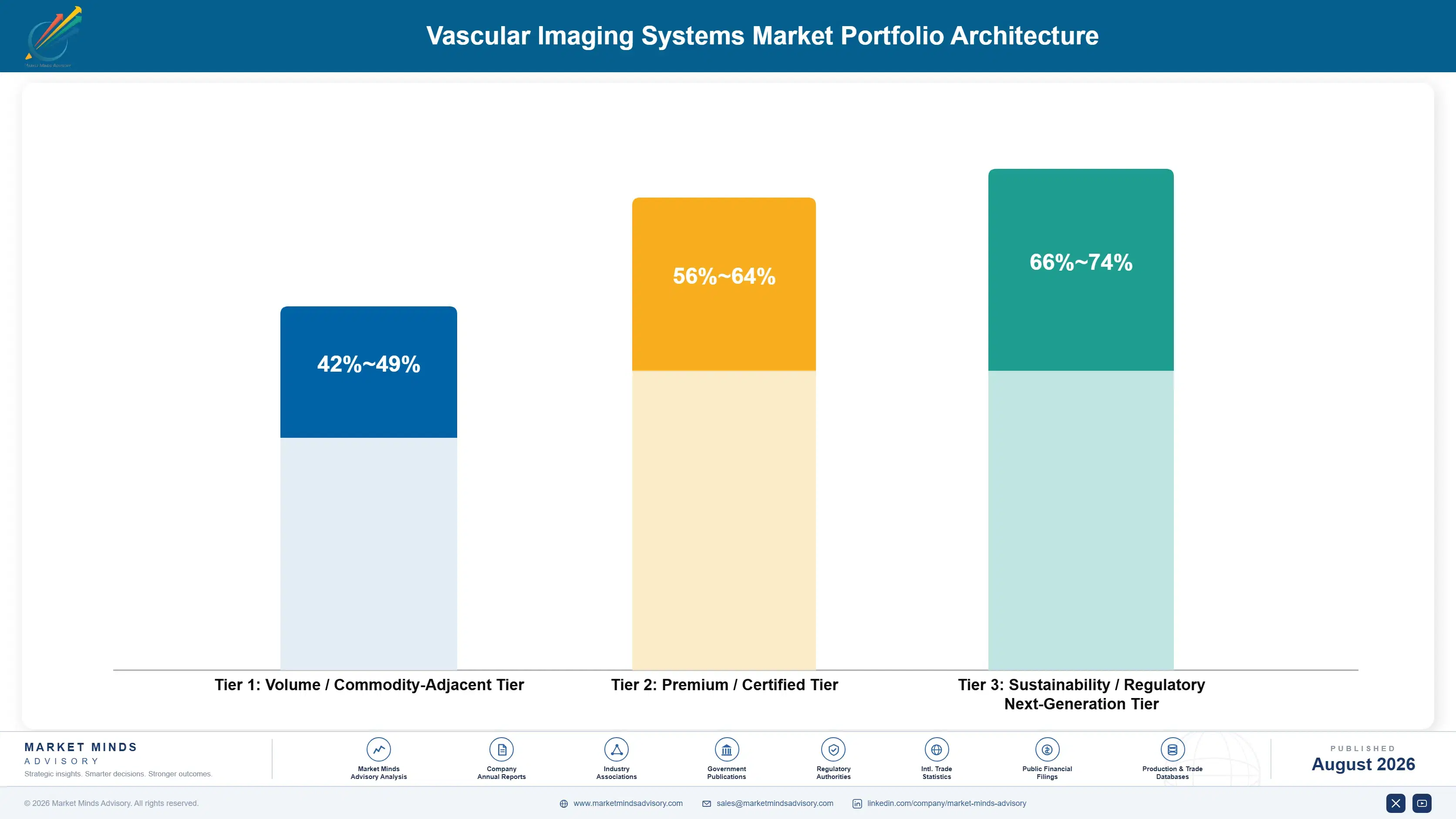
Portfolio Architecture for Margin Defence

The category's margin architecture separates into three tiers: volume-adjacent legacy angiography and standard IVUS systems carrying the thinnest margins around forty-five percent, hybrid IVUS-OCT combination platforms carrying stronger margins in the low sixties, and intravascular OCT-only systems commanding the highest prices and margins as resolution advantage evidence continues to strengthen across the interventional cardiology base. This tiering broadly mirrors how procurement committees ev
Manufacturers face a persistent tension between defending standard IVUS volume, which remains familiar to a large cohort of established interventionalists, and pushing hospitals toward premium OCT platforms that carry meaningfully better unit economics but require additional physician training investment to sell effectively across busy cath lab practices nationwide. Hospital value-analysis committees increasingly scrutinize this trade-off during annual vendor contract renewal negotiations.

High-value margin pools concentrate specifically in intravascular OCT systems and their associated disposable catheter and service revenue, where imaging resolution and recurring consumable fees combine to lift blended margins well above the standard IVUS baseline across the broader portfolio and installed base this forecast period. Manufacturers investing early in this convergence stand to capture disproportionate long-term value.

Volume / Commodity-Adjacent Tier

Legacy vascular angiography and standard intravascular ultrasound systems sold primarily on established clinical track record and price competitiveness against newer OCT platforms entering the market. Community hospitals remain the primary buyer segment.
Gross Margin: 42-49%

Premium / Certified Tier

Hybrid IVUS-OCT combination systems carrying documented workflow efficiency evidence and broader physician familiarity than pure OCT platforms, positioned as the established middle tier across most academic hospital systems nationwide. Mid-sized hospitals unable to justify premium costs frequently select this tier.
Gross Margin: 56-64%

Sustainability / Regulatory / Next-Generation Tier

Intravascular OCT-only systems bundled with disposable catheter subscriptions and value-based contracting structures tied to documented revascularization outcomes across large hospital network populations and academic centers. Academic centers pursuing formulary consolidation lead adoption in this tier.
Gross Margin: 66-74%
vascular-imaging-systems-market-portfolio-architecture-1787310112447

High-value Sub-segments and Strategic Watch-out

Intravascular OCT Systems

The fastest-growing, highest-margin segment as hospitals increasingly specify OCT capability as a baseline procurement requirement nationwide. Manufacturers with cleared platforms are converting the installed base ahead of scheduled capital replacement, capturing premium pricing across academic center relationships. Payer coverage recognition continues expanding. across major reimbursement geographies.
Gross Margin: 64-70%

Hybrid IVUS-OCT Combination Systems

A large, established, high-margin segment benefiting from hospital procurement preference for reduced equipment footprint and simplified physician training across multiple imaging modalities and academic teaching programs nationwide. Manufacturers continue refining modality integration each product cycle to broaden adoption. Larger institutions lead early adoption of this complementary segment.
Gross Margin: 58-64%

Standard Intravascular Ultrasound Systems

A steady, mid-margin segment sold primarily on established track record and price competitiveness, facing gradual share erosion as OCT and hybrid platforms earn broader hospital procurement recognition across most major reimbursement geographies this period. Manufacturers continue defending price nationwide against OCT encroachment. Independent hospitals remain the primary buyers here.
Gross Margin: 44-50%

Legacy Vascular Angiography Systems

A shrinking legacy segment losing share to intravascular imaging platforms with superior resolution and workflow efficiency, though it retains a niche among smaller hospitals prioritizing lower upfront capital cost over precision imaging. Manufacturers continue serving this segment steadily where it remains cost-effective. Replacement demand persists among smaller facilities.
Gross Margin: 36-42%

Capital Cycle and Catheter Attachment Economics

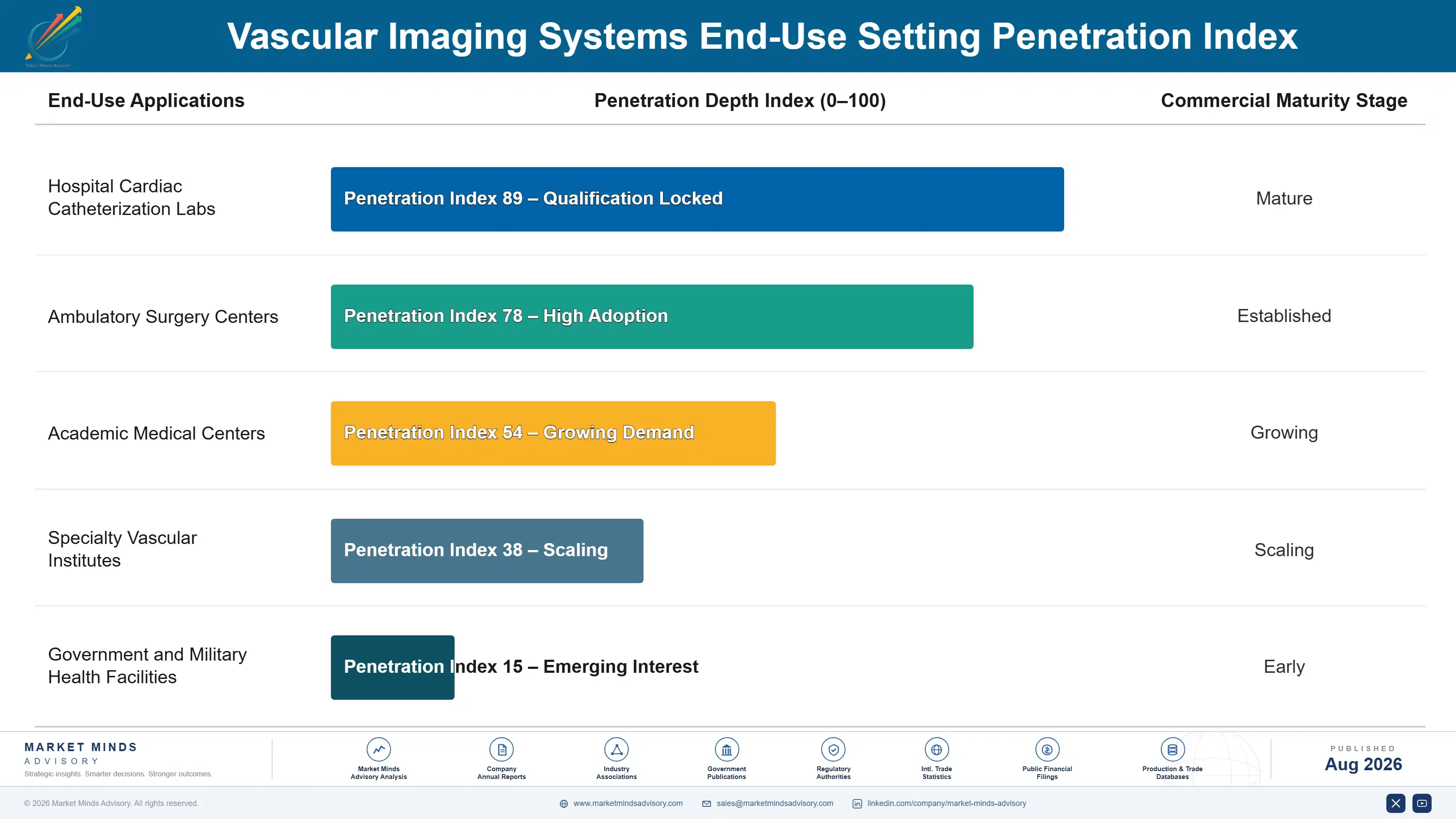
Revenue in this category behaves like a hybrid capital and consumable annuity once a hospital commits to an imaging platform: the initial console sale is followed by a predictable eight-year replacement cycle, periodic service and calibration contracts, and continuous disposable catheter consumption tied directly to interventional procedure volume rather than console pricing alone. This recurring structure gives manufacturers meaningful revenue visibility beyond the initial capital sale.
Adoption depth varies meaningfully by clinical vertical. Interventional cardiology programs show the deepest, most consistent OCT adoption, while peripheral vascular programs adopt more selectively, reserving intravascular imaging for higher-complexity cases after exhausting simpler angiography-guided options already familiar to their staff. Rehabilitation-adjacent specialties represent a smaller but growing referral source as awareness of intravascular imaging expands beyond traditional interventional cardiology into broader vascular medicine practice.

A generational shift in buyer profile is underway as younger interventionalists trained during the OCT era default to evidence-based platform selection, while an older cohort trained on legacy angiography-only technique shows more brand loyalty rooted in decades of prior clinical familiarity and established referral relationships. Manufacturers increasingly tailor sales approaches differently across these two distinct physician cohorts to maximize conversion.
vascular-imaging-systems-market-end-use-penetration-index-1787310112938

Where Imaging Makers Should Focus

These are among the four positions where our research anticipates prominent divergence between winners and laggards over the coming forecast period. Each is grounded in the demand model, the regulatory perimeter, and the announced capacity pipeline.
01 / INTRAVASCULAR OCT INVESTMENT

OCT capability is becoming table stakes, not a differentiator, within four years.

Three of five leading manufacturers already offer OCT-capable platforms as their flagship interventional offering, and two smaller competitors have systems entering trials in 2026 across expanded peripheral applications. Manufacturers still selling purely IVUS-only systems by 2029 will find themselves competing only on price against platforms with stronger comparative outcomes evidence backed by multi-site studies at major academic centers. The investment case for OCT has moved from optional differentiation to a defensive necessity for defending cath lab contract position nationwide across most major reimbursement geographies.
02 / CATHETER PORTFOLIO STRATEGY

Disposable catheter revenue can outgrow console hardware margin over time.

Disposable imaging catheters priced around $850 per procedure represent the largest recurring revenue stream in the category and increasingly determine which console platform a hospital standardizes on across its interventional service lines and physician training programs. Hospitals with higher OCT attach rates generate meaningfully higher catheter revenue per cath lab annually than those relying primarily on standard angiography guidance across comparable case volumes. Manufacturers building deeper catheter relationships now will lock in account loyalty before console-only competitors catch up nationwide.
03 / VALUE-BASED CONTRACT STRATEGY

Early value-based agreements set precedent for pricing long-term risk.

Siemens Healthineers's January 2026 value-based agreement with a regional hospital network ties pricing explicitly to documented revascularization outcomes, a structure other manufacturers and hospital systems are watching closely this budget cycle across the industry. Manufacturers with strong outcomes data have the most to gain from moving early into similar contracts ahead of competitors. Those with weaker outcomes data risk being locked out of preferred hospital network status as these agreements proliferate nationwide over the next several years across most major reimbursement geographies.
04 / COMPONENT SUPPLY RESILIENCE

Dual-sourcing critical fiber optics is now a competitive requirement.

The 2021 to 2022 fiber optic component disruption showed clearly that single-sourced manufacturers faced longer production delays than dual-sourced competitors, directly affecting their ability to fulfill hospital orders during a period of strong underlying demand growth nationwide across most geographies. Smaller manufacturers without the purchasing scale to negotiate dual-sourcing agreements remain more exposed to future disruptions. This supply resilience gap increasingly factors into hospital value-analysis committee vendor selection alongside clinical evidence and pricing considerations across most major reimbursement geographies and hospital systems.

Engagement Snapshot From the Field

A live engagement with an industry participant carrying material or product regulatory and market exposure ahead of a defining policy shift, showing how our research translates into a defensible multi-year portfolio strategy.
MARKET MINDS ADVISORY · CLIENT ENGAGEMENT SUMMARY
Vascular Imaging Systems Producer Strategic Portfolio Review and Transition Roadmap 2026·Investment Scenario on Vascular Imaging Systems Exposure Evaluation 2025-26
CLIENT PROFILE
The client is a regional cardiovascular center operating three cath labs across a multi-hospital health system, performing several thousand percutaneous coronary and peripheral interventions annually. The center's value-analysis committee had flagged rising intravascular imaging capital and catheter spend as a category requiring closer review ahead of its next annual capital budgeting cycle, prompting the engagement.
STRATEGIC CHALLENGE
The center needed to rationalize its imaging platform formulary, which had grown to include three separate manufacturer consoles across different cath labs, without disrupting existing interventionalist workflows or ongoing case volume. Leadership also wanted a defensible framework for evaluating OCT-capable platforms against the IVUS-only systems already in wide use across the center.
MMA APPROACH
MMA conducted structured interviews with the center's interventionalists and value-analysis committee members, benchmarked platform pricing and outcomes data against comparable regional cardiovascular centers, and modeled the total cost of ownership across a three-year formulary consolidation scenario. The analysis incorporated both published comparative-effectiveness literature and center-specific procedural outcomes data by physician.
KEY FINDINGS
  1. Revascularization-related costs accounted for a larger share of the center's total category spend than console acquisition cost alone, reshaping the committee's prioritization framework (client-reported, unverified by MMA).
  2. Consolidating from three platforms to two preferred vendors was projected to reduce annual device spend meaningfully while preserving physician choice across most case volume (client-reported, unverified by MMA).
  3. OCT platform adoption among the center's interventionalists correlated with measurably fewer target lesion revascularization procedures compared with angiography-only guidance still in use.
  4. Interventionalists newly trained through manufacturer-sponsored proctorship programs showed measurably higher confidence interpreting OCT imaging than those relying on informal peer instruction alone.
CLIENT PROFILE
The client is a regional cardiovascular center operating three cath labs across a multi-hospital health system, performing several thousand percutaneous coronary and peripheral interventions annually. The center's value-analysis committee had flagged rising intravascular imaging capital and catheter spend as a category requiring closer review ahead of its next annual capital budgeting cycle, prompting the engagement.
STRATEGIC CHALLENGE
The center needed to rationalize its imaging platform formulary, which had grown to include three separate manufacturer consoles across different cath labs, without disrupting existing interventionalist workflows or ongoing case volume. Leadership also wanted a defensible framework for evaluating OCT-capable platforms against the IVUS-only systems already in wide use across the center.
MMA APPROACH
MMA conducted structured interviews with the center's interventionalists and value-analysis committee members, benchmarked platform pricing and outcomes data against comparable regional cardiovascular centers, and modeled the total cost of ownership across a three-year formulary consolidation scenario. The analysis incorporated both published comparative-effectiveness literature and center-specific procedural outcomes data by physician.
KEY FINDINGS
  1. Revascularization-related costs accounted for a larger share of the center's total category spend than console acquisition cost alone, reshaping the committee's prioritization framework (client-reported, unverified by MMA).
  2. Consolidating from three platforms to two preferred vendors was projected to reduce annual device spend meaningfully while preserving physician choice across most case volume (client-reported, unverified by MMA).
  3. OCT platform adoption among the center's interventionalists correlated with measurably fewer target lesion revascularization procedures compared with angiography-only guidance still in use.
  4. Interventionalists newly trained through manufacturer-sponsored proctorship programs showed measurably higher confidence interpreting OCT imaging than those relying on informal peer instruction alone.
RECOMMENDED STRATEGY
Phase 1: Phase 1 (Months 1-3): Complete a center-wide device utilization and outcomes audit across all three existing platforms to establish a defensible baseline. Phase 2: Phase 2 (Months 4-8): Negotiate consolidated preferred-vendor agreements with two manufacturers, incorporating value-based pricing terms tied to documented clinical outcomes. Phase 3: Phase 3 (Months 9-14): Implement a phased transition plan for existing platforms approaching replacement, prioritizing OCT-capable migration where clinically appropriate.
OUTCOME
The center adopted a two-vendor preferred formulary within eight months of the engagement's conclusion, incorporating value-based pricing terms for a portion of its annual device volume. Leadership reported improved budget predictability heading into the following capital cycle and stronger negotiating leverage in subsequent vendor renewal discussions (client-reported, unverified by MMA).

Frequently Asked Questions

Foundational context covering the market sizes, CAGR, scope, country, region and competition that inform every finding below. This section is provided to cover basics and most often pre-purchase conversations, answered from the MMA Primary Research Dataset.

What is the current size of the Vascular Imaging Systems Market?

The market stood at USD 2.6 billion in 2025, based on MMA Primary Research Dataset findings. Intravascular OCT adoption is the primary driver of accelerating system revenue growth.

How large will the Vascular Imaging Systems Market be by 2036?

MMA projects the market will reach USD 6.58 billion by 2036 under the base case scenario, representing roughly 2.33 times the 2026 opening value across the eleven-year forecast period.

What is the CAGR for the Vascular Imaging Systems Market 2026 to 2036?

The base case CAGR is 8.8% annually. MMA's bull scenario reaches 10.1% while the bear scenario, reflecting mid-sized hospital capital budget constraints, runs closer to 7.5% over the forecast period.

Which segment is growing fastest?

Intravascular OCT systems lead at 13.2% CAGR, roughly 1.5 times the overall market rate, as sub-cellular resolution earns broader interventionalist and procurement committee preference now.

Who are the major companies in the Vascular Imaging Systems Market?

Philips, GE HealthCare, Siemens Healthineers, Canon Medical, and Boston Scientific lead the market, together controlling an estimated 69% of global revenue on a consistent basis.

Which country is growing fastest?

China posts the fastest national growth at 12.8% CAGR, driven by expanding cath lab infrastructure and rising interventional cardiology procedure volume. Domestic manufacturers are also gaining share in lower-tier hospitals.

Report Segmentation Architecture

The full report scope spans multiple orthogonal segmentation dimensions, with cross-tabulated demand data provided for each dimension pair. Coverage extends further to regional breakdowns, trend trajectories, and the competitive detail needed to support segment-level decision-making.

By Imaging Technology

  • Intravascular OCT Systems
  • Hybrid IVUS-OCT Combination Systems
  • Standard Intravascular Ultrasound Systems
  • Legacy Vascular Angiography Systems
  • Vascular Ultrasound Duplex Systems
  • Intravascular Photoacoustic Imaging Systems

By End-Use Setting

  • Hospital Cardiac Catheterization Labs
  • Ambulatory Surgery Centers
  • Academic Medical Centers
  • Specialty Vascular Institutes
  • Government and Military Health Facilities

By Clinical Application

  • Coronary Artery Disease Intervention
  • Peripheral Artery Disease Intervention
  • Carotid Artery Stenosis Assessment
  • Structural Heart Intervention

By Region

  • North America
  • Western Europe
  • East Asia
  • South Asia and Pacific
  • Latin America
  • Middle East and Africa
  • Eastern Europe

Scope, Methodology, and Coverage

Every figure in this report is reproducible from documented input assumptions. The scope below maps the historical period, the forecast horizon, the segmentation dimensions, and the countries covered, alongside the underlying primary and qualitative methodology.
Historical Period
2020 to 2025
Forecast Period
2026 to 2036
Base Year
2025 (USD billions; MMA Primary Research Dataset, August 2026)
Market Definition
This market covers imaging systems used to visualize vascular anatomy and guide interventional procedures, including intravascular ultrasound, intravascular optical coherence tomography, vascular ultrasound, and vascular angiography systems. It excludes general-purpose diagnostic ultrasound platforms, standalone MRI and CT scanners, and the guidewires and catheters used alongside these systems.
Quantitative Units
USD billions (current prices); unit system placements where applicable
Segmentation Dimensions
By Imaging Technology; By End-Use Setting; By Clinical Application; By Region
Regions Covered
North America, Western Europe, East Asia, South Asia and Pacific, Latin America, Middle East and Africa, Eastern Europe
Countries Covered
USA, China, Germany, France, UK, Japan, South Korea, India, Australia, Canada, Brazil, Mexico, Indonesia, Vietnam, Thailand, Malaysia, UAE, Saudi Arabia, South Africa, Nigeria, Turkey, Poland, Netherlands, Italy, Spain, Sweden, Switzerland, Argentina, Colombia, Singapore, and additional markets relevant to this sector
Key Companies Profiled
Koninklijke Philips N.V., GE HealthCare Technologies Inc., Siemens Healthineers AG, Canon Medical Systems Corporation, Boston Scientific Corporation, Abbott Laboratories, Terumo Corporation, Shimadzu Corporation, Fujifilm Healthcare Corporation, Esaote S.p.A., Samsung Medison Co. Ltd., Mindray Medical International Limited, SonoScape Medical Corp., Chison Medical Technologies Co. Ltd., Konica Minolta Inc., Analogic Corporation, Infraredx Inc., Opsens Inc., Hologic Inc., Carestream Health Inc.
Quantitative Methodology
Primary survey, n=3,800 respondents, Q4 2025, six countries; demand-side model with trade association cross-validation
Qualitative Methodology
47 expert interviews, Q4 2025; applied to validate demand model assumptions, identify emerging dynamics, and assess competitive positioning
Report Format
PDF and XLSX data workbook (Word format preview document)
Publisher
Market Minds Advisory
Report Code
MMA-2026-MED-126
Published
August 2026
Contact
sales@marketmindsadvisory.com | www.marketmindsadvisory.com

Purchase the full Vascular Imaging Systems Market Report (2026 to 2036).

The full report provides a complete competitive and commercial analysis of the global vascular imaging systems market, including detailed segmentation by imaging technology, end-use setting, and clinical application. It profiles twenty manufacturers across established and emerging platform technologies, with country-level sizing across thirty individual markets worldwide. The report includes capital budgeting trend tracking across major hospital systems and a value-based contracting outlook through 2036. Buyers receive full access to the underlying primary survey and expert interview datasets referenced throughout the analysis and appendices. It also includes a dedicated OCT technology comparison section.
Country-level market sizing through 2036 forecast
Twenty-company competitive profiling and moat analysis
Capital budgeting trend tracking across hospital systems
Intravascular OCT technology roadmap and outlook
Value-based contracting case examples and precedent
Primary survey and expert interview datasets included

Built For The People Who Decide

From boardroom strategy to bench-side execution, this report is read cover-to-cover by leaders shaping the next decade of their industry, turning demand scenarios, market dynamics and valuation benchmarks into decisions.
CXOs/ Presidents/ VPs/ Managers
M&A and Corporate Development
Strategy Teams and R&D Heads
Procurement and Product Directors
Regulatory and Compliance Leaders
Investor Relations and Equity Analysts