Market Minds Advisory
Varicose Veins Treatment Devices Market

Varicose Veins Treatment Devices Market: Identical Closure Rates, Divergent Patient Experience and a Physician Who Owns the Clinic

All three main endovenous techniques close veins at roughly the same rate after twelve months, so competition runs entirely on how many needle sticks the patient endures rather than on any clinical outcome.

Lead Analyst

Alice Ballenger

Published

September 2026

Make Smarter Decisions with Customized Research Insights

Request a free sample report and evaluate market opportunities, growth trends, and competitive dynamics relevant to your business needs.

2025 MARKET VALUE$1.4BMarket Size 2025
2036 FORECAST VALUE$2.9BBase Case , 2026 to 2036
CAGR 2026 TO 20366.6 %Bull 7.8% / Bear 5.4%
INCREMENTAL OPPORTUNITY$1.4BNet 10- year value creation
EXPANSION MULTIPLE1.89x2036 value over 2026 base
Strategic Levers
M&A Pipeline
Regional Outlook
Country Rankings
Competitive Intelligence
Segmental Deep-dive
Call-Us : 91 93563 13602

Executive Snapshot and Market Trajectory

This is the only vascular procedure where the patient frequently chooses the treatment, pays part of the bill and cares what the leg looks like afterwards. It behaves like an aesthetics market wearing a vascular label, and the commercial rules follow from that rather than from the vascular literature.
The three main endovenous techniques close veins at roughly 94% after twelve months, which is close enough that no clinician argues efficacy any more. Competition therefore runs on experience. Thermal ablation requires tumescent anaesthesia delivered through multiple needle sticks along the leg, and cyanoacrylate adhesive requires none, which is why it grows at 9.9%, half again the market rate of 6.6%, despite costing more. Mechanochemical ablation follows at 8.4% on the same logic.
Concentration sits at 64% of procedure volume and the buyer is unusual. Roughly 46% of procedures happen in physician owned clinics, so the device purchase is a capital decision taken by the same person who decides which patients get treated. Around 38% of treatments are funded partly or wholly privately, because most reimbursement systems demand documented symptoms and a three month compression trial first.
Market Definition
Devices and consumables used to treat varicose veins and superficial venous reflux, covering endovenous radiofrequency ablation systems, endovenous laser ablation systems, cyanoacrylate adhesive closure systems, mechanochemical ablation systems, sclerotherapy delivery products, and surgical stripping and phlebectomy instruments. Measured at manufacturer selling value including capital and disposables. Compression garments, deep venous intervention devices, diagnostic ultrasound systems and pharmaceutical venoactive agents are excluded.
Base Year Value
$1.4B in 2025 (MMA Primary Research Dataset, August 2026)
Forecast Period
2026 to 2036, eleven discrete annual values
CAGR
6.6% base case. Bull 7.8%. Bear 5.4%.
Fastest Growth Segment
Cyanoacrylate Adhesive Closure Systems: 9.9% CAGR
Fastest Growth Country
Turkey: 12.8% CAGR
Fastest Growth Region
South Asia and Pacific: 8.8% CAGR
Largest Region
East Asia: 28% of 2025 global value
Market Leaders
Medtronic, Boston Scientific, AngioDynamics, Merit Medical Systems, Becton Dickinson. Source: MMA Primary Research Dataset, July 2026.
Primary Survey
n=3,800 procurement and R&D decision-makers, Q4 2025, six countries
Methodology
Demand-side build-up, cross-validated against public data, 47 expert interviews

Varicose Veins Treatment Devices Market Forecast Scenarios

varicose-veins-treatment-devices-market-size-forecast-scenario-1787641332984
The five years to 2025 completed a transition that had been running for two decades. Surgical stripping fell to a small residual share as endovenous techniques took the volume, and the last guidelines recommending surgery first were revised. Volumes were interrupted during the pandemic, since this treatment is deferrable by definition, then recovered. The 5.6% historical rate reflects substitution rather than any growth in disease.
The 6.6% base case rests on three mechanisms. Non thermal non tumescent techniques continue displacing thermal ablation on patient experience rather than on outcome, and they carry higher device revenue per leg. Physician owned clinic formation continues in markets that permit it, and each new clinic is a capital placement followed by years of disposable purchasing. And treatment rates in East Asia remain far below prevalence, with endovenous capability spreading through provincial and regional hospitals steadily.
The 7.8% bull case turns on reimbursement systems dropping the compression trial requirement, which currently delays or deters a large share of symptomatic patients before any device is used. The 5.4% bear case is the reverse: tighter documentation requirements would push more procedures into a self pay channel that is genuinely price sensitive and shrinks in a weak economy.

Where Patient Experience Outranks Clinical Outcome

Efficacy stopped being a differentiator years ago. Radiofrequency ablation, laser ablation and cyanoacrylate adhesive closure all achieve vein closure in roughly 94% of cases at twelve months, with differences that trials struggle to detect and clinicians have stopped arguing about. What separates them is the hour the patient spends on the table and the fortnight afterwards, and that is a genuinely different competitive question.
TOP FIVE CONCENTRATION64%Combined procedure volume served by leading device suppliers
TWELVE MONTH CLOSURE RATE94%Vein closure achieved across all main endovenous techniques
SELF PAY PROCEDURE SHARE38%Portion of treatments funded partly or wholly privately
DISPOSABLE COST PER LEGUSD 640Typical consumable cost for treating one affected limb
PHYSICIAN OWNED CLINIC SHARE46%Proportion of procedures performed in physician owned settings
COMPRESSION TRIAL REQUIREMENT3 monthsConservative therapy period usually demanded before reimbursement approval
Tumescent anaesthesia is the reason. Thermal techniques heat the vein and require a cuff of dilute local anaesthetic injected along its length to protect surrounding tissue, which means anything from ten to twenty needle sticks down a leg. Cyanoacrylate adhesive needs none, mechanochemical ablation needs almost none, and patients notice. That single procedural difference explains the entire growth pattern of this market.
The buyer is unusual too. Around 46% of procedures happen in physician owned vein clinics, so the person choosing the device is also the person deciding which patients get treated and the person carrying the capital cost. Disposables run near 640 dollars a leg, and roughly 38% of treatments are funded privately because reimbursement typically demands documented symptoms and a three month compression trial.
"Nobody in this market has won a share point on closure rates for a decade. They win them on whether the patient tells three friends the procedure was uncomfortable, which is not a sentence most vascular device companies are built to hear."
Director, Interventional Devices and Ambulatory Procedures Practice · MMA Medical Devices and Diagnostics Practice · August 2026

Market Trends

Non Thermal Techniques Win on Needles, Not on Outcomes

Cyanoacrylate adhesive closure grows at 9.9% against a market rate of 6.6% and mechanochemical ablation at 8.4%, and neither offers a better twelve month closure rate than thermal ablation does. What they offer is the removal of tumescent anaesthesia, which means the patient avoids ten to twenty needle sticks along the leg during a procedure they are awake for. Device cost per leg runs higher and clinics charge accordingly, particularly in the self pay segment where the patient is choosing. Manufacturers still leading with efficacy data are competing in an argument that finished years ago.
Market Impact: Self pay covers 38% of procedures

Physician Owned Clinics Change How Devices Get Bought

Roughly 46% of procedures now take place in physician owned vein clinics rather than in hospitals, and that changes the purchase entirely. The clinician choosing the device also carries the capital cost, sets the patient schedule and captures the procedure margin, which makes the decision commercial in a way a hospital purchase never is. Payback period matters more than specification, disposable cost per leg matters enormously, and marketing support that fills the appointment book carries real weight. Companies selling into hospital value analysis committees have found this a genuinely different conversation.
Market Impact: Regional volume grows 7.6% yearly

Market Opportunities and Growth Drivers

Self Pay Demand Behaves Like Aesthetic Purchasing

Roughly 38% of treatments are funded partly or wholly by the patient, because most reimbursement systems require documented symptoms and a failed conservative trial before approving anything. That produces a large population who want treatment, cannot easily qualify, and will pay for it. Those patients choose on comfort, downtime and cosmetic result rather than on closure rates they cannot evaluate, and they respond to clinic marketing the way aesthetic patients do. Device selection follows what the clinic can advertise, which is why the least uncomfortable technique commands a premium. Clinics advertise exactly that difference.
Market Impact: Delays treatment by 3 months

East Asian Treatment Rates Remain Far Below Prevalence

Varicose vein prevalence in East Asian populations is substantial and treatment rates sit far below what Western markets record, largely because endovenous capability has been concentrated in major urban hospitals rather than distributed. That is changing as provincial and regional hospitals acquire equipment and train operators, and each new site converts patients who previously received compression advice or nothing at all. Regional growth of 7.6% reflects volume expansion rather than pricing, since procedure values sit well below Western equivalents. Domestic device manufacture is developing alongside, which will compress pricing further.
Market Impact: Recurrence affects 22% within five years

Market Restraints and Challenges

Compression Trial Requirements Delay or Deter Treatment

Most reimbursement systems require documented symptoms and a conservative therapy trial of around three months in compression stockings before approving any intervention, and a meaningful share of patients never return afterwards. The root cause is a payer view that varicose vein treatment sits close to cosmetic, and the requirement is designed to filter rather than to treat. Commercially it pushes patients into self pay or out of the market entirely. Manufacturers respond by supporting clinics with documentation systems and by building evidence on ulceration and progression, which is the argument that moves payers.
Market Impact: Adhesive closure grows 9.9% annually

Recurrence Undermines the Case for Premium Devices

Varicose veins recur in a substantial minority of treated patients within five years, through neovascularisation and progression in untreated tributaries rather than through failure of the original closure. The root cause is that the underlying venous insufficiency is progressive and no device addresses it. Commercially this makes it difficult to justify a premium technique on durability, since the recurrence rates converge regardless of what was used. Manufacturers respond by positioning around retreatment ease and by supporting surveillance protocols, which turns a weakness into a repeat procedure. Surveillance protocols turn recurrence into repeat revenue for somebody.
Market Impact: Serves 46% of procedure volume
3 additional market trends, 4 additional growth drivers, and 2 additional restraints and challenges are covered in the full report. Contact sales@marketmindsadvisory.com to access the complete intelligence.

Segment CAGR and Growth Architecture

Segmentation follows treatment technology, since technology decides the patient experience, the disposable cost and the capital required. Six technologies cover the field, from surgical stripping in retreat to adhesive closure requiring no anaesthetic at all. Growth sits entirely with techniques that remove needles from the procedure rather than with anything improving outcomes. Efficacy stopped mattering years ago.
varicose-veins-treatment-devices-market-market-share-analysis-1787641333657

Cyanoacrylate Adhesive Closure Systems

A medical adhesive delivered through a catheter to seal the incompetent vein mechanically rather than by heating it, which removes the need for tumescent anaesthesia entirely. At 9.9% this is the fastest growing technology in the market, half again the market rate of 6.6%, and it achieves closure rates around 94% at twelve months, statistically indistinguishable from thermal ablation. The advantage is procedural comfort: no cuff of anaesthetic injected along the leg, no thermal injury risk, and patients frequently walk out without compression stockings. Disposable cost per leg runs well above thermal alternatives and clinics recover it readily in the self pay segment where patients choose. Patent protection is what holds that pricing in place.
CAGR 9.9%

Mechanochemical Ablation Systems

A rotating catheter tip that abrades the vein wall while sclerosant is infused, achieving closure without heat and therefore without tumescent anaesthesia. Growth of 8.4% is second fastest in the market, on the same patient experience logic that drives adhesive closure, with a lower device cost per leg that appeals to clinics working within reimbursed pricing. Closure rates sit slightly below thermal and adhesive techniques in several published series, which matters more to payers than to patients. The technique also avoids leaving a permanent implant in the vein, which some clinicians and some patients prefer for reasons that are largely intuitive. Clinics working inside reimbursed pricing find the cost per leg easier to justify.
CAGR 8.4%
Full segment breakdown across 6 segments available in the complete report.

Regional Architecture and Country Demand Map

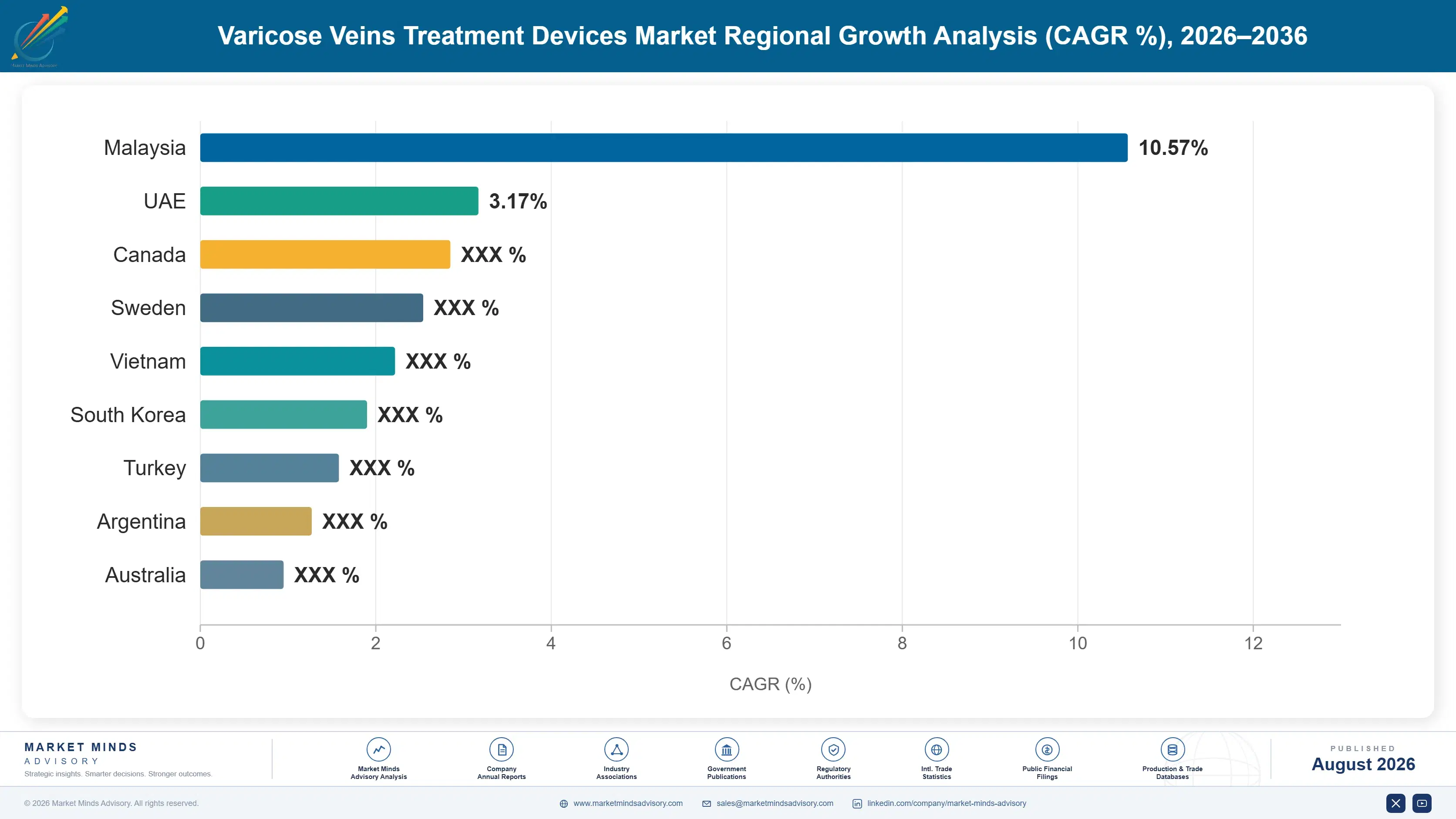
East Asia holds the largest share at 28% on procedure volume rather than on price, with treatment rates rising fast from a low base. North America follows at 27% with far higher value per procedure. Western Europe trails on reimbursement restriction and conservative guidance. Turkey grows fastest of any country.

East Asia

Volume rather than value gives this region its 28% share, and the distinction matters commercially. Chinese procedure numbers are large and rising quickly as provincial and regional hospitals acquire endovenous capability that was previously concentrated in major urban centres, though the value per procedure sits well below Western equivalents and domestic manufacturers are compressing it further. Japanese practice is technically sophisticated with reimbursement covering endovenous ablation, and adoption of non thermal techniques has been notably quick. South Korean private clinics behave much like American physician owned practices, with a substantial self pay component and heavy patient facing marketing. Growth of 7.6% is led by Chinese capability spread. Domestic manufacture will compress pricing further.
Share: 28% | CAGR: 7.6% (2026 to 2036)

North America

Value per procedure rather than volume explains this 27% share. American reimbursement pays for endovenous ablation where documentation supports medical necessity, and the procedure prices well above equivalents anywhere else, which is why the region carries more revenue than its procedure count implies. Physician owned vein clinics are most developed here and account for a large share of volume, buying capital equipment on payback arithmetic rather than through hospital committees. Roughly 38% of treatments involve some patient payment, driven by the compression trial requirement filtering formal approvals. Canadian provincial coverage is narrower and pushes correspondingly more volume into private clinics. Adhesive closure adoption here has been quicker than anywhere else covered, driven by that self pay component.
Share: 27% | CAGR: 6.0% (2026 to 2036)
Regional intelligence for 5 additional markets available in the complete report: Western Europe, South Asia and Pacific, Latin America, Middle East and Africa, Eastern Europe. Contact sales@marketmindsadvisory.com.
varicose-veins-treatment-devices-market-country-cagr-analysis-1787641334249

Where Share Is Actually Won

Nobody wins on closure rates, which converge across every endovenous technique at around 94%. Value accrues to whoever removes needles from the procedure, whoever sells capital on payback arithmetic to a physician owner, and whoever helps a clinic fill its appointment book. Four routes carry weight, and none of them is a clinical argument.

Compete on Needle Count, Not on Closure Rates

All three main endovenous techniques close roughly 94% of veins at twelve months, so efficacy has not moved a share point in a decade. Tumescent anaesthesia requires ten to twenty injections along the leg during a procedure the patient is awake for, and removing that is what cyanoacrylate adhesive sells at 9.9% growth against a market rate of 6.6%. Clinics recover the higher disposable cost readily in the self pay segment, where the patient is choosing. Manufacturers still leading with trial data are answering a question the market settled years ago.
Market Impact: Grows 9.9% simply by removing every single needle

Sell Capital to the Physician Who Owns the Clinic

Roughly 46% of procedures happen in physician owned vein clinics, where the clinician carrying the capital cost is also the person scheduling patients and capturing procedure margin. That decision runs on payback period and disposable cost per leg near 640 dollars rather than on specification, and it closes in weeks where a hospital committee takes quarters. Placement programmes, flexible financing and marketing support that fills the appointment book carry more weight than any technical claim. Companies organised around hospital selling have found this a genuinely different commercial motion. Payback arithmetic decides everything here.
Market Impact: Reaches the 46% of clinic owned procedure volume

Build the Self Pay Proposition Deliberately

Roughly 38% of treatments involve patient payment because reimbursement systems demand documented symptoms and a three month compression trial that many patients never complete. Those patients choose on comfort, downtime and cosmetic result, and they respond to clinic marketing exactly as aesthetic patients do. Supporting clinics with patient facing material, before and after documentation and financing options reaches demand that no reimbursement decision will ever release. It is also the segment where a premium technique can be priced properly, since nobody is negotiating against a fee schedule. Nobody negotiates against a fee schedule.
Market Impact: Addresses the 38% self pay share of procedures

Follow Endovenous Capability Into Provincial Hospitals

East Asian treatment rates sit far below prevalence because endovenous capability has been concentrated in major urban hospitals, and provincial and regional facilities are now acquiring it. Each new site converts patients who previously received compression advice or nothing, and regional growth runs at 7.6% on that mechanism. Value per procedure is well below Western levels and domestic manufacturers are compressing it further, so this is a volume position rather than a margin one. Training and operator proficiency support decides who takes those placements more than pricing does. Volume rather than margin is the prize.
Market Impact: Captures the 7.6% regional procedure volume growth rate

Who Controls the Margin Pool

Concentration is moderate and technology specific. The top five serve 64% of procedure volume and associated device revenue, the basis applied consistently here, though leadership differs sharply by technique and no company leads across all of them. Medtronic holds the strongest position in adhesive closure, which is the fastest growing technology, and the distance to challengers there reflects intellectual property and clinical evidence accumulated ahead of anyone else.
Competition runs on three fronts that reward different capabilities. Thermal ablation is a mature contest fought on generator pricing, catheter cost per leg and service response, where hospitals and clinics negotiate hard. Non thermal techniques compete on patient experience claims and on the marketing support a clinic can use directly. Sclerotherapy and surgical instruments are commodity businesses where price and availability decide almost everything.

Rankings will shift as adhesive closure patents expire and comparable products enter, which several manufacturers are positioning for openly. Cost per leg would fall sharply and the premium that funds current growth would compress. The other pressure point is Chinese domestic manufacture, which is developing endovenous capability for a market whose procedure volumes already exceed North American ones.
varicose-veins-treatment-devices-market-company-positioning-matrix-1787641334821

Competitive Moat and Risk Dimensions

MEDTRONIC

Moat: Adhesive Closure Position

Leadership in cyanoacrylate adhesive closure covers the fastest growing technology in the market, supported by clinical evidence accumulated well ahead of competitors and by intellectual property that has kept comparable products out. Clinics that adopted the technique built patient facing propositions around it, which makes switching a marketing problem as much as a clinical one.
MEDTRONIC

Risk: Patent Expiry Exposure

The premium that funds adhesive closure growth depends substantially on limited competition, and comparable products are being positioned openly for entry as protection lapses. Cost per leg would fall sharply, and a technology whose advantage is patient comfort rather than outcome has little defence once an equivalent product offers the same experience at lower cost.
ANGIODYNAMICS

Moat: Clinic Channel Depth

Long standing relationships with physician owned vein clinics, which perform roughly 46% of procedures, give access to a buyer that hospital oriented competitors reach awkwardly. Those relationships include practice support, marketing material and financing arrangements that matter more to a clinic owner than technical specification does, and they are built over years of individual contact.
ANGIODYNAMICS

Risk: Thermal Technology Weighting

A portfolio weighted toward thermal ablation sits in the part of the market losing share to techniques that remove tumescent anaesthesia, growing at 5.2% for laser against 9.9% for adhesive closure. Defending on price in a mature technology while competitors sell patient comfort is a position that erodes slowly and continuously rather than collapsing.

Players Tracked

Prominent Players

Medtronic
Boston Scientific
AngioDynamics
Merit Medical Systems
Becton Dickinson

Other Key Players

Teleflex
Cook Medical
Biolitec
Alma Lasers
Lumenis
Sciton
Energist
F Care Systems
Eufoton
Intros Medical Laser
Dornier MedTech
Kreussler Pharma
STD Pharmaceutical Products
Bioteque Corporation
Shanghai Sunmed

Recent Developments

MARCH 2025

Comparative trial confirms equivalent closure across endovenous techniques

A multi centre comparative trial reported twelve month closure rates statistically indistinguishable across radiofrequency ablation, laser ablation and cyanoacrylate adhesive closure, with differences confined to procedural discomfort and recovery. Commercial teams across the sector shifted messaging toward patient experience, which several had already been doing informally for years.
Signal: Confirming equivalence removes the last technical argument and leaves patient comfort as the only differentiator remaining
JUNE 2025

Insurer tightens documentation requirements for venous ablation approval

A large health insurer tightened documentation requirements for endovenous ablation approval, extending conservative therapy evidence and requiring more detailed symptom recording before authorisation. Clinics reported a measurable shift of patients into self pay arrangements rather than any reduction in the number seeking treatment overall. Volumes did not fall at all.
Signal: Tightening approval moves patients into the self pay channel rather than removing them from the market
SEPTEMBER 2025

Turkish clinic group expands venous treatment capacity for medical tourism

A Turkish private clinic group expanded venous treatment capacity across several cities, targeting European patients whose home systems fund varicose vein intervention narrowly or not at all. The expansion specified adhesive closure and mechanochemical systems rather than thermal, on the basis of shorter recovery for travelling patients.
Signal: Medical tourism selects techniques by recovery time because the patient has a flight home to catch

What Treating One Leg Costs

Disposable content dominates the economics at roughly 640 dollars per limb treated. Catheter assemblies, introducer sheaths and the active agent, whether adhesive, sclerosant or optical fibre, account for about 54% of cost of goods, with sterile packaging and sterilisation adding a further 17%. Medical grade polymers and specialised adhesive chemistry come from a small number of qualified suppliers, mostly in Western Europe, the United States and Japan.
Medical grade polymer and adhesive component pricing moved sharply through the last five years. Cyanoacrylate monomer suitable for implantation is produced by very few manufacturers and demand rose across several device categories simultaneously. EIA petrochemical feedstock series show the underlying movement, and company annual reports across the device sector documented the resulting margin pressure. Sterilisation constraints added cost separately as ethylene oxide facility closures reduced availability.

Exposure divides by technology rather than by company size. Adhesive systems carry concentrated supply risk on a specialty monomer with almost no qualified alternative, while laser systems depend on optical fibre supply that is comparatively abundant. A manufacturer weighted toward adhesive closure therefore carries both the fastest growth and the tightest input position at once. Smaller clinic focused suppliers sit last in allocation whenever sterilisation capacity tightens.
varicose-veins-treatment-devices-market-cost-volatility-analysis-1787641335048

Qualify second sources for implantable adhesive monomer

Cyanoacrylate suitable for implantation comes from very few qualified producers, and requalifying a source requires biocompatibility and stability work across every market where the device is registered. Holding a second qualified supplier looks unnecessary until demand from another device category tightens availability. Manufacturers that qualified alternatives before the last squeeze maintained supply while competitors rationed allocation to their largest accounts.

Secure sterilisation capacity on multi year commitments

Ethylene oxide facility closures reduced regional sterilisation availability and pushed smaller device manufacturers to the back of allocation queues without warning. Multi year capacity commitments cost more per cycle and remove the risk of finished goods sitting unsterilised while a launch window passes. Electron beam suits some presentations and requires validation best completed before capacity becomes scarce.

Standardise catheter platforms across technique variants

Introducer sheaths, guidewires and catheter bodies are largely common across endovenous techniques, and manufacturers holding several technologies frequently build them separately for historical reasons. Consolidating onto shared platforms improves purchasing leverage on polymer components and reduces the number of separate validations to maintain. The engineering is unglamorous and the saving falls through to a disposable cost that decides clinic purchasing.

Portfolio Architecture for Margin Defence

Margin architecture follows how far a technology sits from tumescent anaesthesia. Surgical instruments and sclerotherapy products earn commodity margins, sold on price and availability with no differentiation available. Thermal ablation consumables earn moderately, in a mature contest where clinics negotiate catheter cost per leg hard. Adhesive closure earns the best margins in the market, on a patient experience advantage that competitors have not yet been able to match.
The tension is that the premium rests on exclusivity rather than on outcome. Adhesive closure prices well because comparable products have been kept out, not because it closes veins better, and equivalence has now been demonstrated in a multi centre trial. When protection lapses, cost per leg falls and the technique becomes a better mousetrap at a normal price. Planning around that is uncomfortable and unavoidable.

High value pools concentrate in non thermal disposables sold into physician owned clinics with a self pay component, where the patient chooses and nobody negotiates against a fee schedule. Everything sold into hospital procurement or reimbursed pricing is exposed to a cost per leg comparison the buyer runs carefully. Chinese domestic manufacture will compress that comparison further across the largest procedure market in the world.

Sclerotherapy and Surgical Instruments

Sclerosant delivery products, phlebectomy hooks and stripping instruments sold on price and availability with no meaningful differentiation available to anybody. Volume is declining as endovenous techniques take procedures and nothing reverses that trend.
Gross Margin: 24-27%

Thermal Ablation Systems and Catheters

Radiofrequency and laser generators with single use catheters, sold into a mature market where clinics negotiate cost per leg carefully. Margin holds on installed base pull-through rather than on any remaining technical differentiation between competing systems.
Gross Margin: 48-51%

Non Thermal Closure Systems

Adhesive and mechanochemical systems that remove tumescent anaesthesia entirely, priced on patient experience in a market where the patient frequently pays. Margin is the best available and depends on competing products remaining out rather than on outcome.
Gross Margin: 64-67%
varicose-veins-treatment-devices-market-portfolio-architecture-1787641335610

High-value Sub-segments and Strategic Watch-out

Cyanoacrylate Adhesive Closure Systems

The fastest growing technology at 9.9% and the best margin in the market, earned on removing every needle from the procedure rather than on closing veins better. That premium rests on competing products remaining out, and manufacturers are positioning openly for entry as protection lapses.
Gross Margin: 64-67%

Mechanochemical Ablation Systems

Second fastest at 8.4% on the same no anaesthetic logic at a lower device cost per leg, which suits clinics working inside reimbursed pricing. Closure rates sit marginally below thermal and adhesive in several series, which concerns payers considerably more than it concerns patients. Payers watch it carefully.
Gross Margin: 58-61%

Endovenous Radiofrequency Ablation

Growing at 6.8% and holding position better than laser, since generator installed base creates catheter pull-through that persists through technique preference shifts. Tumescent anaesthesia is the vulnerability, and no engineering change removes it from a thermal technique. Installed generators keep this alive longer than preference suggests.
Gross Margin: 48-51%

Surgical Stripping and Phlebectomy

Growing at only 1.2% and reduced to residual use in complicated anatomy and in systems where endovenous equipment is unavailable. Two decades of substitution have nearly completed, and the remaining volume sits in settings where capital equipment cannot be justified. Nothing will reverse two decades of substitution at this stage.
Gross Margin: 24-27%

How Clinic Demand Actually Repeats

Revenue here follows a capital placement rather than a procedure. A generator or delivery console placed in a clinic generates disposable purchasing at roughly 640 dollars per limb for as long as the clinic operates, and vein clinics operate for a long time. The placement happens once and consumable revenue recurs weekly, which is why equipment terms look generous read as an equipment sale.
Stickiness varies sharply by setting. Physician owned clinics that built a patient facing proposition around a specific technique almost never switch, because the marketing, the consent material and the reputation all reference it. Hospital departments retender on cycles and switch on cost per leg without much hesitation. Medical tourism clinics select on recovery time above everything, since a patient with a flight home has a constraint local patients do not.

The decision maker has moved a long way from the hospital. Purchases once ran through vascular surgery departments weighing specification against price. Roughly 46% of volume now sits with physician owners who evaluate payback period, disposable cost and whether the technique gives them something to advertise. Selling to a clinician who is also the business owner requires arguments most vascular device teams never learned.
varicose-veins-treatment-devices-market-end-use-penetration-index-1787641336169

Where This Market Rewards Focus

These are among the four positions where our research anticipates prominent divergence between winners and laggards over the coming forecast period. Each is grounded in the demand model, the regulatory perimeter, and the announced capacity pipeline.
01 / PATIENT EXPERIENCE POSITIONING

Nobody has won on closure rates for a decade

All three main endovenous techniques close roughly 94% of veins at twelve months and a multi centre comparative trial has now confirmed it, which leaves procedural discomfort as the only remaining differentiator in the category. Tumescent anaesthesia means ten to twenty injections along a leg during a procedure the patient is awake for, and removing that is what drives adhesive closure at 9.9% against a market rate of 6.6%. Companies still leading commercially with trial data are answering a question that the market settled years ago.
02 / CLINIC OWNER SELLING

The buyer signs the cheque and books the patient

Roughly 46% of procedures take place in physician owned vein clinics, where the clinician choosing the device also carries the capital cost, schedules the patients and captures the procedure margin from every case performed. That decision turns on payback period and disposable cost near 640 dollars a leg rather than on specification, and it closes in weeks where a hospital committee takes quarters. Placement terms, financing and marketing support that fills an appointment book carry more weight than any technical claim ever will.
03 / SELF PAY CHANNEL BUILDING

Payer restriction creates demand nobody is serving

Roughly 38% of treatments involve patient payment because reimbursement systems demand documented symptoms and a three month compression trial that many patients simply never complete. Those patients choose on comfort, downtime and cosmetic result, and they respond to clinic marketing exactly as aesthetic patients do rather than as vascular ones. It is also the only segment anywhere in this market where a premium technique can be priced properly, since nobody is negotiating it against a published fee schedule at all.
04 / PREMIUM EXPIRY PLANNING

The adhesive premium rests on exclusivity, not outcome

Cyanoacrylate adhesive closure earns the best margins in this market on a patient experience advantage rather than on any superior closure rate, and comparable products are being positioned openly for entry as protection lapses. Cost per leg falls sharply when that happens, and a technology whose only advantage is comfort has very little defence once an equivalent offers the same experience cheaper. Any plan built on current adhesive pricing needs a scenario for the year that changes, and few appear to have one.

Engagement Snapshot From the Field

A live engagement with an industry participant carrying material or product regulatory and market exposure ahead of a defining policy shift, showing how our research translates into a defensible multi-year portfolio strategy.
MARKET MINDS ADVISORY · CLIENT ENGAGEMENT SUMMARY
Varicose Veins Treatment Devices Producer Strategic Portfolio Review and Transition Roadmap 2026·Investment Scenario on Varicose Veins Treatment Devices Exposure Evaluation 2025-26
CLIENT PROFILE
An interventional device manufacturer supplying radiofrequency and laser endovenous ablation systems into hospital vascular departments across North America and Western Europe. Annual venous revenue was approximately 190 million dollars (client-reported, unverified by MMA), almost entirely from thermal technologies. No non thermal product existed and physician owned clinic accounts represented under 12% of volume. Hospital pricing had been eroding steadily.
STRATEGIC CHALLENGE
Volume had grown slowly for four years while adhesive closure took share in exactly the accounts the company considered secure. Management wanted to know whether to develop a non thermal product, acquire one, or defend thermal position on price. Nobody internally could explain why clinics were paying more for a technique with the same closure rate.
MMA APPROACH
MMA modelled procedure economics by setting and by technique, separating what a hospital department optimises from what a physician owner optimises. Patient choice research established what actually drives selection where a self pay component exists. Forty-seven expert interviews with vein clinic owners, hospital vascular surgeons and patients who had undergone treatment established how the decision is made and by whom at each stage.
KEY FINDINGS
  1. Clinic owners in 31 of the 47 interviews named procedural comfort as their primary technique selection criterion, and none named closure rate at all.
  2. Physician owned clinics closed capital decisions in a median of 5 weeks against 7 months for hospital committees, and negotiated far less aggressively on price.
  3. Patients with a self pay component chose adhesive closure at roughly 3 times the rate of fully reimbursed patients, indicating genuine willingness to pay for comfort.
  4. Thermal catheter pricing had eroded 19% over four years in hospital accounts while clinic pricing had held, confirming that channel rather than technology drove margin.
CLIENT PROFILE
An interventional device manufacturer supplying radiofrequency and laser endovenous ablation systems into hospital vascular departments across North America and Western Europe. Annual venous revenue was approximately 190 million dollars (client-reported, unverified by MMA), almost entirely from thermal technologies. No non thermal product existed and physician owned clinic accounts represented under 12% of volume. Hospital pricing had been eroding steadily.
STRATEGIC CHALLENGE
Volume had grown slowly for four years while adhesive closure took share in exactly the accounts the company considered secure. Management wanted to know whether to develop a non thermal product, acquire one, or defend thermal position on price. Nobody internally could explain why clinics were paying more for a technique with the same closure rate.
MMA APPROACH
MMA modelled procedure economics by setting and by technique, separating what a hospital department optimises from what a physician owner optimises. Patient choice research established what actually drives selection where a self pay component exists. Forty-seven expert interviews with vein clinic owners, hospital vascular surgeons and patients who had undergone treatment established how the decision is made and by whom at each stage.
KEY FINDINGS
  1. Clinic owners in 31 of the 47 interviews named procedural comfort as their primary technique selection criterion, and none named closure rate at all.
  2. Physician owned clinics closed capital decisions in a median of 5 weeks against 7 months for hospital committees, and negotiated far less aggressively on price.
  3. Patients with a self pay component chose adhesive closure at roughly 3 times the rate of fully reimbursed patients, indicating genuine willingness to pay for comfort.
  4. Thermal catheter pricing had eroded 19% over four years in hospital accounts while clinic pricing had held, confirming that channel rather than technology drove margin.
RECOMMENDED STRATEGY
Phase 1: Phase one: rebuild the commercial organisation around physician owned clinics, where decisions close in 5 weeks and pricing has held while hospital pricing eroded. Phase 2: Phase two: acquire rather than develop a non thermal product, since the share loss is happening now and development timelines do not answer it. Phase 3: Phase three: prepare pricing scenarios for adhesive patent expiry, since the premium funding that segment rests entirely on limited competition.
OUTCOME
The client restructured its commercial organisation toward clinic accounts within two quarters and acquired a mechanochemical ablation business the following year. Clinic accounts rose from 12% to 29% of volume, and blended margin recovered as pricing in that channel held where hospital pricing had continued eroding (client-reported, unverified by MMA).

Frequently Asked Questions

Foundational context covering the market sizes, CAGR, scope, country, region and competition that inform every finding below. This section is provided to cover basics and most often pre-purchase conversations, answered from the MMA Primary Research Dataset.

What is the current size of the Varicose Veins Treatment Devices Market?

The market was valued at 1.42 billion dollars in 2025, covering thermal, non thermal, sclerotherapy and surgical treatment devices and consumables. It reaches an estimated 1.51 billion dollars during 2026.

How large will the Varicose Veins Treatment Devices Market be by 2036?

MMA forecasts 2.86 billion dollars by 2036, an increase of 1.35 billion dollars over the 2026 base. That represents an expansion multiple of 1.89 times across the forecast period.

What is the CAGR for the Varicose Veins Treatment Devices Market 2026 to 2036?

The base case compound annual growth rate is 6.6%, with a bull case of 7.8% and a bear case of 5.4%. Reimbursement documentation requirements separate those scenarios most sharply.

Which segment is growing fastest?

Cyanoacrylate adhesive closure grows at 9.9%, half again the market rate of 6.6%, because it removes tumescent anaesthesia entirely. Mechanochemical ablation follows at 8.4% on identical logic.

Who are the major companies in the Varicose Veins Treatment Devices Market?

Medtronic, Boston Scientific, AngioDynamics, Merit Medical Systems and Becton Dickinson lead on procedure volume served and device revenue. Together they account for 64% of the market.

Which country is growing fastest?

Turkey grows fastest at 12.8%, on a large domestic private clinic sector and substantial medical tourism from European patients whose own systems fund treatment narrowly.

Report Segmentation Architecture

The full report scope spans multiple orthogonal segmentation dimensions, with cross-tabulated demand data provided for each dimension pair. Coverage extends further to regional breakdowns, trend trajectories, and the competitive detail needed to support segment-level decision-making.

By Treatment Technology

  • Endovenous Radiofrequency Ablation Systems
  • Endovenous Laser Ablation Systems
  • Cyanoacrylate Adhesive Closure Systems
  • Mechanochemical Ablation Systems
  • Sclerotherapy Delivery Products
  • Surgical Stripping and Phlebectomy Instruments

By End-Use Industry

  • Physician Owned Vein Clinics
  • Hospital Vascular Surgery Departments
  • Ambulatory Surgical Centres
  • Interventional Radiology Suites
  • Medical Tourism Facilities
  • Dermatology and Aesthetic Practices

By Commercial Dimension

  • Capital Equipment Purchase
  • Placement and Consumable Agreements
  • Hospital Tender Procurement
  • Group Purchasing Contracts
  • Distributor Supply
  • Self Pay Clinic Channels

By Region

  • North America
  • Western Europe
  • East Asia
  • South Asia and Pacific
  • Latin America
  • Middle East and Africa
  • Eastern Europe

Scope, Methodology, and Coverage

Every figure in this report is reproducible from documented input assumptions. The scope below maps the historical period, the forecast horizon, the segmentation dimensions, and the countries covered, alongside the underlying primary and qualitative methodology.
Historical Period
2020 to 2025
Forecast Period
2026 to 2036
Base Year
2025 (USD billions; MMA Primary Research Dataset, August 2026)
Market Definition
Devices, systems and single use consumables used to treat varicose veins and superficial venous reflux worldwide, covering endovenous radiofrequency ablation systems, endovenous laser ablation systems, cyanoacrylate adhesive closure systems, mechanochemical ablation systems, sclerotherapy delivery products, and surgical stripping and phlebectomy instruments. Measured at manufacturer selling value including capital equipment and disposables. Compression garments and hosiery, deep venous intervention devices, diagnostic ultrasound systems and pharmaceutical venoactive agents are excluded from scope.
Quantitative Units
USD billions (current prices); limbs treated; USD per limb by treatment technology
Segmentation Dimensions
Treatment technology; end-use industry; commercial dimension; region
Regions Covered
North America, Western Europe, East Asia, South Asia and Pacific, Latin America, Middle East and Africa, Eastern Europe
Countries Covered
United States, Canada, Germany, United Kingdom, France, Italy, Spain, Sweden, China, Japan, South Korea, Taiwan, India, Australia, Indonesia, Brazil, Colombia, Turkey, Saudi Arabia, Poland
Key Companies Profiled
Medtronic, Boston Scientific, AngioDynamics, Merit Medical Systems, Becton Dickinson, Teleflex, Cook Medical, Biolitec, Alma Lasers, Lumenis, Sciton, Energist, F Care Systems, Eufoton, Intros Medical Laser, Dornier MedTech, Kreussler Pharma, STD Pharmaceutical Products, Bioteque Corporation, Shanghai Sunmed
Quantitative Methodology
Primary survey, n=3,800 respondents, Q4 2025, six countries; demand-side model with trade association cross-validation
Qualitative Methodology
47 expert interviews, Q4 2025; applied to validate demand model assumptions, identify emerging dynamics, and assess competitive positioning
Report Format
PDF and XLSX data workbook (Word format preview document)
Publisher
Market Minds Advisory
Report Code
MMA-2026-MED-128
Published
August 2026
Contact
sales@marketmindsadvisory.com | www.marketmindsadvisory.com

Purchase the full Varicose Veins Treatment Devices Market Report (2026 to 2036).

The full report treats varicose vein intervention as a market where closure rates converged years ago and competition runs entirely on patient experience, which explains why the most expensive technique is also the fastest growing. It sizes all six treatment technologies independently through 2036, models procedure economics separately for physician owned clinics and hospital departments, and quantifies the self pay share created by reimbursement documentation requirements. Regional chapters cover all seven regions, with procedure volume assessed separately from value per procedure. Competitive profiling covers 20 participants on one consistent procedure volume basis.
Six treatment technologies sized independently through 2036
Procedure economics modelled by clinic and hospital setting
Self pay share quantified against reimbursement documentation requirements
Patient technique preference measured through structured choice research
Adhesive closure patent expiry scenarios modelled on pricing
Twenty participants profiled on one consistent volume basis

Built For The People Who Decide

From boardroom strategy to bench-side execution, this report is read cover-to-cover by leaders shaping the next decade of their industry, turning demand scenarios, market dynamics and valuation benchmarks into decisions.
CXOs/ Presidents/ VPs/ Managers
M&A and Corporate Development
Strategy Teams and R&D Heads
Procurement and Product Directors
Regulatory and Compliance Leaders
Investor Relations and Equity Analysts