Market Minds Advisory
Varicella Vaccines Market

Varicella Vaccines Market: The Coverage Threshold Problem, Cold Chain Limits and Why Most Countries Still Decline

A country that introduces varicella vaccination and reaches only partial coverage can make outcomes worse by pushing disease into adulthood, which makes this the rare vaccine a health ministry can be punished for trying.

Lead Analyst

Alice Ballenger

Published

September 2026

Make Smarter Decisions with Customized Research Insights

Request a free sample report and evaluate market opportunities, growth trends, and competitive dynamics relevant to your business needs.

2025 MARKET VALUE$2.9BMarket Size 2025
2036 FORECAST VALUE$6.0BBase Case , 2026 to 2036
CAGR 2026 TO 20366.8 %Bull 8.0% / Bear 5.6%
INCREMENTAL OPPORTUNITY$2.9BNet 10- year value creation
EXPANSION MULTIPLE1.93x2036 value over 2026 base
Strategic Levers
M&A Pipeline
Regional Outlook
Country Rankings
Competitive Intelligence
Segmental Deep-dive
Call-Us : 91 93563 13602

Executive Snapshot and Market Trajectory

Varicella is the vaccine nobody is entirely sure they need. Chickenpox frightens no one the way measles or polio does, and roughly 40 countries include it in routine childhood immunisation against nearly 200 that vaccinate against measles. The vaccine works. The argument is about whether to use it.
Two awkward facts govern that argument. Partial coverage shifts disease into adulthood where it is considerably more severe, so a programme reaching 60% can produce worse outcomes than none at all, and guidance advises against introduction below a sustained 80%. Exposure to circulating chickenpox also appears to boost adult immunity against shingles, which several European countries cite as their reason for declining. Both arguments are genuinely serious.
The market is concentrated at 82% of dose volume and the binding constraint on expansion is a refrigerator rather than a price. Live attenuated varicella historically required frozen storage that most developing programmes cannot maintain, and roughly 11% of doses are lost to excursions where they try. Refrigerator stable monovalent presentations grow fastest at 10.2%, half again the market rate of 6.8%, for exactly that reason. Frozen presentations are being designed out entirely.
Market Definition
Vaccines protecting against varicella zoster virus primary infection, covering monovalent frozen storage vials, monovalent refrigerator stable vials, monovalent prefilled syringes, measles mumps rubella varicella combination vials, and combination prefilled syringes. Measured at manufacturer selling value across public and private channels. Herpes zoster vaccines, varicella zoster immunoglobulin, antiviral therapies and measles mumps rubella vaccines without a varicella component are excluded.
Base Year Value
$2.9B in 2025 (MMA Primary Research Dataset, August 2026)
Forecast Period
2026 to 2036, eleven discrete annual values
CAGR
6.8% base case. Bull 8.0%. Bear 5.6%.
Fastest Growth Segment
Monovalent Refrigerator Stable Vial: 10.2% CAGR
Fastest Growth Country
Indonesia: 13.8% CAGR
Fastest Growth Region
South Asia and Pacific: 9.0% CAGR
Largest Region
East Asia: 30% of 2025 global value
Market Leaders
Merck, GSK, Sinovac Biotech, Changchun BCHT, GC Biopharma. Source: MMA Primary Research Dataset, July 2026.
Primary Survey
n=3,800 procurement and R&D decision-makers, Q4 2025, six countries
Methodology
Demand-side build-up, cross-validated against public data, 47 expert interviews

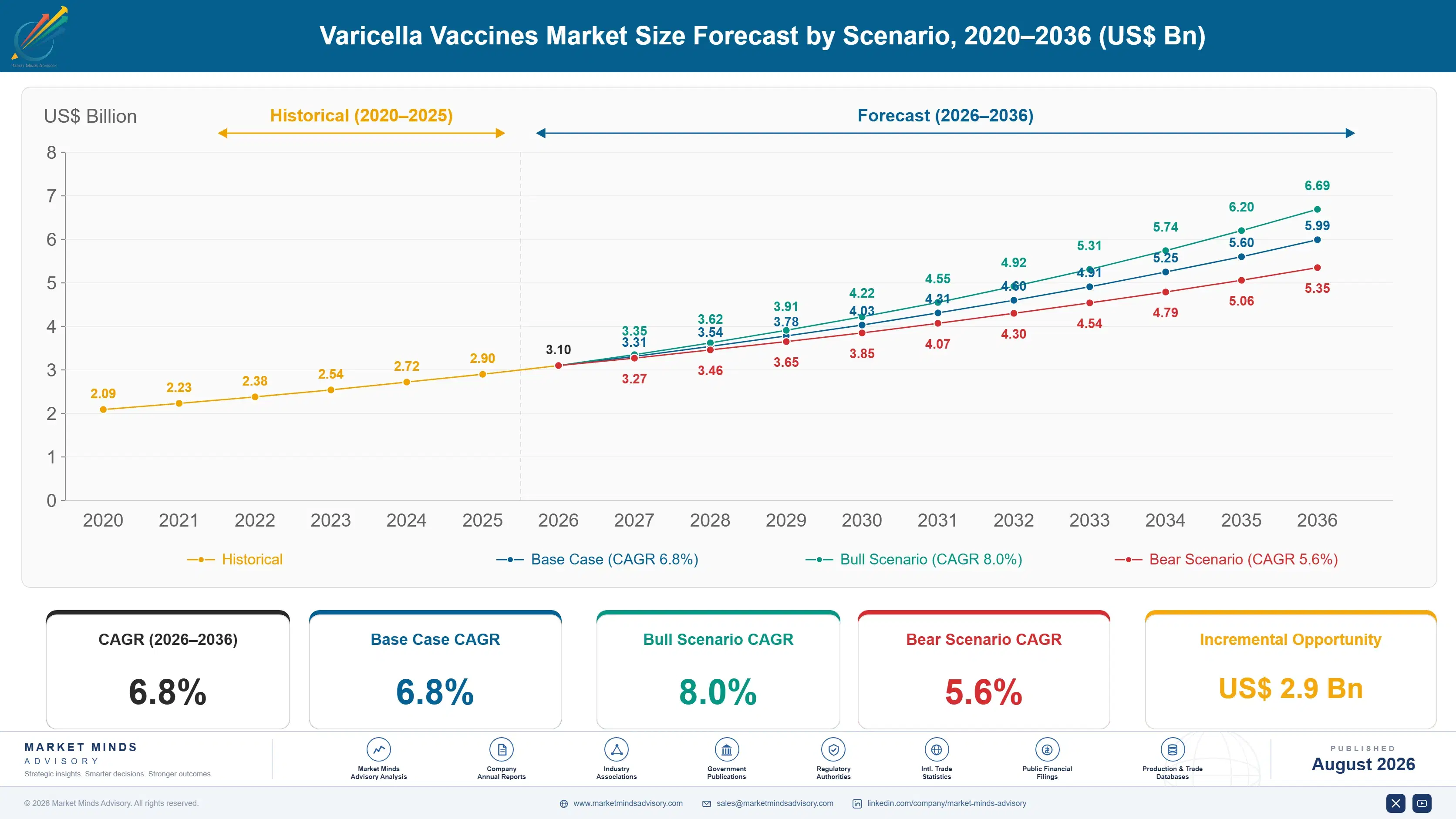
Varicella Vaccines Market Forecast Scenarios

varicella-vaccines-market-size-forecast-scenario-1787641309812
The five years to 2025 were shaped by disruption rather than by any change in the underlying argument. Routine immunisation was interrupted across most countries during the pandemic and catch up campaigns followed, producing volume that looked like growth and was recovery. Chinese provincial expansion added genuine new volume alongside it. The 5.4% historical rate blends a collapse, a rebound and one real expansion.
The 6.8% base case rests on three mechanisms. Refrigerator stable formulations remove the cold chain barrier that kept this vaccine out of most low and middle income programmes, which changes what a health ministry can realistically deliver. Chinese and Indian domestic manufacturing continues expanding supply at price points that make national introduction affordable. And combination presentations reduce the injection burden at the second dose, which improves completion rates in programmes already running.
The 8.0% bull case turns on two or three large Asian countries introducing varicella into routine national immunisation, which would add birth cohorts measured in tens of millions. The 5.6% bear case is the shingles argument gaining ground: if modelling on adult zoster incidence hardens, countries currently undecided will decline and a few running programmes may reconsider them.

The Vaccine Countries Argue About Introducing

Efficacy has never been the question here. Two doses of varicella vaccine prevent almost all severe disease and most mild disease, and the safety record across three decades is about as reassuring as vaccine records get. What stops adoption is that chickenpox in a healthy child is usually an unpleasant week, so the case rests on complications, hospitalisations and parental working days rather than on fear.
TOP FIVE CONCENTRATION82%Combined dose volume supplied by the largest manufacturers
NATIONAL PROGRAMME ADOPTION40Countries including the vaccine in routine childhood immunisation
COVERAGE THRESHOLD REQUIREMENT80%Minimum sustained coverage advised before any programme introduction
PUBLIC TENDER PRICEUSD 7.40Typical price per dose under national procurement arrangements
PRIVATE MARKET SHARE34%Portion of doses sold outside publicly funded programmes
COLD CHAIN FAILURE RATE11%Doses lost to storage excursions across developing programmes
The coverage threshold makes that argument genuinely difficult. Partial vaccination reduces circulating virus without eliminating it, which raises the average age at infection, and varicella in an adult carries far higher rates of pneumonia and hospitalisation than in a child. Guidance advises against introduction unless a programme can sustain coverage above 80%. A health ministry uncertain of reaching that is being told, correctly, that trying may be worse than declining.
Cold chain has been the other barrier and it is the one now falling. Live attenuated varicella traditionally required frozen storage that most developing programmes cannot maintain, and roughly 11% of doses are lost to temperature excursions where they attempt it. Refrigerator stable formulations change what is deliverable, which is why they grow at 10.2% while the frozen presentations decline.
"Every other vaccine argument is about money or supply. This one is about whether a half finished programme is worse than no programme, and that is a genuinely uncomfortable question for a health ministry to answer in public."
Director, Vaccines and Immunisation Policy Practice · MMA Healthcare and Life Sciences Practice · August 2026

Market Trends

Refrigerator Stable Formulations Remove the Cold Chain Barrier

Live attenuated varicella has traditionally required frozen storage at temperatures most national programmes outside high income settings cannot maintain reliably, and roughly 11% of doses are lost to excursions where they try. Refrigerator stable presentations remove that constraint entirely and grow at 10.2% against a market rate of 6.8%, faster than anything else in the market. The change is not scientific novelty but deliverability: a ministry that could not run this programme now can. Manufacturers holding only frozen presentations are excluded from precisely the introductions that represent the growth. Licensure position now decides tender eligibility.
Market Impact: Supply priced near 7.40 dollars

Combination Presentations Improve Second Dose Completion

Second dose completion is the practical weakness of every two dose childhood schedule, and combining varicella with measles, mumps and rubella removes an injection at the visit where completion is weakest. Combination prefilled syringes grow at 8.6%, second fastest in the market, on convenience for the administering clinician rather than on any immunological advantage. The counterargument is a documented higher febrile seizure rate at first dose with combination products, which several countries have responded to by using monovalent first and combination second. That split schedule is now common practice. Portfolio breadth matters more than either product.
Market Impact: Private channel supplies 34% of doses

Market Opportunities and Growth Drivers

Domestic Asian Manufacturing Brings Introduction Within Reach

Chinese and Indian manufacturers have built substantial varicella capacity and supply at price points that change the arithmetic of a national introduction entirely. A public tender price near 7.40 dollars a dose against Western reference pricing several times higher makes the difference between a programme a ministry can fund and one it cannot. Chinese provincial programmes have expanded on domestic supply, and Indian producers are positioning for regional export. Capacity is no longer the constraint anywhere, which shifts the whole conversation back to the epidemiological argument. Price is no longer the obstacle anywhere here.
Market Impact: Requires 80% sustained coverage

Private Market Demand Grows Where Public Programmes Decline

Roughly 34% of doses are sold outside publicly funded programmes, and that share rises in exactly the countries where health ministries have declined to introduce varicella into routine schedules. Parents in higher income segments buy the vaccine privately on paediatrician recommendation, particularly in Western European markets citing the shingles argument and across urban Asia. The private channel prices at a substantial premium to tender and requires no policy decision from anyone. It is also the only route to volume in a market where the public argument may never resolve favourably.
Market Impact: Blocks introduction in 8 countries

Market Restraints and Challenges

Partial Coverage Can Make Population Outcomes Worse

Reducing circulating virus without eliminating it raises the average age at infection, and varicella in adults carries far higher rates of pneumonia, hospitalisation and death than in children. Guidance therefore advises against introduction unless a programme can sustain coverage above 80%, which many countries cannot promise. The root cause is the epidemiology itself rather than any product weakness, and no formulation change addresses it. Manufacturers respond by supporting coverage modelling and delivery capability alongside the product, since a ministry needs confidence in reaching the threshold before it will consider the vaccine at all.
Market Impact: Cuts 11% cold chain wastage

The Shingles Argument Keeps Several Countries Undecided

Repeated exposure to circulating chickenpox appears to boost adult immunity against herpes zoster, so eliminating childhood varicella may raise shingles incidence in adults for a generation before the vaccinated cohorts age. Several European countries cite this explicitly as their reason for not introducing routine varicella vaccination. The root cause is a genuine modelling uncertainty rather than any misunderstanding, and it will not resolve for years. The counterargument is that widespread zoster vaccination in older adults removes the concern, which is now the standard manufacturer response and increasingly persuasive. Several undecided countries are watching that data.
Market Impact: Combination syringes grow 8.6% annually
3 additional market trends, 4 additional growth drivers, and 2 additional restraints and challenges are covered in the full report. Contact sales@marketmindsadvisory.com to access the complete intelligence.

Segment CAGR and Growth Architecture

Segmentation follows product presentation, since presentation determines which programmes can physically deliver the vaccine and which cannot. Five presentations cover the market, from a frozen monovalent vial through to a combination prefilled syringe. Growth sits entirely with the presentations that remove a delivery obstacle rather than with any immunological improvement. Efficacy differences barely register with anybody.
varicella-vaccines-market-market-share-analysis-1787641310365

Monovalent Refrigerator Stable Vial

Lyophilised monovalent varicella vaccine formulated and licensed for storage at standard refrigerator temperatures rather than in a freezer. At 10.2% this is the fastest growing presentation in the market, half again the market rate of 6.8%, and the reason is logistical rather than clinical. Most national programmes outside high income settings cannot maintain a reliable frozen chain, and roughly 11% of doses are lost to excursions where they attempt it. Removing that requirement converts a programme a ministry could not run into one it can, which is why every new introduction under consideration specifies this presentation. Manufacturers holding only frozen product are effectively excluded from the growth. Conversion is a licensure exercise, not a research one.
CAGR 10.2%

MMRV Combination Prefilled Syringe

Measles, mumps, rubella and varicella combined in a single prefilled syringe, removing an injection at the visit where second dose completion is weakest. Growth of 8.6% is second fastest in the market, driven by administration convenience and completion rates rather than by any immunological benefit over separate products. The complication is a documented higher febrile seizure rate at first dose with combination presentations, which has led several countries to use monovalent varicella first and combination second. That split schedule is now common practice and manufacturers supply both accordingly. Prefilled syringes also reduce preparation error and wastage compared with reconstituted vials. Wastage falls noticeably in busy clinic settings too, which procurement notices.
CAGR 8.6%
Full segment breakdown across 5 segments available in the complete report.

Regional Architecture and Country Demand Map

East Asia holds the largest share at 30%, driven by Chinese provincial programmes running on domestic manufacturing capacity. North America follows on universal two dose schedules. Western Europe trails because several large countries have declined to introduce routine varicella vaccination at all. Private demand fills much of that gap.

East Asia

Volume rather than policy consensus gives this region its 30% share. Chinese provincial immunisation programmes have expanded varicella coverage steadily, supplied almost entirely by domestic manufacturers whose capacity and pricing make large birth cohorts affordable in a way imported product never would. Vaccination remains partly self funded in several provinces, which produces coverage patterns that vary considerably within one country. Japanese and South Korean programmes are established, universal and mature, with two dose schedules and high completion. Taiwan runs one of the longest continuous varicella programmes anywhere. Regional growth of 7.8% is led by continued Chinese provincial expansion rather than by any new national introduction. Self funded coverage varies enormously between provinces here.
Share: 30% | CAGR: 7.8% (2026 to 2036)

North America

Universal two dose schedules explain this 26% share more than population does. The United States introduced routine varicella vaccination earlier than almost anywhere and moved to a second dose after outbreaks demonstrated that one dose left meaningful susceptibility, which established the schedule most other adopting countries now follow. Coverage sits high enough that the threshold argument never applied here, and the shingles concern has been addressed through widespread adult zoster vaccination. Combination presentations are used at second dose in most jurisdictions following febrile seizure findings at first dose. Canadian provincial programmes are universal with schedules varying between provinces. Growth of 6.2% reflects a saturated market moving with birth cohorts. Schedule positions here are very rarely disturbed.
Share: 26% | CAGR: 6.2% (2026 to 2036)
Regional intelligence for 5 additional markets available in the complete report: Western Europe, South Asia and Pacific, Latin America, Middle East and Africa, Eastern Europe. Contact sales@marketmindsadvisory.com.
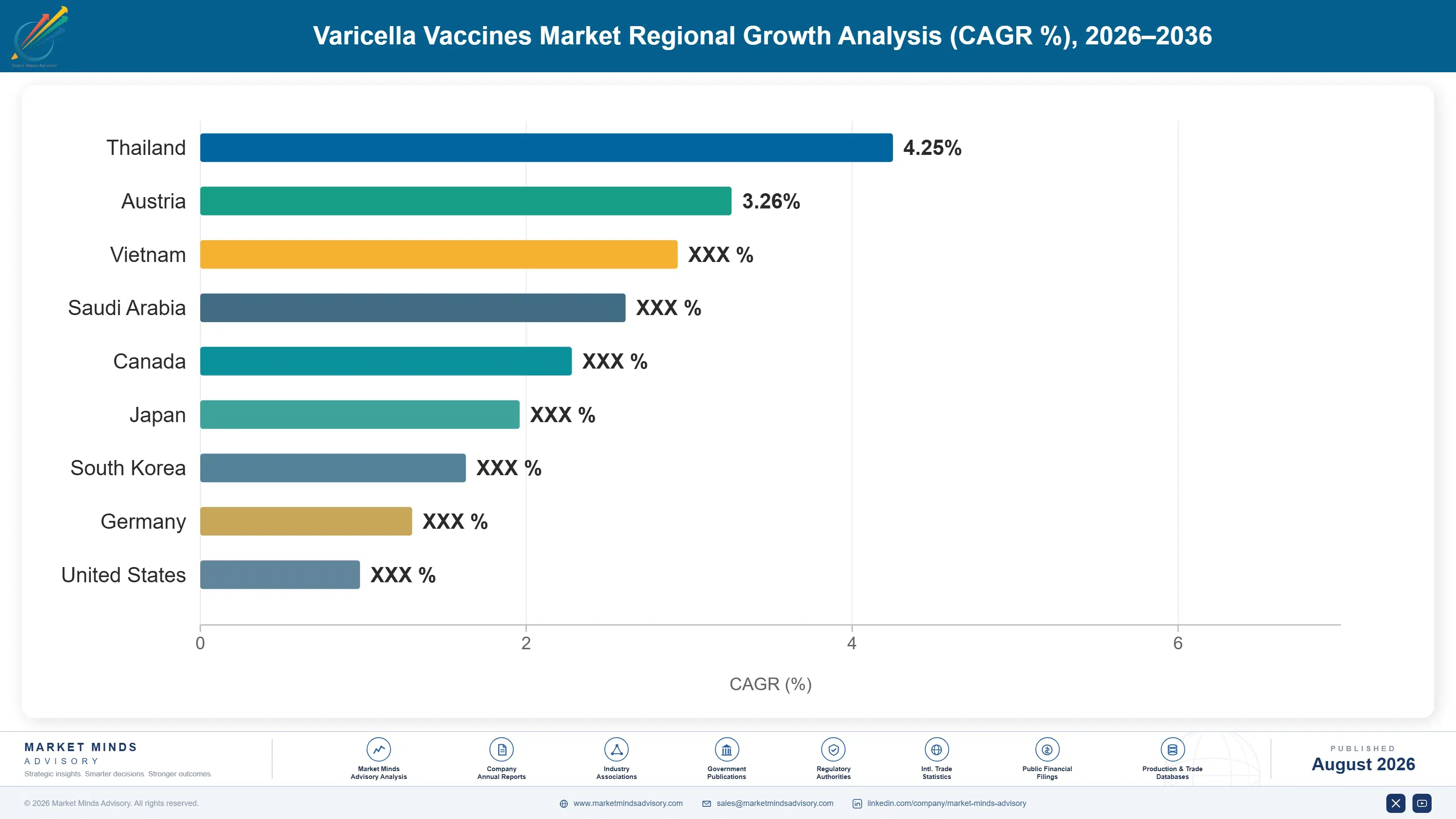
varicella-vaccines-market-country-cagr-analysis-1787641310909

Where Volume Is Actually Won

Nothing here is won on efficacy, which is established and comparable across manufacturers. Value accrues to whoever removes a delivery obstacle a ministry cannot solve, whoever prices within reach of a large birth cohort, and whoever reaches parents where public programmes have declined. Four routes carry weight, and only one of them involves a public policy decision.

Lead With Refrigerator Stable Presentations Everywhere

Roughly 11% of doses are lost to temperature excursions in programmes attempting a frozen chain, and most ministries outside high income settings cannot maintain one at all. Refrigerator stable monovalent presentations grow at 10.2% against a market rate of 6.8% purely on deliverability, and every new introduction currently under consideration specifies them. A manufacturer holding only frozen product is not competing on price in those tenders; it is not competing at all. Converting the portfolio is a licensure exercise rather than a research one, which makes the delay harder to justify.
Market Impact: Removes 11% of the current cold chain wastage

Price Against a Birth Cohort, Not a Reference Market

A public tender price near 7.40 dollars a dose is what makes a national introduction fundable in a country with a birth cohort measured in millions, and Western reference pricing several times higher simply removes the conversation. Chinese and Indian manufacturers have built capacity around that arithmetic and taken the volume accordingly. The commercial question is whether a manufacturer will accept tender pricing to hold a programme it might otherwise lose entirely. Companies that refused on margin grounds watched domestic producers take introductions that will run for decades. Those programmes run for decades once won.
Market Impact: Wins tenders priced at 7.40 dollars per dose

Sell Privately Where Ministries Have Declined

Roughly 34% of doses move outside publicly funded programmes, and that share is highest precisely where health ministries have declined to introduce routine varicella vaccination on the shingles or cost effectiveness argument. Parents in higher income segments buy on paediatrician recommendation at a substantial premium to tender pricing, with no policy decision required from anybody. Western European and urban Asian markets carry most of this volume. It is also the only durable route in countries where the public argument may never resolve favourably, which is more of them than manufacturers like to plan for.
Market Impact: Reaches the 34% of all doses sold privately

Support the Coverage Case Before Selling the Product

Guidance advises against introduction below a sustained 80% coverage because partial vaccination shifts disease into adulthood, so a ministry uncertain of delivery is being correctly told that trying may be worse than declining. Manufacturers that arrive with coverage modelling, delivery capability assessment and second dose completion evidence address the actual obstacle. Those that arrive with efficacy data are answering a question nobody asked, since efficacy was never in dispute. The companies winning new introductions have built health systems capability alongside a commercial function. Health systems capability is now part of the commercial function. Very few have built it.
Market Impact: Addresses the advised 80% sustained coverage threshold directly

Who Controls the Margin Pool

Concentration is high and geographically split. The top five supply 82% of dose volume and associated revenue, the basis applied consistently here, though the leaders in high income markets and those in Chinese provincial programmes are almost entirely different companies. Merck holds the strongest position across established Western schedules, and the distance to any challenger there reflects thirty years of accumulated schedule incumbency rather than any current advantage.
Competition runs on three fronts. Established Western manufacturers compete for national schedule positions on combination portfolio breadth and supply security, which is a relationship measured in decades. Chinese and Indian producers compete on price per dose into tenders where the arithmetic decides everything. Private market competition runs through paediatric prescribing preference and pharmacy availability, and behaves nothing like either of the others.

Rankings will move with new national introductions rather than with share shifts in existing programmes, since schedule incumbency is very rarely disturbed. Two or three large Asian introductions would reorder the market entirely. The other pressure point is refrigerator stable licensure: manufacturers without it are excluded from the tenders that represent the growth, and several are further behind than their commercial statements suggest.
varicella-vaccines-market-company-positioning-matrix-1787641311462

Competitive Moat and Risk Dimensions

MERCK

Moat: Schedule Incumbency Depth

Position in established national schedules across North America and much of Europe was built over three decades and is almost never disturbed, since changing a supplier in a routine childhood programme means requalifying presentation, training and supply security for no clinical gain. The combination portfolio alongside monovalent product also allows supplying both positions in a split schedule.
MERCK

Risk: Emerging Tender Pricing

New national introductions are decided at tender prices near 7.40 dollars a dose against a birth cohort measured in millions, and domestic Asian manufacturers have built capacity around exactly that arithmetic. Declining to compete on those terms cedes programmes that will run for decades, which is a considerably larger loss than the margin protected.
SINOVAC BIOTECH

Moat: Domestic Cost Position

Manufacturing scale built around Chinese provincial demand produces a cost per dose that importers cannot approach, and the capacity is already installed rather than requiring investment against uncertain volume. That position also supports export pricing into regional tenders where a national introduction depends entirely on whether the arithmetic works for a health ministry.
SINOVAC BIOTECH

Risk: Regulatory Recognition Limits

Access to internationally procured and donor funded programmes depends on prequalification and regulatory recognition that takes years and is not guaranteed by manufacturing quality alone. Without it, an enormous cost advantage reaches only markets that will license the product directly, which excludes several of the introductions most likely to happen next.

Players Tracked

Prominent Players

Merck
GSK
Sinovac Biotech
Changchun BCHT
GC Biopharma

Other Key Players

Shanghai Institute of Biological Products
Beijing Wantai Biological Pharmacy
Serum Institute of India
Bharat Biotech
Biken
Mitsubishi Tanabe Pharma
Takeda Pharmaceutical
Sanofi
Bio Farma
Butantan Institute
Zydus Lifesciences
Walvax Biotechnology
Hualan Biological
Panacea Biotec
Sinopharm

Recent Developments

FEBRUARY 2025

Refrigerator stable varicella presentation approved in additional markets

A manufacturer secured approval for a refrigerator stable monovalent varicella presentation across several additional national regulators, removing the frozen storage requirement that had excluded the product from programmes without freezer capacity. Health ministries that had previously ruled introduction impractical reopened assessment work within months of the approvals.
Signal: Deliverability rather than efficacy has been the real binding constraint on this vaccine for two decades
MAY 2025

European advisory committee declines routine varicella recommendation again

A national immunisation advisory committee in Western Europe again declined to recommend routine childhood varicella vaccination, citing uncertainty about adult herpes zoster incidence and questioning cost effectiveness at current pricing. Private paediatric demand in the market has continued growing regardless, at prices well above any tender level.
Signal: Where the public argument fails the private channel absorbs that demand at considerably better pricing anyway
SEPTEMBER 2025

Southeast Asian ministry begins varicella introduction assessment

A large Southeast Asian health ministry began formal assessment of introducing varicella into routine childhood immunisation, following refrigerator stable product availability and regional supply pricing that made a birth cohort of that size fundable. Coverage sustainability against the advised threshold was named as the central question in the assessment.
Signal: Introductions now turn on whether a ministry can sustain coverage rather than on whether it can afford doses

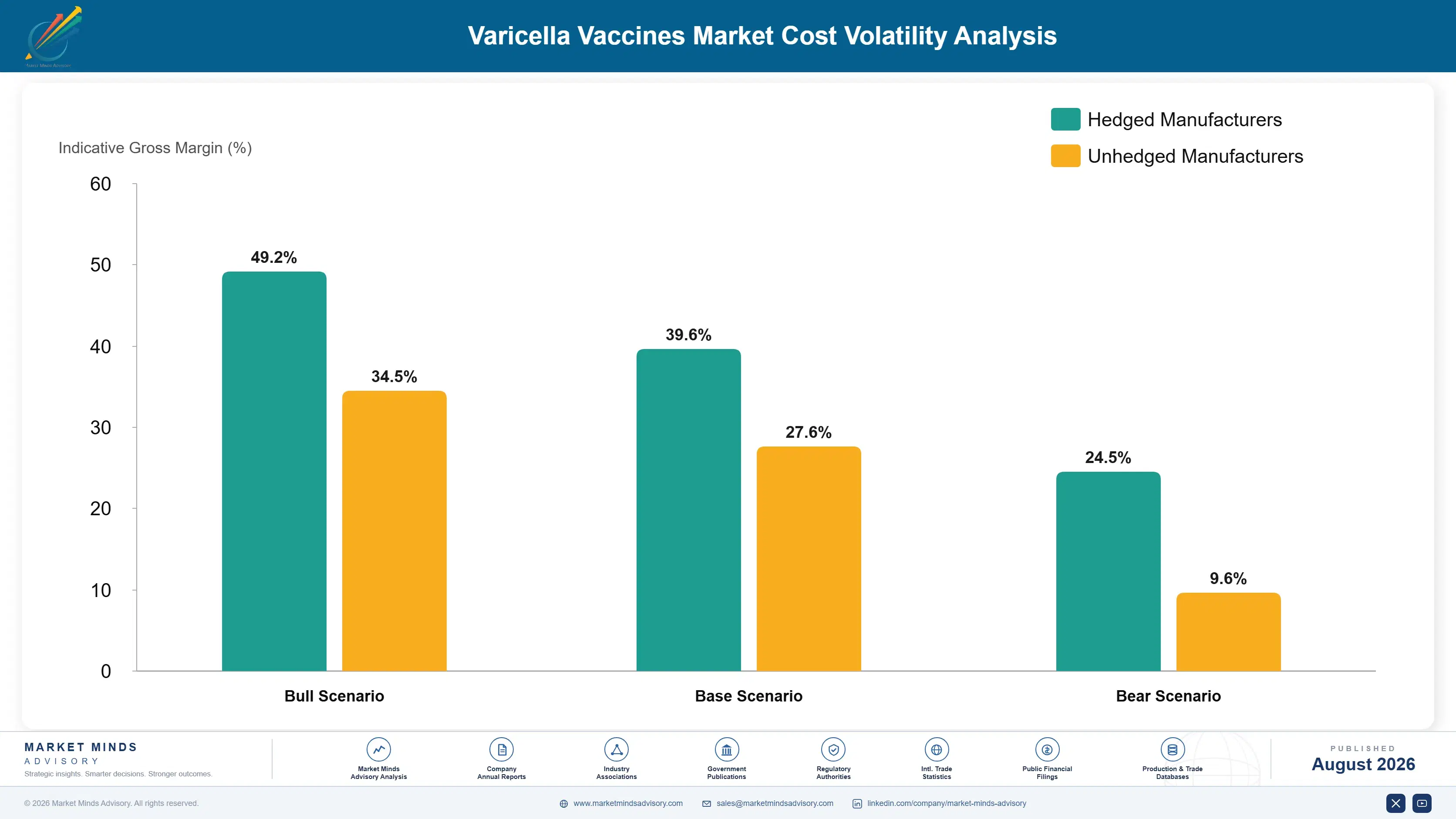
What a Dose Costs to Make

Live viral vaccine manufacture is dominated by facility and quality cost rather than by materials. Cell culture media, human diploid cell substrate maintenance and stabiliser components account for roughly 18% of cost of goods, while quality control, release testing and facility overhead absorb far more. Cell substrate and specialised media come from very few qualified suppliers in Europe and North America, and requalifying any takes years.
Cold chain has been the cost line that mattered most and the one now changing. Frozen distribution requires equipment, monitoring and contingency capacity that refrigerated distribution does not, and roughly 11% of doses have been lost to excursions in programmes attempting it. Company annual reports across the vaccine sector documented distribution cost and wastage through the period. Energy pricing through 2022 raised cold storage operating cost, disproportionately on frozen product.

Exposure divides by presentation portfolio rather than by scale. A manufacturer holding refrigerator stable licensure carries lower distribution cost and lower wastage, and can bid tenders that frozen only competitors cannot enter. Facility cost per dose falls sharply with volume, which is precisely why Chinese and Indian producers supplying very large birth cohorts reach price points importers cannot match at any reasonable margin.
varicella-vaccines-market-cost-volatility-analysis-1787641311670

Convert the portfolio to refrigerator stable licensure

Refrigerator stable formulation is a licensure and stability exercise rather than a research problem, and it removes both distribution cost and roughly 11% wastage at once. It also opens tenders a frozen only manufacturer cannot enter regardless of price. The work takes years of stability data and submission in each market, which is why starting late is expensive.

Qualify second sources for media and cell substrate

Specialised cell culture media and qualified cell substrate come from very few suppliers, and requalifying either takes years of comparability work in every market where the product is licensed. Holding a second qualified source is expensive and looks unnecessary until a supplier exits or a facility closes. Manufacturers that qualified alternatives early have avoided supply interruptions that competitors could not.

Build volume commitments that lower facility cost per dose

Facility and quality overhead dominates cost per dose and falls sharply with throughput, so a manufacturer running below capacity carries a cost disadvantage no procurement improvement can close. Multi year tender commitments and regional supply agreements provide the volume certainty that justifies running at scale. Accepting lower unit pricing for guaranteed volume often produces better absolute margin than holding out.

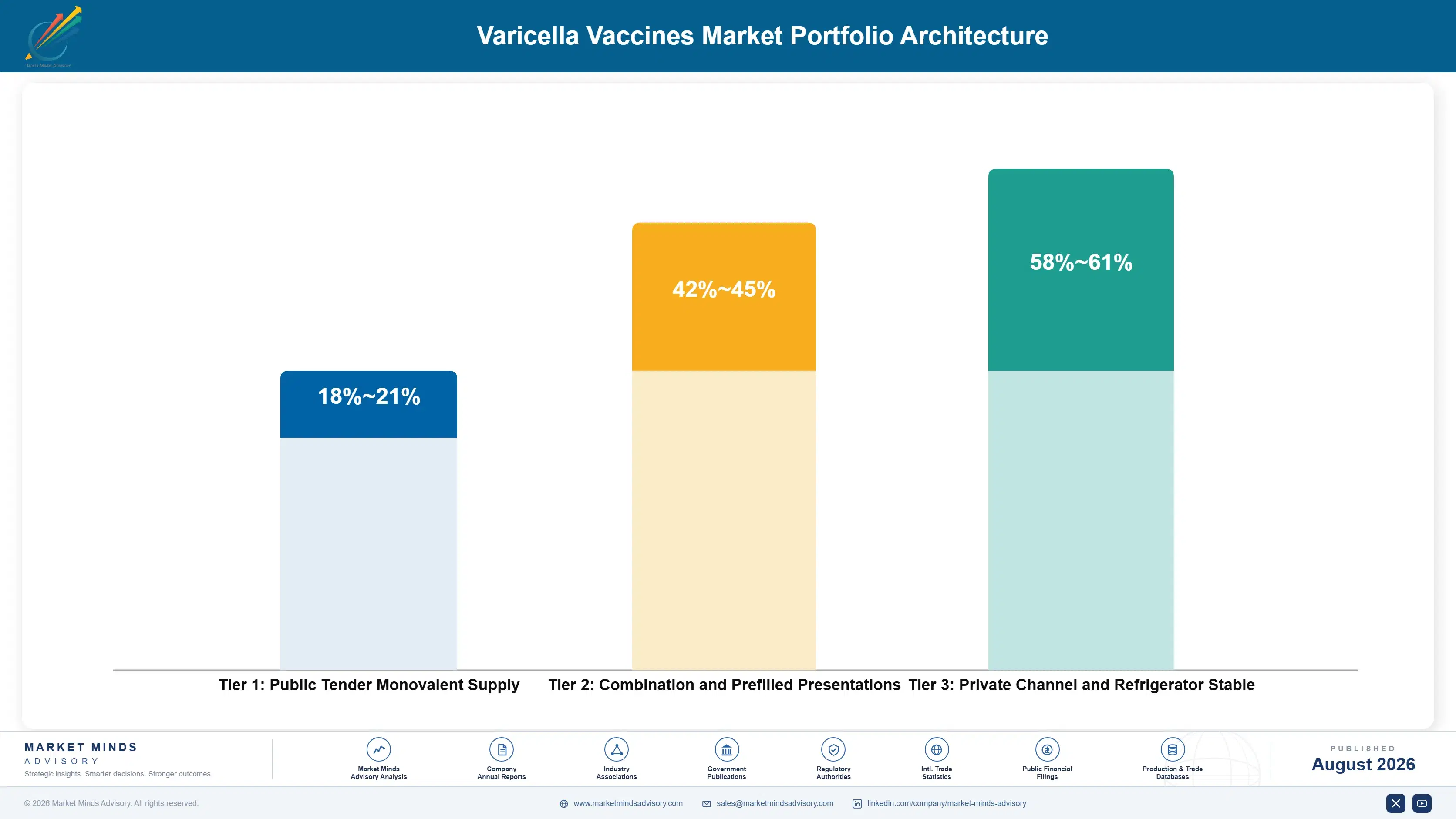
Portfolio Architecture for Margin Defence

Margin architecture divides by channel far more than by product. Public tender supply near 7.40 dollars a dose earns modest margins that depend on facility utilisation, and a manufacturer running below capacity loses money where a fuller plant profits. Private market supply earns several times that, priced on parental willingness rather than on procurement arithmetic. Combination presentations earn better than monovalent in both channels.
The tension is between volume that is durable and margin that is not. A national programme position runs for decades once won and is almost never disturbed, but it is priced against a birth cohort. Private demand prices well and disappears the moment a ministry introduces a public programme, since parents stop paying for something available free. A portfolio built purely on private supply is holding a position its own commercial success would destroy.

High value pools concentrate in private paediatric supply across markets that have declined public introduction, and in combination presentations at second dose where completion matters to the administering clinician. Everything else is priced against a tender arithmetic set by domestic Asian capacity. Manufacturers without refrigerator stable licensure are excluded from the growth entirely.

Public Tender Monovalent Supply

Monovalent doses supplied into national and pooled procurement at prices near 7.40 dollars, where facility utilisation rather than pricing decides whether the contract earns anything at all. Volume is durable across decades and margin is thin throughout.
Gross Margin: 18-21%

Combination and Prefilled Presentations

Combination and prefilled syringe products supplied into established schedules where administration convenience and completion rates matter to the clinician. Margin holds on formulation complexity and on portfolio breadth across both doses of a split schedule.
Gross Margin: 42-45%

Private Channel and Refrigerator Stable

Private paediatric supply in markets without public programmes, alongside refrigerator stable presentations that open tenders frozen products cannot enter. Margin is the best available and depends on public programmes remaining absent in those markets.
Gross Margin: 58-61%
varicella-vaccines-market-portfolio-architecture-1787641312171

High-value Sub-segments and Strategic Watch-out

Monovalent Refrigerator Stable Vial

The fastest growing presentation at 10.2% and the one that decides whether a manufacturer can bid the introductions representing all the growth. Removing the frozen requirement converts a programme a ministry could not run into one it can, which no pricing argument achieves. Licensure is the whole question.
Gross Margin: 44-47%

MMRV Combination Prefilled Syringe

Second fastest at 8.6% on administration convenience and second dose completion rather than any immunological advantage. Split schedule guidance following febrile seizure findings means portfolio breadth across both doses now matters more than either product alone. Split schedules have made both presentations necessary rather than optional for any serious supplier.
Gross Margin: 42-45%

MMRV Combination Vial

Growing at 6.4% and gradually losing position to prefilled presentations that reduce preparation error and wastage in busy clinics. It remains the volume format in cost constrained programmes where the syringe premium cannot be justified against a tender price. Prefilled formats will take this position steadily over the forecast period.
Gross Margin: 40-43%

Monovalent Frozen Storage Vial

Declining slowly at 2.2% and excluded from every new introduction under consideration, since ministries specify refrigerator stable presentations they can actually deliver. It persists only in established high income programmes with reliable frozen chain already installed. Nothing will reverse that decline, since new introductions specify refrigerator stable presentations exclusively.
Gross Margin: 16-19%

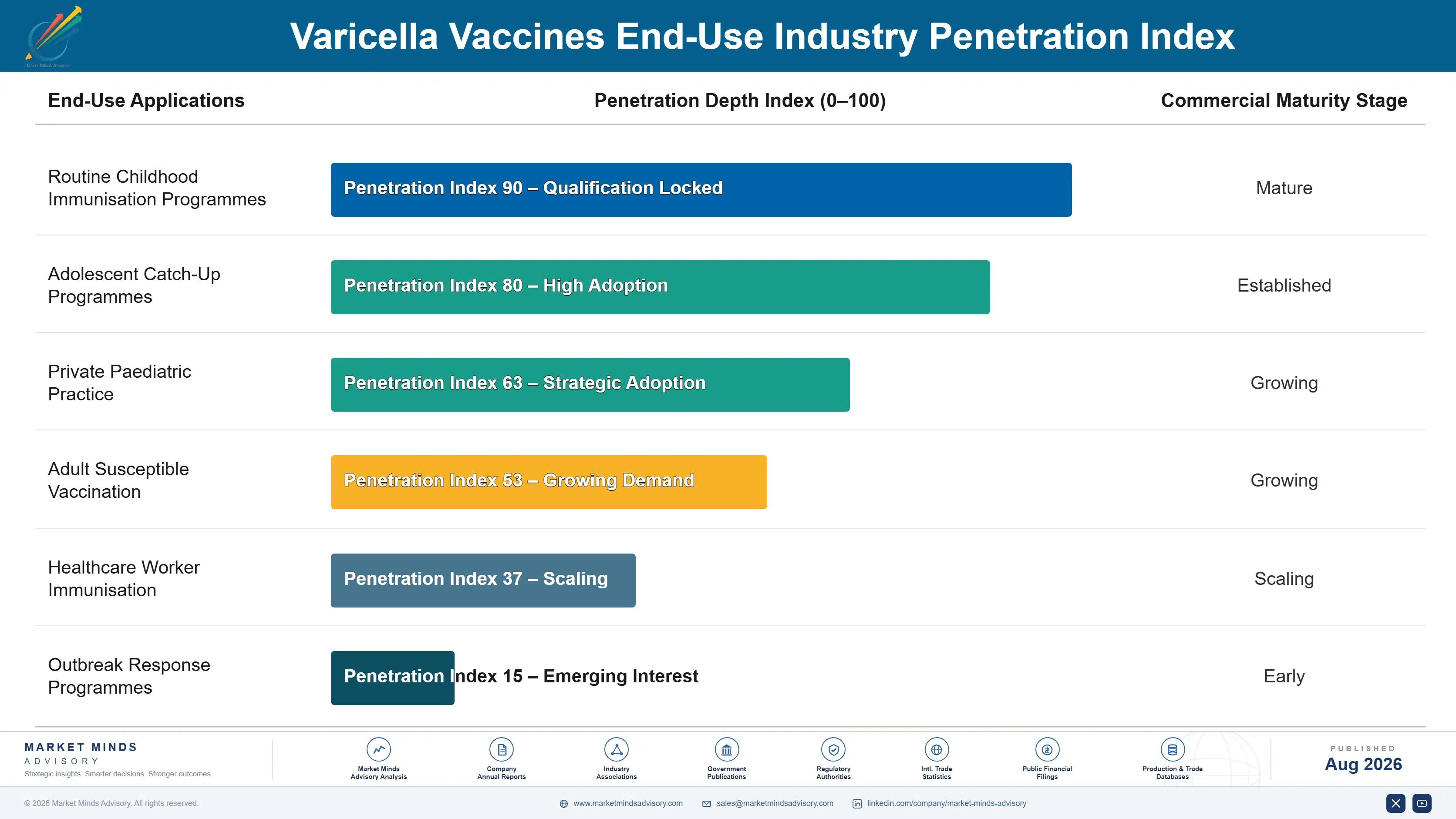
How Programme Demand Repeats

Demand recurs with a reliability almost nothing else in pharmaceuticals matches. A national programme consumes two doses per child in every birth cohort, every year, for as long as the schedule stands, and schedules stand for decades. That makes a programme position an annuity with an unusually long duration, which is why incumbency matters so much and why manufacturers accept tender pricing near 7.40 dollars a dose to secure one.
Stickiness varies enormously by channel. A national schedule position is almost never disturbed, since changing supplier means requalifying presentation, training and supply security for no clinical gain whatever. Private paediatric demand is far looser, moving with prescriber preference and pharmacy availability. Pooled regional procurement sits between the two, retendering on cycles that give incumbents an advantage without any guarantee attached to it.

The decision maker has shifted over two decades. Introduction was once argued by paediatricians to a health ministry on clinical grounds. It now runs through national immunisation technical advisory groups weighing coverage modelling, cost effectiveness thresholds and adult zoster projections simultaneously, and those committees ask questions no commercial team is equipped to answer. Manufacturers with health economics capability reach that room. The rest present efficacy data.
varicella-vaccines-market-end-use-penetration-index-1787641312677

Where This Vaccine Actually Grows

These are among the four positions where our research anticipates prominent divergence between winners and laggards over the coming forecast period. Each is grounded in the demand model, the regulatory perimeter, and the announced capacity pipeline.
01 / COLD CHAIN DELIVERABILITY

Refrigerator stable licensure decides who can bid

Roughly 11% of doses are lost to temperature excursions where programmes attempt a frozen chain, and most ministries outside high income settings cannot maintain one at all. Refrigerator stable presentations grow at 10.2% against a market rate of 6.8% purely because they convert an undeliverable programme into a deliverable one, and every introduction currently under assessment specifies them. A manufacturer without that licensure is not competing on price in those tenders, it is not competing at all, and converting late costs years of stability work.
02 / BIRTH COHORT PRICING

Tender arithmetic beats reference pricing every time

A public tender price near 7.40 dollars a dose is what makes introduction fundable in a country with a birth cohort of millions, and Western reference pricing several times higher simply ends the conversation before it starts. Chinese and Indian manufacturers built capacity around that arithmetic and have taken the volume that follows from it. A programme position runs for decades once won and is almost never disturbed, which makes refusing tender pricing on margin grounds a considerably larger loss than it appears.
03 / PRIVATE CHANNEL DEVELOPMENT

Sell where the ministry has already said no

Roughly 34% of doses move outside publicly funded programmes, and that share is highest precisely in the countries whose advisory committees have declined routine introduction on shingles or cost effectiveness grounds. Parents simply buy on paediatrician recommendation at a substantial premium to tender pricing, with no policy decision required from anybody at all. It is the only durable route available in markets where the public argument may never resolve favourably, and that describes considerably more countries than manufacturers generally plan for.
04 / COVERAGE CASE SUPPORT

Answer the question committees are actually asking

Guidance advises against introduction below a sustained 80% coverage, because partial vaccination shifts disease into adulthood where varicella is far more dangerous, so a ministry unsure of delivery is correctly told that trying may be worse. Manufacturers arriving with coverage modelling, delivery capability assessment and second dose completion evidence address the actual obstacle standing in the way of a decision. Those arriving with efficacy data alone are answering a question that nobody in that room has actually asked for twenty years.

Engagement Snapshot From the Field

A live engagement with an industry participant carrying material or product regulatory and market exposure ahead of a defining policy shift, showing how our research translates into a defensible multi-year portfolio strategy.
MARKET MINDS ADVISORY · CLIENT ENGAGEMENT SUMMARY
Varicella Vaccines Producer Strategic Portfolio Review and Transition Roadmap 2026·Investment Scenario on Varicella Vaccines Exposure Evaluation 2025-26
CLIENT PROFILE
A global vaccine manufacturer holding varicella positions in established high income national schedules, supplying frozen monovalent and combination vial presentations. Annual varicella revenue was approximately 410 million dollars (client-reported, unverified by MMA), with 81% from four developed markets. No refrigerator stable presentation was licensed and no emerging market tender had been won in five years.
STRATEGIC CHALLENGE
Three large Asian countries had begun assessing varicella introduction and the client could not bid, because every assessment specified refrigerator stable presentation the company did not hold. Management wanted to know whether to pursue licensure conversion, compete on price with frozen product, or concentrate on defending existing developed market positions. Nobody had sized what the introductions were actually worth.
MMA APPROACH
MMA modelled introduction probability and dose volume for eleven countries under formal or informal assessment, weighting coverage sustainability against advised thresholds rather than population alone. Refrigerator stable licensure timelines and costs were established market by market. Forty-seven expert interviews with immunisation advisory group members, ministry procurement leaders and paediatric prescribers established what actually decides both introduction and supplier selection.
KEY FINDINGS
  1. Eight of the eleven assessments explicitly required refrigerator stable presentation, which excluded the client from bidding regardless of price or supply security offered.
  2. Advisory group members in 34 of the 47 interviews named coverage sustainability rather than price or efficacy as the decisive question in any introduction decision.
  3. Licensure conversion required roughly 4 years of stability data and regulatory submission, against introduction decisions expected within 3 years in most assessed countries.
  4. Private paediatric demand in two declining European markets exceeded 40% of what a public programme would have consumed, at prices well above any tender level.
CLIENT PROFILE
A global vaccine manufacturer holding varicella positions in established high income national schedules, supplying frozen monovalent and combination vial presentations. Annual varicella revenue was approximately 410 million dollars (client-reported, unverified by MMA), with 81% from four developed markets. No refrigerator stable presentation was licensed and no emerging market tender had been won in five years.
STRATEGIC CHALLENGE
Three large Asian countries had begun assessing varicella introduction and the client could not bid, because every assessment specified refrigerator stable presentation the company did not hold. Management wanted to know whether to pursue licensure conversion, compete on price with frozen product, or concentrate on defending existing developed market positions. Nobody had sized what the introductions were actually worth.
MMA APPROACH
MMA modelled introduction probability and dose volume for eleven countries under formal or informal assessment, weighting coverage sustainability against advised thresholds rather than population alone. Refrigerator stable licensure timelines and costs were established market by market. Forty-seven expert interviews with immunisation advisory group members, ministry procurement leaders and paediatric prescribers established what actually decides both introduction and supplier selection.
KEY FINDINGS
  1. Eight of the eleven assessments explicitly required refrigerator stable presentation, which excluded the client from bidding regardless of price or supply security offered.
  2. Advisory group members in 34 of the 47 interviews named coverage sustainability rather than price or efficacy as the decisive question in any introduction decision.
  3. Licensure conversion required roughly 4 years of stability data and regulatory submission, against introduction decisions expected within 3 years in most assessed countries.
  4. Private paediatric demand in two declining European markets exceeded 40% of what a public programme would have consumed, at prices well above any tender level.
RECOMMENDED STRATEGY
Phase 1: Phase one: begin refrigerator stable licensure conversion immediately, accepting that 4 years of stability work means missing the earliest introduction decisions entirely. Phase 2: Phase two: build private channel capability in the European markets that declined public introduction, where demand already reaches 40% of programme equivalent volume. Phase 3: Phase three: develop coverage modelling and delivery assessment capability, since 34 of 47 advisory members named sustainability as the decisive question.
OUTCOME
The client began licensure conversion within a quarter and established private channel operations in two European markets the following year. Private revenue grew to 11% of the varicella business at margins well above tender supply, and the company entered two of the later introduction assessments it would otherwise have missed (client-reported, unverified by MMA).

Frequently Asked Questions

Foundational context covering the market sizes, CAGR, scope, country, region and competition that inform every finding below. This section is provided to cover basics and most often pre-purchase conversations, answered from the MMA Primary Research Dataset.

What is the current size of the Varicella Vaccines Market?

The market was valued at 2.9 billion dollars in 2025, covering monovalent and combination varicella vaccines across public and private channels. It reaches an estimated 3.10 billion dollars during 2026.

How large will the Varicella Vaccines Market be by 2036?

MMA forecasts 5.99 billion dollars by 2036, an increase of 2.89 billion dollars over the 2026 base. That represents an expansion multiple of 1.93 times across the forecast period.

What is the CAGR for the Varicella Vaccines Market 2026 to 2036?

The base case compound annual growth rate is 6.8%, with a bull case of 8.0% and a bear case of 5.6%. New national introductions and the adult shingles argument separate those scenarios.

Which segment is growing fastest?

Monovalent refrigerator stable vials grow at 10.2%, half again the market rate of 6.8%, because they remove the frozen storage barrier. Combination prefilled syringes follow at 8.6%.

Who are the major companies in the Varicella Vaccines Market?

Merck, GSK, Sinovac Biotech, Changchun BCHT and GC Biopharma lead on dose volume supplied and associated revenue. Together they account for 82% of the market.

Which country is growing fastest?

Indonesia grows fastest at 13.8%, as refrigerator stable presentations and regional supply pricing together make a national introduction deliverable for a very large birth cohort.

Report Segmentation Architecture

The full report scope spans multiple orthogonal segmentation dimensions, with cross-tabulated demand data provided for each dimension pair. Coverage extends further to regional breakdowns, trend trajectories, and the competitive detail needed to support segment-level decision-making.

By Product Presentation

  • Monovalent Frozen Storage Vial
  • Monovalent Refrigerator Stable Vial
  • Monovalent Prefilled Syringe
  • MMRV Combination Vial
  • MMRV Combination Prefilled Syringe

By End-Use Industry

  • Routine Childhood Immunisation Programmes
  • Adolescent Catch-Up Programmes
  • Private Paediatric Practice
  • Adult Susceptible Vaccination
  • Healthcare Worker Immunisation
  • Outbreak Response Programmes

By Commercial Dimension

  • National Tender Procurement
  • Pooled Regional Procurement
  • Private Pharmacy and Clinic Supply
  • Donor Funded Programmes
  • Hospital and Institutional Supply
  • Travel and Occupational Health

By Region

  • North America
  • Western Europe
  • East Asia
  • South Asia and Pacific
  • Latin America
  • Middle East and Africa
  • Eastern Europe

Scope, Methodology, and Coverage

Every figure in this report is reproducible from documented input assumptions. The scope below maps the historical period, the forecast horizon, the segmentation dimensions, and the countries covered, alongside the underlying primary and qualitative methodology.
Historical Period
2020 to 2025
Forecast Period
2026 to 2036
Base Year
2025 (USD billions; MMA Primary Research Dataset, August 2026)
Market Definition
Vaccines protecting against primary varicella zoster virus infection worldwide, covering monovalent frozen storage vials, monovalent refrigerator stable vials, monovalent prefilled syringes, measles mumps rubella varicella combination vials, and combination prefilled syringes, supplied through public and private channels. Measured at manufacturer selling value. Herpes zoster vaccines, varicella zoster immunoglobulin, antiviral therapies, measles mumps rubella vaccines without a varicella component and diagnostic testing are excluded from scope.
Quantitative Units
USD billions (current prices); doses supplied; USD per dose by presentation and channel
Segmentation Dimensions
Product presentation; end-use industry; commercial dimension; region
Regions Covered
North America, Western Europe, East Asia, South Asia and Pacific, Latin America, Middle East and Africa, Eastern Europe
Countries Covered
United States, Canada, Germany, Spain, Italy, United Kingdom, Netherlands, Sweden, China, Japan, South Korea, Taiwan, India, Indonesia, Australia, Brazil, Argentina, Chile, Saudi Arabia, Poland
Key Companies Profiled
Merck, GSK, Sinovac Biotech, Changchun BCHT, GC Biopharma, Shanghai Institute of Biological Products, Beijing Wantai Biological Pharmacy, Serum Institute of India, Bharat Biotech, Biken, Mitsubishi Tanabe Pharma, Takeda Pharmaceutical, Sanofi, Bio Farma, Butantan Institute, Zydus Lifesciences, Walvax Biotechnology, Hualan Biological, Panacea Biotec, Sinopharm
Quantitative Methodology
Primary survey, n=3,800 respondents, Q4 2025, six countries; demand-side model with trade association cross-validation
Qualitative Methodology
47 expert interviews, Q4 2025; applied to validate demand model assumptions, identify emerging dynamics, and assess competitive positioning
Report Format
PDF and XLSX data workbook (Word format preview document)
Publisher
Market Minds Advisory
Report Code
MMA-2026-HLT-147
Published
August 2026
Contact
sales@marketmindsadvisory.com | www.marketmindsadvisory.com

Purchase the full Varicella Vaccines Market Report (2026 to 2036).

The full report treats varicella as a vaccine whose adoption turns on an epidemiological argument rather than on price or efficacy, since partial coverage shifts disease into adulthood and guidance advises against introduction below a sustained threshold. It sizes all five presentations independently through 2036, models introduction probability and dose volume across eleven countries under assessment, and maps refrigerator stable licensure position by manufacturer and market. Regional chapters cover all seven regions, with private channel demand assessed separately from publicly funded programmes. Competitive profiling covers 20 participants on one consistent dose volume basis.
Five presentations sized independently through 2036
Introduction probability modelled across eleven assessing countries
Refrigerator stable licensure position mapped by manufacturer
Private channel demand assessed separately from public programmes
Coverage sustainability weighted against advised introduction thresholds
Twenty participants profiled on one consistent dose basis

Built For The People Who Decide

From boardroom strategy to bench-side execution, this report is read cover-to-cover by leaders shaping the next decade of their industry, turning demand scenarios, market dynamics and valuation benchmarks into decisions.
CXOs/ Presidents/ VPs/ Managers
M&A and Corporate Development
Strategy Teams and R&D Heads
Procurement and Product Directors
Regulatory and Compliance Leaders
Investor Relations and Equity Analysts