Market Minds Advisory
Variable Data Printing Market

Variable Data Printing Market: Variable Data Printing Market. E-Commerce Personalization Pulls a Mature Print Technology Into a New Growth Cycle

E-commerce packaging personalization and transactional mail digitization are pushing print service providers to replace static offset runs with variable data workflows that price by data complexity rather than sheet count alone.

Lead Analyst

Published

September 2026

Make Smarter Decisions with Customized Research Insights

Request a free sample report and evaluate market opportunities, growth trends, and competitive dynamics relevant to your business needs.

2025 MARKET VALUE$8.6BMarket Size 2025
2036 FORECAST VALUE$17.7BBase Case , 2026 to 2036
CAGR 2026 TO 20366.8 %Bull 8.1% / Bear 5.6%
INCREMENTAL OPPORTUNITY$8.5BNet 10- year value creation
EXPANSION MULTIPLE1.93x2036 value over 2026 base
Strategic Levers
M&A Pipeline
Regional Outlook
Country Rankings
Competitive Intelligence
Segmental Deep-dive
Call-Us : 91 93563 13602

Executive Snapshot and Market Trajectory.

E-commerce packaging insert personalization has become the single clearest growth pocket in a printing category most buyers assumed had already fully matured years ago into a stable, low-growth commodity segment of the wider global print industry landscape entirely and permanently, with little room left for genuine surprise.
Print service providers serving direct mail and packaging clients are shifting pricing models away from per-sheet cost toward data complexity and personalization depth, since a single-variable name field and a fully personalized image layout require very different production workflows, equipment, and operator training investment upfront. Transactional document printing remains the largest volume segment even as marketing mail growth slows in several mature markets worldwide today.
HP Indigo and Canon Production Printing hold the deepest installed base among digital press vendors, but EFI and Xerox are both pushing workflow software upgrades that let smaller print shops compete on personalization sophistication rather than press speed alone. Postal rate increases across several major markets are accelerating a shift toward higher-value personalized mail that justifies cost per piece, squeezing out low-value bulk mail volume that used to anchor much of the category.
Market Definition
The variable data printing market covers digital press hardware, workflow and RIP software, and production services that enable content, images, or text to change from one printed piece to the next within a single print run. It excludes static offset printing, wide-format signage without variable content, and generic document management software sold without a print production link.
Base Year Value
$8.6B in 2025 (MMA Primary Research Dataset, September 2026)
Forecast Period
2026 to 2036, eleven discrete annual values
CAGR
6.8% base case. Bull 8.1%. Bear 5.6%.
Fastest Growth Segment
Personalized Packaging and Labels: 10.4% CAGR
Fastest Growth Country
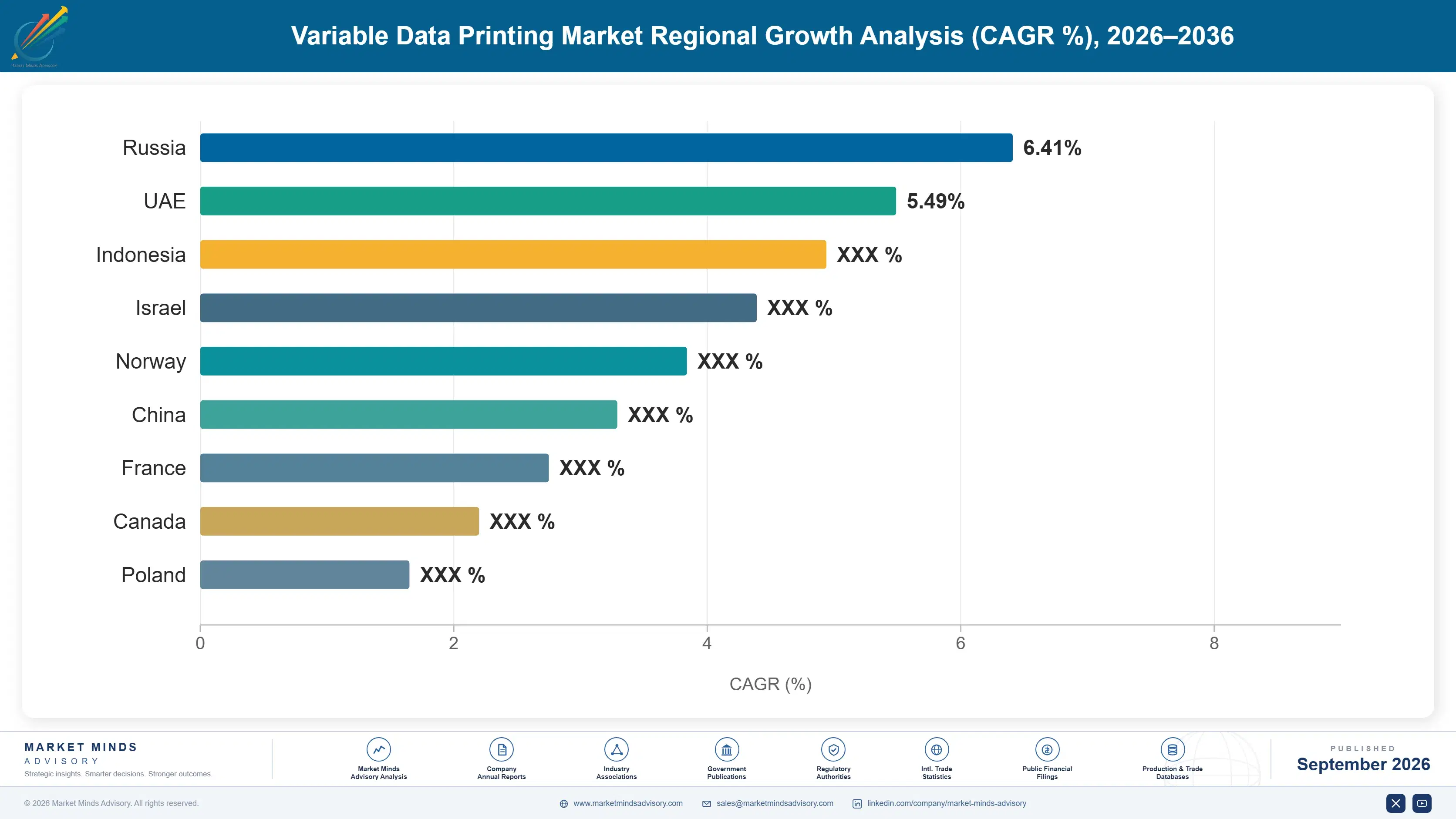
India: 9.6% CAGR
Fastest Growth Region
South Asia and Pacific: 8.8% CAGR
Largest Region
North America: 29% of 2025 global value
Market Leaders
HP Indigo, Canon Production Printing, EFI, Xerox, and Ricoh lead the competitive landscape.
Primary Survey
n=3,800 procurement and R&D decision-makers, Q4 2025, six countries
Methodology
Demand-side build-up, cross-validated against public data, 47 expert interviews

Variable Data Printing Market Forecast Scenarios

variable-data-printing-market-size-forecast-scenario-1790007389084
The variable data printing market compounded at roughly 6.0 percent between 2020 and 2025, a period shaped by a sharp pandemic-era dip in transactional and direct mail volume followed by a steadier recovery as e-commerce packaging personalization opened an entirely new demand channel that partly offset continued decline in traditional bulk mail categories nationwide and abroad.
MMA's base case assumes 6.8 percent annual growth through 2036, anchored by three commercial mechanisms: e-commerce brands adopting personalized packaging inserts and shipping labels at real scale, postal rate increases pushing mailers toward higher-value personalized formats that justify rising cost per piece, and continued workflow software upgrades that let smaller print shops take on personalization work previously reserved for the largest, most capitalized providers with dedicated production lines and staff.
The bull case centers on e-commerce brands accelerating packaging personalization faster than current adoption curves suggest, pulled forward by social media unboxing culture that rewards distinctive packaging design. The bear case is continued decline in transactional mail volume as digital billing and statement delivery displace print entirely across an increasing share of financial services and utility customers over the next full decade.

Personalization Depth Now Sets Variable Data Print Pricing

Variable data printing sits awkwardly between two very different buyer mindsets: marketing teams that view personalization as a response-rate lever worth paying a premium for, and finance teams that still evaluate print spending mainly on cost per piece produced. That tension shapes almost every vendor pricing conversation happening in the category today across nearly every client segment.
MARKET CONCENTRATIONCR5 46%top five vendors hold roughly half of press revenue
AVERAGE JOB VALUE$3,400typical personalized print run value across mid-size providers today
DIGITAL PRESS PENETRATION38%of commercial print capacity now runs on digital equipment
PACKAGING SEGMENT SHARE22%of total category revenue now comes from personalized packaging
RESPONSE RATE UPLIFT+34%average lift versus static print for personalized direct mail
CONSUMABLE COST SHARE31% of COGSink and substrate costs remain largest single input expense
Digital press penetration keeps climbing as offset equipment ages out of service, but the more consequential shift is happening in workflow software, where automated data merge and variable image composition tools are letting smaller shops take on jobs that once required a dedicated production specialist on staff. Packaging personalization is growing from a smaller base but expanding faster than any other application category tracked in this report.
Vendors that can demonstrate a documented response rate lift are increasingly winning budget away from cost-focused competitors, since marketing clients now expect personalization spending to show measurable return rather than simply looking distinctive on the shelf. HP Indigo and Canon Production Printing both lean on case study libraries quantifying this uplift to justify premium equipment and consumable pricing against lower-cost digital press alternatives entering the market steadily.
"Nobody buys a digital press because it prints fast anymore. They buy it because marketing can prove the personalized version outsold the generic one three to one."
Senior Analyst, Print Technology and Marketing Production Practice · MMA Technology Practice · September 2026

Market Trends

E-Commerce Brands Scale Personalized Packaging Insert Programs

Direct-to-consumer brands are increasingly treating the unboxing moment as a marketing channel in its own right, commissioning variable data printed inserts, thank-you cards, and shipping labels that reference the specific product purchased or the customer's order history. Social media unboxing content has turned personalized packaging into a measurable acquisition channel, with brands tracking user-generated content volume tied directly to packaging distinctiveness. Print service providers that can turn around short-run personalized packaging orders within days rather than weeks are capturing this demand fastest, since e-commerce brands operate on much shorter planning cycles than traditional retail packaging buyers ever did.
Market Impact: Lifts response rates 34 percent
Postal Rate Increases Push Mailers Toward Higher-Value Formats

Repeated postal rate increases across the United States, United Kingdom, and several European markets have made low-value undifferentiated bulk mail increasingly uneconomical, pushing mailers to either abandon print marketing or shift toward highly personalized formats that generate response rates high enough to justify the rising cost per piece. This bifurcation is reshaping the competitive landscape, since providers serving only commodity bulk mail face shrinking volume while those with genuine personalization capability capture share from clients consolidating spending into fewer, higher-value campaigns. Postal operators are promoting personalized mail to sustain volume against digital competition.
Market Impact: Cuts cycle time 40 percent

Market Opportunities and Growth Drivers

Response Rate Data Justifies Premium Personalization Pricing

Marketing teams increasingly demand documented proof that personalized print outperforms static alternatives before approving budget, and vendors that can supply this data are winning larger, more durable client relationships than those competing purely on unit price. Multiple published case studies from major print service providers now show personalized direct mail generating response rates several multiples higher than generic equivalents, a gap wide enough that marketing budget holders are willing to pay meaningfully more per piece. This dynamic is pulling print spending away from pure commodity providers toward those who invest in data-driven production capability and measurement infrastructure.
Market Impact: Cuts transactional volume 12 percent

Digital Press Replacement Cycle Accelerates Workflow Software Adoption

Aging offset and early-generation digital press fleets are reaching end of useful life across many mid-size print shops simultaneously, and replacement purchases increasingly bundle modern workflow software capable of handling complex variable data jobs that older equipment could never process efficiently. This replacement cycle is compressing the technology gap between large national print providers and smaller regional shops, since new equipment arrives with personalization capability built in rather than requiring a separate, expensive software integration project. Equipment vendors are using flexible financing terms to accelerate this replacement cycle among budget-constrained smaller providers.
Market Impact: Adds 9 percent to substrate costs

Market Restraints and Challenges

Digital Channel Substitution Erodes Transactional Print Volume

Financial services and utility companies continue migrating customers from printed statements and invoices to digital delivery, a trend whose root cause is a straightforward cost advantage: digital delivery costs a fraction of print and postage per document at scale. The commercial impact falls hardest on print providers whose revenue concentrates in transactional document printing rather than higher-margin marketing and packaging applications, since transactional volume decline is largely irreversible once a customer opts into digital delivery. Some providers are mitigating this by pivoting capacity toward personalized marketing and packaging work that faces no comparable digital substitute.
Market Impact: Adds 6.8 percent packaging revenue

Substrate and Ink Cost Volatility Compresses Provider Margins

Paper and specialty substrate pricing has been volatile since 2022, with the root cause tracing back to pulp mill capacity closures and elevated energy costs affecting paper manufacturing across several major producing regions simultaneously and without much warning. The commercial impact hits smaller print providers hardest, since they lack the purchasing scale to negotiate favorable long-term substrate contracts that larger national providers have already secured for themselves. Some providers are mitigating exposure by passing substrate cost increases directly through to clients via surcharge clauses now common in personalized print contracts industry-wide.
Market Impact: Cuts bulk mail volume 18 percent
3 additional market trends, 4 additional growth drivers, and 2 additional restraints and challenges are covered in the full report. Contact sales@marketmindsadvisory.com to access the complete intelligence.

Segment CAGR and Growth Architecture

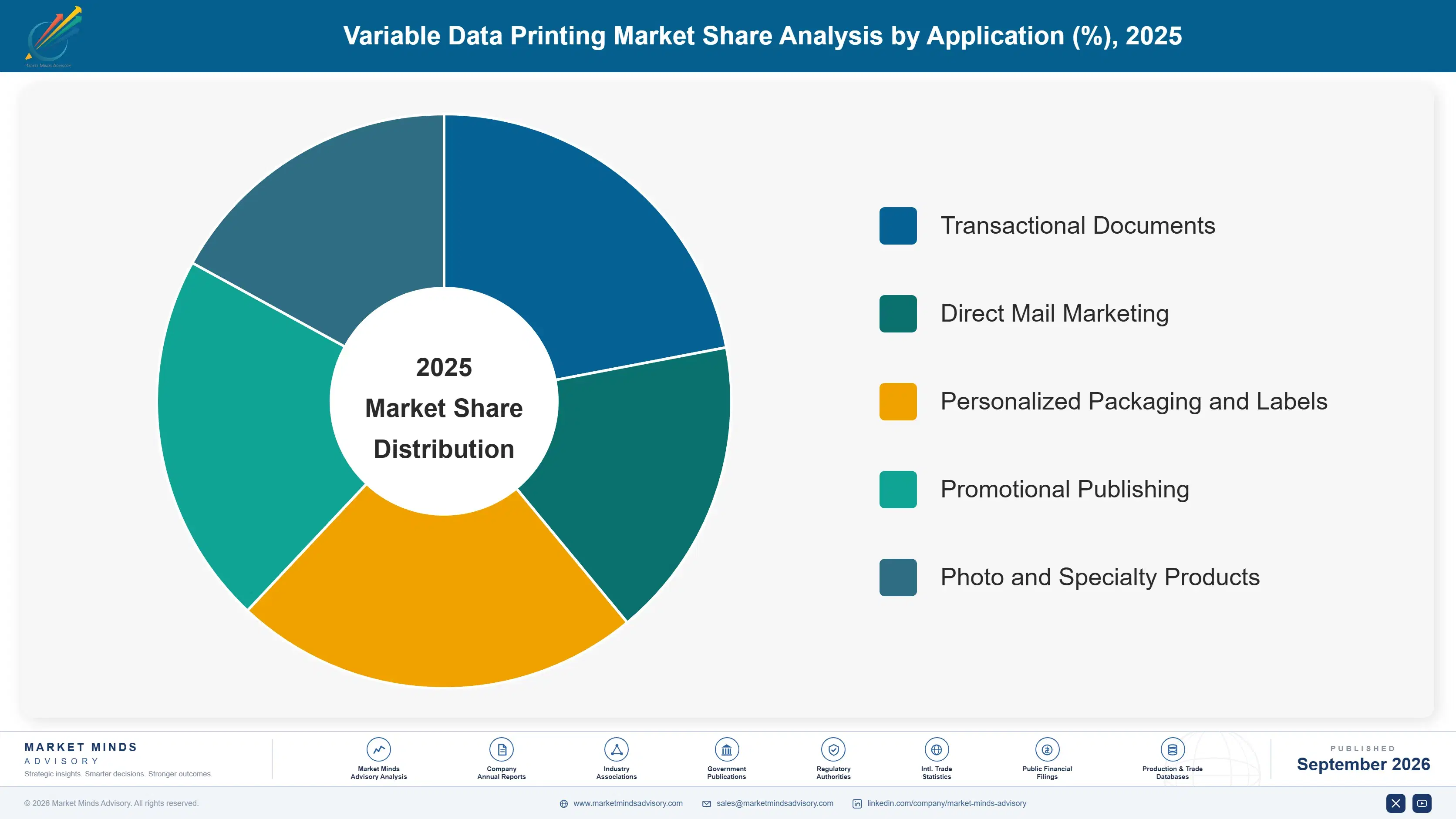
Five application categories cover the market: transactional documents, direct mail marketing, personalized packaging and labels, promotional publishing, and photo and specialty products. Classification follows end-use application alone, rather than press technology, print substrate type, or vendor business model, keeping the hierarchy consistent across every downstream commercial discussion found in this report and its appendices.
variable-data-printing-market-market-share-analysis-1790007389619

Personalized Packaging and Labels

Personalized packaging and labels is the fastest-growing application category, at a 10.4 percent CAGR against a base rate of 6.8 percent, pulled forward by e-commerce brands treating the unboxing moment as a genuine marketing channel rather than a purely functional shipping requirement. Growth here compounds off a smaller starting base than transactional documents, but the trajectory is steep enough that several digital press vendors have redesigned product roadmaps specifically around short-run packaging capability. Social media unboxing culture has turned distinctive packaging into a measurable driver of user-generated content and repeat purchase behavior, giving brand marketers a documented return on investment case that justifies premium pricing over generic, undifferentiated packaging alternatives.
CAGR 10.4%

Direct Mail Marketing

Direct mail marketing carries the second-fastest growth rate, at 8.9 percent, as postal rate increases push mailers toward higher-value personalized formats that generate response rates strong enough to justify rising cost per piece. This represents a genuine bifurcation within the category: low-value bulk mail volume continues shrinking even as personalized, data-driven campaigns expand steadily, meaning overall category revenue can grow even while total piece volume declines further still. Marketing teams increasingly treat direct mail as a complement to digital channels rather than a replacement, using personalization data captured online to drive offline print targeting decisions that would have been impossible under the previous generation of static, undifferentiated mail campaigns entirely.
CAGR 8.9%
Full segment breakdown across 5 segments available in the complete report.

Regional Architecture and Country Demand Map

North America leads variable data printing demand by a modest margin, anchored by the world's largest direct-mail and transactional document infrastructure and the earliest e-commerce packaging personalization adoption, narrowly ahead of an East Asian base scaling fast off a smaller starting point across most application categories tracked.

North America

The United States postal system's sheer scale, still the largest direct-mail and transactional document volume base globally despite years of decline, anchors this region's lead even as that underlying volume continues to shrink steadily. E-commerce brands headquartered in the United States were also the earliest adopters of personalized packaging inserts, giving American print service providers a head start in building the short-run, quick-turnaround production capability this application now demands. Canada's smaller but steady financial services and utility transactional printing base adds incremental volume. Growth trails the global base rate as this mature market's transactional document decline partly offsets packaging and marketing personalization gains that are still building momentum across most provider segments.
Share: 29% | CAGR: 6.5% (2026 to 2036)

East Asia

China's expanding e-commerce packaging personalization market, still earlier in its adoption curve than North America, is compounding faster off a smaller base and closing the regional gap year over year with each passing quarter. Japan's transactional document printing base remains large and stable, tied to a mature financial services and utility billing infrastructure that has been slower to digitize than comparable Western markets. South Korea's packaging and label printing sector, serving both domestic and export-oriented consumer brands, adds further volume to the regional total each year. Growth here outpaces the global base rate as e-commerce personalization adoption across the region remains in an earlier, faster-compounding phase relative to more mature Western markets today.
Share: 24% | CAGR: 7.5% (2026 to 2036)
Regional intelligence for 5 additional markets available in the complete report: Western Europe, South Asia and Pacific, Latin America, Middle East and Africa, Eastern Europe. Contact sales@marketmindsadvisory.com.
variable-data-printing-market-country-cagr-analysis-1790007390147

Where Variable Data Print Margin Actually Sits

Press speed no longer decides who wins the very best jobs in this category anymore at all. Margin concentrates instead in personalization sophistication, documented response rate data, and short-run turnaround speed, capabilities that commodity providers competing purely on cost per piece cannot easily replicate without a genuine, sustained investment in both people and equipment.

Response Rate Data as a Sales Tool

Providers that build a documented case study library quantifying response rate lift are winning larger marketing budgets than competitors who can only cite production capability alone in sales conversations. Vendors with published data showing personalized direct mail outperforming static equivalents by 30 to 40 percent are converting that evidence directly into premium pricing, since marketing clients increasingly need to justify print spend against digital channel alternatives with comparable measurement rigor. HP Indigo and Canon Production Printing both maintain dedicated case study teams specifically to support this sales motion across their reseller network.
Market Impact: Supports a 30 to 40 percent price premium

Short-Run Packaging Turnaround Speed Premium Pricing

Providers that can turn around personalized packaging orders within days rather than the multi-week timelines traditional packaging converters typically quote are capturing a disproportionate share of e-commerce brand business, since these brands operate on much shorter planning cycles than traditional retail packaging buyers. This turnaround capability commands a real price premium, with rush short-run jobs pricing 15 to 25 percent above equivalent standard-lead-time orders at most providers offering both options. Digital press vendors are increasingly marketing turnaround speed as a headline feature rather than a secondary consideration for prospective packaging clients.
Market Impact: Commands a 15 to 25 percent turnaround premium

Workflow Software Licensing Beyond Hardware Sale

Equipment vendors are increasingly separating workflow and data merge software into standalone recurring licenses rather than bundling it into the one-time press hardware sale, converting what was once a single capital purchase into an ongoing revenue relationship. Software licensing revenue now accounts for roughly 12 to 15 percent of total vendor revenue among the largest digital press manufacturers, a share that has grown steadily as personalization complexity increases and clients require more frequent software updates. This shift mirrors a broader industrial equipment trend toward recurring software revenue over one-time hardware sales.
Market Impact: Adds 12 to 15 percent recurring software revenue

Substrate Surcharge Pass-Through Margin Protection Clauses

Providers that have successfully negotiated substrate cost surcharge clauses into client contracts are protecting margin far better than competitors still absorbing raw material volatility internally, a practice that has become increasingly standard since substrate pricing turned volatile starting in 2022. These surcharge clauses typically pass through 80 to 90 percent of substrate cost increases directly to clients within thirty to sixty days, preserving provider margin that would otherwise erode during a cost spike. Larger providers with more sophisticated contract terms have been faster to adopt this practice than smaller regional competitors.
Market Impact: Passes through 80 to 90 percent of increases

Who Controls the Margin Pool

At 46 percent, CR5 concentration leaves a genuinely fragmented tail of regional and specialty providers beneath the top five. HP Indigo leads the digital press hardware segment by a wide margin, but Canon Production Printing and EFI have both narrowed the gap in workflow software sophistication, closing what was once a larger distance to the leader.
Current competitive activity centers on workflow software differentiation, documented response rate case studies, and short-run turnaround capability rather than raw press speed. Vendors are racing to publish quantified personalization impact data since marketing clients increasingly demand measurement rigor before committing budget. Several providers have also begun offering flexible equipment financing tied to workflow subscriptions, bundling separate capital and operating decisions into one contract.

The next competitive shift is coming from cloud-native workflow software vendors entering from the marketing technology side rather than traditional print equipment manufacturing, a threat that could compress hardware vendor margins on the software layer. That threat remains contained to workflow orchestration for now, since press hardware still requires deep manufacturing expertise these newer entrants lack. Smaller specialty packaging converters focused on personalization are proving harder for large national providers to displace.
variable-data-printing-market-company-positioning-matrix-1790007390671

Competitive Moat and Risk Dimensions

HP INDIGO

Moat: Digital press installed base depth

HP Indigo's decades-long presence in digital press manufacturing gives it the deepest installed base and service network of any vendor in the category, and providers rarely switch press platforms once operators and workflow processes are built around a specific system. That installed base also generates a large, recurring consumables revenue stream smaller vendors cannot match.
HP INDIGO

Risk: Hardware-centric revenue exposure

HP Indigo's revenue still concentrates heavily in press hardware and consumables sales rather than the higher-margin workflow software layer where competitive differentiation increasingly happens. Competitors building cloud-native workflow platforms independent of any specific press hardware are capturing software revenue that HP Indigo's more hardware-anchored business model is much slower to pursue.
CANON PRODUCTION PRINTING

Moat: Workflow software integration depth

Canon has invested heavily in workflow software that integrates data merge, variable image composition, and production scheduling into a single platform, reducing the operator expertise required to run complex personalized jobs. This integration depth gives Canon a genuine advantage with mid-size print shops that lack dedicated data specialists on staff and need software to fill that gap.
CANON PRODUCTION PRINTING

Risk: Narrower packaging segment presence

Canon's installed base skews toward transactional document and direct mail applications, leaving it less established in the fastest-growing personalized packaging segment than competitors who built dedicated packaging press lines earlier. Catching up in packaging-specific hardware requires meaningful capital investment that competes internally with Canon's existing document printing product roadmap priorities.

Players Tracked

Prominent Players

HP Inc
Canon Inc
EFI Inc
Xerox Holdings Corporation
Ricoh Company Ltd

Other Key Players

Konica Minolta Inc
Kodak Alaris Inc
Xeikon NV
Heidelberger Druckmaschinen AG
Koenig and Bauer AG
Domino Printing Sciences plc
Bobst Group SA
Screen Holdings Co Ltd
Fujifilm Holdings Corporation
Landa Digital Printing Ltd
Duplo International Ltd
MGI Digital Technology SA
Objectif Lune Inc
Pitney Bowes Inc
Quadient SA

Recent Developments

JANUARY 2026

HP Indigo Launches Packaging-Optimized Digital Press Line

HP Indigo introduced a new digital press line specifically optimized for short-run personalized packaging and label production, targeting e-commerce brands and specialty packaging converters. The launch extends HP Indigo's existing press portfolio into a faster-growing application category where competitors had previously held an early advantage in short-run turnaround capability.
Signal: Packaging-specific hardware is fast becoming a required product line for every major digital press vendor nationwide
OCTOBER 2025

Canon Acquires Cloud Workflow Software Startup

Canon Production Printing completed the acquisition of a cloud-native workflow software startup to accelerate its transition toward subscription-based software revenue independent of hardware sales. The deal brings modern data integration capability that Canon had previously developed more slowly through internal engineering resources alone, compressing its roadmap timeline significantly.
Signal: Workflow software acquisition is emerging as a faster path to capability than slower internal engineering development
APRIL 2026

EFI Signs Major Retail Packaging Converter Partnership

EFI signed an exclusive equipment and software partnership with a major retail packaging converter network to standardize personalization workflow across the converter's facilities nationwide. The agreement extends EFI's existing packaging-focused product strategy and provides a reference deployment other converters are likely to evaluate closely in coming quarters.
Signal: Exclusive converter partnerships are becoming a preferred distribution and customer lock-in strategy across the whole industry

Substrate and Consumable Cost Exposure

Paper and specialty substrate costs account for roughly 31 percent of variable data printing cost of goods sold, sourced predominantly from North American, Scandinavian, and Southeast Asian pulp and paper mills operating on long-standing supply contracts. Ink and toner consumables add a further 14 to 18 percent, with proprietary consumables typically required by most digital press vendors.
Substrate pricing volatility hit hardest starting in 2022, when pulp mill capacity closures in North America and elevated energy costs affecting paper manufacturing across Europe combined to push specialty substrate prices up sharply within a single year. International Energy Agency data on European industrial energy costs cited paper and pulp manufacturing as among the most energy-intensive sectors affected, and several print providers disclosed substrate cost increases as a direct margin pressure through 2023 and 2024.

Larger national print providers with long-term substrate supply contracts and multi-mill sourcing relationships absorbed the 2022 volatility with far less disruption than smaller regional shops reliant on spot-market paper purchases, a resilience gap that persists today. Proprietary consumables exposure follows a similar pattern: providers locked into a single press vendor's ink system face less pricing flexibility than those running open-platform equipment compatible with multiple consumable suppliers.
variable-data-printing-market-cost-volatility-analysis-1790007390867

Multi-Mill Substrate Sourcing Diversification

Larger providers are diversifying substrate sourcing across multiple pulp and paper mills in different regions specifically to avoid single-source exposure during a future capacity closure or regional energy price spike, trading some procurement simplicity for genuine, durable supply resilience that smaller competitors generally lack access to at any comparable scale or cost today at all.

Contractual Substrate Surcharge Pass-Through Clauses

Providers are increasingly building substrate cost surcharge clauses directly into client contracts, passing through the majority of raw material cost increases rather than absorbing them all internally, a practice that has become standard since the 2022 volatility episode reshaped contract negotiation norms across the entire industry over the following two to three full years.

Open-Platform Equipment Selection for Consumable Flexibility

Some providers are deliberately favoring open-platform digital presses compatible with multiple third-party consumable suppliers over proprietary closed systems, sacrificing some print quality consistency for a much more meaningfully greater degree of negotiating leverage on ongoing ink and toner procurement costs over the equipment's entire full useful operating life span and well beyond its eventual replacement.

Portfolio Architecture for Margin Defence

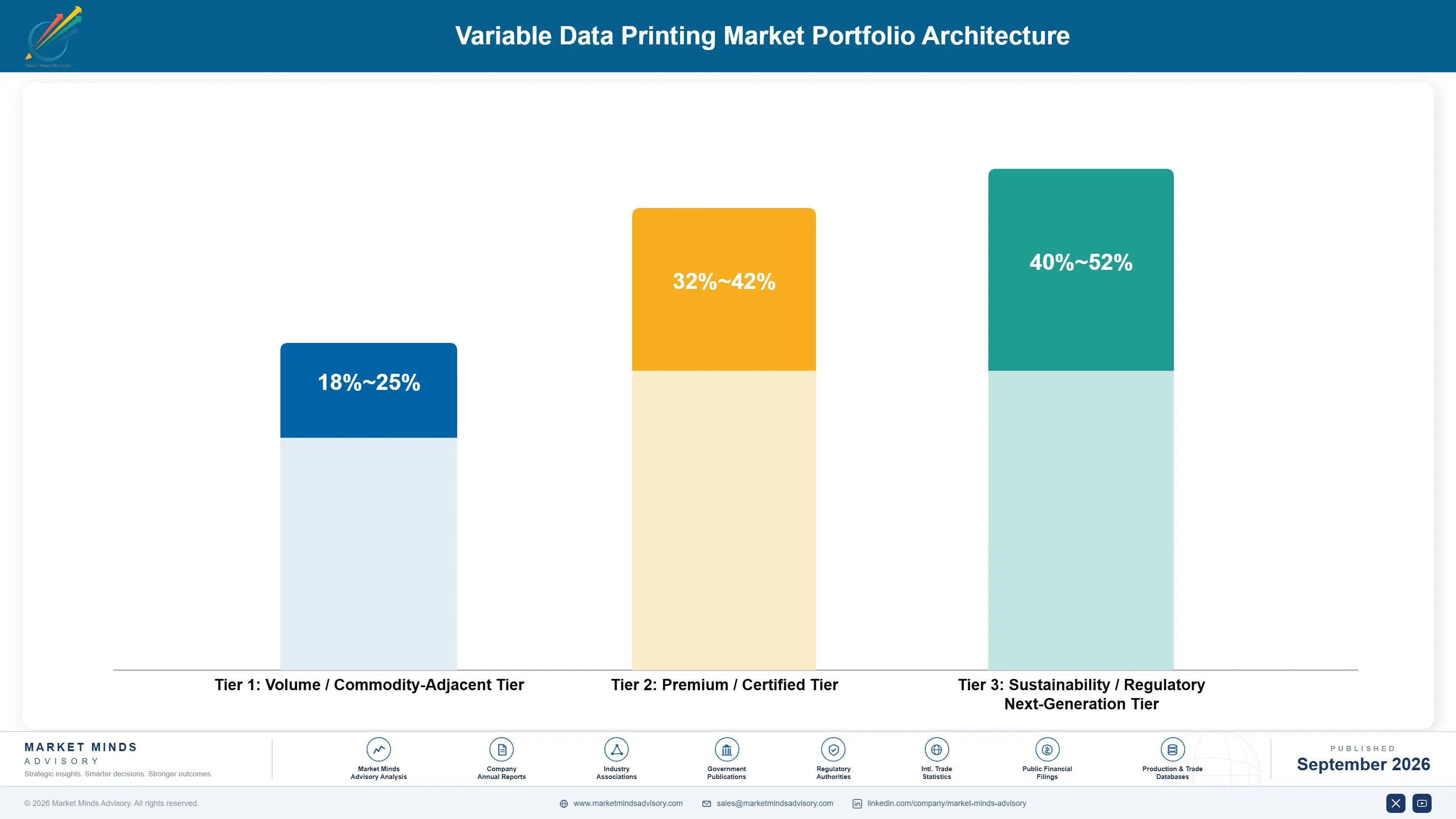
Margin architecture in variable data printing splits along personalization sophistication rather than press type alone. Commodity transactional printing holds gross margins around 18 to 25 percent as digital substitution keeps pricing pressure constant. Personalized packaging and premium direct mail hold materially higher margins, since documented response rate data and short-run turnaround capability create real switching costs clients cannot easily walk away from once a relationship is established.
The volume versus premium tension runs through the entire provider base: commodity transactional printers scale on document count but face relentless digital substitution, while personalization-focused providers grow more slowly in volume terms but capture disproportionate margin per job. High-value margin pools concentrate almost entirely in packaging and marketing personalization rather than transactional documents, and that concentration is where the strongest providers are now directing the bulk of new equipment and software investment.

Regulatory-adjacent pressure, particularly rising postal rates pushing mailers toward higher-value formats, is opening a genuinely new premium tier that smaller commodity-focused providers struggle to enter quickly, since building documented response rate credibility takes years of case study accumulation. Providers positioned early in personalization are compounding an advantage that price-focused competitors will find increasingly hard to close.

Volume / Commodity-Adjacent Tier

Transactional document and undifferentiated bulk mail printing, competing on cost per piece against continued digital delivery substitution, with limited pricing power against price-focused financial services and utility procurement teams industry-wide.
Gross Margin: 18-25%

Premium / Certified Tier

Direct mail marketing and mid-tier personalized packaging carrying documented response rate data, where measurement credibility and turnaround speed give established providers durable pricing power over newer, unproven market entrants still building comparable case study evidence.
Gross Margin: 32-42%

Sustainability / Regulatory / Next-Generation Tier

E-commerce packaging personalization and cloud-native workflow software tied to unboxing marketing programs, the fastest-compounding and highest-margin tier in the market as brand personalization investment continues expanding steadily across most product categories and price points.
Gross Margin: 40-52%
variable-data-printing-market-portfolio-architecture-1790007391375

High-value Sub-segments and Strategic Watch-out

Personalized Packaging and Labels

The highest-value, fastest-growing pool in the market, converting a functional shipping requirement into a genuine marketing channel as e-commerce brands scale unboxing-focused personalization programs across most major direct-to-consumer product categories and price points, a trend MMA analysts expect to persist well through the full forecast period ending 2036.
Gross Margin: 40-52%

Direct Mail Marketing

High-value and growing steadily as postal rate increases push mailers toward personalized formats, though the underlying bifurcation between commodity bulk mail and premium personalized campaigns continues to widen with each passing year across nearly every mature postal market this report actually tracks in real detail.
Gross Margin: 32-42%

Transactional Documents

The volume core of the market, generating the bulk of all print runs but facing continued digital substitution pressure as financial services and utility companies migrate customers toward paperless statement delivery options steadily across nearly every developed market this report tracks and covers in depth.
Gross Margin: 18-25%

Cloud-Native Workflow Software Entrants

The clearest strategic watch-out for traditional press hardware vendors, as marketing technology companies build workflow orchestration software that threatens to capture the highest-margin software layer independent of any specific press hardware platform, a shift genuinely worth monitoring closely going forward over the next several years.
Gross Margin: n/a

Why Variable Data Print Revenue Compounds

Variable data printing increasingly behaves like an annuity business in its premium segments rather than a one-time job order. Once a client builds their marketing calendar around a provider's personalization workflow and response rate reporting, switching costs rise sharply, and renewal rates for personalized direct mail and packaging contracts now commonly exceed 80 percent, turning what used to be a project-based purchase into a durable, multi-year relationship.
Adoption depth varies significantly by end-use vertical. Financial services and insurance clients show the deepest stickiness, since compliance-sensitive statement and billing formats rarely get redesigned once approved through internal review processes. E-commerce packaging personalization runs nearly as sticky, tied to brand identity elements clients rarely change, while promotional publishing remains largely transactional and shows minimal loyalty to any single print provider.

Buyer profiles are shifting generationally as well. Younger marketing managers entering brand teams now expect data-driven personalization as a baseline expectation rather than a novel feature, while procurement has moved from pure print buyers toward brand and customer experience teams, who evaluate providers on measurable response data rather than unit price alone. This buyer shift is steadily raising the evidentiary bar every provider must clear.
variable-data-printing-market-end-use-penetration-index-1790007391867

Where Print Personalization Value Concentrates

These are among the four positions where our research anticipates prominent divergence between winners and laggards over the coming forecast period. Each is grounded in the demand model, the regulatory perimeter, and the announced capacity pipeline.
01 / RESPONSE RATE EVIDENCE BUILDING

Build a documented response rate case study library before competitors do

Marketing clients increasingly demand quantified proof that personalized print outperforms static alternatives before approving meaningful budget, and providers without this evidence are losing deals to competitors who can show the number directly rather than merely asserting it. Building a credible case study library takes years of accumulated client data, which means providers that start now hold a real head start over slower-moving competitors still relying on qualitative claims. This capability is becoming the clearest differentiator separating premium providers from commodity ones across the category.
02 / PACKAGING TURNAROUND INVESTMENT

Invest in short-run packaging turnaround capability ahead of e-commerce demand

E-commerce brands operate on much shorter planning cycles than traditional retail packaging buyers, and providers unable to turn around personalized packaging orders within days rather than weeks are losing this fast-growing business to more responsive competitors already positioned for it. HP Indigo's new packaging-optimized press line signals where equipment investment is heading industry-wide, and providers without comparable turnaround capability risk permanent exclusion from the category's fastest-growing application segment. Building this capability now, well ahead of full demand maturity, costs meaningfully less than catching up later.
03 / WORKFLOW SOFTWARE MODERNIZATION

Modernize workflow software before cloud-native entrants capture the layer

Marketing technology companies entering from the software side rather than traditional print manufacturing are threatening to capture the highest-margin workflow orchestration layer independent of any specific press hardware platform. Providers still running legacy workflow systems built around a single vendor's hardware are increasingly vulnerable to this newer competitive threat, since clients care more about data integration capability than which specific press produces the final piece. Modernizing now, while the threat remains contained, is far cheaper than reacting once cloud-native platforms gain real scale.
04 / SUBSTRATE CONTRACT PROTECTION

Lock in substrate surcharge protections before the next volatility cycle

Substrate pricing volatility since 2022 exposed how badly providers without surcharge pass-through clauses or diversified sourcing relationships were positioned to absorb a genuine raw material cost spike, a risk that remains fully present even though the acute crisis has passed. Providers that have already built these protections into standard contract terms are meaningfully better positioned than competitors still negotiating fixed-price agreements without any pass-through mechanism at all. Building this resilience now, before the next cycle turns, is materially cheaper than negotiating it during an active crisis.

Engagement Snapshot From the Field

A live engagement with an industry participant carrying material or product regulatory and market exposure ahead of a defining policy shift, showing how our research translates into a defensible multi-year portfolio strategy.
MARKET MINDS ADVISORY · CLIENT ENGAGEMENT SUMMARY
Variable Data Printing Producer Strategic Portfolio Review and Transition Roadmap 2026·Investment Scenario on Variable Data Printing Exposure Evaluation 2025-26
CLIENT PROFILE
A national print service provider operating twelve production facilities across the United States engaged MMA to evaluate digital press and workflow software vendors ahead of a major fleet modernization program. The client had accumulated an aging mix of offset and early-generation digital equipment across facilities and sought a standardized platform to consolidate procurement and expand personalized packaging capacity.
STRATEGIC CHALLENGE
Leadership needed to modernize equipment fleet-wide without disrupting active transactional document contracts serving several large financial services clients under strict service level agreements. Existing equipment varied significantly by facility, creating inconsistent capability for personalized packaging work that clients increasingly requested, while budget constraints ruled out replacing all twelve facilities simultaneously.
MMA APPROACH
MMA benchmarked five candidate digital press vendors against a weighted scorecard covering workflow software sophistication, packaging turnaround capability, total cost of ownership over a seven-year horizon, and documented response rate case study depth. The team conducted structured interviews with each vendor's implementation team and cross-referenced disclosed client references against MMA's primary survey dataset covering comparable provider fleets.
KEY FINDINGS
  1. The lowest-priced equipment option ranked last once workflow software licensing costs and packaging turnaround capability were fully factored into the seven-year total cost of ownership scoring.
  2. Vendors with dedicated packaging-optimized press lines cut projected personalized packaging rollout timelines by roughly four months compared with vendors requiring custom configuration.
  3. Documented response rate case study depth varied significantly across candidate vendors, directly affecting how confidently the client could pitch personalization services to marketing clients.
  4. Phased facility rollout sequencing, prioritizing highest-volume locations first, secured meaningful equipment financing terms that a simultaneous twelve-facility rollout could not have negotiated.
CLIENT PROFILE
A national print service provider operating twelve production facilities across the United States engaged MMA to evaluate digital press and workflow software vendors ahead of a major fleet modernization program. The client had accumulated an aging mix of offset and early-generation digital equipment across facilities and sought a standardized platform to consolidate procurement and expand personalized packaging capacity.
STRATEGIC CHALLENGE
Leadership needed to modernize equipment fleet-wide without disrupting active transactional document contracts serving several large financial services clients under strict service level agreements. Existing equipment varied significantly by facility, creating inconsistent capability for personalized packaging work that clients increasingly requested, while budget constraints ruled out replacing all twelve facilities simultaneously.
MMA APPROACH
MMA benchmarked five candidate digital press vendors against a weighted scorecard covering workflow software sophistication, packaging turnaround capability, total cost of ownership over a seven-year horizon, and documented response rate case study depth. The team conducted structured interviews with each vendor's implementation team and cross-referenced disclosed client references against MMA's primary survey dataset covering comparable provider fleets.
KEY FINDINGS
  1. The lowest-priced equipment option ranked last once workflow software licensing costs and packaging turnaround capability were fully factored into the seven-year total cost of ownership scoring.
  2. Vendors with dedicated packaging-optimized press lines cut projected personalized packaging rollout timelines by roughly four months compared with vendors requiring custom configuration.
  3. Documented response rate case study depth varied significantly across candidate vendors, directly affecting how confidently the client could pitch personalization services to marketing clients.
  4. Phased facility rollout sequencing, prioritizing highest-volume locations first, secured meaningful equipment financing terms that a simultaneous twelve-facility rollout could not have negotiated.
RECOMMENDED STRATEGY
Phase 1: Phase one modernized the three highest-volume facilities and standardized workflow software across all twelve locations within the first six months. Phase 2: Phase two extended personalized packaging capability to five additional facilities over a nine-month rollout window with dedicated vendor support and training. Phase 3: Phase three completed fleet modernization across the remaining facilities and launched a documented response rate marketing program for existing clients.
OUTCOME
The provider reported a 28 percent increase in personalized packaging revenue within the first year following fleet modernization, alongside a 19 percent reduction in per-job production cycle time across facilities (client-reported, unverified by MMA). Client retention in the personalization segment improved measurably following the rollout.

Frequently Asked Questions

Foundational context covering the market sizes, CAGR, scope, country, region and competition that inform every finding below. This section is provided to cover basics and most often pre-purchase conversations, answered from the MMA Primary Research Dataset.

What is the current size of the Variable Data Printing Market?

The global variable data printing market reached 8.6 billion dollars in 2025. Growth is concentrated in personalized packaging and direct mail rather than transactional document printing.

How large will the Variable Data Printing Market be by 2036?

MMA projects the market will reach 17.72 billion dollars by 2036, up from 9.18 billion dollars in 2026. That represents a 1.93 times expansion over the ten-year forecast window.

What is the CAGR for the Variable Data Printing Market 2026 to 2036?

The base case compound annual growth rate is 6.8 percent. MMA's bull scenario projects 8.1 percent, while the bear scenario projects 5.6 percent over the same forecast period.

Which segment is growing fastest?

Personalized Packaging and Labels is the fastest-growing segment at a 10.4 percent CAGR, roughly 1.53 times the overall market rate, driven by e-commerce unboxing marketing programs.

Who are the major companies in the Variable Data Printing Market?

HP Indigo, Canon Production Printing, EFI, Xerox, and Ricoh lead the competitive landscape. The top five hold roughly 46 percent of global category revenue combined.

Which country is growing fastest?

India leads country-level growth at a 9.6 percent CAGR, helped by an expanding e-commerce sector and growing financial services transactional document volume nationwide across most major cities.

Report Segmentation Architecture

The full report scope spans multiple orthogonal segmentation dimensions, with cross-tabulated demand data provided for each dimension pair. Coverage extends further to regional breakdowns, trend trajectories, and the competitive detail needed to support segment-level decision-making.

By Application

  • Transactional Documents
  • Direct Mail Marketing
  • Personalized Packaging and Labels
  • Promotional Publishing
  • Photo and Specialty Products

By End-Use Industry

  • Financial Services and Insurance
  • Retail and E-Commerce
  • Consumer Packaged Goods
  • Healthcare and Utilities
  • Publishing and Media
  • Government and Public Sector

By Commercial Dimension

  • In-House Print Production
  • Outsourced Print Service Providers
  • Cloud-Based Workflow Subscription
  • Equipment Leasing and Financing
  • Managed Print Services

By Region

  • North America
  • Western Europe
  • East Asia
  • South Asia and Pacific
  • Latin America
  • Middle East and Africa
  • Eastern Europe

Scope, Methodology, and Coverage

Every figure in this report is reproducible from documented input assumptions. The scope below maps the historical period, the forecast horizon, the segmentation dimensions, and the countries covered, alongside the underlying primary and qualitative methodology.
Historical Period
2020 to 2025
Forecast Period
2026 to 2036
Base Year
2025 (USD billions; MMA Primary Research Dataset, September 2026)
Market Definition
The variable data printing market covers digital press hardware, workflow and RIP software, and production services that enable content, images, or text to change from one printed piece to the next within a single print run. It excludes static offset printing, wide-format signage without variable content, and generic document management software sold without a print production link.
Quantitative Units
USD Billion
Segmentation Dimensions
By Application, By End-Use Industry, By Commercial Dimension, By Region
Regions Covered
North America, Western Europe, East Asia, South Asia and Pacific, Latin America, Middle East and Africa, Eastern Europe
Countries Covered
United States, China, Germany, United Kingdom, Japan, India, Brazil, France, Australia, Poland
Key Companies Profiled
HP Inc, Canon Inc, EFI Inc, Xerox Holdings Corporation, Ricoh Company Ltd, Konica Minolta Inc, Kodak Alaris Inc, Xeikon NV, Heidelberger Druckmaschinen AG, Koenig and Bauer AG, Domino Printing Sciences plc, Bobst Group SA, Screen Holdings Co Ltd, Fujifilm Holdings Corporation, Landa Digital Printing Ltd, Duplo International Ltd, MGI Digital Technology SA, Objectif Lune Inc, Pitney Bowes Inc, Quadient SA
Quantitative Methodology
Primary survey, n=3,800 respondents, Q4 2025, six countries; demand-side model with trade association cross-validation
Qualitative Methodology
47 expert interviews, Q4 2025; applied to validate demand model assumptions, identify emerging dynamics, and assess competitive positioning
Report Format
PDF and XLSX data workbook (Word format preview document)
Publisher
Market Minds Advisory
Report Code
MMA-2026-TEC-101
Published
September 2026
Contact
sales@marketmindsadvisory.com | www.marketmindsadvisory.com

Purchase the full Variable Data Printing Market Report (2026 to 2036).

This report provides a comprehensive analysis of the global variable data printing market, covering historical performance from 2020 to 2025 and a detailed forecast through 2036. It examines segmentation by application, end-use industry, and commercial model, alongside regional demand dynamics across all seven MMA-tracked geographies. The analysis includes competitive benchmarking of twenty leading vendors, input cost exposure, portfolio margin architecture, and strategic recommendations grounded in primary survey data. Findings draw on MMA's proprietary quantitative survey and expert interview programs conducted in the fourth quarter of 2025.
Segment-level revenue forecasts through the year 2036
Competitive benchmarking of twenty leading market vendors
Regional demand analysis across all seven geographies
Input cost exposure and mitigation strategy review
Portfolio margin architecture and pricing tier analysis
Strategic verdict with actionable commercial recommendations included

Built For The People Who Decide

From boardroom strategy to bench-side execution, this report is read cover-to-cover by leaders shaping the next decade of their industry, turning demand scenarios, market dynamics and valuation benchmarks into decisions.
CXOs/ Presidents/ VPs/ Managers
M&A and Corporate Development
Strategy Teams and R&D Heads
Procurement and Product Directors
Regulatory and Compliance Leaders
Investor Relations and Equity Analysts