Market Minds Advisory
Valeronitrile Market

Valeronitrile Market: documentation value, cyanide handling capability and regulated intermediate qualification

A niche nitrile intermediate where the molecule costs very little and the regulatory dossier behind it costs a great deal, which is why documentation rather than chemistry decides who supplies the pharmaceutical accounts.

Lead Analyst

Bilal Shaikh

Published

September 2026

Make Smarter Decisions with Customized Research Insights

Request a free sample report and evaluate market opportunities, growth trends, and competitive dynamics relevant to your business needs.

2025 MARKET VALUE$0.1BMarket Size 2025
2036 FORECAST VALUE$0.2BBase Case , 2026 to 2036
CAGR 2026 TO 20366.4 %Bull 7.6% / Bear 5.1%
INCREMENTAL OPPORTUNITY$0.1BNet 10- year value creation
EXPANSION MULTIPLE1.82x2036 value over 2026 base
Strategic Levers
M&A Pipeline
Regional Outlook
Country Rankings
Competitive Intelligence
Segmental Deep-dive
Call-Us : 91 93563 13602

Executive Snapshot and Market Trajectory

Valeronitrile is a small molecule with a large paperwork problem attached. The chemistry has been settled for decades and any competent fine chemical plant can make it, but supplying a regulated pharmaceutical account requires a documentation package that takes years to assemble and cannot simply be bought in from anywhere.
Growth concentrates in pharmaceutical intermediate grade material, expanding at 9.6%, where impurity profiling, residual solvent control and regulatory support drive selection rather than assay alone. East Asia holds 34% of value, the largest regional share, because Chinese fine chemical capacity supplies most of the world's nitrile intermediates, and because the pharmaceutical and agrochemical customers consuming them now increasingly sit in the same region rather than in Europe or North America.
The supplier base is tightly concentrated for a molecule this simple, with the top five holding 58% of production capacity, and it divides between integrated fine chemical producers, specialty reagent houses and Chinese and Indian custom manufacturers. Competition runs on documentation and handling capability rather than on chemistry. Regulated starting material qualification is the barrier now separating premium documented supply from ordinary bulk technical trade.
Market Definition
Valeronitrile comprises pentanenitrile supplied across technical, pharmaceutical intermediate, agrochemical intermediate, analytical, custom anhydrous and bulk solvent grades. Sizing covers material sold to pharmaceutical, agrochemical, specialty chemical and research customers at realised delivered price. Other nitrile intermediates including butyronitrile and capronitrile, valeric acid and amylamine derivatives made downstream, cyanide reagents sold separately, custom synthesis services performed on customer-supplied material, and finished active pharmaceutical ingredients all fall outside scope.
Base Year Value
$0.1B in 2025 (MMA Primary Research Dataset, August 2026)
Forecast Period
2026 to 2036, eleven discrete annual values
CAGR
6.4% base case. Bull 7.6%. Bear 5.1%.
Fastest Growth Segment
Pharmaceutical Intermediate Grade: 9.6% CAGR
Fastest Growth Country
India: 9.2% CAGR
Fastest Growth Region
South Asia and Pacific: 8.7% CAGR
Largest Region
East Asia: 34% of 2025 global value
Market Leaders
Evonik Industries, Tokyo Chemical Industry, Merck, Thermo Fisher Scientific and Hairui Chemical lead on production capacity across technical and regulated intermediate grades. Source: MMA Primary Research Dataset, July 2026.
Primary Survey
n=3,800 procurement and R&D decision-makers, Q4 2025, six countries
Methodology
Demand-side build-up, cross-validated against public data, 47 expert interviews

Valeronitrile Market Forecast Scenarios

valeronitrile-market-size-forecast-scenario-1787310898566
Growth of 5.4% across 2020 to 2025 was steadier than the wider fine chemical picture suggests. Pharmaceutical intermediate demand held firm through 2020 while agrochemical and solvent volumes softened, then reversed as crop protection restocking took hold from 2022. Reagent availability and Chinese environmental inspections both constrained output for several quarters, and buyers who had single-sourced discovered how narrow the qualified field really was.
The base case at 6.4% rests on three mechanisms. Small molecule pharmaceutical development keeps generating demand for nitrile building blocks, and valeronitrile serves as a precursor into the amine and carboxylic acid functionality that medicinal chemists reach for repeatedly across therapeutic classes. Agrochemical intermediate demand grows with crop protection formulation across South Asia. And regulated supply requirements keep tightening, shifting volume from technical trade toward documented grades at better pricing.
The bull case at 7.6% turns on a small molecule programme reaching commercial scale with valeronitrile as a registered starting material, since a single approved route can multiply demand from a qualified supplier several times. The bear case at 5.1% turns on route substitution. Medicinal chemists select building blocks freely at development stage, and an alternative nitrile or a different synthetic approach removes the demand entirely.

Valeronitrile: documentation value against handling capability

This is a documentation market that happens to involve a chemical. Valeronitrile itself is straightforward and the synthetic route has been public for generations, so the commercial question is never whether a plant can make it. The question is whether the producer holds impurity profiling, residual solvent data, change control history and regulatory support that a pharmaceutical customer's quality function will actually accept without argument.
TOP FIVE CONCENTRATION58%Share of global production capacity held collectively worldwide
ALKYL HALIDE COST SHARE46% of COGSPortion of delivered cost tied to halide feedstock
PHARMACEUTICAL GRADE SHARE34% of volumeLargest single application by consumed intermediate tonnage globally
TYPICAL CAMPAIGN SCALE2 tonnesBatch size at which most commercial production actually runs
REGULATED PURITY SPECIFICATION99.5% minimumLevel demanded for regulated pharmaceutical intermediate service worldwide
QUALIFICATION LEAD TIME16 monthsApproval cycle before any regulated intermediate supply begins
Cost structure sits mostly in feedstock and containment. Alkyl halide accounts for roughly 46% of delivered cost, cyanide reagent handling adds both material cost and the capital burden of contained processing, and campaign scale near two tonnes means fixed costs spread across very little product. Small volume combined with demanding handling is a thoroughly unattractive combination for anybody who does not already hold the capability and the permits.
Demand divides sharply according to whether the customer is regulated or not. Pharmaceutical intermediate grade takes 34% of volume and pays several times technical pricing for the documentation behind it. Agrochemical, analytical and bulk solvent duty sits considerably lower, where assay and delivered price are very close to the whole conversation between buyer and seller.
"Buyers in this market keep asking suppliers for a certificate of analysis, which every producer can generate on the day of shipment. The suppliers making real money are the ones who can hand over five years of change control history, and there are remarkably few of them."
Director, Fine Chemicals and Pharmaceutical Intermediates Practice · MMA Chemica

Market Trends

Regulated starting material designation reshaping intermediate supply relationships

Regulatory authorities have pushed the boundary of controlled manufacture further upstream, so intermediates that were once bought as ordinary chemicals now sit inside a filed process description. Once valeronitrile is designated a registered starting material in an approved route, the supplier named in that filing becomes extremely difficult to displace, since substitution touches a regulatory submission the customer will not reopen casually. Producers holding audited quality systems and change control discipline capture those positions. Those selling on assay and price alone find themselves confined to the technical and solvent grades where competition is fiercest.
Market Impact: Delivers 34% of market volume
Asian custom manufacture displacing Western reagent house supply

Chinese and Indian fine chemical producers have moved from supplying technical material toward serving regulated accounts directly, having built quality systems and inspection histories that European and American customers now accept. That shift has compressed the margin that Western reagent houses historically earned simply by repackaging and documenting Asian material. Regulatory inspections and audit outcomes rather than delivered price are what actually determine whether the transition succeeds at any individual producer. The result is that the qualified supplier field is broadening geographically while remaining genuinely narrow in absolute numbers everywhere.
Market Impact: Grows 8.7% annually across region

Market Opportunities and Growth Drivers

Small molecule pharmaceutical development sustaining nitrile building block demand

Nitrile functionality gives medicinal chemists a route into primary amines, carboxylic acids, amidines and tetrazoles, which is why nitrile building blocks appear repeatedly across small molecule discovery programmes. Valeronitrile specifically supplies a five-carbon chain with terminal nitrile functionality that turns up in several therapeutic classes. Demand at development scale is small in tonnage but establishes the supplier relationship that carries through to commercial manufacture if a candidate progresses. Pharmaceutical grade material already accounts for 34% of volume, and it earns several times what the identical technical grade material realises anywhere.
Market Impact: Concentrates 58% of capacity collec

Agrochemical intermediate demand expanding across South Asian formulation

Crop protection intermediate manufacture has shifted substantially toward India and China, and nitrile intermediates feed into several established herbicide and insecticide routes still under patent or in generic production. Indian formulators have moved upstream into intermediate manufacture rather than importing finished actives, which pulls building block demand into the region directly. Specification requirements here are less demanding than pharmaceutical service but tighter than bulk technical trade, which puts realised pricing in between. Volume growth here tracks planted area and crop protection spending rather than any pharmaceutical development cycle at all.
Market Impact: Runs 2 tonne typical campaign scale

Market Restraints and Challenges

Cyanide handling capability restricting the credible producer field

Production requires cyanide reagent handling under contained conditions with the permitting, emergency planning and worker protection systems that go with it. The root cause is regulatory rather than technical: the capability is well understood, but the licensing burden and community consultation involved make new capacity genuinely difficult to establish anywhere in Europe or North America. Commercially this keeps the producer field narrow and concentrates supply in facilities that already hold the permits. Participants are responding by consolidating volume into existing licensed sites and by qualifying second sources rather than building new capability.
Market Impact: Locks positions for 16 month cycles

Small campaign scale spreading fixed costs across very little product

Commercial campaigns typically run near two tonnes, so plant fixed costs, cleaning validation and analytical release spread across a volume that would be a rounding error in most chemical businesses. The root cause is that demand is genuinely small and highly fragmented across many customers with different specifications, which prevents any producer building continuous capacity. Commercially this keeps unit costs high and makes the business unattractive without adjacent product lines sharing the same assets. Producers are responding by campaigning several nitriles through shared trains and by pricing documentation rather than tonnage.
Market Impact: Covers 34% of global capacity
2 additional market trends, 3 additional growth drivers, and 4 additional restraints and challenges are covered in the full report. Contact sales@marketmindsadvisory.com to access the complete intelligence.

Segment CAGR and Growth Architecture

Segmentation follows grade and purity class, because the specification level determines the quality system required, the documentation package that must accompany the material, the analytical burden carried and therefore the realised price achieved. Six grades cover the whole market, running from bulk solvent duty through analytical and agrochemical service to fully regulated pharmaceutical intermediate supply.
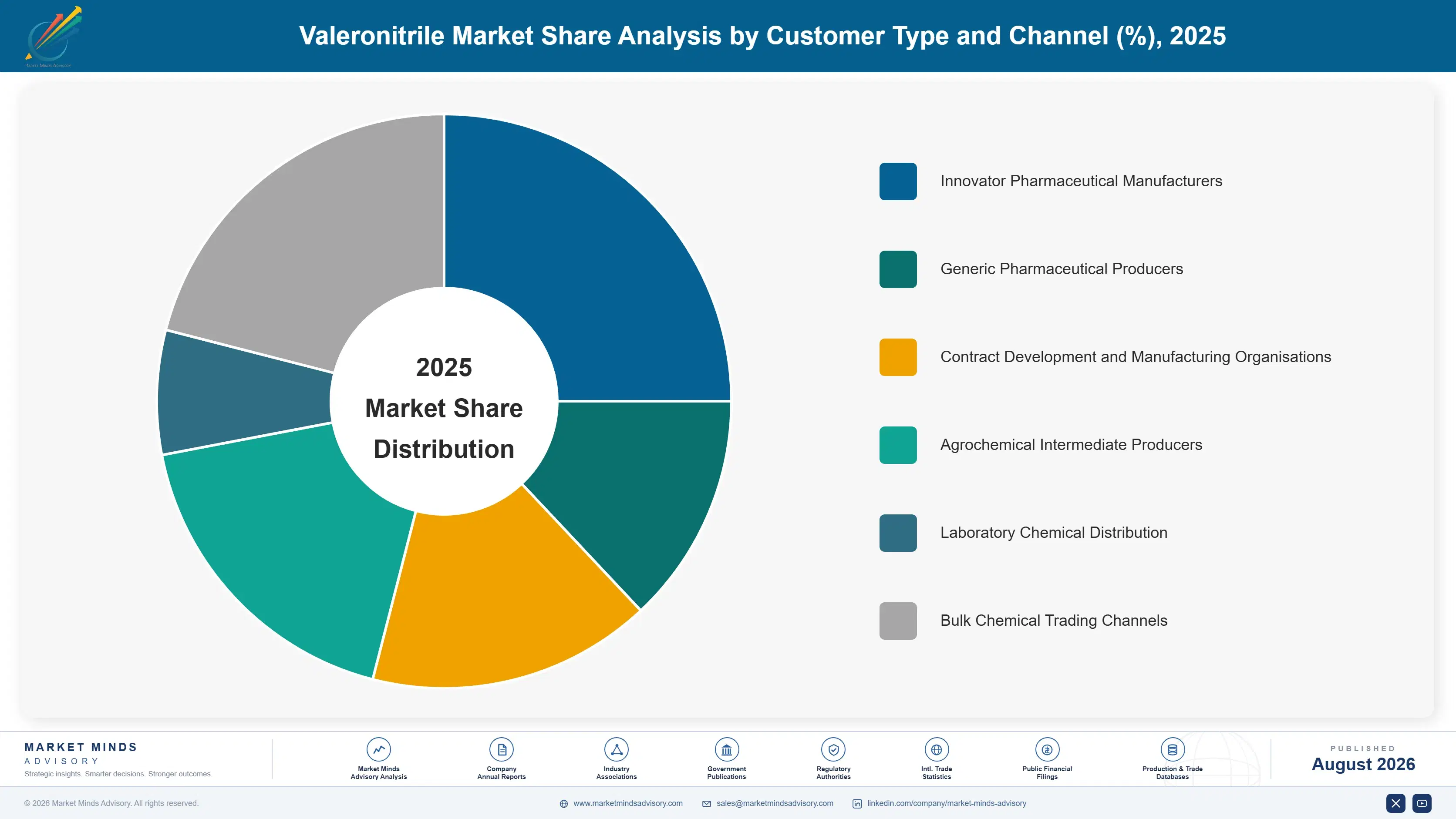
valeronitrile-market-market-share-analysis-1787310899090

Pharmaceutical Intermediate Grade

Expanding at 9.6%, a full 1.50 times the market rate, on material meeting a 99.5% minimum specification with full impurity profiling, residual solvent control and the regulatory support a pharmaceutical quality function will actually accept. The molecule is identical to technical grade in every respect that a chemist would care about, and the price difference is several fold, which tells you exactly what the customer is actually purchasing here. Registered starting material designation makes these positions extraordinarily durable, since any substitution touches a filed process description that nobody reopens lightly. Qualification runs around sixteen months from first enquiry, and remarkably few producers anywhere hold the audit history required to begin it at all.
CAGR 9.6%

Agrochemical Intermediate Grade

Growing at 7.2% on material serving crop protection intermediate manufacture, where specification requirements sit above bulk technical trade but below pharmaceutical service and realised pricing lands accordingly between the two. Indian and Chinese formulators have moved upstream into intermediate production themselves rather than simply importing finished actives, which pulls this demand into the same regions that already hold the production capacity. Colour, water content and specific impurity limits all matter here, because each of them carries through into the downstream active. Volume tracks planted area and crop protection spending rather than any pharmaceutical development cycle, which makes the demand steadier in trend but considerably more seasonal in its ordering pattern.
CAGR 7.2%
Full segment breakdown across 6 segments available in the complete report.

Regional Architecture and Country Demand Map

Valeronitrile supply concentrates in facilities already licensed for cyanide handling, which is a very much shorter list than the total number of fine chemical plants, and demand now increasingly sits alongside that capacity rather than in the Western markets that historically bought most of it.

East Asia

Thirty-four percent of global value, comfortably the largest regional share, because Chinese fine chemical capacity supplies most of the world's nitrile intermediates and because pharmaceutical and agrochemical customers consuming them increasingly sit in the region rather than in Europe. Note: this exceeds the standard regional band because cyanide-licensed fine chemical capacity is concentrated inside a handful of Chinese chemical parks to a degree that no demand measure would capture. Japanese reagent houses hold analytical and research grade positions built on documentation depth accumulated over many decades. Growth of 7.3% runs above the global rate, supported by Chinese producers now moving into regulated intermediate supply directly rather than through Western intermediaries.
Share: 34% | CAGR: 7.3% (2026 to 2036)

North America

Twenty-two percent of global value here, weighted heavily toward pharmaceutical intermediate and research grade supply where documentation requirements are the most demanding anywhere and where realised pricing reflects that properly. Domestic cyanide-licensed capacity is genuinely limited, and much of the material consumed is imported and then documented locally, which is a commercial position now under real pressure as Asian producers qualify directly with the end customers themselves. Contract development and manufacturing organisations consume meaningful volumes at development scale, and they buy on documentation rather than on delivered price. Growth of 5.8% reflects steady pharmaceutical demand alongside a repackaging and documentation business that is now slowly being competed away by direct Asian qualification.
Share: 22% | CAGR: 5.8% (2026 to 2036)
Regional intelligence for 5 additional markets available in the complete report: Western Europe, South Asia and Pacific, Latin America, Middle East and Africa, Eastern Europe. Contact sales@marketmindsadvisory.com.
valeronitrile-market-country-cagr-analysis-1787310899602

Where valeronitrile margin genuinely sits

Four commercial positions separate producers earning regulated intermediate economics from those trading a simple nitrile against assay and delivered price. Each one of them rests on something a competitor cannot assemble quickly: accumulated documentation history, a filed supplier position, licensed handling capability, or else genuine specification service delivered at the customer's own quality function.

Sell change control history rather than certificates of analysis

Every producer can issue a certificate of analysis on the day of shipment, and buyers have learned that it says almost nothing about whether the next campaign will match. Producers presenting five years of change control records, impurity trend data and audit outcomes realise roughly 45% above competitors selling on assay alone, because a pharmaceutical quality function is buying predictability rather than a single result. The evidence already exists inside most quality systems and is rarely assembled into a commercial document. That omission is the cheapest margin available in this business.
Market Impact: Realises roughly 45% above assay-se

Achieve registered starting material supplier designation

Once valeronitrile is named as a registered starting material inside an approved manufacturing route, the supplier in that filing supplies for the commercial life of the product, because any substitution touches a regulatory submission that nobody reopens simply to save on purchasing. Producers achieving that designation capture roughly 6 times the lifetime volume of those supplying at development scale only. Qualification runs around sixteen months and has to begin while the customer's programme is still in development. Waiting until commercial launch means the position has already been filled by somebody else entirely.
Market Impact: Captures roughly 6 times the lifeti

Consolidate volume into existing licensed handling sites

Cyanide handling permits, emergency planning and worker protection systems are effectively impossible to establish new in Europe or North America, which makes existing licensed sites unusually valuable strategic assets in their own right. Producers consolidating nitrile campaigns through shared trains at licensed facilities cut unit cost by roughly 24% against running them separately, because fixed cost and cleaning validation spread across several products rather than one. The constraint is scheduling discipline rather than capital. Most producers under-load these assets very badly and never measure what the idle capacity is actually costing them.
Market Impact: Cuts unit cost by roughly 24% per c

Offer specification service at the customer quality function

Customers with awkward requirements on water content, colour or a specific impurity usually solve them internally with additional purification, which costs them time and yield on every batch they process. Producers meeting those requirements at source command roughly 30% above catalogue specification pricing, because the customer is buying removed process steps rather than a purer chemical. Doing it needs analytical capability and someone willing to talk to a quality function rather than to purchasing. Very few producers in this market employ anybody who does that sort of work at all.
Market Impact: Commands roughly 30% above catalogu

Who Controls the Margin Pool

Concentration is high for a molecule this simple, with the top five holding 58% of production capacity, the basis on which every participant here is assessed. Evonik and Tokyo Chemical Industry lead through documentation depth and audited quality systems rather than through any scale advantage, while the challenger group divides between Western reagent houses, Chinese chemical park producers and Indian custom manufacturers moving upstream into regulated supply.
Competition currently runs on documentation history, licensed handling capability and specification service rather than on chemistry or delivered price, which matter only in the technical and solvent grades. Audit outcomes are what actually determine which suppliers pharmaceutical customers will consider, and those accumulate slowly. Cyanide handling licences function as a genuine barrier to entry across Europe and North America alike.

Emerging pressure comes from two directions simultaneously. Chinese and Indian producers are qualifying directly with Western pharmaceutical customers, which competes away the repackaging and documentation margin that reagent houses historically earned. And route substitution remains a live risk at development stage, meaning rankings can shift on a medicinal chemist's building block choice rather than on anything a supplier actually controls.
valeronitrile-market-company-positioning-matrix-1787310900133

Competitive Moat and Risk Dimensions

EVONIK INDUSTRIES

Moat: Licensed handling and documentation depth

Existing cyanide handling licences at established European sites, combined with quality documentation accumulated across decades of pharmaceutical supply, give Evonik a position that cannot be replicated by any new entrant in the region. Permitting comparable capability today would face community consultation and licensing burdens that in practice nobody attempts, which makes the incumbent position genuinely defensible.
EVONIK INDUSTRIES

Risk: European cost base exposure

European energy, labour and compliance costs sit well above Chinese and Indian equivalents, and as Asian producers accumulate audit histories that Western customers accept, the documentation premium that justifies European pricing narrows. Campaign scale near two tonnes gives very little room to absorb a cost disadvantage, and the assets involved cannot easily be relocated.
TOKYO CHEMICAL INDUSTRY

Moat: Analytical and research grade breadth

A catalogue position spanning thousands of research and analytical grade compounds gives Tokyo Chemical Industry customer relationships and specification data that a single-product producer cannot match. Research customers buying across a wide range value one qualified supplier over several, and that breadth produces the early relationships that carry into development scale supply later on.
TOKYO CHEMICAL INDUSTRY

Risk: Limited commercial scale position

Strength in research and analytical quantities does not translate automatically into commercial campaign supply, where cost per kilogram, campaign scheduling and registered starting material designation govern selection instead. Producers with licensed bulk handling capability take the commercial volumes even where the early development relationship sat elsewhere, which caps how much of the value chain the position actually reaches.

Players Tracked

Prominent Players

Evonik Industries
Tokyo Chemical Industry
Merck KGaA
Thermo Fisher Scientific
Hairui Chemical

Other Key Players

Otto Chemie
Central Drug House
Spectrum Chemical Manufacturing
Santa Cruz Biotechnology
Apollo Scientific
Fluorochem
BLD Pharmatech
Combi-Blocks
Ambeed
Chemieliva Pharmaceutical
Hangzhou Dayangchem
Hubei Jusheng Technology
Wuhan Fortuna Chemical
Zhejiang Wansheng
Anhui Wotu Chemical

Recent Developments

FEBRUARY 2025

Asian producer completes pharmaceutical customer audit qualification

An Asian fine chemical producer completed quality system audits with two Western pharmaceutical customers covering change control, impurity trending and full analytical method validation, establishing direct regulated supply where exactly the same material had previously reached those customers only through a Western reagent house intermediary.
Signal: Direct Asian qualification is now competin
JUNE 2025

Regulatory designation locks intermediate supplier into filed route

A pharmaceutical manufacturer named valeronitrile as a registered starting material within an approved commercial synthetic route, thereby fixing the qualified supplier into the filing itself and making any substitution a regulatory variation rather than an ordinary purchasing decision for the entire commercial life of that product.
Signal: Starting material designation converts an
SEPTEMBER 2025

Producer consolidates nitrile campaigns into licensed shared train

A fine chemical producer consolidated several separate nitrile intermediate campaigns through a single licensed handling train at a single site, spreading cleaning validation and fixed conversion cost across multiple products rather than carrying all of them separately on individual volumes measured in low single-digit tonnes each.
Signal: Asset loading discipline rather than the c

Alkyl halide and cyanide cost exposure

Alkyl halide feedstock accounts for roughly 46% of delivered valeronitrile cost, sourced from chlorination and bromination producers concentrated in China, India and Western Europe. Cyanide reagent contributes about 13%, contained processing and effluent treatment around 12%, solvent and distillation energy 9%, analytical release and documentation 8%, with packaging, freight and working capital carrying the remaining 12%.
Input availability rather than price was the binding constraint through much of the forecast history. Chinese provincial power rationing and environmental inspections through 2021 and 2022 curtailed both halide and reagent output, and European industrial energy prices reached levels the IEA documented as unprecedented across the same window. Evonik Annual Report 2023 recorded raw material and energy cost pressure across its fine chemical operations, and Merck KGaA Annual Report 2022 noted input cost recovery lagging.

The competitive disadvantage mechanism runs through licensed handling capability rather than through feedstock buying. Producers without cyanide handling permits cannot make the material at all and must buy and repackage, which caps margin at whatever the documentation adds. Those with permits but poor asset loading spread fixed cost across too little volume. Small regional producers typically carry both limitations, which confines them to technical and solvent grade trade.
valeronitrile-market-cost-volatility-analysis-1787310900332

Load licensed handling assets across multiple nitrile campaigns

Cleaning validation and fixed conversion cost fall on whatever volume passes through a licensed train, and single-product loading at campaign scales near two tonnes is close to the worst possible arrangement. Scheduling several nitrile intermediates through the same asset spreads those costs properly and it requires nothing more than production planning discipline rather than any capital investment.

Contract halide feedstock supply on multi-year terms

Alkyl halide carries nearly half of delivered cost and comes from a supplier base that has proved vulnerable to provincial power rationing and environmental inspection shutdowns. Multi-year contracting with a qualified second source costs very little and protects against an availability failure that stops production entirely rather than merely raising the input cost involved.

Price documentation separately from the material itself

Producers quoting a single price per kilogram give away the documentation package that actually took years to build and that the pharmaceutical customer genuinely values. Separating regulatory support, change control access and impurity trending into an explicit commercial element makes the value visible and it defends that value when procurement benchmarks the quotation against technical grade offers.

Portfolio Architecture for Margin Defence

Margin architecture separates almost entirely by documentation burden rather than by anything happening in the reactor, which is genuinely unusual even among fine chemical businesses. Technical and bulk solvent grade material earns whatever assay-based competition allows, because the molecule is identical between producers and no buyer here is paying for anything at all beyond purity.
Value climbs steeply where a quality function rather than a purchasing function makes the selection. Agrochemical intermediate service defends modest premiums through impurity limits that carry directly into the downstream active itself. Pharmaceutical intermediate grade sits far higher, since change control history, audit outcomes and regulatory support take years to accumulate and cannot be assembled quickly once a customer has asked for them.

The highest value pools concentrate where registered starting material designation overlaps with licensed handling capability, since both are genuinely difficult to replicate and neither responds to a lower delivered price. Those pools are tiny in tonnage and quite disproportionate in realised margin. The commercial tension is that technical grade volume keeps a licensed asset loaded while funding almost none of the quality system investment that opens anything above it.

Volume / Commodity-Adjacent Tier

Technical and bulk solvent grade material supplied against assay specifications into specialty chemical synthesis and solvent duty, where the molecule is identical between producers and delivered price decides nearly every enquiry received.
Gross Margin: 14-22%

Premium / Certified Tier

Agrochemical intermediate and analytical grade material supplied against defined impurity, colour and water limits. Specification consistency and analytical capability defend pricing here. The ten-point range reflects catalogue supply against qualified customer positions.
Gross Margin: 26-36%

Sustainability / Regulatory / Next-Generation Tier

Pharmaceutical intermediate grade material with impurity profiling, change control access and registered starting material designation. Documentation depth and filed positions defend pricing very strongly. The fifteen-point range reflects development supply against commercial filed positions.
Gross Margin: 42-57%
valeronitrile-market-portfolio-architecture-1787310900838

High-value Sub-segments and Strategic Watch-out

Registered starting material filed positions

High value and genuinely high growth together here, because designation inside an approved route makes any substitution a regulatory variation rather than a purchasing decision, and the position then holds for the entire commercial life of the product, whatever competitors happen to offer later on.
Gross Margin: 42-57%

Custom anhydrous and specification service grades

Strong realised value on genuinely steady growth, because customers with awkward water, colour or impurity requirements are buying removed process steps rather than a purer chemical, and very few producers in this market employ anybody who will actually sit down and discuss it with them.
Gross Margin: 38-50%

Technical and bulk solvent grade trade

The volume core of this whole market, keeping a licensed handling asset properly loaded while earning whatever assay-based competition permits on a molecule that is identical everywhere it is made. Necessary for basic asset economics, but this tier funds nothing whatsoever above itself and never will.
Gross Margin: 14-22%

Route substitution exposure across the portfolio

The strategic watch-out running across this whole portfolio, given that medicinal chemists select their building blocks entirely freely at the development stage and an alternative nitrile or a different synthetic approach removes the demand outright rather than merely repricing it downward for a period or two.
Gross Margin: 10-45%

How valeronitrile demand behaves

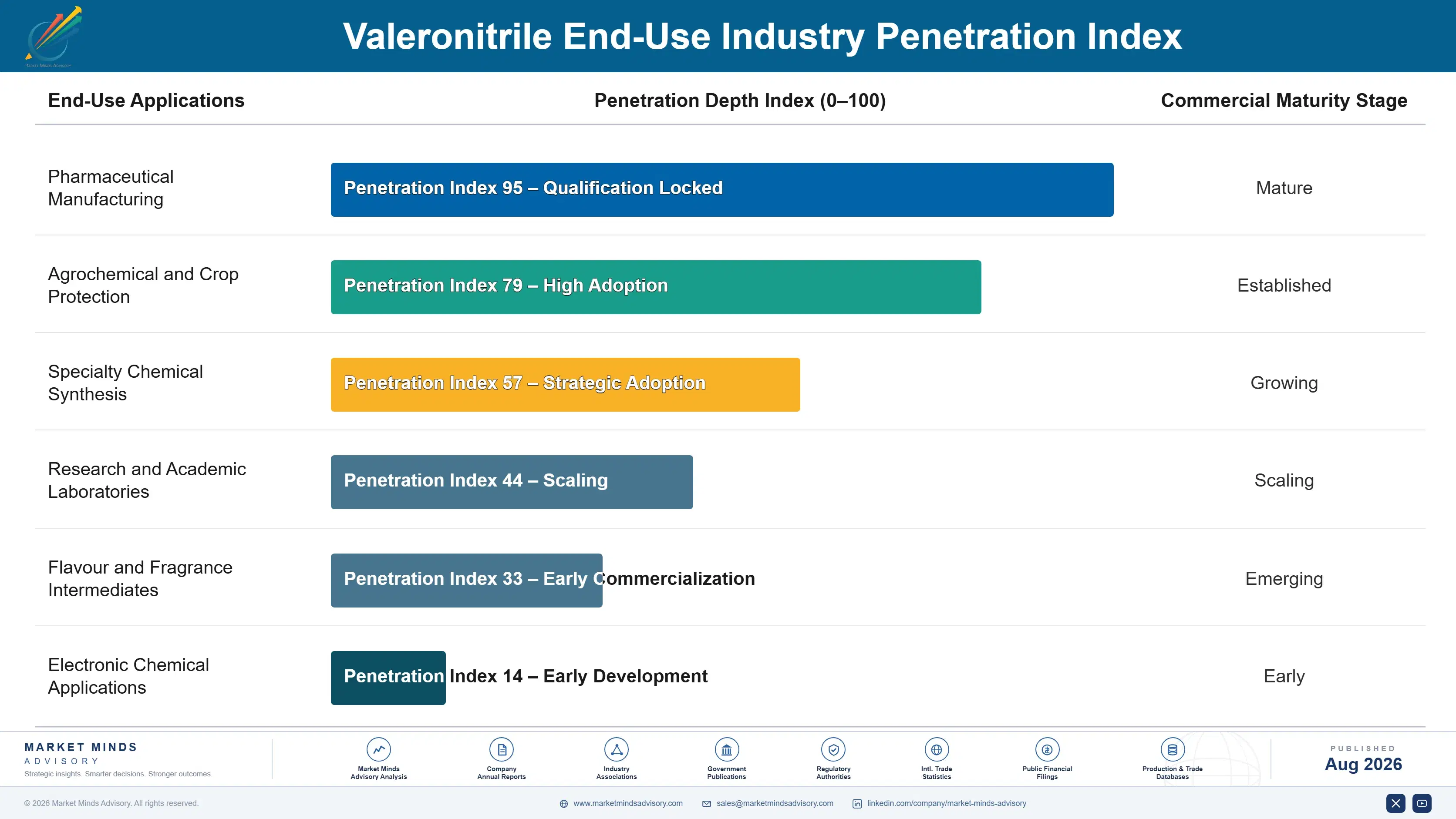
Demand is binary in a way that few chemical markets are. Either the customer is regulated, in which case documentation governs everything and the relationship survives almost any price comparison, or they are not, in which case assay and delivered price are the whole conversation. There is very little middle ground, and producers trying to serve both with one model lose money on the first and business on the second.
Stickiness follows the regulatory filing rather than the technical difficulty. Technical and solvent grade supply is loosest, substituted on a single purchase order. Agrochemical intermediate service sits tighter, because impurity limits carry into a downstream active nobody wants to re-validate. Registered starting material positions are stickiest of all, since displacing the named supplier means a regulatory variation no pharmaceutical company files to reduce a purchasing cost.

The buyer profile splits between functions rather than by company size. Regulated customers put quality assurance in charge, evaluating audit history and change control long before commercial discussion begins, and procurement then executes what quality has already decided. Unregulated customers buy through distribution on assay and availability, which is why catalogue reagent houses and bulk traders coexist here without ever really competing.
valeronitrile-market-end-use-penetration-index-1787310901394

What we would actually do here

These are among the four positions where our research anticipates prominent divergence between winners and laggards over the coming forecast period. Each is grounded in the demand model, the regulatory perimeter, and the announced capacity pipeline.
01 / DOCUMENTATION DEPTH PRICING

Sell the change control history, not the assay result

Every producer can issue a certificate of analysis at shipment, and buyers long ago learned that it says nothing about whether the next campaign will match the last one. Producers presenting five years of change control records, impurity trend data and audit outcomes realise roughly 45% above competitors selling on assay alone. The evidence already exists inside most quality systems and is almost never assembled into a commercial document, which makes it comfortably the cheapest margin available anywhere in this business.
02 / STARTING MATERIAL QUALIFICATION

Get named in the filing before commercial launch

Once valeronitrile is designated a registered starting material inside an approved route, the named supplier holds the position for the commercial life of the product, because substitution becomes a regulatory variation rather than a purchasing decision. Producers achieving that designation capture roughly 6 times the lifetime volume of those supplying only at development scale. Qualification runs sixteen months and must begin while the customer's programme is still in development, since waiting until commercial launch means somebody else already holds the position.
03 / LICENSED ASSET LOADING

Fill the licensed train instead of building anything

Cyanide handling permits are effectively impossible to establish new in Europe or North America, which makes an existing licensed site an unusually valuable strategic asset that most owners under-load badly. Consolidating several nitrile campaigns through shared trains cuts unit cost by roughly 24% against running them separately, because fixed cost and cleaning validation then spread across multiple products. The constraint is scheduling discipline rather than capital investment, and almost nobody in this business measures what the idle capacity is actually costing them.
04 / SPECIFICATION SERVICE CAPABILITY

Remove the customer's purification step at source

Customers with awkward requirements on water content, colour or a specific impurity usually solve them internally with additional purification, losing time and yield on every batch processed. Producers meeting those requirements at source command roughly 30% above catalogue specification pricing, because the customer is buying removed process steps rather than a purer chemical. Doing it needs analytical capability and somebody willing to talk to a quality function, and very few producers in this market employ anybody at all who does that.

Engagement Snapshot From the Field

A live engagement with an industry participant carrying material or product regulatory and market exposure ahead of a defining policy shift, showing how our research translates into a defensible multi-year portfolio strategy.
MARKET MINDS ADVISORY · CLIENT ENGAGEMENT SUMMARY
Valeronitrile Producer Strategic Portfolio Review and Transition Roadmap 2026·Investment Scenario on Valeronitrile Exposure Evaluation 2025-26
CLIENT PROFILE
A fine chemical producer operating a licensed nitrile handling train in Western Europe alongside general specialty synthesis capacity, supplying pharmaceutical, agrochemical and research customers across Europe and North America. Nitrile intermediate revenue approached EUR 31 million annually (client-reported, unverified by MMA), with valeronitrile a meaningful line inside it, roughly sixty percent sold as technical and analytical grade against assay specifications.
STRATEGIC CHALLENGE
The licensed train was running at well under half its available loading and management treated that as a market demand problem rather than a scheduling one. Pharmaceutical intermediate opportunities were being lost without anybody establishing why. A proposed disposal of the licensed asset was under active consideration on the grounds that returns did not justify the compliance burden.
MMA APPROACH
We rebuilt unit economics by campaign rather than by product line, quantified what the licensed handling permit was actually worth against replacement impossibility, and reconstructed ten lost pharmaceutical opportunities through interviews with customer quality assurance functions rather than the procurement contacts the client normally dealt with. Documentation packages were benchmarked against three competitor submissions independently.
KEY FINDINGS
  1. Poor unit economics traced to single-product campaign loading rather than to any weakness at all in achievable pricing across the qualified pharmaceutical grades.
  2. Nine of ten lost pharmaceutical opportunities failed on absent change control documentation rather than on price, purity or delivery performance in any respect.
  3. The licensed handling permit could not be replaced anywhere in the region at any cost, which the disposal analysis had valued at nothing whatsoever.
  4. No commercial element was priced separately for documentation, so procurement benchmarked every single quotation directly against technical grade offers from unlicensed traders.
CLIENT PROFILE
A fine chemical producer operating a licensed nitrile handling train in Western Europe alongside general specialty synthesis capacity, supplying pharmaceutical, agrochemical and research customers across Europe and North America. Nitrile intermediate revenue approached EUR 31 million annually (client-reported, unverified by MMA), with valeronitrile a meaningful line inside it, roughly sixty percent sold as technical and analytical grade against assay specifications.
STRATEGIC CHALLENGE
The licensed train was running at well under half its available loading and management treated that as a market demand problem rather than a scheduling one. Pharmaceutical intermediate opportunities were being lost without anybody establishing why. A proposed disposal of the licensed asset was under active consideration on the grounds that returns did not justify the compliance burden.
MMA APPROACH
We rebuilt unit economics by campaign rather than by product line, quantified what the licensed handling permit was actually worth against replacement impossibility, and reconstructed ten lost pharmaceutical opportunities through interviews with customer quality assurance functions rather than the procurement contacts the client normally dealt with. Documentation packages were benchmarked against three competitor submissions independently.
KEY FINDINGS
  1. Poor unit economics traced to single-product campaign loading rather than to any weakness at all in achievable pricing across the qualified pharmaceutical grades.
  2. Nine of ten lost pharmaceutical opportunities failed on absent change control documentation rather than on price, purity or delivery performance in any respect.
  3. The licensed handling permit could not be replaced anywhere in the region at any cost, which the disposal analysis had valued at nothing whatsoever.
  4. No commercial element was priced separately for documentation, so procurement benchmarked every single quotation directly against technical grade offers from unlicensed traders.
RECOMMENDED STRATEGY
Phase 1: Phase one: schedule three additional nitrile intermediates through the licensed train and abandon the proposed asset disposal process immediately and completely. Phase 2: Phase two: assemble change control and impurity trending histories into a commercial documentation package and price it as an explicit element. Phase 3: Phase three: pursue registered starting material designation with two pharmaceutical customers whose lead programmes are still in clinical development today.
OUTCOME
The client withdrew the disposal and rescheduled campaigns to load the licensed train properly. Loading rose above three quarters of capacity within nine months, and realised margin on pharmaceutical grade volume improved by 23% (client-reported, unverified by MMA) once documentation was priced separately from the material.

Frequently Asked Questions

Foundational context covering the market sizes, CAGR, scope, country, region and competition that inform every finding below. This section is provided to cover basics and most often pre-purchase conversations, answered from the MMA Primary Research Dataset.

What is the current size of the Valeronitrile Market?

The market is valued at USD 0.1 billion in 2025, rising to USD 0.11 billion in 2026. Sizing covers material sold to pharmaceutical, agrochemical, specialty and research customers at realised delivered price.

How large will the Valeronitrile Market be by 2036?

The market reaches USD 0.20 billion by 2036, an increase of USD 0.09 billion across the forecast period. That represents an expansion multiple of 1.82 times the 2026 base.

What is the CAGR for the Valeronitrile Market 2026 to 2036?

The base case CAGR is 6.4% across 2026 to 2036. The bull case reaches 7.6% on a commercial pharmaceutical programme, while the bear case sits at 5.1% under synthetic route substitution.

Which segment is growing fastest?

Pharmaceutical intermediate grade grows fastest at 9.6%, a full 1.50 times the market rate. The molecule is identical to technical grade, and the several fold price difference buys documentation rather than purity.

Who are the major companies in the Valeronitrile Market?

Evonik, Tokyo Chemical Industry, Merck, Thermo Fisher Scientific and Hairui Chemical lead on production capacity, holding 58% collectively. The remaining field spans reagent houses and Asian custom manufacturers.

Which country is growing fastest?

India grows fastest at 9.2%, driven by fine chemical producers expanding into both pharmaceutical and agrochemical intermediate supply with quality systems Western customers now audit and accept.

Report Segmentation Architecture

The full report scope spans multiple orthogonal segmentation dimensions, with cross-tabulated demand data provided for each dimension pair. Coverage extends further to regional breakdowns, trend trajectories, and the competitive detail needed to support segment-level decision-making.

By Grade and Purity Class

  • Technical Grade
  • Pharmaceutical Intermediate Grade
  • Agrochemical Intermediate Grade
  • Analytical and Reagent Grade
  • Custom Anhydrous Grade
  • Bulk Solvent Grade

By End-Use Industry

  • Pharmaceutical Manufacturing
  • Agrochemical and Crop Protection
  • Specialty Chemical Synthesis
  • Research and Academic Laboratories
  • Flavour and Fragrance Intermediates
  • Electronic Chemical Applications

By Customer Type and Channel

  • Innovator Pharmaceutical Manufacturers
  • Generic Pharmaceutical Producers
  • Contract Development and Manufacturing Organisations
  • Agrochemical Intermediate Producers
  • Laboratory Chemical Distribution
  • Bulk Chemical Trading Channels

By Region

  • North America
  • Western Europe
  • East Asia
  • South Asia and Pacific
  • Latin America
  • Middle East and Africa
  • Eastern Europe

Scope, Methodology, and Coverage

Every figure in this report is reproducible from documented input assumptions. The scope below maps the historical period, the forecast horizon, the segmentation dimensions, and the countries covered, alongside the underlying primary and qualitative methodology.
Historical Period
2020 to 2025
Forecast Period
2026 to 2036
Base Year
2025 (USD billions; MMA Primary Research Dataset, August 2026)
Market Definition
The market comprises pentanenitrile, commonly traded as valeronitrile, supplied across technical grade, pharmaceutical intermediate grade, agrochemical intermediate grade, analytical and reagent grade, custom anhydrous grade, and bulk solvent grade specifications. Sizing captures product revenue at realised delivered price across pharmaceutical manufacturing, agrochemical and crop protection, specialty chemical synthesis, research and academic laboratories, flavour and fragrance intermediates, and electronic chemical applications. Other nitrile intermediates including butyronitrile and capronitrile, valeric acid and amylamine derivatives produced downstream, cyanide reagents sold separately, custom synthesis services performed on customer-supplied material, and finished active pharmaceutical ingredients all fall outside scope.
Quantitative Units
USD billions (current prices); material shipped annually in hundreds of tonnes; USD per kilogram at realised delivered price
Segmentation Dimensions
By Grade and Purity Class; By End-Use Industry; By Customer Type and Channel; By Region
Regions Covered
North America, Western Europe, East Asia, South Asia and Pacific, Latin America, Middle East and Africa, Eastern Europe
Countries Covered
USA, Canada, Mexico, UK, Germany, Switzerland, France, Italy, Spain, Netherlands, Belgium, Poland, Hungary, Slovenia, Turkey, China, Japan, South Korea, Taiwan, India, Singapore, Malaysia, Thailand, Australia, Brazil, Argentina, Colombia, Egypt, Saudi Arabia, UAE, South Africa, and additional markets relevant to this sector
Key Companies Profiled
Evonik Industries, Tokyo Chemical Industry, Merck KGaA, Thermo Fisher Scientific, Hairui Chemical, Otto Chemie, Central Drug House, Spectrum Chemical Manufacturing, Santa Cruz Biotechnology, Apollo Scientific, Fluorochem, BLD Pharmatech, Combi-Blocks, Ambeed, Chemieliva Pharmaceutical, Hangzhou Dayangchem, Hubei Jusheng Technology, Wuhan Fortuna Chemical, Zhejiang Wansheng, Anhui Wotu Chemical.
Quantitative Methodology
Primary survey, n=3,800 respondents, Q4 2025, six countries; demand-side model with trade association cross-validation
Qualitative Methodology
47 expert interviews, Q4 2025; applied to validate demand model assumptions, identify emerging dynamics, and assess competitive positioning
Report Format
PDF and XLSX data workbook (Word format preview document)
Publisher
Market Minds Advisory
Report Code
MMA-2026-CHM-571
Published
August 2026
Contact
sales@marketmindsadvisory.com | www.marketmindsadvisory.com

Purchase the full Valeronitrile Market Report (2026 to 2036).

The full report sizes the valeronitrile market across six grade and purity classes, six end-use industries, six customer channels and seven regions, with annual forecasts to 2036 in revenue and tonnage shipped. It rebuilds unit economics by campaign rather than by product line, which is the analysis that establishes why licensed handling assets so often appear unprofitable when the real problem is loading. Twenty participants are assessed on a consistent production capacity basis, with documentation depth and audit history mapped separately from installed capability. Registered starting material positions are identified supplier by supplier.
Six grade and purity classes sized and forecast annually
Unit economics rebuilt by campaign rather than product
Twenty participants assessed on consistent production capacity basis
Documentation depth mapped separately from installed handling capability
Registered starting material positions identified supplier by supplier
Licensed cyanide handling capacity mapped across every region

Built For The People Who Decide

From boardroom strategy to bench-side execution, this report is read cover-to-cover by leaders shaping the next decade of their industry, turning demand scenarios, market dynamics and valuation benchmarks into decisions.
CXOs/ Presidents/ VPs/ Managers
M&A and Corporate Development
Strategy Teams and R&D Heads
Procurement and Product Directors
Regulatory and Compliance Leaders
Investor Relations and Equity Analysts