Market Minds Advisory
Vacuum Insulated Medium Voltage Switchgear Market

Vacuum Insulated Medium Voltage Switchgear Market: Vacuum Insulated Medium Voltage Switchgear Market. SF6 Phase-Out Redraws Grid Equipment Procurement.

Regulatory phase-out of SF6 gas insulation is pushing utilities and industrial buyers toward vacuum switchgear technology across Europe, North America, and East Asia at an accelerating commercial pace this decade.

Lead Analyst

Published

September 2026

Make Smarter Decisions with Customized Research Insights

Request a free sample report and evaluate market opportunities, growth trends, and competitive dynamics relevant to your business needs.

2025 MARKET VALUE$4.2BMarket Size 2025
2036 FORECAST VALUE$9.8BBase Case , 2026 to 2036
CAGR 2026 TO 20368.0 %Bull 9.2% / Bear 6.8%
INCREMENTAL OPPORTUNITY$5.3BNet 10- year value creation
EXPANSION MULTIPLE2.16x2036 value over 2026 base
Strategic Levers
M&A Pipeline
Regional Outlook
Country Rankings
Competitive Intelligence
Segmental Deep-dive
Call-Us : 91 93563 13602

Executive Snapshot and Market Trajectory.

European Union F-gas regulation phasing out SF6 by 2030 is forcing utilities and industrial buyers to accelerate vacuum switchgear procurement decisions well ahead of prior replacement cycle timelines, reshaping supplier order books considerably. Procurement teams are moving faster than most suppliers anticipated. Suppliers are scrambling to adjust delivery schedules.
Commercial momentum concentrates around digital and smart switchgear incorporating condition monitoring sensors, alongside compact ring main units suited to distributed renewable interconnection at substation level. East Asia leads volume demand given China's continued grid infrastructure investment, while Europe leads the regulatory-driven technology transition specifically toward vacuum insulation over conventional gas-based alternatives still common elsewhere. Digital monitoring capability is quickly becoming a baseline procurement requirement rather than an optional premium feature across most utility tenders.
The competitive field remains dominated by established electrical equipment manufacturers with decades of switchgear engineering experience, though regional Asian manufacturers are expanding aggressively on price competitiveness across emerging distribution markets. Utility procurement standards and grid modernization funding will jointly determine which suppliers capture the largest share of replacement cycle contracts over the coming decade across major electricity markets worldwide, with early movers already securing framework agreements.
Market Definition
This report covers medium voltage switchgear using vacuum interrupter technology for circuit protection and switching, typically rated between 1 and 38 kilovolts. It excludes low voltage switchgear, high voltage transmission switchgear, and gas-insulated switchgear using SF6 or alternative gas dielectrics.
Base Year Value
$4.2B in 2025 (MMA Primary Research Dataset, September 2026)
Forecast Period
2026 to 2036, eleven discrete annual values
CAGR
8.0% base case. Bull 9.2%. Bear 6.8%.
Fastest Growth Segment
Digital and Smart Switchgear: 12.5% CAGR
Fastest Growth Country
India: 10.5% CAGR
Fastest Growth Region
South Asia and Pacific: 10.0% CAGR
Largest Region
East Asia: 31% of 2025 global value
Market Leaders
Schneider Electric, Siemens Energy, ABB, Eaton Corporation, Hitachi Energy. Source: MMA Primary Research Dataset, July 2026.
Primary Survey
n=3,800 procurement and R&D decision-makers, Q4 2025, six countries
Methodology
Demand-side build-up, cross-validated against public data, 47 expert interviews

Vacuum Insulated Medium Voltage Switchgear Market Forecast Scenarios

vacuum-insulated-medium-voltage-switchgear-market-size-forecast-scenario-1788254966730
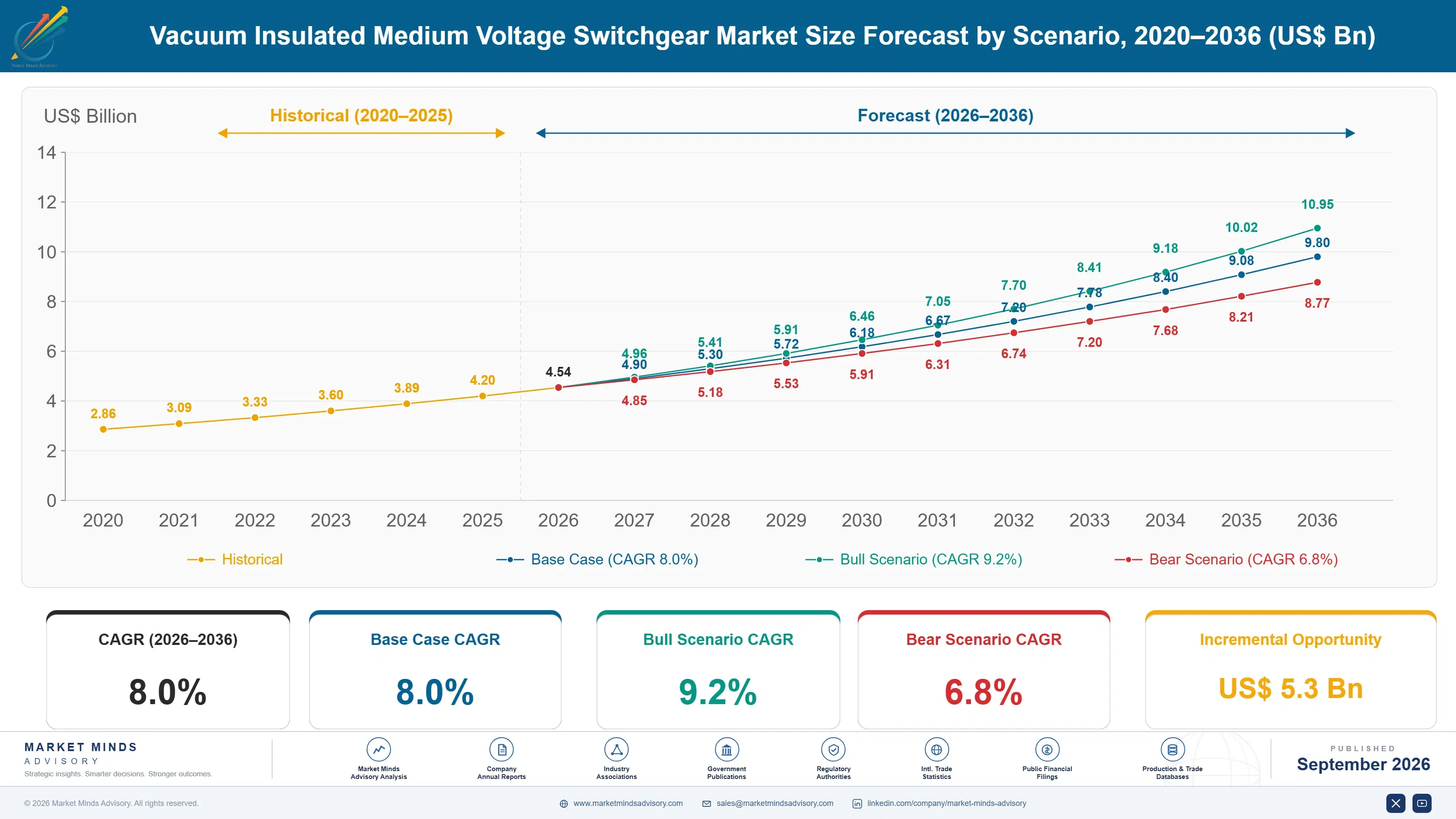
Vacuum switchgear grew steadily between 2020 and 2025, expanding at roughly 7.0 percent annually as utilities gradually replaced aging gas-insulated equipment during ordinary asset renewal cycles rather than under regulatory pressure specifically. Growth accelerated only toward the end of this period as SF6 phase-out deadlines became firm across major European markets. Most purchasing decisions remained tied to ordinary maintenance budgets rather than regulatory compliance capital.
The base case assumes steady commercial acceleration driven by three mechanisms: binding SF6 phase-out deadlines in the European Union, rising grid modernization funding tied to renewable interconnection, and utility preference for digital condition monitoring capability now standard in newer switchgear designs. Combined, these forces support 8.0 percent compound annual growth through 2036 as replacement cycles compress across most developed electricity markets. Manufacturers are expanding vacuum interrupter production capacity to meet this anticipated demand curve.
A bull scenario built around accelerated global SF6 phase-out adoption beyond Europe could push growth toward 9.2 percent, while a bear case tied to delayed grid funding and persistent Asian price competition could pull growth down toward 6.8 percent. Either path implies higher vacuum penetration than currently installed. Grid operators in both scenarios keep favoring vacuum technology over legacy gas-insulated alternatives.

SF6 Phase-Out Redraws Switchgear Procurement Standards

Vacuum insulated switchgear demand is shifting from voluntary technology upgrade toward mandatory replacement as regulators tighten SF6 handling and disposal requirements across major electricity markets. Utilities increasingly specify vacuum interrupter technology by default in new tender documents rather than treating it as a premium alternative to conventional gas-insulated equipment. Regulatory momentum in Europe is already influencing procurement standards in adjacent markets watching the transition closely.
MARKET CONCENTRATIONCR5 48%Top five manufacturers hold roughly half industry revenue
AVERAGE SELLING PRICE$85K per bayReflects typical mid-tier metal-clad switchgear bay unit pricing
TOP COUNTRY SHAREChina 22%Leads global demand through sustained grid infrastructure investment
CAPACITY UTILISATION74%Reflects steady manufacturing throughput across established production lines
TRADE INTENSITY38%Share of equipment value sourced through cross-border supply chains
FEEDSTOCK COST SHARE29% of COGSCopper and specialty insulation materials drive most input cost
Manufacturers face growing pressure to integrate digital condition monitoring sensors directly into switchgear enclosures, a capability utilities now expect as standard rather than optional premium equipment. This shift favors established suppliers with strong software and sensor integration capability over smaller regional manufacturers focused purely on mechanical switchgear assembly. Suppliers lagging on sensor integration capability risk losing shortlist positions even where their mechanical switchgear quality remains genuinely competitive.
Demand growth through 2036 depends heavily on grid modernization funding translating into firm replacement contracts rather than remaining deferred maintenance backlog across aging distribution networks. Europe has moved furthest toward binding replacement mandates, while many emerging markets still rely on gradual asset renewal rather than accelerated regulatory-driven procurement. Equipment lead times of twelve to eighteen months mean today's orders will shape which suppliers dominate the coming replacement wave.
"Nobody expected SF6 phase-out to move this fast outside Europe. Suppliers without a credible vacuum switchgear roadmap are already losing tender shortlist positions they held for years."
Senior Analyst, Grid Infrastructure Practice · MMA Construction and Industrial Equipment Practice · September 2026

Market Trends

EU F-Gas Regulation Forces Accelerated SF6 Replacement

The European Union's revised F-gas regulation sets binding phase-out deadlines for new SF6-insulated switchgear installations, forcing utilities and industrial buyers to commit to vacuum interrupter alternatives well ahead of ordinary asset replacement schedules across most member states. Germany, France, and the Netherlands have already updated national grid codes to specify vacuum technology as the default requirement for new medium voltage installations rather than treating gas-insulated equipment as an acceptable alternative. This regulatory shift is pulling forward equipment orders that manufacturers had previously modeled only for the early 2030s, compressing supplier lead times considerably across the entire European supply chain.
Market Impact: Directs 15 billion dollars annually
Digital Condition Monitoring Becomes Standard Tender Requirement

Utility procurement specifications increasingly require embedded condition monitoring sensors capable of tracking contact wear, partial discharge activity, and switching cycle counts directly within the switchgear enclosure rather than as a retrofit accessory. This shift reflects utility efforts to reduce unplanned outage risk and extend asset life through predictive maintenance scheduling rather than fixed-interval inspection routines. Suppliers without integrated sensor and analytics capability are increasingly excluded from tender shortlists entirely, a meaningful threat to manufacturers whose commercial position historically rested on mechanical switchgear quality alone without software integration expertise. This gap is widening as procurement criteria tighten further.
Market Impact: Adds 8 GW annual interconnection capacity

Market Opportunities and Growth Drivers

Grid Modernization Funding Accelerates Distribution Upgrades

National grid modernization programmes across Europe, North America, and East Asia are directing substantial capital toward distribution network upgrades, with switchgear replacement representing a meaningful share of total funded infrastructure investment. These programmes typically bundle renewable interconnection capacity with equipment modernization requirements, favoring suppliers offering vacuum switchgear with digital monitoring integration over conventional mechanical-only alternatives from smaller regional manufacturers. Utilities receiving public modernization funding increasingly face reporting requirements around equipment reliability and emissions reduction, further reinforcing vacuum technology preference in procurement specifications across most funded projects. Equipment vendors are adjusting sales strategy accordingly across the region.
Market Impact: Adds 10 to 15 percent

Renewable Interconnection Drives Compact Switchgear Demand

Distributed solar and wind interconnection projects require compact ring main units and pad-mounted switchgear suited to substation footprints far smaller than traditional utility infrastructure, favoring vacuum technology given its reduced physical footprint compared to gas-insulated alternatives. This demand pattern is particularly pronounced in regions adding renewable capacity rapidly, where grid operators must interconnect numerous smaller distributed generation sites rather than a handful of large centralized power plants. Suppliers offering compact, pre-assembled switchgear packages are winning a disproportionate share of these interconnection contracts as installation speed becomes a genuine competitive differentiator.
Market Impact: Cuts margins by 12 percent

Market Restraints and Challenges

Copper Price Volatility Pressures Manufacturing Margins

Copper represents a substantial share of switchgear manufacturing cost given its use in busbars, contacts, and windings throughout the equipment, exposing manufacturers to significant margin risk during periods of elevated commodity price volatility that are difficult to hedge across multi-year supply contracts. The root cause traces to copper's fundamental role across renewable energy, electric vehicle, and grid infrastructure demand simultaneously competing for constrained global mining supply. Manufacturers are mitigating this exposure through long-term supply agreements with refiners and by exploring aluminum busbar alternatives in lower-voltage applications where copper's conductivity advantage matters less.
Market Impact: Adds 1.8 GW replacement capacity annually

Regional Manufacturers Compress Pricing on Standard Products

Regional Asian manufacturers offering standardized metal-enclosed switchgear at meaningfully lower prices are compressing margins for established global suppliers competing on commodity-grade product tiers, particularly across emerging distribution markets less focused on premium digital monitoring capability. The root cause lies in lower labor and overhead costs among regional manufacturers combined with government industrial policy support in several Asian markets. Established suppliers are mitigating this pressure by shifting commercial focus toward premium digital-enabled products and bundled service contracts where regional competitors lack comparable technical capability. This pricing pressure is intensifying as more regional entrants scale export capacity.
Market Impact: Cuts outage incidents 20 percent
4 additional market trends, 3 additional growth drivers, and 3 additional restraints and challenges are covered in the full report. Contact sales@marketmindsadvisory.com to access the complete intelligence.

Segment CAGR and Growth Architecture

Vacuum insulated medium voltage switchgear segments by product configuration, the primary axis of technical differentiation and installation footprint across suppliers. Six product categories span mature metal-clad designs through fast-growing digital and smart switchgear formats. Terminal buyers increasingly evaluate switchgear on digital capability and installation footprint rather than purely mechanical specification and price alone now.
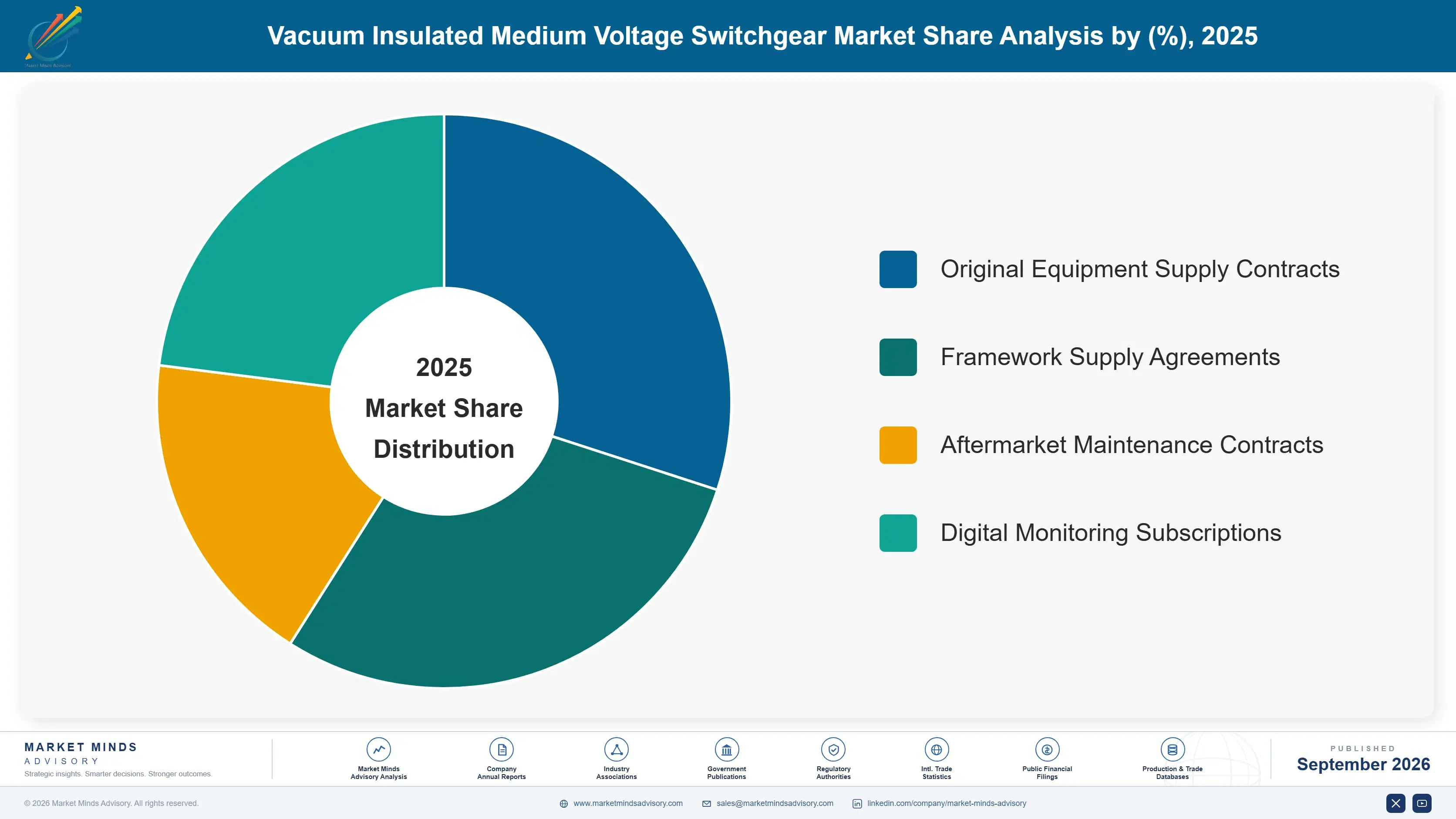
vacuum-insulated-medium-voltage-switchgear-market-market-share-analysis-1788254967309

Digital and Smart Switchgear

Digital and smart switchgear represents the fastest-growing product category, expanding at an estimated 12.5 percent annually as utilities increasingly specify embedded condition monitoring, partial discharge detection, and remote diagnostics as standard tender requirements rather than optional premium features. These systems command meaningfully higher average selling prices than mechanical-only alternatives, reflecting the added sensor hardware, software licensing, and cloud analytics integration bundled into the equipment package. Established suppliers with strong software development capability are capturing a disproportionate share of this segment's growth, while smaller regional manufacturers focused purely on mechanical assembly struggle to compete on technical specification alone. Terminal buyers increasingly treat this monitoring capability as a genuine risk-reduction investment justifying the added cost premium.
CAGR 12.5%

Ring Main Units

Ring main units are expanding at an estimated 10.5 percent annually, the second-fastest pace in the category, driven heavily by distributed renewable interconnection projects requiring compact substation footprints across residential and commercial distribution networks. This format's smaller physical size and simplified installation process make it particularly well suited to space-constrained urban distribution upgrades and rapidly expanding solar and wind interconnection sites globally. Manufacturers offering pre-assembled, factory-tested ring main unit packages are winning a growing share of these installation contracts as speed becomes a genuine competitive differentiator against custom-built alternatives requiring extensive on-site assembly work. Continued renewable capacity additions should sustain this segment's above-average growth pace well through the remainder of the forecast period.
CAGR 10.5%
Full segment breakdown across 7 segments available in the complete report.

Regional Architecture and Country Demand Map

Regional demand splits between East Asia's grid infrastructure volume, led by China's sustained distribution network investment, and Europe's regulatory-driven technology transition toward vacuum insulation ahead of binding SF6 phase-out deadlines. North America follows closely. Emerging regions adopt more gradually, tied to distribution network expansion rather than regulatory compliance deadlines.

East Asia

China's State Grid Corporation and Southern Power Grid together anchor the largest single regional share, driven by sustained distribution network expansion and rural electrification programmes extending across multiple provinces annually. This concentration justifies a share above the typical regional band, since China alone represents the world's largest single procurement market for medium voltage switchgear by installed unit volume. Japan and South Korea contribute meaningful demand through aging infrastructure replacement rather than network expansion specifically. Continued grid investment through the forecast period should sustain above-average regional growth relative to more mature Western markets elsewhere. South Korean manufacturers are also positioning to export vacuum switchgear technology to neighboring Southeast Asian grid modernization programmes.
Share: 31% | CAGR: 9.0% (2026 to 2036)

North America

United States utilities are accelerating vacuum switchgear procurement through federal grid modernization funding tied to renewable interconnection and wildfire mitigation programmes across western states specifically. Investor-owned utilities increasingly specify digital condition monitoring in new tender documents, reflecting growing regulatory scrutiny over outage prevention and asset reliability reporting requirements. Canadian utilities pursue similar upgrades at a more measured pace, tied primarily to ordinary asset renewal cycles rather than dedicated modernization capital programmes. Growth here should track close to the global average as replacement cycles continue compressing across most major utility territories over the coming several years. Mexican utilities are also beginning to specify vacuum switchgear in new industrial park interconnection projects near the border.
Share: 25% | CAGR: 8.5% (2026 to 2036)
Regional intelligence for 5 additional markets available in the complete report: Western Europe, South Asia and Pacific, Latin America, Middle East and Africa, Eastern Europe. Contact sales@marketmindsadvisory.com.
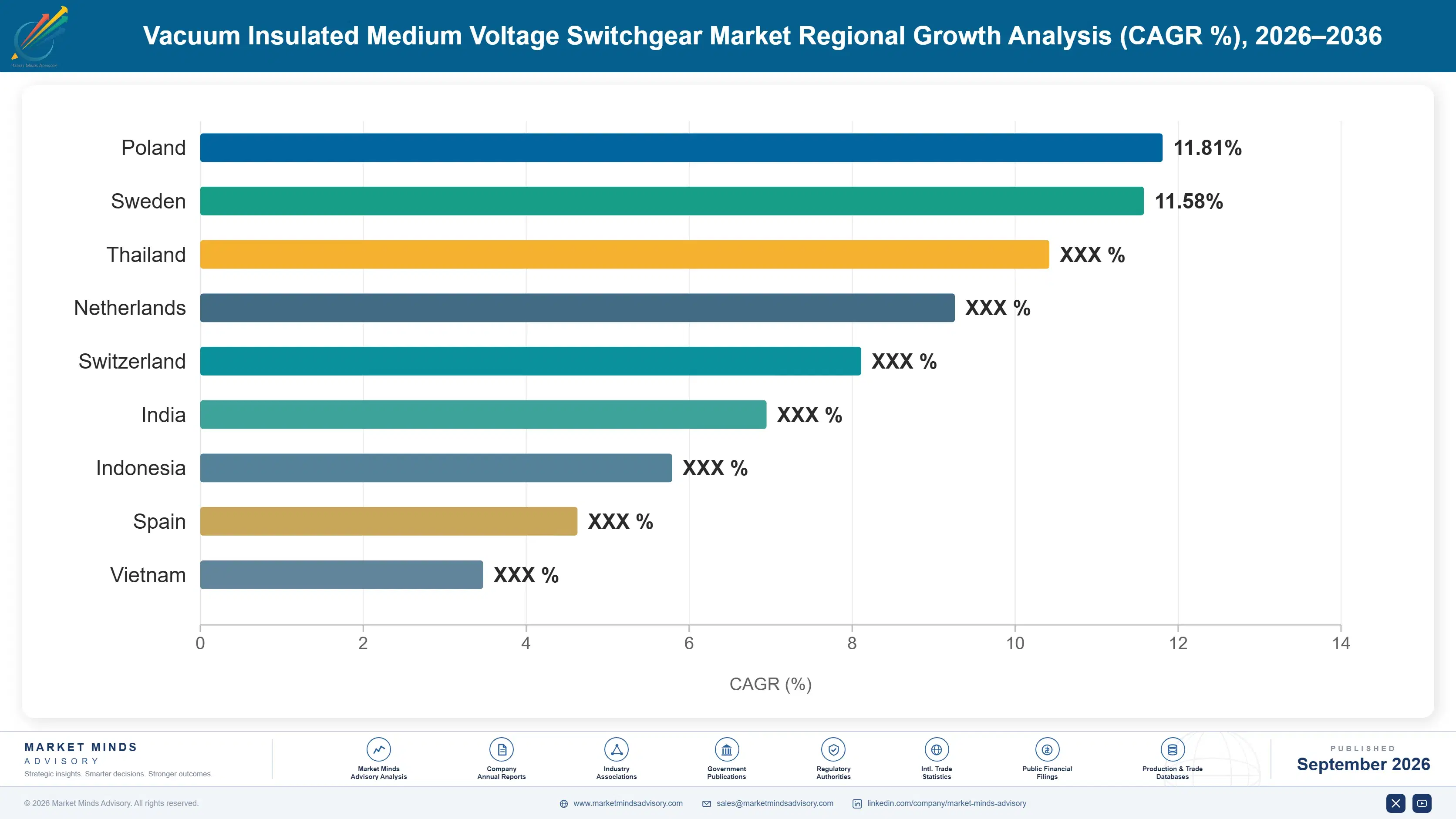
vacuum-insulated-medium-voltage-switchgear-market-country-cagr-analysis-1788254967824

Where Switchgear Manufacturers Can Capture More Value

Beyond initial equipment sales, switchgear manufacturers can capture additional value through digital monitoring subscriptions, bundled maintenance contracts, and premium technology positioning that extend well beyond a single capital transaction. Suppliers capturing these adjacent revenue streams early build deeper, stickier utility relationships than those competing purely on initial unit price. Contract structure shapes competitive positioning as much as equipment technology.

Bundle Digital Monitoring Subscription Services Broadly

Manufacturers offering embedded condition monitoring hardware alongside subscription-based analytics dashboards capture recurring revenue across the equipment's operating life rather than a single equipment transaction alone. These subscriptions typically add 10 to 15 percent to total contract value over a ten-year period while deepening utility customer relationships through renewal cycles. Utilities increasingly favor suppliers offering this bundled monitoring structure since it improves predictive maintenance scheduling and reduces unplanned outage risk, a genuine commercial advantage over competitors offering equipment-only contracts without embedded analytics capability attached. Early adopters of this model report meaningfully higher customer retention across contract renewal cycles.
Market Impact: Adds an estimated 10 to 15 percent revenue

Offer Extended Multi-Year Maintenance Service Contracts

Suppliers bundling extended maintenance and vacuum interrupter replacement contracts alongside initial equipment sales capture meaningful aftermarket revenue while reducing customer switching costs across the equipment's operating life. This approach suits utilities seeking predictable long-term maintenance budgeting rather than unplanned repair expenditure across their distribution networks. Extended maintenance contracts typically generate 12 to 18 percent of total contract value as ongoing service revenue, a meaningfully higher margin stream than equipment sales alone, while strengthening long-term customer retention across multiple replacement cycles industry-wide. This model also reduces customer churn risk across multiple future replacement cycles considerably.
Market Impact: Generates an estimated 12 to 18 percent revenue

Expand Compact Pre-Assembled Product Line Offerings

Manufacturers expanding pre-assembled, factory-tested compact switchgear lines targeting renewable interconnection projects capture a growing share of installation-sensitive contracts where speed matters more than customization. This approach suits established manufacturers already possessing modular product design capability from other equipment lines. Pre-assembled product lines typically command a 15 to 20 percent price premium over custom-built alternatives given faster installation and reduced on-site engineering cost, positioning suppliers favorably against competitors still offering only traditional custom-engineered switchgear configurations. Manufacturers pursuing this path also shorten delivery timelines relative to fully custom alternatives. This shift meaningfully strengthens their position against competitors still offering only custom configurations.
Market Impact: Commands an estimated 15 to 20 percent premium

Provide Regulatory Compliance Advisory Services Broadly

Suppliers offering regulatory compliance advisory services alongside equipment sales help utilities navigate SF6 phase-out deadlines and evolving grid interconnection standards, creating an additional fee-based revenue stream beyond core equipment sales. This advisory capability deepens customer relationships during the critical specification phase, often positioning the advising supplier favorably when formal procurement decisions follow. Early adopters of this advisory model report 5 to 8 percent incremental revenue per major account, a meaningfully profitable addition given the largely fixed cost of maintaining dedicated regulatory expertise internally. Utilities increasingly value this guidance given the complexity of evolving grid interconnection standards.
Market Impact: Adds an estimated 5 to 8 percent revenue

Who Controls the Margin Pool

Concentration in this market sits at 48 percent among the top five manufacturers, reflecting moderate barriers to entry relative to more capital-intensive electrical equipment categories. Schneider Electric leads through established global distribution reach and deep utility relationships, while the gap between it and mid-tier challengers remains meaningful given certification requirements across major markets.
Current competitive activity centers on digital monitoring integration, compact product line expansion, and regional manufacturing capacity additions to serve growing emerging market demand more competitively. Several suppliers have announced joint development partnerships with sensor and analytics firms to accelerate condition monitoring capability. Established suppliers with in-house software capability are winning more digital-heavy tenders than rivals relying on third-party integration partners. This shortens development timelines compared to building analytics capability from scratch.

Emerging pressure comes from regional Asian manufacturers who lack global distribution scale but compete aggressively on price for standardized product tiers. Rankings could shift meaningfully over the next three to five years if these manufacturers successfully expand digital capability, potentially displacing established suppliers whose position rests heavily on legacy brand reputation. Suppliers unable to demonstrate credible roadmaps risk losing shortlist positions.
vacuum-insulated-medium-voltage-switchgear-market-company-positioning-matrix-1788254968345

Competitive Moat and Risk Dimensions

SCHNEIDER ELECTRIC

Moat: Global Distribution and Service Network

Schneider Electric's global distribution network and established utility service relationships across more than one hundred countries give it reach that smaller specialist manufacturers cannot easily replicate on their own within a comparable timeframe. This network effect strengthens further as reference installations accumulate across major utility accounts, reinforcing the company's incumbent position over time.
SCHNEIDER ELECTRIC

Risk: Exposure to Regional Price Competition

The company's premium pricing position leaves it exposed to regional Asian manufacturers competing aggressively on price for standardized product tiers, particularly across emerging distribution markets less focused on digital capability. Continued margin pressure in these segments could gradually erode overall profitability if the shift toward premium products doesn't accelerate meaningfully.
SIEMENS ENERGY

Moat: Deep Utility Engineering Relationships

Siemens Energy's decades-long engineering relationships with major utilities give it deep insight into evolving grid interconnection requirements, positioning it favorably during early specification phases before formal tenders are issued. This early access advantage compounds over successive procurement cycles as trusted relationships deepen further with key utility accounts.
SIEMENS ENERGY

Risk: Slower Compact Product Line Expansion

The company has moved more slowly than some rivals into compact, pre-assembled product lines favored by renewable interconnection projects, risking share loss in this fast-growing segment specifically. Competitors moving faster on compact designs could capture meaningful share before Siemens Energy closes this product gap fully.

Players Tracked

Prominent Players

Schneider Electric
Siemens Energy
ABB
Eaton Corporation
Hitachi Energy

Other Key Players

Mitsubishi Electric
Toshiba Corporation
GE Vernova
Hyundai Electric
CG Power and Industrial Solutions
Larsen and Toubro
Lucy Electric
Nissin Electric
Meidensha Corporation
Chint Group
XD Group
Pinggao Group
S&C Electric Company
Powell Industries
Elgin Power Solutions

Recent Developments

FEBRUARY 2026

Schneider Electric Acquires Sensor Analytics Startup

Schneider Electric acquired a European sensor analytics startup specializing in partial discharge detection for medium voltage equipment, strengthening its digital condition monitoring product line ahead of tightening utility tender specification requirements across major European markets. The acquisition adds engineering talent and proprietary detection algorithms to the company's existing portfolio.
Signal: Confirms established suppliers are acquiring specialized digital capability rather than developing it entirely in-house. Fast integration matters most.
OCTOBER 2025

Siemens Energy Expands Vacuum Interrupter Production

Siemens Energy announced a capacity expansion at its German vacuum interrupter manufacturing facility specifically to meet anticipated demand from EU F-gas regulation compliance deadlines over the coming several years of committed replacement orders. The expansion increases annual production capacity meaningfully beyond current output levels. Production ramps by 2027.
Signal: Indicates established suppliers are committing capital ahead of confirmed order volume materializing fully across Europe. Order books support this.
JUNE 2025

ABB Signs Grid Modernization Framework Agreement

ABB signed a multi-year framework supply agreement with a major North American utility covering vacuum switchgear procurement tied to wildfire mitigation and grid modernization funding across several western states. The agreement establishes preferred supplier status ahead of individual project-level tenders over the coming years. Terms remain confidential.
Signal: Shows utilities locking in framework agreements early rather than competing separately on every individual tender. More agreements are expected soon.

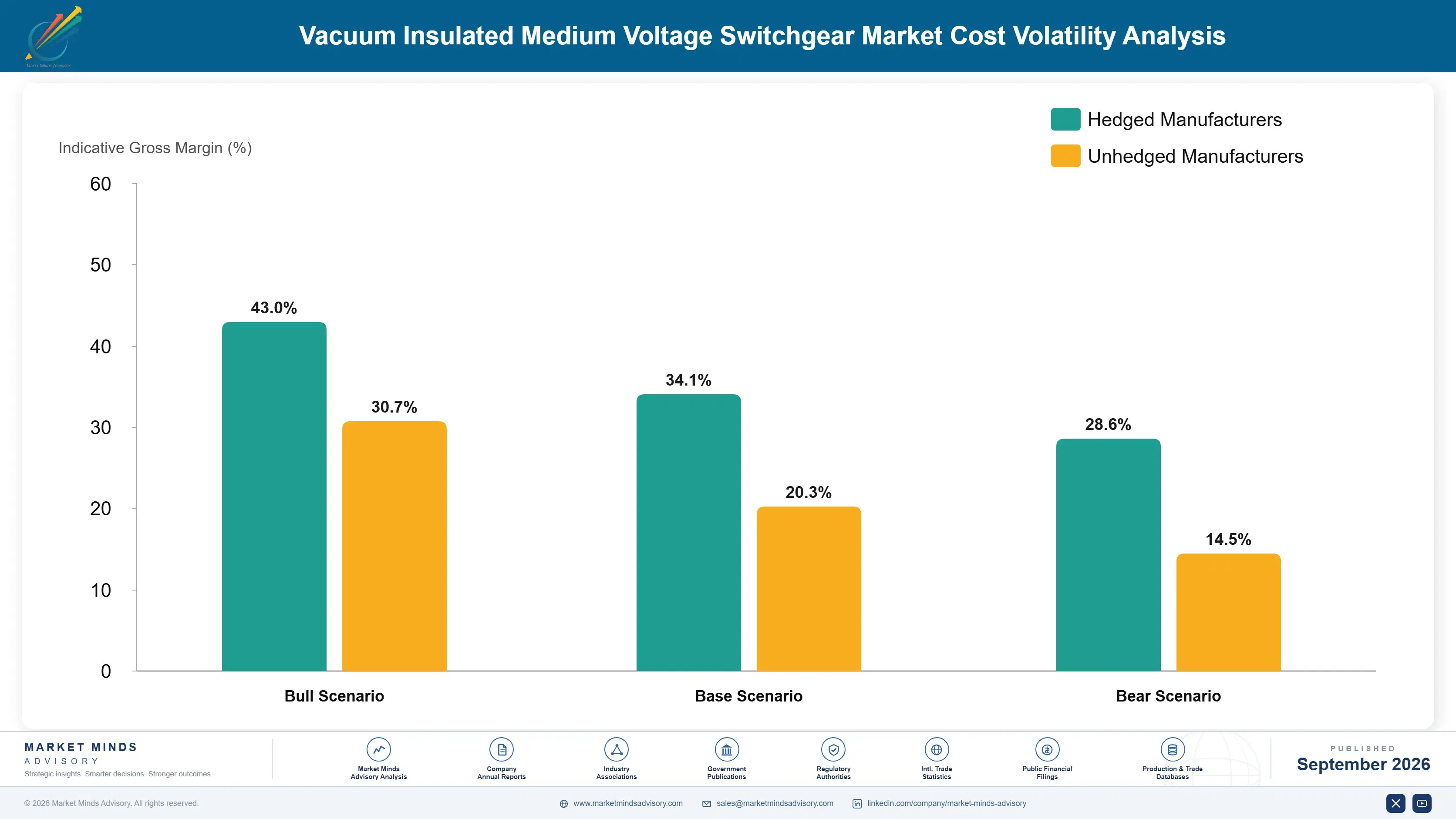
Copper and Insulation Material Cost Exposure

Copper represents an estimated 29 percent of switchgear cost of goods sold, used extensively in busbars, contacts, and interrupter windings, with primary refined supply sourced predominantly from Chile, Peru, and China's smelting operations serving the broader electrical equipment industry. Aluminum busbar alternatives carry lower material cost but higher electrical resistance, requiring larger conductor cross-sections that partially offset the raw material savings for manufacturers pursuing this substitution path.
Copper prices spiked sharply during 2024 following supply disruption concerns tied to Chilean mining labor disputes and Peruvian production shortfalls, a volatility event documented in the USDA and broader commodity market reporting, which pushed manufacturing costs higher for suppliers with fixed-price contracts already signed. Suppliers with flexible-price supply arrangements absorbed the volatility more effectively than those locked into long-term fixed contracts negotiated before the disruption began, underscoring the value of adjustable pricing mechanisms.

Manufacturers reliant on copper-intensive designs face a genuine cost disadvantage against competitors exploring aluminum busbar alternatives in lower-voltage applications. This disadvantage is most acute for smaller regional manufacturers without long-term supply agreements already in place with established refiners. Suppliers with vertically integrated refining relationships maintain meaningfully better margin stability than smaller developers dependent on spot market copper purchases.
vacuum-insulated-medium-voltage-switchgear-market-cost-volatility-analysis-1788254968541

Diversify Copper Supply Agreements

Manufacturers are pursuing long-term supply agreements across multiple refiners and geographies, including North American and Australian copper producers, to reduce single-region dependence and improve price predictability across multi-year equipment manufacturing and procurement contracts industry-wide. This diversification has already reduced average exposure to any single refiner by roughly one-quarter among leading manufacturers pursuing the approach.

Expand Aluminum Busbar Alternatives

Several manufacturers are increasing engineering investment in aluminum busbar designs for lower-voltage applications specifically, reducing copper dependence even while continuing to use copper in higher-voltage and space-constrained configurations where its conductivity advantage remains decisive. Several manufacturers expect broader aluminum adoption within three to five years as engineering confidence in the substitution grows further across the industry.

Portfolio Architecture for Margin Defence

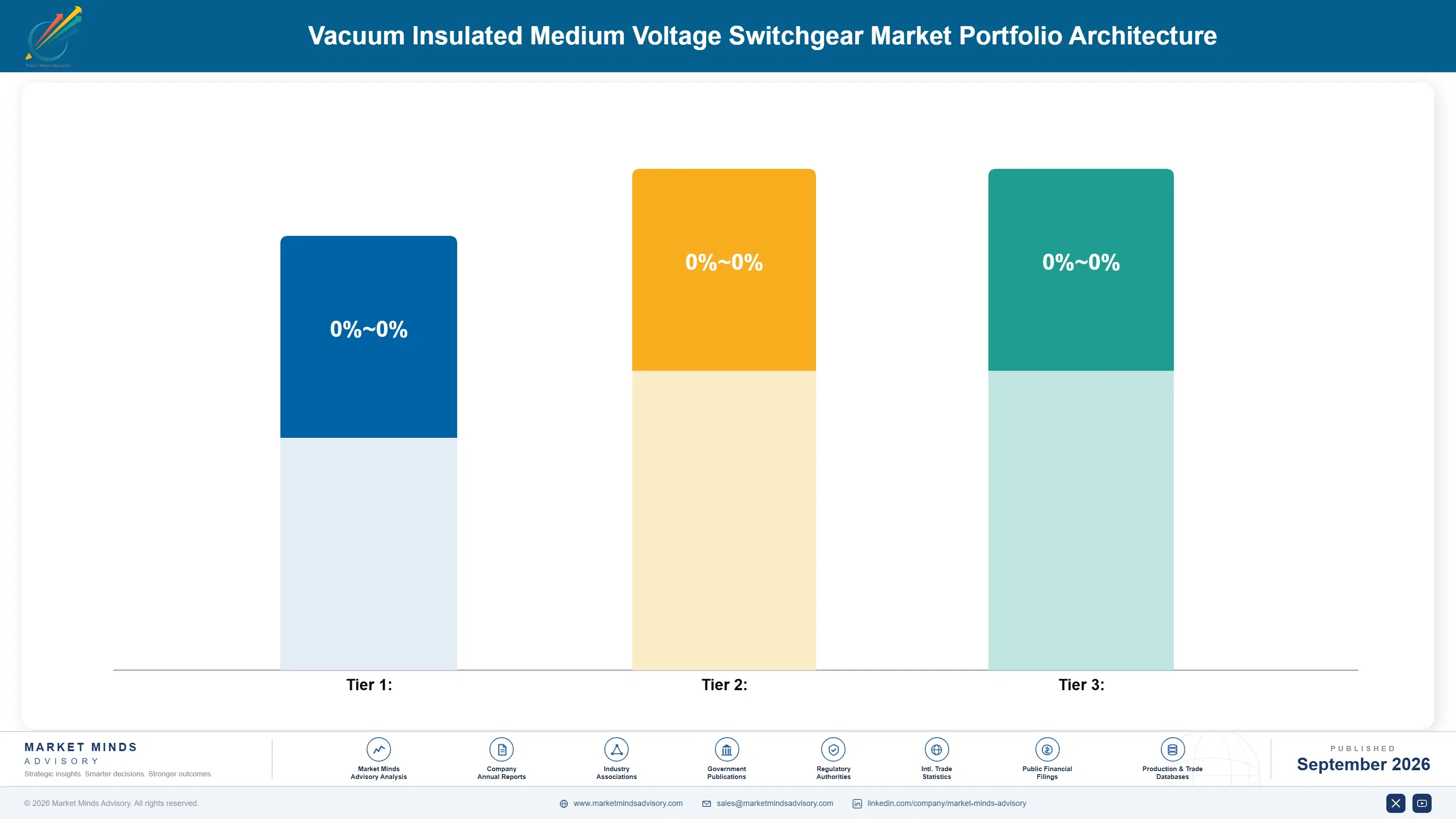
The vacuum switchgear market organizes into three commercial tiers with meaningfully different margin economics. Volume-commodity metal-enclosed products compete primarily on price and delivery reliability, generating moderate margins given standardized designs and intense regional price competition. Premium certified digital products command higher margins by offering embedded monitoring capability. Manufacturers still selling mostly into the volume tier face gradual margin pressure as buyers grow more sophisticated.
Sustainability and next-generation formats, particularly digital smart switchgear with predictive analytics, represent the smallest but fastest-growing tier, carrying the highest margins given genuine technical differentiation and rising regulatory pressure favoring monitored equipment. Manufacturers face a persistent tension between defending volume-tier revenue, still the largest absolute dollar pool today, and investing in premium capability where growth concentrates most heavily. Manufacturers hedging across tiers weather transitions more smoothly than single-tier specialists.

High-value pools increasingly concentrate around digital monitoring subscriptions and bundled maintenance contracts rather than standalone equipment sales alone across most major utility accounts. Manufacturers positioned only in the volume-commodity tier face gradual margin erosion as certified digital competitors capture disproportionate share of new tender specifications, reinforcing the strategic case for premium tier investment ahead. This shift accelerates as buyers professionalize procurement and demand audited performance records.

Standardized metal-enclosed switchgear competes on price and delivery reliability across mature replacement demand, generating the thinnest margins given intense competition among numerous regional suppliers. These systems remain the industry's proven commercial default despite emerging digital technology pressure from premium competitors.
Gross Margin

Certified digital-enabled switchgear with embedded condition monitoring commands meaningfully higher margins, reflecting utility willingness to pay for demonstrated reliability and predictive maintenance capability. Utilities view this certification as a genuine risk-reduction investment rather than discretionary spending on optional features.
Gross Margin

Smart switchgear with predictive analytics and remote diagnostics carries the highest margins given limited competition and genuine engineering differentiation across emerging grid modernization projects. Early commercial success here could meaningfully reshape long-term competitive positioning across the broader switchgear category.
Gross Margin
vacuum-insulated-medium-voltage-switchgear-market-portfolio-architecture-1788254969043

High-value Sub-segments and Strategic Watch-out

Digital and Smart Switchgear

This segment combines the highest current margins with the fastest growth trajectory, making it the clearest priority for manufacturer investment across software, sensor integration, and cloud analytics capability. Suppliers moving early capture disproportionate reference project value across major utility accounts. Source: MMA Estimate, July 2026.

Ring Main Units

Strong margins paired with rapid growth make this segment a reliable and valuable secondary investment priority, particularly for manufacturers building pre-assembled, factory-tested product lines to capture renewable interconnection contracts. Installation speed increasingly matters more than customization for these interconnection-focused replacement projects. Source: MMA Estimate, July 2026.

Metal-Clad Switchgear

This large, mature segment anchors current category revenue despite slower growth, and manufacturers must defend this volume base carefully while shifting incremental investment toward faster-growing premium categories. This remains the proven commercial default for most standard replacement contracts across the industry today. Source: MMA Estimate, July 2026.

Legacy Gas-Insulated Alternatives

This segment faces meaningful displacement risk as utilities increasingly favor vacuum insulation for regulatory and reliability reasons, making it a genuine strategic watch-out for manufacturers still exposed here. Few new gas-insulated orders are expected going forward across most major markets. Source: MMA Estimate, July 2026.

Replacement Cycles Anchor Recurring Demand

Vacuum switchgear sales increasingly bundle multi-year maintenance contracts, converting a single capital purchase into a recurring relationship spanning the equipment's operating life. Vacuum interrupters require periodic inspection and eventual replacement given gradual contact wear under continuous switching operation, creating predictable aftermarket revenue for suppliers who win the initial installation contract. Suppliers structuring these contracts well retain relationships across cycles rather than competing on price.
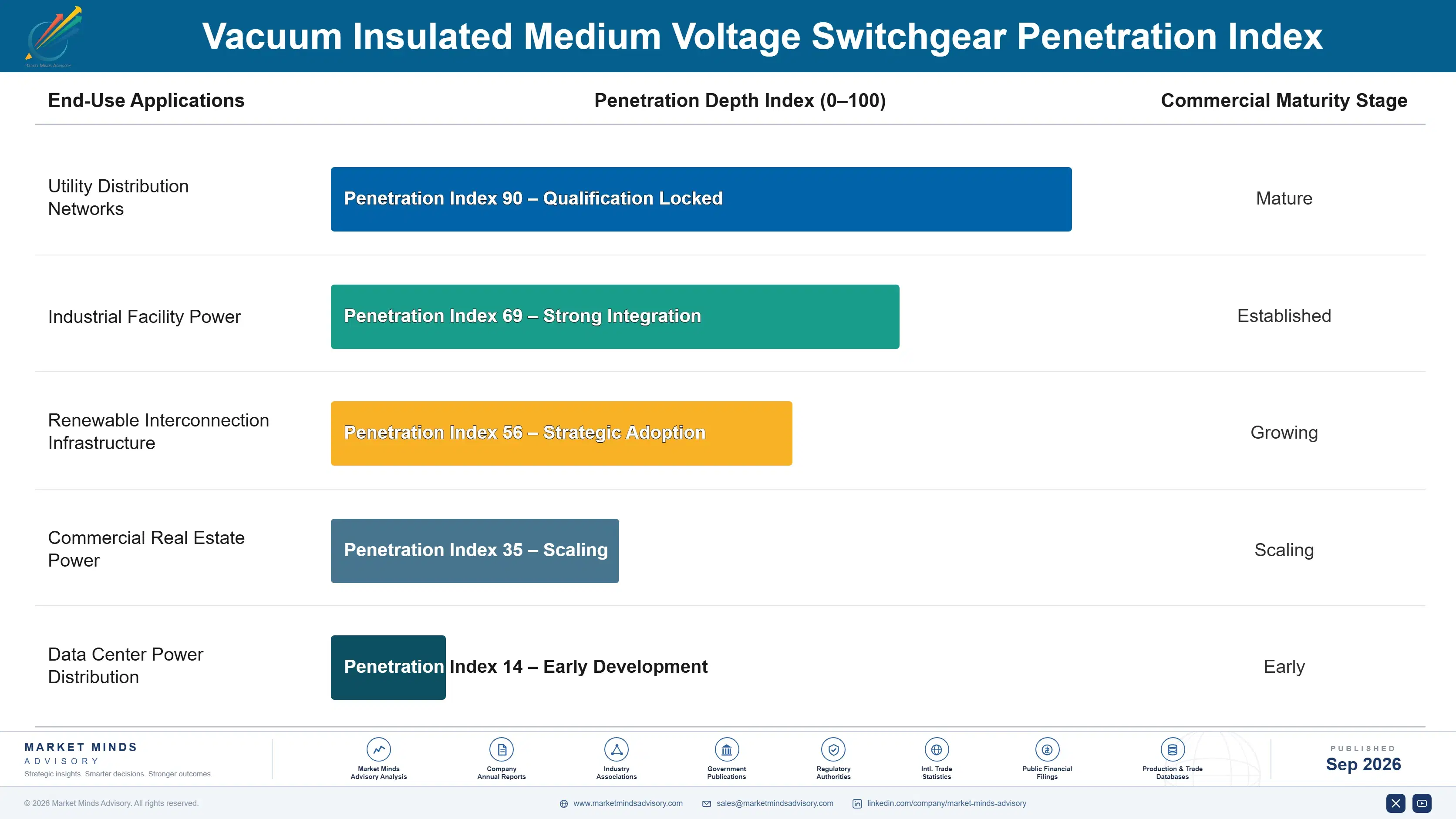
Adoption depth varies by end-use vertical. Utility distribution networks show the deepest commitment given binding regulatory replacement mandates, while industrial facility operators adopt more cautiously, weighing capital cost against remaining useful life of existing gas-insulated equipment. Renewable interconnection projects sit between these two poles, adopting steadily as grid connection standards increasingly specify vacuum technology by default. This uneven pattern means suppliers must tailor commercial terms across each buyer category.

Buyer profiles are shifting as utility procurement teams staffed by grid modernization specialists replace generalist electrical equipment buyers less familiar with digital monitoring capability. Younger procurement teams increasingly demand remote diagnostics and predictive maintenance data rather than relying on supplier reputation alone, reshaping how equipment vendors must present technical evidence during tender evaluations. Suppliers unable to produce this evidence risk losing tenders to rivals with stronger records.
vacuum-insulated-medium-voltage-switchgear-market-end-use-penetration-index-1788254969529

Strategic Priorities For Switchgear Manufacturers

These are among the four positions where our research anticipates prominent divergence between winners and laggards over the coming forecast period. Each is grounded in the demand model, the regulatory perimeter, and the announced capacity pipeline.
01 / DIGITAL CAPABILITY INVESTMENT

Prioritize embedded monitoring over mechanical improvements alone

Digital and smart switchgear carries the fastest segment growth in the category, expanding at more than half again faster than the overall market average through 2036 as utilities standardize monitoring requirements. Manufacturers still allocating the bulk of engineering budgets toward incremental mechanical improvements risk ceding the highest-margin, fastest-growing tier to competitors already integrating sensor and analytics capability into their core product lines. Redirecting capital toward digital integration now positions a manufacturer to capture premium tender specifications before certification cycles lock in rival suppliers for years.
02 / REGIONAL MANUFACTURING FOOTPRINT

Expand East Asian capacity while defending European share

East Asia accounts for the largest single share of global demand, driven by China's sustained grid infrastructure investment through State Grid Corporation and Southern Power Grid. Europe remains a meaningfully sized and regulation-driven market as SF6 phase-out deadlines tighten, so manufacturers cannot treat it as secondary despite East Asia's clear volume lead. A balanced footprint spanning both regions reduces exposure to any single market's demand cycle or regulatory shift over the coming decade, particularly as compliance deadlines tighten further across additional jurisdictions.
03 / INPUT COST MANAGEMENT

Secure copper supply beyond concentrated single-region sourcing

Copper represents a substantial and growing share of manufacturing cost for most switchgear designs, and recent volatility has already exposed manufacturers overly dependent on single-region mining and smelting capacity. Diversifying supplier agreements across secondary refiners and multiple producing geographies reduces margin exposure to any single disruption event while improving long-term negotiating leverage. Manufacturers that move early on multi-sourcing agreements will protect gross margins more effectively than rivals scrambling to secure alternative supply after the next volatility event arrives unexpectedly across global markets.
04 / AFTERMARKET SERVICE EXPANSION

Build recurring monitoring and maintenance revenue streams now

Digital switchgear technology creates a genuine and lasting opportunity for recurring monitoring subscriptions and extended maintenance contracts that traditional equipment-only sales never supported at meaningful commercial scale. These recurring revenue streams carry materially higher margins than one-time equipment sales and deepen utility relationships across multi-year renewal and replacement cycles considerably. Manufacturers building these service capabilities now, rather than treating switchgear as a pure hardware sale, will capture a disproportionate share of lifetime customer value across the installed utility base ahead.

Engagement Snapshot From the Field

A live engagement with an industry participant carrying material or product regulatory and market exposure ahead of a defining policy shift, showing how our research translates into a defensible multi-year portfolio strategy.
MARKET MINDS ADVISORY · CLIENT ENGAGEMENT SUMMARY
Vacuum Insulated Medium Voltage Switchgear Producer Strategic Portfolio Review and Transition Roadmap 2026·Investment Scenario on Vacuum Insulated Medium Voltage Switchgear Exposure Evaluation 2025-26
CLIENT PROFILE
The client is a mid-sized European distribution utility operating aging gas-insulated switchgear across several thousand substations, facing binding SF6 phase-out compliance deadlines within the next several years across its national service territory (client-reported, unverified by MMA). The utility had budgeted for gradual replacement over fifteen years but faced pressure to accelerate given tightening regulatory timelines and rising SF6 disposal costs.
STRATEGIC CHALLENGE
Leadership needed to decide whether to accelerate replacement capital spending significantly, pursue a phased regional rollout prioritizing highest-risk installations first, or seek regulatory exemptions for a subset of aging equipment. Internal estimates suggested full compliance would require tripling annual replacement capital versus historical spending levels absent a more efficient phasing strategy (client-reported, unverified by MMA).
MMA APPROACH
MMA conducted a structured assessment combining primary interviews with equipment suppliers, regulatory compliance timeline analysis, and capital allocation modeling across several phased replacement scenarios under consideration. The engagement drew on MMA's primary research dataset and expert interview programme to quantify realistic supplier capacity and delivery timelines under each scenario. This combined approach quantified realistic tradeoffs across each scenario.
KEY FINDINGS
  1. Equipment suppliers indicated delivery lead times would extend meaningfully if the utility waited until closer to the compliance deadline before placing firm orders.
  2. A risk-based phasing approach prioritizing oldest and highest-fault-rate substations first captured most compliance risk reduction at a fraction of full replacement cost (client-reported, unverified by MMA).
  3. Utilities that had already committed to preferred supplier framework agreements were securing better pricing and priority delivery slots than those competing tender by tender.
  4. Digital monitoring integration during replacement added modest incremental cost but meaningfully improved long-term maintenance budget predictability across the utility's broader distribution network.
CLIENT PROFILE
The client is a mid-sized European distribution utility operating aging gas-insulated switchgear across several thousand substations, facing binding SF6 phase-out compliance deadlines within the next several years across its national service territory (client-reported, unverified by MMA). The utility had budgeted for gradual replacement over fifteen years but faced pressure to accelerate given tightening regulatory timelines and rising SF6 disposal costs.
STRATEGIC CHALLENGE
Leadership needed to decide whether to accelerate replacement capital spending significantly, pursue a phased regional rollout prioritizing highest-risk installations first, or seek regulatory exemptions for a subset of aging equipment. Internal estimates suggested full compliance would require tripling annual replacement capital versus historical spending levels absent a more efficient phasing strategy (client-reported, unverified by MMA).
MMA APPROACH
MMA conducted a structured assessment combining primary interviews with equipment suppliers, regulatory compliance timeline analysis, and capital allocation modeling across several phased replacement scenarios under consideration. The engagement drew on MMA's primary research dataset and expert interview programme to quantify realistic supplier capacity and delivery timelines under each scenario. This combined approach quantified realistic tradeoffs across each scenario.
KEY FINDINGS
  1. Equipment suppliers indicated delivery lead times would extend meaningfully if the utility waited until closer to the compliance deadline before placing firm orders.
  2. A risk-based phasing approach prioritizing oldest and highest-fault-rate substations first captured most compliance risk reduction at a fraction of full replacement cost (client-reported, unverified by MMA).
  3. Utilities that had already committed to preferred supplier framework agreements were securing better pricing and priority delivery slots than those competing tender by tender.
  4. Digital monitoring integration during replacement added modest incremental cost but meaningfully improved long-term maintenance budget predictability across the utility's broader distribution network.
RECOMMENDED STRATEGY
Phase 1: Phase one: sign a framework supply agreement covering the highest-risk substations to secure priority delivery ahead of tightening supplier lead times. Phase 2: Phase two: execute risk-based phased replacement prioritizing oldest and highest-fault-rate installations over the following three years of the compliance window. Phase 3: Phase three: integrate digital monitoring capability across all replacements to build long-term predictive maintenance capability across the broader distribution network over time.
OUTCOME
The utility signed a framework agreement securing priority delivery slots and began risk-based phased replacement ahead of schedule, reducing projected peak-year capital spending meaningfully versus the original uniform replacement plan (client-reported, unverified by MMA). The phased approach is now referenced internally as a template for future compliance programmes.

Frequently Asked Questions

Foundational context covering the market sizes, CAGR, scope, country, region and competition that inform every finding below. This section is provided to cover basics and most often pre-purchase conversations, answered from the MMA Primary Research Dataset.

What is the current size of the Vacuum Insulated Medium Voltage Switchgear Market?

The vacuum insulated medium voltage switchgear market reached an estimated 4.2 billion dollars in 2025. Growth is driven by SF6 phase-out regulation and grid modernization funding across major economies.

How large will the Vacuum Insulated Medium Voltage Switchgear Market be by 2036?

MMA projects the market will reach approximately 9.8 billion dollars by 2036. This reflects accelerating replacement of gas-insulated equipment across regulated and emerging electricity markets.

What is the CAGR for the Vacuum Insulated Medium Voltage Switchgear Market 2026 to 2036?

The base case compound annual growth rate is 8.0 percent across the forecast period. Bull and bear scenarios range from 9.2 percent to 6.8 percent depending on regulatory adoption pace.

Which segment is growing fastest?

Digital and smart switchgear is the fastest-growing segment, expanding at 12.5 percent annually. That is roughly 1.6 times the overall market growth rate through 2036.

Who are the major companies in the Vacuum Insulated Medium Voltage Switchgear Market?

Leading companies include Schneider Electric, Siemens Energy, ABB, Eaton Corporation, and Hitachi Energy. Together these five companies hold an estimated 48 percent combined share reflecting broad global distribution reach.

Which country is growing fastest?

India leads regional growth at an estimated 10.5 percent annually through 2036. Expansion is driven by national grid expansion and rural electrification programmes across multiple states.

Report Segmentation Architecture

The full report scope spans multiple orthogonal segmentation dimensions, with cross-tabulated demand data provided for each dimension pair. Coverage extends further to regional breakdowns, trend trajectories, and the competitive detail needed to support segment-level decision-making.
  • Metal-Clad Switchgear
  • Metal-Enclosed Switchgear
  • Ring Main Units
  • Compact Secondary Switchgear
  • Pad-Mounted Switchgear
  • Digital and Smart Switchgear
  • Utility Distribution Networks
  • Industrial Facility Power
  • Renewable Interconnection Infrastructure
  • Commercial Real Estate Power
  • Data Center Power Distribution
  • Original Equipment Supply Contracts
  • Framework Supply Agreements
  • Aftermarket Maintenance Contracts
  • Digital Monitoring Subscriptions

By Region

  • East Asia
  • North America
  • Western Europe
  • South Asia and Pacific
  • Latin America
  • Middle East and Africa
  • Eastern Europe

Scope, Methodology, and Coverage

Every figure in this report is reproducible from documented input assumptions. The scope below maps the historical period, the forecast horizon, the segmentation dimensions, and the countries covered, alongside the underlying primary and qualitative methodology.
Historical Period
2020 to 2025
Forecast Period
2026 to 2036
Base Year
2025 (USD billions; MMA Primary Research Dataset, September 2026)
Market Definition
This report covers medium voltage switchgear using vacuum interrupter technology for circuit protection and switching, typically rated between 1 and 38 kilovolts. It excludes low voltage switchgear, high voltage transmission switchgear, and gas-insulated switchgear using SF6 or alternative gas dielectrics.
Quantitative Units
USD billions
Segmentation Dimensions
Regions Covered
East Asia, North America, Western Europe, South Asia and Pacific, Latin America, Middle East and Africa, Eastern Europe
Countries Covered
Key Companies Profiled
Schneider Electric, Siemens Energy, ABB, Eaton Corporation, Hitachi Energy, Mitsubishi Electric, Toshiba Corporation, GE Vernova, Hyundai Electric, CG Power and Industrial Solutions, Larsen and Toubro, Lucy Electric, Nissin Electric, Meidensha Corporation, Chint Group, XD Group, Pinggao Group, S&C Electric Company, Powell Industries, Elgin Power Solutions
Quantitative Methodology
Primary survey, n=3,800 respondents, Q4 2025, six countries; demand-side model with trade association cross-validation
Qualitative Methodology
47 expert interviews, Q4 2025; applied to validate demand model assumptions, identify emerging dynamics, and assess competitive positioning
Report Format
PDF and XLSX data workbook (Word format preview document)
Publisher
Market Minds Advisory
Report Code
MMA-2026-CON-118
Published
September 2026
Contact
sales@marketmindsadvisory.com | www.marketmindsadvisory.com

Purchase the full Vacuum Insulated Medium Voltage Switchgear Market Report (2026 to 2036).

This report provides a comprehensive analysis of the global vacuum insulated medium voltage switchgear market, covering market sizing, segmentation, regional dynamics, and competitive positioning through 2036. It examines the regulatory-driven transition away from SF6 gas insulation toward vacuum technology. The analysis quantifies regional demand concentration across seven world regions and profiles the twenty leading manufacturers shaping category development. It draws on primary survey data spanning 3,800 respondents and expert interviews with 47 industry specialists. Company disclosures round out the evidence base supporting strategic decisions for manufacturers, utilities, and investors.
Ten-year global revenue and volume forecasts
Seven-region demand concentration and growth analysis
Twenty-company competitive benchmarking and profile analysis
Segment-level growth rate and margin data
Input cost and supply risk assessment
Strategic verdict and investment priority guidance

Built For The People Who Decide

From boardroom strategy to bench-side execution, this report is read cover-to-cover by leaders shaping the next decade of their industry, turning demand scenarios, market dynamics and valuation benchmarks into decisions.
CXOs/ Presidents/ VPs/ Managers
M&A and Corporate Development
Strategy Teams and R&D Heads
Procurement and Product Directors
Regulatory and Compliance Leaders
Investor Relations and Equity Analysts