Market Minds Advisory
UV LED Printers Market

UV LED Printers Market: UV LED Printers Market. Instant-Cure Inks Displace Mercury-Vapor Curing Across Industrial Print

Print shops and packaging converters are replacing mercury-vapor UV curing systems with LED-based units, cutting energy consumption sharply while enabling instant curing on heat-sensitive substrates that traditional UV lamps could never safely print on.

Lead Analyst

Published

September 2026

Make Smarter Decisions with Customized Research Insights

Request a free sample report and evaluate market opportunities, growth trends, and competitive dynamics relevant to your business needs.

2025 MARKET VALUE$1.6BMarket Size 2025
2036 FORECAST VALUE$4.5BBase Case , 2026 to 2036
CAGR 2026 TO 20369.8 %Bull 11.0% / Bear 8.5%
INCREMENTAL OPPORTUNITY$2.7BNet 10- year value creation
EXPANSION MULTIPLE2.55x2036 value over 2026 base
Strategic Levers
M&A Pipeline
Regional Outlook
Country Rankings
Competitive Intelligence
Segmental Deep-dive
Call-Us : 91 93563 13602

Executive Snapshot and Market Trajectory.

Print shops and packaging converters are replacing mercury-vapor UV curing systems with LED-based units, cutting energy consumption sharply while enabling instant curing on heat-sensitive substrates that traditional lamps could never safely handle without scorching the material. Trends confirm this shift. Trends confirm this shift clearly.
Roland DG, Mimaki, and Epson dominate the wide-format printer layer, while East Asia's dense concentration of packaging converters and electronics assembly anchors the largest share of installed printer volume worldwide today. Industrial packaging printers and flatbed UV LED systems are growing fastest of all six tracked segments, as converters push digital short-run printing deeper into packaging lines previously dominated by analog flexographic and offset processes. Smaller regional shops follow with a meaningful lag.
Competitive intensity centers on ink chemistry compatibility rather than print speed alone, since buyers increasingly select systems based on which vendor's proprietary UV LED ink formulations deliver the strongest substrate adhesion. Regulatory pressure around mercury disposal and workplace exposure limits is pulling incremental demand into segments that previously relied entirely on legacy mercury-vapor curing systems. Firms unable to demonstrate adhesion risk losing contracts entirely. Substrate compatibility remains decisive.
Market Definition
The UV LED Printers Market covers printing systems that use ultraviolet light-emitting diodes to instantly cure specialized inks on contact rather than relying on mercury-vapor lamps or air-drying processes. It excludes traditional solvent and aqueous inkjet printers, laser printers, and analog printing processes such as flexography and offset lithography.
Base Year Value
$1.6B in 2025 (MMA Primary Research Dataset, September 2026)
Forecast Period
2026 to 2036, eleven discrete annual values
CAGR
9.8% base case. Bull 11.0%. Bear 8.5%.
Fastest Growth Segment
Industrial Packaging Printers: 13.4% CAGR
Fastest Growth Country
China: 12.1% CAGR
Fastest Growth Region
South Asia and Pacific: 11.8% CAGR
Largest Region
East Asia: 28% of 2025 global value
Market Leaders
Roland DG, Mimaki, Epson, HP Inc, and Canon lead the field. Source: MMA Analysis, July 2026.
Primary Survey
n=3,800 procurement and R&D decision-makers, Q4 2025, six countries
Methodology
Demand-side build-up, cross-validated against public data, 47 expert interviews

UV LED Printers Market Forecast Scenarios

uv-led-printers-market-size-forecast-scenario-1790002069890
Between 2020 and 2025 the market expanded at an 8.8 percent historical CAGR, driven initially by signage and wide-format print shops upgrading from mercury-vapor systems before broadening into industrial packaging lines as ink chemistry matured to match analog print quality and adhesion performance requirements. Growth accelerated meaningfully in the final two years of that window as packaging adoption scaled.
The base case assumes 9.8 percent annual growth through 2036, anchored by three commercial mechanisms: packaging converters replacing analog flexographic short runs with digital UV LED printing to cut changeover costs, regulators phasing out mercury-vapor lamps under expanding environmental disposal regulations that favor LED alternatives, and electronics assemblers adopting UV LED direct-to-substrate printing for component marking previously done with legacy pad printing methods. Vendor consulting and application engineering headcount has grown considerably across nearly every major printer manufacturer operating today.
The bull case reaches 11.0 percent if mercury lamp phase-out regulations accelerate faster than expected across additional manufacturing jurisdictions. The bear case falls to 8.5 percent should capital equipment budgets tighten during a prolonged manufacturing capital expenditure slowdown across major industrial economies. Analysts view the bull scenario as increasingly plausible given current regulatory momentum across the European Union and North America.

Ink Adhesion Performance Determines Vendor Selection

UV LED printers sit at the intersection of precision photonics and industrial print manufacturing, and the market's economics increasingly reflect that hybrid position across every major vendor's product roadmap. Hardware margins compress steadily as LED curing modules commoditize across competing suppliers, while proprietary ink chemistry increasingly carries the profit pool vendors now defend most aggressively. Procurement teams negotiate ink supply terms alongside hardware pricing rather than as separate purchases.
MARKET CONCENTRATIONCR5 46%Top five vendors hold under half of global unit share
AVERAGE SELLING PRICE$38,000Typical mid-format UV LED printer including standard ink set
TOP PRODUCING COUNTRY SHAREChina 29%Largest single national concentration of printer assembly worldwide
CAPACITY UTILISATION69%Average printer manufacturing capacity utilisation reported across surveyed vendors
ENERGY SAVINGS VS MERCURY62%Typical power consumption reduction achieved by switching to LED curing
LAMP REPLACEMENT CYCLE LENGTH7 yearsTypical interval before LED curing module requires full replacement
Substrate versatility is the single most durable demand driver, since UV LED's instant, low-heat curing lets converters print directly onto heat-sensitive materials including thin films, foam board, and electronic components that mercury-vapor systems would damage. Print shops that once maintained separate equipment for different substrate types are moving steadily toward unified UV LED platforms. Vendors unable to transition risk losing shelf space to versatile competitors.
Mercury phase-out regulation is reshaping procurement decisions considerably, as environmental agencies across major manufacturing regions restrict new mercury-vapor lamp installations under expanding hazardous materials disposal rules. This shift is intensifying competition on ink formulation breadth, since buyers increasingly compare vendors on substrate compatibility as much as raw print speed and resolution specifications. Vendors slow to expand ink compatibility lose consideration during industrial procurement shortlisting.
"The lamp technology is basically solved at this point. What separates a winning vendor from a mediocre one now is whether their ink actually sticks to whatever bizarre substrate the customer brings in."
Senior Analyst, Industrial Printing and Photonics Practice · MMA Technology Practice · September 2026

Market Trends

Digital Packaging Printing Displaces Analog Short Runs

Packaging converters are increasingly replacing analog flexographic and offset printing for short-run and personalized packaging jobs with digital UV LED systems capable of printing directly onto corrugated board, flexible film, and rigid containers without plate setup costs. Roughly 33 percent of new industrial packaging printer purchases in 2025 specified UV LED curing technology, according to primary survey data collected across major packaging converters worldwide. This shift lets converters serve smaller order quantities profitably, since digital printing eliminates the plate-making costs that make short analog runs economically unviable for brand owners requesting frequent design changes.
Market Impact: Cuts energy consumption 62 percent

Mercury Lamp Phase-Out Regulation Accelerates Fleet Replacement

Environmental regulators across the European Union and several North American jurisdictions are progressively restricting new mercury-vapor lamp installations under expanding hazardous materials disposal frameworks, pushing print shops toward LED alternatives ahead of mandatory compliance deadlines set by national environmental agencies. This regulatory pressure is accelerating fleet replacement cycles that would otherwise follow normal equipment depreciation schedules extending well beyond a decade in many operations. Print shops replacing mercury systems ahead of schedule report roughly 28 percent of 2025 equipment purchases were regulation-driven rather than purely performance-motivated replacement decisions. This trend is expected to continue.
Market Impact: Cites 37 percent as primary justification

Market Opportunities and Growth Drivers

Energy Cost Reduction Justifies Fleet Modernization Investment

UV LED curing systems consume dramatically less electricity than mercury-vapor lamps, since LEDs generate targeted light output without the substantial heat waste that mercury systems produce continuously during operation regardless of actual printing activity. This energy efficiency directly reduces operating costs for print shops running equipment across extended daily shifts, a meaningful consideration as industrial electricity prices rise across most major manufacturing regions globally. Print shops switching to UV LED systems report energy consumption reductions of roughly 62 percent compared to equivalent mercury-vapor curing installations previously operated. Larger operations report the strongest measurable savings from this transition.
Market Impact: Adds 30,000 to 60,000 dollars upfront

Heat-Sensitive Substrate Demand Expands Addressable Applications

Growing demand for printing directly onto heat-sensitive substrates, including thin plastic films, foam board, and pre-assembled electronic components, is expanding the addressable application base for UV LED printers beyond traditional rigid substrate printing that mercury-vapor systems historically served exclusively. This shift reflects broader packaging and electronics industry trends toward lighter, more temperature-sensitive materials that would be damaged or warped by the sustained heat output mercury lamps generate during extended curing cycles. Roughly 37 percent of new UV LED printer purchases now cite heat-sensitive substrate compatibility as the primary purchase justification.
Market Impact: Adds 15 to 25 percent

Market Restraints and Challenges

High Upfront Equipment Cost Deters Smaller Shops

UV LED printer systems typically cost 30,000 to 60,000 dollars for mid-format industrial units, a substantial capital outlay that deters smaller print shops and startups from upgrading despite the long-term operating cost advantages LED curing offers over legacy mercury systems. The root cause is the precision LED array and specialized ink delivery components shared with broader industrial photonics markets, none of which benefits from print-specific manufacturing scale comparable to consumer electronics production. Smaller shops frequently continue operating older mercury systems well past optimal replacement age due to this cost barrier. Some vendors now offer leasing programs to lower this barrier.
Market Impact: Reaches 33 percent of new purchases

Proprietary Ink Compatibility Limits Vendor Switching

UV LED printer systems typically require vendor-specific proprietary ink formulations calibrated to each manufacturer's particular LED wavelength and curing profile, locking customers into a single vendor's consumables lineup once hardware purchase decisions are made and equipment is installed on the shop floor. The root cause traces to genuine technical necessity, since ink chemistry must precisely match LED output wavelength for reliable curing performance that generic third-party inks cannot consistently replicate. This lock-in extends effective consumable costs by 15 to 25 percent compared to open ink systems available in some competing technologies.
Market Impact: Drives 28 percent of equipment purchases
3 additional market trends, 4 additional growth drivers, and 2 additional restraints and challenges are covered in the full report. Contact sales@marketmindsadvisory.com to access the complete intelligence.

Segment CAGR and Growth Architecture

The market splits across six product types spanning format size, substrate application, and ink chemistry category across every major end-use industry tracked. Two segments are growing well ahead of the overall market average, both reflecting the industry's decisive shift toward digital short-run packaging and versatile flatbed systems rather than legacy analog production methods. Buyer priorities are shifting accordingly.
uv-led-printers-market-market-share-analysis-1790002070878

Industrial Packaging Printers

Systems built specifically for digital packaging production on corrugated board, flexible film, and rigid containers are the fastest-growing segment tracked in this report, expanding well ahead of every other category as converters shift short-run and personalized packaging jobs away from analog flexographic and offset processes. Roughly 33 percent of new industrial packaging printer purchases in 2025 specified UV LED curing technology, according to primary survey data collected across major packaging converters worldwide. Manufacturers increasingly build dedicated packaging-grade ink formulations optimized for food-contact safety and substrate adhesion, letting converters serve brand owners without qualifying separate analog production runs. Converters unable to demonstrate a credible food-contact certification track record increasingly lose consideration during brand owner vendor selection entirely.
CAGR 13.4%

Flatbed UV LED Systems

Flatbed printers capable of printing directly onto rigid substrates including foam board, acrylic, and wood panels are growing nearly as fast as packaging systems, reflecting a broader industry shift toward versatile production platforms that serve signage, display, and industrial marking applications from a single machine. Roughly 37 percent of new UV LED printer purchases now cite heat-sensitive substrate compatibility as the primary purchase justification. Manufacturers increasingly design modular flatbed platforms accepting interchangeable print heads and curing modules, letting print shops upgrade capability incrementally without replacing an entire production system outright. This modular design shift is reshaping vendor relationships considerably, since customers increasingly favor suppliers offering flexible upgrade paths over fixed-configuration systems.
CAGR 12.0%
Full segment breakdown across 6 segments available in the complete report.

Regional Architecture and Country Demand Map

Seven regions divide global demand unevenly, with East Asia commanding the largest share given its dense concentration of packaging converters, electronics assembly, and printer manufacturing spanning China, South Korea, Taiwan, and Japan's advanced industrial and precision photonics component manufacturing base worldwide today across many industries.

East Asia

China's dominant packaging converter base and electronics assembly sector together drive the majority of regional demand, since Chinese manufacturers increasingly specify UV LED printing for both consumer packaging and component marking applications across their expansive production facilities. South Korea's Samsung and Japan's precision electronics sector contribute meaningful demand tied to component marking and specialty label printing. Taiwan's semiconductor packaging industry adds a further layer of specialized demand, and Chinese domestic printer manufacturers are increasingly competing against established Japanese and Korean brands on both price and delivery lead time. Vietnam's expanding manufacturing sector is a smaller but genuinely growing source of regional demand as well. This growth is expected to continue as regional manufacturing capacity expands further.
Share: 28% | CAGR: 10.5% (2026 to 2036)

North America

United States packaging converters and sign shops drive substantial demand, particularly as brand owners increasingly request short-run, customizable packaging that digital UV LED printing enables cost-effectively compared to analog alternatives requiring expensive plate setup. American printer manufacturers including HP and specialized regional vendors maintain significant domestic engineering and support operations, reinforcing customer proximity for complex installations. Canada's growing signage and display sector adds incremental demand concentrated around Toronto and Vancouver's commercial printing clusters, reinforcing this region's genuine technology adoption leadership position. Silicon Valley technology companies increasingly specify precision UV LED printing for component marking applications. Mexican assembly integration deepens this region's broader manufacturing footprint considerably beyond the United States alone.
Share: 24% | CAGR: 11.0% (2026 to 2036)
Regional intelligence for 5 additional markets available in the complete report: Western Europe, South Asia and Pacific, Latin America, Middle East and Africa, Eastern Europe. Contact sales@marketmindsadvisory.com.
uv-led-printers-market-country-cagr-analysis-1790002071765

Monetizing Ink Chemistry and Substrate Breadth

Four commercial paths let vendors capture more value per installed printer beyond the initial hardware sale alone across most contract structures. Each depends on ink formulation depth, substrate compatibility, or service breadth rather than raw print speed, reflecting how genuine differentiation has shifted across the sector. Pricing structures continue evolving rapidly across most industrial equipment contract types.

Tiered Ink Formulation Pricing By Substrate

Vendors increasingly separate baseline ink formulations from specialized substrate-specific variants, letting customers pay incrementally as their production requirements expand beyond standard rigid substrates toward flexible film, foam, and food-contact packaging applications. This tiered structure lifts average consumable revenue by roughly 29 percent compared to single-formulation pricing sold historically across the industry. Customers appreciate the flexibility to add specialized formulations only when new applications demand them, while vendors capture durable expansion revenue as customer production needs diversify over multiple product cycles. Vendors executing this pricing well outperform peers still selling one undifferentiated formulation universally across all customers.
Market Impact: Lifts consumable revenue by roughly 29 percent overall

Extended Service And Calibration Contracts Offered

Vendors increasingly bundle extended maintenance and periodic calibration service plans with initial printer sales, addressing customer demand for sustained print quality performance well beyond the original delivery transaction and initial installation period at a given facility. Vendors report calibration service contracts generate roughly 21 percent incremental annual revenue per customer relative to hardware-only sales, since production-critical operations value guaranteed uptime over managing calibration internally with limited specialized technical staff. This service layer also deepens customer switching costs considerably across the equipment's operational lifetime. Vendors offering the strongest calibration support increasingly win renewal negotiations over less committed competitors.
Market Impact: Adds roughly 21 percent recurring service revenue yearly

Application Engineering Support For New Substrates

Vendors increasingly offer dedicated application engineering support to help customers qualify new substrate types for production, addressing demand for expertise that internal customer teams typically lack when attempting to print onto unfamiliar or challenging materials. This model commands meaningful premium pricing given the substantial technical expertise required to troubleshoot adhesion and curing issues across diverse substrate chemistries. Customers report application engineering support reduces substrate qualification time by roughly 45 percent compared to independent trial-and-error testing, justifying the recurring service cost. Vendors offering the deepest engineering expertise increasingly win platform mandates over less prepared rivals.
Market Impact: Cuts qualification time by roughly 45 percent overall

Enterprise Fleet Standardization Service Agreements Overall

Large packaging converters and printing conglomerates increasingly negotiate fleet-wide standardization agreements covering multiple printers across production facilities, rather than managing individual equipment purchases and service contracts separately through fragmented purchasing decisions made by different plant managers. This enterprise-level agreement structure commands roughly 24 percent volume discount pricing while still generating meaningful aggregate revenue given the scale of converter printer fleets involved. Vendors that win a fleet-wide contract also gain durable incumbency advantage when individual facilities later expand production capacity. Vendors winning these contracts rarely lose the account during the following equipment refresh cycle.
Market Impact: Delivers roughly a 24 percent volume discount overall

Who Controls the Margin Pool

Concentration sits at a moderate 46 percent for the top five vendors, evaluated consistently on global installed printer unit base, since a long tail of regional and specialty vendors keeps the ceiling below the tighter concentration typical of pure semiconductor equipment categories. Roland DG leads by a meaningful margin over Mimaki and Epson, who compete closely for the challenger position. Regional challengers are narrowing that gap gradually across several product categories.
Current competitive activity concentrates on ink formulation breadth and application engineering capability rather than pure print speed races, as vendors expand substrate compatibility through both internal formulation research and targeted acquisition of specialty ink chemistry firms. Several vendors have also expanded packaging-grade certified ink lines over the past two years, responding directly to converter demand.

Pressure is building from Chinese domestic printer manufacturers who compete aggressively on price for entry-level and mid-range systems, threatening to commoditize the hardware layer that established Japanese and European vendors once dominated through superior engineering alone. Specialty ink formulators are also gaining share by supplying third-party ink to multiple hardware platforms, and rankings could shift meaningfully if that segment continues capturing consumable revenue from established vendors at scale.
uv-led-printers-market-company-positioning-matrix-1790002072687

Competitive Moat and Risk Dimensions

ROLAND DG CORPORATION

Moat: Application engineering and dealer network

Roland DG's decades of accumulated application engineering expertise and dense global dealer network give it customer support reach few competitors can match, creating durable purchasing relationships since print shops rarely want to rebuild vendor training and support relationships elsewhere once established. Few rivals can match this reach.
ROLAND DG CORPORATION

Risk: Slower packaging segment expansion pace

Roland DG's traditional strength in signage and wide-format applications makes rapid expansion into industrial packaging printing considerably harder than for competitors who built packaging-focused product lines from the start, rather than adapting signage-oriented platforms to packaging applications after the fact. This gap widens each product cycle.
MIMAKI ENGINEERING CO LTD

Moat: Ink formulation research depth

Mimaki's substantial internal ink chemistry research investment, spanning specialty formulations for textile, packaging, and industrial applications, earns strong loyalty among customers who value a single vendor relationship covering diverse substrate needs rather than sourcing formulations from multiple specialty suppliers separately. Few competitors can replicate this depth.
MIMAKI ENGINEERING CO LTD

Risk: Limited scale outside core Japan

Mimaki's manufacturing and engineering scale remains smaller than larger diversified competitors like Epson and HP, limiting its ability to compete on price for high-volume industrial packaging contracts where larger rivals can use broader manufacturing scale advantages across comparable product categories and customer segments. This tradeoff persists across most segments.

Players Tracked

Prominent Players

Roland DG Corporation
Mimaki Engineering Co Ltd
Epson America Inc
HP Inc
Canon Inc

Other Key Players

Durst Group AG
EFI (Electronics For Imaging)
Agfa-Gevaert Group
Konica Minolta Inc
Xerox Holdings Corporation
Fujifilm Holdings Corporation
Ricoh Company Ltd
Xaar plc
Screen Holdings Co Ltd
Kornit Digital Ltd
Mutoh Holdings Co Ltd
SwissQprint AG
Colordyne Technologies LLC
Mark Andy Inc
Domino Printing Sciences plc

Recent Developments

FEBRUARY 2025

Roland DG Launches Expanded Packaging Ink Line

Roland DG launched an expanded food-contact certified ink line for packaging applications, extending its product portfolio to serve converters previously unable to qualify its systems for direct food packaging printing due to certification gaps. Analysts view this expansion as a defensive move against packaging-focused competitors gaining share.
Signal: Signals signage-focused vendors are racing to capture the fastest-growing packaging segment before specialists gain share. today
JULY 2025

Mimaki Acquires Specialty Ink Chemistry Firm

Mimaki acquired a small specialty ink chemistry firm specializing in flexible film adhesion formulations, adding roughly two dozen chemists to its expanding research team focused on broadening substrate compatibility across emerging packaging applications and rapidly growing industrial marking use cases nationwide. Terms were not disclosed.
Signal: Signals mid-tier vendors are buying specialized ink expertise rather than building comparable capability entirely in-house. overall
NOVEMBER 2025

Epson Signs Multi-Year Converter Supply Agreement

Epson entered a multi-year supply agreement with a major regional packaging converter to deploy its industrial UV LED platform across multiple production facilities, replacing a previously fragmented, multi-vendor equipment arrangement across the converter's various regional plant operations spanning three countries. Financial terms were not disclosed.
Signal: Signals fleet-wide standardization contracts have become a genuine competitive battleground among the largest printer vendors. widely

LED Array and Photoinitiator Chemical Exposure

Precision LED array components, specialized photoinitiator chemicals for ink formulation, and print head assemblies together represent roughly 49 percent of printer cost of goods sold, sourced predominantly from a concentrated group of manufacturers based across Japan, Taiwan, and Germany with limited domestic alternative capacity available. Buyer power varies considerably by manufacturer scale and long-term contract structure.
Photoinitiator chemical prices spiked meaningfully during 2025 as demand for specialty UV curing compounds surged across printing, coatings, and electronics industries simultaneously, a trend the IEA and industry reporting linked to broader specialty chemical feedstock constraints, forcing several manufacturers to absorb higher formulation costs temporarily rather than pass the full increase through to customers mid-contract, compressing margins for two consecutive fiscal quarters. Manufacturers expect similar pressure to recur periodically as global demand cycles continue.

Smaller manufacturers without long-term chemical supplier agreements face the sharpest cost pressure during these episodes, since they lack the purchasing volume to secure priority allocation during shortages. Larger manufacturers with multi-year supply contracts and diversified sourcing relationships weather these episodes with comparatively minor disruption to production schedules and existing customer delivery commitments. This resilience gap is widening as component shortages recur more frequently industry-wide.
uv-led-printers-market-cost-volatility-analysis-1790002073027

Diversify photoinitiator chemical sourcing

Several manufacturers are qualifying alternative chemical suppliers outside the traditional Japanese and German supply base, reducing exposure to future feedstock disruptions tied to a concentrated set of specialized global producers. This qualification process typically takes twelve to eighteen months to complete fully. Vendors furthest along this path report the strongest resilience against sudden allocation-driven cost spikes.

Invest in domestic LED array assembly

Larger manufacturers increasingly invest in domestic LED array assembly infrastructure, trading upfront capital investment for long-term supply certainty that protects production schedules during periods of broader global component shortages. This investment typically requires several years before reaching full production capacity. Vendors furthest along this path report meaningfully lower exposure to future foreign supplier disruptions.

Negotiate multi-year component supply agreements

Manufacturers are increasingly locking in multi-year fixed-price component agreements with key suppliers, trading some near-term flexibility for predictable input cost planning across multi-year customer delivery commitments and budgets prepared each fiscal year. These agreements meaningfully reduce cost volatility across the portfolio. Vendors report these agreements meaningfully improve budget forecasting accuracy across each fiscal year.

Portfolio Architecture for Margin Defence

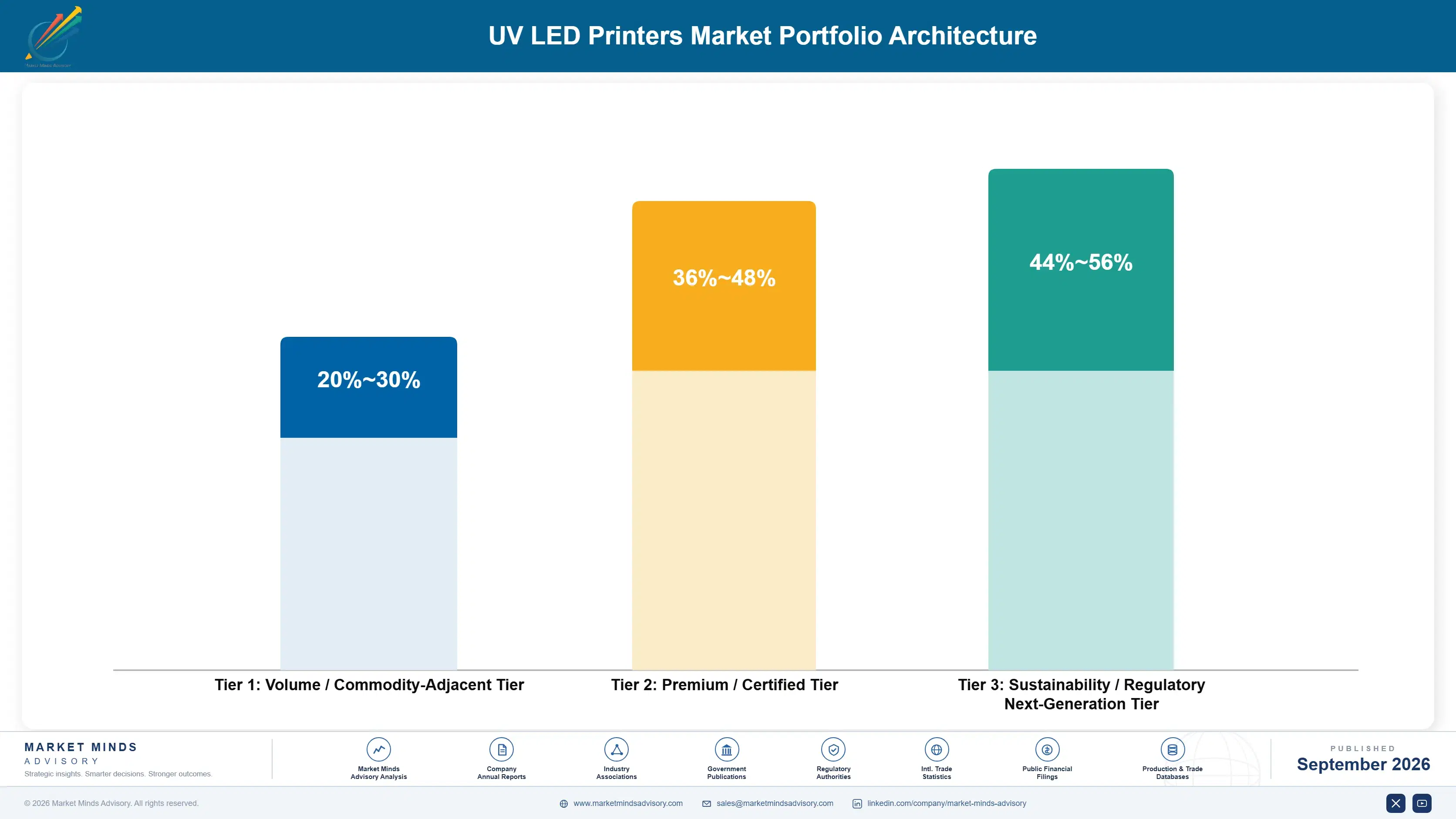
Three tiers structure this market's margin economics, from commoditizing entry-level desktop and small-format printers through certified mid-format industrial systems to next-generation packaging-grade platforms supporting food-contact certification. Gross margins vary considerably by tier, since ink formulation depth and certification breadth command far stronger pricing power than basic hardware sales alone ever could. This structure closely mirrors patterns seen across other photonics-enabled industrial equipment categories serving comparably diverse customer segments.
Volume and premium segments pull the industry in genuinely different directions simultaneously across nearly every procurement cycle. Entry-level buyers, mostly small sign shops and hobbyist studios, push vendors toward simplified, lower-cost configurations, while large packaging converters demand extensive certification documentation, dedicated technical support, and multi-substrate ink compatibility that commands genuinely premium pricing across every contract negotiation. Vendors that misjudge which tier a given account belongs in risk losing the contract entirely.

High-value margin pools concentrate overwhelmingly in packaging-grade and industrial systems rather than entry-level hardware, since certified ink formulation and application engineering support scale without proportional cost increases, unlike commodity desktop printer manufacturing that remains constrained by intensifying price competition from Chinese domestic producers entering the space. Vendors slow to build proprietary certification capability risk lasting margin disadvantage relative to established competitors.

Volume / Commodity-Adjacent Tier

Entry-level desktop and small-format printers sold primarily to sign shops and hobbyist studios operating on tight capital budgets and limited substrate diversity needs. Margins compress further each year as basic hardware components commoditize across the broader industry.
Gross Margin: 20-30%

Premium / Certified Tier

Mid-format industrial systems with extensive substrate certification and dedicated technical support, sold predominantly to converters requiring audit-defensible, multi-substrate production capability. These converters negotiate directly with vendors on multi-year support commitments and pricing terms.
Gross Margin: 36-48%

Sustainability / Regulatory / Next-Generation Tier

Packaging-grade platforms supporting food-contact certification and mercury-free compliance for forward-looking converters investing ahead of expanding environmental disposal mandates. Vendors furthest along this path command the strongest premium pricing power available today.
Gross Margin: 44-56%
uv-led-printers-market-portfolio-architecture-1790002074073

High-value Sub-segments and Strategic Watch-out

Industrial Packaging Printers

Growing fastest of all six segments as converters shift short-run packaging away from analog processes, commanding premium margins as food-contact certification and substrate adhesion expertise become genuinely difficult for smaller competitors to replicate at comparable scale, reliability, and regulatory defensibility across most packaging categories tracked.
Gross Margin: 46-58%

Flatbed UV LED Systems

The second-fastest segment, capturing an increasing share of vendor profit pools as buyers demand versatile production platforms for signage and industrial marking, supporting durable margin expansion and deepening customer loyalty across every account managed under multi-substrate ink licensing agreements, renewal cycles, and expanding modular configurations offered.
Gross Margin: 38-50%

Wide-Format Signage Printers

The largest segment by unit volume, providing steady baseline revenue even as margins compress under intensifying commoditization pressure from Chinese domestic manufacturers entering the space across multiple regions simultaneously, predictably, and with growing technical sophistication and local service capability improving over time and successive product generations.
Gross Margin: 24-34%

Legacy Mercury-Vapor Printers

A strategic watch-out segment facing a sustained, longer-term volume decline as mercury regulation phases out legacy systems entirely, risking steady erosion for suppliers slow to transition beyond basic mercury-vapor hardware manufacturing sold across shrinking, increasingly obsolete legacy equipment replacement categories and compliance-driven regional markets today.
Gross Margin: 12-20%

Recurring Ink Sales Anchor Fleet Relationships

Hardware sales are the visible transaction, but recurring ink consumable purchases, calibration service contracts, and application engineering support increasingly generate the durable revenue vendors value most, since a single installed printer typically stays in production and under an active ink supply relationship for close to eight years before full replacement. Vendors winning a fleet contract rarely lose the account before the next equipment refresh.
Adoption depth varies sharply by end-use vertical across the industry. Packaging converters, where substrate certification directly drives daily production decisions, embed UV LED printing deeply into core operations, while occasional-use sign shops treat it as one tool among several rather than continuous infrastructure, limiting near-term recurring revenue from that segment considerably despite growing awareness of the technology. This gap is narrowing as UV LED pricing becomes accessible to smaller operations.

A generational shift in buyer profile is underway as younger production managers, trained on digital short-run economics rather than traditional analog plate-based workflows, now specify UV LED platforms by default during equipment planning rather than treating them as an optional upgrade, steadily accelerating replacement cycles across operations run by newly promoted technical leadership teams. Procurement committees increasingly reflect this shift in vendor evaluation criteria used today.
uv-led-printers-market-end-use-penetration-index-1790002074932

Where UV LED Printer Value Concentrates

These are among the four positions where our research anticipates prominent divergence between winners and laggards over the coming forecast period. Each is grounded in the demand model, the regulatory perimeter, and the announced capacity pipeline.
01 / PACKAGING SEGMENT POSITIONING

Prioritize packaging-grade certification over signage hardware alone

Converters increasingly shift short-run packaging away from analog processes toward digital UV LED printing, and this shift is not a temporary preference in the way past printing technology cycles often proved to be for the category. Vendors who invest in food-contact certification and packaging-grade ink formulations capture the fastest-growing segment tracked in this report, roughly 1.37 times the overall market growth rate. Companies still focused purely on signage hardware, given how urgently consumer packaging segments demand this shift, should expand into packaging before competitors lock in converter relationships.
02 / REGIONAL MANUFACTURING ALLOCATION

Deepen East Asia presence while building North America service capacity

East Asia's dense concentration of packaging converters, electronics assembly, and printer manufacturing anchors the single largest share of global demand today, a durable feature of the industry rather than a temporary sourcing pattern likely to shift. Vendors should simultaneously build technical service capacity in North America, where regulatory phase-out timelines are tightening fastest and where design-in decisions increasingly happen before manufacturing details are finalized. Waiting risks ceding certification leadership, which compounds over successive product cycles, to established regional competitors already scaling.
03 / INK CHEMISTRY INVESTMENT STRATEGY

Separate ink formulation pricing from baseline hardware sales

Tiered ink formulation pricing lifts average consumable revenue by roughly 29 percent compared to single-formulation pricing sold historically across the industry's largest and most established vendors operating today. Vendors still bundling basic and specialized ink formulations into a single hardware price are leaving recurring revenue on the table that competitors increasingly capture through incremental substrate-specific formulations sold separately over a printer's operational lifetime. Customers increasingly favor vendors offering precise substrate matching, a pricing discipline boards increasingly reward with stronger valuation multiples.
04 / MERCURY PHASE-OUT STRATEGY

Accelerate fleet transition programs to capture regulatory demand

Environmental regulators are progressively restricting new mercury-vapor lamp installations, extending fleet replacement timelines and pulling demand toward LED alternatives ahead of mandatory compliance deadlines that competitors are actively working to capture through structured transition programs and financing options. Vendors that offer fleet-wide standardization contracts capture roughly 24 percent volume discount pricing over per-unit purchases, since procurement teams value standardized architecture that simplifies compliance management across the entire portfolio. Vendors slow to build this capability, including financing options that help smaller shops, risk losing accounts entirely.

Engagement Snapshot From the Field

A live engagement with an industry participant carrying material or product regulatory and market exposure ahead of a defining policy shift, showing how our research translates into a defensible multi-year portfolio strategy.
MARKET MINDS ADVISORY · CLIENT ENGAGEMENT SUMMARY
UV LED Printers Producer Strategic Portfolio Review and Transition Roadmap 2026·Investment Scenario on UV LED Printers Exposure Evaluation 2025-26
CLIENT PROFILE
The client is a mid-tier packaging converter operating three production facilities, generating annual revenue of roughly 340 million dollars (client-reported, unverified by MMA). Facing declining margins on short-run analog print jobs as brand owners requested increasingly frequent design changes, the converter's operations leadership needed to evaluate whether investing in UV LED digital printing capacity would restore profitability on smaller order volumes.
STRATEGIC CHALLENGE
The client's existing analog flexographic equipment could not economically serve the growing share of short-run, frequently updated packaging orders that brand owners increasingly demanded, forcing the converter to either decline these jobs or absorb unprofitable plate-making costs. Leadership needed a clear framework for evaluating digital printing investment against the true economics of the short-run order volume the converter was losing.
MMA APPROACH
MMA's team benchmarked four competing UV LED packaging printer platforms against the client's specific order volume and substrate requirements, drawing on primary survey data and 47 expert interviews with practicing packaging converter operations specialists. The engagement modeled total cost of ownership and break-even order volume across each platform over a five-year deployment horizon.
KEY FINDINGS
  1. Digital UV LED printing reduced the client's short-run job cost by roughly 38 percent (client-reported, unverified by MMA) compared to analog plate-based production for comparable order volumes.
  2. The client's existing production staff lacked sufficient digital printing operational experience, risking underutilization of any platform purchased without a dedicated training program.
  3. Two of four evaluated platforms offered meaningfully stronger food-contact certification support than the client's previous analog ink supplier relationships had provided historically.
  4. A digital printing capability would let the client capture short-run orders it previously declined, generating incremental revenue from underserved smaller brand customers.
CLIENT PROFILE
The client is a mid-tier packaging converter operating three production facilities, generating annual revenue of roughly 340 million dollars (client-reported, unverified by MMA). Facing declining margins on short-run analog print jobs as brand owners requested increasingly frequent design changes, the converter's operations leadership needed to evaluate whether investing in UV LED digital printing capacity would restore profitability on smaller order volumes.
STRATEGIC CHALLENGE
The client's existing analog flexographic equipment could not economically serve the growing share of short-run, frequently updated packaging orders that brand owners increasingly demanded, forcing the converter to either decline these jobs or absorb unprofitable plate-making costs. Leadership needed a clear framework for evaluating digital printing investment against the true economics of the short-run order volume the converter was losing.
MMA APPROACH
MMA's team benchmarked four competing UV LED packaging printer platforms against the client's specific order volume and substrate requirements, drawing on primary survey data and 47 expert interviews with practicing packaging converter operations specialists. The engagement modeled total cost of ownership and break-even order volume across each platform over a five-year deployment horizon.
KEY FINDINGS
  1. Digital UV LED printing reduced the client's short-run job cost by roughly 38 percent (client-reported, unverified by MMA) compared to analog plate-based production for comparable order volumes.
  2. The client's existing production staff lacked sufficient digital printing operational experience, risking underutilization of any platform purchased without a dedicated training program.
  3. Two of four evaluated platforms offered meaningfully stronger food-contact certification support than the client's previous analog ink supplier relationships had provided historically.
  4. A digital printing capability would let the client capture short-run orders it previously declined, generating incremental revenue from underserved smaller brand customers.
RECOMMENDED STRATEGY
Phase 1: Phase one selected a UV LED platform offering strong food-contact certification support aligned with the client's core product categories and budget. Phase 2: Phase two established a structured training program to build production staff proficiency with the new digital printing platform quickly and safely. Phase 3: Phase three expanded digital capacity to all three production facilities over the following twelve months, completing the full planned deployment timeline.
OUTCOME
Within fifteen months, the client reported a 38 percent reduction in short-run job cost alongside a meaningful increase in captured order volume from previously declined smaller jobs (client-reported, unverified by MMA). The converter has since expanded digital capacity further. Leadership views this transition as a repeatable model for other underperforming product lines.

Frequently Asked Questions

Foundational context covering the market sizes, CAGR, scope, country, region and competition that inform every finding below. This section is provided to cover basics and most often pre-purchase conversations, answered from the MMA Primary Research Dataset.

What is the current size of the UV LED Printers Market?

The UV LED Printers Market was valued at 1.6 billion dollars in 2025. Growth is driven by converters replacing mercury-vapor curing systems with LED alternatives that cut energy use sharply.

How large will the UV LED Printers Market be by 2036?

MMA projects the market will reach 4.48 billion dollars by 2036, up from 1.76 billion dollars in 2026. That reflects a 2.55 times expansion driven by packaging and regulatory-driven adoption.

What is the CAGR for the UV LED Printers Market 2026 to 2036?

The base case CAGR is 9.8 percent, with a bull case of 11.0 percent and a bear case of 8.5 percent. Historical growth from 2020 to 2025 ran somewhat slower at 8.8 percent.

Which segment is growing fastest?

Industrial packaging printers lead at a 13.4 percent CAGR, roughly 1.37 times the overall market rate. Converters increasingly shift short-run packaging away from analog printing processes.

Who are the major companies in the UV LED Printers Market?

Roland DG, Mimaki, Epson, HP, and Canon lead the field. Combined, the top five vendors hold an estimated 46 percent share on a global installed unit basis.

Which country is growing fastest?

China leads at a projected 12.1 percent CAGR, driven by its dominant packaging converter base and expanding electronics assembly sector. That pace outstrips every other major national market tracked.

Report Segmentation Architecture

The full report scope spans multiple orthogonal segmentation dimensions, with cross-tabulated demand data provided for each dimension pair. Coverage extends further to regional breakdowns, trend trajectories, and the competitive detail needed to support segment-level decision-making.

By Product Type

  • Industrial Packaging Printers
  • Flatbed UV LED Systems
  • Wide-Format Signage Printers
  • Desktop and Small-Format Printers
  • Ink and Consumables
  • Legacy Mercury-Vapor Printers

By End-Use Industry

  • Packaging and Converting
  • Signage and Display
  • Electronics and Component Marking
  • Textiles and Apparel
  • Commercial Printing Services
  • Industrial Manufacturing

By Commercial Dimension

  • Direct Equipment Sales
  • Equipment Leasing
  • Ink Supply Agreements
  • Calibration and Maintenance Contracts
  • Application Engineering Services
  • Enterprise Fleet Contracts

By Region

  • North America
  • Western Europe
  • East Asia
  • South Asia and Pacific
  • Latin America
  • Middle East and Africa
  • Eastern Europe

Scope, Methodology, and Coverage

Every figure in this report is reproducible from documented input assumptions. The scope below maps the historical period, the forecast horizon, the segmentation dimensions, and the countries covered, alongside the underlying primary and qualitative methodology.
Historical Period
2020 to 2025
Forecast Period
2026 to 2036
Base Year
2025 (USD billions; MMA Primary Research Dataset, September 2026)
Market Definition
The UV LED Printers Market covers printing systems that use ultraviolet light-emitting diodes to instantly cure specialized inks on contact rather than relying on mercury-vapor lamps or air-drying processes. It excludes traditional solvent and aqueous inkjet printers, laser printers, and analog printing processes such as flexography and offset lithography.
Quantitative Units
USD Billion
Segmentation Dimensions
Product type, end-use industry, commercial dimension, and region
Regions Covered
North America, Western Europe, East Asia, South Asia and Pacific, Latin America, Middle East and Africa, Eastern Europe
Countries Covered
China, United States, Germany, Japan, South Korea, India, Taiwan, and 24 additional markets across seven global regions
Key Companies Profiled
Roland DG Corporation, Mimaki Engineering Co Ltd, Epson America Inc, HP Inc, Canon Inc, Durst Group AG, EFI (Electronics For Imaging), Agfa-Gevaert Group, Konica Minolta Inc, Xerox Holdings Corporation, Fujifilm Holdings Corporation, Ricoh Company Ltd, Xaar plc, Screen Holdings Co Ltd, Kornit Digital Ltd, Mutoh Holdings Co Ltd, SwissQprint AG, Colordyne Technologies LLC, Mark Andy Inc, Domino Printing Sciences plc
Quantitative Methodology
Primary survey, n=3,800 respondents, Q4 2025, six countries; demand-side model with trade association cross-validation
Qualitative Methodology
47 expert interviews, Q4 2025; applied to validate demand model assumptions, identify emerging dynamics, and assess competitive positioning
Report Format
PDF and XLSX data workbook (Word format preview document)
Publisher
Market Minds Advisory
Report Code
MMA-2026-TEC-431
Published
September 2026
Contact
sales@marketmindsadvisory.com | www.marketmindsadvisory.com

Purchase the full UV LED Printers Market Report (2026 to 2036).

This report delivers a complete strategic assessment of the UV LED Printers Market from 2026 through 2036, covering hardware, ink chemistry, and services across packaging, signage, and industrial applications. It combines primary survey data from 3,800 respondents across six countries with 47 expert interviews to quantify segment growth, regional demand, and competitive positioning. Analysts examine mercury phase-out trends, ink formulation strategy, and component cost exposure across every major product category tracked in this analysis. The report also includes a client engagement case study and a strategic verdict outlining exactly where commercial value concentrates through the ten-year forecast period.
Ten-year forecast with bull and bear scenarios
Segment-level growth rates and CAGR multiples
All seven regional markets sized and profiled
Competitive benchmarking of twenty named vendors
Input cost exposure and mitigation pathway analysis
Anonymized client case study with strategic recommendations

Built For The People Who Decide

From boardroom strategy to bench-side execution, this report is read cover-to-cover by leaders shaping the next decade of their industry, turning demand scenarios, market dynamics and valuation benchmarks into decisions.
CXOs/ Presidents/ VPs/ Managers
M&A and Corporate Development
Strategy Teams and R&D Heads
Procurement and Product Directors
Regulatory and Compliance Leaders
Investor Relations and Equity Analysts