Market Minds Advisory
Utility Locator Market

Utility Locator Market: Utility Locator Market. Damage Prevention Rules Force a Locating Equipment Upgrade Cycle

Expanding fiber broadband buildout and stricter one-call damage prevention enforcement are forcing excavation contractors to replace decades-old analog locators with GPS-tagged, data-logging equipment that regulators can actually audit after a strike.

Lead Analyst

Published

September 2026

Make Smarter Decisions with Customized Research Insights

Request a free sample report and evaluate market opportunities, growth trends, and competitive dynamics relevant to your business needs.

2025 MARKET VALUE$1.8BMarket Size 2025
2036 FORECAST VALUE$3.9BBase Case , 2026 to 2036
CAGR 2026 TO 20367.4 %Bull 8.7% / Bear 6.1%
INCREMENTAL OPPORTUNITY$2.0BNet 10- year value creation
EXPANSION MULTIPLE2.04x2036 value over 2026 base
Strategic Levers
M&A Pipeline
Regional Outlook
Country Rankings
Competitive Intelligence
Segmental Deep-dive
Call-Us : 91 93563 13602

Executive Snapshot and Market Trajectory.

A single missed gas line strike now costs contractors far more than the locator equipment itself ever would, and that simple math is finally driving fleet-wide replacement of ageing analog units across North American excavation crews working underground utility jobs across the country this year.
Fiber broadband expansion under national subsidy programmes and continuing gas distribution pipeline maintenance are the two largest demand pools, with contractors increasingly required to submit GPS-logged locate records before one-call tickets are officially closed out at the end of each completed excavation job. North America and Western Europe together hold the deepest installed base of professional-grade electromagnetic and ground-penetrating radar locators, reflecting decades of dense underground utility construction across both mature regions.
Five vendors hold just over half of global unit sales, a concentration built on decades of trusted brand reputation among utility locate crews who rarely switch suppliers once trained well on a particular platform they already know well. Regulatory scrutiny following several high-profile pipeline strikes is pushing state authorities toward mandatory digital locate record retention rules, a shift that favors vendors already selling connected, cloud-logging hardware platforms today.
Market Definition
The utility locator market covers handheld and vehicle-mounted electromagnetic, ground-penetrating radar, and acoustic equipment used to detect and mark the position of buried pipes, cables, and conduits before excavation. It excludes trenchless installation machinery and pipeline inspection cameras used after a line is already exposed.
Base Year Value
$1.8B in 2025 (MMA Primary Research Dataset, September 2026)
Forecast Period
2026 to 2036, eleven discrete annual values
CAGR
7.4% base case. Bull 8.7%. Bear 6.1%.
Fastest Growth Segment
GPS/GIS-Integrated Smart Locators: 11.5% CAGR
Fastest Growth Country
India: 10.2% CAGR
Fastest Growth Region
South Asia and Pacific: 9.4% CAGR
Largest Region
North America: 30% of 2025 global value
Market Leaders
Radiodetection, Vivax-Metrotech, Schonstedt, SebaKMT, and Leica Geosystems lead the market. Source: MMA Primary Research Dataset, July 2026.
Primary Survey
n=3,800 procurement and R&D decision-makers, Q4 2025, six countries
Methodology
Demand-side build-up, cross-validated against public data, 47 expert interviews

Utility Locator Market Forecast Scenarios

utility-locator-market-size-forecast-scenario-1790002769677
Between 2020 and 2025 the market grew at roughly 6.4% a year as pandemic-era construction delays slowed early replacement cycles before a strong rebound in fiber broadband rollout and pipeline maintenance spending pulled demand forward again through the back half of the period, particularly across North America and parts of continental Europe where infrastructure budgets recovered fastest.
The base case assumes 7.4% annual growth through 2036, built on three mechanisms: continued national fiber subsidy programmes requiring extensive new underground cable locating before trenching begins, tightening one-call damage prevention enforcement that mandates documented locate records on every excavation ticket submitted, and a wave of aging analog equipment reaching end of service life across contractor fleets that purchased their current units more than a decade ago and have delayed replacement since.
A bull case near 8.7% follows if additional national governments adopt mandatory digital locate record retention laws similar to those already active in parts of North America and the United Kingdom. The principal bear risk, a slowdown in public infrastructure spending that delays fiber and pipeline maintenance budgets across major economies, would instead pull growth toward 6.1%.

Utility Locator Market Overview

Utility locators sit at the point where a construction schedule meets a buried gas line, and that intersection has turned a once-simple electromagnetic detector into a data-logging safety instrument almost overnight. Contractors no longer buy a locator purely on detection depth or price. They increasingly demand GPS tagging, cloud upload, and audit-ready record keeping that satisfies regulators after any incident occurs on site.
MARKET CONCENTRATIONCR5 51%Five established vendors hold just over half of global sales
AVERAGE SELLING PRICE$1,200-6,500Price spans handheld electromagnetic units to GPR-equipped systems
LEADING PRODUCING COUNTRYUnited Kingdom, 22% shareUK-based manufacturers concentrate premium locator design and assembly
FLEET REPLACEMENT CYCLE7-9 yearsContractors typically replace units well past their design life
TRADE INTENSITY41% import shareMany national markets rely heavily on imported locator equipment
INPUT COST SHARE38%Electronic sensors and antenna assemblies dominate total unit cost
The United Kingdom hosts a disproportionate share of premium locator manufacturing, reflecting decades of dense underground utility networks and a mature national one-call culture that rewards precision equipment over cheaper alternatives. North America, by contrast, is the largest single demand pool by volume, driven by extensive fiber broadband subsidy programmes and an aging gas distribution network requiring frequent locate work across thousands of municipalities nationwide.
Fleet replacement cycles run longer than most industrial equipment categories, since a working locator rarely fails outright, it simply becomes less accurate over years of continuous field use. That slow depreciation curve is now colliding with tightening documentation mandates that make older, non-connected units a genuine compliance liability rather than a mere performance shortfall for the crew relying on them.
"Locator crews used to trust their gut over their equipment. Now the equipment has to prove the crew was right, because a regulator will ask for the log, not the memory."
Director, Industrial Equipment Practice · MMA Construction and Industrial Equipment Practice · September 2026

Market Trends

GPS-tagged digital locate records become standard practice

Locate crews across North America and parts of Western Europe increasingly generate GPS-tagged, time-stamped digital records for every excavation ticket, replacing paper logs that offered little defense in a post-incident investigation. Several US states have moved toward requiring electronic locate documentation retained for a fixed number of years following any excavation near a regulated pipeline, and utilities are pushing contractors to standardise on connected equipment that automatically uploads this data to a central system. Vendors without cloud-logging hardware are increasingly excluded from utility preferred-supplier programmes as a direct consequence of this shift.
Market Impact: 18 billion dollar fiber subsidy spend

Ground-penetrating radar adoption expands beyond specialist crews

Ground-penetrating radar units, once reserved for specialist survey firms because of cost and training requirements, are increasingly appearing in mainstream excavation contractor fleets as prices fall and interfaces simplify for non-expert operators in the field. This shift matters because GPR can detect non-metallic pipes such as plastic gas and water lines that traditional electromagnetic locators miss entirely, closing a long-standing detection gap that has caused numerous strikes on modern plastic infrastructure across the country. Rental fleets are adding GPR units at a faster pace than any other equipment category tracked in this market today.
Market Impact: 2.1 million miles of aging mains

Market Opportunities and Growth Drivers

National fiber broadband subsidy programmes drive locate volume

Government-funded fiber broadband expansion programmes across the United States, the United Kingdom, and continental Europe require extensive underground cable locating before trenching begins in previously unserved or underserved rural and suburban areas, generating locate ticket volume well beyond ordinary maintenance and repair activity seen in prior years across most service territories. Contractors bidding on these publicly funded builds increasingly must demonstrate GPS-logged compliance records as a condition of payment under programme rules, pushing adoption of connected equipment faster than organic replacement demand alone would support across the wider contractor base nationwide.
Market Impact: 3,200 dollar price gap per unit

Aging gas distribution networks require frequent locate work

Cast iron and unprotected steel gas distribution mains installed many decades ago continue requiring routine locate work ahead of any nearby excavation, and utility operators face mounting regulatory pressure to accelerate pipe replacement programmes following several high-profile leak incidents in recent years across multiple states and regulatory jurisdictions nationwide even today. Every accelerated replacement project generates its own additional locate demand on top of ordinary third-party excavation activity already happening nearby, effectively doubling locate crew workload in affected service territories for the full duration of active replacement work currently underway.
Market Impact: 27% lower accuracy in dense corridors

Market Restraints and Challenges

Small contractor fleets resist premium connected equipment pricing

Independent excavation contractors and small municipal crews often operate on thin equipment budgets and find the price gap between a basic electromagnetic locator and a fully connected, GPS-logging unit difficult to justify against immediate cash flow needs and other priorities. The root cause is that documentation mandates apply uniformly regardless of company size, but larger contractors can spread the equipment cost across a bigger fleet and more billable jobs than a two-person crew realistically can. Several vendors have introduced subscription-based hardware leasing to lower the up-front cost barrier for these smaller operators.
Market Impact: 35% of new units now GPS-connected

Signal interference limits accuracy in dense urban corridors

Congested underground utility corridors packed with overlapping cables, pipes, and rebar-reinforced concrete create electromagnetic interference that degrades locate accuracy precisely in the dense city environments where a strike is most costly and disruptive to traffic and business operations nearby every single working day of the year. The underlying cause is decades of uncoordinated utility placement without shared mapping standards between different operators sharing the same right of way over many years. Several cities are now piloting shared underground utility mapping databases intended to reduce this ambiguity over time and improve locate outcomes.
Market Impact: 22% annual GPR unit growth
3 additional market trends, 3 additional growth drivers, and 3 additional restraints and challenges are covered in the full report. Contact sales@marketmindsadvisory.com to access the complete intelligence.

Segment CAGR and Growth Architecture

Utility locators segment cleanly by detection technology, the dimension that determines both capability and price for any given crew or budget. This framework separates electromagnetic pipe and cable locators, ground-penetrating radar systems, acoustic leak and pipe locators, multi-sensor combination units, GPS/GIS-integrated smart locators, and marker-based passive location systems, avoiding overlap between hardware type and end-use application.
Section default visual

GPS/GIS-Integrated Smart Locators

GPS/GIS-integrated smart locators are pulling ahead of every other configuration as regulatory documentation requirements convert what was once an optional convenience feature into a hard specification requirement across major infrastructure programmes nationwide and increasingly overseas as well. These units combine traditional electromagnetic or radar detection with satellite positioning and automatic cloud upload, producing a permanent, auditable record of every locate performed in the field regardless of crew or location. Utilities and large contractors favor this configuration because it shortens dispute resolution after an incident and produces billing-grade documentation that satisfies regulators without requiring separate manual paperwork, a growing burden for crews handling dozens of daily tickets across large service territories.
CAGR 11.5%

Ground-Penetrating Radar Systems

Ground-penetrating radar systems remain the fastest-growing detection category after smart locators, gaining share as prices fall and interfaces simplify enough for mainstream excavation crews rather than specialist survey firms alone to operate them effectively on ordinary job sites across the country and beyond its borders. Their ability to detect non-metallic pipes, a category traditional electromagnetic locators cannot see at all, closes a persistent gap that has caused numerous strikes on plastic gas and water infrastructure installed over the past several decades across most developed markets worldwide. Rental fleet operators report GPR unit additions outpacing every other equipment category currently tracked in the broader locator market by a wide and growing margin.
CAGR 9.8%
Full segment breakdown across 7 segments available in the complete report.

Regional Architecture and Country Demand Map

North America leads on the strength of its mature one-call damage prevention regime, aging gas distribution networks, and large-scale fiber broadband subsidy programmes, while East Asia and Western Europe follow closely behind on dense urban infrastructure and long-established locate equipment manufacturing bases across the region.

North America

The United States operates the most extensive one-call damage prevention network in the world, with the Common Ground Alliance and state-level regulators pushing utilities and contractors toward documented, GPS-logged locate practices ahead of any excavation near buried infrastructure of any kind. Cast iron and unprotected steel gas mains installed decades ago across older northeastern and midwestern cities continue generating steady locate demand tied to accelerated pipe replacement programmes mandated by state regulators nationwide. Federal fiber broadband subsidy funding under national infrastructure legislation is layering additional locate ticket volume on top of this baseline demand, particularly in rural counties receiving first-time high-speed connections that require extensive new underground cable installation work.
Share: 30% | CAGR: 8.6% (2026 to 2036)

Western Europe

The United Kingdom and Germany host the deepest concentration of premium locator manufacturing worldwide, reflecting decades of dense underground utility construction and a mature national safety culture around excavation near buried services of all kinds and sizes. France and the Nordic countries are extending fiber broadband coverage into remaining rural areas, generating incremental locate demand similar in character to comparable North American subsidy programmes already underway across the Atlantic. Replacement demand across the region grows more slowly than new-connection demand elsewhere, since most Western European cities already maintain fairly complete underground utility mapping systems that reduce, though never eliminate, the risk of an undocumented strike during routine excavation work nearby.
Share: 22% | CAGR: 5.9% (2026 to 2036)
Regional intelligence for 5 additional markets available in the complete report: East Asia, South Asia and Pacific, Latin America, Middle East and Africa, Eastern Europe. Contact sales@marketmindsadvisory.com.
utility-locator-market-market-share-analysis-1790002770585

Where Margin Concentrates in Locate Equipment

Manufacturers capture the widest margins where regulatory documentation requirements force an equipment upgrade regardless of the underlying construction cycle, and where installed units generate recurring data or service revenue well beyond the original hardware sale itself, year after year. Four levers stand out as the clearest paths to expanding gross margin over the coming decade.

Bundle cloud-based compliance reporting into locator sales

Manufacturers that pair a connected locator with a paid compliance reporting subscription capture recurring revenue well beyond the original equipment transaction, transforming what was once a single hardware sale into an ongoing commercial relationship with the contractor or utility. Several leading vendors have expanded cloud dashboards that automatically compile locate records into regulator-ready reports, cutting administrative burden for compliance teams substantially compared with manual paperwork. Large contractors managing thousands of monthly tickets find the time savings attractive enough to accept a service fee that raises blended margin by roughly 9 percentage points.
Market Impact: 9 percentage point blended margin uplift from software

Win exclusive supplier status on national utility contracts

Securing preferred-supplier status on a national utility or municipal framework agreement locks in multi-year volume and reduces sales cost per unit substantially compared with competing project by project across a fragmented contractor base. Large utilities increasingly run centralized procurement covering hundreds of locate crews simultaneously, and winning that single contract delivers guaranteed order flow smaller competitors cannot match through individual regional sales relationships. Manufacturers that invest early in utility-specific product certification typically hold their position for the full multi-year contract term, worth an estimated 14% revenue premium over spot sales.
Market Impact: 14% revenue premium earned on multi-year utility contracts

Expand GPR rental fleets to capture occasional-use demand

Small contractors who need ground-penetrating radar only occasionally increasingly rent rather than purchase, and manufacturers moving into direct rental fleet ownership capture margin that would otherwise go to third-party equipment rental companies acting as intermediaries between vendor and crew every single time. This model also builds brand familiarity among crews who may eventually purchase their own unit once job volume justifies the capital outlay involved in ownership over the long run. Vendors operating rental fleets directly report utilization rates near 68% and gross margins meaningfully above what wholesale equipment sales alone typically generate.
Market Impact: 20% higher margin achieved through direct rental ownership

License locate data feeds to underground mapping platforms

Third-party underground utility mapping platforms increasingly pay locator manufacturers or fleet operators for anonymized locate data feeds that improve the accuracy of shared subsurface maps used across an entire city or utility service territory. This creates a software-like revenue stream layered on top of the original hardware sale, carrying margins that substantially exceed those available on the physical locator itself. Early adopters of this model in North America report that data licensing revenue, while still a modest share of total sales, carries gross margins above 65% and grows independently of new unit shipment volume.
Market Impact: 65% gross margin achieved on data licensing revenue

Who Controls the Margin Pool

Five manufacturers, measured by unit shipment volume, hold roughly 51% of global utility locator sales, leaving the remainder split among a long tail of regional specialists and niche technology vendors. Radiodetection and Vivax-Metrotech lead this group with the broadest product ranges and deepest installed base among professional locate crews, and the gap to the third-ranked player is wide enough that challengers compete mainly for the remaining mid-tier and specialist segments.
Current competitive activity centres on cloud connectivity and compliance reporting, with manufacturers racing to bundle GPS logging and automated documentation into hardware that once competed purely on detection depth. Several producers have added ground-penetrating radar to previously electromagnetic-only product lines, letting a single sales relationship cover a broader share of a contractor's total equipment budget across categories.

Emerging pressure is coming from lower-cost Asian manufacturers entering North American and European public tenders, testing whether documentation and certification requirements are strict enough to keep them confined to price-sensitive segments. Rankings are most likely to shift in Latin America and parts of South Asia, where budget constraints give new entrants a genuine opening that incumbents in mature markets do not face to the same degree.
utility-locator-market-country-cagr-analysis-1790002771555

Competitive Moat and Risk Dimensions

RADIODETECTION

Moat: Deep locate crew training network

Radiodetection has built a training and certification network among locate crews spanning decades, creating brand loyalty that persists even when competitors offer marginally lower prices. Crews trained on its interface rarely switch platforms voluntarily, since retraining an entire workforce carries real productivity cost that most contractors are unwilling to absorb without a compelling reason.
RADIODETECTION

Risk: Slower cloud platform rollout

Radiodetection's core hardware reputation has historically outpaced its software and cloud connectivity offering, leaving room for newer entrants to win specification battles purely on documentation and reporting capability alone. Closing this gap requires sustained software investment that competes internally against hardware research and development budgets each year.
VIVAX-METROTECH

Moat: Broad multi-technology product range

Vivax-Metrotech offers one of the widest product ranges spanning electromagnetic, acoustic, and combination locators, letting distributors and large contractors consolidate purchasing with a single vendor rather than managing multiple supplier relationships across different equipment categories and technology types used across a typical multi-crew fleet deployment nationwide.
VIVAX-METROTECH

Risk: Thinner presence in ground-penetrating radar

Vivax-Metrotech's product range remains comparatively thin in ground-penetrating radar, the fastest-growing segment of this market, leaving it more reliant on partnerships or future acquisitions to compete for contracts that specifically require non-metallic pipe detection capability at scale across an entire national fleet deployment over time.

Players Tracked

Prominent Players

Radiodetection
Vivax-Metrotech
Schonstedt Instrument Company
SebaKMT
Leica Geosystems

Other Key Players

Ridgid
Subsite Electronics
McLaughlin Group
Geophysical Survey Systems
Sensors and Software
3M
T-Mac Locators
Amprobe
Fisher Research Laboratory
Sewerin
Mala GeoScience
Deep Trekker
Pipehawk
C-Scope
Trimble

Recent Developments

FEBRUARY 2026

Radiodetection acquired a US-based cloud compliance software startup specializing in automated locate ticket documentation, adding a purpose-built reporting layer rather than continuing to develop equivalent functionality internally from scratch. The acquisition brings existing customer relationships with several large North American utilities directly into Radiodetection's distribution network.
Signal: Hardware manufacturers are increasingly buying software capability outright rather than building equivalent reporting tools internally from scratch.
JUNE 2025

Vivax-Metrotech and a Chinese ground-penetrating radar specialist signed a supply agreement giving Vivax-Metrotech access to GPR hardware components for a new combination product line, rather than developing the technology in-house through a longer internal engineering process. The agreement targets contractors seeking one vendor covering both detection needs.
Signal: Component supply partnerships are filling technology gaps faster than internal development can, particularly in ground-penetrating radar.

Electronics and Battery Cost Exposure

Electronic sensor arrays, microcontrollers, and rechargeable battery packs together account for roughly 38% of unit cost of goods sold, sourced primarily from semiconductor fabricators concentrated in East Asia and lithium battery cell manufacturers based mainly in China and South Korea. Antenna assemblies and injection-molded housings, sourced more regionally, add a smaller but still meaningful cost layer specific to each product line.
Semiconductor supply disruptions during 2021 and 2022, documented extensively in the US Census Bureau's manufacturing survey data and multiple company annual reports from that period, forced several locator manufacturers to extend lead times and, in some cases, redesign circuit boards around substitute components with different specifications. Producers unable to secure priority allocation from major chipmakers lost specification slots on time-sensitive public infrastructure tenders during this period.

Smaller manufacturers carry disproportionately more of this exposure because they lack the volume commitments and direct chipmaker relationships that larger competitors use to secure priority allocation during shortages. Vendors dependent on distributor channels rather than direct semiconductor sourcing relationships face longer lead times and higher per-unit component costs, a persistent disadvantage that compounds during periods of genuine supply constraint across the industry.
utility-locator-market-company-positioning-matrix-1790002771940

Qualify secondary chip suppliers across two regions

Manufacturers increasingly qualify microcontroller and sensor components from both East Asian and European suppliers rather than relying on a single sourcing relationship, reducing the chance that one regional disruption halts production entirely across an entire product line permanently. Radiodetection and Vivax-Metrotech have both expanded qualified supplier lists for this exact reason over recent years.

Hold strategic component inventory ahead of demand spikes

Some manufacturers now hold larger safety stock of critical electronic components ahead of known demand spikes tied to public infrastructure funding cycles, accepting higher working capital cost in exchange for reduced exposure to sudden allocation shortages during periods of constraint. This approach requires accurate forecasting of government funding timelines well in advance of actual disbursement.

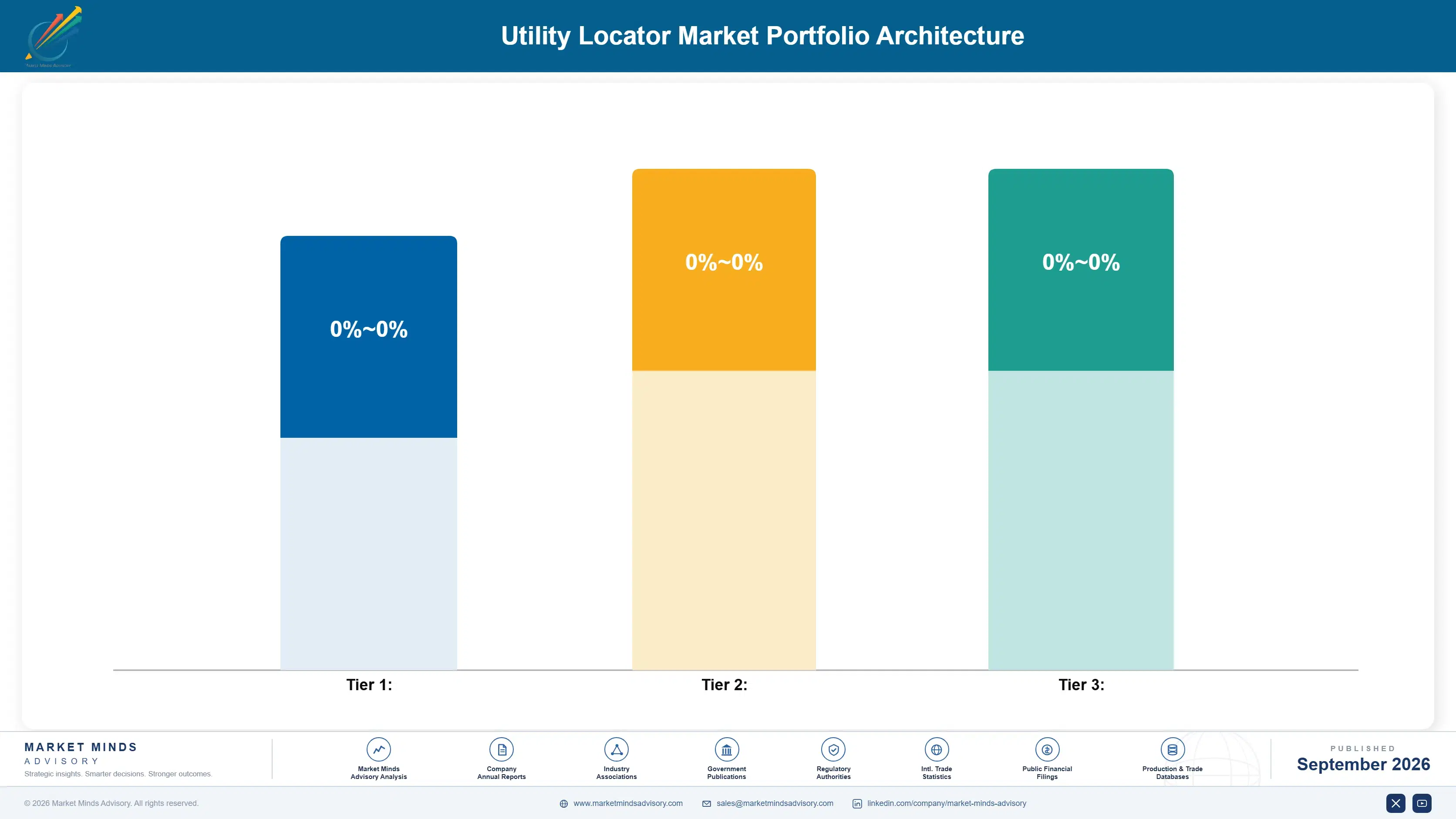
Portfolio Architecture for Margin Defence

Manufacturers organize product portfolios across three margin tiers that mirror how contractors actually buy equipment, ranging from basic electromagnetic locators purchased on price alone to fully connected smart systems specified for regulatory compliance regardless of cost. Volume tier products carry the thinnest margins but the highest unit sales, while certified premium systems command significantly higher prices from utilities that prioritize documentation and reliability over sticker price.
The tension between volume and premium tiers shows up most clearly in small contractor purchasing behavior, where budget constraints keep basic units selling steadily even as regulatory pressure pushes larger fleets toward connected alternatives. High-value margin pools concentrate disproportionately in utility and municipal procurement, where documentation requirements and long-term service contracts justify premium pricing that individual contractors would resist paying out of pocket.

Next-generation product lines integrating GPR and GPS connectivity into a single platform are still a small share of total revenue but carry the highest margins in the entire portfolio, reflecting genuine technical differentiation rather than brand premium alone. Manufacturers investing here are positioning for a future where regulatory mandates make basic, unconnected locators effectively obsolete for professional use.

Basic electromagnetic locators sold primarily on price to small contractors and municipal crews with limited equipment budgets and minimal documentation requirements to satisfy, purchased mainly for routine, low-complexity locate jobs.
Gross Margin

GPS-logging, cloud-connected units specified by utilities and large contractors that must demonstrate documented compliance with one-call and pipeline safety regulations consistently across every job ticket submitted for regulator review each month.
Gross Margin

Multi-sensor platforms combining GPR, electromagnetic detection, and automated compliance reporting, positioned for a regulatory environment that increasingly treats connected locating as mandatory rather than optional for professional excavation work across most developed markets.
Gross Margin
utility-locator-market-cost-volatility-analysis-1790002772891

High-value Sub-segments and Strategic Watch-out

GPS/GIS-Integrated Smart Locators

High-value and high-growth simultaneously, this segment benefits from both regulatory documentation mandates and utility procurement preference, commanding premium pricing while adding unit volume faster than any other configuration in the entire market today across nearly every developed region tracked by MMA analysts this year and last.

Ground-Penetrating Radar Systems

High-value with moderate but steady growth, GPR systems carry strong margins tied to genuine technical differentiation, expanding gradually as prices fall and mainstream contractors gain confidence operating equipment once reserved for specialist survey firms exclusively across most developed markets tracked here today by MMA analysts.

Electromagnetic Pipe and Cable Locators

The volume core of the market, generating the largest unit sales base even as growth slows relative to smart and radar alternatives, remaining essential for routine locate work across every contractor fleet regardless of sophistication level or regional location worldwide today and for years to come.

Acoustic Leak and Pipe Locators

A strategic watch-out segment where growth depends heavily on aging water infrastructure replacement budgets that vary significantly by municipality each year, creating demand that is real but far less predictable than regulation-driven categories elsewhere in the broader portfolio tracked in this annual MMA research report.

Recurring Locate Demand Economics

Locate equipment generates something close to annuity economics once a contractor or utility standardizes on a platform, because every excavation ticket requires a locate crew regardless of broader construction cycles or seasonal fluctuations in overall building activity. Replacement purchasing follows equipment failure or regulatory obsolescence rather than discretionary upgrade decisions, giving manufacturers unusually predictable long-term revenue visibility across their entire installed base.
Adoption depth varies sharply by end-use vertical across the market. Gas utilities exhibit the deepest stickiness, having standardized locate protocols around specific hardware platforms tied directly to internal safety certification programmes that actively discourage switching between vendors. Telecommunications contractors show comparatively looser loyalty, frequently choosing equipment based on individual project requirements and rental availability rather than any fixed corporate standard applied across their fleet.

A generational shift in buyer profile is underway as younger procurement managers, more comfortable evaluating cloud dashboards and data outputs than raw detection specifications, increasingly influence purchasing decisions once made almost entirely by field technicians alone. This shift favors vendors who can present a compelling software story alongside traditional hardware performance claims that dominated buying conversations for decades across nearly every major market.
Section default visual

MMA Verdict on Utility Locators

These are among the four positions where our research anticipates prominent divergence between winners and laggards over the coming forecast period. Each is grounded in the demand model, the regulatory perimeter, and the announced capacity pipeline.
01 / PRODUCT CERTIFICATION STRATEGY

Certify for connected compliance before mandates force it

Manufacturers still selling primarily analog, unconnected locators face a shrinking window before mandatory digital documentation becomes standard practice across most major markets tracked in this report. Waiting for regulation to fully arrive before investing in cloud connectivity and GPS logging cedes valuable specification slots to competitors who moved earlier and already hold deep utility trust built over years. The window to build that same trust without facing direct price competition is closing fast within the next several years across nearly every developed market.
02 / CHANNEL AND RENTAL STRATEGY

Build direct rental fleets rather than ceding GPR to third parties

Ground-penetrating radar rental demand is growing considerably faster than outright purchases among small contractors who need the capability only occasionally throughout the working year and across seasons. Manufacturers ceding this channel entirely to independent equipment rental companies lose both margin and the brand familiarity that eventually converts occasional renters into committed long-term buyers of owned equipment. Building direct rental capability captures value that otherwise flows entirely to intermediaries positioned between the vendor and the actual end user of the equipment itself.
03 / GEOGRAPHIC EXPANSION PRIORITY

Prioritize India and Southeast Asia over saturated Western markets

Western European and North American markets already carry deep locator penetration and comparatively slower headroom for pure volume growth going forward across most product categories tracked in this report. India's fiber and gas distribution buildout is generating locate demand from a comparatively small existing installed base, offering considerably more room for genuine share gain than simply defending position in already mature, saturated markets. Manufacturers building local assembly and service capability early will capture this growth well before competitors arrive in meaningful force.
04 / SOFTWARE AND DATA STRATEGY

Treat compliance data as a product, not a free feature

Locate data carries genuine value to underground utility mapping platforms and municipal planning departments that extends well beyond the immediate excavation ticket it was originally generated for by a field crew. Manufacturers currently give this data away as a bundled feature rather than pricing it as a separate, high-margin product line in its own right worth real revenue. Charging for data access, even quite modestly at first, converts an underused hardware byproduct into a durable, recurring revenue stream that compounds meaningfully over time.

Engagement Snapshot From the Field

A live engagement with an industry participant carrying material or product regulatory and market exposure ahead of a defining policy shift, showing how our research translates into a defensible multi-year portfolio strategy.
MARKET MINDS ADVISORY · CLIENT ENGAGEMENT SUMMARY
Utility Locator Producer Strategic Portfolio Review and Transition Roadmap 2026·Investment Scenario on Utility Locator Exposure Evaluation 2025-26
CLIENT PROFILE
The client is a regional gas distribution utility serving several million customers across a mid-sized US state, operating a mixed fleet of locate equipment accumulated over two decades through acquisitions of smaller utility operators with different purchasing histories. The utility faced growing internal pressure to standardize on a single connected platform ahead of anticipated state regulatory changes requiring digital locate documentation.
STRATEGIC CHALLENGE
The utility needed to consolidate five different locator brands across its service territory onto a single platform without disrupting daily locate operations or retraining its entire workforce simultaneously, all while satisfying a state regulatory deadline for digital documentation compliance that left limited runway for a fully phased rollout across every territory.
MMA APPROACH
MMA conducted a comparative assessment of leading connected locator platforms against the utility's specific documentation requirements, field conditions, and existing crew training levels across its entire service territory. The engagement included a phased rollout plan sequencing replacement by service territory to limit workforce disruption while still meeting the regulatory deadline set by state authorities.
KEY FINDINGS
  1. Standardizing on a single platform reduced average training time per technician by an estimated 40%, based on client-reported onboarding time data collected during the rollout.
  2. Digital locate records cut dispute resolution time following excavation incidents from several weeks down to days, according to client-reported case tracking data shared with MMA.
  3. Consolidated purchasing across the standardized platform negotiated a volume discount of roughly 12%, per client-reported procurement figures shared during the engagement review.
  4. Phased rollout by territory avoided any measurable disruption to locate ticket response times during the transition period, per client reporting throughout the engagement.
CLIENT PROFILE
The client is a regional gas distribution utility serving several million customers across a mid-sized US state, operating a mixed fleet of locate equipment accumulated over two decades through acquisitions of smaller utility operators with different purchasing histories. The utility faced growing internal pressure to standardize on a single connected platform ahead of anticipated state regulatory changes requiring digital locate documentation.
STRATEGIC CHALLENGE
The utility needed to consolidate five different locator brands across its service territory onto a single platform without disrupting daily locate operations or retraining its entire workforce simultaneously, all while satisfying a state regulatory deadline for digital documentation compliance that left limited runway for a fully phased rollout across every territory.
MMA APPROACH
MMA conducted a comparative assessment of leading connected locator platforms against the utility's specific documentation requirements, field conditions, and existing crew training levels across its entire service territory. The engagement included a phased rollout plan sequencing replacement by service territory to limit workforce disruption while still meeting the regulatory deadline set by state authorities.
KEY FINDINGS
  1. Standardizing on a single platform reduced average training time per technician by an estimated 40%, based on client-reported onboarding time data collected during the rollout.
  2. Digital locate records cut dispute resolution time following excavation incidents from several weeks down to days, according to client-reported case tracking data shared with MMA.
  3. Consolidated purchasing across the standardized platform negotiated a volume discount of roughly 12%, per client-reported procurement figures shared during the engagement review.
  4. Phased rollout by territory avoided any measurable disruption to locate ticket response times during the transition period, per client reporting throughout the engagement.
RECOMMENDED STRATEGY
Phase 1: Phase one: pilot the selected platform in a single service territory to validate workflow fit before any wider organizational rollout begins. Phase 2: Phase two: expand deployment by service territory over twelve months, retraining crews in sequence rather than all simultaneously across the utility. Phase 3: Phase three: retire legacy equipment entirely and integrate locate data feeds into the utility's internal asset mapping and planning system.
OUTCOME
The utility completed platform standardization within its regulatory deadline and reported measurable improvements in training efficiency, dispute resolution speed, and procurement cost, all figures client-reported and unverified by MMA. The engagement also established a template for phased equipment transitions applicable to other utilities facing similar consolidation pressure.

Frequently Asked Questions

Foundational context covering the market sizes, CAGR, scope, country, region and competition that inform every finding below. This section is provided to cover basics and most often pre-purchase conversations, answered from the MMA Primary Research Dataset.

What is the current size of the Utility Locator Market?

The global utility locator market was valued at $1.8 billion in 2025. This figure covers electromagnetic, ground-penetrating radar, and acoustic detection equipment used before excavation.

How large will the Utility Locator Market be by 2036?

The market is projected to reach $3.94 billion by 2036, up from a 2025 base of $1.8 billion. That represents roughly a 2.04 times expansion from its 2026 base value.

What is the CAGR for the Utility Locator Market 2026 to 2036?

The market is expected to grow at a 7.4% compound annual growth rate over this period. Growth is driven primarily by regulatory documentation mandates and fiber broadband buildout.

Which segment is growing fastest?

GPS/GIS-integrated smart locators are the fastest-growing segment tracked, expanding at roughly 11.5% annually through 2036. That is about 1.55 times the overall market growth rate.

Who are the major companies in the Utility Locator Market?

Radiodetection, Vivax-Metrotech, Schonstedt Instrument Company, SebaKMT, and Leica Geosystems lead the market by unit shipment volume. Together these five vendors hold roughly 51% of global unit sales.

Which country is growing fastest?

India is the fastest-growing national market tracked in this report, expanding at roughly 10.2% annually. Growth is tied to national fiber broadband and city gas distribution buildout programmes.

Report Segmentation Architecture

The full report scope spans multiple orthogonal segmentation dimensions, with cross-tabulated demand data provided for each dimension pair. Coverage extends further to regional breakdowns, trend trajectories, and the competitive detail needed to support segment-level decision-making.

        By Region

        • North America
        • Western Europe
        • East Asia
        • South Asia and Pacific
        • Latin America
        • Middle East and Africa
        • Eastern Europe

        Scope, Methodology, and Coverage

        Every figure in this report is reproducible from documented input assumptions. The scope below maps the historical period, the forecast horizon, the segmentation dimensions, and the countries covered, alongside the underlying primary and qualitative methodology.
        Historical Period
        2020 to 2025
        Forecast Period
        2026 to 2036
        Base Year
        2025 (USD billions; MMA Primary Research Dataset, September 2026)
        Market Definition
        The utility locator market covers handheld and vehicle-mounted electromagnetic, ground-penetrating radar, and acoustic equipment used to detect and mark the position of buried pipes, cables, and conduits before excavation. It excludes trenchless installation machinery, pipeline inspection cameras, and underground utility mapping software sold independently of physical detection hardware.
        Quantitative Units
        USD billions
        Segmentation Dimensions
        Regions Covered
        North America, Western Europe, East Asia, South Asia and Pacific, Latin America, Middle East and Africa, Eastern Europe
        Countries Covered
        Key Companies Profiled
        Radiodetection, Vivax-Metrotech, Schonstedt Instrument Company, SebaKMT, Leica Geosystems, Ridgid, Subsite Electronics, McLaughlin Group, Geophysical Survey Systems, Sensors and Software, 3M, T-Mac Locators, Amprobe, Fisher Research Laboratory, Sewerin, Mala GeoScience, Deep Trekker, Pipehawk, C-Scope, Trimble
        Quantitative Methodology
        Primary survey, n=3,800 respondents, Q4 2025, six countries; demand-side model with trade association cross-validation
        Qualitative Methodology
        47 expert interviews, Q4 2025; applied to validate demand model assumptions, identify emerging dynamics, and assess competitive positioning
        Report Format
        PDF and XLSX data workbook (Word format preview document)
        Publisher
        Market Minds Advisory
        Report Code
        MMA-2026-CON-118
        Published
        September 2026
        Contact
        sales@marketmindsadvisory.com | www.marketmindsadvisory.com

        Purchase the full Utility Locator Market Report (2026 to 2036).

        This report provides a comprehensive analysis of the global utility locator market, covering market sizing, segmentation, competitive dynamics, and regional demand patterns through 2036. It examines the shift toward connected, GPS-logging equipment driven by regulatory documentation mandates and fiber broadband expansion programmes underway across major economies worldwide. The analysis includes detailed profiles of leading manufacturers, input cost exposure, and revenue diversification strategies available to equipment vendors operating in this space. Readers gain a structured view of where margin concentrates across product tiers and which regional markets offer the strongest growth opportunity over the coming decade.
        Full 2026 to 2036 forecast across all major segments
        Detailed competitive profiles of five leading manufacturers
        Regional demand analysis across all seven global regions
        Input cost exposure and mitigation strategy assessment
        Revenue lever analysis for margin expansion opportunities
        Anonymized client case study on platform standardization

        Built For The People Who Decide

        From boardroom strategy to bench-side execution, this report is read cover-to-cover by leaders shaping the next decade of their industry, turning demand scenarios, market dynamics and valuation benchmarks into decisions.
        CXOs/ Presidents/ VPs/ Managers
        M&A and Corporate Development
        Strategy Teams and R&D Heads
        Procurement and Product Directors
        Regulatory and Compliance Leaders
        Investor Relations and Equity Analysts