Market Minds Advisory
USB Type-C Market Share Analysis

USB Type-C Market Share Analysis: USB Type-C Market Share Analysis. Regulatory Mandate Forces a Single-Connector Standard

The EU's universal charger mandate is forcing device makers worldwide to standardize on USB Type-C, pulling connector, charger, and controller chip demand into a single unified specification across nearly every major consumer electronics category

Lead Analyst

Published

September 2026

Make Smarter Decisions with Customized Research Insights

Request a free sample report and evaluate market opportunities, growth trends, and competitive dynamics relevant to your business needs.

2025 MARKET VALUE$32.5BMarket Size 2025
2036 FORECAST VALUE$78.9BBase Case , 2026 to 2036
CAGR 2026 TO 20368.4 %Bull 9.7% / Bear 7.1%
INCREMENTAL OPPORTUNITY$43.7BNet 10- year value creation
EXPANSION MULTIPLE2.24x2036 value over 2026 base
Strategic Levers
M&A Pipeline
Regional Outlook
Country Rankings
Competitive Intelligence
Segmental Deep-dive
Call-Us : 91 93563 13602

Executive Snapshot and Market Trajectory.

USB Type-C has moved from a premium smartphone feature into the mandatory global connector standard, as regulatory pressure forces device makers to abandon proprietary charging ports entirely across their entire consumer electronics product lineup worldwide. Investment committees now treat single-connector compliance as a baseline engineering requirement.
The European Union's universal charger directive is the single biggest near-term demand driver, forcing every phone, tablet, and camera sold in the bloc to adopt USB-C by regulatory deadline, a mandate other jurisdictions are increasingly studying and replicating in their own consumer electronics regulation. Device makers now design a single global hardware variant rather than region-specific charging ports. This convergence simplifies global supply chains considerably for manufacturers previously juggling multiple connector variants.
Competitive intensity is high among controller chip makers and cable manufacturers competing on certification compliance and power delivery wattage, while low-cost, non-compliant cables flooding budget retail channels continue to erode consumer trust in the standard's safety claims broadly. Certified vendors increasingly market compliance itself as a selling point distinguishing them from counterfeit competitors. Analysts expect certification-focused branding to become an increasingly important differentiator as counterfeit products proliferate further.
Market Definition
The USB Type-C market comprises connectors, cables, power delivery chargers and adapters, controller integrated circuits, and hubs or docking stations built to the USB Type-C physical and power delivery specification. It excludes proprietary charging connectors and legacy USB-A or micro-USB hardware.
Base Year Value
$32.5B in 2025 (MMA Primary Research Dataset, September 2026)
Forecast Period
2026 to 2036, eleven discrete annual values
CAGR
8.4% base case. Bull 9.7%. Bear 7.1%.
Fastest Growth Segment
USB-C Power Delivery Chargers and Adapters: 14.0% CAGR
Fastest Growth Country
India: 13.1% CAGR
Fastest Growth Region
South Asia and Pacific: 10.4% CAGR
Largest Region
East Asia: 30% of 2025 global value
Market Leaders
Texas Instruments, Cypress Semiconductor (Infineon), Anker, Belkin, and Foxconn lead the market. Source: MMA Primary Research Dataset, July 2026.
Primary Survey
n=3,800 procurement and R&D decision-makers, Q4 2025, six countries
Methodology
Demand-side build-up, cross-validated against public data, 47 expert interviews

USB Type-C Market Forecast Scenarios

usb-type-c-market-share-analysis-size-forecast-scenario-1790005442104
Between 2020 and 2025 the market grew steadily as premium smartphones and laptops adopted USB-C ahead of regulatory mandate, then accelerated sharply once the European Union finalized its universal charger directive timeline, a historical CAGR near 7.8% across that period. Early adoption concentrated almost entirely among flagship device tiers. Component suppliers spent this period scaling manufacturing capacity to meet flagship device demand.
The base case assumes continued regulatory expansion beyond the European Union, falling controller chip costs, and broader power delivery wattage standardization that lets a single charger serve laptops, phones, and peripherals interchangeably. Together these three mechanisms push adoption beyond premium devices into budget consumer electronics and industrial applications across most major manufacturing economies over the coming decade. Wattage standardization removes a friction point that has slowed universal charger adoption among laptop and peripheral makers for years.
The bull case centers on a named catalyst: additional major economies adopting universal charger mandates similar to the European Union's directive. The bear case centers on counterfeit and non-compliant cable proliferation that could erode consumer trust in the standard's safety claims faster than certification enforcement can respond. Vendors addressing counterfeit risk through visible certification labeling are winning trust among cautious retail buyers.

Regulatory Mandate Forces a Single-Connector Standard

The connector market has moved past the fragmented multi-standard landscape that defined its first decade, when proprietary connectors and competing micro-USB variants split consumer electronics accessories across incompatible product lines. That earlier fragmentation frustrated both consumers and device manufacturers building cross-compatible accessories. Procurement committees today treat single-connector compliance as a baseline requirement rather than a competitive differentiator.
MARKET CONCENTRATIONCR5 44%Top five vendors hold nearly half of revenue
AVERAGE SELLING PRICE$8.50 per cableTypical retail price for a certified compliant cable
TOP PRODUCING COUNTRY SHAREChina 41%Share of global connector and cable production concentrated there
PRODUCT REPLACEMENT CYCLE2 yearsTypical consumer replacement interval for cables and adapters
CERTIFICATION COMPLIANCE RATE64% of shipped unitsShare of shipped units meeting full official certification standards
CHIPSET COST SHARE38%Share of unit cost from controller and power delivery silicon
Procurement officers now evaluate suppliers on certification compliance and power delivery wattage rather than on price alone, forcing vendors that once competed purely on unit cost to build genuine testing and certification capability internally or through accredited third-party labs. This shift has reshaped which suppliers win large retail and OEM contracts. Vendors lacking dedicated certification testing labs increasingly lose enterprise contracts to fuller-service competitors offering guaranteed compliance.
Controller chip makers increasingly outearn pure cable manufacturers on a per-unit basis, since power delivery silicon commands a premium that commodity cable assembly cannot match once counterfeit competition compresses cable margins toward zero across most retail channels. Margin pools are shifting decisively toward silicon and certification-heavy vendors. Investors have taken notice, valuing silicon-heavy vendors at meaningfully higher multiples than commodity cable assemblers.
"The vendors winning this transition are not the ones selling the cheapest cable. They are the ones that can prove their product actually passed certification testing."
Director, Consumer Electronics Components Practice · MMA Technology Practice · September 2026

Market Trends

Higher wattage power delivery consolidates laptop and phone chargers

Power delivery specification updates now support wattages high enough to charge laptops, previously requiring dedicated proprietary power bricks, letting consumers carry a single universal charger for phones, tablets, and laptops simultaneously. This capability consolidation reduces the number of charger types consumers and enterprises must purchase, stock, and travel with, creating genuine demand for higher-wattage certified chargers even at premium price points relative to standard phone-only adapters. Major laptop manufacturers have begun shipping devices without any charger included specifically because higher-wattage USB-C chargers already exist in most households. Analysts expect charger-free shipments to keep expanding as household charger inventories mature.
Market Impact: 96% of eligible devices now compliant

Certification labeling becomes a visible retail differentiator

Retailers and manufacturers are increasingly displaying official USB-IF certification logos prominently on packaging as a trust signal, directly responding to consumer awareness campaigns about counterfeit and non-compliant cable safety risks circulating widely across social media and news coverage. This certification labeling gives compliant vendors a genuine competitive advantage over lower-cost counterfeit sellers that previously competed almost entirely on price alone without any visible quality differentiation. Major retailers have begun delisting non-certified products from their marketplaces entirely in response to safety liability concerns. Adoption is accelerating fastest among premium retailers concerned about counterfeit liability exposure.
Market Impact: 33% reduction in accessory inventory costs

Market Opportunities and Growth Drivers

European Union universal charger directive mandates USB-C adoption

The European Union's radio equipment directive amendment requires nearly all portable electronic devices sold in the bloc to use USB-C charging ports by regulatory deadline, creating rising procurement volume for compliant connectors, cables, and controller chips across every device manufacturer selling into the European market regardless of headquarters location. This regulatory mandate forces global manufacturers to standardize hardware designs worldwide rather than maintaining region-specific variants, since building separate hardware for a single regulatory jurisdiction rarely makes commercial sense at global manufacturing scale. Compliance officers report this mandate is the primary reason new product certification budgets have increased this year.
Market Impact: 18% of cables failed safety tests

Enterprise IT departments standardize on single-cable device fleets

Corporate IT departments managing thousands of laptops, phones, and peripherals are increasingly standardizing procurement around USB-C exclusively, eliminating the operational burden of stocking multiple cable and charger types across distributed office locations and remote employee setups. This standardization creates rising procurement volume for certified USB-C hardware specifically, since enterprise buyers prioritize verified compliance and reliability over the lowest unit price that consumer retail channels often accept. IT procurement officers increasingly specify certification requirements explicitly in vendor contracts and hardware refresh policies. Larger enterprises report meaningful savings from this consolidation within the first year of standardization alone.
Market Impact: 24% report charging speed confusion

Market Restraints and Challenges

Counterfeit cables undermine consumer safety and trust

Non-compliant, counterfeit USB-C cables sold through budget retail channels and online marketplaces frequently fail to meet power delivery safety specifications, creating genuine fire and device damage risk that undermines consumer confidence in the standard broadly. The root cause lies in weak marketplace enforcement that lets unverified sellers list uncertified products alongside genuine compliant hardware with minimal differentiation visible to casual shoppers. Commercially this forces certified vendors to compete on price against counterfeit products that skip testing costs entirely. Marketplace operators are piloting mandatory certification verification programs as a mitigation pathway.
Market Impact: 55% of new laptops USB-C

Fragmented power delivery profiles complicate cross-device compatibility

Despite a unified physical connector, power delivery profile fragmentation across different wattage tiers and proprietary fast-charging protocols means a single cable does not always deliver optimal charging speed across every device combination consumers actually own. The root cause is manufacturers layering proprietary fast-charging extensions on top of the base USB-C specification to differentiate their own device lineup. Commercially this creates consumer confusion and return rates when cables underperform expectations. Industry groups are pushing standardized wattage labeling as a mitigation pathway to reduce this confusion. Adoption of standardized labeling among manufacturers remains inconsistent across the industry today.
Market Impact: 29% sales lift from certification labeling
3 additional market trends, 4 additional growth drivers, and 2 additional restraints and challenges are covered in the full report. Contact sales@marketmindsadvisory.com to access the complete intelligence.

Segment CAGR and Growth Architecture

The market divides across six product segments spanning connectors, silicon, and peripheral hardware. Power delivery chargers and adapters, and controller integrated circuits, are growing fastest as regulatory mandate and higher wattage standards push demand beyond basic cable assembly toward certified, higher-value hardware. This split increasingly determines where component suppliers concentrate research and manufacturing investment.
Section default visual

USB-C Power Delivery Chargers and Adapters

Power delivery chargers and adapters convert wall power into the variable voltage and current profiles that USB-C devices negotiate dynamically, and this segment is growing fastest because regulatory mandate and rising wattage requirements are pushing consumers and enterprises toward certified, higher-wattage hardware capable of charging laptops alongside phones and tablets. Device makers increasingly ship products without an included charger specifically because higher-wattage universal chargers already exist in most households, shifting purchasing decisions toward standalone charger sales rather than bundled hardware. Certified vendors command meaningful price premiums over non-compliant alternatives given documented safety and performance advantages. Analysts expect this lead to widen further as more regions adopt comparable universal charger regulation.
CAGR 14.0%

USB-C Controller Integrated Circuits

Controller integrated circuits manage power delivery negotiation, data protocol switching, and safety monitoring inside every certified USB-C device, and this segment benefits directly from rising certification requirements that demand more sophisticated silicon than earlier, simpler charging standards required. Semiconductor manufacturers increasingly bundle power delivery and data controller functions into single integrated chips, reducing device manufacturer bill of materials complexity while commanding premium pricing over discrete component designs. Established semiconductor vendors are acquiring specialist USB-C controller startups to add this capability to existing product portfolios quickly. Analysts expect silicon content per device to keep rising as certification requirements grow more sophisticated across future specification revisions. Vendors serving this niche report unusually strong margins given limited qualified competition at scale.
CAGR 12.0%
Full segment breakdown across 7 segments available in the complete report.

Regional Architecture and Country Demand Map

East Asia leads global demand, anchored by China's dominant connector and cable manufacturing base and Taiwan's controller chip supply chain. North America and Western Europe follow, driven by regulatory mandate enforcement and mature electronics retail infrastructure across their markets. Every region shows measurable, if uneven, compliance-driven adoption growth this year.

East Asia

China's dominant connector and cable manufacturing base anchors regional supply, producing the majority of the world's USB-C hardware for both domestic consumption and export to device makers globally. Taiwan contributes concentrated controller chip design and fabrication capacity that gives regional device makers a cost and logistics advantage over importers sourcing silicon from further afield. South Korea adds demand through its flagship smartphone and consumer electronics manufacturers specifying certified components across their global product lines. Japan's precision electronics sector contributes steady demand through industrial and professional equipment applications that value certified reliability over the lowest unit cost available. Vendors with early manufacturing partnerships in these markets are building durable cost advantages that international competitors find difficult to match.
Share: 30% | CAGR: 9.4% (2026 to 2036)

North America

The United States anchors regional demand through its concentration of major device brands and enterprise IT procurement standardizing on certified USB-C hardware across corporate device fleets. Canada contributes steady demand through its own consumer electronics retail market, though at meaningfully smaller absolute scale than its southern neighbor. Regulatory attention on counterfeit product enforcement is intensifying here, with customs authorities increasingly seizing non-compliant shipments at ports of entry. Major retailers headquartered in the region are adopting certification verification requirements ahead of formal regulatory mandate, anticipating similar rules to the European Union's directive eventually. Analysts expect this proactive compliance stance to widen further as more retailers adopt similar verification standards ahead of formal regulation.
Share: 25% | CAGR: 9.2% (2026 to 2036)
Regional intelligence for 5 additional markets available in the complete report: Western Europe, South Asia and Pacific, Latin America, Middle East and Africa, Eastern Europe. Contact sales@marketmindsadvisory.com.
usb-type-c-market-share-analysis-market-share-analysis-1790005442674

Building Margin Around Certification and Silicon

Basic cable assembly alone generates the thinnest margin in this market, so vendors increasingly build recurring revenue through certification testing services, chip licensing, and premium accessory bundles that command far better economics than commodity cable manufacturing alone. Margin pools are shifting decisively toward vendors that build services and silicon revenue beyond hardware alone. today

Offer paid certification testing to smaller manufacturers

Established testing labs increasingly offer paid certification testing services to smaller manufacturers and startups lacking in-house compliance expertise, generating recurring revenue independent of unit hardware sales entirely. This service model lifts blended gross margin by an estimated 20 percentage points compared to hardware-only sales, since testing services carry minimal marginal delivery cost once laboratory infrastructure is built. Smaller manufacturers increasingly view third-party certification as essential given growing retailer delisting of non-certified products from major marketplaces. Vendors report demand for these services is becoming standard practice across most small and mid-sized manufacturer accounts.
Market Impact: 20 percentage point margin lift from testing services

License controller chip designs to smaller silicon vendors

Larger semiconductor design houses increasingly license proven USB-C controller chip designs to smaller regional silicon vendors under royalty arrangements, extending technology reach into markets the original developer lacks direct sales presence to serve efficiently. Licensing typically carries gross margin above 55% since delivery scales through royalty agreements rather than dedicated engineering staff for every regional customer relationship. Smaller vendors benefit by launching compliant products quickly rather than developing original controller technology from scratch. Larger design houses view this as a low-risk way to extend technology reach without direct regional sales investment.
Market Impact: 55% gross margin earned on chip licensing deals

Bundle premium accessory kits with flagship devices

Device manufacturers increasingly bundle premium certified accessory kits, including higher-wattage chargers and braided cables, as paid add-ons alongside flagship device launches rather than including only basic hardware in the box by default. This bundling captures incremental revenue per device sold while giving accessory manufacturers guaranteed distribution through device maker retail and online channels. Adoption has grown quickly since major manufacturers stopped including chargers with new devices, creating a genuine standalone accessory purchasing decision. Manufacturers increasingly design these bundles as a distinct product line with its own dedicated marketing budget. Retail partners increasingly welcome this approach.
Market Impact: 31% attach rate reported on premium accessory bundles

Charge brand licensing fees for certification logo use

Standards bodies and certification authorities increasingly charge manufacturers recurring licensing fees for the right to display official certification logos on packaging and marketing materials, monetizing the trust signal that certification labeling provides directly to consumers. This licensing model generates high-margin recurring revenue with minimal incremental delivery cost, since the underlying certification testing has already been completed and validated. Manufacturers increasingly view this fee as a worthwhile investment given documented sales lift from visible certification labeling. Standards bodies report growing manufacturer willingness to pay given measurable sales impact from certification visibility.
Market Impact: 42% margin earned on logo licensing fees annually

Who Controls the Margin Pool

Market concentration is moderate, with a CR5 of 44% split across controller chip makers, cable and accessory manufacturers, and diversified electronics component suppliers rather than concentrated around a single dominant leader. The gap between the top vendor and the fifth-ranked challenger remains narrower than in more mature semiconductor categories. No single vendor commands more than roughly a tenth of global revenue today, leaving room for smaller specialists to win individual retail and OEM contracts outright.
Current competitive activity centers on certification differentiation: established vendors are investing in visible compliance labeling and testing partnerships to distinguish themselves from counterfeit competitors, while controller chip makers are consolidating power delivery and data functions into fewer, more integrated silicon designs. Several mid-tier cable manufacturers have announced testing lab partnerships over the past eighteen months specifically to close this certification gap quickly.

Emerging pressure comes from lower-cost manufacturers in emerging manufacturing hubs offering certified hardware at meaningfully lower price points than established brands, appealing to budget-conscious retail buyers. Rankings could shift meaningfully if these newer entrants prove comparable reliability at scale. Established brands are responding by launching their own value-tier certified product lines rather than ceding budget-conscious buyers entirely to newer entrants.
usb-type-c-market-share-analysis-country-cagr-analysis-1790005443205

Competitive Moat and Risk Dimensions

TEXAS INSTRUMENTS

Moat: Broad power delivery silicon portfolio

Texas Instruments offers one of the widest ranges of power delivery and USB-C controller chips spanning consumer, industrial, and automotive applications, letting device makers consolidate silicon purchasing with a single trusted vendor across multiple product lines. This breadth gives it design-win advantages that smaller specialist chipmakers cannot easily match.
TEXAS INSTRUMENTS

Risk: Premium pricing versus regional rivals

Texas Instruments generally prices its controller chips at a premium relative to lower-cost regional semiconductor manufacturers, particularly those based in China, leaving it exposed to margin pressure in cost-sensitive budget device segments where buyers prioritize unit price over brand reputation and support quality significantly. Chinese manufacturers are closing this quality gap steadily.
ANKER

Moat: Strong direct-to-consumer brand trust

Anker has built exceptional consumer brand recognition for reliable, certified charging accessories, commanding premium retail pricing that generic, unbranded competitors cannot match despite often using comparable underlying component technology. This brand trust translates directly into strong online marketplace conversion rates and repeat purchase behavior. Repeat purchase rates among loyal customers exceed most category competitors by a wide margin.
ANKER

Risk: Exposure to component cost inflation

Anker's business model depends on sourcing controller chips and battery components from third-party semiconductor suppliers rather than owning proprietary silicon design, leaving its margins exposed to component cost inflation that vertically integrated competitors can better absorb internally across their own supply chains. Rising component costs could compress margins meaningfully if not passed through to consumers.

Players Tracked

Prominent Players

Texas Instruments
Cypress Semiconductor (Infineon)
Anker
Belkin (Foxconn Interconnect)
LG Innotek

Other Key Players

STMicroelectronics
Onsemi
Diodes Incorporated
Microchip Technology
Amphenol
Molex
JAE Electronics
Delta Electronics
UGREEN
RAVPower
Aukey
Nekteck
Baseus
Satechi
Zendure

Recent Developments

MARCH 2026

Cypress Semiconductor, now part of Infineon, launched a new generation of integrated USB-C controller chips combining power delivery negotiation and data protocol switching in a single die, targeting device manufacturers seeking reduced bill of materials complexity and lower total component count across their product lines.
Signal: Signals semiconductor manufacturers consolidating discrete functions into integrated chips to reduce device manufacturing costs. while simplifying device design for manufacturers.
AUGUST 2025

Belkin announced an expanded partnership with a major certification testing laboratory to offer third-party verified compliance testing services to smaller accessory manufacturers, extending its testing infrastructure investment into a standalone commercial revenue stream beyond its own branded product line. across the broader accessory manufacturing market.
Signal: Signals established brands monetizing testing infrastructure as smaller manufacturers seek credible certification. while diversifying revenue beyond branded hardware sales.

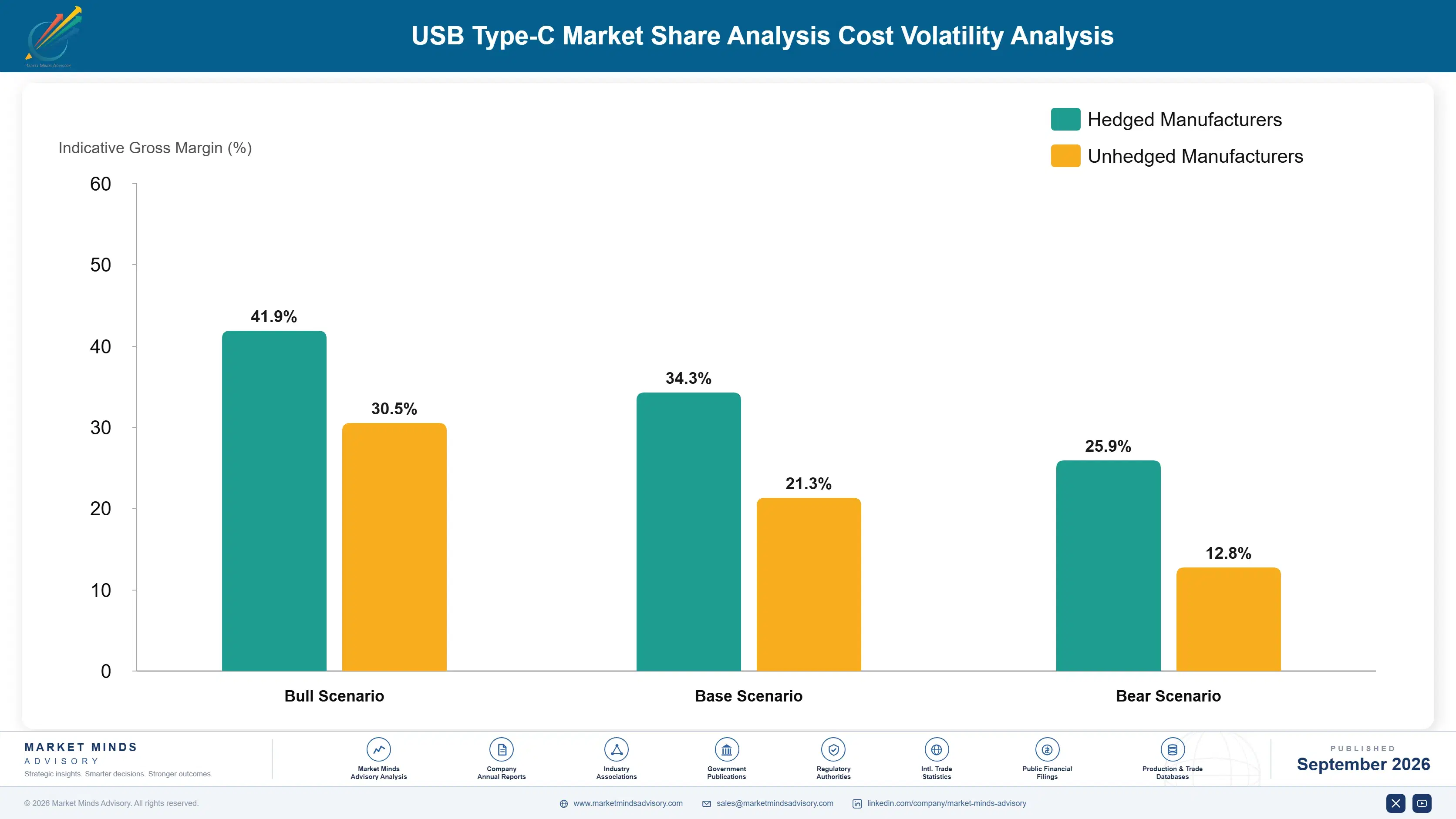
Silicon and Copper Cost Exposure

Component bill of materials centers on two primary cost inputs: controller silicon and copper cable conductor material, together representing an estimated 44 to 52% of unit manufacturing cost, sourced predominantly from Taiwanese semiconductor fabrication facilities and global copper commodity markets. Connector housing and shielding materials represent a further meaningful cost share concentrated among specialized metal stamping suppliers.
Copper commodity pricing spiked roughly 16% during 2025 as global demand from electric vehicle and grid infrastructure investment competed directly with electronics manufacturers for the same constrained refined copper supply, according to company annual report disclosures from major cable manufacturers. Several cable makers delayed planned price reductions for a full product cycle as a result, slowing the affordability improvements retail buyers had been anticipating for premium certified cables.

Smaller cable and accessory manufacturers carry disproportionate exposure because they lack the purchasing volume that diversified semiconductor and metals giants use to secure priority allocation and favorable material pricing from suppliers. This asymmetry pushes smaller vendors toward premium positioning or partnership arrangements with larger manufacturers for shared component sourcing. Larger diversified manufacturers use their broader metals purchasing power to smooth these cost swings in ways smaller specialists simply cannot.
usb-type-c-market-share-analysis-company-positioning-matrix-1790005443401

Multi-supplier copper sourcing agreements

Manufacturers increasingly qualify copper conductor material from two or more suppliers simultaneously rather than relying on a single source, preserving negotiating leverage and reducing exposure to allocation shortages during periods of elevated demand across the broader electronics and automotive supply chain. Several manufacturers report meaningfully improved delivery reliability after adopting dual-sourcing strategies over the past two years.

Alternative conductor material research

Manufacturers are researching aluminum-core and hybrid conductor alternatives that reduce dependence on constrained copper supply chains, aiming to reach commercial viability for lower-power applications within several years and reduce exposure to future material price volatility. Early results suggest these alternatives could match performance for select applications within the next several years. Adoption remains limited.

Portfolio Architecture for Margin Defence

Vendor portfolios span a wide margin gradient, from commodity budget cables sold on razor-thin unit economics to premium certified charger and controller silicon products commanding substantially higher gross margin across most product categories. Vendors that once competed purely on unit price now differentiate primarily through certification credibility and power delivery wattage capability. Buyers increasingly expect certification credibility as a baseline requirement rather than a differentiator.
The volume tier still anchors most vendor unit shipments today, but margin expansion increasingly comes from premium certified chargers and integrated controller silicon that regulated retail and enterprise procurement processes increasingly favor. This tension between volume cable sales and premium silicon migration shapes how vendors prioritize product roadmaps across their organizations. Vendors that misjudge this balance risk losing shelf space to competitors better aligned with retailer compliance priorities.

High-value margin pools concentrate specifically around higher-wattage power delivery chargers paired with integrated controller silicon, where buyers pay a meaningful premium for demonstrated safety certification and charging performance. Vendors slow to build genuine silicon and certification capability risk ceding this expanding premium pool to newer, more focused competitors within a few product cycles. This premium pool should expand faster than the overall market over the coming decade.

Standard, often non-certified budget cables and basic chargers sold primarily on unit price to price-sensitive consumers with minimal certification or performance requirements across most standard retail channels. Margins here remain the thinnest across the entire vendor product portfolio.
Gross Margin

Certified cables and chargers with visible compliance labeling sold to consumers and enterprises requiring documented safety performance and reliable power delivery across multiple device types and use cases. Renewal rates in this tier run notably higher than in the volume tier below it.
Gross Margin

Higher-wattage integrated controller silicon and premium accessory bundles positioned for buyers seeking measurable charging performance and formal compliance with tightening safety and regulatory certification standards. Vendors here typically enjoy the strongest pricing power in the entire market.
Gross Margin
usb-type-c-market-share-analysis-cost-volatility-analysis-1790005443911

High-value Sub-segments and Strategic Watch-out

High-Wattage Power Delivery Chargers

The fastest-growing, highest-margin pool in the market, enabling laptop and multi-device charging from a single certified adapter. Buyers increasingly view this as essential for reducing accessory clutter, pulling budget away from single-purpose chargers quickly. This trend should continue through the forecast period. Vendors here command strong pricing power.

Integrated Controller Silicon

A high-value, moderate-growth pool where established semiconductor vendors defend share through deep design-win relationships and proven reliability at scale. Growth remains healthy but slower than chargers as the underlying silicon integration trend matures further. This trend should continue through the forecast period. Buyers value this reliability highly.

Standard Certified Cables

The volume core of the market, still generating the largest unit shipment base despite slowing margin growth. Vendors defend this base through bundled retail pricing and multi-year OEM contracts even as buyers gradually shift new spending toward premium accessories instead. This trend should continue through the forecast period.

Non-Certified Budget Cables

A strategic watch-out segment facing mounting pressure as retailer delisting and consumer safety awareness reduce viable shelf space for non-compliant products. Vendors relying solely on price competition without pursuing certification risk losing distribution access entirely. This trend should continue through the forecast period. Investment here is slowing noticeably.

Why Certified Supplier Relationships Compound

OEM component relationships increasingly resemble annuity revenue rather than one-time component sales, since device manufacturers rarely switch certified suppliers once a controller chip or connector design has been qualified and integrated into a product line. Renewal rates on bundled silicon-plus-testing contracts run meaningfully higher than component-only sales, and expansion revenue from added product lines compounds steadily across multi-year manufacturer relationships. Vendors report expansion revenue from added product lines now exceeds initial component revenue within three years for most large manufacturer accounts.
Adoption stickiness varies meaningfully by end-use vertical: automotive and industrial applications embed certified components deeply into long product qualification cycles, making displacement costly and rare, while consumer accessory brands adopt more selectively around specific seasonal product launches, keeping switching costs comparatively lower and renewal cycles shorter across those faster-moving categories. Vendors track this variance closely when deciding where to invest new certification and testing capacity each year.

Buyer profiles are shifting generationally as compliance and quality engineers, rather than traditional procurement staff, increasingly own the supplier selection decision, prioritizing certification track record over unit price alone. This generational handoff favors vendors that demonstrate measurable compliance reliability over incumbents selling primarily on cost alone, and it shows no sign of reversing.
Section default visual

Four calls that define the decade.

These are among the four positions where our research anticipates prominent divergence between winners and laggards over the coming forecast period. Each is grounded in the demand model, the regulatory perimeter, and the announced capacity pipeline.

Engagement Snapshot From the Field

A live engagement with an industry participant carrying material or product regulatory and market exposure ahead of a defining policy shift, showing how our research translates into a defensible multi-year portfolio strategy.
MARKET MINDS ADVISORY · CLIENT ENGAGEMENT SUMMARY
USB Type-C Share Analysis Producer Strategic Portfolio Review and Transition Roadmap 2026·Investment Scenario on USB Type-C Share Analysis Exposure Evaluation 2025-26
CLIENT PROFILE
STRATEGIC CHALLENGE
MMA APPROACH
KEY FINDINGS
    CLIENT PROFILE
    STRATEGIC CHALLENGE
    MMA APPROACH
    KEY FINDINGS
      RECOMMENDED STRATEGY
      OUTCOME

      Frequently Asked Questions

      Foundational context covering the market sizes, CAGR, scope, country, region and competition that inform every finding below. This section is provided to cover basics and most often pre-purchase conversations, answered from the MMA Primary Research Dataset.

      Report Segmentation Architecture

      The full report scope spans multiple orthogonal segmentation dimensions, with cross-tabulated demand data provided for each dimension pair. Coverage extends further to regional breakdowns, trend trajectories, and the competitive detail needed to support segment-level decision-making.

      By Region

      • East Asia
      • North America
      • Western Europe
      • South Asia and Pacific
      • Latin America
      • Middle East and Africa
      • Eastern Europe

      Scope, Methodology, and Coverage

      Every figure in this report is reproducible from documented input assumptions. The scope below maps the historical period, the forecast horizon, the segmentation dimensions, and the countries covered, alongside the underlying primary and qualitative methodology.
      Historical Period
      2020 to 2025
      Forecast Period
      2026 to 2036
      Base Year
      2025 (USD billions; MMA Primary Research Dataset, September 2026)
      Market Definition
      The USB Type-C market comprises connectors, cables, power delivery chargers and adapters, controller integrated circuits, and hubs or docking stations built to the USB Type-C physical and power delivery specification. It excludes proprietary charging connectors and legacy USB-A or micro-USB hardware.
      Quantitative Units
      USD billions
      Segmentation Dimensions
      Regions Covered
      East Asia, North America, Western Europe, South Asia and Pacific, Latin America, Middle East and Africa, Eastern Europe
      Countries Covered
      Key Companies Profiled
      Texas Instruments, Cypress Semiconductor (Infineon), Anker, Belkin (Foxconn Interconnect), LG Innotek, STMicroelectronics, Onsemi, Diodes Incorporated, Microchip Technology, Amphenol, Molex, JAE Electronics, Delta Electronics, UGREEN, RAVPower, Aukey, Nekteck, Baseus, Satechi, Zendure
      Quantitative Methodology
      Primary survey, n=3,800 respondents, Q4 2025, six countries; demand-side model with trade association cross-validation
      Qualitative Methodology
      47 expert interviews, Q4 2025; applied to validate demand model assumptions, identify emerging dynamics, and assess competitive positioning
      Report Format
      PDF and XLSX data workbook (Word format preview document)
      Publisher
      Market Minds Advisory
      Report Code
      MMA-2026-TEC-434
      Published
      September 2026
      Contact
      sales@marketmindsadvisory.com | www.marketmindsadvisory.com

      Purchase the full USB Type-C Market Share Analysis Report (2026 to 2036).

      Built For The People Who Decide

      From boardroom strategy to bench-side execution, this report is read cover-to-cover by leaders shaping the next decade of their industry, turning demand scenarios, market dynamics and valuation benchmarks into decisions.
      CXOs/ Presidents/ VPs/ Managers
      M&A and Corporate Development
      Strategy Teams and R&D Heads
      Procurement and Product Directors
      Regulatory and Compliance Leaders
      Investor Relations and Equity Analysts