Market Minds Advisory
USA Yeast Extracts Market

USA Yeast Extracts Market: Nucleotide Multiplication, Sodium Reduction Mandates and Clean-Label Substitution That Changes Only The Label

Removing salt strips savoury depth that has to come back from somewhere, and nucleotide yeast extracts restore it at inclusion levels a formulator can actually afford to carry through an entire product range.

Lead Analyst

Lisa Gevelber

Published

September 2026

Make Smarter Decisions with Customized Research Insights

Request a free sample report and evaluate market opportunities, growth trends, and competitive dynamics relevant to your business needs.

2025 MARKET VALUE$0.4BMarket Size 2025
2036 FORECAST VALUE$0.8BBase Case , 2026 to 2036
CAGR 2026 TO 20366.6 %Bull 7.8% / Bear 5.4%
INCREMENTAL OPPORTUNITY$0.4BNet 10- year value creation
EXPANSION MULTIPLE1.89x2036 value over 2026 base
Strategic Levers
M&A Pipeline
Regional Outlook
Country Rankings
Competitive Intelligence
Segmental Deep-dive
Call-Us : 91 93563 13602

Executive Snapshot and Market Trajectory

Take salt out of a processed food and something has to replace the savoury depth that leaves with it. Yeast extract is what most American formulators reach for, and nucleotide-rich grades do it at inclusion levels that make the arithmetic work. That arithmetic is the whole business.
High-nucleotide extracts carry the growth because inosine and guanosine monophosphate multiply the glutamate effect rather than adding to it, so a small inclusion replaces a large one. Clean-label substitution grades grow nearly as fast doing a job identical to monosodium glutamate under a different declaration. Western Europe holds the largest supply share, since European producers built this capability decades ago and American extraction capacity remains limited.
Concentration reads at 68% for the top five, high because autolysis control and nucleotide enrichment are genuinely difficult and most extract producers have never developed either. Food and Drug Administration sodium reduction targets have done more for demand than any flavour argument, and reformulation projects proceed product by product rather than across a range. Reformulation proceeds product by product rather than across a range, which makes this steady growth rather than a step change.
Market Definition
This market covers yeast extracts supplied into United States food and beverage manufacturing, spanning high-nucleotide extracts, clean-label substitution grades, standard savoury yeast extracts, low-sodium and reduced-salt formulation grades, and specialty and kokumi-enhancing extracts. Nutritional yeast sold as a food, yeast beta-glucans and cell wall products, brewers yeast for fermentation, autolysed yeast for animal feed, and monosodium glutamate itself are excluded.
Base Year Value
$0.4B in 2025 (MMA Primary Research Dataset, August 2026)
Forecast Period
2026 to 2036, eleven discrete annual values
CAGR
6.6% base case. Bull 7.8%. Bear 5.4%.
Fastest Growth Segment
High-Nucleotide Yeast Extracts: 9.9% CAGR
Fastest Growth Country
United States: 6.6% CAGR
Fastest Growth Region
South Asia and Pacific: 8.9% CAGR
Largest Region
Western Europe: 41% of 2025 global value
Market Leaders
Angel Yeast, Lesaffre, Ohly, Lallemand and Kerry Group lead on yeast extract supply into the United States. Source: MMA Primary Research Dataset, July 2026.
Primary Survey
n=3,800 procurement and R&D decision-makers, Q4 2025, six countries
Methodology
Demand-side build-up, cross-validated against public data, 47 expert interviews

USA Yeast Extracts Market Forecast Scenarios

usa-yeast-extracts-market-trends-size-forecast-scenario-1787458090178
Growth ran at 5.6% annually between 2020 and 2025, and sodium reduction targets rather than any flavour trend set the pace. Food and Drug Administration voluntary guidance pushed manufacturers to reduce sodium across categories, and every reduction created a savoury gap that needed filling. Clean-label reformulation ran alongside it, replacing monosodium glutamate and hydrolysed vegetable protein with an ingredient consumers react to differently.
The base case at 6.6% rests on three mechanisms. Sodium reduction targets keep tightening across processed food categories, and each round creates fresh reformulation demand rather than a single conversion. Clean-label substitution continues product by product as manufacturers work through portfolios. And plant-based and meat alternative manufacturing keeps expanding, where savoury depth has to be built entirely rather than reduced from a meat baseline. None of the three depends on a consumer trend holding.
The bull case at 7.8% turns on sodium targets becoming mandatory rather than voluntary, which would convert a gradual reformulation programme into a compressed one. The bear case at 5.4% reflects cost pressure pushing manufacturers back toward monosodium glutamate, since the functional job is identical and only the declaration differs, and cost-led buyers do occasionally make that argument internally.

Sodium Targets Drive This More Than Flavour

Salt does more in processed food than make things taste salty. It carries savoury depth, suppresses bitterness and rounds a flavour profile, and taking it out removes all of that at once. Food and Drug Administration sodium targets pushed American manufacturers to do exactly that across most categories, and yeast extract is what the majority reached for to fill the gap.
TOP FIVE CONCENTRATION68%High, since autolysis and nucleotide enrichment are genuinely difficult
NUCLEOTIDE INCLUSION ADVANTAGE4.2 timesSavoury effect against comparable standard extract at equal weight
IMPORT DEPENDENCE74%Share of extract sourced from outside domestic production capacity
SODIUM REDUCTION SHARE53%Portion of volume entering reduced-salt reformulation applications specifically
PRICE AGAINST GLUTAMATE3.6 timesYeast extract cost relative to monosodium glutamate delivering comparable effect
QUALIFICATION CYCLE9 monthsTypical time to qualify an extract into a food formulation
Nucleotide chemistry is why it works at an affordable inclusion. Inosine and guanosine monophosphate multiply the effect of glutamate rather than adding to it, which means a high-nucleotide extract delivers roughly 4.2 times the savoury effect of a standard grade at equal weight. That multiplication is the whole commercial argument for paying several times commodity extract pricing, and formulators who have run the comparison do not go back.
The clean-label substitution is more awkward to discuss honestly. Yeast extract replacing monosodium glutamate does a functionally identical job under a different name, and the industry rarely states that plainly. It does not make the substitution commercially unsound, since consumers react to specific ingredient names rather than to specific molecules, but it does mean the position rests on labelling preference rather than on any functional advantage.
"Yeast extract replacing monosodium glutamate is doing the same job under a name people prefer, and everybody in this industry knows it. The nucleotide grades are different, though. Those are genuinely solving a formulation problem nothing else solves as cheaply."
Director, Food Ingredients and Savoury Systems Practice · MMA Food Ingredients Practice · August 2026

Market Trends

Sodium Reduction Targets Create Demand No Flavour Trend Did

Food and Drug Administration voluntary sodium targets pushed American manufacturers to reduce salt across most processed food categories, and every reduction stripped savoury depth that had to be replaced from somewhere else. Yeast extract is what the majority reached for. Roughly 53% of volume now enters reduced-salt reformulation specifically, which makes regulatory guidance the primary demand driver rather than any consumer flavour preference. Each successive round of target tightening creates fresh reformulation work rather than a single conversion. Regulatory guidance turns out to move formulators far more reliably than preference does.
Market Impact: Inclusion runs 3 times conventional levels
Nucleotide Multiplication Justifies Several Times Commodity Pricing

Inosine and guanosine monophosphate multiply the effect of glutamate rather than adding to it, so a high-nucleotide extract delivers roughly 4.2 times the savoury effect of a standard grade at equal inclusion weight. That multiplication is the entire argument for paying several times commodity extract pricing, and formulators who have run the comparison do not return to standard grades. Production requires autolysis control and nucleotide enrichment that most extract producers have simply never developed the capability to do. Formulators who have run the comparison properly do not return to standard grades.
Market Impact: Conversions take 9 months each

Market Opportunities and Growth Drivers

Plant-Based Manufacturing Builds Savoury Depth From Nothing

Meat alternative and plant-based manufacturing faces a harder problem than sodium reduction, since there is no meat baseline to reduce from and savoury depth has to be constructed entirely from plant ingredients that do not naturally supply it. Yeast extract carries most of that construction in American formulations. Inclusion levels run considerably higher than in conventional processed food, which makes this segment disproportionately valuable relative to its tonnage. The category continues expanding despite widely reported retail difficulties. Retail difficulties in the category have not reduced ingredient demand much at all.
Market Impact: Costs 3.6 times monosodium glutamate

Clean-Label Reformulation Proceeds Product By Product Steadily

Manufacturers replace monosodium glutamate and hydrolysed vegetable protein one product at a time rather than across a whole range, because each conversion requires its own sensory validation and shelf life work. That makes demand steady rather than sudden, which suits suppliers planning capacity but frustrates anybody expecting a step change. Each conversion also tends to bring the rest of a manufacturer's portfolio behind it eventually, since the internal argument has already been won once. Sensory validation and shelf life work have to be repeated for each product. Steady growth suits capacity planning well.
Market Impact: Import share sits at 74%

Market Restraints and Challenges

Cost Against Glutamate Invites Periodic Internal Reconsideration

Yeast extract costs roughly 3.6 times monosodium glutamate for comparable savoury effect and does a functionally identical job, which makes it a visible line item whenever a manufacturer is defending margin. The root cause is that the substitution rests on labelling preference rather than on functional advantage. Commercially this means conversions can reverse under cost pressure, and cost-led buyers do occasionally make that argument internally. Participants are responding with nucleotide grades reducing inclusion, contract terms and sensory evidence. Everybody in this industry privately acknowledges the functional equivalence. Nucleotide grades reduce inclusion and help.
Market Impact: Sodium work drives 53% of volume

Import Dependence Leaves Formulators Exposed To Overseas Supply

Roughly 74% of yeast extract used in American food manufacturing is imported, principally from European and Chinese producers, because domestic extraction capacity was never built at meaningful scale. The root cause is that fermentation and autolysis capacity requires capital that American producers directed elsewhere decades ago. Commercially this exposes formulators to freight, currency and supply decisions taken abroad. Participants are responding with dual sourcing, inventory positions American manufacturers historically avoided, and longer contract terms. Formulators were caught short during recent disruptions they never saw coming. Inventory positions are now carried deliberately.
Market Impact: Delivers 4.2 times standard effect
4 additional market trends, 2 additional growth drivers, and 3 additional restraints and challenges are covered in the full report. Contact sales@marketmindsadvisory.com to access the complete intelligence.

Segment CAGR and Growth Architecture

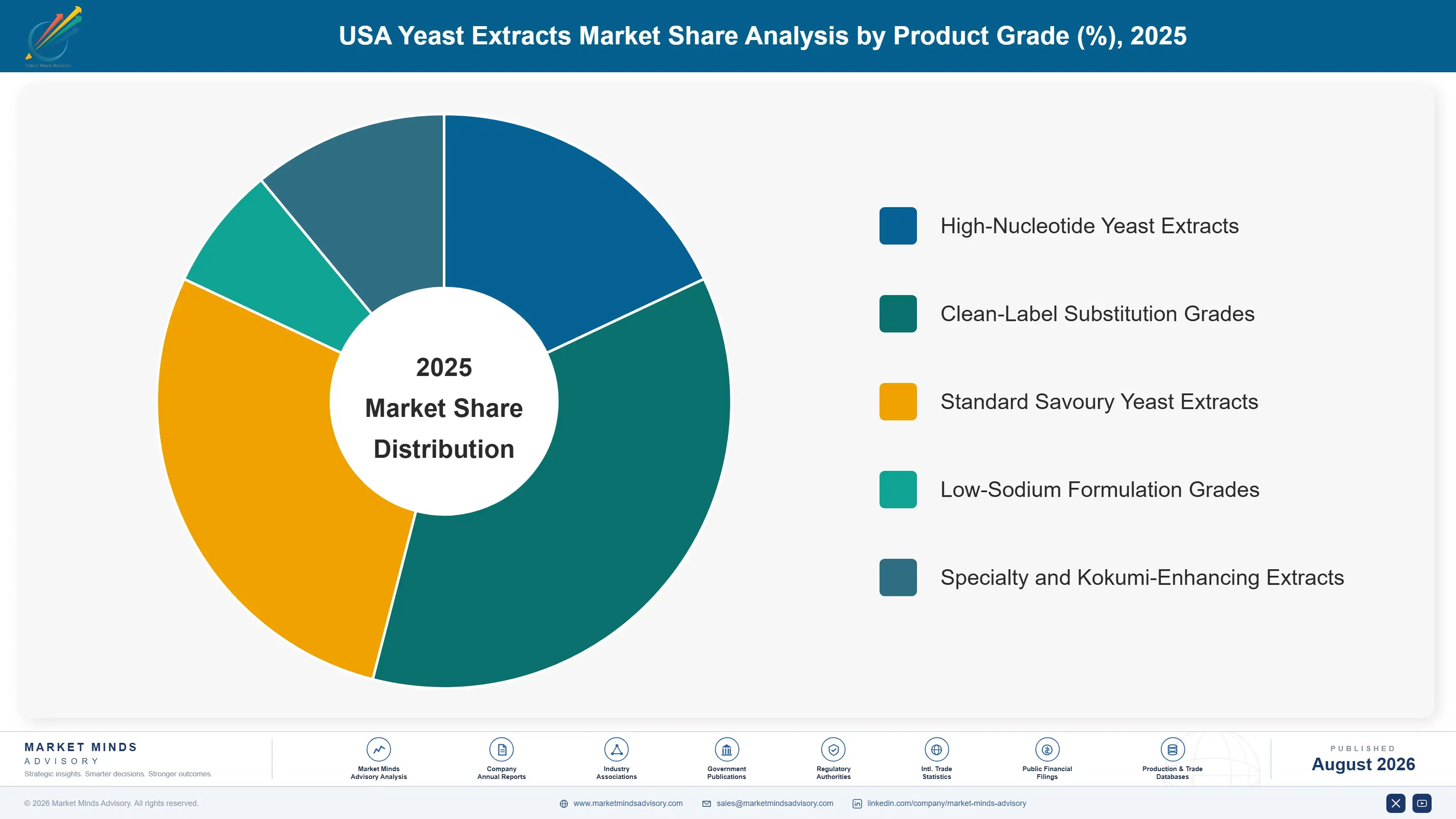
Five product grades divide this market on nucleotide content and formulation role rather than on the yeast strain or substrate behind them. That reflects how buyers actually purchase, since a formulator specifies savoury intensity, sodium contribution and declaration wording, and none of those depend on whether the yeast grew on molasses or on spent grain.
usa-yeast-extracts-market-trends-market-share-analysis-1787458090712

High-Nucleotide Yeast Extracts

Growing at 9.9% and the fastest part of this market. High-nucleotide yeast extracts carry elevated inosine and guanosine monophosphate content that multiplies the savoury effect of glutamate rather than simply adding to it, which is why a small inclusion replaces a large one. That multiplication is the entire technical argument for paying several times commodity extract pricing. Sodium reduction is the application driving it, since removing salt strips savoury depth that has to come back from somewhere and nucleotide extracts restore it at inclusion levels a formulator can afford. Production requires autolysis control and nucleotide enrichment that most extract producers have never developed. Capability rather than capacity decides who competes here.
CAGR 9.9%

Clean-Label Substitution Grades

Growing at 8.4% on yeast extracts supplied specifically as replacements for monosodium glutamate and hydrolysed vegetable protein in clean-label reformulation, where the functional job is identical and only the ingredient declaration changes. That is an uncomfortable truth the industry rarely states plainly, and it does not make the substitution commercially unsound. Consumers read declarations and react to specific names rather than to specific molecules. Reformulation projects run product by product rather than across a range, which makes this steady rather than sudden growth, and each conversion tends to bring the rest of a manufacturer's portfolio behind it eventually. Labelling preference rather than function drives the whole substitution. Portfolios follow the first conversion.
CAGR 8.4%
Full segment breakdown across 5 segments available in the complete report.

Regional Architecture and Country Demand Map

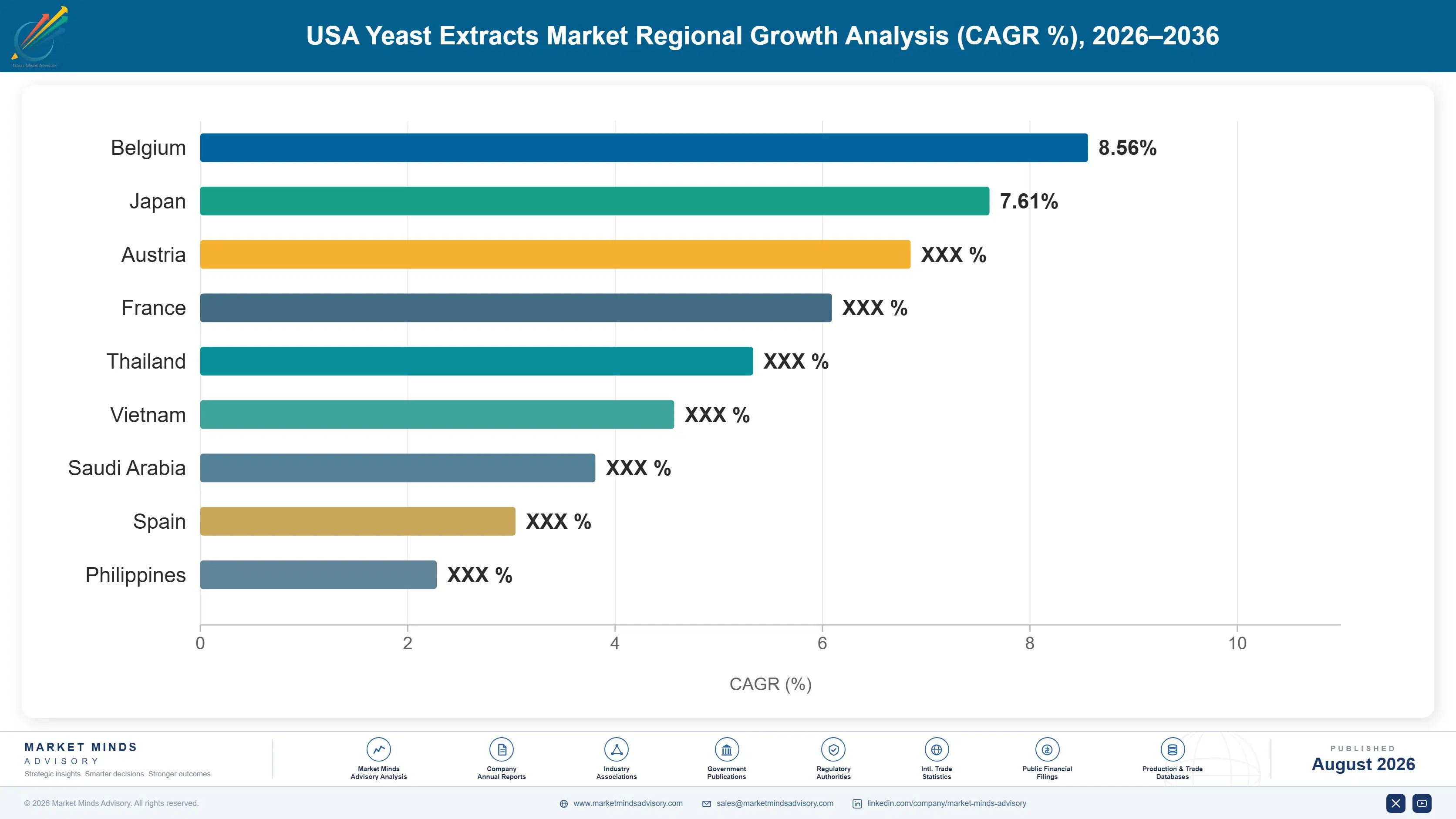
This is a United States-scoped report, so every regional figure reflects supply origin rather than consumption and all seven shares sit outside the standard global bands. Western Europe leads at 41% because European producers built autolysis and nucleotide capability decades before anybody else did. Domestic capacity remains genuinely limited.

Western Europe

Note: Western Europe holds 41% because this is a United States-scoped report measuring supply origin, and European producers built autolysis and nucleotide enrichment capability decades before anybody else attempted it. Ohly in Germany and Lesaffre in France hold the deepest technical positions, and both supply American formulators directly rather than through intermediaries. Regulatory documentation carried as standard for European food manufacturing satisfies American requirements without additional work. Freight and currency both work against the position in commodity grades, which is why European supply concentrates in high-nucleotide and specialty extracts where the technical premium absorbs those costs comfortably. Technical premium is what makes distant supply commercially viable at all. Documentation transfers without extra work.
Share: 41% | CAGR: 5.1% (2026 to 2036)

East Asia

Note: East Asia registers at 33% as a supply origin under this report's scope. Chinese producers led by Angel Yeast have built fermentation and extraction capacity at scale and cost that European producers cannot match, and have moved from commodity grades into nucleotide-enriched products that compete on technical merit rather than only on price. That transition is the significant development of recent years. Japanese producers hold premium positions in specialty and kokumi-enhancing grades where quality expectations are demanding. Freight economics from Asia into American ports are considerably better than from Europe, which supports the position across standard and clean-label grades. That technical transition is the significant development of the past few years.
Share: 33% | CAGR: 7.7% (2026 to 2036)
Regional intelligence for 5 additional markets available in the complete report: North America, South Asia and Pacific, Latin America, Eastern Europe, Middle East and Africa. Contact sales@marketmindsadvisory.com.
usa-yeast-extracts-market-trends-country-cagr-analysis-1787458091229

Where Yeast Extract Supply Earns Returns

Four positions separate suppliers holding durable American business from those quoting commodity extract on price: developing nucleotide enrichment capability, qualifying into formulations before competitors are evaluated, positioning against sodium targets rather than clean-label preference, and holding domestic finishing capacity that shortens lead times formulators genuinely value. Only the first is genuinely hard to acquire quickly.

Develop Nucleotide Enrichment Capability Competitors Have Not Built

Inosine and guanosine monophosphate multiply the glutamate effect rather than adding to it, so a high-nucleotide extract delivers roughly 4.2 times the savoury effect of standard grades at equal weight. That multiplication justifies several times commodity pricing, and suppliers holding the capability realise 45% to 55% higher margin than commodity extract producers. Autolysis control and enrichment are genuinely difficult, which is precisely why most producers have never developed either and why the position holds. Enrichment capability takes years and cannot be bolted onto an existing plant. That difficulty is the moat.
Market Impact: Realises up to 55% higher margin than commodity

Qualify Into Formulations Before Competitors Are Evaluated

Qualification with an American food manufacturer takes around nine months of sensory validation, shelf life work and documentation, and once an extract sits inside a formulation nobody revisits it without a reason. Qualified suppliers realise 25% to 32% higher pricing than those quoting spot material. Each conversion also tends to bring the rest of that manufacturer's portfolio behind it eventually, because the internal argument for substitution has already been won once and does not need repeating. Sensory validation is expensive enough that nobody redoes it casually. Portfolios follow the first conversion.
Market Impact: Realises 32% higher pricing once the formulation qualifies

Position Against Sodium Targets Not Clean-Label Preference

Clean-label substitution rests on labelling preference and reverses under cost pressure, since yeast extract costs roughly 3.6 times monosodium glutamate for a functionally identical job. Sodium reduction is different, because the regulatory target does not go away when a procurement team looks at the line item. Roughly 53% of volume already enters reduced-salt reformulation, and positioning there produces demand that survives a cost review rather than becoming a casualty of one. A regulatory target survives a procurement review; a preference frequently does not. Compliance work is difficult to undo afterwards.
Market Impact: Reaches the 53% of volume in sodium work

Hold Domestic Finishing Capacity Formulators Genuinely Value

Import dependence near 74% leaves American formulators exposed to freight, currency and overseas supply decisions, and several have been caught short during disruptions they had no visibility of. Domestic finishing of imported crude extract shortens lead times and provides supply chain visibility that commands 20% to 28% premiums over comparable imported material. Capital and quality systems are both required, and the volume has to justify them before anything is built or acquired. Two disruptions in recent years changed how buyers think about this. Visibility is what buyers now ask for.
Market Impact: Commands premiums of as much as 28% higher

Who Controls the Margin Pool

Concentration reads at 68% for the top five measured on yeast extract supply into the United States, the basis used throughout this section, and it reflects technical capability rather than fermentation scale. Angel Yeast has moved from commodity supply into nucleotide-enriched grades at Chinese cost. Lesaffre and Ohly hold the deepest European technical positions. Lallemand and Kerry bring breadth across savoury systems.
Competition runs on three fronts. Nucleotide enrichment capability is the first and by a wide margin the most decisive, since it justifies pricing that commodity extract never supports. Formulation qualification is the second, converting spot supply into volume repeating for years. Supply reliability is the third, and it matters more since American formulators were caught short during recent disruptions. None of the three is a pricing argument.

Pressure arrives from two directions. Chinese producers moving into nucleotide grades compete on technical merit from a considerably lower cost base, which is a more serious position than price competition alone. Separately, American formulators are seeking domestic finishing and second origins. Rankings will shift toward suppliers combining nucleotide capability with supply visibility American buyers can actually verify. Technical depth alone no longer secures a position here.
usa-yeast-extracts-market-trends-company-positioning-matrix-1787458091752

Competitive Moat and Risk Dimensions

ANGEL YEAST

Moat: Scale plus technical progression

Fermentation and extraction capacity at Chinese cost combined with a genuine move into nucleotide-enriched grades gives the business a position competing on technical merit rather than only on delivered price, which European producers had assumed would not happen. Freight economics into American ports also work considerably better than from European origins across every grade.
ANGEL YEAST

Risk: Origin concentration and documentation

American formulators increasingly want supply origins outside concentrated Chinese production for reasons unconnected to quality or price, which caps share regardless of technical progress. Documentation expectations for imported ingredients have also tightened, and buyers who cannot easily visit a plant apply more scrutiny to what arrives from it than they once did.
OHLY

Moat: Autolysis and nucleotide depth

Decades of autolysis control and nucleotide enrichment experience produce specification consistency and technical service depth that newer entrants spend years attempting to reach, and formulators build savoury systems around that consistency. Qualified positions inside American formulations built over many years also deliver volume predictability that spot suppliers never achieve at all.
OHLY

Risk: European freight and currency

Delivered cost from European plants is uncompetitive against Asian supply in standard and clean-label grades where technical depth carries no premium, which confines the position to specialty and nucleotide products. Euro exposure adds a second layer American buyers feel directly, and Chinese producers are now closing the technical gap that justified it.

Players Tracked

Prominent Players

Angel Yeast
Lesaffre
Ohly
Lallemand
Kerry Group

Other Key Players

Associated British Foods
Biospringer
DSM-Firmenich
Givaudan
International Flavors and Fragrances
Sensient Technologies
Titan Biotech
Marcor Development
Flavorchem Corporation
Alltech
Leiber GmbH
Halcyon Proteins
Chr. Hansen
Nikken Foods
Savoury Systems International

Recent Developments

JANUARY 2025

Chinese producer launches nucleotide-enriched grade for American formulators

A Chinese yeast extract producer launched a nucleotide-enriched grade aimed specifically at American sodium reduction applications, competing on savoury multiplication and technical documentation rather than on the delivered cost advantage that had defined its position previously. Two American formulators qualified the grade within the year.
Signal: Chinese producers competing on nucleotide capability rather than on price is the significant recent development here
MAY 2025

Domestic finishing capacity commissioned after import supply disruption

An American ingredient company commissioned domestic finishing and standardisation capacity for imported crude yeast extract, responding to disruptions that had left formulators short with no visibility of overseas supply decisions affecting them. Capacity handles standardisation rather than primary fermentation. Two customers had asked for exactly this.
Signal: Supply visibility rather than delivered cost is what American formulators now consistently say that they want
SEPTEMBER 2025

Sodium reduction reformulation completed across processed meat range

A processed meat manufacturer completed sodium reduction reformulation across a substantial product range using nucleotide yeast extract to restore savoury depth, contracting supply multi-year rather than tendering annually as it had done previously. Sodium targets rather than any consumer preference drove the reformulation decision. Annual tendering was abandoned.
Signal: Sodium-driven conversions produce multi-year contracts because the underlying regulatory target simply does not ever go away

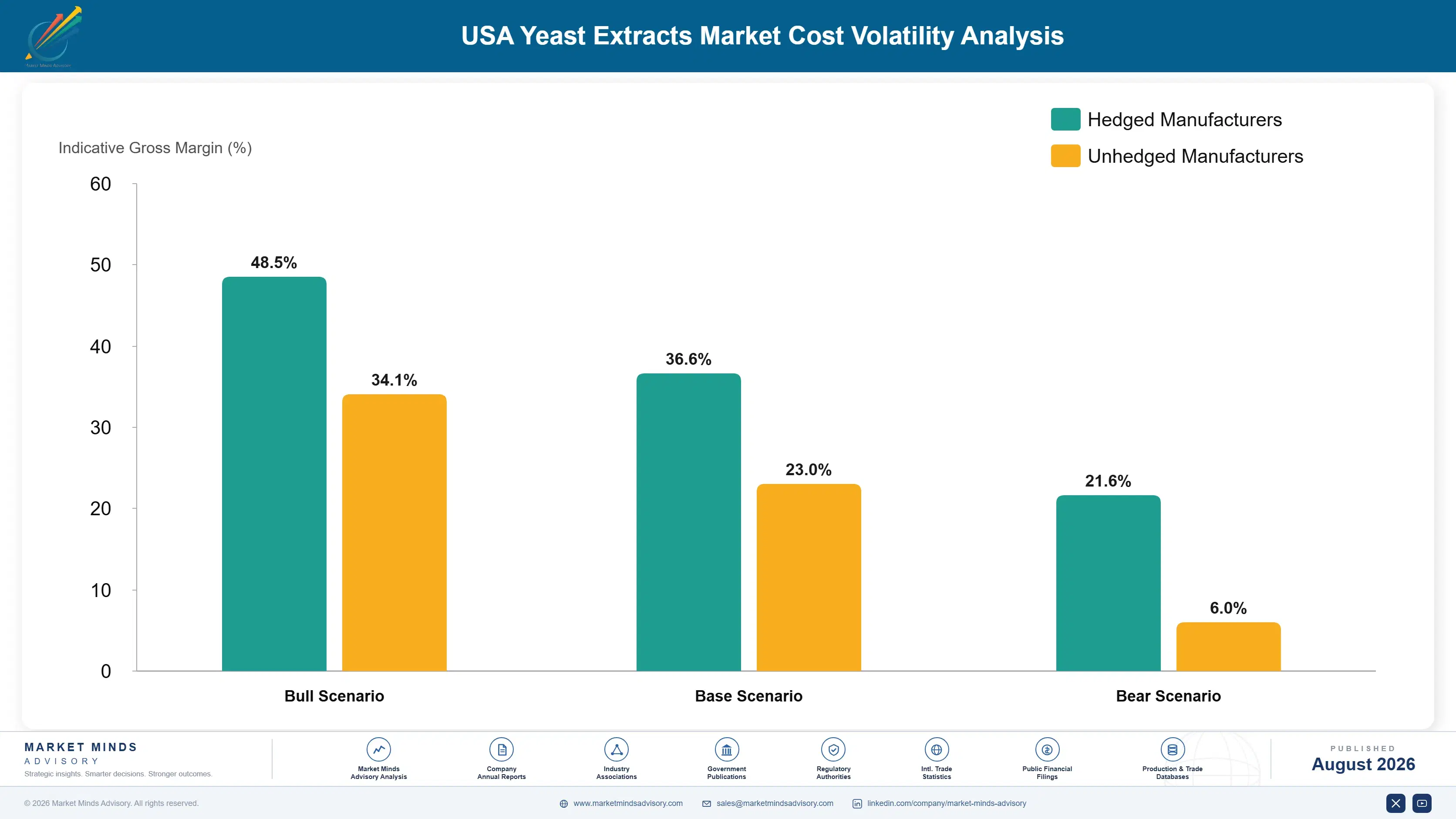
What Drives Yeast Extract Cost

Fermentation substrate including molasses and other sugar sources accounts for roughly 27% of manufactured cost, though the share varies with regional feedstock availability. Fermentation and autolysis processing adds around 24%, and nucleotide enrichment a further 12% where it applies. Energy for concentration and drying contributes about 15%, packaging and freight roughly 14% given import distances, and quality and documentation close to 8%.
Molasses pricing moved through 2023 and 2024 on sugar market conditions and competing ethanol demand, with United States Department of Agriculture sugar and sweetener data showing the movement, while European fermentation energy costs remained above the previous decade's baseline according to International Energy Agency figures. Freight from European origins rose in parallel, compounding the delivered cost gap against Asian supply. European producers absorbed most of both movements.

The disadvantage mechanism is freight combined with energy position, and it separates suppliers by origin rather than by capability. European producers carry the longest freight leg and elevated energy costs together, which is sustainable in nucleotide grades where technical premium absorbs it and impossible in commodity extract where it does not. Exposure also varies by capability, since nucleotide enrichment supports pricing that commodity production simply never will.
usa-yeast-extracts-market-trends-cost-volatility-analysis-1787458091947

Contract molasses and substrate on annual committed volume

Substrate is over a quarter of manufactured cost and prices on sugar market conditions and ethanol demand that pay no attention to extract requirements. Annual committed volume secures predictable cost and allocation through the tightness that periodically follows a poor cane harvest. The commitment carries volume risk when demand softens, which is the honest price of predictability.

Weight production toward nucleotide-enriched grades

Commodity extract competes on delivered cost against origins with better freight and energy positions, which is a contest European producers cannot win and should stop entering. Nucleotide grades support pricing that absorbs those disadvantages comfortably. The constraint is enrichment capability, which takes years to develop properly and cannot simply be added to an existing plant on a short timeline.

Position finishing capacity inside the American market

Freight runs near 14% of delivered cost from European origins and American formulators have been caught short during import disruptions they could not see coming. Domestic finishing of imported crude shortens both lead times and the visibility gap. Capital and quality systems are both substantial, and the volume needs to justify them before anything gets built rather than afterwards.

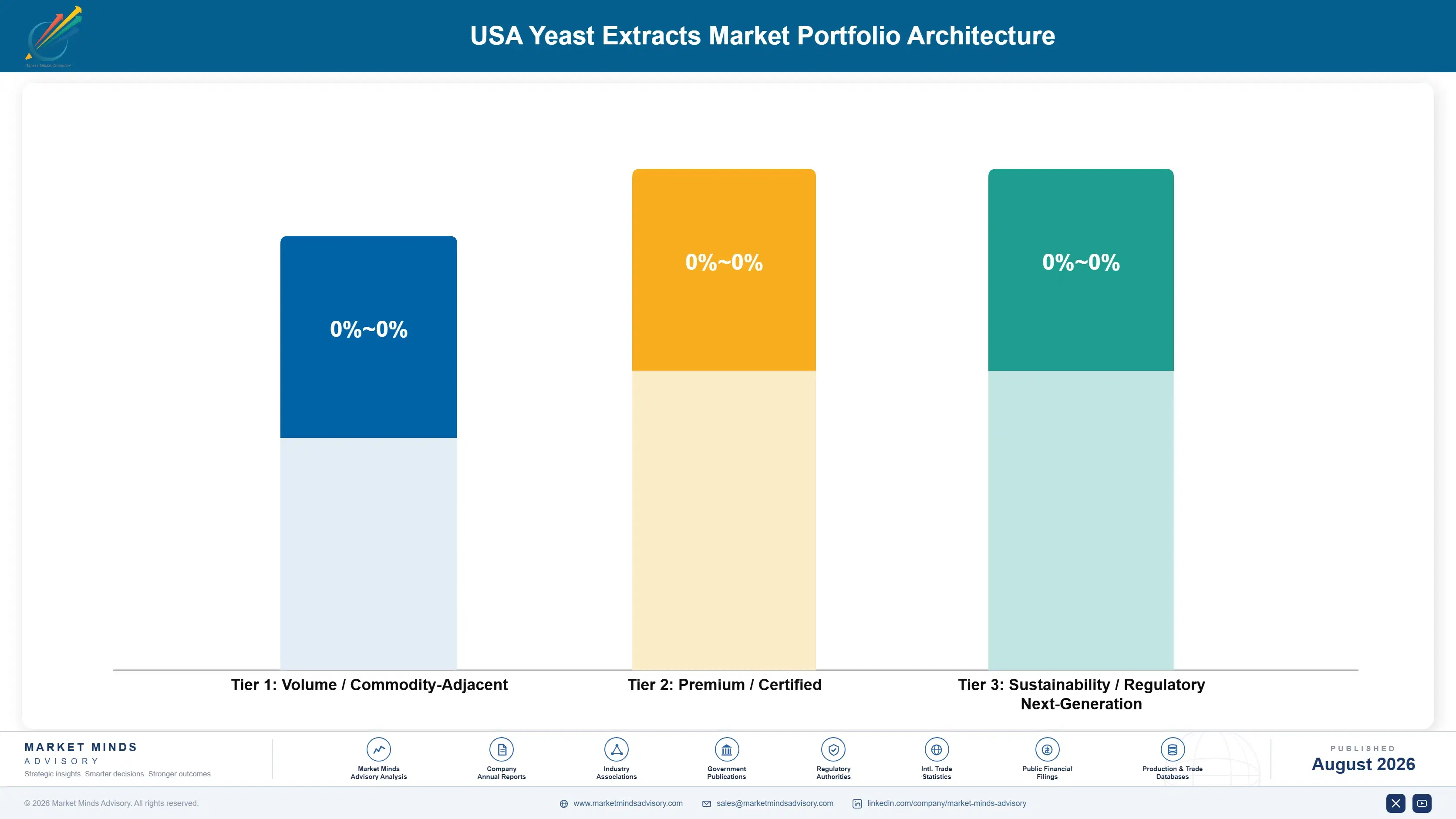
Portfolio Architecture for Margin Defence

Portfolio economics here divide on technical capability rather than on fermentation scale. Commodity savoury extract sold on delivered cost per kilogram competes against origins with better freight and energy positions, and a producer without a technical advantage is entering a contest decided entirely by geography rather than by anything it controls. European producers in particular should stop entering that contest.
The middle tier is clean-label substitution grade qualified into named formulations. Nine months of sensory validation and shelf life work produce volume that repeats for years, though the position rests on labelling preference rather than functional advantage and can reverse under cost pressure. Margins reach the high twenties and hold while procurement is not looking closely. Cost reviews do occasionally notice the equivalence.

Above both sits nucleotide-enriched extract in sodium reduction applications. Savoury multiplication at roughly 4.2 times standard grades justifies several times commodity pricing, the regulatory target driving demand does not disappear when a cost review happens, and margins reach the high forties. The position requires autolysis and enrichment capability that takes years to develop and cannot be added quickly. Very few producers have built it properly.

Volume / Commodity-Adjacent

Commodity savoury extract sold on delivered cost per kilogram. The range reflects substrate, energy and freight position rather than commercial skill, and geography decides the contest more than capability does.
Gross Margin: 14 to 21%

Premium / Certified

Clean-label substitution grade qualified into named formulations. The range reflects qualification depth and whether the position rests on sodium reduction or purely on labelling preference that cost pressure can reverse.
Gross Margin: 26 to 34%

Sustainability / Regulatory / Next-Generation

Nucleotide-enriched extract supplied into sodium reduction applications. The wide range reflects enrichment level achieved and whether the supplier holds domestic finishing capacity American buyers can actually verify. Capability takes years to develop.
Gross Margin: 42 to 52%
usa-yeast-extracts-market-trends-portfolio-architecture-1787458092444

High-value Sub-segments and Strategic Watch-out

Nucleotide Sodium Reduction Supply

High value and high growth together, driven by regulatory targets that survive a procurement cost review. The wide range reflects enrichment level achieved and whether the supplier holds domestic finishing capacity American buyers can verify directly. Compliance work is difficult to reverse. Enrichment level decides the position.
Gross Margin: 42 to 52%

Plant-Based Formulation Extract Supply

A genuinely premium pool where savoury depth is built from nothing rather than reduced from a meat baseline. Inclusion runs several times conventional levels. The range reflects nucleotide content and how much application support accompanies the supply. There is no meat baseline to reduce from.
Gross Margin: 37 to 46%

Clean-Label Substitution Grades

The volume core of this market and where most conversion activity happens. The range reflects qualification depth, though the position rests on labelling preference rather than functional advantage and cost reviews do occasionally reverse it. Cheaper alternatives do the identical job. Conversions proceed one product at a time.
Gross Margin: 26 to 34%

Commodity Savoury Extract Supply

The strategic watch-out. Volumes are real but freight and energy position decide the contest, technical capability earns nothing here, and European producers in particular should stop entering it. The range reflects geography rather than skill. Technical capability earns nothing at all here. Geography decides this contest entirely.
Gross Margin: 14 to 21%

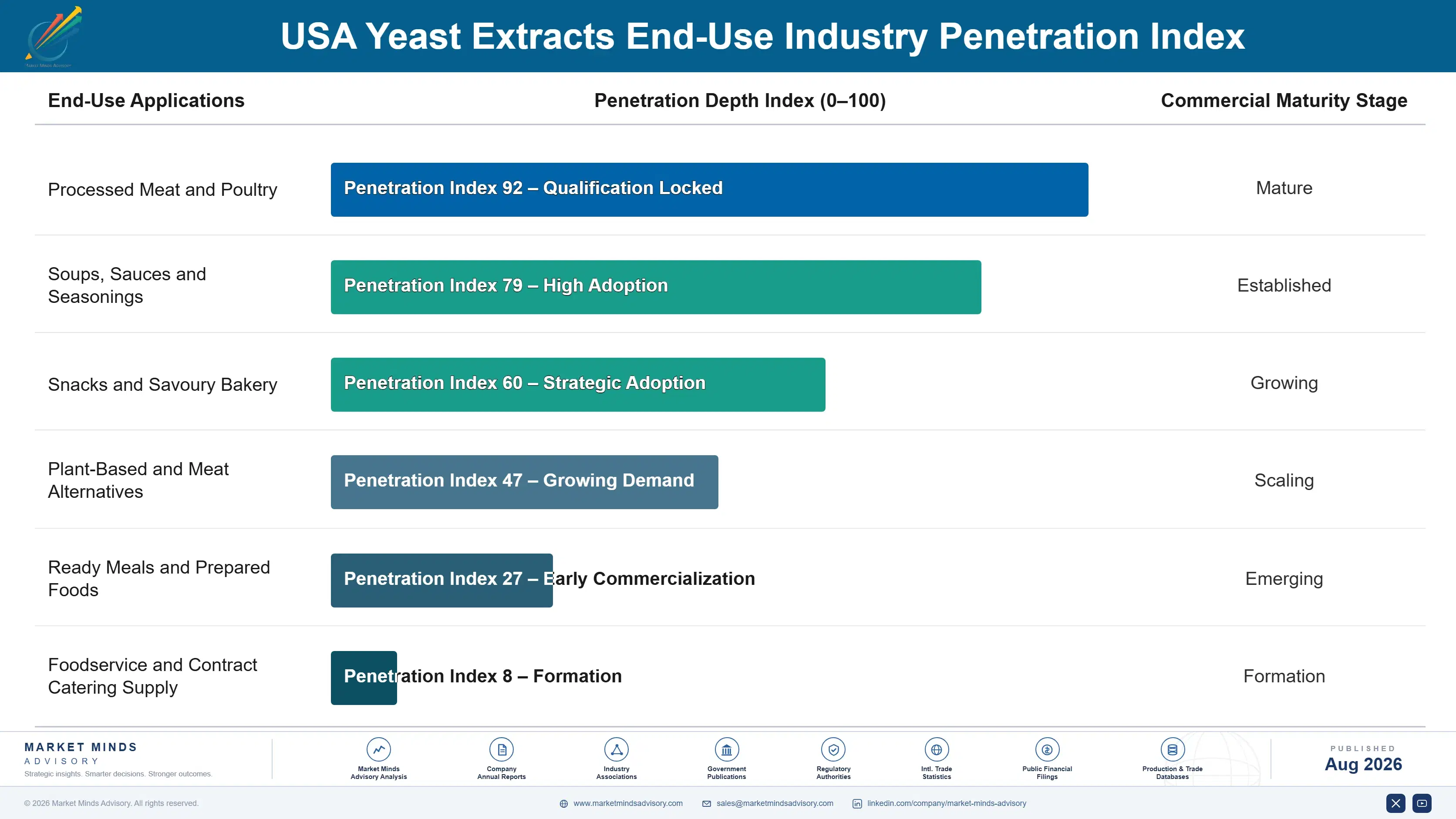
How Extract Demand Actually Repeats

Qualified formulation positions repeat with unusual reliability because sensory validation is expensive and nobody redoes it casually. Once an extract sits inside an American food formulation the volume repeats annually for as long as the product is manufactured, which is frequently many years. Spot supply repeats only when somebody needs volume quickly, and that demand appears without warning and disappears the same way.
Stickiness varies sharply by what drove the conversion. Sodium reduction positions hold best, since the regulatory target does not disappear when procurement reviews the line item and reversing means undoing compliance work. Plant-based formulations hold well because savoury depth was built rather than reduced and cannot simply be removed. Clean-label substitutions hold less firmly, because the functional job is identical to a cheaper alternative and cost reviews notice that.

The buyer profile has shifted noticeably. Extract purchasing once sat with procurement functions treating it as a savoury commodity bought on delivered price. Sodium targets moved the decision toward product development and regulatory affairs teams who weigh compliance and sensory performance above cost, which rewards suppliers with technical service capability and disadvantages those whose entire argument was a competitive quotation.
usa-yeast-extracts-market-trends-end-use-penetration-index-1787458092930

Where To Compete And Why

These are among the four positions where our research anticipates prominent divergence between winners and laggards over the coming forecast period. Each is grounded in the demand model, the regulatory perimeter, and the announced capacity pipeline.
01 / NUCLEOTIDE CAPABILITY BUILDING

Multiplication beats addition entirely

Inosine and guanosine monophosphate multiply the glutamate effect rather than adding to it, so a high-nucleotide extract delivers roughly 4.2 times the savoury effect of standard grades at the same inclusion weight. That multiplication justifies several times commodity pricing and suppliers holding the capability realise 45% to 55% higher margin than commodity producers. Autolysis control and enrichment are genuinely difficult, which is exactly why most producers never developed either capability and why the position holds as well as it does.
02 / FORMULATION QUALIFICATION TIMING

Nine months buys many years

Qualification with an American food manufacturer takes around nine months of sensory validation, shelf life work and documentation, after which nobody revisits the decision without a specific reason to do so. Qualified suppliers realise 25% to 32% higher pricing than those quoting spot material on volumes that repeat annually. Each conversion also tends to bring the rest of that manufacturer's portfolio behind it, since the internal substitution argument has already been won once and does not need to be made all over again.
03 / SODIUM POSITIONING CHOICE

Regulation outlasts labelling preference

Clean-label substitution rests on labelling preference and does reverse under cost pressure, since yeast extract costs roughly 3.6 times monosodium glutamate for a functionally identical job that everybody privately acknowledges. Sodium reduction behaves differently, because a regulatory target does not disappear when a procurement team examines the line item. Roughly 53% of volume already enters reduced-salt reformulation work, and positioning there produces demand that survives a procurement cost review intact rather than becoming an early casualty of the next one.
04 / SUPPLY VISIBILITY PROVISION

Buyers want to see the plant

Import dependence near 74% leaves American formulators exposed to freight, currency and overseas supply decisions they have no visibility of, and several were caught short during disruptions nobody warned them about. Domestic finishing of imported crude shortens lead times and provides the supply chain visibility that now commands 20% to 28% premiums over comparable imported material. Capital and quality systems are both required before any of that becomes available, and the volume genuinely has to justify that whole commitment beforehand.

Engagement Snapshot From the Field

A live engagement with an industry participant carrying material or product regulatory and market exposure ahead of a defining policy shift, showing how our research translates into a defensible multi-year portfolio strategy.
MARKET MINDS ADVISORY · CLIENT ENGAGEMENT SUMMARY
USA Yeast Extracts Producer Strategic Portfolio Review and Transition Roadmap 2026·Investment Scenario on USA Yeast Extracts Exposure Evaluation 2025-26
CLIENT PROFILE
A European yeast extract producer with annual revenue near $128 million (client-reported, unverified by MMA), supplying savoury extracts to food manufacturers across Europe and North America. American revenue had grown steadily for a decade and then flattened as Chinese producers moved into grades the business had assumed its technical depth would protect indefinitely against any competitor.
STRATEGIC CHALLENGE
Delivered cost from European plants had become uncompetitive against Asian supply in standard and clean-label grades, while nucleotide products held pricing but represented a minority of American volume. Management needed to decide between defending commodity share on price, weighting decisively toward nucleotide grades, or investing in American finishing capacity closer to its customers.
MMA APPROACH
MMA modelled realised margin by grade and customer across four years of the client's American sales data, benchmarked delivered cost and technical position against Chinese and domestic competitors, and assessed finishing capacity economics against current freight. Twenty expert interviews with food manufacturer development leads, regulatory affairs teams and procurement functions tested each route.
KEY FINDINGS
  1. Commodity and clean-label grades delivered barely positive contribution after freight from European plants, and the client had been defending that volume for reasons of scale rather than economics.
  2. Nucleotide grades realised roughly 41 percentage points more margin and had never been lost to a Chinese competitor on price alone in any account the engagement examined.
  3. Manufacturers converting for sodium reduction contracted multi-year while clean-label converters tendered annually, and the client had not been distinguishing between the two in its commercial approach.
  4. Two American customers had been caught short during an import disruption and stated plainly they would pay a premium for domestic finishing they could verify and visit themselves.
CLIENT PROFILE
A European yeast extract producer with annual revenue near $128 million (client-reported, unverified by MMA), supplying savoury extracts to food manufacturers across Europe and North America. American revenue had grown steadily for a decade and then flattened as Chinese producers moved into grades the business had assumed its technical depth would protect indefinitely against any competitor.
STRATEGIC CHALLENGE
Delivered cost from European plants had become uncompetitive against Asian supply in standard and clean-label grades, while nucleotide products held pricing but represented a minority of American volume. Management needed to decide between defending commodity share on price, weighting decisively toward nucleotide grades, or investing in American finishing capacity closer to its customers.
MMA APPROACH
MMA modelled realised margin by grade and customer across four years of the client's American sales data, benchmarked delivered cost and technical position against Chinese and domestic competitors, and assessed finishing capacity economics against current freight. Twenty expert interviews with food manufacturer development leads, regulatory affairs teams and procurement functions tested each route.
KEY FINDINGS
  1. Commodity and clean-label grades delivered barely positive contribution after freight from European plants, and the client had been defending that volume for reasons of scale rather than economics.
  2. Nucleotide grades realised roughly 41 percentage points more margin and had never been lost to a Chinese competitor on price alone in any account the engagement examined.
  3. Manufacturers converting for sodium reduction contracted multi-year while clean-label converters tendered annually, and the client had not been distinguishing between the two in its commercial approach.
  4. Two American customers had been caught short during an import disruption and stated plainly they would pay a premium for domestic finishing they could verify and visit themselves.
RECOMMENDED STRATEGY
Phase 1: Phase one: weight commercial effort decisively toward nucleotide grades and sodium reduction applications, since these hold pricing and produce multi-year contracts rather than annual tenders. Phase 2: Phase two: withdraw from commodity grade competition where freight makes contribution negligible, releasing capacity and commercial attention for the segments that pay. Phase 3: Phase three: assess American finishing capacity against the premium two customers have already stated they would pay, sizing it to demonstrated demand rather than ambition.
OUTCOME
The client shifted nucleotide grades from 31% to 58% of American volume within fourteen months and exited commodity supply in two accounts (client-reported, unverified by MMA). Blended margin on American business improved by roughly thirteen points, three sodium reduction contracts were signed on multi-year terms, and finishing capacity was approved for 2027.

Frequently Asked Questions

Foundational context covering the market sizes, CAGR, scope, country, region and competition that inform every finding below. This section is provided to cover basics and most often pre-purchase conversations, answered from the MMA Primary Research Dataset.

What is the current size of the USA Yeast Extracts Market?

The United States yeast extracts market was valued at $0.40 billion in 2025, reaching an estimated $0.43 billion in 2026. That covers yeast extracts supplied into American food and beverage manufacturing.

How large will the USA Yeast Extracts Market be by 2036?

MMA forecasts the market reaching $0.81 billion by 2036, an increase of $0.38 billion over the 2026 base. That represents an expansion multiple of 1.89 times across the forecast period.

What is the CAGR for the USA Yeast Extracts Market 2026 to 2036?

The base case compound annual growth rate is 6.6%, with a bull case of 7.8% and a bear case of 5.4%. Historical growth between 2020 and 2025 ran at 5.6% annually.

Which segment is growing fastest?

High-nucleotide yeast extracts grow at 9.9%, a full 1.50 times the market rate, on savoury multiplication that justifies premium pricing. Clean-label substitution grades follow at 8.4% annually.

Who are the major companies in the USA Yeast Extracts Market?

Angel Yeast, Lesaffre, Ohly, Lallemand and Kerry Group lead on supply into the United States. Together they account for roughly 68%, high because nucleotide capability is genuinely difficult.

Which country is growing fastest?

The United States is the defined scope of this report and grows at 6.6% annually, driven by sodium reduction targets and clean-label reformulation. No comparison country applies here.

Report Segmentation Architecture

The full report scope spans multiple orthogonal segmentation dimensions, with cross-tabulated demand data provided for each dimension pair. Coverage extends further to regional breakdowns, trend trajectories, and the competitive detail needed to support segment-level decision-making.

By Product Grade

  • High-Nucleotide Yeast Extracts
  • Clean-Label Substitution Grades
  • Standard Savoury Yeast Extracts
  • Low-Sodium Formulation Grades
  • Specialty and Kokumi-Enhancing Extracts

By End-Use Industry

  • Processed Meat and Poultry
  • Soups, Sauces and Seasonings
  • Snacks and Savoury Bakery
  • Plant-Based and Meat Alternatives
  • Ready Meals and Prepared Foods
  • Foodservice and Contract Catering Supply

By Commercial Dimension

  • Direct Supply to Food Manufacturers
  • Flavour House Intermediated Supply
  • Distributor and Ingredient Trading
  • Contract Blending and Custom Systems
  • Private Label and Contract Manufacturer Supply

By Region

  • Western Europe
  • East Asia
  • North America
  • South Asia and Pacific
  • Latin America
  • Eastern Europe
  • Middle East and Africa

Scope, Methodology, and Coverage

Every figure in this report is reproducible from documented input assumptions. The scope below maps the historical period, the forecast horizon, the segmentation dimensions, and the countries covered, alongside the underlying primary and qualitative methodology.
Historical Period
2020 to 2025
Forecast Period
2026 to 2036
Base Year
2025 (USD billions; MMA Primary Research Dataset, August 2026)
Market Definition
This report covers yeast extracts supplied into United States food and beverage manufacturing, spanning high-nucleotide extracts, clean-label substitution grades, standard savoury yeast extracts, low-sodium and reduced-salt formulation grades, and specialty and kokumi-enhancing extracts, across direct manufacturer supply, flavour house, distribution, contract blending and private label channels. Nutritional yeast sold as a food, yeast beta-glucans and cell wall products, brewers and bakers yeast sold for fermentation, autolysed yeast for animal feed, and monosodium glutamate itself are excluded from the sizing.
Quantitative Units
USD billions at supplier realised value; volume in thousand tonnes; contract pricing in USD per kilogram.
Segmentation Dimensions
By product grade; by end-use industry; by commercial dimension; by supply origin region.
Regions Covered
Western Europe, East Asia, North America, South Asia and Pacific, Latin America, Eastern Europe, Middle East and Africa
Countries Covered
United States as the defined market, with supply origin coverage of Germany, France, Netherlands, United Kingdom, Belgium, Poland, Hungary, China, Japan, South Korea, India, Australia, Canada, Mexico, Brazil, Argentina, Turkey, Egypt, South Africa and Thailand.
Key Companies Profiled
Angel Yeast, Lesaffre, Ohly, Lallemand, Kerry Group, Associated British Foods, Biospringer, DSM-Firmenich, Givaudan, International Flavors and Fragrances, Sensient Technologies, Flavorchem Corporation, Leiber GmbH, Nikken Foods and others.
Quantitative Methodology
Primary survey, n=3,800 respondents, Q4 2025, six countries; demand-side model with trade association cross-validation
Qualitative Methodology
47 expert interviews, Q4 2025; applied to validate demand model assumptions, identify emerging dynamics, and assess competitive positioning
Report Format
PDF and XLSX data workbook (Word format preview document)
Publisher
Market Minds Advisory
Report Code
MMA-2026-AGR-187
Published
August 2026
Contact
sales@marketmindsadvisory.com | www.marketmindsadvisory.com

Purchase the full USA Yeast Extracts Market Report (2026 to 2036).

The full report sizes the United States yeast extracts market across five product grades, six end-use categories and seven supply origin regions, with tonnage and per kilogram pricing detail behind every value estimate. It profiles twenty companies on nucleotide capability, qualification positions and supply reliability. Chapters cover sodium reduction targets, reformulation practice and clean-label substitution economics in detail. Cost analysis quantifies substrate, energy and freight exposure by production origin. Supply origin analysis maps import concentration and the visibility gap it creates for American formulators buying it.
Tonnage and per kilogram pricing by product grade
Sodium reduction targets and reformulation demand quantified
Nucleotide multiplication economics compared against standard extract
Import concentration and supply visibility risk assessed
Competitive position assessments across twenty companies
Qualification cycles and conversion behaviour benchmarked across manufacturers

Built For The People Who Decide

From boardroom strategy to bench-side execution, this report is read cover-to-cover by leaders shaping the next decade of their industry, turning demand scenarios, market dynamics and valuation benchmarks into decisions.
CXOs/ Presidents/ VPs/ Managers
M&A and Corporate Development
Strategy Teams and R&D Heads
Procurement and Product Directors
Regulatory and Compliance Leaders
Investor Relations and Equity Analysts