Market Minds Advisory
USA Prenatal Vitamin Supplements Market

USA Prenatal Vitamin Supplements Market: Compliance Economics, Format Trade-Offs and a Fourteen Month Customer

The fastest growing prenatal format leaves out iron because iron ruins a gummy, which means compliance and formulation now pull in opposite directions and almost nobody in the category says so on pack.

Lead Analyst

Lisa Gevelber

Published

September 2026

Make Smarter Decisions with Customized Research Insights

Request a free sample report and evaluate market opportunities, growth trends, and competitive dynamics relevant to your business needs.

2025 MARKET VALUE$0.9BMarket Size 2025
2036 FORECAST VALUE$2.3BBase Case , 2026 to 2036
CAGR 2026 TO 20368.4 %Bull 9.6% / Bear 7.2%
INCREMENTAL OPPORTUNITY$1.3BNet 10- year value creation
EXPANSION MULTIPLE2.24x2036 value over 2026 base
Strategic Levers
M&A Pipeline
Regional Outlook
Country Rankings
Competitive Intelligence
Segmental Deep-dive
Call-Us : 91 93563 13602

Executive Snapshot and Market Trajectory

Prenatal vitamins are the only supplement category where a doctor tells the buyer to take one. Roughly 55% of purchases still happen off a shelf with no clinician involved, decided on packaging and price. That contradiction runs through everything commercial here, and it explains the growth.
Compliance decides purchase far more than formulation does. Around 38% of women stop taking a prenatal during the first trimester because nausea makes swallowing a large tablet impossible. Gummies solve that and grow at 12.6%, half again the market rate of 8.4%, despite containing no iron at all, because iron degrades a gummy and tastes of metal. Powders follow at 10.4% on exactly the same logic, and nobody advertises that particular trade at all.
So the fastest growing form in the category omits one of the few nutrients with real evidence behind it, and very few people in the industry say that out loud. Concentration is moderate, with the top five holding 44% of revenue, and the challengers are direct to consumer brands selling transparency and subscription rather than shelf presence. The customer stays roughly 14 months and then never returns at all.
Market Definition
Vitamin and mineral supplements formulated for preconception, pregnancy and lactation and sold in the United States, covering tablet, softgel and capsule, gummy and chewable, powder and drink mix, and liquid and sachet forms, through both retail and prescription channels. Measured at retail and prescription selling value. General multivitamins, standalone single nutrient products not marketed for pregnancy, infant formula and fertility pharmaceuticals are excluded.
Base Year Value
$0.9B in 2025 (MMA Primary Research Dataset, August 2026)
Forecast Period
2026 to 2036, eleven discrete annual values
CAGR
8.4% base case. Bull 9.6%. Bear 7.2%.
Fastest Growth Segment
Gummy and Chewable Prenatals: 12.6% CAGR
Fastest Growth Country
Texas: 11.2% CAGR
Fastest Growth Region
South Asia and Pacific: 10.6% CAGR
Largest Region
North America: 92% of 2025 global value
Market Leaders
Church and Dwight, Bayer Consumer Health, Nestle Health Science, Pharmavite, Ritual. Source: MMA Primary Research Dataset, July 2026.
Primary Survey
n=3,800 procurement and R&D decision-makers, Q4 2025, six countries
Methodology
Demand-side build-up, cross-validated against public data, 47 expert interviews

USA Prenatal Vitamin Supplements Market Forecast Scenarios

usa-prenatal-vitamin-supplements-market-size-forecast-scenario-1787641230986
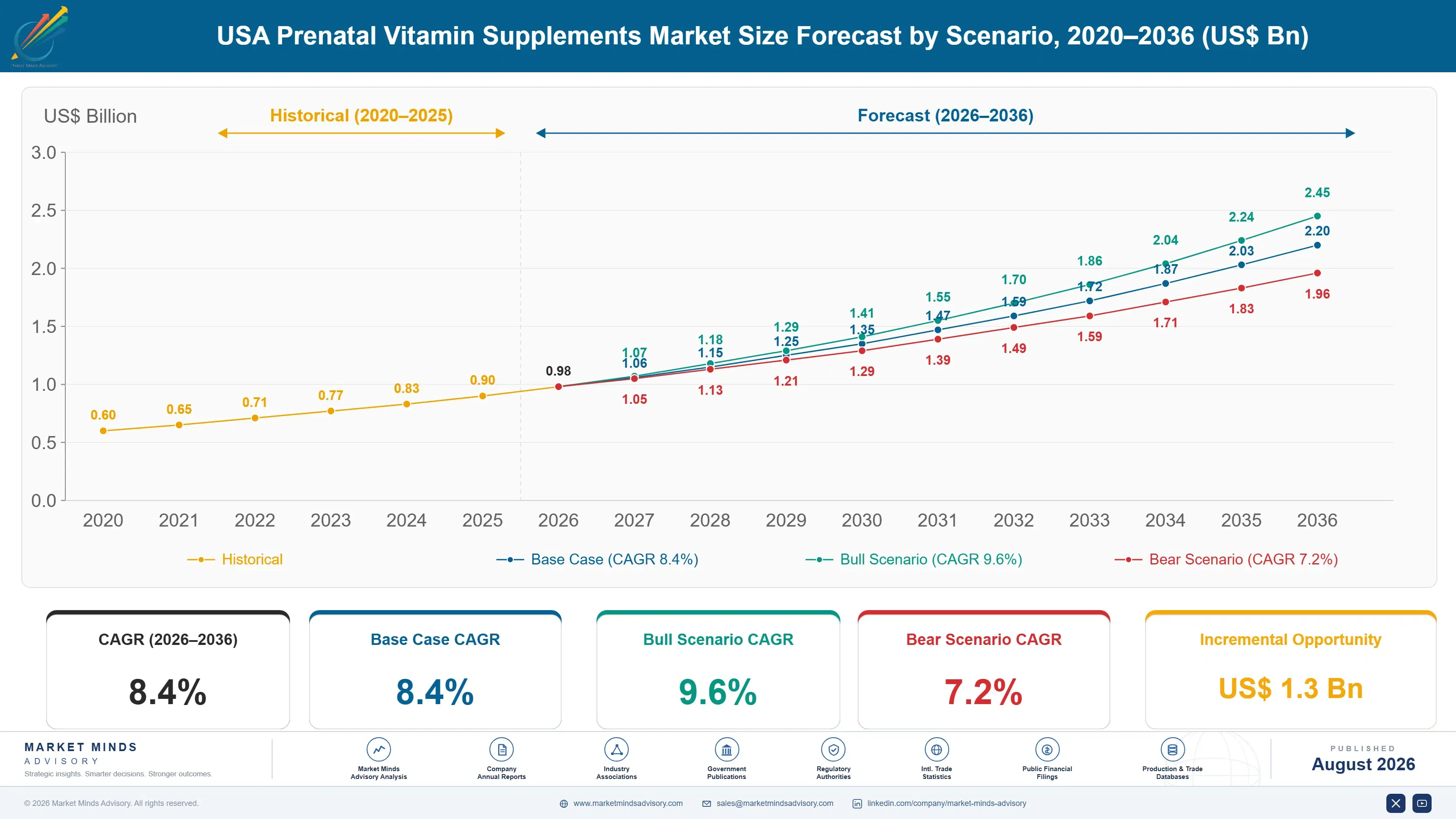
The five years to 2025 were shaped by two things happening at once. American births declined, which should have shrunk it, while price per month rose sharply as direct to consumer brands established a premium tier that did not previously exist. The 7.2% historical rate is entirely a price and mix story, since the number of pregnancies underneath it went the other way.
The 8.4% base case rests on three mechanisms. Preconception supplementation is expanding the consumption window at the front end, since folic acid only works if taken before conception and clinical guidance now says so insistently. Format innovation continues to lift average price, with gummies, powders and sachets all commanding more per month than a tablet. And subscription models now carry 27% of category revenue, which raises the number of months a customer actually completes.
The 9.6% bull case turns on preconception supplementation becoming routine advice, which would add months to a window that currently runs about 14. The 7.2% bear case is the birth rate: this category has a physical ceiling set by the number of pregnancies, and no amount of premium formulation changes how many people are pregnant in a given year.

A Clinical Necessity Sold Like a Consumer Product

The evidence base is narrower than the label suggests. Folic acid taken before conception prevents neural tube defects, iodine matters for fetal brain development, and iron addresses a real and common deficiency in pregnancy. Most of the rest of a twenty-something ingredient panel is there because the panel sells the product, not because a trial supports it. Clinicians know this and do not fight it.
TOP FIVE CONCENTRATION44%Combined retail and prescription revenue held by leading brands
FIRST TRIMESTER DISCONTINUATION38%Share of women stopping supplementation because of nausea
SELF SELECTED PURCHASE SHARE55%Portion bought without any clinician recommendation behind it
AVERAGE MONTHLY PRICEUSD 34Typical retail cost of a month of supply
SUBSCRIPTION REVENUE SHARE27%Portion of category revenue arriving through recurring subscription
TYPICAL CONSUMPTION WINDOW14 monthsLength of time a buyer remains in the category
Compliance is the variable that actually matters and the industry has quietly organised around it. Roughly 38% of women stop during the first trimester, almost always because nausea makes a large tablet impossible to keep down. A prenatal nobody takes delivers nothing whatever its panel says. That reframes format from a marketing choice into a clinical one, though the trade-offs involved are rarely explained to the buyer.
Commercially this is an unusual business. Average price sits near 34 dollars a month, the customer stays roughly 14 months and then leaves permanently, and 55% of purchases happen with no clinician involved. Acquisition cost has to be recovered inside a window that ends on a known date. Subscription carries 27% of revenue and exists mainly because it stops the customer forgetting to reorder in month four.
"The fastest growing format in this category leaves out iron, and iron is one of the three things that genuinely matters. Everyone knows. Nobody wants to be the brand that says a gummy is a compromise."
Director, Consumer Health and Nutrition Practice · MMA Consumer Health and Nutrition Practice · August 2026

Market Trends

Format Choice Now Outranks Formulation in Purchase Decisions

Roughly 38% of women stop taking a prenatal in the first trimester, and nausea rather than doubt about the product is almost always the reason. Gummies grow at 12.6% against a market rate of 8.4% on that single mechanism, and powders at 10.4% for the same reason. The trade is real and rarely disclosed: iron degrades a gummy matrix and tastes unmistakably metallic, so gummy prenatals generally contain none. A supplement taken every day without iron may still beat a complete tablet abandoned in week seven, but nobody frames the choice that way on pack.
Market Impact: Subscription supplies 27% of revenue
Preconception Supplementation Extends the Consumption Window Forward

Folic acid prevents neural tube defects only if it is present before the neural tube closes, which happens in the fourth week, usually before a woman knows she is pregnant. Clinical guidance has been explicit about this for years and consumer behaviour is finally catching up, helped by fertility tracking applications that put the message in front of people planning rather than expecting. Every month added at the front end is a month of revenue in a category with a hard ceiling on total customers. Brands that market to planning rather than to pregnancy reach the buyer first.
Market Impact: Supports pricing above 34 dollars

Market Opportunities and Growth Drivers

Subscription Models Convert Forgetting Into Completed Months

Roughly 27% of category revenue now arrives through subscription, and the reason is not loyalty. A prenatal customer has no reason to remember a reorder in month four, and the ones who forget do not come back because the window is short and the purchase was never habitual. Subscription removes the decision entirely and lifts completed months per customer by a meaningful margin, which matters enormously when the total window runs about 14 months. Direct to consumer brands built on this mechanism have taken share from shelf brands with far greater distribution.
Market Impact: Births fell 2% over five years

Ingredient Transparency Claims Command a Price Premium

Third party testing certificates, methylated folate rather than folic acid, chelated iron forms and published heavy metal results have become the standard vocabulary of premium prenatal marketing. Whether any of it changes an outcome is genuinely unsettled, but it supports pricing well above the 34 dollar category average and it reaches an anxious buyer at a moment when anxiety is high. Clinicians rarely endorse the specific claims and rarely contradict them either. Brands that publish full testing data have built trust that translates directly into subscription conversion rates. Anxiety is a durable commercial asset.
Market Impact: Restricts claims across 100% of products

Market Restraints and Challenges

The Birth Rate Sets a Hard Ceiling on Customers

American births have declined for most of the past decade and the total number of pregnancies is the physical limit on how many people can ever buy a prenatal. The root cause sits entirely outside this industry, in housing costs, delayed family formation and choices no supplement company influences. Category growth therefore has to come from price, format mix and window length rather than from customer count, which is a considerably harder way to grow. The responses that work are preconception marketing, lactation extension products and subscription completion rates. None of them add a single customer.
Market Impact: Gummies grow 12.6% without iron

Regulatory Status Limits What Any Brand Can Claim

Prenatal supplements sit under dietary supplement rules rather than drug approval, which means no brand may claim to prevent a birth defect even where the evidence for folic acid is about as settled as nutrition evidence gets. The root cause is a regulatory framework written for a different category and never adapted. Commercially this pushes marketing toward format, transparency and lifestyle messaging, because those are the only things a brand may actually say. Prescription prenatal products carry different latitude, and several companies maintain a prescription line largely for that reason.
Market Impact: Adds 3 months per customer
3 additional market trends, 4 additional growth drivers, and 2 additional restraints and challenges are covered in the full report. Contact sales@marketmindsadvisory.com to access the complete intelligence.

Segment CAGR and Growth Architecture

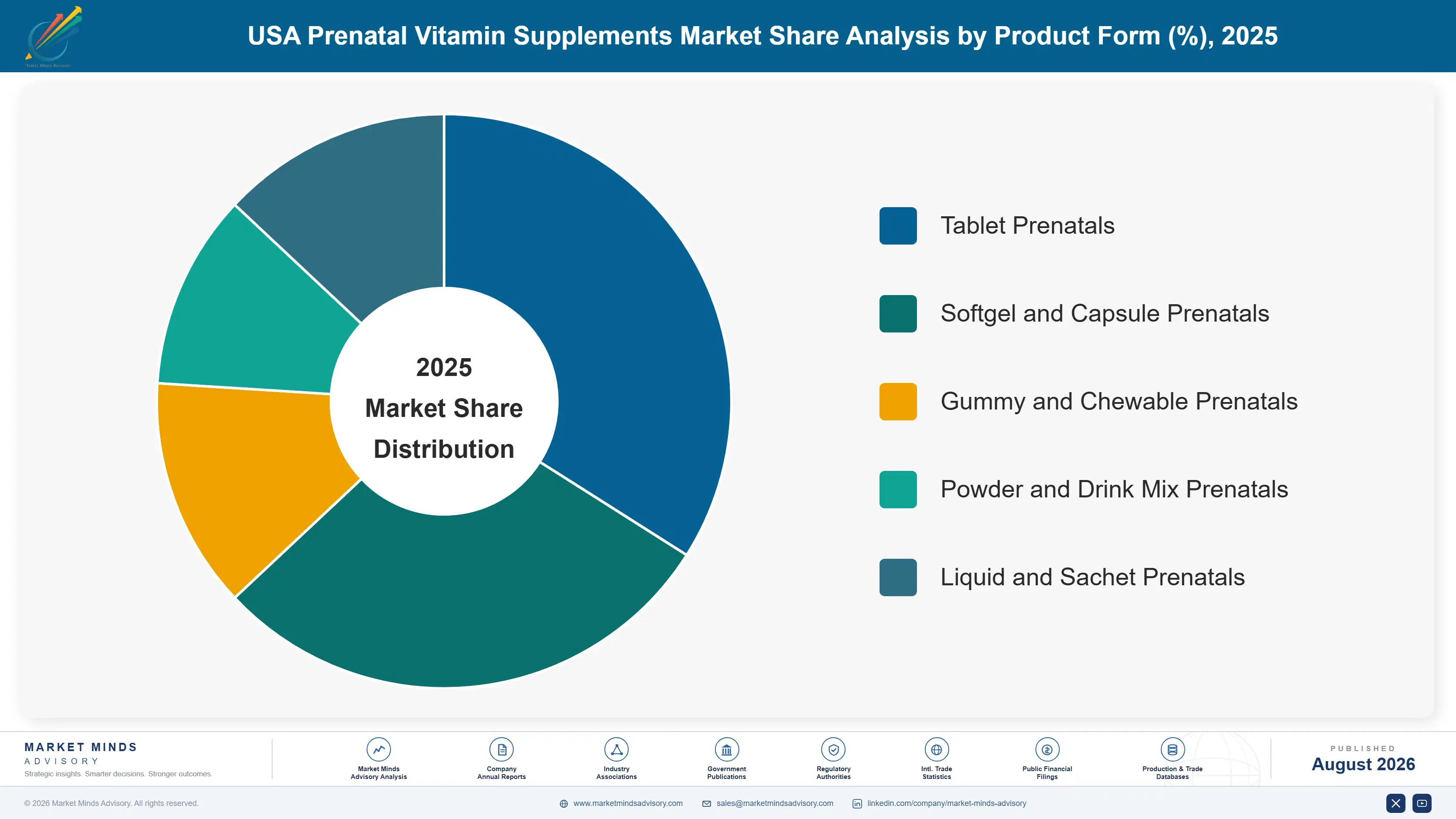
Segmentation follows product form, since form decides whether the supplement gets taken at all and therefore what it can contain. Five forms cover the category, from a large complete tablet to a gummy that omits iron by necessity. Growth sits entirely with the formats that solve nausea, which is not a formulation argument at all.
usa-prenatal-vitamin-supplements-market-market-share-analysis-1787641231551

Gummy and Chewable Prenatals

Pectin or gelatin based chewables carrying folate, vitamin D, iodine and a partial mineral panel, taken as two or three units a day. At 12.6% this is the fastest growing form in the category, half again the market rate of 8.4%, and compliance is the entire reason. A woman with first trimester nausea will keep a gummy down when she cannot keep a tablet down, and a supplement taken daily beats a complete one abandoned. The trade is iron: it destabilises the matrix and tastes metallic, so most gummy prenatals contain none and recommend a separate iron supplement in small print nobody reads. Sugar content is the other quiet compromise here.
CAGR 12.6%

Powder and Drink Mix Prenatals

Single serve powders and stick packs mixed into water or a smoothie, which avoid swallowing anything solid and allow a complete mineral panel including iron. Growth of 10.4% is second fastest in the category, and the format solves the nausea problem without the compromise gummies make. Taste masking is the technical difficulty, since iron and B vitamins are both unpleasant and a pregnant palate is unusually sensitive. Price per month runs above the 34 dollar category average, and the format suits subscription particularly well because a stick pack box is a natural monthly unit. Retail presence remains limited, so almost all volume moves online. That is a real constraint on scale.
CAGR 10.4%
Full segment breakdown across 5 segments available in the complete report.

Regional Architecture and Country Demand Map

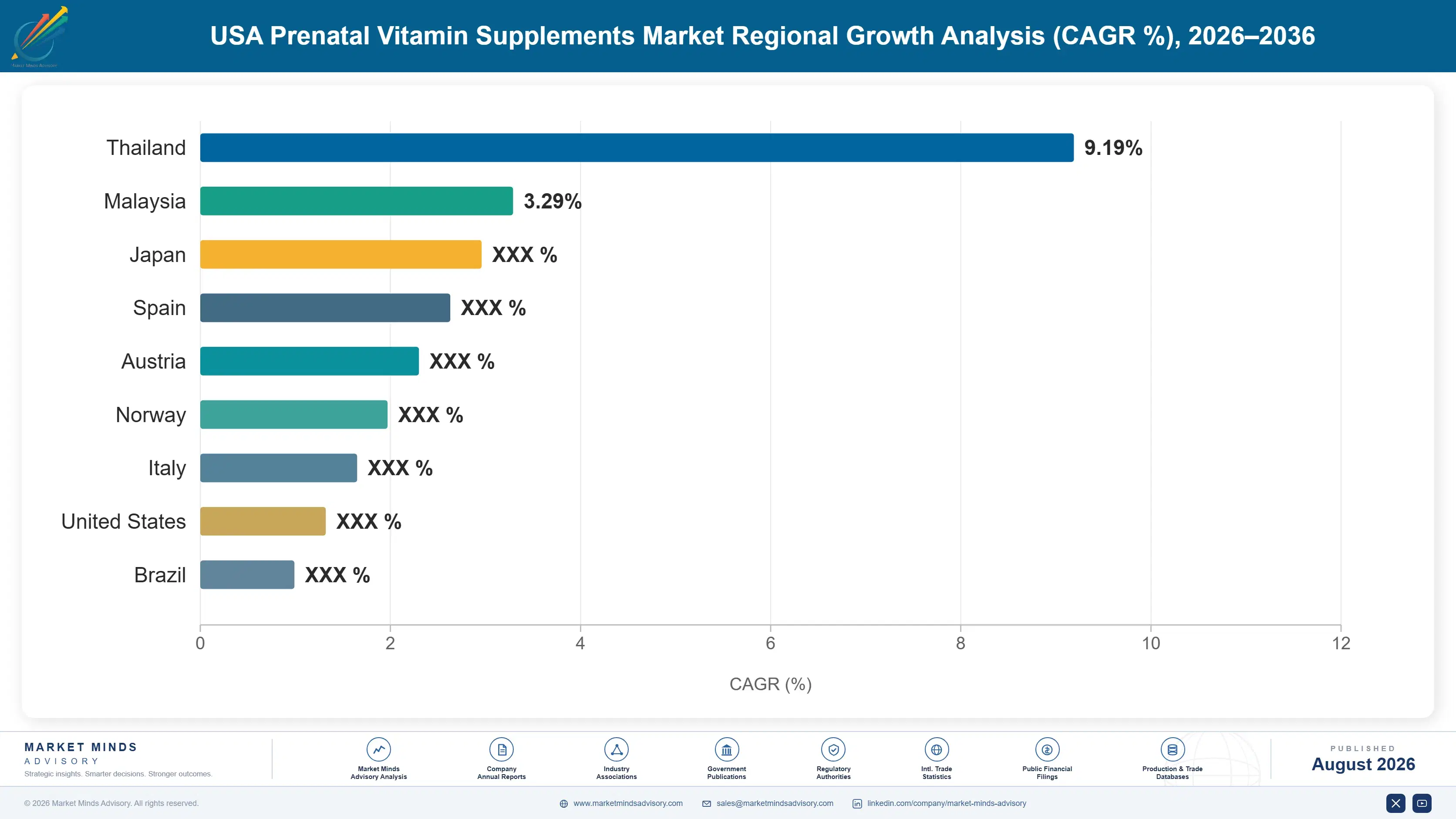
North America holds 92% of the market by definition, since scope covers United States consumption. The remaining shares reflect manufacturing, ingredient supply and comparative regulation rather than demand. Texas, California and Florida carry the largest volume, tracking birth numbers rather than income. Online sales flatten geography considerably.

North America

Scope fixes this position rather than any commercial dynamic: the market covers United States consumption, so North America carries 92% by construction and the remaining shares represent ingredient supply and manufacturing. Domestic demand tracks births rather than income, which puts Texas, California and Florida at the top by volume and makes the category unusually insensitive to consumer confidence. Medicaid covers roughly two in five American births and prescription prenatal products serve much of that population, creating a channel with completely different economics from retail. Direct to consumer subscription brands concentrate in coastal metropolitan markets where willingness to pay above 34 dollars a month is highest. Canadian demand sits outside the defined scope entirely.
Share: 92% | CAGR: 8.4% (2026 to 2036)

Western Europe

European clinical practice and ingredient supply are what this 2% share represents under a scope covering United States consumption. European guidance recommends folic acid supplementation on essentially the same evidence but through public health programmes rather than through consumer marketing, which produces higher compliance at a fraction of the price per month. Several of the vitamin and mineral premixes used by American manufacturers come from German, Swiss and Dutch ingredient houses, and pricing on those moves in euros. European regulation permits health claims that American dietary supplement rules do not, which occasionally shapes what a global brand can say in one market and not another. Growth of 6.8% reflects mature European consumption.
Share: 2% | CAGR: 6.8% (2026 to 2036)
Regional intelligence for 5 additional markets available in the complete report: East Asia, South Asia and Pacific, Latin America, Middle East and Africa, Eastern Europe. Contact sales@marketmindsadvisory.com.
usa-prenatal-vitamin-supplements-market-country-cagr-analysis-1787641232102

Where This Category Actually Earns

The customer count is fixed by biology and the window closes on a known date, so nothing here is won by acquiring more people. Value accrues to whoever solves nausea, whoever starts the relationship before conception, and whoever converts a forgetful buyer into a completed subscription. Four routes carry weight, and none of them involves reformulating the panel.

Solve Nausea Before Solving the Panel

Around 38% of women stop taking a prenatal in the first trimester because of nausea, which means more than a third of the addressable customers leave the category before the product has done anything at all. Gummies grow at 12.6% and powders at 10.4% purely on this mechanism, while complete tablets grow at 4.2%. A brand competing on ingredient completeness against a format that gets taken daily is competing on the wrong dimension entirely. Format development returns more than formulation development in this category by a wide margin. Nobody wins an argument about panels here.
Market Impact: Recovers the 38% of buyers who stop early

Start the Relationship Well Before Conception

Folic acid works only if present before the neural tube closes in week four, which is usually before a pregnancy is known, and clinical guidance has said so for years. Marketing to people planning rather than expecting adds roughly 3 months to a consumption window that otherwise runs about 14, and it captures the customer before any competitor is in the conversation. Fertility tracking applications are the obvious channel and remain underused by the large shelf brands. The customer acquired at planning stage also converts to subscription at a considerably higher rate.
Market Impact: Adds 3 months to a 14 month window

Convert Reordering Into a Standing Instruction

Subscription carries 27% of category revenue and its function is not loyalty but memory. A prenatal buyer has no habit to fall back on, and the ones who forget a month four reorder generally do not return, because the window is short and the purchase was never routine. Removing the reorder decision lifts completed months per customer materially, which is the only lever available in a category where total customers cannot be increased. Direct to consumer brands built this way have taken share from shelf brands with vastly wider distribution.
Market Impact: Grows the current 27% subscription revenue share further

Publish the Testing Data Competitors Will Not

Third party heavy metal results, methylated folate, chelated iron forms and full certificate publication support pricing well above the 34 dollar category average, and they reach a buyer whose anxiety at that moment is genuinely high. Whether any of it changes an outcome is unsettled, and clinicians neither endorse nor contradict the claims. What matters commercially is that transparency converts to subscription at higher rates than any advertising does, and that a brand publishing everything makes competitors who publish nothing look like they have a reason. That inference does most of the work.
Market Impact: Prices well above the 34 dollar monthly average

Who Controls the Margin Pool

Concentration is moderate for a consumer health category. The top five hold 44% of annual retail and prescription sell-through revenue in the United States, the basis applied consistently here. Church and Dwight leads on gummy volume rather than on formulation, and the gap to the next tier is narrow because shelf position and clinical credibility are held by different companies and neither has both.
Competition runs on three fronts. Shelf brands compete on distribution, price per month and pack recognition in mass retail and pharmacy. Direct to consumer brands compete on transparency, subscription mechanics and acquisition cost against a fourteen month window. Prescription prenatal suppliers compete for formulary and obstetric prescribing habit, in a channel serving the roughly two in five American births covered by Medicaid.

Rankings shift where format and channel intersect. Powder and sachet formats grow at 10.4% and sit almost entirely online, which favours brands built for subscription rather than for a fixture. Acquisition of direct to consumer prenatal brands by larger consumer health groups has already begun. The other pressure point is retailer own brand gummies, which replicate the format at a fraction of the price.
usa-prenatal-vitamin-supplements-market-company-positioning-matrix-1787641232640

Competitive Moat and Risk Dimensions

CHURCH AND DWIGHT

Moat: Gummy Format Scale

Manufacturing gummy supplements at national retail scale requires depositing, curing and stability capability that few competitors hold, and the format now carries the fastest growth in the category at 12.6%. Combined with fixture position across mass retail and pharmacy, that produces a cost per unit direct to consumer challengers cannot approach at their volumes.
CHURCH AND DWIGHT

Risk: Iron Omission Exposure

The gummy format cannot carry iron without destabilising the matrix and tasting metallic, and iron is one of very few prenatal nutrients with genuinely settled evidence behind it. If clinical bodies begin stating that plainly, or a retailer own brand solves the problem first, the growth engine of this portfolio becomes a liability rather than an advantage.
RITUAL

Moat: Transparency Brand Position

Published supply chain sourcing, third party testing certificates and specific ingredient form claims built a position that supports pricing well above the 34 dollar category average and converts to subscription at unusually high rates. That reputation was built over years of consistent disclosure and cannot be assembled quickly by a competitor deciding to compete on the same ground.
RITUAL

Risk: Fourteen Month Window

Every customer leaves on a known date roughly 14 months after acquisition, and a business built on paid acquisition into a window that short has almost no room for cost inflation in its channels. Rising digital acquisition costs compress the economics directly, and there is no repeat purchase behind the window to recover them.

Players Tracked

Prominent Players

Church and Dwight
Bayer Consumer Health
Nestle Health Science
Pharmavite
Ritual

Other Key Players

Perrigo
Reckitt Benckiser
Exeltis
Theralogix
Needed
FullWell
Thorne HealthTech
Seeking Health
Zahler
SmartyPants Vitamins
Olly
MaryRuth Organics
New Chapter
Rainbow Light
Persona Nutrition

Recent Developments

FEBRUARY 2025

Consumer health group acquires direct to consumer prenatal brand

A large consumer health company acquired a subscription based prenatal supplement brand, citing subscription mechanics and transparency positioning rather than formulation as the rationale. The acquirer had substantial retail distribution and no credible position with buyers who research ingredient forms before purchasing anything. The gap was commercial rather than technical.
Signal: Shelf distribution and subscription credibility sit in different companies, and buying is faster than building either
MAY 2025

Retailer launches own brand prenatal gummy at sharp discount

A national retailer introduced an own brand prenatal gummy priced well below the branded equivalents on the same fixture, matching the ingredient panel closely. Branded suppliers lost facings in several formats, and the pressure concentrated on the fastest growing part of the category rather than on the declining tablet tier.
Signal: Own brand price pressure has arrived first in the format carrying all of the category growth
AUGUST 2025

Clinical body strengthens preconception folate supplementation guidance

A professional clinical body issued strengthened guidance on folate supplementation before conception, emphasising that neural tube closure occurs before most pregnancies are recognised. Brands marketing to people planning a pregnancy reported measurable increases in acquisition, while those reaching buyers only after confirmation gained nothing at all.
Signal: Clinical guidance moves acquisition timing far more effectively than any campaign a brand could ever run

What a Month of Supply Costs

Cost structure varies enormously by format. On a tablet prenatal, the vitamin and mineral premix accounts for roughly 34% of cost of goods, with tabletting, coating and packaging covering most of the rest. On a gummy the premix drops below 20% while sugar, pectin, depositing and curing take far more. Premix actives come principally from Chinese, Indian and European producers, with several B vitamins concentrated in few plants.
Vitamin active pricing moved sharply through the last five years and the causes were mostly upstream. Chinese environmental enforcement closed capacity for several B vitamins, and company annual reports across the nutrition sector documented the resulting premix cost movement. Folate and iron salt pricing followed different paths again. Gelatin costs tracked meat processing volumes, which matters for gummy manufacturers who cannot substitute pectin without reformulating texture.

The exposure falls hardest where nobody expects it. A brand selling at 34 dollars a month absorbs a premix increase without much difficulty, while a prescription or value tablet product priced near the bottom of the market has no room at all. Contract manufacturers pass increases through on renewal, and brands without volume commitments sit last in the allocation queue.
usa-prenatal-vitamin-supplements-market-cost-volatility-analysis-1787641232840

Qualify second premix suppliers across concentrated actives

Several B vitamins are produced in very few plants worldwide, and an interruption reprices a whole formulation rather than one line item. Brands holding qualified alternative premix sources avoid reformulating under pressure, which is when specification drift happens. Qualification requires stability and dissolution testing over months, so it has to be completed before any supply event arrives.

Commit contract volumes to secure allocation priority

Contract manufacturers allocate scarce actives to customers with committed annual volumes, and brands buying opportunistically discover this only when supply tightens. Committing volume costs flexibility and buys priority, which is the correct trade for any brand whose growth depends on a single format. Subscription revenue makes those commitments considerably easier to forecast and therefore easier to make.

Design formats that carry cheaper delivery systems

Gummy manufacture is expensive in everything except actives, since sugar, pectin, depositing and curing dominate the bill. Stick pack powders invert that: filling is cheap, the delivery matrix costs almost nothing, and the premix can carry a complete mineral panel. For a brand facing active cost inflation, shifting mix toward powder formats reduces exposure while improving the panel.

Portfolio Architecture for Margin Defence

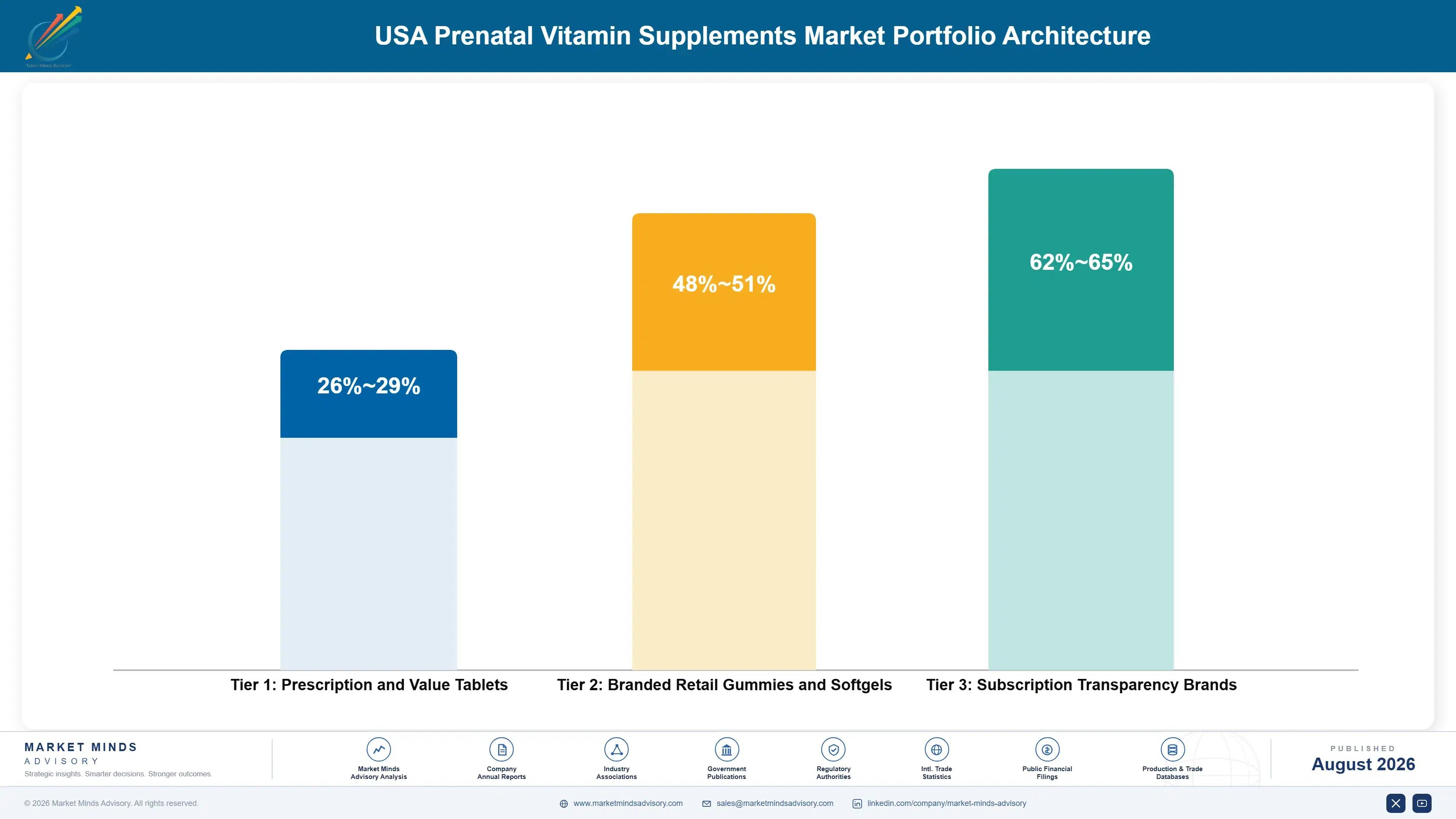
Margin here follows channel far more than it follows format. Direct to consumer subscription products carry the best gross margin in the category, since there is no retailer taking a cut and pricing sits well above 34 dollars a month. Retail branded product earns considerably less after trade spend and slotting. Prescription prenatal products earn least of all, priced against Medicaid reimbursement with no consumer marketing leverage available.
The tension is between the volume that comes with shelf presence and the margin that comes without it. Mass retail reaches every pregnant woman in the country and takes most of the value doing it. Direct to consumer reaches a fraction and keeps the economics, but only until acquisition cost rises, and no repeat purchase follows to absorb an increase. Neither position is comfortable.

High value pools concentrate in subscription powders and premium transparency positioned products, both of which price above the category average and both of which sit almost entirely online. Everything on a shelf is exposed to retailer own brand, and own brand has arrived first in gummies, which is precisely where the growth is. That is an uncomfortable place for the volume leaders to be standing.

Prescription and Value Tablets

Tablet products priced against Medicaid reimbursement or against the bottom of the retail fixture, with no consumer marketing behind them and no room for input cost movement. Volume is real and the economics are thin throughout.
Gross Margin: 26-29%

Branded Retail Gummies and Softgels

Nationally distributed branded product carrying the fastest growing format in the category, sold through mass retail and pharmacy at recognised price points. Margin holds on manufacturing scale and fixture position rather than on any formulation advantage.
Gross Margin: 48-51%

Subscription Transparency Brands

Direct to consumer products sold on published testing, specific ingredient forms and subscription convenience at prices well above the category average. Margin is the best available and depends entirely on acquisition cost staying below what a fourteen month window supports.
Gross Margin: 62-65%
usa-prenatal-vitamin-supplements-market-portfolio-architecture-1787641233356

High-value Sub-segments and Strategic Watch-out

Gummy and Chewable Prenatals

The fastest growing form at 12.6% and the one carrying the category, driven entirely by first trimester compliance rather than by any formulation merit. Retailer own brand has arrived here first, which puts the growth engine and the price pressure in exactly the same place.
Gross Margin: 48-51%

Powder and Drink Mix Prenatals

Second fastest at 10.4% and the only format that solves nausea while carrying a complete mineral panel including iron. Distribution is almost entirely online, which caps reach but suits subscription economics unusually well and keeps retailer margin out of it. Reach is the only real constraint.
Gross Margin: 58-61%

Softgel and Capsule Prenatals

Growing at 8.8% on the strength of DHA inclusion and easier swallowing than a large tablet, holding a middle position that neither leads nor declines. It remains the default clinician recommendation, which gives it durability that the growth rate alone does not suggest. Clinicians move slowly and that helps here.
Gross Margin: 44-47%

Tablet Prenatals

Growing at only 4.2%, the slowest form in the category, and losing share for a reason that has nothing to do with what is in it. The complete panel is the best available and roughly 38% of buyers cannot keep it down during the first trimester.
Gross Margin: 26-29%

How a Fourteen Month Customer Behaves

There is no annuity in this category and every model that assumed one has been wrong. A customer enters at conception or shortly before, stays roughly 14 months through pregnancy and early lactation, and then leaves permanently unless another pregnancy follows. Acquisition cost has to be recovered inside that window, and 27% of revenue arrives through subscription precisely because the alternative is a customer forgetting in month four.
Stickiness varies by how the relationship started. A woman whose obstetrician named a specific product usually stays with it, since second guessing a clinician during pregnancy appeals to almost nobody. A woman who chose off a shelf switches on price, format or a friend's recommendation without much thought. Subscription customers stay longest of all, not from loyalty but because cancelling requires a deliberate action nobody prioritises.

The buyer has changed substantially within a decade. The traditional customer took whatever the obstetrician wrote down and never examined the panel. The current buyer researches ingredient forms, reads heavy metal testing results, compares methylated folate against folic acid, and arrives at the appointment with a product already chosen. Clinicians report being asked to approve a decision rather than make one.
usa-prenatal-vitamin-supplements-market-end-use-penetration-index-1787641233871

Where This Category Rewards Focus

These are among the four positions where our research anticipates prominent divergence between winners and laggards over the coming forecast period. Each is grounded in the demand model, the regulatory perimeter, and the announced capacity pipeline.
01 / COMPLIANCE FIRST DEVELOPMENT

A supplement nobody swallows delivers nothing at all

Roughly 38% of women stop taking a prenatal during the first trimester because nausea makes a large tablet impossible, which removes more than a third of the addressable customers before the product has done anything. Gummies grow at 12.6% and powders at 10.4% purely because they solve that, while complete tablets grow at 4.2% with the best panel in the category. Competing on ingredient completeness against a format that actually gets taken every day is competing on entirely the wrong dimension.
02 / WINDOW EXTENSION ECONOMICS

Add months forward, because customer count cannot grow

The number of pregnancies sets a hard ceiling on how many people can ever buy a prenatal, and American births have declined for most of a decade, so growth has to come from price, mix and window length instead. Preconception marketing adds roughly 3 months to a window that otherwise runs about 14, and it reaches the buyer before any competitor enters the conversation. Fertility tracking channels remain underused by exactly the large shelf brands with most to gain from them.
03 / ACQUISITION PAYBACK DISCIPLINE

Every customer leaves on a date you already know

A prenatal buyer stays roughly 14 months and then leaves permanently, which means acquisition cost has to be recovered inside a window with no repeat purchase behind it to absorb any overrun. Subscription carries 27% of category revenue and exists to stop the customer forgetting a reorder rather than to build loyalty, because loyalty has nowhere to go. Direct to consumer brands that let acquisition costs drift upward have discovered how quickly that particular arithmetic stops working out at all.
04 / OWN BRAND DEFENCE

Retailer copies arrived where the growth already sits

Retailer own brand prenatal gummies now sit on the same fixture at a sharp discount with closely matched panels, and gummies are the format growing at 12.6% and carrying the category. That places the price pressure and the growth engine in precisely the same place, which is the least comfortable position a volume brand can occupy. Defending it requires either a formulation claim own brand cannot match or a channel where the side by side fixture comparison never actually happens.

Engagement Snapshot From the Field

A live engagement with an industry participant carrying material or product regulatory and market exposure ahead of a defining policy shift, showing how our research translates into a defensible multi-year portfolio strategy.
MARKET MINDS ADVISORY · CLIENT ENGAGEMENT SUMMARY
USA Prenatal Vitamin Supplements Producer Strategic Portfolio Review and Transition Roadmap 2026·Investment Scenario on USA Prenatal Vitamin Supplements Exposure Evaluation 2025-26
CLIENT PROFILE
A direct to consumer prenatal supplement brand selling a subscription softgel product with published third party testing, priced above the category average. Annual revenue was approximately 84 million dollars (client-reported, unverified by MMA), with 71% arriving through subscription. No retail distribution existed, no gummy or powder format had been launched, and paid acquisition supplied nearly all new customers.
STRATEGIC CHALLENGE
Paid acquisition costs had risen for seven consecutive quarters and payback against a fourteen month window had moved from comfortable to marginal. Management wanted to know whether to enter retail, launch additional formats, or push acquisition earlier into the preconception stage. Each option pointed at a different buyer and the team had no evidence about which one paid back.
MMA APPROACH
MMA modelled contribution by acquisition channel against completed months per customer, isolating where payback actually broke rather than where cost had risen. Format economics were costed across gummy, powder and softgel manufacture at the client's volumes. Forty-seven expert interviews with obstetric clinicians, retail buyers and category buyers established how each cohort selects a product and when the decision is actually made.
KEY FINDINGS
  1. Customers acquired at preconception stage completed 16.4 months against 11.2 for those acquired after confirmation, which changed payback more than any reduction in acquisition cost could.
  2. Powder format manufacture at the client's volume carried gross margin of 59% against 46% for softgels, and allowed a complete mineral panel including iron.
  3. Retail entry modelled at negative contribution for three years, since trade spend and slotting exceeded the margin available at any realistic shelf price point.
  4. Obstetric clinicians in 33 of the 47 interviews said patients now arrive with a product already chosen, making clinician marketing far less valuable than assumed.
CLIENT PROFILE
A direct to consumer prenatal supplement brand selling a subscription softgel product with published third party testing, priced above the category average. Annual revenue was approximately 84 million dollars (client-reported, unverified by MMA), with 71% arriving through subscription. No retail distribution existed, no gummy or powder format had been launched, and paid acquisition supplied nearly all new customers.
STRATEGIC CHALLENGE
Paid acquisition costs had risen for seven consecutive quarters and payback against a fourteen month window had moved from comfortable to marginal. Management wanted to know whether to enter retail, launch additional formats, or push acquisition earlier into the preconception stage. Each option pointed at a different buyer and the team had no evidence about which one paid back.
MMA APPROACH
MMA modelled contribution by acquisition channel against completed months per customer, isolating where payback actually broke rather than where cost had risen. Format economics were costed across gummy, powder and softgel manufacture at the client's volumes. Forty-seven expert interviews with obstetric clinicians, retail buyers and category buyers established how each cohort selects a product and when the decision is actually made.
KEY FINDINGS
  1. Customers acquired at preconception stage completed 16.4 months against 11.2 for those acquired after confirmation, which changed payback more than any reduction in acquisition cost could.
  2. Powder format manufacture at the client's volume carried gross margin of 59% against 46% for softgels, and allowed a complete mineral panel including iron.
  3. Retail entry modelled at negative contribution for three years, since trade spend and slotting exceeded the margin available at any realistic shelf price point.
  4. Obstetric clinicians in 33 of the 47 interviews said patients now arrive with a product already chosen, making clinician marketing far less valuable than assumed.
RECOMMENDED STRATEGY
Phase 1: Phase one: redirect acquisition spend toward fertility tracking and preconception channels, where completed months run 16.4 against 11.2 for buyers acquired later. Phase 2: Phase two: launch a stick pack powder format at 59% gross margin, which solves nausea while carrying iron the softgel range already includes. Phase 3: Phase three: defer retail entry entirely, since modelled contribution stays negative for a full three years at every realistic shelf price point.
OUTCOME
The client shifted roughly half its acquisition budget to preconception channels within two quarters and launched a powder format the following year. Completed months per customer rose from 11.9 to 14.6 and blended contribution margin recovered to pre-inflation levels without any retail investment (client-reported, unverified by MMA).

Frequently Asked Questions

Foundational context covering the market sizes, CAGR, scope, country, region and competition that inform every finding below. This section is provided to cover basics and most often pre-purchase conversations, answered from the MMA Primary Research Dataset.

What is the current size of the USA Prenatal Vitamin Supplements Market?

The market was valued at 0.94 billion dollars in 2025, covering supplements formulated for preconception, pregnancy and lactation across retail and prescription channels. It reaches an estimated 1.02 billion dollars during 2026.

How large will the USA Prenatal Vitamin Supplements Market be by 2036?

MMA forecasts 2.28 billion dollars by 2036, an increase of 1.26 billion dollars over the 2026 base. That represents an expansion multiple of 2.24 times across the forecast period.

What is the CAGR for the USA Prenatal Vitamin Supplements Market 2026 to 2036?

The base case compound annual growth rate is 8.4%, with a bull case of 9.6% and a bear case of 7.2%. Preconception adoption and the birth rate separate those scenarios.

Which segment is growing fastest?

Gummy and chewable prenatals grow at 12.6%, half again the market rate of 8.4%, driven by first trimester compliance rather than formulation. Powder and drink mix formats follow at 10.4%.

Who are the major companies in the USA Prenatal Vitamin Supplements Market?

Church and Dwight, Bayer Consumer Health, Nestle Health Science, Pharmavite and Ritual lead on retail and prescription sell-through revenue. Together they account for 44% of the market.

Which country is growing fastest?

The market is defined as United States consumption, and Texas grows fastest of any state at 11.2% on birth numbers rather than on income or category penetration.

Report Segmentation Architecture

The full report scope spans multiple orthogonal segmentation dimensions, with cross-tabulated demand data provided for each dimension pair. Coverage extends further to regional breakdowns, trend trajectories, and the competitive detail needed to support segment-level decision-making.

By Product Form

  • Tablet Prenatals
  • Softgel and Capsule Prenatals
  • Gummy and Chewable Prenatals
  • Powder and Drink Mix Prenatals
  • Liquid and Sachet Prenatals

By End-Use Industry

  • Preconception and Fertility Planning
  • First Trimester Pregnancy
  • Second and Third Trimester
  • Lactation and Postnatal
  • High Risk Pregnancy Management
  • Adolescent and Teen Pregnancy

By Commercial Dimension

  • Mass Retail and Grocery
  • Chain and Independent Pharmacy
  • Direct to Consumer Subscription
  • Online Marketplaces
  • Prescription and Medicaid Channels
  • Clinician Dispensed Supply

By Region

  • North America
  • Western Europe
  • East Asia
  • South Asia and Pacific
  • Latin America
  • Middle East and Africa
  • Eastern Europe

Scope, Methodology, and Coverage

Every figure in this report is reproducible from documented input assumptions. The scope below maps the historical period, the forecast horizon, the segmentation dimensions, and the countries covered, alongside the underlying primary and qualitative methodology.
Historical Period
2020 to 2025
Forecast Period
2026 to 2036
Base Year
2025 (USD billions; MMA Primary Research Dataset, August 2026)
Market Definition
Vitamin and mineral supplements formulated and marketed for preconception, pregnancy and lactation within the United States, covering tablet, softgel and capsule, gummy and chewable, powder and drink mix, and liquid and sachet forms sold through retail, online and prescription channels. Measured at retail and prescription selling value. General adult multivitamins, standalone single nutrient products not marketed for pregnancy, infant and maternal formula, fertility pharmaceuticals and medical nutrition products are excluded from scope.
Quantitative Units
USD billions (current prices); months of supply sold; USD per month by product form and channel
Segmentation Dimensions
Product form; end-use industry; commercial dimension; region
Regions Covered
North America, Western Europe, East Asia, South Asia and Pacific, Latin America, Middle East and Africa, Eastern Europe
Countries Covered
United States, Canada, Mexico, United Kingdom, Germany, Switzerland, Netherlands, France, China, Japan, South Korea, India, Australia, Vietnam, Brazil, Argentina, Saudi Arabia, Israel, South Africa, Poland
Key Companies Profiled
Church and Dwight, Bayer Consumer Health, Nestle Health Science, Pharmavite, Ritual, Perrigo, Reckitt Benckiser, Exeltis, Theralogix, Needed, FullWell, Thorne HealthTech, Seeking Health, Zahler, SmartyPants Vitamins, Olly, MaryRuth Organics, New Chapter, Rainbow Light, Persona Nutrition
Quantitative Methodology
Primary survey, n=3,800 respondents, Q4 2025, six countries; demand-side model with trade association cross-validation
Qualitative Methodology
47 expert interviews, Q4 2025; applied to validate demand model assumptions, identify emerging dynamics, and assess competitive positioning
Report Format
PDF and XLSX data workbook (Word format preview document)
Publisher
Market Minds Advisory
Report Code
MMA-2026-HLT-144
Published
August 2026
Contact
sales@marketmindsadvisory.com | www.marketmindsadvisory.com

Purchase the full USA Prenatal Vitamin Supplements Market Report (2026 to 2036).

The full report treats prenatal supplementation as a compliance problem rather than a formulation one, since roughly 38% of women stop in the first trimester and a product nobody swallows delivers nothing. It sizes all five product forms independently through 2036, models acquisition payback against a fourteen month consumption window, and quantifies the completed months gained by acquiring at preconception rather than after confirmation. Regional chapters cover all seven regions, with non domestic shares assessed as ingredient supply and comparative regulation rather than demand. Competitive profiling covers 20 participants on one consistent sell-through revenue basis.
Five product forms sized independently through 2036
Acquisition payback modelled against a fourteen month window
Completed months quantified by acquisition stage and channel
Format cost structures compared across gummy, powder and tablet
Retailer own brand pressure assessed by format and fixture
Twenty participants profiled on one consistent revenue basis

Built For The People Who Decide

From boardroom strategy to bench-side execution, this report is read cover-to-cover by leaders shaping the next decade of their industry, turning demand scenarios, market dynamics and valuation benchmarks into decisions.
CXOs/ Presidents/ VPs/ Managers
M&A and Corporate Development
Strategy Teams and R&D Heads
Procurement and Product Directors
Regulatory and Compliance Leaders
Investor Relations and Equity Analysts