Market Minds Advisory
USA Non-Commercial Acrylic Paint Market 2025-2035

USA Non-Commercial Acrylic Paint Market 2025-2035: Technique Cycles, Kit Economics and Two Cost Structures in One Category

Nobody needs acrylic paint, so the technique that arrives through a video decides which bottle leaves the shelf, and the pigment argument that justifies artist grade pricing reaches almost none of those buyers.

Lead Analyst

Bilal Shaikh

Published

September 2026

Make Smarter Decisions with Customized Research Insights

Request a free sample report and evaluate market opportunities, growth trends, and competitive dynamics relevant to your business needs.

2025 MARKET VALUE$0.7BMarket Size 2025
2036 FORECAST VALUE$1.2BBase Case , 2026 to 2036
CAGR 2026 TO 20365.6 %Bull 6.8% / Bear 4.4%
INCREMENTAL OPPORTUNITY$0.5BNet 10- year value creation
EXPANSION MULTIPLE1.72x2036 value over 2026 base
Strategic Levers
M&A Pipeline
Regional Outlook
Country Rankings
Competitive Intelligence
Segmental Deep-dive
Call-Us : 91 93563 13602

Executive Snapshot and Market Trajectory

This looks like a paint market and behaves like a media market. Nobody actually needs acrylic paint at all. People buy it because a video showed them a technique, and the technique decides which bottle leaves the shelf far more reliably than pigment quality or brand loyalty ever has.
The 2020 pouring boom put fluid acrylics into millions of households that had never bought art supplies, and most of those buyers stopped within a year. Fluid and pouring acrylics remain the fastest growing form at 8.4%, half again the market rate of 5.6%, because each new technique cycle recruits a fresh cohort. Acrylic markers follow closely at 7.2% on apparel and sneaker customisation.
Concentration is moderate, with the top five holding 62% of retail volume, and the contest sits between artist grade houses defending pigment credentials and craft brands winning on shelf position and colour naming. The cost structures are opposite: a professional tube is 60% pigment cost, a craft bottle is 70% everything except pigment. Both reach the same buyer, who arrived through a video and picks up whichever is nearest. Price barely enters it.
Market Definition
Acrylic paint formulated and sold for artistic, craft, hobby and educational use in the United States, covering craft and multi-surface acrylics, heavy body artist acrylics, fluid and pouring acrylics, acrylic markers and paint pens, and acrylic gouache and matte acrylics. Measured at retail selling value. Architectural and house paint, industrial and automotive coatings, professional signwriting paints, and acrylic mediums sold without pigment are excluded.
Base Year Value
$0.7B in 2025 (MMA Primary Research Dataset, August 2026)
Forecast Period
2026 to 2036, eleven discrete annual values
CAGR
5.6% base case. Bull 6.8%. Bear 4.4%.
Fastest Growth Segment
Fluid and Pouring Acrylics: 8.4% CAGR
Fastest Growth Country
Texas: 7.6% CAGR
Fastest Growth Region
South Asia and Pacific: 7.8% CAGR
Largest Region
North America: 91% of 2025 global value
Market Leaders
Colart International, Golden Artist Colors, Plaid Enterprises, DecoArt, Crayola. Source: MMA Primary Research Dataset, July 2026.
Primary Survey
n=3,800 procurement and R&D decision-makers, Q4 2025, six countries
Methodology
Demand-side build-up, cross-validated against public data, 47 expert interviews

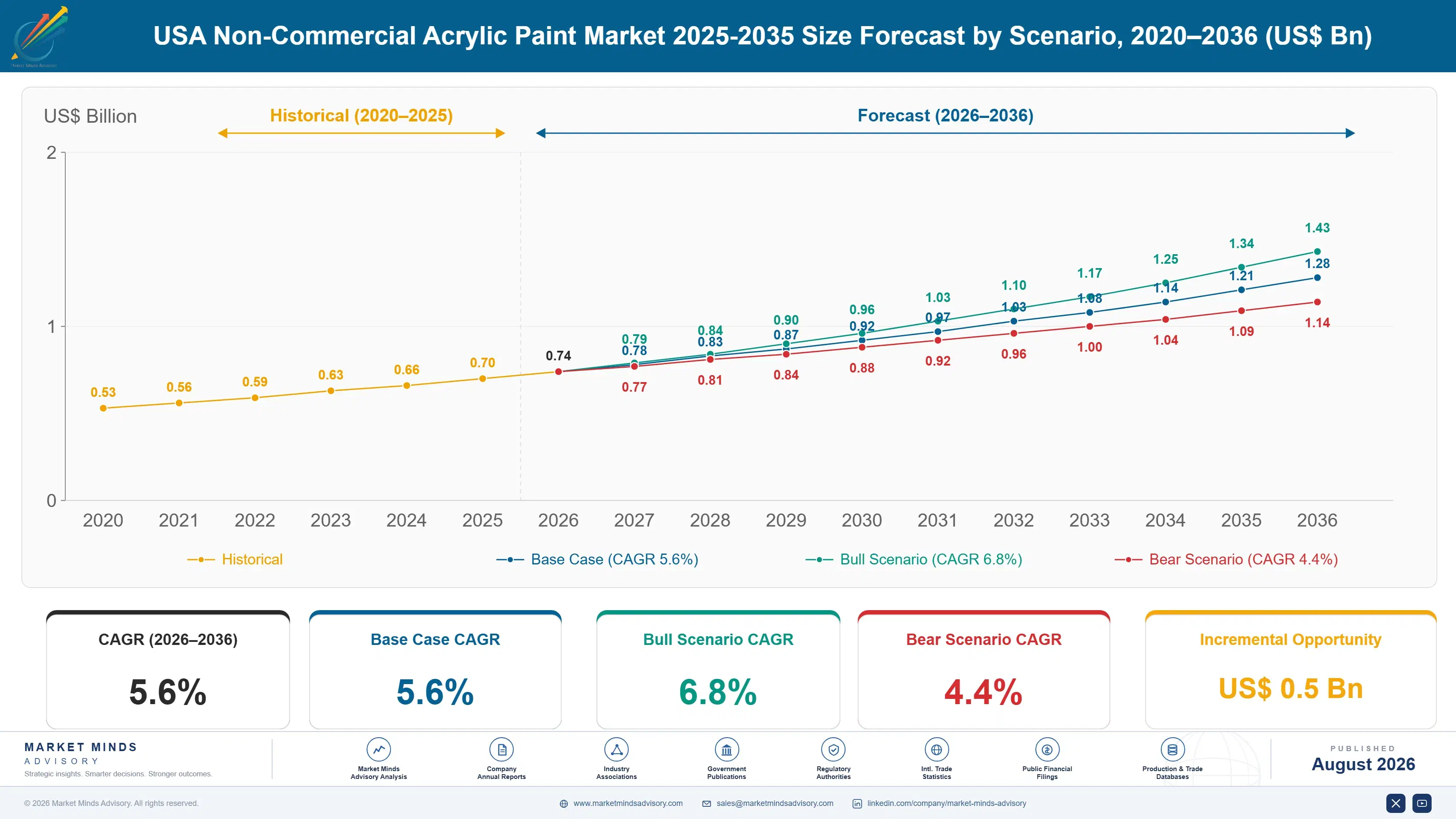
USA Non-Commercial Acrylic Paint Market Forecast Scenarios

usa-non-commercial-acrylic-paint-market-size-forecast-scenario-1787641211440
The five years to 2025 were not a trend, they were a spike and a hangover. Lockdown craft spending lifted acrylic volume sharply in 2020 and 2021, then fell back hard as households returned to other spending and the pouring cohort largely stopped. The 4.4% historical rate averages two completely different periods and describes neither of them accurately.
The 5.6% base case rests on three mechanisms. Technique cycles keep recruiting new buyers, and each one, pouring then acrylic gouache then marker customisation, brings a cohort that would never have walked into an art supply store. School and classroom purchasing is the second, a large and unglamorous volume base that moves with district budgets rather than with taste. And apparel and footwear customisation has created an entirely new use case for a product that used to go on canvas.
The 6.8% bull case turns on another technique cycle of comparable reach to pouring, which nobody can schedule and everybody watches for. The 4.4% bear case is discretionary spending: acrylic paint is bought with money nobody had to spend, and household budget pressure removes craft purchases before it removes anything else. School budgets are the only genuinely defensive part of this market.

A Paint Category Running on Technique Cycles

Two products sit in this market and they have almost nothing in common except the binder. A professional heavy body tube carries around 60% of its cost in pigment, sells on lightfastness ratings, and is bought by people who read the label. A craft bottle is roughly 70% water, filler and packaging, and sells on the colour name and where it sits on the shelf.
TOP FIVE CONCENTRATION62%Retail volume share held by the largest brand owners
ARTIST GRADE PIGMENT COST60%Portion of professional tube cost accounted for by pigment
CRAFT BOTTLE WATER CONTENT70%Share of a craft bottle that is not pigment
ONLINE CHANNEL SHARE44%Portion of retail sales completed through digital channels
REPEAT PURCHASE RATE31%Buyers returning for a second purchase within a year
AVERAGE BASKET VALUEUSD 34Typical spend per transaction across specialist and mass retail
The buyer usually cannot tell the difference. Someone who watched a pouring video wants a bottle that flows and a colour that looks like the one on screen, and the lightfastness rating that justifies an artist grade price is irrelevant to a piece that will sit on a shelf for two years. That has pushed premium brands into defending a specification the growth cohort never asked about.
Retail has moved accordingly. Online now carries 44% of sales, and the discovery path runs from a video to a marketplace listing without a store visit. Average basket sits near 34 dollars and repeat purchase within a year runs at only 31%, which tells you most of what you need to know about the customer. Brands optimised for a shelf are optimised for the wrong place.
"Half this industry is still arguing about pigment load with people who bought their first tube because of a thirty second video. The argument is correct and it is also completely beside the point."
Director, Consumer Materials and Creative Products Practice · MMA Chemicals and Materials Practice · August 2026

Market Trends

Technique Cycles Recruit Buyers Faster Than Advertising Does

Acrylic pouring, then acrylic gouache, then marker customisation on footwear and denim: each cycle has arrived through short form video and each has recruited a cohort that would never have entered an art supply store. Fluid and pouring acrylics grow at 8.4% against a market rate of 5.6% on exactly this mechanism. The cycles are short, typically eighteen months to peak, and brands that tooled up late arrived with inventory as the interest faded. Nobody has found a reliable way to predict the next one, and several have spent considerable money trying.
Market Impact: Online reaches 44% of sales
Apparel Customisation Moves Paint Off the Canvas

Acrylic paint on sneakers, denim jackets and tote bags is now a substantial use case that barely existed a decade ago, and it demands properties nobody formulated for: flexibility after cure, wash durability and adhesion to synthetic leather. Acrylic markers and paint pens grow at 7.2%, second fastest in the market, largely on this application. Brands have responded with fabric specific ranges and with heat setting instructions, though most buyers ignore those and complain later. The category also drags in a younger buyer with no prior art supply relationship at all.
Market Impact: Supplies 22% of category volume

Market Opportunities and Growth Drivers

Online Discovery Replaces the Art Supply Store

Online now carries 44% of retail sales in this category, and the path to purchase runs from a video to a marketplace listing with no store visit at all. That removes the specialist retailer's role as an explainer, which used to be how buyers learned the difference between artist grade and craft product. Brands that invested in creator partnerships and in listing quality have taken share from brands with better paint and worse photography. Shelf position still matters in mass retail, but it decides considerably less than it did five years ago.
Market Impact: Only 31% buy again yearly

School and Classroom Purchasing Anchors Volume Demand

Classroom acrylic and tempera purchasing is the least glamorous part of this market and the most reliable, since school districts buy on a schedule whatever the consumer mood happens to be. Volumes are large, prices are low, and specifications are written around safety certification and washability rather than around pigment quality. Purchase decisions run through district procurement and approved supplier lists, which take years to enter and are almost never revisited afterwards. For a brand exposed to technique cycles that come and go, this is the ballast that keeps a plant running through a flat year.
Market Impact: Pigment is 60% of cost

Market Restraints and Challenges

Repeat Purchase Rates Undermine Cohort Acquisition Value

Only 31% of buyers return for a second purchase within a year, which means every technique cycle recruits a cohort that mostly leaves. The root cause is that acrylic paint is bought for a project rather than for a practice, and once the project is finished the remaining paint sits in a drawer until it dries out. Brands acquire customers repeatedly and retain them rarely. The responses that work are consumable formats that run out faster, subscription and refill programmes, and skill progression content that turns a project buyer into a hobbyist, which very few have executed well.
Market Impact: Cycles peak within 18 months

Pigment Cost Volatility Squeezes Artist Grade Margins

Pigment accounts for roughly 60% of cost of goods on a professional heavy body tube, and several of the pigments that matter most are single source or produced in small volume for industries far larger than art materials. Cadmium replacement, cobalt and certain quinacridones have all seen sharp price movement driven by demand entirely outside this category. The root cause is scale: an artist colour house buys tonnes where an industrial coating buyer takes thousands. Reformulation to hues rather than genuine single pigments is the usual response, and knowledgeable buyers notice immediately.
Market Impact: Markers grow 7.2% on apparel
3 additional market trends, 4 additional growth drivers, and 2 additional restraints and challenges are covered in the full report. Contact sales@marketmindsadvisory.com to access the complete intelligence.

Segment CAGR and Growth Architecture

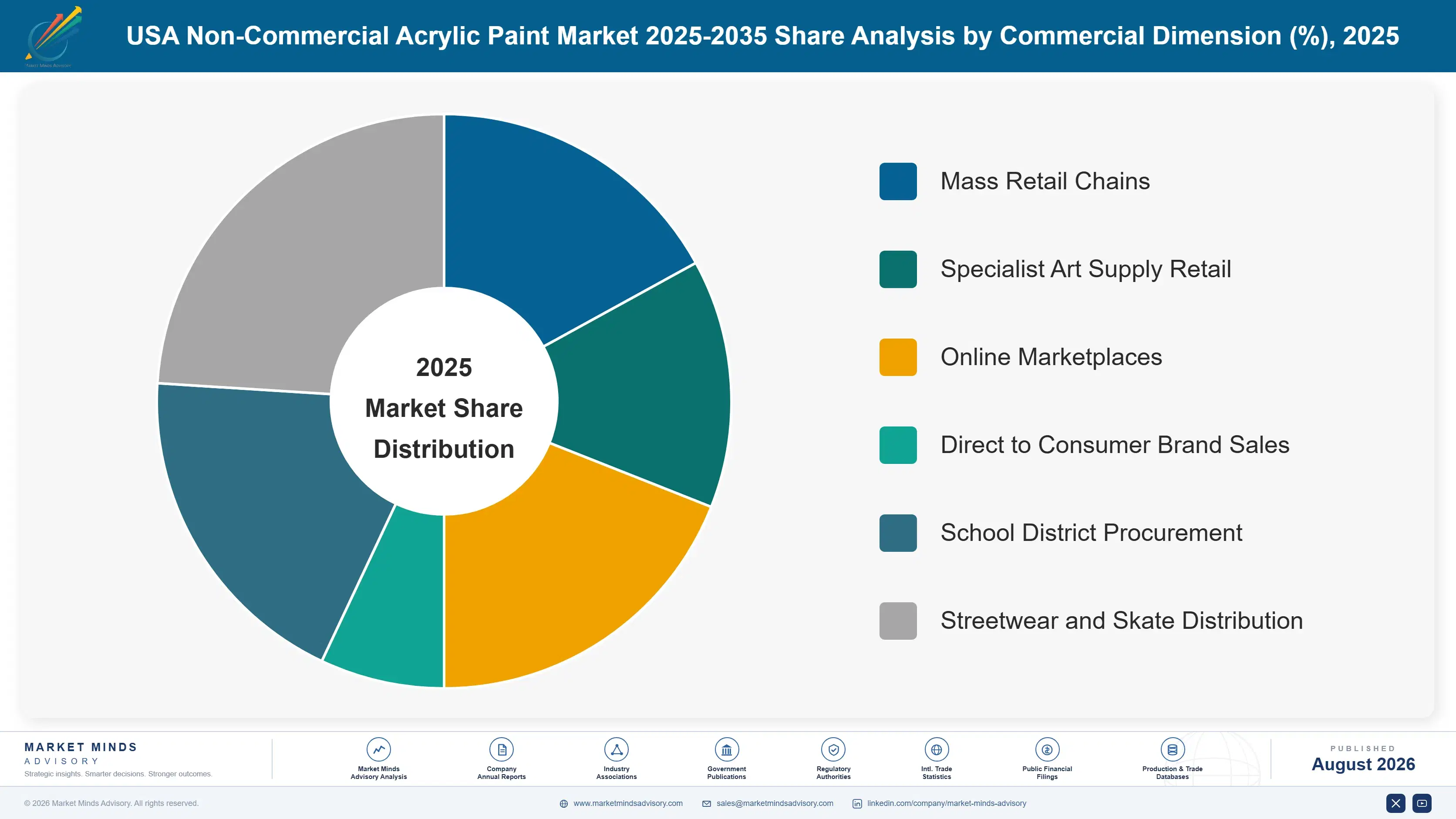
Segmentation follows product form, since form determines the technique, the price point and the buyer. Five forms cover the category, from a two dollar craft bottle to a professional heavy body tube and a paint marker sold in a skate shop. Growth sits with the forms that new techniques require, which is not where the volume sits.
usa-non-commercial-acrylic-paint-market-market-share-analysis-1787641212038

Fluid and Pouring Acrylics

Low viscosity acrylics formulated to flow and to hold cell structure when combined with pouring mediums and silicone additives. At 8.4% this is the fastest growing form in the market, half again the market rate of 5.6%, and it exists commercially because of a technique that spread through video rather than through any art school. The buyer profile is unusual: high acquisition, low retention, and a strong preference for kits over individual colours because nobody entering through a video knows what to buy separately. Volume per project is high, which partly offsets the retention problem, since pouring consumes considerably more paint than brushwork does. Kits are the whole commercial answer here.
CAGR 8.4%

Acrylic Markers and Paint Pens

Pressurised or valve fed acrylic in a pen body, sold for lettering, sneaker customisation, denim work and mural detail. Growth of 7.2% is second fastest in the market, and the buyer is younger and considerably less likely to have bought art supplies before. Formulation demands differ from tube acrylics in ways that matter: the paint must not settle in the barrel, must flow on demand after weeks of sitting, and must flex after cure on fabric and synthetic leather without cracking. Price per millilitre is high and margins are correspondingly good. Distribution runs through skate, streetwear and marketplace channels that traditional art brands never served. Learning those channels has taken years.
CAGR 7.2%
Full segment breakdown across 5 segments available in the complete report.

Regional Architecture and Country Demand Map

North America holds 91% of the market by definition, since scope covers United States consumption. The remaining shares reflect manufacturing and pigment supply rather than demand. Texas, California and Florida carry the largest domestic volume, and online now accounts for 44% of sales regardless of geography.

North America

Scope defines this position rather than any commercial dynamic: the market covers United States consumption, so North America carries 91% by construction and the remaining shares represent manufacturing and pigment supply. Domestic demand concentrates where population and disposable income do, with Texas, California and Florida the largest volume states by a clear margin. Retiree heavy markets in Arizona and Florida support a disproportionate craft acrylic business, while urban markets carry the marker and customisation demand. School district purchasing spreads volume evenly across the country on a schedule nobody else follows. Online carries 44% of sales and has flattened regional differences considerably. Canadian demand sits outside the defined scope. Craft chains still shape mass volume.
Share: 91% | CAGR: 5.6% (2026 to 2036)

Western Europe

European colour houses supply a meaningful share of what American artists buy, which is what this 2% share represents under a scope covering United States consumption. Dutch, German, British and French manufacturers hold reputational positions in artist grade acrylics that domestic brands find difficult to attack, and buyers who read labels tend to buy them. European pigment producers also supply the specialty organics that a professional range depends on, and pricing on those moves in euros. European regulatory restrictions on cadmium and cobalt pigments have pushed reformulation across the industry, and American brands generally follow rather than maintain separate formulations. Growth of 4.0% reflects a mature European craft market with limited headroom.
Share: 2% | CAGR: 4.0% (2026 to 2036)
Regional intelligence for 5 additional markets available in the complete report: East Asia, South Asia and Pacific, Latin America, Middle East and Africa, Eastern Europe. Contact sales@marketmindsadvisory.com.
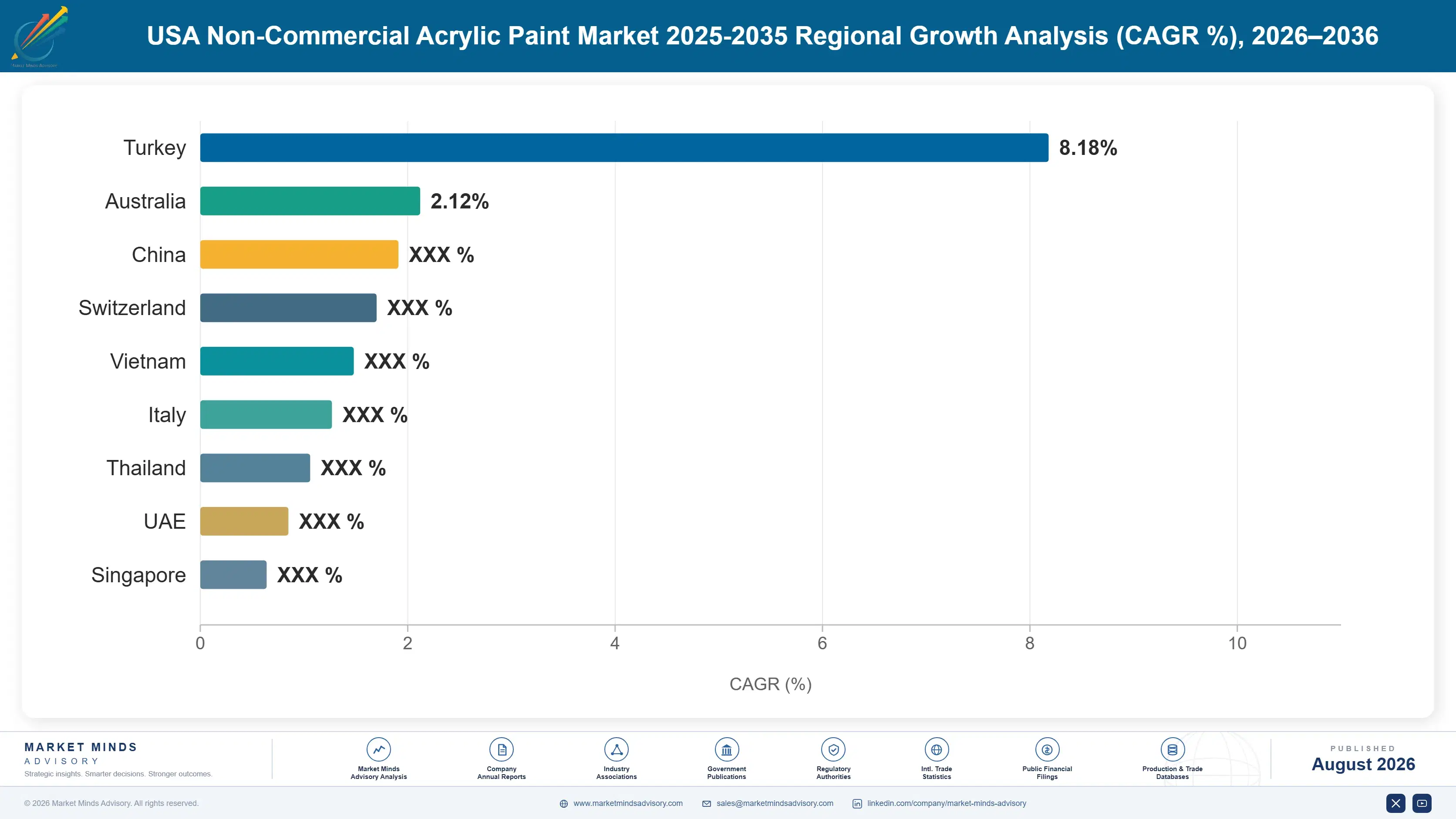
usa-non-commercial-acrylic-paint-market-country-cagr-analysis-1787641212601

Where This Category Actually Earns

Nothing here is won on paint quality, because the growth cohort cannot assess it and does not try. Value accrues to whoever gets discovered alongside a technique, whoever sells a kit rather than a colour, and whoever holds a school district on an approved supplier list. Four routes carry weight, and only one of them is a formulation argument.

Sell the Kit, Not the Colour

Someone arriving through a pouring video does not know what to buy, and a shelf of individual colours is a decision they are unqualified to make. Kits convert that hesitation into a 34 dollar basket instead of a 4 dollar one, and they carry the medium, the additive and the surface alongside the paint. Margin on a kit runs well above the sum of its parts because the buyer is paying for the decision, not the contents. Brands that led with kits during the pouring cycle outperformed those that led with colour ranges by a wide margin.
Market Impact: Lifts basket from 4 to 34 dollars typically

Be Present Where the Technique Is Discovered

Online carries 44% of category sales and the discovery path runs from a video to a listing, so a brand absent from creator content is absent from the decision entirely. Creator partnerships cost a fraction of retail media and convert at rates conventional advertising in this category never approached. The discipline is speed: technique cycles peak in roughly eighteen months, and a brand that commissions content after the trend is visible arrives with inventory and no audience. Several have learned that expensively and more than once. Speed beats budget every single time.
Market Impact: Reaches the 44% of category sales completed online

Hold the School District Approved Supplier Position

Classroom purchasing supplies roughly 22% of category volume and moves on district schedules rather than consumer sentiment, which makes it the only genuinely counter cyclical revenue in this market. Approved supplier lists take years to enter and are almost never revisited afterwards, so the position compounds once won. Specifications turn on safety certification, washability and price per litre, not on pigment quality, which suits a manufacturer with volume capacity and no premium story. For a brand exposed to technique cycles, this keeps the plant running through a flat year. Nobody else wants this business.
Market Impact: Anchors the 22% of category volume through districts

Formulate for Fabric Before Competitors Notice

Acrylic markers grow at 7.2% on apparel and footwear customisation, and the properties that application needs, flexibility after cure, wash durability and adhesion to synthetic leather, are not what tube acrylics were ever designed for. Brands that reformulated specifically rather than repositioning existing product have taken the category. Distribution matters as much: skate, streetwear and marketplace channels reach this buyer and art supply retail does not. Price per millilitre in markers runs several times a tube equivalent, and margins follow. Very few traditional brands have made that transition well. Distribution is the harder half.
Market Impact: Captures the 7.2% marker and pen growth rate

Who Controls the Margin Pool

Concentration is moderate for a consumer category. The top five hold 62% of retail sell-through volume in the United States, the basis applied consistently here. Colart leads on breadth across both artist and craft tiers rather than on dominance in either, and the gap to the next tier is narrow because the two halves of this market barely compete with each other.
Competition runs on three fronts that share almost no ground. Artist grade houses compete on pigment credentials, single pigment formulations and lightfastness ratings. Craft brands compete on shelf position, colour naming and price per bottle in mass retail. Marker brands compete on distribution into skate and streetwear channels that neither of the other two ever served, and on formulation properties that neither has.

Rankings shift with whatever technique arrives next, which nobody can schedule. The brands that gained most in the past five years were positioned in fluid acrylics before pouring became visible, and positioning after the fact has consistently failed. Acquisition of marker specialists by larger colour houses has already begun. Retailer own brands are the other pressure point, since a craft bottle is difficult to differentiate and mass retailers know it.
usa-non-commercial-acrylic-paint-market-company-positioning-matrix-1787641213185

Competitive Moat and Risk Dimensions

COLART INTERNATIONAL

Moat: Portfolio Tier Breadth

Holding credible brands in both the artist grade and craft tiers means a buyer moving up or down the price ladder rarely leaves the portfolio, and retailers can be served across the whole fixture from one supplier. Very few competitors can offer that, and building the reputational half takes decades rather than marketing budget.
COLART INTERNATIONAL

Risk: Technique Cycle Exposure

Growth in this market arrives through techniques that spread over eighteen months and then fade, and a large portfolio moves too slowly to catch them. Fluid acrylics at 8.4% and markers at 7.2% both grew fastest for companies that were already positioned, and a broad range is a disadvantage when speed decides the outcome.
GOLDEN ARTIST COLORS

Moat: Formulation Credibility Depth

Decades of published technical data, single pigment formulations and lightfastness testing have built a reputation among serious painters that no amount of marketing replicates, and that audience recommends rather than merely buys. Professional endorsement flows downward into student and craft purchasing in a way that cannot be bought directly at any price. That asset took forty years.
GOLDEN ARTIST COLORS

Risk: Pigment Cost Concentration

Pigment accounts for roughly 60% of cost of goods on a professional heavy body tube, and several specialty organics are single source or produced at volumes set by industries far larger than art materials. A company built on genuine single pigment formulations cannot reformulate to hues without losing the credibility that justifies its pricing.

Players Tracked

Prominent Players

Colart International
Golden Artist Colors
Plaid Enterprises
DecoArt
Crayola

Other Key Players

Royal Talens
Daler-Rowney
Jacquard Products
Sargent Art
Chroma
Blick Art Materials
Speedball Art Products
Tri-Art Manufacturing
Holbein
Turner Colour Works
Schmincke
Lascaux
Da Vinci Paint
Nova Color Paints
Createx Colors

Recent Developments

MARCH 2025

Colour house expands acrylic marker range for fabric applications

An established artist colour manufacturer launched an acrylic marker range formulated for textile and synthetic leather surfaces, with flexibility after cure and wash durability as the stated design targets. Distribution was directed toward streetwear and skate retail alongside conventional art supply channels, which is a departure for the company.
Signal: Traditional colour houses are learning that the channel matters more than the formulation in this segment
JUNE 2025

Mass retailer expands own brand craft acrylic assortment

A national mass retailer widened its own brand craft acrylic offering across colour count, sourcing from Asian manufacture and pricing below the established craft brands on the same fixture. Branded suppliers lost facings in several formats, and the pressure fell hardest on the volume tier where differentiation is weakest.
Signal: A craft bottle is difficult to differentiate and the mass retailers have finally noticed that fact
SEPTEMBER 2025

Pigment supplier reduces specialty organic production capacity

A specialty pigment producer scaled back output of several organic pigments used across artist grade acrylic ranges, citing volumes too small to justify continued dedicated production. Colour houses relying on those pigments face reformulation to hue versions, a change knowledgeable buyers detect immediately and complain about publicly. Options remain limited.
Signal: Art materials buy pigment in tonnes while the industries that actually set production volumes buy thousands

What Sits Inside a Tube

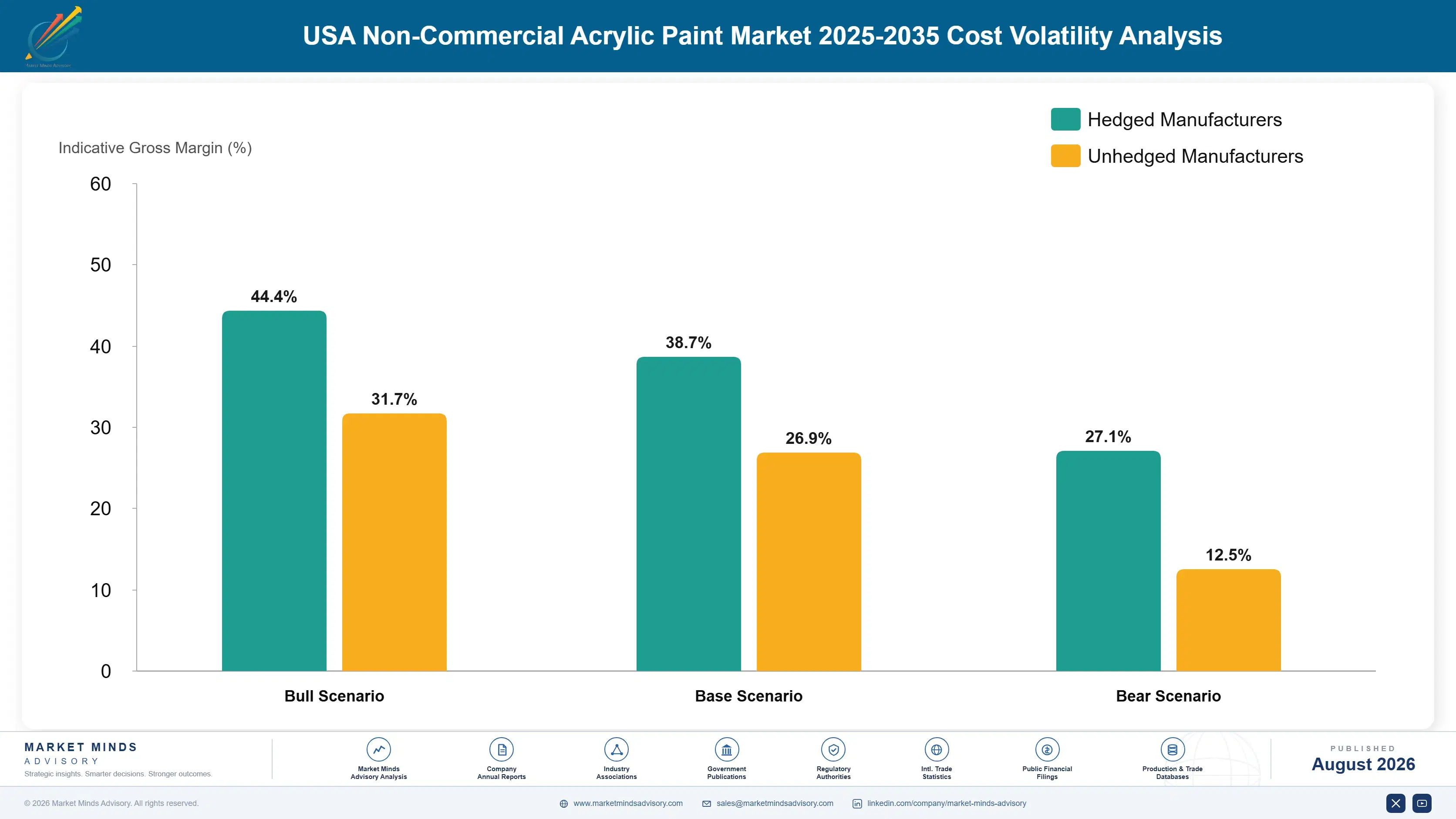
Cost structure splits by tier. On a professional heavy body tube, pigment accounts for roughly 60% of cost of goods, with acrylic emulsion binder around 18% and packaging the remainder. On a craft bottle the position inverts: pigment is under 10%, water and filler cost almost nothing, and packaging plus freight account for more than half. Specialty organic pigments come mainly from European, Indian and Japanese producers.
Acrylic emulsion pricing tracks acrylic acid and therefore propylene, and EIA petrochemical feedstock series show the movement through 2022 that lifted binder costs. Art materials absorbed it late, because retail price points are sticky at 4 and 8 dollars. Pigment moved separately and more sharply: cadmium restriction, cobalt demand from battery manufacture, and specialty organic capacity closures each repriced individual colours rather than the whole range.

The disadvantage falls on artist grade producers and it cannot be engineered away. A craft brand facing a pigment increase changes almost nothing, since pigment is under 10% of its cost. An artist colour house carries 60% and has no room, because reformulating a genuine single pigment colour to a hue destroys the credibility that justifies the price. Small buyers also sit last in the allocation queue.
usa-non-commercial-acrylic-paint-market-cost-volatility-analysis-1787641213395

Qualify alternative pigment sources before capacity closes

Specialty organic pigments are produced in small volumes by few suppliers, and closures arrive with little warning. Colour houses that hold qualified second sources for their most exposed colours avoid reformulating under pressure, which is when hue substitutions get made badly. Qualification requires full lightfastness and colour matching work over months, so it has to happen before the notice arrives.

Price by colour rather than across the range

Pigment cost movement hits individual colours rather than whole ranges, and uniform pricing across a range forces the cheapest colours to subsidise the most expensive. Series pricing, grouping colours into price bands by pigment cost, is standard practice in artist grade and almost absent from craft. Extending it downward protects margin without a visible increase on the colours buyers purchase.

Shift craft tier freight exposure through nearshore sourcing

On a craft bottle, packaging and freight exceed half of cost while pigment sits under 10%, so container rates matter far more than any chemical price. Mexican production shortens lead times and reduces exposure to ocean freight and tariff movement on Asian goods. The trade is unit cost, which runs higher, against inventory carrying cost and markdown risk, which fall.

Portfolio Architecture for Margin Defence

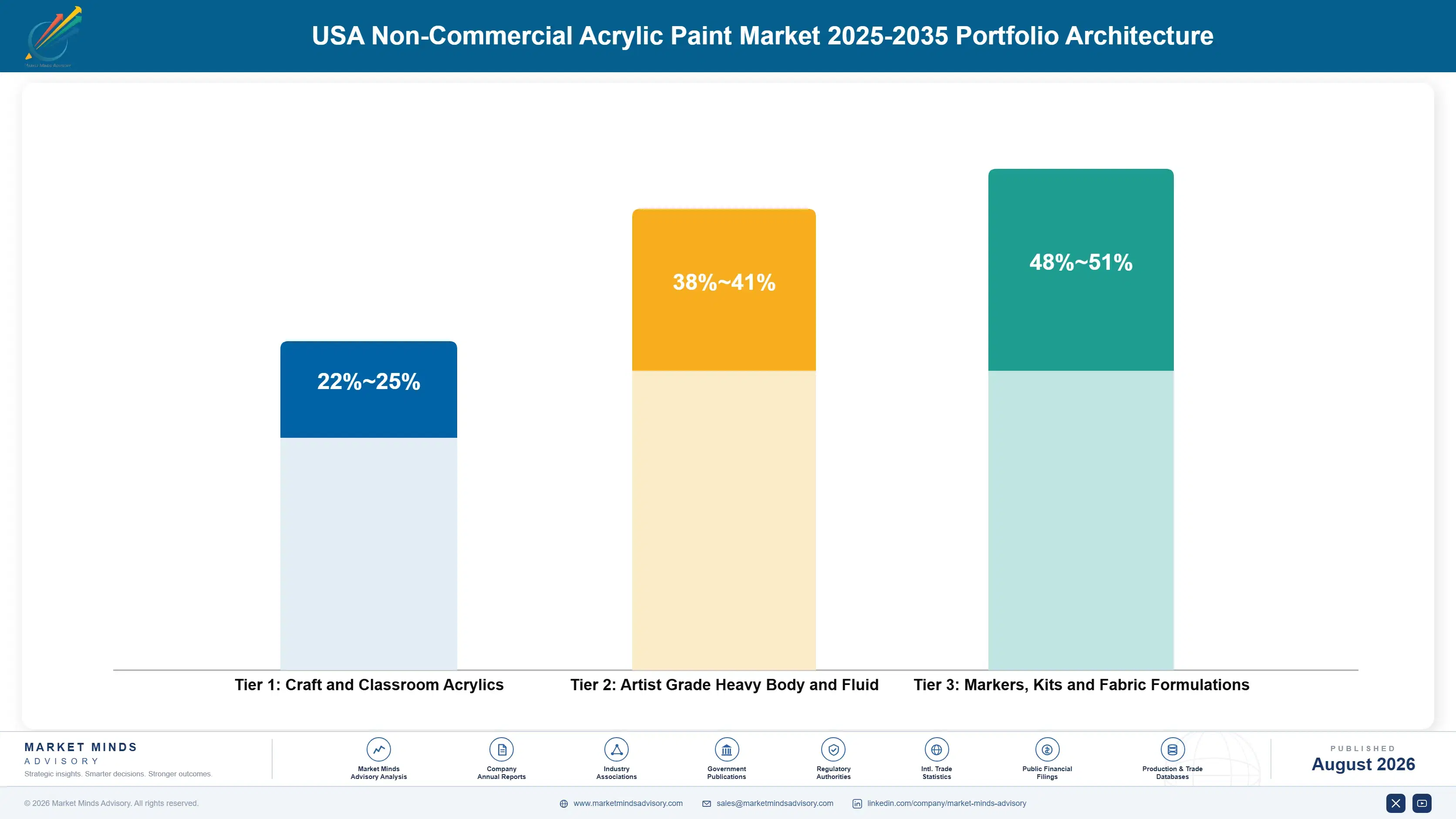
Margin here follows how far a product sits from a commodity bottle. Craft acrylic in mass retail earns thin margins against retailer own brands and Asian landed cost. Artist grade earns better, though pigment at 60% of cost caps how much better. Markers and pens earn best, because price per millilitre is high, the formulation is genuinely harder, and no retailer has built an own brand equivalent yet.
The tension is between the volume that pays the factory and the margin that pays for everything else. Craft and classroom acrylic carries most of the litres and very little of the profit. Artist grade and markers carry the profit and a fraction of the volume. A brand optimising purely for margin loses the retail relationships and the plant utilisation that make the whole thing work.

High value pools concentrate in markers and in kits, both of which price on the decision rather than on the contents. A pouring kit at 34 dollars carries margin no individual bottle approaches, and a marker set sold through streetwear retail sits outside the price comparison entirely. Everything else in this category is exposed to a retailer that can source a comparable bottle from Asia.

Craft and Classroom Acrylics

Bottles sold in mass retail and to school districts on price per litre, where pigment is under 10% of cost and the retailer can source a comparable product from Asia. Differentiation rests on shelf position and colour naming.
Gross Margin: 22-25%

Artist Grade Heavy Body and Fluid

Single pigment formulations with published lightfastness data, sold to buyers who read labels and recommend to others. Margin holds on reputation built over decades, though pigment at 60% of cost of goods caps the ceiling.
Gross Margin: 38-41%

Markers, Kits and Fabric Formulations

Acrylic markers, technique kits and fabric specific formulations priced on the decision rather than the contents. Margin is the best in the category because no retailer has built an own brand equivalent and the formulation is genuinely harder.
Gross Margin: 48-51%
usa-non-commercial-acrylic-paint-market-portfolio-architecture-1787641213921

High-value Sub-segments and Strategic Watch-out

Fluid and Pouring Acrylics

The fastest growing form at 8.4% and the one that recruits most new buyers, since pouring spread entirely through video rather than through any art school. Retention is poor but volume per project is high, and kits convert an uncertain buyer into a 34 dollar basket.
Gross Margin: 44-47%

Acrylic Markers and Paint Pens

Second fastest at 7.2% and the best margin in the category, sold through skate, streetwear and marketplace channels that traditional art brands never served. Formulation is genuinely harder and no mass retailer has produced an own brand equivalent yet. Acquisition activity has already begun here.
Gross Margin: 48-51%

Craft and Multi-Surface Acrylics

The volume core at 4.2% growth and the weakest position in the category, since a craft bottle is difficult to differentiate and mass retailers are widening own brand assortments. Classroom purchasing is the defensible part, protected by approved supplier lists rather than by product. Nothing else here defends itself.
Gross Margin: 22-25%

Heavy Body Artist Acrylics

Growing at only 3.6%, the slowest form in the category, with a loyal audience that is not expanding and a cost base where pigment runs to 60%. Reputation protects the position and reformulation to hues would destroy it, which leaves very little room to manoeuvre.
Gross Margin: 38-41%

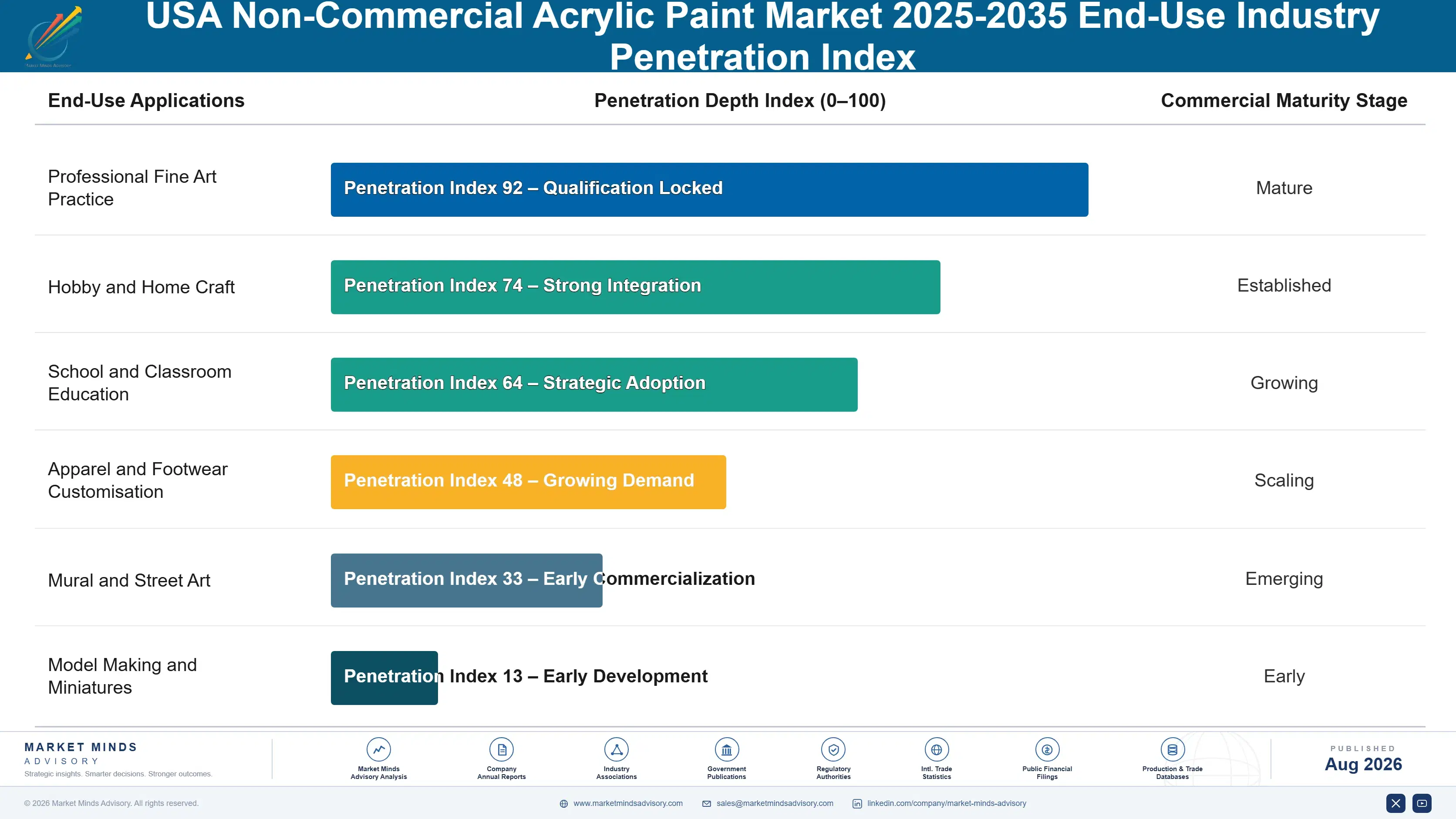
How Buyers Arrive and Leave

There is very little annuity in this category. Only 31% of buyers return within a year, because acrylic paint is bought for a project rather than for a practice, and the leftover paint dries in a drawer. The recurring revenue that does exist sits in classroom purchasing, which runs on district schedules, and in the small proportion of buyers who become genuine hobbyists.
Stickiness varies enormously by how the buyer arrived. Someone who came through art education or a class buys the same brand for years. Someone who came through a pouring video buys once, from whichever listing appeared first, and remembers no brand at all afterwards. School districts sit at the extreme, holding approved suppliers for a decade or more without revisiting the decision.

The buyer profile has shifted generationally. The traditional customer was a trained or self taught painter who knew pigment codes and bought individual colours. The current growth cohort is younger, arrived through a phone, buys kits and surfaces alongside paint, and treats the material as a means to a specific outcome rather than as a craft to master. Neither group is going away, and almost nothing sells to both.
usa-non-commercial-acrylic-paint-market-end-use-penetration-index-1787641214445

Where This Category Rewards Effort

These are among the four positions where our research anticipates prominent divergence between winners and laggards over the coming forecast period. Each is grounded in the demand model, the regulatory perimeter, and the announced capacity pipeline.
01 / TECHNIQUE CYCLE TIMING

Position before the trend, never after it

Fluid and pouring acrylics grow at 8.4%, half again the market rate of 5.6%, and the brands that captured that growth were formulated and stocked before pouring became visible on video. Cycles peak in roughly eighteen months, which means a company that commissions product after the trend appears arrives with inventory and no audience left to sell it to. Speed of response matters considerably more than range breadth in this category, and large portfolios are consistently the slowest to move.
02 / KIT BASKET ECONOMICS

Sell the decision, because the buyer cannot make it

Average basket sits near 34 dollars where a kit is bought and near four where a single bottle is, and the difference is not the contents but the decision the buyer no longer has to make. Someone arriving through a video does not know which medium, additive or surface to pair with the paint. Brands that led with kits during the pouring cycle outperformed those that led with colour ranges, and the margin gap was larger than the volume gap.
03 / CLASSROOM VOLUME ANCHORING

School districts are the only defensive revenue here

Classroom purchasing supplies roughly 22% of all category volume and moves on district schedules rather than on consumer sentiment, which makes it the only part of this market that holds through a discretionary spending downturn. Approved supplier lists take years to enter and are almost never revisited, so the position quietly compounds once it is won. It is unglamorous, low margin business that keeps a plant running through a flat year, and brands that dismissed it have regretted doing so more than once.
04 / FABRIC CHANNEL ENTRY

Markers earn best and reach a different buyer

Acrylic markers grow at 7.2%, second fastest in the category, and carry the highest gross margin in the category because price per millilitre is high and no mass retailer has built an own brand equivalent yet. The barrier is not formulation, though flexibility after cure and adhesion to synthetic leather are genuinely difficult, but distribution into skate, streetwear and marketplace channels that traditional art brands never served. Acquisition has become the usual route in, and it is getting expensive very quickly indeed.

Engagement Snapshot From the Field

A live engagement with an industry participant carrying material or product regulatory and market exposure ahead of a defining policy shift, showing how our research translates into a defensible multi-year portfolio strategy.
MARKET MINDS ADVISORY · CLIENT ENGAGEMENT SUMMARY
USA Non-Commercial Acrylic Paint 2025-2035 Producer Strategic Portfolio Review and Transition Roadmap 2026·Investment Scenario on USA Non-Commercial Acrylic Paint 2025-2035 Exposure Evaluation 2025-26
CLIENT PROFILE
A craft materials brand owner selling acrylic paints, brushes and accessories through mass retail and craft chains across the United States, with roughly 62% of revenue in craft acrylic bottles. Annual revenue was approximately 210 million dollars (client-reported, unverified by MMA). No artist grade position existed, no marker range had been developed, and classroom business was minimal.
STRATEGIC CHALLENGE
Two mass retailers had expanded own brand acrylic assortments and the client lost facings in both, with volume declining for six consecutive quarters. Management wanted to know whether to defend the craft bottle position on price, move upmarket into artist grade, or enter markers. The commercial team had no view on which buyer any of those decisions would reach.
MMA APPROACH
MMA modelled category margin by product form against landed cost for own brand equivalents, establishing which positions a retailer could replicate and which it could not. Purchase path research traced how buyers in each form discovered and selected product. Forty-seven expert interviews with retail buyers, creator marketers and school district procurement officers established what each channel actually rewards and what it ignores.
KEY FINDINGS
  1. Own brand landed cost sat 34% below the client's craft bottle cost of goods, meaning the volume tier could not be defended on price under any realistic scenario.
  2. Marker gross margin ran at 49% against 23% for craft bottles, and no retailer buyer interviewed had an own brand marker programme in development.
  3. Artist grade entry required an estimated 6 years to build credibility, since 41 of the 47 interviews identified reputation rather than formulation as the barrier.
  4. School district approved supplier positions took roughly 3 years to win but were revisited on average only once a decade, giving unusually durable volume.
CLIENT PROFILE
A craft materials brand owner selling acrylic paints, brushes and accessories through mass retail and craft chains across the United States, with roughly 62% of revenue in craft acrylic bottles. Annual revenue was approximately 210 million dollars (client-reported, unverified by MMA). No artist grade position existed, no marker range had been developed, and classroom business was minimal.
STRATEGIC CHALLENGE
Two mass retailers had expanded own brand acrylic assortments and the client lost facings in both, with volume declining for six consecutive quarters. Management wanted to know whether to defend the craft bottle position on price, move upmarket into artist grade, or enter markers. The commercial team had no view on which buyer any of those decisions would reach.
MMA APPROACH
MMA modelled category margin by product form against landed cost for own brand equivalents, establishing which positions a retailer could replicate and which it could not. Purchase path research traced how buyers in each form discovered and selected product. Forty-seven expert interviews with retail buyers, creator marketers and school district procurement officers established what each channel actually rewards and what it ignores.
KEY FINDINGS
  1. Own brand landed cost sat 34% below the client's craft bottle cost of goods, meaning the volume tier could not be defended on price under any realistic scenario.
  2. Marker gross margin ran at 49% against 23% for craft bottles, and no retailer buyer interviewed had an own brand marker programme in development.
  3. Artist grade entry required an estimated 6 years to build credibility, since 41 of the 47 interviews identified reputation rather than formulation as the barrier.
  4. School district approved supplier positions took roughly 3 years to win but were revisited on average only once a decade, giving unusually durable volume.
RECOMMENDED STRATEGY
Phase 1: Phase one: stop defending craft bottle facings on price, since own brand landed cost sits 34% below the client's own cost of goods. Phase 2: Phase two: enter acrylic markers immediately, where gross margin runs 49% against 23% and no retailer own brand programme yet exists. Phase 3: Phase three: pursue school district approved supplier positions over 3 years, accepting low margin for volume that survives any discretionary downturn.
OUTCOME
The client launched a marker range within ten months through an acquired formulation partner and secured streetwear distribution it had never held. Craft bottle facings continued declining as expected, but blended gross margin rose from 27% to 34% within eighteen months of the portfolio shift (client-reported, unverified by MMA).

Frequently Asked Questions

Foundational context covering the market sizes, CAGR, scope, country, region and competition that inform every finding below. This section is provided to cover basics and most often pre-purchase conversations, answered from the MMA Primary Research Dataset.

What is the current size of the USA Non-Commercial Acrylic Paint Market?

The market was valued at 0.68 billion dollars in 2025, covering acrylic paints sold for artistic, craft, hobby and educational use across the United States. It reaches an estimated 0.72 billion dollars during 2026.

How large will the USA Non-Commercial Acrylic Paint Market be by 2036?

MMA forecasts 1.24 billion dollars by 2036, an increase of 0.52 billion dollars over the 2026 base. That represents an expansion multiple of 1.72 times across the forecast period.

What is the CAGR for the USA Non-Commercial Acrylic Paint Market 2026 to 2036?

The base case compound annual growth rate is 5.6%, with a bull case of 6.8% and a bear case of 4.4%. Technique cycles and discretionary spending separate those scenarios.

Which segment is growing fastest?

Fluid and pouring acrylics grow at 8.4%, half again the market rate of 5.6%, driven by techniques that spread through short form video. Acrylic markers follow at 7.2%.

Who are the major companies in the USA Non-Commercial Acrylic Paint Market?

Colart International, Golden Artist Colors, Plaid Enterprises, DecoArt and Crayola lead on retail sell-through volume in the United States. Together they account for 62% of the market.

Which country is growing fastest?

The market is defined as United States consumption, and Texas grows fastest of any state at 7.6% on population growth and craft retail expansion across the state.

Report Segmentation Architecture

The full report scope spans multiple orthogonal segmentation dimensions, with cross-tabulated demand data provided for each dimension pair. Coverage extends further to regional breakdowns, trend trajectories, and the competitive detail needed to support segment-level decision-making.

By Product Form

  • Craft and Multi-Surface Acrylics
  • Heavy Body Artist Acrylics
  • Fluid and Pouring Acrylics
  • Acrylic Markers and Paint Pens
  • Acrylic Gouache and Matte Acrylics

By End-Use Industry

  • Professional Fine Art Practice
  • Hobby and Home Craft
  • School and Classroom Education
  • Apparel and Footwear Customisation
  • Mural and Street Art
  • Model Making and Miniatures

By Commercial Dimension

  • Mass Retail Chains
  • Specialist Art Supply Retail
  • Online Marketplaces
  • Direct to Consumer Brand Sales
  • School District Procurement
  • Streetwear and Skate Distribution

By Region

  • North America
  • Western Europe
  • East Asia
  • South Asia and Pacific
  • Latin America
  • Middle East and Africa
  • Eastern Europe

Scope, Methodology, and Coverage

Every figure in this report is reproducible from documented input assumptions. The scope below maps the historical period, the forecast horizon, the segmentation dimensions, and the countries covered, alongside the underlying primary and qualitative methodology.
Historical Period
2020 to 2025
Forecast Period
2026 to 2036
Base Year
2025 (USD billions; MMA Primary Research Dataset, August 2026)
Market Definition
Acrylic paint formulated and sold for artistic, craft, hobby and educational use within the United States, covering craft and multi-surface acrylics, heavy body artist acrylics, fluid and pouring acrylics, acrylic markers and paint pens, and acrylic gouache and matte acrylics. Measured at retail selling value across all channels. Architectural and house paint, industrial and automotive coatings, professional signwriting and commercial trade paints, spray paint in aerosol form, and unpigmented acrylic mediums are excluded from scope.
Quantitative Units
USD billions (current prices); litres sold; USD per litre by product form and channel
Segmentation Dimensions
Product form; end-use industry; commercial dimension; region
Regions Covered
North America, Western Europe, East Asia, South Asia and Pacific, Latin America, Middle East and Africa, Eastern Europe
Countries Covered
United States, Canada, Mexico, United Kingdom, Germany, France, Netherlands, Spain, China, Japan, South Korea, Taiwan, India, Vietnam, Australia, Brazil, Argentina, South Africa, Poland, Czechia
Key Companies Profiled
Colart International, Golden Artist Colors, Plaid Enterprises, DecoArt, Crayola, Royal Talens, Daler-Rowney, Jacquard Products, Sargent Art, Chroma, Blick Art Materials, Speedball Art Products, Tri-Art Manufacturing, Holbein, Turner Colour Works, Schmincke, Lascaux, Da Vinci Paint, Nova Color Paints, Createx Colors
Quantitative Methodology
Primary survey, n=3,800 respondents, Q4 2025, six countries; demand-side model with trade association cross-validation
Qualitative Methodology
47 expert interviews, Q4 2025; applied to validate demand model assumptions, identify emerging dynamics, and assess competitive positioning
Report Format
PDF and XLSX data workbook (Word format preview document)
Publisher
Market Minds Advisory
Report Code
MMA-2026-CHM-149
Published
August 2026
Contact
sales@marketmindsadvisory.com | www.marketmindsadvisory.com

Purchase the full USA Non-Commercial Acrylic Paint Market 2025-2035 Report (2026 to 2036).

The full report treats acrylic paint as a category governed by technique cycles rather than by product development, since the buyer arrives through a video and leaves within a year. It sizes all five product forms independently through 2036, models margin by form against own brand landed cost, and traces the purchase path from discovery to transaction for each buyer cohort. Regional chapters cover all seven regions, with non domestic shares assessed as manufacturing and pigment supply rather than demand. Competitive profiling covers 20 participants on one consistent retail sell-through volume basis.
Five product forms sized independently through 2036
Margin by form modelled against own brand cost
Purchase path traced from discovery to transaction
Technique cycle duration measured across three recent cycles
School district procurement assessed separately from consumer demand
Twenty participants profiled on one consistent volume basis

Built For The People Who Decide

From boardroom strategy to bench-side execution, this report is read cover-to-cover by leaders shaping the next decade of their industry, turning demand scenarios, market dynamics and valuation benchmarks into decisions.
CXOs/ Presidents/ VPs/ Managers
M&A and Corporate Development
Strategy Teams and R&D Heads
Procurement and Product Directors
Regulatory and Compliance Leaders
Investor Relations and Equity Analysts