Market Minds Advisory
USA Knotless Surgical Sutures Market

USA Knotless Surgical Sutures Market: A Cheap Item Controlling Expensive Minutes

The suture is four tenths of one percent of what a case costs and it decides a fifth of closure time in a theatre billing sixty-two dollars a minute. Procurement sees only the first number.

Lead Analyst

Alice Ballenger

Published

September 2026

Make Smarter Decisions with Customized Research Insights

Request a free sample report and evaluate market opportunities, growth trends, and competitive dynamics relevant to your business needs.

2025 MARKET VALUE$0.7BMarket Size 2025
2036 FORECAST VALUE$1.9BBase Case , 2026 to 2036
CAGR 2026 TO 20368.8 %Bull 10.0% / Bear 7.6%
INCREMENTAL OPPORTUNITY$1.1BNet 10- year value creation
EXPANSION MULTIPLE2.31x2036 value over 2026 base
Strategic Levers
M&A Pipeline
Regional Outlook
Country Rankings
Competitive Intelligence
Segmental Deep-dive
Call-Us : 91 93563 13602

Executive Snapshot and Market Trajectory

A barbed suture costs about 4.3 times a conventional one and removes knot tying entirely, cutting closure time by roughly 21%. Theatre time runs near 62 dollars a minute fully loaded. The suture is 0.4% of what the case costs, which is the only number procurement ever looks at.
Growth runs at 8.8% on conversion from conventional closure rather than on procedure volume, which is essentially flat across the United States and has been for several years now. Antibacterial-coated barbed sutures grow fastest at 13.2%, exactly 1.50 times the market rate, as surgical site infection penalties made coating a financial argument rather than a clinical preference. Anchor-terminated knotless constructions follow at 11.6% on termination strength.
Concentration reaches 88% across the top five measured on annual knotless suture units sold into United States procedures, exceptionally high because two suppliers effectively define the category and both hold deeply entrenched hospital and group purchasing contracts of very long standing. Almost the entire supply is manufactured in Mexico and Puerto Rico, which gives an ordinary-looking consumable an unusual trade and currency exposure that nobody in hospital supply chain planned for.
Market Definition
This market covers barbed and knotless surgical sutures used in procedures performed in the United States, measured at manufacturer realised prices net of contract rebates, spanning unidirectional barbed absorbable, bidirectional barbed absorbable, antibacterial-coated barbed, non-absorbable barbed, anchor-terminated knotless, and long-absorption barbed constructions. Conventional knotted sutures, surgical staplers, tissue adhesives, mesh and hernia devices, knotless orthopaedic anchors, and procedures performed outside the United States fall outside scope.
Base Year Value
$0.7B in 2025 (MMA Primary Research Dataset, August 2026)
Forecast Period
2026 to 2036, eleven discrete annual values
CAGR
8.8% base case. Bull 10.0%. Bear 7.6%.
Fastest Growth Segment
Antibacterial-Coated Barbed Sutures: 13.2% CAGR
Fastest Growth Country
United States: 8.8% CAGR
Fastest Growth Region
South Asia and Pacific: 10.6% CAGR
Largest Region
Latin America: 45% of 2025 global value
Market Leaders
Johnson & Johnson, Medtronic, Corza Medical, DemeTECH, Assut Medical. Source: MMA Analysis based on company annual reports.
Primary Survey
n=3,800 procurement and R&D decision-makers, Q4 2025, six countries
Methodology
Demand-side build-up, cross-validated against public data, 47 expert interviews

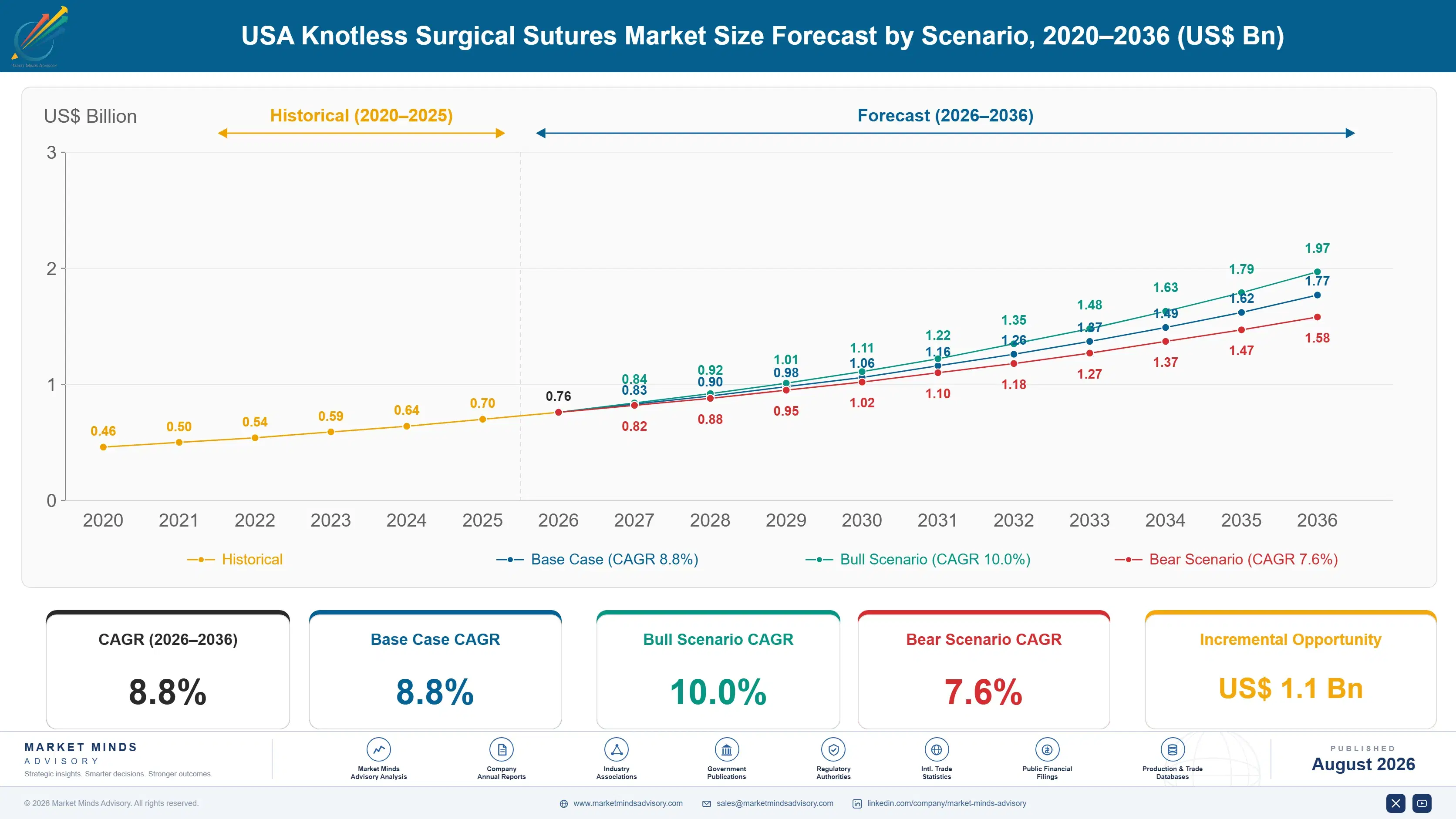
USA Knotless Surgical Sutures Market Forecast Scenarios

usa-knotless-surgical-sutures-market-size-forecast-scenario-1787299889263
The 2020 to 2025 period ran at 7.4% and adoption followed the operating room rather than the surgeon. Robotic and laparoscopic procedure growth mattered most, since knot tying through a port is slow, awkward, and the step most likely to consume time nobody planned for. Hysterectomy, bariatric, and arthroplasty closure converted furthest. Open general surgery converted least, since a surgeon tying comfortably by hand sees little reason to pay more.
Three mechanisms carry the 8.8% base case. Minimally invasive conversion is the largest, since barbed closure removes the single most difficult intracorporeal step and the time saving is largest exactly where the technique is hardest. Infection penalty exposure is the second, driving antibacterial-coated constructions at 13.2%. And theatre throughput pressure is the third, as hospitals under perioperative staffing constraint now value theatre minutes far more than before the nursing shortage bit.
The 10.0% bull case rests on hospitals moving suture purchasing decisions from supply chain to perioperative services, which would put the buyer and the beneficiary of the time saving in the same conversation. The 7.6% bear case is contract renewal pressure at the two dominant suppliers, since 88% concentration invites aggressive tendering that compresses realised price without changing volume.

The Cheapest Item on an Expensive Table

The commercial problem here is a ratio nobody in the hospital owns. A barbed suture costs roughly 4.3 times its conventional equivalent, which sounds enormous until you notice the item is 0.4% of total procedure cost. What it buys is around 21% off closure time in a theatre running near 62 dollars a minute fully loaded. Eight minutes saved covers the price difference several times over, in a budget the buyer does not manage.
TOP FIVE CONCENTRATION88%Very high because two suppliers define the category commercially
CLOSURE TIME REDUCTION21%Against conventional interrupted or knotted running closure technique
THEATRE COST PER MINUTE62 dollarsFully loaded across staffing, facility, and equipment overhead
UNIT COST MULTIPLE4.3 timesPaid per suture against the conventional equivalent it replaces
SUTURE SHARE OF CASE0.4%Of total procedure cost across the typical surgical case mix
KNOT SECURITY VARIABILITY31%Difference in tensile retention between surgeons tying identical closures
Underneath that sits a quality argument the industry almost never makes out loud. A conventional closure depends on knots tied by hand, and tensile retention across those knots varies by roughly 31% between surgeons performing the identical closure. It is the least standardised step in an otherwise heavily protocolised operation. A barbed suture removes the operator variable completely, which is a genuine safety point that reads as criticism and therefore rarely gets said.
The supply picture is unusual for something this ordinary. Suture assembly is labour-intensive and precision-dependent, and almost the entire United States supply is manufactured in Mexico and Puerto Rico rather than domestically. That gives a routine consumable a trade and currency exposure few supply chains have examined.
"I have watched a value analysis committee reject a suture on a four times unit price and approve a robot in the same meeting. The suture buys eight minutes a case. Nobody in that room was measuring minutes, because minutes belong to somebody else's budget line."
Director, Surgical Consumables and Perioperative Economics Practice · MMA Medica

Market Trends

Infection Penalties Turned Coating Into An Economic Case

Antibacterial coating on suture material was a preference argument for years, supported by evidence surgeons found interesting and administrators found irrelevant. Payment penalties tied to surgical site infection rates changed that, since an avoided infection carries direct financial consequence rather than merely clinical benefit. Coated barbed constructions now grow at 13.2% against 8.8% for the market overall. The interesting part is that nothing about the evidence changed materially. What changed was who in the hospital had a reason to care about it. That is worth remembering before commissioning further studies.
Market Impact: Saves 62 dollars per minute
Robotic Closure Made Knot Tying The Awkward Step

Tying a secure knot with instruments through a port is the slowest and least reproducible part of a minimally invasive procedure, and robotic wristed instruments improve it without making it fast. Barbed closure removes the step entirely, which is why conversion has run furthest in hysterectomy, bariatric, and robotic urological work rather than in open general surgery. The time saving is largest precisely where the technique is hardest. Open surgeons tying comfortably by hand remain the least converted group and the hardest to persuade on price. Price is the whole conversation there.
Market Impact: Removes 31% retention variability

Market Opportunities and Growth Drivers

Theatre Minutes Are The Scarcest Resource In A Hospital

Perioperative staffing shortages have made operating room throughput a board-level constraint rather than an efficiency preference, and a theatre running near 62 dollars a minute fully loaded rewards anything that shortens a case. Barbed closure removes roughly 21% of closure time, which across a busy service adds up to genuine additional case capacity without hiring anybody. That argument reaches perioperative leadership readily and reaches supply chain not at all, which is precisely where most conversion programmes stall. Reaching the right audience is the entire problem, and most manufacturers have never restructured their commercial coverage to do it.
Market Impact: Unit price runs 4.3 times higher

Closure Consistency Removes The Operator Variable

Tensile retention across hand-tied knots varies by around 31% between surgeons closing identical wounds, making it the least standardised step in an otherwise protocolised procedure. Barbed constructions distribute tension along the wound and eliminate the knot entirely, which removes that variability rather than reducing it. Quality and safety functions find this argument compelling once it is put to them directly. Manufacturers rarely make it, because saying a surgeon's knots are inconsistent is commercially awkward however well the data supports it. Framed as removing an unnecessary variable rather than as fixing a deficiency, it lands without giving offence.
Market Impact: Top five hold 88% share

Market Restraints and Challenges

The Buyer And The Beneficiary Sit In Different Budgets

Supply chain approves the suture against a unit price 4.3 times the conventional alternative, while the time saving accrues to perioperative services and shows up as theatre utilisation rather than as a supply saving. The root cause is that hospital budgeting separates consumables from capacity, and nobody reconciles them at the item level. Commercial impact is that an economically obvious substitution fails value analysis routinely. Manufacturers are responding with time-motion evidence, perioperative-facing selling, and case cost models that combine both lines. Very few systems reconcile the two lines at all.
Market Impact: Growing at 13.2% annually

Eighty-Eight Percent Concentration Invites Aggressive Tendering

Two suppliers effectively define this category and both hold entrenched multi-year hospital and group purchasing contracts, which makes the category an obvious target whenever a system reviews supply spending. The root cause is that concentration and high unit price together look like an opportunity to any procurement analyst, regardless of the underlying economics. Commercial impact is realised price compression at renewal without any corresponding volume gain. Suppliers are defending with bundled portfolio agreements, outcome data, and conversion support that raises switching cost. Price alone concedes several points every cycle without recovering them.
Market Impact: Saves 21% of closure time
3 additional market trends, 4 additional growth drivers, and 2 additional restraints and challenges are covered in the full report. Contact sales@marketmindsadvisory.com to access the complete intelligence.

Segment CAGR and Growth Architecture

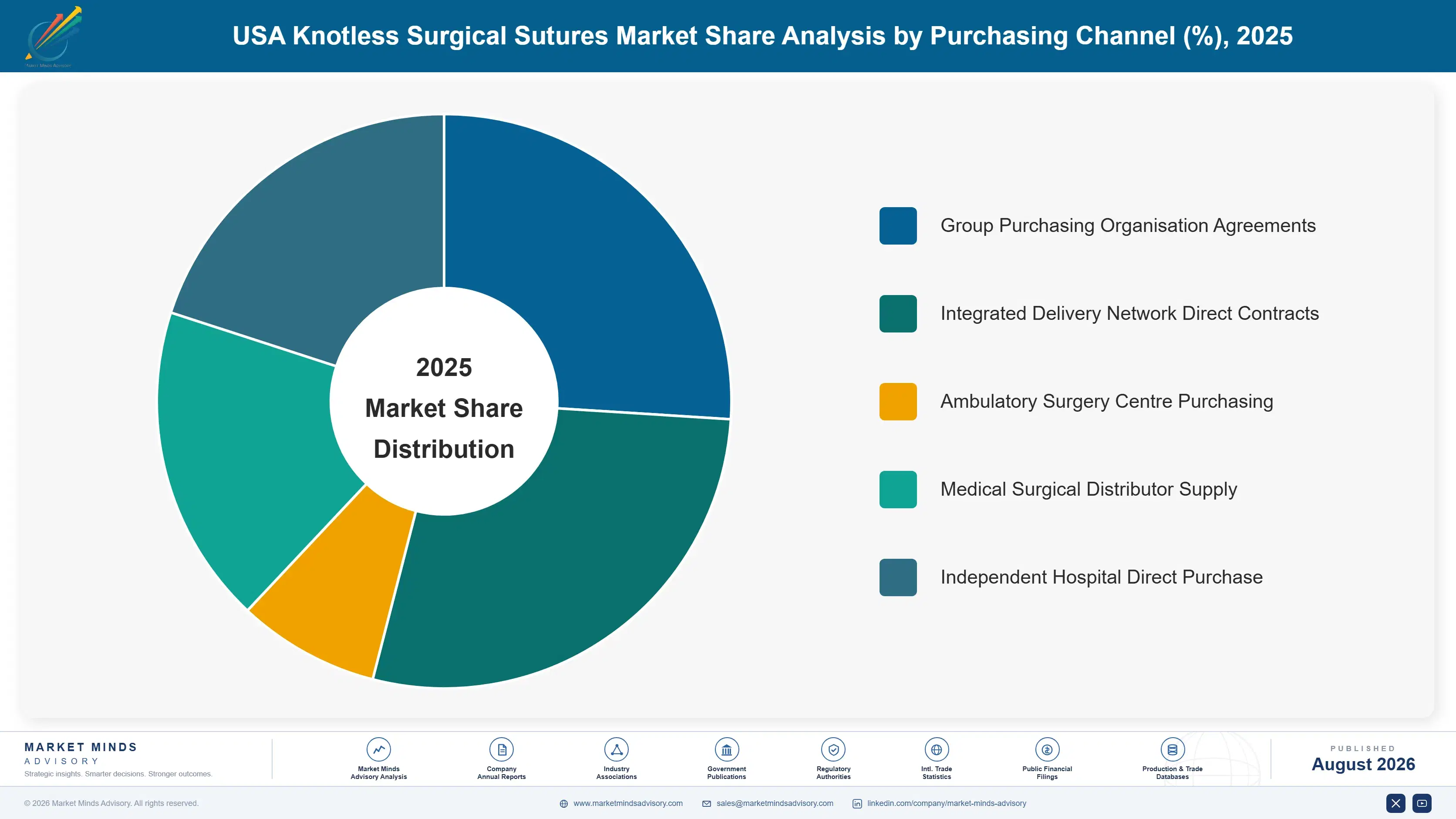
Segmentation follows suture construction and material profile, because those determine absorption behaviour, tissue holding characteristics, which procedures a surgeon will accept the product in, and what a manufacturer realises per unit sold. Surgical specialty and wound location both cut across every construction rather than separating them, which makes either a weak primary dimension here.
usa-knotless-surgical-sutures-market-market-share-analysis-1787299889796

Antibacterial-Coated Barbed Sutures

The fastest construction at 13.2%, exactly 1.50 times the market rate, and the growth has almost nothing to do with new evidence. Triclosan and comparable antibacterial coatings applied to barbed absorbable material have been available and supported by literature for years while administrators treated them as a clinical preference. Payment penalties attached to surgical site infection rates converted that preference into a financial argument, and adoption followed immediately. Colorectal, bariatric, and caesarean closure have converted furthest given their baseline infection rates. The coating adds meaningfully to unit price, which now reads as insurance rather than as expense. What changed was who inside the hospital had reason to care about it.
CAGR 13.2%

Anchor-Terminated Knotless Sutures

Second fastest at 11.6%, covering constructions that terminate in a loop, a welded anchor, or a purpose-made device end rather than relying on barbs alone to hold the final pass. The clinical argument is that barbed closure is strongest along its length and weakest at termination, which is where reported failures concentrate in the published series. Anchor termination addresses precisely that. Manufacturing is more complex than barb cutting alone, so realised prices sit above standard barbed constructions and the qualified supplier list is shorter, which suits the two dominant manufacturers rather well. Termination is where the published failures concentrate, and it is the one place a competitor cannot easily copy.
CAGR 11.6%
Full segment breakdown across 6 segments available in the complete report.

Regional Architecture and Country Demand Map

This report covers sutures used in United States procedures, so the regional table below is repurposed to show where that supply is actually manufactured rather than where it is consumed. Every share sits outside its framework band by construction rather than by any analytical judgment.

Latin America

Forty-five percent of the sutures used in United States procedures are manufactured here, overwhelmingly in northern Mexico, which is far outside the framework band because this table shows manufacturing origin rather than consumption. Suture assembly is labour-intensive and precision-dependent, which drew the industry to Ciudad Juárez and Chihuahua decades ago and has kept it there through every subsequent cost review. Both dominant suppliers operate substantial plants in the corridor. Growth at 8.4% tracks close to the market rate, since this capacity expands roughly in line with the demand it serves rather than gaining or losing share. Nothing about that corridor position looks likely to change soon. Every subsequent cost review has confirmed the original decision.
Share: 45% | CAGR: 8.4% (2026 to 2036)

North America

Thirty-one percent originates within the United States and Puerto Rico, which falls inside the framework band by coincidence rather than design given this table shows origin across a single-country market. Puerto Rican plants carry a disproportionate share of higher-specification and antibacterial-coated production, helped by tax treatment and by proximity to domestic regulatory oversight. Mainland facilities concentrate on needle manufacture, packaging, and final release rather than on suture assembly itself. Growth at 8.0% sits slightly below the market rate, reflecting gradual migration of remaining labour-intensive steps toward the Mexican corridor. Puerto Rican capacity is the part most exposed to any change in tax treatment. It also carries a disproportionate share of the highest-value coated production in the entire supply chain.
Share: 31% | CAGR: 8.0% (2026 to 2036)
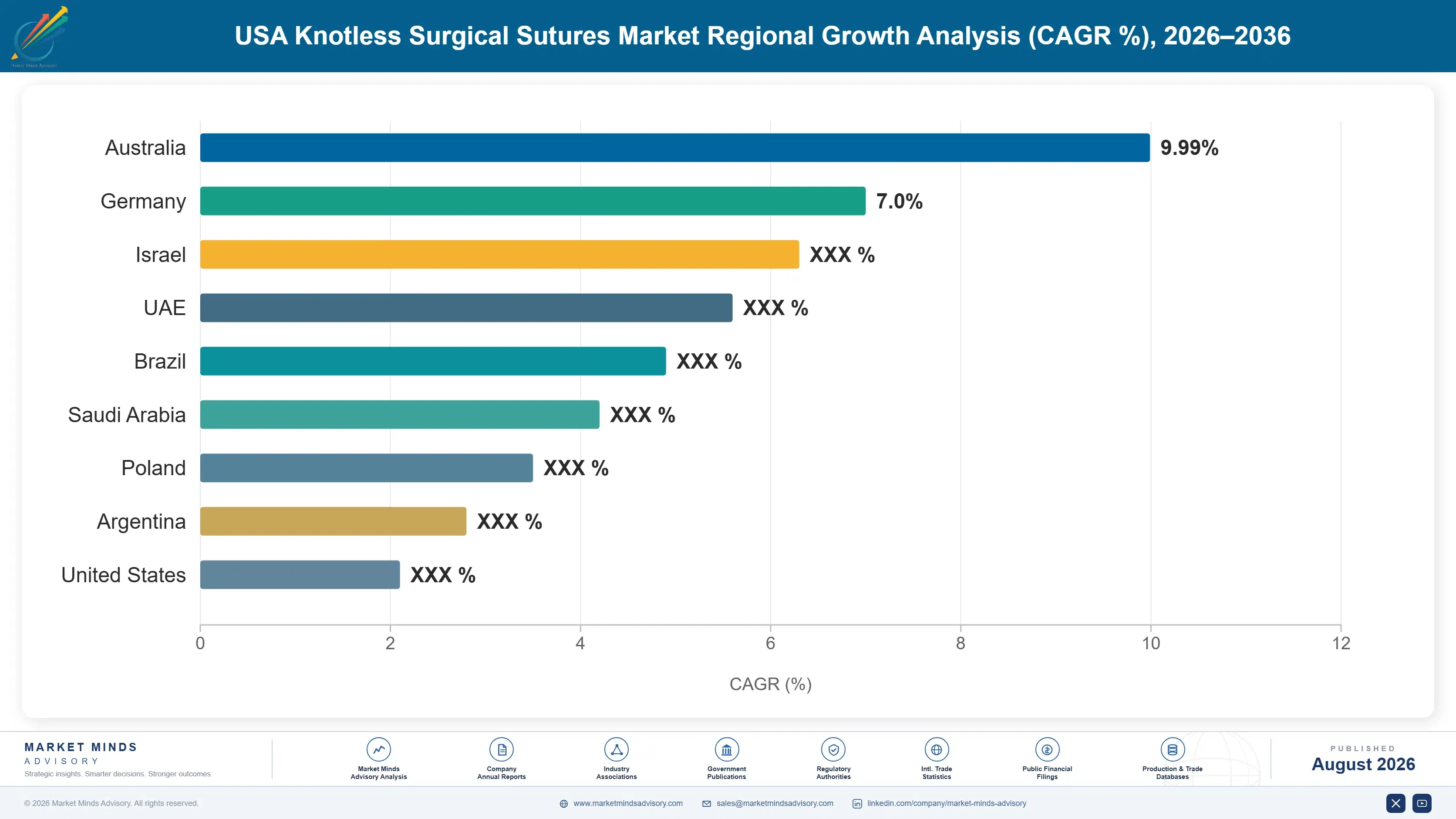
Regional intelligence for 5 additional markets available in the complete report: East Asia, Western Europe, South Asia and Pacific, Eastern Europe, Middle East and Africa. Contact sales@marketmindsadvisory.com.
usa-knotless-surgical-sutures-market-country-cagr-analysis-1787299890314

Selling Minutes To People Buying Items

The suture is 0.4% of case cost and controls 21% of closure time in a theatre worth 62 dollars a minute, yet procurement evaluates it on a 4.3 times unit price. Value comes from reaching perioperative leadership, from quantifying time in the customer's own theatre, from making the consistency argument, and from defending against tender compression.

Sell To Perioperative Services Rather Than Supply Chain

Supply chain sees a suture costing 4.3 times the alternative and nothing else, while perioperative services manages theatre utilisation in a facility running near 62 dollars a minute and has no visibility of the item price at all. Selling to the second group with a case cost model combining both lines converts value analysis submissions that fail routinely when made on unit price. Manufacturers restructuring their commercial teams around perioperative leadership report win rates roughly doubling on the same clinical evidence. That restructuring is neither expensive nor quick. Most manufacturers never attempt it.
Market Impact: Win rates roughly double, from about 20% upward

Measure Time In The Customer's Own Operating Room

Published time-motion evidence persuades nobody in a hospital, because every surgical service believes its own case mix and technique differ from the study population. Running a timed comparison in the customer's own theatre across twenty cases costs perhaps 40,000 dollars in clinical support and produces a number nobody in the room can argue with. Manufacturers who do this convert on evidence the customer generated themselves. Almost everybody else quotes a journal article and loses to a procurement spreadsheet instead. The customer cannot dispute their own numbers. Twenty cases settles the argument.
Market Impact: An in-theatre time study costs about 40,000 dollars

Make The Closure Consistency Argument Explicitly

Tensile retention across hand-tied knots varies by around 31% between surgeons closing identical wounds, which makes knot tying the least standardised step in an otherwise heavily protocolised procedure. Quality and safety functions respond strongly to that once it is put to them, and they hold influence that supply chain does not. Manufacturers avoid the argument because it implies criticism of surgical technique. Framed as removing an unnecessary variable rather than as fixing a deficiency, it lands without offence and reaches an entirely new buyer. Quality functions hold influence supply chain does not.
Market Impact: Addresses the 31% variability in closure tensile retention

Defend Renewal Pricing With Conversion Support

A category at 88% concentration with unit prices several times the alternative is an obvious target at every contract renewal, regardless of what the underlying case economics show. Suppliers defending on price alone lose several points each cycle. Those bundling conversion support, in-theatre time studies, and surgeon training into the agreement raise the cost of switching well beyond the price difference at stake. That support costs around 700,000 dollars annually across a large system and protects considerably more than it consumes. Switching cost beats price defence every time. Price defence loses several points a cycle.
Market Impact: Conversion support costs about 700,000 dollars each year

Who Controls the Margin Pool

Concentration reaches 88% across the top five measured on annual knotless suture units sold into United States procedures, which is among the highest in any surgical consumable category. Two suppliers effectively define it, both hold entrenched multi-year hospital and group purchasing agreements, and both bundle knotless sutures inside far broader wound closure portfolios that a challenger cannot match on breadth. The gap between them is narrow and moves with individual system contract renewals
Competitive activity runs on three fronts. Portfolio bundling is the first, since a hospital buying staplers, mesh, and conventional suture from one supplier rarely splits the knotless line out separately. Conversion support is the second, where surgeon training and in-theatre time studies raise switching cost. Antibacterial coating capability is the third, and it is where the fastest growth and the strongest clinical evidence currently sit.

Pressure comes from two directions. Value-tier entrants with Asian and Indian manufacturing have obtained clearances and are contesting the price-sensitive segment. And systems reviewing supply spend keep targeting a category whose concentration and unit price make it look like an obvious saving.
usa-knotless-surgical-sutures-market-company-positioning-matrix-1787299890836

Competitive Moat and Risk Dimensions

JOHNSON & JOHNSON

Moat: Wound closure portfolio breadth

A hospital buying conventional sutures, staplers, mesh, and energy devices from one supplier under a single agreement has little appetite to carve out the knotless line for separate tendering. That bundling makes the category difficult to attack on its own merits whatever a competitor offers. Breadth built over decades protects a narrow line.
JOHNSON & JOHNSON

Risk: Bundle invites system-wide tendering

The same breadth that protects the knotless line makes the whole agreement a large and visible target whenever a health system reviews supply spending seriously. A challenge to the bundle threatens far more revenue than the sutures alone, and defending it usually means conceding price somewhere. Concentration at this level attracts exactly the procurement attention that erodes realised value.
MEDTRONIC

Moat: Established minimally invasive surgeon base

Deep relationships with laparoscopic and robotic surgeons, built through stapling and energy platforms, place the company with exactly the group where knotless closure converts fastest. Knot tying through a port is the awkward step those surgeons feel every case. Reaching them needs a field organisation already present in those theatres.
MEDTRONIC

Risk: Open surgery remains largely unconverted

Surgeons tying comfortably by hand in open procedures see the smallest time benefit and the clearest price difference, which makes them the least persuadable group in this market. A position built on minimally invasive strength does not extend easily into that population. The unconverted volume is substantial, and reaching it needs an economic argument rather than a technique one.

Players Tracked

Prominent Players

Johnson & Johnson
Medtronic
Corza Medical
DemeTECH
Assut Medical

Other Key Players

B. Braun
Péters Surgical
Internacional Farmacéutica
Dolphin Sutures
Healthium Medtech
Meril Life Sciences
Lotus Surgicals
Shanghai Pudong Jinhuan Medical
Jiangsu Chenkai
Riverpoint Medical
CP Medical
Genesis MedTech
Aspen Surgical
Unimax Medical
Kono Seisakusho

Recent Developments

FEBRUARY 2025

Health system moves suture evaluation from supply chain to perioperative committee

A multi-hospital system relocated surgical consumable evaluation for closure products from its supply chain committee to a perioperative services group that also owns theatre utilisation targets. The change was internal governance policy rather than any supply agreement, joint venture, or arrangement with a device manufacturer.
Signal: Putting the buyer and the beneficiary of saved minutes in the same room changes which products get approved
MAY 2025

Manufacturer expands antibacterial-coated barbed suture range

A wound closure manufacturer extended antibacterial coating across additional barbed suture sizes and absorption profiles, targeting colorectal, bariatric, and caesarean closure where baseline infection rates are highest. The launch was a product line extension rather than any acquisition, licensing arrangement, or joint venture with a coating technology supplier.
Signal: Infection penalties converted a clinical preference into a financial argument without any new evidence appearing at all
AUGUST 2025

Value-tier entrant obtains clearance for barbed absorbable construction

A manufacturer with Asian production facilities obtained regulatory clearance for a barbed absorbable suture construction aimed at price-sensitive United States hospital segments through distributor channels. The clearance was a routine regulatory outcome rather than any partnership, licensing agreement, or acquisition involving an established supplier. Distributor launch followed shortly.
Signal: Clearance is no longer the barrier for value-tier entrants, and hospital quality perception now clearly is

Why the Plants Are in Juárez

Assembly labour dominates in a way unusual for a medical device, running roughly 34% of cost of goods, because attaching a needle to a strand and cutting barbs to specification remains precision handwork at scale. Absorbable polymer adds about 21%, surgical needle stock around 17%, sterilisation and packaging near 15%, and quality release and regulatory documentation carry the remainder of the cost base.
Mexican manufacturing cost movement is therefore the exposure that matters most. INEGI reporting documented sustained increases in manufacturing wages across northern Mexican industrial corridors through recent years, alongside currency movement that changed dollar-denominated costs independently of anything happening in the plants. Suppliers with fixed multi-year hospital contracts absorbed those increases directly, since a group purchasing agreement does not reprice merely because a peso moved against the dollar.

The competitive disadvantage mechanism runs through contract duration rather than through plant location. Every major supplier manufactures in broadly the same corridor at broadly similar cost, so nobody holds an advantage on production. What differs is whether a supplier locked three-year pricing before a wage and currency cycle or after it. Exposure also varies by mix, since coated and anchor-terminated constructions absorb labour movement that commodity barbed sutures cannot.
usa-knotless-surgical-sutures-market-cost-volatility-analysis-1787299891031

Attach labour and currency escalation to multi-year agreements

Three-year hospital and group purchasing pricing agreed before a wage and currency cycle hands the supplier every cost movement across that whole period with no recovery mechanism at all. Escalation clauses tied to published manufacturing wage indices move that risk where it can be absorbed. A supplier quoting without one has given away an option.

Automate barb cutting and needle attachment where volume allows

Assembly labour at 34% of cost of goods is the largest single line and the one exposed to a wage cycle nobody controls. Laser barb cutting and automated swaging reduce that share meaningfully on high-volume constructions, though validation and regulatory change notification take months. The investment only pays on the constructions with genuine volume behind them.

Weight the mix toward coated and anchor-terminated constructions

Commodity barbed sutures carry realised prices too thin to absorb labour cost movement, while coated and anchor-terminated constructions sell at prices that comfortably can. Those are also the two fastest growing parts of this market at 13.2% and 11.6% respectively. Mix improvement therefore protects margin and follows demand in the same direction, which is a rare alignment.

Portfolio Architecture for Margin Defence

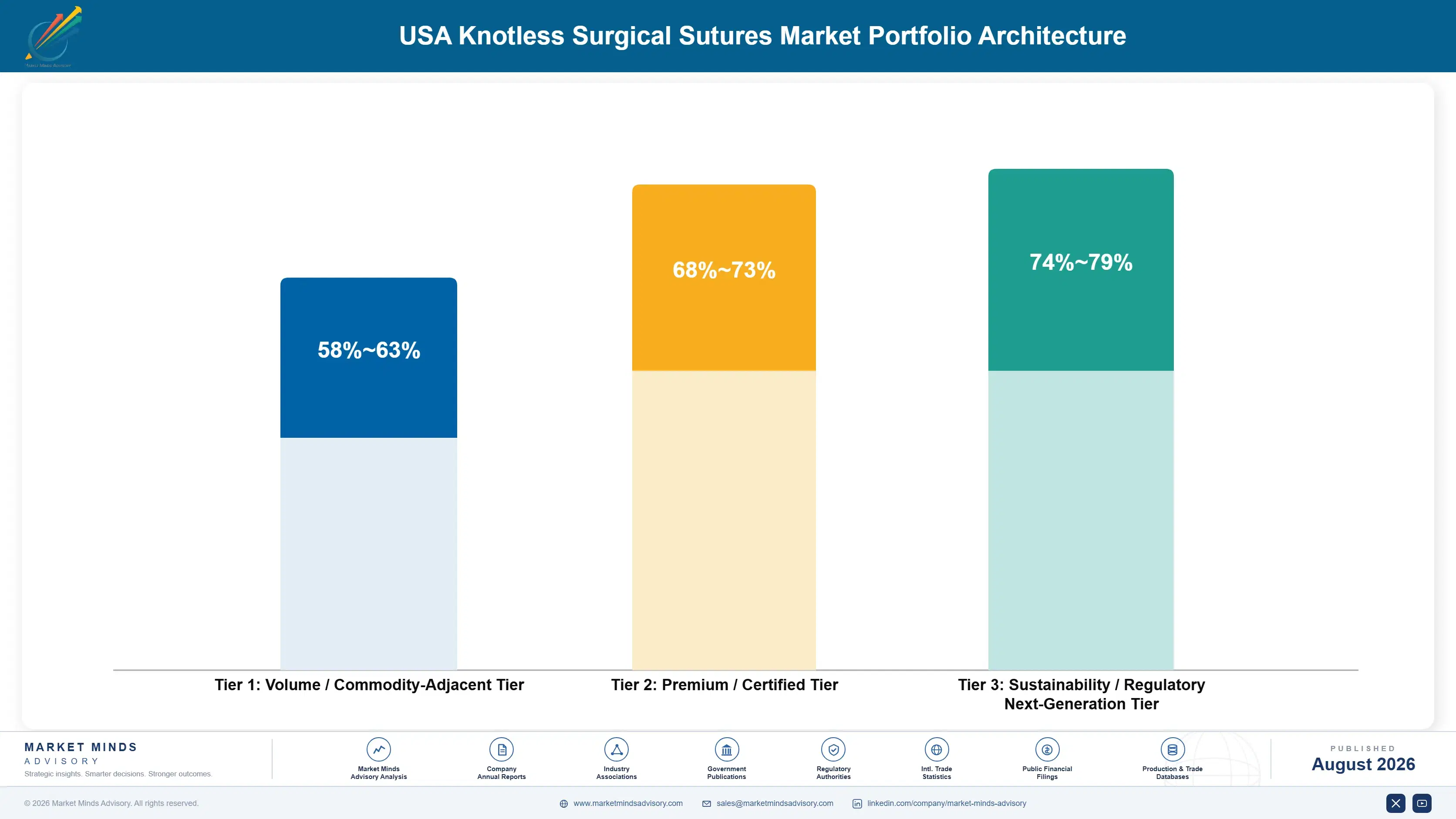
Three tiers describe this business and the spread is set by whether a construction can be tendered against an equivalent. Standard unidirectional and bidirectional barbed sutures sit at the bottom, where value-tier entrants now hold clearances and procurement can compare specifications line by line. Coated constructions sit higher on infection penalty economics. Anchor-terminated designs occupy a third tier on manufacturing complexity and a genuinely short supplier list.
The tension is that the contestable tier carries the conversion. A hospital converting a surgical service from conventional closure starts with standard barbed constructions on the commonest procedures, and only afterward specifies coated or anchor-terminated products where the case justifies them. A supplier absent from the standard tier is not in the theatre when those later decisions are made and generally does not get asked.

High-value pools concentrate where a procedure carries measurable downside. Colorectal, bariatric, and caesarean closure combine high baseline infection rates with payment penalties attached to them, which turns coating from a preference into an economic requirement that price comparison does not easily reach. Reversion there becomes a documented risk decision nobody wants to sign, which protects realised price better than any contractual term.

Volume / Commodity-Adjacent Tier

Standard unidirectional and bidirectional barbed absorbable sutures now cleared by value-tier entrants and comparable line by line at tender. Margin compresses at each renewal, but this tier carries the conversions through which every higher specification later gets specified.
Gross Margin: 58-63%

Premium / Certified Tier

Antibacterial-coated barbed constructions sold into procedures carrying surgical site infection payment penalties. Margin reflects an economic argument rather than a clinical preference, which price comparison against uncoated alternatives does not reach in the same way.
Gross Margin: 68-73%

Sustainability / Regulatory / Next-Generation Tier

Anchor-terminated knotless constructions addressing the termination failures that published series concentrate on. Best margin because manufacturing complexity keeps the qualified supplier list very short and because no straightforward tender equivalent currently exists.
Gross Margin: 74-79%
usa-knotless-surgical-sutures-market-portfolio-architecture-1787299891531

High-value Sub-segments and Strategic Watch-out

Antibacterial-Coated Barbed Sutures

Fastest growth at 13.2%, exactly 1.50 times the market rate, driven entirely by infection payment penalties converting an old clinical preference into a financial argument. Colorectal, bariatric, and caesarean closure have adopted furthest given their baseline infection rates. Nothing about the underlying evidence changed at all.
Gross Margin: 68-73%

Anchor-Terminated Constructions

Best margin on manufacturing complexity that keeps the supplier list genuinely short, addressing the termination point where published barbed closure failures concentrate. No straightforward tender equivalent exists, which protects realised price at renewal in a way nothing else here does. Manufacturing complexity is the barrier here.
Gross Margin: 74-79%

Standard Barbed Absorbable Sutures

The volume core under fresh pressure now that value-tier entrants hold clearances and procurement can compare specifications directly. It nonetheless carries the service conversions through which coated and anchor-terminated products are later specified inside the same theatre. Abandoning it removes the route to everything above.
Gross Margin: 58-63%

Bundled Contract Positions

The strategic watch-out here, since the portfolio agreements that protect knotless sutures from any separate tendering also make them part of a target large enough to attract serious procurement attention at every single renewal cycle. Defending the bundle usually means conceding price somewhere within it.
Gross Margin: 58-63%

How This Volume Converts

Conversion happens by surgical service rather than by hospital or by surgeon, which is the single most useful thing to understand about demand here. A gynaecology service adopts barbed closure for hysterectomy across all its surgeons at once, usually after one champion demonstrates it, and then the volume runs at that service's case rate indefinitely. Winning a service is worth several years of predictable consumption; winning an individual surgeon is worth very little and rarely spreads on its
Stickiness varies by how the conversion was made. Services converted through a documented time study and a protocol change stick hardest, because reverting means undoing an agreed practice standard rather than merely reordering a different product. Services where individual surgeons adopted informally revert readily whenever procurement raises the price question. Coated constructions stick hardest of all, since an infection penalty makes reversion a documented risk decision nobody wants to sign.

Buyer profiles are genuinely split. Surgeons drive the initial adoption, supply chain controls the approval, and perioperative services receives the benefit without participating in either conversation. Bridging those three functions is the commercial task, and manufacturers addressing only one convert at a fraction of the available rate.
usa-knotless-surgical-sutures-market-end-use-penetration-index-1787299892018

What We Would Tell a Board

These are among the four positions where our research anticipates prominent divergence between winners and laggards over the coming forecast period. Each is grounded in the demand model, the regulatory perimeter, and the announced capacity pipeline.
01 / PERIOPERATIVE BUYER ACCESS

You are selling minutes to people counting items

Supply chain evaluates a suture costing 4.3 times the conventional alternative and has no line of sight to theatre time at all, while perioperative services manages a facility running near 62 dollars a minute and never sees the item price. Selling to the second group with a case cost model that combines both lines converts submissions that fail routinely on unit price alone. Manufacturers restructuring commercial teams around perioperative leadership report win rates roughly doubling on exactly the same clinical evidence they already had.
02 / CUSTOMER-GENERATED TIME EVIDENCE

Nobody believes a journal article about their own theatre

Every surgical service is convinced its case mix and technique differ enough from published populations that time-motion evidence from elsewhere simply does not apply to them. Running a timed comparison across twenty cases in the customer's own operating room costs around 40,000 dollars in clinical support and produces a number that nobody in the approval meeting can dispute. Manufacturers who do this convert on the customer's own data, while everybody else brings a journal citation to what is really a spreadsheet fight.
03 / CONSISTENCY ARGUMENT FRAMING

The least standardised step in a protocolised operation

Tensile retention across hand-tied knots varies by roughly 31% between surgeons closing identical wounds, making knot tying the one remaining step in modern surgery with no meaningful standardisation behind it. Quality and safety functions find that compelling immediately and hold influence supply chain does not. Manufacturers avoid the argument because it sounds like criticism of surgeons, but framed as removing an unnecessary variable rather than fixing a deficiency it reaches an entirely new buyer inside the hospital without causing any offence.
04 / RENEWAL DEFENCE DESIGN

Concentration this high is a procurement target

A category at 88% concentration with unit prices several times the alternative looks like an obvious saving to any procurement analyst reviewing spend, whatever the underlying case economics actually show. Suppliers defending on price alone concede several points every renewal cycle and never recover them afterward. Bundling conversion support, in-theatre time studies, and surgeon training into the agreement costs around 700,000 dollars annually across a large system and raises switching cost well beyond the price difference actually at stake in the tender.

Engagement Snapshot From the Field

A live engagement with an industry participant carrying material or product regulatory and market exposure ahead of a defining policy shift, showing how our research translates into a defensible multi-year portfolio strategy.
MARKET MINDS ADVISORY · CLIENT ENGAGEMENT SUMMARY
USA Knotless Surgical Sutures Producer Strategic Portfolio Review and Transition Roadmap 2026·Investment Scenario on USA Knotless Surgical Sutures Exposure Evaluation 2025-26
CLIENT PROFILE
A wound closure manufacturer with approximately 210 million dollars in annual United States surgical suture revenue (client-reported, unverified by MMA), holding a modest knotless position alongside a larger conventional suture business. The commercial organisation sold through supply chain and value analysis committees, cited published time-motion literature, and offered no conversion support or training with any agreement it signed.
STRATEGIC CHALLENGE
Knotless conversion rates in the client's accounts trailed the national picture badly, and value analysis submissions were being rejected on unit price in roughly four cases out of five. Management proposed reducing knotless pricing toward conventional levels. The board wanted an independent read on whether price was genuinely the obstacle before compressing margin across the range.
MMA APPROACH
We reviewed sixty rejected value analysis submissions against who had evaluated them and on what basis. Theatre cost per minute and closure time were measured at eight customer sites. Approval pathways were mapped to establish who owned theatre utilisation in each system, and conversion durability was compared between services that had adopted formally and informally.
KEY FINDINGS
  1. Every rejected submission had been evaluated by supply chain against unit price alone, and none had reached anybody who held responsibility for theatre utilisation targets.
  2. Measured closure time saving at the eight sites averaged 21%, worth several times the price difference at a theatre cost near 62 dollars per minute fully loaded.
  3. Services that adopted through a documented time study and protocol change retained the product, while informally adopted services reverted whenever procurement raised price.
  4. Coated constructions faced almost no price challenge in procedures carrying infection payment penalties, since reversion became a documented risk decision instead of a saving.
CLIENT PROFILE
A wound closure manufacturer with approximately 210 million dollars in annual United States surgical suture revenue (client-reported, unverified by MMA), holding a modest knotless position alongside a larger conventional suture business. The commercial organisation sold through supply chain and value analysis committees, cited published time-motion literature, and offered no conversion support or training with any agreement it signed.
STRATEGIC CHALLENGE
Knotless conversion rates in the client's accounts trailed the national picture badly, and value analysis submissions were being rejected on unit price in roughly four cases out of five. Management proposed reducing knotless pricing toward conventional levels. The board wanted an independent read on whether price was genuinely the obstacle before compressing margin across the range.
MMA APPROACH
We reviewed sixty rejected value analysis submissions against who had evaluated them and on what basis. Theatre cost per minute and closure time were measured at eight customer sites. Approval pathways were mapped to establish who owned theatre utilisation in each system, and conversion durability was compared between services that had adopted formally and informally.
KEY FINDINGS
  1. Every rejected submission had been evaluated by supply chain against unit price alone, and none had reached anybody who held responsibility for theatre utilisation targets.
  2. Measured closure time saving at the eight sites averaged 21%, worth several times the price difference at a theatre cost near 62 dollars per minute fully loaded.
  3. Services that adopted through a documented time study and protocol change retained the product, while informally adopted services reverted whenever procurement raised price.
  4. Coated constructions faced almost no price challenge in procedures carrying infection payment penalties, since reversion became a documented risk decision instead of a saving.
RECOMMENDED STRATEGY
Phase 1: Phase 1 (months one to nine): cancel the price reduction and rebuild commercial coverage around perioperative services rather than supply chain committees. Phase 2: Phase 2 (months nine to twenty-four): fund in-theatre time studies at target accounts and convert services through documented protocol change. Phase 3: Phase 3 (months twenty-four to thirty-six): weight the portfolio toward coated and anchor-terminated constructions. Both tiers resist tender comparison far better.
OUTCOME
The price reduction was cancelled. Value analysis approval rates rose above half within four quarters once submissions reached perioperative leadership with customer-generated time data, converted services proved durable at renewal, and coated construction mix improved materially (client-reported, unverified by MMA). Conversion support was added to every agreement.

Frequently Asked Questions

Foundational context covering the market sizes, CAGR, scope, country, region and competition that inform every finding below. This section is provided to cover basics and most often pre-purchase conversations, answered from the MMA Primary Research Dataset.

What is the current size of the USA Knotless Surgical Sutures Market?

The market is valued at USD 0.74 billion in 2025, rising to USD 0.81 billion in 2026. Scope covers barbed and knotless sutures used in procedures performed within the United States.

How large will the USA Knotless Surgical Sutures Market be by 2036?

MMA forecasts USD 1.87 billion by 2036, an increase of USD 1.06 billion over the 2026 base. That represents an expansion multiple of 2.31 times across the forecast period.

What is the CAGR for the USA Knotless Surgical Sutures Market 2026 to 2036?

The base case CAGR is 8.8%, with a bull case of 10.0% and a bear case of 7.6%. The historical rate from 2020 to 2025 was 7.4%, so conversion is accelerating.

Which segment is growing fastest?

Antibacterial-coated barbed sutures at 13.2%, exactly 1.50 times the market rate. Surgical site infection payment penalties turned an established clinical preference into a financial argument.

Who are the major companies in the USA Knotless Surgical Sutures Market?

Johnson and Johnson, Medtronic, Corza Medical, DemeTECH, and Assut Medical lead on annual units sold into United States procedures. The top five hold 88% between them.

Which country is growing fastest?

The United States at 8.8%, which is nominal since this report covers a single national market. Growth varies far more by surgical service than by geography within it.

Report Segmentation Architecture

The full report scope spans multiple orthogonal segmentation dimensions, with cross-tabulated demand data provided for each dimension pair. Coverage extends further to regional breakdowns, trend trajectories, and the competitive detail needed to support segment-level decision-making.

By Suture Construction

  • Unidirectional Barbed Absorbable Sutures
  • Bidirectional Barbed Absorbable Sutures
  • Antibacterial-Coated Barbed Sutures
  • Non-Absorbable Barbed Sutures
  • Anchor-Terminated Knotless Sutures
  • Long-Absorption Barbed Sutures

By Surgical Service

  • Gynaecology And Obstetric Surgery
  • Bariatric And General Laparoscopic Surgery
  • Orthopaedic And Arthroplasty Closure
  • Colorectal And Abdominal Surgery
  • Plastic And Reconstructive Surgery

By Purchasing Channel

  • Group Purchasing Organisation Agreements
  • Integrated Delivery Network Direct Contracts
  • Ambulatory Surgery Centre Purchasing
  • Medical Surgical Distributor Supply
  • Independent Hospital Direct Purchase

By Region

  • Latin America
  • North America
  • East Asia
  • Western Europe
  • South Asia and Pacific
  • Eastern Europe
  • Middle East and Africa

Scope, Methodology, and Coverage

Every figure in this report is reproducible from documented input assumptions. The scope below maps the historical period, the forecast horizon, the segmentation dimensions, and the countries covered, alongside the underlying primary and qualitative methodology.
Historical Period
2020 to 2025
Forecast Period
2026 to 2036
Base Year
2025 (USD billions; MMA Primary Research Dataset, August 2026)
Market Definition
This market comprises barbed and knotless surgical sutures used in procedures performed within the United States, measured at manufacturer realised prices net of contract rebates and group purchasing discounts. Construction coverage spans unidirectional barbed absorbable, bidirectional barbed absorbable, antibacterial-coated barbed, non-absorbable barbed, anchor-terminated knotless constructions terminating in a loop or welded end, and long-absorption barbed sutures. Conventional knotted sutures of any material, surgical staplers and stapling reloads, tissue adhesives and sealants, surgical mesh and hernia repair devices, knotless orthopaedic suture anchors, wound dressings, and any procedure performed outside the United States fall outside scope.
Quantitative Units
USD billions (current prices); suture units sold annually; realised price per unit; converted surgical services
Segmentation Dimensions
By Suture Construction; By Surgical Service; By Purchasing Channel; By Region
Regions Covered
Latin America, North America, East Asia, Western Europe, South Asia and Pacific, Eastern Europe, Middle East and Africa
Countries Covered
United States, with supply origin coverage across Mexico, Puerto Rico, Canada, China, South Korea, Japan, India, Vietnam, Germany, Ireland, United Kingdom, France, Italy, Spain, Switzerland, Belgium, Poland, Czechia, Turkey, Israel, Brazil, and additional markets relevant to this sector
Key Companies Profiled
Johnson & Johnson, Medtronic, Corza Medical, DemeTECH, Assut Medical, B. Braun, Péters Surgical, Internacional Farmacéutica, Dolphin Sutures, Healthium Medtech, Meril Life Sciences, Lotus Surgicals, Shanghai Pudong Jinhuan Medical, Jiangsu Chenkai, Riverpoint Medical, CP Medical, Genesis MedTech, Aspen Surgical, Unimax Medical, Kono Seisakusho
Quantitative Methodology
Primary survey, n=3,800 respondents, Q4 2025, six countries; demand-side model with trade association cross-validation
Qualitative Methodology
47 expert interviews, Q4 2025; applied to validate demand model assumptions, identify emerging dynamics, and assess competitive positioning
Report Format
PDF and XLSX data workbook (Word format preview document)
Publisher
Market Minds Advisory
Report Code
MMA-2026-MED-476
Published
August 2026
Contact
sales@marketmindsadvisory.com | www.marketmindsadvisory.com

Purchase the full USA Knotless Surgical Sutures Market Report (2026 to 2036).

The full report sizes knotless surgical sutures across six constructions, five surgical services, five purchasing channels, and the United States market in detail, with supply origin mapped across manufacturing countries. Closure time saving is quantified by procedure type against measured theatre cost per minute, since that comparison rather than unit price determines the genuine economics. Value analysis approval rates are analysed against which hospital function evaluated the submission. Competitive profiling covers twenty companies on annual units sold into United States procedures. Conversion durability is compared between formally and informally adopted surgical services.
Closure time saving quantified by procedure against theatre cost
Value analysis approval rates analysed by evaluating hospital function
Conversion durability compared across formal and informal adoption
Supply origin mapped across manufacturing countries and facilities
Infection penalty exposure assessed by surgical service and procedure
Contract renewal price movement tracked across purchasing channels

Built For The People Who Decide

From boardroom strategy to bench-side execution, this report is read cover-to-cover by leaders shaping the next decade of their industry, turning demand scenarios, market dynamics and valuation benchmarks into decisions.
CXOs/ Presidents/ VPs/ Managers
M&A and Corporate Development
Strategy Teams and R&D Heads
Procurement and Product Directors
Regulatory and Compliance Leaders
Investor Relations and Equity Analysts