Market Minds Advisory
Animal Artificial Insemination Market

Animal Artificial Insemination Market: Genomic Selection and Sexed Semen Dynamics

Sexed semen and genomic selection are turning artificial insemination into a data-driven genetics business, concentrating value among companies that control both proprietary sperm-sorting technology and genetic merit rankings breeders increasingly demand.

Lead Analyst

Alice Ballenger

Published

September 2026

Make Smarter Decisions with Customized Research Insights

Request a free sample report and evaluate market opportunities, growth trends, and competitive dynamics relevant to your business needs.

2025 MARKET VALUE$4.2BMarket Size 2025
2036 FORECAST VALUE$8.7BBase Case , 2026 to 2036
CAGR 2026 TO 20366.8 %Bull 7.9% / Bear 5.6%
INCREMENTAL OPPORTUNITY$4.2BNet 10- year value creation
EXPANSION MULTIPLE1.93x2036 value over 2026 base
Strategic Levers
M&A Pipeline
Regional Outlook
Country Rankings
Competitive Intelligence
Segmental Deep-dive
Call-Us : 91 93563 13602

Executive Snapshot and Market Trajectory

Artificial insemination in livestock breeding is shifting from conventional semen doses toward sexed and genomically ranked semen, letting breeders select calf sex and genetic merit simultaneously in ways that were commercially impractical just a decade ago across most major dairy and beef operations worldwide each year.
Sexed semen is the fastest-growing segment as dairy operations worldwide increasingly demand female-biased calves to expand milking herds without proportional bull calf byproduct, while genomic testing services layer additional selection precision onto every straw sold. North America and Western Europe anchor the deepest commercial concentration, reflecting decades of genetics company headquarters, proprietary sperm-sorting technology, and breeding program investment that developing dairy markets with larger raw herd counts still cannot fully replicate at comparable scale.
Genus and STgenetics set the technology benchmark through proprietary genomic selection platforms and sperm-sorting patents, while a fragmented tail of regional AI cooperatives and smaller genetics companies competes on price and local service relationships. Expanding genomic testing adoption and patent expiry on core sexing technology are both reshaping which vendors capture breeding revenue as smaller entrants gain access to previously proprietary capability faster than expected.
Market Definition
The animal artificial insemination market covers semen doses, sperm-sorting and genomic testing services, and AI equipment used to breed dairy cattle, beef cattle, swine, and other livestock without natural mating. It spans conventional and sexed semen doses, breeding-related genomic testing, embryo transfer services, and AI delivery equipment across all major livestock categories. Natural mating services, unrelated animal health pharmaceuticals, and general veterinary diagnostics are excluded.
Base Year Value
$4.2B in 2025 (MMA Primary Research Dataset, August 2026)
Forecast Period
2026 to 2036, eleven discrete annual values
CAGR
6.8% base case. Bull 7.9%. Bear 5.6%.
Fastest Growth Segment
Sexed and Sorted Semen Doses: 13.2% CAGR
Fastest Growth Country
India: 10.8% CAGR
Fastest Growth Region
South Asia and Pacific: 9.1% CAGR
Largest Region
North America: 27% of 2025 global value
Market Leaders
Genus, CRV Holding, Semex Alliance, STgenetics, URUS Group. Source: MMA Analysis based on company annual reports.
Primary Survey
n=3,800 procurement and R&D decision-makers, Q4 2025, six countries
Methodology
Demand-side build-up, cross-validated against public data, 47 expert interviews

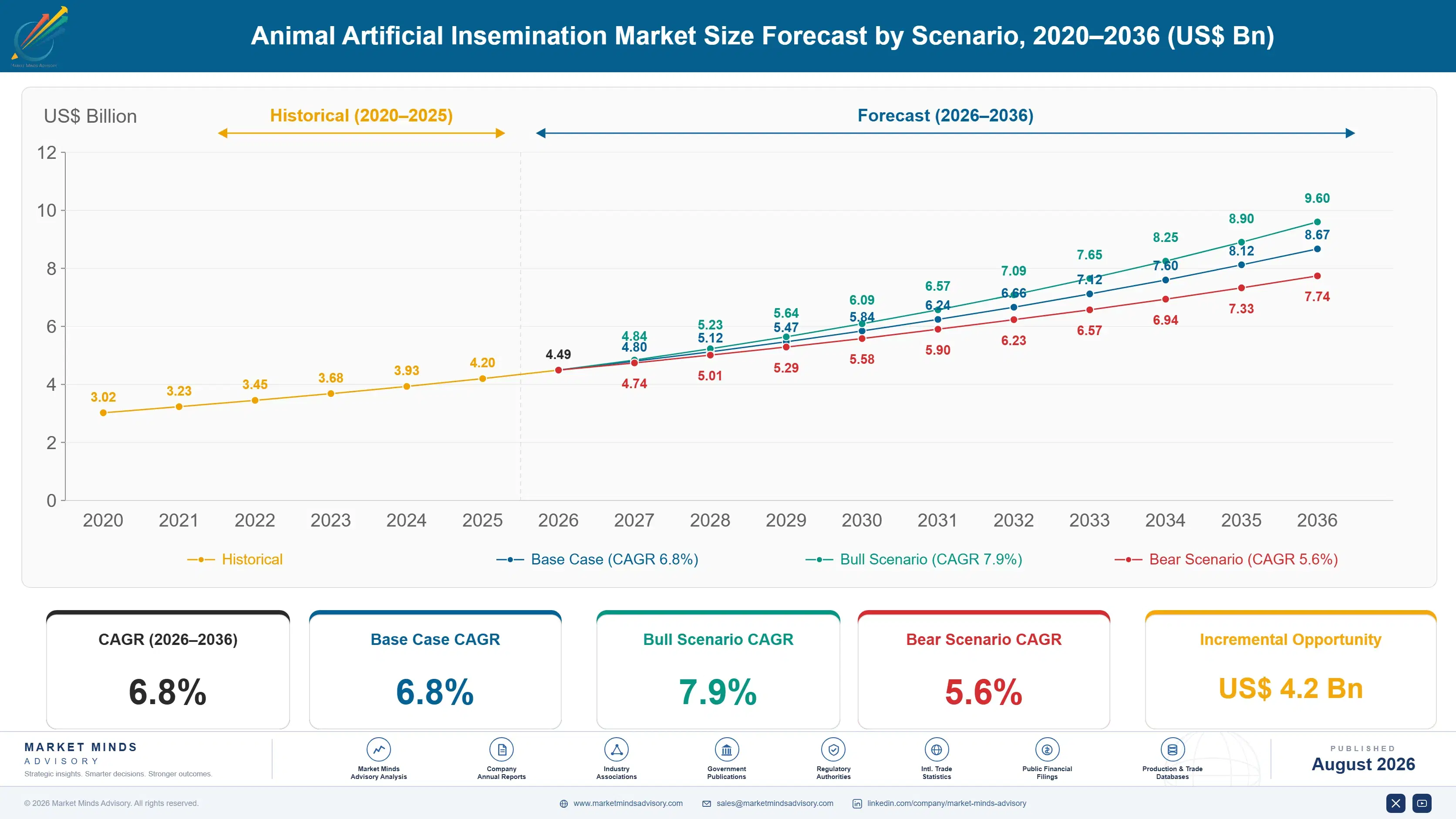
Animal Artificial Insemination Market Forecast Scenarios

usa-animal-artificial-insemination-market-size-forecast-scenario-1787303645516
Artificial insemination demand grew steadily across 2020 to 2025 as dairy and beef operations consolidated into larger herds that favor AI over natural mating, even as commodity dairy price volatility periodically slowed breeding investment. The market grew at an estimated 6.2% historical CAGR across the period, reflecting rising sexed semen and genomic testing adoption offsetting flat conventional semen dose volume in mature markets.
The base case assumes sexed semen adoption continues expanding across both dairy and beef operations through 2030, genomic testing becomes standard practice alongside most semen dose purchases, and emerging dairy markets in South Asia and Latin America scale AI penetration meaningfully. Together these three commercial mechanisms support a 6.8% forecast CAGR, with conventional semen remaining the volume anchor even as sexed and genomically tested doses capture a growing share of total value each year across every major producing region.
The bull case centers on faster-than-expected sexed semen conception rate improvements that narrow the remaining gap with conventional semen well ahead of current timelines. The bear case centers on renewed dairy commodity price weakness, which would slow breeding program investment and push producers back toward lower-cost conventional semen across cost-constrained operations worldwide for several years to come.

Genetics IP and Herd Consolidation Dynamics

Artificial insemination sits at the intersection of livestock genetics and reproductive biotechnology, since sperm-sorting and genomic testing require specialized laboratory capability while conventional semen collection and distribution remains a comparatively simple commodity business. That split has kept the vendor base divided between technology-driven genetics companies and regional AI cooperatives competing on service and price.
TOP 5 CONCENTRATION42%share held by leading five genetics and breeding companies
AVERAGE DOSE PRICE$28 per sexed dosetypical price premium for sexed over conventional semen
LEADING COUNTRY SHAREUnited States, 19%share of global artificial insemination dose volume overall
SEXED SEMEN PENETRATION38% of dairy dosesshare of dairy semen doses sold in sexed form
GENOMIC TESTING ATTACH RATE44% of breeding herdsshare of breeding herds enrolled in genomic testing programs
CONCEPTION RATE GAP8 to 12 pointstypical conception rate gap between sexed and conventional semen
Commercially, the market splits between a mature conventional semen base sold through broad cooperative and distributor channels, and a smaller but faster-growing sexed and genomically tested tier sold on calf sex certainty and predicted genetic merit rather than price alone. Embryo transfer and AI equipment round out demand with application-specific purchasing tied to elite genetic multiplication and breeding technician staffing needs.
Over the next decade, genetic data and sexing precision will matter more than raw dose volume alone, since breeders increasingly select suppliers based on predicted genetic merit accuracy rather than semen price per straw. Vendors that can expand genomic testing and sexed semen production capacity into mid-tier regional cooperatives fastest stand to capture a widening share of a market that data-driven breeding is reshaping as much as herd consolidation is.
"Breeders used to buy semen. Now they buy a genetic merit prediction that happens to come with semen attached."
Director, Animal Genetics and Breeding Practice · MMA Agriculture / Livestock Ge

Market Trends

Sexed Semen Adoption Broadens Beyond Dairy Operations

Sexed semen, historically concentrated in dairy operations seeking female-biased calves for herd replacement, is expanding into beef cattle operations seeking male-biased calves for terminal market production, broadening the addressable use case for sperm-sorting technology considerably. STgenetics and Genus have both expanded sexing laboratory capacity since 2023 to meet this dual-direction demand, targeting breeding cooperatives that previously lacked access to reliable sexed semen supply at commercial scale. Conception rates for sexed semen continue narrowing the gap with conventional semen as sorting technology improves, removing one of the last remaining barriers to broader adoption across both dairy and beef operations worldwide.
Market Impact: Covers 9 million dairy cows annuall
Genomic Testing Becomes Standard Breeding Practice

Genomic testing, once reserved for elite seedstock and nucleus herds, is becoming standard practice across commercial breeding operations as testing costs fall and predicted genetic merit accuracy improves meaningfully with larger reference populations. Neogen and Zoetis have both expanded genomic testing panel availability and lowered per-sample pricing since 2023, targeting commercial dairy and beef operations that previously found testing economically impractical at scale. This testing expansion is letting breeders select semen suppliers based on predicted genetic merit data rather than pedigree alone, shortening the interval between genetic potential and realized herd improvement considerably.
Market Impact: Reaches 5 million smallholder herds

Market Opportunities and Growth Drivers

Dairy Herd Consolidation Favors AI Over Natural Mating

Global dairy herd consolidation into larger, more professionally managed operations continues favoring artificial insemination over natural mating, since larger herds can justify the breeding technician expertise and record-keeping infrastructure that AI programs require to deliver genetic improvement at scale. The United States dairy herd has consolidated meaningfully over the past decade, with a shrinking number of operations now managing a majority of the national dairy cow inventory and nearly all relying on structured AI breeding programs. Similar consolidation trends are underway across Western Europe, sustaining AI dose demand even where cattle inventory growth remains flat.
Market Impact: Excludes 30% of smallholder herds

Government Dairy Programs Expand AI Access In Emerging Markets

National dairy development programs across South Asia, led by India's Rashtriya Gokul Mission and similar state-level initiatives, are subsidizing artificial insemination access for smallholder dairy farmers who previously relied entirely on natural mating with limited genetic improvement potential. These programs have expanded AI technician training and cold-chain semen distribution infrastructure meaningfully since 2022, reaching smallholder herds that commercial AI companies could not previously serve profitably on their own. Similar government-backed programs are emerging across parts of Sub-Saharan Africa and Southeast Asia, gradually expanding the formal AI-served share of the world's smallholder dairy herd.
Market Impact: Cuts sexed semen margins by 15%

Market Restraints and Challenges

Cold-Chain Logistics Limit Rural Market Penetration

Semen doses require continuous liquid nitrogen cold-chain maintenance from collection through insemination, creating logistics costs and technical failure risk that limit artificial insemination penetration in regions lacking reliable rural transport and storage infrastructure. This constraint is most severe in smallholder farming regions across Sub-Saharan Africa and parts of South Asia, where breeders may lack economic access to trained AI technicians or reliable semen tank replenishment on any predictable schedule. Genetics companies and government programs are investing in expanded regional distribution hubs and mobile AI technician networks to extend cold-chain reach, though meaningful improvement will take years across most affected markets.
Market Impact: Adds $28 premium per sexed dose

Sperm-Sorting Patent Expiry Pressures Pricing Power

Core sperm-sorting patents that historically protected premium sexed semen pricing are beginning to expire across major markets, opening the technology to smaller competitors and regional cooperatives that previously could not offer sexed semen at commercially viable cost. That patent expiry forces established sexing technology leaders to compete increasingly on conception rate performance and service quality rather than exclusive technology access alone, compressing margins that funded years of sorting technology research and development investment. Established players are responding by accelerating next-generation sorting technology development and bundling genomic testing services to preserve differentiation as patents lapse.
Market Impact: Cuts testing cost by 45%
3 additional market trends, 2 additional growth drivers, and 4 additional restraints and challenges are covered in the full report. Contact sales@marketmindsadvisory.com to access the complete intelligence.

Segment CAGR and Growth Architecture

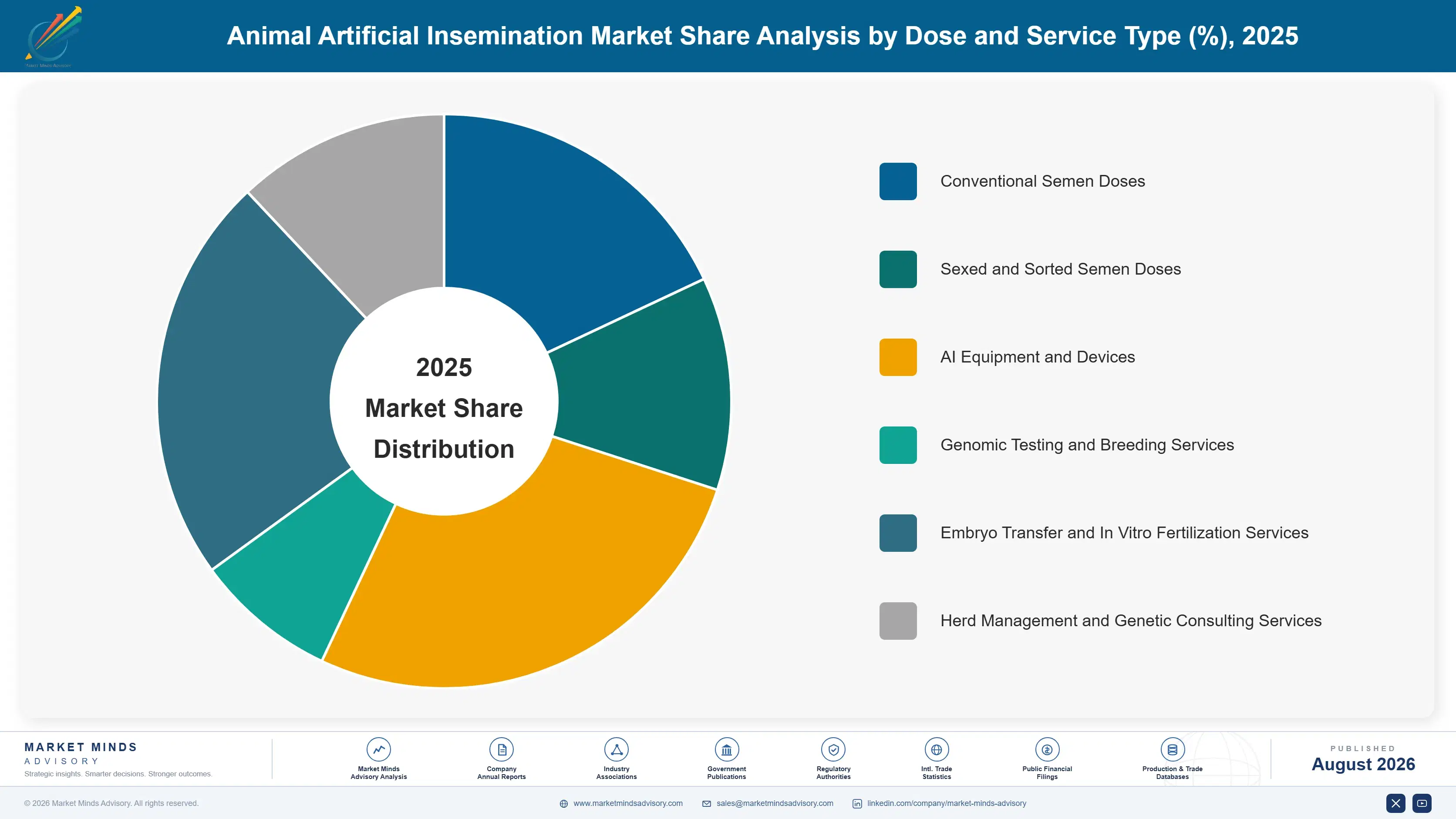
Artificial insemination products segment by dose and service type, the classification breeding cooperatives and genetics companies use to set pricing, technical delivery requirements, and margin structure, since conventional, sexed, and genomic testing buyers each negotiate under distinct commercial terms. Vendors price each category differently depending on sorting technology and genetic data depth involved. Margins compress as access broadens.
usa-animal-artificial-insemination-market-market-share-analysis-1787303646049

Sexed and Sorted Semen Doses

Sexed and sorted semen doses form the fastest-growing segment as dairy and beef operations increasingly demand calf sex certainty to optimize herd replacement and terminal market production respectively. STgenetics and Genus have both expanded sperm-sorting laboratory capacity since 2023, targeting breeding cooperatives that want reliable sexed semen supply at commercial-scale pricing rather than niche premium positioning. Cooperatives that adopt sexed semen early are capturing member loyalty from smaller distributors that lack sorting technology access, an advantage that compounds as more breeding programs standardize around sex-selected genetics. If sexed semen adoption continues at the current pace, this segment could approach a meaningful share of total category value within the next decade.
CAGR 13.2%

Genomic Testing and Breeding Services

Genomic testing and breeding services form the second-fastest segment as commercial dairy and beef operations increasingly pair semen purchases with predicted genetic merit data rather than relying on pedigree information alone. Neogen and Zoetis have both expanded genomic testing panel availability and commercial-scale pricing since 2023, targeting operations that previously found testing economically impractical outside elite seedstock herds. Breeding programs that integrate genomic testing early are capturing member loyalty from cooperatives that still rely on pedigree-only selection, an advantage that compounds as reference population data improves prediction accuracy. Testing services increasingly bundle directly with semen dose purchases rather than selling separately. Cooperatives increasingly view testing infrastructure as a durable competitive differentiator worth defending.
CAGR 11.4%
Full segment breakdown across 6 segments available in the complete report.

Regional Architecture and Country Demand Map

Artificial insemination commercial activity concentrates where genetics company headquarters and proprietary sorting technology reside, even though raw cattle inventory and breeding volume often run highest in regions still building the AI technician and cold-chain infrastructure needed to capture that value commercially each year. particularly across major producing regions.

North America

The United States and Canada together anchor North America's artificial insemination commercial value, reflecting decades of genetics company headquarters, proprietary sperm-sorting technology development, and dairy herd consolidation into large, professionally managed operations that rely almost entirely on structured AI breeding programs. STgenetics and URUS Group both maintain their primary research and sexing laboratory infrastructure within the region, capturing licensing and technology revenue well beyond the region's own dose volume alone. Sexed semen and genomic testing penetration both run meaningfully ahead of the global average across most large commercial dairy operations. Beef cattle operations are adopting sexed semen more slowly than dairy, though adoption is broadening each year across major cattle-producing states.
Share: 27% | CAGR: 7.3% (2026 to 2036)

Western Europe

The Netherlands, France, and the United Kingdom together anchor Western Europe's artificial insemination demand, reflecting long-established cooperative breeding structures and genetics company headquarters including CRV and Cogent Breeding that have operated regional breeding programs for decades. Dairy herd consolidation across the region has proceeded steadily, sustaining AI dose demand even as total cattle inventory has declined modestly in several member markets over the past decade. Genomic testing penetration runs comparatively high given the region's dense cooperative breeding infrastructure and long history of structured genetic recording. Smaller Western European markets rely heavily on cross-border genetics imports from the region's larger breeding cooperatives. Cooperative consolidation continues gradually, reinforcing the region's long-standing genetics research and breeding infrastructure leadership.
Share: 24% | CAGR: 5.6% (2026 to 2036)
Regional intelligence for 5 additional markets available in the complete report: East Asia, South Asia and Pacific, Latin America, Middle East and Africa, Eastern Europe. Contact sales@marketmindsadvisory.com.
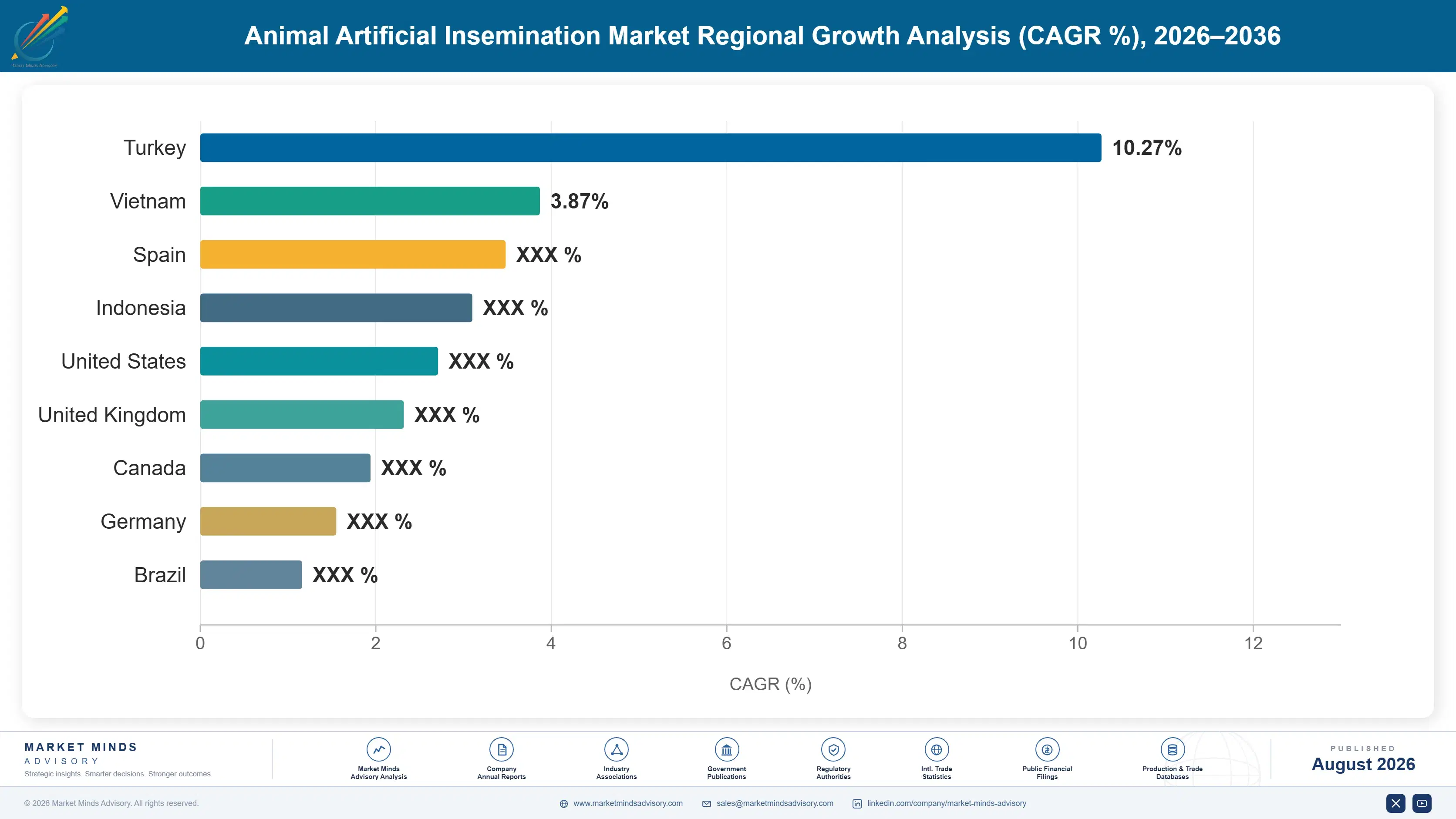
usa-animal-artificial-insemination-market-country-cagr-analysis-1787303646571

Where Genetics Value Concentrates Next

Revenue growth in artificial insemination increasingly depends on capturing sexed semen adoption, genomic testing attach rates, and emerging-market infrastructure expansion rather than raw conventional dose volume alone, since herd consolidation and patent expiry are reshaping where breeding value concentrates. The levers below outline where that value is concentrating fastest across the breeding pathway today.

Expanding Sperm-Sorting Laboratory Capacity Right Now

Genetics companies expanding sperm-sorting laboratory capacity are capturing sexed semen volume that capacity-constrained competitors cannot fulfill, particularly as beef cattle operations join dairy in demanding sex-selected genetics at commercial scale. Building additional sorting laboratory capacity typically costs $15 million to $35 million in equipment, facility, and technician training investment per major regional expansion. Companies without adequate sorting capacity increasingly lose cooperative distribution relationships to better-capitalized competitors offering reliable supply. Companies without such investment risk losing cooperative relationships to better-capitalized competitors permanently over time. That advantage compounds further as beef demand for sexed semen continues accelerating industry-wide.
Market Impact: Costs $15 to $35 million per full e

Building Genomic Testing Reference Population Scale

Genetics companies building larger genomic testing reference populations are capturing prediction accuracy advantages that smaller competitors with thinner reference data cannot match, since predicted genetic merit accuracy improves directly with reference population size and diversity. Building a competitive reference population typically costs $20 million to $50 million in genotyping, data infrastructure, and breeding program partnership investment over several years. Companies with larger reference populations increasingly win breeding program contracts from competitors offering less accurate genetic merit predictions. Companies without such scale risk losing prediction-accuracy-sensitive customers to better-positioned competitors steadily. That advantage compounds as reference population data quality improves.
Market Impact: Costs $20 to $50 million to fully b

Securing Broader Emerging Market Distribution Partnerships

Genetics companies securing distribution partnerships with government dairy development programs and regional cooperatives across South Asia and Latin America are capturing smallholder volume that remains largely untapped by direct commercial sales alone. These partnerships typically carry a 12 to 22% margin premium over commodity distributor channels given the technical training and cold-chain infrastructure support required to serve smallholder markets reliably. Companies able to demonstrate reliable rural cold-chain performance increasingly win government program contracts over less-prepared competitors. Companies without such partnerships compete purely on commercial dairy volume when smallholder markets remain closed.
Market Impact: Commands a 12 to 22% margin premium

Investing In Next-Generation Sorting Technology Now

Genetics companies investing in next-generation sperm-sorting technology that improves conception rates and processing speed are positioned to capture premium pricing as core sorting patents expire and competition intensifies on performance rather than exclusive access. Developing next-generation sorting technology typically costs $40 million to $90 million in research, clinical trial, and regulatory validation investment across multiple breeding seasons. Companies with superior sorting technology increasingly win premium pricing from breeders willing to pay for better conception rates. Companies without such investment risk losing premium pricing power once patent protection fully lapses across major markets.
Market Impact: Costs $40 to $90 million to fully d

Who Controls the Margin Pool

The top five vendors hold an estimated 42% of global artificial insemination revenue, a moderate concentration reflecting both the technology barriers protecting sexed semen and genomic testing leaders and the fragmented cooperative structure still common in conventional semen distribution. Genus and STgenetics lead on sperm-sorting technology and genomic selection platforms, while a fragmented tail of regional cooperatives competes on price and local service relationships.
Current competitive activity centers on three fronts. Sorting capacity expansion is opening a new front for genetics companies willing to invest ahead of broader sexed semen demand growth. Genomic reference population scale is becoming increasingly important as companies compete on predicted genetic merit accuracy rather than pedigree alone. And several regional cooperatives are pursuing distribution partnerships with government dairy programs to capture emerging-market smallholder volume.

Emerging pressure comes from mid-sized regional cooperatives moving into genomic testing and sexed semen distribution as sorting patents expire and technology access broadens, though matching Genus or STgenetics's reference population scale remains years away for most. If these challengers close that data gap, expect share to shift within specific regional cooperative markets first, before any material pressure reaches the largest incumbents given how embedded existing relationships are.
usa-animal-artificial-insemination-market-company-positioning-matrix-1787303647094

Competitive Moat and Risk Dimensions

GENUS PLC

Moat: Proprietary Genomic Selection Platform

Genus operates one of the largest proprietary genomic reference populations in livestock genetics, built through decades of breeding program data collection across both cattle and swine operations worldwide. That data depth gives Genus a durable prediction-accuracy advantage that smaller competitors with thinner reference populations cannot quickly replicate, even as genomic testing costs continue falling industry-wide.
GENUS PLC

Risk: High R&D Reinvestment Requirement

Maintaining genomic prediction accuracy leadership requires continuous reinvestment in reference population expansion and breeding program data infrastructure, a cost burden that smaller, less capitalized competitors do not carry at comparable scale. If Genus slows that reinvestment pace, its prediction-accuracy advantage could erode meaningfully within several breeding generations.
STGENETICS

Moat: Sexed Semen Technology Leadership

STgenetics holds foundational sperm-sorting technology and processing capacity that has anchored its sexed semen market leadership for years, built through sustained research investment and processing laboratory scale that smaller competitors have struggled to match. That processing scale advantage lets STgenetics offer sexed semen at commercial pricing that smaller sorting operations still find difficult to reach.
STGENETICS

Risk: Patent Expiry Competitive Exposure

Core sperm-sorting patents underlying STgenetics's technology leadership are beginning to expire across major markets, opening the door to smaller competitors and regional cooperatives that previously could not offer sexed semen at viable cost. Without continued technology differentiation, STgenetics risks losing pricing power as sexed semen becomes increasingly commoditized.

Players Tracked

Prominent Players

Genus plc
CRV Holding B.V.
Semex Alliance
STgenetics
URUS Group

Other Key Players

World Wide Sires Ltd.
Coopex Montbeliarde
Avantea S.r.l.
Neogen Corporation
IMV Technologies
Minitube GmbH
Cogent Breeding Ltd.
XY, LLC
Vytelle LLC
Zoetis Inc.
Topigs Norsvin
Hendrix Genetics B.V.
EW Group GmbH
Aviagen Group
Genesis Breeding International

Recent Developments

MARCH 2025

STgenetics Expands Sperm-Sorting Laboratory Capacity

STgenetics commissioned additional sperm-sorting laboratory capacity to meet rising sexed semen demand across both dairy and expanding beef cattle applications, following distributor commitments signed as more cooperatives sought reliable sexed semen supply. The expansion followed sustained cooperative pressure for dedicated sorting infrastructure given growing dual-direction demand.
Signal: Confirms sorting capacity is becoming the
OCTOBER 2024

Genus Signs Multi-Year Genomic Data Partnership

Genus secured a multi-year genomic data partnership with a major regional dairy cooperative network, guaranteeing testing volume and reference population data access through 2029 across several affiliated breeding programs. The agreement reflects cooperatives' push to lock in reliable genomic testing capacity ahead of broader industry standardization.
Signal: Shows cooperatives prioritizing long-term
JANUARY 2025

CRV Announces Emerging Market Distribution Expansion

CRV announced expanded distribution partnerships across South Asia and Latin America to serve smallholder dairy farmers through government-backed AI development programs, following sustained demand for sexed semen and genomic testing services in previously underserved smallholder markets. Similar expansions are expected across other qualified competitors soon.
Signal: Signals emerging-market smallholder distri

Sorting Technology and Genotyping Cost Pressure

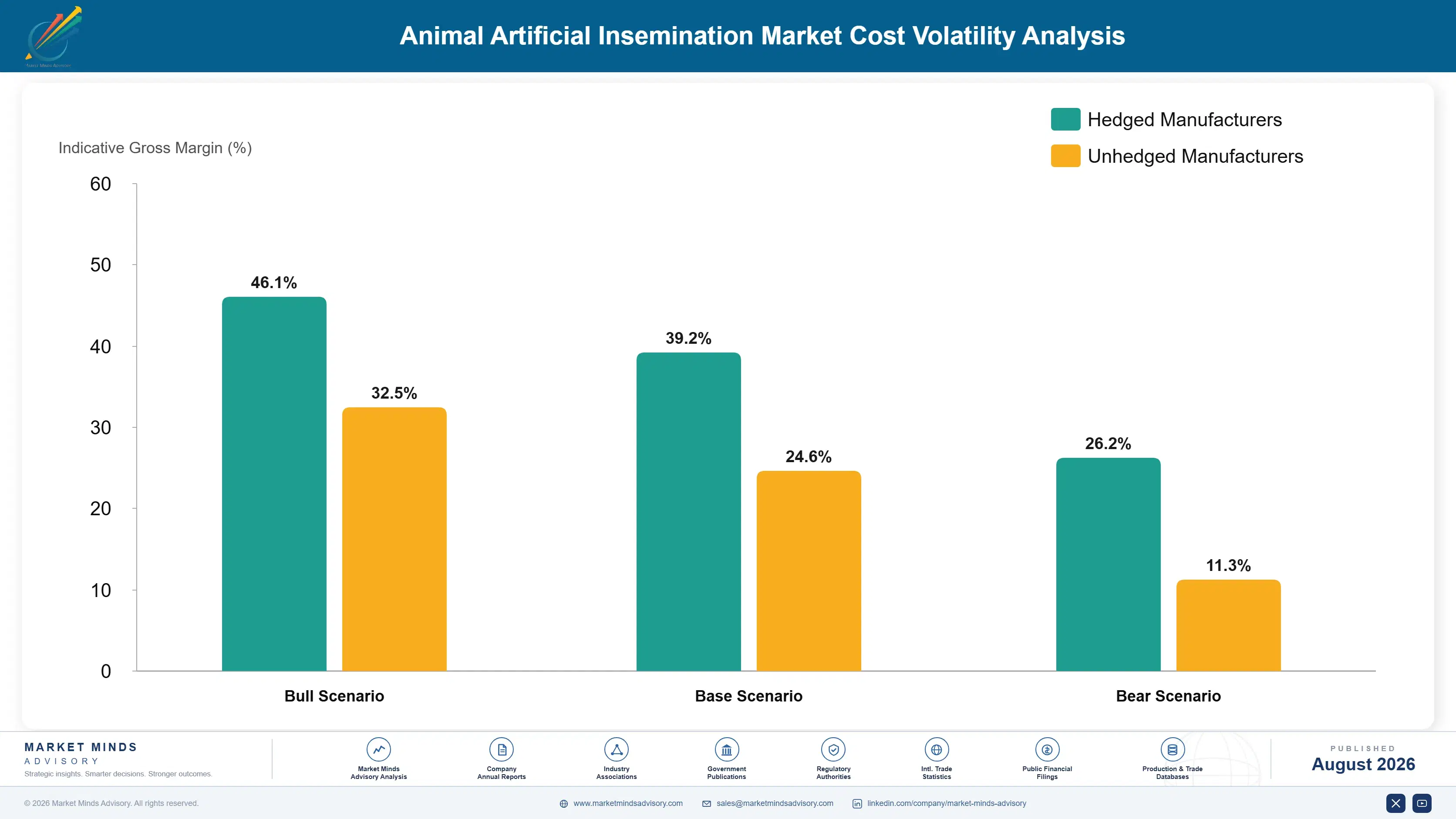
Sperm-sorting equipment and genomic genotyping reagents together account for roughly 32% of effective cost of goods for sexed semen and genomic testing providers, given the specialized laboratory equipment and consumable costs involved in both processes. Bull housing, feed, and veterinary care add a further meaningful share, concentrated among vendors maintaining proprietary genetics herds for semen collection.
Genotyping reagent and laboratory equipment costs rose meaningfully following 2022 global supply chain disruption, with several manufacturers reporting input cost increases exceeding 18% in their annual reports before pricing stabilized through 2023 and into 2024. Industry supply chain reviews have flagged sperm-sorting equipment sourcing as this market's single most concentrated input, more than genotyping reagents or bull maintenance costs combined. Several genetics companies have publicly flagged equipment sourcing concentration as a leading operational risk.

Smaller regional cooperatives without long-term equipment supply agreements absorbed the 2022 cost increases hardest, losing sexed semen distribution contracts to larger competitors including STgenetics and Genus that had negotiated priority supplier allocation years in advance. Companies with secured equipment and reagent supply weathered the cost increases far better than those dependent on spot market purchasing, a cost advantage that persists most sharply across smaller regional cooperatives today.
usa-animal-artificial-insemination-market-cost-volatility-analysis-1787303647290

Long-Term Equipment Supplier Agreements Secure Pricing

Genetics companies increasingly negotiate multi-year equipment and reagent supply agreements with priority allocation clauses, reducing exposure to spot market price volatility during periods of global supply chain disruption. This approach has helped several companies maintain more stable sexed semen and genomic testing pricing even during periods of broader input cost inflation across the industry.

Shared Laboratory Infrastructure Lowers Fixed Cost

Smaller genetics companies and cooperatives increasingly share sperm-sorting and genomic testing laboratory infrastructure through joint venture arrangements, spreading fixed equipment cost across broader processing volume than any single smaller operation could support alone economically. This shared infrastructure model has helped smaller players remain price-competitive against larger integrated genetics companies. Partners share the fixed cost burden.

Vertical Integration Into Bull Genetics Reduces Exposure

Several larger genetics companies are investing in proprietary bull genetics herds and housing infrastructure to reduce dependence on third-party semen collection arrangements, gaining supply security that non-integrated competitors cannot match during periods of tightening capacity. This integration also reduces exposure to rising third-party collection service costs. This has helped several companies weather recent cost volatility better.

Portfolio Architecture for Margin Defence

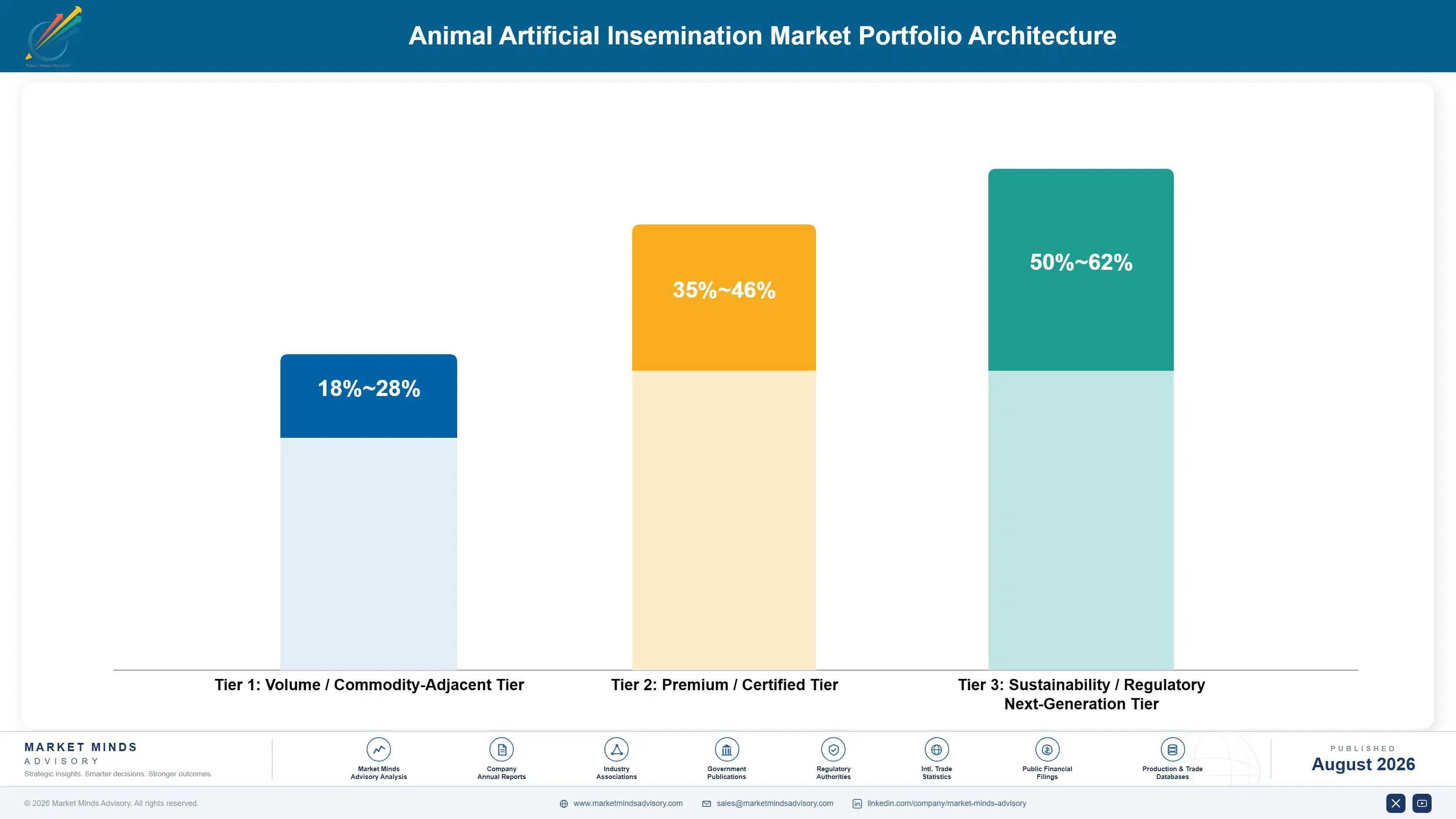
Artificial insemination portfolios span three margin tiers, from commodity-adjacent conventional semen doses sold largely on price, through certified sexed semen and breeding equipment carrying technology-driven premiums, toward an emerging next-generation tier built around genomic testing and predictive breeding services still gaining share. Gross margin widens meaningfully at each tier as data depth and sorting technology sophistication increase across the industry today, reflecting growing wi
The volume versus premium tension centers on laboratory and reference population investment allocation. Genetics companies must choose between dedicating capital to high-margin sexed semen and genomic testing programs with growing but still-smaller volume, or serving reliable conventional semen demand that fills out most dose volume across a typical breeding season. Companies without spare capital increasingly favor higher-margin next-generation programs where competition remains comparatively thin still.

High-value margin pools concentrate in sexed semen and genomic testing services, where sorting technology investment and reference population depth keep competition thin and breeders pay a premium for genetic certainty and predicted merit accuracy. Conventional semen remains the volume anchor but carries the thinnest margins across the entire portfolio, leaving smaller cooperatives with fewer diversification options than larger integrated genetics companies today.

Volume / Commodity-Adjacent Tier

Conventional semen doses sold largely on price and cooperative relationship without technology-driven premiums, across most commercial dairy and beef buyer segments worldwide each breeding season. Cooperative loyalty and price competitiveness remain the primary purchasing drivers in this tier.
Gross Margin: 18-28%

Premium / Certified Tier

Sexed semen doses and breeding equipment sold under cooperative and distributor contracts carrying technology-driven pricing power built through years of proven sorting performance across major accounts worldwide. Breeders increasingly compare sorting performance data before committing to a long-term supplier relationship.
Gross Margin: 35-46%

Sustainability / Regulatory / Next-Generation Tier

Genomic testing and predictive breeding services in active commercial adoption, commanding premium pricing against limited proven alternatives as reference population data and prediction accuracy expand across major markets. Vendors with the deepest reference population data capture most of this premium value.
Gross Margin: 50-62%
usa-animal-artificial-insemination-market-portfolio-architecture-1787303647796

Recurring Breeding Cycle Purchasing

Artificial insemination purchasing functions closer to a recurring annuity than a one-time transaction for commercial breeding operations, since herds require repeated dose purchases across every breeding cycle for the operation's entire productive life, often spanning many years of continuous genetic improvement investment. Genomic testing relationships persist even longer, since operations that adopt a given testing platform typically retain it across many subsequent breeding generations for c
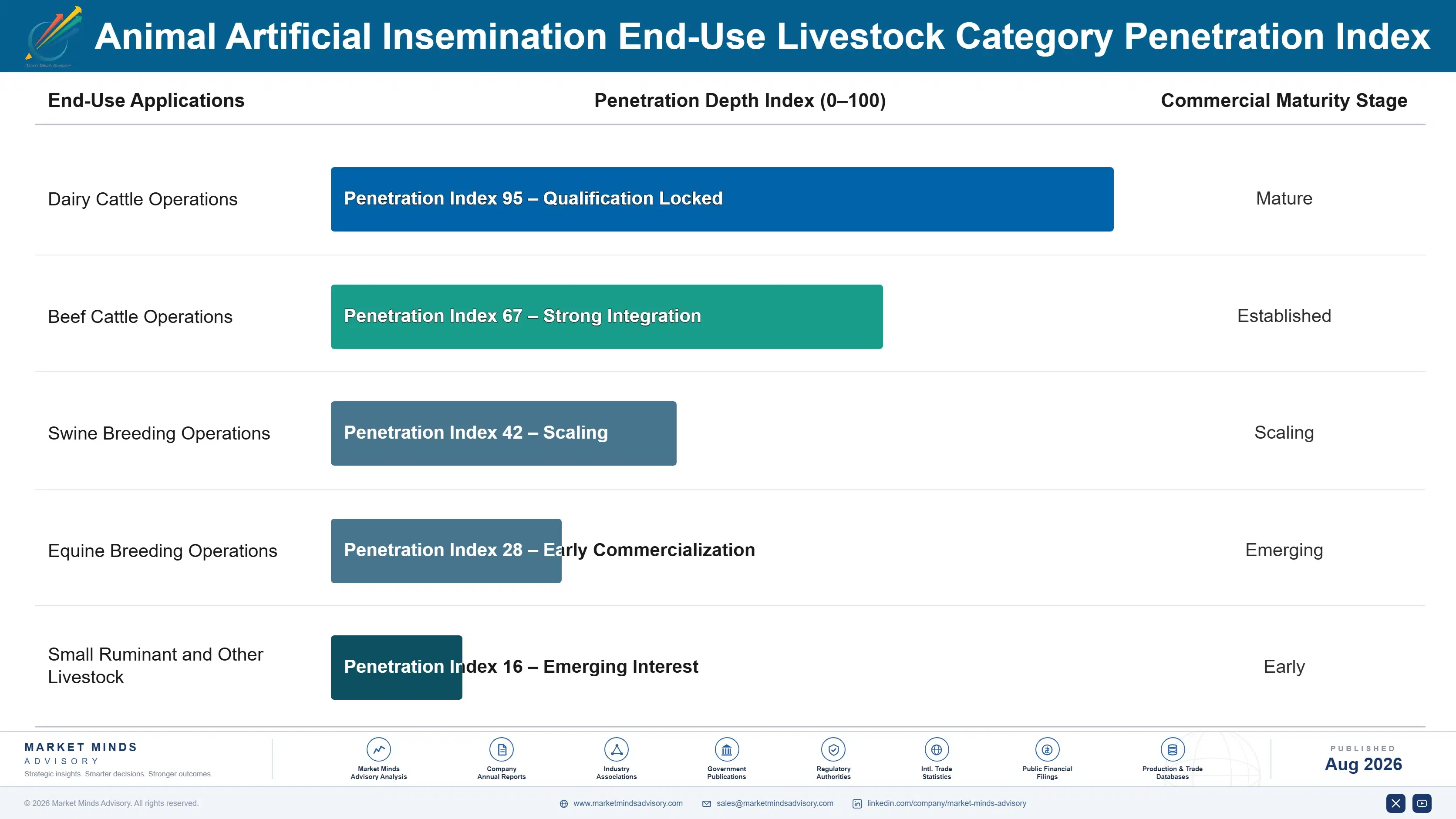
Adoption depth varies sharply by end-use vertical. Large commercial dairy operations and elite seedstock breeders show the deepest engagement with sexed semen and genomic testing, given dedicated breeding technician staff and structured genetic improvement programs, while smallholder operations adopt more slowly since AI technician access and cold-chain infrastructure remain limited in many regions. That divide shapes where genetics companies concentrate commercial investment.

A generational shift is underway as younger commercial breeders, trained during the era of routine genomic testing and sexed semen availability, evaluate genetics suppliers on prediction accuracy and data transparency rather than decades-long cooperative loyalty alone. That openness gives technology-forward genetics companies a rare opening to win breeding program share in a category where cooperative relationships have otherwise been difficult to dislodge, across several major commercial markets today.
usa-animal-artificial-insemination-market-end-use-penetration-index-1787303648286

Where MMA Sees The Opportunity

These are among the four positions where our research anticipates prominent divergence between winners and laggards over the coming forecast period. Each is grounded in the demand model, the regulatory perimeter, and the announced capacity pipeline.
01 / SORTING CAPACITY INVESTMENT

Expand Sperm-Sorting Capacity Before Beef Demand Fully Matures

Beef cattle operations are increasingly adopting sexed semen alongside dairy, and genetics companies without adequate sorting capacity are losing cooperative distribution relationships to better-capitalized competitors as this dual-direction demand accelerates. Capacity investment requires meaningful upfront capital but opens durable cooperative relationships that capacity-constrained rivals cannot match once demand fully materializes. Companies waiting until beef demand fully matures will find themselves racing to catch up against incumbents who invested years earlier, a gap that widens each season capacity investment lags behind competitor programs already underway.
02 / GENOMIC DATA SCALE

Build Reference Population Scale Before Prediction Accuracy Standardizes

Breeding cooperatives have not universally committed to a single genomic testing provider, leaving a genuine opportunity for genetics companies willing to fund reference population expansion ahead of confirmed industry standardization trends. Waiting for cooperatives to formally standardize risks missing the data partnership window entirely once a preferred testing provider relationship forms across the network. The investment required is meaningful but positions early movers to capture a testing category growing faster than conventional semen today, a window that will not stay open indefinitely once cooperatives settle on preferred providers.
03 / EMERGING MARKET ACCESS

Prioritize South Asia and Latin America Distribution Investment

South Asia and Pacific and Latin America carry enormous raw cattle inventory relative to their current commercial artificial insemination value, as government dairy development programs accelerate formal AI access across India, Brazil, and neighboring markets. Genetics companies concentrating capacity expansion solely around legacy Western cooperative relationships risk ceding share in the regions where dose volume growth will be steepest through 2036. Early investment in regional distribution and technician training partnerships offers a meaningful head start over competitors still anchored entirely to legacy Western customer bases.
04 / SORTING TECHNOLOGY DIFFERENTIATION

Invest In Next-Generation Sorting Before Patents Fully Lapse

Sperm-sorting patent expiry is opening the sexed semen category to smaller competitors, and genetics companies without next-generation sorting technology investment risk losing pricing power as sexed semen becomes increasingly commoditized across most major markets. Next-generation sorting technology that improves conception rates offers a meaningful differentiation path even as basic sorting technology access broadens industry-wide. Companies pursuing sorting technology investment now, while competitive density remains manageable, protect premium pricing against the next wave of sorting competitors entering this category as remaining patents lapse over the coming years.

Engagement Snapshot From the Field

A live engagement with an industry participant carrying material or product regulatory and market exposure ahead of a defining policy shift, showing how our research translates into a defensible multi-year portfolio strategy.
MARKET MINDS ADVISORY · CLIENT ENGAGEMENT SUMMARY
Animal Artificial Insemination Producer Strategic Portfolio Review and Transition Roadmap 2026·Investment Scenario on Animal Artificial Insemination Exposure Evaluation 2025-26
CLIENT PROFILE
The client is a mid-sized regional dairy cooperative serving several hundred member farms across a major dairy-producing region in the United States. The cooperative reported annual semen and breeding service revenue of approximately $85 million (client-reported, unverified by MMA) and was evaluating whether to launch an in-house genomic testing program or continue referring members to third-party testing providers instead.
STRATEGIC CHALLENGE
Leadership needed to decide whether building in-house genomic testing capability would justify the capital investment given uncertain member adoption rates and the risk that third-party providers could offer comparable service at lower switching cost to members. Referring members to third-party providers preserved capital but risked losing testing-related service revenue and member data insight entirely.
MMA APPROACH
MMA benchmarked the cooperative's projected member adoption against comparable dairy cooperatives that had already launched in-house genomic testing programs, modeling break-even testing volume against member retention and cross-sell revenue across adjacent breeding service lines. The analysis incorporated primary survey data from cooperative administrators at twelve comparable regional organizations. Findings were benchmarked against member retention data published in recent cooperative industry surveys.
KEY FINDINGS
  1. Break-even testing volume for an in-house genomic program was lower than management initially assumed once member retention value across adjacent breeding services was included in the model.
  2. Peer cooperatives that launched in-house testing reported measurable increases in member semen purchase loyalty within two breeding seasons, driven by the convenience of bundled testing and dose sales.
  3. Cross-sell revenue from sexed semen recommendations tied to genomic test results offset a meaningful share of the program's operating cost, though timing depended on member data adoption speed.
  4. Referring members to third-party providers carried a quantifiable member retention risk as members increasingly viewed integrated testing and breeding advice as a marker of cooperative service quality.
CLIENT PROFILE
The client is a mid-sized regional dairy cooperative serving several hundred member farms across a major dairy-producing region in the United States. The cooperative reported annual semen and breeding service revenue of approximately $85 million (client-reported, unverified by MMA) and was evaluating whether to launch an in-house genomic testing program or continue referring members to third-party testing providers instead.
STRATEGIC CHALLENGE
Leadership needed to decide whether building in-house genomic testing capability would justify the capital investment given uncertain member adoption rates and the risk that third-party providers could offer comparable service at lower switching cost to members. Referring members to third-party providers preserved capital but risked losing testing-related service revenue and member data insight entirely.
MMA APPROACH
MMA benchmarked the cooperative's projected member adoption against comparable dairy cooperatives that had already launched in-house genomic testing programs, modeling break-even testing volume against member retention and cross-sell revenue across adjacent breeding service lines. The analysis incorporated primary survey data from cooperative administrators at twelve comparable regional organizations. Findings were benchmarked against member retention data published in recent cooperative industry surveys.
KEY FINDINGS
  1. Break-even testing volume for an in-house genomic program was lower than management initially assumed once member retention value across adjacent breeding services was included in the model.
  2. Peer cooperatives that launched in-house testing reported measurable increases in member semen purchase loyalty within two breeding seasons, driven by the convenience of bundled testing and dose sales.
  3. Cross-sell revenue from sexed semen recommendations tied to genomic test results offset a meaningful share of the program's operating cost, though timing depended on member data adoption speed.
  4. Referring members to third-party providers carried a quantifiable member retention risk as members increasingly viewed integrated testing and breeding advice as a marker of cooperative service quality.
RECOMMENDED STRATEGY
Phase 1: Phase 1 (Months 1 to 6): Secure genomic testing laboratory partnership agreements and begin member data infrastructure development ahead of formal program launch. Phase 2: Phase 2 (Months 7 to 14): Launch in-house genomic testing program while tracking member adoption and cross-sell revenue against the modeled break-even benchmark closely. Phase 3: Phase 3 (Months 15 to 24): Expand testing-linked breeding advisory services to capture broader member loyalty once the program demonstrates measurable adoption and revenue performance.
OUTCOME
Within eighteen months of launch, the client reported member genomic testing adoption of approximately 41% (client-reported, unverified by MMA), exceeding initial projections meaningfully. Cross-sell revenue from sexed semen recommendations offset roughly a third of the program's operating cost (client-reported, unverified by MMA), and the cooperative now serves as a reference model for peer organizations.

Frequently Asked Questions

Foundational context covering the market sizes, CAGR, scope, country, region and competition that inform every finding below. This section is provided to cover basics and most often pre-purchase conversations, answered from the MMA Primary Research Dataset.

What is the current size of the Animal Artificial Insemination Market?

The global animal artificial insemination market was valued at approximately $4.2 billion in 2025. Growth is driven by rising sexed semen and genomic testing adoption alongside herd consolidation.

How large will the Animal Artificial Insemination Market be by 2036?

The market is forecast to reach approximately $8.67 billion by 2036. That represents roughly 1.93 times its 2026 value as sexed and genomically tested doses broaden globally.

What is the CAGR for the Animal Artificial Insemination Market 2026 to 2036?

The market is forecast to grow at a 6.8% CAGR between 2026 and 2036. Bull and bear scenarios range from roughly 5.6% to 7.9% depending on dairy commodity price cycles.

Which segment is growing fastest?

Sexed and sorted semen doses are the fastest-growing segment at approximately 13.2% CAGR, roughly 1.94 times the overall market growth rate. Genomic testing services follow closely as the second-fastest segment.

Who are the major companies in the Animal Artificial Insemination Market?

Leading companies include Genus, CRV Holding, Semex Alliance, STgenetics, and URUS Group, together holding an estimated 42% of global commercial revenue. Regional cooperatives make up most of the remaining fragmented share.

Which country is growing fastest?

India is the fastest-growing country at approximately 10.8% CAGR, driven by national dairy development programs subsidizing AI access for smallholder farmers. The United States still commands the largest overall share of commercial value.

Report Segmentation Architecture

The full report scope spans multiple orthogonal segmentation dimensions, with cross-tabulated demand data provided for each dimension pair. Coverage extends further to regional breakdowns, trend trajectories, and the competitive detail needed to support segment-level decision-making.

By Dose and Service Type

  • Conventional Semen Doses
  • Sexed and Sorted Semen Doses
  • AI Equipment and Devices
  • Genomic Testing and Breeding Services
  • Embryo Transfer and In Vitro Fertilization Services
  • Herd Management and Genetic Consulting Services

By End-Use Livestock Category

  • Dairy Cattle Operations
  • Beef Cattle Operations
  • Swine Breeding Operations
  • Equine Breeding Operations
  • Small Ruminant and Other Livestock

By Commercial Dimension

  • Cooperative and Distributor Channel Sales
  • Direct Commercial Farm Sales
  • Government and Development Program Distribution
  • Elite Seedstock and Nucleus Herd Services

By Region

  • North America
  • Western Europe
  • East Asia
  • South Asia and Pacific
  • Latin America
  • Middle East and Africa
  • Eastern Europe

Scope, Methodology, and Coverage

Every figure in this report is reproducible from documented input assumptions. The scope below maps the historical period, the forecast horizon, the segmentation dimensions, and the countries covered, alongside the underlying primary and qualitative methodology.
Historical Period
2020 to 2025
Forecast Period
2026 to 2036
Base Year
2025 (USD billions; MMA Primary Research Dataset, August 2026)
Market Definition
The animal artificial insemination market covers semen doses, sperm-sorting and genomic testing services, and AI equipment used to breed dairy cattle, beef cattle, swine, and other livestock without natural mating. It spans conventional and sexed semen doses, breeding-related genomic testing, embryo transfer services, and AI delivery equipment across all major livestock categories. Natural mating services, unrelated animal health pharmaceuticals, and general veterinary diagnostics are excluded.
Quantitative Units
USD billions (current prices); dose volume in millions where applicable
Segmentation Dimensions
By Dose and Service Type; By End-Use Livestock Category; By Commercial Dimension; By Region
Regions Covered
North America, Western Europe, East Asia, South Asia and Pacific, Latin America, Middle East and Africa, Eastern Europe
Countries Covered
USA, China, Germany, France, UK, Japan, South Korea, India, Australia, Canada, Brazil, Mexico, Indonesia, Vietnam, Thailand, Malaysia, UAE, Saudi Arabia, South Africa, Nigeria, Turkey, Poland, Netherlands, Italy, Spain, Sweden, Switzerland, Argentina, Colombia, Singapore, and additional markets relevant to this sector
Key Companies Profiled
Genus plc, CRV Holding B.V., Semex Alliance, STgenetics, URUS Group, World Wide Sires Ltd., Coopex Montbeliarde, Avantea S.r.l., Neogen Corporation, IMV Technologies, Minitube GmbH, Cogent Breeding Ltd., XY, LLC, Vytelle LLC, Zoetis Inc., Topigs Norsvin, Hendrix Genetics B.V., EW Group GmbH, Aviagen Group, Genesis Breeding International
Quantitative Methodology
Primary survey, n=3,800 respondents, Q4 2025, six countries; demand-side model with trade association cross-validation
Qualitative Methodology
47 expert interviews, Q4 2025; applied to validate demand model assumptions, identify emerging dynamics, and assess competitive positioning
Report Format
PDF and XLSX data workbook (Word format preview document)
Publisher
Market Minds Advisory
Report Code
MMA-2026-AGR-108
Published
August 2026
Contact
sales@marketmindsadvisory.com | www.marketmindsadvisory.com

Purchase the full Animal Artificial Insemination Market Report (2026 to 2036).

This report provides a comprehensive analysis of the global animal artificial insemination market, covering conventional, sexed, and genomic testing segments across all seven MMA-tracked global regions. It includes detailed market sizing and forecasts through 2036, competitive benchmarking of the top twenty vendors across genetics, sorting technology, and testing services, and segment-level analysis of dose and service adoption. The report draws on MMA's primary survey of 3,800 respondents and 47 expert interviews conducted in the fourth quarter of 2025, supplemented by company disclosures and government agricultural agency data. Buyers receive full access to regional data tables, competitive profiles, and strategic recommendations tailored to genetics companies, cooperatives, and agricultural investors worldwide.
Full seven-region market sizing and forecast data
Competitive benchmarking of twenty profiled industry vendors
Segment-level analysis of dose and service adoption trends
Primary survey data from 3,800 global respondents
Expert interview insights from 47 genetics specialists
Strategic recommendations for genetics companies and cooperatives

Built For The People Who Decide

From boardroom strategy to bench-side execution, this report is read cover-to-cover by leaders shaping the next decade of their industry, turning demand scenarios, market dynamics and valuation benchmarks into decisions.
CXOs/ Presidents/ VPs/ Managers
M&A and Corporate Development
Strategy Teams and R&D Heads
Procurement and Product Directors
Regulatory and Compliance Leaders
Investor Relations and Equity Analysts