Market Minds Advisory
USA and Canada Potassium Sulfate Market 2025-2035

USA and Canada Potassium Sulfate Market 2026-2035: Chloride Sensitive Acreage, Two Production Routes and the Import Parity Ceiling

Potassium sulfate costs roughly 2.3 times muriate per unit of potash, and buyers pay it only where chloride burns the crop, which makes irrigation policy a better demand indicator than any fertiliser price.

Lead Analyst

Bilal Shaikh

Published

September 2026

Make Smarter Decisions with Customized Research Insights

Request a free sample report and evaluate market opportunities, growth trends, and competitive dynamics relevant to your business needs.

2025 MARKET VALUE$0.4BMarket Size 2025
2036 FORECAST VALUE$0.7BBase Case , 2026 to 2036
CAGR 2026 TO 20364.6 %Bull 5.8% / Bear 3.4%
INCREMENTAL OPPORTUNITY$0.2BNet 10- year value creation
EXPANSION MULTIPLE1.57x2036 value over 2026 base
Strategic Levers
M&A Pipeline
Regional Outlook
Country Rankings
Competitive Intelligence
Segmental Deep-dive
Call-Us : 91 93563 13602

Executive Snapshot and Market Trajectory

Potassium sulfate exists for one reason: some crops will not tolerate chloride. Almonds, grapes, citrus, potatoes, avocados and tobacco all suffer measurable yield or quality loss when fertilised with muriate of potash. Everything commercial about this market follows from that single agronomic fact, and very little else.
Buyers pay roughly 2.3 times the muriate price per unit of potash, and they pay it only where chloride does real damage. Soluble grade for fertigation and foliar application is the fastest growing segment at 6.9%, half again the market rate of 4.6%, following drip irrigation across permanent crop acreage. California, Washington, Florida and Idaho account for most of the regional demand between them, by a wide margin.
Supply is concentrated, with the top five holding 88% of tonnage, and it splits into two production routes with nothing in common. Solar evaporation from the Great Salt Lake and from Utah brines produces natural potassium sulfate at low cash cost and at the mercy of lake levels. The Mannheim process converts muriate with sulfuric acid, costs considerably more, and prices off energy. Roughly 38% of regional demand still arrives from outside North America.
Market Definition
Potassium sulfate supplied into the United States and Canada for agricultural and industrial use, covering soluble grade, technical and industrial grade, granular fertiliser grade, standard powder fertiliser grade and compacted blend-ready grade, whether produced domestically by solar evaporation or Mannheim conversion or imported. Measured at supplier selling value. Muriate of potash, potassium nitrate, langbeinite, potassium magnesium sulfate and compound fertilisers containing potassium sulfate as a component are excluded.
Base Year Value
$0.4B in 2025 (MMA Primary Research Dataset, August 2026)
Forecast Period
2026 to 2036, eleven discrete annual values
CAGR
4.6% base case. Bull 5.8%. Bear 3.4%.
Fastest Growth Segment
Soluble Grade Potassium Sulfate: 6.9% CAGR
Fastest Growth Country
California: 7.8% CAGR
Fastest Growth Region
South Asia and Pacific: 6.8% CAGR
Largest Region
North America: 91% of 2025 global value
Market Leaders
Compass Minerals, Intrepid Potash, Tessenderlo Kerley, K+S Group, SQM. Source: MMA Primary Research Dataset, July 2026.
Primary Survey
n=3,800 procurement and R&D decision-makers, Q4 2025, six countries
Methodology
Demand-side build-up, cross-validated against public data, 47 expert interviews

USA and Canada Potassium Sulfate Market Forecast Scenarios

usa-and-canada-potassium-sulfate-market-size-forecast-scenario-1787641153735
Nothing dramatic happened between 2020 and 2025, but the drivers moved in opposite directions. Permanent crop acreage in California contracted under water allocation cuts, removing demand that had been reliable for twenty years, while potato and specialty vegetable acreage held. Energy costs pushed Mannheim production economics badly out of shape in 2022. The 3.8% historical rate hides more movement than it shows.
The 4.6% base case rests on three mechanisms. Drip and micro-irrigation conversion across permanent crops continues, and every acre converted shifts potassium purchasing toward soluble grades that carry a further premium. Organic certified acreage in the United States keeps expanding, and natural potassium sulfate from solar evaporation is one of very few approved potassium sources. And industrial demand, principally for specialty glass and for pharmaceutical grade applications, grows independently of anything happening in agriculture.
The 5.8% bull case turns on almond and pistachio acreage recovering as water allocations stabilise, since permanent crops consume potassium sulfate for decades once planted. The 3.4% bear case is Great Salt Lake elevation: prolonged low water reduces brine availability and forces the cheapest tonnage in the region offline, which pushes buyers toward imports and dampens demand at the resulting price.

Two Production Routes, One Chloride Sensitive Market

The price premium is the whole story. Potassium sulfate delivers potassium without chloride and without the salt index, and buyers pay roughly 2.3 times the muriate price per unit of potash for that property. Nobody pays it by accident. Growers who can use muriate do, which means the addressable acreage is fixed by agronomy rather than by marketing effort.
TOP FIVE CONCENTRATION88%Combined tonnage supplied by the largest five participants
CHLORIDE SENSITIVE ACREAGE9.4 millionAcres planted to crops that reject chloride fertiliser
PREMIUM OVER MURIATE2.3xPrice ratio against muriate per unit of potash
IMPORTED SUPPLY SHARE38%Portion of regional demand met from outside North America
MANNHEIM PROCESS SHARE44%Regional tonnage produced by acid conversion rather than brine
DELIVERED FREIGHT SHARE17%Portion of delivered cost accounted for by transport
Roughly 9.4 million acres across the United States and Canada carry crops that reject chloride, and that number moves with permanent crop planting decisions made a decade earlier. Almonds, pistachios, grapes and citrus dominate the California share; potatoes carry Idaho, Washington and Alberta; tobacco and vegetables account for most of the eastern demand. Water allocation policy in the western states affects this market more than fertiliser prices do.
Supply divides along a cost line that has nothing to do with product quality. Solar evaporation from Great Salt Lake brines produces potassium sulfate at a cash cost well below anything else in the region, constrained only by lake elevation. Mannheim furnaces convert muriate with sulfuric acid at roughly 44% of regional output, carrying an energy bill that moves with natural gas. Imports fill the remaining 38%, mostly from Chile, Belgium and China.
"Everyone models this market off potash prices. It runs off almond acreage and lake elevation, and neither of those appears in a fertiliser price series."
Director, Agricultural Inputs and Specialty Fertilisers Practice · MMA Agriculture and Agricultural Inputs Practice · August 2026

Market Trends

Drip Irrigation Conversion Pulls Demand Toward Soluble Grades

Micro-irrigation now covers a large majority of California permanent crop acreage, and every conversion moves potassium application from a spreader to an injection line. Granular product cannot go through a drip emitter, so the purchase shifts to soluble grade, which carries a further premium of roughly 25% over granular. Soluble grade grows at 6.9% against a market rate of 4.6% almost entirely on this mechanism. Growers rarely revert once converted, because the irrigation infrastructure is already paid for and the labour saving is real. That makes the shift permanent rather than cyclical.
Market Impact: Adds 2.1 million certified acres
Great Salt Lake Elevation Becomes a Supply Variable

The cheapest potassium sulfate in North America comes out of solar evaporation ponds fed by Great Salt Lake brine, and lake elevation fell to record lows during the western drought. Low water concentrates some salts and strands the intake infrastructure that feeds the ponds, which is a production constraint no amount of capital spending fixes quickly. Utah has since enacted water policy measures intended to restore elevation, with mixed results. Buyers who had treated this supply as permanent have started carrying inventory and qualifying import sources, and neither is free.
Market Impact: Covers 9.4 million chloride sensitive acres

Market Opportunities and Growth Drivers

Organic Certified Acreage Requires Approved Potassium Sources

Certified organic production in the United States has expanded steadily, and the approved input lists permit naturally mined or solar evaporated potassium sulfate while excluding Mannheim material, which is chemically identical but produced by acid conversion. That distinction creates a premium sub-market with an unusually captive buyer, since an organic grower needing potassium has very few alternatives and none of them is cheap. Organic vegetable, berry and tree nut acreage carries most of this demand. Producers holding natural supply price accordingly, and certification bodies audit the chain of custody carefully.
Market Impact: Removes 180,000 acres since 2020

Chloride Damage Drives Permanent Crop Fertiliser Choice

Almond, pistachio, grape, citrus and avocado growers use potassium sulfate because chloride accumulation in root zones causes leaf burn, reduced yield and quality downgrades that show up in the price received. This is not a preference and it is not agronomic fashion. Roughly 9.4 million acres across the two countries carry crops in this category, and the tonnage per acre on a mature almond orchard runs several times what a row crop consumes. Planting decisions made a decade ago therefore set demand today, which makes the forecast unusually legible. Acreage data is public.
Market Impact: Affects 44% of regional output

Market Restraints and Challenges

Water Allocation Policy Removes Permanent Crop Acreage

Surface water allocations to California's Central Valley have been cut repeatedly, and groundwater pumping is being restricted under state sustainability legislation with compliance deadlines approaching. Growers facing a permanent water shortfall remove trees, and removed acreage stops consuming potassium sulfate immediately and permanently. The root cause is a basin that has been over-allocated for decades, which no fertiliser supplier can influence at all. Suppliers are responding by broadening geographically toward the Pacific Northwest, the southeast and Canadian potato regions, and by pushing industrial grade demand that has no water exposure whatsoever.
Market Impact: Soluble grade grows 6.9% annually

Mannheim Energy Costs Cap Domestic Conversion Economics

Roughly 44% of regional potassium sulfate comes from Mannheim furnaces, which react muriate of potash with sulfuric acid at high temperature and consume a great deal of natural gas doing it. When gas prices moved sharply in 2022, conversion economics deteriorated to the point where imported material landed cheaper than domestic production in several markets. The root cause is thermodynamic rather than commercial: the reaction needs the heat. Producers are responding with heat recovery retrofits and by co-locating with sulfuric acid supply, which trims the bill without changing the fundamentals.
Market Impact: Threatens 18% of regional supply
3 additional market trends, 4 additional growth drivers, and 2 additional restraints and challenges are covered in the full report. Contact sales@marketmindsadvisory.com to access the complete intelligence.

Segment CAGR and Growth Architecture

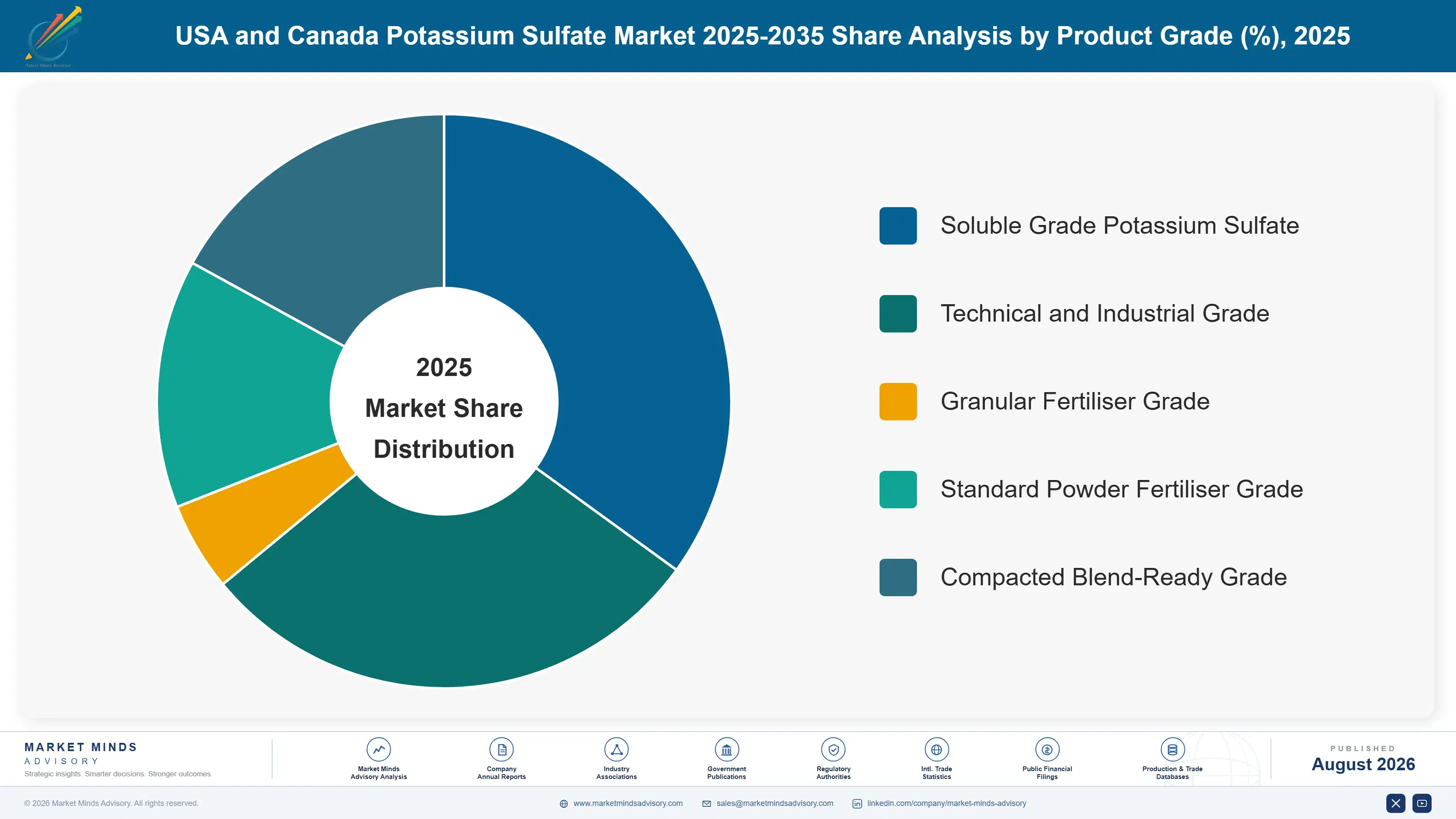
Segmentation follows product grade, since grade determines application method, price and which buyer can use the material at all. Five grades cover regional supply, from a coarse compacted product blended into dry fertiliser to a soluble powder injected through drip emitters. Growth concentrates at the soluble and technical ends, where the premium is defensible. Everything else drifts.
usa-and-canada-potassium-sulfate-market-market-share-analysis-1787641154298

Soluble Grade Potassium Sulfate

A finely milled, low insoluble product designed to dissolve completely in an injection tank without blocking drip emitters. At 6.9% this is the fastest growing grade in the region, half again the market rate of 4.6%, and the driver is irrigation infrastructure rather than agronomy. Micro-irrigation conversion across California, Washington and Florida permanent crops moves potassium purchasing from a spreader to a fertigation line, and granular material simply cannot pass through. Buyers pay roughly 25% above granular for the milling and the insoluble specification. The quality bar is genuinely demanding: a single blocked emitter line costs a grower more in labour than the fertiliser saved. Suppliers that cannot hold the specification lose accounts quickly and permanently.
CAGR 6.9%

Technical and Industrial Grade

High purity material sold outside agriculture entirely, into specialty glass, pharmaceutical formulation, food processing and gypsum board manufacture. Growth of 5.4% is second fastest in the region, and it moves with industrial production rather than with acreage or water policy, which makes it a genuine diversification for suppliers exposed to Californian irrigation risk. Purity specifications run tighter than fertiliser grade by a wide margin, with heavy metal limits and consistent particle size demanded by contract. Qualification takes months and buyers rarely change supplier afterwards. Volumes are modest against the fertiliser business, but pricing is negotiated annually rather than tracking potash markets, which suits everyone involved. That stability is worth more than the volume.
CAGR 5.4%
Full segment breakdown across 5 segments available in the complete report.

Regional Architecture and Country Demand Map

North America holds 91% of the market by definition, since scope covers United States and Canada supply. The remaining shares represent export tonnage and reference pricing links rather than consumption. California, Washington, Idaho and Florida account for most regional demand between them. Water policy shapes all four.

North America

Scope defines this position rather than any commercial dynamic: the market covers United States and Canada supply, so North America carries 91% by construction and the remaining shares represent export tonnage rather than consumption. California accounts for the largest single block of demand, driven by almond, pistachio, grape and citrus acreage that consumes potassium sulfate for the life of the planting. Washington and Idaho carry potato and tree fruit demand. Florida contributes citrus and vegetable tonnage. Canadian demand concentrates in Alberta and Manitoba potato acreage and in British Columbia horticulture. Supply comes from Utah solar evaporation, Mannheim conversion plants, and imports covering roughly 38% of consumption. That import share is the exposure worth watching.
Share: 91% | CAGR: 4.6% (2026 to 2036)

Western Europe

European tonnage enters this market as competing supply rather than as demand, which is why the share sits at 2% against a band that assumes consumption. Belgian and German producers operate large Mannheim capacity and ship soluble and technical grades into North American ports at prices that set the ceiling for domestic converters. That competition is real and it is priced in euros, so exchange rate movement changes the landed cost more than any commercial decision either side makes. European agricultural demand for potassium sulfate is itself substantial, concentrated in Mediterranean horticulture, which occasionally tightens export availability. Growth of 3.0% reflects mature European industrial output rather than anything happening on North American acreage.
Share: 2% | CAGR: 3.0% (2026 to 2036)
Regional intelligence for 5 additional markets available in the complete report: East Asia, South Asia and Pacific, Latin America, Middle East and Africa, Eastern Europe. Contact sales@marketmindsadvisory.com.
usa-and-canada-potassium-sulfate-market-country-cagr-analysis-1787641154815

Where the Premium Actually Holds

Nothing here is won on chemistry, because potassium sulfate from any route is the same compound. Value accrues to whoever holds the low cost brine position, whoever can meet a soluble specification consistently, and whoever sells outside agriculture entirely. Four routes carry weight, and only one of them depends on what happens to fertiliser prices.

Mill for the Emitter, Not the Spreader

Soluble grade grows at 6.9% against a market rate of 4.6%, and the growth is entirely a function of irrigation hardware rather than agronomic argument. Meeting the specification means milling to consistent particle size and holding insolubles low enough that a drip emitter does not block, which is a manufacturing discipline rather than a chemistry problem. Buyers pay roughly 25% above granular for it and switch supplier immediately after a single blockage incident, because the labour cost of clearing an orchard irrigation system dwarfs any fertiliser saving. Consistency is the entire product here.
Market Impact: Earns a 25% premium over standard granular grades

Sell Industrial Tonnage to Escape Acreage Risk

Technical grade demand grows at 5.4% and moves with specialty glass, gypsum board and pharmaceutical production rather than with water allocation decisions in the Central Valley. For a supplier whose fertiliser volume sits downstream of Californian tree nut acreage, that diversification is worth more than the margin difference suggests. Qualification runs several months against tighter purity and particle specifications, and buyers rarely change supplier once approved. Pricing is negotiated annually instead of tracking potash indices, which removes the volatility that makes the fertiliser business hard to plan around. Volume is modest and predictable.
Market Impact: Grows at 5.4% independently of any acreage risk

Certify Natural Product for Organic Approved Channels

Solar evaporated potassium sulfate qualifies for certified organic production while chemically identical Mannheim material does not, which creates a premium channel with a genuinely captive buyer. Organic acreage in the United States has passed 2.1 million certified acres and continues expanding, and a certified grower needing potassium has almost no alternative source. Holding chain of custody documentation through blending and distribution is the practical requirement, and it is where most suppliers fail rather than at the production step. Certification bodies audit the paperwork, not the chemistry. The premium survives because supply is genuinely scarce.
Market Impact: Serves the 2.1 million certified organic acre base

Hedge Import Parity Rather Than Potash Prices

Roughly 38% of regional demand arrives as imported tonnage from Chile, Belgium and China, which means the domestic price ceiling is set by landed cost rather than by production economics. A Mannheim converter watching muriate and natural gas is watching the wrong variables, since freight rates, exchange rates and Chinese export availability determine whether domestic material clears the market at all. Suppliers that model import parity by port and by grade price considerably more accurately than those working from a potash index, and they lose fewer contracts to landed competition.
Market Impact: Covers the full 38% imported supply exposure today

Who Controls the Margin Pool

This is a concentrated market by any measure. The top five account for 88% of tonnage supplied into the United States and Canada, the basis applied consistently here, whether produced domestically or imported. Compass Minerals leads on natural production position rather than on scale, and the gap to the next tier reflects access to brine rather than any commercial capability.
Competition runs on cost position and on specification, not on product. Natural producers compete on cash cost and on organic certification eligibility, neither of which a converter can replicate. Mannheim converters compete against each other and against imports on landed price, with energy efficiency the only real variable. Soluble grade is contested on milling consistency and insoluble content, where a single failure loses an account.

Rankings will move on water and on trade policy rather than on anything a commercial team does. Great Salt Lake elevation determines whether the region's cheapest tonnage is available, and Utah water legislation is the variable to watch. Tariff treatment of Chinese material is the second. New brine projects in Western Australia will change global availability toward the end of the forecast period, and North American buyers will feel that through import parity.
usa-and-canada-potassium-sulfate-market-company-positioning-matrix-1787641155338

Competitive Moat and Risk Dimensions

COMPASS MINERALS

Moat: Natural Brine Cost Position

Solar evaporation from Great Salt Lake brine produces potassium sulfate at a cash cost no conversion route can approach, because the energy input is sunlight rather than natural gas. The position cannot be replicated, since the resource is geographic and the water rights are historic. Organic certification eligibility comes with it, opening a premium channel converters simply cannot enter.
COMPASS MINERALS

Risk: Lake Elevation Exposure

The same asset that produces the cost advantage depends entirely on a lake whose elevation fell to record lows during the western drought. Low water strands intake infrastructure and reduces brine availability, and no capital programme fixes that quickly. Utah water policy now determines a meaningful part of this company's production capability, an unusual position for an industrial producer.
TESSENDERLO KERLEY

Moat: Soluble Specification Reliability

Consistent milling and low insoluble content in soluble grades is a manufacturing discipline rather than a chemistry advantage, and it has been built over decades of supplying fertigation customers who cannot tolerate a blocked emitter line. Accounts stay put because the cost of a single failure in an orchard irrigation system is measured in labour, not fertiliser.
TESSENDERLO KERLEY

Risk: Mannheim Energy Dependence

Conversion economics rest on natural gas and on muriate input pricing, both of which moved violently after 2022 and neither of which the company controls. Roughly 44% of regional output comes through this route, and when gas prices rise, imported tonnage lands cheaper than domestic production in several markets. Heat recovery retrofits trim the exposure without removing it.

Players Tracked

Prominent Players

Compass Minerals
Intrepid Potash
Tessenderlo Kerley
K+S Group
SQM

Other Key Players

Yara International
Nutrien
The Mosaic Company
ICL Group
Migao Corporation
Sesoda Corporation
Qinghai Salt Lake Industry
Guotou Xinjiang Luobupo Potash
Archean Chemical Industries
Haifa Group
Kemapco
Arab Potash Company
Wilbur-Ellis
Helena Agri-Enterprises
J R Simplot

Recent Developments

APRIL 2025

Utah water legislation advances Great Salt Lake elevation measures

Utah enacted further measures aimed at raising Great Salt Lake elevation, including changes to water rights administration and upstream diversion practice. Mineral extraction operators drawing brine from the lake face a policy environment that now weighs ecological restoration against industrial water use, with implications for long term extraction volumes.
Signal: Water policy has become a production variable for the lowest cost supply in the entire region
AUGUST 2025

California groundwater sustainability deadlines reach permanent crop districts

Groundwater sustainability plans in several San Joaquin Valley subbasins moved into binding allocation phases, requiring measurable pumping reductions from districts carrying substantial almond and pistachio acreage. Growers facing permanent shortfalls have continued removing trees, and removed acreage stops consuming potassium sulfate at once and does not return.
Signal: Demand in this market is set by irrigation policy far more than by any fertiliser pricing decision
OCTOBER 2025

Western Australian brine project reaches commercial production milestone

A brine based potassium sulfate operation in Western Australia reported reaching commercial production rates, adding supply aimed principally at Asian markets. The tonnage does not enter North America directly, but additional global availability affects the landed price of imported material arriving on the American west coast.
Signal: Additional solar evaporation supply anywhere changes import parity pricing for every North American buyer eventually here

What Sets Delivered Cost Per Tonne

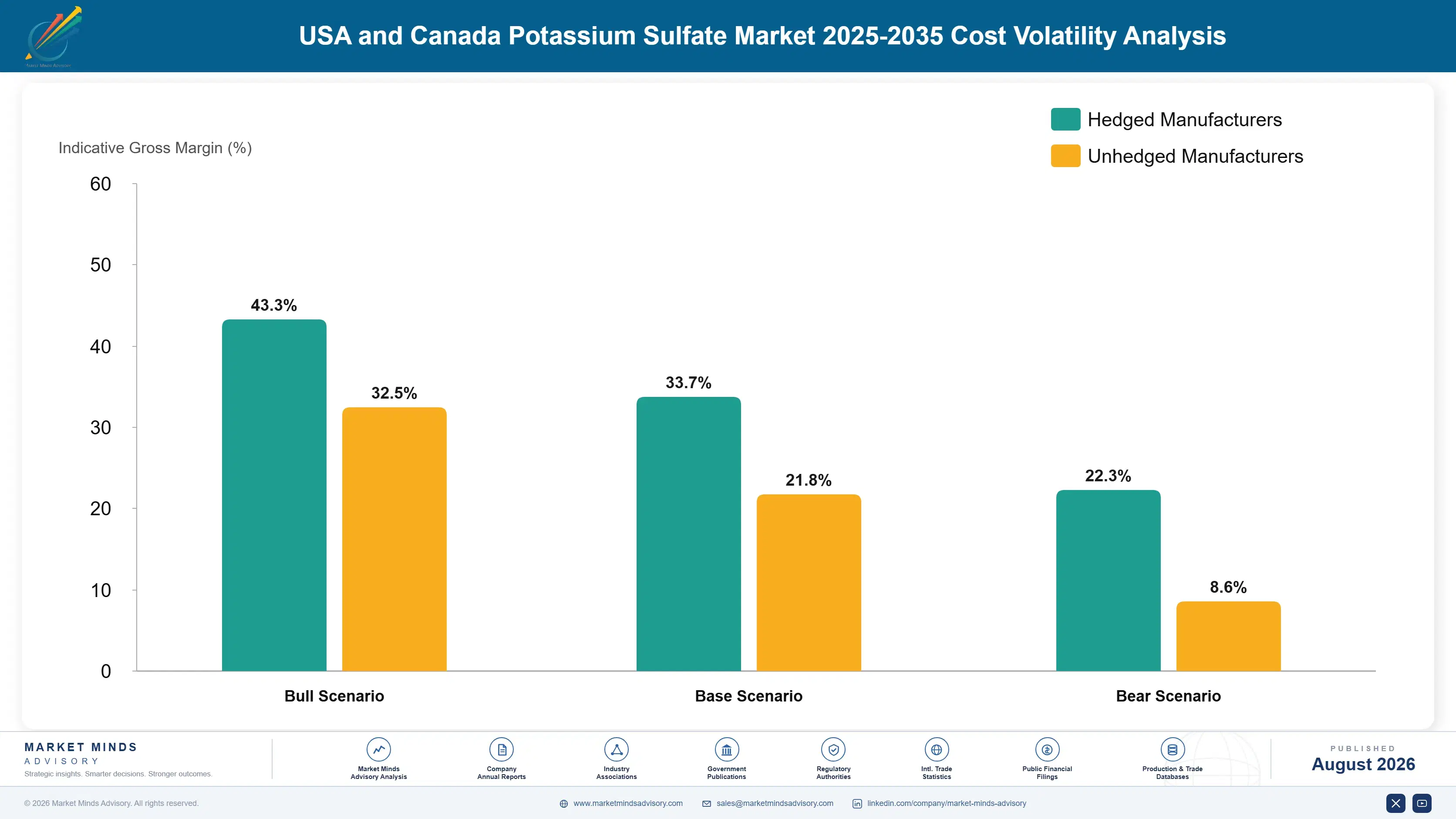
Cost structure depends entirely on production route. For Mannheim converters, muriate of potash accounts for roughly 52% of cost of goods and natural gas a further 19%. Muriate comes principally from Saskatchewan and from Russian and Belarusian producers where sanctions permit. For solar evaporation operations the cost line looks nothing like that: energy is sunlight, and the dominant costs are harvesting, processing and water rights.
Natural gas was the defining input event of this period. EIA price series show Henry Hub moving sharply through 2022, which pushed Mannheim conversion economics badly out of shape on both continents. Converters pricing annual contracts against a stable energy assumption absorbed the difference. Muriate pricing compounded it, since sanctions on Belarusian supply removed a meaningful volume from western trade flows in the same period.

The disadvantage falls entirely on converters, and operating improvement does not recover it. A solar evaporation producer facing a gas price spike notices nothing, while a Mannheim plant watches its cash cost cross the landed price of imported Chilean or Chinese material. Geography compounds it: converters located far from sulfuric acid supply or from muriate rail infrastructure carry freight on both inputs. Coastal buyers switch to imports quickly.
usa-and-canada-potassium-sulfate-market-cost-volatility-analysis-1787641155536

Recover furnace heat and co-locate with acid supply

Mannheim furnaces run hot and vent a great deal of usable energy, so heat recovery retrofits cut gas consumption meaningfully without changing the reaction itself. Co-locating with a sulfuric acid producer removes freight on one input and often allows heat integration across both plants. Neither measure changes the underlying thermodynamics, but together they move a converter down the cost curve.

Contract muriate supply on multi-year terms

Converters increasingly buy muriate under multi-year agreements with Saskatchewan producers rather than on the spot market, accepting a premium in exchange for volume security. The 2022 disruption made the case for everyone who had been buying opportunistically. Saskatchewan supply also carries no sanctions exposure, which matters more than the price difference to any buyer with contractual delivery obligations downstream.

Price contracts against import parity rather than potash indices

Since roughly 38% of regional demand arrives as imports, the effective price ceiling is landed cost at the nearest port, not any potash index. Suppliers writing annual contracts against index movement find themselves undercut whenever freight rates fall or a currency moves. Modelling import parity by port and grade produces a more defensible price and considerably fewer lost contracts.

Portfolio Architecture for Margin Defence

Margin here follows production route far more than product grade. Solar evaporation output earns well because the cash cost is low and the organic channel pays a premium on top. Mannheim conversion earns thinly and cyclically, since the cost base moves with gas and muriate while the selling price is capped by imports. Soluble and technical grades earn a specification premium regardless of which route produced them.
The tension is between a volume business tied to acreage and a premium business tied to specification. Granular fertiliser grade carries most of the tonnage and almost none of the margin, and its volume depends on planting decisions made a decade ago and on water allocations decided by a state agency. Soluble and technical grades carry far less tonnage and considerably better economics, but the addressable volume is genuinely limited.

High value pools concentrate in organic certified supply and in industrial contracts, both small, both defensible and both entirely separate from the fertiliser tonnage business. Organic buyers have no alternative source and industrial buyers have qualified a supplier they will not casually change. Everything else in the portfolio is priced against a landed import number, which is a different business entirely.

Granular and Standard Fertiliser Grades

Bulk tonnage sold into agricultural distribution against a landed import price, with volume set by acreage and margin set by whichever production route the seller happens to operate. Nothing here is defensible on product.
Gross Margin: 14-17%

Soluble and Technical Grades

Milled soluble product for fertigation and high purity technical material for industrial buyers, both sold on specification rather than on price. Margin holds because a failed specification costs the buyer far more than the fertiliser.
Gross Margin: 28-31%

Organic Approved Natural Grades

Solar evaporated material eligible for certified organic production, sold to buyers with almost no alternative potassium source. Margin depends on maintaining chain of custody documentation through blending and distribution rather than on any production advantage.
Gross Margin: 36-39%
usa-and-canada-potassium-sulfate-market-portfolio-architecture-1787641156031

High-value Sub-segments and Strategic Watch-out

Soluble Grade Potassium Sulfate

The fastest growing grade at 6.9% and the one with a genuine specification barrier behind it, since a blocked drip emitter costs a grower more in labour than the fertiliser saved. Demand follows irrigation hardware conversion rather than agronomic argument, which makes it unusually predictable.
Gross Margin: 28-31%

Technical and Industrial Grade

Second fastest at 5.4% and the only part of this market with no exposure to water allocation policy, since demand comes from specialty glass, gypsum board and pharmaceutical production. Qualification takes months and buyers stay once approved, which suits suppliers wanting predictable volume. Contracts renew annually.
Gross Margin: 30-33%

Granular Fertiliser Grade

The tonnage core of the market, growing at 3.4% and priced against landed imports at every port. Volume depends on permanent crop acreage that water policy is actively reducing in California, and nothing a supplier does changes that arithmetic in either direction. Defending share is all that remains.
Gross Margin: 14-17%

Standard Powder Fertiliser Grade

Growing at 3.0%, the slowest grade in the region, and increasingly displaced by compacted and soluble products that handle better or dissolve properly. Handling losses and dust make it unpopular with distribution, and no supplier is defending the position with any conviction at all. Decline looks likely.
Gross Margin: 13-16%

How Tonnage Repeats Each Season

Demand in this market repeats with unusual reliability, because a mature almond orchard consumes potassium sulfate every season for twenty five years and nobody replants annually. Once an acre is planted to a chloride sensitive crop, the fertiliser decision is effectively fixed for the life of that planting. That gives suppliers a demand base set by planting decisions taken a decade ago.
Stickiness varies sharply by end use. Permanent crop growers are the deepest hold, since the agronomic requirement does not change and the irrigation system dictates the grade. Industrial buyers are stickier still, because qualification against purity specifications takes months and nobody repeats it for a small price difference. Row crop and vegetable buyers are the loosest, switching between potassium sources on price whenever the agronomy tolerates it.

The buyer has changed generationally. Fertiliser decisions on large permanent crop operations used to sit with a farm manager and a local dealer. They now sit with agronomists employed by the operation itself, or with crop consultants running tissue and soil analysis programmes, and those people specify grade and timing rather than accepting a dealer recommendation. Dealers still take the order and increasingly do not shape it.
usa-and-canada-potassium-sulfate-market-end-use-penetration-index-1787641156531

Where This Market Actually Pays

These are among the four positions where our research anticipates prominent divergence between winners and laggards over the coming forecast period. Each is grounded in the demand model, the regulatory perimeter, and the announced capacity pipeline.
01 / GRADE PORTFOLIO DISCIPLINE

The premium lives in specification, not in tonnage

Soluble grade grows at 6.9%, half again the market rate of 4.6%, and it earns roughly 25% above granular because a blocked drip emitter costs a grower more in labour than any fertiliser saving. Technical grade earns better still and carries no exposure to water allocation policy at all. Granular tonnage carries the volume and is priced against a landed import number at every port, which means it is somebody else's decision entirely rather than a commercial choice anyone here makes.
02 / WATER POLICY MONITORING

Track irrigation allocations, not potash price indices

Roughly 9.4 million chloride sensitive acres set demand in this market, and California groundwater sustainability plans are actively reducing that number as permanent crop districts move into binding allocation phases with measurable pumping reductions. Removed trees stop consuming potassium sulfate at once and do not come back. Any commercial plan that models this market off potash pricing rather than off irrigation allocation and acreage data is modelling the wrong variable entirely, and will be wrong in the same direction every single year.
03 / COST ROUTE POSITIONING

Solar brine wins whenever energy prices move

Roughly 44% of all regional output now comes from Mannheim conversion, where muriate is 52% of cost of goods and natural gas a further 19%, and neither input is within a converter's control. Solar evaporation notices none of that, because the energy input is sunlight and the constraint is lake elevation instead. A portfolio holding only conversion capacity is holding a cost position that imported tonnage can undercut in any quarter that gas prices rise sharply anywhere in the world.
04 / ORGANIC CHANNEL DEFENCE

Paperwork protects the highest margin in the market

Solar evaporated material qualifies for certified organic production while chemically identical Mannheim product does not, and organic acreage in the United States has passed 2.1 million certified acres with almost no alternative potassium source available. The premium is real and it is defended entirely by chain of custody documentation through blending and distribution rather than by anything in the production process. Certification bodies audit the paperwork, so the paperwork is where the margin actually lives for anyone holding natural supply.

Engagement Snapshot From the Field

A live engagement with an industry participant carrying material or product regulatory and market exposure ahead of a defining policy shift, showing how our research translates into a defensible multi-year portfolio strategy.
MARKET MINDS ADVISORY · CLIENT ENGAGEMENT SUMMARY
USA and Canada Potassium Sulfate 2025-2035 Producer Strategic Portfolio Review and Transition Roadmap 2026·Investment Scenario on USA and Canada Potassium Sulfate 2025-2035 Exposure Evaluation 2025-26
CLIENT PROFILE
A North American specialty fertiliser producer operating Mannheim conversion capacity and supplying granular and soluble potassium sulfate into western United States agricultural distribution. Annual revenue in the potassium business was approximately 240 million dollars (client-reported, unverified by MMA), with roughly three quarters in granular grades sold through dealer networks. No natural production position existed and no industrial customer base had been developed.
STRATEGIC CHALLENGE
Granular volume had declined for three consecutive years as Californian permanent crop acreage came out, and gas price movement had twice pushed conversion cost above landed import parity. Management wanted to know whether to defend granular share, invest in soluble milling capacity, or pursue industrial qualification. The sales organisation had no visibility into which acreage would come out next.
MMA APPROACH
MMA mapped chloride sensitive acreage by county against groundwater sustainability plan allocation schedules, producing a district level demand forecast rather than a state level one. Landed import parity was modelled by port and by grade across three freight scenarios. Forty-seven expert interviews with agronomists, crop consultants and industrial procurement managers established how grade decisions are actually made at each buyer type.
KEY FINDINGS
  1. District level modelling identified 118,000 acres of chloride sensitive permanent crop scheduled for binding pumping reductions within four years, concentrated in three subbasins the client served heavily.
  2. Landed import parity at west coast ports sat below the client's conversion cash cost in two of the three freight scenarios, meaning granular share could not be defended profitably.
  3. Crop consultants and employed agronomists, not dealers, specified grade for 39 of the 47 large operations discussed, and the client's commercial effort reached almost none of them.
  4. Industrial qualification for specialty glass and gypsum board customers required an estimated 9 months of testing but delivered contract pricing negotiated annually rather than against potash indices.
CLIENT PROFILE
A North American specialty fertiliser producer operating Mannheim conversion capacity and supplying granular and soluble potassium sulfate into western United States agricultural distribution. Annual revenue in the potassium business was approximately 240 million dollars (client-reported, unverified by MMA), with roughly three quarters in granular grades sold through dealer networks. No natural production position existed and no industrial customer base had been developed.
STRATEGIC CHALLENGE
Granular volume had declined for three consecutive years as Californian permanent crop acreage came out, and gas price movement had twice pushed conversion cost above landed import parity. Management wanted to know whether to defend granular share, invest in soluble milling capacity, or pursue industrial qualification. The sales organisation had no visibility into which acreage would come out next.
MMA APPROACH
MMA mapped chloride sensitive acreage by county against groundwater sustainability plan allocation schedules, producing a district level demand forecast rather than a state level one. Landed import parity was modelled by port and by grade across three freight scenarios. Forty-seven expert interviews with agronomists, crop consultants and industrial procurement managers established how grade decisions are actually made at each buyer type.
KEY FINDINGS
  1. District level modelling identified 118,000 acres of chloride sensitive permanent crop scheduled for binding pumping reductions within four years, concentrated in three subbasins the client served heavily.
  2. Landed import parity at west coast ports sat below the client's conversion cash cost in two of the three freight scenarios, meaning granular share could not be defended profitably.
  3. Crop consultants and employed agronomists, not dealers, specified grade for 39 of the 47 large operations discussed, and the client's commercial effort reached almost none of them.
  4. Industrial qualification for specialty glass and gypsum board customers required an estimated 9 months of testing but delivered contract pricing negotiated annually rather than against potash indices.
RECOMMENDED STRATEGY
Phase 1: Phase one: stop defending granular share in the three exposed subbasins, since landed import parity sits below conversion cash cost in most freight scenarios. Phase 2: Phase two: invest in soluble milling capacity, since that grade grows at 6.9% and carries a specification barrier a landed import cannot easily cross. Phase 3: Phase three: begin industrial qualification immediately, accepting 9 months of testing to reach contract pricing with no exposure to water allocation policy.
OUTCOME
The client exited granular supply in two of the three exposed subbasins within a year and commissioned soluble milling capacity ahead of schedule. Industrial qualification completed with two glass customers, and the share of revenue exposed to water allocation policy fell from 74% to 51% (client-reported, unverified by MMA).

Frequently Asked Questions

Foundational context covering the market sizes, CAGR, scope, country, region and competition that inform every finding below. This section is provided to cover basics and most often pre-purchase conversations, answered from the MMA Primary Research Dataset.

What is the current size of the USA and Canada Potassium Sulfate Market?

The market was valued at 0.42 billion dollars in 2025, covering all potassium sulfate grades supplied into the United States and Canada. It reaches an estimated 0.44 billion dollars during 2026.

How large will the USA and Canada Potassium Sulfate Market be by 2036?

MMA forecasts 0.69 billion dollars by 2036, an increase of 0.25 billion dollars over the 2026 base. That represents an expansion multiple of 1.57 times across the forecast period.

What is the CAGR for the USA and Canada Potassium Sulfate Market 2026 to 2036?

The base case compound annual growth rate is 4.6%, with a bull case of 5.8% and a bear case of 3.4%. Water allocation policy and lake elevation separate those scenarios.

Which segment is growing fastest?

Soluble grade potassium sulfate grows at 6.9%, half again the market rate of 4.6%, driven by micro-irrigation conversion across permanent crop acreage. Technical and industrial grade follows at 5.4%.

Who are the major companies in the USA and Canada Potassium Sulfate Market?

Compass Minerals, Intrepid Potash, Tessenderlo Kerley, K+S Group and SQM lead on tonnage supplied into the United States and Canada. Together they account for 88% of the market.

Which country is growing fastest?

The market is defined as United States and Canada supply, and California grows fastest of any state or province at 7.8% on permanent crop and organic acreage demand.

Report Segmentation Architecture

The full report scope spans multiple orthogonal segmentation dimensions, with cross-tabulated demand data provided for each dimension pair. Coverage extends further to regional breakdowns, trend trajectories, and the competitive detail needed to support segment-level decision-making.

By Product Grade

  • Soluble Grade Potassium Sulfate
  • Technical and Industrial Grade
  • Granular Fertiliser Grade
  • Standard Powder Fertiliser Grade
  • Compacted Blend-Ready Grade

By End-Use Industry

  • Permanent Tree Nut and Fruit Crops
  • Potato and Root Vegetable Production
  • Greenhouse and Protected Horticulture
  • Certified Organic Production
  • Specialty Glass Manufacturing
  • Pharmaceutical and Food Processing

By Commercial Dimension

  • Agricultural Dealer Networks
  • Direct Grower Supply
  • Industrial Contract Supply
  • Blender and Formulator Supply
  • Import Distribution
  • Export Tonnage

By Region

  • North America
  • Western Europe
  • East Asia
  • South Asia and Pacific
  • Latin America
  • Middle East and Africa
  • Eastern Europe

Scope, Methodology, and Coverage

Every figure in this report is reproducible from documented input assumptions. The scope below maps the historical period, the forecast horizon, the segmentation dimensions, and the countries covered, alongside the underlying primary and qualitative methodology.
Historical Period
2020 to 2025
Forecast Period
2026 to 2036
Base Year
2025 (USD billions; MMA Primary Research Dataset, August 2026)
Market Definition
Potassium sulfate supplied into the United States and Canada for agricultural and industrial use, covering soluble grade, technical and industrial grade, granular fertiliser grade, standard powder fertiliser grade and compacted blend-ready grade, whether produced domestically by solar evaporation or Mannheim conversion or imported from outside the region. Measured at supplier selling value. Muriate of potash, potassium nitrate, langbeinite, potassium magnesium sulfate, and compound fertilisers containing potassium sulfate as one component are excluded from scope.
Quantitative Units
USD billions (current prices); tonnes supplied; USD per tonne by grade and port
Segmentation Dimensions
Product grade; end-use industry; commercial dimension; region
Regions Covered
North America, Western Europe, East Asia, South Asia and Pacific, Latin America, Middle East and Africa, Eastern Europe
Countries Covered
United States, Canada, Chile, Belgium, Germany, Spain, China, Japan, South Korea, India, Australia, Taiwan, Brazil, Mexico, Israel, Jordan, Morocco, Egypt, Poland, Russia
Key Companies Profiled
Compass Minerals, Intrepid Potash, Tessenderlo Kerley, K+S Group, SQM, Yara International, Nutrien, The Mosaic Company, ICL Group, Migao Corporation, Sesoda Corporation, Qinghai Salt Lake Industry, Guotou Xinjiang Luobupo Potash, Archean Chemical Industries, Haifa Group, Kemapco, Arab Potash Company, Wilbur-Ellis, Helena Agri-Enterprises, J R Simplot
Quantitative Methodology
Primary survey, n=3,800 respondents, Q4 2025, six countries; demand-side model with trade association cross-validation
Qualitative Methodology
47 expert interviews, Q4 2025; applied to validate demand model assumptions, identify emerging dynamics, and assess competitive positioning
Report Format
PDF and XLSX data workbook (Word format preview document)
Publisher
Market Minds Advisory
Report Code
MMA-2026-AGR-200
Published
August 2026
Contact
sales@marketmindsadvisory.com | www.marketmindsadvisory.com

Purchase the full USA and Canada Potassium Sulfate Market 2025-2035 Report (2026 to 2036).

The full report treats potassium sulfate as a market defined by agronomy and water policy rather than by potash pricing, which is why the demand forecast is built from county level acreage rather than from fertiliser indices. It sizes all five grades independently through 2036, models landed import parity by port and grade across three freight scenarios, and maps chloride sensitive acreage against groundwater sustainability plan allocation schedules. Regional chapters cover all seven regions, with non North American shares assessed as export and pricing relationships rather than consumption. Competitive profiling covers 20 participants on one consistent tonnage supplied basis.
Five product grades sized independently through 2036
Chloride sensitive acreage mapped against groundwater allocation schedules
Landed import parity modelled by port and grade
Organic approved supply assessed as a separate channel
Mannheim and solar evaporation cost curves compared directly
Twenty participants profiled on one consistent tonnage basis

Built For The People Who Decide

From boardroom strategy to bench-side execution, this report is read cover-to-cover by leaders shaping the next decade of their industry, turning demand scenarios, market dynamics and valuation benchmarks into decisions.
CXOs/ Presidents/ VPs/ Managers
M&A and Corporate Development
Strategy Teams and R&D Heads
Procurement and Product Directors
Regulatory and Compliance Leaders
Investor Relations and Equity Analysts