Market Minds Advisory
US Hand Holes Market

US Hand Holes Market: Precast Concrete, Polymer Concrete, and Composite Underground Utility Enclosures

Federal broadband buildout and EV charging infrastructure programmes are pulling hand hole demand well beyond traditional electric utility replacement cycles, forcing precast concrete incumbents to defend share against lighter composite enclosure makers.

Lead Analyst

David Horsley

Published

August 2026

Make Smarter Decisions with Customized Research Insights

Request a free sample report and evaluate market opportunities, growth trends, and competitive dynamics relevant to your business needs.

2025 MARKET VALUE$1.9BMarket Size 2025
2036 FORECAST VALUE$3.8BBase Case , 2026 to 2036
CAGR 2026 TO 20366.8 %Bull 8.0% / Bear 5.6%
INCREMENTAL OPPORTUNITY$1.8BNet 10- year value creation
EXPANSION MULTIPLE1.93x2036 value over 2026 base
Strategic Levers
M&A Pipeline
Regional Outlook
Country Rankings
Competitive Intelligence
Segmental Deep-dive
Call-Us : 91 93563 13602

Executive Snapshot and Market Trajectory

Hand hole demand is climbing well beyond traditional electric utility replacement cycles as federal broadband buildout and EV charging infrastructure programmes push installers to specify underground access enclosures at a pace unseen in decades nationwide and across most major utility territories tracked closely in this report and its supporting data.
Fiberglass reinforced composite enclosures are capturing the largest share of new unit growth as fiber and telecom installers favor lighter, corrosion-resistant materials over traditional precast concrete, while polymer concrete hand holes remain a fast-growing category as utilities value their combination of concrete-like strength and meaningfully lighter installation weight relative to conventional precast alternatives across nearly every major installation scenario this report tracks in close detail throughout its supporting segment data.
A fragmented field of regional precast and composite manufacturers still commands roughly a third of global revenue, but national distributors are consolidating smaller producers to build coast-to-coast fulfillment capability, while expanding federal infrastructure funding in several major programmes keeps commercial pressure firmly pointed toward faster installation and lighter material specification specifically across nearly every major utility territory this report tracks in close detail throughout its supporting regional benchmarking data and primary survey figures nationwide.
Market Definition
The market covers underground utility access enclosures, known as hand holes, used for cable splicing and maintenance access to electric, telecom, fiber, and traffic signal infrastructure without requiring personnel entry, including precast concrete, polymer concrete, fiberglass composite, and thermoplastic construction. It excludes manholes and vaults sized for personnel entry, and the cables or conduit housed within the enclosure.
Base Year Value
$1.9B in 2025 (MMA Primary Research Dataset, August 2026)
Forecast Period
2026 to 2036, eleven discrete annual values
CAGR
6.8% base case. Bull 8.0%. Bear 5.6%.
Fastest Growth Segment
Fiberglass Reinforced Composite Hand Holes: 10.4% CAGR
Fastest Growth Country
India: 10.2% CAGR
Fastest Growth Region
South Asia and Pacific: 8.9% CAGR
Largest Region
North America: 42% of 2025 global value
Market Leaders
Oldcastle Infrastructure | Hubbell Power Systems (Quazite) | Christy Concrete Products | Armorcast Products Company | Carson Industries LLC. Source: MMA Primary Research Dataset, July 2026.
Primary Survey
n=3,800 procurement and R&D decision-makers, Q4 2025, six countries
Methodology
Demand-side build-up, cross-validated against public data, 47 expert interviews

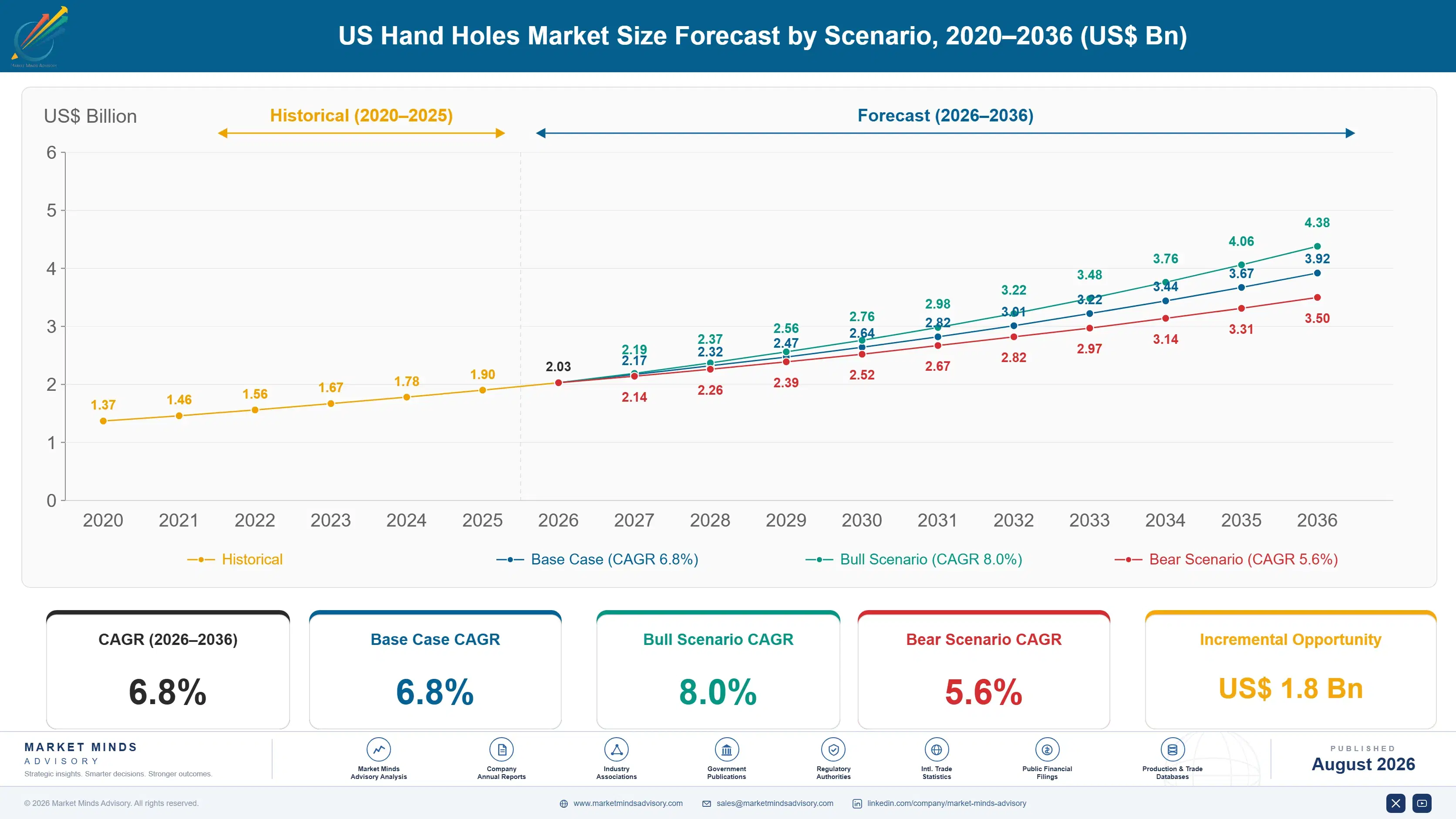
US Hand Holes Market Forecast Scenarios

us-hand-holes-market-size-forecast-scenario-1787300490512
Between 2020 and 2025 the market grew at an estimated 5.8 percent annually as early federal broadband funding announcements and expanding EV charging pilot programmes pushed installers to begin specifying additional underground enclosure capacity across that five-year span, a pace that outstripped most other precast concrete product categories over the same period and few manufacturers had forecast before the funding programmes matured.
The base case assumes 6.8 percent annual growth through 2036, anchored in three distinct commercial mechanisms operating together: federal broadband buildout programmes requiring extensive new underground fiber access infrastructure across previously unserved areas, EV charging network expansion driving new electrical service connections that each require dedicated hand hole access points, and utilities replacing aging enclosures reaching the end of their service life across established grid infrastructure and its surrounding distribution network.
The bull case centers on federal infrastructure funding programmes expanding further and accelerating disbursement timelines, pulling forward years of expected installation demand almost overnight across every eligible utility territory. The bear case centers on funding disbursement delays and permitting bottlenecks slowing installation pace well below the underlying programme funding levels already committed by federal agencies.

The Broadband and EV Charging Installation Surge

Hand holes used to be a quiet, unglamorous line item on a utility capital budget, purchased steadily but rarely discussed. Federal broadband and EV charging infrastructure programmes changed that calculus, turning underground enclosure procurement into a genuine capacity constraint installers now plan construction schedules around directly, well before ground is ever broken on site.
MARKET CONCENTRATIONCR5 34%top five hand hole manufacturers hold a modest combined share
AVERAGE PRICE PREMIUM30-50% for composite unitsfiberglass composite enclosures commanding a meaningful pricing premium
TOP PRODUCING STATE SHARETexas 18%leading share of domestic hand hole manufacturing capacity
MANUFACTURING CAPACITY UTILISATION64-78%precast and composite production lines running below theoretical maximum
TRADE INTENSITY22%share of finished enclosure unit volume crossing a border
INPUT COST SHARE34-44%primary raw material inputs as a share of production cost
Precast concrete enclosures still generate the largest share of category revenue, anchored by their low cost and established specification across nearly every electric utility standard nationwide. Fiberglass reinforced composite enclosures are the segment reshaping purchasing decisions fastest, since fiber and telecom installers increasingly favor their lighter weight and corrosion resistance over traditional precast concrete, a preference that shortens installation crew time meaningfully on every job site and reduces the equipment needed to place each unit.
Resin and cement inputs remain the largest cost driver behind hand hole manufacturing, since both composite and precast production depend directly on commodity material pricing that fluctuates independently of underlying enclosure demand. Manufacturers with established raw material supply relationships are capturing disproportionate share of new national distributor contracts specifically across nearly every major utility territory tracked in this report and its supporting data.
"Nobody used to think twice about a hand hole order. Broadband funding changed that overnight, and now lead times on composite enclosures are something installers actually plan construction schedules around."
Practice Lead, Construction Materials Intelligence · MMA Construction and Indust

Market Trends

Fiberglass Composite Enclosures Replace Precast Concrete

Fiber and telecom installers are increasingly specifying fiberglass reinforced composite hand holes over traditional precast concrete, valuing their meaningfully lighter weight and corrosion resistance on job sites where crew time and equipment access constraints directly affect installation cost. These enclosures typically command a 30 to 50 percent price premium over comparable precast concrete units, reflecting the specialty resin and molding process required relative to conventional concrete casting. Installers report meaningfully faster placement times with composite enclosures, since a two-person crew can often handle units that would otherwise require mechanical lifting equipment for an equivalent precast concrete unit.
Market Impact: Commits $42 billion in funding
Federal Broadband Programmes Drive Bulk Procurement Contracts

Federal broadband buildout programmes are pushing installers and utilities toward bulk procurement contracts covering thousands of hand hole units across multi-year deployment schedules, a shift from the smaller, project-by-project purchasing that historically characterized the category. Manufacturers capable of guaranteeing consistent lead times and volume pricing across these multi-year contracts are capturing disproportionate share of new programme awards specifically. This bulk procurement shift is also standardizing enclosure specifications across previously fragmented regional purchasing practices, since programme administrators increasingly favor a single qualified supplier across an entire funded service territory rather than juggling several regional vendors with inconsistent lead times.
Market Impact: Adds connections at 40-60% faster pace

Market Opportunities and Growth Drivers

Federal Broadband Funding Expands Underground Fiber Access

Federal broadband funding programmes have committed an estimated $42 billion toward expanding fiber access into previously unserved and underserved areas, and each new fiber route requires dedicated hand hole access points spaced at regular intervals along its length. This funding commitment translates directly into sustained multi-year hand hole demand regardless of short-term construction cost fluctuations, since the underlying programme funding has already been allocated and committed to specific service territories. Installers report programme administrators increasingly specifying enclosure standards directly in funding award requirements, shaping which manufacturers can compete for this demand specifically.
Market Impact: Compresses margins by an estimated 15-20%

EV Charging Network Expansion Requires New Service Connections

EV charging network expansion is driving substantial new electrical service connection volume, and each new charging site typically requires dedicated hand hole access points for the underground electrical infrastructure connecting the site to the broader grid. Federal EV charging infrastructure programmes are accelerating this connection volume beyond what organic charging network growth alone would generate, concentrating demand in specific highway corridor and urban deployment zones targeted by programme funding. Utilities report EV charging-related service connection requests growing considerably faster than overall new electrical service volume across their territories, a pattern expected to continue throughout the current forecast period.
Market Impact: Delays installation by 6-12 months

Market Restraints and Challenges

Commodity Material Costs Compress Manufacturer Margins

Resin and cement pricing volatility directly compresses manufacturer margins, since both composite and precast production depend on commodity material inputs that fluctuate independently of underlying enclosure demand or contracted pricing agreements. The root cause is that most hand hole manufacturers lack the purchasing scale to negotiate long-term fixed-price material contracts the way larger construction materials producers can, leaving them exposed to spot market swings between contract signing and actual production. This pressure is most acute for manufacturers locked into fixed-price bulk contracts signed before recent cost increases. Manufacturers are mitigating this by negotiating price escalation clauses into new multi-year contracts.
Market Impact: Commands a 30-50% price premium

Permitting Delays Slow Installation Despite Available Funding

Permitting and right-of-way approval delays are slowing actual installation pace well below the underlying programme funding levels already committed, creating a gap between announced funding and realized hand hole demand that manufacturers must plan production around carefully. The root cause is that municipal and utility permitting processes were not designed for the installation volume federal broadband and EV charging programmes are now generating simultaneously across many jurisdictions. This delay risk complicates manufacturer production planning considerably. Some jurisdictions are mitigating this by streamlining permitting specifically for federally funded broadband and EV charging infrastructure projects.
Market Impact: Covers contracts worth 1,000+ units
3 additional market trends, 3 additional growth drivers, and 2 additional restraints and challenges are covered in the full report. Contact sales@marketmindsadvisory.com to access the complete intelligence.

Segment CAGR and Growth Architecture

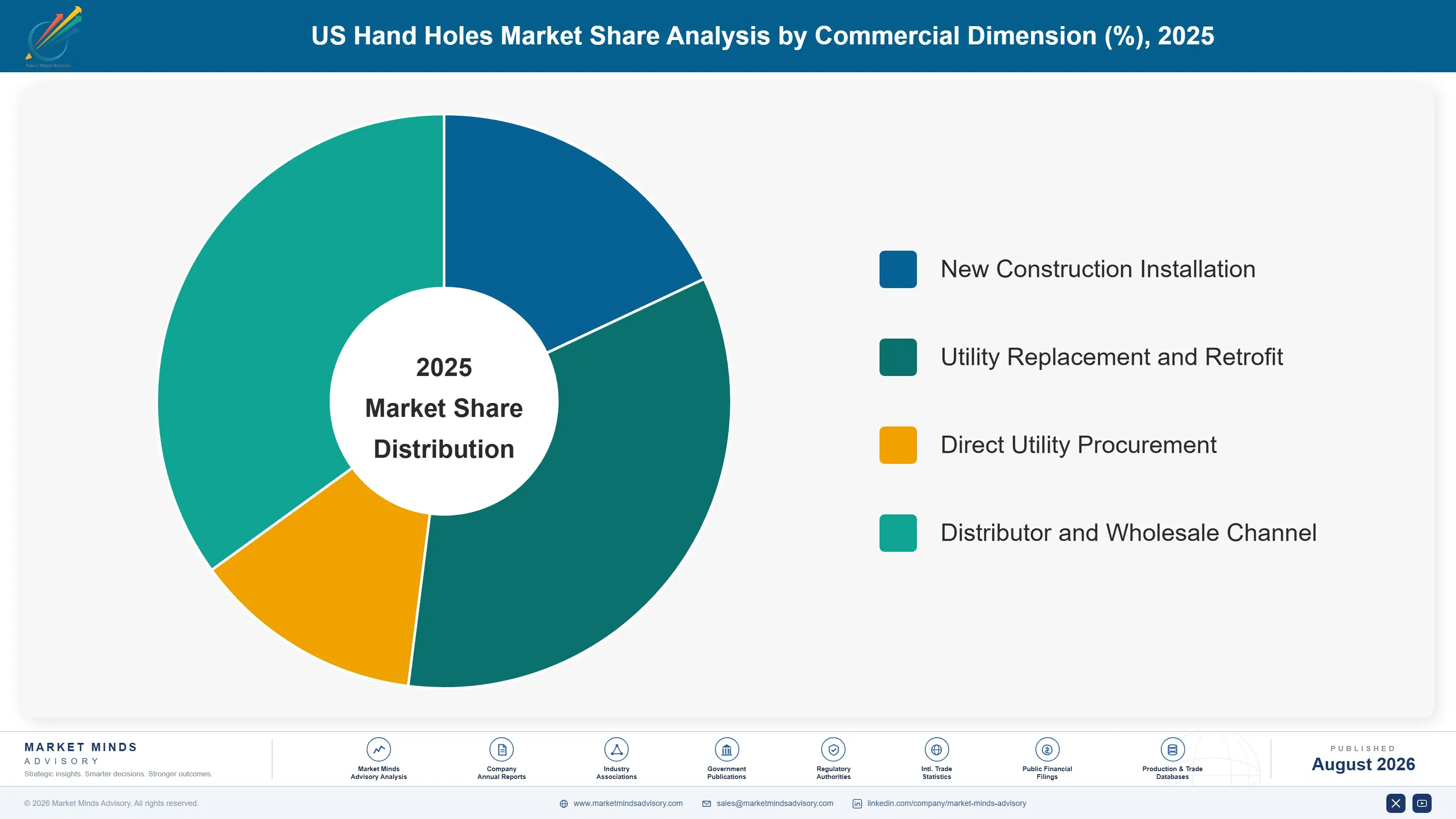
Segmentation follows enclosure material because installation weight, corrosion resistance, and typical purchasing buyer differ substantially between precast concrete, polymer concrete, fiberglass composite, and thermoplastic construction, each carrying its own distinct price point and specification standard shaped by the specific utility application, installation environment, and load-bearing requirement each project's governing standard actually specifies across telecom, power, and water infras
us-hand-holes-market-market-share-analysis-1787300491041

Fiberglass Reinforced Composite Hand Holes

Fiberglass reinforced composite hand holes are the fastest-growing category as fiber and telecom installers increasingly favor their meaningfully lighter weight and corrosion resistance over traditional precast concrete on job sites where crew time and equipment access constraints directly affect installation cost. These enclosures typically command a 30 to 50 percent price premium over comparable precast concrete units, reflecting the specialty resin and molding process required relative to conventional concrete casting. Installers report meaningfully faster placement times, since a two-person crew can often handle units that would otherwise require mechanical lifting equipment for an equivalent precast concrete unit. Manufacturers with established composite molding capability are capturing disproportionate share of new fiber and telecom installer contracts specifically.
CAGR 10.4%

Polymer Concrete Hand Holes

Polymer concrete hand holes are the second-fastest growing category, valued for combining concrete-like structural strength with meaningfully lighter installation weight than traditional precast concrete alternatives. Electric utilities in particular favor this material for applications requiring both durability and easier field handling, since polymer concrete resists cracking and chemical exposure better than standard precast concrete while remaining lighter than steel alternatives. Manufacturers with established polymer concrete production capability are capturing disproportionate share of new electric utility standardization contracts, since utilities increasingly specify a single enclosure material across their full service territory rather than mixing materials by application type, simplifying inventory management and crew training across every installation crew operating within that territory.
CAGR 8.9%
Full segment breakdown across 6 segments available in the complete report.

Regional Architecture and Country Demand Map

North America dominates global demand by a wide margin, reflecting the category's origin in United States National Electrical Code standards and utility specification practices, while South Asia shows the fastest percentage growth off a smaller established base of installed enclosure capacity across its expanding telecom infrastructure buildout.

North America

North America's share of global hand hole revenue sits well above the band this report's regional model would typically assign, and that concentration reflects a genuine regulatory and manufacturing reality rather than a default assumption: hand holes as a defined product category originated in and remain governed by United States National Electrical Code standards and utility specification practices that most other regions simply do not use in the same form. The United States hosts the overwhelming majority of category manufacturing capacity, federal broadband and EV charging infrastructure funding programmes, and the utility standardization bodies that define enclosure specifications nationwide. Canada follows comparable utility standards, reinforcing regional demand alongside the dominant United States market and its concentrated manufacturing base.
Share: 42% | CAGR: 7.8% (2026 to 2036)

Western Europe

Western Europe uses fundamentally different underground utility chamber and duct systems than the United States hand hole standard, limiting direct category comparison, though multinational telecommunications operators expanding fiber networks across Germany, France, and the United Kingdom increasingly specify enclosures functionally similar to United States hand holes for fiber splice access points. Nordic countries maintain steady demand tied to rural broadband expansion programmes. Regulatory harmonization across the European Union generally speeds product approval relative to fragmented emerging market frameworks elsewhere, though enclosure standards still vary meaningfully between individual member states and their national utility specification bodies. Italy and Spain are also expanding fiber network coverage as public broadband subsidy programmes continue funding rural connectivity projects across underserved regions.
Share: 18% | CAGR: 5.8% (2026 to 2036)
Regional intelligence for 5 additional markets available in the complete report: East Asia, South Asia and Pacific, Latin America, Middle East and Africa, Eastern Europe. Contact sales@marketmindsadvisory.com.
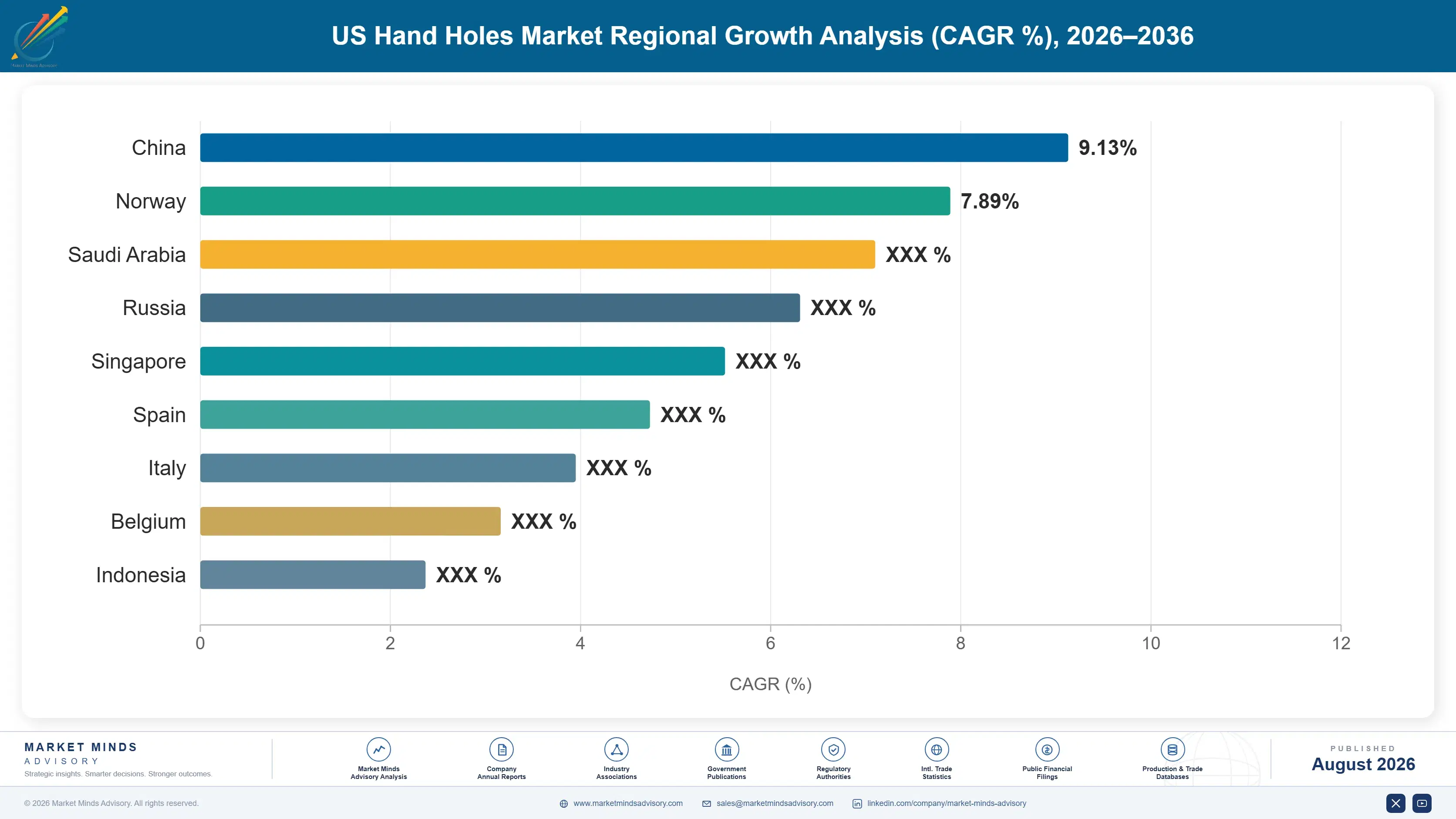
us-hand-holes-market-country-cagr-analysis-1787300491543

Where Hand Hole Manufacturers Capture Margin

Hand hole economics offer several distinct paths to margin expansion beyond simple unit volume growth, from composite material premiums that command materially higher per-unit pricing to national distribution consolidation that captures fulfillment margin smaller regional producers cannot match, across nearly every application category and utility specification tier this report tracks in close detail throughout its supporting data.

Commercialize Composite Formats for Fiber Installer Accounts

Manufacturers building fiberglass reinforced composite product lines specifically engineered for fiber and telecom installer crews capture a 30 to 50 percent price premium over comparable precast concrete units, reflecting the specialty resin and molding process required relative to conventional casting. This premium holds even as core resin costs fluctuate, since the value installers pay for is reduced crew time and easier job site handling rather than the physical enclosure alone. Manufacturers with established composite molding capability are capturing disproportionate share of new fiber installer contracts specifically across every major telecom buildout programme tracked in this report.
Market Impact: Commands a 30-50% price premium per composite unit

Consolidate Regional Distributors Into National Networks

National distributors acquiring smaller regional precast and composite producers build coast-to-coast fulfillment capability that captures freight and lead-time margin fragmented regional suppliers cannot match, typically compressing delivery windows by 20 to 35 percent for large multi-site utility and telecom customers. This consolidation converts a series of one-off regional relationships into a single national account relationship, since large buyers increasingly prefer sourcing enclosures from one qualified vendor across their full service territory rather than managing multiple regional supplier qualifications each fiscal year. Distributors that move early capture the most attractive independent producers before larger rivals bid them up.
Market Impact: Cuts delivery lead time by 20-35% for buyers

Pursue Utility and EV Charging Specification Approval

Manufacturers securing formal specification approval on major electric utility and EV charging infrastructure programmes gain access to multi-year procurement contracts worth thousands of units annually, a channel considerably more durable than one-off distributor orders subject to competitive rebidding each cycle. Formal specification approval typically requires 12 to 18 months of product testing and documentation, creating a genuine barrier smaller manufacturers without dedicated compliance staff struggle to clear. Manufacturers that secure early approval capture disproportionate share of new programme awards before competitors complete their own qualification process, locking in renewal business across each utility's full multi-year replacement schedule.
Market Impact: Wins multi-year contracts worth 1,000+ units each year

Offer Custom Sizing and Pre-Assembly Services

Manufacturers offering custom sizing and factory pre-assembly services, rather than shipping standard catalog dimensions alone, capture a 10 to 20 percent service premium from large infrastructure customers seeking to reduce field labor hours on complex multi-conduit installations. This service layer converts a single product sale into an ongoing engineering relationship with repeat project specification work, since customers rarely switch suppliers once a working dimensional and hardware standard has been established across a multi-site rollout. Manufacturers building dedicated pre-assembly capacity are capturing disproportionate share of large multi-site infrastructure contracts, since buyers value reduced coordination burden nearly as much as the enclosure.
Market Impact: Adds a 10-20% premium on pre-assembled hand hole units

Who Controls the Margin Pool

Hand holes remain fragmented at a CR5 of roughly 34 percent measured on production capacity, reflecting the category's mix of national precast specialists and dozens of regional concrete producers. Oldcastle Infrastructure leads on distribution breadth and manufacturing footprint, and its gap over Hubbell Power Systems remains meaningful, though composite-focused challengers are narrowing that lead through fiber installer relationships legacy precast specialists historically underserved.
Current competitive activity centers on composite material expansion, as precast-heavy manufacturers add fiberglass and polymer concrete product lines rather than ceding that growth entirely to specialist entrants. Several players are also pursuing regional distributor acquisitions to build national fulfillment capability, and utility specification approval campaigns have intensified as EV charging and broadband programmes expand procurement volume across most major territories.

Emerging pressure comes from composite-only specialists entering with lighter, corrosion-resistant product lines to contest accounts precast incumbents have held for decades, a dynamic that could pull share away from concrete-heavy suppliers in coastal and high-corrosion territories over the next several years. Rankings shift most where composite molding capability and national distribution reach, not manufacturing scale alone, determine which producers capture emerging fiber and EV charging demand across each region this report tracks.
us-hand-holes-market-company-positioning-matrix-1787300492061

Competitive Moat and Risk Dimensions

OLDCASTLE INFRASTRUCTURE

Moat: National precast manufacturing footprint

Oldcastle Infrastructure's extensive network of regional precast manufacturing plants gives it delivery and lead-time advantages smaller regional producers cannot match, supporting its position as the default specification choice across large multi-site utility and telecom accounts nationwide and across every major metro territory it currently serves.
OLDCASTLE INFRASTRUCTURE

Risk: Slower composite product transition

Oldcastle Infrastructure's manufacturing base remains weighted toward precast concrete, leaving it more exposed to losing fiber installer accounts to composite-focused rivals offering lighter, purpose-built product lines across a growing share of new telecom buildout contracts each successive year and each successive fiber installer procurement cycle its national accounts run.
HUBBELL POWER SYSTEMS (QUAZITE)

Moat: Established polymer concrete brand

Hubbell's Quazite polymer concrete brand carries decades of documented utility specification history, giving it genuine credibility that newer composite entrants cannot easily replicate, supporting premium positioning across electric utility accounts requiring proven long-term field performance records and formal qualification across each utility's own engineering standards committee.
HUBBELL POWER SYSTEMS (QUAZITE)

Risk: Narrower fiberglass composite menu

Hubbell's product menu remains more concentrated in polymer concrete than dedicated fiberglass composite specialists, leaving it more exposed to losing lightweight-focused fiber installer contracts to rivals offering purpose-built composite configurations across a broader materials portfolio and a deeper bench of installer-specific product variants tuned to each regional buildout programme.

Key Players

Oldcastle Infrastructure
Hubbell Power Systems (Quazite)
Christy Concrete Products
Armorcast Products Company
Carson Industries LLC

Others

NDS, Inc.
Highline Products
Synertech Moulded Products
Jensen Precast
Elmhurst-Chicago Stone Co.
Utility Concrete Products, LLC
Wieser Concrete Products, Inc.
CDR Systems Corporation
Cretex Concrete Products, Inc.
Foresight Products, LLC
County Materials Corporation
Spartan Concrete Products, Inc.
StarLine Supply Company
Trenwa, Inc.
Rinker Materials

Recent Developments

MARCH 2025

Oldcastle Infrastructure Expands Composite Molding Capacity

Oldcastle Infrastructure completed an organic capacity expansion at its Georgia manufacturing facility, adding dedicated fiberglass reinforced composite molding lines to serve growing fiber installer demand across the Southeast. The expansion increases regional composite output meaningfully without requiring a corresponding acquisition or joint venture with an outside partner.
Signal: Signals precast incumbents are investing organically in composite capacity rather than ceding fiber accounts to specialists nationwide.
SEPTEMBER 2025

Hubbell Power Systems Acquires Regional Polymer Producer

Hubbell Power Systems acquired a regional polymer concrete producer serving the Southeast utility market, expanding its Quazite brand manufacturing footprint and distribution reach into a territory it previously served only through third-party distributors. The acquisition brings established utility specification relationships directly under Hubbell's own sales organization.
Signal: Signals continued industry consolidation as national brands absorb regional producers to close distribution gaps in underserved territories.
JANUARY 2026

Carson Industries Signs Multi-Year Utility Supply Agreement

Carson Industries signed a multi-year supply agreement with a large West Coast electric utility to provide polymer concrete hand holes across its full service territory replacement programme. The agreement, a supply commitment rather than an acquisition or joint venture, formalizes Carson as the utility's primary enclosure vendor.
Signal: Signals utilities increasingly standardizing on a single qualified vendor across their full service territory and budget cycle.

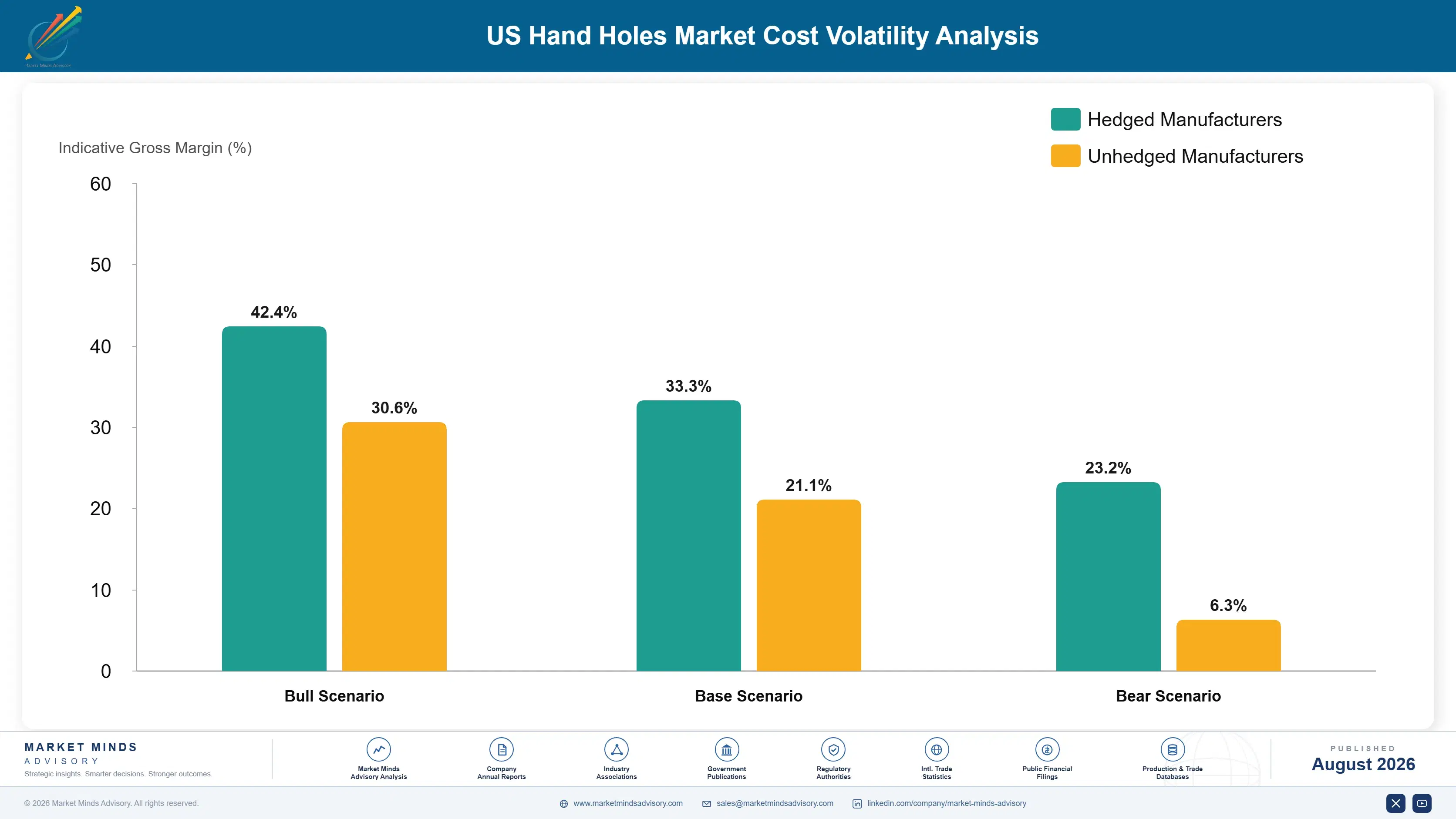
Concrete and Composite Resin Cost Exposure

Portland cement, aggregate, and specialty composite resin together represent an estimated 40 to 50 percent of total production cost, sourced from a broad domestic cement and aggregate supply base alongside a narrower group of specialty resin producers serving the composite molding segment specifically. Steel reinforcement and rebar add a further meaningful share of remaining input cost across most precast manufacturing facilities.
Cement pricing rose an estimated 12 to 18 percent between 2023 and 2025 according to US Census Bureau construction materials tracking and company annual report disclosures, squeezing margins for precast manufacturers unable to pass the increase through to price-sensitive utility buyers on fixed multi-year supply agreements. Composite resin pricing has shown similar volatility tied to broader petrochemical feedstock swings over the same period, further complicating cost forecasting for manufacturers quoting multi-year contract pricing.

Smaller regional precast producers carry the highest exposure to this cost pressure since they lack the purchasing scale to negotiate favorable long-term cement and aggregate contracts the way national manufacturers can. Composite specialists face comparable exposure to resin feedstock swings, though their typically higher unit pricing provides somewhat more room to absorb input cost increases than commodity-tier precast producers competing primarily on price.
us-hand-holes-market-cost-volatility-analysis-1787300492256

Negotiate Multi-Year Cement and Aggregate Contracts

Larger manufacturers lock in multi-year cement and aggregate supply contracts at fixed or capped pricing, reducing exposure to spot market volatility that has squeezed smaller regional competitors dependent on shorter-term purchasing arrangements and less predictable input cost planning each fiscal year, preserving quoted pricing on multi-year utility contracts already signed and under agreement nationwide.

Shift Product Mix Toward Composite Categories

Manufacturers shifting investment toward higher-margin composite product lines achieve meaningful insulation from cement and aggregate cost swings, since composite categories carry pricing power commodity-tier precast producers simply do not have available to them across comparable procurement channels and buyer negotiation cycles, preserving margin even as raw material costs move against them across successive quarters and budget cycles.

Diversify Resin Sourcing Across Multiple Suppliers

Composite manufacturers qualifying multiple resin suppliers rather than depending on a single feedstock relationship reduce exposure to petrochemical price spikes and regional supply disruptions, preserving production continuity during periods when single-source competitors face longer lead times and steeper spot market price increases across their own procurement channels and contract renewal negotiations each fiscal year.

Portfolio Architecture for Margin Defence

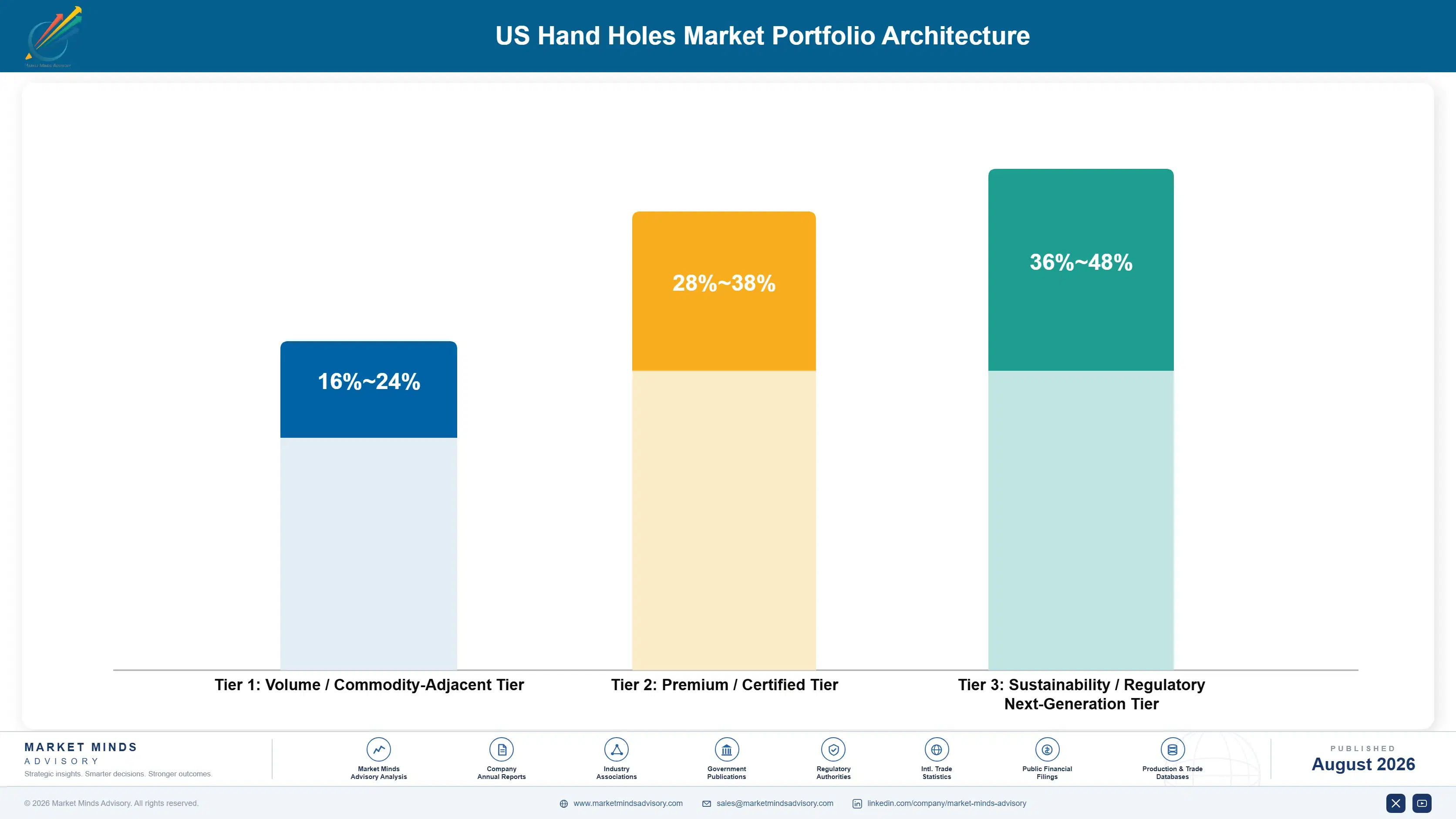
Portfolio economics in hand holes separate along enclosure material and specification tier, with margin expanding as products move from standard precast concrete toward premium composite and certified utility-grade platforms that command materially higher per-unit pricing and stronger buyer willingness to pay across nearly every purchasing channel tracked in this report and its underlying regional survey data.
Volume-tier precast concrete competes on price and reliable regional supply, prioritizing unit volume and broad distribution reach over premium positioning, while composite and certified polymer concrete systems prioritize application-specific engineering and material differentiation, accepting smaller addressable unit volume in exchange for meaningfully higher margin per unit sold. Manufacturers straddling both tiers must balance capital allocation carefully, since the two economics reward very different commercial disciplines and distinct sales force training investments.

The highest-value pools concentrate in fiberglass composite formats and factory pre-assembled multi-conduit configurations, both of which command pricing well above conventional precast formats while requiring proportionally less incremental manufacturing investment once molding capacity is established. EV charging infrastructure procurement is emerging as a third distinct high-value pool as utilities specify enclosures built for higher current-carrying capacity across their expanding public charging networks.

Volume / Commodity-Adjacent Tier

Standard precast concrete enclosures priced for broad distribution and reliable regional supply, competing mainly on price across large utility accounts with thin per-unit margins nationwide, purchased in bulk for routine replacement programmes.
Gross Margin: 16-24%

Premium / Certified Tier

Polymer concrete and certified utility-grade enclosures with documented load rating and long-term field performance records, commanding higher pricing across institutional accounts with strong specification renewal and growing brand loyalty each qualification cycle.
Gross Margin: 28-38%

Sustainability / Regulatory / Next-Generation Tier

Fiberglass composite and EV charging-rated enclosures engineered for corrosion resistance and higher current capacity, priced on installer labor savings and regulatory compliance value across utilities facing expanding EV infrastructure mandates.
Gross Margin: 36-48%
us-hand-holes-market-portfolio-architecture-1787300492756

High-value Sub-segments and Strategic Watch-out

Fiberglass Reinforced Composite Hand Holes

High value and high growth at 10.4 percent, the fastest category, as fiber and telecom installers increasingly specify composite formats over precast concrete for their lighter weight and corrosion resistance across most major urban and suburban telecom buildout territories nationwide, a shift manufacturers are meeting with dedicated molding capacity expansion.
Gross Margin: 38-48%

Polymer Concrete Hand Holes

High value and moderate growth at 8.9 percent, as electric utilities standardize on polymer concrete's combination of structural strength and lighter installation weight across full service territories, simplifying inventory management and field crew training programmes while extending average asset service life and reducing long-term replacement frequency across each maintained territory.
Gross Margin: 28-36%

Precast Concrete Hand Holes

The volume core of the category, precast concrete remains the default specification for routine utility replacement programmes where upfront cost outweighs installation labor savings, sustaining steady if unspectacular unit volume across most regional utility territories and their annual replacement budgets each fiscal cycle regardless of composite pricing pressure.
Gross Margin: 16-22%

Steel and Metal Hand Holes

A strategic watch-out segment facing gradual displacement as corrosion concerns and rising steel input costs push specifiers toward composite and polymer concrete alternatives, though it retains a defensible niche in high-security and heavy-load applications where structural load rating still favors steel construction over lighter materials currently available.
Gross Margin: 20-28%

The Replacement-Driven Purchase Cycle

Hand hole purchasing follows a genuinely annuity-like economics pattern rather than a single discretionary buy, since utilities and telecom operators specify enclosures against multi-year capital programmes that recur predictably as networks expand and older enclosures reach end of service life across most major territories tracked in this report and its underlying utility replacement schedules.
Adoption depth varies sharply by end-use vertical. Telecom and broadband operators show the deepest, most consistent specification of composite formats, since installer labor savings directly offset the material premium on large fiber buildout programmes, while electric utilities show more gradual adoption tied to standardization cycles that only refresh every several years, a gap that narrows mainly where EV charging infrastructure investment accelerates specification review across an entire service territory at once.

A generational shift is underway in buyer profile: younger utility and telecom procurement staff trained during a period of expanding composite adoption increasingly default to lightweight materials as standard specification practice, while older buyers, more accustomed to precast concrete, historically favored incumbent suppliers and adopted composite alternatives at meaningfully lower rates across their own procurement tenure and internal vendor approval processes.
us-hand-holes-market-end-use-penetration-index-1787300493244

Where Hand Hole Makers Focus Next

These are among the four positions where our research anticipates prominent divergence between winners and laggards over the coming forecast period. Each is grounded in the demand model, the regulatory perimeter, and the announced capacity pipeline.
01 / COMPOSITE PRODUCT INVESTMENT

Expand composite molding capacity ahead of fiber buildout peak

Fiberglass composite enclosures command a 30 to 50 percent price premium and are capturing disproportionate share of new fiber installer contracts as crews increasingly value reduced job site handling time over upfront unit cost across most major telecom buildout territories tracked in this report. Manufacturers that expand dedicated composite molding capacity now will capture disproportionate share before generalist precast competitors adapt their own product lines to match. Those that wait risk finding early movers already holding the strongest fiber installer relationships and specification approvals in this fast-moving category.
02 / NATIONAL DISTRIBUTION CONSOLIDATION

Acquire regional producers before larger rivals close the gap

National distributors acquiring smaller regional precast and composite producers build coast-to-coast fulfillment capability that captures freight and lead-time margin fragmented suppliers cannot match on large multi-site accounts spanning multiple utility and telecom territories at once. Manufacturers pursuing targeted regional acquisitions now will consolidate the most attractive independent producers before larger national rivals bid them up. Competitors that delay will find themselves competing for a shrinking pool of independent regional targets at increasingly unfavorable acquisition pricing and weaker negotiating leverage across every remaining regional auction process.
03 / UTILITY SPECIFICATION APPROVAL

Pursue EV charging specification ahead of programme scale-up

Formal specification approval on major electric utility and EV charging infrastructure programmes opens multi-year procurement contracts worth thousands of units annually, a channel considerably more durable than one-off distributor orders subject to competitive rebidding each cycle. Manufacturers securing early approval now will capture disproportionate share of new programme awards before competitors complete their own twelve to eighteen month qualification process. Those that wait will find incumbents already embedded across the utility's full service territory and its multi-year replacement schedule and annual capital budget.
04 / SERVICE AND PRE-ASSEMBLY EXPANSION

Build pre-assembly capacity before service becomes standard

Custom sizing and factory pre-assembly services capture a 10 to 20 percent premium from infrastructure customers seeking to reduce field labor hours on complex multi-conduit installations, and this differentiator is increasingly weighed alongside base unit pricing in large contract awards. Manufacturers building dedicated pre-assembly capacity now will capture recurring engineering relationships before competitors close the service gap entirely across comparable project types nationwide. Those that wait will find customers already locked into a rival's dimensional standard and unwilling to requalify a new supplier mid-programme.

Engagement Snapshot From the Field

A live engagement with an industry participant carrying material or product regulatory and market exposure ahead of a defining policy shift, showing how our research translates into a defensible multi-year portfolio strategy.
MARKET MINDS ADVISORY · CLIENT ENGAGEMENT SUMMARY
US Hand Holes Producer Strategic Portfolio Review and Transition Roadmap 2026·Investment Scenario on US Hand Holes Exposure Evaluation 2025-26
CLIENT PROFILE
The client is a mid-sized regional telecom operator executing a multi-year fiber broadband buildout across three states, previously sourcing hand holes from a mix of regional precast suppliers without a standardized material specification. Facing rising installer labor costs and inconsistent product quality across its supplier base, the operator sought an independent assessment of whether consolidating around a single composite supplier would reduce total installed cost across its remaining buildout phases.
STRATEGIC CHALLENGE
The operator lacked internal data comparing installed cost across precast concrete and composite enclosure options under its specific crew staffing model, and needed guidance on realistic labor savings assumptions, since none of its procurement staff had previously evaluated composite alternatives at this scale before this engagement began at the operator's request.
MMA APPROACH
MMA benchmarked installed cost across precast concrete and composite enclosure options using primary survey data on regional installer labor rates, modeled projected savings across the operator's remaining buildout phases, and evaluated which composite suppliers offered established fiber installer product lines suited to the operator's three-state territory and its existing crew equipment.
KEY FINDINGS
  1. Composite enclosures cost roughly 35 percent more per unit but reduced average crew installation time by nearly half across comparable job sites.
  2. Total installed cost, including labor, favored composite formats on the majority of the operator's planned installation sites given current regional labor rates.
  3. Suppliers with established fiber installer product lines offered stronger delivery reliability than generalist precast producers lacking comparable composite molding capacity, a gap that widened during peak buildout season.
  4. A phased rollout starting with the highest labor-cost territory allowed the operator to validate combined savings assumptions before committing its full remaining buildout.
CLIENT PROFILE
The client is a mid-sized regional telecom operator executing a multi-year fiber broadband buildout across three states, previously sourcing hand holes from a mix of regional precast suppliers without a standardized material specification. Facing rising installer labor costs and inconsistent product quality across its supplier base, the operator sought an independent assessment of whether consolidating around a single composite supplier would reduce total installed cost across its remaining buildout phases.
STRATEGIC CHALLENGE
The operator lacked internal data comparing installed cost across precast concrete and composite enclosure options under its specific crew staffing model, and needed guidance on realistic labor savings assumptions, since none of its procurement staff had previously evaluated composite alternatives at this scale before this engagement began at the operator's request.
MMA APPROACH
MMA benchmarked installed cost across precast concrete and composite enclosure options using primary survey data on regional installer labor rates, modeled projected savings across the operator's remaining buildout phases, and evaluated which composite suppliers offered established fiber installer product lines suited to the operator's three-state territory and its existing crew equipment.
KEY FINDINGS
  1. Composite enclosures cost roughly 35 percent more per unit but reduced average crew installation time by nearly half across comparable job sites.
  2. Total installed cost, including labor, favored composite formats on the majority of the operator's planned installation sites given current regional labor rates.
  3. Suppliers with established fiber installer product lines offered stronger delivery reliability than generalist precast producers lacking comparable composite molding capacity, a gap that widened during peak buildout season.
  4. A phased rollout starting with the highest labor-cost territory allowed the operator to validate combined savings assumptions before committing its full remaining buildout.
RECOMMENDED STRATEGY
Phase 1: Phase 1 (Months 1-2): Benchmark installed cost and installer labor hours carefully across all three planned buildout territories currently underway this quarter. Phase 2: Phase 2 (Months 3-6): Standardize on composite enclosures in the highest labor-cost territory and validate combined savings assumptions promptly and reliably. Phase 3: Phase 3 (Months 7-14): Expand composite specification across the remaining two territories based on measured results achieved during the pilot phase.
OUTCOME
Within fourteen months, the operator reported installed cost savings exceeding initial projections across the two expanded territories, with field crews reporting sustained reductions in average installation time per unit across the full remaining buildout (client-reported, unverified by MMA). Management approved composite specification as the default standard for all future regional buildout phases.

Frequently Asked Questions

Foundational context covering the market sizes, CAGR, scope, country, region and competition that inform every finding below. This section is provided to cover basics and most often pre-purchase conversations, answered from the MMA Primary Research Dataset.

What is the current size of the US Hand Holes Market?

The US Hand Holes Market reached an estimated 1.85 billion dollars in 2025. Demand is climbing as broadband buildout and EV charging infrastructure programmes push installers to specify underground access enclosures at a pace exceeding traditional utility replacement cycles.

How large will the US Hand Holes Market be by 2036?

The market is projected to reach approximately 3.82 billion dollars by 2036, roughly 1.93 times its 2026 value. Growth is driven by continued fiber, EV charging, and electric utility infrastructure investment across most major service territories.

What is the CAGR for the US Hand Holes Market 2026 to 2036?

The market is forecast to grow at a 6.8 percent compound annual rate between 2026 and 2036. This compares with a historical rate of roughly 5.8 percent between 2020 and 2025, reflecting accelerating infrastructure investment nationwide.

Which segment is growing fastest?

Fiberglass reinforced composite hand holes are growing fastest at 10.4 percent annually, roughly 1.53 times the overall market rate, as fiber installers favor their lighter weight and corrosion resistance over traditional precast concrete.

Who are the major companies in the US Hand Holes Market?

Leading manufacturers include Oldcastle Infrastructure, Hubbell Power Systems through its Quazite brand, Christy Concrete Products, Armorcast Products Company, and Carson Industries LLC. The category remains fragmented with a CR5 near 34 percent.

Which country is growing fastest?

India leads regional growth at an estimated 10.2 percent annually, driven by expanding fiber broadband and smart city infrastructure programmes adopting underground enclosure standards modeled on American and European utility practice.

Report Segmentation Architecture

The full report scope spans multiple orthogonal segmentation dimensions, with cross-tabulated demand data provided for each dimension pair. Coverage extends further to regional breakdowns, trend trajectories, and the competitive detail needed to support segment-level decision-making.

By Primary Market Dimension

  • Precast Concrete Hand Holes
  • Polymer Concrete Hand Holes
  • Fiberglass Reinforced Composite Hand Holes
  • Thermoplastic Hand Holes
  • Steel and Metal Hand Holes
  • Composite-Polymer Hybrid Hand Holes

By End-Use Industry

  • Telecommunications and Broadband
  • Electric Utility
  • Water and Wastewater
  • Transportation and Traffic Signal
  • Commercial and Industrial

By Commercial Dimension

  • New Construction Installation
  • Utility Replacement and Retrofit
  • Direct Utility Procurement
  • Distributor and Wholesale Channel

By Region

  • North America
  • Western Europe
  • East Asia
  • South Asia and Pacific
  • Latin America
  • Middle East and Africa
  • Eastern Europe

Scope, Methodology, and Coverage

Every figure in this report is reproducible from documented input assumptions. The scope below maps the historical period, the forecast horizon, the segmentation dimensions, and the countries covered, alongside the underlying primary and qualitative methodology.
Historical Period
2020 to 2025
Forecast Period
2026 to 2036
Base Year
2025 (USD billions; MMA Primary Research Dataset, August 2026)
Market Definition
This report covers underground and at-grade access enclosures, commonly termed hand holes, used to house cable splices, conduit junctions, and electrical connections for telecom, electric utility, water, and traffic signal infrastructure. It excludes larger vault and manhole structures, above-ground pedestal enclosures, and conduit or cable products sold separately from the enclosure itself.
Quantitative Units
USD billions (current prices); unit shipment volume where disclosed
Segmentation Dimensions
By Enclosure Material; By End-Use Industry; By Commercial Dimension; By Region
Regions Covered
North America, Western Europe, East Asia, South Asia and Pacific, Latin America, Middle East and Africa, Eastern Europe
Countries Covered
USA, China, Germany, France, UK, Japan, South Korea, India, Australia, Canada, Brazil, Mexico, Indonesia, Vietnam, Thailand, Malaysia, UAE, Saudi Arabia, South Africa, Nigeria, Turkey, Poland, Netherlands, Italy, Spain, Sweden, Switzerland, Argentina, Colombia, Singapore, and additional markets relevant to this sector
Key Companies Profiled
Oldcastle Infrastructure, Hubbell Power Systems (Quazite), Christy Concrete Products, Armorcast Products Company, Carson Industries LLC, NDS, Inc., Highline Products, Synertech Moulded Products, Jensen Precast, Elmhurst-Chicago Stone Co., Utility Concrete Products, LLC, Wieser Concrete Products, Inc., CDR Systems Corporation, Cretex Concrete Products, Inc., Foresight Products, LLC, County Materials Corporation, Spartan Concrete Products, Inc., StarLine Supply Company, Trenwa, Inc., Rinker Materials
Quantitative Methodology
Primary survey, n=3,800 respondents, Q4 2025, six countries; demand-side model with trade association cross-validation
Qualitative Methodology
47 expert interviews, Q4 2025; applied to validate demand model assumptions, identify emerging dynamics, and assess competitive positioning
Report Format
PDF and XLSX data workbook (Word format preview document)
Publisher
Market Minds Advisory
Report Code
MMA-2026-CON-188
Published
August 2026
Contact
sales@marketmindsadvisory.com | www.marketmindsadvisory.com

Purchase the full US Hand Holes Market Report (2026 to 2036).

The full US Hand Holes Market report delivers granular sizing and forecast data across all enclosure materials, end-use industries, and commercial channels through 2036. It includes detailed competitive profiling of all twenty companies covered, complete regional breakdowns across all seven regions, and input cost modeling tied to cement, aggregate, and composite resin pricing. Subscribers also receive access to the underlying primary survey and expert interview datasets referenced throughout this analysis. The report also includes a dedicated revenue lever and portfolio margin appendix built specifically for strategy and pricing teams. Quarterly refreshes keep every regional and competitive data table current across the full forecast window.
Full seven-region data tables and CAGRs
Complete twenty-company competitive profiles and moat analysis
Segment-level sizing across all six categories
Input cost and mitigation strategy modeling
Editable data appendix in spreadsheet format
Quarterly market update and refresh subscription option

Built For The People Who Decide

From boardroom strategy to bench-side execution, this report is read cover-to-cover by leaders shaping the next decade of their industry, turning demand scenarios, market dynamics and valuation benchmarks into decisions.
CXOs/ Presidents/ VPs/ Managers
M&A and Corporate Development
Strategy Teams and R&D Heads
Procurement and Product Directors
Regulatory and Compliance Leaders
Investor Relations and Equity Analysts