Market Minds Advisory
US Green Tea Supplement Market

US Green Tea Supplement Market: Catechin Specification, Liver Safety Scrutiny and Formulation Rather Than Single Ingredient Sales

Liver injury reporting put concentrated catechin extracts under scrutiny that commodity suppliers cannot document their way out of, pushing volume toward specified material and multi-ingredient formulations that spread the attention.

Lead Analyst

Lisa Gevelber

Published

September 2026

Make Smarter Decisions with Customized Research Insights

Request a free sample report and evaluate market opportunities, growth trends, and competitive dynamics relevant to your business needs.

2025 MARKET VALUE$0.5BMarket Size 2025
2036 FORECAST VALUE$1.1BBase Case , 2026 to 2036
CAGR 2026 TO 20367.2 %Bull 8.4% / Bear 6.0%
INCREMENTAL OPPORTUNITY$0.5BNet 10- year value creation
EXPANSION MULTIPLE2.00x2036 value over 2026 base
Strategic Levers
M&A Pipeline
Regional Outlook
Country Rankings
Competitive Intelligence
Segmental Deep-dive
Call-Us : 91 93563 13602

Executive Snapshot and Market Trajectory

Liver injury case reports involving concentrated green tea extract changed this market more than any marketing trend did. Suppliers who could document catechin profile, solvent residues and batch consistency survived the scrutiny that followed. Suppliers selling a commodity extract mostly did not. That was not a regulatory decision at all.
Standardised high-EGCG extracts carry the growth on exactly that documentation requirement, since a formulator can dose to a published study rather than to a plant. Multi-ingredient formulations grow nearly as fast partly because combination positioning spreads regulatory attention. East Asia holds the largest share of supply because Chinese extraction capacity produces most of the material this market consumes, and every regional figure here reflects origin rather than demand.
Concentration reads at 31% for the top five, low because supplement contract manufacturing remains fragmented and brands switch ingredient suppliers more readily than pharmaceutical formulators ever would. Contract manufacturers have become the practical gatekeepers, increasingly refusing to formulate with material that arrives without a full specification and documentation package behind it. Import dependence near 88% leaves American brands carrying documentation responsibility for plants they have never visited or inspected. Verification is the commercial issue.
Market Definition
This market covers green tea extract and catechin ingredients supplied into United States dietary supplement products, spanning standardised high-EGCG extracts, multi-ingredient formulation grade material, decaffeinated green tea extracts, whole leaf powder supplement grades, and finished single-ingredient green tea supplements. Brewed and ready-to-drink tea beverages, matcha sold as a food or beverage, green tea used in cosmetics, and pharmaceutical catechin products are excluded.
Base Year Value
$0.5B in 2025 (MMA Primary Research Dataset, August 2026)
Forecast Period
2026 to 2036, eleven discrete annual values
CAGR
7.2% base case. Bull 8.4%. Bear 6.0%.
Fastest Growth Segment
Standardised High-EGCG Extracts: 10.8% CAGR
Fastest Growth Country
United States: 7.2% CAGR
Fastest Growth Region
South Asia and Pacific: 9.5% CAGR
Largest Region
East Asia: 61% of 2025 global value
Market Leaders
Taiyo International, Indena, Layn Natural Ingredients, Martin Bauer Group and Nutra Green Biotechnology lead on green tea supplement ingredient supply into the United States. Source: MMA Primary Research Dataset, July 2026.
Primary Survey
n=3,800 procurement and R&D decision-makers, Q4 2025, six countries
Methodology
Demand-side build-up, cross-validated against public data, 47 expert interviews

US Green Tea Supplement Market Forecast Scenarios

us-green-tea-supplement-market-size-forecast-scenario-1787375362443
Growth ran at 6.1% annually between 2020 and 2025, and safety scrutiny rather than demand set the direction throughout. Liver injury case reports drew regulatory and media attention to concentrated catechin extracts, several European authorities restricted daily intake, and the American market responded by moving toward specified material and combination formulations rather than by contracting. Volume held while the supplier base narrowed considerably.
The base case at 7.2% rests on three mechanisms. Standardisation requirements keep concentrating volume among suppliers able to document catechin profile and residual solvents, which is a smaller group than the ingredient listing suggests. Multi-ingredient formulation continues absorbing extract into blends where inclusion is modest but reach is wide. And metabolic and cognitive health positioning keeps green tea extract in formulations that would otherwise have moved on to newer actives entirely.
The bull case at 8.4% turns on a defined upper intake level being established with clarity, which would settle the safety question and let formulators dose confidently rather than conservatively. The bear case at 6.0% reflects further restriction following additional case reports, since the American framework permits considerably higher doses than European authorities now allow and that gap invites attention.

Documentation Decides Who Supplies This Market

Safety scrutiny reorganised this market and it did so quickly. Liver injury case reports involving concentrated catechin extracts drew regulatory and media attention, European authorities restricted daily intake, and American contract manufacturers responded by tightening what they would accept. A supplier who could document catechin profile, residual solvents and batch consistency kept its customers. A commodity extract supplier generally did not.
TOP FIVE CONCENTRATION31%Low, since supplement contract manufacturing remains genuinely fragmented
STANDARDISED GRADE SHARE58%Portion of volume specified to a defined catechin content
TYPICAL EGCG SPECIFICATION50%Common epigallocatechin gallate content in standardised extract grades
MULTI-INGREDIENT SHARE64%Portion entering blends rather than single-ingredient supplement products
IMPORT DEPENDENCE88%Share of extract sourced from outside domestic production capacity
QUALIFICATION CYCLE8 monthsTypical time to qualify an extract with a contract manufacturer
Contract manufacturers became the practical gatekeepers in that process, which was not their intention. They carry the liability if a formulation causes harm and the reputational damage if a brand they produce for is named, so they increasingly refuse material arriving without a full documentation package. Qualification takes around eight months, and roughly 58% of volume now moves as specified rather than commodity grade.
Import dependence near 88% shapes everything underneath that. Chinese and Indian extraction capacity supplies almost all the material this market consumes, and American brands carry the documentation burden for processes they do not control and plants they have mostly never visited. Suppliers who invest in audit readiness and documentation depth hold positions that price competition alone cannot displace. Price competition alone displaces almost nobody now.
"The interesting thing about green tea extract in America is that a handful of liver case reports did more to consolidate the supplier base than a decade of competition. Documentation became the moat, and most suppliers never saw it coming."
Director, Nutraceutical Ingredients and Supplement Markets Practice · MMA Nutraceuticals Practice · August 2026

Market Trends

Contract Manufacturers Became Gatekeepers After Liver Safety Scrutiny

Liver injury case reports involving concentrated catechin extracts put contract manufacturers in an uncomfortable position, since they carry production liability and reputational exposure if a brand they produce for is named in a report. They responded by tightening what material they would accept, requiring catechin profile documentation, residual solvent data and batch consistency records before formulating at all. That narrowed the supplier base considerably without any regulator instructing it. Roughly 58% of volume now moves as specified rather than commodity grade material. No regulator instructed any of it, which is the striking part.
Market Impact: Specifications typically sit at 50%

Combination Formulation Spreads Regulatory And Safety Attention

Green tea extract sold as a single-ingredient product concentrates safety attention on one named ingredient in a way that brands have found genuinely uncomfortable since liver injury reporting began. Multi-ingredient formulations spread that attention across a blend while still delivering catechins and caffeine, and roughly 64% of volume now enters products formulated this way. Inclusion levels are modest, so tonnage per formulation is small even where the brand is large. Reach compensates for depth across the category. Reach across many products compensates for that limited depth considerably. Depth is traded for breadth here.
Market Impact: Extract holds 64% of blend inclusion

Market Opportunities and Growth Drivers

Standardisation Lets Formulators Dose To Published Evidence

A standardised extract specifying defined epigallocatechin gallate content rather than a general catechin range lets a formulator dose to a published study and lets a brand point to evidence rather than to a plant. That distinction matters commercially in a category where claim substantiation is scrutinised and safety questions have already been raised. Typical specifications sit near 50% EGCG. Suppliers able to hold that consistently reach formulators who will not consider anything less specified than it. Commodity extractors rarely developed the process control this requires of them. Evidence beats a plant name every time.
Market Impact: Doses cut by 30% in formulations

Metabolic And Cognitive Positioning Keeps Extract In Formulations

Green tea extract could easily have been displaced by newer actives across weight management and cognitive support, and largely was not, because the catechin and caffeine combination has published human work behind it that newer ingredients cannot match yet. Formulators keep it in blends for that reason rather than for any consumer recognition. Metabolic positioning in particular has held up well against considerable competition. Familiarity with the ingredient also lowers the regulatory work a new formulation requires. Newer actives have not yet accumulated comparable published human work. Familiarity also lowers the regulatory work.
Market Impact: Import share sits at 88%

Market Restraints and Challenges

Hepatotoxicity Reporting Keeps Regulatory Attention On Concentrated Extracts

Case reports linking concentrated catechin extracts to liver injury have drawn sustained regulatory and media attention, and European authorities have already restricted daily intake in ways the American framework has not matched. The root cause is that idiosyncratic reactions are rare, serious and difficult to predict from any specification. Commercially this caps dosing confidence and invites further scrutiny of a gap between jurisdictions. Participants are responding with lower dose formulations, combination products, and documentation depth that survives an audit. The gap between jurisdictions invites continuing attention. Dosing confidence has fallen accordingly.
Market Impact: Specified grade covers 58% of volume

Import Dependence Places Documentation Burden On American Brands

Roughly 88% of green tea extract used in American supplements is imported, mostly from Chinese and Indian extraction capacity, which means brands carry documentation responsibility for processes they do not control at plants they have generally never visited. The root cause is that domestic extraction economics never justified building capacity for this volume. Commercially this creates audit exposure that falls on the brand rather than the supplier. Participants are responding with supplier audits, third-party testing programmes and dual sourcing. Third-party testing has become routine rather than exceptional. Dual sourcing has become common practice.
Market Impact: Blends absorb 64% of volume
4 additional market trends, 2 additional growth drivers, and 3 additional restraints and challenges are covered in the full report. Contact sales@marketmindsadvisory.com to access the complete intelligence.

Segment CAGR and Growth Architecture

Five product categories divide this market on specification level and formulation role rather than on extraction method. That reflects how buyers actually purchase, since a contract manufacturer specifies catechin content and documentation depth while a brand decides whether the ingredient stands alone or sits inside a blend, and extraction method enters neither conversation. Documentation decides everything else.
us-green-tea-supplement-market-market-share-analysis-1787375362987

Standardised High-EGCG Extracts

Growing at 10.8% and the fastest part of this market. Standardised high-EGCG extracts specify a defined epigallocatechin gallate content rather than a general catechin range, which is what lets a formulator dose to a study and a brand point to published evidence rather than to a plant. That distinction has become considerably more important since hepatotoxicity concerns put green tea extract under scrutiny, because a supplier able to document catechin profile and residual solvent levels survives an audit that a commodity extract supplier does not. Chinese and Indian extraction capacity supplies most of the material. Contract manufacturers increasingly refuse to formulate with anything less specified than this. Audit survival is the whole argument here.
CAGR 10.8%

Multi-Ingredient Formulation Grade

Growing at 9.2% on green tea extract supplied into multi-ingredient formulations rather than sold as a single-ingredient product, principally weight management, sports nutrition and cognitive support blends where it contributes caffeine and catechins alongside other actives. Combination positioning also spreads the regulatory and safety attention across a formulation rather than concentrating it on one named ingredient, which brands have found genuinely useful since liver injury reporting drew attention to concentrated extracts. Formulators buy on specification, documentation and consistency here rather than on any consumer-facing story. The constraint is that inclusion levels are modest, so tonnage per formulation is small even when the brand is large. Reach across products compensates for that.
CAGR 9.2%
Full segment breakdown across 5 segments available in the complete report.

Regional Architecture and Country Demand Map

This is a United States-scoped report, so every regional figure reflects supply origin rather than consumption and all seven shares sit outside the standard global bands. East Asia dominates at 61% because Chinese extraction capacity produces most of the material this market consumes. Indian supply grows fastest of all.

East Asia

Note: East Asia holds 61% because this is a United States-scoped report and the region supplies most of the extract the market consumes, which has nothing to do with regional demand. Chinese extraction capacity across Zhejiang, Hunan and Anhui produces the substantial majority of world green tea extract at costs no other origin matches. Documentation depth varies enormously between Chinese suppliers, and the ones investing in audit readiness and catechin profile records have gained share since safety scrutiny tightened. Japanese producers including Taiyo hold premium positions on consistency and documentation rather than on price. Korean and Taiwanese supply is smaller and generally serves regional rather than American demand. Documentation investment has decided which suppliers gained share.
Share: 61% | CAGR: 8.2% (2026 to 2036)

South Asia and Pacific

Note: this region registers at 21% as a supply origin under the United States scope of this report. Indian extraction capacity has grown considerably and competes against Chinese supply on both cost and increasingly on documentation, with several producers building audit histories specifically aimed at American contract manufacturers. Indian botanical extraction infrastructure serves many ingredients, which spreads compliance investment across a wider portfolio than a single-ingredient producer manages. Growth from this origin runs fastest of any. Sri Lankan and Indonesian tea production feeds some extraction but at modest scale, and quality documentation there has lagged behind the Indian and Chinese leaders. Compliance investment spreads across a wider portfolio than single-ingredient producers manage.
Share: 21% | CAGR: 9.5% (2026 to 2036)
Regional intelligence for 5 additional markets available in the complete report: North America, Western Europe, Latin America, Middle East and Africa, Eastern Europe. Contact sales@marketmindsadvisory.com.
us-green-tea-supplement-market-country-cagr-analysis-1787375363510

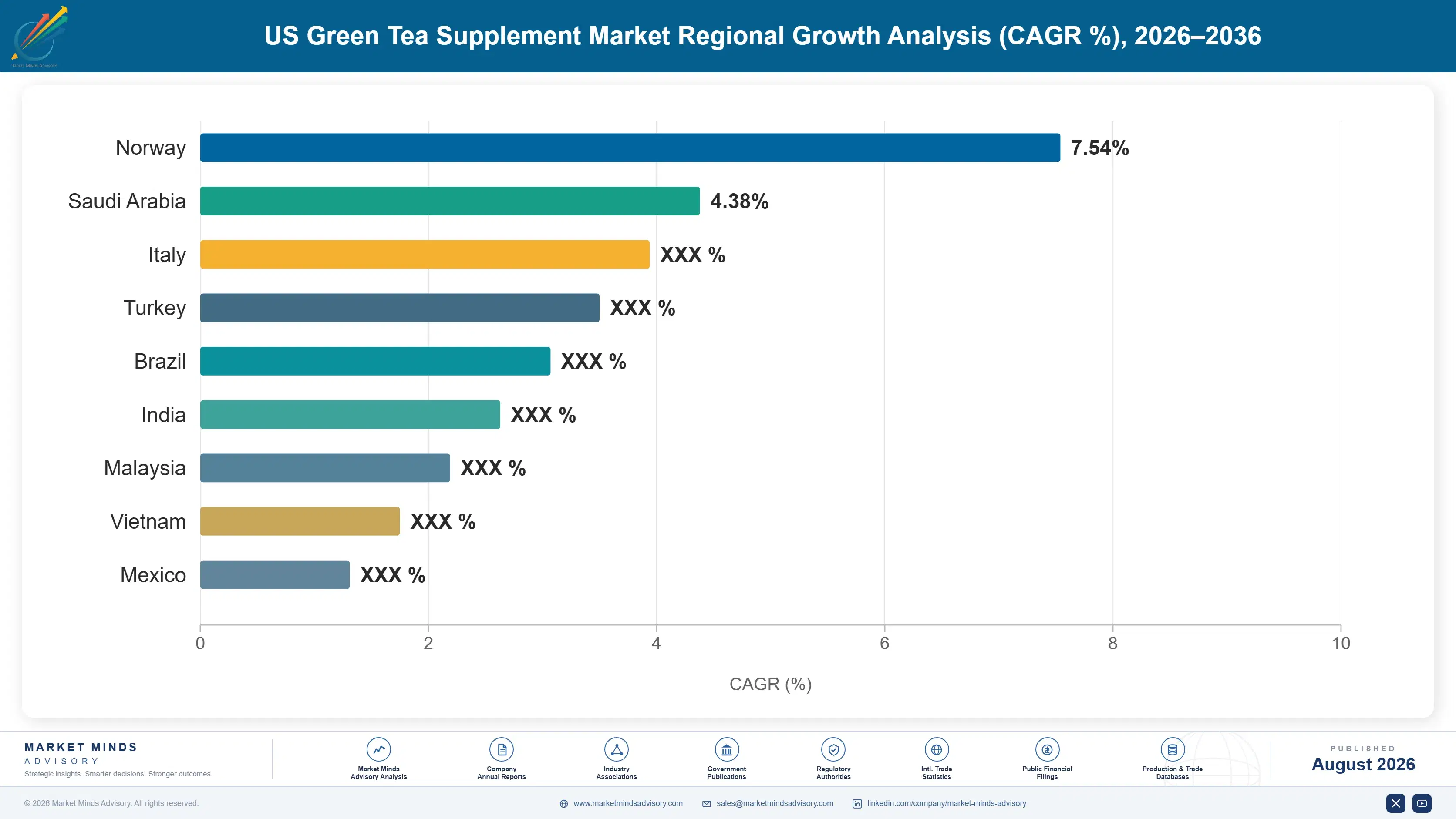
Where Green Tea Extract Supply Earns

Four positions separate suppliers holding durable American business from those quoting on price per kilogram: building documentation that survives a contract manufacturer audit, holding standardised catechin specification, qualifying into multi-ingredient formulations, and offering a supply origin outside the Asian concentration that makes brands uncomfortable. Only the first is genuinely non-negotiable now. The rest follows from it.

Build Documentation That Survives A Manufacturer Audit

Contract manufacturers carry production liability and reputational exposure if a brand they produce for is named in a liver injury report, which is why they now require catechin profile records, residual solvent data and batch consistency documentation before formulating at all. Suppliers holding that package realise 32% to 40% higher pricing than commodity extract and keep customers through safety scrutiny that removes competitors entirely. The investment is quality systems and records rather than any change to extraction. Most suppliers never saw this requirement coming at all. Records rather than chemistry decide this.
Market Impact: Realises up to 40% higher pricing than commodity

Hold Standardised Catechin Specification Reliably Across Batches

A defined epigallocatechin gallate content near 50% lets a formulator dose to a published study and a brand point to evidence rather than to a plant, which matters considerably in a category where claim substantiation is scrutinised. Roughly 58% of volume now moves as specified rather than commodity grade, and that share keeps climbing. Holding specification consistently across batches requires process control that commodity extractors have not needed to develop and frequently cannot supply. A general catechin range convinces nobody who has read a study. Batch consistency is the real test.
Market Impact: Reaches the 58% specified grade volume pool entirely

Qualify Into Multi-Ingredient Formulations Rather Than Single Products

Roughly 64% of volume enters blends where green tea sits alongside other actives, and combination positioning spreads safety attention across a formulation rather than concentrating it on one named ingredient. Qualification takes around eight months with a contract manufacturer, after which the volume repeats for as long as the blend is produced. Inclusion levels are modest so tonnage per formulation is small, but reach across many products compensates for that depth considerably. Requalification costs the manufacturer eight months and delivers them nothing. Blends validate as complete formulations. Depth is traded for reach here.
Market Impact: Reaches roughly 64% of all formulated blend volume

Offer Supply Origin Outside The Asian Concentration

Import dependence near 88% concentrated in Chinese and Indian extraction leaves American brands carrying documentation responsibility for plants they have never visited, and several are actively seeking a second origin for risk reasons rather than cost. European and domestic finishing capacity commands 25% to 35% premiums on exactly that basis. The volume is modest and the pricing is defensible, which makes it a genuinely attractive position for anybody able to occupy it. Risk rather than cost is what drives these particular conversations. Second origin demand is genuine. Very few suppliers can occupy it.
Market Impact: Commands premiums of up to 35% above Asian

Who Controls the Margin Pool

Concentration reads at 31% for the top five measured on green tea supplement ingredient supply into the United States, the basis used throughout this section, and it is low because supplement contract manufacturing remains fragmented. Taiyo and Indena hold premium documentation positions. Layn operates Chinese extraction at genuine scale. Martin Bauer brings European regulatory depth, and Nutra Green competes on Chinese cost with improving records.
Competition runs on three fronts. Documentation depth is the first and by a wide margin the most decisive, since contract manufacturers now refuse material that arrives without it. Specification consistency is the second, and it determines whether a formulator can dose to published evidence. Origin diversification is the third, and it matters to brands uncomfortable with concentrated Asian supply. None of the three is a pricing argument.

Pressure arrives from two directions. Indian producers are building audit histories aimed specifically at American contract manufacturers, which is a considerably more serious position than competing on price. Separately, contract manufacturers integrating backwards into standardisation take work suppliers used to do. Rankings will shift toward suppliers combining documentation depth with a supply origin brands find comfortable to verify.
us-green-tea-supplement-market-company-positioning-matrix-1787375364042

Competitive Moat and Risk Dimensions

TAIYO INTERNATIONAL

Moat: Japanese documentation and consistency

Japanese production and quality systems built to expectations that predate American safety scrutiny give the business documentation depth contract manufacturers accept without argument, which has become the practical entry requirement in this market. Long-standing formulator relationships and application support also make the material easier to work with than a comparable specification arriving from an unfamiliar plant.
TAIYO INTERNATIONAL

Risk: Cost against Chinese supply

Japanese production costs sit well above Chinese extraction and the premium only holds where documentation is genuinely valued, which is not every account. Chinese and Indian suppliers investing in audit readiness are closing the documentation gap that has justified the pricing, and doing so from a considerably lower cost base than the business operates on.
LAYN NATURAL INGREDIENTS

Moat: Chinese extraction scale advantage

Extraction capacity at Chinese scale and cost gives the business a position no European or Japanese producer can match on delivered price, and investment in audit readiness has closed much of the documentation gap that previously excluded Chinese suppliers from demanding accounts. Breadth across botanical extracts also spreads compliance cost across more revenue than a single-ingredient producer manages.
LAYN NATURAL INGREDIENTS

Risk: Origin concentration concerns

American brands increasingly want a supply origin outside concentrated Chinese extraction for risk reasons that have nothing to do with quality or price, which caps share regardless of how good the documentation becomes. Indian producers pursuing the same American accounts with comparable cost positions and improving records also compete directly for that volume.

Players Tracked

Prominent Players

Taiyo International
Indena
Layn Natural Ingredients
Martin Bauer Group
Nutra Green Biotechnology

Other Key Players

Kemin Industries
DSM-Firmenich
Sabinsa
Naturex
Blue California
Hunan Nutramax
Xi'an Sost Biotech
Shaanxi Jiahe Phytochem
Prinova Group
Applied Food Sciences
Nutrafur
Synthite Industries
Arjuna Natural
Ozone Naturals
Amax NutraSource

Recent Developments

JANUARY 2025

Contract manufacturer tightens documentation requirements for catechin ingredients

A large American supplement contract manufacturer introduced documentation requirements covering catechin profile, residual solvents and batch consistency for all green tea extract, removing several established suppliers from its approved list without any regulatory instruction to do so. Several established suppliers lost the account entirely. No warning was given.
Signal: Contract manufacturers are enforcing standards no regulator ever required, because they carry all the production liability
MAY 2025

Indian producer completes audit programme targeting American formulators

An Indian botanical extraction business completed an audit readiness and documentation programme aimed specifically at American supplement contract manufacturers, competing against Chinese supply on records and traceability rather than only on delivered cost per kilogram. Two American accounts qualified the material within the year. Chinese incumbents lost share.
Signal: Indian producers competing on documentation is a considerably more serious development than any amount of price competition
SEPTEMBER 2025

Brand shifts single-ingredient product into combination formulation

A supplement brand reformulated a single-ingredient green tea product into a multi-ingredient blend, spreading safety attention across a formulation rather than concentrating it on one named ingredient while retaining the catechin and caffeine contribution. Catechin and caffeine contribution was retained unchanged. Single-ingredient exposure was the stated reason for the change.
Signal: Combination positioning is being adopted partly to manage regulatory attention rather than for any formulation benefit

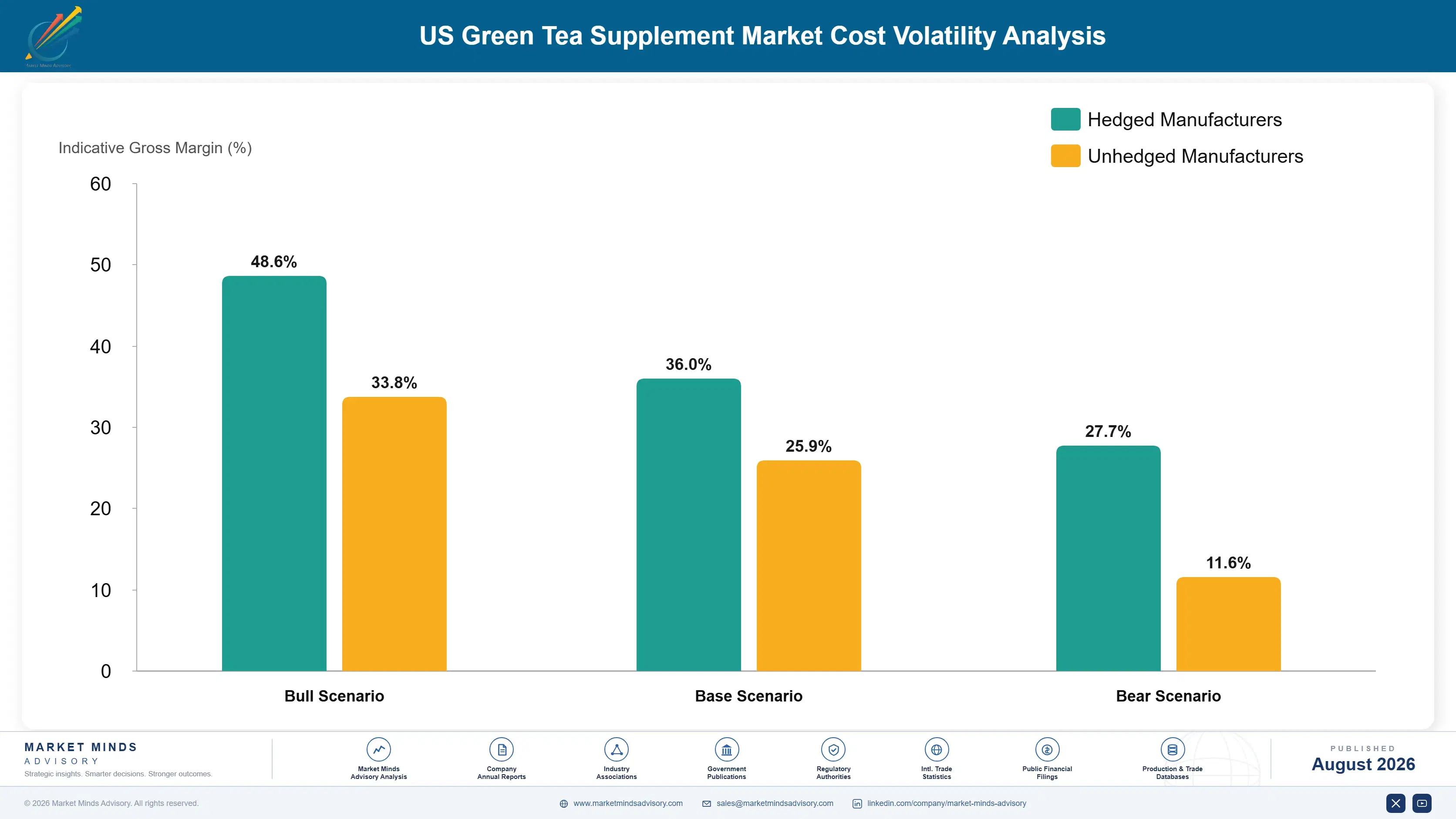
What Drives Extract Supply Cost

Green tea leaf accounts for roughly 34% of extract manufactured cost and varies by grade, since catechin-rich leaf commands more than commodity material. Extraction solvents, recovery and processing add around 22%. Purification and standardisation to a defined catechin content contribute about 14%, which is where specified grades separate from commodity extract. Testing, documentation and audit maintenance reach roughly 12%, and packaging and freight close to 15%.
Chinese green tea leaf pricing moved through 2023 and 2024 on harvest conditions and competing demand from beverage and matcha applications, with United States Department of Agriculture and national statistical office data both showing the movement, while extraction energy costs rose across the same period according to International Energy Agency figures. Suppliers passed some of it through and absorbed the rest against American buyer resistance.

The disadvantage mechanism is documentation and audit cost spread across volume, and it separates suppliers by scale rather than by capability. Testing, records and audit maintenance run near 12% of cost and much of it is fixed per facility, so a small extractor carries several times what a large one does. Exposure varies by origin, since European producers carry higher base costs against a premium that is not universal.
us-green-tea-supplement-market-cost-volatility-analysis-1787375364239

Spread documentation cost across a wider extract portfolio

Testing, records and audit maintenance are largely fixed per facility rather than per kilogram, which punishes single-ingredient extractors severely. Producers handling several botanical extracts spread that burden across far more revenue while offering contract manufacturers one qualified supplier for multiple ingredients. The requirement is genuine capability rather than a catalogue, since audits examine what is produced on site.

Contract leaf supply by catechin grade rather than generally

Catechin-rich leaf and commodity tea price on related but distinct dynamics, and buying generally leaves a standardised extract producer exposed to a grade premium nobody intended to carry. Contracting by grade reflects how the material is actually used downstream. The administrative burden is real and the alternative is discovering the grade spread widened mid-harvest.

Position finishing capacity closer to American customers

Standardisation and finishing of imported crude extract can be done domestically, which gives American brands documentation and audit exposure they can verify directly rather than at a plant nobody has visited. That verifiability commands a genuine premium. Capital and quality systems are both required, and the volume has to justify them before anything gets built or acquired.

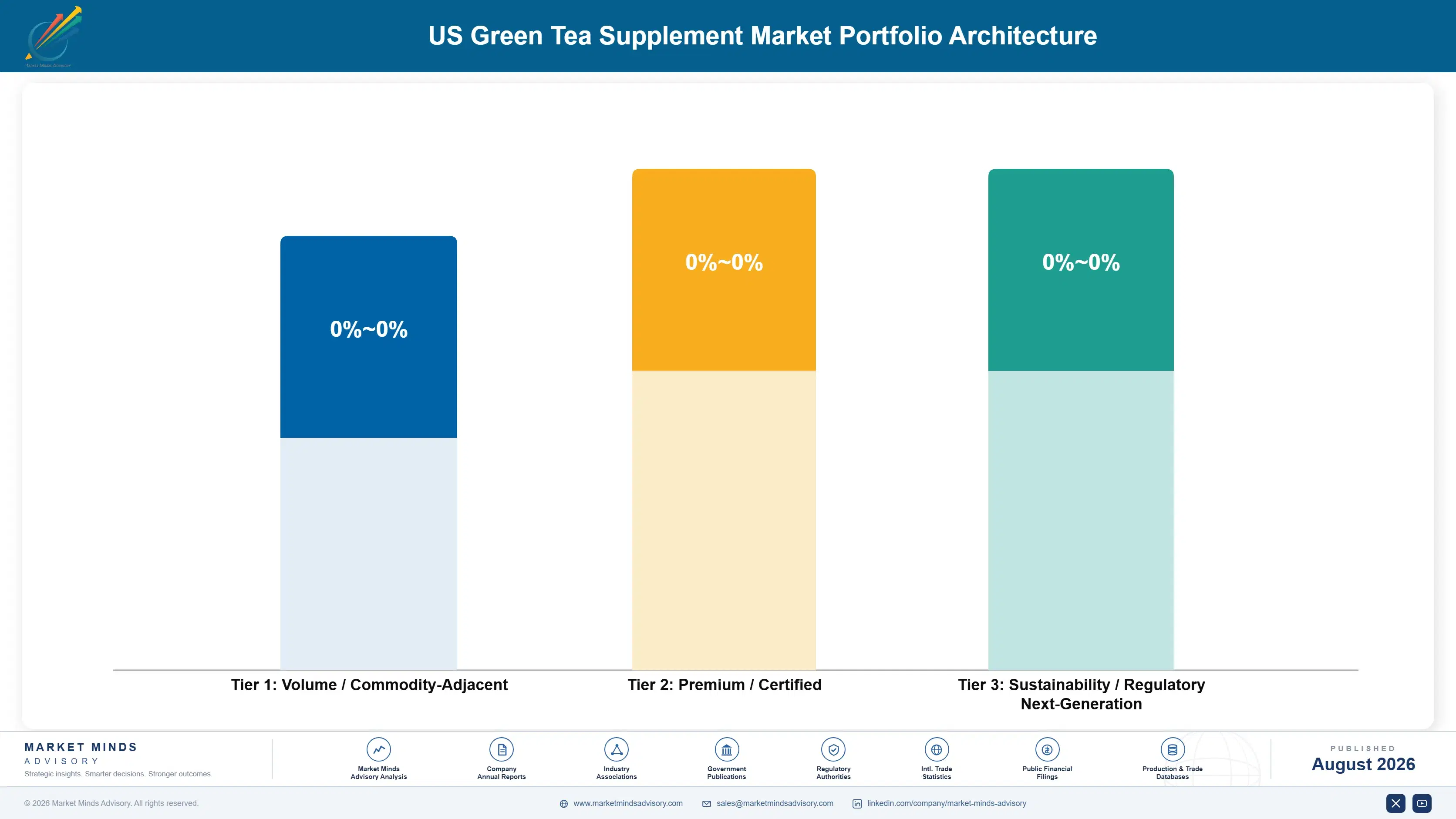
Portfolio Architecture for Margin Defence

Portfolio economics here divide on documentation rather than on extraction chemistry. Commodity extract sold on price per kilogram without a full records package is increasingly unsaleable into serious American contract manufacturers, whatever the catechin content happens to be, because the manufacturer carries the liability if anything goes wrong. Catechin content stopped being the deciding question some time ago.
The middle tier is standardised extract qualified with a contract manufacturer. Eight months of specification work and audit produce a position that repeats for as long as the blend is made, and roughly 58% of volume now moves this way. Margins reach the low thirties, and displacement requires a competitor to complete the same qualification rather than simply quote lower.

Above both sits documented extract from an origin brands can verify comfortably. Import dependence near 88% concentrated in Asian extraction leaves American brands carrying responsibility for plants they have never visited, and European or domestic finishing commands 25% to 35% premiums on exactly that basis. Margins reach the mid forties. The volume is modest, which is why so few suppliers have built the position properly. The volume is modest but the pricing is genuinely defensible.

Volume / Commodity-Adjacent

Commodity extract sold on price per kilogram without a full records package. The range reflects leaf and solvent cost rather than commercial skill, and serious contract manufacturers increasingly will not accept it.
Gross Margin: 12 to 19%

Premium / Certified

Standardised extract qualified with a contract manufacturer to a defined catechin specification. The range reflects documentation depth and whether a second source sits qualified alongside in the same formulation. Displacement requires requalification.
Gross Margin: 28 to 36%

Sustainability / Regulatory / Next-Generation

Documented extract from an origin American brands can verify directly. The wide range reflects whether finishing happens domestically or at a European plant, and how much the buyer values that verifiability.
Gross Margin: 40 to 50%
us-green-tea-supplement-market-portfolio-architecture-1787375364763

High-value Sub-segments and Strategic Watch-out

Verifiable Origin Documented Extract

High value and high growth together, serving brands uncomfortable carrying responsibility for plants nobody has visited. The wide range reflects whether finishing happens domestically or in Europe, and how much the buyer values that direct verifiability. Few suppliers have built this position properly. Modest volume, defensible pricing.
Gross Margin: 40 to 50%

Standardised High-EGCG Grades

High value on strong growth as specification becomes the practical entry requirement. The range reflects consistency across batches, which requires process control that commodity extractors have never needed and frequently cannot supply reliably. Specification is now the practical entry requirement. Process control separates suppliers here.
Gross Margin: 33 to 42%

Multi-Ingredient Formulation Supply

The volume core of this market, reaching many products at modest inclusion each. The range reflects documentation depth and whether qualification with the contract manufacturer covers several of their brand customers at once. Inclusion levels are modest but reach is wide. Requalification costs eight months.
Gross Margin: 28 to 36%

Commodity Extract Without Documentation

The strategic watch-out. Volumes look available but serious contract manufacturers increasingly refuse the material entirely, and safety scrutiny keeps narrowing what is acceptable. The range reflects leaf and solvent cost rather than any commercial decision. Safety scrutiny keeps narrowing what is acceptable. Approved lists keep getting shorter.
Gross Margin: 12 to 19%

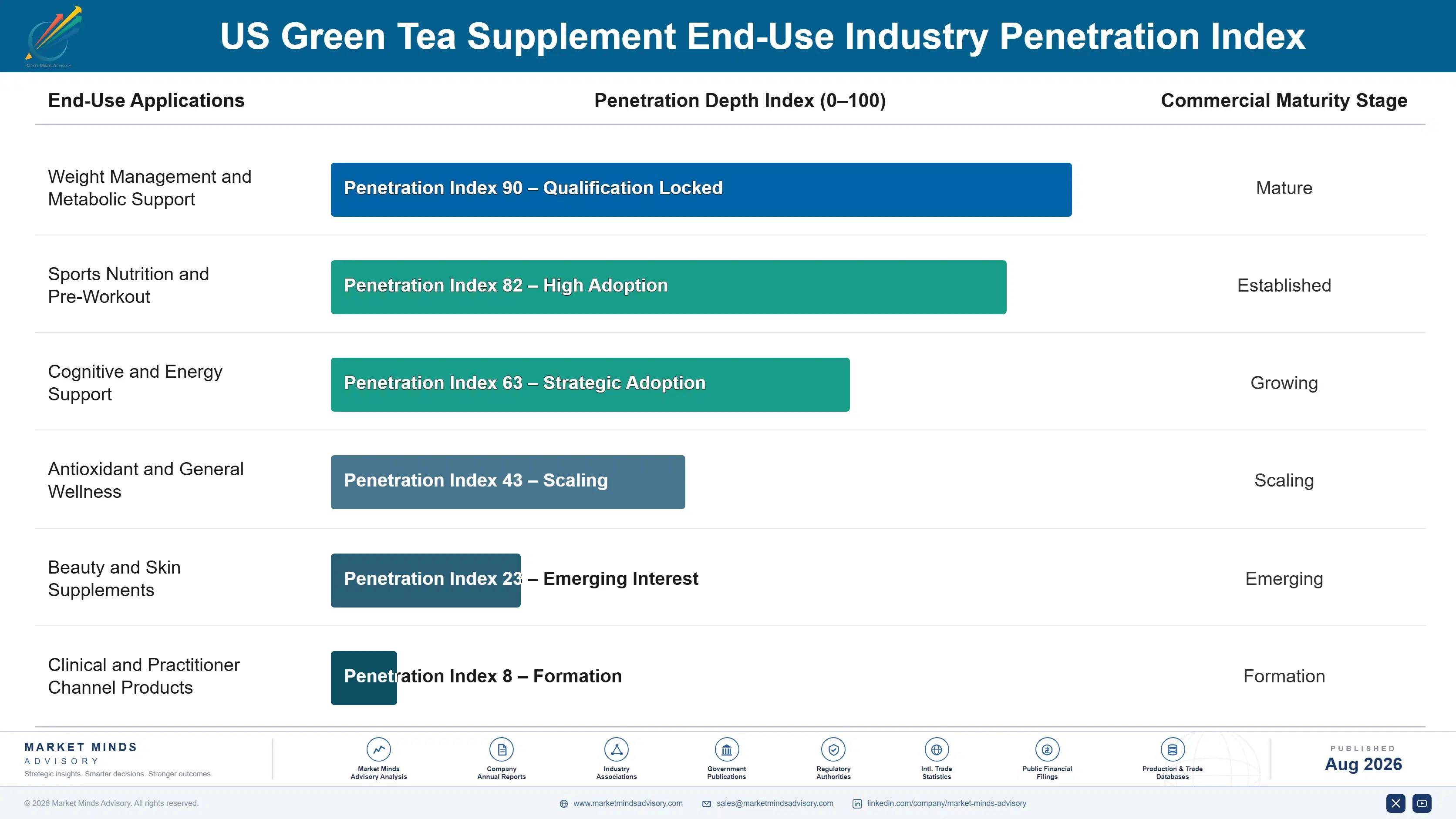
How Extract Demand Actually Repeats

Qualified positions behave like annuities and unqualified supply behaves like nothing at all. Once an extract is qualified with a contract manufacturer and written into a formulation, the volume repeats for as long as that blend is produced, because requalification costs eight months and delivers the manufacturer nothing. Unqualified material is bought opportunistically when somebody needs volume quickly and cannot wait. Nobody waits eight months by choice.
Stickiness varies sharply by formulation role. Multi-ingredient blends hold best, since the extract is one component of a validated formulation and changing it means revalidating the whole product. Single-ingredient products hold moderately and are more exposed to safety attention landing on the named ingredient. Commodity extract holds worst, moving on delivered price whenever a contract manufacturer is willing to accept it at all.

The buyer profile has moved decisively. Ingredient purchasing once sat with brand teams selecting on story, price and availability, and now sits substantially with contract manufacturer quality functions assessing documentation, audit history and batch records. That shift rewards suppliers who invested in quality systems and disadvantages those whose commercial argument was a competitive quotation and a plausible certificate of analysis.
us-green-tea-supplement-market-end-use-penetration-index-1787375365260

Where To Compete And Why

These are among the four positions where our research anticipates prominent divergence between winners and laggards over the coming forecast period. Each is grounded in the demand model, the regulatory perimeter, and the announced capacity pipeline.
01 / AUDIT DOCUMENTATION DEPTH

Manufacturers enforce what regulators did not

Contract manufacturers carry production liability and reputational exposure if a brand they produce for is named in a liver injury report, so they now require catechin profile records, residual solvent data and batch consistency documentation before formulating anything. Suppliers holding that package realise 32% to 40% higher pricing than commodity extract and keep customers through scrutiny that removes competitors entirely. The investment is quality systems and records rather than any change to extraction itself, and most suppliers never saw the requirement coming.
02 / SPECIFICATION CONSISTENCY HOLDING

Dose to a study, not a plant

A defined epigallocatechin gallate content near 50% lets a formulator dose to published evidence and lets a brand point to a study rather than to a plant, which matters considerably where claim substantiation is scrutinised. Roughly 58% of volume now moves as specified rather than commodity grade and the share keeps climbing steadily. Holding specification across batches requires process control that commodity extractors never needed to develop and frequently cannot supply reliably enough to hold a serious American account at all.
03 / BLEND QUALIFICATION PURSUIT

Combinations spread the attention

Roughly 64% of volume enters multi-ingredient blends where green tea sits alongside other actives, and combination positioning spreads safety attention across a formulation instead of concentrating it on one named ingredient. Qualification takes around eight months with a contract manufacturer, after which the volume repeats for as long as the blend is produced. Inclusion levels are modest, but reach across many products compensates considerably for that limited depth, and requalification costs the manufacturer eight months that it will simply not spend on a switch.
04 / ORIGIN VERIFIABILITY POSITIONING

Brands cannot audit what they never see

Import dependence near 88% concentrated in Chinese and Indian extraction leaves American brands carrying documentation responsibility for plants they have never visited and cannot realistically inspect. Several are actively seeking a second origin for risk reasons rather than cost, and European or domestic finishing commands 25% to 35% premiums on exactly that basis. The volume is modest and the pricing defensible, which makes it genuinely attractive for anybody able to occupy the position at all, and very few currently can.

Engagement Snapshot From the Field

A live engagement with an industry participant carrying material or product regulatory and market exposure ahead of a defining policy shift, showing how our research translates into a defensible multi-year portfolio strategy.
MARKET MINDS ADVISORY · CLIENT ENGAGEMENT SUMMARY
US Green Tea Supplement Producer Strategic Portfolio Review and Transition Roadmap 2026·Investment Scenario on US Green Tea Supplement Exposure Evaluation 2025-26
CLIENT PROFILE
An Asian botanical extract producer with annual revenue near $74 million (client-reported, unverified by MMA), supplying green tea and other plant extracts to supplement customers across several markets. American sales had grown for years and then fell sharply when two large contract manufacturers removed the business from approved supplier lists following documentation reviews conducted without any prior warning.
STRATEGIC CHALLENGE
Removal from approved lists had cost roughly a fifth of American revenue within two quarters and the client did not initially understand why, since product quality had not changed and no regulator had acted. Management needed to decide between rebuilding documentation capability, retreating to less demanding markets, or competing purely on price where documentation mattered less.
MMA APPROACH
MMA reconstructed the documentation requirements each contract manufacturer applied, benchmarked the client's records against suppliers who had been retained, and modelled realised pricing by documentation level across the client's own customer base. Twenty-two expert interviews with contract manufacturer quality leads, brand technical directors and third-party testing laboratories established what is genuinely required.
KEY FINDINGS
  1. Both contract manufacturers had removed the client for incomplete residual solvent and batch consistency records rather than for any quality failure, and neither had explained that clearly at the time.
  2. Retained suppliers realised roughly 34% higher pricing than the client on materially comparable specification, with the entire difference attributable to documentation depth rather than product.
  3. Documentation cost was largely fixed per facility, and the client's four other extract lines could have carried the same investment without any proportional increase in expenditure.
  4. Two American brands had asked their contract manufacturers for a supply origin outside concentrated Chinese extraction, which the client could have partly addressed through an existing Indian facility.
CLIENT PROFILE
An Asian botanical extract producer with annual revenue near $74 million (client-reported, unverified by MMA), supplying green tea and other plant extracts to supplement customers across several markets. American sales had grown for years and then fell sharply when two large contract manufacturers removed the business from approved supplier lists following documentation reviews conducted without any prior warning.
STRATEGIC CHALLENGE
Removal from approved lists had cost roughly a fifth of American revenue within two quarters and the client did not initially understand why, since product quality had not changed and no regulator had acted. Management needed to decide between rebuilding documentation capability, retreating to less demanding markets, or competing purely on price where documentation mattered less.
MMA APPROACH
MMA reconstructed the documentation requirements each contract manufacturer applied, benchmarked the client's records against suppliers who had been retained, and modelled realised pricing by documentation level across the client's own customer base. Twenty-two expert interviews with contract manufacturer quality leads, brand technical directors and third-party testing laboratories established what is genuinely required.
KEY FINDINGS
  1. Both contract manufacturers had removed the client for incomplete residual solvent and batch consistency records rather than for any quality failure, and neither had explained that clearly at the time.
  2. Retained suppliers realised roughly 34% higher pricing than the client on materially comparable specification, with the entire difference attributable to documentation depth rather than product.
  3. Documentation cost was largely fixed per facility, and the client's four other extract lines could have carried the same investment without any proportional increase in expenditure.
  4. Two American brands had asked their contract manufacturers for a supply origin outside concentrated Chinese extraction, which the client could have partly addressed through an existing Indian facility.
RECOMMENDED STRATEGY
Phase 1: Phase one: rebuild residual solvent and batch consistency documentation to the standard retained suppliers hold, since this is records work rather than any process change. Phase 2: Phase two: extend that documentation across the four other extract lines, spreading fixed cost and offering contract manufacturers one qualified supplier for several ingredients. Phase 3: Phase three: position the Indian facility as a second origin for brands seeking supply outside concentrated Chinese extraction on risk grounds.
OUTCOME
The client regained approved supplier status with both contract manufacturers within ten months and lifted realised pricing by roughly 27% (client-reported, unverified by MMA). Three additional extract lines were qualified on the same documentation investment, the Indian facility won a second-origin position with one brand, and American revenue exceeded its previous peak during 2026.

Frequently Asked Questions

Foundational context covering the market sizes, CAGR, scope, country, region and competition that inform every finding below. This section is provided to cover basics and most often pre-purchase conversations, answered from the MMA Primary Research Dataset.

What is the current size of the US Green Tea Supplement Market?

The United States green tea supplement market was valued at $0.50 billion in 2025, reaching an estimated $0.54 billion in 2026. That covers green tea extract and catechin ingredients supplied into American supplements.

How large will the US Green Tea Supplement Market be by 2036?

MMA forecasts the market reaching $1.08 billion by 2036, an increase of $0.54 billion over the 2026 base. That represents an expansion multiple of 2.00 times across the forecast period.

What is the CAGR for the US Green Tea Supplement Market 2026 to 2036?

The base case compound annual growth rate is 7.2%, with a bull case of 8.4% and a bear case of 6.0%. Historical growth between 2020 and 2025 ran at 6.1% annually.

Which segment is growing fastest?

Standardised high-EGCG extracts grow at 10.8%, a full 1.50 times the market rate, as specification becomes the practical entry requirement. Multi-ingredient formulation grade follows at 9.2%.

Who are the major companies in the US Green Tea Supplement Market?

Taiyo International, Indena, Layn Natural Ingredients, Martin Bauer Group and Nutra Green Biotechnology lead on ingredient supply. Together they account for roughly 31%, low for a specialty ingredient.

Which country is growing fastest?

The United States is the defined scope of this report and grows at 7.2% annually, driven by standardisation requirements and multi-ingredient formulation. No comparison country applies here.

Report Segmentation Architecture

The full report scope spans multiple orthogonal segmentation dimensions, with cross-tabulated demand data provided for each dimension pair. Coverage extends further to regional breakdowns, trend trajectories, and the competitive detail needed to support segment-level decision-making.

By Product Type

  • Standardised High-EGCG Extracts
  • Multi-Ingredient Formulation Grade
  • Decaffeinated Green Tea Extracts
  • Whole Leaf Powder Supplement Grades
  • Finished Single-Ingredient Supplements

By End-Use Industry

  • Weight Management and Metabolic Support
  • Sports Nutrition and Pre-Workout
  • Cognitive and Energy Support
  • Antioxidant and General Wellness
  • Beauty and Skin Supplements
  • Clinical and Practitioner Channel Products

By Commercial Dimension

  • Contract Manufacturer Direct Supply
  • Brand Owner Direct Supply
  • Ingredient Distributor Channel
  • Private Label Supplement Supply
  • Practitioner and Professional Channel

By Region

  • East Asia
  • South Asia and Pacific
  • North America
  • Western Europe
  • Latin America
  • Middle East and Africa
  • Eastern Europe

Scope, Methodology, and Coverage

Every figure in this report is reproducible from documented input assumptions. The scope below maps the historical period, the forecast horizon, the segmentation dimensions, and the countries covered, alongside the underlying primary and qualitative methodology.
Historical Period
2020 to 2025
Forecast Period
2026 to 2036
Base Year
2025 (USD billions; MMA Primary Research Dataset, August 2026)
Market Definition
This report covers green tea extract and catechin ingredients supplied into United States dietary supplement products, spanning standardised high-EGCG extracts, multi-ingredient formulation grade material, decaffeinated green tea extracts, whole leaf powder supplement grades, and finished single-ingredient green tea supplements, across contract manufacturer, brand owner, distributor, private label and practitioner channels. Brewed and ready-to-drink tea beverages, matcha sold as a food or beverage, green tea used in cosmetic formulation, pharmaceutical catechin products, and supply into markets outside the United States are excluded from the sizing.
Quantitative Units
USD billions at supplier and brand realised value; volume in tonnes of extract; contract pricing in USD per kilogram.
Segmentation Dimensions
By product type; by end-use industry; by commercial dimension; by supply origin region.
Regions Covered
East Asia, South Asia and Pacific, North America, Western Europe, Latin America, Middle East and Africa, Eastern Europe
Countries Covered
United States as the defined market, with supply origin coverage of China, India, Japan, South Korea, Taiwan, Indonesia, Sri Lanka, Canada, Mexico, Brazil, Argentina, Germany, France, Italy, Switzerland, Spain, Poland, Czech Republic, Kenya and Turkey.
Key Companies Profiled
Taiyo International, Indena, Layn Natural Ingredients, Martin Bauer Group, Nutra Green Biotechnology, Kemin Industries, DSM-Firmenich, Sabinsa, Blue California, Prinova Group, Applied Food Sciences, Synthite Industries, Arjuna Natural and others.
Quantitative Methodology
Primary survey, n=3,800 respondents, Q4 2025, six countries; demand-side model with trade association cross-validation
Qualitative Methodology
47 expert interviews, Q4 2025; applied to validate demand model assumptions, identify emerging dynamics, and assess competitive positioning
Report Format
PDF and XLSX data workbook (Word format preview document)
Publisher
Market Minds Advisory
Report Code
MMA-2026-HLT-166
Published
August 2026
Contact
sales@marketmindsadvisory.com | www.marketmindsadvisory.com

Purchase the full US Green Tea Supplement Market Report (2026 to 2036).

The full report sizes the United States green tea supplement market across five product types, six end-use categories and seven supply origin regions, with tonnage and per kilogram pricing detail behind every value estimate. It profiles twenty companies on documentation depth, specification capability and origin position. Chapters cover contract manufacturer requirements, safety scrutiny history and claim substantiation practice in detail. Cost analysis quantifies leaf, extraction and documentation exposure by producer scale. Supply origin analysis maps import concentration and the audit exposure it creates for American brands.
Tonnage and per kilogram pricing by product type
Contract manufacturer documentation requirements mapped in detail
Safety scrutiny history and intake restrictions across jurisdictions
Supply origin concentration and audit exposure analysis
Competitive position assessments across twenty companies
Specification and catechin standardisation benchmarking across suppliers

Built For The People Who Decide

From boardroom strategy to bench-side execution, this report is read cover-to-cover by leaders shaping the next decade of their industry, turning demand scenarios, market dynamics and valuation benchmarks into decisions.
CXOs/ Presidents/ VPs/ Managers
M&A and Corporate Development
Strategy Teams and R&D Heads
Procurement and Product Directors
Regulatory and Compliance Leaders
Investor Relations and Equity Analysts