Market Minds Advisory
Urine Monitoring Systems Market

Urine Monitoring Systems Market: Automating the Last Manual Vital Sign, and the Reimbursement Gap That Slows It

Urine output is the only vital sign still measured by hand with a jug and a clock, and the obstacle to automating it has never been the sensor but the absence of any billing code.

Lead Analyst

Alice Ballenger

Published

September 2026

Make Smarter Decisions with Customized Research Insights

Request a free sample report and evaluate market opportunities, growth trends, and competitive dynamics relevant to your business needs.

2025 MARKET VALUE$0.6BMarket Size 2025
2036 FORECAST VALUE$2.2BBase Case , 2026 to 2036
CAGR 2026 TO 203612.4 %Bull 13.6% / Bear 11.2%
INCREMENTAL OPPORTUNITY$1.6BNet 10- year value creation
EXPANSION MULTIPLE3.21x2036 value over 2026 base
Strategic Levers
M&A Pipeline
Regional Outlook
Country Rankings
Competitive Intelligence
Segmental Deep-dive
Call-Us : 91 93563 13602

Executive Snapshot and Market Trajectory

Urine output is the oldest vital sign in clinical medicine and the only one still measured by a human being with a jug and a clock. Heart rate, oxygen saturation and blood pressure were automated decades ago. Urine output was not, and the reason is commercial rather than technical.
Automated systems now measure output continuously through an inline sensor on the drainage line, and they detect declining renal perfusion hours before a nurse would chart it. Critical care monitors are the fastest growing segment at 18.6%, half again the market rate of 12.4%. East Asia holds the largest share at 29%, where Japanese fixture-integrated sensing and Chinese intensive care expansion pull in the same direction.
The market is fragmented, with the top five holding 38%, and most of the interesting technology sits with venture funded specialists rather than the large device groups. No separate reimbursement code exists for continuous urine output monitoring in any major system. The device is a cost inside the admission, which makes every sale a cost avoidance argument, and those are the hardest arguments to win in a hospital capital allocation committee.
Market Definition
Devices and systems that measure urine output or urine composition at the point of production or collection, covering automated critical care output monitors, connected home and wearable urinalysis devices, fixture-integrated bathroom sensing modules, uroflowmetry and bladder volume systems, and continence wetness detection sensors. Measured at supplier selling value across instruments, sensors and disposables. Laboratory urinalysis and culture testing, urinary catheters, drainage bags and therapeutic products are excluded.
Base Year Value
$0.6B in 2025 (MMA Primary Research Dataset, August 2026)
Forecast Period
2026 to 2036, eleven discrete annual values
CAGR
12.4% base case. Bull 13.6%. Bear 11.2%.
Fastest Growth Segment
Automated Critical Care Output Monitors: 18.6% CAGR
Fastest Growth Country
India: 17.4% CAGR
Fastest Growth Region
South Asia and Pacific: 14.6% CAGR
Largest Region
East Asia: 29% of 2025 global value
Market Leaders
Baxter International, Medtronic, Convatec, Teleflex, Laborie Medical Technologies. Source: MMA Primary Research Dataset, July 2026.
Primary Survey
n=3,800 procurement and R&D decision-makers, Q4 2025, six countries
Methodology
Demand-side build-up, cross-validated against public data, 47 expert interviews

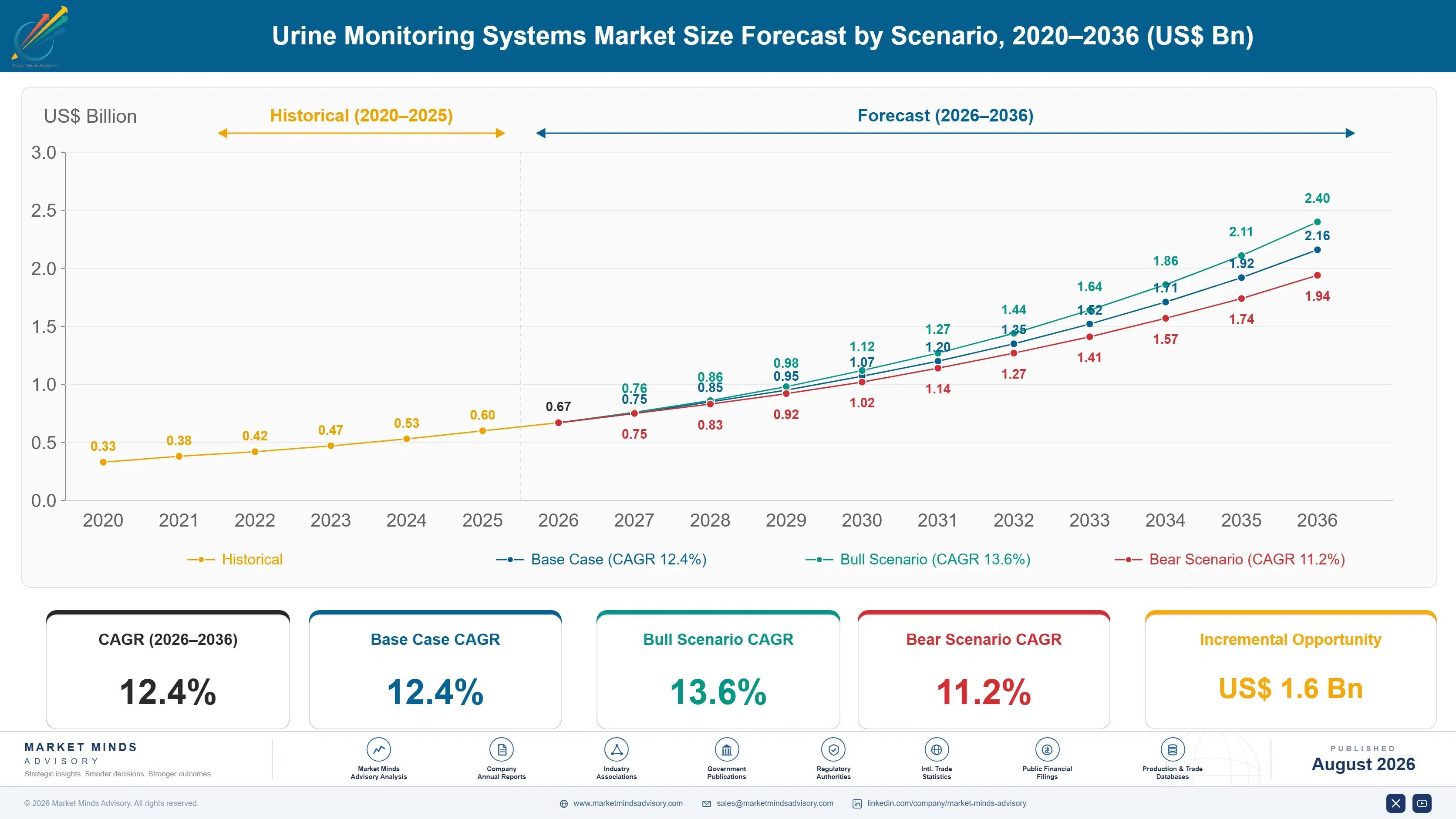
Urine Monitoring Systems Market Forecast Scenarios

urine-monitoring-systems-market-size-forecast-scenario-1787641135260
Nothing much happened in this market before 2020. A handful of cleared devices existed and intensive care units carried on with the jug. The pandemic changed the staffing arithmetic rather than the clinical argument: units running at extreme nurse to patient ratios could not chart hourly anything. The 11.2% historical rate reflects that shift more than any change in evidence.
The 12.4% base case rests on three mechanisms. Acute kidney injury remains the single most common complication in critical care, and urine output is one of only two criteria in the KDIGO staging definition, which gives continuous measurement a documented clinical anchor. Nursing time is the second: automated monitoring removes a task performed hourly across every catheterised bed. And Asian fixture manufacturers now ship urinalysis sensing inside domestic bathroom products at consumer volumes.
The 13.6% bull case depends on a reimbursement code for continuous urine output monitoring appearing in at least one major system, which would convert a cost avoidance pitch into a billable service overnight. The 11.2% bear case is alarm fatigue: a continuous number that nobody is contracted to act on generates escalation noise, and intensive care units have removed monitoring before for exactly that reason.

Measuring the Vital Sign Nobody Automated

Hourly urine output is charted on almost every critical care flowsheet in the world, and audit after audit finds the entries were made retrospectively. Compliance with the documented hourly interval sits near 58% in observational studies. That gap is the whole commercial case for automation, and it is also the reason clinicians are sceptical, because the charted number has always looked complete.
TOP FIVE CONCENTRATION38%Combined position held by the largest system suppliers
HOURLY CHARTING COMPLIANCE58%Proportion of catheterised beds charted at the documented interval
DISPOSABLE SENSOR PRICEUSD 145Typical single patient sensor cost per critical care admission
MONITOR ATTACHMENT RATE9%Share of intensive care beds with automated output monitoring
DISPOSABLE REVENUE SHARE78%Portion of supplier revenue arriving through single use sensors
MONITOR SERVICE LIFE6 yearsTypical bedside unit life before hospitals replace the fleet
The revenue model mirrors infusion pumps rather than patient monitors. Bedside units are placed at modest capital cost or on loan, and 78% of supplier revenue arrives through the single patient sensor, which runs around 145 dollars per admission. Attachment sits near 9% of intensive care beds globally, so the installed base argument that works in other monitoring categories does not yet apply here at all.
Reimbursement is the obstacle underneath everything, and there is no polite way around it. No major payer system carries a separate code for continuous urine output monitoring, so the sensor is a consumable cost inside a fixed admission payment. Every purchase has to be justified on avoided acute kidney injury, avoided dialysis and reduced length of stay, which are real effects that land on somebody else's budget line entirely.
"Every hospital in the world already believes it measures urine output hourly. The hardest part of this sale is not proving the device works; it is persuading a unit that its own flowsheet has been fiction for thirty years."
Principal Analyst, Critical Care and Monitoring Devices Practice · MMA Medical Devices and Diagnostics Practice · August 2026

Market Trends

Acute Kidney Injury Staging Gives Output a Definition

Urine output is one of only two criteria in the KDIGO acute kidney injury staging definition, alongside serum creatinine, and it moves first. Creatinine lags renal injury by a day or more, which means a diagnosis made on chemistry alone is a diagnosis made late. Continuous measurement shifts detection forward by several hours in most published series, and that window is where fluid and vasopressor decisions actually change outcomes. Adoption follows units that have written acute kidney injury bundles into protocol, and it stalls completely in units that have not.
Market Impact: Saves 24 nursing minutes daily

Bathroom Fixtures Become Consumer Urinalysis Collection Points

Japanese and Korean sanitaryware manufacturers have been embedding sensing into domestic toilets for years, initially for glucose and protein screening, and the installed base runs into millions of households. That is a consumer electronics business with medical device claims attached, and it behaves nothing like the hospital market. Regulatory positioning is deliberately vague in most jurisdictions, since a wellness reading avoids the clearance burden that a diagnostic reading carries. Volume is enormous and revenue per unit is tiny, roughly 3% of a critical care sensor, but the data asset accumulating behind it is what the manufacturers are actually building.
Market Impact: Adds 14.6% regional growth annually

Market Opportunities and Growth Drivers

Nursing Time Pressure Removes an Hourly Manual Task

Charting urine output hourly on a catheterised patient takes a nurse roughly two minutes including documentation, which sounds trivial until multiplied across a twelve bed unit and a twelve hour shift. Automated monitoring removes the task entirely and populates the electronic record directly. Nurse staffing shortages across North America, Western Europe and Japan have made time saving arguments considerably more persuasive to hospital administrators than clinical outcome arguments, because time saving appears immediately in rostering while outcomes appear in a registry eighteen months later. That asymmetry is doing most of the selling.
Market Impact: Sensor adds 145 dollars uncompensated

Intensive Care Bed Expansion Across Asian Health Systems

China added intensive care capacity at extraordinary pace under national capability requirements issued after 2020, and India, Indonesia and Vietnam are building critical care beds from very low per capita bases. New units buy monitoring equipment as a package rather than retrofitting it, which is the only moment automated urine output monitoring competes on equal terms with established categories. Retrofit sales into existing units require displacing a working process; specification into a new build requires only a line item. East Asia already holds 29% of the market, and South Asia and Pacific grows fastest at 14.6%.
Market Impact: Caps attachment near 9% currently

Market Restraints and Challenges

No Reimbursement Code Exists for Continuous Output Monitoring

Continuous urine output monitoring has no separate billing code in the United States, in German diagnosis related groups, or in any major Asian system. The root cause is procedural rather than political: coding bodies require published evidence of independent clinical benefit, and the trials that would produce it need a control arm charting hourly by hand, which units find difficult to justify running. Commercially this means every sensor is a cost inside a fixed payment. Manufacturers are responding by funding outcome registries and by pricing per admission rather than per device, so the cost lands where the saving does.
Market Impact: Shifts detection forward by 8 hours

Alarm Burden Undermines Continuous Measurement in Practice

A continuous number generates alerts, and intensive care units are already drowning in them. Urine output falls for many reasons that require no action at all, including positioning, catheter kinking and ordinary diurnal variation, so a naive threshold alarm fires constantly and gets muted within a week. That is not a hypothetical failure mode; several early deployments were withdrawn for exactly this reason. Suppliers now ship trend based algorithms that suppress transient dips and escalate only sustained decline, and the better systems require a nursing acknowledgement pathway before any alert reaches a physician at all.
Market Impact: Consumer units earn 3% per sensor
4 additional market trends, 2 additional growth drivers, and 3 additional restraints and challenges are covered in the full report. Contact sales@marketmindsadvisory.com to access the complete intelligence.

Segment CAGR and Growth Architecture

Segmentation follows system type, since the measurement site determines who buys and what gets measured. Five system types cover the field, from an inline sensor on an intensive care drainage line to a sensing module inside a domestic toilet. Growth concentrates where measurement is continuous, and stalls where it is periodic. Those two ends share almost nothing.
urine-monitoring-systems-market-market-share-analysis-1787641135838

Automated Critical Care Output Monitors

An inline optical or gravimetric sensor sits on the drainage line and reports output continuously to the bedside monitor and the electronic record. At 18.6% this is the fastest growing system type in the market, half again the market rate of 12.4%, and it is where every clinical outcome claim in the category originates. Attachment remains near 9% of intensive care beds, so the runway is long. The obstacle is not performance: current devices measure accurately to the millilitre and detect declining perfusion hours ahead of manual charting. It is that the saving accrues to length of stay while the cost sits in the consumables budget, and different people own those two numbers.
CAGR 18.6%

Connected Home and Wearable Urinalysis Devices

Handheld analysers, clip-on toilet sensors and smartphone-read strips aimed at consumers and at chronic disease management programmes. Growth of 15.2% is second fastest in the market, driven mainly by kidney disease and urinary infection monitoring programmes run by payers rather than by individual purchase. The commercial pattern differs completely from hospital sales: acquisition cost is low, retention is poor, and roughly 40% of users stop within three months. Programme buyers therefore price on engaged users rather than devices shipped. Regulatory positioning stays deliberately light, since a wellness claim avoids the clearance burden a diagnostic claim carries. Churn is the whole business problem here, not technology. Devices ship and then quietly stop being used, which no clinical claim can fix.
CAGR 15.2%
Full segment breakdown across 5 segments available in the complete report.

Regional Architecture and Country Demand Map

East Asia holds the largest share at 29%, where Japanese fixture sensing and Chinese critical care expansion pull together. North America follows at 28% on acute kidney injury protocol depth. South Asia and Pacific grows fastest at 14.6% from a very small installed base. Europe buys on nursing time.

North America

Protocol depth explains the North American position more than any purchasing appetite does. Acute kidney injury bundles are written into critical care practice across most large American health systems, and urine output is one of only two staging criteria, which gives automated monitoring a documented clinical hook that other regions lack. Group purchasing organisations still buy the sensor as a consumable inside a fixed admission payment, so the argument runs on avoided dialysis and length of stay rather than on any billable code. Canadian provincial systems buy centrally and adopt more slowly. Most of the venture funded specialist developers in this category are American, which concentrates early clinical evidence here. That advantage will not last.
Share: 28% | CAGR: 11.8% (2026 to 2036)

Western Europe

Nursing time, not clinical outcome, is what sells these systems across Western Europe. German and Nordic intensive care units operate under nurse to patient ratio regulations that make an hourly manual task genuinely expensive, and the business case gets written against rostering rather than against dialysis avoidance. Diagnosis related group payment offers no separate reimbursement anywhere in the region, and health technology assessment bodies have not yet assessed the category at all, which leaves purchasing at unit level. The United Kingdom buys through national framework agreements that reward price above capability. Growth at 10.8% is the lowest of the seven regions, and capital constraint rather than clinical scepticism explains it. Adoption is uneven country by country.
Share: 21% | CAGR: 10.8% (2026 to 2036)
Regional intelligence for 5 additional markets available in the complete report: East Asia, South Asia and Pacific, Latin America, Middle East and Africa, Eastern Europe. Contact sales@marketmindsadvisory.com.
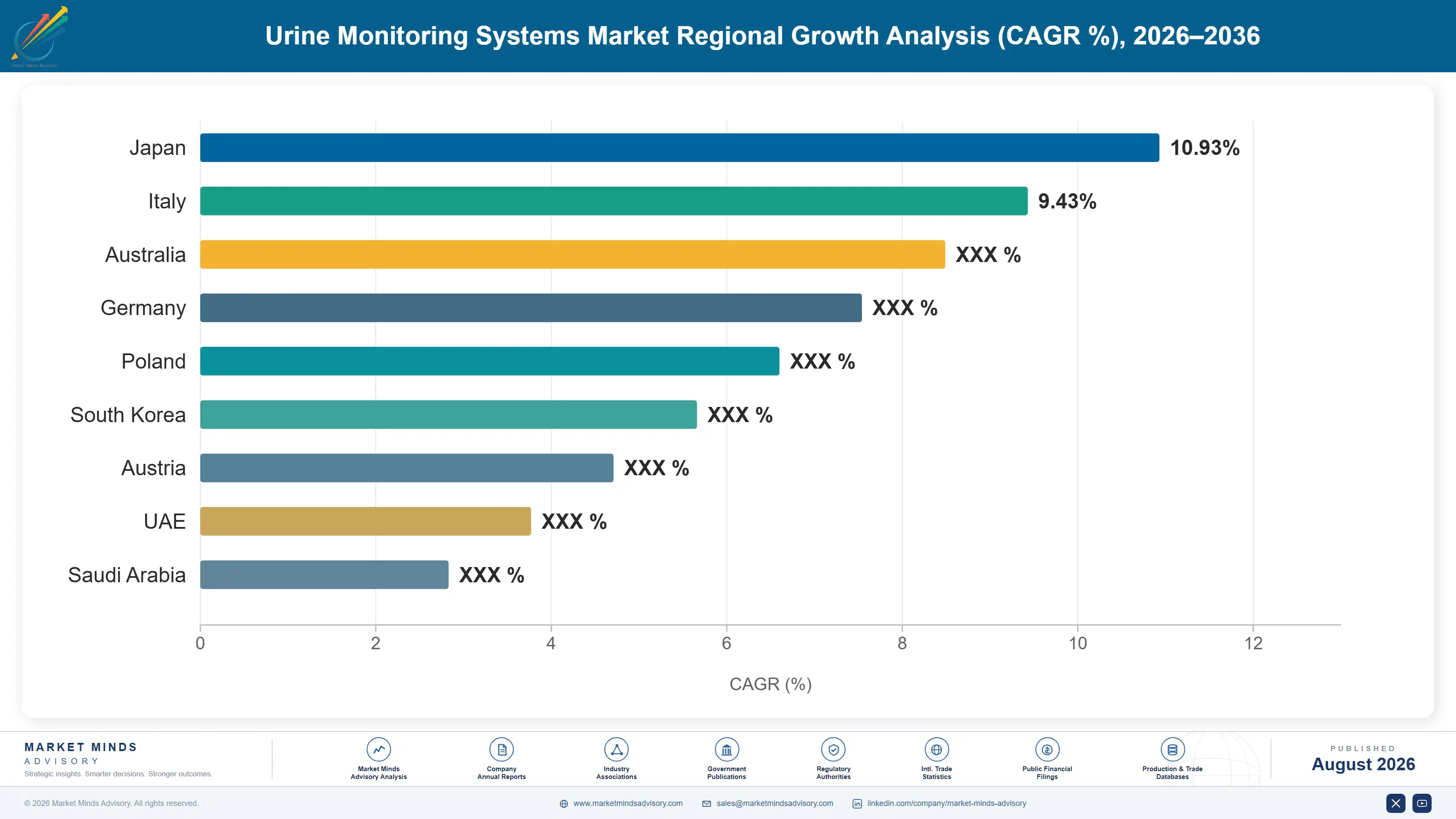
urine-monitoring-systems-market-country-cagr-analysis-1787641136357

Where the Money Actually Sits Today

Nobody in this market is paid for measuring. Value accrues to whoever removes a nursing task, whoever can attach a saving to a budget somebody owns, and whoever gets specified into a new unit before the process hardens. Four routes carry weight, and only one of them is a clinical argument at all. The rest are operational.

Sell Rostering Savings Rather Than Kidney Outcomes

Hourly urine output charting takes roughly two minutes per patient including documentation, which is 24 nursing minutes a day on every catheterised bed. Across a twelve bed unit that is nearly five hours of nursing time daily, and unlike avoided dialysis it appears in the rostering budget immediately rather than in a registry eighteen months later. Nursing directors control that budget and buy considerably faster than capital committees do. The most successful commercial teams in this category stopped presenting outcome data first and started presenting a staffing calculation, and their conversion rates roughly doubled.
Market Impact: Frees 24 nursing minutes on every catheterised bed

Get Specified Into New Intensive Care Builds

Retrofitting a working process is the hardest sale in hospital equipment; being written into the specification for a unit that does not exist yet is one of the easiest. China, India, Indonesia and Vietnam are adding critical care beds at pace, and South Asia and Pacific grows at 14.6% against a market rate of 12.4%. New builds purchase monitoring as a bundled package, which means the decision is made by a project team working from a specification document rather than by a unit defending its existing workflow. Winning that document is worth more than any clinical trial.
Market Impact: Targets the 14.6% fastest regional growth rate available

Price Per Admission Instead of Per Sensor

The disposable sensor costs around 145 dollars per admission and sits inside a fixed payment with no billing code behind it, which puts it in direct competition with everything else in the consumables budget. Pricing per admission across a whole unit, with a committed annual volume, moves the negotiation to a single number a director can compare against agency nursing spend. It also removes the per patient decision, which is where attachment rates leak: when a nurse chooses whether to open a sensor, roughly half the eligible patients never get one.
Market Impact: Lifts attachment well above the current 9% level

Build the Alarm Logic Before the Sensor

Several early deployments were withdrawn because the alerts became noise, and no amount of measurement accuracy recovers a unit that has muted the device. Trend based suppression of transient dips, a nursing acknowledgement step before physician escalation, and thresholds configurable by unit are now the difference between a retained installation and a returned one. Suppliers that invested in the algorithm layer first report sustained use at more than 3 times the rate of those that shipped raw measurement. This is a software problem sold as a hardware product, and pricing rarely reflects that.
Market Impact: Sustains continued use at 3 times the rate

Who Controls the Margin Pool

Concentration is low for a medical device category. The top five hold 38% measured on installed monitoring units and annual disposable sensor shipment volume, the basis used consistently here. Baxter International leads on critical care channel reach rather than on technology, and the gap to the challengers is narrow because most of the differentiated engineering sits with venture funded specialists who have distribution problems instead.
Competition runs on three fronts that barely overlap. Critical care monitoring is contested on sensor accuracy, alarm behaviour and integration with the electronic record, and the integration argument now decides more tenders than the measurement one. Uroflowmetry and bladder scanning is a mature urology equipment business fought on price and service. Consumer and fixture sensing is a consumer electronics contest between sanitaryware manufacturers and health technology startups.

Rankings will move on acquisition rather than on competition. The specialists holding the credible critical care technology are small, loss-making and dependent on further financing rounds, while the large device groups have the intensive care channel and no differentiated product. That combination resolves one way. The other pressure point is Chinese domestic manufacturers, who are supplying new intensive care builds at home on price and will follow abroad.
urine-monitoring-systems-market-company-positioning-matrix-1787641136882

Competitive Moat and Risk Dimensions

BAXTER INTERNATIONAL

Moat: Critical Care Channel Reach

Existing relationships across intensive care infusion, renal replacement and fluid management put a sales organisation in front of exactly the clinicians who decide urine output monitoring. New entrants spend years reaching those conversations. The renal replacement adjacency matters too, because a company already selling continuous dialysis has an established argument about detecting kidney injury sooner.
BAXTER INTERNATIONAL

Risk: Technology Held Externally

The differentiated sensing and algorithm work in this category sits largely with independent specialists rather than inside the large device groups, which leaves channel strength attached to undifferentiated product. Acquiring a specialist solves it and raises the entry price every year the segment grows at 18.6%. Waiting is expensive and moving is expensive.
MEDTRONIC

Moat: Hospital Integration Depth

Existing monitoring and electronic record integration across intensive care units removes the single largest technical objection buyers raise, which is whether a new measurement stream will actually reach the flowsheet. Interface work that takes a specialist eighteen months per health system is already done here, and that quietly decides tenders where the clinical case is a tie.
MEDTRONIC

Risk: Category Priority Competition

Urine output monitoring is a small line inside a very large portfolio, and internal capital competes against cardiac, neuromodulation and surgical robotics programmes with far larger addressable markets. Categories that grow at 12.4% from a base under a billion dollars rarely win those arguments, and the specialists chasing this segment have no other priorities at all.

Players Tracked

Prominent Players

Baxter International
Medtronic
Convatec
Teleflex
Laborie Medical Technologies

Other Key Players

Potrero Medical
Serenno Medical
Sentinel Medical Technologies
RenalSense
TOTO
Verathon
Becton Dickinson
Coloplast
Cardinal Health
SRS Medical
Albyn Medical
Withings
Vivoo
Olive Diagnostics
Andromeda Medizinsysteme

Recent Developments

FEBRUARY 2025

Critical care monitoring specialist secures further growth financing

An automated urine output monitoring developer closed a private financing round to fund hospital sales expansion in North America and Europe, having built its installed base through single unit evaluations rather than health system contracts. The company remains loss-making, and management named health system contracting as its commercial objective.
Signal: Distribution rather than technology is the binding constraint, which is precisely the gap an acquirer would fill
JUNE 2025

Japanese sanitaryware group extends bathroom urinalysis sensing range

A major Japanese fixture manufacturer expanded its domestic urinalysis sensing product line, adding analytes and smartphone connectivity while retaining a wellness rather than diagnostic regulatory position. Distribution runs through the housing and renovation channel, and pricing sits far below any clinical device, at a small fraction of a hospital sensor.
Signal: The consumer end of this market answers to housing cycles and not to clinical evidence at all
SEPTEMBER 2025

Chinese hospital tender specifies automated output monitoring bundle

A provincial Chinese hospital construction programme included automated urine output monitoring within its standard intensive care equipment specification, awarded as a bundle alongside patient monitors and infusion systems. Domestic manufacturers took the majority of the award on price, with one multinational supplier retaining the tertiary referral centres.
Signal: Specification into a new build settles the purchase long before any clinician ever evaluates the device

What Sits Inside a Disposable Sensor

Electronic components dominate cost here rather than plastics. Optical or pressure sensing elements, a microcontroller and the connector assembly account for roughly 44% of cost of goods on a critical care sensor, sourced predominantly from Japanese, Taiwanese and Chinese component manufacturers. Medical grade polymer housings and tubing add a further 26%, and sterilisation, packaging and regulatory documentation account for most of the remainder.
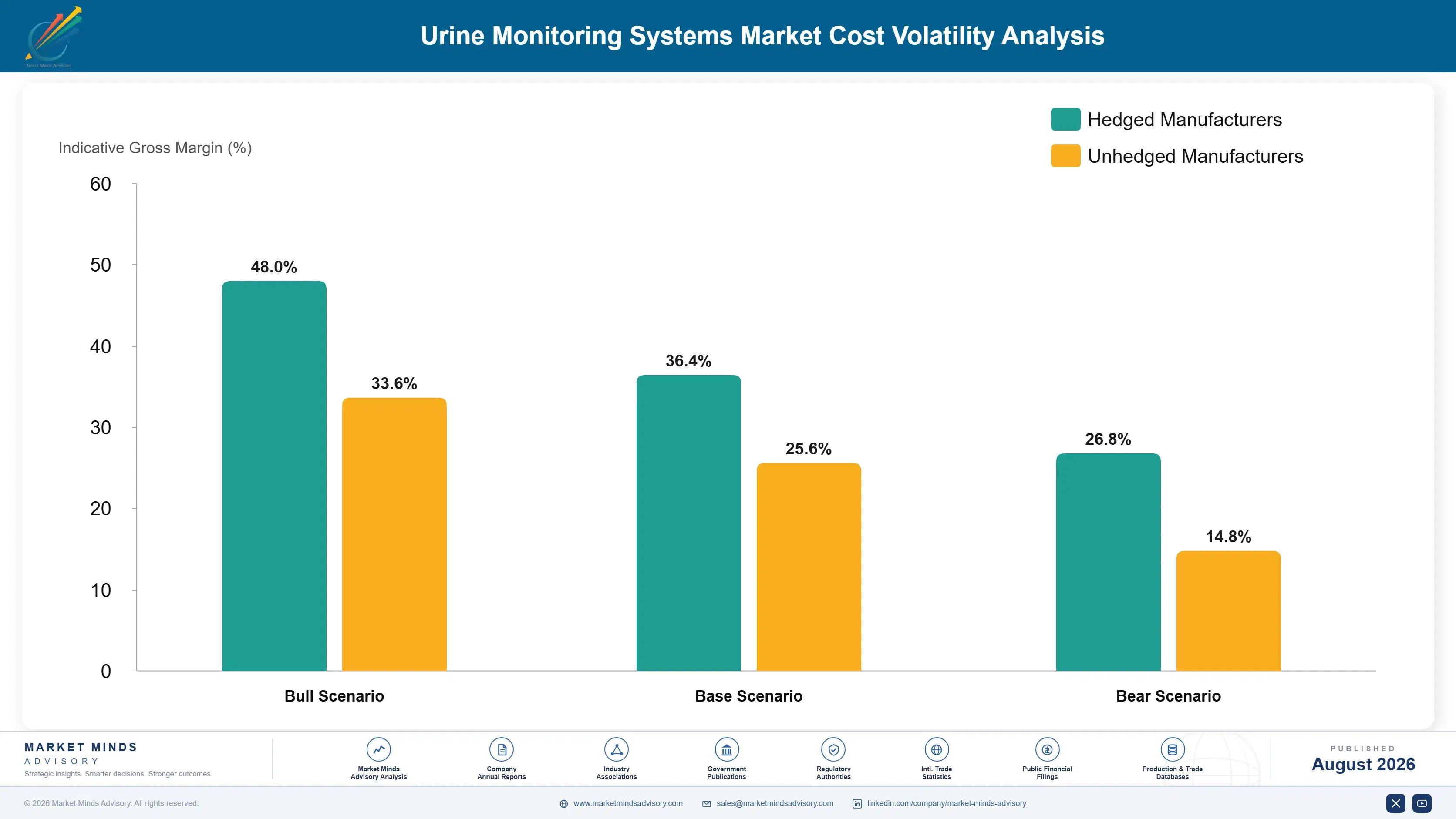
Semiconductor allocation was the defining input event of the last five years and this category sat at the back of the queue. Microcontroller lead times ran past a year at the peak, and device manufacturers competing for the same parts as automotive and consumer buyers found themselves rationed rather than merely expensive. Company annual reports across the medical device sector documented the margin effect through 2022 and into 2023.

Exposure is worst for the small specialists, which is awkward. A venture funded developer shipping tens of thousands of sensors annually has no allocation priority with component manufacturers and no volume leverage on price, while a large device group buying microcontrollers across a dozen product lines has both. The cost gap runs to roughly 20% on identical bills of material, and it widens exactly when supply tightens.
urine-monitoring-systems-market-cost-volatility-analysis-1787641137077

Qualify second-source controllers before allocation tightens

Dual qualification of microcontrollers and sensing elements is now standard practice among the larger manufacturers, carried out during design, not during a shortage. The regulatory notification burden is the reason smaller developers skip it, since a component change on a cleared device requires equivalence testing. Doing that work early costs months; doing it under allocation pressure costs the product line.

Aggregate component purchasing through contract manufacturers

Smaller developers increasingly buy through contract manufacturers who aggregate demand across many customers, converting a negligible order into part of a meaningful one. The trade is margin: the contract manufacturer keeps a share of the saving. For a company shipping under a hundred thousand sensors a year, that trade is worth making, because allocation priority matters more than unit cost.

Design reusable bedside units with disposable sensing only

Splitting the system so that electronics live in a reusable bedside unit and only the sensing element is disposable cuts component content per admission. Several manufacturers have moved this way, pushing the microcontroller out of the consumable entirely. Engineering is harder because the connection has to survive repeated cleaning, but the input cost exposure falls with every component removed.

Portfolio Architecture for Margin Defence

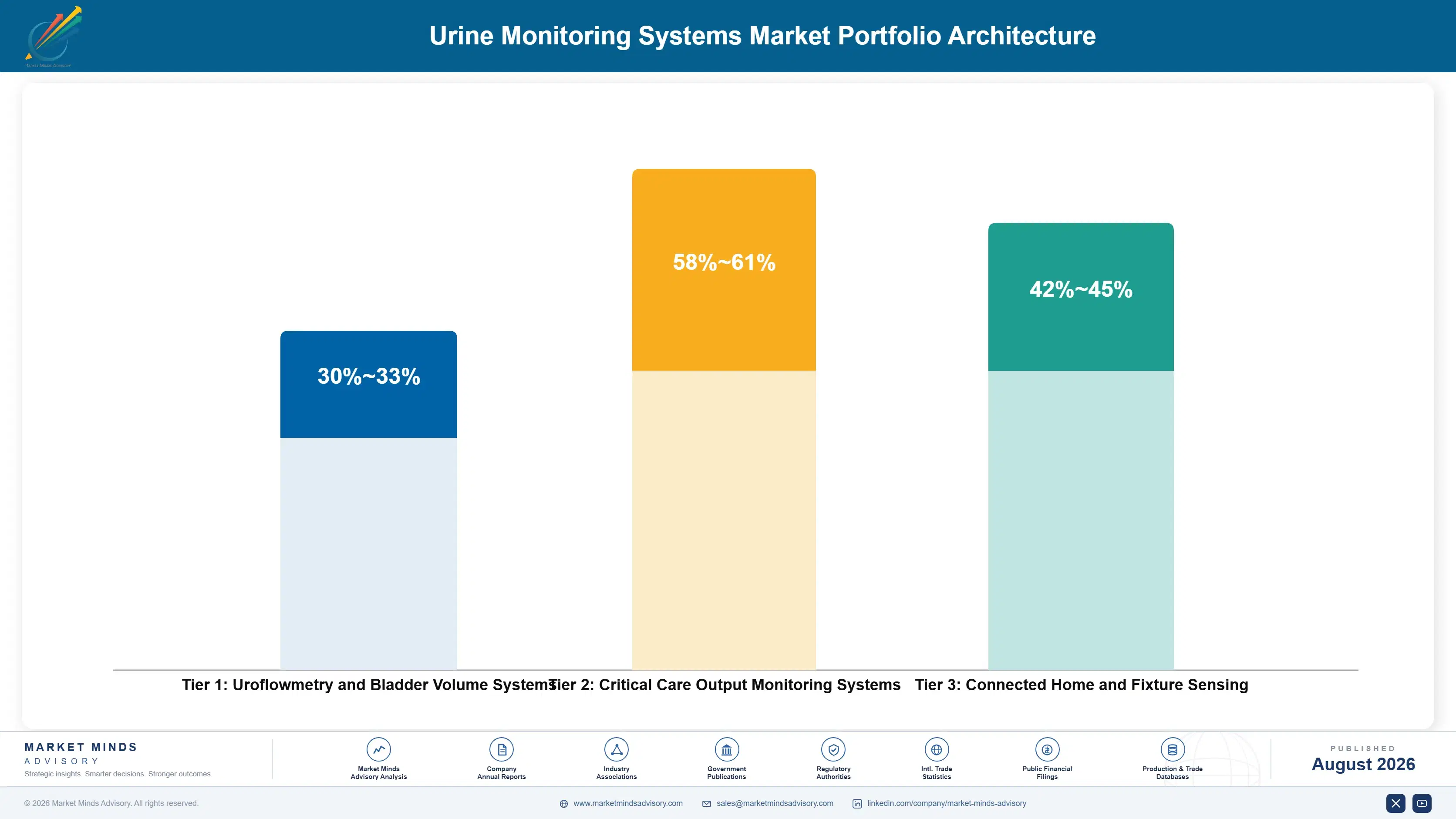
Margin in this market follows how hard the measurement is to replicate. Uroflowmetry and bladder scanning equipment is mature, widely copied and sold on price, with margins to match. Critical care sensing carries clearance, clinical evidence and integration work behind it, and prices accordingly. Consumer fixture sensing sits somewhere unusual: high volume, low unit revenue, and margins set by consumer electronics economics rather than medical device ones.
The tension here is unusual because the volume and the value are in different industries. Millions of households own fixture-integrated sensing and almost none of that revenue reaches a medical device income statement recognisably. Critical care sensors sell in far smaller numbers at 145 dollars each with no reimbursement behind them. A company cannot straddle both: the channels, the regulatory posture and the price points have nothing in common.

High value pools sit in intensive care units that have written acute kidney injury bundles into protocol, which is a small and identifiable set of institutions concentrated in North America, Japan, Korea and the Gulf. Those units buy on clinical argument and pay list. Everywhere else the sale is a nursing time calculation, and the price ceiling is whatever agency staffing costs that week.

Uroflowmetry and Bladder Volume Systems

Mature urology equipment with well understood physics and many capable manufacturers, sold into clinic tenders on price and service response. Replacement rather than expansion drives volume, and differentiation is largely a software interface argument now.
Gross Margin: 30-33%

Critical Care Output Monitoring Systems

Cleared devices with clinical evidence, alarm algorithms and electronic record integration behind them, sold into intensive care on a disposable per admission basis. Margin holds because the integration work and the clearance are genuinely difficult to replicate quickly.
Gross Margin: 58-61%

Connected Home and Fixture Sensing

Consumer and programme sold devices carrying wellness rather than diagnostic claims, priced at a small fraction of hospital sensors and manufactured at consumer volumes. Margin depends on retention, since roughly 40% of users abandon the device within three months.
Gross Margin: 42-45%
urine-monitoring-systems-market-portfolio-architecture-1787641137582

High-value Sub-segments and Strategic Watch-out

Automated Critical Care Output Monitors

The fastest growing system type at 18.6% and the only one with a documented clinical outcome argument behind it. Attachment sits near 9% of intensive care beds worldwide, so the runway is unusually long, and the constraint is reimbursement rather than any question about whether the technology works.
Gross Margin: 58-61%

Connected Home and Wearable Urinalysis Devices

Second fastest at 15.2% and the hardest business to run well, since roughly 40% of users abandon the device inside three months. Payer run chronic disease programmes are the only buyer with enough patience to make retention economics work, and they buy on engaged users.
Gross Margin: 44-47%

Fixture-Integrated Bathroom Sensing Modules

Millions of installed units and almost no revenue per unit, growing at 12.8% on housing renovation cycles rather than on anything clinical. Japanese and Korean manufacturers own this position entirely, and the data accumulating behind it is worth more than the hardware margin. Nobody else can enter.
Gross Margin: 40-43%

Uroflowmetry and Bladder Volume Systems

Growth of 8.6% and no defensible position left in the hardware, with capable manufacturers in every region selling comparable equipment. Portable bladder scanning is being commoditised fastest, and the only remaining differentiation is workflow software that most buyers currently decline to pay for. That will not change soon.
Gross Margin: 30-33%

How This Revenue Actually Repeats

The bedside unit is not the business. A monitor placed in an intensive care bed generates a 145 dollar disposable sensor for every catheterised admission over about six years, and 78% of supplier revenue arrives that way. The purchase decision happens once and revenue then depends entirely on attachment behaviour, which is why per admission contracting matters more than the capital sale.
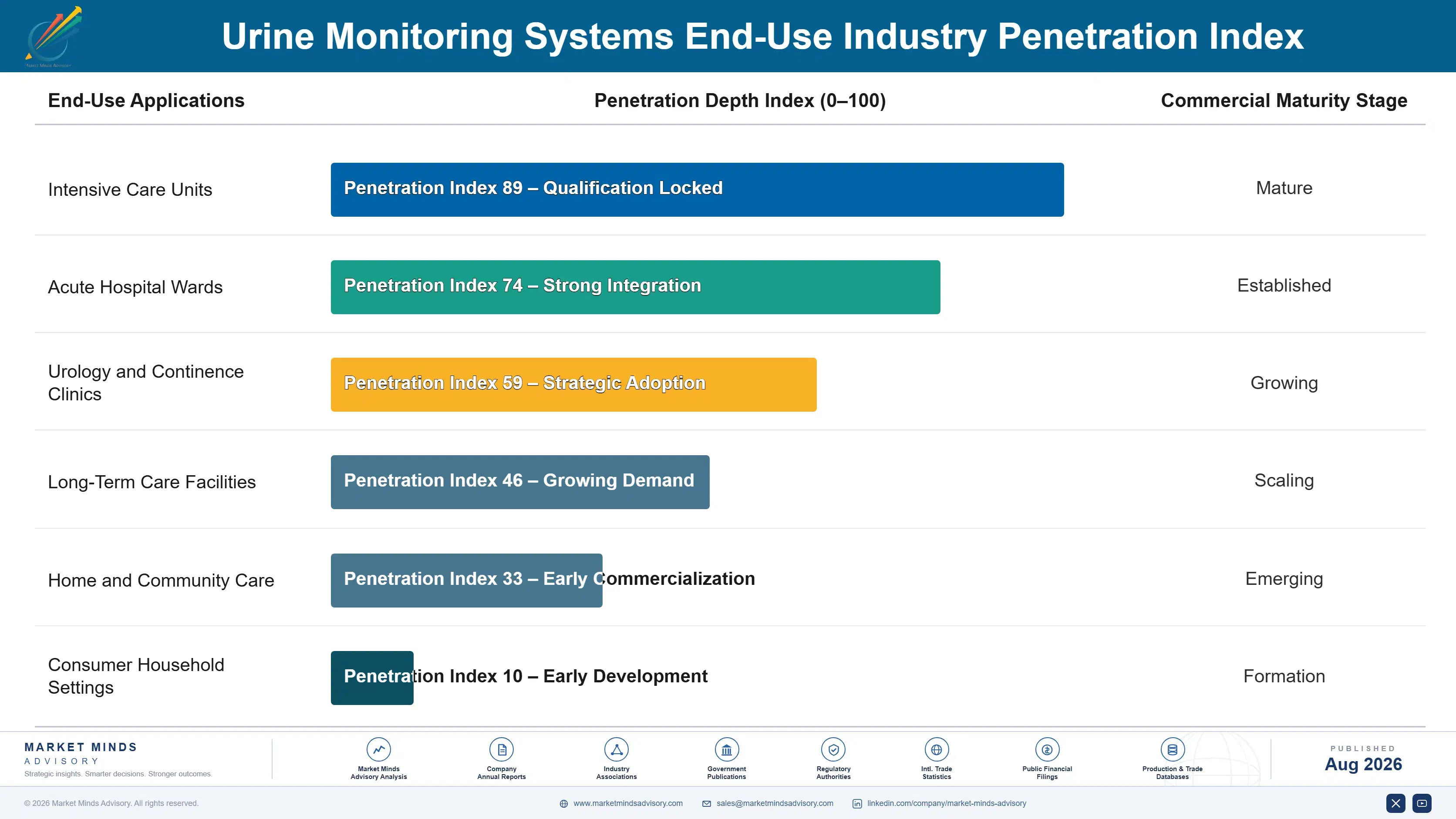
Stickiness varies by setting. Intensive care units that have integrated the monitor into their electronic record and written it into an acute kidney injury protocol almost never remove it, since the protocol would need rewriting. Units running it as an optional bedside device drop it within a year, usually after an alarm incident. Consumer fixture sensing is stickiest by accident, since nobody replaces a toilet to change a sensor.

Who buys has shifted noticeably. The intensive care consultant used to decide monitoring purchases on clinical grounds, but the nursing director now controls the argument that actually persuades finance. Value analysis committees are the real gate in American systems, evaluating a device against agency staffing spend rather than another device. Younger clinicians expect measurement to reach the record automatically, and treat manual charting as an anachronism now.
urine-monitoring-systems-market-end-use-penetration-index-1787641138072

Where This Category Actually Pays

These are among the four positions where our research anticipates prominent divergence between winners and laggards over the coming forecast period. Each is grounded in the demand model, the regulatory perimeter, and the announced capacity pipeline.
01 / COMMERCIAL ARGUMENT DESIGN

Sell nursing time, then sell kidney outcomes

Hourly urine output charting consumes 24 nursing minutes a day on every catheterised bed, and that saving lands in the rostering budget immediately while avoided dialysis appears in a registry eighteen months later. Nursing directors buy considerably faster than capital committees do, and the asymmetry between those two timescales is doing most of the selling in this category today. Teams that lead with a staffing calculation rather than outcome data convert at roughly twice the rate, which is not a subtle difference.
02 / REIMBURSEMENT PATH PLANNING

No billing code means no easy sale anywhere

Continuous urine output monitoring carries no separate payment in the United States, in German diagnosis related groups or in any major Asian system, which leaves a 145 dollar disposable sitting inside a fixed admission price. Every purchase therefore competes against everything else in the consumables budget rather than generating revenue of its own. Funding outcome registries and pricing per admission are the two responses that work, and both take years, so companies without that patience should not enter this category at all.
03 / NEW BUILD SPECIFICATION

Win the specification document, not the evaluation

South Asia and Pacific grows at 14.6% and East Asia at 13.4%, both driven by intensive care beds that did not exist five years ago and are being equipped as complete packages. A project team working from a specification document makes that decision, not a unit defending an existing workflow, which removes the single hardest objection in the category. Commercial resource aimed at construction programmes and health ministry standards returns considerably more than the same money spent on retrofit selling.
04 / ACQUISITION TIMING DISCIPLINE

Buy the specialists before the segment reprices

Critical care output monitoring grows at 18.6%, half again the market rate of 12.4%, and almost all of the differentiated sensing and alarm technology sits with small loss-making specialists dependent on further financing. The large device groups hold the intensive care channel and no comparable product, which is a combination that resolves through acquisition rather than through competition. Entry prices rise every year the segment compounds at that rate, so waiting is not the cautious option it appears to be.

Engagement Snapshot From the Field

A live engagement with an industry participant carrying material or product regulatory and market exposure ahead of a defining policy shift, showing how our research translates into a defensible multi-year portfolio strategy.
MARKET MINDS ADVISORY · CLIENT ENGAGEMENT SUMMARY
Urine Monitoring Systems Producer Strategic Portfolio Review and Transition Roadmap 2026·Investment Scenario on Urine Monitoring Systems Exposure Evaluation 2025-26
CLIENT PROFILE
A mid-sized critical care device manufacturer with an established intensive care presence in patient monitoring and infusion, evaluating entry into automated urine output monitoring. Divisional revenue was approximately 620 million dollars (client-reported, unverified by MMA), almost all from capital equipment with modest consumable attachment. No urine measurement capability existed internally, and the board had already declined one acquisition proposal on price.
STRATEGIC CHALLENGE
The board wanted a view on whether a category with no reimbursement code could support a viable business, and whether to build, acquire or partner. Sales leadership argued the intensive care channel would carry any product; the finance function pointed out that attachment rates in comparable consumable categories had disappointed twice before. Neither side had evidence.
MMA APPROACH
MMA modelled attachment economics across three purchasing structures, per sensor, per admission and per bed annually, using observed behaviour from comparable intensive care consumables. Forty-seven expert interviews with intensive care consultants, nursing directors and value analysis committee members established who actually controls the decision at each stage. A parallel workstream valued the four credible acquisition targets against likely competing bidders.
KEY FINDINGS
  1. Per sensor pricing produced attachment of roughly 48% of eligible admissions, while per admission contracting across a whole unit lifted it above 80% in the deployments examined.
  2. Nursing directors, not intensive care consultants, initiated 34 of the 47 purchases discussed, and the persuasive argument was documentation time rather than kidney injury detection.
  3. Two of the four acquisition targets were already in discussions with larger groups, and valuations across the set had risen roughly 60% in two years (client-reported, unverified by MMA).
  4. Building internally required an estimated 30 months to clearance plus a further 18 months of clinical evidence generation, by which time the segment would have consolidated.
CLIENT PROFILE
A mid-sized critical care device manufacturer with an established intensive care presence in patient monitoring and infusion, evaluating entry into automated urine output monitoring. Divisional revenue was approximately 620 million dollars (client-reported, unverified by MMA), almost all from capital equipment with modest consumable attachment. No urine measurement capability existed internally, and the board had already declined one acquisition proposal on price.
STRATEGIC CHALLENGE
The board wanted a view on whether a category with no reimbursement code could support a viable business, and whether to build, acquire or partner. Sales leadership argued the intensive care channel would carry any product; the finance function pointed out that attachment rates in comparable consumable categories had disappointed twice before. Neither side had evidence.
MMA APPROACH
MMA modelled attachment economics across three purchasing structures, per sensor, per admission and per bed annually, using observed behaviour from comparable intensive care consumables. Forty-seven expert interviews with intensive care consultants, nursing directors and value analysis committee members established who actually controls the decision at each stage. A parallel workstream valued the four credible acquisition targets against likely competing bidders.
KEY FINDINGS
  1. Per sensor pricing produced attachment of roughly 48% of eligible admissions, while per admission contracting across a whole unit lifted it above 80% in the deployments examined.
  2. Nursing directors, not intensive care consultants, initiated 34 of the 47 purchases discussed, and the persuasive argument was documentation time rather than kidney injury detection.
  3. Two of the four acquisition targets were already in discussions with larger groups, and valuations across the set had risen roughly 60% in two years (client-reported, unverified by MMA).
  4. Building internally required an estimated 30 months to clearance plus a further 18 months of clinical evidence generation, by which time the segment would have consolidated.
RECOMMENDED STRATEGY
Phase 1: Phase one: acquire rather than build, accepting the higher entry price, since 48 months to a credible clinical position is longer than the consolidation window. Phase 2: Phase two: contract per admission across whole units rather than per sensor, since that structure lifted attachment above 80% in every deployment examined. Phase 3: Phase three: rebuild the commercial approach around nursing directors and value analysis committees, since consultants sign off but rarely initiate the purchase at all.
OUTCOME
The client acquired one of the four targets within eleven months at a premium it had previously refused, and restructured pricing to a per admission model before integration completed. Attachment across the acquired installed base rose from 51% to 79% within two quarters of the pricing change (client-reported, unverified by MMA).

Frequently Asked Questions

Foundational context covering the market sizes, CAGR, scope, country, region and competition that inform every finding below. This section is provided to cover basics and most often pre-purchase conversations, answered from the MMA Primary Research Dataset.

What is the current size of the Urine Monitoring Systems Market?

The market was valued at 0.62 billion dollars in 2025, covering critical care output monitors, connected home devices, fixture sensing, uroflowmetry and continence detection systems. It reaches an estimated 0.70 billion dollars during 2026.

How large will the Urine Monitoring Systems Market be by 2036?

MMA forecasts 2.25 billion dollars by 2036, an increase of 1.55 billion dollars over the 2026 base. That represents an expansion multiple of 3.21 times across the forecast period.

What is the CAGR for the Urine Monitoring Systems Market 2026 to 2036?

The base case compound annual growth rate is 12.4%, with a bull case of 13.6% and a bear case of 11.2%. Reimbursement recognition and alarm burden separate those scenarios.

Which segment is growing fastest?

Automated critical care output monitors grow at 18.6%, half again the market rate of 12.4%, driven by acute kidney injury protocols and nursing time pressure. Connected home devices follow at 15.2%.

Who are the major companies in the Urine Monitoring Systems Market?

Baxter International, Medtronic, Convatec, Teleflex and Laborie Medical Technologies lead on installed monitoring units and disposable sensor shipment volume. Together they account for 38% of the market.

Which country is growing fastest?

India grows fastest at 17.4%, driven by intensive care bed construction from a very low per capita base, where monitoring is specified into new units rather than retrofitted.

Report Segmentation Architecture

The full report scope spans multiple orthogonal segmentation dimensions, with cross-tabulated demand data provided for each dimension pair. Coverage extends further to regional breakdowns, trend trajectories, and the competitive detail needed to support segment-level decision-making.

By System Type

  • Automated Critical Care Output Monitors
  • Connected Home and Wearable Urinalysis Devices
  • Fixture-Integrated Bathroom Sensing Modules
  • Uroflowmetry and Bladder Volume Systems
  • Continence Wetness Detection Sensors

By End-Use Industry

  • Intensive Care Units
  • Acute Hospital Wards
  • Urology and Continence Clinics
  • Long-Term Care Facilities
  • Home and Community Care
  • Consumer Household Settings

By Commercial Dimension

  • Capital Equipment Purchase
  • Per Admission Contracting
  • Public Tender Procurement
  • Group Purchasing Agreements
  • Distributor Supply
  • Consumer Retail Channels

By Region

  • North America
  • Western Europe
  • East Asia
  • South Asia and Pacific
  • Latin America
  • Middle East and Africa
  • Eastern Europe

Scope, Methodology, and Coverage

Every figure in this report is reproducible from documented input assumptions. The scope below maps the historical period, the forecast horizon, the segmentation dimensions, and the countries covered, alongside the underlying primary and qualitative methodology.
Historical Period
2020 to 2025
Forecast Period
2026 to 2036
Base Year
2025 (USD billions; MMA Primary Research Dataset, August 2026)
Market Definition
Devices and systems that measure urine output or urine composition at the point of production or collection, covering automated critical care output monitors, connected home and wearable urinalysis devices, fixture-integrated bathroom sensing modules, uroflowmetry and bladder volume measurement systems, and continence wetness detection sensors. Measured at supplier selling value across capital units, sensors and disposables. Laboratory urinalysis and culture testing, urinary catheters and drainage bags, dialysis equipment, and therapeutic products are excluded from scope.
Quantitative Units
USD billions (current prices); units and sensors shipped; USD per admission by system type
Segmentation Dimensions
System type; end-use industry; commercial dimension; region
Regions Covered
North America, Western Europe, East Asia, South Asia and Pacific, Latin America, Middle East and Africa, Eastern Europe
Countries Covered
United States, Canada, United Kingdom, Germany, France, Netherlands, Sweden, Japan, China, South Korea, Taiwan, India, Australia, Indonesia, Vietnam, Brazil, Mexico, Saudi Arabia, United Arab Emirates, Poland
Key Companies Profiled
Baxter International, Medtronic, Convatec, Teleflex, Laborie Medical Technologies, Potrero Medical, Serenno Medical, Sentinel Medical Technologies, RenalSense, TOTO, Verathon, Becton Dickinson, Coloplast, Cardinal Health, SRS Medical, Albyn Medical, Withings, Vivoo, Olive Diagnostics, Andromeda Medizinsysteme
Quantitative Methodology
Primary survey, n=3,800 respondents, Q4 2025, six countries; demand-side model with trade association cross-validation
Qualitative Methodology
47 expert interviews, Q4 2025; applied to validate demand model assumptions, identify emerging dynamics, and assess competitive positioning
Report Format
PDF and XLSX data workbook (Word format preview document)
Publisher
Market Minds Advisory
Report Code
MMA-2026-MED-127
Published
August 2026
Contact
sales@marketmindsadvisory.com | www.marketmindsadvisory.com

Purchase the full Urine Monitoring Systems Market Report (2026 to 2036).

The full report treats urine output as a vital sign that was never automated for commercial reasons rather than technical ones, which explains why the strongest sales arguments in this category are about nursing rosters rather than kidneys. It sizes all five system types independently through 2036, quantifies attachment economics across per sensor, per admission and per bed contracting structures, and maps reimbursement status across every major payer system. Regional chapters cover all seven regions, with consumer fixture sensing assessed separately from hospital demand. Competitive profiling covers 20 participants on one consistent installed unit and sensor shipment basis. Acquisition candidates are assessed against likely competing bidders throughout.
Five system types sized independently through 2036
Attachment economics quantified across three contracting structures
Reimbursement status mapped across every major payer system
Consumer fixture sensing assessed separately from hospital demand
Alarm algorithm capability compared across critical care platforms
Twenty participants profiled on one consistent evaluation basis

Built For The People Who Decide

From boardroom strategy to bench-side execution, this report is read cover-to-cover by leaders shaping the next decade of their industry, turning demand scenarios, market dynamics and valuation benchmarks into decisions.
CXOs/ Presidents/ VPs/ Managers
M&A and Corporate Development
Strategy Teams and R&D Heads
Procurement and Product Directors
Regulatory and Compliance Leaders
Investor Relations and Equity Analysts